



Abstract
Antitrust litigation against the NCAA has focused on its members’ collusive restraint on athlete compensation at levels below marginal revenue product. The recent O’Bannon v. NCAA and In Re NCAA Grant-in-Aid Cap Antitrust Litigation have both prescribed a relevant market for “college education” where schools compete for athlete labor by offering tuition and fee or cost-of-attendance offsets. This article argues that this unitary definition conflates two separate products, academic education and athletic participation, that NCAA members offer as a bundled tie. The NCAA has mandated purchase of the tied product, academic education, as a pre-requisite for access to intercollegiate athletics participation, the tying product. Paradoxically, the NCAA has then argued that this bundled tie, which this article argues violates the Supreme Court’s three-pronged ‘quasi’ per-se rule prohibiting tying arrangements, represents a claimed ‘pro-competitive justification’ by integrating athletics and academics. This article offers evidence that this tying arrangement serves no legitimate pro-competitive purpose under the NCAA model of amateurism. Rather, it extracts consumer surplus, enhances dominant cartel members' market power, and forecloses competition not only from non-members but also from smaller NCAA member-schools. As such, the NCAA model of amateurism violates antitrust law governing tying arrangements and should be enjoined.
I. Introduction
Economists have long recognized the National Collegiate Athletic Association (NCAA) as a monopsonistic cartel that restrains athlete labor compensation below competitive market levels. However, an additional restraint has been heretofore ignored. This article argues that NCAA justifies the restraint on athlete compensation through an anticompetitive tying restraint between two distinct products: intercollegiate athletic participation and postsecondary academic education. Contrary to the unitary “college education” market definition used in the O’Bannon 1 v. NCAA case and to which parties stipulated in subsequent litigation, this article presents evidence of separate relevant markets for these goods. The NCAA Division I cartel leverages its market power in the intercollegiate athletics market, particularly through dominant autonomy “Power-5” (P5) conference members, to enhance market power in the tying market, extract consumer surplus from both athletes and the general student body, and foreclose competition in the tied market. The existence of separate markets, market power in the tying market, and nontrivial foreclosure sales in the tied education market confirm that NCAA’s model of “amateurism” meets the Supreme Court’s three-pronged per se test for unlawful tying. Further, even in the absence of foreclosure share, the tying arrangement enhances dominant schools’ market power in athletics and achieves surplus extraction by harming competition, which should warrant the imposition of antitrust liability. This article presents an analysis of relevant markets and discusses relevant economic arguments raised by economic experts in the O’Bannon and NCAA Grant-in-Aid litigation, along with a review of the relevant academic literature and legal precedent.
Part I presents a brief history of how the NCAA arrived in its current form. It discusses the antitrust challenges to NCAA amateurism, with a focus on the recent challenges to name, image, and likelihood (NIL) restrictions in the O’Bannon v. NCAA case and the challenge to the NCAA’s cap on athlete compensation in the NCAA Grant-in-Aid litigation matter. Part II conducts a formal analysis of relevant markets, describing the market goods and the participants in each relevant market, with a focus on the latter’s transactional preferences. Part III reviews the treatment of tying arrangements in antitrust jurisprudence and explains why the NCAA’s tying arrangement meets current antitrust standards for anticompetitive conduct. As such, I argue that the tying arrangement should be enjoined, removing the key pillar underlying the existence of NCAA “amateurism.” Further, the tying arrangement extracts significant consumer surplus, both from members of the general student body and from college athletes whose compensation NCAA bylaws restrain at cost-of-attendance (COA). This surplus extraction combined with the strategic use of tying to enhance dominant members’ market share in the intercollegiate athletics market lends evidentiary support to arguments that tying harms competition even in the absence of foreclosure share.
II. A Brief History of the NCAA
The institution known as the modern-day NCAA, which governs intercollegiate athletics among its approximately 1121 member schools, originated in December 1905 with the introduction of the Intercollegiate Athletic Association of the United States (IAAUS). The IAAUS was officially founded in March 1906 and later became the NCAA in 1910. Since its early days, the NCAA’s administrative and legislative authority has emphasized the “amateur” status of participants, though the definition of what constitutes an “amateur” has shifted considerably over since that time. At its 11th Annual Convention in 1916, the NCAA defined the “amateur athlete” as “one who participates in competitive physical sports only for the pleasure, and the physical, mental, moral, and social benefits directly derived therefrom.”
2
Subsequently, at its 17th Annual Convention in 1922, the NCAA modified the definition to add the oft-cited term “avocation” and defined the amateur athlete as “one who engages in sport solely for the physical, mental, or social benefits he derives therefrom,
The NCAA attempted to address this issue in 1948 by instituting the ephemeral “Sanity Code,” which forbade members from offering scholarships based on athletic ability. Two years later, the Sanity Code was abandoned. In the 1950s, the NCAA caved to economic realities and allowed its members to offer athletic scholarships, a significant departure from the initial ideal of collegiate sports as an “avocation.” Nonetheless, the modern-day NCAA continues to emphasize the concept of “amateurism,” despite its shifting definitions, through a series of bylaws prohibiting “pay-for-play,” that is, compensation in exchange for participation in athletics beyond the institutional COA as well as any compensation to athletes in exchange for use of their NIL. To this day, the NCAA refers to participants in intercollegiate athletics as “student-athletes,” a term coined by former NCAA president Walter Byers in the 1970s to avoid classifying athletes as employees and thus having to pay them long-term disability insurance. Ironically, it is this very term that draws attention to the antitrust injury created by the tying arrangement NCAA members use to sustain the model of amateurism. But, before delving into the details of the mechanism of tying, a summary of the recent NCAA antitrust litigation and the legal precedent is useful.
A. Antitrust Challenges to the NCAA “Amateurism” Model
Recent litigation has challenged the NCAA model of amateurism, under which member colleges and universities collude to restrain athlete compensation to COA as violating the prohibition against collusive behavior in restraint of trade outlined in Section 1 of the Sherman Antitrust Act. 4 Such cases include O’Bannon v. NCAA, Alston v. NCAA, 5 and Jenkins v. NCAA, 6 which morphed into the broader Grant-in-Aid litigation. Section 1 antitrust claims are adjudicated under one of two analytical frameworks, the per se rule and the rule of reason, the latter of which predominates judicial scrutiny. Conduct on its face so likely to harm competition that it obviates further idiosyncratic inquiry is deemed illegal per se, that is, condemned as harmful to competition by its very nature. Such conduct includes “naked” 7 price-fixing arrangements, agreements to fix output, and market allocation agreements. 8 Thus, under the per se rule, plaintiffs need not show that the defendant(s) hold market power in the relevant market(s). Demonstrating the occurrence of the prohibited conduct suffices to establish antitrust injury.
While horizontal agreements among universities to fix compensation for athletes, which are plainly enshrined in the NCAA’s bylaws, would seem to fall squarely under the per se rule, the Supreme Court’s landmark Board of Regents
9
case found that “it would be inappropriate to apply a per se rule in this case where it involves an industry in which horizontal restraints on competition are essential if the product is to be available at all.”
10
In Law v. NCAA, a class action claim brought by Division I entry-level basketball coaches affected by the NCAA’s then rule limiting annual compensation to $16,000, the 10th Circuit cited the precedent established in Board of Regents in declining to apply the per se rule. Instead, the 10th Circuit relied on the rule of reason to find the restriction anticompetitive. Based on such precedent, the determination of whether the NCAA’s actions run afoul of antitrust laws has fallen under the second, and more frequently applied framework, the rule of reason, which allows for consideration of the NCAA’s justification for the existence of its restraint on trade.
11
Adjudication of anticompetitive conduct under the rule of reason generally follows a three-step approach, which also includes a generally un-numbered “balancing” step. First, the plaintiff attempts to establish that the defendant’s conduct has had an anticompetitive effect through the defendant’s ability to leverage market power,
12
which the Court defined in Board of Regents as “the ability to raise prices above those that would be charged in a competitive market.” If the Plaintiff succeeds at the first step, the burden then shifts to the defendant to demonstrate one or more legitimate procompetitive justifications for the conduct. Should the defendant succeed, the burden shifts back to plaintiff to show that the same procompetitive justifications could have been achieved by a “less restrictive alternative.” If the Plaintiff does not or cannot fulfill the third step,
13
then the court is left to “balance” the anticompetitive and procompetitive effects each side has offered as an implicit fourth step.
14
However, as Carrier points out, In the first decade of the twenty-first century, courts have continued their use of a burden-shifting framework in applying the rule of reason. They almost never balance. And they dispose of 97% of rule of reason cases on the grounds that the plaintiff cannot show an anticompetitive effect.
15
The NCAA cartel’s collusive agreement to fix athlete compensation has been viewed by the courts as an ancillary restraint, that is, characterized by some procompetitive attributes designed to promote the joint success of its members. 18 Generally, the term “cartel” refers to collusive agreements among horizontal competitors (e.g., oil-producing countries) to exercise seller power, that is, conspire to limit output and/or fix prices. 19 The exercise of buyer power that results in a monopsony, or one buyer of goods or services, can be viewed as a mirror image of the monopoly (one seller). 20 Indeed, it is patently clear that the legislative intent of the Sherman Act was to prohibit competitive harm resulting from both buyer and seller power. 21
This article argues that neither the current litigation nor the antitrust literature on the NCAA have addressed the cartel’s tying arrangement, its distortion of the competitive process, and the antitrust injury caused not only to students but to postsecondary institutions that include cartel members who do not belong to the P5 autonomy conferences. The discussion that follows begins with a stepwise approach to identifying the goods at issue, the market participants, the markets themselves, and the existence and leverage of market power.
III. Market Definition
Demonstration of a defendant’s market power has been for some time a strict requirement of successfully establishing liability in an antitrust case adjudicated under the rule of reason. 22 Market power may be shown either through direct evidence, also referred to as “direct effects,” 23 or indirectly through inferences drawn from an analysis of relevant markets and concentrations demonstrated through an analysis of market shares. 24 Direct evidence refers “to evidence indicating the likely competitive effects of a transaction or practice that is not based on inferences drawn from market concentration alone.” 25 The general unavailability of direct evidence has precipitated the widespread use of the inferential approach, as the DC Circuit court noted in Microsoft. 26 Using this approach, the plaintiff attempts to establish market power by showing a defendant’s share of a defined relevant market along with various structural factors such as barriers to entry, the divergence between price and marginal cost as evidenced by the Lerner Index, and demand elasticity. 27 Courts in FTC v. Indiana Federation of Dentists 28 and Toys R Us v. FTC 29 have held that a demonstration of anticompetitive conduct via direct evidence, for example, natural experiments, evidence that competition among merging resulted in lower prices, reduction of output as a result of a merger between horizontal competitors, competitors’ postmerger plans to increase prices or reduce output, can obviate the need to define specific relevant markets. Though market definition is an indirect means of investigating potential market power and not an end unto itself, 30 the 7th Circuit in Republic Tobacco v. North Atlantic ruled that the plaintiff cannot dispense with market definition entirely and must, at a minimum, delineate at least “the rough contours of the relevant market.” 31 More recently, the district court in NCAA GIA Litigation opined that “In a rule-of-reason analysis, the Court must first define the relevant market within which the challenged restraint may produce significant anticompetitive effects.” 32 However, the Supreme Court in Ohio v. Amex clarified that direct effects may be used to establish antitrust injury where horizontal restraints are involved. 33 Though current jurisprudence requires no precise market definition in antitrust claims involving horizontal restraints, the general relevant markets involved in the exchange of goods and services between NCAA members, students who either do or do not participate in intercollegiate athletics, and downstream consumers of both educational and athletic products will be discussed herein.
In O’Bannon, the district court defined the market as one in which NCAA Division I schools: compete to sell unique bundles of goods and services to elite football and basketball recruits…these schools compete to offer recruits the opportunity to earn a higher education while playing for an FBS football or Division I men’s basketball team. In exchange, the recruits who accept these offers provide their schools with their athletic services and acquiesce in their schools’ use of their names, images, and likenesses while they are enrolled.
34
The NCAA also argued that “in economic terms, the product that the universities and colleges ‘sell’ to their student-athletes, has an academic as well as an athletic component.” 35 The justification for this claim will be discussed in detail herein. Indeed, defining what the NCAA “sells” as a single “product” underscores the critical error in identifying the relevant market. 36 Indeed, even the NCAA draws the distinction between the two products in practice, as it sets rules on the number of hours that athletes may spend on “countable athletically related activities.” It also represents, at the very least, a realization that blurring the lines between the two markets for the products NCAA members sell to prospective students, athletics and academics, such that they are treated as one “educational” market, likely represents the best defense against an antitrust tying claim under Section 1 of the Sherman Antitrust Act and Section 3 of the Clayton Act. This view is evidenced in the NCAA’s legal arguments, including Mazza v. NCAA, ongoing as of the writing of this article, where the NCAA argued in its motion to dismiss that “the NCAA and its membership view athletics as an integral part of a student’s broader educational experience.” 37 Disagreements among Plaintiff and Defense experts in the GIA litigation notwithstanding, both sides in the NCAA GIA Cap requested that the Court adopt the market definition in O’Bannon, which the Court subsequently did. 38
This article argues that the relevant market definition set forth in O’Bannon and adopted in the GIA litigation is incorrect to the extent that it treats two separate tied products as though they were one. The analysis presented here, while acknowledging neoclassical approaches to consumer rationality and utility theory, follows a transactional orientation to identifying separate antitrust markets for postsecondary education and intercollegiate athletics in NCAA Division I. 39 The transactional approach is particularly useful in the context of intercollegiate sports where at least one key assumption of neoclassical price theory is violated: that individuals act based on full and relevant information. 40 As discussed herein, both academic and athletic markets are characterized by adverse selection, or information asymmetry, which violates this neoclassical assumption. I begin by identifying the primary goods exchanged between NCAA member schools and consumers of their educational and athletic offerings, the parties that participate in that exchange and the nature of the exchange relationship, and the relevant markets in which those goods are exchanged. Then, I discuss the mechanism used by NCAA members to tie two separate relevant markets together. Finally, I present empirical evidence that the restraint imposed by the NCAA’s model of amateurism causes harm to competition, resulting in antitrust injury to individual schools, the athletes that participate in intercollegiate athletics, and ultimately to consumers of both academic and athletic products produced by NCAA member schools.
A. The Market Goods—Academics and Athletics
Universities in the NCAA markets for D1 basketball and Football Bowl Subdivision (FBS) football offer two separate products to prospective students and athletes: academic training and athletic participation. 41 Except for those who receive full scholarships in exchange for their academic talents, those interested in academic training generally purchase the academic instruction from the school. Those interested in the athletic instruction and opportunities available at the NCAA D1 basketball and FBS levels can sell their talents to member schools in exchange for partial or full COA. Some overlap exists between the two groups. That is, some students in the buyer group may choose to walk-on as athletes on teams. However, those primarily or entirely interested in athletic instruction, as many top NCAA athletes have demonstrated they are, do not have the same choice. Such athletes must (at least in the technical sense) participate in academics as a requirement for receiving the athletic instruction and participating in intercollegiate athletics. 42 The numerical minimum extent of academic participation is mandated by NCAA bylaws: they must consume sufficient academic product, of whatever quality, to maintain “satisfactory progress toward a degree.” 43 Some college athletes may want to consume more, or at least a different variety, of the academic product. Of these, some can do so, while others cannot because of scheduling limitations imposed by their athletic obligations. Some may want to consume less, or none, at least not simultaneously while participating in high-profile athletics. Certainly, competing incentives that exist between college athletes and institutions that use their labor do highlight the existence of the principal agent problem, an issue I address in the relevant markets section of this article.
Prospective college athletes have a set of preferences for the two primary goods universities offer that can be defined as p(x), where x = athletics and
The aim of this section is to investigate how available evidence illuminates athlete preferences in selecting different programs, which in turn helps us understand the nature of the market exchanges. Evidence presented here demonstrates that preferences of prospective college athletes, particularly athletes in football and basketball at the highest levels, are primarily for the athletic product, and the academic product is purchased concurrently, or in its current proportion, largely because the tying arrangement mandates its purchase as a prerequisite for athletic participation.
1. Product Perishability
Perhaps the main reason top athletes would have different consumption preferences of the NCAA model absent the restraint is that the ability to monetize athletic ability is a perishable good with a relatively short shelf life. This characteristic distinguishes it from monetizing an academic education, which can occur well beyond the point when athletic skill has diminished in value. 46 Thus, a rational consumer with the opportunity to monetize either or both and with limited consumption capability would choose to consume the goods in the proportion that would maximize her or his own welfare. Simply put, the NCAA’s model restricts college athletes’ choices. 47 Evidence shows that the most highly skilled and thus highly demanded athletes prefer to consume the most perishable good first, a choice that we observe annually as freshman basketball players declare for the NBA draft at the first possible opportunity.
The principle that individuals evaluate choices according to their ordinal preference schedule and select the one(s) that maximize their utility, or satisfaction, lies at the heart of the metatheory of neoclassical economics. A simple example that considers the perishability of the latter good can illuminate the importance of allowing the athlete to make her or his utility-maximizing decision regarding the benefits of each good, academics, or athletics. Suppose a shipwrecked traveler is stranded on a deserted island with only two sources of food: 5 pounds of steak and fifteen cans of Chef Boyardee pasta. Every day, the traveler must consume 900 calories to survive, and the food must last for ten days, at which time the next ship will pass the island and rescue the traveler. One pound of the traveler’s steak is 900 calories, and one can of pasta contains 300 calories. Thus, the traveler can survive by eating either 1 pound of steak or three cans of pasta each day. Being raw meat, the steak cannot be preserved and will only be edible for five days, while the canned pasta has years of shelf life remaining. How should the traveler structure the daily meals to ensure survival? The logical way would be to eat the steak first, then the pasta, as this arrangement will last the full ten days, and the traveler will not go hungry. Every other arrangement will result in a less efficient outcome for the traveler. For example, if the traveler consumes half a pound of steak and 1.5 cans of pasta every day (i.e., consumes the goods in tandem), he/she will only be able to consume 2.5 lbs. of steak before the remainder spoils after five days. The traveler will then have sufficient meals for seven days and will only have half a meal for the eighth day. Even though some may argue that the simultaneous consumption of steak and pasta yields the benefits of nutritional diversity, the resulting allocative inefficiency will result in the traveler going hungry for the remaining two and a half days. Thus, when dealing with perishable goods, such as the ability to monetize athletic skill, not only do the quantities of the goods consumed matter, but so does the order in which they are consumed.
Table 1 below offers an example of three college athletes. The yellow cells indicate years spent in college, the brown cells indicate years spent in the work force outside of sport, and the blue cells indicate years spent in professional sports. The figures in each cell reflect the expected present value of that year’s salary. 48
PV of Lifetime Earnings.
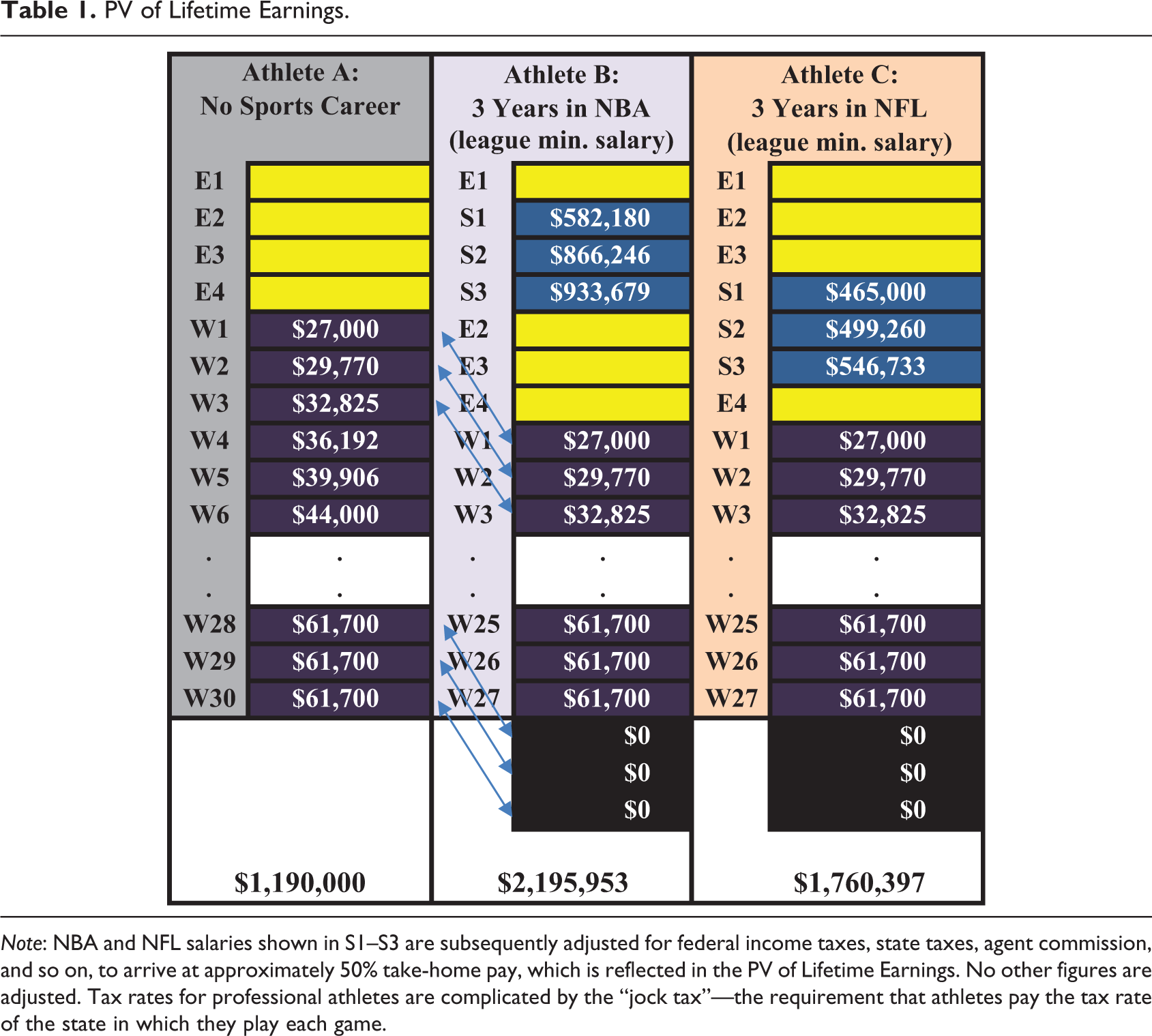
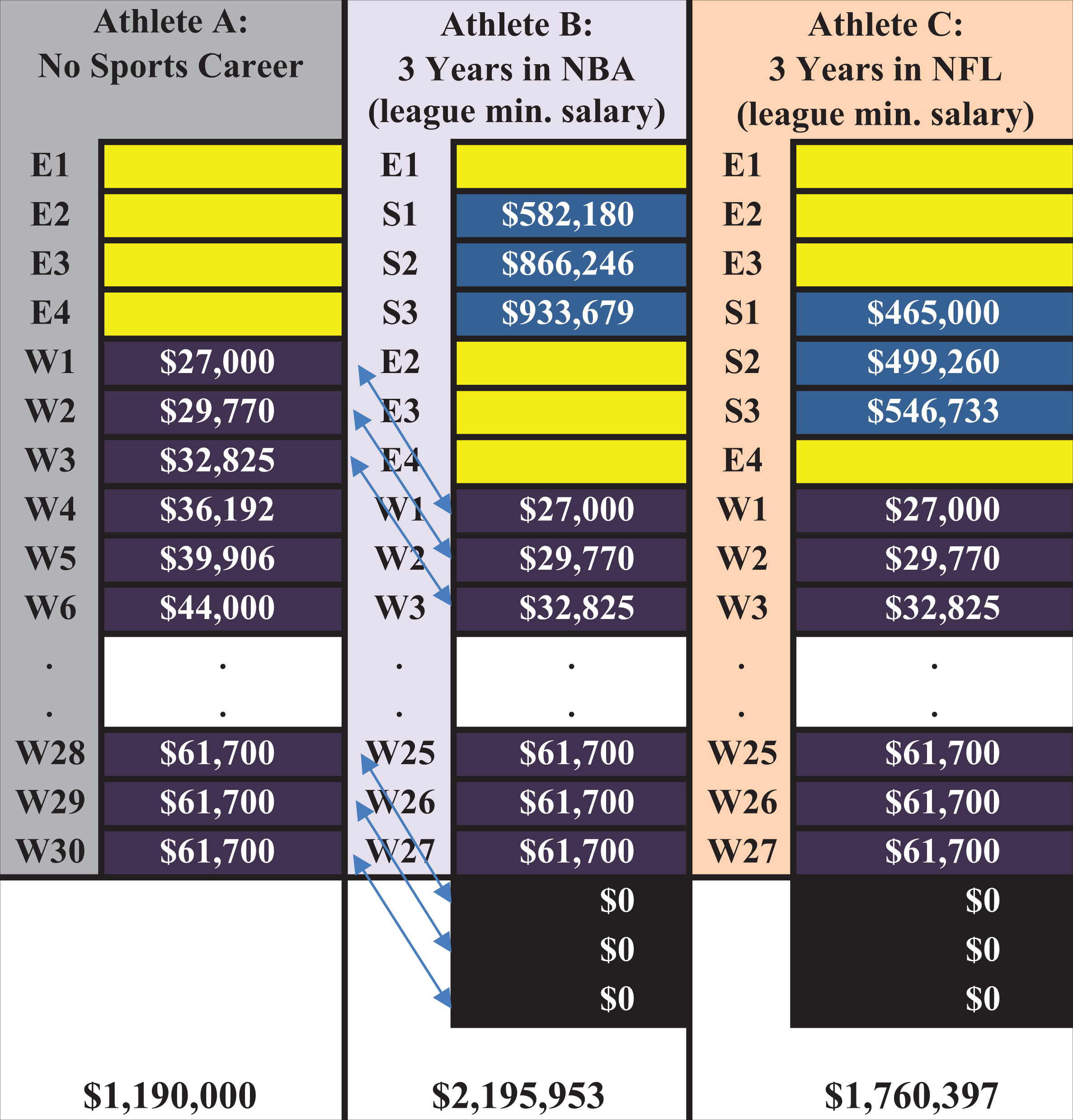
Note: NBA and NFL salaries shown in S1–S3 are subsequently adjusted for federal income taxes, state taxes, agent commission, and so on, to arrive at approximately 50% take-home pay, which is reflected in the PV of Lifetime Earnings. No other figures are adjusted. Tax rates for professional athletes are complicated by the “jock tax”—the requirement that athletes pay the tax rate of the state in which they play each game.
Athlete A does not pursue a sports career and has the lifetime earnings of a typical college graduate, $1.19M, in today’s dollars.
49
Athlete B leaves college after one year, enters the NBA, earns the league minimum for three years, exits, continues his education, and then enters the work force. He then follows the earning schedule of a typical college graduate. Athlete C leaves college after three years, enters the NFL, earns the league minimum for three years, exits, continues his education, and then enters the work force.
For each year an athlete works in the NBA or the NFL, he loses one year of postgraduate nonsport earnings at the end of his work life. This is because he can recoup the earlier lost earnings years after he obtains the degree and enters the work force (post-sports career) but will have given up the last years’ nonsports earning potential in exchange for sport earnings years. So, while athlete A earns from W1–W30, athlete B will have traded W28–W30 in exchange for S1–S3.
As Table 1 shows, this trade-off is well worth making financially. Athletes B (NBA) and C (NFL) end up with 85% and 48% higher expected lifetime earnings, respectively, than athlete A, all other things equal. Table 2 shows the percentage of lifetime expected earnings from a college degree that can be earned in 1–3 years in the NBA or NFL while earning the minimum salary. In three years at NBA league minimum, basketball players can make up the equivalent of a lifetime’s worth of expected average earnings of an individual with a college degree, even taking home only 50% of their base NBA salaries, as explained in the footnote to Table 1, and not accounting for endorsement income they may receive.
% College Degree Lifetime Earnings Versus 1–3 Years in Pro Sports at League Minimum Salary (PV).

In terms of earning potential, on average, an athlete would be better off monetizing his or her athletic potential early in their careers. Of course, one may counter that some basketball athletes, for example, would be better off financially by staying in college another year, or two, or even three rather than leaving after their freshman years. But this argument has little to do with education. Rather, this valuation hinges only on whether the athlete would achieve a higher salary that offsets the lost earnings year, likely by being drafted higher the following year, because of spending additional time honing his/her skills in college. In other words, that calculation reflects the comparison between the present value of expected compensation by entering the professional ranks in year N vs. year N + 1, not any educational value that may accrue in that one year.
2. Product Quality and Adverse Selection
According to the NCAA, graduation, not education, is the “ultimate goal of the college experience.” 50 The implication of this position is that the undergraduate degree acts as a signaling device, and the athlete benefits from simply having the degree, regardless of the quality of instruction or even whether any meaningful instruction took place. Harkening back to the shipwrecked traveler example, the logical corollary of the NCAA’s position is that all calories are the same. Under the NCAA’s argument, whether the traveler obtained the required 900 calories from sugary drinks, Twinkies, hydrogenated fats, or steak is nutritionally irrelevant as long as the calorie threshold was met. Likewise, if athletes were enrolled fraudulent classes, as many athletes (and nonathletes) were at the University of North Carolina during the “paper class” scandal, this fact did not violate any NCAA regulations if sufficient “progress toward degree” was achieved. Of course, contrary to the NCAA’s position, it is well recognized that, just as not all calories have the same nutritional value, not all “college experiences” have the same educational value either. Naturally, this begs the question why athletes would voluntarily choose to forego the opportunity to monetize their talents in athletics in exchange for an “education” for which there is no guarantee of actual quality. Such a choice would neither fulfill an individual student’s demand for education nor would it maximize the benefits of her/his athletic ability. Such a choice would normally occur primarily under two nonexclusive conditions: (1) a restraint compels the athlete to purchase the goods simultaneously in their current combination and/or (2) adverse selection conditions exist.
The existence of the first condition is obvious as the restraint is enshrined in the NCAA’s bylaws and is readily acknowledged. With respect to the second, namely adverse selection, or information asymmetry, documents released after the investigation into UNC’s fraudulent classes indicate that many athletes were angry that they had been steered to the fraudulent classes instead of being made aware of other legitimate educational options.
51
In her declaration submitted in the O’Bannon case, Mary Willingham, former learning instructor for athletes at UNC-Chapel Hill, explained that, The college football and basketball players that I worked with sometimes earned a degree, but they did not get an education. They simply did not have equal access to a real education…. They did not have access to all courses and degree programs. They did not participate in study abroad, internships or research opportunities. They were prohibited from enjoying any of these opportunities because they conflicted with practice, tournaments, summer school, or spring football.
52
Once in college the student who goes in for competitive sports, and in particular for football, finds himself under a pressure, hard to resist to give his whole time and thought to his athletic career. No college boy training for a major team can have much time for thought or study.
54
3. Survey Evidence of Athlete Preferences
This logical deduction that athletic participation drives interest in athletes’ college attendance is also supported by surveys of college athletes’ own stated preferences. In 2010 and 2015, the NCAA conducted its “GOALS Study of the Student Athlete Experience.” In both surveys, collegiate athlete preferences demonstrated that athletics were the single greatest driver of the college decision at every NCAA Division level. 56 Athletes, particularly those in football, basketball, and baseball, reported spending more time on athletics per week than academics, with time spent on athletics exceeding forty hours per week in some sports. 57 The 2015 survey showed similar results, with all athletes in all three NCAA division showing athletics as the strongest driver of the college choice decision. 58
The NCAA’s 2015 survey also showed that college athletes reported more time spent on athletics in 2015 than in 2010 in all divisions for both men’s and women’s sports (median 34 hours/week in 2015 up from 32 in 2010). 59 Survey evidence indicates that time demands placed upon college athletes are even more pronounced in the most competitive conferences, as the 2015 PAC-12 Time Demands Survey showed. 60
The NCAA’s 2015 survey documents the divergence between athletes’ preferences and the consumption schedule mandated by the NCAA’s tying restraint. In the 2015 survey, 42% of Division I male and 24% of Division I female athletes said they would prefer more time on athletics. 61 In contrast, 16% of D-I male and 25% of D-I female athletes said they would prefer less time on athletics. Regarding academics, 59% and 66% of D-I men and women, respectively, would prefer to spend more time on academics, while 9% and 6% of men and women in D-I, respectively, would prefer to spend less. 62 These data show that athletes are not consuming the goods, athletics, and academics, in proportions that correspond to their actual preferences, which informs the existence of a restraint that prevents them from doing so. The athletes’ own statements have identified this restraint, represented by the fact that they are forced into a trade-off between athletic and academic activities that would not exist absent the NCAA’s tying arrangement. NCAA Chief Medical Officer Brian Hainline summarized this restraint in his presentation for the ACGME symposium, noting “Whether because of the structure of their college sport season or self-imposed pressure to develop/improve in their sport, student-athletes are generally under strong time pressures year-round.” 63 As the previous survey data showed, athletes can spend 50+ hours per week on athletics and 80+ hours per week on the two activities combined. Thus, the NCAA’s tying arrangement, which mandates simultaneous consumption of the two activities, imposes a significant time constraint that results in a divergence between the time athletes want to spend on each activity and the time they must spend. This divergence represents lost consumer surplus.
B. The Market Participants
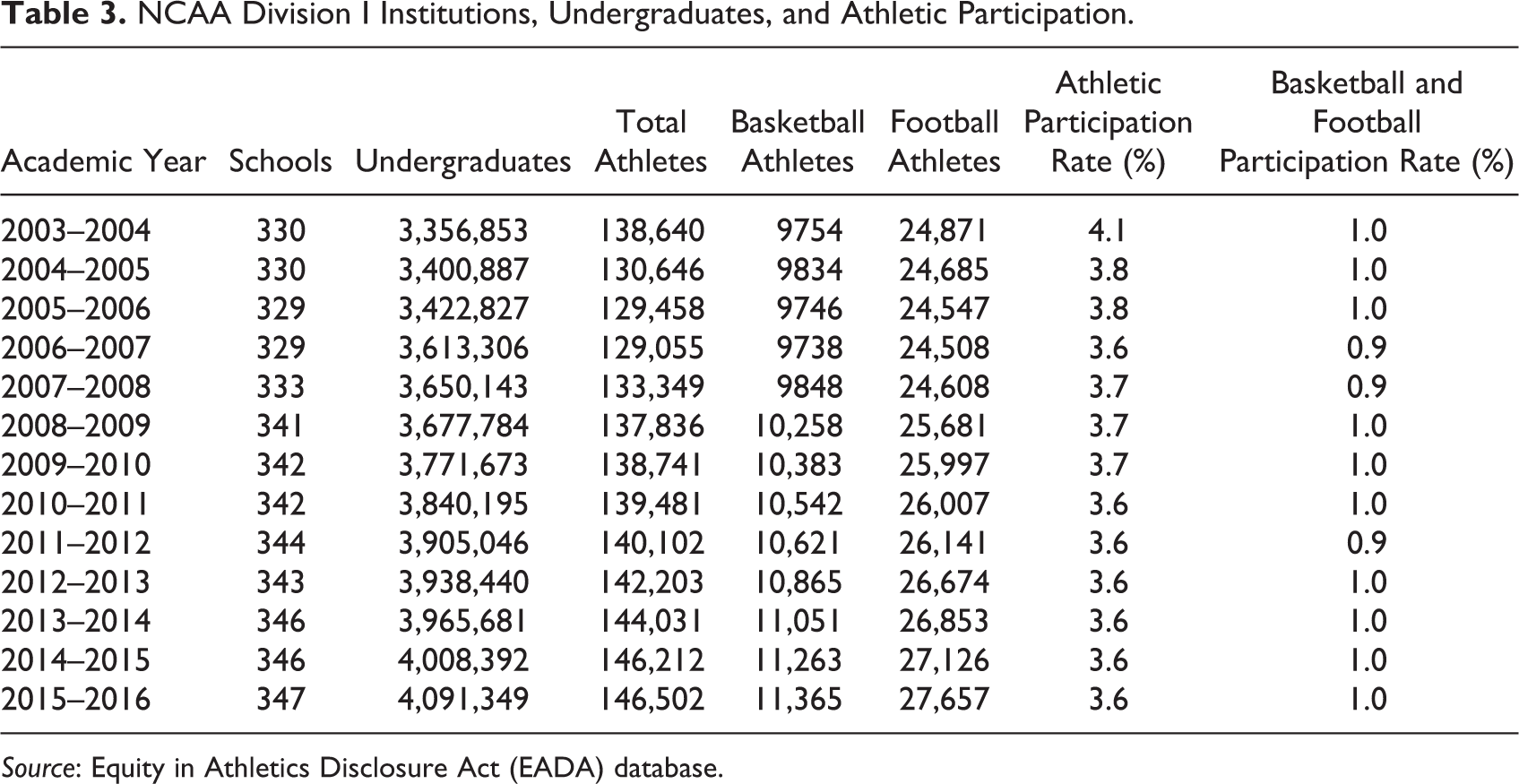
Three main groups of market participants exchange goods and services with NCAA members, a portion of whom are involved in the NCAA’s “amateurism” model of collegiate athletics at the Division I level: (1) the member D-I universities themselves, which offer undergraduate academic training and intercollegiate athletic competition under the NCAA system, (2) the prospective students who are purchasers of the educational or athletic competition products offered by the universities, and (3) the downstream consumers of the academic and athletic products universities produce. 64 The prospective purchasers of the university goods in (2) can be subdivided into two categories. The first and largest category of participants in group 2 are the students who do not participate in intercollegiate athletics and seek to purchase the academic product the schools offer either using money or some combination of money and special talent, the latter of which would command a (0,1] COA percentage offset. 65 For the nearly 350 members of NCAA Division I, this group represents over 96% of undergraduates, as Table 3 shows.
NCAA Division I Institutions, Undergraduates, and Athletic Participation.
Source: Equity in Athletics Disclosure Act (EADA) database.
The second group 2 category consists of individuals who participate in athletics and represent the remaining 3.6% of the total undergraduate student body. Contrary to apparent public perception, many athletes receive only partial scholarships to offset the costs of attendance. Such D-I athletes participate in NCAA “equivalence” sports, where no restriction exists on the number of athletes who can receive athletic aid. A fixed sum of scholarship money is allotted to a sport, and the coaching staff decides how to apportion it among team members. In contrast, Division I football and basketball are NCAA “head count” sports, meaning that the number of athletes who can be on scholarship is restricted and coaches cannot divide these scholarships to offer them to more athletes beyond the limit imposed (eighty five for football and thirteen for basketball). 66 Participants in basketball and football, the major revenue-generating sports that are at the heart of the NCAA GIA litigation represent approximately 1% of the student body. According to the NCAA, 56% of Division I athletes receive aid, in other words, a partial or full waiver of attendance costs in exchange for their athletic skills. 67
The downstream consumers of the academic (e.g., employers, graduate schools) and athletic (e.g., fans) products universities produce represent the third market group. Several distinctions exist between the demand preferences of downstream consumers of these two products. Downstream consumers of the academic product typically consume the good after students complete their academic training, that is, graduate. Prospective employers and graduate schools generally wait until students have achieved, or have nearly achieved, a level of qualification that presumably justifies the bachelor’s degree before extending employment or admission offers. 68 Put another way, the full market value of the academic product university students purchase is usually realized after the degree requirements have been completed and may act as a signaling device to downstream consumers that the individual has the required skills for employment. 69 In contrast, college sports fans, who are downstream consumers of universities’ athletic product, consume the good simultaneously with its production. Other such consumers, including licensing customers and media companies, realize the benefits of consumption both while the good is produced, and afterward through the increase in product interest and purchasing that follows athletic success. Thus, the market value of an athlete to the school and to the fans of the school’s sports program is realized primarily while the athlete is enrolled and playing for the school, though top athletes continue to benefit schools through donations and exposure after their departure.
Unlike the education market, where the binary signaling effects of a college degree indicate the individual’s qualifications to a prospective employer or graduate school, college athletes are evaluated on a continuous basis and may enter the professional sports ranks as soon as the opportunity presents itself. This phenomenon reveals itself on at least an annual basis, as athletes, particularly in college basketball, declare early for the professional ranks before exhausting their NCAA eligibility.
C. The Relevant Markets
As noted previously, this article argues that the relevant market definition used in previous NCAA litigation, which referenced a single market where higher education and athlete labor are exchanged, is inconsistent with factual evidence. That definition falls prey to the fallacy of confusing two tied products offered by NCAA member institutions, academics and athletics, as one single product. Prof. Noll, in his expert report on liability in In Re Student Athlete Name Image and Likeness Litigation, opined that The starting place for defining a relevant market is a ‘reference product’…. The reference product for the college education market is the sale by NCAA member colleges of
Rather ironically, one of the two remaining procompetitive justifications the NCAA has offered for its restraint underscores the existence of separate markets. In its March 28, 2018, order in the NCAA Grant-in-Aid case, the District Court denied parties cross-motions for summary adjudication of two questions: (1) whether the NCAA’s challenged restraint serves its claimed procompetitive justification of integrating athletics and academics and (2) preserving the popularity of the product by promoting the amateurism model, despite its changing definitions. With respect to the first, the Court referenced Prof. James Heckman’s deposition testimony in ruling that, Defendants also present evidence that paying student-athletes would detract from the integration of academics and athletics in the campus community. For example, Professor James T. Heckman testified that paying student-athletes would likely lead them to dedicate even more effort and possibly more time to their sports, potentially diverting them “away from actually being students and towards just being athletes.”
71
1. Undergraduate Education Market
It would be presumptuous to attempt a thorough analysis of the market for postsecondary education at the undergraduate level in a single article primarily devoted to an antitrust analysis of the NCAA’s collegiate model of amateurism. Nor is it possible to even summarize the breadth of the economic literature on the matter, as the articles and books written on this subject are legion. Fortunately, such an epistemological journey into postsecondary pedagogy is unnecessary, as the key interest here is understanding the market’s basic operating characteristics and its similarities and differences to that of the quasi-professional world of “amateur” intercollegiate athletics. Such an understanding necessitates a discussion of several key points.
Winston, in a view that would almost certainly provoke a sharp rejoinder from Thorstein Veblen, explained that “Higher education is a business: it produces and sells educational services to customers for a price and it buys inputs with which to make that products.” 73 This citation does not signal an endorsement on my part of the state of higher education in the United States, but rather a reflection of the current reality in which undergraduate education finds itself. In the U.S. market for undergraduate academics, prospective students generally function as consumers of the academic product universities sell. Rothschild and White’s 1993 work offers documentary and referential support for the existence of some price competition among schools, though they note that, despite the existence of thousands of postsecondary institutions in the United States, price competition seems unlikely to approach the “textbook” model. 74 Most U.S. postsecondary educational institutions are nonprofits, though the for-profit educational sector has grown significantly over the past twenty years. Hansmann’s seminal Yale Law Review article provides an excellent overview of the economic and legal structures of nonprofit enterprises, 75 and Martin’s subsequent work discusses the nature of nonprofits in the context of higher education. 76 Unlike traditional firms, nonprofits do not distribute their profits to the individuals who control them and cannot access equity markets (i.e., they cannot trade their own stock either privately or publicly and are thus sometimes referred to as “nonstock corporations”). The term nonprofit may give the impression that such firms are barred from earning profits. This is not so, as many institutions, including university athletic departments, do indeed earn profits. The prohibition levied by nonprofit status is not on earning profits, but rather on their distribution. 77
The nonprofit status of postsecondary institutions of higher education has a strong economic basis. Markets characterized by adverse selection, or information asymmetries, can be exploited by sellers who hold an informational advantage to further their economic self-interest at the expense of buyers. As Winston points out, the extreme case, yet one unfortunately applicable to the pseudo-education all-too-often offered to college athletes in exchange for their labor, is one where buyers pay but remain unaware of whether they have even purchased anything.
78
Akerlof’s 1970 “lemons” paper discussing quality uncertainty in the market for used cars
79
(for which he used the vernacular descriptive “lemons”) offers a valuable analogy to the information asymmetry that exists in higher education. Competition on reputation among nonprofit postsecondary institutions occurs because prospective students often cannot determine a priori the quality or value of the product they will receive from the university and thus rely on the reputation of the university, the coach(es), or both.
80
Former Harvard president Derek Bok summarized the problem: They [applicants] rarely possess either the time or the information to explore all the promising options available to them and usually have only a limited basis for comparing the options they do consider. Under these conditions, competition does not necessarily cause good instruction to drive out bad.
81
As a concluding point on this matter, it would be remiss not to acknowledge, as many economists have pointed out, that analyzing labor market outcomes to college education suffers from a causality problem. Educational attainment and entry into top academic schools are endogenous with socioeconomic factors, race, class, and perhaps other factors that complicate the relationship. For example, at top schools such as Harvard, legacy status can affect likelihood of admission. Duke University entertains admission preferences for offspring of financially well-off donors. Called “development admits,” these have been criticized for being a de facto affirmative action policy for wealthy, primarily white, individuals. 86
2. NCAA Division I Intercollegiate Athletics Market
The intercollegiate athletics market, which includes approximately 4% of the students enrolled at NCAA D-I institutions, exhibits complexities generated by the grafting of quasi-professional athletic departments onto academic institutions. 87 A prospective college athlete cannot access the intercollegiate athletic product, that is, the ability to compete in intercollegiate athletics, by itself, but rather must purchase access, which NCAA members package, or bundle, with some version of the academic product. In exchange for a waiver of these fees and an additional payment to cover the COA, athletes must (1) agree not to monetize their names and likenesses, (2) forego the right to receive any kind of compensation that may be related to their abilities in their sport or reputation derived from it, and (3) agree to expend what often amounts to more than 40 hours of labor per week on their athletic endeavors. This exchange differs fundamentally from that involving a full academic scholarship. Individuals receiving a full academic scholarship receive the full benefit of the tuition and fees waiver in exchange for foregoing their opportunity cost of attending another school. Athletes, however, must “pay” for this COA benefit, not only by waiving other opportunities but also through their labor, their waiver of NIL rights, and the risks and injuries they incur. As explained further infra, athletes also receive limited access to the same educational opportunities available to nonathlete students.
a. Nature of Competition for Athlete Recruitment
First, NCAA D-I universities’ demand for athletes is naturally driven by a desire for institutional success in intercollegiate athletics, which engages fans, drives revenues, and enhances the institution’s brand. Competitors in the higher education market for college students often do not compete for top college athletes. Duke and Kentucky compete fiercely for top “one-and-done” basketball talent, though the schools are not considered to occupy the same academic tier and do not consider each other as “peers.” 88 Stanford and Duke represent two of the top non-Ivy academic institutions and thus compete in the undergraduate education market, yet they rarely compete for the same basketball talent. While the University of Arizona’s men’s basketball team competes for top recruits with the likes of Kentucky, Kansas, and Duke, none of these schools are listed as Arizona’s institutional peers. 89 This discussion is certainly not intended to question the academic reputation or downplay the value of any university, but rather to describe the competitive reality that occurs between schools in academic and athletic markets.
A second factor indicative of separate market for undergraduate education and intercollegiate athletics is that the primary contacts for prospective athletes, particularly those highly recruited, are college coaches and athletic recruiting staff. Highly talented recruits can receive offers for admission early in their high school careers or even during middle school. 90 A recent NCAA study found that 34% of Division-I basketball athletes had their first recruiting contact by 9th grade or earlier, and 63% by tenth grade or earlier. 91
Third, as the NCAA’s expert acknowledged in quoting various athletic department officers, the downstream consumers for the athletic product are different than the downstream consumers of the educational product.
92
For example, Michael Aresco, Commissioner of the American Athletic Conference (AAC), testified that he told the Knight Commission that “I may have mentioned paying players…. I felt that it would be less attractive to the TV networks to televise what would be essentially a professional model.”
93
Universities have ceded control over the scheduling of their own sports contests to television executives, who make these decision ostensibly to maximize viewership and therefore profit. Duke University’s 2008 athletics strategic plan explained the scheduling: We no longer determine at what time we will play our games, because they are scheduled by TV executives…. In return for large television contracts, we have surrendered control over a function that can profoundly influence the experience of our students.
94
An internship gives you direction, teaches you valuable life lessons and prepares you for a level of professionalism. At a competitive football school, completing an internship is almost impossible….
95
These paper classes…were especially popular among student-athletes, particularly those who played the “revenue” sports of football and men’s basketball. Many of these student-athletes were referred to these classes by academic counselors in the Academic Support Program for Student-Athletes (“ASPSA”) who were always under pressure to maintain student-athlete eligibility and saw these classes—and their artificially high grades—as key to helping academically-challenged student-athletes remain eligible and on the playing field.
97
b. The Cellophane Fallacy and Claimed Substitutes
Critics of a relevant market definition that encompasses intercollegiate athletics labor claim that such a definition is too narrow and that the NBA’s developmental league and professional opportunities overseas represent viable substitutes for the NCAA’s FBS and Division I football and basketball products, respectively. Because we observe a small minority of athletes choosing such options, some claim that this represents evidence of a broader relevant market that includes these purported substitutes. However, the court in O’Bannon rejected both other professional options and other NCAA divisions as substitutes for the FBS and Division I basketball.
The court’s finding requires closer scrutiny, because, as noted previously, this article does not endorse the “relevant college education market” definition adopted in O’Bannon. Indeed, as the Court’s ruling notes, its market definition covers a “bundle of goods and services,” which, I argue, represents a tie of two distinct products that should be treated separately as part of athletic and academic markets. In its opinion, the court noted that recruits do not typically pursue opportunities in leagues that allow immediate post-high school entry, such as the NBA Developmental League (previously named the D-League and now called the G-league), the Arena Football League (AFL), and overseas leagues. The court’s ruling, however, risks being incorrectly interpreted to suggest that had more recruits pursued these opportunities, it would offer evidence that these alternatives should be included as substitutes in the relevant market. But this is not so. Such a deduction would fall prey to the cellophane fallacy.
The cellophane fallacy, alternatively called the cellophane trap, originates from the U.S. v. E.I. Dupont de Nemours 99 case where the Supreme Court failed to detect DuPont’s dominant market position in cellophane by erroneously defining too broad a relevant market as flexible packaging materials. While DuPont produced 75% of the cellophane sold in the United States, the Court found that cellophane only constituted 17.9% of the market for flexible wrapping materials when other claimed substitute products were considered. The Court’s error lay in its failure to observe the fact that other competing substitutes existed because DuPont had already exercised market power and raised the price of cellophane above the competitive price. The use of the prevailing price as an input into the hypothetical monopolist “small but significant non-transitory increase in price (SSNIP)” test is subject to this potential fallacy. 100 Both in the cellophane case and generally, the elasticity of demand is higher at the monopoly equilibrium than at the competitive equilibrium. 101
Arguments that overseas leagues, the AFL or the NBA G-League, serve as substitutes for NCAA FBS and Division I basketball athletes also commit the mirror image of the cellophane fallacy, that is, the same error but from the buyer side. Clearly, the prevailing labor wage for college athletes, maximized at COA, does not reflect competitive market conditions, but rather monopsony wages imposed by the NCAA cartel’s bylaws. 102 Because NCAA members have already set wages at noncompetitive levels, it follows that higher demand elasticity exists at prevailing wages, and we should expect to see athletes pursue other avenues, such as overseas leagues or the NBA developmental league. But this does not inform as to whether these alternatives would serve as viable substitutes in a competitive market. Concluding otherwise leads one into the same cellophane trap that befell the DuPont court.
IV. NCAA’s Tying Arrangement and Antitrust Injury
A. The Treatment of Tying Restraints in Antitrust Jurisprudence
In output markets, a tying arrangement occurs when a seller conditions the sale or lease of a product or service on the customer’s purchase of an additional product or service. 103 For many years, antitrust jurisprudence condemned tying arrangements as per se illegal. In Standard Oil, the Supreme Court found that “Tying agreements serve hardly any purpose beyond the suppression of competition.” 104 As a historical matter, tying arrangements and patent litigation are inextricably linked. 105 The Court in Jefferson Parish v. Hyde made explicit the long-held presumption that dominated antitrust jurisprudence at the time, namely that the granting of a patent conferred market power upon its holder, finding “if the Government has granted the seller a patent or similar monopoly over a product, it is fair to presume that the inability to buy the product elsewhere gives the seller market power.” 106 However, the U.S. Congress, through the Patent Misuse Reform Act of 1988, 107 obviated the market power presumption and required that a Plaintiff alleging patent misuse demonstrate that the patentee has market power. As a result, the Court in Illinois Tool Works v. Independent Ink 108 presented with the question of whether “the presumption of market power in a patented product should survive as a matter of antitrust law despite its demise in patent law” abrogated in part its previous opinion in Jefferson Parish, concluding that “the mere fact that a tying product is patented does not support such a presumption.”
Judicial perception of tying has morphed dramatically over the last three decades into the current three-pronged per se rule that “makes it illegal to tie together 1) separate products when the defendant (2) has tying market power and (3) forecloses a nontrivial dollar amount of sales in the tied market.” 109 Because the second prong of the current tying per se standard requires the demonstration of the defendant’s market power, parallels have been drawn to the rule of reason, resulting in the reference to the per se tying rule as “quasi” per se. 110 Because ties that meet the first and second requirements and lack offsetting efficiencies will also generally incur antitrust liability in the presence of substantial foreclosure share, which may be inferred through direct evidence that the ability of rivals in the tied market has been harmed, 111 Elhauge has proposed the alternative term “bifurcated rule of reason” as a more accurate description of current per se standard in tying claims. This nomenclature appears to capture the essence of the Supreme Court’s opinion in Jefferson Parish, which pronounced that “The time has therefore come to abandon the ‘per se’ label and refocus the inquiry on the adverse economic effects, and the potential economic benefits, that the tie may have.” Thus, the per se standard in tying jurisprudence is a largely equivalent to the rule of reason in other antitrust matters and substance, with a key difference being “that the rule of reason is more receptive to procompetitive justifications for the tying arrangement and more willing to examine the effects of that arrangement in both the tying and tied markets.” 112
Citing to precedent in Jefferson Parish, Supreme Court in NCAA v. Board of Regents acknowledged limited separation between per se tying claims and those subject to the rule of reason, placing quotations around the per se rule in this context: “there is often no bright line separating per se from Rule of Reason analysis…while the Court has spoken of a ‘per se’ rule against tying arrangements, it has also recognized that tying may have procompetitive justifications that make it inappropriate to condemn without considerable market analysis.” 113 Lower courts have followed this guidance. The 10th Circuit in Suture Express v. Owens & Minor noted the narrowing distinction between per se and rule of reason frameworks of assessing tying claims. 114 Indeed, in Illinois Tool, the Supreme Court cemented the requirement of market power in tying cases, regardless of the framework used to analyze them, holding that “in all cases involving a tying arrangement, the plaintiff must prove that the defendant has market power in the tying product.”
Distinctions between per se and rule of reason arguments in tying jurisprudence notwithstanding, in its landmark Jefferson Parish v. Hyde decision, the Supreme Court, while not dismissing intra-consumer surplus extraction entirely, focused on foreclosure as the prevailing anticompetitive concern of tying arrangements, finding that, …. the law draws a distinction between the exploitation of market power by merely enhancing the price of the tying product, on the one hand, and by attempting to impose restraints on competition in the market for a tied product, on the other. When the seller’s power is just used to maximize its return in the tying product market, where presumably its product enjoys some justifiable advantage over its competitors, the competitive ideal of the Sherman Act is not necessarily compromised. But if that power is used to impair competition on the merits in another market, a potentially inferior product may be insulated from competitive pressures.
115
The 9th Circuit, the venue in which both O’Bannon and current In Re Grant-in-Aid cases have been litigated, has naturally taken direction from the Supreme Court in its own seminal tying cases. In Cascade Solutions v. PeaceHealth, the 9th Circuit likewise focused on foreclosure rather than extraction.
116
In Brantley v. NBC Universal, the 9th Circuit, referencing Jefferson Parish and its own precedent in Blough v. Holland Realty,
117
found that, courts distinguish between tying arrangements in which a company exploits its market power by attempting “to impose restraints on competition in the market for a tied product” (which may threaten an injury to competition) and arrangements that let a company exploit its market power “by merely enhancing the price of the tying product” (which does not).
118
1. Role of Consumer Choice in Assessing a Restraint’s Effects
Plaintiff CollegeNET alleged collusion among competitor colleges and conspiracy with Defendant to restrain trade and foreclose rival providers in the admission and online college application processing markets. In its tying claim, CollegeNet alleged that Defendant’s tying arrangement harms competition in the relevant markets by limiting college choice, limiting the scope of services and price competition available to student applicants, and foreclosing rival providers from capturing colleges’ and applicants’ business.
120
On appeal, the 9th Circuit reversed the lower court decision, finding that “The district court prematurely concluded that CollegeNET could not assert an antitrust injury from restraints that resulted in reduced choice, and lower quality and less innovative college application services.” Citing to precedent in Glen Holly v. Tektronix, 121 the appeals court opined that “A plaintiff may assert antitrust injury from ‘[c]oercive activity that prevents [consumers] from making free choices between market alternatives,’ as well as restraints that artificially erect barriers to market entry and protect lower quality products.” As discussed subsequently, the issues identified by the 9th Circuit as permissible foundations of an antitrust injury claim in CollegeNET also appear under the NCAA’s “amateurism” restraint to an even greater degree.
Justice Sotomayor explained the value of choice in preserving competition in the Ohio v. Amex oral arguments, in a quote that offers a succinct critique applicable to the NCAA’s model: You’re making my choice for me. You’re not giving me the choice. And that’s what price competition is about, my choice, not your choice about what’s more valuable to me.
122
While the Supreme Court’s opinion in Board of Regents has been used to highlight the importance of downstream consumer (sports fan) choice in preserving the NCAA’s concept of amateurism, such a defense is both conceptually flawed and runs afoul of recent Supreme Court jurisprudence. In the recent Grant-in-Aid Cap litigation, the NCAA has simultaneously presented two arguments: (1) that amateurism preserves consumer demand for intercollegiate athletics and thus serves as a procompetitive justification and (2) that the Supreme Court’s recent American Express decision has precluded the use of “balancing” anti- and procompetitive effects under the rule of reason by specifying only a “three-step” rule of reason process. As such, so the NCAA’s argument goes, any claimed procompetitive justification offsets any anticompetitive restraint and suffices to shift the burden back onto the Plaintiffs to show the existence of a less restrictive alternative (LEA). 125
The NCAA is incorrect on two fronts. First, while the difficulty and rarity of balancing are acknowledged, the notion is that balancing never occurs is demonstrably false. In his 1999 analysis of how courts adjudicate antitrust cases under the rule of reason, Carrier offers four cases as examples where courts balanced claimed anticompetitive effects and procompetitive justifications. 126 In his 2009 update, 127 Carrier again offers additional examples of balancing, including three 9th Circuit cases: California Dental Ass’n v. FTC, 128 County of Tuolumne v. Sonora Community Hospital, 129 and Paladin Associates v. Montana Power Co. 130 Further, the fact that balancing seldom occurs does not indicate that courts eschew the process but rather that many cases are decided before this step. Carrier reviewed 738 cases, 222 of which involved a final court determination in rule of reason cases. Of these, 215 (96.8%) were disposed because Plaintiffs could not show an anticompetitive effect. In five cases, the court made use of balancing. 131 Thus, Carrier showed that, in cases where Plaintiffs have demonstrated an anticompetitive effect, as they have O’Bannon and Grant-in-Aid Cap Litigation, courts availed themselves of balancing in five of seven instances.
Second, NCAA’s argument runs counter to precedent set in Ohio v. American Express. The 2nd Circuit opinion, affirmed by the Supreme Court, held that the District Court’s opinion “erroneously elevated the interests of merchants above those of cardholders” by failing to consider the effect of nondiscriminatory provisions on the entire market, which the Supreme Court agreed, included both parties. This funding undermines the NCAA’s position in Grant-in-Aid, regardless of whether the market in this case is one-sided or multi-sided (though the District Court rejected the multi-sided platform argument and excluded the NCAA’s expert’s opinion on this issue). Suppose the market is one-sided and with respect to athlete labor. Then, of course, there is no procompetitive justification to act as an offset because downstream consumers of sporting events exist in a different market altogether. Indeed, as I argue elsewhere, the lack of indirect network externalities between athletes and consumers, coupled with the NCAA’s insistence that athletes are “students first,” in the face of mounting evidence to the contrary, establish the existence of universities as single-sided market platforms competing for athlete services.
Even if universities were multi-sided platforms, this alternative would not rescue the NCAA’s position because its argument does exactly what the court prohibited in American Express: it elevates the interests of downstream fans over those of college athletes. Without balancing, any amount of increased demand effect, no matter how small, would offset any anticompetitive harm to athletes, no matter how large, clearly elevating the interests of the former over the latter. The NCAA’s position is that a pebble’s worth of procompetitive justification can offset a mountain’s worth of anticompetitive harm clearly cannot represent the standard for determining whether antitrust injury has occurred.
Further, if adopted by the courts, it would effectively insulate Defendants from cases brought under the rule of reason. Based on Carrier’s analysis of 222 cases, if Defendants would have been allowed to offset anticompetitive harm by claiming any procompetitive justification, no matter how small, then Defendants’ victories would have scored 221 or perhaps even 222 victories of the 222 cases. Against such nigh-impossible odds, many cases would never be brought. Further, considering the increasing shift from per se liability to rule of reason, such a finding would virtually eviscerate antitrust laws.
B. The NCAA’s Tying Restraint
The demonstration of separate markets for the athletics and postsecondary education products necessitated the lengthy discussion in this article’s previous section. As explained, the overwhelming evidence leads to the conclusion that athletics and college academics are two distinct products, with separate markets for each, that are tied under the NCAA Division I model of amateurism. The unitary market definition of “higher education services” for college athletes used in O’Bannon and the NCAA GIA litigation notwithstanding, the District Court acknowledged Dr. Noll’s testimony regarding the existence of a separate market for athletic services, [Plaintiffs’ expert] Dr. Noll testified that elite football and basketball recruits—the buyers in Plaintiffs’ college education market—could also be characterized as sellers in an almost identical market for their athletic services and licensing rights. In that market, FBS football and Division I basketball schools are buyers seeking to acquire recruits’ athletic services and licensing rights, paying for them with full grants-in-aid but no more. From that perspective, the NCAA’s restrictions on student-athlete compensation still represent a form of price fixing but create a buyers’ cartel, rather than a sellers’ cartel.
132
1. Market Power
Having presented the supporting evidence for the existence of separate products and separate markets for athletics and academics at the postsecondary level, the next question is whether the NCAA Division I members have market power in the tying market, namely intercollegiate athletics. This question has been amply addressed, confirmed by the District Court in O’Bannon, and unchallenged by the 9th Circuit on appeal. In continuing its finding from the citation above, the Court opined that Thus, because Plaintiffs’ college education market is essentially a mirror image of the market for recruits’ athletic services and licensing rights, the …the Court finds that the NCAA has the power—and exercises that power—to fix prices and restrain competition in the college education market that Plaintiffs have identified.
133
Thus, having met the first two prongs of the Supreme Court’s three-part “quasi”-per se test of demonstrating the unlawful nature of a tying agreement, separate products and separate markets for each as well as market power in the tying market, I turn to the discussion of the tying arrangement’s three anticompetitive outcomes: strategic use to enhance market power in the tying (intercollegiate athletics) market, consumer surplus extraction, and foreclosure, the latter of which is the focus of current antitrust jurisprudence with respect to tying claims. To inform why schools would restrain trade in such a fashion, I first explain why they view tying as profitable.
2. Why Universities Tie Intercollegiate Athletics and Academics
The two most obvious reasons why NCAA D-I member schools tie athletics and academics is (a) to avoid paying athlete labor at the market rate and (b) to accrue the benefits of NIL rights that would have otherwise gone to the athletes holding them. Additionally, the benefits of high-profile athletics to the individual schools are not limited to athletic department coffers. Both anecdotal evidence and previous research indicate that universities treat athletics as a brand-building advertising tool, enabling them to gain national attention, greater endowments, increase admissions selectivity, and ultimately improve their financial positions. As University of Texas president Gregory Fenves noted, in naming Mike Perrin the interim athletic director in 2015, “For many, athletics is the front door to the university,” 134 a comment echoed by the Bob Vecchione, executive director of the National Association of Collegiate Directors of Athletics. 135
One method through which schools achieve such outcomes is by reducing prospective students’ search costs. 136 The positive effect of athletics success on a university’s applications has been commonly referred to as the “Flutie effect,” in reference to the two-year 30% rise in applications at Boston College after then-quarterback Doug Flutie’s famous 1984 “Hail Mary” touchdown pass against the University of Miami. Certainly, the role of college sports as drivers of enrollment and vehicles of fulfillment of consumer need for entertainment in American institutions of higher education has been recognized for decades. 137 Previous research shows that the financial value of intercollegiate athletics to a university clearly transcends its dollar contribution to the athletic department coffers, illuminating administrators’ decisions to engage in such sports. In their article analyzing the impact of college athletics on tuition revenues, Mixon and Ressler conclude that “When examining the role of athletics within the mission of universities and colleges, one must take care to include all of the monetary rewards reaped by universities with successful athletic programmes.” 138
3. Consumer Surplus Extraction
The NCAA’s tying arrangement extracts surplus both from students who participate in intercollegiate athletics and those who do not. With respect to the first group, both the district court and the 9th Circuit have found that, but-for restraint, college athletes would pay less for the tied athletics and academics product combination: …. if total financial aid was not capped at the cost of attendance, schools would compete for the best recruits by offering them compensation exceeding the cost of attendance. This competition would effectively lower the price that the recruits must pay for the combination of educational and athletic opportunities that the schools provide.
The implications of these rulings for tying jurisprudence are significant. The Court in O’Bannon defined the college education market as the bundle of higher education and intercollegiate athletics. Because schools do not provide access to intercollegiate athletics without the purchase of the educational product, this tying arrangement is regarded as a “bundled tie.” 140 It then follows that both the district court and the 9th Circuit agree that consumer surplus extraction represents an anticompetitive action when considering a bundled tying arrangement. This is an economically logical finding yet one that appears to challenge the notion that substantial foreclosure share must exist for a tying arrangement to cause antitrust injury.
Empirical evidence also shows that students who do not participate in intercollegiate athletics pay higher costs as a result of the tying of the two products, intercollegiate athletics and academics. Faced with rising costs as a result of their attempts to maintain competitive athletic programs, universities pass costs on to the student body through athletic fees that can be occasionally hidden. 141 Even when schools levy such fees overtly, they are commonly mandatory. 142 For example, the University of Arizona Board of Regents voted to impose a mandatory $100 athletics fee for undergraduate students. 143 The same is true at many other NCAA universities. 144 At the University of Virginia, the $657 annual student athletic fee is higher than the student health fee. 145 Universities in the state of Virginia, including James Madison University, Radford University, and Old Dominion University, obtain among the highest revenues from student athletic fees in the nation. Longwood University, in Farmville, VA, a virtual unknown in NCAA sports, levied a $63.40 per credit-hour athletics fee in 2016–2017, which equals $1902 per academic year at the thirty credits/year full-time rate. 146 In the state of Virginia, rising athletics fees prompted Gov. Terry McAuliffe to sign a bill limiting the percentage of athletic department budgets that can be funded through student athletic fees. 147 The bill’s co-sponsor, De. Kirk Cox, pointed to such fees as a major driver behind a 122% increase in tuition and fees from 2002 to 2015. While D-III schools can fund 92% of their budgets from athletic fees, P5 members such as Virginia and Virginia Tech are limited to 20%. Members of smaller conferences, such as the Conference USA, can fund up to 55% of their budgets from athletics fees because such leagues have less lucrative television contracts. While this legislation is limited to the state of Virginia, it underscores the ability of high-profile P5 conference members to raise costs levied on the student body at smaller institutions.
Such athletic fees charged to the student body are neither rare nor de minimis. Over twelve-year period from 2005 through 2016 academic years, the approximately 225 public NCAA Division I institutions that reported such data levied $10.3 billion in student athletic fees. Such fees are more prevalent among non-Power-5 (NP5) conference public college and universities, 88% (150/171) of whom charged student athletic fees in 2016, a percentage that has remained virtually unchanged over the last twelve years. Among public P5 members, 60% (31/52) charged student athletic fees, but this percentage has been gradually decreasing since 2006, where it reached 72%. This divergence further indicates that the tying arrangement disproportionately benefits members of the dominant five power conferences, whose revenues net of institutional investment or subsidies dwarf those of NP5 members, reducing or eliminating the need to levy such fees. Further, inflation-adjusted effective total student fees per undergraduate at NP5 schools have increased at a compound annual growth rate (CAGR) of 2.7%, compared to the 1.6% growth rate at P5 schools, as shown in Figure 1.
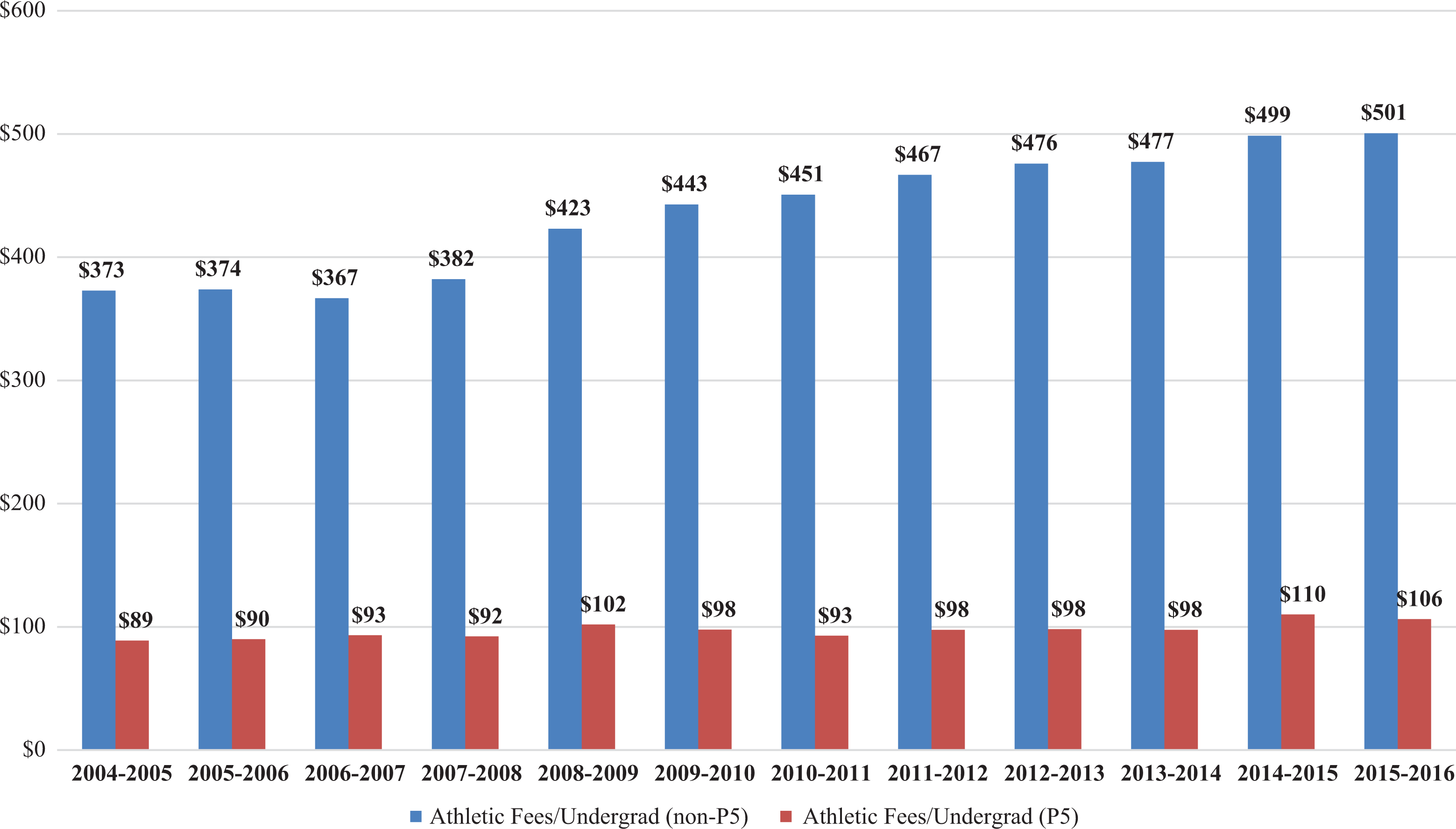
Total student athletic fees/number of undergraduates P-5 versus non P-5 NCAA D-I public universities (inflation adjusted, 2017 = 100). Source: Student athletics fee data from USA Today NCAA finances database. Undergraduate data from EADA database.
Figure 2 illustrates the dichotomy between the P5 conferences and other NCAA Division I conferences. We observe that institutional investment in the athletic department (university funds plus student athletic fees) constitutes a significant portion of other conferences’ revenues, whereas outside sources such as licensing rights, ticket sales, and contributions represent the primary drivers of revenues at P5 member athletic departments.

Average member athletics revenues versus institutional investment in athletics by conference and Power-5 conference status public universities, 2015–2016 academic year. Institutional investments includes athletics fees charged to students. Average revenues include all reported member revenues. Source: Revenue data from EADA. Institutional investment data from USA Today NCAA finances database.
This difference can be observed at the individual school level as well, as shown in Figure 3. With rare exceptions, the percentage of athletic revenues from allocated sources, defined as direct and indirect institutional investment in athletics plus any athletic fees levied on the general student body, at P5 institutions falls far below that at NP5 schools. Only Rutgers, where 34% of athletic revenues in 2016–2017 were allocated from institutional funds or student fees, exceeded 20%. Conversely, among the NP5 schools, only Alabama A&M, the public D-I institution with the least athletic revenues in 2016–2017 ($3.3M vs. $9.5M in athletic expenses), reported allocated athletic revenues below 20% of total.
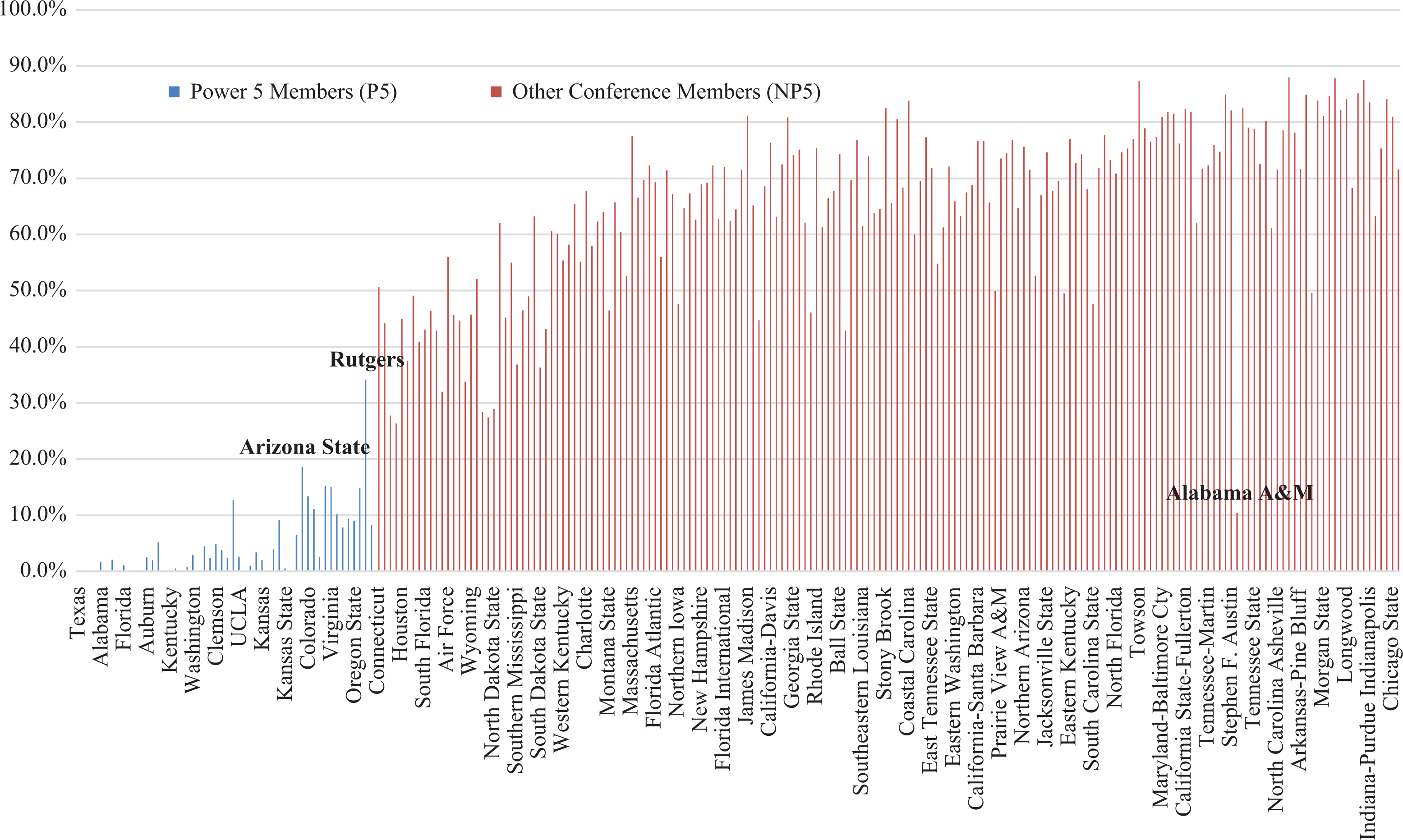
2016–2017 NCAA public D-I Institutions: Percentage of athletic revenues allocated. Source: USA Today NCAA finances database. Allocated revenues refer to direct and institutional funding of athletics and athletic fees levied on the general student body.
These findings comport to NCAA’s longtime policy advisor Wally Renfro’s comments in an October 17, 2010, email to NCAA President Mark Emmert: The top 25 percent of the Division I is setting the spending pace for the rest of the division. Although the bottom 25 has largely stopped trying to compete and is content with the prestige that comes with being in the same neighborhood, the real issue appears to be with the middle 25 percent. So, what we really see are the haves, the have-nots, and forget-about-its.
148
A common criticism of treating extraction effects as anticompetitive posits that they are identical to the effects of exercising legally obtained market power to raise prices. Elhauge 150 addresses the shortcomings of this argument in some detail, noting that the Supreme Court in Jefferson Parish, “specifically condemned the tendency of tying agreements to ‘increase the social costs of market power by facilitating price discrimination, thereby increasing monopoly profits over what they would be absent the tie.’” 151 Institutions of higher education may have the ability to raise tuition prices or levy a variety of potentially mandatory fees (e.g., technology fee, student health fee). A firm school with legally obtained market power may impose monopoly pricing without incurring antitrust condemnation. But the Supreme Court distinguished between this ability and the monopoly profits incurred from imposing a tying arrangement. As Elhauge again observes, “the Court held that it was anticompetitive to increase monopoly profits over the levels that the defendant could have obtained through simple monopoly pricing without the tie.” 152 Absent the tying arrangement, athletic fees designed to sustain intercollegiate athletic programs would obviously not be mandated.
4. Strategic Use to Enhance Market Power
Tying athletics to academics also enhances athletically dominant institutions’ market power in the tying market. The reported net revenue 153 gap between the P5 and the NP5 schools has grown over the last twelve years. Despite being outnumbered by over 3-1, the 52 public P5 schools outgained the 171 NP5 schools in net revenue by over $4B dollars in 2015–2016. In 2015–2016, every P5 school exceeded every NP5 school in net revenues, with the largest 9 net revenue P5 schools exceeding the net revenues of all 171 NP5 schools combined. This figure has remained remarkably constant over the last twelve years. In any year during that time period, it has required at most the top eleven P5 public institutions combined to outgain all NP5 schools together. Figure 4 illustrates annual trends in net revenues for P5 versus NP5 schools.
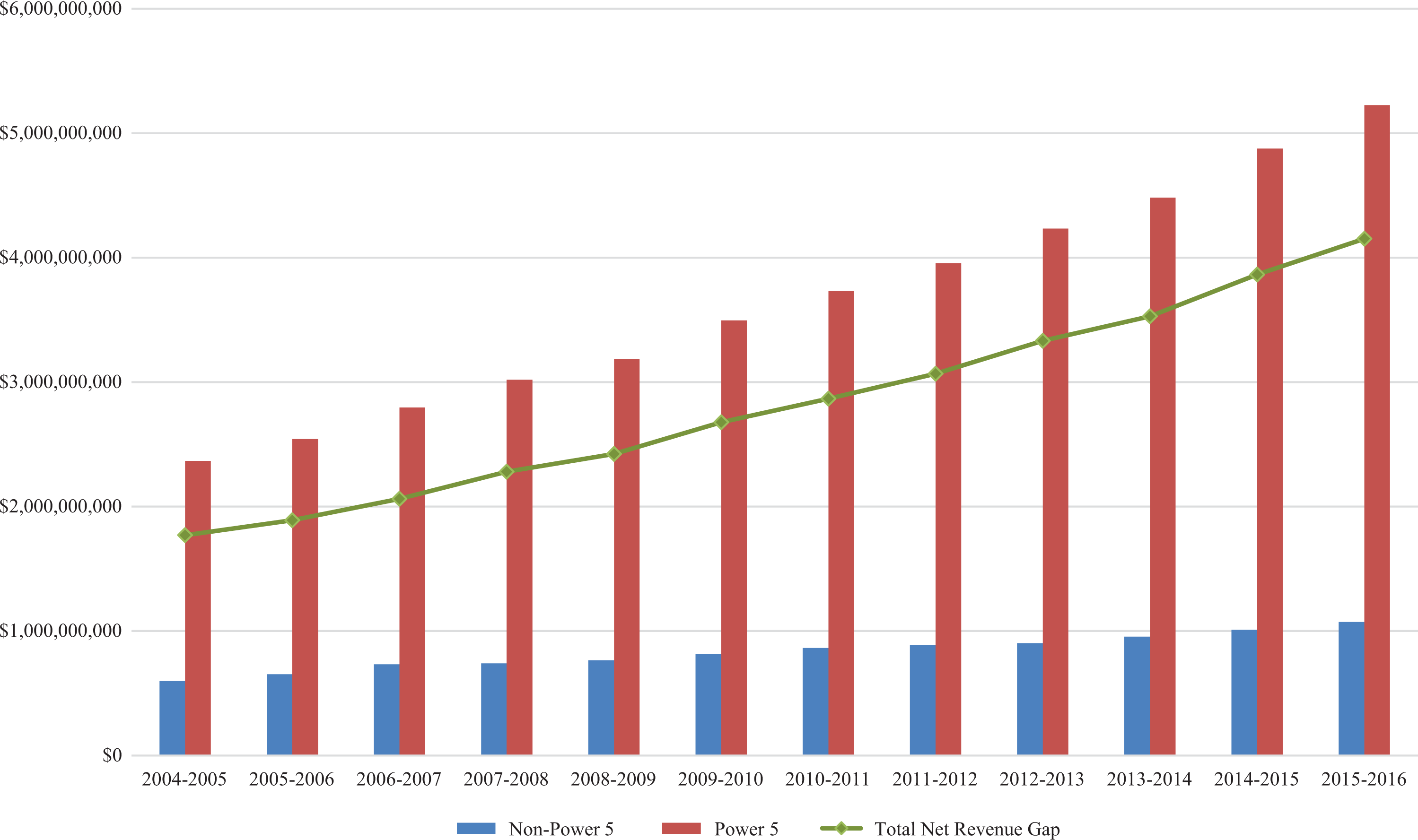
Net revenues for non-Power 5 and Power 5 conference members total, NCAA Division I public universities. Non-Power 5 public schools outnumber Power 5 conference members by over 3-1. 2015–2016 data based on 171 non-Power-5 schools and 52 Power-5 members. Source: USA Today NCAA finances database.
The per-school average net revenue figures underscore the divergence between P5 and NP5 schools. While in 2004–2005, the average P5 public university outgained the average NP5 by $41.6M per year, the per-school gap more than doubled to $94M by 2015–2016. Examining each school’s three main external revenue sources, rights and licensing, ticket sales, and contributions, we observe that each category favors the P5 schools by margin often exceeding an order of magnitude. As Table 4 shows, not only is the margin significant, but the CAGR over the last twelve years is greater for P5 schools than NP5, indicating that the gap between dominant NCAA cartel members and the rest is widening.
Annual Selected Sources of Revenue, P5 Versus NP5.
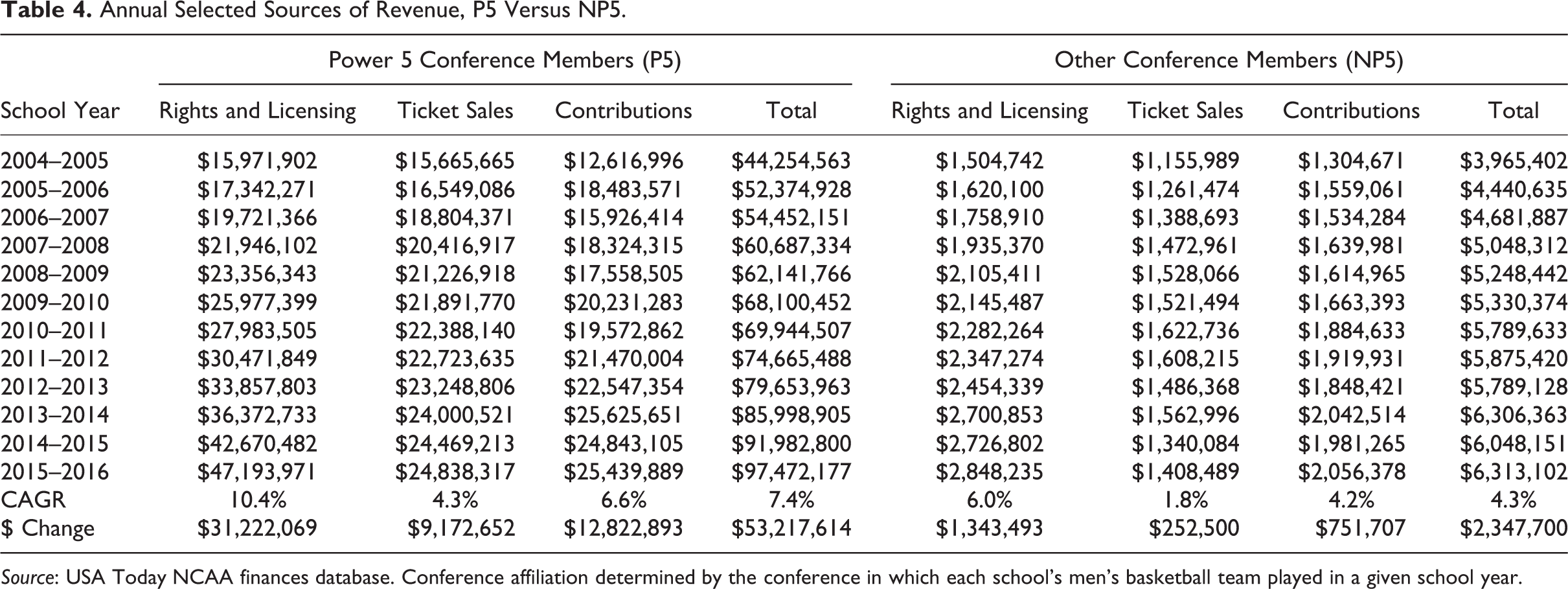
Source: USA Today NCAA finances database. Conference affiliation determined by the conference in which each school’s men’s basketball team played in a given school year.
The separation between the “haves and have-nots” in athletics does not limit itself to the dichotomy between P5 and NP5 members. Even within the P5 conferences, separations have emerged, driven largely by football revenues. As Figure 5 indicates, the top football conferences, SEC and Big Ten, have separated themselves from the remaining three conferences over the last five years. Together, the SEC and Big Ten conferences reported 46% of the total revenues of all NCAA D-I public universities, according to the USA Today NCAA finances database.
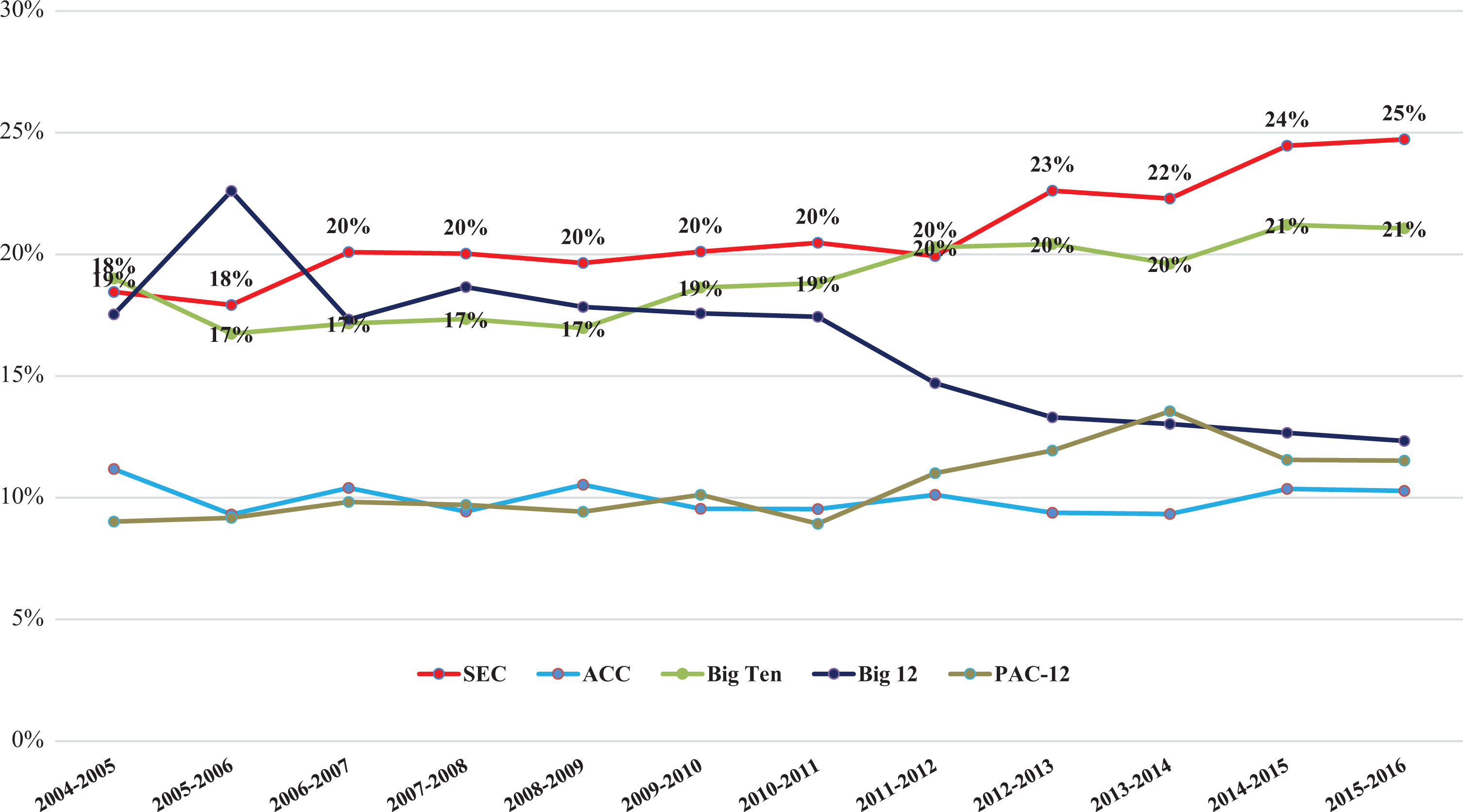
Contributions of total NCAA D-I athletic revenues originating from each Power-5 conference (public universities). Source: USA Today NCAA finances database.
At an individual school-level example, Washington State University reported the least athletic revenue among all P5 schools. Though Washington State is a member of the P5 PAC-12 Conference, deficit spending has caused the athletic department to owe $67M to the university, which has invested approximately $100M over the 2005–2016 time period in its athletic program.
5. Foreclosure
The concern over foreclosed sales in the tied market as the barometer of a tying restraint’s anticompetitive effects represents the normative assessment that firms should not be able to leverage power in one market to restrict competition in a separate market where their product would not achieve the same success on its merits. The Supreme Court’s opinion in Jefferson Parish assumes that, absent an anticompetitive restraint, the achievement of market power in the tying market is predicated upon some “justifiable advantage.” Assuming such an advantage exists, the Supreme Court’s per se tying rule prohibits firms from leveraging this advantage to foreclose competition in a different market through a tying arrangement, as such a restraint can result in the unwarranted success of a “potentially inferior product” in the tied market. Where athletic success of NCAA member institutions, primarily those in the dominant P5 conferences, forecloses sales in the educational market from institutions that would have otherwise prevailed on academic merits, the per se tying rule is violated. To wit, when postsecondary institutions with dominant athletics programs leverage the advertising benefits achieved through athletic success to gain an advantage in the educational market by obtaining enrollment that would have otherwise gone to other institutions, this outcome would appear to be a prima facie violation of current tying jurisprudence. 154 To be specific, this article argues that postsecondary institutions with dominant athletic programs, which are almost exclusively members of the P5 conferences, foreclose a portion of the academic market from weaker rivals in the athletics. To a lesser extent, weaker rivals within the NCAA Division I also foreclose some sales from academic rivals outside of the NCAA umbrella or in lower divisions.
Earlier studies, such as McCormick and Tinsley,
155
Bremmer and Kesselring,
156
and Mixon
157
offered mixed results regarding the effects of success in intercollegiate athletics on the postsecondary academic market. However, several more recent studies have indicated a positive relationship. Pope and Pope
158
found evidence that both football and basketball success can have a sizable impact on the number of applications a school receives “in the range of 2–15%, depending on the sport, level of success, and type of school.” Anderson
159
used data on bookmaker spreads to estimate probability of winning each game then used a propensity score design to condition on these probabilities and estimate the effects of winning on donations, applications, and enrollment. The results showed that “winning reduces acceptance rates and increases donations, applications, academic reputation, in-state enrollment, and incoming SAT scores.” Chung used market-level data to control for various factors that affect an individual’s choice of postsecondary education and found that, …when a school goes from being mediocre to being great on the football field [defined as going from four to ten wins in a season], applications increase by 17.7 percent. To achieve similar effects, a school would have to either decrease its tuition by 3.8 percent or increase the quality of its education by recruiting higher-quality faculty who are paid 5.1 percent more in the academic labor market.
160
The adversarial nature of sports contests implies that advertising one’s success in sport concurrently demonstrates one’s overall superiority over other universities in direct competition. One might expect, therefore, that the impact of athletic success on an institution’s student enrollment will be a zero-sum game. In other words, to make one school better off from athletic success in enrollment terms, other school(s) must necessarily become worse off, other things equal. Further, if the college attendance decision is nested, the allocation of athletic success among participants in the market for undergraduate education suggests Pareto efficiency exists with respect to enrollment. Nesting implies that the choice of college is conditional on first deciding to apply to college and incur the associated costs, then, once the decision is made to attend, the next choice is the destination. Athletic success would affect an individual’s decision of where to go but not whether to go or not. 164 Assuming that athletic success affects the decision of where prospective students choose to enroll, then the impact of one university’s athletic success on its own enrollment would then come at the expense of other institutions’ decreased enrollment.
a. The Raising Rivals’ Costs Foreclosure Paradigm
Among NCAA members, the advertising effects of high-profile intercollegiate athletics not only serve to enhance a university’s brand but, as Salop and Scheffman 165 explain, also to raise the costs of disadvantaged rivals.
The raising rivals’ cost (RRC) foreclosure paradigm used to analyze potential anticompetitive effects arising from vertical restraints such as ties focuses on the ability of the tying firm to raise prices to consumers in a relevant market, an outcome that Krattenmaker and Salop, two of the theory’s most respected proponents, describe as gaining “power over price.” 166 In the NCAA case, tying athletics and academic allows D-I members to use the latter as justification for raising the price to athletes for participation in intercollegiate athletics above what would otherwise likely be negative price for many. As a result, cartel members gain power over price. Likewise, the tie enables members to levy athletic fees on the general student body, again raising the price of university attendance even to consumers who may neither participate in intercollegiate athletics nor have any interest in such activities. Dominant cartel members with ample generated revenue sources such as television rights and licensing have little need to raise athletic funds from student fees. Nonetheless, having raised their smaller rivals’ costs such that these rivals must charge significant athletics fees to their student population, even the most dominant programs can then raise their own fees, justifying them as comparatively small next to those of NP5 conference members. Texas A&M may have no need to every levy its approved $75/year student fee, yet it could justify it by comparison to Virginia’s $657 annual fee, which is nearly an order of magnitude higher. In other words, by raising rivals’ costs to the point where they are able to raise their own prices to students and justify it as comparatively less of an increase, Texas A&M and other athletics revenue-rich schools have obtained power over price under the RRC foreclosure paradigm.
b. Comparative Dynamics and the Athletics Arms Race
The process through which dominant NCAA members raise the costs of less athletically successful institutions and members’ responses to the actions of their rivals points to the existence of a dynamic relationship. The choices of individual agents based on relative performance criteria and/or the basis of their own historical experiences represent a class of decision rules commonly known as comparative dynamics. 167 Under this paradigm, institutions learn not only from their own behavior but also by observing others’ actions the impacts of those actions on their own performance. Such imitative learning behavior has resulted in what some have termed the athletics “arms race” in which colleges and universities, particularly those with top athletics programs, compete to build increasingly lavish facilities and hire the highest profile coaches as an indirect means of gaining a recruiting advantage. Hoffer et al. 168 identified two types of competitive behavior, a “naïve equilibrium” case where the athletic department principal acts independently of any future actions that rivals may undertake and a “sophisticated equilibrium” where the principal considers such rival actions in the institution’s own welfare-optimizing decision. Testing the sophisticated (closed-loop Nash) equilibrium using a spatial econometric model with total athletic expenditures and coaching salary expenditures as dependent variables, the authors’ results “support the idea that universities take their conference rivals’ behavior into account, suggesting that the competitive behavior among rival institutions is sophisticated and evidence of an athletics arms race exists.”
Under the NCAA model, such imitative dynamics certainly do not represent a winner-take-all game. Nor do they guarantee the winner will take anything. Rather, they resemble to some degree the paid search results from generalized second price auctions on search engines. The auction results determine the order in which the paid advertisements appear on a search results page, yet this does not ensure that the winner will take all, most, or any of the click-throughs or the sale conversions, just as spending the most on athletic facilities does not guarantee recruiting victories. However, a distinguishing characteristic is that the NCAA restricts on scholarship squad sizes in football and basketball, a limit not present in paid search results where little or no incentive exists to limit click through rates or conversions. Nonetheless, just as advertisers’ competition for positions in search results affect each other’s costs, so does the imitative dynamic relationship between universities, particularly among in-conference and in-state competitors, raise rivals’ costs.
c. Estimate of Foreclosed Sales in Tied Market
The concept of foreclosure in the context of leveraging market power in the tying intercollegiate athletics market to increase sales in the tied higher education market suggests that a tying arrangement enables schools to gain revenues or sales in the tied academic market at the expense of their rivals. As explained previously, such leveraging raises costs among universities who struggle to gain the exposure of actual or potential rivals with high-profile athletics programs but may not be able to do so on their academic merits alone. The expenditure of billions of dollars in institutional funding for athletics at many universities where such departments are low-profile at best represents a diversion of funds that could have otherwise been used more efficiently to support the university’s mission.
To the extent that tying by dominant P5 cartel members compels rivals to divert funds from the tied academics market or raise prices to students, this restrains the ability of universities in the tied market to compete. The foreclosed universities include both lower-profile NCAA D-I members and non-NCAA schools. 169 Where athletics fees are levied on the student body, evidence indicates such fees result in decreased enrollment. Using IPEDS data from 1991–1992 to 2006–2007 on all reporting four-year public institutions in the United States, Hemelt and Marcotte found that “Evaluated at the means (approximately $4,200 tuition and enrollment of 10,700), a $100 increase in tuition and fees would lead to a decline in enrollment of approximately 25 students, or a little more than 0.23%.” 170 The overall elasticity of total headcount was −0.0958, but this figure was more pronounced (−0.2142) for Tier 1 research universities and (−0.2505) for Top 120 universities in the U.S. News rankings. Such results indicate that athletics fees levied on the general student body, primarily by less athletically successful institutions, foreclose sales through reduced enrollment in the tied academics market.
In Table 5, I use the regression results from Hemelt and Marcotte to estimate the enrollment impacts on individual public schools in Division I over the eleven-year period from 2004–2005 to 2014−2015. The data show that the athletic fees levied on students resulted in a loss of approximately 140k enrollees and $784M in lost tuition revenues. To put these figures in perspective, at the average undergraduate student body of 13k, the lost tuition is sufficient to cover the entire undergraduate tuition for one D-I public institution of average enrollment for nearly eleven years. The formulas I applied for lost enrollment and tuition appear below:

and,

Where:
LE = lost enrollments; FPU = athletic fees per undergraduate, defined as total fees levied/No. of undergraduates; NTF = in-state tuition and fees net of athletic fees; UGD = No. of undergraduates; LT = lost tuition; TF = in-state tuition and fees; TD = Percentage tuition discount obtained from IPEDS/Delta Cost Center data.
Elasticity = the coefficients obtained from the Hemelt and Marcotte log-log models. I applied the respective elasticities reported above based on whether the institution was ranked in the top 120 in the U.S. News & World Report rankings or was classified as a Tier 1 research university based on the 2010 Carnegie scores. If neither criterion was met, I applied the overall elasticity reported.
These resulting lost enrollment and lost tuition calculations presented in Table 5 are likely understated, because, as the formula above indicates, they reflect the use of in-state tuition. One might expect that higher tuition costs would render out-of-state students even more cost-sensitive to fee increases. Losing out-of-state enrollment would have a greater financial impact on public institutions, given the disparity between in-state and out-of-state rates. Nevertheless, these results indicate that a substantial number of sales, as measured by enrollment numbers and the corresponding tuition, have been foreclosed by the imposition of athletic fees resulting from the tying arrangement. As such, evidence indicates that the NCAA’s tying arrangement, far from representing a procompetitive justification, meets the three prongs of the Supreme Court’s bifurcated rule of reason, causes antitrust injury, and should be enjoined.
Impact of Student Athletics Fees on Enrollment and Tuition, 2004–2005 to 2014–2015 (NCAA D-I Public Institutions—Totals by Conference) Using Hemelt and Marcotte (2011) Elasticities.
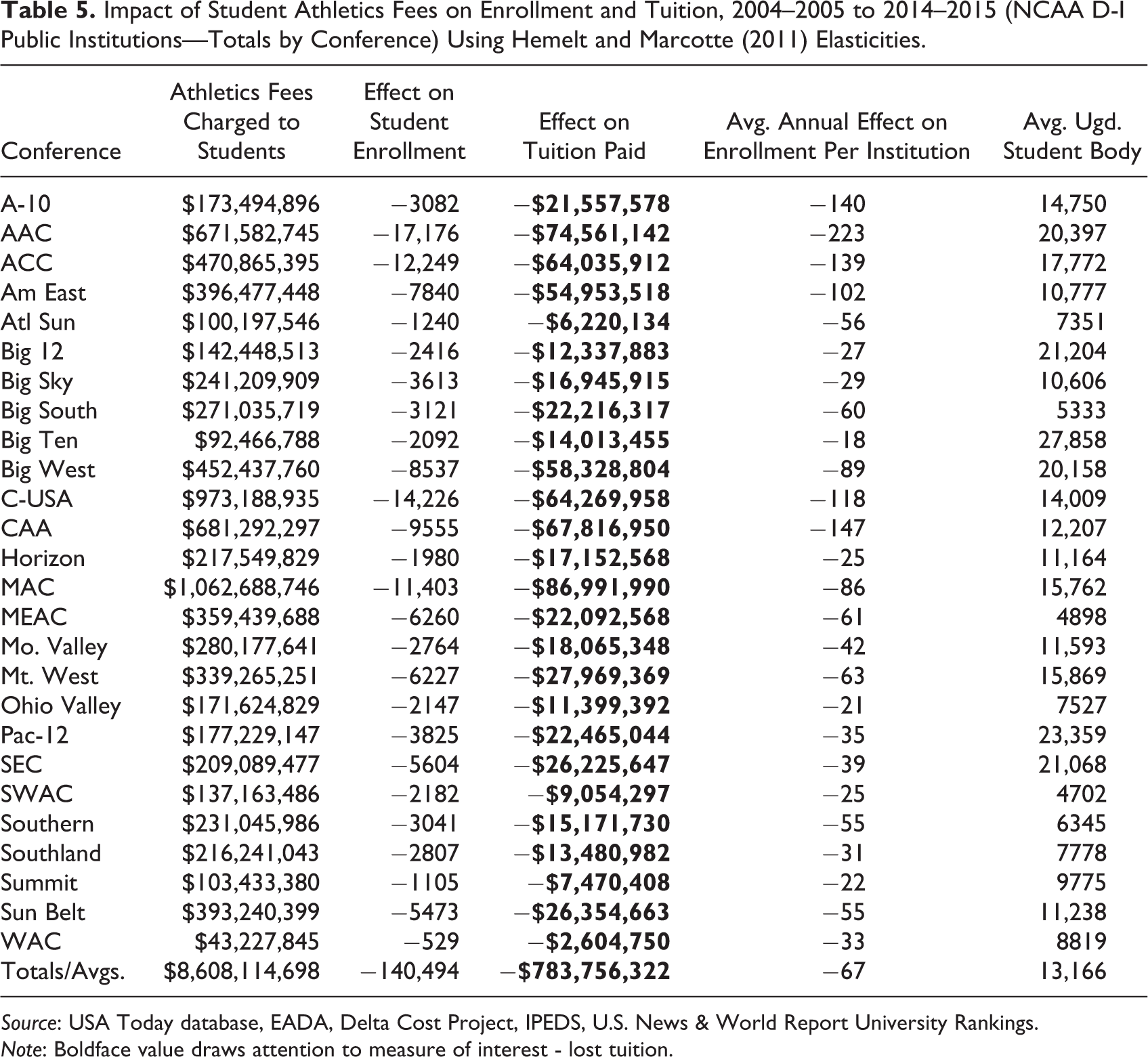
Source: USA Today database, EADA, Delta Cost Project, IPEDS, U.S. News & World Report University Rankings.
Note: Boldface value draws attention to measure of interest - lost tuition.
V. Conclusion
The NCAA claims that the integration of athletics and academics under its model of collegiate “amateurism,” regardless of its shifting definitions over time, justifies its restraint on athlete compensation. This article challenges that justification and argues that the NCAA’s model represents an unlawful tying restraint that violates the Supreme Court’s “quasi”-per se tying rule. Previous litigation and antitrust arguments have taken the bundled tie of the athletic and academic product as a marketplace reality, rather than questioning its compliance with antitrust law. The Board of Regents case, now nearly thirty-five years old, has continued to offer the NCAA a palladium from condemnation in antitrust, labor, and athlete injury cases. The superficial argument that “eligibility laws are presumptively procompetitive” has found fertile ground in various courtrooms across the nation, two notable exceptions being the district court and 9th Circuit’s opinions in O’Bannon, both of whom properly rejected it as mere form where substance is required. Indeed, as the 9th Circuit correctly noted, if the mere label of “eligibility bylaw” were the sole requirement for a presumption of procompetitiveness to exist, nothing would prevent the NCAA from placing any rule it wanted under the eligibility section, thus shielding it from antitrust scrutiny.
I argue that evidence from actual world transactions, rather than abstract theoretical constructs, informs the existence of separate markets for intercollegiate athletics and postsecondary academics, two distinct goods whose bundling under the NCAA collegiate model has been mistaken for a single unitary product. The existence of separate markets, coupled with the NCAA’s market power in the tying market and the presence of foreclosed sales, should result in condemnation of the NCAA’s collegiate model as unlawful under the current bifurcated rule of reason or quasi-per se rule.
This article also offers implications for public policy. Every nation in the world, save the United States, has eschewed the simultaneous integration of athletics and academics under an NCAA-type model. The preservation of this model of “amateurism,” and the labor exploitation it engenders, has no economic justification. Its erroneous perception as a “revered tradition” is nothing more than mirage and its justification based on its temporal longevity grants it no more merit than bankrupt arguments favoring the prohibition of interracial marriage in Loving v. Virginia. 171 As the Supreme Court observed in Obergefell v. Hodges, 172 “History and tradition guide and discipline the inquiry but do not set its outer boundaries.” Even recognizing such guidance, the “tradition of amateurism” is characterized by shifting definitions, a comparatively minuscule time period relative to the marriage issue in Obergefell, and an increasing divergence between substance and form. Few are so removed from reality as to fail to notice the increasing commercialization of intercollegiate athletics and the benefits accrued to virtually all but the labor. The detrimental effects of this “tradition” do not restrain themselves to athletics. Coupled with the imposition of funding cuts to higher education, they contribute to the fundamental shift in the view of the undergraduate student not as a pupil to be educated but as a customer to be served in return for a financial reward to the institution. Modern society publicly funds education based on the assessment that it generates positive welfare returns. An educated population promotes the social welfare. Some of that benefit can be readily measurable through the increased pay that may be commensurate with the acquisition of higher skills, and some that manifests itself through positive externalities. Far from embracing and supporting this goal, the NCAA’s model of amateurism imposes both anticompetitive restrictions and harms the educational mission of postsecondary educational institutions in the United States.
Footnotes
Acknowledgments
I would like to thank Mike Carrier and Mark Glick for comments on an earlier draft of this paper. All errors and omissions are the sole responsibility of the author.
Declaration of Conflicting Interests
The author(s) declared no potential conflicts of interest with respect to the research, authorship, and/or publication of this article.
Funding
The author(s) received no financial support for the research, authorship, and/or publication of this article.