



Abstract
Although the Consumer Welfare doctrine has served as an important feature of antitrust liability since the 1980s, the Department of Justice (DOJ) and Federal Trade Commission (FTC) have downplayed this factor in their respective Google and amended Facebook complaints. Each complaint makes a general reference to this issue, but with few detailed factual allegations. A complicating factor is that the defendants have gained dominant market positions by providing valuable digital services at little or no direct charge to consumers. In this paper, we emphasize that the services offered by the two platforms embody quality as well as price dimensions, both of which can affect consumers positively. Indeed, quality product dimensions may become even more important to consumers in a zero price environment. We construct a simple economic model using privacy as a significant quality attribute through which these issues can be explored, and then draw some appropriate policy conclusions.
I. Introduction
The doctrine of Consumer Welfare has been an important feature of antitrust liability for four decades. Since the path-breaking volumes of Robert Bork and Richard Posner in the 1970s, 1 a finding of harm to consumers has generally been assumed a necessary component for successful antitrust litigation. While the DoJ Google and the FTC Amended complaints 2 include references to this issue, the agencies are confronted with the reality that the defendants gained their dominant market shares by providing valuable services at little or no direct charge to consumers. As could be asked when the Google complaint was filed: “What is the consumer harm when Google’s search service is free?”
There is a clear response to this question. Consumer welfare is not just about setting low consumer prices. It also embodies the welfare gains from quality competition. Indeed, that form of competition may be even more important in a zero price environment, such as that served by Google and Facebook, where different dimensions of quality become the only means to distinguish one platform from another. Quality competition supports consumer preferences for product features and characteristics, and also enables consumer choice as between high quality–high priced items and their lower priced–less valued alternatives. The mere fact that a product or service is offered with no monetary charge does not mean that consumer welfare is optimal or cannot be improved through enhanced competition.
On this issue, a 1985 Supreme Court decision is particularly relevant. In Aspen Ski,
3
as in the complaints against Google and Facebook, the conduct at issue was alleged to have exclusionary effects, and the question before the Court was whether that conduct was sufficient to trigger Section 2 of the Sherman Act. The Court continued, We are concerned with conduct which unnecessarily excludes or handicaps competitors. This is conduct which does not benefit consumers by making a better product or service available.
4
Among the factors to be considered was “the effect of the challenged pattern of conduct on consumers.” 5
The Court ruled that “consumers were adversely affected by the elimination of the 4-area ticket,” 6 which was the exclusionary conduct at issue. The decision cited evidence and testimony to this effect, and affirmed a jury verdict for the Plaintiff. An important similarity of that case to the Google and Facebook complaints is that price effects were minimal in the Aspen Ski case just as they are in the current matters.
Despite this precedent, a striking feature of the two recent complaints is the minimal attention paid to questions of consumer welfare. While obligatory passing references are made to that issue, they are fleeting and little evidence is alleged. On this point, the Google Complaint is telling. Only a single paragraph is used exclusively to address this issue, which takes the form of a single sentence: By restricting competition in general search services, Google’s conduct has harmed consumers by reducing the quality of general search services Including dimensions such as privacy, data protection, and the use of consumer data, lessening choice in general search services, and impeding innovation.
7
There is no supporting evidence offered; just a simple, conclusory allegation.
The amended FTC Facebook complaint pays more attention to consumer effects but even there the allegations are limited. Compressed into a single paragraph, there are allegations that “competition benefits users [through] . . . innovation . . ., quality improvements . . . [and] consumer choice.” 8 Again few details are mentioned in connection with Facebook’s acquisitions. If the Agencies had more detailed evidence to offer on prospective consumer harm, would they not have included it in their complaints?
It is noteworthy that neither platform moved to dismiss their complaint on grounds that it had not sufficiently alleged consumer harm. The antitrust agencies may have believed that, unlike private plaintiffs, they do not need to demonstrate consumer harm to establish a Section 2 violation. Strikingly, nearly all appellate court decisions emphasizing consumer welfare concerns have appeared in private cases. And also, the Supreme Court sustained in 1990 an FTC finding of antitrust liability where there was no real consumer connection to the illegal conduct. 9
In most circumstances, when a charge of monopolization is levied, the presence of consumer harm can be inferred from the higher prices the monopolist sets, even though it is the exclusionary conduct rather than the monopolistic prices that triggers Section 2 liability. Thus, in the most substantial Section 2 case brought in the current era, 10 DoJ focused on the company’s efforts to exclude a potential rival who could undercut the high prices charged for its Windows operating system.
For both Google and Facebook, however, no such price effects are anticipated since the companies have long set zero prices for their services. Their business plans were to create valuable digital services and provide them to all prospective users without charge in order to secure valuable data on users’ interests and tastes. Even if the companies had excluded potential rivals, consumer prices would likely have remained at zero.
Both Google and Facebook are highly profitable companies so their charging a zero price has apparently increased their profitability by making their services more attractive to more consumers. Both companies have found means to monetize their customer base so they can profit from increased quantities. That being so, any residual consumer harm is not associated with the common standard of depressed quantities.
In many respects, Google and Facebook have followed a business plan developed earlier by both major newspaper chains and the original television networks. While the former charged a minimal price, the latter charged none at all. Instead, they monetized their large audiences through the sale of advertising messages. But there was competition among major newspapers and television networks in most geographic markets, and so competitive problems were limited. Not so for their current successors: Google and Facebook are dominant providers in their product areas on an essentially global basis. Their monopolization charges relate to their market conduct and structure, but whether they also impose consumer harm remains an issue.
II. Consumer Information as a Valuable Asset
Although consumers make no monetary payment for the valuable services supplied by Google and Facebook, that fact does not mean they provide little of value to the platforms. In both cases, users supply particularly useful information about themselves. In return for Google’s search services, consumers provide detailed data on their preferences and interests; while for Facebook, there is extensive information on their families, friends, and associates. And all this is offered without additional charge to the companies but in return for the search and networking services received. For many consumers, this exchange is made without them even being aware that their personal data can be “harvested” by the platforms. Indeed, as recently stated, these data include the “digital trails of personal and professional activities—activities that were previously conducted in private and left little or no trace.” 11 Although modern economies rarely employ large barter exchanges, the trading of one good or service for another, that form of exchange appears here on a vast scale. Without money or financial assets involved, items of considerable value are traded: personal information for digital services.
Historically, most individuals have not considered their personal information an asset with monetary value; but the major information platforms have made it so. Indeed, for many consumers, perhaps most, this exchange is hardly recognized; but even if it were, it might still be considered a “bargain.” Most retail transactions leave a trail as sellers keep records of past purchases; and consumers think nothing of it. Their valuations of this form of personal information may be effectively zero, and besides their selections were but one or a few out of millions. But the new technology, and the popularity of the information platforms, have made those views obsolete. In large measure that is because the platforms can aggregate, sort, and summarize the harvested data into formats valuable to advertisers and others. Along with the new technology has come the enhanced value of unsorted consumer data, and the appearance of firms who exchange “free” products or services for potentially valuable data. 12 Google and Facebook are only the most prominent examples.
If personal information is so valuable, could it be worth more than the implicit value of the “free” services received? Indeed, an individual’s personal information may become much more valuable precisely because of the platforms skill in aggregating and sorting millions of data points. Google and Facebook serve as aggregators of underlying personal data; and it is this aggregated but detailed information which has become the source of the platforms dominant economic positions.
An important reality is that consumers lack effective property or other legal rights attributed to their personal data. While sellers have long acquired detailed information on their own customers, the platforms have accelerated this process and created enormous data sets that are the source of their considerable wealth. And they don’t need to share their wealth with their customers who lack effective legal rights to their own personal information.
As Economides and Lianos point out in an interesting discussion of these issues, there are different legal regimes which could potentially secure the protection of personal information. 13 The first is the creation, perhaps by statute, of contractual rights that give consumers the ability to veto the use of their personal information unless they consent and/or receive an agreed-upon amount. On the other hand, liability rules could provide compensation for any harm imposed by use without authorization, although it could prove difficult for consumers to quantify and prove their damage claims. 14
Many consumers may not even be aware they are providing something of value which potentially could be the source of additional compensation. They are of course free now to reject the platforms’ digital services and thereby retain their personal information; and there are indications that increasing numbers of users are leaving Facebook due to privacy concerns. 15 Apparently, for some of these users, the utility gained from the use of the digital services falls short of their concern over the disclosure of personal information.
Various consumers complain, either directly or through their representatives, about the lack of privacy. While that term is often difficult to define, we can find a specific meaning from interactions between information platforms and their customers. When individuals complain about the disclosure of personal information, that statement could mean that (1) they believe such disclosures are inappropriate and should not be necessary, and/or (2) they feel they are not being compensated sufficiently for their personal information. In this discussion, the demand for greater privacy is tied to the consumer’s valuation of the disclosed information.
III. Product Attributes and Product Quality
Most products embody an array of dimensions or attributes. These factors are valued according to buyers’ preferences and not always subject to objective standards. Matters such as fashion or color or design are the subject of individual taste more than of objective determination. So it is, to some degree, with software products where one user’s array of preferred options is another’s bewilderment at the range of choice and the difficulty of finding his or her accustomed settings.
Consider the textbook model of Vertical Product Differentiation in which consumers agree that certain product attributes are preferred, but differ on their valuations. 16 Largely as a matter of taste, some consumers value the improved quality levels associated with particular attributes more highly than others do, and therefore are willing potentially to pay more for a higher perceived quality level. Consumer preferences can thereby determine their product valuations.
A relevant attribute is the condition of sale, which in reference to the barter arrangements indicated above, describes the personal information required as payment for platform services. Since a platform user’s legal rights are not well defined, there is invariably uncertainty as to how the personal information inherent in using a platform’s services will be employed unless it is covered in the terms of service which the user may have agreed to when signing up for the platform’s services. In that case, the user has effectively agreed with whatever privacy controls are included with the platform services.
Whether actual disclosure of individual preferences is possible depends on the extent to which his or her information is aggregated with sufficient controls to prevent disclosure. While the data used and acquisition process can be tailored to fit the needs of large numbers of customers, there invariably are some platform users for whom privacy issues are critical. In the absence of effective legal rights over personal information, it may be inevitable that privacy concerns arise. Particularly since consumer differences on this matter may be wide, some consumers will find themselves left with no option other than to stop using the digital services if they feel sufficiently strongly about the loss of privacy.
Much depends on the terms of the barter arrangement between platform and customer. Where privacy concerns are paramount, the aggregation process can insure that individual records cannot be deciphered. However, as data sets become increasingly disaggregated to better reflect individual decisions, privacy concerns are likely to increase.
Today’s consumers are offered the binary choice of whether to use the platform or not—whether the platform’s service is so valuable that it is worth sacrificing some degree of privacy to use it? Digital services have both positive and negative features such that a consumer’s choice depends on their individual balance between them. To formalize this concept, consider an individual’s “reservation price” for the service which describes his or her maximum “willingness to pay” for the digital product rather than do without. It represents a price because, hypothetically, if the seller charged a monetary price for the item, the consumer would purchase it only if his or her reservation price exceeded that amount. With a zero price, the consumer uses the digital service with any positive reservation price; or in other words, when the positive valuation of the features offered exceeds any negative privacy concerns.
Since the perceived quality of digital services depends on user perceptions, it is closely tied to individual’s reservation prices. The greater the utility/quality of the digital product, the higher the related reservation price. A low-quality product is one for which individuals would not pay much, while a high-quality product is one which commands a substantial price. In the analysis below, we measure the perceived quality of digital services by consumers’ associated reservation prices.
IV. A Simple Economic Model of Product Quality
Since neither side of the barter transactions at issue here involves money, user valuations of both sides of the contract are relevant as there are two sets of reservation prices that determine outcomes. The first measures users’ valuations of the digital services provided and the second is reflected in the monetary value of the data sets produced by the platforms. Both are included in the total societal gains from consumers’ use of the platforms, although only the first is related to privacy concerns. Our attention is directed at consumer valuations.
Consider the spectrum of consumer reservation prices which reflect their valuations in either barter or monetary transactions. As suggested above, these implicit prices indicate perceived quality levels even in the absence of monetary payments. They describe the willingness to pay for digital services which include a platform’s specific privacy controls. Presumably, some individual consumers would willingly pay less for the product if these controls were weakened.
For users of a specific platform with particular controls in place, we let there be a substantial distribution among users in the importance attributed to privacy concerns. While some users may place great importance on privacy, others might not mind widespread distribution of their personal information as compared with their value of the “free” services provided. These valuations are reflected in user reservation prices for the digital services offered, with those valuing the product higher having a higher reservation price for the digital service. Where quality levels for these services depend on consumer valuations, reservation prices may vary widely.
See Figure 1 where consumer reservation prices are arrayed on the vertical axis and their associated quantities on the horizontal axis; and let privacy controls be the product attribute at issue. In this setting, we hold constant all other dimensions of platform performance, such as for example speed and accuracy. A direct implication of this model is that user reservation prices fall as perceived quality levels decline.

Quality demand curve.
This quality demand schedule, given by D1, describes the locus of user reservation prices such that if a hypothetical price were charged for these services, the total number of users is given by the corresponding point on the horizontal axis. Where consumer reservation prices equal P1, the highest possible quality level is attributed to the product with no diminution on account of privacy concerns. In that case, the associated quantity of prospective users is q0. However, as these concerns become increasingly important to individual customers, their reservation prices decline until eventually the total number of additional customers using the digital services falls to zero at q1. At the conventional zero monetary price, the final (marginal) reservation price would then also equal zero, with the total number of users set at q1. In these circumstances, the marginal consumers are defined by those with privacy concerns that just equal the benefits gained from using the digital services.
In this discussion, we assume that platforms have established privacy controls with attention paid to their average users’ concerns. However, they are also responsive to the market value of the aggregated data sets, which might decline if privacy controls were strengthened since more revealing data are more useful and thereby more valuable to marketers and other data users. In such circumstances, the platforms’ profitability calculations invariably balance the preferences of their users at the privacy margin of q1 against the preferences of their data set customers. Critically, only users at that margin influence platform decisions, who are those who would not have used the platform without the specific controls in place. These users determine the location of the horizontal intercept in Figure 1.
To explore this matter further, let the platform consider imposing additional privacy controls which would appeal to many but not necessarily all of its users, and which lead to higher perceived quality levels and higher reservation prices for many users. This proposed strengthening in privacy controls is indicated by shifting the quality demand curve upward and to the right.as represented by D2 in Figure 2. The new schedule may or may not have the same intercept as before, depending on whether the particular quality improvements impact the reservation prices of those users least concerned with privacy issues.
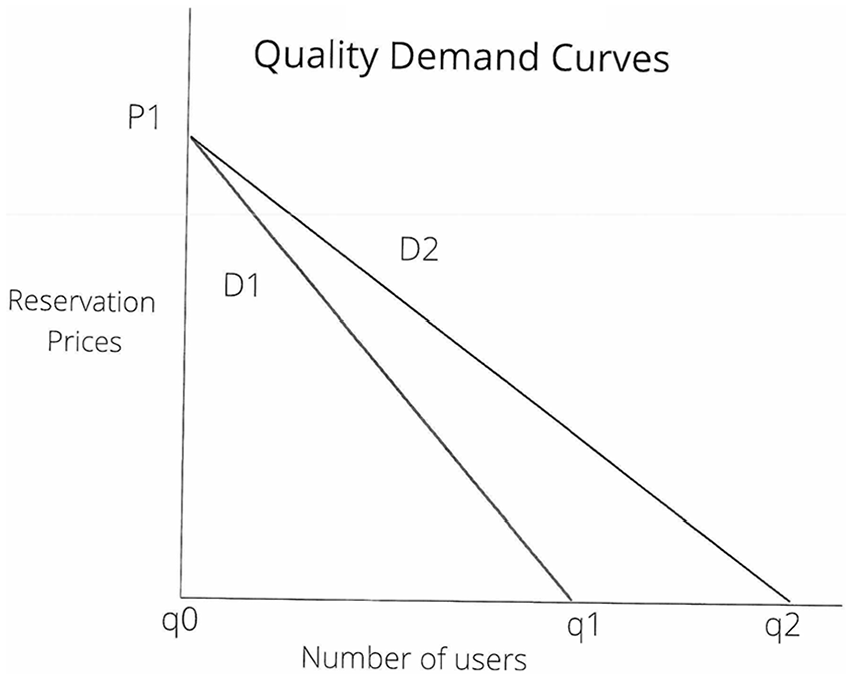
Quality demand curves: Alternate Curves.
We assume in Figure 2 that any enhanced privacy controls do not impact q0 users so the vertical intercept is unchanged. However, we also assume that greater privacy controls will attract a number of additional users and thereby shift the horizontal intercept from q1 to q2. And with a greater number of users, the platform’s consumer data sets become larger and more valuable.
For the information platforms, the total number of users drives profitability. That number also drives consumer welfare. Increased consumer surplus is represented by the area between D2 and D1. Consumer gains are then composed of two segments: the original q1 number of users receive higher quality products, reflected in their increased reservation prices, but also an additional number of users, represented by the increase (q2 − q1), find quality levels sufficiently improved to now accept the revised barter arrangement and provide personal information in return for access to the digital services.
To be sure, there may be increased platform costs associated with the proposed quality improvements. Increased attention to user privacy concerns may require additional costs. In these circumstances, one encounters the distinction between private and social calculations. The former turns on the higher profits resulting from the increased number of users resulting from quality improvements. In contrast, social optima follow from net benefits to all users as reflected in increased consumer surplus resulting from enhanced privacy controls. There are thus two distinct measures of value, both of which can be compared with the additional costs incurred.
In contrast to profit calculations which are determined entirely by marginal calculations, optimal societal quality levels are impacted by the net gains received by all users, infra-marginal as well as marginal ones. Largely on that account, Spence concluded that private monopolies do not generally establish quality levels for their products or services that are most preferred by consumers. 17 As indicated in Figure 2, the required conditions for Spence’s dictum apply as well to monopolistic information platforms. Infra-marginal and marginal users together are indicated by the entirety of Q2 users, while marginal users alone are those found only between Q2 and Q1.
These theoretical concepts lead to an important conclusion: that the major information platforms cannot be relied upon to provide optimal quality levels in regard specifically to desired privacy controls. Michael Spence’s dictum applies to the dominant information platforms in a zero price environment.
V. Adding Competition to the Model
The discussion above was limited to a single firm responding to a diverse set of customers. Our conclusion, following Spence, is that there was little reason to expect that the most desired quality levels are set for the digital services provided. At this point, we add a second firm to the model, while retaining the zero price environment, and consider how quality levels might be impacted.
To be sure, expected outcomes will depend on user responses to the rival platforms. However, making a few stylized assumptions suggests possible outcomes. Consider an entrant who offers enhanced privacy controls but without the widespread acceptance of the established platform. Under such circumstances, the entrant’s quality demand curve would have a lower vertical intercept but a larger horizontal intercept, as indicated in Figure 3. For potential users, reservation prices are lower for those less concerned with privacy issues. In contrast, the entrant’s enhanced privacy controls lead its quality demand curve to have a larger horizontal intercept. These circumstances are indicated by an entrant’s quality demand schedule represented by D3 in Figure 3. By assumption, the entrant offers greater privacy controls although many consumers stay with the established platform. Under these conditions, the firms divide the market: the larger share (q0 + qd) remain with the incumbent firm; while the entrant, providing improved privacy controls, attracts (q3 − qd) users. By offering improved quality, the entrant gains market share under the condition that the established firm does not respond.
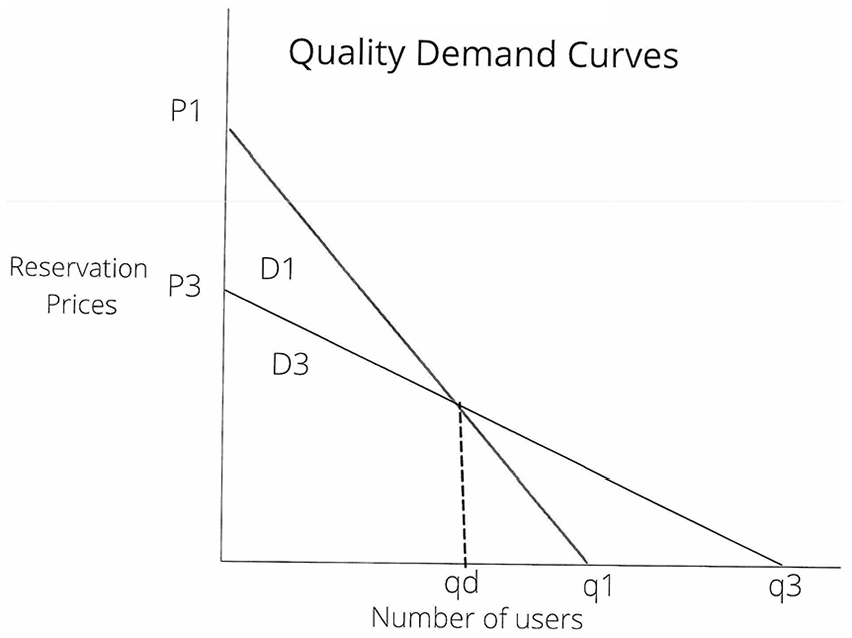
Quality demand curves: Alternate Suppliers.
In the hypothetical circumstances set forth in Figure 3, a zero price structure is retained in which most users remain with the original platform. The users attracted to the new platform are those with higher valuations of enhanced privacy controls and thereby higher product reservation prices associated with the resulting improved quality levels. They include those who had used the original platform and also new users attracted by the greater controls. And the total number of users is expanded with the second group of users. Those who switched must have higher perceived quality levels for the entrant’s product than for the original supplier. Under these presumed circumstances, the enhanced consumer surplus is indicated by the area between the two demand curves for quantities exceeding qd. As anticipated, consumer welfare is improved with the appearance of the second platform.
This model is strongly incomplete. There is no consideration given to the likely response of the original platform to the entrant’s appearance nor of prospects for reaching an equilibrium outcome. However, the model does suggest circumstances where competitive entry can promote consumer welfare even in a zero price environment. Where rival platforms may have different attributes, as invariably they do, and where different consumers view these attributes differently, the presence of rival platforms provides greater space for individual preferences to be satisfied. Since privacy concerns surely differ among users, the presence of rival platforms expands the prospect that a greater range of preferences will be satisfied. Consumer welfare is thus enhanced by the presence of rivals and harmed by their absence.
VI. Privacy Concerns
In a zero price environment, quality competition is central to both consumer welfare and entrepreneurial success. Among them, particularly for the dominant information platforms, are user concerns for the privacy of their individual data. There are two relevant dimensions of privacy controls: the first concerns the security of personal records, and the second turns on how widespread is the use of the resulting data sets.
A recent national poll of adult internet users reports that fully 80% would like online services such as Google and Facebook to collect less individual data. 18 But whether Americans are willing to pay these platforms a monthly fee to maintain greater privacy of their personal records is a different matter. When a possible charge is mentioned, only 27% are reported willing to pay for digital services which did not collect and disseminate personal data. 19 Unfortunately, this report does not mention the amount of the proposed charge which is also relevant.
While there is still a substantial minority of internet users willing to pay a fee to maintain the privacy of their actions and preferences, this disconnect is telling. Many Americans may believe that privacy is an inherent right of the citizenry and not merely a commodity to be purchased.
A recent university report also supports that approach.
20
From a 2015 national public opinion survey of 1500 internet users, the authors report the following conclusions: 91% disagree (77% strongly) that “if companies give me a discount, it is a fair exchange for them to collect information about me without my knowing.” A majority of Americans are resigned to giving up their data—and that is why many appear to be engaging in trade-offs. Resignation appears when a person believes an undesirable outcome is inevitable and feels powerless to stop it. A large pool of Americans feel resigned to the inevitability of surveillance and the power of marketers to harvest their data.
21
Many Americans apparently believe that privacy is not a commodity but rather an inherent right that should not be relinquished and need not be paid for.
In the analysis above, we consider privacy controls an important dimension of product quality that lowers the reservation prices of many Google and Facebook users. Not only has Facebook lost an estimated 15% of its users on account of privacy concerns 22 but also Google faces an expanding rival, Duck Duck Go, that has sought “to carve out a niche for itself among privacy-minded internet users.” 23
More platform controls lead directly to greater privacy of personal data. That there is a wide disparity in these preferences is evident from the data presented above. Having more than a single platform with different sets of controls would enhance consumer welfare. That judgment is little more than finding societal gains resulting from diverse quality levels associated with divergent consumer preferences.
VII. Implications for Antitrust Policy
There is an important distinction between price and quality competition that is relevant for antitrust enforcement practices. To the extent that consumer welfare remains an important policy objective, this distinction should be acknowledged and embodied in the standards employed. For price competition, that task is readily accomplished since consumers commonly prefer the lowest possible prices for specific products whether offered by one supplier or many. In that context, the number of suppliers may not be critical unless associated with lower prices.
In contrast, for quality competition, the calculus is less direct. Quality levels commonly affect costs with higher quality products associated with higher prices, and lower quality goods with lower prices. Moreover, some consumers may prefer the higher quality–higher price “bundle” while others prefer the lower quality–lower price alternative. In that case, there is no one preferred alternative, and no single most-preferred solution for policy standards. The appropriate policy goal is instead to promote alternatives from which consumers can select.
That distinction is particularly relevant in the case of the large information platforms. Because the digital services are provided without monetary charge, there are no low prices to be sought. What remains are the products and their inherent quality attributes. In this case, as the simple model presented above exemplifies, consumer welfare is advanced by the presence of alternate platforms, each with inherent quality differences. While that simple model does not capture much detail in the complicated environment faced by the platforms, it suggests that consumers gain from the presence of available alternatives with different quality features. And the model does emphasize that quality preferences are likely customer-specific.
What the model also suggests is that promoting less concentrated structures in which rivals compete over quality attributes provides consumer benefits. In these circumstances, policy efforts which protect the competitive process are also those which promote consumer welfare. To be sure, the presence of network effects and the advantages of larger networks is a countervailing factor also affecting reservation prices for individual platforms. Privacy concerns are not the only factors affecting platform quality.
Consumer welfare is promoted by enhanced quality competition even in markets characterized by zero price regimes. Indeed, zero pricing makes quality competition central to consumer welfare. Government monopolization cases often challenge exclusionary conduct pursued by dominant firms. That conduct is found in contractual arrangements, as charged in the DoJ Google complaint, or in acquiring potential competitors as alleged in the FTC Facebook complaint; or by other means as well. Whatever the vehicle of exclusion, the core antitrust presumption is that new competitors lead to improved consumer welfare, whether through setting lower prices, increased quantities, or accelerated rates of innovation. There is no reason to abandon this traditional presumption in zero-priced monopolistic platform markets, where quality issues matter and enhanced antitrust enforcement can promote consumer welfare. 24
Footnotes
Acknowledgements
We are grateful to H.E. Frech for very helpful comments on earlier drafts.
Declaration of Conflicting Interests
The author(s) declared no potential conflicts of interest with respect to the research, authorship, and/or publication of this article.
Funding
The author(s) received no financial support for the research, authorship, and/or publication of this article.
1.
2.
U.S. et al. v. Google LLC, Complaint Dkt. (D.DC, 2020) (Google complaint); Federal Trade Commission v. Facebook, Inc., Amended Complaint Dkt. (D.DC. 2021) (Facebook amended complaint).
3.
Aspen Skiing Co. v. Aspen Highland Skiing Corp., 472 U.S. 585 (1985).
4.
Id. at 597.
5.
Id. at 605.
6.
Id. at 605.
7.
Google complaint, supra note 2 at 53.
8.
Facebook amended complaint, supra note 2 at 73.
9.
F.T.C. v. Superior Court Trial Lawyers Association, 493 U.S. 411 (1990). The victim of the price-fixing “strike” by a small group of lawyers was the District of Government, whose political leadership was sympathetic to efforts of low paid public defenders to increase their compensation. Any increased payments obtained for their services were paid by the government. See Donald I. Baker, The Supreme Court Trial Lawyers Case: A Battle on the Frontier between Politics and Antitrust, in Antitrust Stories 257–86 (E. Fox & D. Crane, eds., New York, Foundatiion Press, 2007).
10.
United States v. Microsoft Corp., 253 F. 3d 34 (D.C. Cir. 2001).
11.
Acquisiti et al., The Economics of Privacy, 54 J. Econ. Lit. 444 (2016).
12.
Id. at 473–75.
13.
Nicholas Economides and Ioannis Lianos, Restrictions on Privacy and Exploitation in the Digital Economy: A Market Failure Perspective, 17 J. Competition Law Econ. 25 (2021).
14.
Id. at 25.
15.

16.
Jean Tirole, The Theory Of Industrial Organization (MIT Press, 1988).
17.
M. Spence, Monopoly, Quality, and Regulation, 6 BELL J. ECONOMICS 417 (1975).
18.
19.
Id.
20.
Joseph Turow et al., The Tradeoff Fallacy: How Marketers Are Misrepresenting American Consumers and Opening Them Up to Exploitation, Annenberg School Of Communication, University Of Pennsylvania (2015), https://repository.upenn.edu/cgi/viewcontent.cgi?article=1554&context=asc_papers#:~:text=New%20Annenberg%20survey%20results%20indicate,tradeoff%20for%20benefits%20they%20receive.&text=Resignation%20occurs%20when%20a%20person,feels%20powerless%20to%20stop%20it.
21.
Id. at 3–4.
22.
Jagannathan, supra note 15.
23.
24.
See our companion article for a discussion of more detailed antitrust proposals. We propose various ways through which competition can be improved in digital platform markets, particularly with supplemental antitrust legislation. Donald I. Baker and William S. Comanor, A U.S. Antitrust Agenda for the Dominant Information Platforms, 35 Antitrust 66–71 (2021).