



Abstract
EU and U.K. antitrust are contingent upon rigorous enforcement and the imposition of sanctions. Hard enforcement is key; antitrust loses its effect when it does not “bite.” Soft instruments (non-adversarial, informal) and negotiated penalty settlements may be used, but authorities are expected to exercise self-restraint. This article reveals that despite the prevalence of hard-enforcement rhetoric, the vast majority of actions taken by the European Commission (1958–2021) and German, Dutch, and U.K. antitrust authorities (2004–2021) were not fully adversarial. The hard-enforcement actions, moreover, were confined to limited practices and sectors. Despite the prominence of non-fully adversarial instruments in Europe, and in striking contrast to the United States, only limited attention was devoted to their existence and implications. Urging to take a hard look at soft enforcement and negotiated penalty settlements, the article systematically records the enforcement instruments and their particularities, questions their effectiveness, and calls to align enforcement theory to practice.
In October 2018, the (then vice) president of the General Court of the European Union (GC), Judge Marc van der Woude, heavily criticized the Dutch competition authority for “losing its bite.” 1 In a speech in front of the Dutch Association of Competition Law, he noted that the authority has hardly issued infringement decisions or imposed fines for (EU and national) antitrust infringements. Instead, the authority devoted much of its efforts toward soft enforcement actions, such as issuing informal opinions, warning letters, and negotiated remedies.
This overreliance on soft enforcement, the Judge maintained, goes against the very foundations of the EU enforcement system. Referring to the ECN+ Directive Proposal, 2 he observed that antitrust rules “do not have teeth” where the European Commission (Commission) and national competition authority (NCAs) do not impose effective sanctions for non-compliance. By neglecting to adopt formal infringement decisions, the Dutch NCA marginalized its function and threatened its credibility. 3
Yet, favoring soft over hard enforcement is far from being a unique Dutch phenomenon. This article provides empirical evidence demonstrating that despite the strong prevalence of hard-enforcement rhetoric in EU and U.K. antitrust, various European antitrust authorities, including the Commission itself, have directed the vast majority of their enforcement efforts toward soft enforcement and non-fully adversarial negotiated penalty settlements (that is, leniency and/or settlements). 4 To this end, the article surveys all of the published public enforcement actions of the European and national prohibitions on anticompetitive agreements issued by the Commission (1958–2021) and the German, Dutch, and British NCAs (May 2004–2021). 5 It illustrates that while the enforcement is founded on a hard-enforcement rhetoric, such strategy has become the exception. The enforcement overwhelmingly relied on cooperation and negotiations between authorities and firms.
The predominance of non-fully adversarial enforcement may come as a surprise; modern EU and U.K. antitrust systems are founded on a deterrence-based approach, assuming that law compliance is to be achieved primarily by issuing infringement decisions and imposing high fines following an adversarial process. 6 Such a paradigm was an important driver behind the reform of EU antitrust enforcement at the turn of the millennium. Abandoning the previous compliance-based approach, Regulation 1/2003 calls to focus the Commission’s and NCAs’ scarce resources on pursuing and punishing the most serious antitrust violations and increasing the number of infringement decisions. 7
At the same time, EU and U.K. antitrust laws provide only little guidance on the appropriate selection of enforcement targets and instruments. Antitrust authorities are generally not required to report how they allocated their resources or justify their choices. Expected to exercise self-restraint, it is assumed that authorities are not tempted to use non-fully adversarial instruments to gain short-term benefits or to promote their reputation, rather than pursuing the long-term societal interest. 8
Moreover, despite the central role of soft enforcement and negotiated penalty settlements in EU and U.K. practice, thus far only limited attention was devoted to their study. In stark contrast with the extensive attention given to hard enforcement, the existence and implications of the non-fully adversarial instruments are underexplored and underreported. There has been little or no indication of how often such enforcement instruments are being used, whether such instruments are becoming more or less prevalent, what kind of cases they are being used in, and if and how the outcome of each case is affected by the chosen instrument. Such indications are missing from the authorities’ annual reports, the Commission’s reports assessing the functioning of the European Union’s multi-level enforcement system, the discussion preceding the ECN+ Directive, and from academic literature. 9 While the Commission’s growing reliance on soft enforcement and negotiated penalty settlements was observed, 10 especially in connection to commitment decisions, 11 only a few have systematically mapped the practice or evaluated its implications. Such studies, furthermore, focused on a single instrument or mostly on EU-level enforcement by the Commission.
The limited debate over antitrust enforcement strategies is striking when compared with the vast American scholarship on non-fully adversarial instruments. 12 Soft enforcement and negotiated penalty settlements have won fierce praise as well as strong criticism in the United States. Although the American experience immensely inspired the development of the European instruments, it is not directly transposable. Important differences remain in the practicalities of the instruments and the broader enforcement environment. 13 One key difference pertains to the role of private enforcement. In the United States, public soft enforcement is accompanied by rigorous private hard actions. In the European Union, by comparison, there is no possibility of bringing private actions in front of the EU Courts. Despite the gradual increase in the number of private actions launched in front of national courts, 14 such actions are almost exclusively limited to follow-on cases relying on public enforcement (98% of the cases as to 2021). 15 Imposition of fines by the Commission and NCAs, therefore, is the primary measure to ensure that EU and U.K. antitrust will “bite.”
This article offers four contributions. First, it explores the law enforcement theories guiding hard and soft enforcement and negotiated penalty settlements. After presenting the methodology in Part I, Part II discusses the risks and promises of each strategy. Part III focuses on the theory of EU antitrust enforcement. It undercovers the transformation in the narrative and aims: the historical reliance on soft enforcement; the calls for reform toward the turn of the millennium; and the shift to the hard-enforcement paradigm.
Second, the article systematically records the frequency (quantitively) and particularities (qualitatively) of the enforcement instruments in the European Union and the United Kingdom, offering a robust basis for assessing current practices. Part IV first examines the Commission, revealing a gap between its hard-enforcement rhetoric and the reliance on non-fully adversarial instruments in practice. It shows that not only was there no increase in the number of infringement decisions (as was expected by the reform), but that the Commission continued to follow a compliance-based approach and introduced new non-fully adversarial instruments. Part V turns to national enforcement. It demonstrates that soft enforcement and negotiated penalty settlements were central to the efforts of the German, Dutch, and U.K. NCAs. Moreover, negotiation and compromise were sometimes explicitly favored as a national enforcement strategy.
Third, the article discusses the normative implications emanating from the gap between the hard-enforcement aims and rhetoric, on one hand, to practice on the other. Part VI submits that this gap may stand in the way of achieving both (hard) deterrence and (soft) compliance. It points to some indications suggesting that the reliance on soft enforcement and negotiated penalty settlements may have failed to cultivate an environment in which firms fear a significant risk of enforcement upon engaging in anticompetitive behavior, and detracts from the firms’ incentives to effectively cooperate with the authorities. This part also argues that the form and characteristics of the soft instrument employed by the Commission and NCAs failed to realize their potential and that many of the implications of the enforcement strategies are underreported and unexplored. The above, it is argued, hinders the proper assessment of the effectiveness of EU and U.K. competition law and the success and legitimacy of the antitrust authorities’ enforcement efforts, and results in enforcement that is incompatible with the enforcement theory enshrined in EU and U.K. primary and secondary law and jurisprudence.
Finally, the article concludes by calling to align enforcement theory to practice. There is no magic formula guiding the ideal number of infringement decisions or the proportion between hard enforcement, negotiated penalty settlements, and soft enforcement. The optimal level of deterrence, furthermore, is an economic-empirical question going beyond the scope of this article. Nevertheless, Part VII maintains that enforcement theory should guide the allocation of the antitrust authorities’ enforcement efforts and communications, the selection of instruments and form of publication, and the creation of a balanced and transparent portfolio of cases, for which the authorities are accountable for.
I. Methodology
The database guiding this study was comprised by applying systematic content analysis on all public enforcement actions of the EU prohibition on anticompetitive agreements (Article 101 of the Treaty on the Functioning of the European Union (TFEU)) and the national equivalent provisions (Part 1 of the German Act against Restraints of Competition, Section 6 of the Dutch Competition Act, and Section 1 of the U.K. Competition Act). Inspired by Legal Realism, systematic content analysis of legal text is an empirical methodology used to analyze a large body of legal text in a structured and replicable manner, by defining and “coding” common variables appearing in judgments, decisions, or public announcements. 16
The database includes enforcement actions published in any form (formal decision, informal opinion, press release, or mentions in the authorities’ annual reports) and using any enforcement instrument (infringements decisions, findings of inapplicability, settlements, formal or voluntary commitments, decisions not to investigate a potential infringement or to terminate an investigation, and informal guidance referring to the conduct of a specific firm). The prohibition on anticompetitive agreements, equivalent to the U.S. Federal prohibition on unreasonable restraints of trade (Section 1 of the Sherman Act), was chosen as a subject of study because it was the key focus of EU and U.K. antitrust enforcement over the years. 17
For the Commission, the database covers all enforcement actions issued since the establishment of the European Communities in 1958. For the NCAs, it covers actions taken following the entry into force of Regulation 1/2003 on May 1, 2004, which was the first to provide NCAs significant enforcement powers. The cut-off date for this study is decisions adopted before the 31st of December 2021 and published prior to May 31, 2022.
The Commission was chosen as a subject of study given its immense influence on the development of European antitrust law and policy. Germany, the Netherlands, and the United Kingdom were selected (1) to reflect a range of law enforcement strategies; (2) by established, active, well-funded, and respected authorities; and (3) given the discretion of those NCAs to select their enforcement targets and instruments. The United Kingdom was an EU Member State during most of the relevant time period of this study, leaving the Union on January 31, 2020. As elaborated below, the findings on the British approach and practice are unlikely to be significantly affected by Brexit, at least in the short term.
II. Theory: Between “Hard” and “Soft” Enforcement
Gaining compliance with the law, as observed by the rich literature in the field of regulatory law enforcement, is typically not simply achieved by formal enforcement and prosecution. There are a host of informal enforcement techniques, including education, advice, persuasion, and negotiation. 18 Reiss famously distinguished between two approaches to law enforcement: a deterrence-based approach, in which adversarial prosecution and imposition of penalties discourage law violations, and a compliance-based approach, applying soft and non-binding measures to gain compliance. 19 The use of those two approaches differs across authorities and jurisdictions. Yet, almost all regulatory authorities make use of both, at least to an extent. 20
The EU Treaties do not spell out the antitrust enforcement strategy or instruments. Article 101 TFEU is neutral as to whether a deterrence- or compliance-based approach should be employed. By the same token, whereas the European Court of Justice (ECJ) has always declared that enforcement aims to prevent violation of the law, 21 it did not detail how this aim should be achieved. At the same time, scholars and policymakers stress that effective antitrust enforcement is contingent on a well-balanced enforcement portfolio, in which the selection of instruments is tailored to the characteristics of each case. 22 The following sections explore the attributes of hard and soft enforcement, as well as of a third, intermediate approach of negotiated penalty settlements.
A. Hard Enforcement and the Deterrence-Based Approach
The origins of the deterrence-based approach can be traced to eighteenth-century contributions of classic utilitarian philosophers, such as Montesquieu, Beccaria, and Bentham. 23 Modern variants of this approach are linked to the Law and Economics literature, originating from the seminal contribution of Nobel Prize economist Becker, later adapted to the field of antitrust by Landes. 24 According to the deterrence-based approach, law obedience is not taken for granted; public and private enforcement are necessary both to prevent offenses and to apprehend offenders. Convictions alone, moreover, are not generally considered sufficient. Significant punishment is key to deterring law violations.
In EU and U.K. antitrust laws, like many other forms of economic regulation, punishment normally takes the form of an administrative fine. The enforcement system is expected to create a credible threat that the expected fines would be higher than the expected anticompetitive gains. Put differently, the fine must exceed the expected gain from the violation, multiplied by the inverse of the probability that a fine will be imposed. 25 This enforcement approach, that is, formal findings of infringements and imposition of fines, is labeled in this article as hard enforcement.
Some studies attempted to capture the deterrent effect of hard enforcement in antitrust. A survey among British companies, for example, reported deterrence ratios of twenty-eight cartels deterred per detected by the British NCAs’ investigation, forty for other commercial agreements, and twelve for abuse of dominance. 26 A survey among Dutch companies and their advisers reported a lower deterrence ratio for cartels, amounting to five cartels deterred per detected by the Dutch NCA. 27
Hard enforcement, remarkably, is not only about deterrence. 28 First, as a form of command-and-control regulation, it characterizes many social and economic regulations introduced in the late eighteenth century to facilitate large-scale industrialization (for example, sector and utility regulators, antitrust and environmental agencies). 29 Under command-and-control, regulators fix the applicable standards for certain activities (command) and use the force of the law to prohibit conduct that does not meet such standards (control). In addition to deterring infringements, therefore, the force of the law is used to prohibit certain forms of conduct and demand positive action. Command-and-control regulation is believed to support the rule of law, as it relies upon the use of transparent and precisely formulated legal standards of general application. 30
Second, hard enforcement is said to signal that law violations harm the social order. Fines are not just a “price” to be paid for non-compliance. They also attach a degree of condemnation. 31 This is reflected by the jurisprudence of the EU Courts, emphasizing that the fines imposed for antitrust infringements are not only aimed at deterrence or corrective justice, but also at punishment. 32
Third, hard enforcement is a prerequisite for the development of a body of jurisprudence clarifying the scope of the law. A formal infringement decision resulting from a fully fledged adjudication process is not only important to correct a particular violation or increase general deterrence, but also to explicate and give force to legal rules, interpret the values upon which they are grounded, and bring reality into accord with them. 33 Since only hard-enforcement actions are fully susceptible to judicial review, a steady flow of such decisions is essential for enhancing legal certainty and developing the law. 34 To this end, hard enforcement can also prevent over-deterrence. 35
Finally, hard enforcement is linked to the credibility of law enforcement authorities. In the words of Bernstein, “[o]ne of the critical tests of the effectiveness of a regulatory commission is its capacity to obtain the compliance of persons subject to the regulation and to enforce its regulations against violators. This capacity becomes, in the long run, a primary measuring rod of the ability of the agency to operate in the public interest.” 36 He added that insufficient hard enforcement of laws may render them to “be more honoured in the breach than in the observance.” 37
B. Soft Enforcement and the Compliance-Based Approach
Despite the benefits of hard enforcement, in practice, many regulatory authorities scarcely use their formal enforcement powers. Empirical studies reported that they more often recourse to education, advice, and persuasion. 38 Ayres and Braithwaite famously advocated this approach as a normative strategy. Introducing the pyramid of regulatory enforcement, they sustained that regulators should seek to rely on education and compliance and that escalation to hard enforcement is only appropriate when such strategies have failed. 39
Indeed, hard enforcement is not the only instrument in the antitrust authorities’ arsenal. In the United States, the use of compromise and negotiations in lieu of a full adjudication was introduced to civil public antitrust as early as 1906. 40 Consent decrees 41 entrust the Federal Trade Commission (FTC) and the Department of Justice Antitrust Division (DoJ) to close a case by accepting concessions without determining whether an infringement has taken place or undertaking a market test. Becoming the hallmark of civil public enforcement, in recent years over 90 percent of the cases were settled via consent decrees. 42
On the other side of the Atlantic too, the Commission and NCAs are equipped with a myriad of non-binding, non-adversarial enforcement instruments, such as informal opinions, guidance letters, press releases, 43 and letters or notices warning against a specific possible infringement. They also include negotiated remedies in the form of commitment decisions (Article 9 of Regulation 1/2003, formal commitments) and decisions to close an investigation after the firms agreed to modify their potential anticompetitive behavior (voluntary commitments). 44 The above instruments are collectively labeled as soft enforcement. 45
Soft enforcement, as observed by the ECJ, “pursue[s] different objectives” from hard enforcement. 46 Legal, economic, and social policy theories typically point to six aims of such strategy that are relevant in the field of antitrust:
First, soft instruments reflect a distinct theory of law enforcement. In place of focusing on deterrence and punishment, they use non-punitive measures to foster compliance. 47 Advocates of the compliance-based approach maintain that soft enforcement may be more effective in preventing law violation because it generates less resistance from the regulatee. Its negotiated nature, free from the fear of sanctions, supports a culture of cooperation between firms and authorities, 48 allowing authorities to act as consultants rather than policemen. 49 Differing from the deterrence-based approach, firms are not seen as amoral calculators and law obedience is not exclusively conditional upon their self-interests. 50 A shared commitment to compliance, moreover, may be constructive in the field of antitrust, bridging inevitable information asymmetries between authorities and markets. 51
Second, soft enforcement may strengthen legal certainty. Published and reasoned informal measures can clarify the law as applied in practice, thereby encouraging voluntary compliance. 52 While, as mentioned, hard enforcement is a prerequisite for the development of a body of jurisprudence clarifying the scope of the law and subject to judicial review, informal measures are of particular value to address new legal-economic questions or borderline infringements, where the full force of hard enforcement may be deemed inappropriate.
Third, soft enforcement offers unique legal remedies, unavailable under the hard-enforcement track. 53 For instance, although the Commission may order any behavioral or structural remedy as part of an antitrust infringement decision, such remedy is limited to correcting the infringement and must be proportionate. 54 Soft enforcement, by comparison, is not restricted to what is necessary to bring an infringement to an end. It facilitates a process of negotiation between firms and antitrust authorities, inviting tailored and case-specific solutions without determining if the law was infringed.
In addition to offering a wider range of remedies, this flexibility opens the door to tailor general standards or open-ended provisions of law to fit a particular set of circumstances or changing business and technological requirements, without the need to modify the law. 55 In this sense, soft enforcement shifts antitrust from enforcement-based to a more regulatory nature 56 ; antitrust rules are instrumentalized to meet the objectives of sector-specific regimes. 57 This may be useful from the standpoint of authorities to “address issues that are politically or economically important but legally ambiguous.” 58 As Abel observes, soft enforcement may neutralize economic and social conflict by responding to grievances in ways that prevent their transformation into serious challenges to the domination of state and capital. 59
Fourth, soft enforcement is said to carry procedural economy benefits. 60 Such instruments often neither entail a full-scale investigation nor reach definitive conclusions on matters of facts or law. They are also not subject to the rigid procedural safeguards imposed on formal infringement decisions. The saved resources can be directed to combat other infringements, 61 while providing the authority a quick tool to communicate its position and prevent further harm. 62 To this end, shortening the duration of proceedings may also positively affect the effectiveness of the decision. 63
The limited controls imposed on soft enforcement are vindicated by their consent-based nature. The process of negotiation, the argument goes, transforms the enforcement from a public law paradigm (unilateral, top-down, hierarchical command by the authority) to a private contract-law kind. Both the general public interest and the interests of the suspected infringers are expected to be safeguarded through negotiations. 64 This consent-based nature, in turn, brings additional procedural economy benefits because it justifies a more limited judicial review. Soft enforcement, therefore, overcomes a “war of attrition”; authorities conserve the resources required to manage long investigations over several years and to defend their positions in appeal, especially when well-resourced parties are involved. 65
This was illustrated by the ECJ’s judgment in Alrosa. The Court accepted AG Kokott’s argument that the necessity of negotiated commitments “may be presumed as a matter of course in relation to the interests of the undertaking which has offered the commitments.” 66 Hence, the “extent and content” of the principle of proportionality differ between commitments and hard enforcement. In the former, judicial review is limited to assessing whether the commitments were sufficient to address the competition concerns identified by the Commission. 67 Later jurisprudence extended this obligation also to the protection of third parties’ rights. 68
Whether soft enforcement leads to cost savings is a factual question, going beyond the scope of this study. It is sufficient to note that some have questioned this assumption. Black, for example, noted that effective soft enforcement requires significant resources. 69 Others argued that in the field of EU antitrust, the procedural economy advantages of soft enforcement tend to be overstated. 70 They showed, for instance, that the time elapsing between the initiation of a proceeding and the final disposition of a case is comparable under the hard enforcement and the formal commitments route. 71 Mariniello, in fact, found that adopting Article 102 TFEU commitments took longer than hard-enforcement decisions. 72 Monitoring the execution of remedies attached to commitments, moreover, imposes additional costs. 73
Fifth, soft enforcement may serve authorities’ reputational interests. 74 The limited availability of judicial review mediates the risk that legally or politically sensitive cases will be overturned by courts. In addition, in legal systems where hard enforcement is contingent upon a court’s approval, soft enforcement allows authorities to control the handling and the outcome of a case. 75 This is of relevance for the antitrust authorities following a “judicial model” whereby only a court can adopt an infringement decision and impose fines on the basis of the NCAs’ recommendation (for example, in Austria, Finland, Denmark, Estonia, Sweden, and Malta). 76 While those NCAs do not have the power to adopt infringement decisions independently, they can accept soft remedies without courts’ involvement. 77
Finally, soft enforcement may increase deterrence by assisting harmed parties to detect infringements and bring private action. 78 This feature was labeled in the United States as “sunshine” enforcement. According to this enforcement theory, a public authority may adequately intervene in markets by merely exposing information about anticompetitive behavior. Shining a bright light on such practice, in and of itself, is predicted to force infringing parties to comply with the law. 79
C. Negotiated Penalty Settlements
Negotiated penalty settlements, also known as “transactional resolution mechanisms,” are an intermediate category between hard and soft enforcement. While they comprise of a formal finding of an infringement, the penalty is reduced or waived in favor of admitting to a violation (or to the facts involved) and cooperating with the authority.
Negotiated penalty settlements were introduced to U.S. antitrust in the late 1970s, upon the adoption of the DoJ’s first leniency program. 80 European antitrust systems gradually adopted comparable instruments from the late 1990s. As elaborated below, there are three main forms of negotiated penalty settlements in the European Union and the United Kingdom—leniency, settlements for cartel cases, and settlements for non-cartel cases. 81
First, the Commission’s and NCAs’ leniency programs provide immunity from fines to the first firm disclosing its participation in a cartel and sharing relevant evidence and information. 82 Other firms may receive significant fine reductions upon disclosing their participation and providing evidence of added value, amounting to up to 50 percent according to the Commission’s program. 83 The Commission’s and many of the national leniency programs were heavily inspired by the DoJ’s experience. Yet, they differ in several aspects, and criticized as providing firms less incentives to cooperate. 84
Second, the Commission and some of the NCAs offer settlement programs, granting a fine reduction to all firms admitting to a cartel participation and accepting their liability. The Commission’s settlement program, which was first introduced in 2008, awards a 10-percent fine reduction in return for submission of a formal settlement, recognition of the infringement, the firm’s liability, acceptance of the range of likely fines, and waiver of further access to the file and an oral hearing. 85 Notably, the European settlement programs are not equivalent to American consent decrees: they do not involve bargaining on the scope and details of the infringement or fine; are not subject to a court’s approval; and are separate from leniency, in terms of both their timing and the possibility for a cumulative fine reduction. 86
Third, in 2019, the Commission introduced a new procedure for cooperation in non-cartel proceedings. Inspired by the settlement notice for cartels, it grants a similar fine reduction in vertical and abuse of dominance cases. 87
The above forms of negotiated penalty settlements share some of the characteristics of hard enforcement, as they involve an official finding of an infringement and may be accompanied by a fine, at least for some of the involved firms. Yet, they involve many of the attributes of soft enforcement, as they depend on firms’ cooperation and are non-fully adversarial. Similarly to the promises of soft enforcement, negotiated penalty settlements are expected to provide procedural economy benefits. 88 They can help antitrust authorities to quickly conclude their investigations and render their decisions. Cost savings are also associated with the avoidance of litigation costs. While both leniency and settlements are subject to judicial review in front of the EU and some of the national courts, firms have limited incentives to launch appeals. In addition, akin to soft enforcement, the cooperative nature of such negotiations is also said to reduce the resistance and hostility between the firms and antitrust authorities, thereby helping to promote long-term compliance. 89
Negotiated penalty settlements also lay in between hard and soft enforcement when it comes to deterrence. On one hand, they may contribute to deterrence by increasing the number of detected and punished cartels (that is, the expected detection), thereby positively impacting general deterrence. On the other hand, the waiver or reduction of penalty may significantly reduce the specific deterrence of the apprehended cartel members (that is, the expected punishment). They run the risk that the penalty for an infringement will be lower than the anticompetitive gain. 90
The threat to deterrence is reinforced in EU competition law due to limitations imposed on follow-on civil actions based on negotiated penalty settlements. While civil action is feasible, differing from the American system the information included in the firms’ leniency or settlement submissions cannot be used. 91 The leniency applicant in Europe, moreover, is generally exempted from joint and several liability for the entire harm caused by the cartel. 92
Leniency and settlement programs, therefore, may negatively impact deterrence. 93 For this reason, the ECJ held that they should be reserved to “strictly exceptional situations only,” 94 that is, when the firms’ cooperation has been decisive in detecting and suppressing a cartel, and only so far as the program is implemented in a manner that does not undermine the effective and uniform application of the antitrust prohibition. 95
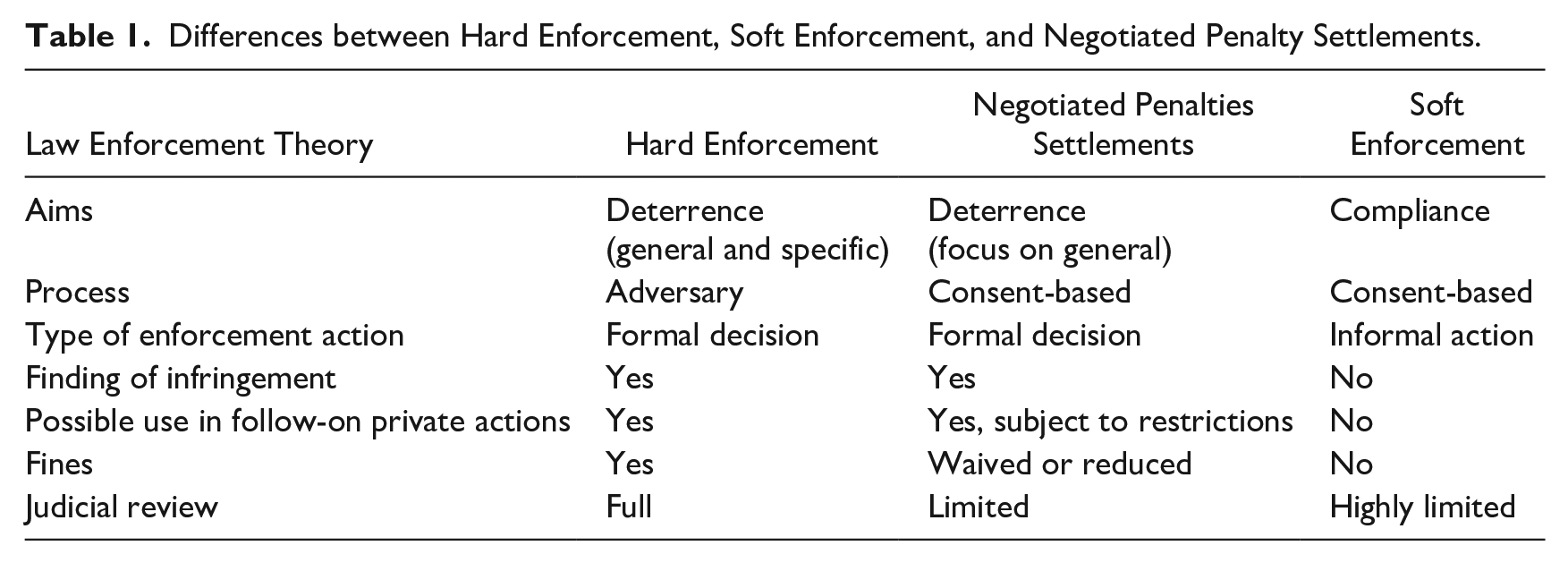
The differences between hard and soft enforcement and negotiated penalty settlements are summarized in Table 1.
Differences between Hard Enforcement, Soft Enforcement, and Negotiated Penalty Settlements.
III. EU Aims and Narrative: Transformation from Soft to Hard Enforcement
EU antitrust enforcement was reformed as part of the “modernization” of antitrust in the early 2000s. This part demonstrates that the aims and rhetoric of the enforcement shifted from placing an emphasis on soft enforcement that is based on negotiation and persuasion to an increase in the number of hard-enforcement actions and imposition of high fines. This narrative is noticeable in contrast to the empirical findings presented in the next part, demonstrating that this rhetoric was not matched by increased hard enforcement in practice.
A. The Old Soft Enforcement Paradigm
The old enforcement framework of Regulation 17/62 strived to prevent antitrust violations by reducing the opportunity for committing infringements. This compliance-based approach prescribed a centralized notification regime, by which all potential anticompetitive agreements had to be notified to the Commission for authorization prior to their implementation. From the early days of EU antitrust enforcement, the Commission and ECJ interpreted the vague wording of the prohibition of Article 101(1) TFEU broadly. As a result, almost every agreement that could have restricted the parties’ commercial freedom, irrespective of the competitive situation of the market, had to be notified to the Commission.
In place of defining a limited and clear scope of prohibited conduct, this system of ex ante controls was based on the Commission’s discretion and a case-by-case assessment: when the Commission considered an agreement to be anticompetitive, it declared its incompatibility with Article 101 TFEU; when it found no ground for intervention, it would issue a negative clearance; and when an agreement fulfilled the conditions of Article 101(3) TFEU, it granted an exemption. Firms enjoyed immunity from fines if they duly notified their agreements, irrespective of the agreement’s content or potential harm to competition. 96
When an agreement was not notified, hard enforcement was permissible. Regulation 17/62 stated that Articles 101 and 102 TFEU infringements must be enforceable by means of fines, and the ECJ emphasized that the Commission has the duty to ensure the deterrent effects of its fines. 97 Yet, in practice, hard enforcement was a secondary strategy. The Commission confirmed that “[t]he aim of an effective competition policy is to have a direct effect on the conduct of undertakings rather than to create a multiplicity of lengthy procedures.” 98 Instead of pursuing all serious antitrust infringements coming to its attention “with the utmost vigour,” the Commission declared it will choose the “appropriate action” in each case. 99
The old enforcement regime was based on the premise that a system of controls—together with stating and clarifying the law via the Commission’s and the EU Courts’ decisional practice—would facilitate voluntary compliance. 100 Even when an anticompetitive agreement was not duly notified, the Commission often refrained from imposing a fine, especially when the antitrust rules on the matter were not fully clear. 101
Although Regulation 17/62 did not explicitly refer to soft enforcement, such instruments were quickly created as a pragmatic solution to combat the administrative workload created by the notification system. Shortly after the Regulation came into force, the Commission was flooded with tens of thousands of notifications, 102 which continued to haunt its docket for many years later. 103 From the early 1970s, the Commission introduced the tool of comfort letters, administrative letters signed by a Commission official stating that no action would be taken against a particular agreement. 104 Such letters were used to handle cases “which at first sight raise no problems with respect to the rules of competition and do not require a formal decision.” 105 Following their issuance, the proceedings were terminated without adopting a formal decision. 106 Comfort letters were not binding on national courts, NCAs, or third parties, yet they constituted a matter of fact that national courts could have taken into account. 107
In parallel to comfort letters, agreements raising antitrust concerns were mostly handled by accepting voluntary commitments. 108 In such cases, the proceedings were terminated after a statement of objection was issued, without finding of an infringement or imposing fines. 109 This enforcement strategy was justified as a means to bring a specific infringement to an end. The Commission stated that its “main aim is to ensure efficiently functioning markets. It is therefore prepared to accept undertakings from dominant companies to achieve this end.” 110
The procedure for accepting voluntary commitments was fully informal, meaning the Commission had no dedicated mechanism to ensure compliance or to protect the rights of third parties. 111 The Commission had also not pronounced clear criteria for accepting such commitments or the appropriate type of cases. Strikingly, the acceptance of voluntary commitments was not made dependent on the seriousness of the infringement. They were used not only to deal with notified agreements involving minor or borderline infringements, but also to resolve serious infringements—such as price fixing, quota agreements, joint selling agencies, and setting the conditions of sale—as well as agreements that were not duly notified. 112 While some investigations were terminated after an agreement was modified, terminated, or expired, 113 similar anticompetitive agreements were subject to hard enforcement and sanctions even if the parties agreed to modify or terminate them. 114
A similar compliance-based mechanism was embedded within the Commission’s non-opposition procedure. In the 1980s and 1990s, some of the European Union’s block exemption regulations specified that agreements containing terms that were neither explicitly exempted nor explicitly prohibited were exempted unless the Commission opposed them within a period of six months. 115 In practice, when an agreement raised concerns, the Commission mostly invited the firms to renegotiate its terms, and terminated the proceedings by soft means of issuing a comfort letter or accepting voluntary commitments. 116
The strategy of favoring soft over hard enforcement under the old enforcement regime is confirmed by Figure 1. 117 The top graph represents the number of soft enforcement actions, in the form of voluntary commitments (dotted area), comfort letters (white area), negotiations within the opposition procedure (black area), and Article 101(3) TFEU exemptions subject to commitments or conditions (gray area). The bottom graph represents the number of infringement decisions (hard enforcement and negotiated penalty settlements 118 ), either with and without fines (black and stripped bars, respectively). The graph covers the period between 1976 and 2004, namely from the first year when the full data on soft measures have been published and until the entry into force of Regulation 1/2003 modernizing the enforcement.
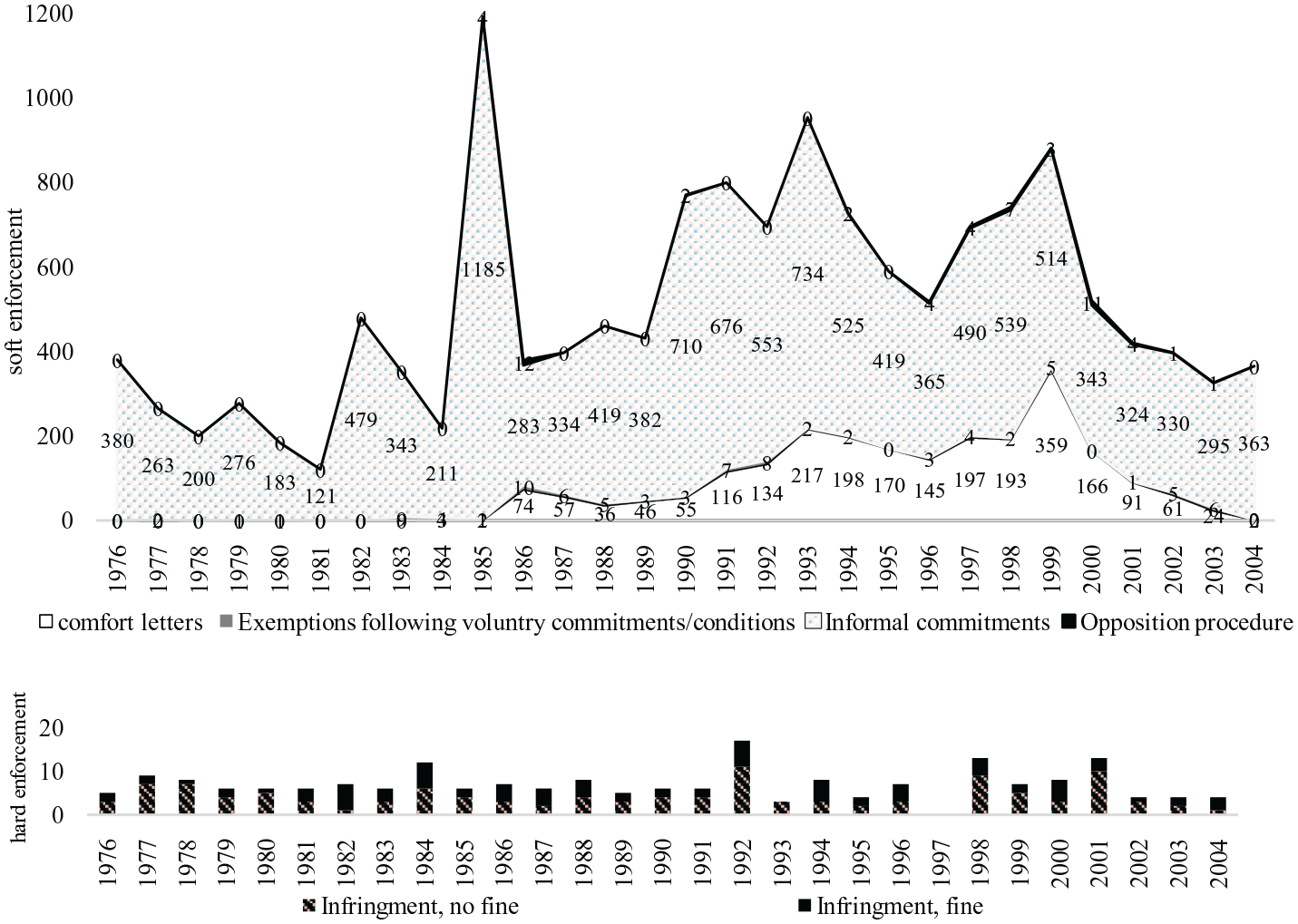
Soft versus hard enforcement under the old enforcement regime, Commission (1976–2004). 119
The figure illustrates that the vast majority of enforcement under the old notification regime took the form of soft enforcement (upper graph). Even in the rare occasions where the Commission opted for a formal infringement decision (bottom graph), it was often not accompanied by fines, thereby considerably limiting its deterrent effect.
The figure also shows that the strategy of favoring soft over hard enforcement guided the Commission well into the 1990s. In 1997, for example, the Commission had not taken a single hard action against an Article 101 TFEU violation, noting that it was able to accept voluntary commitments instead. 120
The Commission regularly justified its compliance-based approach with reference to procedural economy motives. Soft enforcement allowed it “to avoid the preparatory work and procedural delays required for the preparation of decisions once the Commission’s views were clearly established, or when a decision would not have added in any way to existing administrative case law.” 121 Along similar lines, the Commission argued that informal measures enabled a rapid response, as compared to the approximately twenty-four months required for issuing a formal decision (yet, it argued it was impossible to calculate the average period of time for such procedures). 122 The Commission also confirmed that procedural economy motives vindicated soft enforcement even in face of serious restrictions of competition. 123
Notably, the Commission maintained that soft enforcement was particularly warranted in the areas where the law was relatively clear. In such instances, according to the Commission, “it increasingly suffices to draw a firm’s attention to actual or possible infringements of the rules of competition for the offending practice to be voluntarily terminated.” 124 The Commission maintained that “[i]t is much to be regretted” that it must take hard-enforcement actions against practices that have already been clarified via case law. 125 These statements stand in conflict with the theory of law enforcement presented in Part II, by which a compliance-based approach is justified in the face of new or borderline legal-economic questions to strengthen legal certainty, rather than for dealing with intentional infringements when the law is clear.
Commentators suggested that the reliance on soft enforcement could be explained by the relatively low legitimacy of EU antitrust in its early days. Gerber, proposed that emphasizing persuasion and compromise was necessary given the Commission’s weak enforcement tools and cautions political backing to EU antitrust. 126 Temple Lang highlighted that the Commission’s enforcement priorities and instruments valued establishing the legal principles underlining EU antitrust law over correcting the operation of markets. 127 This suggests that politics and lack of legitimacy, rather than enforcement theory, might have contributed to the prominence of soft enforcement.
B. Questioning the Commission’s Approach
Serving as the cornerstone of EU antitrust for many years, from the 1990s soft enforcement was increasingly criticized as ineffective.
First, it became apparent that the Commission’s selection of enforcement instruments was not based on a definite theory. As mentioned, there were no clear criteria for determining which cases were appropriate for soft instruments and which vindicated hard enforcement, resulting in similar types of infringements being subject to different treatments for no apparent reason. The European Parliament, for example, advocated for greater transparency, asking the Commission to provide more information “on the principles and criteria” guiding its strategy so as to “provide more guidance for affected undertakings.” 128
Second, as the choice of soft instruments was neither based on a clear strategy nor bound to a clear procedural framework, such instruments have frequently failed to realize their potential benefits. Comfort letters and voluntary commitments mostly went unpublished, had no binding effect, and could not be challenged in front of the EU Courts. This stood in the way of enhancing compliance by increasing the awareness to antitrust rules, by shedding light on a specific infringement (the “sunshine” enforcement feature), or by clarifying the law as applied to new or borderline legal questions. 129
Finally, the Commission’s enforcement strategy was condemned as costly and ineffective in preventing violations. 130 In the over forty years in which Regulation 17/62 was in force, only nine notified agreements were prohibited without a complaint having been lodged against them. 131 In fact, by the late 1990s, only 0.5 percent of the notified agreements resulted in an infringement decision. 132 The notification system imposed immense costs on both firms and the Commission, 133 and led to directing most of the enforcement resources to agreements raising no or very limited competition concerns, while serious infringements were left undetected.
C. The New Hard-Enforcement Aim and Rhetoric
Around the turn of the millennium, the Commission advocated a dramatic reform to antitrust enforcement. In its 1999 Modernization White Paper, it called for a shift to hard enforcement, as to allow it “to refocus its activities on the most serious infringements.” 134 Instead of directing its efforts to provide comfort to specific agreements, the new enforcement regime of Regulation 1/2003 champions a deterrence-based approach, which is contingent on hard enforcement. The Regulation and the Commission’s policy papers accompanying it emphasize that while the new enforcement system is without prejudice to the power of using soft enforcement in limited and appropriate circumstances (that is, informal guidance 135 and formal commitments 136 ), hard enforcement directed at combating serious infringements should be the primary strategy. Deviating from the Commission’s prior practice, the Regulation declares that soft instruments such as commitments are not appropriate to address by-object restrictions, secret cartels, or cases where the Commission intends to impose a fine. 137
The new enforcement regime was expected not only to refocus the Commission’s enforcement priorities on serious restrictions, but also to significantly boost the number of hard-enforcement actions. The Commission explained in its Modernization White Paper that as it “would be concentrating its attention on the most serious restrictions, the number of individual prohibition decisions can be expected to increase substantially.” 138 This aim was repeated in the evaluation of the reform in 2009 and 2014. 139
The centrality of the deterrence-based approach is also reflected by the rules for calculating fines. While the fining guidelines of 1998 already declared that the level of fines should ensure they have “a sufficiently deterrent effect,”
140
the 2006 version further adds that the Commission will increase the fine when necessary to ensure that it exceeds the improperly made gains. Fines are expected to have a sufficiently deterrent effect, not only in order to sanction the undertakings concerned (specific deterrence) but also in order to deter other undertakings from engaging in, or continuing, behaviour that is contrary to Articles [101] and [102] of the [EU] Treaty (general deterrence).
141
The new hard-enforcement rhetoric was embraced by all EU institutions. 142 The EU Courts emphasized that the antitrust prohibitions are ineffective when their breach is not accompanied by the imposition of fines. 143 Pointing to the “intrinsic link” between prohibitions and fines, the ECJ observed that the imposition of fines by the Commission and NCAs is a precondition for the effectiveness of the rules. 144 In Mamoli and Schenker, the ECJ held that fines are necessary to ensure that antitrust is applied effectively in the general interest. In striking contrast to past practice, the Court explained that while authorities are not precluded from not imposing a fine, such an approach must be reserved for “strictly exceptional situations only.” 145
The shift to a deterrence-based approach was also reflected by EU secondary law, adopted by the European Parliament and the Council. The 2014 Damages Directive is premised on the notion that private enforcement is necessary to ensure the full deterrent effect of antitrust law. 146 The 2019 ECN+ Directive expresses a similar approach. 147 This shift was apparent during the negotiations preceding the adoption of the Directives, where the Commission stressed that hard enforcement “is a central enforcement tool,” 148 a “key aspect” of the EU antitrust regime, 149 and the “most efficient weapon in the Commission’s armoury to fight cartels.” 150 At other occasions the European Parliament noted that although the Commission may issue informal opinions where “clarification is in the general interest,” this should be confined to exceptional cases. 151
The hard-enforcement rhetoric was not limited to enforcement by the Commission. The decentralization of the enforcement, coupled with the imposition of effective fines by a multiplicity of authorities, is deemed essential for strong, effective, and deterrent enforcement. 152 Therefore, the ECN+ Directive requires all Member States to at least match the level of fines imposed in infringement proceedings taking place in front of NCAs to those that can be imposed by the Commission. 153 Moreover, in a bid to ensure the effectiveness of fines, it notes that firms “cannot compete on the merits if there are safe havens for anticompetitive practices, for example, because (. . .) undertakings are able to escape liability for fines.” 154
The shift to a deterrence-based approach at the national level is further reflected by the trend of criminalization of serious antitrust violations by several Member States and/or the imposition of individual administrative sanctions. While criminal enforcement and individual administrative sanctions are not available as a matter of EU law, they may be imposed for the breach of Article 101 TFEU in national courts proceedings. 155
Alongside this clear shift in aims and rhetoric, and despite the importance attributed to hard enforcement in the past twenty years, EU law does not direct or limit the selection of enforcement targets or instruments. The Commission and NCAs are expected to exercise self-restraint in the selection and application of soft enforcement instruments and negotiated penalty settlements, 156 and their strategies and motivations remain mostly hidden. The next parts show that in practice, the Commission and NCAs have adopted diverse enforcement strategies, all in which hard enforcement remains the exception rather than the norm.
IV. Commission’s Practice: Talking the Talk but Not Walking the Walk?
A. Infringement Decisions: Hard Enforcement and Negotiated Penalty Settlements
The hard-enforcement rhetoric—mirrored by the EU Regulations, Directives, jurisprudence, and the Commission’s policy papers—was not matched by a greater number of hard-enforcement actions in the Commission’s practice. The empirical findings indicate that not only was there no increase in the number of infringement decisions (as was foreseen by the Modernization White Paper), but that the Commission continues to follow a compliance-based approach and introduced new instruments of soft enforcement and negotiated penalty settlements.
Figure 2 outlines the total number of enforcement actions taken by the Commission since it rendered its first decision in 1964 and up to 2021. It specifies the number of hard-enforcement decisions (black bars), negotiated penalty settlements (gray bars), and published decisions reporting the use of soft enforcement (white bars). 157
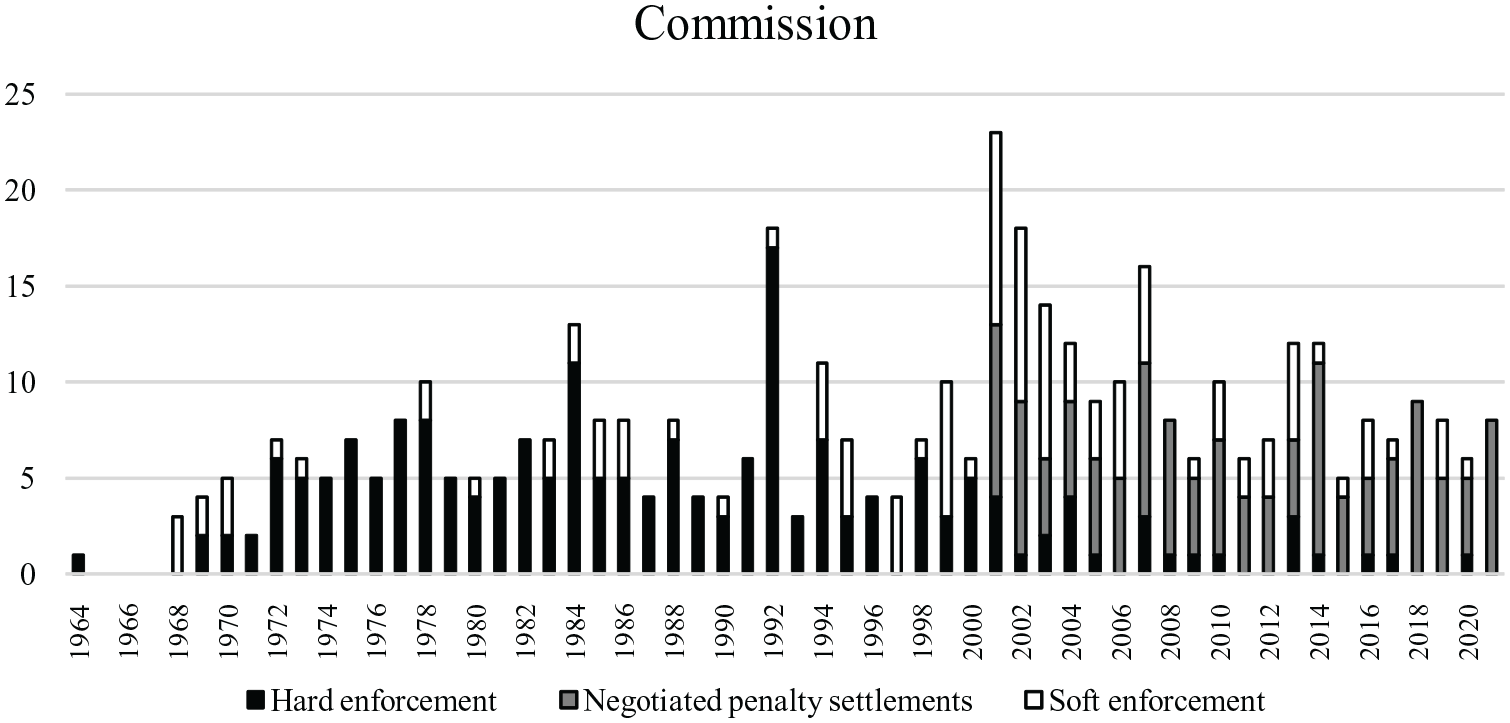
Hard and soft enforcement per year, Commission (1964–2021).
The figure illustrates that contrary to the hard-enforcement rhetoric and unlike the initial expectation from Regulation 1/2003, 158 freeing the Commission from the administrative burden of notifications did not result in a greater number of fully adversarial decisions. These findings are notable given the significant enlargement of the European Union since 2004, growing from fifteen Member States to twenty-eight (twenty-seven, following Brexit in 2020) and the increase in the staff and budget of the Directorate General for Competition. Although the geographic scope of EU antitrust law has expanded significantly and the Commission no longer has the burden of responding to notifications, there was no increase in the average number of infringement decisions per year (hard enforcement and negotiated penalty settlements).
The findings summarized by the figure demonstrate that since the entry into force of Regulation 1/2003 on May 1, 2004, 44 percent of the Commission’s proceedings involved negotiated penalty settlements: 15 percent a combination of leniency and settlements, 24 percent leniency, 1 percent settlements, and 4 percent cooperation procedure in non-cartel cases. Hard enforcement, by comparison, amounted to only 8 percent of the cases and even then, fines were imposed only in thirteen out of the eighteen cases. Put differently, 85 percent (!) of the Commission’s infringement decisions did not consist of a fully adversarial procedure. As forms of negotiated penalty settlements, they involved a significant degree of cooperation with the firms. This stands in striking contrast to the ECJ’s order to reserve such proceedings to “strictly exceptional situations only.” 159
Moreover, the figure reveals that there was no increase in the average number of infringement decisions per year (gray and black bars) following modernization. By comparison, the number of infringement decisions grew since 2002, due to the increasing use of negotiated penalty settlements (gray bars). This appears to be associated with the introduction of the Commission’s new leniency program that year rather than the reform of Regulation 1/2003 in 2004 160 ; while between 2002 and 2004 the Commission issued an average of eight infringement decisions per year, from 2005 to 2021 this average dropped to 6.5.
The introduction of the Commission’s settlement program in 2008 and the cooperation procedure in non-cartel cases in 2019 did not appear to increase the number of infringement decisions. This challenges one of the main vindications of such programs, namely that the reduction of fines and specific deterrence is justified by the increased detection of infringements. 161
The limited number of infringement decisions and the prevalent use of negotiated penalty settlements do not correspond to the deterrence-based rhetoric following modernization and to the expected increase in the number of infringement decisions. Deterrence might be sub-optimal, especially when the above is taken together with the following observations 162 : First, most of the negotiated penalty settlement instruments are limited by definition to secret cartels. 163 This means that the enforcement reform of Regulation 1/2003 did not have a significant positive effect on deterrence beyond cartels. The empirical findings imply that there is almost a negligible chance that firms will be sanctioned by the Commission for other types of antitrust infringements. In the limited number of cases when such practices were subject to a Commission’s investigation, they were more likely to be resolved by accepting formal commitments than by imposition of fines. 164 Those findings are also in line with the limited number of the Commission’s own-initiative investigations, significantly declining since 2015. 165
Second, members of secret cartels were relatively protected from sanctions where no leniency application has been filed. This corresponds to the finding of a previous study, showing that almost 70 percent of the firms investigated for cartel participation by the Commission have escaped a fine if they have not applied for immunity or leniency. 166 In addition to hindering deterrence, this reduces the attractiveness of the Commission’s leniency program, and could explain the significant reduction of leniency applications submitted to the Commission over the past years. 167 The limited risk of sanctions outside negotiated penalty settlements may also invite strategic use of leniency, by which firms threat to submit leniency applications to deter their competitors from deviating from a cartel. 168 Along these lines, Stephan argues the Commission’s leniency program is not detecting active cartels, but rather uncovering failed inactive cartels. 169
Third, even where leniency applications have been submitted, the alleged cartel members had a high chance of escaping sanctions. As of 2020, only approximately 15 percent of the leniency applications led to a formal investigation by the Commission, and only 60 percent of these investigations ended with a prohibition decision and the imposition of fines. 170
Fourth, commentators warned that even when penalties have been imposed, their level did not produce a sufficient deterrent effect. 171 A 2020 Court of Audits report observed that nearly two-thirds of the fines imposed by the Commission in cartel cases were lower than 0.99 percent of the parties’ global annual turnover. 172 Marvão and Spagnolo added that this trend has been aggregated over time, whereby over 70 percent of the fines imposed on convicted cartel members were lower than 1 percent of their turnover. 173 Cautioning against a “leniency inflation,” they point to an increase in both the number of cartel members receiving full immunity and the level of fine reductions. 174 This is particularly worrying when combined with the findings of Smuda, reporting that in 67 percent of cartel cases, the anticompetitive gains exceeded the maximum 10 percent worldwide turnover threshold prescribed by Regulation 1/2003 and the Commission’s Guidelines. 175
Finally, the Commission does not engage in a comprehensive impact assessment of its enforcement strategies. It does not systematically reflect on the formation of its portfolio of cases, the selection of instruments, and the assessment of its performance. It is unclear how the Commission balances monitoring markets on its own initiative with responding to complaints, leniency, or settlements applications. 176 When it comes to the imposition of penalties, while the Commission often emphasizes the high level of fine it imposed, it does not evaluate their deterrent effect. Undoubtedly, the Commission’s fines for antitrust infringements are among the highest in the world; yet, given the size and economic significance of the common market, this cannot alone inform a conclusion about their effectiveness. 177
Taken together, the findings on the Commission’s practice question the realization of the basic aims of the European Union’s deterrence-based approach and the shift to hard-enforcement rhetoric, that is, increasing the number of infringement decisions and ensuring that the expected fine for an infringement is higher than the expected anticompetitive gains.
B. Soft Enforcement
In parallel to hard enforcement and negotiated penalty settlements, following the modernization, the Commission continued to resolve many of its investigations by means of soft enforcement. The new enforcement regime, in fact, has given rise to new soft enforcement instruments. This is demonstrated by Figure 3, specifying the makeup of the Commission’s Article 101 TFEU enforcement portfolio since the entry into force of Regulation 1/2003.
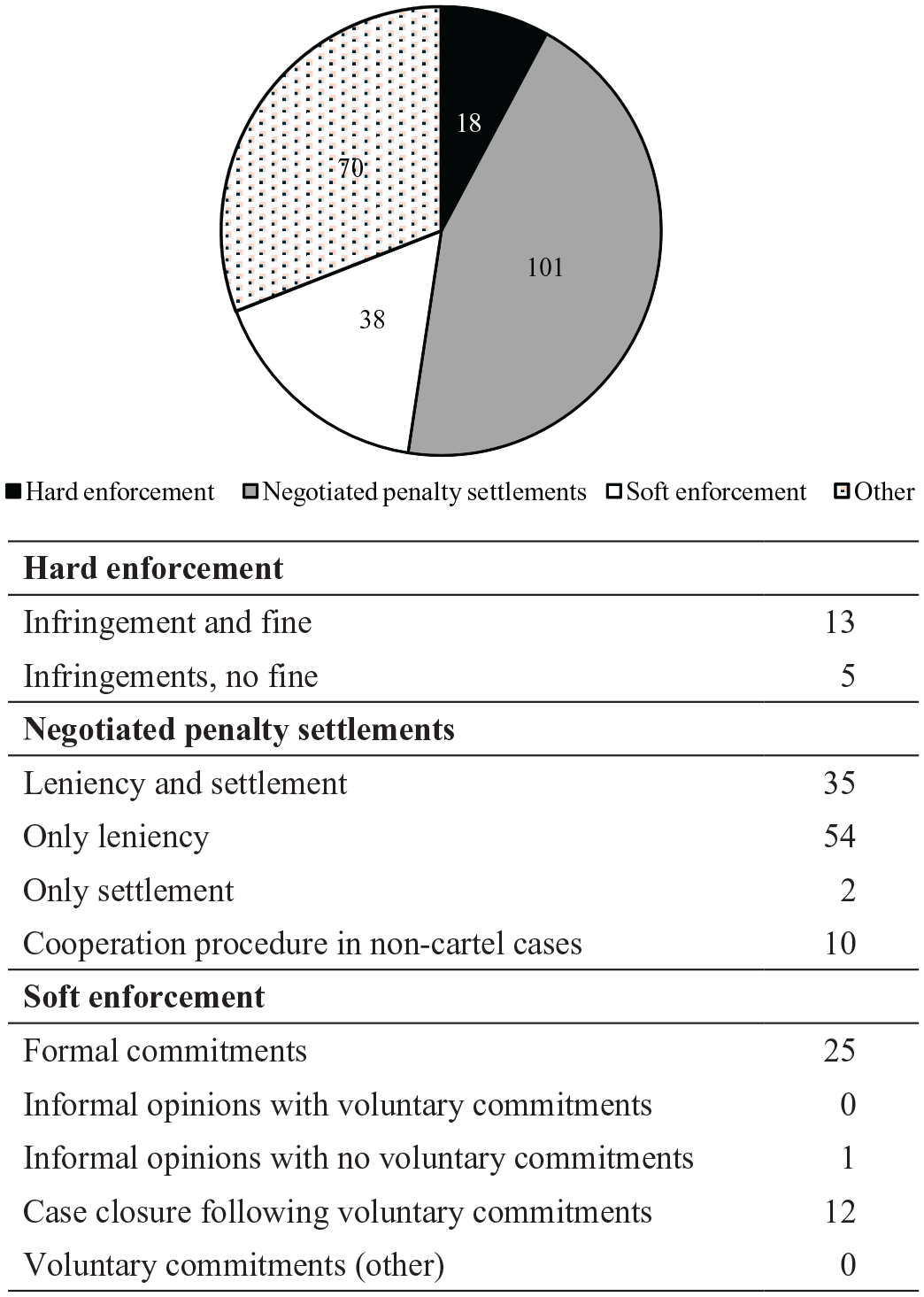
Commission, ratio of hard and soft enforcement, May 2004–2021.
The figure shows that 11 percent of the Commission’s proceedings were closed by means of accepting formal commitments, a new enforcement instrument introduced by Regulation 1/2003. 178 Formal commitments entrust the Commission (and NCAs) to terminate an investigation after making the behavioral or structural remedies proposed by a firm binding, and impose fines for failure to comply. 179 In comparison to the voluntary commitments that were described above, the process for accepting formal commitments is more streamlined, transparent, and safeguards the rights of third parties. 180 This instrument was inspired by the U.S. consent decrees, yet EU commitments do not involve the imposition of fines and are not being reviewed by courts prior to their adoption to determine whether the decree is in the public interest. 181
In addition, the Commission has continued to terminate investigations into potential infringements upon the acceptance of voluntary commitments. While the figure points to a limited use of this instrument (approximately 6% of the proceedings), their number is likely to be underreported because not all such cases are published.
Both formal and voluntary commitments were mostly accepted to settle potential infringements in highly regulated sectors such as utilities (telecom, media, energy, and transport), 182 financial services, 183 and technology and digital markets. 184 The Commission’s formal commitment decisions were relatively detailed, albeit avoiding a finding on the possible infringement. Voluntary commitments, however, were announced in short press releases (typically one to two pages), which do not offer a detailed factual or legal analysis.
The Commission made scarce or no use of the other soft instruments in its arsenal. It did not issue informal guidance or comfort letters, with the exception of a 2020 comfort letter concerning the supply of medicine during the Coronavirus pandemic. 185 In late 2022, the Commission adopted a new notice on informal guidance, declaring that such an instrument may be used “where it considers it appropriate and subject to its enforcement priorities,” in particular, to clarify novel or unresolved questions and would provide added value to legal certainty and predictability. 186 The new notice introduces a more formal process, including consultation with NCAs and an assurance that the Commission will not impose a fine if the firms relied in good faith on its guidance. This instrument, therefore, may be used more frequently in the future.
When viewing the Commission’s practice per year, Figure 2 may appear to suggest that there was a decrease in the use of soft enforcement since 2008. 187 Yet, rather than concluding that the practice of accepting voluntary commitments or issuing informal guidance was abandoned, this figure may serve as an indication that the Commission stopped reporting such actions. There is evidence that the Commission still make use of such instruments. In its 2020 annual report, for example, it stated that it “engaged with companies (. . .) providing informal guidance for the types of cooperation that are likely to be unproblematic, and identified the necessary safeguards for such cooperation.” 188 The little reporting of such discussions may stand in the way of realizing the benefits of soft enforcement, as will be elaborated below. 189
The significant proportion of negotiated penalty settlements and soft enforcement implies that despite the hard-enforcement aims and rhetoric of modernization, the Commission continues to follow a compliance-based approach. As a result, a gap emerges between the stated aims of Regulation 1/2003 and the Commission’s enforcement practice. This gap is particularly alarming since the reliance on soft enforcement often goes underreported. The statistics published in the Commission’s reports on the functioning of Regulation 1/2003, for instance, include little information on soft enforcement. 190 On the contrary, when surveying the allocation of the enforcement effort, the Commission concluded that the authorities have “prioritised the most serious and harmful anticompetitive practices, in particular, cartels, which account for a substantial proportion of their enforcement record.” 191 The Commission, likewise, does not generally distinguish between fully adversarial hard enforcement and negotiated penalty settlements in its annual reports and studies, and ignores the efforts allocated to soft enforcement.
Before turning to discuss the implications of this gap in Part VI, the next part demonstrates that the NCAs also made limited use of hard enforcement. In fact, contrary to the hard-enforcement narrative of Regulation 1/2003, some NCAs explicitly declared that soft enforcement should play a fundamental part in their enforcement strategy.
V. NCAs: Soft Enforcement as a Key Strategy
In line with the European Union’s multi-leveled enforcement regime, the procedural rules governing antitrust proceedings and penalties remain in the remit of the Member States, subject to limited harmonization measures. The NCAs are mostly left free to devise their enforcement strategies according to their respective national institutional and procedural rules. They enjoy considerable discretion in deciding what cases to pursue and which to disregard, what enforcement instruments to use, whether or not to impose penalties, and if so—to set the level of fines. 192
This part illustrates that non-fully adversarial proceedings have played an important role in the practice of all NCAs examined by this study. Figure 4—presenting the ratio and frequency of the various enforcement instruments—points to limited hard enforcement by the Dutch, German, and British NCAs and to the strong reliance on soft enforcement and negotiated penalty settlements when enforcing Article 101 TFEU and their national equivalent prohibitions.
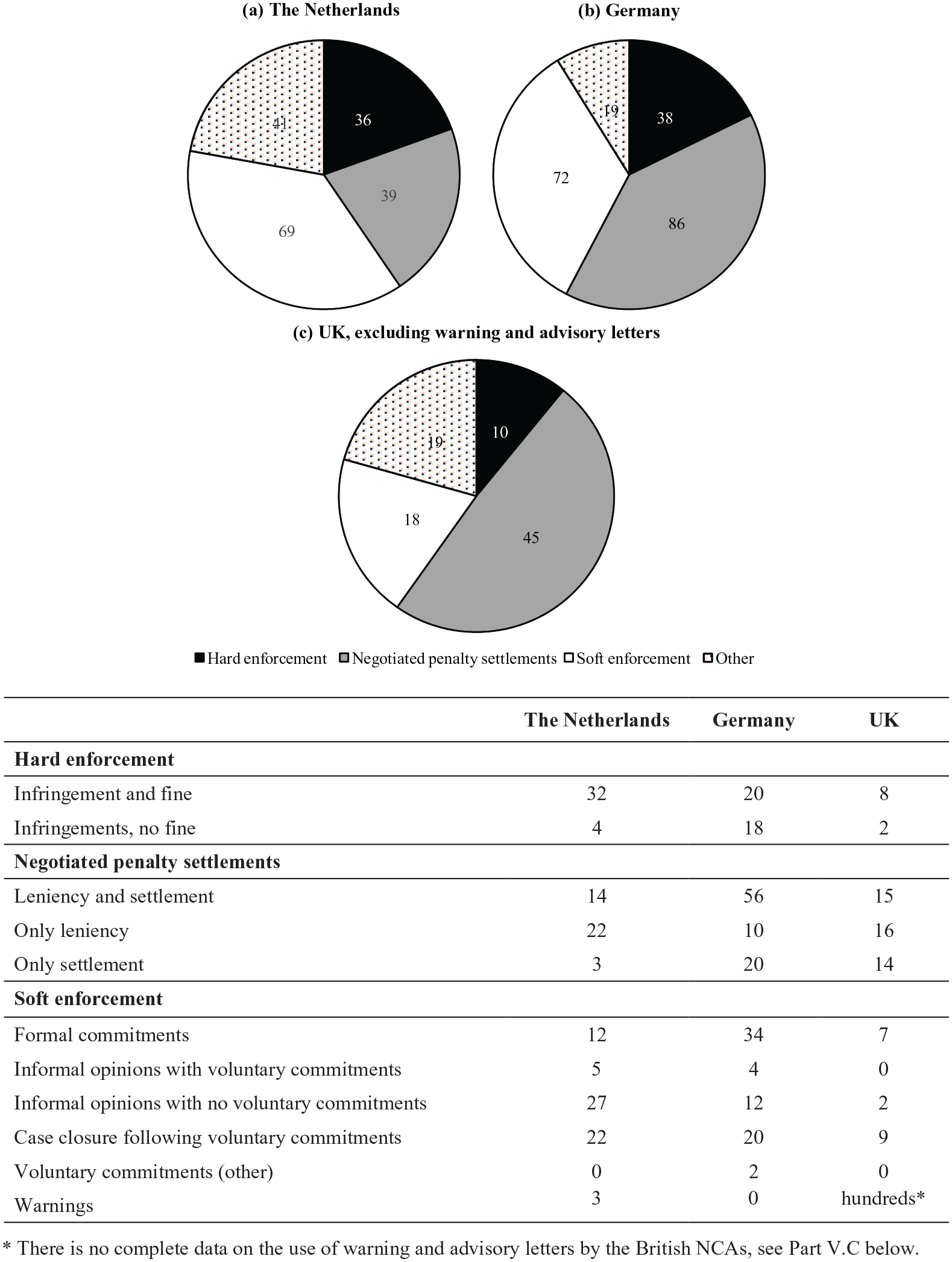
Hard and soft enforcement ratios, NCAs, May 2004–2021. 193
The following sub-sections detail the enforcement instruments used by the NCAs, the types of cases to which they were applied to, and the rationale guiding the choice of instruments. As elaborated below, such observations yield two important conclusions: First, unlike the Commission, some NCAs opted for soft enforcement as a declared strategic policy. The national enforcement systems reserved a central room for soft enforcement, in a manner that runs counter to the European Union’s hard-enforcement rhetoric. Second, the national soft instruments were often applied using ad hoc procedures, lacking the sufficient transparency necessary to realize the full potential of soft enforcement.
A. The Netherlands (ACM)
The ACM (and its predecessor until 2013, the NMa) has made frequent use of soft enforcement and compliance-based approach. Figure 4 indicated that it relied on soft enforcement to the greatest extent in comparison to the authorities presented in this study. Figure 5 further illustrates that this trend was reinforced since 2015. 194 In particular, no findings of infringements concerning anticompetitive agreements were adopted in 2016, 2018, and 2019.
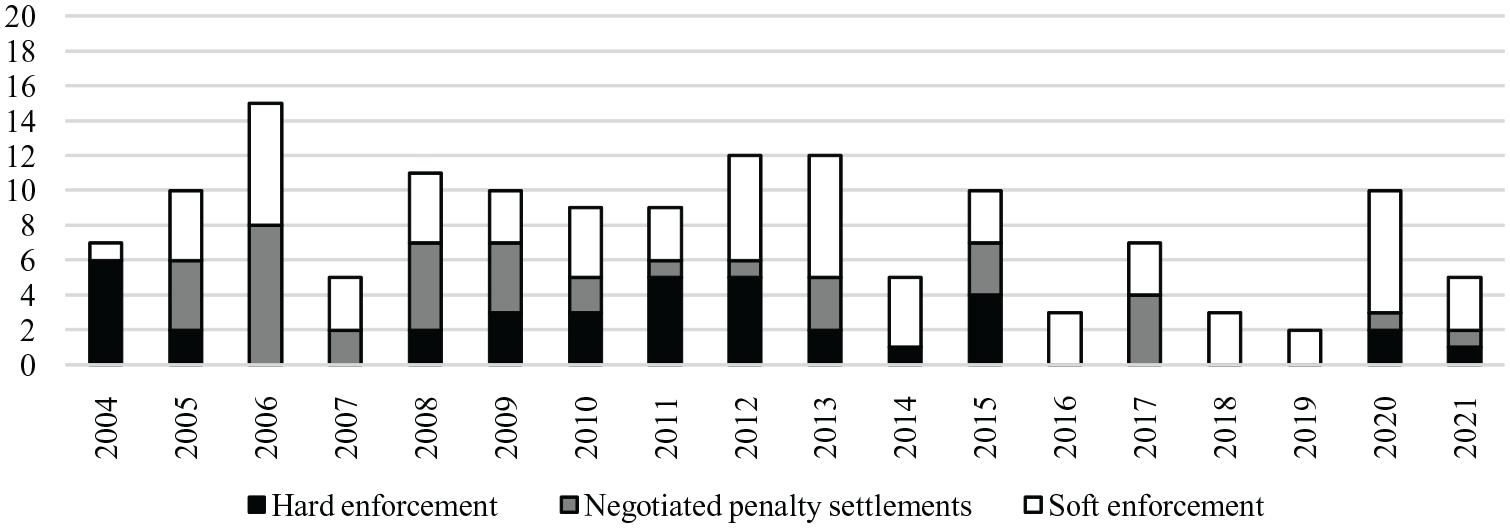
Hard versus soft enforcement, Dutch NCA, per year.
Only 40 percent of the ACM’s proceedings ended with a finding of an infringement, from which about half involved negotiated penalty settlements and thus were not fully adversarial. In addition, four out of the thirty-six hard-enforcement actions did not include a fine. All those proceedings were adopted between 2004 and 2005, and the NCA justified the waiver of fines by the recent liberalization of the markets, lack of previous antitrust enforcement in those areas, 195 or due to a governmental involvement in the infringement. 196
Several soft enforcement instruments were used. Some instruments resulted in a detailed analysis that can enhance legal certainty and shed light to potential infringements. Others were limited to a laconic press release 197 :
The ACM issued twelve formal commitment decisions and closed the proceedings in twenty-two cases after the parties agreed to modify their conduct (voluntary commitments). It explained that commitments are “highly recommended” as a device for quick and transparent termination of proceedings, while preventing future harm. 198 Formal commitments were used to tackle controversial and politically sensitive matters related to professional associations, health care, 199 and other highly regulated sectors. 200 Those decisions included a detailed analysis, 201 clarifying the NCA’s position. Many of the voluntary commitments have also related to professional associations, health care, 202 and other regulated sectors. 203 They were also adopted to address Coronavirus challenges. 204 Unlike the Dutch formal commitments, the reporting was short and concise, in a manner that is unlikely to realize the full benefits of soft enforcement.
The ACM issued thirty-two ex ante informal opinions, examining the compatibility of a specific agreement with the antitrust rules. Five of the informal opinions involved voluntary commitments offered by the parties. 205 This instrument was regularly used to examine agreements that enjoyed a degree of public or governmental support despite their (often serious) anticompetitive effect, 206 in particularly related to sustainability benefits. 207 Other informal opinions related to regulated markets 208 and Coronavirus challenges. 209 Informal opinions were mostly detailed, discussing factual and legal aspects of the case, yet some provided limited information. 210
The ACM also reported warnings it has issued to parties, in a form of press releases. Those announcements were concise, limited to few, general details on the potential infringement and the involved parties. 211
The extensive reliance on soft enforcement was not just a matter of practice in the Netherlands. It is tied to the national approach to social and economic governance. Dubbed as the polder-model, Dutch decision-making process is heavily deliberative and consensus-based, inviting stakeholders to present their views and come to a joint solution. 212 The ACM justifies the reliance on soft enforcement with reference to its problem-solving supervisory style. It declares that it tackles market problems from a broad perspective. Instead of merely investigating alleged infringements, it seeks the root cause favoring norm-transmitting discussions and commitment decisions. 213 Aiming at optimal compliance rather than maximum enforcement, 214 trust forms the backbone of this supervision style. 215
In its 2005 annual report, which presented a general account of the enforcement strategy, the NCA noted that it intends to use “as far as possible” alternatives to hard enforcement, involving consultation with market players’ representatives. 216 It would refrain from imposing sanctions where: the infringement was terminated immediately upon notice or ended; is unlikely to be repeated; does not involve a hardcore infringement; and where alternative enforcement is likely to benefit consumers, generate sufficient prevention effects, and does not raise third-party objections. 217 The soft enforcement philosophy was also advocated by the head of the authority during the Coronavirus crisis, noting that “we position ourselves these days more as a reasonable ‘market superintendent,’ rather than as cartel police or consumer union.” “The open and constructive dialogue with companies, consumers, and other authorities,” he added, “could be an efficient approach for other issues in the future as well.” 218
Many aspects of the Dutch practice may contribute to realizing the benefits of soft enforcement. The commitment decisions and informal opinions often detailed the alleged infringement, antitrust concerns, and the accepted remedies to alleviate them. Yet, the extensive reliance on soft enforcement raises concerns as to the prevailing level of deterrence in the Netherlands, especially in the operation of professional associations, health care, and other highly regulated markets, in which soft instruments were almost exclusively used for many years.
This risk was highlighted by an external consultancy report examining the effectiveness of the NCA’s enforcement, commissioned in 2015 upon the request of the Dutch Minister of Economic Affairs. The report recommends granting further attention to the deterrence effects of the NCA’s efforts, analyzing the relationship between the enforcement instruments used to the long-term deterrent effects of its enforcement efforts. 219 Nevertheless, as Figure 5 illustrated, soft enforcement only became more prominent in the following years.
B. Germany (Bundeskartellamt)
Contrary to the Netherlands and similarly to the Commission, the German NCA manifests a hard-enforcement rhetoric. It states that the aim of cartel prosecution is not only to uncover, terminate, and sanction cartels, but also to achieve as much deterrence as possible. A high level of prosecution and fines is essential, 220 the “key focus of the Bundeskartellamt’s work.” 221 From the early 2020s, especially as a response to the Coronavirus and energy crises and the uncertainty surrounding sustainability-related cooperation agreements, soft rhetoric is becoming more common. The Bundeskartellamt affirmed that “we also consider ourselves a partner for businesses rather than exclusively a sanctioning or prohibiting authority.” 222
Figures 4 and 6 show that consistent with the hard-enforcement rhetoric, infringement decisions were prominent in Germany. Amounting to 58 percent of the proceedings, this ratio is the highest in comparison to the authorities examined in this study. Nevertheless, some promises of hard enforcement may not fully materialize in Germany, as out of the thirty-eight hard-enforcement actions, only twenty (53%) resulted in an imposition of a fine. In addition, 69 percent of the infringement decisions involved negotiated penalty settlements, and thus were not fully adversarial. This trend was more pronounced in recent years. Since 2017, only two fully adversarial hard-enforcement decisions were adopted, both were not accompanied by the imposition of fines. 223
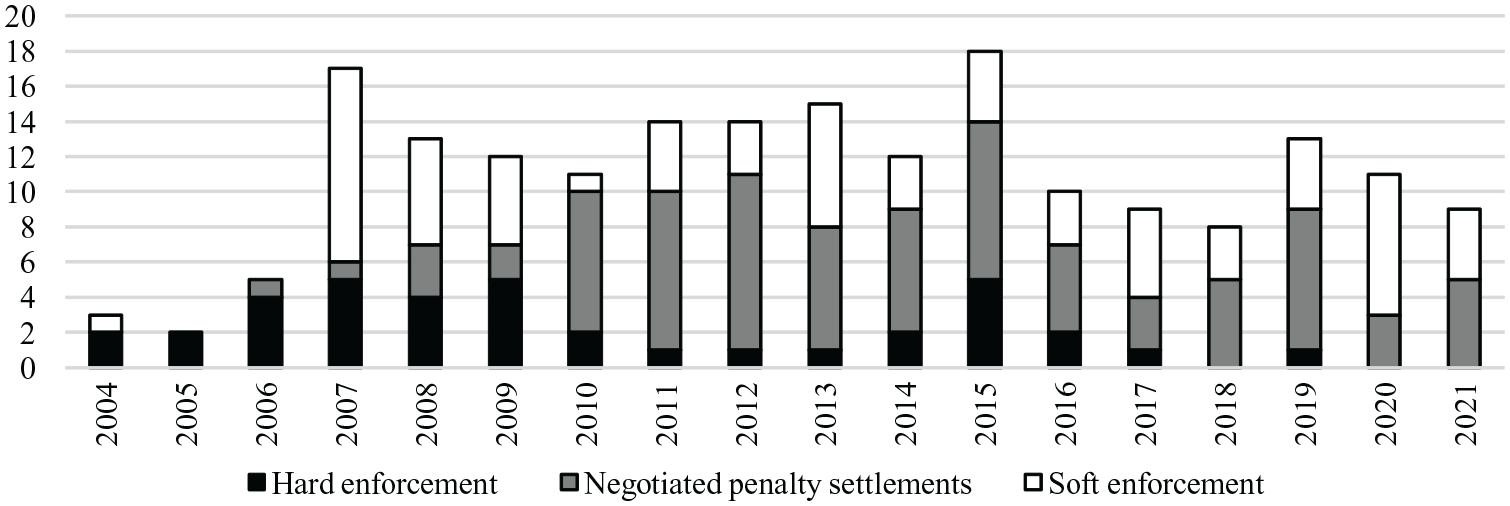
Hard versus soft enforcement, German NCA, per year.
Alongside the hard-enforcement rhetoric, soft enforcement was prominent:
The Bundeskartellamt adopted thirty-four formal commitments and two formal decisions declaring that it has no ground for action after the parties offered voluntary commitments. Similarly to the other authorities examined, such commitments related to practices in regulated and liberalized markets (especially energy 224 and sport broadcasting 225 ), which often raise complex questions about the relationship between the protection of competition and other public interests. 226 Such decisions were detailed and reasoned, allowing to clarify those challenges and increase legal certainty.
The Bundeskartellamt issued press releases reporting that its investigation was brought to an end after securing voluntary commitments in twenty cases. 227 This instrument was commonly used to resolve investigations into digital and technology markets, raising new legal and economic questions in fast-moving markets. 228 Here, too, there was no single form of publication. Most press releases consisted of a concise summary of the case, while others provided more details (two to four pages typically) focusing on the principles guiding the legal analysis. 229
The NCA provided guidance (informal opinions). 230 Most of this guidance went unpublished, making it difficult to assess how frequently this instrument was used. The sixteen published summaries (from which four declared that voluntary commitments were offered by the parties) 231 commonly examine agreements related to broadcasting, 232 digital and technology markets, 233 professional associations, 234 Coronavirus, 235 and sustainability arrangements. 236 The lack of or limited publication hinders the potential effect of this guidance. While the reported summaries pertained to cases in which the law appeared to be unclear or when the protection of competition should have been balanced against the protection of other public interests, many of the summaries did not sufficiently detail matters of facts and law to facilitate voluntary law compliance. This is illustrated by the 2017 press release on the Tierwohl animal welfare initiative. After providing general information about the initiative, the NCA merely declared that it will “tolerate the agreement only for a transitional period until 2020.” It did not specify the legal basis for “tolerating” the agreements, whether the initiative was likely to violate the antitrust rules, or fulfill the conditions for an exception. Consequently, the enforcement resources dedicated to this case could not realize the benefits of soft enforcement. 237
C. The United Kingdom (CMA and Sector Regulators)
U.K. antitrust has committed to a deterrence-based enforcement system. This was evident in the process of adopting the Enterprise Act of 2002, calling for a “strong deterrent effect” to root out anticompetitive behavior. 238 In addition to administrative hard enforcement, the Act strives to secure deterrence by criminalizing the participation in certain forms of cartels. 239 The centrality of a deterrence-based approach was repeated in more recent policy papers 240 and jurisprudence. 241 In 2020, the then Chief Executive of the CMA, Andrea Coscelli, clarified that hard enforcement is the CMA’s “bread and butter,” and that the CMA “can only secure our legitimacy if we achieve robust enforcement outcomes on what the public believes to be the glaring injustices of the day.” 242
In parallel to this hard-enforcement emphasis, the CMA (and its predecessor, the Office of Fair Trading, OFT) explicitly invokes soft enforcement as an important strategic tool. 243 This was particularly apparent in regulated markets, where in the United Kingdom, unlike many other European legal systems, antitrust is being enforced also by sector regulators. The CMA noted that while a competitive environment “can be achieved in part through effective and efficient enforcement,” soft enforcement tools “can, in appropriate circumstances, also be effective.” 244
Despite the acknowledgment of both hard and soft enforcement, Figures 4 and 7 demonstrate that infringement decisions played a limited role in practice, especially beyond negotiated penalty settlements.
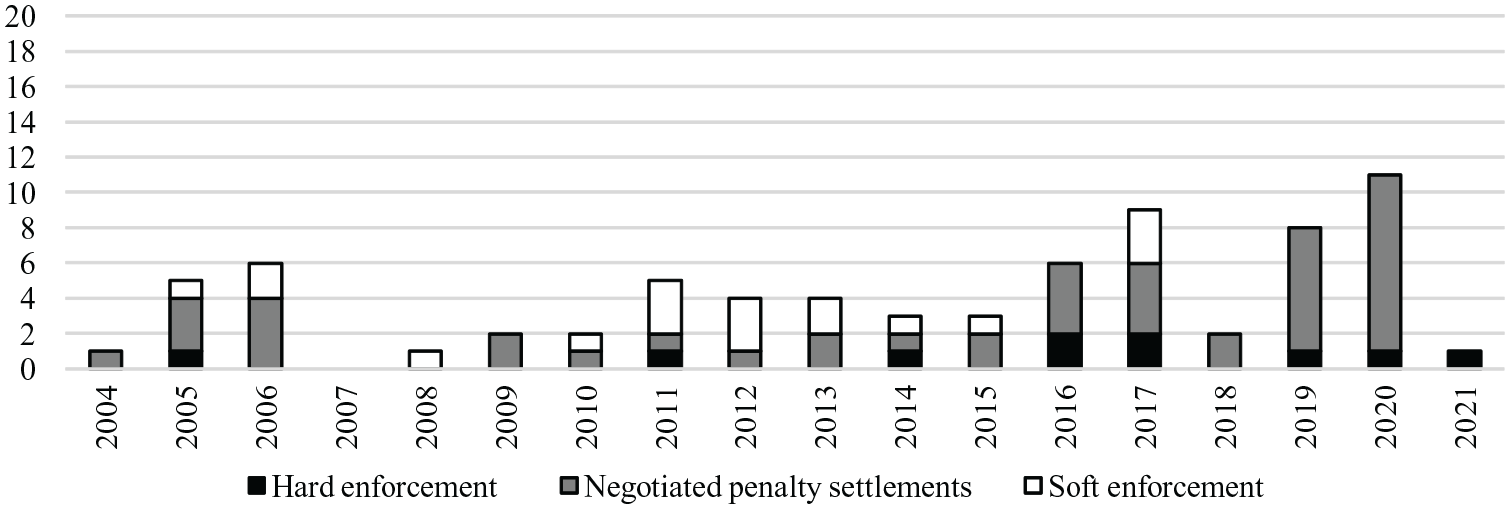
Hard versus soft enforcement, U.K. antitrust authorities, per year (excluding warning and advisory letters).
Figure 7 records the strikingly low number of infringement decisions in the United Kingdom, especially when compared to other jurisdictions having a similar market size and antitrust authorities with a similar (or lower) budget and staff. 245 In contrast with the fifty-five infringement decisions adopted by the CMA and sector regulators between May 2004 and 2021 (hard enforcement and negotiated penalty settlements), the German and Dutch NCAs have adopted 124 and seventy-five infringement decisions, respectively.
Negotiated penalty settlements amounted to 82 percent of the infringement decisions (and 49% of the total enforcement efforts recorded in the figure), meaning that only ten proceedings were fully adversarial (from which only eight resulted in an imposition of a fine). Up to 2019, all of the enforcement efforts of the sector regulators were resolved by soft enforcement instruments. 246
The limited level of infringement decisions in the United Kingdom, especially in important regulated sectors, was criticized by the National Audit Office in its 2010 report. 247 Subsequently, the government announced far-reaching changes to the enforcement regime, including the Enterprise and Regulatory Reform Act 2013. This reform, however, did not significantly increase hard enforcement. This was observed by the 2016 National Audit Office report, calling to “build up a steady flow of successful high-profile cases, decisions and fines that withstand appeal.” Findings of infringement and the imposition of financial penalties were seen as critical for deterrence and for clarifying the law. 248 In light of the above, the CMA declared that it would move to “step-up” its enforcement. 249 Figure 7 confirms the increase in infringement decisions since, albeit mostly in the form of negotiated penalty settlements.
The relatively limited number of infringement decisions has a few possible explanations. It was suggested that sector regulators find it easier and more effective (at least in the short term) to use their regulatory rather than antitrust powers. 250 The CMA added that, unlike other European countries, the British approach to economic regulation supports early structural reforms and regulatory frameworks. 251 The limited number of infringement decisions, especially in fully adversarial settings, was also explained by reference to the national rigors appeal system. The National Audit Office stated that stakeholders noted that “the UK was the best jurisdiction in the world to defend a competition case.” 252 The length of the enforcement process and uncertainty of its outcome in appeal may have reduced the appetite of the antitrust authorities to use their hard-enforcement powers. 253 More recently, the CMA linked the limited hard enforcement to Brexit, noting that working toward the EU exit from the European Union in 2020 was a complex and resource-intensive undertaking, resulting in diverting focus and resources away from enforcement. 254
In parallel to hard enforcement and negotiated penalty settlements, various types of soft enforcement instruments were used in the United Kingdom. Like the other authorities examined, not all of those instruments were equally likely to realize the benefits of soft enforcement:
The CMA and sector regulators adopted seven formal commitments and terminated additional nine proceedings after the parties agreed to modify their conduct (voluntary commitments). Like the German and Dutch NCAs, the commitments focused on practices in digital markets, 255 regulated sectors, and trade associations. 256 Differing from the other NCAs, however, all formal and some of the voluntary commitments included a full and detailed analysis, clarifying the underlying factual and legal circumstances. This is particularly noteworthy as the CMA maintained that despite its thorough analysis, securing commitments have produced important procedural economy benefits. 257
The NCA issued short-form opinions. This instrument is similar to the Dutch informal opinions and to the Commission’s informal guidance in that it offers an ex ante and detailed analysis of a specific agreement raising novel or unresolved questions. 258 As per its declared policy, the NCA had made scarce use of this instrument, issuing only two short-form opinions (both by the OFT) and such instrument has seem to be abandoned in recent years. 259
Perhaps most importantly, the CMA has sent warning and advisory letters notifying businesses that they might be breaking antitrust law. 260 Those letters do not involve findings of law or fact. They only spell out the CMA’s concerns and recommend firms to self-assess their practice. 261 Because there is no complete and accurate data on the use of warning and advisory letters, they are not recorded in the figures above. However, since 2014, the CMA published some aggregated information, suggesting that between 2014 and 2021, 390 warning letters and 167 advisory letters were issued as to possible infringements of EU and national antitrust laws. 262
The effectiveness of advisory and warning letters as a form of soft enforcement is questionable. In theory, such letters can encourage compliance by bringing about the benefits associated with sunshine enforcement. Yet, even after the CMA began to publish the use of advisory and warning letters, the register includes only very general information. Aiming to protect the identity of the parties involved and avoid “naming and shaming,” this information is limited to the type of the agreement and the market concerned. 263 Such reporting, therefore, is insufficient to effectively facilitate private action.
The choice of cases to be handled by warning and advisory letters is not fully clear. The CMA has deferred to a vague standard, noting it will make use of such letters where it believes there is or may be illegal activity, but does not find “it appropriate to pursue a full investigation.” 264 A review of the register suggests that most cases involved resale price maintenance, and that at times also serious infringements were handled by means of letters rather than hard enforcement. 265 In 2021, for example, the CMA sent advisory letters to a number of firms as a response to an allegation of price fixing by suppliers of goods and services to disabled university students. 266
VI. Implications
The previous parts illustrated that in contrast to the hard-enforcement aims and rhetoric advocated by EU and U.K. antitrust since the turn of the millennium, soft enforcement and negotiated penalty settlements embodied the majority of the Commission’s and NCAs’ enforcement practices. As a result, there is a noticeable gap between the stated aims and rhetoric of antitrust on one hand, and its application on the other hand. This gap, this part submits, hinders the effectiveness and credibility of the enforcement regime (1) due to risks of limited deterrence and law compliance; (2) due to lack of alignment between the particularities of the instruments used and enforcement theory; and (3) because this gap is underreported and unexplored.
A. Deterrence and Law Compliance
The findings presented above suggest that antitrust enforcement in the European Union and the United Kingdom failed to meet the ends of the modernization reform, namely shifting from a soft to hard-enforcement regime and increasing the number of infringement decisions. The findings may also suggest that the level of deterrence of EU and U.K. antitrust enforcement is sub-optimal, that is, that there is no sufficient threat that the expected fine for infringements would be higher than the expected anticompetitive gains. This results from a combination of the low excepted probability for detection and prosecution (Points 1–5) and the expected fine (Points 5 and 6):
In contrast to the stated aim of the modernization, there was no increase in the average number of the Commission’s infringement decisions per year (hard enforcement and negotiated penalty settlements), neither following the entry into force of Regulation 1/2003 nor following the introduction of the settlement programs for cartels and non-cartels.
Only a few hard-enforcement decisions were adopted by the NCAs examined in this study, both in absolute numbers and in their proportion of the total national enforcement efforts.
Almost no findings of infringements (hard enforcement and negotiated penalty settlements) were made beyond secret cartels, both at the EU and national levels.
Almost no findings of infringement were made against agreements in regulated markets; technology, digital, and financial products and services; practices of trade and professional associations; or involving sustainability-related considerations. 267
Only a small proportion of the Commission’s and NCAs’ total enforcement efforts were taken in a fully adversarial manner, beyond negotiated penalty settlements.
Fines were fully waived or substantively reduced in most infringement decisions, (combining leniency and settlements or a decision not to impose a fine) even when addressing serious antitrust violations.
The limited number and proportion of hard-enforcement decisions are not decisive, in themselves, to conclude that the level of deterrence in the European Union and the United Kingdom is insufficient. Yet, such a conclusion may be supported when considering that the modernization (and the following secondary and soft laws) aimed to increase the number of hard-enforcement decisions. It may also be reinforced as the geographic markets subject to EU competition law have significantly increased in parallel to the entry into force of Regulation 1/2003 (implying an increase in the number of anticompetitive activity, see Part IV.A), and since there are no theoretical or empirical indications that the level of anticompetitive activity in the European Union and the United Kingdom has decreased. It is also supported by the findings that the introduction of settlement programs for cartels and non-cartels has not led to a greater number of infringement decisions. The presence of a sub-optimal level of deterrence compared to what was envisioned by Regulation 1/2003 may also be inferred from the observation that in contrast to the assumption that as a rule hard enforcement should be used to ensure that antitrust is applied effectively and in the general interest, hard enforcement has become the exception. As long as private enforcement in the European Union and the United Kingdom remains underdeveloped and confined to follow-on actions, firms might have little incentive to act in compliance. There is a serious risk that EU and U.K. antitrust laws do not “bite.”
A sufficient and steady threat of hard enforcement is not only a precondition for a deterrence-based approach. It is also essential for compliance-based approach and negotiated penalty settlements. Law enforcement literature—in particular Ayres and Braithwaite’s pyramid of regulatory enforcement—emphasizes that the threat of hard-enforcement underpins the functioning of voluntary compliance. 268 Firms are more likely to effectively cooperate with antitrust authorities when a failure to do so is likely to result in severe sanctions. 269 Lowering the expected detection and/or sanctions diminishes the firms’ incentives to cooperate. Over-reliance on negotiated penalty settlements, notably, was said to weaken the effectiveness of leniency programs. Hammond, the Deputy Assistant Attorney General for Criminal Enforcement in the DoJ, famously predicted that a leniency program will only be successful if there is a threat of severe sanctions; a high risk of detection; and a high degree of transparency and predictability in relation to the award of leniency. 270 It is doubtful whether the first two prerequisites have materialized in the European Union and the United Kingdom.
B. Failure to Achieve the Benefits of Soft Enforcement
While soft enforcement played an important part in the Commission’s and NCAs’ practice, there are no or little guiding rules on what cases are appropriate for soft enforcement and how such instruments should be designed. For example, although EU law entrusts NCAs to adopt formal commitments, it leaves their particularities to be determined by national laws. Other, less formal forms of soft enforcement are subject to even fewer controls. In contrast with the U.S. consent decrees, 271 and the European Union’s and the United Kingdom’s formal commitments, many soft instruments are not subject to a clear procedure or substantive test, and are only confined by general principles of law.
The qualitative systematic review of the soft instruments used by the Commission and NCAs, as presented in Parts IV.B and V, demonstrated that there was no alignment between the theory of law enforcement and the particularities of the soft instruments used by the authorities. This suggests that soft enforcement has often failed to achieve the full promises associated with such instruments.
First, many of the soft enforcement efforts were not fully published and/or reasoned. Even when informal commitments, opinions, guidance, warning letters, and press releases were published, the analysis typically neither made a finding about the existence of an infringement nor was sufficiently detailed on matters of facts and law to assist such a conclusion. The reporting of soft enforcement, therefore, could not substantively clarify the authorities’ interpretation or be generalized to inform other cases. Furthermore, the highly informal nature of such actions implies that judicial review is impossible or unlikely. Taken together with the observation that much of the soft enforcement pertained to politically sensitive markets and those raising complicated legal and economic challenges, this entails that important areas of EU and U.K. antitrust are being developed by a line of soft enforcement actions that are never tested judicially.
Second, the particularities of the soft instruments used could have only a modest effect in assisting harmed parties to detect infringement and bring follow-up private actions (the “sunshine” feature of soft enforcement). 272 The reporting of the enforcement actions is particularly crucial in the European Union, where third parties do not have a right to access the Commission’s investigation files. This is also true for negotiated penalty settlements, whereby both the file and the leniency and settlements applications remain confidential. 273 The Commission refuses access requests to protect the cooperative nature of its programs, and this policy was affirmed by the courts. 274 Because the vast majority of private actions are brought as follow-on actions, the large number of soft enforcement actions—and to some degree also negotiated penalty settlements—stands in the way of effective private litigation. 275
Third, the reported lack of a linear connection between the gravity of the infringement and the enforcement instrument used may deprive antitrust of its meaning. This could be the case when soft enforcement is used to settle hard-core infringements (see Parts IV and V), or when the negotiated remedies go beyond what is necessary to end the alleged infringement. In such situations, soft enforcement may serve as sector regulation, 276 overly focusing on the remedy instead of prevention of the wrong. 277
C. Underreported and Underexplored
Perhaps above all, the existence, frequency, and effects of soft enforcement and negotiated penalty settlements are underreported and underexplored in Europe. EU and national antitrust are mostly silent about the desired enforcement strategy, appropriate proportion between hard and soft enforcement, suitable type and the number of cases for negotiated penalty settlements, criteria guiding the selection of instruments, and their impact. Such a debate is strikingly missing from the Commission’s and NCAs’ annual reports, policy papers evaluating the success of Regulation 1/2003, and the Damages and ECN+ Directives. They often did not disclose the degree of reliance and efforts allocated to soft enforcement, and generally did not distinguish between fully adversarial hard enforcement and negotiated penalty settlements. This distorts the proper understanding of the enforcement system and the assessment of its effectiveness.
This point was highlighted by the U.K. National Audit Office. Its 2016 report noted that while the national antitrust authority has well-established prioritization criteria for the selection of cases, it is difficult to take robust prioritization decisions about the selection of instruments given the limited evidence about their relative effectiveness. 278 A similar observation was made by the Dutch NCA, noting that it does not have a method to quantify the impact of soft enforcement. 279
The little attention provided to the non-fully adversarial instruments hinders the proper assessment of the effectiveness of EU and U.K. competition law and the success and legitimacy of the antitrust authorities’ enforcement efforts. It also leads to overlooking the gap between what the authorities do to what they are saying they are doing—that is, between practice and the hard-enforcement aims and rhetoric. NCAs that strategically rely on soft enforcement, in particular, were not yet required to explain if and how such an approach is compatible with the shift to hard enforcement embraced by EU law and jurisprudence. All of this may result in an enforcement practice out of line with the enforcement strategy enshrined in EU and U.K. antitrust.
VII. Conclusion: Aligning Instruments to Theory
The modernization of EU antitrust in the early 2000s aimed to redirect the enforcement efforts, transforming the soft compliance-based old system into a rigorous deterrence-focused regime. The abolishment of the notification system and the decentralization of the enforcement intended to allow the Commission and NCAs to focus their limited resources on combating the most serious antitrust infringements and on imposing significant sanctions. Increasing the number of hard-enforcement actions and the level of fines, it was believed, would strengthen deterrence and law compliance.
The reform was labeled as a huge success. The Commission announced that it had focused on areas where it can make “a significant contribution,” 280 and that the Commission and NCAs have prioritized the most serious and harmful anticompetitive practices, accounting for “a substantial proportion of their enforcement record.” 281
The findings presented in this article, however, question this conclusion: First, they prove that there was no increase in the average number of the Commission’s infringement decisions per year, neither following the entry into force of Regulation 1/2003 (2004) nor following the introduction of the settlement programs for cartels (2008) and non-cartels (2019). Second, in contrast to the assumption that hard enforcement should be the rule, this enforcement strategy rather became the exception. Few enforcement actions have been taken without the cooperation of their addressees, both at the EU and national levels. Third, the markets and types of infringements subject to hard enforcement were significantly limited. Few findings of infringements were made beyond secret cartels, and many regulated and technological sectors remained greatly untouched by hard enforcement. Fourth, fines were fully waived or substantively reduced in most cases, even when addressing serious violations. Finally, despite the transformation to hard-enforcement aim and rhetoric at the EU level, some NCAs embraced soft enforcement as a declared strategic policy.
The gap between the hard-enforcement aim and rhetoric and the systematic use of soft enforcement and negotiated penalty settlements contradicts the underlying assumptions of the deterrence-based approach and may hinder the effectiveness and credibility of the enforcement: it stands in the way of achieving deterrence and law compliance (as EU and U.K. antitrust do not sufficiently “bite”); the soft enforcement efforts fail to achieve their potential benefits; and the existence, frequency, and effects of soft enforcement and negotiated penalty settlements are underreported and underexplored.
This article does not take the position that soft enforcement or negotiated penalty settlements are undesirable as such. To the contrary, an informed, selective, and crafted use of such instruments may contribute to effective enforcement to the extent they assist in the detection of violations, induce firms to effectively cooperate to end infringements, settle cases quickly, focus enforcement resources on serious restrictions, tailor the law to changing environments, clarify the authorities’ positions to increase legal certainty and predictability, and support private actions. The article merely urges to take a hard look at soft enforcement and negotiated penalty settlements, 282 calling to align theory to practice. More specifically, as elaborated below, enforcement theory should guide the allocation of enforcement efforts; selection of instrument and form of publication; and the creation of a balanced and transparent portfolio of cases, to which the authorities are accountable for.
A. Allocation of Enforcement Efforts
Antitrust authorities should direct their enforcement efforts to pursuing the long-term public interest. They should avoid the temptation to use soft enforcement and negotiated penalty settlements to produce short-term or reputational benefits. In particular, when the general interest favors a different allocation of enforcement efforts, such instruments should not be used to inflate the number of successfully handled cases, which, as previous studies have observed, 283 is the common reputational measure of authority’s performance.
Accordingly, by aligning law enforcement theory to practice, non-fully adversarial tools should not be used to pursue: (1) low-hanging fruits, namely infringements causing a modest anticompetitive harm or that do not significantly contribute to a deterrent effect; (2) “weak” cases unlikely to result in findings of infringements if conducted in adversarial settings. 284 Soft instruments and negotiated penalty settlements should be reserved to cases based on an accepted theory of harm and supported by substantial evidence 285 ; (3) serious or repeated infringements, 286 in particular when the cooperative and friendly relations between authorities and firms may lead to capture 287 ; and (4) to circumvent judicial review. When the probability of a reversal of an authority’s decisions is high—when the law is unclear, when the case requires the balancing of conflicting interests, or when a new remedy or theory of harm are being tested—non-fully adversarial tools may be attractive from the viewpoint of an authority. Yet, they should not be used if adjudication better serves the public interest. 288
B. Choice of Instrument and Form of Publication
The selection of instruments and form of publication should correspond to enforcement theory. First, soft enforcement and negotiated penalty settlements should only be used when there is a genuine commitment for compliance and trust. This shared commitment needs to be tested in each case, rather than assumed. 289 For example, soft enforcement is only appropriate when the potential infringement was terminated immediately after the firms became aware of its potential concerns, is unlikely to be repeated, and does not involve a serious restriction of competition. 290
Moreover, antitrust authorities must ensure that firms are not overly pressured to cooperate given the threat of high fines, commercial and litigation costs, negative publicity, or if they lack sufficient information about the allegations they face. 291 Especially as the Commission and most of the European NCAs function both as prosecutors and adjudicators, firms may be assured that refusal to compromise will not result in harsher charges and sanctions, 292 and that they could not impact the outcome of the case during the process of negotiation. 293 The timing for selecting the instrument is key. Antitrust authorities should avoid entering negotiations before they formulate their preliminary concerns and should provide firms with a degree of depth and quality that can inform their choice to cooperate or litigate. 294
Similarly, authorities should be mindful that the consequences of negotiated penalty settlements and soft enforcement may extend beyond the negotiating parties. Such enforcement efforts may carry a precedential value, guiding future conduct of the authority and other firms. 295 In the European Union’s multi-leveled governance system, moreover, soft instruments can be used to block enforcement by other authorities. They may prevent (soft and hard) enforcement 296 by another authority, even when the choice of soft enforcement was informed by enforcement priorities rather than a belief that no infringement had taken place. 297 In cases where such effects are likely to materialized, hard enforcement may be more appropriate.
Second, procedural economy benefits should not overly influence the selection of instruments. Other effects of negotiated penalty settlements and soft enforcement should also be weighted, such as increasing compliance, legal certainty, predictability, and assisting in bringing private actions. The selection of instrument should reflect the nature of the infringement, distributional inequalities, and social implications of the infringements, intention and behavior of the violating firms, frequency of violations, and the need for an authoritative law interpretation or supervision of compliance following the termination of the procedure. 298
Enforcement theory should guide the form of publication and the participation rights of third parties. Authorities may be incentivized to limit the detail of reporting and public consultations in non-fully adversarial proceedings to realize procedural economy benefits and avoid resistance from the cooperating firms. Yet, such considerations should be assessed on a case-by-case basis against the other benefits of negotiated penalty settlements and soft enforcement. Realizing the full potential of a compliance-based approach, in particular, may tilt the balance in favor of opting for formal commitments over informal voluntary commitments, opinions, guidance, or warning letters.
C. A Balanced and Transparent Portfolio of Cases
Antitrust authorities should mindfully allocate their efforts across hard enforcement, negotiated penalty settlements, and soft enforcement. The selection of instrument should not only match the characteristics of the suspected infringement (the “micro” level), but also the authority’s overall strategy (the “macro” level). The benefits of using non-fully adversarial instruments to handle a specific case should be balanced against the deterrent effect of the enforcement system as a whole and maintaining the firms’ incentives to effectively cooperate with the authority in appropriate cases.
In the absence of detailed guidance to inform the selection of enforcement efforts and instruments, antitrust authorities are expected to exercise self-restraint. Hence, the attempt to align theory to practice may be supported by increasing the transparency and accountability of such choices. Authorities should explain why a particular instrument was chosen to handle each case, and annually report the total allocation of their efforts across the instruments (number of actions pursued, sanction imposed, and allocation of budget and staff). In particular, they should safeguard against an “inflation” of leniency applications and settlements.
Openly sharing the allocation of enforcement efforts invites additional checks and balances. It is expected to facilitate a discussion internally within the authority, as well as external scrutiny and public debate. 299 In the longer term, such debate may also help bridge the gap between the hard-enforcement aims and rhetoric and the soft practice.
Footnotes
Acknowledgements
The author is very much grateful to Konstantinos Stylianou, Teresa Oriani, Linus Hoffmann, and the reviewers of this journal for their solid advice and great suggestions.
Declaration of Conflicting Interests
The author(s) declared no potential conflicts of interest with respect to the research, authorship, and/or publication of this article.
Funding
The author(s) received no financial support for the research, authorship, and/or publication of this article.
1.
Marc van der Woude, Ontwikkelingen Mededingingsrecht—Mededingingsbeleid en mededingingsrecht, Speech at the Annual Conference of the Dutch Association of Competition Law (Oct. 4, 2018),  . The speech was also cited by Eric van Damme, Mededinging en de man-vrouw verhouding, (5) Markt en Mededinging, 181–183 (2018).
2.
Eur. Comm’n, Proposal for a Directive to Empower the Competition Authorities of the Member States to Be More Effective Enforcers and to Ensure the Proper Functioning of the Internal Market, COM/2017/0142 final (Mar. 22, 2017) [hereinafter ECN+ Directive Proposal], 16.
3.
van der Woude, supra note 1, at 5.
4.
As elaborated in Part II, the term soft enforcement is limited in this article to non-binding non-fully adversarial enforcement actions directed at a specific anti-competitive behavior of specific firms. The article does not discuss soft law instruments such as guidelines and notices, which are directed at abstract categories of anti-competitive conducts.
5.
For definition and research design, see Part I.
6.
See Parts III–V.
7.
Council Regulation No. 1/2003, 2003 O.J. (L 1) 1 (on the implementation of the rules on competition in Articles 81 and 82 of the Treaty) [hereinafter Regulation 1/2003]. See Part III.C.
8.
See Part III.C.
9.
This lack was highlighted by CMA, Deterrent Effect of Competition Authorities Work, Literature Review 7.2–7.3 (2017) [hereinafter CMA Deterrent Effect Report].
10.
Eva Lachnit, ; Pablo Ibáñez Colomo,
11.
Heike Schweitzer, Commitment Decisions under Art. 9 of Regulation 1/2003: The Developing EC Practice and Case Law (European University Institute Working Paper No. Law 2008/22, 2008), , 11; Ian Forrester, Creating New Rules or Closing Easy Cases: Policy Consequences for Public Enforcement of Settlements under Article 9 of Regulation 1/2003, 2008
12.
Joseph C. Gallo et al., Department of Justice Antitrust Enforcement, 1955-1997: An Empirical Study, 17(1)
13.
For an interesting discussion, see George Stephanov Georgiev, Contagious Efficiency: The Growing Reliance on US-style Antitrust Settlements in EU Law, 4
14.
15.
Jean François Laborde, Cartel Damages Claims in Europe: How Courts Have Assessed Overcharges, 3
16.
On this methodology see, Mark A. Hall & Ronald F. Wright, Systematic Content Analysis of Judicial Opinions, 96
17.
For an overview of all enforcement of Articles 101 and 102 TFEU by the Commission see the database accompanying Colomo, supra note 10, https://www-cambridge-org.eui.idm.oclc.org/nl/academic/subjects/law/competition-law/shaping-eu-competition-law?format=HB; for the British CMA, see: .
18.
Bridget M. Hutter, Variations in Regulatory Enforcement Styles, 11(2)
19.
Albert J. Reiss, Selecting Strategies of Social Control over Organizational Life, IN
20.
Bridget, supra note 18, at 154; Baldwin et al, supra note 18, at 239;
21.
Case 41/69, ACF Chemiefarma NV v. Comm’n, ECLI:EU:C:1970:71, 173; Joined Cases 100/80 to 103/80, Musique Diffusion Française v. Comm’n, ECLI:EU:C:1983:158, 106; Joined Cases C-189/02P, C-202/02P, C-205/02P to C-208/02P & C‑213/02P, Dansk Rørindustri and Others v. Comm’n, ECLI:EU:C:2005:408, 260. Also see Wouter P. J. Wils, Optimal Antitrust Fines: Theory and, Practice, 29(2)
22.
Michael Grenfell, ;
23.
Mitchell A. Polinsky & Steven Shavell, The Theory of Public Enforcement of Law, IN
24.
Gary S. Becker, Crime and Punishment: An Economic Approach, 76
25.
Note by the UNCTAD Secretariat,
26.
27.
Barbara Baarsma et al., Let’s Not Stick Together: Anticipation of Cartel and Merger Control in The Netherlands, 160(4)
28.
This was summarized by former DG for Competition, noting that hard enforcement is intended “to punish, to deter, and to set a precedent”. See Alexander Italianer, . Also see 1983 Policy Report, at 56.
29.
Keith Hawkins, Law as
30.
Yeung, supra note 20, at 158–59.
31.
Gerard E. Lynch, The Role of Criminal Law in Policing Corporate Misconduct, 60(3)
32.
Case T-59/02, Archer Daniels Midland v. Comm’n, ECLI:EU:T:2006:272, 130. Also see Joined Cases 100/80 to 103/80, Musique Diffusion Française, supra note 21, at 105. A similar approach was pronounced by the Commission, see Eur. Comm’n, 13th
33.
In 33.49 Scottish Salmon Board of July 30, 1992, 24, the Commission noted that it will issue a formal decision even where the infringement has ended, “if the decision might clarify a point of law and thus prevent the same or similar infringements from being committed in the future (. . .) Such a practice makes for legal certainty”. Also see Owen M. Fiss, Against Settlement, 93
34.
35.
Baarsma et al., supra note 27, at 361.
36.
37.
Id., at 224.
38.
Rebecca Schmidt & Colin Scott, Regulatory Discretion: Structuring Power in the Era of Regulatory Capitalism, 41(3)
39.
40.
United States v. Otis Elevator Co. 1 Decrees and Judgments in Federal Antitrust Cases 107 (N.D. Cal. 1906).
41.
Proceedings taking place in front of the FTC refer to consent orders, subject to a similar framework. The article uses the term “consent decrees” as shorthand to refer to both types of proceedings. DoJ’s consent decrees are governed by the Antitrust Procedures and Penalties Act of 1974, 15 U.S.C. § 16 (the Tunney Act) and the FTC’s consent orders, by the FTC’s Rules of Practice 16 C.F.R. §§0.0 et seq. For an overview see, Note by the United States to the OECD Directorate for Financial and Enterprise Affairs Competition Committee,
42.
Based on the data presented in Id., at 7. Also see Georgiev, supra note 13, at 1006–1007.
43.
The antitrust authorities differ in the form of such measures. The Commission issues informal guidance letter can be issued at the request of undertakings in cases posing a novel legal question. See European Comm’n, The White Paper on Modernization of the Rules Implementing Articles 85 and 86 of the EC Treaty, Commission Programme No 99/027 [hereinafter Modernization White Paper], 89; Regulation 1/2003, Preamble 38; Eur. Comm’n, Notice on Informal Guidance Relating to Novel Questions Concerning Articles 81 And 82 of the EC Treaty that Arise in Individual Cases (Guidance Letters) 2004 O.J. (C 101) 78 [hereinafter Commission Informal Guidance Notice]. This is further elaborated in Part V.
44.
See Parts III.A and V. Also see Ivo Van Bael, The Antitrust Settlement Practice of the EEC Commission, 23 ; Van Rompuy, supra note 11, at 270; Frederic Jenny, Worst Decision of the EU Court of Justice: The Alrosa Judgment in Context and the Future of Commitment Decisions, 38(3)
45.
Julia Black, Talking about Regulation, 1
46.
Case C-441/07 P, Comm’n v. Alrosa, ECLI:EU:C:2010:377, 46.
47.
Hawkins, supra note 29, at 41–42.
48.
Yeung, supra note 20, at 112, 178. More generally see,
49.
Frank Pearce & Steve Tombs, Ideology, Hegemony, and Empiricism: Compliance Theories of Regulation, 30(4)
50.
Id.; Kaufmann, supra note 48, at 112–19.
51.
Baldwin et al., supra note 18, at 239–40; Black, supra note 45, at 97.
52.
Id., at 78, 90–91; Yeung, supra note 20, at 178; Petit & Rato, supra note 10, at 205; Lachnit, supra note 10, at 23; Colomo, supra note 10, at 69.
53.
As confirmed by the ECJ in Case C-441/07 P-Alrosa, supra note 46, at 48.
54.
Regulation 1/2003, Article 7.
55.
Black, supra note 45, at 88, 95.
56.
Harry First, Is Antitrust ‘Law’, 10
57.
Colomo, supra note 56, at 277.
58.
Melamed, supra note 56, at 13–14.
59.
Richard L. Abel, The Contradictions of Informal Justice, IN
60.
Case C-441/07 P-Alrosa, supra note 46, at 35. More generally see Yeung, supra note 20, at 112.
61.
Lachnit, supra note 10, at 15, 17–18; ECN, Recommendation on Commitment Procedures (2013), [hereinafter: ECN Recommendation on Commitment Procedures], 2; CMA annual report (2018), 38; Case C-441/07 P-Alrosa, supra note 46, at 35; Eur. Comm’n, Communication from the Commission to the European Parliament and the Council: Report on the Functioning of Regulation 1/2003, COM (2009) 206 final [hereinafter 2009 Report on the Functioning of Regulation 1/2003], 13; Eur. Comm’n Staff Working Paper, Accompanying the 2009 Report on the Functioning of Regulation 1/2003, SEC(2009) 574 final [hereinafter 2009 Report on the Functioning of Regulation 1/2003 Staff Working Paper], 94; Eur. Comm’n, Communication from the Commission to the European Parliament and the Council: Ten Years of Antitrust Enforcement under Regulation 1/2003: Achievements and Future Perspectives, COM (2014) 453 final, 9 (July 9, 2014) [hereinafter 2014 Report on the Functioning of Regulation 1/2003], 21. For empirical data on the duration of the commitment procedure compared to Article 7 decisions, see Gerard, supra note 11, at 148.
62.
Petit & Rato, supra note 10, at 207; Schweitzer, supra note 11; ECN Recommendation on Commitment Procedures, 2; Ottow, supra note 22, at 180.
63.
Court of Auditors, Special Report No 24/2020
64.
Hawkins, supra note 29, at 422–24; Papp, supra note 11, at 933. For possible limits of such assumptions, see Part VII.B.
65.
2010 National Audit Report, 14–15; Svetiev, supra note 11, at 471.
66.
The Court noted in Case C-441/07P-Alrosa, supra note 46, at 48 that firms “which offer commitments on the basis of Article 9 of Regulation No 1/2003 consciously accept that the concessions they make may go beyond what the Commission could itself impose on them in a decision adopted under Article 7 of the regulation after a thorough examination”. Also see Papp, supra note 11, at 936.
67.
Case C-441/07 P-Alrosa, supra note 46, at 61.
68.
Case C-132/19 P, Groupe Canal+ v. Comm’n, ECLI:EU:C:2020:1007, 111–115.
69.
Black, supra note 45, at 98–99.
70.
Bruno Lasserre & Fabien Zivy, A Principled Approach to Settlements: A Few Open Issues, 2008
71.
Paul Lugard & Martin Mollmann, The European Commission’s Practice under Article 9 Regulation 1/2003: A Commitment a Day Keeps the Court Away, 9
72.
Mariniello, supra note 71, at 4–5.
73.
Svetiev, supra note 11, at 484.
74.
For the reputational effects on authorities’ performance more generally, see for example, Dovilė Rimkutė, Organizational Reputation and Risk Regulation: The Effect of Reputational Threats on Agency Scientific Outputs, 96(1)
75.
Hawkins, supra note 29, at 423.
76.
77.
Id., at 29–30.
78.
79.
On sunshine enforcement, see Petit & Rato, supra note 10.
80.
Daniel Sokol, Cartels, Corporate Compliance, and What Practitioners Really Think about Enforcement, 78
81.
The Commission and NCAs may also consider firms’ cooperation outside of the formal leniency or settlement programs. Eur. Comm’n, Guidelines on the Method of Setting Fines Imposed Pursuant to Article 23(2)(A) of Regulation No 1/2003, 2006 O.J (C210/2) 2 [hereinafter Commission Finning Guidelines 2006], 29, for example, allow it to mitigate a fine when a firm “has effectively cooperated with the Commission outside the scope of the Leniency Notice and beyond its legal obligation to do so”. Given the broad authorities’ discretion to award such additional reduction and the divergence in their conditions, these proceedings are not recorded by this study.
82.
See, for example, Eur. Comm’n, Notice on Immunity from Fines and Reduction of Fines in Cartel Cases, 2006 O.J. (C 298) 17 [hereinafter Commission’s Leniency Notice], 8–13. For a discussion of the diverging national programs see Eur. Comm’n Staff Working Paper, Impact Assessment accompanying the ECN+ Directive Proposal, SWD(2017) 114 final, 23–25 and Annex XII–XIII.
83.
Commission’s Leniency Notice, 24–26.
84.
Andreas Stephan, An Empirical Assessment of the European Leniency Notice, 5(3)
85.
Commission Regulation No. 622/2008 of June 30, 2008 Amending Regulation No. 773/2004, as regard the Conduct of Settlement Procedures in Cartel Cases, 2008 O.J (L 171) 3 [hereinafter Settlements Regulation]; Eur. Comm’n, Notice on the Conduct of Settlement Procedures in View of the Adoption of Decisions Pursuant to Article 7 and 23 of Council Regulation (EC) No 1/2003 in Cartel Cases, 2008 O.J. (C167) 1 [hereinafter Settlements Notice], 17, 20–22. Also see Flavio Laina & Elina Laurinen, The EU Cartel Settlement Procedure: Current Status and Challenges, 4(4)
86.
Settlements Regulation, 1. For the U.S. system also see Wouter P. J. Wils, The Use of Settlements in Public Antitrust Enforcement: Objectives and Principles, 31(3)
87.
Press Release, Eur. Comm’n, Commission Launches New Online Tool for Cartel Leniency and Settlements and Non-cartel Cooperation (Mar. 19, 2019) (IP/19/1594). For an interesting analysis, see Niamh Dunne,
88.
Commission’s Leniency Notice, 3; Settlements Regulation, 1.
89.
Wils, supra note 86, at 340; Lasserre & Zivy, supra note 70, at 145–46. For empirical support of this position, see Johan Ysewyn & Siobhan Kahmann, The Decline and Fall of the Leniency Programme in Europe, 1
90.
Marcos, supra note 10, at 7.
91.
Damages Directive, Article 6 and Preamble 26.
92.
Id., Article 11(5) and (6) and Preamble 38.
93.
The effect of negotiated penalty settlements on the number of infringement proceedings in the EU and UK will be discussed in Part IV.A.
94.
Case C-619/13 P, Mamoli Robinetteria SpA v. Comm’n, ECLI:EU:C:2017:50, 52. Also see Case C-681/11, Bundeswettbewerbsbehörde v. Schenker & Co., ECLI:EU:C:2013:404, 44–47.
95.
This is further discussed in Part III.C.
96.
Regulation 17/62, Articles 2, 3, and 15(5).
97.
Joined Cases 100/80 to 103/80-Musique Diffusion Française, supra note 21, at 105–108.
98.
Eur. Comm’n, 23rd
99.
Answer given by Mr Andriessen on behalf of the Commission in response to Written Question No 2006/82 by Mr Robert Battersby (ED-GB) to the Commission of the European Communities 1983 O.J. (C118) 26, at 21.
100.
John Temple Lang, Community Antitrust Law: Compliance and Enforcement, 18(3)
101.
26349 Besluiten van de Vereniging G.I.S.A. (1972); 28374 Advocaat Zwarte Kip (1974); 27095 Franco-Japanese ballbearings (1974); 28980 Pabst & Richarz/BNIA (1976); 28282 The Distillers Company Limited, Conditions of sale (1977); 29418 Spices (1977); 29535 White led (1978); 29290 Vaessen/Moris (1979); 29869 Italian cast glass (1980); 29988 Italian flat glass (1981); 28930 Aluminum imports from eastern Europe (1984); 32732 Ijsselcentrale (1991); 33494 Scottish Salmon Board (1992); 33585 Distribution of railway tickets by travel agents (1992); 31400 Ford Agricultural (1992); 32448 32450 Cewal, Cowac, and Ukwal (1992); 33407 CNSD (1993); 33686 Coapi (1995).
102.
Modernization White Paper, 25; Valentine Korah, Comfort Letters: Reflections on the Perfume Cases, 6 .
103.
Eur. Comm’n, 11th
104.
Van Bael, supra note 44, at 63; John Temple Lang, European Community Constitutional Law and the Enforcement of Community Antitrust Law, IN
105.
1981 Policy Report, at 27.
106.
Id., at 27. Initially, comfort letters were only employed for negative clearance. Since the mid-1980s, they were extended to Article 101(3) TFEU exemptions. See 1983 Policy Report, 13.
107.
Case 253/78 and 1 to 3/79 Procureur de la République, ECLI:EU:C:1980:188, 13; Case 31/80 ’Oréal Lv. De Nieuwe AMCK, ECLI:EU:C:1980:289, 11–12.
108.
In the past, this procedure was described by the Commission as a settlement. Yet, it should not be confused with the Commission’s 2008 settlement program, by which the fine for a cartel member is reduced in exchange to cooperation (see Part II.C).
109.
Eur. Comm’n, 12th
110.
Eur. Comm’n, 24th
111.
Compliance could only be ensured by adopting a formal decision attaching conditions and obligations to an Article 101(3) TFEU exemption. ECJ in Case 7/82 GVL v. Comm’n, ECLI:EU:C:1983: 52, at 25–28.
112.
See examples cited in Eur. Comm’n, 1st
113.
1981 Policy Report, 51. Also see Andriessen, supra note 99, at 22.
114.
The Commission, for example, adopted a formal infringement finding after the agreements were terminated in IV/26.870 Aluminum imports from eastern Europe (1984), 18.1; IV/31.550 IV/31.898 Zera/Montedison and Hinkens/Stähler (1993), 132. It had also imposed a fine in IV/30.809 John Deere (1984), 41–42. Also see Van Bael, supra note 44, at 67.
115.
James S. Venit, The Commission’s Opposition Procedure: Between the Scylla of Ultra Vires and the Charybdis of Perfume: Legal Consequences and Tactical Considerations, 22(2)
116.
See, for instance, Eur. Comm’n, 17th
117.
For similar findings also see Van Bael, supra note 44, at 61; Ian Forrester, Competition Structures for the 21st Century, IN
118.
At this period, negotiated penalty settlements only included the Commission’s leniency program.
119.
The number of soft enforcement actions was extracted from the Commission’s annual reports, expect for the comfort letters issued between 1990 and 2004 that are available on the Commission’s website . The number of hard enforcement actions and negotiated penalty settlements was gathered by the author.
120.
Moreover, the Commission has imposed a fine only in a single Article 102 TFEU case that year. See Eur. Comm’n, 27th
121.
1971 Policy Report, at 24. Also see 1975 Policy Report, at 9.
122.
Written Question No 173/85 by Ms Quin (S-GB) to the Commission of the European Communities 1985 O.J. (C255) 27.
123.
Id.
124.
1976 Policy Report, at 11.
125.
Id.
126.
David J Gerber,
127.
Temple Lang, supra note 100, at 352.
128.
European Parliaments Resolution on the Tenth Report of the Commission of the European Communities on Competition Policy, 1982 O.J. (C 11) 78. Also see European Parliaments Resolution on the Sixteenth Report of the Commission of the European Communities on Competition Policy (annex to the 1987 Policy Report), 45.
129.
See Part II.
130.
1981 Policy Report, 27–28; 1982 Policy Report, 38; 1983 Policy Report; 61–62; Eur. Comm’n, 14th
131.
Modernization White Paper, 77.
132.
1999 Policy Report, 9. Also see Modernization White Paper, 43.
133.
Eur. Comm’n, 26th
134.
Modernization White Paper, 13; Regulation 1/2003, Recital 3; Commission Informal Guidance Notice, 6.
135.
Id., at 6–7. Also see, 2009 Report on the Functioning of Regulation 1/2003, 9; Sanja Bogojevic & Nicolas Petit, Deterring the State versus the Firm: Soft and Hard Deterrence Regimes in EU Law, 23
136.
Modernization White Paper (1999), 90. Also see Eur. Comm’n, 33th
137.
Regulation 1/2003, Preamble 13; Press Release, Eur. Comm’n, Article 9 of Council Regulation 1/2003—Providing for a Modernised Framework for Antitrust Scrutiny of Company Behaviour (Sep. 17, 2004) (MEMO/04/217); Eur. Comm’n, Notice on Best Practices for the Conduct of Proceedings Concerning Articles 101 and 102, 2011 O.J 308 6, 116. Most Member States declared that they follow a similar approach, yet some also accept commitments to remedy hard-core infringements (for example, Czech Republic and Slovenia). See OECD,
138.
Modernization White Paper, 87.
139.
2009 Report on the Functioning of Regulation 1/2003, 8; 2009 Report on the Functioning of Regulation 1/2003 Staff Working Paper, 18–21; 2014 Report on the Functioning of Regulation 1/2003, 19. The expected increase in the number of the hard enforcement actions was also reported by Eric Gippini-Fournier,
140.
Eur. Comm’n, Guidelines on the Method of Setting Fines Imposed Pursuant to Article 15(2) of Regulation No 17 and Article 65(5) of the ECSC Treaty, 1998 O.J. (C9) 3, at 4 and 30.
141.
Commission Finning Guidelines 2006, 4, as confirmed by the GC in Case T-13/03, Nintendo Co. Ltd and others v. Comm’n, ECLI:EU:T:2009:131, at 73. Also see Wils, supra note 21, at 187.
142.
Also see Christopher Harding, Cartel Deterrence: The Search for Evidence and Argument, 56(2)
143.
Case C-429/07, Inspecteur van de Belastingdienst v. X BV, EU: C:2009:359, at 36.
144.
Id., at 37.
145.
These statements were made with reference to immunity granted as part of the Commission’s and NCAs’ leniency applications. Case C-619/13P-Mamoli, supra note 94, at 52. Also see Case C-681/11-Bundeswettbewerbsbehörde, supra note 94, at 44–47.
146.
Eur. Comm’n, Green Paper on Damages Actions for Breach of the EC Antitrust Rules, COM (2005) 672 final (Dec. 19, 2005), 1.1 and 2.7; Comm’n Staff Working Paper, Annex to the Private Damaged Directive Green Paper, SEC(2005) 1732, 5–6; Comm’n Staff Working Paper, Accompanying the White Paper on the Private Damaged Directive, SEC(2008) 405, at 68, 71, 106–109. More implicitly see, Directive 2014/104/EU, of the European Parliament and of the Council of Nov. 26, 2014 on Certain Rules Governing Actions for Damages under National Law for Infringements of the Competition Law Provisions of the Member States and of the European Union, 2014 O.J. (L 349) 1 [hereinafter Damages Directive], Preamble 3.
147.
Directive (EU) 2019/1 of the European Parliament and of the Council of Dec. 11, 2018 to Empower The Competition Authorities of the Member States to Be More Effective Enforcers and to Ensure the Proper Functioning of the Internal Market, 2019 O.J. (L 11) 3 [hereinafter ECN+ Directive], Preamble 41. Also see Wils, supra note 10, at 345.
148.
Commission Staff Working Document, Impact Assessment Accompanying the document Proposal for a Directive of the European Parliament and of the Council to Empower the Competition Authorities of the Member States to Be More Effective Enforcers and to Ensure the Proper Functioning of the Internal Market {COM(2017) 142 final}, 18–19.
149.
ECN+ Directive Proposal, Explanatory memorandum, 2.
150.
2009 Report on the Functioning of Regulation 1/2003, 17.
151.
European Parliament Resolution on the Commission White Paper on Modernisation of the Rules Implementing Articles 85 and 86 of the EC Treaty (COM(1999) 101 & C5-0105/1999 & 1999/2108(COS)) of Jan. 18, 2000, 12.
152.
ECN+ Directive Proposal, Explanatory memorandum, 2.
153.
ECN+ Directive, Article 15 and Preamble 49.
154.
Id., Preamble 6.
155.
Regulation 1/2003, Article 5. Also see Peter Whelan, Reforming the European Commission’s Enforcement of Cartel Law: The Case for Individual Administrative Sanctions, 2
156.
Papp, supra note 11, at 931–32.
157.
158.
See supra notes 138–39.
159.
See footnote 94.
160.
The Commission’s first leniency program was codified by the Eur. Comm’n, Notice on the Non-Imposition or Reduction of Fines in Cartel Cases, 1996 O.J. (C 207) 4. In a bid to increase its effectiveness, it was replaced by Eur. Comm’n, Notice on Immunity from Fines and Reduction of Fines in Cartel Cases, 2002 O.J. (C 45) 3. In 2006, the Commission’s Leniency Notice it was amended once again, clarifying the information and cooperation required in return to leniency. Also see Wouter P. J. Wils, The Use of Leniency in EU Cartel Enforcement: An Assessment after Twenty Years, 20(3)
161.
See Part II.
162.
OECD,
163.
Commission’s Leniency Notice, 1; Settlements Regulation, 1. National leniency programs are often subject to similar conditions; see Wouter P. J. Wils, Leniency in Antitrust Enforcement: Theory and Practice 30(1)
165.
Court of Auditors Report, 17–18.
166.
Ysewyn & Kahmann, supra note 89, at 51–52.
167.
Id. Also see Court of Auditors Report, 18–19.
168.
Sokol, supra note 80, at 212.
169.
Stephan, supra note 24, at 229–30.
170.
Court of Auditors Report, 18. The report explained these figures by a combination of facts, including that the applicants did not satisfy the conditions for leniency, that there was no prima facie evidence of an infringement, that such cases were not a Commission priority, or that the Commission was not the best-placed authority within the ECN to investigate the case.
171.
CMA Deterrent Effect Report, 4.38–4.39; Massimo Motta, On Cartel Deterrence and Fines in the European Union,
172.
Court of Auditors Report, 33.
173.
Catarina Marvão & Giancarlo Spagnolo, . Their findings were based on a sub-sample of the Commission’s cartel fines.
174.
Id., Figures 4–.
175.
Smuda, supra note 171, at 84.
176.
For a similar critic see Court of Auditors Report, 31–33.
177.
Id., at 5.
178.
Regulation 1/2003, Articles 5 and 9.
179.
Id., Article 23.
180.
Id., Article 27.
181.
Jenny, supra note 44, at 701–70. Also see Lugard & Mollman, supra note 71, at 3; Georgiev, supra note 13, at 997–1000.
182.
Formal commitments: 37214 Joint selling of the media rights to the German Bundesliga (2005); 38173 The Football Association Premier League Limited (2006); 38348 Repsol (2006); 38681 Cannes Agreement (2006); 39151 39152 SABAM and BUMA (2006); 39140 DaimlerChrysler (2007); 39141 Fiat (2007); 39142 Toyota Motor Europe (2007); 39143 Opel (2007); 39416 Ship Classification (2009); 39596 BA/AA/IB (2010); 39595 Continental/United/Lufthansa/Air Canada (2013); 39964 Air France/KLM/Alitalia/Delta (2015); 39850 Container Shipping (2016); 40023 Cross-border access to pay-TV (2016)—annulled by the EUCJ and withdrawn by the Commission. Voluntary commitments: 38427 Pay Television Film Output Agreements (2004); 38307 PO/Territorial restrictions Germany (Gazprom) (2005); 38767 FIPCOM/Koninklijke Philips Electronics N.V. (2006); 37811 Algerian gas export contracts (2007); 39699 Baltic Max Feeder (2010); 39673 Virtual Print Fee agreements (2011); 39636 Rights Agency Ltd/SCAPR a.o. (2011); IP/13/82 European Minibulk and Container Feeder cooperatives (2013); 39943 E5—Cooperation among large telecom operators (2013).
183.
Formal commitments: 39398 Visa MIF (2010); 39398 Visa MIF (2014); 39745 CDS Information Market (2016); 39398 Visa MIF (2019). Voluntary commitments: 39177 Which?/DFB + Mastercard + FIFA (2005); 39876 EPC online payments (2013).
184.
Formal commitments: 39736 SIEMENS/AREVA (2012); 39847 eBooks (2012); 39230 Rio Tinto Alcan (2012); MasterCard II—the inter-regional interchange fees leg (2019). Voluntary commitments: 40360 Production and distribution of audiobooks (2017).
185.
COMP/OG–D(2020/044003) Medicines for Europe (2020). Comfort letters are still permissible as a matter of law. See Gippini-Fournier, supra note 139, at 56.
186.
Eur. Comm’n, Notice on Informal Guidance Relating to Novel or Unresolved Questions Concerning Articles 101 and 102 of the Treaty on the Functioning of the European Union that Arise in Individual Cases (Guidance Letters) SWD(2022) 326 final, 4 and 7.
187.
Based on the trend line of the soft enforcement data reported in the figure.
188.
Eur. Comm’n,
189.
See Part VI.B.
190.
2009 Report on the Functioning of Regulation 1/2003; 2014 Report on the Functioning of Regulation 1/2003.
191.
2014 Report on the Functioning of Regulation 1/2003, 9.
192.
193.
A special coding protocol was applied to the Dutch “construction cartel” cases. Supported by over 480 leniency applications, in 2005 the NCA imposed fine on about 1,400 firms and has used a dedicated fast-lane procedure granting firms that waived their right to contest the legal and factual claims a 15% fine reduction. Also see Anna Gerbrandy & Eva Lachnit, Bid-Rigging with Gingerbread Candy: Adventures in the Land of the Dutch Construction Cartel, IN
194.
Based on the trend line of the infringement decisions data (hard enforcement and negotiated penalty settlements) reported in the figure.
195.
2688 Tilburg Pharmacies (2004), 119; 2501 Assen Pharmacies (2004), 102; 3022 Breda Pharmacies (2004), 152.
196.
3371 Branch Associations for Maritime Container Transportation (2005), 99–105.
198.
NMa, 2010 Annual Report 48 (2010).
199.
6895 Amsterdam hospitals (2010); 7138/47-BT930 Home care providers (2011); 7245/151 Federation Textile Management Netherlands (2011); 7191/138 National Association of General Practitioners (2012).
200.
5709 Day-care (2008); 5998 Insurance pool (2010); 13.0612.53 Mobile operators (2014); 17.0271.29 Schiphol airport (2018); ACM/18/033416 ECT (2018); ACM/19/035502 Port Towage Amsterdam (2019).
201.
See the proceedings in Footnotes 199 and 200 and 7533-22 Art auctions (2013); 15.0959.29 Ready-mix concrete (2016).
202.
Orthobanda industry association (2004); Royal Dutch Society for the Advancement of Pharmacology (KNMP) (2006); KPN customer call data (2006); APX and Endex (2006); Architects (2006); Royal Dutch Notarial Society I (2007); Dutch Association for Real Estate Agents (NVM) (2007); Frisian horses (2008); Flower-bulbs (2008); Royal Dutch Institute of Chartered Accountants (NIVRA) and Association of Accounting Consultants (NOvAA) (2009); 6502 Breed association (2009); Travel Agents and Tour Operators General Agency Conditions (2012); VSS (2012); Royal Dutch Notarial Society II (2012); ACM/19/037488 Association of civil-law notaries (2020); 1627 Lawyers with legal-protection insurance (2020).
203.
ROTA (2007); UvA and VU tuition fees (2012); Ballast Nedam (2013).
204.
Collective arrangements to provide financial support to health-care providers (2020).
205.
Foundation for Appraisals and Validations (2013); 7571/40.O1018 Mandatory flood insurance (2013); Auto repair shops (2018); Joint scheme for handling vehicle-damage claims (2020).
206.
Coal power plants (2013); ACM/DM/2014/206028 Chicken for tomorrow (2015). Also see Inland-shipping industry (2010); 16.1036.15 Employment in Rotterdam harbor (2017).
207.
4268 Shrimps (2005); Boars castration (2008); 7011/23.827 MSC Shrimp Fishery (2011); Coal power plants (2013); ACM/DM/2013/205913 De troomversnelling (2013); 14.0791.01 Coal chain transparency (2014); ACM/DM/2014/206028 Chicken for tomorrow (2015).
208.
4713 Preference policy Medicine (2005); 4237 Broadcasting operation (2005); 5194 Over-the-Counter Payment Services Covenant (2005); 5461 Health care negotiations (2006); 3877OV Chip Card (2006); 6672 Coöperatie Kompany U.A (2009); 7500 Fox/Eredivisie (2012); Foundation for Appraisals and Validations (2013); 7571/40.O1018 Mandatory flood insurance (2013); ACM-DM-2013-202346 Independent pharmacies (2013); Coal power plants (2013); ACM/DM/2014/203905 Emergency medical services in hospitals (2014); 14.1134.15 ATMs in rural areas (2014); ACMDM2015201065_0V Proton therapy (2015); 15.0605.15 Dutch Register of Real Estate Appraisers (NRVT) (2015); 15.1255.53 Paramedical specializations register (2016); 17.0538.15 Thuis & Veilig (2017); Joint scheme for handling vehicle-damage claims (2020).
209.
Distribution of essential drugs for COVID-19 patients (2020); ACM/20/039827 Health insurers—additional costs of the effects of the coronavirus (2020); ACM/20/039827 Health insurers and hospitals regarding COVID-related costs (2021); ACM/20/039827 Planned solidarity scheme 2021 (2021); ACM/20/039827 Health insurers—additional costs of the effects of the coronavirus (2021).
210.
Foundation for Appraisals and Validations (2013); ACM/DM/2014/203905 Emergency medical services in hospitals (2014); Joint scheme for handling vehicle-damage claims (2020).
211.
Royal Dutch Society for Physical Therapy (2010); Port entrepreneurs (2017); Municipalities price fixing (2019).
212.
Giorgio Monti & Jotte Mulder, Escaping the Clutches of EU Competition Law, 42(5)
213.
ACM Strategy Document, . Also see ACM, 2014 Annual Report 7–8 (2014); ACM, 2015 Annual Report 9 (2015);
214.
NMa, 2006 Annual Report 66 (2006); NMa, 2010 Annual Report 5 (2010).
215.
Id., at 46. Also see ACM, 2021 Annual Report 18 (2021).
216.
NMa, 2005 Annual Report 7 (2005).
217.
Id., at 64.
218.
Martijn Snoep, Competition Enforcement in Times of Crisis: A Perspective from the ACM 8(2)
219.
Kwink Groep, Evaluatieonderzoek ACM, https://www.tweedekamer.nl/kamerstukken/brieven_regering/detail?id=2015Z25122&did=2015D50815.
220.
Bundeskartellamt, Effective cartel prosecution, Benefits for the economy and consumers (Dec. 2016), 9.
221.
Bundeskartellamt, 2021/22 Annual Report 22 (2022).
222.
Id., at 6.
223.
B6-132/14-2 Ticketing (2017); SAKRET (2019).
224.
B8-113/03-1 to B8-113/03-12 and B8-113/03-15 Long-term gas supply (2007, 2008); B10-44/09 B10-45/09 B10-47/09 B10-48/09 B10-10/10 B10-11/10 B10-13/10 B10-14/10 B10-18/10 B10-19/10 B10-20/10 B10-21/10 B10-22/10 B10-23/10 B10-24/10 B10-25/10 Gas and electricity suppliers resale bans (2010); B10-6/11 Dinkelsbühl (2011); B10-17/11 Markkleeberg (2011).
225.
B6-114/10 Joint selling of media rights (2012); B6-32/15 Joint selling of media rights to matches of the German Bundesliga (2016); B2-26/17 IOC and DOSB (2019); B6-28/19 Joint selling of media rights to matches of the German Bundesliga (2020).
226.
B7-17/06 T-Mobile, Vodafone and O2 (2007); B4-32/08 Quantity transfer contracts (2008); B2-90/01-1 to B2-90/01-4 Timber (2008, 2009); B9-96/09 Lufthansa (2012); B7-22/07 Basic Encryption of TV Programme—Commitments (2012); B7-30/07-1 Fire detection systems in Düsseldorf (2013); B3-11/13 Ophthalmologists—AOK (2013); B3-11/13 Ophthalmologists—AÄGB (2013); B4-9/11 Electronic cash card payment system (2014); B3-123/11 Pharmacists association in Westphalia-Lippe (2014); B7-25/17 Software/tax advice (2019). Commitments in other markets included B3-93/15 Lighters (2015). The two voluntary commitments were adopted in B7-140/20 Marketing of advertising in daily newspapers (1) (2020); B7-161/20 Marketing of advertising in daily newspapers (2) (2020).
227.
Take-back and disposal of sales packaging (2004); Arena and Premiere (2007); B12-11/08 Ophthalmic lenses (2009); B5-100/10 Sanitary fittings (2011); B05-144-13 GARDENA (2013); B7-11/13 Bosch Siemens (2013); Tank & Rast (2017); B2-31/17 Edeka/Tengelmann (2017); Association of German Book, Newspaper and Magazine Wholesalers (BPVG) (2020); German Association of the Automotive Industry (VDA) (2020); Guitars (2020).
228.
B7-1/13-35 Sennheiser (2013); B6-46/12 Amazon (2013); B3-137/12 Adidas (2014); Verivox (2015); Lego II (2016); Audible (2017); Whitelisting contract (2019); Software for the classification and invoicing of hospital services (2020).
229.
See the cases in Footnote 228 and B5-100/10 Sanitary fittings (2011); B7-11/13 Bosch Siemens (2013); B4-13/10 B4-117/15 Fees for ATM withdrawal (2017); B2-31/17 Edeka/Tengelmann (2017); German Association of the Automotive Industry (VDA) (2020).
230.
ECN, supra note 76, at 50.
231.
B1-232/07 Association of the German construction industry (2009); B2-118/10 Procurement of raw milk (2011); Digital cement trading platform (2017); XOM Metals (2018).
232.
Joint selling of media rights (2008); Paid access programme platform for DVB-T2 transmission (2015).
233.
Yomo (2016); Digital cement trading platform (2017); XOM Metals (2018); Joint payment system (2020); Intersport’s online platform (2021).
234.
B1-232/07 Association of the German construction industry (2009); B2-118/10 Procurement of raw milk (2011); B4-15/17 Packaging disposal through dual systems (2018); Ready-Mixed Concrete Association (2019).
235.
Emergency Platform for Vaccination Equipment (2021).
236.
B2-72/14(1) Animal welfare initiative (2017); B2-90/21 Sustainability initiative to promote living wages in the banana sector (2021); B2-72/14(2) Animal welfare initiative (2021).
237.
B2-72/14(1) Animal welfare initiative (2017).
238.
Secretary of State for Trade and Industry, White Paper, A World Class Competition Regime (July 2001), 3.3 and A2.2. Also see Robert Baldwin, The New Punitive Regulation, 67(3)
239.
Enterprise Act 2002, Articles 188, 190.
240.
2010 National Audit Report, 2.2–2.3, 2.10, 2.16–2.19; OFT, supra note 26; CMA, Prioritisation Principles, CMA16 (Apr. 2014), 1.3; National Audit Office, The UK Competition Regime (Feb. 5, 2016) [hereinafter 2016 National Audit Report], 19, 2.7; CMA Deterrent Effect Report.
241.
Case 1114/1/1/09 1119/1/1/09 1127/1/1/09 1129/1/1/09 1132/1/1/09 1133/1/1/09 Kier Group Plc and others v. the Office of Fair Trading (2011), 140. Also see 161, 231, 259, 290, 324.
242.
243.
CMA, Annual Report and Accounts 2015-16 6 (2016); CMA, Annual Report and Accounts 2017-18 10 37–39 (2018); Coscelli, supra note 242.
244.
CMA, Annual Report on Concurrency CMA63 16 (Apr. 28, 2017) [hereinafter 2017 Annual Report on Concurrency].
245.
The CMA had an annual budget of 95.7 million pounds and approximately 850 employees (CMA, Annual Report and Accounts 2020-21 10 (2021)). Ofgem had 170 staff members dedicated full-time to competition law, Ofcom 132, FCA 62, and Monitor 35 (2016 National Audit Report, 24); the German NCA a budget of 43.5 million euros and 408 employees (Bundeskartellamt, 2020/21 Annual Report 7 (2021); and the Dutch NCA a budget of 69.4 million euros and 610 employees (ACM, 2021 Annual Report 32, 58 (2021)).
246.
Electric trackside lubricators (2005); Doc #213479.02 Supply of grease for use in electric trackside lubricators (2005); CW/00842/06/05 BBC Broadcast’s provision of television access services to Channel 4 (2007); Energy trade association (2013); Provision of Deep Sea Container rail transport services between ports and key inland destinations in Great Britain (2015); Price comparison websites (2016); AP 1507 East Midlands International Airport (2017).
247.
2010 National Audit Report, 12–19.
248.
2016 National Audit Report, 2.7.
249.
CMA, Annual Report and Accounts 2015-16, 5–6, 27 (2016).
250.
2016 National Audit Report, 1.26; 2017 Annual Report on Concurrency, 24.
251.
2017 Annual Report on Concurrency, 25.
252.
Emphasis added. 2016 National Audit Report, 2.15.
253.
2010 National Audit Report, 3.3–3.12.
254.
2017 Annual Report on Concurrency, 25.
255.
Formal commitments: CE/9320-10 Hotel online booking (2014); 50408 Live online bidding auction platform (2017). Voluntary commitments: CE/9692/12 Amazon’s price parity policy (2013); BMW car comparison sites (2017). Voluntary commitments in other markets included Yamaha musical instruments (2006); OFT1415 Street furniture advertising (2012).
256.
Formal commitments: CE/2558-03 TV Eye (2005); CE/2479/03 London-wide newspaper distribution (2006); CE/9388-10 Motor Insurers (2011); 11/2013 Provision of Deep Sea Container rail transport services between ports and key inland destinations in Great Britain (2015); 50243 Showmen’s Guild of Great Britain (2017). Voluntary commitments: OFT946 Scottish legal “mixed doubles” rule (2008); Bar Council of Northern Ireland (2011); School suppliers (2011); NHS trusts (2012); Asbestos awareness training (2013).
257.
CMA, Annual Report and Accounts 2017-18, 40 (2018).
258.
CMA, Guidance on the CMA’s Approach to Short-form Opinions CMA27 (Apr. 2014), 1.2.
259.
Short-form Opinion of the Office of Fair Trading, Makro Self-Service Wholesalers Limited and Palmer & Harvey McLane Limited (2010); Short-form Opinion of the Office of Fair Trading, Rural broadband wayleave rates (2012).
260.
261.
Grenfell, supra note 22.
263.
Grenfell, supra note 22.
264.
CMA, Annual Report and Accounts 2017-18 39 (2018).
265.
See the CMA register referring to market sharing (industrial tools and services markets (2017); agricultural machinery (2017); Confectionary retail (2018)); price fixing (recreation and leisure (2017); Healthcare services (2017); cosmetic products and treatments (2017); trade body (2018); cosmetic products and treatments (2019); Beauty services (2020)); bid-rigging (Residential care services (2019)).
267.
The deterrence effect of hard enforcement is the greatest in the sectors in which interventions took place. See CMA Deterrent Effect Report, 4.32–4.37, 7.7. For an empirical study of the enforcement tools according to sectors, see
268.
Ayres & Braithwaite, supra note 39, at 19.
269.
Hawkins, supra note 29, at 42.
270.
Scott D. Hammond, Cornerstones of an Effective Cartel Leniency Programme, 4
271.
Georgiev, supra note 42, at 1006–017.
272.
273.
Wouter P. J. Wils, Procedural Rights and Obligations of Third Parties in Antitrust Investigations and Proceedings by the European Commission 45(1)
274.
Id.; Ysewyn & Kahmann, supra note 89, at 57.
275.
Georgiev, supra note 42, at 1005; Forrester, supra note 11, at 645.
276.
Colomo, supra note 56, at 278–279.
277.
Gerard, supra note 11, at 144.
278.
2016 National Audit Report, 20 of the key findings and 3.10.
279.
NMa, 2005 Annual Report 85 (2005).
280.
2009 Report on the Functioning of Regulation 1/2003, 8.
281.
2014 Report on the Functioning of Regulation 1/2003, 9.
282.
Paraphrasing Fiona Beveridge & Sue Nott, A Hard Look at Soft Law, IN
283.
Joseph E. Harrington Jr., When Is an Antitrust Authority Not Aggressive Enough in Fighting Cartels 7(1)
284.
Wils, supra note 86, at 347. Also see Yeung, supra note 20, at 155.
285.
Philip Marsden, The Emperor’s Clothes Laid Bare: Commitments Creating the Appearance of Law, While Denying Access to Law, 2013(1)
286.
Forrester, supra note 11, at 638.
287.
In the words of Bernstein, supra note 36, at 231.
288.
Papp, supra note 11, at 963–66. Also see 2010 National Audit Report, 10 of the key findings and 2.2, 3.12; Svetiev, supra note 11, at 484; Forrester, supra note 11, at 638.
289.
Black, supra note 45, at 97.
290.
Also see supra note 217.
291.
Forrester, supra note 11, at 713; Marsden, supra note 285, at 3–4; Yeung, supra note 20, at 115, 182–85; Pablo Ibáñez Colomo, Three Shifts in EU Competition Policy: Toward Standards, Decentralization, Settlements, 20(3)
292.
Papp, supra note 11, at 947; Yeung, supra note 20, at 135–44; Wils, supra note 86, at 350.
293.
294.
Jenny, supra note 44, at 736. Also see Colomo, supra note 291, at 378.
295.
Italianer, supra note 28, at 4.
296.
In Case C-547/16, Gasorba SL and Others v Repsol Comercial de Productos Petrolíferos SA, CLI:EU:C:2017:891, 29, the ECJ held that although national courts are not formally bound by the Commission’s commitment decisions “both the principle of sincere cooperation laid down in Article 4(3) TEU and the objective of applying EU competition law effectively and uniformly require the national court to take into account the preliminary assessment carried out by the Commission and regard it as an indication, if not prima facie evidence, of the anti-competitive nature of the agreement”. This was later emphasized in Case C-132/19P-Canal+, supra note 68, at 111–115, annulling the Commission’s decision to accept commitments, for failure to consider the contractual rights of third parties.
297.
Case T-201/11, Si.mobil v. Comm’n, ECLI:EU:T:2014:1096, 48; Case T-355/13, EasyJet Airline v. Comm’n, ECLI:EU:T:2015:36, paras 25–40.
298.
Black, supra note 45, at 87; Fiss, supra note 33, at 1087; Also see Hawkins, supra note 29, at 41–42.
299.
Van Bael, supra note 44, at 83; Marsden, supra note 285, at 2–3.