




Abstract
Exhaust gases generated by fossil fuel combustion significantly contribute to air pollution and climate change, emphasizing the need for efficient combustion diagnostics. OH radicals are key indicators of flame behavior; however, conventional laser-induced fluorescence (LIF) techniques are impractical for industrial monitoring due to their complexity. In this study, wavelength modulation spectroscopy (WMS) employing a near-infrared laser at 1.49 μm was used to measure OH radical concentrations, incorporating a correction for spectral interference from H2O. A wavelength division multiplexer (WDM) was used to enable the simultaneous operation of two lasers at 1.49 μm (OH) and 1.39 μm (H2O, temperature), allowing for correction of water interference. OH concentrations were determined using both WMS and direct absorption spectroscopy (DAS), and the results were evaluated through comparison with CHEMKIN simulations. The proposed dual-laser system demonstrated reliable and interference-corrected quantification of OH radicals in methane (CH4)/air premixed flames over a range of equivalence ratios. Comparisons with thermocouple-based temperature measurements and CHEMKIN-predicted species concentrations confirmed the reliability of the proposed technique. This study highlights the robustness and applicability of WMS-based OH diagnostics for combustion monitoring and demonstrates the potential for future implementation in industrial burner systems.
This is a visual representation of the abstract.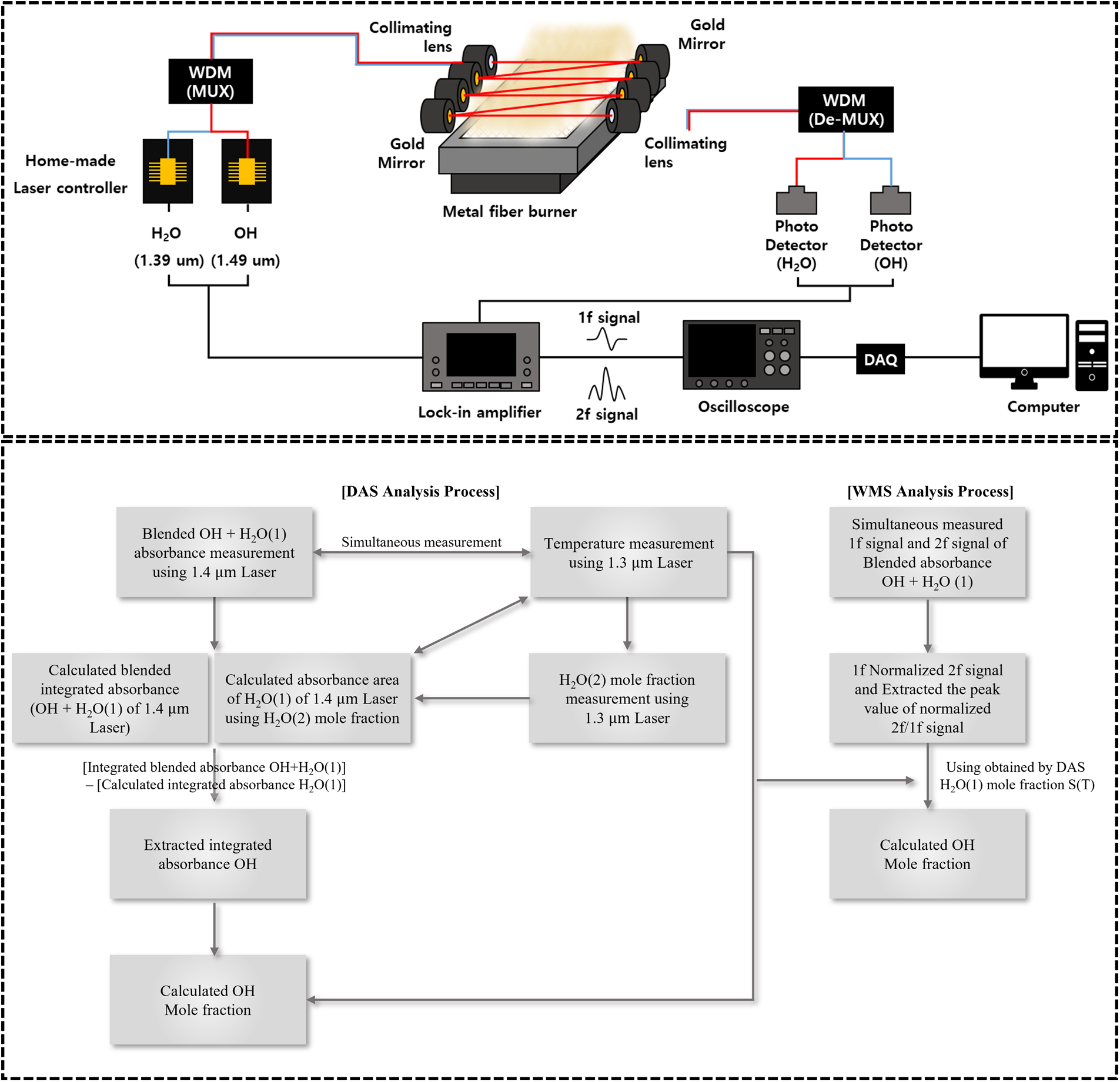
Keywords
Get full access to this article
View all access options for this article.