



Abstract
Introduction
Biomarkers in cerebrospinal fluid (CSF) hold significant potential to aid in the diagnosis, monitoring, and prognosis of neurological disorders, ultimately enhancing patient care. 1 Preanalytical variation can occur during collection, processing, and storage of the CSF and could result in non-biological variation of biomarker levels. 2 The choice of an appropriate container for sample collection plays a critical role in ensuring the accuracy of analytical results. This study focuses on the preanalytical importance of selecting the correct container for CSF analysis. The recommended container is a sterile, additive-free one to avoid analytical interferences. 3
In our laboratory, we often receive unsuitable containers, such as green-top tubes (containing lithium heparin without a separator gel), instead of green screw-cap additive-free containers.
The objective of this study was to determine the variation in protein measurements in CSF depending on the container used and to evaluate the error caused by preanalytical interference.
Materials and methods
To evaluate analytical interference, 30 CSF samples were collected in green screw-cap additive-free containers from patients with protein levels spanning the entire analytical range, and 350 μL were transferred to a lithium heparin tube without a separator gel (BD Vacutainer®, 4 mL, Ref. No. 367880, Becton Dickinson, Franklin Lakes, NJ, USA).
To simulate sample transportation, the samples in the lithium heparin container were placed in a tube rotator (e.g. Thermo Scientific™ Labquake™ Shaker Rotator, Waltham, MA, USA) set at 20 r/min for 5 min prior to analysis. Protein levels in CSF were measured using the Abbott Alinity ci-series analyser (Abbott Laboratories, Abbott Park, IL, USA) with the total protein assay based on the biuret method, specifically calibrated and validated for CSF samples.
Data management and análisis
Data are represented as means ± SD when the distribution was normal and median with range when the distribution was not normal. The analysis of Student’s t-test was used for comparisons of means. Statistical significance level was set at P = .05. Statistical analysis was conducted using MedCalc® following SEQC recommendations.
Results
The mean protein values in samples using sterile screw-cap additive-free containers (n = 30) were 37.94 ± 26.13 mg/dL, while the mean values in lithium heparin tubes (n = 30) were 268.65 ± 47.20 mg/dL (Figure 1). Comparing the mean protein values in both groups revealed a mean difference of 230.71 mg/dL (95% CI: 215.84–245.57), with a significance level of P < .001. A boxplot comparing cerebrospinal fluid (CSF) protein concentration measurements obtained using two types of containers: Sterile, additive-free tubes and lithium heparin tubes without a separator gel.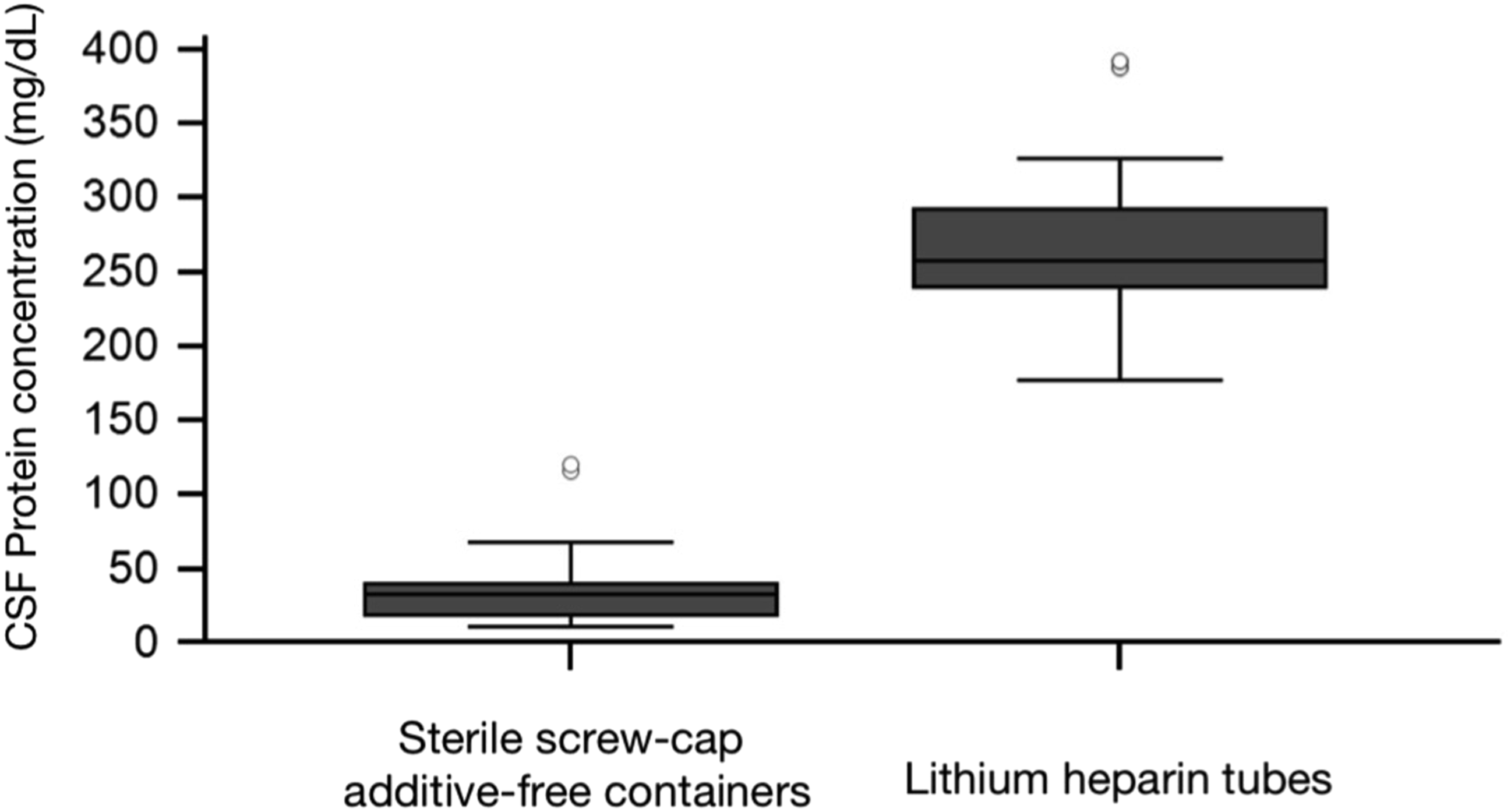
The null hypothesis (Ho) was rejected, confirming a significant difference between the use of lithium heparin containers without separator gel and sterile screw-cap green-top containers without additives.
Discusión
The results of this study demonstrate a significant impact of the choice of container on the measurement of cerebrospinal fluid (CSF) protein levels. Specifically, the use of lithium heparin tubes without a separator gel resulted in a substantial overestimation of protein levels compared to sterile screw-cap additive-free containers. This difference, with a mean increase of 230.71 mg/dL, highlights the critical role of preanalytical factors in ensuring reliable laboratory results.
The preanalytical phase, which includes specimen collection, handling, and transportation, is known to significantly influence the accuracy of clinical laboratory analyses. Errors in this phase can lead to false laboratory results, potentially misleading clinical decision-making. Consistent with our findings, previous research has shown that anticoagulants such as lithium heparin can interfere with protein assays, either by directly interacting with proteins or by altering their stability during storage and processing.4,5 As a result, protein concentration may be altered, either increasing or decreasing depending on the type of heparin and the detection method used. In contrast to the study by Yang et al., 6 which shows that protein levels decrease, our results show that these levels increase. This difference might be explained by differences in measurement techniques.
Lithium heparin tubes are commonly used for measuring total protein in blood due to their ability to prevent clotting and maintain sample integrity during transport. However, for CSF, these tubes are unsuitable because lithium heparin can interfere with protein assays specific to this fluid. The low protein concentration in CSF makes it more susceptible to such interferences, including altered protein stability and adsorption to tube walls, which are less impactful in blood samples. Additionally, the matrix of blood, rich in albumin and other proteins, minimizes the relative impact of adsorption or precipitation caused by anticoagulants. In contrast, the lower baseline protein content in CSF amplifies these effects, leading to substantial measurement inaccuracies.3,7
The overestimation of protein levels observed in our study has important clinical implications. Elevated CSF protein levels are commonly associated with pathological conditions such as central nervous system infections, subarachnoid haemorrhage, neurodegenerative diseases, and autoimmune disorders. 8 Erroneous elevation due to container choice could lead to unnecessary diagnostic procedures or misdiagnoses, such as a false assumption of impaired CSF reabsorption or inflammation. This underscores the importance of following standardized preanalytical protocols, as recommended by professional bodies like the Clinical and Laboratory Standards Institute (CLSI). 9
Another potential factor contributing to the observed differences could be the adsorption of proteins to the container walls, a phenomenon that varies depending on the container material and the presence of additives. Studies have shown that certain anticoagulants may alter the protein composition or cause precipitation, further compounding the variability in results. 10
The implications of the results obtained in this study are not only relevant for total protein measurements in CSF but also for other clinically relevant protein biomarkers, such as those used in neurodegenerative diseases, autoimmune disorders, and central nervous system infections. The interference of anticoagulants like lithium heparin, as well as protein adsorption to container walls, can alter the accurate measurement of biomarkers like tau, beta-amyloid, inflammatory proteins, immunoglobulins, and cytokines, thus affecting clinical decision-making. 11 Since these biomarkers are essential for early diagnosis and monitoring of various neurological conditions, preanalytical errors could lead to misdiagnosis or underestimation of disease severity, compromising appropriate patient management. These findings reinforce the need to adhere to strict standardized protocols for sample collection and transportation, ensuring accurate measurement of protein biomarkers in CSF and improving the quality of diagnosis and treatment in central nervous system diseases. 12
While this study provides valuable insights, it has limitations. The short storage time in lithium heparin tubes may not fully capture the potential effects of longer transport or storage durations. Future research could investigate these variables and expand the sample size to validate our findings further.
In conclusion, the significant variation in CSF protein measurements based on the container used underscores the necessity of rigorous adherence to preanalytical protocols. Ensuring the appropriate selection of containers for CSF collection is vital to prevent analytical errors and safeguard accurate diagnosis and treatment.
Footnotes
Declaration of conflicting interests
The author(s) declared no potential conflicts of interest with respect to the research, authorship, and/or publication of this article.
Funding
The author(s) received no financial support for the research, authorship, and/or publication of this article.
Ethical approval
Not required for the study.
Guarantor
Alberto Izquierdo-Martínez.
Contributorship
The development and validation of the assay was performed by Alberto Izquierdo-Martínez. All authors contributed to the manuscript.
