




Abstract
Public attitudes towards intimate partner violence (IPV) have shifted from viewing IPV as a tolerable, private matter to viewing it as a matter of public concern that should be dealt with as a crime. Despite this major shift in social attitudes towards IPV over the last three decades, there seems to be a lack of understanding of why many women stay, at least initially, when facing severe forms of IPV. Using data from face-to-face interviews conducted with 29 women in Southeast Queensland who experienced severe forms of IPV over an extended period of time, this paper explores the rationale behind the (initial) decision to stay with an abusive partner. While rational decision making has predominantly been seen as a male trait, this paper criticizes this underlying assumption, using a feminist framework of moral reasoning. Findings presented in this paper identify the rationale behind victims’ decisions to stay and offer an advanced understanding of moral reasoning through a gendered lens in the context of IPV. Understanding why women stay, at least initially, is the first crucial step in ensuring adequate support for women on their journey towards the ultimate goal of a violence-free life.
Introduction
Intimate partner violence (IPV) is a serious and widespread phenomenon affecting many women in Australia and worldwide (Hague and Mullender, 2006; Hutchinson and Weeks, 2004; World Health Organization (WHO), 2005). Findings from international victim surveys show that IPV affects one in three adult women in most industrialised nations, is a leading cause of injuries to women of reproductive age (Johnson and Bunge, 2001; Mirrlees-Black, 1999; Mouzos and Makkai, 2004), and is associated with 60 per cent of homicides involving a female victim (Shackelford and Mouzos, 2005; Virueda and Payne, 2010). These occurrences attract ongoing media attention (Barette Meyering, 2010; Bentley, 2011; McInnes and Power, 2008) and have moved IPV and the highly vulnerable status of its predominantly female victims back into the key focus of governmental priorities for the next decade (Australian Government, 2009). Following the North American example, Australia recently saw the emergence of ‘Domestic and Family Violence Death Review’ units in a number of Australian States and Territories and a revision of the current Domestic and Family Violence Protection Act from 2003 (Barette Meyering, 2010; Bentley, 2011; Cairns Regional Domestic Violence Service (CRDVS), 2009). Despite this strategic shift in governmental focus and decades of prior research on the causes and consequences of IPV, it is still a phenomenon not fully understood, especially by the general public (Meyer, 2010). Formal and informal sources of support approached by women experiencing frequent and often severe forms of IPV frequently raise the question of why the victim ‘doesn’t just leave’ (Anderson et al., 2003: 151). The decision to stay is seen as passive, naive, irrational and, where children are involved, further as irresponsible, especially by informal and general formal support sources that lack the understanding of the complex nature of domestic violence (Anderson and Saunders, 2003; Koepsell et al., 2006). As a result, these sources often fail to provide ongoing support once they perceive their initial support as ‘unsuccessful’ where the victim remains with or returns to the abusive partner (Brown, 1997; Liang et al., 2005; Moe, 2007).
While the women’s movement has achieved a change in public attitudes towards IPV from being a tolerable private matter to being a matter of public concern that should be dealt with in a criminal sense (Buzawa and Buzawa, 1990; Douglas, 2008), there appears to be an underlying attitude that only those deciding to leave an abusive partner are worthy of being supported (McMullan et al., 2010). Society as a whole seems to struggle with the idea that there may be valid reasons why women choose to stay with an abusive partner, at least temporarily, and that these have been carefully assessed by those exposed to the abuse on a regular basis (Anderson and Saunders, 2003; Stanko, 1997). This idea seems to be even harder to grasp where IPV involves severe and often life-threatening forms of abuse (Anderson et al., 2003). When listening to the voices of those affected by IPV, it becomes clear that a variety of factors play into victims’ decisions to stay, at least temporarily (Anderson and Saunders, 2003; Fugate et al., 2005). These factors include socio-structural as well as individual factors and follow a pattern predominantly oriented towards harm minimisation for self and others (Anderson and Saunders, 2003). In this context, harm is not to be understood as solely physical harm or injury but further includes considerations around emotional well-being and future financial stability.
While past research has predominantly focused on identifying the factors that predict victims’ decision to leave in a descriptive manner (see e.g. Ellsberg et al., 2001; Koepsell et al., 2006), few have examined the decision to leave or stay in a framework of rational choice (see e.g. Davis, 2002; Moe, 2007). Overall, the body of research on victims’ responses to IPV is shaped by studies aiming to understand how, why and when women leave. While research evidence suggests that leaving the abusive partner is often the only way of regaining safety (Brown, 1997) it is only one step in the complex decision-making process of women affected by IPV. To ensure that victims are eventually adequately supported and empowered to leave, it is important to ensure that their initial decisions when affected by IPV are adequately understood.
This paper therefore seeks to develop an understanding of why women stay and how this decision is rationalised. Using a feminist framework of rational choice and moral reasoning, this paper advances traditional psychology- and economics-based rational choice models (England, 1989) and offers a new framework of viewing and understanding victims’ responses to IPV. First, I will discuss some competing theoretical views on female rationalisation and moral reasoning and introduce a framework in which women’s moral reasoning follows a pattern of rational choice based on an individual cost–benefit analysis. Next, findings from qualitative face-to-face interviews with victims of frequent and severe forms of IPV are used to further support a framework of female rational choice informed by the goal of harm minimisation. Findings are used to advance traditional models of rational choice theory in the context of IPV and to generate a better public understanding of why women stay.
Background
Rational choice theory has a longstanding tradition in areas of psychology, economics and political science (England and Kilbourne, 1990). Traditional approaches to rational choice processes, informed by Kohlberg’s moral stage model (Kohlberg, 1984), focus on the selfishness and rationality of the active decision-maker as two of the key components guiding rational choices and individual cost–benefit analyses. Kohlberg (1984) argued that rational choices are based on moral judgement and reasoning – a feature that is allegedly less developed in women (Friedman, 1985). As such, rational decision-making has traditionally been regarded as a male feature, informed by the separated self of the male decision-maker who aims to maximise his personal benefits (England, 1989). These claims around the gender gap in moral reasoning and rational decision-making have received great academic attention throughout the 1980s, with some studies replicating Kohlberg’s approach (see e.g. Baumrind, 1986) and others criticising the gender bias it promotes (see e.g. Walker, 1984, 1986). Initial, substantive criticism was voiced by Carol Gilligan (1982) who put forward a new approach to understanding female rationality by arguing that moral reasoning in women was different rather than deficient. Gilligan (1982) argued that while male moral reasoning is informed by orientations of justice and entitlement to benefits for oneself, female moral reasoning is guided by the moral orientation towards relationship maintenance and care for others. While this further supports the absence of the selfish component seen as crucial in traditional rational choice models, it suggests that female decision-making is nevertheless guided by a cost–benefit analysis. Costs and benefits are simply assessed on a broader, less selfish scale, taking into account the costs and benefits for individuals close to the rational decision-maker (England and Kilbourne, 1990; Gilligan, 1982). This paper builds on Gilligan’s concepts of moral reasoning in the context of relational responsibility to develop an understanding of victims’ decision to stay when experiencing severe forms of IPV. Given the gendered nature of this phenomenon, its theoretical examination requires a feminist framework that allows an identification of factors associated with victims’ decisions to stay, and how these relate to the concept of moral reasoning and relational responsibility.
Findings from previous studies suggest that few women terminate an intimate relationship as soon as it turns abusive. The same body of research further reveals that those who leave return multiple times to the abusive partner before terminating the relationship permanently, thus indicating that most women affected by IPV stay, at least temporarily (Ellsberg et al., 2001; Fugate et al., 2005; Stark, 2007).
While earlier work on victims’ responses to IPV often described these women as passive for continuing to endure the abuse, more contemporary research portrays them as thoughtful and active actors rather than passive victims in the process of enduring and overcoming victimisation (Akers and Kaukinen, 2009; Kim and Gray, 2008; Liang et al., 2005). Thus, it seems appropriate to apply a rational choice framework in which we can examine women’s responses to IPV as informed decisions made to the best of their knowledge (Hechter and Kanazawa, 1997). According to sociological rational choice models, this knowledge can involve an actual or perceived awareness of any efforts or risks involved in disclosing the abuse and leaving the abusive partner as well as perceived benefits in staying with the abusive partner; if only temporarily. Either decision is usually informed by a clear intention or desired outcome (Hechter and Kanazawa, 1997; Kiser and Hechter, 1998), which is generally the desire to stop the abuse, eliminate fear and minimise harm to themselves and in many cases their dependent children (Akers and Kaukinen, 2009; Hart, 1993; Hoyle and Sanders, 2000; Lempert, 1997). Leading a violence-free life is a benefit many outsiders believe outweighs any potential costs involved in leaving the abuser. Those affected by IPV in their everyday lives are, however, aware of their risk of retaliatory victimisation should they decide to leave (Anderson et al., 2003; Logan and Walker, 2004; Wilson et al., 1995) and the fact that interventions are not always effective in stopping the abuse post separation (Fleury et al., 2000; Klein, 1996; Logan et al., 2006; Schmidt and Sherman, 1996). Unless these women are convinced that the termination of the abusive relationship will offer permanent relief from their violent experiences, the risk of retaliatory violence against them or their children often outweighs the benefits of any attempts to leave (Douglas and Walsh, 2011; Felson et al., 2002; Hart, 1993; Hirschel and Hutchinson, 2003).
If examined in a rational choice framework this indicates that the decision to remain in an abusive relationships is, in many cases, based on a cost–benefit analysis that goes beyond selfishness and entitlement and further considers the impact of one’s individual decisions on dependent others, for example children. For the purpose of this paper, this claim, originally put forward by Gilligan (1982), is supported and illustrated through the examples of the influence of the presence of children and financial dependence on victims’ decisions to stay.
Method
This paper uses data from in-depth interviews with victims of IPV (N = 29), conducted in Southeast Queensland, 1 to examine victims’ responses to IPV in the situational context of moral reasoning and individual risk assessment. 2 Participating women were approached using an agency they were or had recently been in contact with as a gatekeeper. Gatekeeping agencies included four regional Domestic Violence (hereafter referred to as DV) walk-in services (n = 13; 44.8%), three (family) counselling services (n = 9; 31.0%), and three women’s refuges (n = 7; 24.1%). Service providers were located within the greater Brisbane area, and the Sunshine and Gold Coast regions. Due the type of gatekeepers approached for the recruitment of suitable participants, 3 findings presented in this paper are based on the experiences of women who had separated from their partners, at least temporarily, and were receiving specialised support at the time of the interview. All of the victims accessed through the specialised services mentioned above had experienced what part of the IPV literature classifies as ‘intimate’ or ‘patriarchal terrorism’ (see e.g. Johnson, 1995: 284–285). Findings from this study are therefore limited to victims who shared experiences of severe forms of abuse and control, associated with a greater range of barriers and risk factors involved when contemplating leave-taking decisions than victims of so-called situational couple violence for example (see also Leone et al., 2007; Logan and Walker, 2004; Stark, 2007).
Participants had to meet a number of selection criteria, including being female and at least 18 years old. Further criteria included the ability to meet with the interviewer on the service provider’s premises at a mutually suitable time and date, having experienced IPV (emotional, physical, and/or sexual) in their most recent intimate relationship and being separated (at least temporarily) from the abusive partner. 4 Service providers were encouraged to include immigrant and ethnic minority women in their group of selected participants as long as the participants had sufficient English language skills to tell their story. While some services were able to identify eligible participants from immigrant backgrounds, no Indigenous women were selected for participation. 5
A total of 34 face-to-face interviews had originally been scheduled between August 2008 and February 2009. Five victims cancelled one or more of the scheduled interviews and were unable to participate before data collection concluded. All interviews were semi-structured, allowing victims to provide a narrative of their experiences. Information was collected about victims’ individual characteristics and situational circumstances, including the nature and development of their most recent intimate relationship, their experiences of IPV (including verbal, emotional, physical and sexual abuse) in this relationship and their decision to stay or leave at different points throughout the abusive relationship. Information was collected about the outcomes and consequences of a range of informal and formal help-seeking decisions 6 and temporary and permanent leave-taking decisions. Probing questions were used to ensure women addressed all of these themes throughout their narratives. The average interview lasted 53 minutes, ranging between 35 and 88 minutes.
The methodological approach of this study raises some limitations to the generalisability of findings discussed hereafter. While the qualitative nature of the examined data allowed in-depth insight into the situational circumstances and cognitive decision-making processes of victims, the heterogeneous nature of the small sample does not allow the generalisation of findings to the broader victim population. The absence of Indigenous women from the study sample further limits the findings to the experiences of non-Indigenous and partly the experiences of ethnic minority immigrant women. In addition, findings are based on the experiences of victims of so-called patriarchal or intimate terrorism and therefore reflect victims’ responses when experiencing severe and often life-threatening forms of IPV, marked by a high level of coercive control. Overall, findings seem, however, generalisable to this particular population since they reflect the proactive and strategic survival strategies of victims found in other studies on patriarchal terrorism (Johnson, 1995; Leone et al., 2007).
Analysis
All interviews were audio-recorded and afterwards transcribed by a professional transcription agency. After checking the transcripts for transcription errors, meaning was constructed into the data using three different steps of analytic techniques. First, a line-by-line microanalysis was applied to identify broader common themes and experiences. Second, open coding was used to identify relevant concepts and categories relating to individual and situational factors associated with victims’ experiences of and responses to abuse. Third, axial coding was used to identify the complexity of independent variables and their association with different outcome variables (Strauss and Corbin, 1990).
Sample
Characteristics of study participants
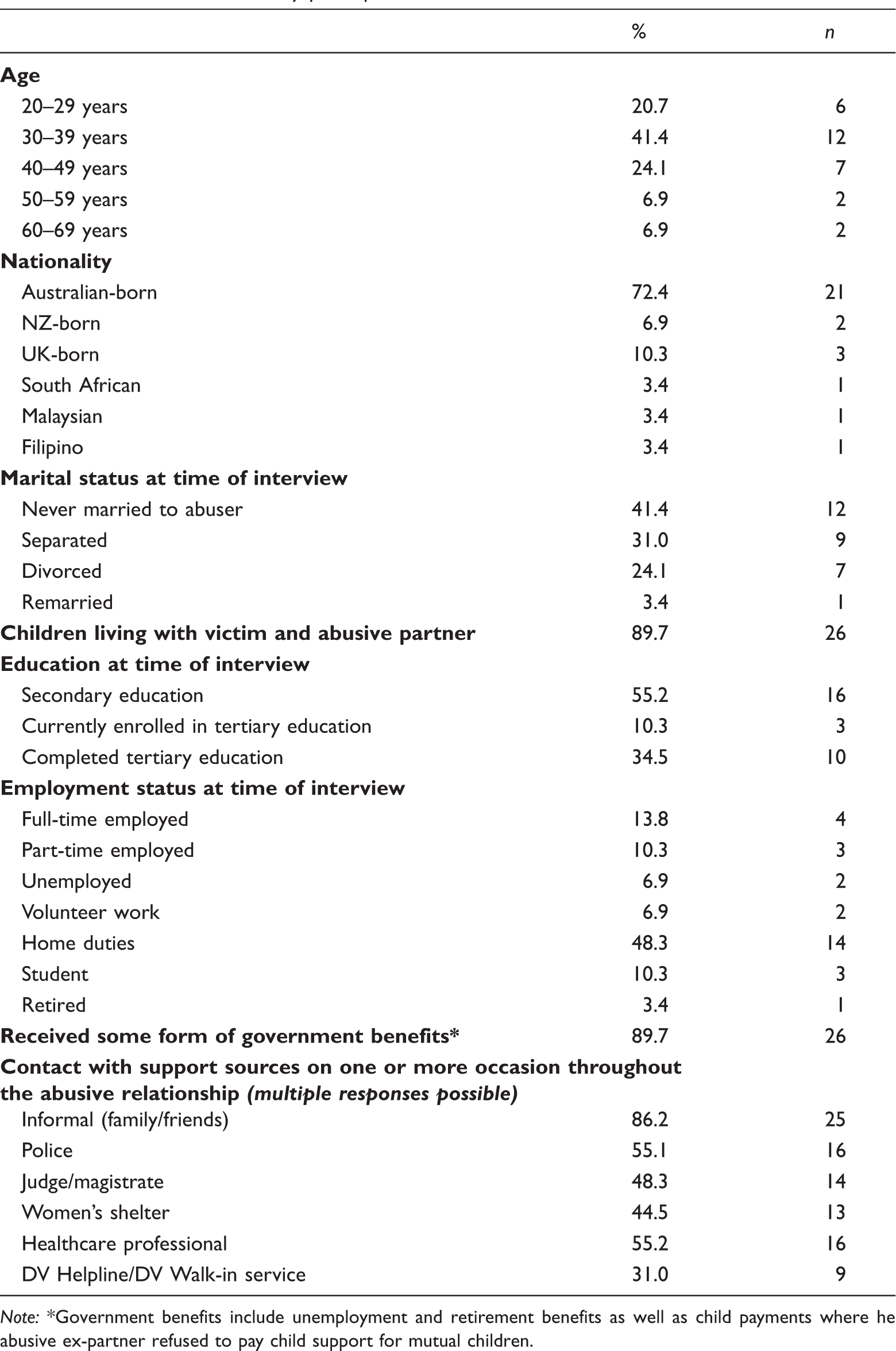
Note: *Government benefits include unemployment and retirement benefits as well as child payments where he abusive ex-partner refused to pay child support for mutual children.
For the majority of participants (89.7%), experiences of IPV ranged at the severe end of emotional and physical abuse. Physical abuse included pushing, shoving, throwing something, punching, kicking, belting, burning, cutting or choking the victim, and the use of weapons or weapon-like objects. In over one-third of the cases (37.9%) these forms of abuse were accompanied by sexual abuse at a later stage throughout the abusive relationship. Few victims (10.3%) reported no physical or sexual violence at any stage throughout the relationship. These victims still experienced forms of emotional abuse, including put-downs, threats of physical harm and the control of finances, social interaction with family and friends, and decisions to engage in the workforce. A great proportion of participants (70%) had repeatedly suffered physical injuries as a result of some of the abusive incidents, including cuts and bruises, bone fractures (such as broken ribs, wrists and noses), ruptured eardrums and dental injuries. Throughout the duration of their relationships, the majority of victims had experienced an increase in the severity and frequency of emotional, physical and sometimes sexual abuse. More than half of the participants (55.2%) furthermore experienced attempts on their lives and/or threats of being killed by their abusive partner.
Victims spent between six months and 36 years in their respective abusive relationships, with a mean relationship duration of 9.7 years. At the time of the interview all victims had terminated their abusive relationship, at least temporarily. Overall, an average of 2.05 years had lapsed since the women had separated from their most recent abusive partner, with almost half of these women (48.3%) having separated within the 12 months prior to the interview. While not all separations may have been permanent at the time of the interview, the majority of women (79.3%) had moved on and established a new life without their abusive ex-partner.
The majority of participants (93.1%) reported having children. While five victims lost custody of their children at some point during the abusive relationship, all but one mother reported children living with her and her abusive partner for at least part of the abusive relationship duration. None of the victims were pregnant at the time of the interview. All but two victims who had children living with them at some stage throughout the abusive relationship reported that their children had witnessed the abuse at least some of the time.
Results
While all victims included in this study showed a diverse range of proactive help-seeking decisions throughout their abusive relationships, the majority (72.4%) stayed with the abusive partner for a prolonged period of time after the onset of abuse. Overall, 13 women (44.8%) further reported previous attempts to terminate the relationship but returned to the abusive partner on one or more occasion. This observation along with the relationship duration shown in Table 1 supports previous research findings suggesting that most women stay, at least temporarily, when faced with the abusive behaviour of an intimate partner (Kim and Gray, 2008; Stanko, 1997). All women were well aware of the risks associated with leaving their abusive partner, including their children’s safety, financial hardship, a lack of accommodation and the risk of fatal retaliatory violence. As a result, these risks often outweighed the perceived benefits of terminating the abusive relationship at different points throughout the abusive relationship and thus led women to remain in the abusive relationship for an extended period of time. The following sections provide some contextual information on the rationale behind the decision to stay.
The role of children
The presence of children was one of the most commonly mentioned factors that informed women’s decision to stay with their abusive partner. Overall, 18 women (62%) reported that their initial decision to stay with or return to the abusive partner was informed by their perceived inability to protect the children from the partner’s threats of retaliatory abuse should she decide to leave. One victim described how she returned to her abusive partner after having separated temporarily because the supervised visitations between her ex-partner and their mutual daughter were coming to end. Rather than leaving her daughter with him unsupervised during scheduled visitations she decided to return to him in order to be around to protect her children: … he had threatened to kill me. So I had left him. He had supervised visitation with our daughter … [which] was coming to an end … I didn’t go back to him because I loved him, I went back to him because I didn’t want him to have access to my child without me being there. So I figured if I was in that situation at least I could protect her to some degree. (I5; 25/10/3)
7
While the above described decision is informed by a perceived risk towards her children, many other women had partners who would clearly articulate what they would do to the mutual children, should the mother decide to separate, as illustrated by the following examples: He used to threaten me all the time. He used to say stuff like ‘if you tell anyone or if you leave, I’m going to kill our son’. That’s the stuff he used to say and you know he was quite capable of doing that stuff. (I20; 28/11/2) I just felt like I couldn’t talk to anyone … [he said] if I was to tell the doctor or anyone about his violence towards me that he would kill our daughter before he killed me and would make me unrecognisable. (I11; 19/5/1)
Other women reported staying with their abuser for an extended period of time to keep the family together and to ensure that the children remain in a familiar environment, as captured by the following quote: I suppose it’s very hard because when you have a house and furniture and it’s your children’s home, it’s very hard to pack up and leave. The home is a secure place. It might be violent but still, that’s their bedroom. (I27; 28/15/4)
The following scenario illustrates that factors influencing victims’ decisions to stay are not only diverse but also multilayered and complex. The statement was made by the same woman who initially returned to her abusive partner to protect the children when the supervised contacts between him and the children were coming to an end. This illustrates that factors informing the decision to stay initially may also inform the decision to leave eventually: I took the kids and went to a motel … I knew the state of mind he was in. Sure enough he came back. He smashed his way in and killed our guinea pigs … he couldn’t get to us so he killed the pets. (I5; 25/10/3)
While this scenario indicates that factors may shift from being predictors of staying to being predictors of leaving an abusive partner, it further supports England’s (1989) and Gilligan’s (1982) concept of moral reasoning guided by relational responsibility. The desire to minimise the risk of harm for dependent others eventually informed both the decision to return initially and the decision to leave eventually.
Overall, findings presented for the role of children lend consistent support to Gilligan’s (1982) argument that female rationalisation is guided by moral reasoning that considers relational responsibility. When contemplating their options, victims of IPV went beyond what was best for them and made decisions informed by what they believed to be in their children’s best interest at that point in time. Thus, these women initially remained in or returned to households they described as highly violent and dangerous for themselves because they believed this decisions afforded their children the security and protection they needed.
The role of financial dependence
Another salient factor that often led women to stay with their abusive partner was the role of financial dependence, also identified as a relevant factor in studies examining victims’ leave-taking decisions (Anderson et al., 2003; Davis, 2002; Kim and Gray, 2008). Twelve women (41.4%) identified financial dependence as an initial key factor that informed their decision to stay. Once women left, an even greater proportion (89.7%) realised they had to depend on government benefits without the support of their ex-partner. One victim described how her financial dependence contributed to her decision to stay with her abusive partner for a further five years from the time she initially contemplated leaving him because she felt unable to start over again with her 10-year old son at that point. It is important to note that this woman’s earlier decision to stay was further informed by her husband’s threat to kill the mutual son, should she decide to leave. This highlights the complexity of factors that guide victims’ moral reasoning around staying and lead to prolonged experiences of abuse: I think when we went over to the caravan park I probably should have gotten out then … but I didn’t have any money … So what I used to do was I used to start to sneak some money away. So I did that for five years. I was slowly sneaking money away … (I20; 28/11/2)
The majority of victims who were interviewed were aware that leaving the abuser often meant walking out with nothing but the few belongings they were able to pack for themselves and their children when the opportunity arose. For many victims this was the only way out once they decided to leave. Still, three of the women interviewed for this study described how they stayed initially to strategically plan their escape and ensure they would be able to take some of their belongings: We were living at my mum’s place at that time … All my belongings were in storage and I knew [the children and I] could stay at my mum’s … I knew I could never leave him if he had the kids or all of my possessions. He would either throw me out or he’d say ‘you can’t have your children you can’t have your possessions, you’re not going to be able to start a new life without your children or your possessions’. So now I had his nuts in a vice. I filed for the domestic violence order [and] I threw him out. That’s what I did. It was sneaky and it was nasty and I know that; but I won. (I15; 23/6.5/3) Well when I left we had a business, truck, house, everything. I knew if I left I wouldn’t get anything. So I waited till he was at work and I packed the whole house up on my own, put it on the back of the truck, put it in a storage shed. I had to make a safety plan, ’cause he wouldn’t let me have anything … I’d seen a solicitor about it for my rights, and she said ‘oh look, you’re better off taking what you can’. So I did. (I22; 23/7/3) … a week before I left I did some research. I rang my legal people, I rang DV Connect … The Saturday was when the cricket was on in Brisbane … They were catching a train to Brisbane so I had a couple of hours to get our stuff and get out … So I rang my friend and said, right, come and help me move … he had a trailer … I got as much stuff as I could in an hour and a half. (I24; 33/2/1)
The presented excerpts from face-to-face interviews with women affected by severe forms of IPV reveal the strategic planning required throughout the journey towards the eventual goal of freedom from abuse for themselves and their dependent children. Thus, victims’ responses to IPV need to be understood as morally reasoned decisions informed by relational responsibility.
Conclusion
Findings discussed in this paper identify victims’ (initial) decisions to stay with or return to an abusive partner as future-oriented rationally informed choices around harm minimisation for themselves and dependent others. Women’s moral reasoning throughout this decision-making process was illustrated in the examples of the role of children and the role of financial dependence. The presence of children proved to be a salient factor that guided the moral reasoning of most women with dependent children. While the presence of children encouraged some women to leave eventually, it first and foremost informed the decision to stay in an attempt to minimise perceived risk and maximise perceived security for children. While the same women later felt that the benefits of staying no longer outweighed the risks of leaving, the decision was informed by the cost–benefit analysis around leaving an abusive partner who either used threats towards the children’s well-being to intimidate the victim or who at the same time of being an abusive partner also represented a father figure to the children and the breadwinner of the family.
Family finances and the role of financial dependence was another crucial factor that was considered carefully and informed victims’ decisions to stay, at least temporarily. While most victims were aware of the availability of short-term crisis accommodation, they often felt unable to establish an independent future lifestyle and support their children when the abuse first unfolded. This often led them to stay initially until they were either able to save some money or gain access to mutual finances through strategic planning of an exit strategy. While most prior research on the role of financial dependence has used this factor as a demographic predictor variable in victims’ leave-taking decisions (Akers and Kaukinen, 2009; Coker et al., 2000), findings from this study provide contextual information around the logistics of victims’ strategic attempts to minimise financial hardship, and their willingness to accept the costs of ongoing violence in an attempt to achieve this.
Overall, findings discussed throughout this paper contribute to an advanced understanding of female moral reasoning in the context of IPV. Women’s decisions to stay with or return to an abusive partner were informed by a variety of factors, which highlights the importance of understanding the complexity of influences on victims’ decisions to stay rather than disregarding this decision as an irrational or irresponsible choice. While past research reveals that separation tends to be the only option to stop the abuse permanently for most women (Brown, 1997), it is important to firstly understand why women stay. Without understanding the factors that inform women’s moral reasoning that lead them to believe that staying is often the safest and most strategic option for the time being, social responses to women affected by IPV are most likely going to remain inadequate. It is therefore important to move away from traditional models of rational choice and the alleged deficiencies in women’s moral reasoning perpetuated by earlier work on female rationality (Kohlberg, 1984; Walker, 1986) towards a gendered understanding of moral reasoning (England and Kilbourne, 1990; Gilligan, 1982). This is particularly important for external informal and formal support sources when being approached for initial support, since past research has linked negative and judgemental reactions towards victims’ disclosure of and responses to IPV to prolonged experiences of victimisation (Beaulaurier et al., 2007). On the other hand, supportive and understanding informal and formal attitudes and reactions to victims’ disclosure of IPV have been associated with shortened experiences of abuse. The first step in supporting women to leave therefore lies in generating a broader public understanding of why women stay. Unless victims feel sufficiently supported and protected once they contemplate the risks and benefits of staying versus leaving, staying with the abusive partner is likely to seem a safer option for many women; at least temporarily.