



Abstract
The Think First program was implemented in five NSW correctional centres between 2003 and 2007. This study is a longitudinal evaluation of Think First using the pre- and post-test scores of four questionnaire measures (the Social Problem Solving Inventory – Revised; Barratt Impulsivity Scale, version 11; Locus of Control Behaviour; and the Crime PICS, version II), in a sample of 135 male participants. Significant change in a pro-social direction was found on the Locus of Control Behaviour, all of the Barratt Impulsivity Scale and Crime PICS II subscales and two of the Social Problem Solving Inventory – Revised subscales. Completion of Think First improved impulsivity levels, criminal thinking styles and some aspects of social problem solving ability. There appeared to be particularly positive effects on Aboriginal and Torres Strait Islander Locus of Control scores post-program.
Keywords
Introduction
The Think First program was developed by James McGuire and targets social problem solving in relation to offending behaviour. This program requires offenders to analyse their own offending behaviours as problems that can be solved (McGuire, 2005). The ‘What Works’ body of literature points to evidence of a link between social problem solving deficits and offending (Antonwiscz and Ross, 2005). It is believed that an individual’s risk of offending is increased through the failure to apply effective problem solving skills (McGuire and Hatcher, 2001). Think First was designed according to the ‘What Works’ principles in that it is a structured, theoretically driven intervention which utilises a cognitive-social-learning model of change and associated cognitive-behavioural methods (McGuire, 2002, 2005). The program has a long history of research-based revision in the United Kingdom (see McGuire, 2005). Think First is a multi-modal program and allocates offenders according to risk, need and responsivity principles (McGuire, 2005). The program incorporates both group and individual sessions, has both treatment and theory manuals, and facilitators receive training prior to implementation (McGuire, 2005).
There are two versions of the Think First program, one for use in correctional centres and the other for use in the community with offenders under supervision orders. The correctional centre program consists of four pre-group sessions (comprising two individual mentor sessions, one pre-testing session and one introductory group session); 30 two-hour group sessions and six post-group sessions (comprising one post-testing session and five individual mentor sessions which may include one group booster session). Sessions include a combination of information giving, practical exercises, skill practice and discussion (McGuire, 2005).
McGuire (2005: 187) notes ‘the overall objective is to help the individual acquire, develop and apply a series of social-problem solving and allied skills that will enable them to manage difficulties in their lives, and to avoid future re-offending’. In order to achieve this, the Think First program content targets four skill areas of problem solving; self-management; social interaction training and values education (McGuire, 2005). The sessions are sequential and the first half of the program addresses basic problem solving skills before offenders move into a detailed assessment of their own personal problems and offending behaviours (McGuire, 2005). The second half of the program covers skills in self, stress and anger management, social interaction, perspective taking and conflict resolution (McGuire, 2005).
While the ultimate aim of therapeutic programs (including Think First) in offender populations is to reduce recidivism, intermediary treatment targets constitute one alternative indicator of program effectiveness. These intermediary targets are criminogenic factors, directly addressed by programs and usually measured with psychometric or questionnaire style tests (Friendship et al., 2003b). A small number of published studies have analysed intermediate treatment targets in other cognitive-behavioural programs with offenders (McGuire, 2005). Most of these investigations have found favourable results, particularly for criminogenic attitudes, social problem solving skills, impulsiveness, locus of control, social reflection, perspective taking and situational response assessments (McGuire, 2005; McGuire and Hatcher, 2001). Cognitive-behavioural programs that specifically target social problem solving skills have demonstrated modest improvements in intermediary treatment targets including cognitive indolence, impulsivity levels, locus of control (Blud et al., 2003), problem solving skills (McMurran et al., 2001), frustration tolerance, social conformity and critical reasoning skills (Tapp et al., 2009). One randomised controlled trial design study of a cognitive-behavioural program in the United Kingdom found significant improvements in impulsivity, locus of control, general attitudes to offending and cognitive indolence (McDougall et al., 2009).
There have been few studies of outcome effectiveness for Think First using intermediary treatment targets. It has almost exclusively been evaluated in the United Kingdom, in community settings and using quasi-experimental designs that have tended to focus on program integrity indicators and recidivism rates (McGuire, 2005; Merrington and Stanley, 2004). In Australia, Think First was implemented in Victoria under a different name at one maximum security prison and one community corrections site (Bartholomew and Aurora, 2001). The incarcerated sample demonstrated change on measures of locus of control, general attitudes towards offending, anticipation of re-offending, victim empathy, perspective taking and evaluation of crime as worthwhile (Bartholomew and Aurora, 2001). The program was observed to be particularly good at targeting criminal thinking styles, although there was continued high impulsiveness and careless decision-making style scores post-program (Bartholomew and Aurora, 2001). The Victorian sample was small, diverse and did not appear to have involved pre- and post-test score matching for individual offenders in the data analysis (Bartholomew and Aurora, 2001). The first aim of the current study is thus to investigate the short-term impact of Think First on incarcerated male offenders using a retrospective longitudinal design and a larger sample.
The second focus of the current study is the treatment needs of Indigenous offenders. There is much discussion in the field of offender treatment regarding the broad need for cultural sensitivity and consultation in the design and delivery of program content, and many have lamented that this appears to be a neglected area of offender rehabilitation (see, for example, Howells et al., 1999). There is still a general lack of research into therapeutic programs with Indigenous Aboriginal offenders in Australian corrections even though, compared to the increasing general prison population in Australia, the Aboriginal and Torres Strait Islander (ATSI) prison population has grown at a substantially faster rate (Brown, 2004; Carach et al., 1999; Eyland, 1996; Gorta et al., 1982).
There are at least four ways in which ATSI inmates may differ from other inmates and that may influence the effectiveness of programs. The first is that that ATSI people may incorporate significant differences in their definitions, expectations and norms relating to anger and violence (Mals et al., 2000) (and indeed, criminal behaviours generally), which have potential implications for the relevance of generalist program material. Most of the criminological and psychological research underpinning offender treatment programs (including Think First), is heavily influenced by individualistic explanations of crime and criminal behaviours (Durrance and Williams, 2003). In contrast, ATSI cultures tend to be much more spiritual, ecological, consensual and communal (Vicary and Andrews, 2000), although caution is required when making such generalisations. As many authors have noted, there are wide cultural differences between and amongst ATSI Australians in different geographical parts of the country (Jones et al., 2002; Howells et al., 1999) and this makes standardised adaptation of programs inappropriate.
A second potential difference between ATSI and non-ATSI offenders may be related to learning styles as it has been proposed that ATSI people may have a learning style that differs from non-ATSI (Howells et al., 1999; Sayers, 1988; Toby, 2001). Research into the learning styles of NSW High School students found that learning goal orientations between different cultural groups were similar; although the ATSI students were more likely to be motivated by social goals than the other groups (McInerney et al., 1998). It has also been proposed that traditional ATSI people tend to be dominant right-brain learners (non-verbal, concrete, analogical, non-temporal, non-rational, spatial, intuitive and holistic), while Western culture values and utilises left-brain learning (verbal, analytic, symbolic, abstract, temporal, rational, logical and linear) (Sayers, 1988). The more traditional the ATSI upbringing and lifestyle, the more the individual is likely to rely on right-brain methods of knowing and acquiring information (Sayers, 1988).
A third potential difference is that the styles of interpersonal interaction amongst ATSI people have also been demonstrated to differ markedly from those of non-ATSI Australians (Powell, 2000). For example, giving or receiving information verbally is atypical in many ATSI cultures where there tends to be a more indirect style of relating (Powell, 2000). This could result in greater reluctance to openly challenge others in a group setting, or in missing opportunities to contribute to group discussion because of a different use of silence (Powell, 2000).
Finally, a higher level and number of criminogenic and non-criminogenic need areas have generally been observed in ATSI offender groups compared to non-ATSI offenders (Jones et al., 2002; Howells et al., 1999; Hsu et al., 2010). In addition, the experience of racism may add to both criminogenic and non-criminogenic factors for this population (Durrance and Williams, 2003). It has been observed that low self-esteem and high levels of frustration were particularly prominent in a Western Australian ATSI population and these problems were thought to be directly related to the effects of colonisation (Mals et al., 2000). Having an ATSI background in Australia needs to be viewed as a responsivity factor, such that programs take into account the historical, social, cultural and learning style frameworks of ATSI lifestyles (Mals et al., 2000).
These areas of difference may mean that ATSI people are less likely to enrol in a program such as Think First. If they do enrol, they may find the philosophy of individual explanations and responsibility for offending behaviour to be at odds with their cultural experiences. ATSI people may also have difficulty internalising some of the Think First concepts and models of delivery which rely heavily on verbal discussions and temporal concepts in learning and then following specific problem solving steps in a pre-determined order. Within the group sessions themselves, ATSI people may present as quieter than other participants and they may miss opportunities to contribute to discussions because of different interpersonal relating styles. Thus, although McGuire (2005) has asserted that Think First is appropriate for use with ethnic minorities and the manual is amenable to cultural adaptations, its relevance to ATSI populations is unknown.
In NSW, the initial pilot Think First groups were facilitated in 2003 at two male correctional centres – Lithgow and Junee. Think First was then expanded to a further three male correctional centres (Bathurst, Mid North Coast and John Morony) in 2004 and 2005. Think First was facilitated according to best practice standards, utilising a manual and specifically trained Offender Services and Programs Staff. In addition, the Department’s Offender Program Unit (OPU) monitored program integrity. As previously stated, the first aim of this study was to assess the impact of the program and specifically to assess whether incarcerated male offenders would demonstrate pro-social changes on the pre- to post-measures. The second aim was to evaluate the efficacy of the program for ATSI offenders. Due to the social, cultural and learning style factors that have been discussed in relation to ATSI offenders, it was expected that this group would generally demonstrate smaller changes in the pro-social direction compared to non-ATSI offenders. To achieve these stated aims, the current study adopted a retrospective longitudinal design using archival data.
Method
Participants
Think First participants were identified via standard Departmental case management procedures. Offenders were invited to participate in the program if they satisfied the following criteria: (a) a history of non-sexual criminal recidivism; (b) a moderate or higher risk range score on the Level of Service Inventory – Revised (Andrews and Bonta, 1995); (c) longer than four months remaining on their sentence; and (d) they were clinically judged by staff to have problem solving deficits as well as sufficient literacy skills and motivation levels to participate.
Between April 2003 and January 2007, 282 male incarcerated participants completed at least one of the pre-test scales. Of this group, 22.1 per cent were ATSI. As demographic information was not recorded in the OPU Think First database, ATSI status was determined through cross-checking manually against other Departmental records by the first author.
Of the 282 participants who completed at least one scale, only 137 offenders completed both the pre- and post-tests and thus constituted the final sample for the study. The overall completion rate was 48.6 per cent but there was only a 35.5 per cent completion rate for the ATSI participants. The number of participants who completed pre-testing and the program but declined to complete post-testing, as well as the true program dropout rate, is unknown as this information was not collected by program facilitators.
Of the initial sample who completed at least one pre-test, the majority were in two locations, Junee (39.6%) and Lithgow (29.3%) with the other locations, Mid North Coast (17.1%), Bathurst (7.5%), and John Morony (5.7%) housing smaller numbers. Lithgow had the highest percentage of participants (41.6%) who had completed both pre- and post-testing and only 6.6 per cent of the pre/post participants came from Mid North Coast. Half of the ATSI pre/post participants were housed at Lithgow. There were no ATSI participants at John Morony.
Measures
During the period 2003–2007, the Think First manual mandated that the program use eight scales for pre- and post-testing. Of these, data from four scales were analysed in this study. These were the Social Problem Solving Inventory – Revised (SPSI-R) (D’Zurilla and Maydeu-Olivares, 1995), the Barratt Impulsivity Scale Version 11 (BIS-11) (Barratt, 1994), the Locus of Control Behaviour (LCB) (Craig et al., 1984), and the Crime PICS II (Frude et al., 1998). These measures were chosen based upon their established psychometric qualities, participant completion rates and suitability for Indigenous participants.
The SPSI-R (short form) is a 25-item measure which assesses the respondent’s attitudes towards solving problems associated with everyday living. Respondents are informed that problems could relate to self, to relationships with others, to the environment or to material possessions. Respondents rate statements on a five-point scale from zero to four to indicate how much the statement applies to them. Items are worded generally, for example, ‘I wait to see if a problem will resolve itself first, before trying to solve it myself’. The items are organised into a total Social Problem Solving score and five scales: Positive Problem Orientation, Negative Problem Orientation, Rational Problem Solving, Impulsiveness/Carelessness Style and Avoidance Style. The psychometric properties of the SPSI-R are good, and solid construct validity has been reported by its authors (D’Zurilla and Chang, 1995; Maydeu-Olivares and D’Zurilla, 1996, 1997).
The BIS-11 is a 30-item measure of impulsivity and asks respondents to indicate on a four-point rating scale how true each item is for them. Three scale scores provide differential measures of cognitive, motor and non-planning impulsivity levels. Items include statements such as ‘I do things without thinking’ and ‘I walk and move fast’. The Barratt Impulsiveness Scale (BIS) has undergone a number of revisions and analysis of the three factor structure (Barratt, 1994; Ireland and Archer, 2008). It has been previously been used in prison samples (Barratt, 1994; Holland et al., 2009) with prisoners found to have higher scores compared to other groups. The BIS-11 is an internally reliable measure in populations where impulsivity levels are elevated (such as correctional centres) (Ireland and Archer, 2008). The higher the impulsiveness score, the wider the range of criminal acts that are performed by the prisoners (Stanford and Barratt, 1992, cited in Barratt 1994).
The LCB contains 17 items that are all scored on a six-point Likert scale according to how strongly the respondent agrees or disagrees. Items relate to a sense of control or lack of control over future plans, difficulties and problems, for example: ‘I believe a person really can be a master of his own fate’. The overall score indicates the extent to which respondents perceive events as being a consequence of their own behaviour. High scores indicate externality of control and low personal responsibility for problem behaviour. A reduced LCB score indicates change towards internality and can predict maintenance. The LCB has been shown to have satisfactory internal reliability, test-retest reliability, and scores are independent of social desirability, age and gender (Craig et al., 1984). Scores have also been demonstrated to be stable over time in the absence of intervention (Craig et al., 1984).
The Crime PICS II measures respondents’ attitudes towards crime, victims and their current life problems. It has 20 items on which respondents indicate how strongly they agree on a five-point Likert scale. The Scale provides five scores: General attitude towards offending; Anticipation of re-offending; Victim hurt denial; Evaluation of crime as worthwhile; and Perception of current life problems. Items include statements such as ‘Crime can be a useful way of getting what you want’ and ‘My crimes have never harmed anyone’. Frude, Honess and McGuire (1998) assert that the Crime PICS II provides reliable and valid scores. The first four subscales of the Crime PICS II were analysed in this study.
Procedure
Once identified for the program, offenders were asked if they would be prepared to participate in an anonymous evaluation of Think First. Those who agreed signed a consent form and completed the four scales prior to the commencement of the group sessions. These offenders then completed the same measures within one to two weeks of the conclusion of the group sessions. Testing occurred in a group format, overseen by program facilitators and was part of the pre- and post-group sessions of the program. Completed scales were sent to the OPU for scoring and entry into an Excel file. Non-consenting offenders still participated in the program. Ethics approvals to use the archival data for this study were obtained from Corrective Services NSW and Charles Sturt University’s respective Ethics Committees. The data for this study were analysed using SPSS v17.
Results
Where participants had not answered five or more items on a scale, no score was calculated. Where there were missing scores on fewer than five items, scale scores were pro-rated.
Prior to performing the main analyses, one-way ANOVAs were conducted on the scores to determine if there were any differences between locations. Due to the high number of tests conducted and the exploratory nature of this study, a more stringent significance level (α = .01) was adopted to reduce the chance of Type I errors. The only significant difference between subscale scores across locations was that the LCB pre-test mean at John Morony was lower than at other locations (18.0 vs. means between 25.9 and 30.3). The John Morony Correctional Centre operates a young adult offender program which utilises older inmates as mentors and also includes an adventure program component. People tend to demonstrate greater internal locus of control as they age (Hans, 2000) which indicates that a greater number of mentors may have been participants at this location. In addition, participants of adventure programs tend to become significantly more internal as a result of their participation (Hans, 2000). It is thus possible that the older ages of mentors and prior completion of the adventure program by the young offenders combined to influence the locus of control scores in this group. Given that other than this one difference, the scores from the different centres were not different, the data were pooled for further analyses.
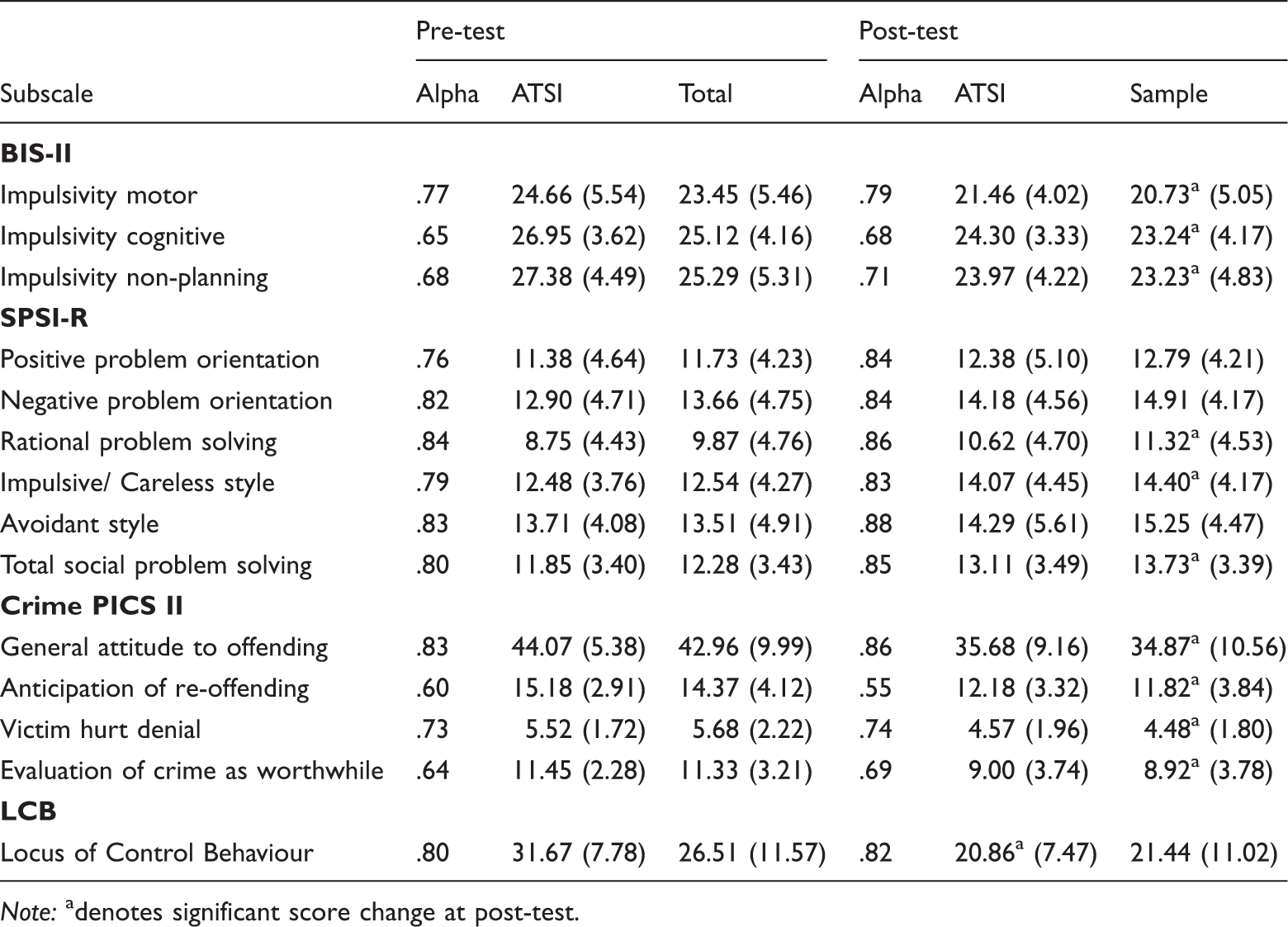
Subscale reliability scores and pre- and post-test mean (standard deviation) subscale scores for Aboriginal and total sample groups.
Note: adenotes significant score change at post-test.
In order to assess whether there were changes in the scores after completion of the program, mixed design ANOVAs were carried out on each of the subscale pre- and post-test scores with ATSI/Non-ATSI as the between subjects factor and time as the within subjects factor. Effect sizes (eta squared) 1 for within and between subject factors were also calculated for each subscale.
In terms of the main effect for time, the BIS-II, Motor impulsivity, Cognitive impulsivity and Non-planning impulsivity scores all decreased significantly at post-testing (F(1, 135) = 19.20, p < .001; F(1, 177.64) = 22.83, p < .001 and F(1, 135) = 23.70, p < .001 respectively) with effect sizes ranging between .12 and .15. With respect to the SPSI-R, the total Social problem solving score increased significantly (F(1, 122) = 11.35, p < .001) after the completion of the program. However, when looking at the subscales, there were only significant differences for the Rational problem solving and Impulsive/Careless Style problem solving scores (F(1, 122) = 6.98, p < .01 and F(1, 122) = 10.32, p < .01 respectively). The effect sizes for these differences ranged between .05 and .08.
All of the Crime-PICS II subscale scores demonstrated significant change post-program with General attitude to offending (F(1, 122) = 50.71, p < .001), Anticipation of re-offending (F(1, 122) = 27.61, p < .001), Victim hurt denial (F(1, 122) = 16.14, p < .001) and Evaluation of crime as worthwhile (F(1, 122) = 35.28, p < .001) scores decreasing following completion of Think First. The effect sizes for these changes ranged between .11 and .28. The Locus of control behaviour scale scores also decreased significantly over time (F(1, 122) = 37.267, p < .001), the effect size being .22. All of the observed changes were in the expected pro-social direction except for the increase of the Impulsive/Careless Style score.
With regard to ATSI status, there were no significant main effects on any of the scales. There was, however, a significant interaction between ATSI status and time for the Locus of Control Behaviour scores (F(1, 122) = 7.965, p < .01, ES = .77). As can be seen in Figure 1, while the locus of control score for both groups decreased, the decrease in the scores of the ATSI participants was much greater. At the pre-test the scores of that group were significantly higher than the non-ATSI group, whereas at the post-test there was no significant difference.
Pre- and post-LCB scores for the total sample and ATSI group.
Discussion
The aims of this study were to examine the short-term impact of the Think First program on incarcerated male offenders in general and specifically on ATSI offenders using a longitudinal design. The results showed that completion of the Think First program by incarcerated male offenders produced reduced motor, cognitive and non-planning impulsivity levels, improved rational and social problem solving skills and led to pro-social changes in general attitudes to offending, anticipation of re-offending, victim hurt denial and evaluation of crime as worthwhile. Think First completers also had higher levels of internal locus of control in both the total sample and among ATSI participants.
These results tend to be broadly similar to a number of previous research studies which have found that generic cognitive-behavioural interventions with offenders improve criminogenic attitudes, social problem solving skills, impulsiveness and locus of control. The Think First program in Victoria achieved remarkably similar results, including the increased impulsivity scores (Bartholomew and Aurora, 2001). Within the total sample, score changes on the SPSI-R scales were small to medium while the BIS-11 cognitive and non-planning scales demonstrated larger effect sizes. Three of the Crime-PICS-II subscales also showed large effect sizes, especially the General attitude to offending and Evaluation of crime as worthwhile scales (.28 and .21 respectively). The size of these changes suggests that completion of the program was worthwhile and that it had a meaningful impact on the participants’ cognitions and attitudes. The study also demonstrated that ATSI offenders in NSW show a very similar pattern of score changes on these measures in pro-social directions. In particular, as indicated by the large effect size, ATSI offenders exhibit a much greater sense of personal control over their lives post-program.
Contrary to the expected outcomes, Impulsive/Careless Style problem solving increased significantly post-program. It is not clear why completion of Think First led to greater impulsivity in specific problem solving style contexts, yet reduced internal and cognitive impulsivity levels (BIS-II). Bartholomew and Aurora (2001) also found impulsive and careless decision making scores remained high at post-testing in Victoria. One possible explanation is that the Think First program increases participant confidence in their problem solving ability such that problem solving decisions are made even more quickly post-program. An alternative explanation relates to the difficulties in undertaking self-report measurement of impulsivity (Ireland and Archer, 2008). There are a large number of factors, behaviours and potential processes that can be included in definitions of impulsivity (Gerbing et al., 1987) and the inferential nature of cognition makes it difficult to reliably capture with self report measures (Barratt, 1994).
While the results indicate that Think First completion brings about pro-social changes in participants, it is of some concern that only half of the Think First participants completed post-testing and just over one third of ATSI participants did so. Unfortunately, however, the Think First program facilitators did not systematically document dropout rates or the reasons for dropping out. Hence, it was not possible to determine an accurate dropout rate and the reasons for the apparent non-completion of the program. For instance, some participants may have completed the program sessions and simply declined to complete post-testing. Another explanation for this may relate to the risk categories of the participants. It has been widely reported that higher-risk offenders tend to drop out of programs more often than lower-risk offenders (Wormith and Oliver, 2002). This is true for general as well as Indigenous offenders and it has been demonstrated that very high risk Indigenous offenders are significantly less likely to complete treatment (Wormith and Oliver, 2002). The greater dropout rate of higher risk offenders may reflect lower motivation levels within this group or a greater likelihood of being transferred between correctional centres mid-program for other systemic reasons.
While it is encouraging that such a large number of scale scores significantly shifted in pro-social directions post-program, any conclusions must be tentative, given the nature of the study. The outcome variables in this study were intermediate goals of knowledge and attitudes rather than a behavioural outcome such as recidivism. While changed knowledge and attitudes do not necessarily lead to changes in behaviour, there is evidence that they can have an impact on behaviour. For instance, Friendship, Blud, Erikson, Travers and Thronton (2003a) found that a cognitive-behavioural treatment program produced a meaningful reduction in recidivism rates in the UK.
Another reason for caution in interpreting the results is that they are based on self-report measures, and consequently it is possible that participants may have simply learned what kinds of responses were expected of them, rather than undergoing true attitude change (McDougall et al., 2009). In addition, the archival nature of the study did not permit the use of a control group to establish whether the changes would have occurred irrespective of the program. However, there is no logical explanation as to why the observed changes would occur simply due to a maturational effect of being in prison and so that being the cause of the change seems unlikely.
Finally, this study has been conducted within a positivist research framework which focuses on narrow pre- and post-test outcome measures as indicators of program success. As such, the cultural approach of this research may not be the most appropriate platform from which to judge or measure ATSI performance in Think First. Future research on program effectiveness with incarcerated ATSI offenders should undertake an assessment of the cultural factors that impact on the offender, the cultural explanations for offending and the relationship between the offender and the program being evaluated as a backdrop against which the raw data can be interpreted (Davey and Day, 2008).
Despite the limitations of the study, the results do provide tentative evidence that the Think First program has positive effects and suggest that further research on its efficacy is needed. Given that individual background variables and offence types are related to program outcomes (McDougall et al., 2009), such future research should include those variables, as well as additional evaluation measures post-program such as recidivism rates and monitoring of gaol misconduct type and severity to determine whether these results reflect genuine behavioural change. In addition, a control group should be used and records kept of dropouts to facilitate the interpretation of the results. Finally, despite the results for the ATSI offenders generally being similar to non-ATSI offenders, further research into ATSI learning styles would assist in determining whether adaptations to the delivery of Think First could enhance program outcomes in this population.
Footnotes
Acknowledgements
The authors would like to acknowledge the efforts of all of the Think First facilitators within CSNSW between 2003 and 2007 who collected the pre and post data from the program participants. We would also like to acknowledge the staff of the CSNSW Offender Program Unit during this period that entered the data into an Excel spreadsheet.
Funding
This research received no specific grant from any funding agency in the public, commercial or not-for-profit sectors.