



Abstract
Considerable research has been undertaken by historians to understand the meanings of prostitution as it evolved in the nineteenth century. Initially, commercial sex was considered in terms of criminality and deviance. Later studies, influenced by the seminal work of Walkowitz (1980), explored the role of local economies in shaping the lived experiences of prostitutes. This article investigates the incarceration of women labelled as prostitutes in late nineteenth century Queensland, using prison and police sources. The analysis identifies similarities and differences between prostitutes and other female prisoners as a way of exploring the place of prostitutes in patterns of ‘offending’ in their communities. While situated in a criminal justice framework, the article takes account of recent work on historical images and representations of prostitutes. There is general agreement among historians on some core interpretations, but debate still surrounds the role of age, and particularly how concerns about age might have informed strategies of governance. In fact, it seems that age was less important in terms of control strategies. Instead, the reputation of women as street rowdies, petty criminals, and the carriers of disease were deciding factors in official regulation of their lives. However, considerations of age did inform contemporary visions of ‘deviant’ women, and especially popular views about divisions between deviant women themselves. Examples are provided of the formation of views about older and younger female offenders. Such views about generational divisions between ‘fallen’ women have exerted a tenacious hold on modern imaginations.
Introduction
Studies of prostitution in the Australasian colonies in the nineteenth century have discovered similarities both in the anxieties expressed by respectable citizens and in the types of punitive and regulatory measures introduced in different places to control the great ‘social evil’ (Evans 1984; Frances 2007; Macdonald 1986; Robinson 1984). Australian commentators at the time attributed sexual immorality to intergenerational contamination bequeathed by the ‘convict taint’ of the founders (Damousi, 1997; Frances, 2007; Perkins, 1991). New Zealand observers found it hard to explain how prostitution continued to flourish after the consolidation of European settlement, since their society had been convict-free and supposedly founded on ideals for civilised colonial development (Jordan, 2010; Macdonald, 1990; Tennant, 1992). In a bid to restrict the lives of prostitutes, all Australasian colonies introduced a range of vagrancy, police and health legislation. However, one particularly intrusive and punitive attempt to regulate prostitutes and contain the spread of venereal disease saw the introduction of contagious diseases legislation from the late 1860s. Women suspected of prostitution could be compelled by police to attend a medical examination and, if there were signs of venereal disease, they were committed to some form of lock hospital for ‘treatment’. Non-compliance or absconding from the hospital resulted in a prison sentence (Evans, 1984; Finnane and Garton, 1992).
In fact, while championed by the powerful as the most effective constraint on the activities of prostitutes, the introduction and policing of this legislation was sporadic over time and region, and was enforced in only a few Australasian colonies: Queensland and Tasmania in Australia; and Auckland and Canterbury in New Zealand (Frances, 2007; Jordan, 2010). Moreover, as with contagious diseases legislation in the United Kingdom, which formed the blueprint for similar measures across the British Empire, most of the Australasian legislation was revoked during the 1880s in the face of concerted opposition from religious, socialist, and feminist groups (Frances, 2007; Levesque, 1986; Walkowitz, 1980). The exception was Queensland, where the Contagious Diseases Act of 1868 continued to be policed into the early twentieth century.
This article explores the characteristics of imprisoned prostitutes in Queensland and compares them with other women prisoners who were not labelled prostitutes. Given the view of historians (Frances, 2007; Walkowitz, 1980) that earlier in the century prostitutes were relatively integrated into the life of their working-class communities, where other types of female offenders also lived, the study investigates whether there were similarities and differences between imprisoned prostitutes and other female prisoners in the 1880s and 1890s.
The images developed of prostitutes in the late nineteenth century have retained a tenacious hold on modern imaginations (Hubbard, 1998). Such images included the ‘hardened’ older woman, spiralling downwards, with recourse to no other means of support, or the younger woman seduced and abandoned, destined for a life on the streets or in the brothel, but still perhaps reclaimable for good (Hubbard, 1998; Tennant, 1992). In both cases, each was seen as a victim, albeit victims inclined to guile and viciousness. In fact, an exploration of nineteenth-century prostitution reveals a complex and shifting web of meanings. Gilfoyle (1999: 137) has noted that despite the increase in studies of prostitution, ‘the prostitute remains an elusive historical character’. It is as if the more historians ‘know’ prostitution, the less they actually understand it. This is partly the result of a paucity of source materials, as prostitutes rarely left their own accounts. Gilfoyle (1999) concludes that: [There are] great difficulties reconstructing accurate accounts of the past because of added layers of myth and fabrication. Because the ‘whore’ was also a metaphor, commercial sex was transformed into a vehicle by which elites and middle classes articulated their social boundaries, problems, fears, agendas, and visions. Consequently, most sources are so embedded in discourses of pleasure, reform, and regulation that any effort to reconstruct the lived experiences of these women is nearly impossible. (1999: 138)
A further aim of the article is to explore the relationship between age, prostitution and punishment. Despite the likely diversity of prostitutes’ lives, Hubbard (1998:72) claims that dominant Victorian images retain a powerful hold on our views about the ‘unknown world [and] badlands of the inner city’. The supposed hardness and predatory nature of older and experienced women, contrasted with the possible reformation of youth, became central to discourse about the great ‘social evil’. The question of age has divided historians. Considerations of age, including concerns about innocence and experience, informed much of the discourse and legislation on sexual behaviours in the nineteenth century (Hunt, 1999; Russell, 2010; Walkowitz, 1992). Examples are provided later in the article by way of vignettes, or illustrative insights into the formation of views about older and younger women offenders.
With regard to prostitution, historical debates about age are important because they inform other interpretations of the types of regulatory strategies adopted by officialdom. For example, Allen (1990) believes that older workers were always the most vulnerable, and became more so later in the century. With increasing age, they were no longer wanted in brothels and as a result they worked the streets and pubs, increasingly open to police harassment. This interpretation claims that police specifically targeted older, poorer and more visible women as a way of regulating and discouraging the prostitute. Older women were more likely to be convicted and more likely to be incarcerated because they could not pay fines. Frances (2007: 153), on the other hand, acknowledges that older women might have been increasingly vulnerable, but doubts that police specifically targeted them ‘given the frequency with which younger women were also charged’. She concludes that age per se was not the deciding factor, but rather rowdy behaviour and intoxication plus a ‘reputation as being diseased’ which caught the attention of authorities (2007: 153).
To help contextualise this study of age, prostitution and punishment in colonial Queensland, four areas of broad agreement in the historical literature on prostitution should be noted.
Hierarchies of work and occupational identities
Since the 1980s research has shifted considerations of prostitution away from deviance and crime towards its historical role in the labour market. Walkowitz (1980) critiqued the view of the ‘common prostitute’ as hapless victim and/or amoral predator and saw that prostitution reflected local conditions of employment as women moved in and out of providing sexual services depending on changing family circumstances and local economies. Frances (2007: 114) points to the complexities of any discussion of prostitution in colonial Australia. She says ‘trading in sex took many forms, from soliciting in the streets to a form of serial monogamy in which women received far more than financial reward from men who supported them’. Indeed, prostitution for many may have constituted only a phase in their adult working lives.
Yet, while the term ‘common prostitute’ had a long and poorly defined history in law, the image of the prostitute became increasingly fixed in the nineteenth-century consciousness. The social construction of prostitution underwent a major shift whereby it became associated with the commercial provision of sexual services and less with its traditional companionate services, and prostitutes became increasingly seen as ‘others’ or outsiders providing morally illicit services (Arnot, 1988; Mahood, 1990).
Control and regulation
The Contagious Diseases Act (hereafter CDA) was introduced into Queensland ostensibly to protect the health of the population. 1 Elsewhere in the British Empire, the legislation which compelled prostitutes to be registered and to undergo medical checks applied mainly to garrison towns. Levine (2003) argues that throughout the Empire the legislation was seen as a means of ‘civilising’ native peoples and as a symbolic way of contrasting native promiscuity with the chastity and self-control of the Empire-builders. In the Australasian colonies the CDA in its various forms was used both as an attempt to contain venereal disease and to regulate the lives and behaviours of prostitutes (Evans, 1984; Frances, 2007; Jordan, 2010; Macdonald, 1986; Perkins, 1991). In Queensland, the Act applied mainly to Brisbane, and there was little attempt to enforce its provisions on indigenous peoples (Levine, 2003). In addition to health concerns, the legislation was aimed at controlling working-class prostitutes who were seen as throwbacks to the recent convict past, ‘wallowing in sensuality’ (Levine, 2004: 160).
At a time when urban capitalism had produced a large, mobile middle- and working-class population of men who delayed marriage, the authorities believed access to brothels and commercial sex were necessary to meet ‘natural’ male needs, but the women themselves were to be constrained in their conduct. The CDA combined with controlling legislation covering vagrancy, riotous behaviour and offensive language to quell the boisterous behaviours of particular groups and individuals. In the case of imprisonment, punishment also controlled the visibility of prostitutes. There is debate about the extent to which prostitutes complied with the CDA. Walkowitz (1980) found that in Plymouth and Southampton in southern England there was considerable resistance among prostitutes to the CDA. Lee (2012), however, found that elsewhere in the UK registered prostitutes made strategic choices to comply with police directions in order to avoid ongoing harassment. While the CDA conceivably threatened all women found in the wrong place at the wrong time (Ferres, 1992; Levesque, 1986), it is also likely that higher status and those deemed respectable prostitutes (not degenerate rowdies) remained discreetly in the background, largely avoiding police supervision and government control (Frances, 1994; Robinson, 1984). It is possible that in addition to controlling street behaviours, officialdom also believed that the rowdies were more likely to spread disease.
Working-class community and division
The CDA was central to isolating and ostracising registered prostitutes from the rest of the community as they became further stigmatised (Allen, 1990; Frances, 2007). Bartley (2000) argues that the legislation drove a wedge into working-class communities. Registration as a prostitute seems to have fixed the notion of deviant identities more firmly in the minds of respectable neighbours, as well as cementing among prostitutes their own sense of a deviant self. Neighbourly tolerance could wear thin with ongoing police surveillance, even if prostitutes and non-prostitutes shared similar tough times. There was always less tolerance for the minority of women rowdies who fought and drank and drew attention to themselves and the locality (Frances, 2007; Robinson, 1984), and there were other unpopular types, such as thief-prostitutes who maintained links with male criminals. As Frances (2007: 169) comments: ‘It was only women who openly flaunted their occupation and forced others to acknowledge it who attracted the disapproval of the “respectable” and suffered the consequences of official intervention in their lives’.
The nature of punishment
For those subject to intervention, a range of punishments could be experienced, including imprisonment. However, there existed a range of semi-penal institutions such as ‘reform’ homes, refuges, inebriate asylums, and magdalen (maternity) homes for single women and those deemed prostitutes (Barton, 2005; Tennant, 1992). The conditions and treatment of inmates in these semi-penal institutions could be as draconian as imprisonment, despite the often ‘voluntary’ commitment of inmates (Tennant, 1992).
The semi-penal institutions rarely fulfilled their objectives. The aims of penal and semi-penal confinement had always been to remove different types of ‘deviant’ women from contaminating environments, punish their indiscretions, and re-socialise them into ‘respectable’ womanhood through domestic labour (Bosworth, 2000). This really amounted to a contradictory combination of objectives incorporating protection, prevention, punishment, control and socialisation. In fact, semi-penal institutions soon came to reject the admission of women with rowdy and troublesome reputations, since the aim of the various ‘refuges’ was increasingly the reformation of ‘deserving’ women (Barton, 2005).
There is broad agreement among historians on some characteristics of prostitution in the nineteenth century. At first, prostitutes were relatively integrated in working-class communities and prostitution was for many an intermittent and casual undertaking. With the introduction of contagious diseases legislation later in the century prostitutes became increasingly isolated within their communities as police increased their surveillance of these neighbourhoods. Questions still remain about the strategies of control. For example, policing may have focused upon older and more vulnerable women in an attempt to drive them off the streets. On the other hand, it may have been the behaviours of some women rather than prostitution per se which drew the attention of authorities. The extent and nature of punishments for convicted prostitutes also remains uncertain. While the CDA contained provisions for incarceration in lock hospitals, and imprisonment for those who did not comply with regulations, it may be that a range of responses to prostitution were exercised by authorities. Turner (2011) has noted that in the UK a range of punishments (fines, probation, prison) emerged for women offenders, including prostitutes, in the late nineteenth century depending on their criminal, personal and family circumstances.
Queensland was the last Australasian colony and state to enforce contagious diseases legislation into the twentieth century. This case study of Queensland analyses prison and police records to explore the role of age-related concerns in attempts to control prostitution in the 1880s and 1890s. It also investigates the range of systemic responses and punishments imposed on prostitutes. Apart from the special case of infringements of contagious diseases legislation, which actually accounted for relatively few committals in Queensland, it is likely that the punishment of prostitutes was similar in other Australasian colonies given the often contradictory images of commercial sex noted earlier that came to dominate as the century drew to a close.
Condemnation and caution
Media reporting suggests that public vilification of prostitutes in Queensland, and particularly in the capital city of Brisbane, increased from the early 1880s. The moral character of immigrants had long been a source of concern to some commentators, as had the condition of convict women. But there is a sense that respectable urbanites increasingly felt themselves overwhelmed by the ‘social evil’ emanating from Albert and Charlotte streets in the city, and the council and police were exhorted to ‘indict all the brothels, and scatter the whole mob’.
2
Look into these dens, and you may see fat, strong, defiant creatures. The females are of the lowest, often in a semi-nude state, get drunk and fight, using the most horrid language, and this, mind you, when people are passing to and from the [Botanic] Gardens.
3
The pavement at one side of Queen Street is by night almost entirely in the possession of fallen women and their hangers-on. The other night, between Edward Street and the Town Hall, I had to move into the road twice to get along, and I counted thirty-six prostitutes whose faces as such are familiar.
4
The landlady, a stout, determined-looking woman, at once presented herself and seemed to be pretty familiar with official visits. … she paid her rent regularly [and] she impressed on the visitors that she kept the house scrupulously clean, and the girls orderly, and the appearance of the buildings and the unfortunate girls bore out her remarks.
6
The published figures on prostitution were also misleading. The annual prison reports claimed that most female prisoners were prostitutes and figures for the early 1890s based on gaol records indicated that 74 per cent of female admissions were prostitutes. 8 Yet, by the late 1890s the figure had declined to 41.5 per cent. Contemporaries must have wondered at the apparent rehabilitative powers of the colony’s prisons and the rapid decline in prostitute numbers. In fact, the earlier figures were based on total convictions and admissions, rather than individual prisoners per annum, which in 1898 became the basis for reporting on prison populations. 9 The revised figure for the late 1890s of about 40 per cent accords more closely with data from Toowoomba Prison 10 – the main women’s prison – analysed below, which indicates that those labelled prostitutes comprised about 32 per cent of the prison’s population.
Imprisoned prostitutes
In this study, the admission records of Toowoomba Gaol, the principal women’s prison in Queensland, have been used for the period 1886–91. These were supplemented with reference to the Queensland Police Gazette which provided monthly, detailed reports on prisoners being released from gaols, prisons and lockups. Prostitution was not a criminal offence, and the term was rarely used in the Police Gazette and not often used in the gaol records. However, for a short period in the late 1880s the term ‘pros’ was entered for some women in the category of prisoner occupation. A number of factors may have influenced the labelling of women. For instance, penal administrators may have known the women’s reputations and continued to label them as prostitutes, despite their convictions for offences such as drunkenness, vagrancy, theft from the person and disorderly behaviour.
It is quite possible that some were compelled to be ‘registered prostitutes’ under the contagious diseases legislation. Penal authorities would know some of these women as recidivists and would have CDA information from other sources, perhaps from transfer documents as the women passed from police custody to the prison. Intriguingly, for some women the label is not applied on each admission, sometimes a year or more elapses before it appears again, sometimes it stops despite later admissions for the same woman. This might indicate haphazard record keeping, or it may signal that some women moved in and out of prostitution, that they no longer attracted police surveillance, or that they were no longer compelled to be registered.
Comparison of prostitutes and other women prisoners released from Toowoomba Gaol, 1886–91.
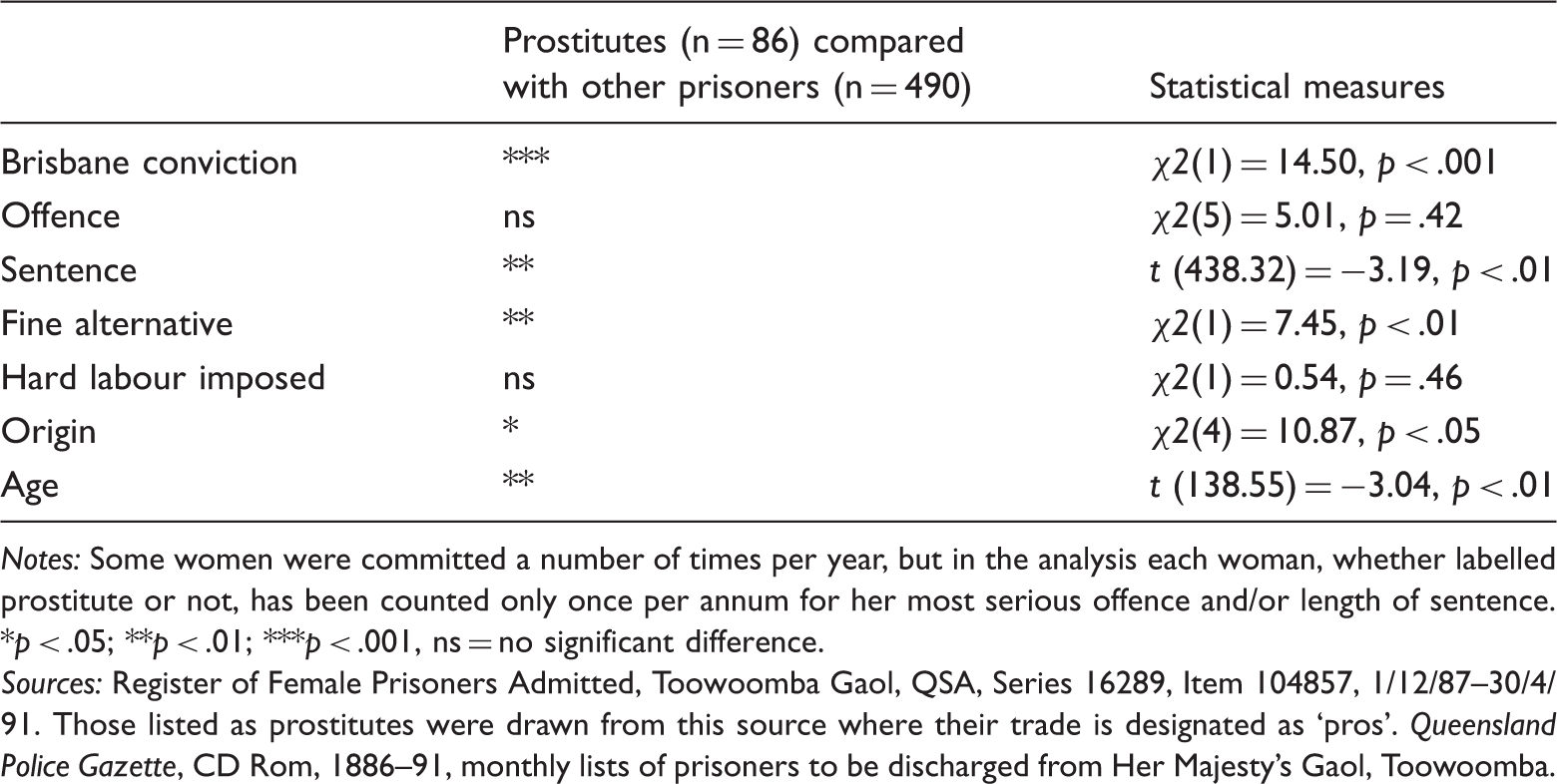
Notes: Some women were committed a number of times per year, but in the analysis each woman, whether labelled prostitute or not, has been counted only once per annum for her most serious offence and/or length of sentence. *p < .05; **p < .01; ***p < .001, ns = no significant difference.
Sources: Register of Female Prisoners Admitted, Toowoomba Gaol, QSA, Series 16289, Item 104857, 1/12/87–30/4/91. Those listed as prostitutes were drawn from this source where their trade is designated as ‘pros’. Queensland Police Gazette, CD Rom, 1886–91, monthly lists of prisoners to be discharged from Her Majesty’s Gaol, Toowoomba.
On the other hand, prostitutes were almost entirely tried in Brisbane (98%) compared with the others (82%). There was a significant difference in terms of sentence, with an average of 12 weeks for prostitutes and 16 weeks for the others. In fact, the mode for both groups was 12 weeks, but other prisoners had more sentences of six months or longer for offences such as homicide, arson and infanticide, and even repeated convictions for vagrancy attracted a six months sentence. There was a difference in mean age between prostitutes (32 years) and others (35 years). Perhaps because prostitutes were on average younger and had greater earning capacity than other women offenders, or had associates (pimps, brothel owners, partners) prepared to assist with the fines, they tended to be offered the alternative of a fine (46.5%) more than the others (31%). Finally, there was also a significant difference in the origins of the two groups. The proportions of those with Irish (44%) and English (26%) backgrounds were virtually the same for both groups, but a higher proportion of prostitutes (19%) were Queensland-born compared with other women prisoners (8%).
Thus, as might be expected, there were similarities between prostitute and non-prostitute prisoners, since these women came from marginalised working-class backgrounds. But there were also differences between women prisoners. The majority were not prostitutes with the same demographic and punishment profiles. Some of the non-prostitutes might have been in the trade at other times, but they were not labelled as such in the years of this study. It seems that while committing broadly similar offences, the prostitutes tended to be younger, were more likely to be offered the alternative of a fine, received shorter sentences as a group, and comprised a higher proportion of Queensland-born women.
Variations in punishment
One hundred and forty-three women were identified as prostitutes in gaol records, but the characteristics of only 86 who were actually released from Toowoomba Gaol on expiry of their sentences were used in the analysis for Table 1. Information for these 86 are most complete in police records. Nevertheless, a close look at the larger group of 143 provides insights into the lives of prostitutes and their dealings with the criminal justice system. The analysis explores: (a) whether there were differences within the prostitute group, particularly age-related differences; and (b) the punishment outcomes for the 57 (40%) who were not sent to Toowoomba but processed judicially in other ways.
Twenty-two (15% of the total 143) served their time at the Fortitude Valley Lockup, a small suburban institution usually reserved for women on shorter sentences. They were commonly convicted of drunkenness or obscene language and released within one or two weeks. Six (4%) paid their fine at some point, and 25 (17.5%) were discharged at the police court. That is, more than 1 in 5 (22%) either avoided a gaol term altogether or avoided serving a full sentence by paying a fine, or having it paid for them. Older prostitutes tended to be convicted of vagrancy and sent to Toowoomba for longer periods, while younger ones tended to be convicted of larceny, CDA offences and disorderly conduct. Four women who had escaped from the Lock Hospital, a place of detention for the ‘treatment’ of venereal disease, were not released on expiry of their month’s sentence, but handed over to police custody to be returned to the Lock Hospital. Of the 25 discharged at the police court, 40 per cent were charged with larceny, an offence, judging from this sample, more often committed by younger prostitutes. Larceny and the more serious ‘stealing from the person’, where the victim was often reported inebriated at the time of the offence, could be hard to prove in court, as the vagaries of the following case suggest: Stolen from the person of William Graham, Bushman’s Home, Albert street, Brisbane, on the night of the 4th instant, in a room in a Chinaman’s house, one £1-note and one half-sovereign. Not identifiable. Complainant was in company with a prostitute named Lottie P at the time.
11
Bella M, a Scottish woman, 28 years of age, was charged with having no lawful means of support. The constable said he found her lying drunk at the rear entrance of the Nine Holes [Chinese quarters in Albert Street] where she had been cohabiting with a Chinese barber for the last 5 or 6 months. He had been locked up the previous day for drunkenness. Bella stated on oath that she had been residing at Beenleigh [a semi-rural district] with a Chinaman’s wife since Christmas, and was remanded for a week to enable her to summon witnesses.
12
There was considerable variability in sentencing and punishment (cf. Turner, 2011). Norah H was born in Queensland and was 19–22 years of age in 1888–91. Police and gaol records show that she was discharged at the police court in 1888 for a breach of the CDA, and then discharged again at the beginning of 1889. But, in February 1889 she was sent to Toowoomba for one month for riotous conduct and assault. In April 1889, she was remanded for trial in the Southern District Court for ‘stealing from the person’, but was discharged from the court. A month later she was convicted of disorderly conduct resulting in a sentence of one month or £2 fine, but avoided prison because her fine was paid. In early 1890, she was remanded for larceny and released for 12 months under the provisions of the Offenders Probation Act. In March 1891, she was convicted of larceny and sent to Toowoomba for six months, this time with no alternative of a fine.
Norah H’s case raises the possibility that numbers of young prostitutes might have been released under the Offenders Probation Act of 1886. 14 She was an example of the type of offender that the Police Commissioner complained about in 1888, when he said that too many recidivists, in his opinion, were released under the Act which had not been its intention. He claimed that ‘soon there will be such a number at large that police will not be able to keep them under surveillance, even in the imperfect way that it can be done at present’. 15
Actually, the youthful Norah H was among the very few prostitutes offered this option. Police records indicate that 35 women were released under the Offenders Probation Act in the period 1888–91, and they constituted only 10 per cent of all offenders released on probation. 16 Over three-quarters (77%) of female probationers had been charged with some form of theft, hence the mean sentence imposed on them (M = 24 weeks) was considerably longer than the average sentence imposed on all women prisoners in Toowoomba Gaol (M = 15 weeks). Their average age was 23 years and 63 per cent of the group were single. Domestic service (49%) was the most common occupation for the women, but only four (11%) of these probationers were identified as prostitutes. These four women were young, with an average age of 22 years (17, 19, 26, 27), and three of them faced long gaol terms. The two youngest were convicted of stealing from the person and sentenced to 12 months each. The same sentence was imposed on the eldest who was convicted of keeping a disorderly house. She was the only married one of the four.
Probation was intended for young offenders who had committed a serious property offence but who, it was hoped, might still be reformed without a stint in prison. 17 None of the probationers had been convicted of vagrancy, drunkenness or disorderly behaviour and obscene language. Few older women, prostitute or not, could meet these conditions. Their offences tended to be precisely the types of street offences, sometimes rowdy and boisterous, for which probation was not an option.
Women labelled as prostitutes were charged with offences similar to other women offenders, which is to be expected since prostitution per se was not a criminal offence. A range of responses had emerged to prostitution, including committal to the lock hospital, fines, and shorter spells of confinement in the police lockup, as opposed to longer periods of incarceration in Toowoomba Prison on the Darling Downs. However, younger rather than older prostitutes were more likely to be offered the alternative of a fine in the police court, more likely to be released without conviction, and in rare cases to be offered probation. In fact, one of the most striking aspects of contemporary views about offending women was the centrality of age-talk in official and public discourse. As the following four vignettes illustrate, age-based themes of innocence and contamination even ran through views about different groups of ‘deviant’ women. Each is evocative of emerging views about generational divisions within prostitution, and particularly between women who were processing through the criminal justice system. From the almost chivalrous (yet fearful) concerns expressed by the police magistrate for the welfare of young prostitutes, to the paternalist administration of the main women’s prison, distinctions and divisions of age surfaced constantly. These sentiments were reported in the press, as illustrated in another vignette. It is as if discussions about ‘fallen’ women could never be divorced from age as the primary construct by which to comprehend the prostitute’s current and future life chances.
The magistrate and fallen women
Phillip Pinnock was the Brisbane magistrate who heard many of the cases in this study. He believed that prostitution was responsible for a ‘large amount of crime’, partly because discharged male prisoners used brothels as refuges and sought out prostitutes to assist them in criminal offences. 18 In his evidence before the 1887 Inquiry into Gaols and Penal Establishments (hereafter Inquiry), he suggested that brothels should be supervised by matrons appointed and paid for by the government, and that police should increase their surveillance of these establishments. 19 Attempting to clarify this, and concerned that he might be seen to condone vice, he said that what he really wanted was a ‘keeper’ of brothels rather than a ‘matron’, a person well known to police who would be responsible for the behaviour of the women and their customers.
He reported that there were currently ‘110 [registered] prostitutes on the books’, not counting others who worked with their mothers and as servants who so far had avoided registration: ‘It is a very profitable business, and they like it very much better than following a respectable calling’.
20
Pinnock believed that the colony was witnessing a ‘crystallising of the native criminal class’ and that the problem was growing,
21
although a decade later in 1897 the press reported only 100 registered prostitutes in Brisbane (Lawson, 1973: 123). The magistrate pointed to the corrupting influence of abusive home lives. Hence, his insistence on the need for greater supervision and protection of young women, including those already enticed into brothels: There are facts which I dare not tell, because if you speak publicly [it] may lead to commission of offences you try to kill. We have to protect girls from their fathers, sisters from their brothers, girls from their mothers, and children from each other. It is something horrible.
22
Thus, it was ironic that when the Criminal Law Amendment Act of 1891 – subtitled ‘a measure to protect women and girls’ – was introduced a few years later, there was little protection for young prostitutes. The Act established punishments of two years with hard labour for procuring a woman under 21 years of age, for defiling a woman through ‘false pretences’, and for the abduction of an unmarried girl under 18 years. 23 However, all such protections were not applicable to a prostitute or woman of ‘known immoral character’. Debates about the protection of women rested upon, by now, familiar images of young women seen as endangered or dangerous. They were viewed as either victims ‘led astray because of temptations placed before working girls’, or they were portrayed as ‘lying, salacious little hussies who go as nurse girls’ seducing unwary males. 24 While legislation forbade attempts to intimidate prostitutes in brothels by withholding their clothes, or pressing them to pay for their street-walking attire, there was little else that offered them legislative protection. That is, the legislation was intended to contribute to saving young women before their fall, and while there might be considerable sympathy for ‘young unfortunates’, there was to be little protection for them once they had strayed.
Innocence and contamination
The contrast between innocence and experience, and age-related divisions between ‘deviant’ females, was nowhere more apparent than in comparisons between reformatory school girls and women prisoners. In 1881 critics had questioned the wisdom of locating the new reformatory for girls adjacent to the women’s gaol in Toowoomba.
25
Young girls who had been ‘dragged up in the lowest haunts of vice’ had until now found themselves incarcerated with ‘the most abandoned and incorrigible thieves and prostitutes’.
26
Thus, there should be complete separation between the two distinct types of women, the inexperienced and the hardened: ‘Strict discipline and homely fare excepted, the place of detention [for girls] ought to be as unlike a gaol as is possible to make any place of imprisonment’.
27
In 1887 the Ministers’ Association of Toowoomba complained to the Inquiry that: Children placed in the reformatory came in contact with some of the worst characters from Brisbane streets. They felt it must have been some strange oversight to place the reformatory not just in the shadow but virtually as part of the State prison. Even if complete separation could be achieved, still taint must follow the girls all their lives.
28
When criminals of all sorts – from the hoary incorrigible who never had an aspiration above crime, to the naturally well-disposed youth who for once succumbed to irresistible temptation, from the old hag who revels in obscenity to the girl, little more than a child, more sinned against than sinning – are herded together 14 hours out of 24, without restraint or surveillance, it is easy to understand what happens.
31
Not all the reformatories in the world would do her any good. As soon as she gets out she is going to return to her wallowing in the mire. Such are her daily professions. Being the oldest, the best looking, and most dare-devil girl, her example must be of the most pernicious consequences with her juniors. It was a terrible mistake, if not a crime, to send her there.
35
Rowdies and outsiders
Women’s wayward and rowdy behaviours often meant that they were excluded from semi-penal institutions such as refuges and inebriate asylums (Tennant, 1992; Zedner, 1991). Instead, magistrates had little choice but return them constantly to prison. Younger women (but rarely young prostitutes) also began to receive probation. It may have been that emerging differences in punishment between older and younger women also fuelled views about the supposed moral/experiential differences between older (experienced, hardened) and younger (redeemable) prostitutes who were imprisoned. Nineteenth-century commentators were sure of such distinctions, however divisions between ‘fallen’ women were not always related to age, as can be seen in the cases of Minnie and Sarah.
The testimony of Sarah M (prisoner no. 124-87) before the 1887 Inquiry has been cited by historians as an example of a marginalised working-class woman, one of the many, deserted by her husband and ‘forced’ into prostitution (Daniels and Murnane, 1980; Evans, 1984). Her testimony was one of the few extensively recorded, apparently under leading questioning. 36 In 1887 she was imprisoned on three separate occasions for riotous behaviour, creating a disturbance and indecent behaviour. She was 25 years old at the time, suffering from venereal disease, and said that she planned to return to the Lock Hospital on release from Toowoomba. It is revealing to couple Sarah M’s case with that of her compatriot Minnie G (prisoner no. 61-87), since they were two of only three women prisoners who complained of ill-treatment from gaol officers. The two women had met earlier in Toowoomba Gaol and apparently bonded in the face of other gaol factions. In 1891 Minnie G was part of a group of five women convicted of ‘assaulting a fellow prisoner’. Her sentence of 15 months was the longest for the group. 37 Minnie G was described by the gaol governor at the Inquiry as ‘the worst character who ever came in this gaol. I have let her out in this town, and it was a disgrace to see her conduct’. 38
The Inquiry seized upon the evidence of both women to condemn the ‘disgraceful practices’ said to occur in the dormitory at night. It was claimed that the ‘old hands’ victimised younger women: Sarah M said that ‘the old hands expose themselves at night, and behave indecently. A young girl may just as well go to a brothel at once. The old hands will pull up their clothes and race around the yard’. 39 The testimony of other prisoners contradicted much of what Sarah and Minnie had to say. The disgraceful practices apparently consisted of ‘filthy language’, noise and dancing. One of the most coherent testimonies (prisoner no. 71-87) stated: ‘I have never seen a woman expose herself before others’. 40
The Inquiry persisted in questioning gaol staff about the ‘horrible indecencies’ reported by Minnie and Sarah, but got little satisfaction. Sarah Nixon, female turnkey, acknowledged that the prisoners could be very troublesome, but that she had never seen prisoners exposing themselves in the yard, or she would ‘lock them up’. There was bad language, which was understandable given that 20 women were ‘locked up together, and you cannot make their language very good’. She had never heard of prostitutes trying to induce young first-time offenders to go, upon release, to brothels. 41 The second female turnkey, Elizabeth Joseph, agreed that in the dormitory the women ‘sing and be jolly’. She had not seen indecent practices in yard, and prisoners would be punished for such infringements. She had not seen ‘petticoats over heads [and] as for their jollifications upstairs, they would not come to light. In the daytime I have never heard of it’. 42
There is little doubt that different factions existed in the gaol and there were tensions among the women. Yet, despite attempts by the Inquiry to portray some archetypal distinction between the innocence of youth and the predations of the older women, it seems that factions cut across generations. Davie (2010) has noted that the behaviours that got women into trouble in prisons were the very things that had got them into trouble on the outside and were not necessarily related to age. The erratic behaviours and emotional impetuosity of street life were imported into the even closer confines of the gaol. On the other hand, Dalley (1993: 309) has wondered why more women did not rebel against gaol rules, given their reputations as ‘supposedly ungovernable’ on the outside. She points to the welfare function of gaols, especially for older women, and suggests that with constant readmissions they became accustomed to prison routines and generally complied with the rules.
Penal paternalism
Most witnesses before the 1887 Inquiry were convinced that women prisoners were invariably prostitutes. Richard Gailey, gaol architect, while emphasising that the community should do more to rehabilitate these women, claimed that ‘there is very seldom a female prisoner [at Toowoomba] except prostitutes’. 43 Albert Stumm, dispenser of medicines, attended to the women’s medicinal requirements, and said the visiting surgeon only saw serious venereal cases. He did not feel they needed to be separated from other inmates because ‘they are all more or less suffering from the same thing. I know most of them are prostitutes from Brisbane’. 44
Henry Blaney, gaol governor, believed that the experienced street women were largely irredeemable. 45 There was no effective way of classifying offenders who might be ‘innocents’ and keeping them separate, as the spare yard was used to house a ‘notorious’ female murderer. He said that the Sherriff gave him ‘general permission’ to take out servants, and he usually had an older woman plus a ‘couple of little girls’ from the reformatory helping about the house. 46 He was adamant that the girls did not mix with the servant who assisted Mrs Blaney. It seems that Blaney also saw his use of trusted servants as rehabilitative, as a reward for good behaviour and as a way of easing deserving women and girls back into society, although he did not hold out great hopes for their reformation. The final report of the Inquiry was critical of Blaney’s paternalism and ‘easy going method of administration’, and particularly his use of prison women and reformatory girls as servants. 47
The parliamentary debates which followed soon after the submission of the Inquiry’s report were remarkable for the strong support shown by Members for the gaol’s administration. 48 Members praised Blaney’s paternalism which suited the difficult conditions of the gaol and the needs of some of the women who were capable of reformation. It was Mr White who claimed (sarcastically) that in Toowoomba they seemed to be a ‘very happy family’. Mr Campbell turned this comment around in support of the gaol’s administration. He believed that the Inquiry commissioners had ‘largely drawn on their own imaginations’ in compiling the damning report. As Members would know, this class of women ‘who were the scum of society’ would not hesitate ‘to swear away the life of anyone’. 49 Since the Inquiry, several of them had revealed that they were prepared to deny everything that was in the report. He understood that the intention behind taking reformatory girls as servants into the gaoler’s house was to let them look after Mrs Blaney’s children and be taught as much as possible of housework, and that there was no possibility of them associating with women employed from the gaol. Members contented themselves in the belief that the institution benefitted from the familial management structure and the example it set for both gaol and reformatory inmates, with ‘Mr Blaney the governor, his wife as matron, and his daughter as schoolmistress in the reformatory’. 50
Conclusions
In the 1890s a stalemate set in between critics calling for the closure of Toowoomba Gaol and the Fortitude Valley Lockup and governments pleading financial constraints. Critics, including senior correctional officers, complained that both institutions were completely inadequate to effect the rehabilitation of women. 51 There was a sense of marking time, almost as if the women had been forgotten. Yet, officialdom kept a close watch on both institutions, which had emerged as embarrassments from the 1887 Inquiry. The numbers admitted to Toowoomba Gaol did not change much between the 1870s and 1890s, however the profile of women prisoners was changing over the last quarter of the nineteenth century. 52 There was a significant difference in the type of offences as convictions for vagrancy declined (34% down to 24%). Convictions for specific offences such as drunkenness, obscene language, and, less often, offences against the CDA accounted for more convictions in combination, from 28.5 per cent up to 46 per cent. The mean sentence did not change significantly over time, 16 weeks down to 14 weeks. There was a considerable increase in the proportion of Queensland-born prisoners (2% up to 17%). There was also a difference in the mean age of prisoners, 33 years in 1875 compared with 37 years in 1895. Few of these women, of course, would have been the same people over a quarter of a century, but there is the disconcerting sense that imprisoned women were just getting older.
This Queensland case study helps provide answers to questions debated in the literature on prostitution and punishment in the nineteenth century. Firstly, it is probable that the age of incarcerated prostitutes was rising, but this reflected the increasing age of women prisoners in general, rather than a police strategy to target older prostitutes, as suggested by Allen (1990). Rather, the evidence supports Frances (2007) and Robinson (1984): rowdiness, exhibitionist or disreputable street behaviours, and the flaunting of deviance, attracted the attention of police rather than prostitution per se, but such behaviours also transcended divisions of age. The rowdies were not necessarily older women on a downward spiral. Minnie G, Sarah M and Norah H were still in their early twenties when first encountered in this study.
Secondly, relatively few women in this study were convicted of infringements against the CDA. The response of prostitutes to contagious diseases legislation varied across jurisdictions where it was enacted (Lee, 2012; Walkowitz, 1980). Few convictions would suggest that prostitutes in Queensland tended to comply with regulations in an attempt to avoid ongoing police harassment. 53 However, despite the small number of women actually convicted of infringements, it is likely that the CDA encouraged closer surveillance of prostitutes by the authorities. Disreputable images of prostitutes became fixed in the public imagination, and women prisoners more generally were increasingly seen as both victims (unfortunates) as well as wild and impulsive creatures. 54 It may be that prostitutes also came to view themselves differently, as separate and apart from working-class life. The shaming intention of the contagious diseases legislation made it difficult for street women to compartmentalise different aspects of their lives. The CDA increasingly divided the respectable and unrespectable urban poor (Bartley, 2000; Frances, 2007; Walkowitz, 1980). Whether the mean age for imprisoned prostitutes of 32 years in the 1880s indicates older or younger participants is probably immaterial since it ignores the fact that prostitution for many was traditionally an intermittent and casual undertaking.
Thirdly, while age may not have played a role in strategies for the control of prostitutes, it featured prominently in shaping views about the supposedly different types of ‘deviant’ women. Carpenter (2004) notes that these images became ingrained in official and public discourse. For example, when prostitution law reform was debated a century later, age-related concerns remained central, including concerns about the emergence of two tiers of sex workers. There were those seen as ‘good, young, and medically supervised’, who were working in brothels, as compared with the street workers seen as ‘bad, older, [and] drug using’ (Carpenter, 2004: 184). Such apparent distinctions were not simply ‘unintended outcomes’ of the legislation, but resulted from over a century of mass-mediated concerns about sexuality and age.
Contrasting images of ‘fallen’ women which were perpetuated from the late nineteenth century were reinforced by the new mass media. Stories about women who were dangerous or endangered, about distinctions between innocence and contamination, aged depravity and the possible reformation of young ‘deviants’, became staples of the popular press (Walkowitz, 1992). Such representations informed lasting concerns for ‘differentiating the bad from the bad’ in twentieth-century regulation of commercial sex (Scott, 2011). A moment in this ongoing construction was captured when a reporter visited Brisbane Women’s Prison in 1904, escorted by the Comptroller-General (Captain Pennefather).
55
This new institution had been hailed as a progressive showpiece and a vast improvement on Toowoomba which had closed a year earlier. After the criticisms of the 1887 Inquiry, the Department was anxious to put its best foot forward, as Pennefather explained the new methods of classifying and segregating first-timers from the ‘old offenders’. ‘Incorrigibles [were] kept wholly by themselves’, including in the work-rooms where conversation was not encouraged during working hours, and they were ‘compelled to eat their meals in their own cells’.
56
Yet, there remained a sense of imminent contamination of the young, even in this regimen of tighter penal segregation in the new century: We visited a number of yards, and in several were two or three prisoners. In one a young girl stood alone looking at us in a puzzled manner, and plucking her apron like a frightened child. The combined ages of a youthful pair who claimed my attention could hardly have totalled 35 years. They were comely girls, and it was saddening to learn that they were in detention for having been drunk and obscene. As a matter of fact, most of the prisoners belong to the ‘unfortunate’ class …
57