




Abstract
In a bid to reduce alcohol-related violence, the New South Wales Government recently proposed introducing mandatory minimum prison terms for assault. This article addresses the question of whether the threat of mandatory minimum penalties would reduce the incidence of assault. We exploit an earlier sentencing reform in New South Wales (the introduction of standard non-parole periods) in which longer minimum periods in custody were announced but never actually carried into effect. We use time series structural modelling to see whether assault rates in New South Wales were affected by the threat of more severe penalties. No evidence is found that the threat of longer prison terms had any effect on the incidence of assault in New South Wales. The article discusses the policy implications of this finding and concludes that liquor licensing policy is a more cost-effective policy instrument for dealing with alcohol-related violence than sentencing policy.
Keywords
Introduction
Alcohol-related violence is a problem of long-standing public concern in New South Wales (NSW), as it is in most other Australian States and Territories. Although assaults in NSW have declined over the last five years (NSW Bureau of Crime Statistics and Research, 2014), the fatal assault on a young teenager (Daniel Christie) in January this year (Needham & Smith, 2014) sparked calls for tougher action on alcohol-related violence. On 21 January 2014, the NSW Government announced a package of measures designed to reduce alcohol-related violence. Among other things, the package included a controversial new proposal to impose mandatory minimum penalties on people convicted of assault while intoxicated by drugs and/or alcohol. The proposed mandatory minimum penalties ranged from three years for reckless wounding (s35(4), NSW Crimes Act 1900) to five years for recklessly inflicting grievous bodily harm in company (s35(1), NSW Crimes Act 1900) or assaulting and causing grievous bodily harm to a police officer ((ss60(3), 60(3 A), NSW Crimes Act 1900).
The proposal came under immediate attack from academics, media commentators and senior members of the State’s legal profession. Criminologist Kate Fitz-Gibbon (2014) criticised the O’Farrell Government for contemplating laws that, in her view, would do nothing to reduce crime but which would ‘discourage defendants from pleading guilty to an offence holding a mandatory minimum sentence’, thereby ‘increasing pressure on an already stretched court system’ (Fitz-Gibbon, 2014, p. 1). High profile business commentator Michael Pascoe described the proposed laws as ‘ridiculous’, adding that they will create a ‘lawyers picnic’ but do nothing to prevent further deaths (Pascoe, 2014). Former NSW director of public prosecutions, Nick Cowdery, NSW Bar Association president, Philip Boulten and NSW Law Society president Ros Everett all questioned the deterrent value of the proposed new laws, with the latter expressing the view that ‘deterrence arises from fear of being caught, not from the length of the sentence’ (Roth, 2014).
It is easy to understand the scepticism. Deterrence theory assumes that individuals make choices about involvement in crime based on the perceived risks, costs and benefits of such involvement (Becker, 1968; Ehrlich, 1973). According to this theory, increasing the cost of involvement in crime will reduce its frequency. The thesis seems plausible in relation to crimes that involve a degree of pre-mediation or planning. Assaults, however, often appear to be unplanned and impulsive, especially when inflicted by people under the influence of alcohol. The classical image of offenders as rational, informed calculating machines does not sit well with the all-too-common television spectacle of enraged and intoxicated young men mindlessly brawling outside nightclubs and pubs. In circumstances like these, changing the environmental factors that give rise to offending would seem more productive than changing the penalties for offending. All the same, intuition and plausible reasoning are no substitute of evidence. The question that needs to be addressed is whether there is any evidence that mandatory minimum penalties are ineffective in deterring crime.
In his widely cited review of the evidence, Tonry (2009, p. 100) concluded that ‘there is little basis for believing that mandatory penalties have any significant effect on rates of serious crime’. This is not because he found that a large number of studies of mandatory minimum penalties which found no effect. The number of studies specifically examining the deterrent effectiveness of mandatory minimum penalties is actually quite small. Nearly all of the studies on which Tonry (2009) based his conclusion examined either the specific deterrent effect of tougher sanctions, such as three strike laws or the relationship between imprisonment rates and crime rates. Most studies of specific deterrence show prison exerts little if any effect on the risk of further offending by those imprisoned (Nagin, Cullen, & Jonson, 2009), but this tells us nothing about general deterrence. Studies of the relationship between crime and imprisonment rates generally find evidence that prison does reduce crime (Donahue, 2009; Spelman, 2000) but these sorts of studies do not and cannot separate deterrence from incapacitation effects.
One way to separate general deterrence from incapacitation is to find a situation in which longer prison terms are threatened but (unbeknownst to potential offenders) not actually imposed. In the lead up to the 2003 State election, the then NSW Premier, Bob Carr introduced a new scheme of what he called ‘standard minimum sentences’ (Carr, 2002) or what are now more commonly referred to as the standard non-parole periods (SNPPs). The aim behind the SNPP legislation, according to Carr, was ‘to tell judges this is the minimum time serious criminals should spend behind bars’ (Carr, 2002). The new laws applied to a large number of offences, including serious assault. For reasons we describe in more detail below, despite the draconian appearance of the new laws, they had little if any effect on the length of sentences imposed on persons convicted of serious assault. This fact did not become apparent until years after the laws were enacted (see below). This study exploits the opportunity created by this situation to see whether the highly publicised threat of longer prison terms reduces the incidence of assault.
The structure of the paper is as follows. In the next section, we discuss the SNPP legislation and the media coverage surrounding it in more detail. In the section that follows, we examine trends in sentence length for assault before and after the SNPP legislation was introduced to demonstrate that, notwithstanding research suggesting otherwise (Poletti & Donnelly, 2010), there was no significant change in total sentence or non-parole period lengths for offenders convicted of assaults under section 33 of the NSW Crimes Act (1900). In the subsequent section, we describe the methods used to test whether the threat of tougher penalties for assault reduced or have any effect on the incidence of assault. In the subsequent section, we present the results of our statistical analysis. In the final section, we discuss the results, their policy implications and the caveats surrounding them.
The SNPP legislation
The SNPP scheme was established via Part 4, Division 1 A (ss 54 A-54D) into the Crimes Sentencing Procedure Act (2002), which commenced on 1 February 2003 and applies to all persons convicted of offences committed on or after that date. The sections just referred to established ‘standard’ non-parole periods for a broad range of serious indictable offences listed in the legislation. Section 54A2 defined a SNPP as the non-parole period for an offence in the table that, ‘taking into account only the objective factors affecting the relative seriousness of that offence, is in the middle of the range of seriousness’. Included in the table were all assaults under s33 of the Crimes Act (1900). 1 The SNPP for assault offences under this section was set at seven years. As the average non-parole period for offences under s33 in the five years preceding the SNPP scheme ranged between 32 and 38 months, 2 the legislatively prescribed SNPP was more than double the length of the non-parole periods then being handed out for this class of assault.
For the threat of longer prison terms to be effective in deterring offenders, information about the change of sanctions must be communicated to its target audience (Kleck, Sever, Spencer, & Gertz, 2005; Nagin, 1998). The headline in the Sydney Morning Herald the day after they were announced read ‘Carr’s new killer sentences’ (Wainwright & Totaro, 2002). The headline in the state edition of the Daily Telegraph on the same day read ‘Doing the time –Tough new minimum sentences for major crime’ (Peterson, 2002a). The headline in the metropolitan editions of the same paper read ‘Die in jail: Carr’s new sentences’ (Peterson, 2002b). The Australian heralded the new laws with the headline ‘Carr gets tough on minimum jail terms’ (Videnieks, 2002). In the days following announcement of the new laws, they were publicly criticised by the Council for Civil Liberties, the Law Society, the Bar Association and leading academic lawyers (The Daily Telegraph, 2002). Articles discussing the new sentencing legislation were being still published in major newspapers 20 days after they were announced. If media coverage of the SNPP scheme is any guide, information about the new sentencing laws was forcefully and effectively conveyed.
Although former Premier Carr described the new SNPPs (when announcing them) as ‘standard minimum sentences’ (Carr, 2002), the courts actually retained considerable flexibility in setting minimum non-parole periods. Section 54B(2) of the new legislation described the SNPP for an offence as no more than ‘a matter to be taken into account by a court in determining the appropriate sentence for an offender, without limiting the matters that are otherwise required or permitted to be taken into account…’. Under section 54B(3), courts were permitted to impose non-parole periods that were longer or shorter than the SNPP as long as they gave their reasons for doing so. In R v Way, the NSW Court of Criminal Appeal held that a sentencing judge must give consideration to whether there are reasons for not imposing the SNPP, 3 describing the latter as a ‘reference point, or benchmark, or sounding board or guidepost’. 4 In practice, then, courts had considerable latitude to continue setting non-parole periods as they had prior to the introduction of SNPPs. This fact completely escaped the attention of the media until 2010, when Poletti and Donnelly (2010) published their evaluation of the effect of the SNPP legislation on sentencing levels 5
The impact of SNPPS on sentencing for assault
Poletti and Donnelly (2010) examined sentencing data for offences covered by the legislation between 3 April 2000 and 31 January 2003 (which they call ‘the pre-period’) with sentencing data between 1 February 2003 and 31 December 2007 (which they call ‘the post-period’). Here we focus only on their findings concerning assault. After excluding cases where the SNPP legislation did not apply (e.g. cases where the defendant was under 18 years of age, cases the offender was sentenced to life imprisonment), they were left with 79 s33 assault cases in the pre-period and 127 s33 assault cases in the post-period. Among these cases, 68.4% pleaded guilty in the pre-period, while 78% pleaded guilty in the post period. Separate analyses were carried out for offenders pleading guilty and those pleading not guilty.
The proportion of convicted offenders sentenced to prison barely changed between the two periods (92.4% pre-period, 94.5% post-period) but Poletti and Donnelly (2001) claimed to observe a ‘dramatic’ increase in the length of sentences for s33 assaults between the pre- and post-periods. In the case of offenders pleading not guilty, their data suggested that the median full term (of imprisonment) increased by 60% (from five years to eight years) and that the median non-parole period increased by 125% (from two years six months to five years 7.5 months. The increase in total sentence length for offenders pleading guilty was 14.3% (from five years three months to six years for the total sentence), while the increase in non-parole period length for offenders pleading guilty was 16.7% (from three years to three years six months for the non-parole period). On the face of it, these figures suggest that the SNPP scheme greatly enhanced the incapacitation benefit of prison for serious assault.
Closer examination of the sentencing data collected by Poletti and Donnelly (2010) suggests otherwise. To begin with, the changes in total sentence and non-parole period for offenders pleading guilty were likely nothing more than random variation, as neither change was statistically significant at the conventional level of 0.05 (Poletti & Donnelly 2001, p. 27, footnotes 129 and 130). The changes for offenders pleading not guilty were statistically significant, but the comparison involved just 24 cases in the pre-period and 28 cases in the post-period. These sample sizes may be large enough to secure the claim that sentences for some cases under the SNPP scheme increased but they are too small to have altered the length of time serious assault offenders were spending in custody. To show this we repeat Poletti and Donnelly’s (2010) analysis looking at all court data for assault offences included under Sections 33, 33(1)(a), 33(1)(b), 33(2)(a) and 33(2)(b) of the Crimes Act 1900.
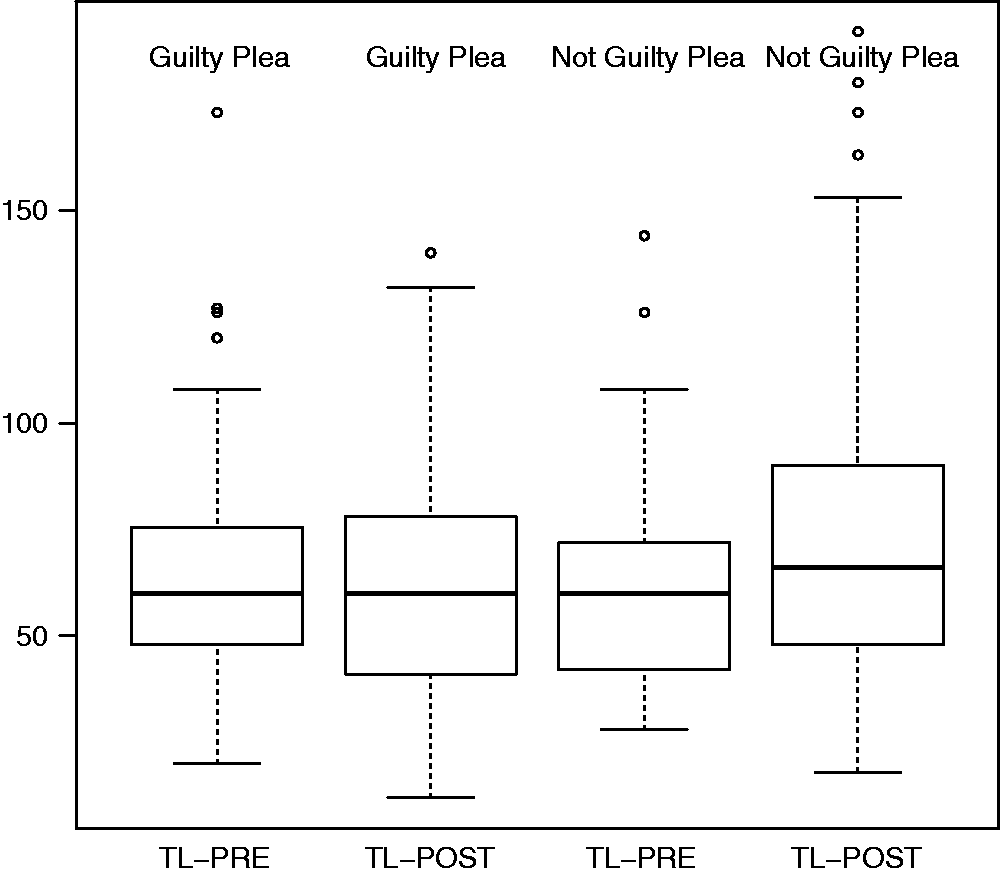
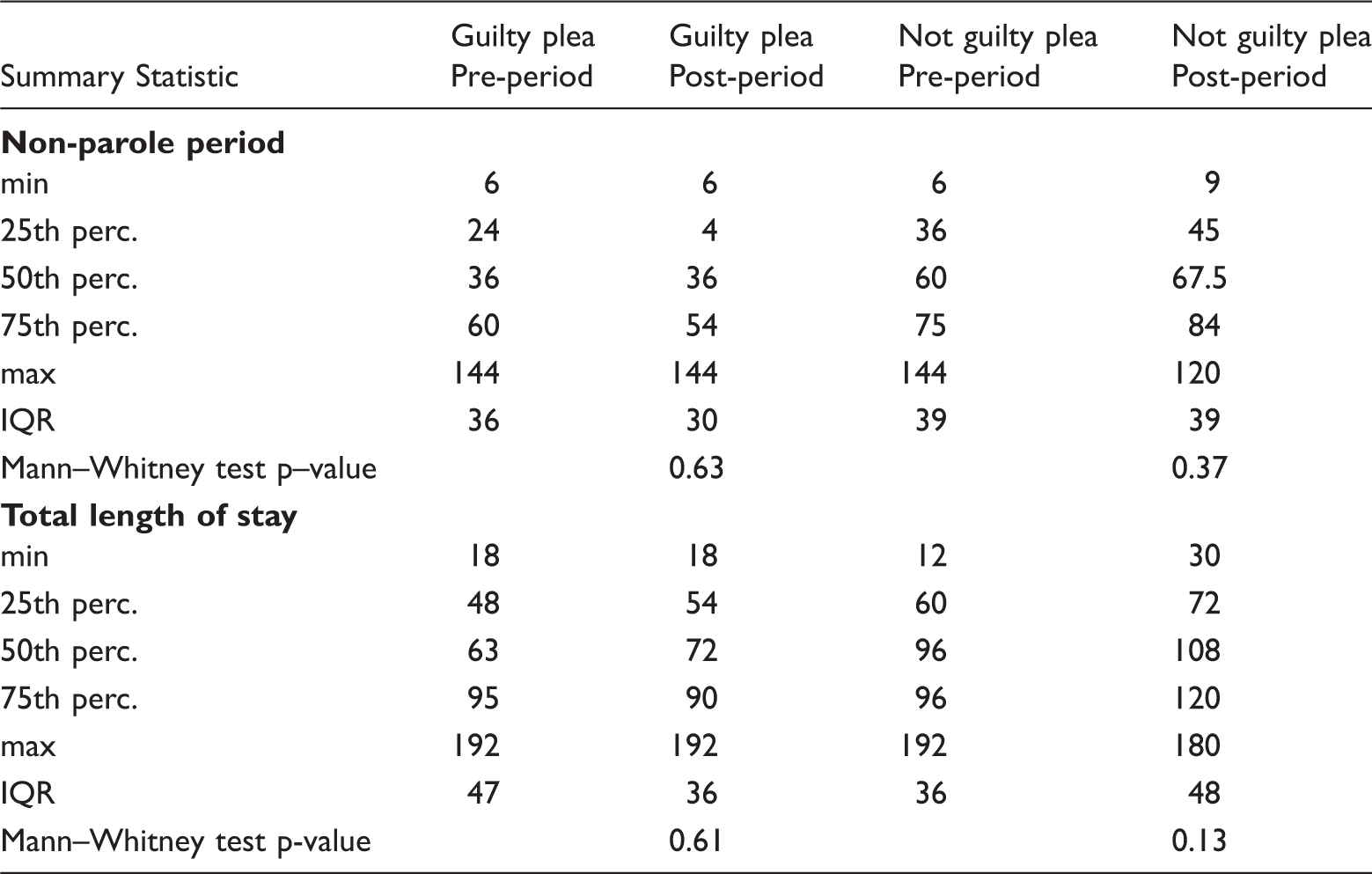
The court data used for this purpose included persons sentenced for offences under sections 33, 33(1)(a), 33(1)(b), 33(2)(a) and 33(2)(b) of the Crimes Act 1900. Data for the study were sourced from the NSW Bureau of Crime Statistics and Research criminal courts database. The period for our analysis is identical to that employed by Poletti and Donnelly (2010). The pre-intervention period, in other words, spans the interval between April 2000 to January 2003, while the post-intervention period spans the interval between February 2003 and December 2008. Figures 1 and 2 show the boxplots of non-parole period (Figure 1) and total sentence length (Figure 2) before and after the SNPP scheme, broken down by plea. There is little evidence in the boxplots to suggest that total sentences or non-parole periods increased for assault offences under sections 33, 33(1)(a), 33(1)(b), 33(2)(a) and 33(2)(b) of the NSW Crimes Act following the introduction of the SNPP scheme.
Boxplots for the non-parole period according to plea for pre- and post-periods. Boxplots for the total length of stay (in months) according to plea for pre- and post-periods.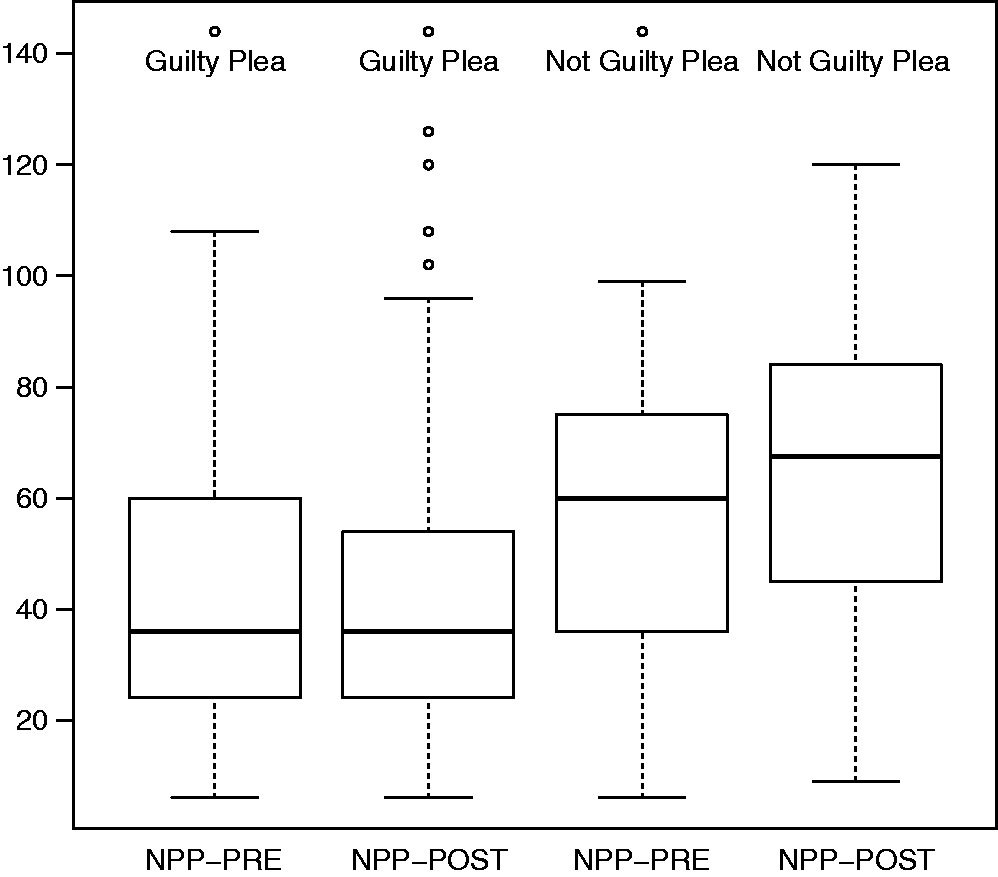
Descriptive statistics for the total sentence and non-parole period length before and after the SNPP scheme, together with Mann–Whitney tests p-values for median differences.
Results for structural models intervention analysis for ABH assault.
Testing for a general deterrent effect
Data
The data for this part of the study consisted of monthly police incident data recorded between April 2000 and December 2007. These data were sourced from the NSW Police Force Computerized Operational Policing Systems database. Police do not classify crime incidents by act and section number. The nearest police incident classification to an assault charge under sections 33, 33(1)(a), 33(1)(b), 33(2)(a) and 33(2)(b) of the NSW Crimes Act is an assault occasioning grievous bodily harm (assault GBH). If the threat of longer prison terms acts as a general deterrent, however, we might expect it to affect all serious assaults, including those occasioning actual bodily harm (assault ABH). For the purposes of this study, therefore, we examine two police incident offences: assault ABH and assault GBH.
Model
Our analysis of the assault time series data was conducted using structural time series models (Harvey, 1991) and their representation as state space models. The state space representation of time series structural models highlights the equivalence between those and ARIMA models (Brockwell and Davis, 2002) bringing both methods under the same umbrella. Time series structural models aim to explain, or model, a given time series yt through a set of different slow varying components. These components are known as the level μt, seasonal component γt and observation error ε
t
which can vary in a dynamical fashion over time. These models have the advantage of allowing us a direct interpretation of each of the time series components as well as revealing their evolution over time. The basic time series structural model can be written as follows


In modelling the effect of an intervention on a time series, it helps to know whether the intervention is likely to produce an immediate or slow-varying effect. If general deterrence operates through the slow diffusion of information about penalty changes or slow changes in offender attitudes, it would seem reasonable to conclude that changes assault in response to the threat of tougher penalties are spread out over time. The analysis to be reported assumes that the new statutory scheme produced a slow but steady effect on crime until a new level in assaults was reached. We model this process via a smooth step intervention (Box, Jenkins, & Reinsel, 2008) represented by
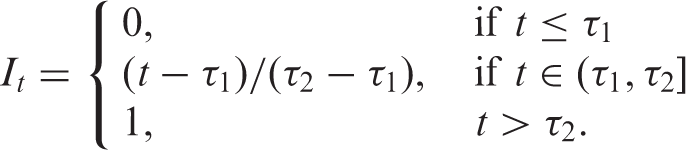
The smooth step intervention (3) is depicted in Figure 3 for illustration for a particular intervention where τ1 (beginning of the intervention) corresponds to February 2003 and τ2 (end the intervention effect) happened in January 2005.
Example of smooth step intervention starting in February 2003 and finishing in January 2008.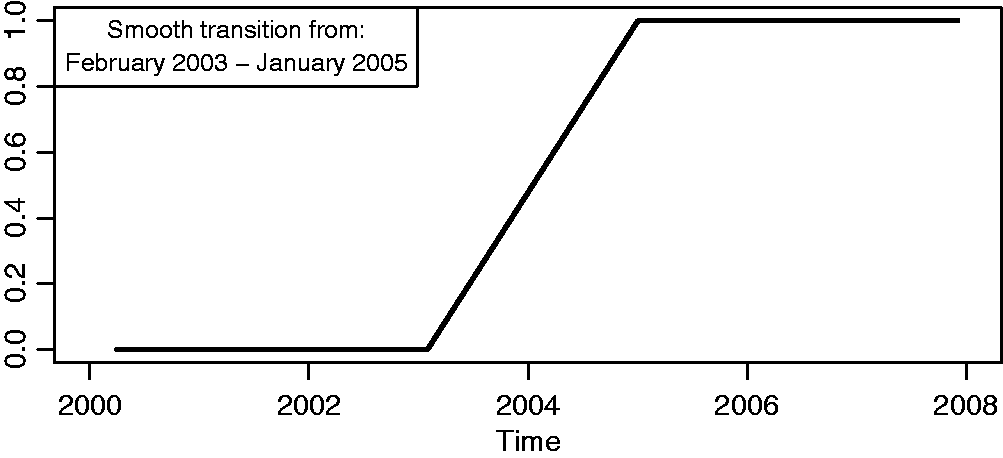
The detailed models used in this study are described in the appendix together with their state space model representation. The state space model representation (Durbin and Koopman, 2012) allows us to fit the models parameters via maximum likelihood estimation computed using the Kalman Filter (Kalman, 1960). The models in this paper were fitted using R version 3.0 (R Core Team, 2014), and in particular, the zoo Zeileis & Grothendieck 2005), dlm (Petris, 2010) and forecast (Hyndman, 2008) packages.
Four set of analysis were carried out in this study. In the first analysis, assault ABH and assault GBH were modelled assuming that the new statutory scheme has no effect on the crime outcome. Subsequent not nested models looked at the effect of the new scheme over different period of times. The first of those models studied the effect of the new statutory scheme over a year since it was first implemented. That is, the effect of the new scheme on ABH and GBH between February 2003 until February 2004. In a second analysis, the effect was assumed to have lasted until October 2004. The final analysis investigated the effect of the intervention between February 2003 and January 2005. Our focus is on which of these models provide the best fit to the observed time series of assaults. The measure of goodness of fit used in this study is the Akaike information Criterion 6 (AIC) which balances the goodness of fit of a model with the model complexity (Akaike, 1974; Durbin & Koopman, 2001; Harvey, 1991). The normality assumption concerning residuals was checked via the Shapiro–Wilk test (H0: residuals are normally distributed) (Shapiro & Wilk, 1965). The independence assumption of the residuals was tested using the Box–Ljung test based on the first 15 autocorrelations (H0: residuals are independent) (Ljung & Box, 1978).
Results
The time series of assault ABH and assault GBH are presented in Figure 4. The vertical line indicates the point when the new statutory scheme was introduced.
Monthly counts for incidents of assault (ABH) and assault (GBH) with vertical dotted line representing February 2003 (the commencement of the new statutory scheme).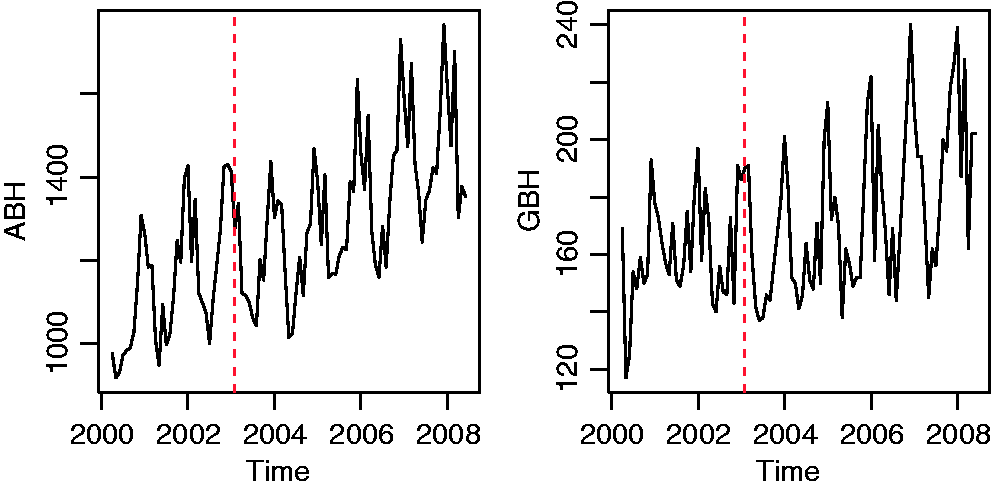
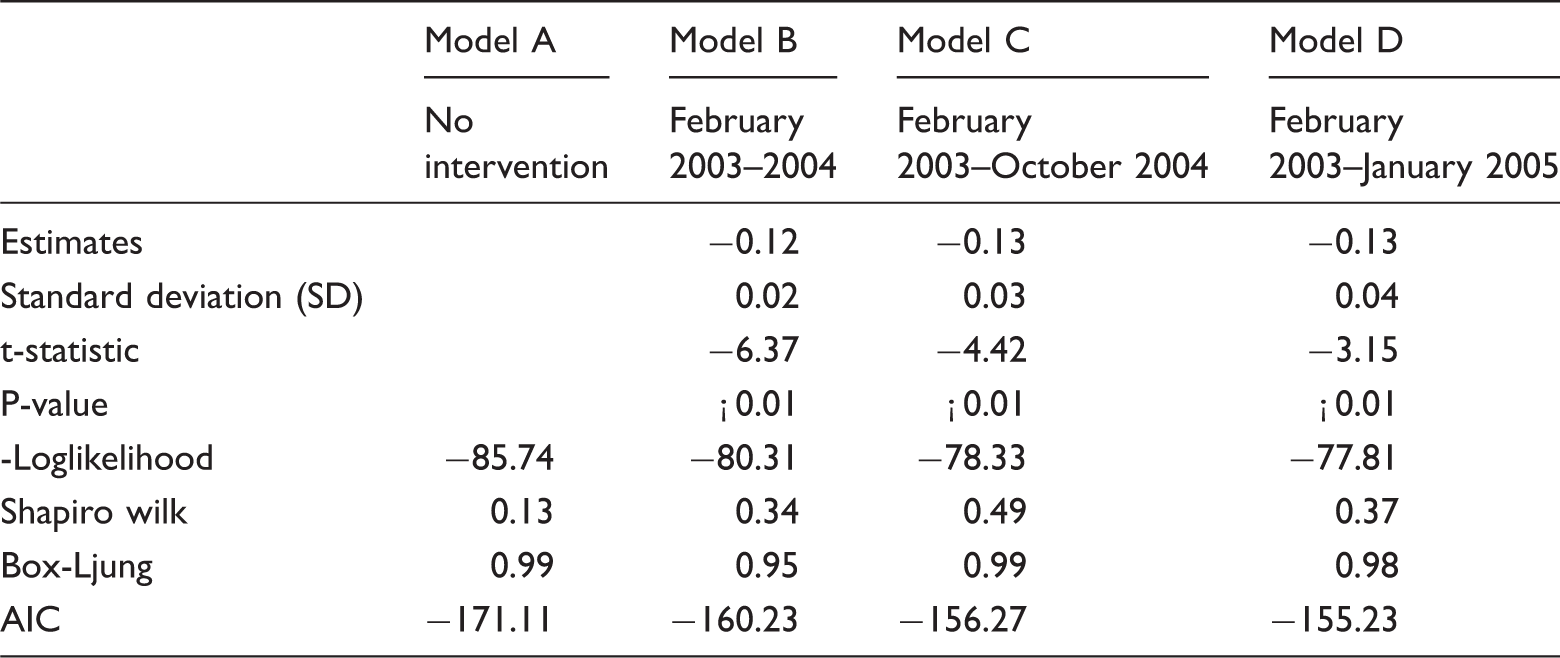
Table 2 shows the results of our analysis for assault occasioning actual bodily harm (ABH). The estimates of the intervention parameter β (as described in equation (2)) for four different non-nested models, together with their standard deviations (SDs), t-statistics and corresponding p-values, are reported in the table. In addition, the negative log-likelihood, together with the AIC, is shown as measures of goodness of fit. Normality and independence of the residuals was checked via the Shapiro–Wilk and the Box–Ljung tests. The p-values in the table show that the models assumptions were fulfilled. The first column shows a model (Model A) in which we assume there is no intervention effect. The second column shows the results of a model (Model B) which assumes an intervention effect beginning in February 2003 (when the SNPP scheme starts) and ending (tapering off) in February 2004. The third column shows the results of a model (Model C) which assumes the same start point but a later end point (October 2004). The final column (Model D) has the same start point but an even later end point (January 2005). The model with the smallest AIC is Model A, which assumes no intervention effect took place. The estimated trend for this model is shown in Figure 5 along with the logged ABH assault trend.
Logged transform series of assault ABH, together with the trend estimates calculated as the sum of the smoother estimates for the level and slope.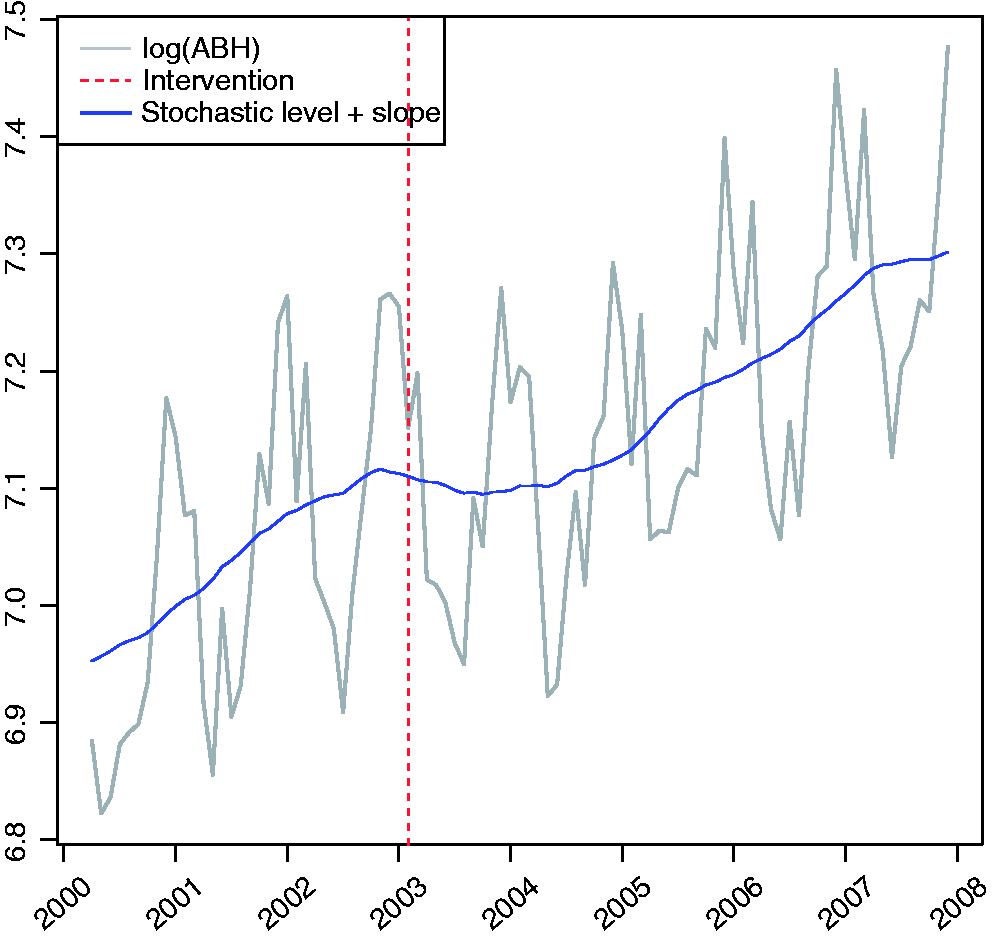
Looking at the figure it can be seen that there is a steady increase in ABH assaults from 2003 to the point where the SNPP scheme commences. There is, then, a very brief deceleration of the upward trend (which lasted for about a year), followed by a resumption of the upward trend in ABH assaults evident prior to the SNPP scheme.
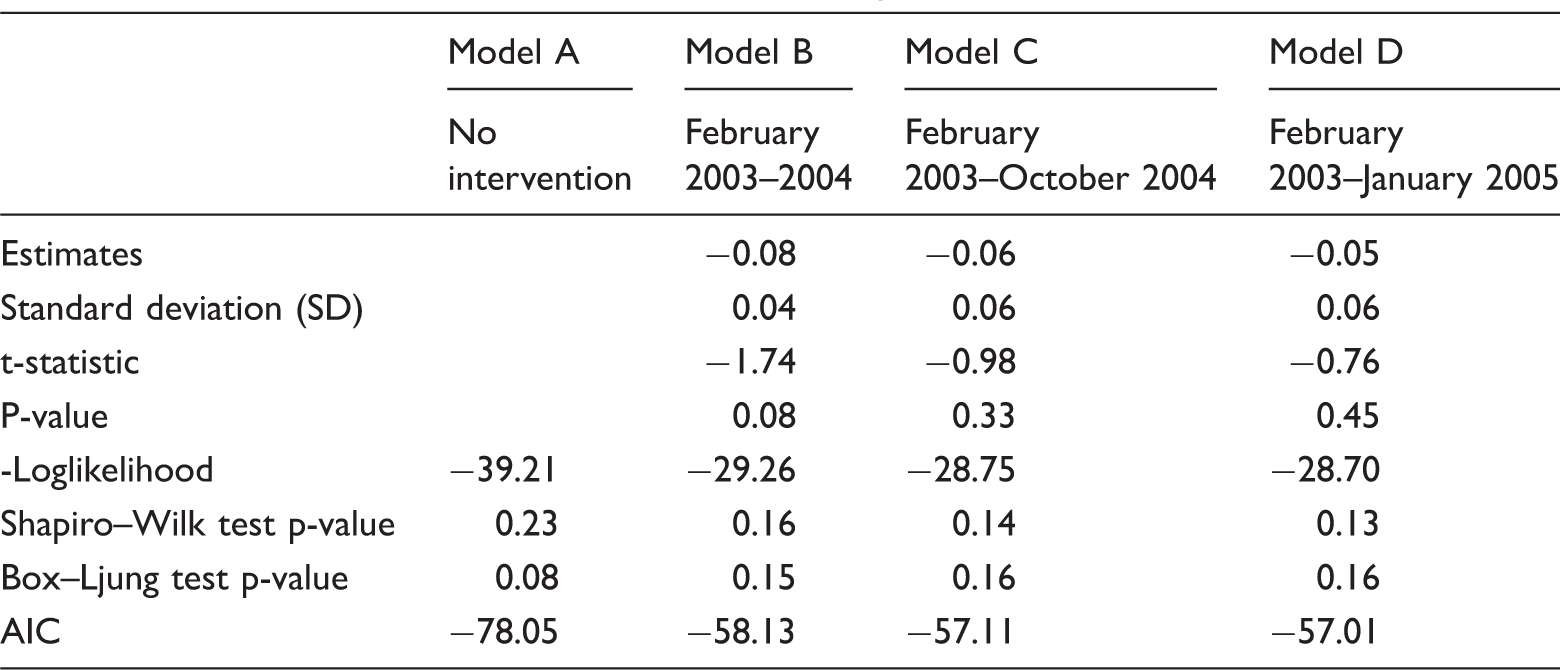
Similarly, the results for GBH assault are shown in Table 3, where the estimated intervention parameters for four different non-nested models are shown, along with their SDs, t-statistics, corresponding p-values, goodness of fit measures and model checking test results. The columns in this table have the same interpretation as in Table 3. Note that none of the p-values associated with the intervention in Models B, C and D is significant. More importantly, the best model in terms of the AIC, once again, is model A, which assumes the intervention had no effect. Figure 6 shows the estimated trend and the observed (logged) incidents of GBH assault. As can be seen from Figure 6, the estimated trend of assault GBH is relatively stable up to and following the point where the SNPP scheme commenced. A year later, we observe an increase on GBH incidents which continues until 2008.
Logged transform series of assault GBH, together with the trend estimates computed as the sum of the smoother estimates for the level and slope. Results for structural models intervention analysis for GBH assault.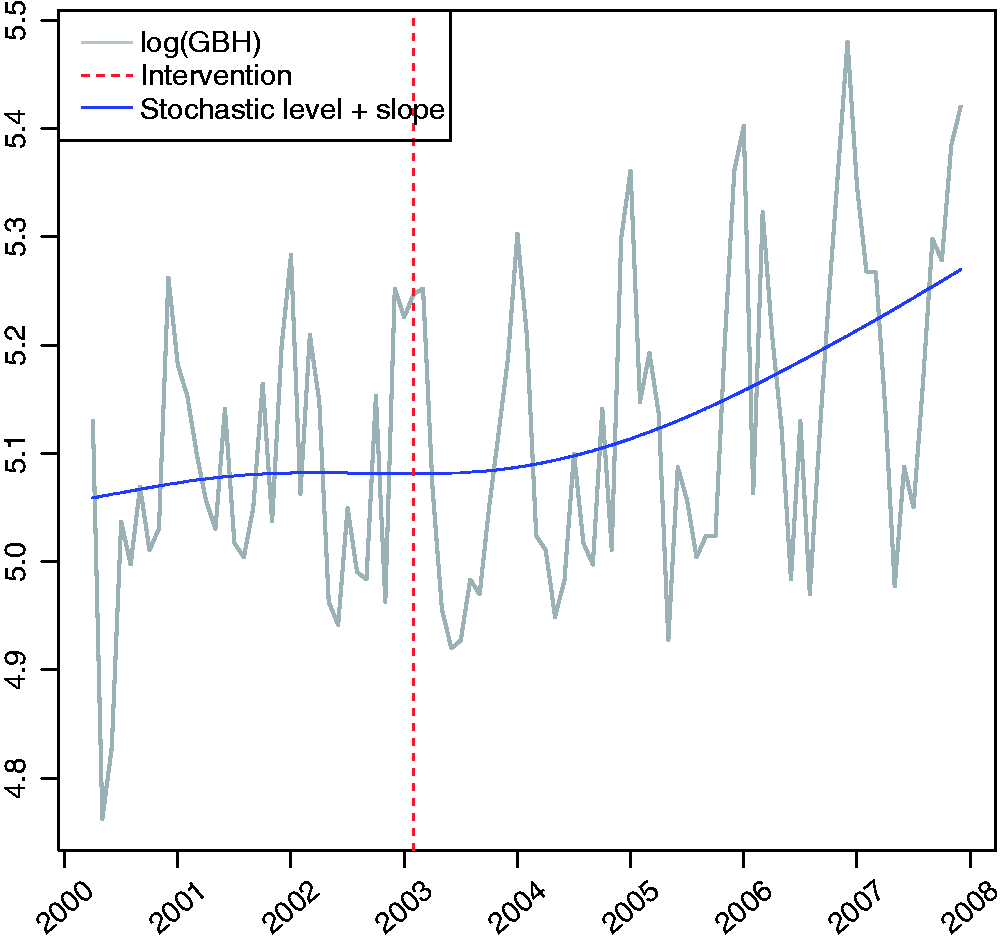
Discussion
There is no evidence in the current study to suggest that the threat of longer prison terms reduces the incidence of assault. This is not surprising. The current study is just one in a long line to cast doubt on the effectiveness of tougher penalties as general deterrent. As Nagin and Pogarsky (2001, p. 865) point out, ‘punishment certainty is far more consistently found to deter crime than is punishment severity’. To be sure, some studies, emanating from the perceptual deterrence literature, have found a deterrent effect of punishment severity. Grasmick and Byrjak (1980), for example, found that the threat of tougher sanctions exerted a deterrent effect. In their case, however, the effect only appeared when the perceived risk of apprehension was relatively high. Howe and Loftus (1996) obtained a similar result. Klepper and Nagin (1989) found an effect of punishment severity that did not seem to be affected by punishment certainty. However, the offence examined in that study (tax evasion) involved a high degree of planning and premeditation. Nagin and Pogarsky (2001) found the effect of sanction severity declined with an individual’s ‘present orientation’ (i.e. among individuals not giving thought to the consequences of their actions).
It might be argued that the main purpose of the proposed mandatory minimum penalties for assault was not so much to deter potential offenders as to change cultural attitudes towards alcohol-related violence. A justification of this sort was advanced by former NSW Premier Barry O’Farrell when announcing the proposal for mandatory minimum penalties for persons convicted of alcohol-related violence. He described the proposal as ‘aimed at changing our culture and promoting personal responsibility’, adding that ‘A strong and consistent message is required that alcohol and drug-fuelled violence will not be tolerated’ (O’Farrell, 2014). The idea that tougher penalties are sometimes necessary to change public attitudes towards crime is hardly new. Calls for tougher penalties are often heard in the context of public campaigns against, for example, domestic violence and child sexual assault. There is little if any evidence, however, that the threat or imposition of tougher penalties does change public attitudes. Indeed, a priori, it would seem more likely that tougher penalties follow a hardening of public attitudes towards crime than the reverse.
Of course, as with all observational studies, the current study has its limitations. We have no control site or group, not exposed to the threat of mandatory minimum penalties that could be used as a counterfactual. Our measure of assault (recorded incidents of assault occasioning actual or grievous bodily harm) may not have faithfully reflected changes in the actual incidence of assault. Although we allowed for a smooth step intervention, the effect of threatening tougher penalties may be long delayed (especially if mediated through changes in public attitudes towards assault). The publicity surrounding the SNPP scheme, though substantial, may not have been enough to communicate the threat of tougher penalties to those most likely to commit assaults. The fact that the SNPP scheme proposed minimum penalties for a wide range of offences (not just assault) may have obscured or attenuated the media message in relation to assault. The fact that the SNPP scheme was introduced in a climate of public concern about crime in general, rather than assault in particular, may have had a similar effect.
Acknowledging all this, it is hard to see how the proposal to introduce mandatory minimum penalties could be viewed as a prudent response to the problem of alcohol-related violence in NSW. High-risk policies may be worth pursuing where there is no more effective policy option available, where the problem they are designed to address is deteriorating rapidly and where the other options for dealing the problem either more expensive or much more difficult to implement than the one under consideration. None of these conditions apply in the present case.
Reducing the supply of motivated offenders is only one way of reducing crime. Other options include reducing the number of criminal opportunities and incentives or increasing the number of capable guardians. Rates of assault in NSW had been steadily declining for some years at the time when the mandatory minimum sentence policy was announced (NSW Bureau of Crime Statistics and Research, 2014). There is reason to believe that changes to liquor licensing policy had played a significant role in producing the decline (Moffatt & Weatherburn, 2011; Moffatt et al., 2009). This alone should have alerted authorities to the potential effectiveness of liquor licensing policy as an instrument for reducing alcohol-related violence.
There are other considerations as well. Liquor licensing policy is arguably a much cheaper means by which to reduce alcohol-related violence than the imposition of a mandatory minimum prison sentence of three to five years on those who commit serious assault. The current study gives further reason to doubt on the deterrent value of longer prison terms. In light of all this, there is some comfort to be had in the fact that the proposal for mandatory minimum sentences does not look it will be passed by Parliament without significant amendment (Patty, 2014).
Footnotes
Declaration of conflicting interests
The author(s) declared no potential conflicts of interest with respect to the research, authorship, and/or publication of this article.
Funding
The author(s) received no financial support for the research, authorship, and/or publication of this article.