



Abstract
The Christchurch Health and Development Study is a longitudinal study of a birth cohort of 1265 children who were born in Christchurch New Zealand in 1977. This cohort has now been studied from birth to the age of 35. This article examines a series of findings from the Christchurch Health and Development Study that address a range of issues relating to the measurement, explanation and prevention of crime and antisocial behaviour. These issues include:
• The measurement of antisocial behaviour in middle childhood;
• The effects of maternal smoking during pregnancy on later criminal offending;
• The long-term consequences of conduct problems, self-control and attention deficits for later crime and delinquency;
• The role of the marker for the monoamine oxidase (MAOA) genotype in moderating the associations between crime and life course predictors of crime;
• The development of trajectory models of crime;
• The use of fixed effects regression in longitudinal analyses to control non-observed sources of confounding;
• Findings from evaluations of home visiting and parent behaviour management programmes.
In general, the findings of the Christchurch Health and Development Study suggest that: (a) conduct problems in childhood and adolescence are a strong and consistent predictor of adult crime; (b) maternal smoking may be an important factor in the development of crime and antisocial behaviour; (c) individuals with the low activity variant of the marker for the MAOA genotype may be at particular risk of criminal offending in adulthood if exposed to environmental risks; (d) the linkages between alcohol misuse and criminal offending are specific to more impulsive kinds of crime such as assault and vandalism; and (e) that home visitation and parent behaviour management programmes may be effective in reducing both child abuse and childhood behaviour problems, amongst other beneficial effects.
Two general themes unite this diverse portfolio of findings. The first has been the commitment of the Christchurch Health and Development Study research team to develop, pioneer and apply statistical methods for addressing long-standing issues relating to measurement and causal analysis in developmental data. The second has been the commitment of the group to translating research findings to develop well-evaluated evidence-based programmes.
Introduction
The Christchurch Health and Development Study (CHDS) is a longitudinal study of a birth cohort of 1265 children who were born in Christchurch New Zealand in 1977. These children were born over a four-month period in 1977, and the cohort represented 98% of all births occurring in Christchurch over this period. The cohort has now been studied on 23 occasions from birth to age 35 years. At age 35, a total of 962 cohort members were studied, with this sample representing 79% of the surviving cohort. Data from the CHDS have been used to address a broad range of issues relating to the health, social functioning and well-being of the cohort as it progressed from infancy to adulthood. A full listing of the study publications may be found at: http://www.otago.ac.nz/christchurch/research/healthdevelopment/publications/.
One important component of this research concerned the development of antisocial behaviour and criminal offending over the life course of the cohort. In this paper, we provide an overview and summary of a number of papers and reports from this portfolio of research. These publications have been selected as representing the more interesting and important findings from the CHDS in this area.
Conceptual background of the CHDS
In the background to this special issue, Piquero (this volume) provides a clear and succinct history of theory and theorising in criminology. The CHDS, while not guided explicitly by criminological theory, has over the course of three decades produced data relevant to issues arising in criminology. The focus of the CHDS has been upon developing, pioneering and applying statistical methods to address issues of measurement and causality in the analysis of developmental data, including data relevant to criminology. Areas in which the CHDS has made contributions include: the application of confirmatory factor analysis and structural equation modelling to developmental data (e.g. Fergusson & Horwood, 1988, 1989, 1993, 1995a, 1996; Fergusson, Horwood, & Lloyd, 1991; Fergusson, Horwood, & Lynskey, 1993a, 1994b; Fergusson, Lynskey, & Horwood, 1996b), the use of survival models and event history analysis (Fergusson, Horwood, & Dimond, 1985; Fergusson, Horwood, & Shannon, 1984), latent Markov models (Fergusson & Horwood, 1983, 1995c; Fergusson, Horwood, & Lynskey, 1995), trajectory analysis (Broidy et al., 2003; Fergusson & Horwood, 2002; Fergusson, Horwood, & Nagin, 2000a; Fergusson, Lynskey, & Horwood, 1996a) and fixed effects regression to control non-observed source of confounding (Boden, Fergusson, & Horwood, 2007, 2012, 2013a, 2013b; Fergusson, Boden, & Horwood, 2006a, 2007, 2009b, 2013a; Fergusson & Horwood, 2000; Fergusson, Horwood, & Ridder, 2005d).
Maternal smoking during pregnancy and later criminal offending
One of the most consistent findings of the CHDS has been of an association between maternal smoking during pregnancy and antisocial behaviours, including conduct problems and crime (Fergusson, Horwood, & Lynskey, 1993b; Fergusson, Woodward, & Horwood, 1998b; Gaysina et al., 2013). These associations are illustrated in Figure 1, which shows the odds ratios (and 95% confidence intervals) for self-reported violent and property offending during the period 16–30 years. The figure shows that the offspring of women who smoked during pregnancy had odds of violent offending that were 1.44 (95% CI: 1.07–1.96) times higher, and odds of property offending that were 1.87 (95% CI: 1.39–2.52) times higher, than those whose mothers did not smoke during pregnancy, even following extensive adjustment for potentially confounding factors.
Odds ratios for the adjusted associations between measures of maternal smoking during pregnancy and violent and property offending from ages 16 to 30.
These finding raise complex issues about the mechanisms that lead to the association between maternal smoking during pregnancy and crime. One way of clarifying these issues is to compare the associations between maternal smoking during pregnancy and crime for children reared by their biological mothers with those reared by adoptive mothers. Evidence showing that adopted children exposed to maternal smoking during pregnancy had similar risks of later crime to non-adopted children would suggest that the origin of the association occurs during the ante-natal period.
This issue has been addressed in a recent collaborative study involving the CHDS (Gaysina et al., 2013) which compared the associations between smoking during pregnancy and antisocial behaviours in adopted and non-adopted participants from three longitudinal studies. The analyses found that the associations were similar for both groups, clearly indicating that the associations between maternal smoking during pregnancy and antisocial behaviour originate during the ante-natal period. Two explanations for this pattern of associations seem possible. The first is that smoking during pregnancy may cause neurophysiological and developmental changes that make children more susceptible to antisocial behaviours (Clifford, Lang, & Chen, 2012). The second explanation may be that smoking during pregnancy more frequently occurs in children whose parents have a genetic predisposition to antisocial behaviour.
Child/adolescent behavioural functioning and subsequent criminal offending
Findings for conduct problems and attention problems
An early application of the CHDS data was to address debates about: (a) the dimensionality of externalising behaviours; and (b) the explanation of modest cross-informant agreement in parent and teacher reports of these behaviours. These issues were addressed in a series of papers applying multitrait multimethod models (Alwin, 1974; Alwin & Jackson, 1980; Campbell & Fiske, 1959; Kenny & Kashy, 1992) using methods of confirmatory factor analysis to examine the dimensionality of parent and teacher reports of childhood behavioural functioning and the reasons for the limited cross-informant agreement (Fergusson & Horwood, 1987a, 1987b, 1989, 1993, 1995b; Fergusson et al., 1991, 1994b). These analyses showed that behaviour reports reflected two highly correlated latent traits corresponding to conduct problems and attention problems. The analyses also showed that reports from different sources (parents; teachers) also contained substantial method variance reflecting the role of contextual factors on the reporting of childhood behaviours. This research provided the foundations of future research examining the role of conduct and attention problems in longer term outcomes.
As part of the CHDS we have conducted a series of studies looking at the linkages between childhood externalising behaviours, including conduct disorder (CD) and attention deficit hyperactivity disorder (ADHD), and subsequent crime and antisocial behaviours in late adolescence and early adulthood (Fergusson, Boden, & Horwood, 2009a, 2010; Fergusson & Horwood, 1995a, 1995b; Fergusson et al., 1993a; Fergusson, Horwood, & Ridder, 2005c; Fergusson, Lynskey, & Horwood, 1997; Fergusson, Woodward, & Horwood, 2000b; Jakobsen, Fergusson, & Horwood, 2012). These studies have consistently shown that:
Both CD and ADHD symptoms are related to subsequent crime and antisocial behaviour in both adolescence and adulthood at the bivariate level. Both CD symptoms and ADHD symptoms are strongly correlated (r (ages 7–9) = .72; r (ages 14–16) = .53).
However, when due allowance is made for the correlation of conduct problems and attention problems, the CHDS data indicated that conduct problems were associated with later criminal offending whereas ADHD symptoms were not. These relationships are illustrated in the data presented in Figures 2 and 3. Figure 2 shows the odds ratios (and 95% confidence intervals) for the associations between disruptive behaviour disorders including CD, Oppositional Defiant Disorder (ODD) and ADHD assessed at ages 14–16 years and risks of property/violent offending during the period ages 16–30 years, after controlling for the co-morbidity between behaviour disorders and confounding factors related to family demographics, family functioning and parental adjustment. For the purposes of the present discussion, property and violent offending were defined as a self-report of at least 10 property or violent offences during the period 16–30 years, and CD/ODD and ADHD were defined as meeting DSM-IV (American Psychiatric Association, 1994) criteria for a particular disruptive behaviour disorder. The data in the figure clearly show a pattern in which there was a strong association between CD/ODD and offending (OR = 5.30; 95% CI: 3.30–8.50) whereas there was a relatively weak and statistically non-significant association between ADHD and offending (OR = 1.82; 95% CI: 0.96–3.45).
Odds ratios for the adjusted associations between measures of behaviour disorder at ages 14–16 (CD/ODD, ADHD) and property/violent offending from ages 16 to 30. Odds ratios for the adjusted associations between measures of behaviour disorder ages 7–9 (conduct problems; attention problems) and property/violent offending from ages 16 to 30.

Figure 3 shows a similar pattern of association after adjustment for both co-morbid disorders and confounding factors, this time employing measures of conduct problems and attention problems assessed during the period ages 7–9 years as the predictor of property/violent offending at ages 16–30 years. For the purposes of this discussion, the measures of conduct problems and attention problems were dichotomised, with the top 10% of the distribution for each behaviour disorder being classified as having conduct or attention problems. The figure shows that there was a moderate to strong association between conduct problems and later offending (OR = 2.53; 95% CI: 1.40–4.59) whereas there was no evidence of association between attention problems and later offending (OR = 0.92; 95% CI: 0.48–1.77).
The role of self-control
In terms of the behavioural antecedents of crime, different explanations have evolved in the areas of criminology and psychiatric epidemiology. One explanation that stimulated a great deal of research and discussion in criminology was that suggested by Gottfredson and Hirschi (1990), who argued that the most important predictor of later crime was lack of self-control. This explanation contrasts with those in the psychiatric epidemiological literature, which have tended to identify the behavioural antecedents of crime as being externalising disorders, most notably CD and ODD (see above).
To a large extent these differing explanatory models have remained separate and there has been little attempt to reconcile the concepts of lack of self-control with measures of externalising behaviours. However, recently there has been a growing interest in this topic. This interest was stimulated by a paper presented by Moffitt et al. (2011) using data from the Dunedin Multidisciplinary Health and Development Study (DMHDS), which showed that a measure of self-control gathered in middle childhood was strongly prognostic of a wide range of developmental outcomes including crime and antisocial behaviour. The authors concluded ‘Differences between individuals in self-control are present in early childhood and can predict multiple indicators of health, wealth, and crime across 3 decades of life in both genders’ (p. 5). While the paper clearly showed that behavioural assessment made in middle childhood was strongly prognostic of later developmental outcomes, the paper failed to: (a) examine the linkages between the measure of self-control and measures of externalising behaviour; and (b) adjust the associations between self-control and later outcomes for the correlated effects of childhood conduct problems.
This issue was addressed in a paper by the CHDS (Fergusson, Boden, & Horwood, 2013b) in which we attempted to replicate and extend the findings of Moffitt et al. This analysis confirmed that measures of self-control gathered in childhood (over the period 6–12 years) were strongly prognostic of later outcomes in late adolescence and early adulthood, including rates of both property and violent offending. However, the paper also found that the measure of self-control was strongly correlated with a measure of childhood conduct problems over the period ages 6–10 years (r = −.76), and that when due allowance was made for the correlated effects of conduct problems, self-control was no longer associated with property crime, and was relatively weakly associated with violent crime. The key findings from this study are presented in Figures 4 and 5.
Odds ratios for the adjusted associations between measures of: conduct problems and self control (ages 6–12) and property offending from ages 16 to 30. Odds ratios for the adjusted associations between measures of: conduct problems and self-control (ages 6–12) and violent offending from ages 16 to 30.

Figure 4 depicts the odds ratios and 95% confidence intervals for the associations between measures of: (a) conduct problems (ages 6–10 years); and (b) self-control (ages 6–12 years); and a measure of property offending during the period 16–30 years (as noted previously, this was a dichotomous self-report measure of at least 10 property offences during the period 16–30 years). The figure shows the odds of the outcome given a one standard deviation change on the continuous measures of either conduct problems or self-control. Inspection of the figure reveals that after controlling for childhood IQ, gender and socioeconomic status at birth, conduct problems were modestly associated with an increased risk of property offending (OR = 1.41; 95% CI: 1.06–1.87) whereas there was little evidence of association between self-control and later property offending (OR = 1.11; 95% CI: 0.79–1.56).
On the other hand, Figure 5 depicts the odds ratios and 95% confidence intervals for the associations between measures of conduct problems, self-control and a measure of violent offending during the period 16–30 years. These data show that after controlling for childhood IQ, gender and socioeconomic status at birth, self-control was modestly associated with an increased risk of violent offending (OR = 1.44; 95% CI: 1.05–1.98) whereas there was only a weak and statistically non-significant association between conduct problems and later violent offending (OR = 1.25; 95% CI: 0.94–1.67).
Summary of findings for childhood disruptive behaviour disorder and self-control
Consideration of the findings from the CHDS presented earlier leads to three general conclusions.
Conduct problems in childhood and adolescence were pervasively related to later criminal offending in late adolescence and early adulthood; The associations between attention problems in childhood and criminal offending in late adolescence and early adulthood were explained in all cases by co-morbid conduct problems and symptoms of oppositional/defiant disorder; Self-control in childhood was prognostic of later violent offending but not property offending.
These findings clearly suggest the importance of investment in early intervention programmes to manage childhood problem behaviour in children showing signs of disruptive behaviour disorder, with an important focus on the prevention, treatment and management of conduct problems in childhood and adolescence (Blissett et al., 2011; Church, 2003; Church et al., 2013; Scott, 2008).
The role of gene × childhood environment interactions in predicting criminal behaviour in adulthood
In 2002 Caspi et al. (2002) published a paper using data from the DMHDS which showed the presence of a gene × environment interaction in the association between childhood maltreatment and antisocial behaviour patterns. This interaction centred around a marker for the monoamine oxidase (MAOA) genotype which was suspected of playing a role in increasing the risk of antisocial behaviour. What Caspi et al. found was that the association between childhood maltreatment and crime varied between the high and low activity variants of MAOA, with those having the low activity variant being more reactive to child maltreatment. Subsequent to the publication of this paper there were a number of attempts to replicate and extend these findings, with mixed results (Beach et al., 2010; Huizinga et al., 2006; Kim-Cohen et al., 2006; Prichard, Mackinnon, Jorm, & Easteal, 2008; Taylor & Kim-Cohen, 2007; Weder et al., 2009).
As part of the CHDS, we attempted to replicate and extend the findings of Caspi et al. over a series of two papers (Fergusson, Boden, Horwood, Miller, & Kennedy, 2012, 2011). What the findings of our own analyses suggested is that there were gene × environment interactions between MAOA and a series of predictors of criminal offending including: maternal smoking during pregnancy, childhood maltreatment (exposure to physical and/or sexual abuse), family material deprivation, failure to achieve secondary school qualifications and childhood IQ. What these findings suggest is that the MAOA genotype interacts with a range of individual and personal factors that are related to criminal offending in late adolescence and early adulthood (Wakschlag et al., 2010).
The relationship between the low and high activity variants of the MAOA genotype and exposure to adversity in childhood is illustrated in Figures 6 and 7, which show the relationships between rates of predicted property (Figure 6) and violent (Figure 7) offending from ages 16 to 30 years, and a risk index which combines information on: pregnancy smoking, child maltreatment, family material deprivation, failure to achieve qualifications and IQ for the high activity and low activity variants of MAOA. These figures clearly show that the MAOA genotype acts to moderate the association between the risk score and offending, with those having the low activity variant being more prone to offend than those with the high activity variant.
Predicted rate of property offending (ages 16–30) for low and high MAOA groups, by risk percentile. Predicted rate of violent offending (ages 16–30) for low and high MAOA groups, by risk percentile.

These findings begin to address the complex interplay between genes, the environment and crime, and clearly support a model in which genetic factors interact with environmental factors to determine risks of criminal behaviour. This model bridges the long-standing debates about whether crime is due to genetic or environmental factors by suggesting a more nuanced explanation in which genetic factors moderate the effects of environmental factors on crime.
Analyses of longitudinal offending data
Trajectory models
Over the last two decades there has been a growing interest in the use of trajectory models to describe differences in patterns of offending across time. This research was stimulated by a need to provide formal statistical tests of the distinction between adolescent-limited and life course-persistent offending proposed by Moffitt (1993) and Patterson and Yoerger (2002). The problem of testing for trajectories was resolved by the development of the Semi-Parametric Group-Based (SPGB) model developed by Nagin (1999).
In two related papers from the CHDS, it was shown that the SPGB model could also be represented as a latent class model in cases where measures of crime were dichotomous. Using this method two analyses of offending trajectories were conducted using CHDS data (Fergusson & Horwood, 2002; Fergusson et al., 2000a). Both analyses not only confirmed the distinction between life course-persistent and adolescent-limited offending but also suggested the existence of other trajectory groups. An analysis up to the age of 18 identified four offending trajectories: a low-risk offending trajectory, an early onset adolescent-limited trajectory, a moderate risk offending group and a group of chronic offenders. An analysis up to the age of 21 identified five offending trajectories: low-risk offenders, early onset adolescent-limited offenders, intermediate onset adolescent-limited offenders, late onset adolescent-limited offenders and chronic offenders.
These findings are broadly consistent with findings from other trajectory analyses (Hussong, Curran, Moffitt, Caspi, & Carrig, 2004; Moffitt, 1993; Patterson, DeBaryshe, & Ramsey, 1989; Patterson, Forgatch, Yoerger, & Stoolmiller, 1998; Patterson & Yoerger, 2002). All analyses identify a group of persistent offenders and a group of low-risk non-offenders. However, analyses have varied with respect to the number of intermediate categories, including both adolescent-limited trajectories and late-onset trajectories. Findings from the CHDS have also shown that both males and females follow similar trajectories, but that rates of chronic offending were substantially lower for females than males (Fergusson & Horwood, 2002).
Fixed effects regression
A limitation of the trajectory models described earlier is that they reduce complex repeated measures data to a number of groups of individuals following similar developmental trajectories across time. In the process of these analyses, important information about patterns of across-time change is lost. An alternative approach is to develop statistical models that take account of and capitalise on patterns of change and stability evident in longitudinal data.
An important application of this approach is provided by the use of conditional fixed effects regression to control for non-observed sources of confounding (Allison, 2009; Cameron & Trivedi, 1998; Greene, 1990; Hamerle & Ronning, 1995). A recurrent problem in testing causal models in criminological research has been that of controlling for confounding factors. To provide an example, it has been well established that alcohol misuse is strongly associated with criminal offending, and it seems reasonable to propose that this relationship arises because the disinhibiting effects of alcohol use increase the individual’s propensity to offend (Field, Schoenmakers, & Wiers, 2008; Freeman, Friedman, Bartholow, & Wulfert, 2010; Houben & Wiers, 2009; Kallmen & Gustafson, 1998; Steele & Southwick, 1985). However, it could be suggested that the association is non-causal, and instead arises because of common factors that predispose the individual to misuse alcohol and to offend (Greenland & Morgenstern, 2001; Ward, 2009; Ward & Johnson, 2008). These issues raise important issues about the extent to which alcohol/offending associations are due to the drink or the drinker (Strandberg-Larsen & Andersen, 2011).
Conventionally, these issues of confounding have been addressed in criminological research by adjusting associations between crime and potentially causative factors for observed confounders such as age; race; and social, family and childhood background. The difficulty with such analyses is that it is always possible to suggest the presence of non-observed confounders which explain the observed association.
The conditional fixed effects regression model provides an important technique for addressing the issue of omitted confounders. The general logic of this approach can be illustrated by a study in which the same sample is assessed on two occasions (t1; t2) with assessments of offending (Yt) and a time varying predictor X being collected. We assume that the associations between Yt and Xt are described by the model



It will be evident that the model in equation (3) provides an estimate of the parameter of interest B1 in a way that excludes the influence of the fixed effects factor U.
The principles illustrated earlier can be generalised to develop fixed-effect adjusted estimates for a wide range of statistical models (Allison, 2009; Hamerle & Ronning, 1995). In addition, the models may be extended to include observed time-dynamic confounders.
The fixed effects model can be used for any situation in which there is interest in the causal effects of a time-dynamic predictor and time-dynamic measures of offending. One application of this approach is to examine the associations between alcohol misuse and crime taking into account non-observed sources of confounding. This approach has been used in a number of CHDS publications (Boden et al., 2007, 2012, 2013a, 2013b; Fergusson et al., 2005d, 2006a, 2007, 2009b, 2013a; Fergusson & Horwood, 2000). One of these publications explored the linkages between alcohol misuse and various types of criminal offending, taking into account fixed effects and time-dynamic confounders (Boden et al., 2013a). This analysis showed that after adjustment, alcohol misuse was related to assault and property damage but not to other types of crime including: theft, burglary and vehicle conversion; and fraud, embezzlement and misappropriation of funds. The findings from this analysis are summarised in Figure 8, which shows the odds ratios and 95% confidence intervals for the associations between alcohol use disorder symptoms and the four categories of criminal offending, after adjustment for non-observed fixed effects, for those individuals with five or more symptoms of alcohol use disorder.
Odds ratios for the fixed-effects adjusted associations between alcohol misuse and types of criminal offending, ages 18–30.
The findings of the CHDS highlight the value of longitudinal data in establishing causal relationships. Not only do these designs make it possible to address issues such as temporal sequencing, but they also provide possibilities for developing stringent controls for non-observed confounders in studies which examine the interplay between changing circumstances and changing patterns of offending. Areas in which this methodology has potential application include: (a) the study of the effects of peer relations on offending patterns (Agnew, 2003; Bennett, Farrington, & Huesmann, 2005; Fergusson & Horwood, 1996, 1999; Fergusson et al., 1996a; Fergusson, Swain-Campbell, & Horwood, 2002); and (b) the effects of changes in partner and romantic relationships on crime (Sampson & Laub, 1990, 1993; Sampson & Lauritsen, 1994; Woodward, Fergusson, & Horwood, 2002). Finally, this methodology can be extended using structural equation models to examine the reciprocal interplay between time-dynamic variables (Boden, Fergusson, & Horwood, 2014; Fergusson et al., 2009b; Fergusson, Boden, & Horwood, 2011).
The development and evaluation of interventions
One of the most important reasons for the continued funding of the CHDS has been the important role played by longitudinal data in laying the foundations for the development of interventions targeted at the prevention, treatment and management of antisocial behaviours. The findings of the CHDS have paid a critical role in the development of two early intervention programmes in New Zealand.
The Early Start (ES) home visiting programme
The development of ES was motivated by findings from a study conducted by the CHDS which examined the social, family and related backgrounds of adolescents who developed severe multiple problem behaviours including crime, substance abuse, sexual risk taking and related behaviours (Fergusson, Horwood, & Lynskey, 1994a). Not surprisingly these analyses suggested that many of these adolescents came from family backgrounds characterised by multiple social, economic, family and related problems. These associations proved to be very strong, with children from the most disadvantaged 5% of the cohort having risks of later multiple problem behaviour that were more than 100 times greater than the risks for the most advantaged 50% of the cohort.
These findings highlighted the potential for early intervention with families facing multiple challenges. As a result of these findings, staff from the CHDS worked in combination with local service providers to develop a home visiting service that became known as ES, which was targeted at the needs of families facing multiple social, economic and personal problems. The key elements of the ES Programme are:
The programme is a prevention programme targeted at children identified during the prenatal period or shortly after birth as coming from families facing multiple challenges. The programme is delivered by trained Family Support Workers (FSW) with tertiary level qualifications in Nursing, Social Work, Teaching or an allied discipline. The intervention involves regular home visiting by the FSWs to provide a programme of family support that includes advice and support on a wide range of issues relating to child health, parenting, home safety, preschool education and related issues. The level of support is calibrated to the level of family need, with all families entering programme having weekly visits from their FSW, with the frequency of visiting reducing as the family progresses through the programme. To ensure uniformity of service delivery, all FSWs have weekly supervision and the performance of the organisation is evaluated against a series of benchmarks reflecting the expected outcomes of the client.
A more detailed explanation of ES has been provided in a number of publications (Fergusson, Boden, & Horwood, 2012a; Fergusson, Horwood, & Grant, 1998a; Fergusson, Horwood, Grant, & Ridder, 2005b).
The evaluation of the ES programme was developed using a Prevention Science methodology in which the programme was initially evaluated using a feasibility study involving 50 families (Fergusson et al., 1998a). The feasibility study was then followed by a randomised controlled trial (RCT) in which the outcomes of 220 families receiving ES were compared with the outcomes of 223 controls not receiving the programme (Fergusson, Grant, Horwood, & Ridder, 2005a, 2006b; Fergusson et al., 2005b). Finally, the RCT was extended to include a nine-year follow-up of both the ES and control groups (Fergusson et al., 2012a). The findings of this process of research can be found in a series of publications describing the programme development and evaluation process (Fergusson, Boden, & Horwood, 2013c; Fergusson et al., 1998a, 2005a, 2006b, 2005b, 2012a). The key findings of this research process were that ES group had advantages in a number of areas including:
Early health care utilisation; Reduction in risks of injury; Reduced risks of child abuse; Greater access to preschool education; Improved parenting; Reduced rates of childhood behaviour problems.
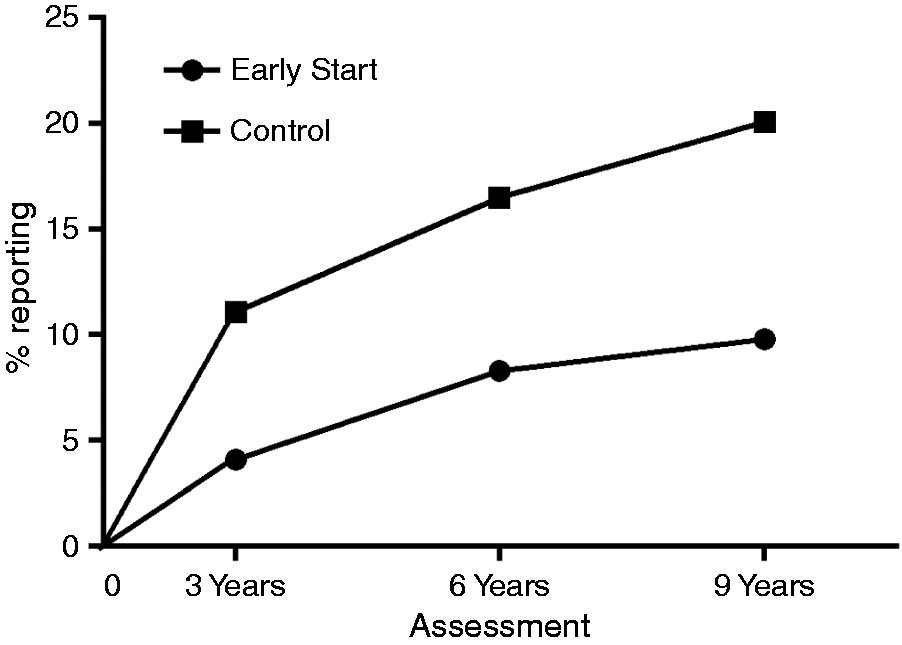
Perhaps the most clear and consistent findings were for a reduction in rates of hospital attendance for accidental injury and rates of parentally reported child abuse. These findings are depicted in Figures 9 and 10 which show the cumulative risks of hospitalisation for accidental injury and parental report of physical child abuse over the nine-year follow-up. The figure shows that by the nine-year follow-up children in the ES series had rates of hospital attendance for injury with were one-third lower than the rates for the control series, and rates of parentally reported physical child abuse which were 50% lower. These findings clearly suggested that the provision of ES led to better health care, improved parenting and reduced risks of injury and physical child abuse. In addition, at the nine-year follow-up there was evidence that children in the ES series had reduced rates of antisocial behaviour. All of these findings suggest that ES was a successful early intervention programme which reduced childhood risks in a number of areas related to later crime and other adverse outcomes.
Cumulative risk of hospital attendance for accidental injury to 9-year follow-up, Early Start vs. controls. Cumulative risk of parental reports of child abuse to 9-year follow-up, Early Start vs. controls.
The Incredible Years preschool parent programme
Earlier it was noted that one of the most consistent findings of the CHDS was the strong linkages between conduct problems in childhood and adolescence and later adverse outcomes including crime. These findings, together with other New Zealand research including findings from the DMHDS, were presented to New Zealand Government Agencies (Ministries of Health, Education, and Social Development) by a committee of advisors known as the Advisory Group on Conduct Problems (AGCP). The AGCP prepared a series of four reports outlining effective evidence-based programmes for the treatment, management and prevention of conduct problems in childhood and adolescence (Blissett et al., 2011, 2009a, 2009b; Church et al., 2013). These recommendations were taken up by the Ministry of Education which developed a strategy known as Positive Behaviour for Learning (PB4L) (Ministry of Education, 2009) to implement a number of evidence-based programmes based on the recommendations of the AGCP.
The first part of the strategy involved the adoption of the Incredible Years Parent programme (IYP) (Edwards, Ceilleachair, Bywater, Hughes, & Hutchings, 2007; RAND Corporation, 2006; Webster-Stratton, 2007; Webster-Stratton, Reid, & Hammond, 2001). This programme is a parent behaviour management training programme targeted at the parents of 3–8-year-olds who present with significant behaviour problems. The programme is delivered in a group setting by trained Group Leaders over a period from 12 to 18 weeks.
As part of the implementation of IYP, the programme was evaluated using a combination of pre/post comparisons, single subject studies and a client satisfaction survey delivered at three sites. The pre/post design was used for evaluation as there was already substantial evidence of the efficacy of IYP from randomised trials (Gardner, Burton, & Klimes, 2006; RAND Corporation, 2006). The aims of the pre/post evaluation were to provide reassurance that the benefits of IYP that were found in other settings were also evidenced in New Zealand. The findings of this evaluation provided clear evidence of the efficacy of IYP in a New Zealand setting (Fergusson, Horwood, & Stanley, 2013d; Fergusson, Stanley, & Horwood, 2009c; Sturrock et al., 2013). Figure 11 shows a plot of the estimated effect sizes for series of measures of parent-reported child behaviours. This figure gives values of Cohen’s d for changes in behaviour scores over a series of outcomes assessed at baseline and at six months post-programme. The figure shows that the provision of IYP was associated with clear and statistically significant (p < .05) improvements in all aspects of child behaviour. In all cases, effect sizes fell into the moderate to large range (d > .5).
Estimates of Cohen's d for baseline/six month follow-up comparisons of child behaviours in the Incredible Years Parent programme.
Currently, the programme is being evaluated using a 2.5- to 3-year follow-up. Preliminary analyses suggest that the findings evident at the six-month follow-up were sustained at the 2.5- to 3-year follow-up.
Concluding comments
The findings above reflect a sampling of the CHDS research into the development of crime and antisocial behaviours. However, even this sampling is sufficient to illustrate the power of the longitudinal design to explore causal processes and sequences in the development of crime. Perhaps more importantly the study also illustrates the ways in which findings from longitudinal studies can be translated to develop effective evidence-based prevention and treatment programmes.
In his review Piquero (this volume) proposes a series of further issues that require examination in future longitudinal and developmental research. It is our view that the most scientifically important of these involves a better understanding of the relationships between biology and crime. This area spans a series of issues relating to: gene × environment interactions, epigenetics and neurological development. While further research into the social, personal and contextual factors related to crime over the life course will further inform the development of criminological theory, it is likely that the present body of evidence is adequate to form the foundations of evidence-based interventions. As a consequence, a major priority in applied criminology is the translation of existing knowledge to the development of effective, well-evaluated and sustainable interventions targeted at the prevention, treatment and management of crime and antisocial behaviour over the life course. A promising start has already been made in this area with a growing list of effective interventions for different ages and different social contexts. As Homel (this volume) notes the major task facing the field is likely to be that taking these interventions to scale within populations while at the same time maintaining programme fidelity and effectiveness.
Viewed from an historical perspective, all of the trends in longitudinal and intervention research provide clear evidence of a paradigm shift in thinking about crime away from the view that crime is a sin to be punished and towards the view that crime is a social problem that can be solved. Hopefully the findings from the CHDS and related research have made some contribution to this process.
Footnotes
Acknowledgements
The CHDS could not have succeeded without the support and contribution of many people: In particular, we owe a debt of gratitude to: The Health Research Council and its predecessor the Medical Research Council of New Zealand, for the continued support they have given the study over the past 37 years. The work and efforts of more than 80 interviewers and psychometric testers who have contributed to the study data collection. The research staff who have contributed to the design, collection and analysis of CHDS data including: Rosemary Wright, Mary Clark, Dr Annette Beautrais, Mary Dimond, Dr Jan Lawton, Dr Michael Lloyd, Dr Michael Lynskey, Dr Lianne Woodward, Dr Nicola Swain-Campbell, Elizabeth Ridder, Dr Sheree Gibb, Dr Myron Friesen, Dr Alessandra Raudino. Finally, the contributions made by the 1265 members of the CHDS birth cohort and their families who have endured many hours of often personal questioning about their health, development and life course to provide the raw material for our research.
Funding
This research was funded by grants from the Health Research Council of New Zealand, the National Child Health Research Foundation, the Canterbury Medical Research Foundation and the New Zealand Lottery Grants Board.
Conflicts of interest
Professor Fergusson is a member of the Board of Directors of Early Start. The authors declare no other conflicts of interest.