



Abstract
An examination of a Crime Stoppers initiative – a weekly page published in a major city-based tabloid newspaper – afforded a rare glimpse into this understudied global entity. It also offered a means of reflecting on the co-option of CCTV images; partnerships between police, media organisations, and diverse publics; and the harnessing of citizen labour in a culture of surveillance. Quantitative and qualitative analyses were conducted on the images, accompanying texts, and rhetoric of this feature page for a two-year period. From a media criminology perspective, the portrayals underscore the abrogation of the presumption of innocence, a focus on mundane property offences, with the potential to exacerbate fear of crime and to engender more punitive public attitudes. From a conceptual frame, this article proffers the notion of surveil-labour where the repurposing of CCTV data in the context of a Crime Stoppers scheme reinforces an alliance of police, media, and the public to enhance an infrastructure of informing.
Keywords
Introduction
A major city newspaper recently introduced a weekly feature page that comprises security camera images of local crime events and calls on its readers to provide information. In a news article about the segment, it was heralded as a ‘crime-busting measure’ that combines ‘the law, this newspaper and the public’ as ‘forces for good’ with the aims of ‘stopping crime’ and ‘making the community safer’ (Gold Coast Bulletin, 2016, p. 46). The tabloid proclaimed that readers could ‘take a bow’ because ‘41 cases were solved and a total of 189 charges were laid’ from the ‘202 matters published’; yet ‘crooks can’t say they haven’t been warned … the city is watching’. Advertising such crime metrics and framing them within a crime-fighting discourse in this manner are emblematic of the Crime Stoppers project (Jermyn, 2006), which is a key collaborator on this media feature.
This weekly initiative provided a timely opportunity to interrogate its representations of crime that, in turn, prompt questions about the surveillant utility of CCTV images, the project of Crime Stoppers, and the police–media–public partnerships. This exploration is apposite given the few robust evaluations of Crime Stoppers globally, which remains a ‘surprisingly understudied’ enterprise (Lippert & Wilkinson, 2010, p. 132) despite its international reach (Challinger, 2003, 2004). This is not to deny the seminal research from North America and the United Kingdom over three decades (e.g. Carriere, 1987; Carriere & Ericson, 1989; Gresham, Stockdale, & Batholomew, 2003; Gresham, Stockdale, Batholomew, & Bullock, 2001; Lavrakas, Rosenbaum, & Lurigio, 1990; Lippert, 2002, 2009; Lippert & Walby, 2017; Lurigio & Rosenbaum, 1991; Parent, 1993; Pfuhl, 1992; Rosenbaum, Lurigio, & Lavrakas, 1989). Yet, scant attention has been paid to Crime Stoppers locally beyond the reviews of the Victorian scheme (Challinger, 2003, 2004; Galanopoulos, 1999), its inclusion in an examination of citizen engagement with police (Ayling, 2007), and the critique from an assemblage perspective that drew upon advertisements from Australia (Lippert & Wilkinson, 2010).
This article presents findings from content and discourse analysis of the weekly feature for a two-year period since its inception. The page hosts four to six photographs and short descriptions of incidents allegedly involving offending behaviours from petrol drive-offs and shoplifting, to credit card fraud and assaults. Quantitative data were extracted from over 500 items and coded for content and quality. Qualitative analysis was conducted on the accompanying textual case descriptions and the overall rhetoric of the page. This research contributes to our understanding of police–media–public alliances, the construction of crime narratives through ‘real-life’ cases presented as infotainment, and explores how police and Crime Stoppers leverage the work of informing by repurposing CCTV technologies.
Overview and evaluations of Crime Stoppers
Crime Stoppers is a convergence of police, media, private sponsorship, and a watchful public, to ultimately derive citizen information about local crime events (Lippert & Wilkinson, 2010). Since its inception in 1976 it has been professed to be the ‘most institutionally embedded crime reduction program’ in America (Lippert & Wilkinson, 2010, p. 132), with expansion into Canada, Australia, and the UK throughout the 1980s, and extending to South Asia and the African continent (Lippert, 2002; Lippert & Wilkinson, 2010; Rosenbaum et al., 1989). The scheme is generally configured as a not-for-profit company, often a registered charity staffed by volunteers, and operated in conjunction with public policing (Ayling, 2007; Lippert & Walby, 2017). It can be partnered with local government, transport authorities, and private sponsors usually from the security and insurance sectors (see QCS, 2017; Lippert & Walby, 2017).
There have been many publicity strategies under the umbrella of the Crime Stoppers project across legacy mass media (Challinger, 2003, 2004) with a recent shift to online platforms. Its hallmark though is ‘crime of the week’ that centres on profiled offences with images, descriptions, and calls for public assistance (Carriere & Ericson, 1989; Lippert, 2002; Lippert & Wilkinson, 2010). In recent years these weekly crime features have harnessed the outputs of ubiquitous closed-circuit television installations to render the targeted offences as authentic (Lippert & Wilkinson, 2010). The brief companion texts begin with facts of the case, typically from police sources, that then evolve into moralistic discourse on the acts and the actors (Lippert & Wilkinson, 2010). While the project’s original focus was on serious crime (Rosenbaum et al., 1989), this remit has been partially subsumed by other schemes such as Amber Alerts in the case of child abductions (Griffin, Miller, Hoppe, Rebideaux, & Hammack, 2007) and various anti-terrorism hotlines (Ayling, 2007).
Empirical evaluations reveal a limited range of crime events depicted that centre on street offences with one-half to two-thirds comprising property crimes against businesses (Carriere & Ericson, 1989; Lippert & Wilkinson, 2010) and a tendency to over-represent violent incidents such as robberies (Challinger, 2003, 2004). There is virtually no attention to offences committed by businesses (Thomson, 1989) or by police (Lippert, 2002), and a concomitant overemphasis on individuals as suspects (Lippert & Wilkinson, 2010). The CCTV images are derived largely from private sources, rarely capture footage of the crime in situ, and generally are deemed of insufficient quality to permit identification (Carriere & Ericson, 1989; Lippert & Wilkinson, 2010). The offences represented are often several months old and yet media agencies present them as ‘news’ that belies their currency (Carriere & Ericson, 1989; Challinger, 2003, 2004; Lippert & Wilkinson, 2010). Several studies highlight a bias in the selection of offences supposedly committed by ethnic and minority group members (Carriere & Ericson, 1989; Rosenbaum et al., 1989), which proportionally is as much as 10 times greater for Indigenous peoples (Lippert & Wilkinson, 2010).
Evaluating Crime Stoppers is admittedly difficult as there are myriad measures that could be used; especially so as calls that lead to the provision of new information are not classified by whether they are in direct response to a particular publicity strategy (Challinger, 2003). The counterpoint though is that there have always been impressive statistics claimed for arrests, convictions, and property recovery (Rosenbaum et al., 1989; Thomson, 2010), with the Queensland branch recently asserting ‘some of the best results per capita in the world’ (QCS, 2017). Nationally for the 2015–2016 year there were said to be over 7000 arrests and 20,000 charges flowing from the 340,000 contacts from the public via phone, online, or app (QCS, 2017). However, the Victorian evaluation found that only 5.3% of 114 target crimes were cleared via public information, and that the proportion of calls that result in arrest is less than 2% (Challinger, 2003). Importantly, in only 23% of these cases could the arrest be attributed to the publicity from the Crime Stoppers programme and most of these offences were in fact bail breaches (Challinger, 2004). Further, the once-televised and popular Crime Stoppers show in the UK is purported never to have solved a single crime (Jermyn, 2006).
Critiques of Crime Stoppers
On the one hand, Crime Stoppers has been described as hegemonic in its embodiment of law and order and the business interests that help fund it (Carriere & Ericson, 1989; Lippert & Wilkinson, 2010). On the other, it is characterised as having a more pragmatic function of risk management with a focus on the reduction of property losses rather than symbolising crime control (Lippert, 2002). Further, it is said to promulgate a ‘discourse of affectiveness’ with a ‘promotional appeal to the heart’ (Thomson, 1989, p. 117) as the publicity seems designed to generate outrage towards suspects and promote empathy towards victims (Carriere & Ericson, 1989; Lippert & Wilkinson, 2010). The texts typically ascribe guilt to suspects, given that qualifiers such as ‘reported’ and ‘allegedly’ tend to be omitted (Lippert & Wilkinson, 2010). Thus, grainy ‘real-life’ images, descriptive vignettes of the crime event details, and the editorial omission of any presumption of innocence appear to underscore a law-and-order paradigm.
In the opaque process of selecting the offences to feature in weekly media platforms it is not clear how these are interpreted by the public and how they may be leveraged by police (Lippert & Wilkinson, 2010). The rhetoric has the potential to foster the view that immediate danger calls for an immediate community response as opposed to the reality which comprises the presentation of relatively low-level offences that would normally be dealt with via routine policing methods (Lippert, 2002). Through this process, the police garner elevated legitimacy and are able to extract information from and about the community (Lippert, 2002; Thomson, 2010). At the same time private institutions and the mass media enhance their public image by associating themselves with the ‘virtuous goal of fighting street crime alongside police’ in addition to having a reliable source of entertaining crime stories (Lippert, 2002, p. 479).
Citizen involvement in policing is not new (Grabosky, 1992, 2004), but its reinvigoration in this participatory era recognises that public labour offers ‘a vast, sometimes under-utilized and maligned, resource in the policing toolkit’ (Ayling, 2007, pp. 73–74). One way in which this interaction has been characterised is as a ‘gift’ – a ‘force multiplier’ that can be independent, altruistic, and voluntary (Ayling, 2007). Tipsters willingly give their labour even though their motivations may be complex and likely aligned with favourable perceptions of police (Ayling, 2007; Tyler & Fagan, 2008). However, this comes at a cost of ‘a society increasingly focused on surveillance’ and the potential for vigilantism if there is eroded confidence in law enforcement in circumstances where crime is seen as being out of control (Ayling, 2007, p. 74).
In the same vein, access to citizens amenable to voluntary participation in policing is underpinned by police–media partnerships that have strengthened and expanded exponentially in the last 25 years (McGovern & Lee, 2010). The symbiotic relationship between media organisations and police has long been recognised (Putnis, 1996), and it remains that police are ultimately the privileged gatekeepers of crime information (McGovern & Lee, 2010). The benefits of such alliances are not entirely unidirectional: media organisations and their personnel benefit from police use of broadcast time or publication space resulting in what might be considered convenient journalism under the guise of community service (Hier, Greenberg, Walby, & Lett, 2007; Mawby, 2010).
Another aspect of the Crime Stoppers programme is the co-opting of CCTV images ‘to capture the public’s imagination’ (Lippert & Wilkinson, 2010, p. 135) and ultimately lead to apprehension and prosecution (Dawson, 2012). The visual representations are imbued with a sense of authority for they have been paired with a crime event, vetted by Crime Stoppers and enhanced by the accompanying narratives (Lippert & Wilkinson, 2010). By contrast, this harnessing of CCTV highlights the limitations of the deterrent capacity of surveillant technologies and the banality with which they are regarded (Goold, Loader, & Thamala, 2013; Lippert & Wilkinson, 2010). In addition, the limited capacity for CCTV to successfully identify offenders has been acknowledged given that individuals are able to evade detection by a variety of means (Willis, Taylor, Lee, & Gannoni, 2017). This reliance on CCTV generates broader implications for the surveillance society – a ‘tyrannous citizenry’ (Grabosky, 1992, p. 26) of ‘spies and snitches’ that undermines trust and may in fact absorb greater resourcing of police to follow-up on the information overload that can ensue (Ayling, 2007, p. 91).
Despite these issues and the ubiquity of Crime Stoppers programmes, there are few empirical evaluations and even fewer critical studies, albeit with exceptions (Ayling, 2007; Lippert, 2002; Lippert & Wilkinson, 2010). There has been scant attention to its repurposing of CCTV images and what this means for community surveillance (see Lippert & Wilkinson, 2010). Yet, as part of its publicity remit, Crime Stoppers continues to offer weekly crime features in a number of venues (print and broadcast media, online, and on public hoardings or as digital signage). This article analyses a recent tabloid newspaper feature as a case study through which to navigate questions about the place of Crime Stoppers in crime control, the crime narratives it promulgates, alliances of police–media–public, the co-opting of closed-circuit television images, notions about the surveillance society, and issues of individual responsibilisation in a culture of informing that foster a discussion about the rise of surveillant citizen labour.
Methodology
This research comprised content and discourse analysis conducted on both quantitative and qualitative data from 102 weekly segments for a two-year period since the inception of the feature in March 2014. Throughout the data collection time frame, the page was usually bylined by one of two main reporters, affording some consistency across the sample. Our examination centred exclusively on the print version, accessed from a community library, and via an institutional media database and an online portal. The methodology aligns with three previous studies: Lippert’s (2002) examination of 640 weekly crime features in Canada focussing on crime representation and the discourse adopted, Challinger’s (2003) evaluation of 114 incidents published on a ‘most wanted page’ in the Herald Sun periodical in Victoria in 2000–2002, and Lippert and Wilkinson’s (2010) analysis of 240 Crime Stoppers' web-based advertisements including CCTV images from Canada and Australia in 2004–2008.
The weekly pages (published on a verso page, modally at page 12) were given considerable prominence in the newspaper, with 47% being previewed on the front or second page via an insert featuring images and headlines from one or two cases. The page included blue and white checked police tape imagery and the Call Crime Stoppers logo. Each edition contained four to six separate crime cases, giving a total of 428 (with their police reference numbers), which were typically presented via a single CCTV image and a short textual case description (58 words on average). Within these cases, there were 520 persons and 503 offences depicted. The coding was conducted at both the page and case levels, but the analysis extended to all persons and all crime events. A priori coding categories were drawn from the extant literature and scans of the dataset. In the initial phase, a selection of photos and texts were coded and compared to arrive at agreed definitions for the variables and to engage in inter-rater reliability checks. The study adopted a positive coding method, given that for some of the variables an ‘unknown’ response was likely to have the most veracity. For example, to judge the age of persons depicted, their clothing, body shape, and adornments (hats or tattoos) were taken into account to assist coders in opting for a specific response category.
Some emergent codes were identified where complex variables required more careful consideration (Richards, 2015). For example, determining the picture quality was problematic but generally if grainy, pixelated, or out of focus then it was ranked as poor. This was even more difficult when coding for all persons depicted if the image contained more than one, as often the individual closer to the camera was in focus but the other less distinctive. In other instances, when coding for the utility of the image, the CCTV-derived photo might be of high quality but the person was wearing a hat and dark glasses and thus for identification purposes the image was deemed not useful. As picture quality has implications for accurate assessment of the content portrayed, it was coded separately from whether the face was obscured, and then a third subjective variable was created about whether it might be possible to identify the person. None of these were at a probative level but rather addressed whether the person was potentially recognisable or if there were individuating features (see Figure 1).
Poor quality of the images combined with disguises impede accurate identification, Gold Coast Bulletin, 10 September 2015.
The challenges of this research were largely experienced in the content analysis coding processes. Operationalisation of subjective codes was an ongoing process of clarifying category definitions and attributes between coders where there was uncertainty or disagreement. For example, determining whether a person depicted was ‘identifiable’ yielded multiple interpretations and required consideration of whether this referred to some physical obstruction in the picture (e.g. hat, face covering), or if this referred to whether a reader would be able to recognise and identify a person they knew in the photo. In some instances, more discrete new codes were generated in response and additional sweeps of the dataset were performed. This highlighted the complexity and subjectivity involved with the content analysis design and execution (Churchill, 2013).
These research challenges yielded limitations in terms of design and data collection, but they provided important insight into the potential experience for readers. The exercise of processing and being asked to identify or recognise persons in highly pixelated or obscured images would be difficult for even the most determined reader. This raised important research questions about the selection, filtering, and presentation of these images by the police and media outlets; the efficacy of this initiative given the potential for non- or mis-identification; and whether this initiative was ultimately premised on citizens informing on people they knew intimately. These questions highlighted other complementary research methods that would be insightful to explore in future research on the topic, such as interviewing key stakeholders (police, journalists, and Crime Stoppers personnel), and other strategies such as focus groups to capture audience attitudes and interpretation processes (see Lippert, 2002; Lippert & Wilkinson, 2010).
Results
The sample predominantly portrayed Caucasian males who appeared to be young adults (see Table 1). Most commonly the offences were against property, where places of business comprised the primary victim type (56%), and a proportion of these were petrol drive-offs (28%). Fraud offences, especially stolen credit cards, had some prominence and there was a notable absence of drug-related offending (see ‘Discussion’ section). Of the 428 cases, the majority reported on single incidents; however, there were indications that some were part of a series (22%). On average, there was a 50-day delay between the specified offence date and publication (with a range of 3–405 days), and most cases were published only once (96%).
Summary of offence types, settings, sources, locations, victims, and characteristics of persons depicted.
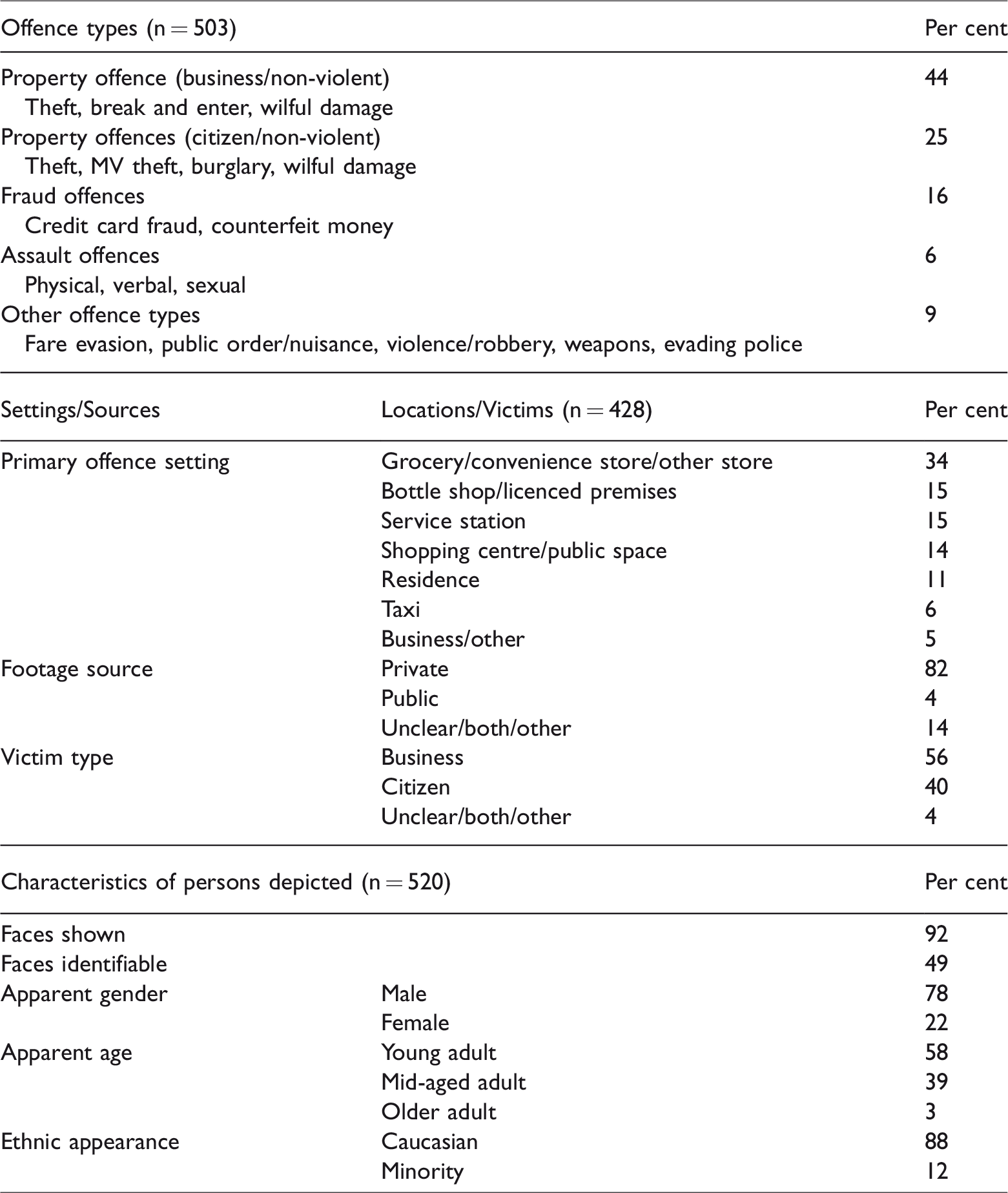
The CCTV images were displayed in colour and almost exclusively drawn from private sources (see Table 1), with the quality rating somewhat evenly distributed: poor (32%), average (43%), and good (25%). The visuals most often (92%) captured faces without any major obstructions (e.g. hat or hood); however, factors such as the picture quality rendered most being classified as difficult to identify. In the 60% of cases where coders judged that no persons could likely be identified, the images were concurrently deemed of poor quality underscoring the collinearity of some variables. Some CCTV images appeared to depict the reported offence with visible indicators of the location or suspect in the act; however, convincing portrayals were rare (2%). Almost half provided incomplete crime scenarios by showing only tangential corroborating elements (e.g. a person at a petrol pump). In the remaining cases, there was no observable context for the alleged crime, rather just evidence of an individual at an unidentifiable location and time (e.g. head shot of a person against a nondescript backdrop).
While footage may have been selected to achieve the best quality for identification, rather than inclusion of observable evidence of an offence, this results in a heavy reliance on case descriptions to provide information and reconstruct the crime event. For example, in 24% of images where no visual crime context was evident, the persons depicted were framed as offenders with no attempts to retain ‘suspect’ status in the accompanying description. More than half (54%) of the sample omitted terms that afford those depicted presumed innocence such as the use of ‘allegedly’, ‘believed’, or ‘suspect’, although most of these occurred in the first year of publication. Changes in personnel overseeing the page may explain the shifts in reporting style as 94% of the cases ascribing guilt carried the same journalist byline. Inference of guilt was reinforced through vocabulary like ‘thief’, ‘fraudster’, or ‘robber’. Some cases even highlighted recidivist tendencies, such as declaring ‘a five-time thief who gave himself a five-finger discount … is wanted for questioning’.
In addition, a spectrum of stereotypical crime portraits was evident in the sample (see Table 2). Some cases relied on ‘stupid thief’ narratives, while other depictions stressed the brazen, opportunistic, deviant, and sneaky qualities of alleged criminal protagonists who were out to trick an unsuspecting community. Censorious and judgemental descriptions that adopted an ends-don’t-justify-the-means tone to condemn suspected rule-breakers were also observed. Other case descriptions trivialised offence motivations or relied on emotive writing to emphasise objectionable qualities of offenders in contrast to undeserving victims:
Examples of memes in the textual descriptions.

All stealing is wrong but thieving from a child is a whole new low. Unfortunately, that is exactly what happened when a young girl left her wallet unattended … [and] a female offender picked up the wallet and left the store. (Case 276)
Some narratives were presented as public service style announcements that were directed at reducing victim risk in a what-not-to-do frame. A parallel theme was to criticise those who thought they were ‘clever enough’ to remain undetected, while proposing crime antidotes like CCTV, citizen interruption, and police detection as capable of thwarting such actions. Occasionally the presumed foolishness of those depicted was raised given they paradoxically committed their alleged crimes in the presence of a camera: If you are going to commit a crime it is probably best not to show off your identifying features. It seems that was not a concern for this man who was captured on CCTV … with his unique neck tattoo in full view. (Case 258)
The case descriptions and broader page rhetoric were congruent in emphasising the presumed powerful roles and relationships of multiple publics, police, and technology in responding to community crime. The identification and information-gathering imperative of Crime Stoppers and police were manifest with repeated calls for citizens to inform on persons they know, with headings such as ‘do you know this man?’ Other banners invited citizen participation in the policing process seemingly designed to foster a sense of ‘good citizenry’, for example ‘can you help with our investigation’, ‘keep your eye out for crims’, and ‘help police clean up our streets’. Inclusive phrases using personal pronouns such as ‘our police’ and ‘help us’ exemplified a perception of the symbiosis of partnerships between police, media, and the public.
Discussion
Overall, the portrayal of offending as depicted in this sample paralleled earlier works (Challinger, 2003; Lippert & Wilkinson, 2010) where most were property offences against businesses and possessed the newsworthiness criteria of proximity (Jewkes, 2011) as the specific locations of crimes are emphasised. The majority of alleged offenders were young adult males subjected to judgemental descriptions of being deceptive, brazen, or stupid. The images rarely depicted an offence and the visual quality was low – often deemed insufficient for identification. One departure from other crime of the week segments is that there were few portrayals of violent events and drug offences (which comprise the bulk of tips according to the QCS, 2017; Challinger, 2003), and nor was there evidence of the over-representation of minority group members (Lippert, 2002). In other respects though, the emergent patterns are consistent with previous studies of Crime Stoppers implying that these weekly segments are apprehended in the 1980’s time frame in which they originated.
The prominence afforded to this feature in terms of positioning, front page previews, and online promotion indicates its marketability for its media venue (Surette, 2015). In addition, there is an intangible return of public trust via the construction of a community-minded crime-fighting image, along with resource savings via police-supplied content rendered as infotainment which simply requires templating by the news organisation. This is reinforced given that the Crime Stoppers marketing material is prolific on taxis and buses, at railway platforms, in shops and shopping centres, and on police vehicles. However, this cannot be explained in a solely mediacentric frame for there are other logics at play.
Risk logic is evident in that crime is deemed regular, prevalent, ongoing, and all pervasive especially in the localised region, with a bifurcation of innocent victims and deviant offenders (Lee & McGovern, 2015). The coverage of a wide range of localities (identified by specific suburbs, rather than police divisions) in the current study communicated an insidiousness and pervasive presence of local crime. A media logic demonstrates the ways in which these ready-made stories are cheap, visual, and profitable infotainment; that are emotive and populist; and focus on local and novel aspects (Challinger, 2003). Police logic is apparent in calls for information, claims of arrest rates, and how they are out there ‘hunting’ for perpetrators (Mawby, 2010). Further there is a surveillance logic around the utility of CCTV, the ‘acceptance by authorities of surveillance activities by citizens’ (Ayling, 2007, p. 91) and reflective of the transformation from the one-to-many to the many-to-many or peer-to-peer work of watching (Andrejevic, 2006). Undeniably there are tensions and commonalities among these logics, yet they appear to be adroitly merged under the Crime Stoppers imprimatur. Indeed, given the low level of offences resolved via tips it is most probable that it is a publicity logic and ‘image work’ that prevails here – being more about public relations than prosecutions (Jewkes, 2011; Lippert, 2002; McGovern & Lee, 2010; Lee & McGovern, 2014), which in turn makes the entire project more appealing to corporate sponsors (Carriere & Ericson, 1989).
Crime-media images both ‘inform and entertain’ and reveal ‘how they identify, stigmatise and control’ those depicted (Wright-Monod, 2017, p. 344). In this way, the CCTV images examined here are rendered as real and undoctored. While they are certainly not posed, there is a selection process occurring in extracting them from the CCTV repositories of private businesses, or occasionally public spaces, by police and Crime Stoppers personnel. The people shown are no longer shoppers, pedestrians, or citizens but ‘low-life’, ‘thugs’, and ‘thieves’ because the affective text anchors the images. Where ‘viewers adopt the adages that seeing is believing and the camera never lies’ (Lippert & Wilkinson, 2010, p. 139), so commences a process that takes viewers from being passive audiences to witnesses and ultimately to positions of action in offering up their labour (Wright-Monod, 2017).
As has been observed by others there is a clear abrogation of the presumption of innocence in the majority of the weekly crime features underscoring the ways in which the media are not subject to evidential rules before condemning an individual (Rowbottom, 2013). There is also evidence of the manipulation of crime fear, distrust, and insecurity (Garland, 2001; McGovern & Lee, 2010), especially given the affective discourse and the emphasis on being a crime victim (Lee & McGovern, 2015). This is not to suggest that publicity about crime and justice issues will automatically lead to excess fear of crime for it can encourage victims and witnesses to report (Solymosi, Cella, & Newton, 2017). However, the unrelenting crime discourse that is about the unpredictable, local, ordinary, and everyday offences configures to entice overzealous reactions based on labelling ‘individual pathology’ (Jewkes, 2011; Lee & McGovern, 2014) that can contribute to increasingly punitive public attitudes (Lippert, 2002).
Citizens are playing more active and engaged roles than previously thought (Cunneen & Russell, 2017; Hier et al., 2007); they are no longer passive audiences but participants; and it is now firmly part of the remit of contemporary policing to enlist support and information from a diversity of publics (Lee & McGovern, 2015). Our observations here can be extended to when such publics ‘actively participate in crime news as eye-witnesses and citizen journalists’ (Stratton, Powell, & Cameron, 2016, p. 25) in new forms of watching roles that constitute labour. Stratton et al. (2016) identify these in five relevant overlapping ways: digital spectatorship (watching), digital engagement (participation, snitching), digital investigation (where publics and governments can gather evidence or call someone out), digital justice and ‘digilantism’ (pillorying an offender that can result in citizen-led harassment), and digital surveillance (either by the state or peer to peer).
In this context we offer the notion of citizen surveil-labour where the consumers of Crime Stoppers publicity become producers as they are encouraged to ‘look closely’ and ‘keep an eye out’ as part of everyday surveillant practices (Bruns, 2008). More than just watching though, they are inveigled to inform (Carriere & Ericson, 1989), to ‘help police’, to take part in ‘our investigation’, and to ‘clean up our streets’. In this way participatory publics are expected to be watchful, help police, fight crime, solve crime, and engage in investigations (Rosenbaum et al., 1989). They are implored to recognise or identify individuals, inform on someone known to them and be ever vigilant; not just about the specific advertised offences but for all crime all the time, given the exhortation to ‘clean up the streets’. This is the co-option of human labour in the work of informing (Lippert, 2009; Lippert & Wilkinson, 2010). Indeed, Challinger (2003) found that 93% would be willing to pass information to Crime Stoppers even though less than one-fifth had done so, and in 2017 over 340,000 purportedly did just that (QCS, 2017). Further, these kinds of advertisements do lead to peaks in snitching to police following their broadcast or publication based on overseas data (Jermyn, 2006). The reality is that these crime incidents are of typically low-level allegations that are being outsourced for investigation to a willing public by potentially overburdened police. This is exemplified by the epithet ‘need your help’ in the form of uncompensated voluntary labour.
The banner headings ‘police need your help’ (which occurs with frequency in these features) attempt to elicit citizen labour, encourage individual responsibilisation, and foster partnerships (McGovern & Lee, 2010). The alternative implication though is that police are not in control, not doing a good job, and not successful which could lead to less favourable views of policing services. There were instances where these headlines in the current case study simply read ‘police need help’ suggesting an even greater projection of hopelessness or helplessness on the part of law enforcement. Crime Stoppers is meant to shore up the police as legitimate, yet it can run the risk of ‘undermining them’ given their reliance on ‘public support, collaboration or information’ because ‘other kinds of detection failed’ (Jermyn, 2006, p. 33).
It is not clear what might propel audiences to turn into active tipsters to a Crime Stoppers hotline beyond humble desires to be good participatory citizens (Ayling, 2007; Lippert, 2002; Pfuhl, 1992). While the scheme does offer rewards, and much attention has been devoted to this aspect in international reviews (Lippert, 2002), this was not mentioned in the feature page examined here and nor are they regularly claimed in Australia (Ayling, 2007). This has important implications for our notion of surveil-labour because it means the work of watching is unremitted, and thus there must be other intangible benefits for those who provide information. Participatory publics may feel compelled, for it seems that inaction and non-involvement are not acceptable in the face of these strong calls for surveillance and proactively acting on suspicions no matter how minor (Jermyn, 2006). This reflects a devolution into a ‘culture of informing’ or a ‘society of snitches’ that has proliferated because of heightened fear in a ‘culture of suspicion’ but also because it embodies the nature of good citizenship (Ayling, 2007; Doyle, 2006; Lippert & Wilkinson, 2010).
Conclusion
In this paper we have presented a case study of a Crime Stoppers scheme and examined ways in which traditional media represent crime and how these events are made meaningful, especially in adopting a legal, guilty, and punitive frame. There is an imperative to explore further the ways that these representations will be rendered within digital infrastructures and social media platforms which may have greater potential for ‘digital vigilantism’ and ‘lateral surveillance’ (Powell, Overington, & Hamilton, 2017; Stratton et al., 2016). However, there is already evidence to suggest that calls to retributive action alongside fear, risk, and warnings of danger are entrenched in the digital sphere and thus continue the legacy of legacy media (Powell et al., 2017). For example, there are social media sites in Australia with tens of thousands of members that post the identities and photographs of local youth who have ‘allegedly been involved in property offenses’ with many repostings and comments such as ‘time these little grubs disappeared’ (Cunneen & Russell, 2017, p. 6).
This paper highlights questions around privacy and security that arise from the almost infinitesimal number and range of images gathered via private and public space CCTV that comprise part of the surveillant assemblage (Haggerty & Ericson, 2000; Chan & Bennett-Moses, 2016). Witnessing how these can be co-opted and repurposed by quasi-state bodies such as Crime Stoppers that, in turn, mobilise citizen action in this small case study offer a cautionary warning for what the algorithms might achieve with access to extensive datasets (Stratton et al., 2016). Our article is therefore situated in reference to many recently identified ‘turns’ such as the digital and participatory, as well as ‘assemblages’ such as surveillance and engagement. As with these there is both a celebratory aspect along with a disruptive one that manifests in a form of cognitive dissonance. By this we mean that there are upsides and downsides to the digital revolution that tend to occur simultaneously and paradoxically.
It is no different with the Crime Stoppers publicity projects, as in the case study undertaken here, albeit conducted on a traditional media format. The advantages are access to an engaged citizenry, a devolution of the authority of policing, and participation in resolving local crime problems. The disadvantages are the potential for greater crime fear, more punitive attitudes, and an accusatory culture of snitching along with the potential to convert these emotions into action. Another tension highlighted here is the championing of CCTV technology as a deterrent, preventive, or evidentiary device, versus its regard as banal or easy to foil, and with low utility for identification purposes. Across a number of measures, this research lamentably reveals that little has changed in the crime-media landscape, particularly with respect to criticisms made of Crime Stoppers' publicity over three decades. Such alliances of police–media–publics are predicated on citizen surveil-labour, which ultimately leads us to question whether these initiatives are ‘working hard’ or ‘hardly working’.
Footnotes
Declaration of conflicting interests
The author(s) declared no potential conflicts of interest with respect to the research, authorship, and publication of this article.
Funding
The author(s) acknowledge the assistance of the Faculty of Society & Design at Bond University for awarding a research grant to fund the data collection and analysis phase of this project.