




Abstract
Improving criminal justice responses to domestic and family violence is a key focus within many policy and practice reforms. The efficacy of police and court responses to domestic and family violence is central because of the role of police as first responders and courts in issuing protection orders, imposing sanctions and ensuring perpetrator cooperation and accountability. To promote compliance and satisfaction with criminal justice outcomes, a large body of research points to the role of procedural justice. This study draws on survey and administrative data from an Australian jurisdiction to examine perceptions of procedural justice in specific domestic and family violence-related encounters. Findings and implications for policy and practice are discussed.
Introduction
Domestic and family violence (DFV 1 ) is a global public health concern and a key driver of disability and premature death in women in Australia (Australian Institute of Health and Welfare (AIHW), 2019) and beyond (World Health Organization (WHO), 2013). In Australia, one in six women reports experiencing physical and/or sexual violence perpetrated by an intimate partner (AIHW, 2019). In addition to physical, emotional and social impacts for victims and children, DFV has broader societal implications (Devries et al., 2013). Its widespread nature creates a significant demand on service responses, including physical and mental health services, child protection and the criminal justice system (CJS). For many victims, the CJS is often the first point of contact in the formal help-seeking process.
Many Australian jurisdictions have undergone substantial legislative and practice reforms to improve service responses for victims and their children and to ensure that DFV perpetrators are held accountable at a community and statutory agency level. Social accountability signals to DFV perpetrators that using violence in the home is unacceptable (Meyer, 2016). Yet, holding perpetrators accountable for their actions has largely remained the role of law enforcement with an increasing focus on punishment. Since the landmark reforms introduced by the Royal Commission into Family Violence (2016) and the Not Now Not Ever (2015) reports in Victoria and Queensland, civil and criminal justice DFV avenues are more frequently utilised (Crime Statistics Agency, 2016). These avenues play a crucial role in responding to DFV and preventing recidivism (Mazerolle et al., 2018). However, evidence has repeatedly identified that police and court responses to DFV are inadequate in responding to victim and perpetrator needs, including protection, recovery and support around long-term behaviour change (e.g. Meyer, 2011).
Criminological research has focused on the nature and effectiveness of criminal justice responses to reduce crime for decades (see, e.g. Gover et al., 2007; Maxwell et al., 2019; Murphy & Barkworth, 2014). Procedural justice consistently emerges as a key antecedent to citizen compliance with law enforcement directives. Procedural justice emphasises the role of respect, fairness, trustworthiness and having a voice in shaping individuals’ perceptions of and future engagement and compliance with authorities (Elliott et al., 2011; Murphy & Barkworth, 2014; Tyler, 2006).
Despite the efficacy of procedural justice in effecting positive police–citizen relations, the role of procedural justice in DFV-related victim and perpetrator encounters with law enforcement remains scarcely researched (see, e.g. Paternoster et al., 1997). However, evidence linking perceptions of police and court encounters to future perpetrator behaviour and victim experiences suggests that police and courts should be equally concerned with applying procedural justice to improve DFV victim and perpetrator outcomes (Meyer, 2011; Murphy & Barkworth, 2014). The current paper seeks to advance existing research by exploring victims’ and respondents’ general perceptions of procedural justice towards Magistrates and police officers. It further canvases whether general perceptions of procedural justice shape specific attitudes during DFV-related court and police encounters. This paper draws on administrative and survey data from an Australian jurisdiction to do so.
Background
DFV encapsulates abusive behaviours that include verbal, emotional, physical, sexual, financial, social and spiritual abuse between intimate partners (WHO, 2013). While no unanimous DFV legislation exists, most western jurisdictions have criminal and civil legislation that offers protection to victims and holds perpetrators accountable through punishment, monitoring and correctional offender management. Resultantly, police and courts, as entry points to the CJS, play a key role in responding to DFV (Hartman & Belknap, 2003).
A substantial body of research has identified criminal justice responses to DFV as inadequate (Buzawa & Buzawa, 2017; Goodman-Delahunty & Crehan, 2016; Meyer, 2011). DFV victims frequently describe police and court responses to their experiences as disrespectful, invalidating and stigmatising. This is concerning given evidence suggesting that negative past experiences with police and court encounters reduce victims’ willingness to re-engage with these systems (Meyer, 2010; Murphy & Barkworth, 2014). For many victims, these experiences are process-focused rather than outcome-orientated (see, e.g. Elliott et al., 2011; Murphy & Barkworth, 2014). In other words, not receiving the desired outcome does not necessarily deter future help-seeking from the same service provider (e.g. calling the police). However, perceiving that they are not treated with respect, not listened to and not believed strongly influences victims' future help-seeking decisions, especially regarding interpersonal crimes such as DFV (Meyer, 2010).
For perpetrators, the focus is less on re-engagement with service and support systems and more on compliance with criminal justice directives. Similar to victim-focused research, perpetrator-focused research highlights that perceptions of processes are more relevant than perceptions of outcomes in predicting future behaviour. An early study by Paternoster et al. (1997) found that DFV offenders who rated their police encounter and the processes employed by police as fair were less likely to re-offend. More recent research has validated this observation, identifying that perceptions of fair treatment by police are a key predictor of decreased recidivism (Maxwell et al., 2019).
In an attempt to improve system responses to DFV, the last decade has seen a growing emphasis on additional police training and judicial education to foster DFV-informed responses that maximise victim safety and perpetrator accountability (Not Now Not Ever, 2015; Royal Commission into Family Violence, 2016). Awareness-raising campaigns around DFV have generated a greater understanding and confidence amongst victims that DFV is no longer a private issue and that public avenues of support are available. Consequently, calls for police service and the number of protection orders issued against DFV perpetrators have increased substantially in Australia (see, e.g. Crime Statistics Agency, 2016). It is therefore necessary that service responses support the growing number of victims seeking help and protection through the courts and ensure perpetrator compliance with relevant police and court directions.
Procedural justice in DFV responses
The evidence base around the role of procedural justice in victim satisfaction and confidence in the CJS has informed the shift towards DFV-informed police and court responses. Pioneered by Thibaut and Walker (1975), procedural justice can be defined as ‘the perceived fairness of the procedures used to make a decision … without regard to the actual outcome’ (i.e. distributive justice; Calton & Cattaneo, 2014, p. 330). Procedural justice consists of four elements: respect, fairness and neutrality, trustworthiness, and voice (Tyler, 2006). In the context of DFV, these principles can be operationalised as ensuring individuals are treated with dignity and respect in preparation for and during court hearings; upholding the fairness and neutrality of court processes, including being unbiased towards victim or perpetrator characteristics or the nature of the offence; upholding the trustworthiness of authorities; and ensuring victims and perpetrators are given the opportunity to actively engage throughout the process.
The link between perceptions of procedural justice and citizen compliance with police and court directions is informed by the normative theory of compliance and the group value model (GVM; Lind & Tyler, 1988). The GVM assumes that those who share trust and confidence in legal authorities are more likely to believe in their legitimacy (Paternoster et al., 1997). Within this theoretical framework, individuals comply with directions issued by legal authorities when they believe social rules and the authorities enforcing them are moral and legitimate (Paternoster et al., 1997; Tyler, 2006). Valuing the social order and perceiving legal authorities as legitimate is closely tied to feeling like a valued member of society. Those who feel respected by society and the authorities enforcing social norms and rules are more likely to perceive legal authorities as procedurally just, which arguably increases their likelihood of complying with relevant directions (Tyler, 2006).
In the DFV context, this evidence derives from replicating the original Minneapolis Domestic Violence Experiment (MDVE) data, which has catalysed the introduction of mandatory arrest policies across numerous US jurisdictions (Sherman et al., 1992). The Milwaukee Domestic Violence Experiment replicated the MDVE. Findings revealed that specific experiences of procedural justice were integral in preventing recidivism amongst DFV perpetrators (Paternoster et al., 1997).
Evidence supporting procedural justice and its applicability to shaping citizen behaviour is primarily based on quantitative research that identifies how perceptions are formed and subsequently affect human behaviour (Mazerolle et al., 2018; Paternoster et al., 1997; Wells, 2007). Few qualitative studies have examined the role of situational context and individual experiences beyond procedural justice in predicting its ability to determine future behaviour (see, e.g. Komter, 2019). Some research has acknowledged that factors beyond citizen–police encounters may moderate the impact of procedural justice in predicting future behaviour (Huo, 2003; Maxwell et al., 2019). However, most procedural justice studies do not examine its role in the context of intersectionality.
In addition to literature predicting the impact of procedural justice on future behaviours (e.g. re-offending), recent research has focused on the predictive nature of procedural justice in shaping CJS engagement amongst victims of crime (Elliott et al., 2011; Murphy & Barkworth, 2014). For example, Elliott et al. (2011) found that procedural justice was more important than the outcome amongst their sample of 110 victims, while participants in Wells’ (2007) study were more outcome-orientated. Murphy and Barkworth (2014) argue that these inconsistencies in the application of procedural justice may be attributable to the nature of the victimisation experienced. In the DFV context, a similar pattern is observable. For example, Hickman and Simpson (2003) found that victims of DFV were more likely to make a repeat call for service if their previous experience of DFV had elicited a preferred criminal justice response. While victim-focused procedural justice research has more commonly linked future engagement to specific past experiences, perpetrator-focused research primarily examines the role of general perceptions of procedural justice and citizen compliance (Maxwell et al., 2019). Paternoster et al.’s (1997) early work remains the only study to date that examines how perceptions of procedural justice arising from a specific police encounter predict re-offending behaviour. However, the link between perceptions of procedural justice and recidivism is not the focus of this paper and will be examined elsewhere.
This study contributes to the scant literature base examining specific and general perceptions of procedural justice and how these may be related. Further, this study takes one step back to identify the factors associated with positive and negative perceptions of procedural justice in DFV-specific court proceedings. Identifying these factors is important given the significant value placed on procedural justice to increase victim confidence and reduce recidivism in other research (Maxwell et al., 2019; Murphy & Barkworth, 2014; Paternoster et al., 1997). Elliott et al. (2012) also suggest that procedural justice can play a crucial role in victim recovery, revealing in their study that victims who perceived their police interactions as procedurally just also reported more favourable recovery outcomes.
The current study
Given the importance of procedural justice in responding to victims and perpetrators of DFV, examining how perceptions and experiences pertaining to specific criminal justice encounters are shaped warrants inquiry. In this study, we identify victim and perpetrator perceptions of procedural justice in civil DFV-related court proceedings, which include private- and police-initiated protection order applications (specific perceptions of procedural justice). We examine the role of individual characteristics in determining the level of procedural justice perceived by court users involved in protection order applications.
Further, we examine the role of criminal history and general perceptions of procedural justice in predicting how victims and perpetrators experience specific DFV-related court proceedings. This element of the study addresses the current knowledge gap around the link between general and specific perceptions of procedural justice, individuals’ criminal histories and their DFV court experiences. To our knowledge, no studies have examined if an individual’s criminal history is associated with general and specific perceptions of procedural justice related to court experiences. Moreover, limited evidence exists around the link between an individual’s general perceptions of procedural justice applied by police and courts and their perceptions of procedural justice related to their court matter.
Methods
Data sources
Experiences in court survey
This study utilises questionnaire data from participants whose DFV-related matters were dealt with in two local (Magistrates) courts in an Australian jurisdiction. Face-to-face questionnaires were completed with 48 victims and 59 alleged perpetrators. The questionnaire contained 75 items, including six demographic measures, eight measures capturing the nature of the court appearance on the day of data collection, 16 measures gauging general perceptions of procedural justice, 20 measures relating to specific perceptions of procedural justice and 15 items canvasing the nature and extent of past police, court and legal practitioner contact. The questionnaire was undertaken as part of a Central Queensland University seed funding grant that sought to examine participants’ perceptions of authorities (i.e. police, lawyers, judicial officers, court support workers) and benchmark their attitudes towards these stakeholders following a DFV-specific court experience.
Between November 2017 and March 2018, the research team attended court when domestic violence protection order matters were being heard and approached potential study participants in court waiting areas. Surveys were administered to consenting participants in a private interview room. Questions pertaining to participants’ specific court perceptions on the day were asked following their court mention. Where participants could not stay following their appearance, consent was obtained to contact them to complete the survey via telephone.
Administrative data
Survey data were combined with administrative data obtained from the state Police Service. Police data contained information across 61 items per individual. During the face-to-face interview, participants were asked if they consented to the research team accessing their police history records. Ethical approval (Central Queensland University, clearance number H1702-017) was obtained to access this information for consenting participants. All participants in the final sample agreed for the research team to access their data, which was merged with the survey data.
Police records showed that on average, participants had received two charges 2 (SD= 5.75), although the majority of participants had no charges (67.3%). One participant had 39 charges against their name. Almost one-quarter of the sample were listed as an aggrieved in at least one prior police recorded DFV matter (23.4%), while 15.0% of the sample were recorded as the primary respondent in at least one matter before the current court matter. One participant was recorded as a respondent 22 times, and one had been an aggrieved 23 times (see Table 1). It is important to note here that while police data allowed the identification of all criminal charges relating to individuals, the data presented here only capture DFV-related victimisation histories. Police databases relating to criminal behaviour tend to be offender-focused, which does not necessarily contain identifying victim-related information unless relevant data linkage is undertaken. For the purpose of this project, available data were limited to research participants’ offending histories along with any civil police matter data related to police-initiated DFV protection order applications. The latter data allow the identification of DFV-specific victimisation and perpetration histories.
Descriptive statistics and bivariate correlations for all control variables and scales.
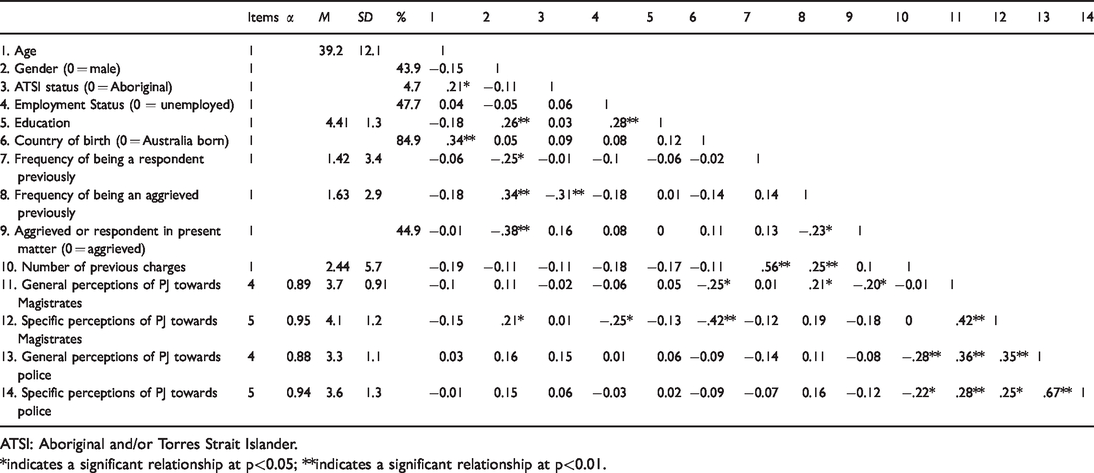
ATSI: Aboriginal and/or Torres Strait Islander.*indicates a significant relationship at p<0.05; **indicates a significant relationship at p<0.01.
Participants
The final sample included 105 participants after removing participants with missing data. Males comprised of 43.9% of the sample and participants’ average age was 39.2 years old (SD = 12.11). Australian-born participants represented 84.9% of the sample and 4.7% identified as Aboriginal. 3 Almost half of the sample were unemployed (47.7%). In terms of educational attainment, more than one-third of participants had completed a certificate or diploma, followed by those who had not completed high school (30.2%). Almost 20% of the sample had completed high school (17.9%), 8.5% had a bachelor’s degree, 4.7% had postgraduate qualifications and less than 1% reported that they had no formal schooling (0.9%). Finally, 44.9% of the sample reported being the aggrieved party in the matter they were involved in at the time of data collection. In 50.5% of the matters, police made the protection order application (see Table 1).
On average participants perceived specific interactions with Magistrates as the most procedurally just (M = 4.1; SD = 1.2). This was followed by general attitudes towards Magistrates (M = 3.7; SD = 0.91). General perceptions that police are procedurally just were lowest amongst the sample (M = 3.3; SD = 1.1). Interestingly, the mean score increased slightly when participants were asked about their perceptions of procedural justice in police following a specific interaction (M = 3.6; SD = 1.3).
Dependent variable
Four dependent variables were employed to conduct analyses on participants’ general perceptions of procedural justice towards police and Magistrates, and their specific procedural justice attitudes regarding police and Magistrates following a DFV-related court appearance. Items were adapted from the work of Murphy et al. (2010). Each item was measured on a five-point Likert scale (i.e. 1= strongly disagree; 5= strongly agree). All items used to measure these dependent variables are outlined in Table 2.
Principal components analysis distinguishing key variables of interest.
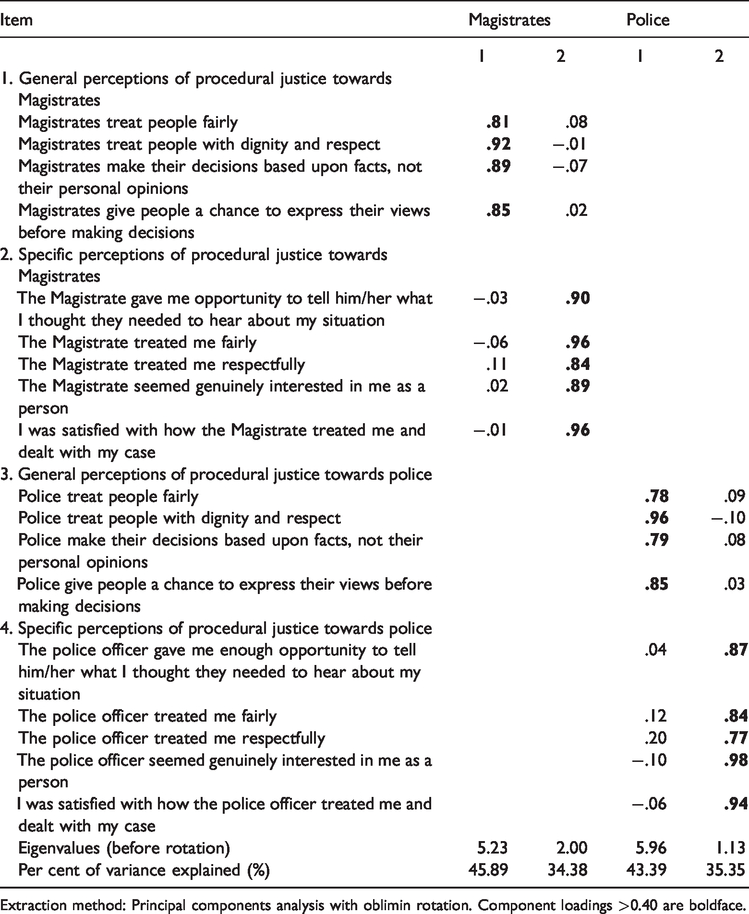
Extraction method: Principal components analysis with oblimin rotation. Component loadings >0.40 are boldface.
Independent variables
Three independent variables of interest were taken from the administrative data and included in the analyses: number of any prior charges, how many times the participant was primarily an aggrieved in a DFV matter and how many times the participant was primarily a respondent in a DFV matter. These items were included as continuous variables in the analysis.
Control variables
Several demographic variables were included in the analyses. These items controlled for the role of age, sex, educational attainment, employment status, whether the participant was born in Australia, and Aboriginal and/or Torres Strait Islander (ATSI) status.
Results
Principal components analysis
Two principal components analyses with oblimin rotation were conducted to determine the construct validity of the procedural justice scales used for each regression (see Table 2). In the first analysis, Component 1 comprised of four items measuring general perceptions of procedural justice towards Magistrates. Component 2 included five items measuring specific perceptions of procedural justice towards Magistrates following a DFV-specific court appearance. In the second analysis, Component 1 contained four items measuring general perceptions of procedural justice towards police. Component 2 included five items measuring specific perceptions of procedural justice towards police related to their recent DFV-related court appearance. From the results of the principal components analyses, four scales were computed by calculating the mean score of the items in each component group. The four scales had high internal reliability as indicated by Cronbach’s Alpha scores above 0.85 (see Table 2). The components were strongly correlated with each other (r = .42 in the first analysis and r = .64 in the second analysis).
Regression analysis
Four ordinary least squares (OLS) regression analyses were conducted. Two analyses sought to determine the individual factors associated with general perceptions of procedural justice towards Magistrates and police. Two analyses were conducted to understand whether these same factors were related to specific perceptions of police and Magistrates following a DFV-related police interaction and court proceeding. Tests for multicollinearity were conducted to ensure the model fit was unaffected. The lowest tolerance value was 0.705 across all models, suggesting multicollinearity was not present. Variance inflation factors were also computed, and no factor exceeded 1.418, which suggests the likelihood of multicollinearity is low (Pallant, 2013). Finally, a predicted probability plot was conducted to test for normality. Results showed a linear line, which is indicative of normally distributed data.
Attitudes towards Magistrates
In the first analysis, a range of individual factors were entered to determine the predictors of general perceptions of procedural justice in Magistrates following a DFV-related court appearance (see Table 3). However, none of the variables were statistically significant. We speculate that these non-significant findings may point to the lack of exposure most participants may have had to Magistrates prior to their recent DFV-related court appearance, although this cannot be confirmed from the data.
OLS regression predicting attitudes towards Magistrates.
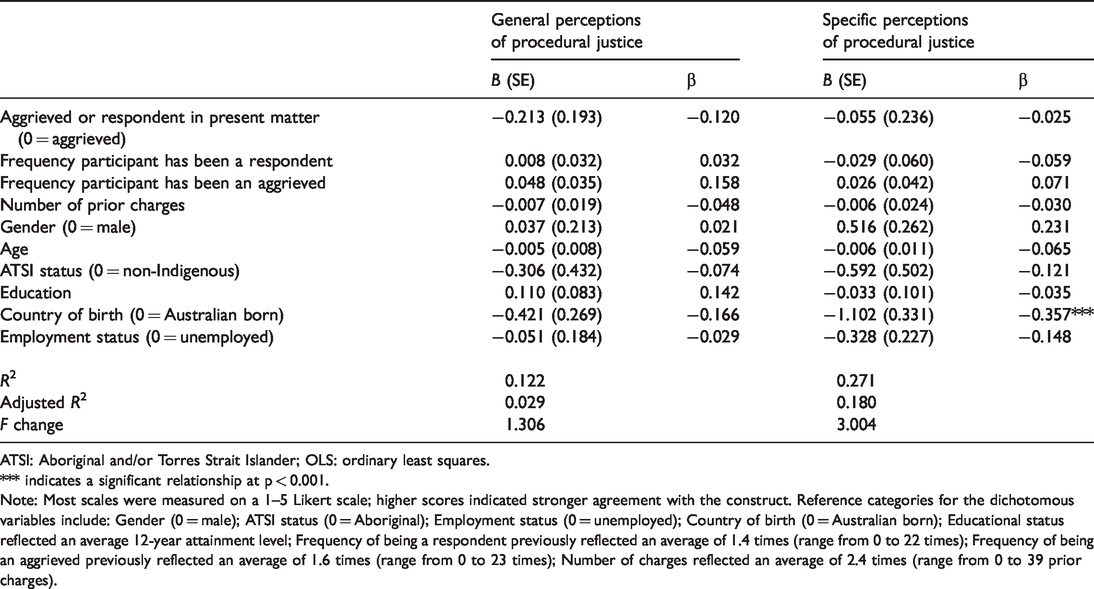
ATSI: Aboriginal and/or Torres Strait Islander; OLS: ordinary least squares.
*** indicates a significant relationship at p < 0.001.
Note: Most scales were measured on a 1–5 Likert scale; higher scores indicated stronger agreement with the construct. Reference categories for the dichotomous variables include: Gender (0 = male); ATSI status (0 = Aboriginal); Employment status (0 = unemployed); Country of birth (0 = Australian born); Educational status reflected an average 12-year attainment level; Frequency of being a respondent previously reflected an average of 1.4 times (range from 0 to 22 times); Frequency of being an aggrieved previously reflected an average of 1.6 times (range from 0 to 23 times); Number of charges reflected an average of 2.4 times (range from 0 to 39 prior charges).
The individual factors entered into the second model accounted for 27.1% of the variance in specific perceptions of procedural justice towards Magistrates. Country of birth was the only significant predictor of attitudes towards Magistrates. Overseas-born participants were less likely to perceive Magistrates as procedurally just when compared to Australian-born participants (β = −1.102, p < 0.001). This finding suggests overseas-born court users have less favourable attitudes towards judicial personnel.
Attitudes towards police
The third and fourth analyses tested the association between the individual factors introduced in the first set of analyses, and general (analysis 3) and specific (analysis 4) perceptions of procedural justice towards police following a DFV-related police interaction (see Table 4). In the third analysis, the only demographic factor related to general perceptions of procedural justice in police was Aboriginality. Specifically, those who identified as Aboriginal were less likely to perceive the police as procedurally just (β = −0.203, p < 0.05). Additionally, the number of previous charges a participant had was negatively and significantly related to general perceptions of procedural justice in the police. In other words, the more prior charges a participant had received from police, the less likely they were to perceive police as procedurally just (β = −0.336, p < 0.01). No statistically significant relationship was observed for histories of having been the alleged perpetrator or victim of DFV in past police encounters.
OLS regression predicting attitudes towards police.

ATSI: Aboriginal and/or Torres Strait Islander; OLS: ordinary least squares.
* indicates a significant relationship at p < 0.05; ** indicates a significant relationship at p < 0.01.
In the fourth analysis, the number of prior charges the participant had received from police was statistically related to specific perceptions of procedural justice in police following a DFV-related police interaction. These findings show that specific perceptions of procedural justice in police following their court appearance were lower amongst those participants who had received a greater amount of prior charges from police (β = −0.337, p < 0.05).
Mediation analysis
Finally, a mediation analysis was conducted to determine whether general perceptions of procedural justice mediate the relationship between the individual factors and specific perceptions of procedural justice related to police and Magistrates. OLS regression analyses were conducted to determine if a mediation relationship exists. Findings showed a significant mediation existed in the regression examining specific perceptions of procedural justice towards police. Specifically, general perceptions of procedural justice mediated the relationship between the number of prior charges and specific perceptions of procedural justice. From here, a mediation analysis using Hayes’ PROCESS model was conducted. As no significant predictors were identified for general perceptions of procedural justice relating to Magistrates, a mediation analysis was only conducted for general and specific perceptions of police.
Hayes’ PROCESS macro (using Model 4) was utilised to examine the direct and indirect effects of this mediation (Hayes, 2017). Model 4 uses bootstrap confidence intervals to estimate bias-corrected standard errors and confidence intervals to examine indirect relationships. Bias-corrected standard errors were created by using 5000 bootstrap samples. Results of the bootstrap analyses showed that there was a significant indirect effect between prior charges and specific perceptions of procedural justice following a police interaction via general perceptions of procedural justice in police (β = −0.051, βSE = 0.022, 95% CI ranging from −0.105 to −0.013; see Figure 1). This means general perceptions of procedural justice mediated the relationship between a participant’s prior charges and their specific perceptions of procedural justice in the police.
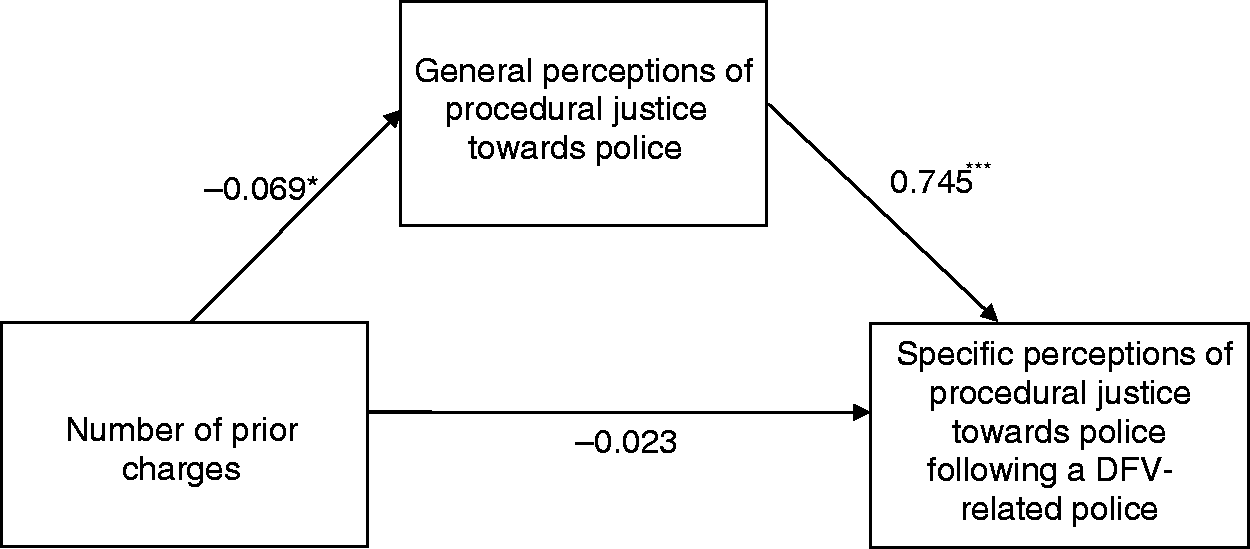
Mediation analysis. * indicates a significant relationship at p < 0.05; *** indicates a significant relationship at p < 0.001. DFV: domestic and family violence.
Findings from the mediation model reveal that general perceptions of procedural justice in police fully mediated the relationship between prior charges and specific perceptions of procedural justice. In other words, participants with more charges were less likely to view a specific interaction with police as procedurally just because of their pre-conceived beliefs that in general, police are procedurally unjust. While there was not a significant direct effect between the number of prior charges a participant had and their specific perceptions of procedural justice in the police, the relationship between prior charges and general perceptions of procedural justice in the police was negative. This means that the more prior charges an individual had at the time the survey was conducted, the less procedurally just they perceived police to be generally. The significant mediation effect suggests that participants’ general perceptions that police are procedurally unjust explain why those with more police charges were also more likely to view a specific interaction as more procedurally unjust. The implications of this finding are discussed in more detail in the following section.
Discussion
Findings presented here contribute to the existing body of literature identifying factors associated with citizen perceptions of procedural justice in a DFV context. Specifically, we examined how individual factors relate to court users’ general perceptions of procedural justice towards police and judicial officers (identified as Magistrates in this study). Further, we examined the same factors in relation to court users’ specific perceptions of procedural justice following a recent DFV-related police encounter and court appearance. While the data are not representative, the analyses herein seek to provide a snapshot of a largely understudied population of participants navigating DFV civil and criminal justice processes.
Attitudes towards Magistrates
Starting with perceptions of procedural justice relating to Magistrates, court users perceived that Magistrates are procedurally just. General perceptions of procedural justice towards Magistrates were more positive than those towards police, and there was less variation in participants’ attitudes. This may speak to the nature of experiences with authorities amongst the general population. Specifically, citizens are more likely to interact with police rather than courts. In the absence of court encounters, citizens may be more likely to believe that courts, represented by Magistrates here, are procedurally just. In addition, citizens are more frequently exposed to negative media reporting about police (e.g. using excessive force) and are more likely to witness police–citizen encounters in public that shape their vicarious experiences (Wolfe et al., 2016). While speculative, this may explain participants’ less positive and greater variation in general perceptions of procedural justice related to police as observed in other research (see, e.g. Pryce & Wilson, 2020).
No statistically significant findings were observed for individual factors predicting more positive or negative perceptions of procedural justice related to Magistrates in general. However, cultural diversity predicted perceptions of procedural justice regarding a specific DFV-related court encounter. The observation around the variation in perceptions of procedural justice amongst overseas-born participants aligns with a large body of research identifying that many migrant populations lack trust in law enforcement and legal proceedings (see, e.g. Murphy & Mazerolle, 2018). Findings presented here support this evidence and further identify that the same applies for a lack of confidence in specific court encounters, such as those related to DFV.
Attitudes towards police
As discussed above, compared to general perceptions of procedural justice in relation to Magistrate encounters, lower average scores and greater variation emerged in participants’ perceptions of procedural justice towards police. Specifically, participants with offending histories and those who identified as Aboriginal perceived police as less procedurally just. Findings presented here add to research evidence stating that police encounters are frequently experienced negatively by Aboriginal and Torres Strait Islander people (see, e.g. Cunneen, 2001). It is therefore not surprising that court users who identified as Aboriginal (none identified as Torres Strait Islander in the current study) were more likely to perceive police as generally less procedurally just than non-Aboriginal participants.
Further, our analysis of factors predicting general perceptions of procedural justice in police highlighted the role of victimisation and offending histories. Participants with more prior charges (DFV and otherwise) perceived police as procedurally unjust. This aligns with existing research evidence suggesting that police encounters as an offender tend to be experienced less positively (Papachristos et al., 2012).
The variation observed in victim and offender perceptions of procedural justice relating to police further reinforces the GVM, which posits that compliance with the police is grounded in fair treatment when an individual adheres to the norms and rules of mainstream society (Lind & Tyler, 1988). Violation of these norms and rules (i.e. through offending) hinders the efficacy of procedural justice, according to the GVM (Huo, 2003). Our research supports this evidence by highlighting that perceptions of police as procedurally just gradually decrease as the number of prior charges as an alleged perpetrator of crime increases.
Turning to perceptions of procedural justice relating to a specific DFV-related police encounter, similar findings were observed. While Indigeneity no longer predicted a variation in perceptions of police as procedurally just in relation to the specific DFV-related police encounter, general offending histories were significant. In relation to cultural identity, this may suggest that while those who identify as Aboriginal rate police as less procedurally just in general, based on personal and community experiences of over-policing and perceptions of racial discrimination (Cunneen, 2001), specific police encounters relating to DFV are less likely to be shaped by cultural identity. Similar to the variation in general perceptions of police, perceptions of procedural justice relating to a specific police encounter were shaped by offending histories. Alleged offending histories were negatively associated with perceptions of procedural justice relating to a specific DFV-related police encounter.
Findings related to perceptions of police as procedurally just in general as well as following a DFV-related encounter suggest that past histories of police contact as an alleged offender more broadly is the main factor shaping citizens’ perceptions of police in general as well as during a specific encounter. Further, and unsurprisingly, general perceptions of police as being procedurally just are also affected by cultural identity. Specifically, those identifying as Aboriginal perceived the police as less procedurally just.
Implications and conclusion
This article supports existing research evidence around the role of procedural justice in victim and perpetrator evaluations of law enforcement responses to their individual DFV experiences. Further, findings contribute new knowledge regarding the cumulative effect of victim and offender perceptions of procedural justice in general and specific contexts. Here, factors associated with specific positive and negative perceptions of procedural justice offer an opportunity to inform future DFV-specific encounters between citizens and police, as well as courts. Considering the link between specific and general perceptions of procedural justice as well as the mediating effect of general perceptions on how individuals experience specific encounters with law enforcement agencies is crucial to improve individual encounters. Doing so can foster citizens’ trust in and compliance with law enforcement (Elliott et al., 2011; Tyler, 2006; Wells, 2007).
Findings in this paper also identify implications for improving responses to DFV, especially regarding culturally diverse court user populations. Aboriginal court users’ negative general perceptions of police and courts in this study concur with prior Australian research highlighting that Aboriginal and Torres Strait Islander people are disproportionately affected by DFV and experience negative police and CJS encounters (Cunneen, 2001). This finding supports ongoing calls to ensure culturally sensitive and informed CJS responses for Aboriginal and Torres Strait Islander people.
Ensuring culturally informed approaches also relates to migrant populations. Findings presented here clearly highlight an ongoing lack of trust in law enforcement agencies more broadly and amongst DFV-related police and court encounters specifically. There is an accumulation of barriers to DFV-related help-seeking identified for some culturally and linguistically diverse populations (see, e.g. Vaughan et al., 2016). Thus, creating positive experiences with law enforcement around DFV is crucial in better protecting CALD victims and identifying relevant support needs for perpetrators.
While numerous findings derived from this study add to existing research evidence, some findings should be considered in the wider applicability of procedural justice across populations. Procedural justice may not necessarily create more positive interactions or compliance with authorities amongst socially and culturally marginalised (perpetrator) populations who are frequently subject to over-policing (Murphy, 2013). However, existing research evidence suggests that positive police–citizen encounters can shape compliance amongst perpetrators, regardless of social status (Maxwell et al., 2019) or cultural heritage (Murphy & Mazerolle, 2018). While this study does not directly test legitimacy perceptions, overall findings spotlight a need for future research to better understand the role and applicability of procedural justice across diverse victim and perpetrator populations.
Footnotes
Acknowledgements
The author/s wish to acknowledge the support and assistance from the Policing Agency and the Department of Justice and Attorney General in undertaking this research. The views expressed in this publication are not necessarily those of the two supporting agencies and any errors of omission or commission are the responsibility of the author/s. The authors would like to thank the anonymous peer reviewers for their time and detailed feedback on prior versions of the manuscript.
Declaration of conflicting interests
The author(s) declared no potential conflicts of interest with respect to the research, authorship, and/or publication of this article.
Funding
The author(s) disclosed receipt of the following financial support for the research, authorship and/or publication of this article: Findings presented in this paper are based on research funded by a Central Queensland University Merit Grant (2017–2018), which provides seed funding to early and mid-career researchers.
