




Abstract
The Community Correction Order, introduced in Victoria, Australia in 2012, provides a sentencing option that enables eligible offenders to serve their sanction in the community, with access to treatment or other rehabilitative activities. This paper contributes to a scant body of research investigating the specific needs of this group, their barriers to inclusion and the extent to which they experience the rehabilitative aspects of Community Correction Orders. It draws on survey data collected from 200 adults (137 men and 63 women) on Community Correction Orders in outer west metropolitan Melbourne and qualitative analysis of in-depth interviews conducted with a sub-set of 20 participants. Long-term unemployment, severe economic hardship, physical and mental health issues, social isolation and troubled personal relationships were common. While participants experienced the punitive aspects of Community Correction Orders, there was limited evidence that they were supported to address key issues that may be predictive of future offending. Support to re/engage in education, training and employment was a key area of unmet need and engagement in other therapeutic programs was low. Opportunities to enhance the rehabilitative potential of Community Correction Orders are discussed, with the paper highlighting that there is a need for rigorous evaluation of community work program activities.
Keywords
Introduction
Across Australia, the overall rate of incarceration is 2.1 times higher than it was 30 years ago (Australian Bureau of Statistics (ABS), 2019; Carcach & Grant, 1999). In Victoria, rates of incarceration have risen particularly dramatically, with the rate of imprisonment increasing by almost 50% and overall prison numbers doubling in the past 10 years (ABS, 2019). 1 Notwithstanding the substantial resourcing implications, research shows that imprisonment is not an effective deterrent and can itself be criminogenic (Cullen et al., 2011). In 2018–19 in Victoria, 57% of people sentenced to prison returned to corrective services within two years (Productivity Commission (PC), 2020). 2 Accordingly, the use, availability and effectiveness of alternatives to imprisonment, such as diversion programs and non-custodial sanctions, demand the ongoing attention of scholars, policymakers and justice advocates.
Introduced in Victoria in January 2012, the Community Correction Order (CCO) is one sentencing option that, on face value, has the potential to keep more people out of prison. The CCO is described as being able to address the ‘particular circumstances of the offender and the causes of the offending’ (‘Boulton v The Queen’, 2014, para. 2), simultaneously promoting the best interests of the community and the person. Intended to replace several other non-custodial orders, CCOs may include certain conditions set by the court, such as unpaid community work, medical treatment, curfews and non-association conditions (Sentencing Act 1991 (Vic) s. 48), alongside mandatory conditions (including that no further offence is committed). The use of CCOs in Victoria rose steadily until 2017–18 where, on an average day, 14,561 people were on the orders. In 2018–19, this decreased to 13,361 (PC, 2020). This may be attributable to the recent exclusion of certain types of violent offences; however, it remains to be seen whether a downward trend will continue. Community-based orders are available across Australian jurisdictions but vary in scope and type, with New South Wales and Tasmania having a similar CCO regime to Victoria (Gelb et al., 2019).
At least on the measure of recidivism, outcomes among people on CCOs appear better than for those sentenced to prison. In Victoria, the rate of return to corrective services within two years was 15.6% in 2018–19 (PC, 2020). However, calculations of recidivism rates are imprecise (Richards, 2011) and comparison of recidivism rates between cohorts who may have vastly different characteristics, such as prior offense history, is problematic (McIvor, 2010). The completion rates of CCOs in Victoria, indicating the extent to which order requirements are complied with, were the lowest in Australia in 2018–19, at 56.4% (PC, 2020). This has been attributed partly to the increasing use of CCOs with a ‘more complex cohort of offenders’ (Department of Justice and Community Safety (DJCS), 2019, p. 21). A separate study suggested that implementation issues, including delayed commencement, may also be contributing factors (Victorian Auditor General, 2017). Continued investigation of effective approaches to working with people sentenced to community-based orders is timely in the context of Victoria and worthwhile, given the relative scarcity of related studies both in Australia and internationally.
Effective practice in delivery of community-based sanctions
There is a plethora of studies investigating the effectiveness of interventions with individuals transitioning out of prison (or prison ‘re-entry’ programs) (Berghuis, 2018; Gill & Wilson, 2017; Lipsey & Cullen, 2007). Rigorous evaluations of re-entry programs show that punitive-based responses are ineffective and that unnecessary, poorly designed or poorly implemented interventions may actually increase the likelihood of negative outcomes (Barnett & Howard, 2018; Lipsey, 2009; Wilson & Davis, 2006). Overall, the literature on recidivism reduction points to the importance of individually tailored approaches, with Sapouna et al. (2015) noting that ‘one-size-fits-all interventions are ill-suited to reducing reoffending’ (p. 103). Assessment of risk is particularly important. For example, research shows that applying high-intensity interventions to low-risk offenders is often ineffective and, at worst, counterproductive (Gill & Wilson, 2017; Sentencing Advisory Council (SAC), 2019a). While interventions such as cognitive behavioural therapies and skills training are supported in the literature, interventions should be multi-modal (Farrall, 2002). These findings are consistent with the ‘Risk-Need-Responsivity’ (RNR) approach, an evidence-based paradigm widely used in countries including Australia in programming treatment for offenders (Andrews et al., 1990, 2011).
While employment is understood to have a general buffering effect in relation to reoffending (Baldry et al., 2018), evidence to support the effectiveness of employment transition programs in reducing reoffending is weak (Berghuis, 2018; Cook et al., 2015; Visher et al., 2006). In their systematic review of the impact of education and training programs on recidivism, Newton et al. (2018) found that employment-focused programs offered in isolation are likely to be ineffective and that programs should include ‘multifaceted wraparound services’ (p. 202). Common elements of programs reporting positive measurable outcomes include life skills, housing assistance, drug and alcohol treatment, placement assistance and ongoing support after people have gained employment (Cook et al., 2015; Duwe, 2012; Newton et al., 2018). The importance of social support, particularly of familial and friendship bonds in desistance from offending, has also been identified, most notably in qualitative studies (Berghuis, 2018; Visher & Courtney, 2007). One U.S. study found that, while an employment transition program had no impact on employment outcomes, recidivism rates among participants were lower. The authors surmised that this was due to improved social support or ‘mentorship’ received through the program (Zweig et al., 2011).
Unpaid community work is a key component of CCOs, included in more than three quarters of cases (76.6%) in Victoria in 2015 (SAC, 2016). 3 There is scant rigorous evidence to guide best practice in this area. In 1992, McIvor found that reconviction rates were lower in Scotland among those who believed their community service experience to be worthwhile. A more recent Australian review found that community work should: be viewed as meaningful and worthwhile, favour individual placements over group work, ensure equal opportunity for participation and be delivered by staff employing a ‘pro-social modelling approach’ (Turner & Trotter, 2013, p. 49). The quality of the relationship between the offender and their community supervisor has also been associated with positive change (Sapouna et al., 2015; Trotter, 2012), with some researchers highlighting the influence workers may have in modelling and reinforcing certain values and behaviours (Trotter & Ward, 2013).
Researchers have found that positive experiences are associated with placements that featured high levels of contact between the person sentenced and ‘beneficiaries’, including agencies or individuals (McIvor, 2010, p. 52), enabling people to appreciate the tangible value of their work (Rex & Gelsthorpe, 2002). This would seem to indicate the rehabilitative potential of meaningful community work. However, the identification of work placements that are described as ‘busywork’ is common in the literature (Turner & Trotter, 2013).
While recidivism outcomes are often a key marker of program success, there is considerable academic debate about whether this is an appropriate focus. For example, it is widely accepted among criminologists that desistance of offending is a process that occurs over time (Maruna et al., 2004), with offending decelerating and becoming less serious, rather than being a single event (Berghuis, 2018). Reductions in the frequency or severity of offending may therefore be more realistic markers of effective interventions. However, any focus on recidivism may distract from more nuanced measures of a program’s effectiveness. This includes impacts on a person’s health status, access to housing, social connections or engagement with employment (Gelb et al., 2019) – all of which may indicate positive change along a pathway to desistance. It is arguable that, in focusing on recidivism, some programs may be deemed ineffective despite having individual, family or community benefits as well as system-wide benefits such as reduced criminal justice expenditure (Farabee et al., 2014). Qualitative studies may therefore be important in building more complete understandings of effectiveness.
In summary, the majority of published work on CCOs in Victoria and elsewhere in Australia has investigated the policy context and implementation issues (Freiberg, 2019; Maxwell, 2017; SAC, 2017, 2019b; Victorian Auditor General, 2017), and elements associated with effectiveness in relation to recidivism reduction (Gelb et al., 2019; Turner & Trotter, 2013). There is far less detailed attention to exploring the range and complexity of needs of people on CCOs and their experiences of interactions with the system (with notable exceptions, including McCulloch (2010) and Seymour (2012)). Such exploration may inform consideration of the appropriateness of existing responses and identification of systemic gaps.
The data analysed in this paper were collected in a broader study which aimed to learn more about the profile, needs and experiences of people on CCOs in Melbourne (Victoria, Australia), with a particular focus on education, training and employment (ETE). Specifically, this paper sought to investigate whether individuals on CCOs have experiences associated with their order that appear to promote positive change and inclusion in the community. The methods and specific questions framing this inquiry are outlined below.
Methods
This paper draws from a study using a simultaneous quantitatively driven mixed method design (Morse, 2016). It analyses survey and qualitative interview data collected from a purposive sample of individuals who had received a community-based sanction and were undertaking community work at a DJCS, State Government of Victoria
4
site in outer west metropolitan Melbourne.
Survey data
The study utilises service data of 200 male and female adult participants (n = 137 men; n = 63 women) of an employment pathways service (EPS) that was nested in a DJCS community work site between October 2017 and April 2019. Participants were on CCOs and accessed the service voluntarily and confidentially. The program was run by Jesuit Social Services (JSS), a not for profit, non-government organisation and not connected to the participants’ justice obligations. The program was set up to identify needs and refer participants to appropriate services and programs, focusing on employment services and training opportunities and related needs.
Consistent with this, the data were collected in a ‘needs assessment’ survey conducted upon engagement. Items recorded include demographic characteristics (e.g. age, gender, country of birth and residency status, postcode of residence, dependent children, housing circumstances); ETE background and current status; future goals; nature of justice history (e.g. recent most serious offence type, prior incarceration); disabilities and health issues; levels of confidence and motivation for job seeking, if relevant. Informed written consent was obtained by the EPS from participants for use of the de-identified data in this study. The sample size was limited to 200 participants, which is sufficient to identify trends; however, the purposive sampling strategy limits the potential to extrapolate findings (limitations discussed later). The EPS staff also gained consent from eligible participants to be contacted by a researcher to participate in an in-depth interview, described next.
b. In-depth interview data
In-depth interview data were collected in this study to gain a richer understanding of the personal circumstances of people on CCOs, with a focus on what has helped or hindered pathways out of the justice system and identifying areas of unmet need. Development of a semi-structured interview guide was informed by literature identifying factors associated with justice system involvement and best practice approaches to recidivism reduction, specifically among people on community-based orders. The interview guide was refined following preliminary analysis of data from the first 100 EPS participants. This ensured that the interviews enriched understanding of the themes identified in the quantitative data and elucidated the lived experiences of participants.
Interviews were conducted with 20 participants (n = 13 men and n = 7 women) from part (a). 5 The broader study investigated location-based issues, and thus sampling was purposive, focusing on adjacent local government areas, the City of Brimbank and the City of Melton, located in outer west metropolitan Melbourne (with the City of Brimbank including suburbs that are among Victoria’s most disadvantaged). Exploration of location-based issues is beyond the scope of this paper. Interviews spanned 20–45 minutes and were undertaken face to face at the DJCS site, a local JSS site or via telephone if a face to face meeting was not possible. Interviewees were reimbursed with a $40 shopping voucher. Interview data collection commenced in October 2018 and occurred simultaneously with the EPS, ceasing once the researcher had attempted to contact all eligible participants, with data collection ceasing in April 2019. Frequent debriefing sessions were held between the EPS staff, project manager (third author, GR) and the principal researcher (first author, RG) during data collection – a process that assisted development of key themes and a trustworthiness measure. Interviews were digitally voice recorded, transcribed verbatim and names and other identifying material were removed or changed to de-identify the participant.
Data analysis
Descriptive analysis of aggregated survey data was undertaken by the first author. There was a full response rate (N = 200) for most demographic questions, but a lower response to more sensitive questions (e.g. justice history), indicated where applicable. Responses to open ended items of the needs assessment were analysed thematically and quantified. Interview transcripts were analysed using NVivo v12 (QSR International). The initial coding strategy involved broad thematic coding of the transcripts using the interview guide as a framework and then development of sub-themes based on identification of repetition in the data through detailed line by line coding. Quantification of responses was undertaken where possible. The third author (GR) read the coded data, discrepancies in interpretation were discussed and sub-themes and key issues were identified.
The data sources were also integrated where possible, a process that assisted to compensate for their shortcomings (explored in the ‘Discussion’ section) and maximise their respective benefits (Shenton, 2004). The EPS data contextualised and confirmed qualitative themes and the interview data added richness and allowed exploration of missing information in the quantitative data, thus improving confidence in the findings. The second author (DH) was not involved in data collection and brought a fresh critical lens to interpretation of data, assisting with identification of gaps, biases and recommendations.
The following four questions guided analysis and structure the findings, presented below:
To what extent do this group experience disadvantage or marginalisation? To what extent are participants engaged in ETE activities and what are their main barriers to participation? Do community work activities support rehabilitative aims? Are participants engaged in services or programs to support their needs?
Governance, ethics and reporting
Development of the study approach and materials were guided by a Project Advisory Group comprising senior JSS staff. Meetings were held throughout the process of data collection and analysis to discuss and test emerging ideas. Procedures were approved by the JSS Human Research Ethics Committee (HREC, May 2018), the Corrections Victoria Research Committee (15/18/508698) and the Justice HREC (DoJR, now DJCS; CF/18/22493). Survey data were aggregated, all interviewees have been de-identified and quotes are labelled with an interview number, gender and the participant’s age.
Findings
The demographic profile and characteristics of participants
The average age of N = 200 EPS participants was 34.9 years. Women comprised almost a third (31.5%) of participants and are more strongly represented in this area of the justice system compared to prisons. 6 Approximately half of participants (52%) had dependent children in their care. More detailed demographic data are presented in Table 1. The average age of reported first involvement in the justice system was 24.4 years. Approximately a quarter of participants (n = 46 of 173 respondents, 26.5%) reported involvement in the justice system as juveniles (age 17 years or younger) 7 with only a small proportion (n = 6, 3%) reporting that they had served a youth supervision order. A quarter (n = 48 of 190 respondents, 25.2%) had reportedly spent time in an adult prison (reported time range 1 week to 9 years).
Demographic characteristics of EPS participants (N = 200).

EPS: employment pathways service.
Table 2 summarises the reported educational attainment of EPS participants. While the reported attainment of year 12/equivalent or higher was slightly lower than the Victorian state average (58.5% versus 63.8% (ABS, 2017)), attainment of ‘certificate’ level tertiary qualifications was far higher than the Victorian state average (41% versus 14.5% of Victorians (ABS, 2017)). Conversely, attainment of bachelor or higher level qualifications was uncommon (7% versus 24.3% in Victoria (ABS, 2017)).
Comparison of highest reported educational attainment EPS participants compared to population of Victoria (ABS, 2017).a
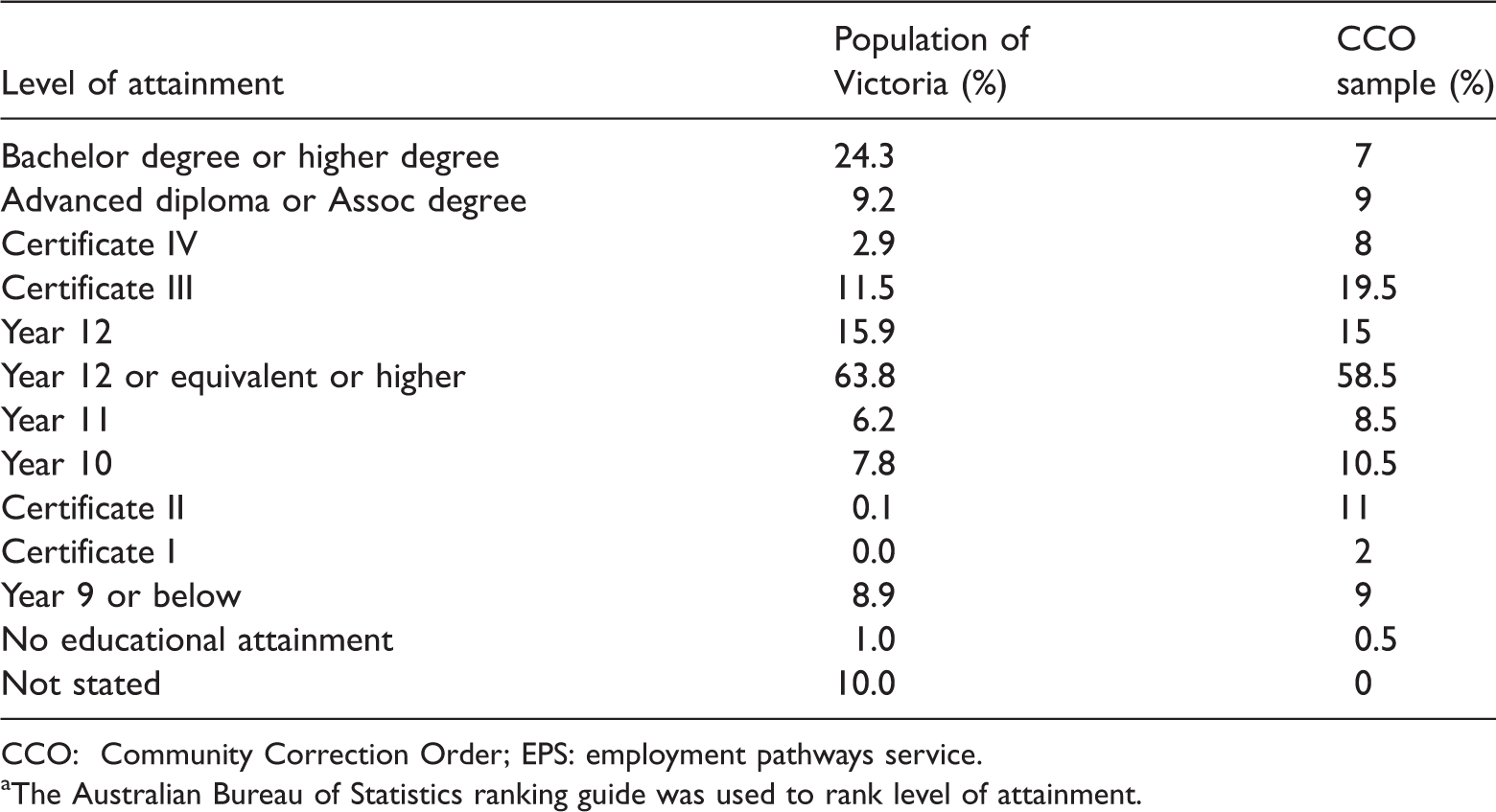
CCO: Community Correction Order; EPS: employment pathways service.
aThe Australian Bureau of Statistics ranking guide was used to rank level of attainment.
A quarter of EPS participants (n = 50) reported that they currently engage in a form of paid work (including informal work) and six (3%) were studying or training. Over half of participants (n = 104, 52%) reported that they were unemployed and seeking work. Seventy per cent of job seeking participants (n = 69, 70%) had been unemployed for 12 months or more and 27% for five or more years. 8 The remainder (20%, n = 40) were not involved in ETE-related activities, with n = 30 being unable to work (carer responsibilities and health issues were the most common reported reasons) and n = 10 reporting no reason for disengagement.
The in-depth interview data highlighted that low current involvement in ETE was often underpinned by very poor prior educational experiences and difficult, unstable or damaging family environments. Four interviewees reported that they lived in out of home care as children, 9 two reported violence or neglect in their home as children and two participants had refugee backgrounds. The lasting psychological and social impacts of trauma experiences were discussed. For example, many individuals in this cohort experienced mental health issues as adults (e.g. anxiety, depression and PTSD) and/or problematic alcohol /or drug use. The data also highlighted the interconnected nature of these issues and others including poor physical health and/or disability and housing instability.
Low levels of social support and troubled personal relationships were prominent experiences among interviewees. Extremely few interviewees (2 of 20) lived with a partner and almost half of those with dependent children (5 of 11) reported recent or current involvement of child protective services. Justice involvement was known to be linked to intimate partner violence for five interviewees (three as perpetrators, two as survivors). Very few interviewees reported involvement in recreational or social activities. For example, 12 of 15 interviewees reported that court-ordered community work was the only activity that they were involved in outside of the home. 10 Financial hardship, unmanaged debt and financial reliance on family members were very common experiences and contributed to a range of previously identified issues. A particular focus of this study was experiences of barriers to participation in ETE and the extent to which participants had experienced support to overcome these, discussed next.
Barriers to participation in education, training and employment
Unemployed EPS participants (n = 104) were asked to name their main barrier to employment (the response rate to this question was 68.2%, n = 71 respondents). Responses are shown in Figure 1. ‘Justice record’ was the most commonly reported barrier, reported by 38% (n = 27). Participants spoke about directly experiencing discrimination from employers associated with their record. One participant described how having a justice record also affected motivation to engage in job seeking:

Main barrier to gaining employment among unemployed participants (n = 71).
If you have a police record – it puts a lot of people off from looking. It’s that roadblock. It’s where it stops a lot of people. They might be on the job network scheme and find a job that they are really interested in but they get stopped by the police. Nope, they’ve got a record and they get disappointed every time. (#3, female, 40 years)
A small proportion of EPS participants (n = 4, 6%) specifically stated that having community work hours was their main barrier to employment. However, interviewees commonly spoke about how they wanted to finish their CCO prior to job seeking. One participant spoke about anticipating difficulty managing justice requirements with employers: ‘… because you are not going to say to your boss, “I’ve got to go to court and I’ve got to do community work twice a week”’ (#9, male, 41 years).
Some spoke about having difficulty managing multiple priorities. The below participant was a single parent with diagnosed post-traumatic stress disorder: I’m not very good at juggling, at multitasking, and at the moment I’ve got the stress on my mind that I have to finish my community hours and, because I look after my daughter, I can go get a job right now, but if I get that job, that would mean that I have to finish off my community hours on the weekend. (#19, male, 33 years)
Support to overcome barriers to inclusion
The most common service type accessed by interviewees was employment service providers, reportedly accessed by 13 of 20.
11
When asked if these providers had helped them, negative experiences were discussed by nine interviewees (with two of these having accessed more than one agency, and having varied experiences). Infrequent and impersonal contact, and being referred to jobs that do not suit individual requirements, were commonly reported by those with negative experiences. I think that they [employment service providers] are just like Centrelink
12
– just absolutely appalling – they don’t bother helping at all. I’m the one looking for jobs – they don’t help me, like at all (emphasis). I’ve actually told Centrelink this – I have to change job providers. They say I can’t do that. So yeah, they’re not very helpful. (#14, female, 30 years)
Another participant reported that she felt ‘degraded’ by staff at an employment service. The majority of participants identified that employment services were accessed through Centrelink as a part of ‘mutual obligation’ requirements. Appraisals of specialist providers appeared to be more positive, with three participants reporting being helped by disability specialist providers and one by a state-funded service, ‘Jobs Victoria Employment Network’. However, the qualitative sample was not large enough to comment on the quality of experiences across employment service types.
When asked about other types of services accessed in conjunction with their CCO, five interviewees reported accessing either a counsellor or a psychologist, with four reporting being helped. While it is possible that participants had been referred to other services or programs (noting that attendance at behaviour change programs are commonly a requirement of CCOs), these were not discussed by participants.
When asked about what services or programs they needed to help them to ‘move on’ or that would support transitions to ETE where appropriate, most interviewees spoke about the qualities of services, including: a focus on helping (i.e. a therapeutic focus), attention to individual needs and services that considered their justice-related requirements and barriers. For example, interviewees commonly discussed the importance of subjective experiences of respect, care and genuine interest shown by staff when discussing what they needed from services: I guess like… having that extra support. Yeah, where you can actually go to a place where that person would actually see you as a person, go through with you, “OK, what have you got? What could we do to help you go further? Like oh, you’ve got Cert II, are you interested in maybe getting a Cert IV and let me see what I can do where I can lead you to that” Stuff like that, you know what I mean? (#1, female, 35 years)
One interviewee reflected on others and his own experiences when discussing what services are needed: Social support. They need a lot of support. They do need support, that’s one thing… Not many people have got the comfort of having family around them. And umm, how can I say it? It’s the family support and there is not a lot of places that actually do support that are close. You have got to go far away. There’s not enough of that, I believe anyways. There’s just a lot of pressure to get your hours done and to look for jobs and no support to help with that. That’s it, more or less. (#17, male, 50 years)
The above participant had a health issue impacting his ability to work and highlighted that specialist and local support is important. Finally, some participants identified that they would benefit from support from a financial counsellor.
Experiences of community work programs
All participants in this study had a community work condition attached to their CCO. The EPS engaged participants who accessed four types of community work programs, with the majority participating in a program termed ‘light duties’ 13 (n = 88, 44%), of which most were women (86%, n = 54). Figures 2 and 3 show program representation among EPS participants by gender.
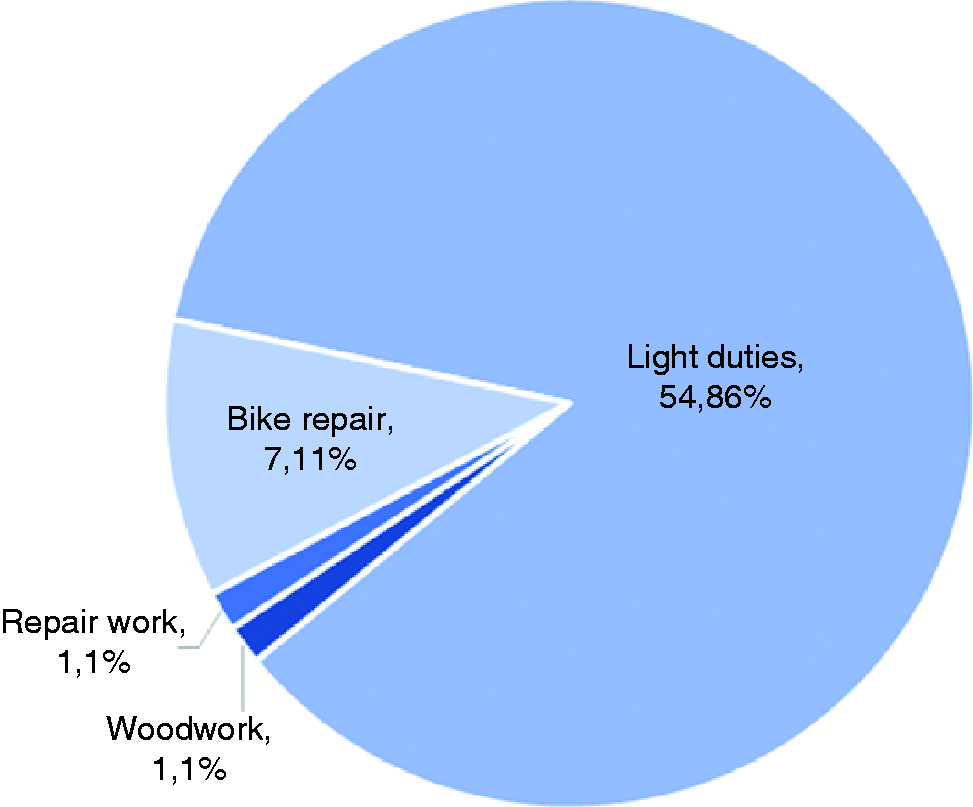
Community work activities of female participants (n = 63).
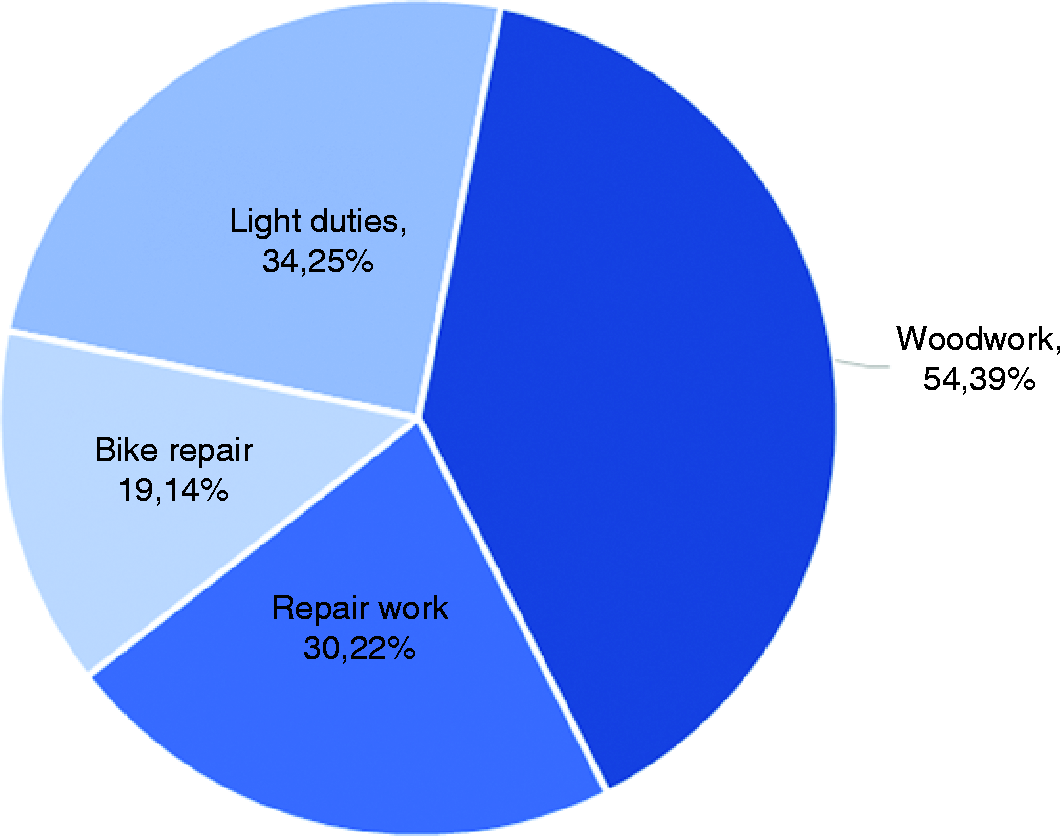
Community work activities of male participants (n = 137).
All interviewees reported attending community work one or two days/week. While some participants had other obligations restricting their availability to undertake community work (e.g. child care responsibilities or illness), most participants reported they were able to attend more frequently than they did. Some expressed frustration at this: They [Corrections Victoria staff] only really want to give me one or two days a week. I asked for more than that just so that I can knock it out [finish quickly]… but (sighs) they just mess you around more than anyone really […] Yeah, it’s pretty much like having a job. If they don’t think that you are reliable, they don’t give you a few days but if you only go once a week it’s going to take you a year to do it. (#16, male, 23 years)
Participants were asked if they gained any useful benefits from community work. Regardless of which program/s they attended, interviewees were rarely able to give examples of opportunities to develop useful skills. The ‘light duties’ program received the most negative feedback: Oh God no. If anything, I think it’s just made me more stressed out [laughs]. Some of the people I really don’t want to associate [with]. But you’re pretty much sitting in one room all day together. You pretty much have no choice. But definitely there are no skills at all that you can learn from… none at all. I think it’s just something that they make you do to pass time, pass the hours. It’s something they can give to everyone – get them to do anything – as long as they’re there then they’re doing something. (#7, male, 45 years)
It was common for participants to describe the program as a punitive and time-wasting activity. The above participant also described the negative impact of associating with other justice-system involved men. However, many female participants valued the ‘social’ group environment, regardless of the program’s skill-building value.
Other programs that were more positively appraised (woodwork and bike repair) were perceived to have community benefits. For example, when asked if he had gained any skills during community work, one participant said: No, because half the stuff is ridiculous. Ok, right the woodwork is brilliant because you’re giving back to society. It’s charity work, right. That one’s good. Woodwork, you’re building stuff for kids. And the fixing bikes for people who need bikes – the fixing bikes one is good too. […] There needs to be a purpose, a goal. They [CCO participants] need a goal. Something to guide them, right, this is… so it’s a purpose for what they are doing. (#19, male, 33 years)
Interviewees commonly stated that they had hoped for the opportunity to ‘give back’ to the community or gain skills through community work but had been let down: I was disappointed because from what I understood of how this program works, they try to support you in acquiring some basic skills that you can try to transfer into the workplace. I understand the facility runs a forklift driver’s licence. I would have loved that opportunity. None of that came my way […] it’s a lost opportunity now – it’s eight months gone. (#6, male, 54 years)
The above participant described variation in assignment to programs, determined by individual case workers and likely by program location. This was reported by others. Most prominently, participants spoke about being capable of undertaking more skilful work than what they were allocated.
Discussion
A social benefit of CCOs is that sentenced offenders have the opportunity to maintain and improve their social and economic support networks in a community setting, while they make amends for their offences and undergo any court-ordered rehabilitation. (Victorian Auditor General, 2017)
The above statement by the Victoria Auditor General reflects a widely held understanding that CCOs are intended to serve both punitive and rehabilitative purposes. However, beyond the blunt measure of recidivism data, there is little published research investigating the extent to which the latter purpose is being realised. Analysis of survey and qualitative interview data has provided insight into the specific barriers to social and economic inclusion experienced among a sample of men and women on CCOs recruited from a community work program site in outer west metropolitan Melbourne, Victoria. Several opportunities to improve the rehabilitative potential of CCOs have been identified.
While a purported advantage of serving a community-based sentence is maintained or improved connection to economic support, unemployment and severe financial hardship were prominent. Around two-thirds of participants who were able to engage in ETE activities were not doing so (n = 114, 67%, excluding n = 30 who were not able to work), and long-term unemployment was common (reported by 70% of job seekers, n = 69). Interviewees who were employed commonly described being in precarious, low paying positions and being underemployed. Many were seeking or intended to seek alternative work. Participants commonly held one or more low level tertiary qualifications (e.g. Certificates I or II) – often attained through welfare services or prison; however, these rarely led to ongoing work in an associated field. This is a cross sectoral issue warranting investigation.
The most commonly accessed service type was employment services. Levels of dissatisfaction were high and experiences of impersonal and infrequent contact triggered disengagement. Analysis indicated that access to more specialist support was needed, including assistance to negotiate the challenge of gaining employment with a criminal record (Selbin et al., 2018).
Thematic analysis highlighted the range of interconnected issues experienced among interviewees that have well established links to justice involvement, including trauma and neglect as children and poor educational experiences (Robertson & Walker, 2018), problematic substance use and mental ill-health (Australian Institute of Health and Welfare, 2019). Other issues commonly mentioned, including recent or current involvement of child protective services and intimate partner violence, pointed to stress and dysfunction in many participants’ social networks. Previous research has identified that the provision of employment support programs is likely to be ineffective if the kind of multifaceted needs identified here and in other studies with justice-involved people are not adequately addressed (Farrall, 2002; Newton et al., 2018).
The inclusion of CCO conditions to seek treatment, particularly related to alcohol and drugs is common in Victoria (e.g. 85% of people had such conditions in 2015–16; Victorian Auditor General, 2017). Studies have shown that treatment that is undertaken on a voluntary basis is more effective than treatment which is mandated or includes any coercive element (Parhar et al., 2008); however, programs that are well implemented can reduce recidivism and enhance public safety (Przybylski, 2008). A small number of interviewees reported receiving counselling or psychological support. Access to other helpful services or therapeutic programs targeting their needs was uncommon. Some interviewees reported that financial counselling and development of financial literacy skills would be valuable. Assistance with child care was also an identified area of need for many, particularly women and single parents.
It should be noted that many participants described having actively taken steps to address issues that were recognised as a ‘problem’, such as ceasing involvement with crime associated peers. However, there were many areas where participants appeared to be floundering. The role of social support in desistance is increasingly prominent in criminological theory (Berg & Huebner, 2011; Chouhy et al., 2020) and emphasised by participants in this study; however, experiences of social isolation and limited social support were particularly prominent.
With the majority of people required to undertake unpaid community work as a condition of their CCO, there is potential for work programs to build skills and confer other benefits that contribute to rehabilitation. Analysis of interviews aimed to identify elements linked to positive outcomes in the literature, including the programming of meaningful activities, contact with beneficiaries in the community and opportunities to build skills (McIvor, 2010; Turner & Trotter, 2013). The recurring experience of interviewees was of engagement in community work that was perceived as meaningless, time-wasting and unskilled – issues identified previously by Turner and Trotter (2013). Further, the majority of participants were assigned to programs on DJCS premises with minimal or no contact with the community. These experiences appeared to erode self-worth, confidence and motivation. While provision of community work programs in larger groups is economically efficient and appeared to be common in this context, individual or small group programs are supported by the research evidence (Turner and Trotter, 2013). Further, participants identified aspects of experiences in group programs that appeared to work against rehabilitative principles. For example, male interviewees commonly reported that group work created ‘negative associations’ (with crime-involved individuals) and reinforced an unwanted identity as ‘criminal’.
In summary, it did not appear that participants in this study experienced the system as supporting or promoting positive change. Instead, the punitive impact of CCOs was the dominant experience – especially in relation to the community work aspect of sentences. This is despite the dominance of the RNR model in offender programming in Australia, recognition of the ineffectiveness of punitive approaches that focus on deficits (McGuire, 2013) and increasing acceptance and integration of strengths-based, wellbeing-focused understandings of offender rehabilitation into policy and practice (Ward and Stewart, 2003).
The importance of implementation factors in shaping the impact of programs targeting offenders has been noted both in Australia (Turner & Trotter, 2013) and internationally (Lowenkamp et al., 2006; Newton et al., 2018). Examples of the negative impact of such issues were identified here. One of these was associated with the unnecessarily prolonged length of community work. It seems pertinent that periods of engagement on CCOs are streamlined and condensed where possible so that individuals are able to focus on ‘moving on’ as soon as practicable. The literature indicates that the first three months of CCOs are instrumental (SAC, 2017; Turner & Trotter, 2013). However, an audit conducted in 2017 indicated that delays in community work program commencement and queues for service intake are common (Victorian Auditor General, 2017).
Overall, the findings point to the need for more robust evaluation of community work activities in Victoria, with detailed consideration of the alignment of programs with the literature on effective practice. This would require analysis of the range of constraints shaping programming – consideration of which was beyond the scope of this study. Evaluations should include attention to the perspectives of people on CCOs and ensure that ‘softer’ measures of impact are used rather than recidivism benchmarks alone (see Maruna et al., 2004).
Combined, the findings suggest that participants would benefit from improved linkages to professionals that provide relationship-based support, with participants placing the highest value on the quality of interpersonal interactions with professionals (e.g. genuineness, respect and willingness to help). As discussed earlier, the role of corrections staff in modelling respectful, pro-social relationships has been identified in previous studies as integral to positive change (Sapouna et al., 2015; Trotter, 2012). In this study, community corrections staff appeared to have an amplified role due to the common experience of social isolation among participants. There was wide variation in participants’ appraisals of interactions with corrections staff, suggesting that there was room for improvement in this area, potentially through enhanced staff training in use of relational techniques and strengths-based practice (Trotter & Ward, 2013).
This study has several limitations which point to the need for further research in certain areas. Participants were purposively recruited from one DJCS site located in outer west metropolitan Melbourne and findings relating to experiences of programs and services cannot be extrapolated, although the identified issues are worth exploring in other contexts. Recruitment of participants from a low socio-economic area and from a service focusing on employment pathways may have contributed to over-representation of participants with ETE needs. The scope of the issues explored in the survey data (and level of detail recorded) was limited by the service provision context in which it was gathered. As a result, understandings of some pertinent issues such as current or historical child protection system involvement are derived from the qualitative data. The impact of the EPS was not evaluated here, though interviewees discussed benefiting from referrals provided and continued to do so after the service ended. Further, it is noteworthy that participants’ access to services and programs may be broader than reported and an audit of court referrals and program attendance may be worthwhile in order to produce a fuller picture of local service usage. The experiences of culturally and linguistically diverse participants and Aboriginal and Torres Strait Islander people on CCOs were not a focus here because of low representation in the sample. These experiences warrant targeted investigation.
Finally, women represented almost a third of participants in this study sample (n = 63, 31.5%) and corrections data show that they are more strongly represented in this area of the justice system compared to prisons (ABS, 2019). Previous research describes how the particular needs of women in the justice system require specific attention and responses (Sheehan & Trotter, 2017; Trotter & Flynn, 2016; Trotter et al., 2012). The needs and experiences of women on CCOs are worth in-depth examination that is beyond the scope of this paper. The findings presented here highlight that attention to the provision of appropriate, skill-building and pro-social community work programs targeting women is needed. This is particularly urgent given the growing representation of women in the justice system both in Victoria and Australia.
Conclusion
There is a strong prevention case for ensuring the corrections system supports the stated rehabilitative goals of CCOs, particularly in light of rising rates of incarceration. The findings of this study reaffirm the need to ensure that individually targeted, therapeutic and meaningful programs and opportunities are available to people involved in the justice system (Sapouna et al., 2015). This includes the programming of community work that builds skills and improves individuals’ capacity to engage with further ETE. Cross sectoral collaborative approaches between the justice system and community service providers, local government, industry and others could help foster greater inclusion of this group in the community.
Footnotes
Acknowledgements
We gratefully acknowledge all participants of this research, all of whom trusted us with their information and shared their experiences. We thank staff at the Department of Justice and Community Safety, who supported the service from which participants were recruited and facilitated access of the researcher to interview participants. We also thank Corrections Victoria for providing ethical clearance as appropriate as well as the JSS HREC. Finally, we acknowledge the contribution of staff at Jesuit Community College, particularly Josephine Boffa, Byron Price and Stephen Ward.
Declaration of conflicting interests
The author(s) declared no potential conflicts of interest with respect to the research, authorship, and/or publication of this article.
Funding
The author(s) disclosed receipt of the following financial support for the research, authorship, and/or publication of this article: This work was supported by the Victorian Legal Services Board.
