



Abstract
As a candidate and as president, Donald Trump heightened the salience of immigration, portraying those crossing the nation’s Southern border as “bad hombres” and advocating building a wall blocking their access to the United States from Mexico. Based on a 2019 MTurk study of 465 White adults, the current study found that a clear majority of respondents rejected this stereotype of Southern immigrants as “bad hombres,” judging them to be just as law-abiding as Americans. Importantly, however, the analysis revealed that two innovative measures—Hispanic resentment and, in particular, White nationalism—were consistently related to perceptions of immigrants as criminogenic. Given the growing demographic diversity of the United States, future research should consider the increasing influence of racial/ethnic resentment and White group identity on public opinions about immigration and other justice issues.
Now, I want to build the wall. We need the wall. And the Border Patrol, ICE, they all want the wall. We stop the drugs. We shore up the border. One of my first acts will be to get all of the drug lords, all of the bad ones—we have some bad, bad people in this country that have to go out. We're going to get them out; we're going to secure the border. And once the border is secured, at a later date, we'll make a determination as to the rest. But we have some bad hombres here, and we're going to get them out. (Blake, 2016) -Donald J Trump, Third 2016 Presidential Debate
Although disquieting cases exist of immigrants perpetrating violent crimes (Kulig & Cullen, 2019), the Trump administration ignores the fact that immigrants themselves are at an elevated risk of being victimized (e.g., Zatz & Smith, 2012). The administration has engaged in policies exposing new arrivals to harm, including placing them in crowded cages and separating parents from children (García Hernández, 2019; Soboroff, 2020). All the while, President Trump has continued to portray immigrants crossing into the United States as inherently criminal (e.g., Trump, 2019a; see also Davis & Shear, 2019). He uses his political authority and position on these issues to justify building a supposedly impenetrable border wall spanning the US’s Southern border. He promises to make Americans safe again from the “bad hombres” who may seek to harm us (Blake, 2016; Updegrove et al., 2020).
Empirical reality, however, challenges Trump’s hyperbolic claims regarding the dangers posed by immigrants. Research has shown repeatedly that compared to native-born Americans, immigrants—including undocumented immigrants—of nearly any origin participate in significantly fewer non-violent antisocial behaviors (e.g., scamming someone for money, shoplifting), violent antisocial behaviors (e.g., hurting another person on purpose), and externalizing behaviors (e.g., selling illegal drugs; e.g., Bersani et al., 2014, 2018; Chouhy & Madero-Hernandez, 2019; Ousey & Kubrin, 2018; Piquero et al., 2016). In fact, some evidence points to a “buffering effect” in which an influx of immigrants protects against crime in a community (Rojas-Gaona & Madero-Hernandez, 2018), including being associated with decreasing crime within “sanctuary cities” (Hausman, 2020; Martínez-Schuldt & Martínez, 2019).
Although not posing a special threat to public safety, immigrants crossing the Southern border—as would any population—have a rate of crime and thus perpetrate criminal acts. They are not crime free, of course. Trump has capitalized on this fact to selectively publicize several cases in which a documented or undocumented immigrant has committed a horrific crime. In doing so, he personalizes the loss of life by citing the victim’s name (Kulig & Cullen, 2019). Individual cases are thus used to make the general point that had all “bad hombres” been stopped at the border, American lives would have been saved—something he promises to accomplish. For example, the president has highlighted the victimization of Marilyn Pharis, an Air Force veteran living in California, who was “raped, murdered and beaten to death with a hammer” by Victor Martinez who was in the country illegally (“Full Transcripts,” 2019).
In short, Trump has socially constructed immigrants as a group containing an unknown number of “bad hombres,” any one of which could kill or maim at a second’s notice. They are portrayed as pouring into the United States to “infest” America with crime and drugs—or, in the least, to get free social welfare and to corrupt our electoral system (e.g., Trump, 2018). But what exactly does the public think about the criminality of immigrants? How widely is Trump’s “bad hombre” view of immigrants from the Southern border shared?
Notably, surveys suggest that only a minority of Americans believe that immigrants are more criminogenic than native-born citizens. For example, in a June 2019 Gallup Poll of 1,015 adults living in the United States, 42% of respondents expressed the belief that immigrants are making “the crime situation” worse for the country. In contrast, the majority of the sample felt immigrants had not much of an effect (50%) or made the crime situation better (7%); the remaining respondents had no opinion. Similarly, in a 2014 General Social Survey (GSS) poll (N = 1,274 applicable respondents), approximately 20% of respondents agreed or strongly agreed that immigrants increased crime rates, whereas 52% disagreed or strongly disagreed with this statement. This belief about immigrants and crime is similar—yet slightly lower—than earlier surveys where 27% (2003, N = 1,200) to 34% (1995, N = 1,207) of Americans agreed or strongly agreed that immigrants increase crime (Simon & Sikich, 2007).
However, when the views of the public are disaggregated by political parties, stark differences occur in beliefs about the criminality of “illegal” immigrants. In a CBS News poll of 1,280 adults administered in February 2017, Republicans (38%) believe that illegal immigrants are more likely to commit crimes compared to American citizens than Independents (17%) and Democrats (9%; Dutton et al., 2017). Conversely, more Democrats (25%) believe that illegal immigrants are less likely to commit crimes compared to American citizens than Independents (17%) and Republicans (7%; CBS News, 2017). These trends are similar to an earlier US survey by The Economist in July 2015 (N = 997), where more than half of Republicans (51%) indicated that illegal immigrants were more likely to commit violent crimes compared to other people—Democrats (12%) and Independents (24%) agreed with this statement to a lesser extent. The broader point here is that Americans as a whole tend not to have negative views of immigrants as criminals, but there is a polarization when examined by political party that has been ongoing since before Donald Trump was elected as president. Although the findings here illuminate perceptions of immigrants and crime, they provide limited insights into a myriad of factors that may play a role in shaping these views. Thus, research on predictors of these viewpoints are especially important to consider.
In one of the few known multivariate studies on views of immigrants, Pryce (2018) used GSS data to examine the influence of patriotism, nationalism, xenophobia, and “world citizenship” on pro-immigration attitudes. He found that pro-immigrant attitudes were more likely to be held by women, younger respondents, respondents who are more educated, respondents higher in patriotism, respondents lower in xenophobia, and those reporting being a “world citizen”. Similarly, Stupi et al. (2016) conducted national telephone surveys of non-Latino adults to determine the predictors of perceived immigrant criminal threats from undocumented immigrants. They found that the strongest predictors were being conservative and less educated.
Although contributing important insights, these multivariate studies are limited in several ways. In particular, the data reported were collected prior to the Trump administration’s anti-immigrant rhetoric of the past three years (Davis & Shear, 2019). Pryce’s (2018) study relied on 2014 GSS data, whereas Stupi et al. (2016) employed phone interview data from 2008. Also, Pryce’s use of “immigrants” and Stupi et al.’s (2016) use of “illegal immigrants” are quite broad and do not specify where they are migrating from—a factor that may influence perceptions of violence. Finally, the sources of beliefs explored by Pryce (2018) and Stupi et al. (2016) are limited in range as neither analysis explores the potential impact of racial animus or identity, religion, the perceived size of the US Hispanic population, or residency in a rural, suburban, or urban area.
The current study sought to address these limitations in four ways. First, using an opt-in survey of 465 White adults across the United States, we draw on data collected in the midst of Trump’s presidential term in October 2019. Second, the survey was designed to focus specifically on immigrants at the Southern border. Due to the Trump administration’s targeted efforts on this population and the construction of a wall to keep these “bad hombres” out of the United States, it is particularly important to assess perceptions of immigrants crossing from the South (see also Updegrove et al., 2020). Third, the public is surveyed about perceptions of a variety of specific crimes, not just crime in general, which highlights the distinct crimes that immigrants are alleged to commit. Fourth, the analysis examines how racial and ethnic beliefs impact the perceived criminality of immigrants. In this way, the current study seeks to illuminate some of the factors that may predict beliefs of the criminality among immigrants from South of the US border. Embedded in this discussion is the vital role and rise of White nationalism in the Trump era, which has rekindled conversations about perceptions of race, ethnicity, and dangerous “others”.
White nationalism in the Trump era
From the very start of his presidential campaign, Donald Trump argued that only he could protect Americans from the “invading hordes” of criminal immigrants—also referred to as the “bad hombres” (Blake, 2016). Trump, however, was not focused broadly on immigration. Nor was he concerned with securing all borders of the United States. Rather, he focused on one particular group—those coming to America from the Southern border. Of course, Trump has made derogatory or inflammatory comments about people from various backgrounds—particularly if they were non-White (e.g., Trump, 2013, 2019b). But he has dedicated special attention to immigrants from the South—effectively isolating this group as dangerous “others” who should be feared and removed (Garland, 2001). To put an end to this perceived surge in immigration of “bad hombres,” one of Trump’s key policy positions was to build a wall across the Southern US/Mexico border (Davis & Shear, 2019).
The idea of constructing this wall and the vitriolic language used to describe immigrants coming across the Southern border were embraced by many Americans, which, in part, led to the election of Trump (Fording & Schram, 2020; Jardina, 2019a; Kaufmann, 2019). The popularity of these views was particularly pronounced among White Americans, 57% of whom voted for Trump in the 2016 presidential election (Roper Center for Public Opinion Research, 2019). In furthering this agenda, Trump has specifically continued to attack individuals seeking entry into the United States at the Southern border as invaders and criminals deserving of inhumane treatment (Davis & Shear, 2019). Conversely, Trump has repeatedly appealed to White Americans—in Charlottesville (most notably)—as victims of immigration (e.g., lost jobs) and racial/ethnic minority violence (Boak, 2019; Fording & Schram, 2020; Trump, 2018).
In this context, political scientists have begun to document the increased salience of racial solidarity or “white identity”—“the lens through which many whites interact and engage in the political world”—for a portion of White Americans (about 30–40%; Jardina, 2019b, p. 40). These White Americans now see themselves as not simply as Americans but as “White”—similar to how other racial and ethnic minority groups might see themselves as “Black” or “Hispanic/Latino”. This emergent cultural belief system is usually termed either “White nationalism” or “ethno-traditional nationalism”; we have chosen to use “White nationalism” because it captures more intuitively the salience of Whiteness in people’s beliefs.
Thus, there are five key elements to distinguish White nationalism. First, individuals high on beliefs of White nationalism tend to see being White as a distinct social identity as opposed to implicitly having an overarching identity of merely being an “American” (Jardina, 2019b). As Kaufmann (2019, p. 11) notes, they value “the ethnic majority as an important component of the nation alongside other groups.” He calls this growing phenomenon of rejecting assimilation and melting-pot ideology in favor of White racial solidarity “whiteshift,” and argues this is a matter of “making the invisible visible” (Jardina, 2019b, p. 22). Second, pride is expressed in their White-European tradition, including its symbols and past accomplishments that “made America great”. Third, a sense exists that White Americans are “under attack” culturally that make them feel, to use Hochschild’s (2016) famous book title, as Strangers in Their Own Land. Their self-perceived patriotism (including military service), traditional Christian values, views on guns and gender roles, and adherence to a work ethic are devalued by politically correct liberal elites (Reilly, 2016b). They resent this marginalization. Fourth, they favor preserving a White population majority in the United States so as to keep the nation a culturally White nation and preserve the values and ways of life that have created a great country. They place a priority on a slowed—but not halted—immigration so that other groups can assimilate to maintain White ethno-traditions (Hochschild, 2016). Fifth, their embrace of White nationalism is not inherently reflective of racial prejudice or animus (Jardina, 2019b; Taub, 2016). Rather, White nationalism stems from a desire to “secure their multi-generational group attachments and identity reference points for posterity” (Kaufmann, 2019, p. 69). In short, these individuals find ethnic changes upsetting to their group attachments and identity (Hochschild, 2016; Kaufmann, 2019; Vance, 2016). In some ways, these views, while controversial, may actually be informed by recent trends in immigration—especially Hispanic immigration and what the future of the United States looks like: while Hispanics comprised about 5% of the United States population in 1970, they represented about 18% in 2018, with a continued upward trend into the future (Krogstad & Noe, 2019).
Importantly, the terms “White nationalism” and “White supremacy” are often employed, in both public and academic discourse, interchangeably. However, scholars—especially contemporary political scientists—argue that both conceptually and empirically, they comprise different sets of beliefs (Allam, 2019; Jardina, 2019a, 2019b; Kaufmann, 2019; Taub, 2016). White supremacy only exists when views of nationalism and racial animus intersect (Allam, 2019; Kaufmann, 2019). The subtle prejudices on the basis of race (e.g., not working hard enough to overcome discrimination) is termed “racial resentment” and does not have to coincide with nationalist beliefs (Kinder & Sanders, 1996). Thus, while there may be overlap in these views, a person can hold views of “White nationalism” without holding views of “White supremacy,” racial animus, or racial prejudice (Jardina, 2019a, 2019b). It is important, therefore, to consider beliefs of racial resentment and White nationalism separately as well as to consider when they are combined to create beliefs of White supremacy.
Relevant to the current political climate, researchers have identified measures of White nationalism as related to support for Trump and broad anti-immigrant views (HuffPost, 2019; Jardina, 2019a; Kaufmann, 2019; Knowles & Tropp, 2018; Riley & Peterson, 2016). A key consideration then would be to separate the effects of racial/ethnic bias from views of White nationalism to better inform what influences these beliefs (Jardina, 2019a, 2019b; Kaufmann, 2019). As such, the current study examines whether White nationalism is a source of perceived criminality of immigrants from the Southern border specifically, beyond allegiance to Trump, racial/ethnic bias, and other demographic control variables. Thus, two questions guide the current analysis: (1) To what extent does the American public believe immigrants from the Southern border are dangerous or criminal? And (2) what predicts views of Southern US/Mexican border immigrant criminality?
Method
Sample
The data for this study come from a nationwide opt-in survey that was administered in October 2019 using Amazon’s MTurk worker program. MTurk is a crowdsourcing marketplace that allows individuals and businesses to engage a workforce (known as “workers”) to perform tasks (Amazon Mechanical Turk, 2018). The “workers” can select from different tasks or assignments that they are eligible to complete for a small financial incentive. Importantly, opt-in surveys such as MTurk have been noted as reducing measurement error, satisficing, and interviewer effects that can adversely affect data collection efforts (Chang & Krosnick, 2009). To be included in the current study, the respondents had to be at least 18 years old and reside in the United States; all respondents were paid $3.38 for their participation. In an effort to recruit high-quality respondents, only individuals with high approval ratings (>90%) were permitted to take the survey (Peer et al., 2014).
The current study is part of a larger project that sampled a total of 763 respondents. Given the focus of White nationalism and the goal of determining endorsements of these beliefs in relation to immigration biases, only the subsample of White respondents were asked the White nationalism items in the survey. The current analyses thus use data only from a subsample of respondents who self-identified as White, which is similar to other studies examining aspects of White-centric attitudes (e.g., Choney & Rowe, 1994; Jardina, 2019a). There were 499 White respondents who initially completed the survey, but 34 respondents were removed due to failing at least one of two attention check items (e.g., mark “not likely at all”). After removal, there were 465 White respondents included in all subsequent analyses; there were no missing values on any of the key variables of interest. Additionally, compared to the 2018 American Community Survey (ACS) data of White adults, the current sample is slightly younger, on average (38.04; ACS = 48.7; see Table 1). There are slightly more males in the current sample (62.2%; ACS = 49.0%) and educated respondents (college degree or higher = 65.8%; ACS = 40.0%). Thus, the current sample might not generalize to the adult White population overall. Although future research should incorporate more formal generalizability checks as applicable (see Thompson & Pickett, 2019), these findings are able to provide a baseline examination of attitudinal predictors of perceptions of Southern immigrant criminality for future comparisons.
Descriptive statistics (N = 465).
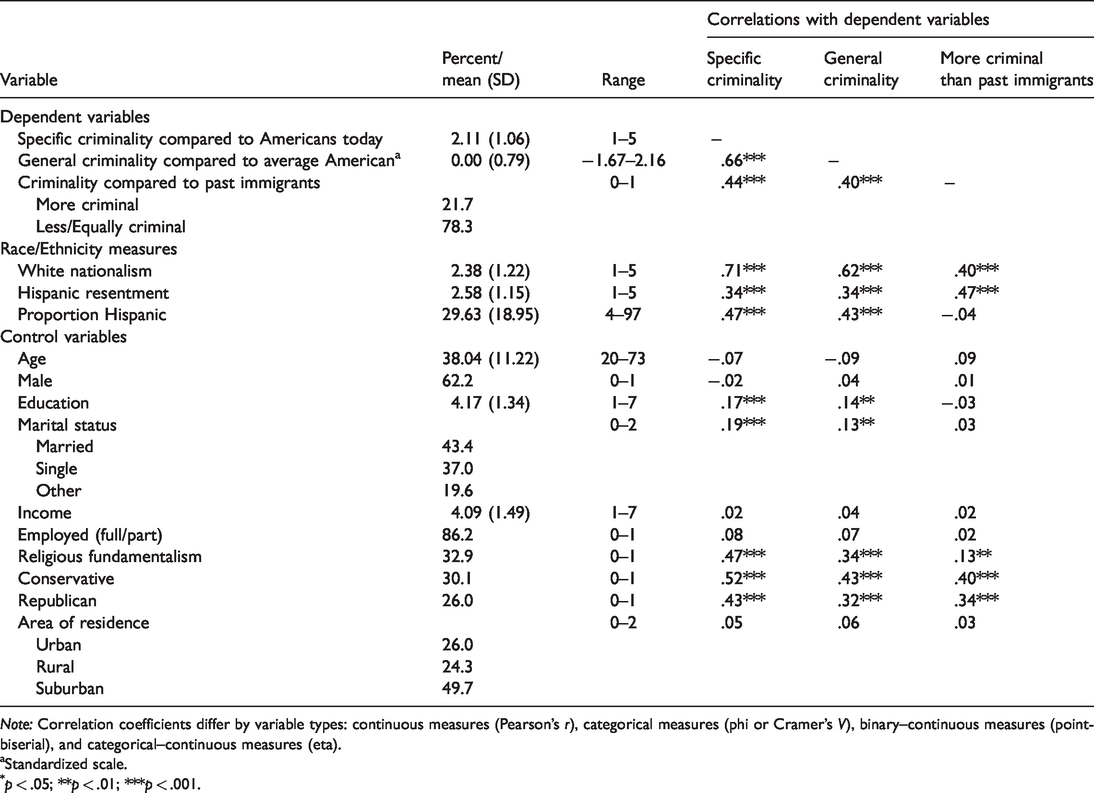
Note: Correlation coefficients differ by variable types: continuous measures (Pearson’s r), categorical measures (phi or Cramer’s V), binary–continuous measures (point-biserial), and categorical–continuous measures (eta).
Standardized scale.
p < .05; **p < .01; ***p < .001.
Dependent variables
There are a number of individual items discussed in the Results section that assessed beliefs of Southern border immigrant criminality, but three dependent variables were included in the multivariate models (see Online Supplemental Appendix for instructions, items, response categories, and properties for each scale). The items used in this survey were developed newly for this study and adapted from prior research to specifically reflect immigrants from the South (Jardina, 2019b; Pew Research Center, 2019). First, specific criminality compared to Americans today asked the respondents how likely immigrants who enter at the US/Mexican border are to engage in various types of criminal behavior. The eight items were averaged, so higher values indicate a greater belief that immigrants are criminal (Cronbach’s α = .96; factor loadings = .84–.92).
Second, general criminality compared to average American is a four-item scale that asked respondents if Mexican immigrants or immigrants who entered at the US Southern border were generally more or less criminal than Americans. Because one of the items had different response options, all items were standardized before they were averaged (Cronbach’s α = .80; factor loadings = .71–.85). Higher values indicate a greater belief that immigrants are more criminal than the average American.
Third, criminality compared to past immigrants was a single-item measure that asked respondents whether immigrants from the US/Mexico border today were more, less, or equally criminal compared to descendants who came to the United States (e.g., Irish, Italian, Polish). The variable was dichotomized so less (17.4%) and equally (60.9%) criminal options were combined (1 = more criminal; 0 = less/equally criminal).
Independent variables
Race/ethnicity measures
As previously noted, White nationalism has been an important indicator of anti-immigrant views (e.g., Knowles & Tropp, 2018; Riley & Peterson, 2016). To construct a measure of White nationalism, we relied on existing items (Jackson, 2019) and then developed items based on the key elements of this construct identified in the literature (see our earlier discussion; see also Jardina, 2019b; Kaufmann, 2019; Pryce, 2018). The five items were averaged to create an overall measure of White nationalism (Cronbach’s α = .92; factor loadings = .82–.91). Higher values indicate greater endorsement of White nationalist beliefs.
Prior research also shows that racial resentment—specifically of Black Americans—is a robust predictor of punitiveness and other criminal justice policy preferences (Enns & Ramirez, 2018; Unnever et al., 2008; Wilson et al., 2015). Whether racial resentment is also an important predictor of beliefs on immigrant criminality, however, has yet to be established. Adapted from Kinder and Sander’s (1996) widely used racial resentment scale, which was initially designed to assess resentment towards Black individuals (e.g., Blair Center Poll, 2016; Chudy, 2020; Maxwell & Shields, 2019), we build on this research by developing a measure of Hispanic resentment. Again, the purpose of including a separate measure of Hispanic resentment from White nationalism is to assess its unique effect on beliefs of immigrant criminality. Similar to Kinder and Sander (1996, p. 106), this scale is intended to measure ethnic animosity, specifically towards Hispanics, in a “subtle” manner so as to avoid social desirability bias for such a sensitive subject.
There were originally five items to measure Hispanic resentment. To ensure that the item constructs did not overlap with White nationalism, a supplemental principal-component factor analysis check with varimax rotation was completed that indicated there were two separate factors. However, two items from the Hispanic resentment scale cross-loaded on the White nationalism factor (factor loadings: >.50; see Online Supplemental Appendix for items). Given the high cross-loadings, the two items were removed and the analysis was re-estimated with the remaining three Hispanic resentment items and the five White nationalism items. The findings indicated that, again, two factors were appropriate but now with minimal cross-loading issues (cross-factor loading range: .09–.35). Thus, the three Hispanic resentment items were reverse coded and averaged so that higher values indicate greater resentment towards Hispanics in the United States (Cronbach’s α = .89; factor loadings = .89–.92). The correlation between the White nationalism and Hispanic resentment scales was moderate (r = .44, p < .05).
As another racial/ethnic measure, proportion Hispanic asked respondents to indicate, on a sliding scale from 0 to 100, what proportion of the US population they think is comprised of Hispanics/Latinos. Prior research suggests that people who overestimate the percentage of the US immigrant population tend to view immigrants less favorably (Hopkins et al., 2018). Because the current study focuses on immigrants from the Southern US border, the question was adapted to represent Hispanics/Latinos more broadly to determine if these perceptions affect other attitudes about Southern US/Mexican border immigrant criminality.
Control variables
A number of sociodemographic control variables were also included in the multivariate models that could possibly influence perceptions of immigrants (Pryce, 2018; Stupi et al., 2016). The respondents were asked a variety of demographic questions that included: age (in years), gender (1 = male, 0 = female), marital status (0 = married, 1 = single, 2 = other), employment status (1 = employed, 0 = other), and area of residence (0 = urban, 1 = rural, 2 = suburban). Education (1 = “less than high school degree” to 7 = “Doctoral degree”) and income (0 = “0–$9,999” to 7 = “$100,000+”) were also included as controls. Additionally, given the divide in perceptions of immigrants by political party, two measures were created to control for political preferences following previous research (Dutton et al., 2017; Shelley et al., 2017). Political ideology was used to discern individuals who identified as “conservative” or “very conservative” from other preferences (1 = conservative, 0 = other). Political affiliation was dichotomized and coded so that 1 = Republican and 0 = other. Finally, a measure of religious fundamentalism was developed by dummy-coding responses that endorsed at least one of the following: (1) “the Bible means exactly what it says. It should be taken literally, word-for-word” and/or (2) indicating that “Fundamentalist,” “Born again,” or “Evangelical” faiths described their religious identity “somewhat well” or “very well”. Based on previous research, individuals who endorsed these items were considered to support religious fundamentalism (Baylor Religion Survey, 2007; Maxwell & Shields, 2019).
Analytic strategy
The current analysis was carried out in two steps. First, we analyzed public opinions to assess the extent that the American public included in this sample believes immigrants from the Southern border are dangerous or criminal. Second, we estimated a series of multivariate regression models (i.e., ordinary least squares regression, logistic regression) to determine the predictors of perceptions of immigrant criminality among the three dependent variables. Importantly, when examining potential issues of multicollinearity, the highest variance inflation factor (VIF) was 2.34 and the condition index was 24.91—both below their recommended cutoffs (Belsley et al., 1980).
Results
Perceptions of immigrant criminality
The survey assessed three types of perceptions of immigrants from the Southern US border: (1) general perceptions, (2) perceptions of specific criminality, and (3) perceptions of general criminality. Each of these types is described below with the items sorted in descending order by the total level of agreement/endorsement within the tables.
General perceptions
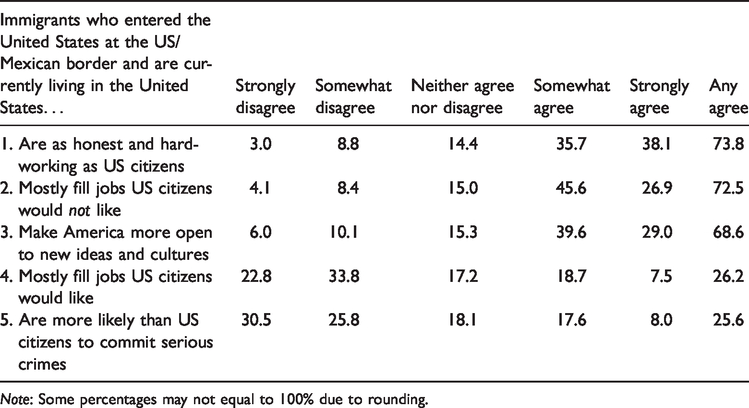
Table 2 presents five items that asked respondents about their perceptions of immigrants who enter the United States at the US/Mexican border. More than half of the respondents “somewhat agree” or “strongly agree” that immigrants are honest and hardworking (73.8%), mostly fill jobs US citizens would not like (72.5%), and make American more open to new ideas and cultures (68.6%). Still, there is a proportion of the sample that believes immigrants take jobs US citizens would like (26.2%) and are more likely to commit serious crimes (25.6%). These data suggest that although most White Americans in this sample generally hold favorable views of immigrants, a non-trivial percentage of respondents (∼25%) view immigrants as undermining or harmful to Americans.
Perceptions of immigrants from US/Mexican border (N = 465; percentages reported).
Note: Some percentages may not equal to 100% due to rounding.
Perceptions of specific criminality
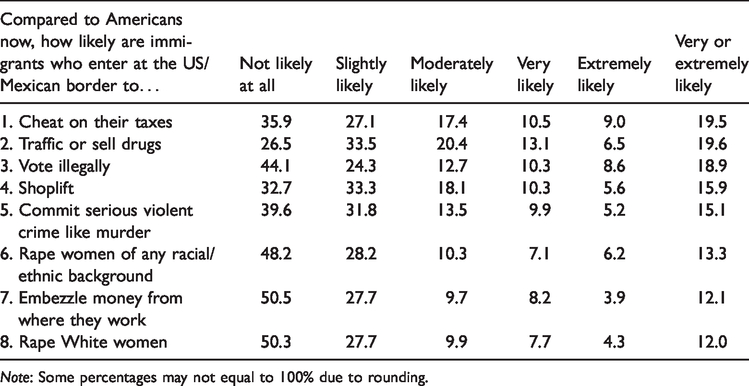
Table 3 provides responses regarding how likely immigrants from the US/Mexican border are to engage in eight forms of crime compared to Americans now. Fewer than 20% of the respondents indicated that it was “very likely” or “extremely likely” that immigrants would engage in any of these crimes. There was a meaningful fraction of the sample, however, that believed it was likely that immigrants would cheat on their taxes (19.5%), traffic or sell drugs (19.6%), vote illegally (18.9%), or engage in other criminal behaviors. Although fewer than one in five respondents, a subset of the sample perceives that immigrants from the Southern border are likely to engage in a range of undesirable behaviors.
Likelihood of specific criminality by immigrants compared to Americans today (N = 465; percentages reported).
Note: Some percentages may not equal to 100% due to rounding.
Perceptions of general criminality
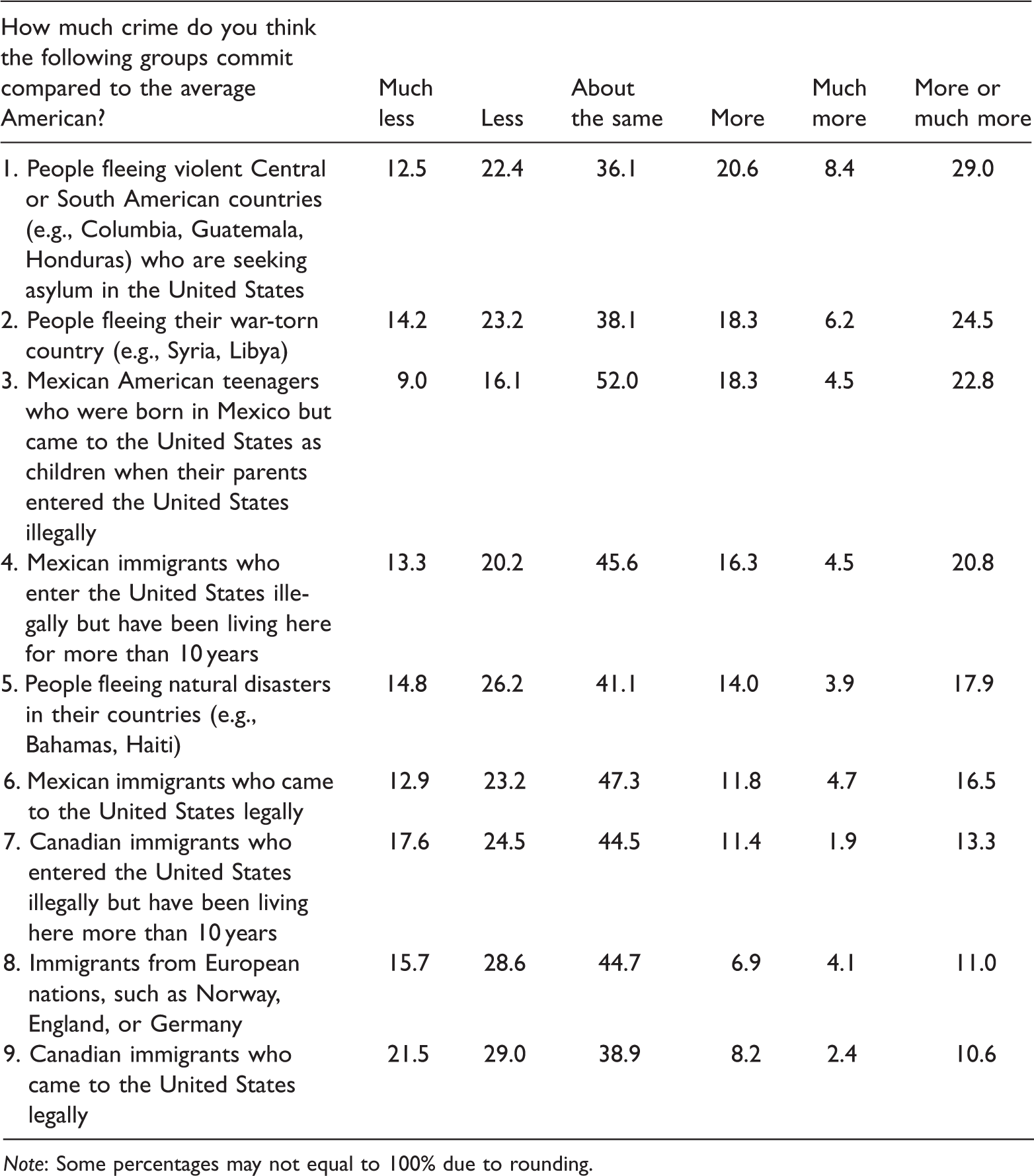
Finally, Table 4 presents the findings for how much crime the respondents think various immigrant groups commit compared to the average American. Notably, there are no items where more than half of the sample endorses “more” or “much more” crime by individuals in the examples. Across all nine categories of immigrants, at least 7 in 10 respondents perceived the criminality of immigrants to be less than or “about the same” as Americans. Three findings are notable. First, immigrants fleeing violent countries (in Central or South America) or warn-torn countries (Syria, Libya) were seen as potentially the most criminogenic. But even here, fewer than 3 in 10 respondents categorized them as “more” or “much more” criminal. Second, Mexican immigrants (dreamers, illegal, and legal) were seen as posing a greater criminal risk than Americans by only a minority of the subjects (about 1 in 5 or less). Third, as might be expected, immigrants from Canada (legal and illegal) and from “White majority” European nations were seen as posing little threat (13.3% or fewer saw them as “more” or “much more” criminal). Again, a clear, bimodal pattern is emerging: Most respondents do not see immigrants as more criminal than “regular” Americans, but about a fifth to a quarter do harbor this concern. Note that similar results occurred when respondents compared today’s immigrants to their “descendants who came to the United States (e.g., Irish, Italian, Polish)”; only 21.7% answered “more criminal”.
Perceived level of general criminality by immigrants compared to the average American (N = 465; percentages reported).
Note: Some percentages may not equal to 100% due to rounding.
Predictors of immigrant criminality
Beyond an assessment of public opinions, the goal of this study was to examine the predictors of perceptions of immigrant criminality among the subsample that endorsed these views. In particular, the unique effects of White nationalism and Hispanic resentment are evaluated beyond other control variables. Table 5 provides the findings for the three regression models for each corresponding dependent variable.
Regression models predicting immigrant criminality (N = 465).

Corresponds to ordinary least squares regression.
Corresponds to binary logistic regression (reference group is “other” criminality combining “less criminal” and “equally criminal”).
p < .05; **p < .01; ***p < .001.
In Table 5, Model 1 findings indicate that the respondents who endorsed White nationalism (β = .48) and Hispanic resentment (β = .11) were more likely to see immigrants from the Southern border as engaging in specific crimes compared to Americans today. Believing that Hispanics make up a greater proportion of the population (β = .16) also was related to seeing immigrants as criminogenic. Being younger (β = −.09), being female (β = −.08), supporting religious fundamentalism (β = .08), and being conservative (β = .12) were also statistically significant. Compared to married respondents, being in an “other” relationship status (β = −.07) decreased the likelihood of believing immigrants engaged in specific forms of criminal conduct. The adjusted model R2 was substantial (58% of the variance in perceptions of specific criminality explained).
In Model 2, similar trends emerged, with White nationalism (β = .40) and Hispanic resentment (β = .17) exerting a significant effect on perceptions of general criminality of immigrants compared to the average American (see Table 5). Believing that Hispanics make up a greater proportion of the population (β = .24) and being conservative (β = .11) also remained significant in the model. The adjusted model R2 again indicated that the model accounted for a sizeable portion of the variance in explaining general criminality (44%).
Model 3 in Table 5 indicated that the respondents who endorsed White nationalism (odds ratio [OR] = 2.01) and Hispanic resentment (OR = 2.09) sentiments had greater odds of perceiving that immigrants today are more criminal than past immigrants. Differing from previous models, individuals who perceived a larger proportion of the Hispanic population had .98 lower odds of endorsing perceptions that immigrants are more criminal. This finding may be due to the fact that in Model 3 the comparison was to past immigrants, whereas in Models 1 and 2 the comparison was to Americans today or average Americans, respectively. Individuals who identified as conservative, however, had 4.07 greater odds of believing that immigrants are more criminal.
Given the robust findings for White nationalism and Hispanic resentment, two supplemental checks were done. First, models were estimated that included an interaction term between these scales for each of the dependent variables. This analysis assessed whether those who embraced White supremacy (the mix of nationalism and resentment) viewed immigrants as especially criminal. The scales were first mean-centered before they were multiplied to reduce potential issues with multicollinearity (highest VIF = 2.34; Condition Index = 23.20). However, the interaction terms were not significant in any of the regression models (p > .05). Second, we also approached the issue of measuring White supremacy by creating a new dichotomous variable that included respondents who “agreed” or “strongly agreed” with both the White nationalism and Hispanic resentment scales (1 = agree on both, 0 = other; n = 25). Given the small number falling into this category, the results should be viewed with caution. However, it is instructive that for the results in each analysis, White supremacy had a significant effect on perceptions of specific criminality (β = .28, p < .001), general criminality (β = .22, p < .001), and immigrants as being more criminal than past immigrants (OR = 11.20, p < .001). The supplemental models are available upon request.
Discussion
Some scholars and political commentators have argued that the Republican Party has used appeals of racial resentment toward Blacks—combined with patriarchy (opposition to “feminism”) and religious fundamentalism (opposition to abortion and gay rights)—to solidify its political control of the South and in other Red States (Maxwell & Shields, 2019). To the party’s credit, however, it had also long resisted efforts to attack immigrants, despite Tea Party inclinations in that direction. Elite leaders, such as President George W. Bush and presidential nominees John McCain and Mitt Romney, rejected such animus. Business interests within the party—from those relying on cheap seasonal labor to those relying on high-tech skilled workers—supported immigration. But more was at stake. The demographic future of the United States as a more diverse nation was, like climate change, a forthcoming reality to be ignored at considerable peril. Following the 2012 presidential election—in which Romney received 27% of the Hispanic vote versus the 44% earned previously by Bush—the Republican National Committee undertook the Growth and Opportunity Project. This initiative addressed the party’s pressing need to appeal more effectively to an increasingly diverse electorate. As the report observed: President George W. Bush used to say, “Family values don’t stop at the Rio Grande and a hungry mother is going to feed her child.” When Hispanics hear that, they knew he cared and were willing to listen to his policies … If Hispanic Americans perceive that the GOP nominee or candidate does not want them in the United States (i.e. self-deportation), they will not pay attention to our next sentence … As one conservative, Tea-Party leader, Dick Armey, told us, “You can’t call someone ugly and expect them to go to the prom with you. We’ve chased the Hispanic voter out of his natural home.” (2013, pp. 7–8)
As Applebaum (2019) notes, however, an alternative to moving toward the center in immigration policy was possible: change the pilot in the cockpit. Rather than see their White Christian nation transformed into a multicultural morass, the goal was to double down in reasserting the value of White nationalism. If the Washington, DC-political class would not take on this existential fight, it was time to find someone who would. Whether by chance or by plan, Donald Trump became the champion of this movement—the new pilot in the cockpit—when he proposed a Muslim ban and then a wall across the Southern border (Davis & Shear, 2019). With support from then-Attorney General Jeff Sessions and advisor Stephen Miller, Trump embraced restrictive immigration policies, all justified by vitriolic rhetoric aimed at the “rapists, murderers, and bad hombres” allegedly streaming across the nation’s Southern border (Davis & Shear, 2019).
In the Trump era, the salient question is whether the president has capitalized on anti-immigration sentiments that are pervasive or limited. One hundred years ago, the United States was gripped by anti-immigrant fervor, targeted mainly at migrants arriving from the Mediterranean (e.g., Italy) and eastern European (e.g., Jewish people from Poland) nations. These were the “shithole” countries of that day (Kendi, 2019). With the eugenics movement flourishing, the concern was with the degradation not simply of American culture but also of American blood (Okrent, 2019). With America First slogans at hand, federal legislation passed in the 1920s imposed severe quotas to restrict immigration from non-Nordic destinations (exceptions were made, e.g., for England, Norway, Germany; Okrent, 2019). Are we in a similar context in which Trump has captured a deep national concern about the dangers posed by people of color from south of the border and from distant lands in the Muslim world? Or do Americans believe that we remain a nation of immigrants that should call out, as the inscription on the Statue of Liberty proclaims, “Give me your tired, your poor, Your huddled masses yearning to breathe free, The wretched refuse of your teeming shore. Send these, the homeless, tempest-tost to me, I lift my lamp beside the golden door!” (National Park Service, 2019).
This portrayal that immigrants from the Southern US border pose a threat to the American people and their way of life, however, has been identified in prior work (see Chavez, 2008). Although other immigrant groups have become part of the United States (e.g., England, Germany), the Latino Threat Narrative posits that immigrant Latinos are perceived as different because of the belief that they are unwilling or unable to assimilate. These negative perceptions have contributed to a shift in criminalizing undocumented Mexican immigrants in particular (Martinez & Slack, 2013). Donald Trump then did not create the animosity towards immigrants from the Southern US/Mexico border, but he amplified its voice when he made immigration reform—with a focus on Mexican immigrants—a central platform of his presidential bid (Blake, 2016).
The data reported in the current survey are instructive and largely in line with other national polls (e.g., Pew Research Center, 2019). Across diverse measures, upwards of 7 in 10 respondents expressed favorable views about immigrants in general and, as captured by the specific nature of our design, about those who originate from south of the US/Mexican border. They see these arrivals much as they would see native-born fellow Americans—honest, hard-working, and no more likely to break the law. This finding supports the notion that Donald Trump’s stance on immigration is likely pandering to a small subset of the population, and that negative attitudes among Americans toward immigrants from the South did not increase following his election (Pew Research Center, 2019; Simon & Sikich, 2007). We probed this crime issue by asking broad questions about whether they “are more likely than U.S. citizens to commit serious crimes” and by asking about specific offenses, including selling drugs, rape, and murder—the very kinds of crimes publicized by President Trump. A clear majority of Americans do not embrace the stereotype of Mexicans and other Southern immigrants as “bad hombres”. Their collective wisdom corresponds with criminological empirical reality (see, e.g., Chouhy & Madero-Hernandez, 2019; Ousey & Kubrin, 2018).
Still, a meaningful minority of respondents in this sample—hovering on either side of a quarter of the sample depending on the question—express negative views of immigrants, including seeing them as more criminal than present Americans and past immigrants. This finding is similar to other national surveys where a fraction of White respondents consistently endorse views of immigrant criminality (33%–34%)—generally at a higher rate than Black or Hispanic respondents (8–21%; Quinnipiac University Poll, 2019; The Economist, 2015). These views matter. Research shows that perceiving immigrants as dangerous is a robust predictor of support for Trump’s restrictive immigrant policies (e.g., the border wall, the Muslim ban; see Haner et al., 2020). Research also shows that a core factor contributing to White support for Trump in the 2016 election, including switching votes from Obama to Trump, was opposition to immigration (Jardina, 2019a; Kaufmann, 2019).
The current study’s special contribution is unpacking why some White Americans see immigrants as criminogenic. In our regression analyses, four variables had significant effects across all three outcomes (see Table 5). Two of these were being a conservative and perceiving the United States as having a higher proportion of Hispanics (with the exception of Model 3 that compared current immigrants to past immigrants). These factors “fit” with a Trump appeal to a right-wing constituency and to those seeing the nation as “overrun” by minorities. Consistent with prior research on racial prejudice and resentment, Hispanic resentment also fostered a view of Southern border crossers as criminal (Jardina, 2019b; Unnever & Cullen, 2012; Unnever et al., 2008). Thus, individuals who do harbor some negative views of Hispanics in particular may be particularly resistant to their presence in the United States (Chavez, 2008). Most importantly, however, the most robust predictor of seeing immigrants as “bad hombres” is our measure of White nationalism. Beyond ethnic resentment, those who believe that the status of White culture and population composition is tenuous and in need of reaffirmation are predisposed to view immigrants as dangerous. We should add that due to small numbers in the current sample, we were not in a good position to assess definitively the unique effect of White supremacy—a toxic mixture of resentment and nationalism. Still, an exploratory measure of this construct was also consistently related to all outcomes, indicating a need for further investigation of this topic.
The findings regarding White nationalism are important for two reasons. First, research on racial beliefs in political science (Jardina, 2019a, 2019b; Kaufmann, 2019) asserts that it is insufficient to restrict empirical studies to the animus that Whites may have about minorities. Beyond studying what Whites think about people of color, it is equally important to study what they think about themselves. A burgeoning line of inquiry, especially in political science, is now investigating issues of White racial identity and ethno-traditionalism. The current study joins with this research in showing the salience of White nationalism as a source of key public opinions.
Second, as realized but now apparently ignored by the Republican National Committee (2013), the demographic destiny of the United States is toward an increasingly diverse population marked by extensive racial/ethnic intermarriage (see also Jones, 2016). As Jardina (2019b, p. 260) notes, “White Americans are losing their numerical majority.” Non-Hispanic Whites are a majority in California, Hawaii, New Mexico, and Texas. Soon to become majority-minority states are Georgia, Maryland, and Nevada (Jardina, 2019b). Whites not only will decline in their numerical dominance but also, according to Jardina (2019b, p. 260), will “not maintain a complete monopoly of power of the nation’s economic, social, and political institutions.” Although these developments may not be of concern to many Whites who continue to prosper, others will bristle at their becoming “strangers in their own land” (Hochschild, 2016). In this context, White racial solidarity and the embrace of a White identity are likely to spread and increase in salience. If so, then belief in White nationalism will, as the current study showed, likely have an important and growing impact on views about crime, criminals, and criminal justice policy. Research in the time ahead thus must incorporate measures of Whiteness into their design to capture fully the nature of American public opinion.
Going forward, we hope that researchers will continue to examine issues regarding perceptions of immigrants—and their potential criminality—but by extending upon our work herein. We envision at least three specific areas that can improve upon some of the limitations of our study. First, while our focus in the current study was on the views that White respondents had upon immigrants’ criminality, other studies should consider the views of other racial/ethnic groups to see if their views align with those of the White individuals found in our work. Second, although our analyses was centered within the American context, we are mindful that the views of immigrants’ criminality in other countries is of a different sort (i.e., different “type” of immigrant nationality) but no less important. We hope that others expand upon our work in this regard. Lastly, we believe that an interesting project would be to examine these types of perceptions within immigrant communities themselves. For example, do immigrants believe that other immigrants are committing a lot of crime, or do they believe that other races/ethnicities are doing so—and does this vary by crime type? We look forward to seeing this research agenda unfold in the future.
Footnotes
Declaration of conflicting interests
The author(s) declared no potential conflicts of interest with respect to the research, authorship, and/or publication of this article.
Funding
The author(s) received no financial support for the research, authorship, and/or publication of this article.
Supplemental Material
Supplemental material for this article is available online.