




Abstract
We present an ancient Greek description written by the philosopher Theophrastus in his classic book ‘Characters’ comparable with modern attention-deficit hyperactivity disorder. The arguments are based in one chapter of this book—The Obtuse Man—presenting features of a character closely resembling the modern description of attention-deficit hyperactivity disorder. In a free comparative exercise, we compared Theophrastus descriptions with modern Diagnostic and Statistical Manual of Mental Disorders (5th ed.; DSM-5) attention-deficit hyperactivity disorder symptoms. The sentences describing The Obtuse Man written by Theophrastus are similar to several symptoms of attention-deficit hyperactivity disorder and he would probably be currently diagnosed with this disorder as an adult. To our knowledge, this is the oldest description compatible with the current conception of attention-deficit hyperactivity disorder in adults in the Western literature. Differently than the moralistic view of ancient Greece regarding those symptoms, the medical attention-deficit hyperactivity disorder conception may be advantageous to patients since it might reduce prejudice and allow individuals to seek treatment.
Keywords
Introduction
Attention-deficit hyperactivity disorder (ADHD) is a neuropsychiatric condition characterized by the presence of symptoms of inattention and/or hyperactivity/impulsivity, according to the Diagnostic and Statistical Manual of Mental Disorders (5th ed.; DSM-5; American Psychiatric Association (APA), 2013). It is considered a valid and common psychiatric disorder in children, adolescents and adults (Faraone, 2005). Extensive literature shows that genetic and neurobiological underpinnings are responsible for the symptoms, as well as clinical impairment in several life areas, which can be mitigated with pharmacological and psychosocial approaches (Faraone, 2005; Gallo and Posner, 2016). Despite being one of the most studied disorders in psychiatry, ADHD is still criticized in lay and professional literature as an artificial label (Bowden, 2014; Moncrieff and Timimi, 2013). Critics suggest that the current diagnosis of ADHD is mainly related to adverse living conditions in Western Society, such as pressure for performance. Others believe that this labeling also works in service of the pharmaceutical industry (Moncrieff and Timimi, 2010).
Historical references demonstrating that characteristics resembling ADHD were observable in different historical times could help to clarify this debate (Taylor, 2011). Moreover, descriptions made before the appearance of modern Western Society and its political, economic and nosological conceptions would be important to reinforce the validity of the current ADHD concept, thereby preventing social stigma. In this sense, there are historical descriptions of pictures resembling ADHD published in a period when the social factors and context were deeply different from those currently acting (Taylor, 2011).
The few historical texts in the literature that describe pictures compatible with what is currently considered ADHD were written in both scientific format and folk or fictional literature (Barkley and Peters, 2012; Taylor, 2011). Until recently, two publications disputed the title of ADHD’s first description: the fictional and worldwide known ‘Struwwelpeter’ written by the pediatrician Heinrich Hoffmann in 1845 (Hoffmann, 1845) and the 1902 ‘Goulstonian Lectures’ titled ‘An abnormal psychical condition in children’, presented by George F. Still and published in The Lancet (Still, 1902). The first contains a series of illustrated short poetic narratives, with one of them telling the history of a boy that, due to his distraction and daydreaming, fell in a river and drowned. In the latter, Still (1902) described in detail 13 children presenting normal intelligence, but behavioral and attention problems caused by what the author called ‘lack of moral control’. More recently, a text written in 1798 by the Scottish physician Alexander Crichton titled ‘An inquiry into the nature and origin of mental derangement: comprehending a concise system of physiology and pathology of the human mind and a history of the passion and their effects’ was rediscovered and republished (Palmer and Finger, 2001). Crichton described a clinical picture similar to the current concept of the predominantly inattentive presentation of ADHD in adults. Soon after, Barkley and Peters (2012) published an article claiming to have found an even older medical description of attention disorders, written by the German physician Melchior Adam Weikard in his medical textbook from 1775 (Barkley and Peters, 2012). He described children and adults who were distractible, with poor persistence, overactive and impulsive.
Considering that behavior, feelings and cognition are relevant traits to understand and predict human conduct, they have been the topic of frequent descriptions along history. The roots of the western concepts of mind and mental illness could be attributed to ancient Greeks poets and philosophers (700–300
In this article, we present an ancient Greek description compatible with modern ADHD written by the Socratic philosopher Theophrastus in his classic book ‘Characters’ in the fourth century
The ‘Characters’
Apart from illnesses that have been reported since ancient Greece, other milder conditions, which can currently be described as mental disorders, were not generally considered as diseases at that time. Even so, these conditions could have been perceived as sufficiently relevant to be described in non-medical Greek texts as odd or picturesque persons. One notable example of these descriptions can be found in the book ‘Characters’ by Theophrastus.
Theophrastus (371
The comparison between Theophrastus’ description and the modern conceptualization of ADHD.
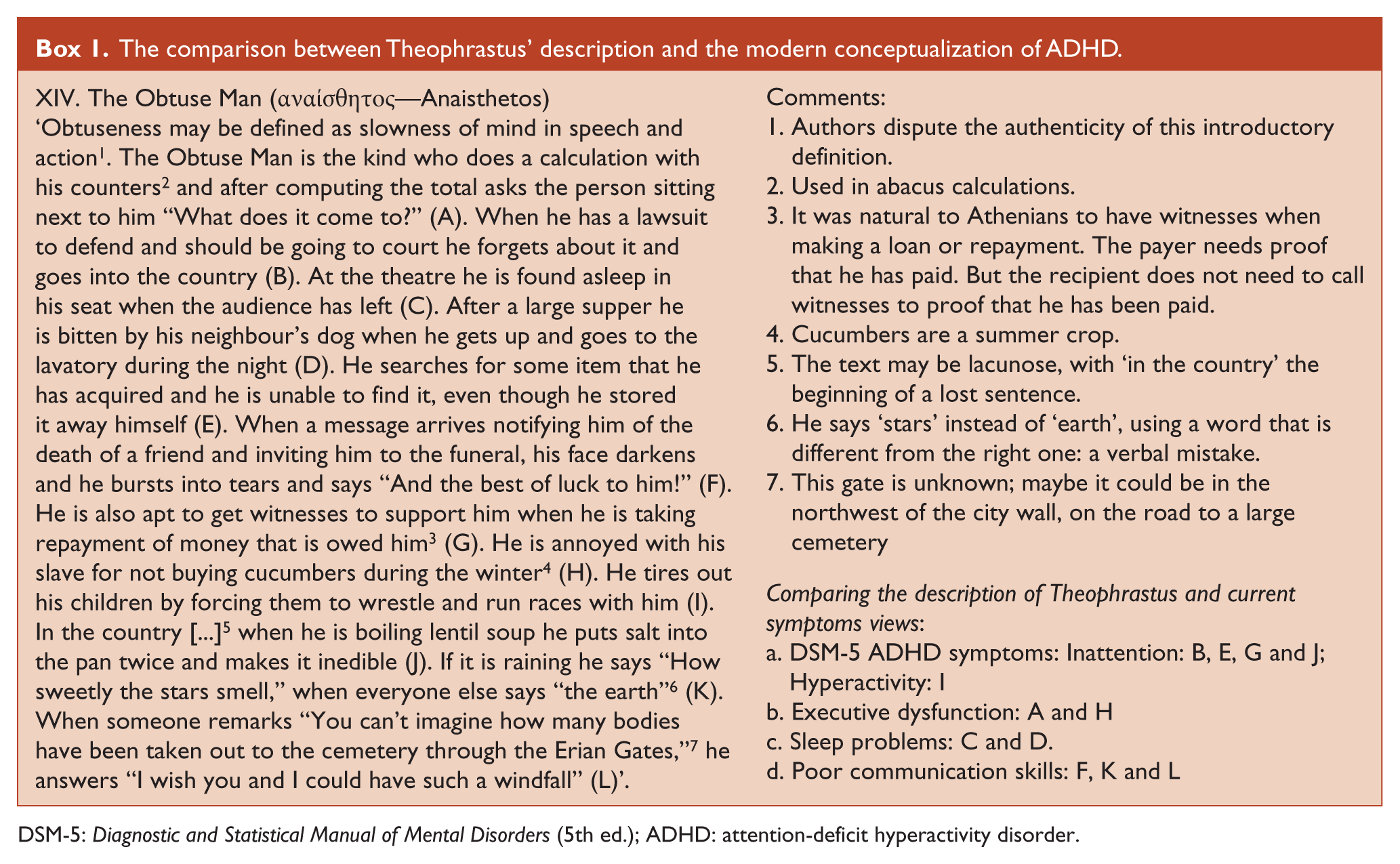
DSM-5: Diagnostic and Statistical Manual of Mental Disorders (5th ed.); ADHD: attention-deficit hyperactivity disorder.
The Obtuse Man—comments on the character
Theophrastus’ 14th character is named The Obtuse Man (Anaisthetos—αναίσθητος). The noun anaisthisía (αναισθησία) and the adjective anaisthetos (αναίσθητος) come from the verb aisthánomai (αἰσθάνομαι), which means ‘see, note, learn something through the senses’, but with a prefix denoting reverse meaning. Therefore, ‘Anaisthetos’ could be literally translated as ‘lack of apperception’ (Diggle, 2004).
In the book, The Obtuse Man is initially defined as having ‘slowness of mind, speech and action’. From then on, Theophrastus describes The Obtuse Man in 12 objective sentences, which resemble the presentation of ADHD symptoms currently observed in DSM-5 criteria (APA, 2013). In a free comparative exercise, it is possible to relate the ‘symptoms’ described by Theophrastus as follows: items B, E, G and J would likely be classified by current clinical psychiatrists as inattentive symptoms. Item H could also be considered an attention mistake, as the individual forgets there are no cucumbers in winter season. Similarly, item I could be clearly classified as a hyperactive symptom. Item A is particularly interesting because it shows that The Obtuse Man is able to perform a calculation correctly; however, he still needs external confirmation on what he is doing. This fact partly contradicts the definition of ‘slowness of mind’ presented in the first phrase of the character. Considering that he has enough intelligence to perform mathematical calculations, what Theophrastus could be highlighting in item A is not in fact ‘slowness’, but the immediate loss of attention in the task.
In three other items (F, K and L), Theophrastus mentions The Obtuse Man’s speech. His dislocated comments have in common the fact that they are verbally impulsive and inappropriate, inconsistent with what would be socially correct or acceptable. This can be observed as following: F—‘And the best of luck to him!’ (for a dead friend); K—‘How sweetly the stars smell’ (when everyone else says ‘the earth’); and L—‘I wish you and I could have such a windfall’ (the good fortune to die?). The individual responds impulsively and erroneously after processing an input of a message (F), a sensory impression (K) and a question from someone else (L). There is no mention in the text to the individual’s own reaction to what he has just said, if he notices or corrects his mistake. Such information would allow a better judgment about the origin of these comments, if they would be related to impulsivity and inattention, to speech itself, to common mistakes or even to cognitive limitations. Interestingly, pragmatic language difficulties have already been reported in children, adolescents and young adults with ADHD (Green et al., 2014; Korrel et al., 2017).
The item C seems associated with somnolence and could be related to a sleep disorder. The item D could also be associated with sleepiness, but admits alternative explanations, including those related to inattention. The Athenian ‘bathroom’ was a tank located on the roof of some houses or sometimes out of them (Diggle, 2004), and The Obtuse Man could have taken a wrong path because of his inattention or sleepiness and ended up in the neighbor’s yard, where he was bitten. It is noteworthy that sleep problems are also frequently reported by individuals with ADHD (Yoon et al., 2012).
An alternative explanation for the characteristics of The Obtuse Man depicted by Theophrastus could be mild intellectual disability. Some items, such as F, K and L (inappropriate comments) or lack of knowledge on item H (cucumbers) could be related to low intellectual capacities or executive functions. Nonetheless, there are some arguments against the mild intellectual disability hypothesis. The Obtuse Man fumbles, is unaware, is verbally inappropriate and does not handle the information from his surroundings as quickly or accurately as others, but it is not stated that he cannot learn. He apparently has the same social status as his fellow citizens, has a family, slaves and business. In fact, he is able to perform mathematical calculations and fully participates in the fourth century
Discussion
Theophrastus’ The Obtuse Man seems to be the oldest detailed description of an individual with a chronic pattern of attention problems. The Obtuse Man was forgetful, inattentive and hyperactive, characterized by a general ‘lack of apperception’ (Anaisthetos) to events in his environment. These features, which nowadays could be considered as traits, compromised his mental abilities and impaired his quality of life. The Obtuse Man could probably be diagnosed as an adult with ADHD by current psychiatrists. Considering that the initial scientific description of ADHD comprised only children and adolescents (Still, 1902), it is certainly interesting that the oldest historical observation of an individual with ADHD characteristics had occurred in an adult. The presence of The Obtuse Man among the 30 Theophrastus’ ‘Characters’ also reinforces the idea that ADHD-like symptoms were relatively common in ancient Athens to deserve a description of a prominent philosopher.
It is worth adding that the 10th character, The Surly Man, would probably be currently classified as a dysthymic individual, reinforcing the idea that current milder psychiatric disorders or traits were not considered as medical problems by the Socratic school of philosophers (in which Theophrastus was inserted) but instead judged as a reprehensible pattern of personality, resulting from the lack of rational control over appetites and behavior (Simon and Weiner, 1966).
The Obtuse Man, in Theophrastus point of view, participated fully, albeit with difficulties, in ancient Greek social life, but was apparently seen as a morally reprehensible and weak citizen (or a negative example). The critique on these specific characteristics lasted two millennia, given that the conceptualization of ADHD, originally designated as ‘minimal brain dysfunction’, as an explanation for these symptoms in adults is very recent (Wood et al., 1976). Until then, individuals presenting such characteristics were socially criticized, but they were neither recognized as suffering from a psychiatric disorder nor treated.
The concepts of health and mental illness are influenced by cultural values of each time and we cannot assure that the current ADHD description is totally devoid of social influences in its design (Bowden, 2014). Currently, specific symptoms and impairment are considered criteria to validate a mental disorder (APA, 2013; Faraone, 2005). In this regard, it is interesting to note that the features described by Theophrastus in ancient Greece apparently brought impairment, prejudice and disapproval to these individuals. The Obtuse Man’s description allows us to infer that many typical ADHD symptoms were related to impairment even in a quite different historical context. From ancient Greece until today, subjects presenting ADHD-like symptoms suffer stigma and prejudice due to their behavioral traits (Thompson and Lefler, 2016). Conversely, the advances in psychiatry considering these problems as nosological entities seem advantageous while providing these individuals with the possibility of appropriate and effective treatment instead of being morally criticized. The same rational process occurred when Hippocrates postulated that several mental problems were illnesses and not products of divine vengeance. Strengthening our current nosological conceptions may result in better clinical care, treatment adherence and general outcomes. The abandonment of the medical concept of ADHD proposed by some critics could, as a consequence, result in a return to the helplessness of Theophrastus’ times. When current authors deny the existence of the disorder, they also deny their treatment, transferring to the affected individuals the responsibility for the management of their personal characteristics.
This work should be appraised in the context of some limitations. First, although some links between the characteristics of The Obtuse Man and his cultural context were made, it is beyond the scope of this study to profoundly discuss moral aspects of ancient Greece. Second, interpreting ancient texts regarding psychological traits requires caution, being intrinsically difficult to properly assure that some of the symptoms reported by Theophrastus are in fact related to ADHD. This occurs because the description of The Obtuse Man in a few sentences is laconic and incomplete, sometimes allowing multiple interpretations. However, the exhibited characteristics, if interpreted with some freedom, may allow these diagnostic speculations and many of the described features are undoubtedly similar to current ADHD symptomatology.
In conclusion, we suggest that Theophrastus’ description of The Obtuse Man recedes in two millennia the first known cultural description of an individual with ADHD-like characteristics and resembling what currently could be classified as an adult with ADHD. The social disadvantage arising from these ADHD-like symptoms even in a different cultural and temporal context is evident. The current medical approach to ADHD may be advantageous to patients in relation to the moralistic and divine approaches previously employed by ancient Greeks, since it might reduce prejudice and allow individuals to seek an adequate treatment.
Footnotes
Declaration of Conflicting Interests
E.H.G. was on the speaker’s bureau for Novartis and Shire for the last 3 years. He also received travel awards (air tickets and hotel accommodations) for participating in two psychiatric meetings from Shire and Novartis.
Funding
This work was supported by the following funding sources: CNPq and CAPES.