



Abstract
This article develops the notion of reciprocal stakeholder behavior by applying the concept of reciprocal behavior from experimental economics to stakeholder theory. A reciprocal stakeholder behavior model shows under which conditions stakeholders can translate normative demands for prosocial corporate behavior into economic incentives for companies through reciprocal sanctions. The author argues effective reciprocal stakeholder sanctions represent a strong mechanism to implement normative stakeholder demands for prosocial corporate behavior. Conceptually, the author introduces behavioral motives as an important element of stakeholder behavior and stakeholder influence. The argument shows that the notion of reciprocal stakeholder behavior adds substantially to a better understanding of (a) how normative stakeholder demands for prosocial corporate behavior are formulated, and (b) why and under which conditions companies voluntarily comply with stakeholder demands for prosocial corporate behavior that goes beyond legal requirements.
Keywords
According to the traditional economics and finance view, the ultimate goal of companies is to maximize risk-adjusted return on capital (Jensen & Meckling, 1976). That view argues that an adequate public policy framework ensures that profit-maximizing behavior of private firms is in line with overarching societal objectives, leaving business with the imperative to maximize shareholder returns while respecting legal obligations (Friedman, 1970). This view has been challenged by many management scholars who argue that companies have a wider prosocial responsibility that goes beyond profit maximization and legal compliance. Stakeholder theory plays a prominent role in this context as that theory posits that companies interact with multiple actors and need to deal with their various interests and demands. While the literature extensively treats corporate responses to stakeholder demands related to commercial partners and exchanges, there is still a fundamental lack of understanding of how and why firms respond to societal expectations for prosocial behavior: Although laws and regulations have delineated specific standards for compliance with societal expectations, voluntary compliance with societal expectations is an enigmatic phenomenon. Predicated on the unstable ground of ethical and instrumental rationales, the mechanisms that compel the firm to consider societal interests are not well understood. (Welcomer, 2002, p. 251)
One of the most prominent aspects in the stakeholder literature is the question of how stakeholders can gain sufficient salience to influence and change firm behavior in favor of their demands (Mitchell, Agle, & Wood, 1997). In this context, many authors (den Hond & de Bakker, 2007; Frooman, 1999; Hendry, 2003; Rowley & Berman, 2000; Rowley & Moldoveanu, 2003; Strong, Ringer, & Taylor, 2001) argue that analyzing the relationships between companies and stakeholders requires a better understanding of the logic behind stakeholder perceptions, stakeholder behavior, and stakeholder expectations: “To attribute ‘irrationality’ to a stakeholder is to take the easy way out” (Freeman, 1984, p. 133). Interest-based approaches to analyzing and explaining stakeholder influence on firm behavior mainly concentrate on resource exchange relations between companies and stakeholders. A resource exchange view argues that stakeholders influence firm behavior by providing important resources on which companies depend (Frooman, 1999; Frooman & Murrell, 2005; Schaltegger, 1999). Identity-based (Rowley & Moldoveanu, 2003), capacity-based (Barnett, 2007), and ideology-based (den Hond & de Bakker, 2007) approaches also have been proposed.
Recently, the question of why and under which conditions corporations behave in prosocial ways has gained increasing attention in the literature (Barnett, 2007; Campbell, 2007; King, 2007). This article contributes to a better understanding of corporate responses to such societal expectations by developing a motive-based approach to explain the implementation of normative stakeholder demands for prosocial corporate behavior. Typically, one can characterize normative stakeholder demands by societal expectations vis-à-vis companies based on normative judgments (Clarkson, 1995; Welcomer, 2002). These demands have often been described in terms of socially constructed expectations for prosocial behavior of actors coming from a company’s social environment (Cummings & Doh, 2000; Lawrence, Wickins, & Phillips, 1997; Massey, 2001; Oliver, 1996). The reader should note that the notion of normative stakeholder demands as used in this article does not refer to those demands that have a legitimate basis in ethical theory, in how (ideally) a firm should treat its stakeholders (Donaldson & Preston, 1995). Rather, normative stakeholder demands refer to societal expectations for prosocial behavior that stem from social discourses within the wider societal and institutional context of organizations as described by social norm theory (Coleman, 1990) and neoinstitutional approaches (DiMaggio & Powell, 1983; Powell & DiMaggio, 1991; Scott, 1995; Suchman, 1995). However, scholars still do not understand well enough how and under which conditions such societal expectations translate into economic incentives for companies (Rowley & Berman, 2000; Welcomer, 2002). Thus it remains unclear why some normative stakeholder expectations influence firm behavior, while others do not appear to have much influence.
This article builds on and extends the notion of resource exchanges between companies and stakeholders by explicitly introducing behavioral motives as a novel element of stakeholder influence. Motives are relatively stable personality dispositions that drive, direct, and select behavior (McClelland, 1986). The argument in this article deviates from the prevailing assumption of self-interested motives of stakeholder behavior and treats motives behind stakeholder action as variables instead of assumptions (Jones & Wicks, 1999). Findings from experimental economics highlight that a substantial fraction of actors is motivated by strong reciprocity—that is by the motive to reward friendliness and punish unfriendliness even if this conduct does not provide additional benefits to reciprocators (for an overview see, for example, Fehr & Falk, 2002a; Fehr & Schmidt, 2000b). The author applies the notion of reciprocal behavior to stakeholder influence theory and corporate social responsibility. The resulting model of reciprocal stakeholder behavior suggests that—even at a net cost to themselves—reciprocal stakeholders reward corporate behavior that they perceive as prosocial and punish corporate conduct that is perceived as socially undesirable. The willingness to maintain reciprocal sanctions at a net cost differentiates stakeholder reciprocity from self-interested behavior. This distinction is particularly relevant with regard to stakeholder influence based on tit-for-tat strategies (Hill, 1990; Jones, 1995) where stakeholders only reciprocate as long as they can expect private benefits from doing so.
The first main contribution of a motive-based approach to stakeholder influence is to provide a better understanding of how normative stakeholder demands for prosocial corporate behavior are formed. Based on empirical findings from experimental economics, the author develops arguments about the formation of normative stakeholder demands and the factors that determine different fairness judgment of reciprocal stakeholders. Reciprocal stakeholder action is triggered by such normative judgments of corporate conduct. Consequently, this first contribution ultimately refers to the question of why reciprocal stakeholders act.
The second main contribution of the article addresses the question of how and under which conditions companies adopt prosocial behavior beyond legal obligations due to reciprocal stakeholder sanctions. The introduction of reciprocal motives of stakeholder behavior based on the findings from experimental economics provides theoretically a strong mechanism to translate normative demands for prosocial corporate behavior into economic incentives. In this context, the literature points to a lack of contingent approaches that allow scholars to explain under which circumstances it is rational for companies to obey normative stakeholder demands (Barnett, 2007; Reinhardt, 1999; Rowley & Berman, 2000; Welcomer, 2002). Responding to Rowley and Berman who call for an “under which conditions [emphasis in the original] approach” (2000, p. 406) to the analysis of corporate behavior toward societal demands, this article seeks to examine and understand “the conditions that generate firm efforts to respond to societal interests” (Welcomer, 2002, p. 251). Based on the findings on reciprocal behavior from experimental economics, the author develops the conditions under which reciprocal stakeholder behavior can successfully induce companies to behave in prosocial ways in resource exchange relations. Based on these findings, the author provides five propositions for effective reciprocal stakeholder influence.
Overall, this article identifies and explores behavioral motives—with a focus on reciprocal motives for the present analysis—as a novel element in the explanation of stakeholders influence and the implementation of normative stakeholder demands for prosocial corporate behavior. Based on this reasoning, the author develops the concept of reciprocal stakeholder behavior as an empirically based behavioral approach to a better understanding of why and under which conditions companies respond positively to demands for prosocial corporate behavior that goes beyond legal requirements. The notion of stakeholder reciprocity results in stakeholder behavior based on reciprocal motives when seeking to influence corporations on societal issues. As soon as such reciprocal stakeholder sanctions are sufficiently strong, they translate normative stakeholder demands into economic incentives and thus affect the incentive structure of profit-seeking firms. As a result, the argument offers a deeper understanding of how and under which conditions stakeholders can formulate and implement normative demands for prosocial corporate behavior to influence firms.
Recent important work by Bosse, Phillips, and Harrison (2009) also addresses reciprocity in stakeholder relations as providing fruitful insights for strategic management theory. Those authors use the same definition of stakeholder reciprocity as actors who will reward fair actions and punish unfair actions even at net cost. As in the present article Bosse et al. use distributional, intentional, and procedural fairness norms to explain the underlying logic of reciprocal behavior. However, their argument does not conceive reciprocity as a behavioral motive in itself but rather refers to “selfish utility maximizing behaviors [that] are bounded by norms of fairness” (Bosse et al., 2009, p. 447). As a result, those authors propose a rather categorical relationship between stakeholder reciprocity and firm performance and do not delve so much into the conditions under which reciprocal stakeholder behavior affects corporate behavior.
The present article developed out of the author’s dissertation (Hahn, 2004, 2005). The model of stakeholder reciprocity here reflects findings in the experimental economics literature. Bosse et al. (2009) emphasize stakeholder reciprocity as powerful explanation of the effect of fairness norms on firm performance. The present study is more concerned with formation of social norms and influence on firm behaviors. Based on the findings from experimental economics, the argument develops the conditions under which (a) stakeholders use different fairness norms to form their demands and (b) stakeholder reciprocity can alter economic incentives for firms. While the development of a full theory of a motive-based theory of stakeholder-firm interaction lies beyond the scope of the present article, the argument presented here provides the starting point for a more comprehensive theory of motivational heterogeneity in firm–stakeholder interaction.
The remainder of the article is organized as follows. The next section provides the conceptual background of company–stakeholder relationships and how normative stakeholder demands on companies get implemented in such relations. The subsequent section introduces the behavioral notion of reciprocity as derived from the empirical evidence of experimental economics and its role in implementing social norms. The next section then develops the concept of reciprocal stakeholder behavior. The subsequent section is a discussion of the most important implications for the fields of corporate social conduct and stakeholder influence theory as well as for further research. A brief conclusion summarizes the argument.
Conceptual Background
This section explains the conceptual background for the reciprocal stakeholder behavior model with regard to prosocial corporate behavior. The section first discusses company–stakeholder relationships and normative stakeholder demands. Second, this section clarifies the relationship between normative stakeholder demands and interest-based stakeholder influence.
Company–Stakeholder Relationshipsand Normative Stakeholder Demands
The management literature widely uses the stakeholder approach to analyze and model the relationship between companies and their different constituents (for an overview on the stakeholder literature see Agle et al., 2008; Mitchell et al., 1997). An instrumental perspective defines and identifies stakeholders by their relevance for corporate success. Many scholars stress that for the understanding of company–stakeholder interactions, it is crucial to analyze and understand stakeholders’ influence on corporate behavior (den Hond & de Bakker, 2007; Frooman, 1999; Frooman & Murrell, 2005; Hendry, 2003; Rowley, 1997; Rowley & Moldoveanu, 2003). In this context, the literature often perceives stakeholder relations of companies as resource exchange relations (Frooman, 1999; Hill & Jones, 1992; Jawahar & McLaughlin, 2001; Jones, 1995; Näsi, 1995). Stakeholders provide resources and in exchange for providing resources they want firms to fulfill their claims (Hill & Jones, 1992). With reference to resource dependence theory (Pfeffer & Salancik, 1978), resources are all means that are required by organizations for survival. By providing resources, stakeholders become instrumental for company success and companies depend on vital stakeholder relationships. In the context of this article, the distinction between direct and indirect stakeholders is relevant (Rowley, 1997). Direct stakeholders are those actors who are involved in direct exchange relations with a company and thus have a direct influence on the company through the control of vital resources. By contrast, indirect stakeholders have an interest in a company’s activities and behavior but do not control resources and have no direct exchange relation with the company. Rather, they moderate and influence direct exchange relations between a company and direct stakeholders.
Prosocial organizational behavior refers to “positive social acts carried out to produce and maintain the well-being and integrity of others” (Brief & Motowidlo, 1986, p. 710). The literature on legitimacy theory and neo-institutionalism widely discusses the formation and adoption of normative demands for corporate prosocial behavior. Scholars argue that companies are embedded in a larger social environment (Campbell, 2007; DiMaggio & Powell, 1983; Meyer & Rowan, 1977; Scott, 1991). As a consequence, companies are subject to normative judgments that result in “generalized perception[s] or assumption[s] that the actions of an entity are desirable, proper, or appropriate within some socially constructed system of norms, values, beliefs and definitions” (Suchman, 1995, p. 574). In this context, stakeholder perceptions of corporate behavior are thus of crucial importance (Elsbach & Sutton, 1992). Such stakeholder perceptions and normative judgments of corporate behavior evolve in communicative discourses (Berger & Luckmann, 1966; Mitnick, 1995, 2000; Suchman, 1995) that represent a political process involving different stakeholders who compete with their different perspectives and normative, cognitive, and cultural backgrounds (Driscoll & Crombie, 2001; Lawrence et al., 1997; Massey, 2001; Neilsen & Rao, 1987; Rao, 1994; Scott, 1995). As a result “socially responsible corporate behavior may mean different things in different places to different people and at different times” (Campbell, 2007, p. 950). Thus in a specific situation, there may be competing perceptions of which corporate behavior stakeholders judge as legitimate, appropriate, and acceptable. In this context, stakeholders can adopt different or multiple roles depending on the specific situation and interaction they have toward a company. For instance, a customer or employee can at the same time be a local citizen or member of an NGO. Moreover, actors with a strong position, role, and influence within the stakeholder network of a company’s social environment are more likelyto dominate and shape social perceptions and judgments of a company’s legitimacy.
Previous research on stakeholders’ action suggests that next to interest other aspects such as identity play an important role (Rowley & Moldoveanu, 2003). The outcome-based perspective of interest cannot fully capture stakeholder action for normative demands. Because normative stakeholder demands refer to some wider societal interests and expectations (e.g., protecting the environment or alleviating poverty), outcomes and benefits of prosocial corporate behavior will, at best, only partly accrue to the stakeholders supporting such demands. Normative stakeholder demands are of collective nature and associated with many externalities. Therefore such demands often go beyond the individual benefits and affectedness of stakeholders, which limits the explanatory power of interest-based approaches to stakeholder action. Rowley and Moldoveanu (2003) complement interest with identity as a rule-based perspective on stakeholder action. In a similar vein, the argument here contends that a better understanding of the implementation of normative stakeholder demands calls for complementary, motive-based perspectives, however, without rejecting the interest-based mechanisms of stakeholder influence.
Normative Stakeholder Demands and Interest-Based Stakeholder Influence
The implementation of normative stakeholder demands for prosocial corporate behavior from both a firm and a stakeholder perspective departs from an interest-based stakeholder influence theory. This starting point provides the foundations for the subsequent introduction of the notion of reciprocal stakeholder behavior and the development of stakeholder reciprocity.
Normative stakeholder demands from the firm perspective
As shown above, normative stakeholder demands toward companies are defined by social norms and refer to prosocial corporate behavior. Rowley and Berman (2000) argue that companies will only obey such societal demands if they have the incentive to do so. This argument does not imply that firms necessarily behave in antisocial ways. Rather, according to the mainstream traditional business perspective firms will adopt prosocial behavior as long as this behavior is in line with their self-interest, that is, profit-maximization. In this context, Brief and Motowidlo (1986) distinguish between functional (i.e., serving corporate interests) and dysfunctional (i.e., not serving corporate interest) prosocial behavior. From this perspective, societal expectations for prosocial behavior as defined by social norms often corresponds to the creation of positive externalities (Coleman, 1990, pp. 249-250; Crouch, 2006; Dufwenberg & Lundholm, 2001); the costs of prosocial corporate behavior are private while the benefits are public (Barnett, 2007; King, 2007). In a market economy, profit making and shareholder wealth maximization are clearly socially desirable. At the same time, they are at the heart of the self-interest of the firm. However, prosocial corporate behavior consists of organizational behavior serving others and thus goes beyond corporate self-interest. In economics this situation is captured by the notion of positive externalities. In other words, society and stakeholders benefit from corporate decisions and actions whose costs are borne by private companies. As a result, in many cases profit-oriented companies see no incentive to obey normative stakeholder demands (Campbell, 2007). Consequently, in those cases where firms do not see any incentives for prosocial behavior, the effective implementation of normative stakeholder demands requires that stakeholders succeed in changing the incentive structure for companies in favor of prosocial behavior.
Interest-based stakeholder influence and prosocial corporate behavior
Based on resource-dependence theory (Pfeffer & Salancik, 1978), Frooman (1999) argues that stakeholders try to gain influence on corporate behavior by strategically controlling resources they provide companies. In this context resources can be tangible or intangible or as Frooman (1999) puts it, “… essentially anything an actor perceives as valuable” (p. 195). He distinguishes between usage and withholding strategies. Both withholding and usage strategies require a direct resources exchange relationship between the company and its stakeholders. Moreover, the reader should note that Frooman’s theory is based on the assumption that interest-based stakeholder influence strategies are motivated by the individual self-interest of stakeholders. When applying withholding strategies, stakeholders stop providing their resources to companies to pressure companies to meet their demands. However, this withholding requires that stakeholders are rather independent from a company. In cases where this independence is not given, stakeholders can apply usage strategies. With usage strategies, stakeholders change the quality or characteristics of the resources they provide depending on whether the company is meeting their claims or not. By strategically controlling resources depending on their own interests and demands being fulfilled by the company, stakeholders seek to align the incentives of the company with their own interests.
Accordingly, if stakeholders seek to implement normative demands through withholding or usage strategies, stakeholders need to be willing to provide resources depending on the degree companies behave in the demanded prosocial way. In other words, stakeholders need to act on behalf of the achievement of some societal interest. However, societal demands for prosocial corporate behavior oftentimes go beyond the immediate individual benefit and affectedness of specific stakeholders. For instance, societal demands for corporate contributions to poverty alleviation of environmental protection very unlikely affect positively stakeholders in direct resource exchange relations with companies. The interest-based notion of Frooman’s framework does thus not cover stakeholder motives to influence companies for demands that go beyond their proper interests. At the same time, actors who would potentially benefit if firms responded to normative demands for prosocial corporate behavior do not necessarily have control over resources and thus lack the possibility to directly influence corporate behavior through withholding or usage strategies.
Toward a motive-based notion of stakeholder influence
It follows that interest-based stakeholder influence does not provide a compelling mechanism to explain how stakeholders implement societal expectations for prosocial corporate behavior vis-à-vis firms. The author argues that relaxing the assumption of self-interested stakeholder motives broadens considerably the explanatory power of stakeholder influence theory and provides novel insights into how normative stakeholder demands are implemented. Scholars such as Chong (2000) argue in line with many mainstream economists for a broad notion of utility and rationality so that almost every type of behavior can by characterized as rational self-interested behavior. However, such a broad notion of rationality has been criticized for a loss of explanatory and analytical power (Sugden, 1984). Therefore, the author follows the logic of many experimental economists that argue for a coexistence of different behavioral types and different kinds of rationality that are distinct from self-interest and among which reciprocity is one form. The author proposes that stakeholder influence through resource control that is based on a motive other than self-interest—namely reciprocity—opens up a promising avenue to better understand how and under which conditions stakeholder influence can induce companies to adopt societal expectations for prosocial corporate behavior.
For this purpose, by drawing on the empirical findings on reciprocal behavior from experimental economics, the article addresses two key questions for the implementation of prosocial behavior vis-à-vis companies.
The first question is how normative stakeholder demands are formed. This question refers to the underlying logic of normative stakeholder demands and the question which groups within the stakeholder network dominate the formation of such demands. As a result, there needs to be a common perception among a sufficient number of stakeholders concerning the normative demands toward a company. For indirect stakeholders who do not exert influence over corporate resources this translates into the challenge to convince other stakeholders of the urgency and legitimacy of their normative demands toward a company. More specifically, indirect stakeholders need to persuade direct stakeholders, that is, stakeholders with control over company resources, to adopt their normative judgments on companies and use their control over resources to influence behavior.
The second question is how and under which conditions stakeholder action can be sufficiently influential (Rowley & Moldoveanu, 2003) to alter the incentive structure in favor of prosocial behavior. Thus on the one side, the implementation of normative stakeholder demands depends on stakeholders who are sufficiently strong and willing to influence companies depending on normative judgments of corporate conduct. This requirement means that in their resources exchange relations with companies direct stakeholders need to be willing to influence companies in favor of some prosocial behavior that may well go beyond their immediate and/or individual benefits and affectedness. On the other side, stakeholders need to have sufficient scope to influence corporate behavior in favor of some societal expectations for prosocial behavior. Researchers thus need to identify and understand the conditions and contingencies that determine the possibility and effectiveness of stakeholder influence in favor of corporate prosocial behavior.
The remainder of this article develops the notion of reciprocal stakeholder behavior and reciprocal stakeholder influence by introducing reciprocal motives from experimental economics to interest-based stakeholder influence theory. This approach provides a better understanding of the mechanisms and drivers behind prosocial corporate behavior beyond legal obligations for which Welcomer (2002) calls. As will be shown in the next section, reciprocal stakeholder behavior offers some fruitful insight into both how stakeholders (a) form normative judgments of corporate social conduct that constitute normative stakeholder demands, and (b) induce and facilitate reciprocal stakeholder sanctions to change the incentives for companies in favor of normative demands for prosocial corporate behavior.
The Model of Reciprocal Behavior
This section introduces the model of reciprocal behavior based on the findings from experimental economics. Based on a brief outline of the characteristics of reciprocal behavior, this section shows how fairness norms trigger reciprocal behavior. This reasoning leads into the discussion of the role of reciprocity for the enforcement of prosocial behavior of firms.
Main Characteristics of Reciprocal Behavior
Experimental economists have developed and postulated the model of reciprocal behavior over the last two decades (Fehr & Gächter, 1998; Gintis, 2000). This model builds on the empirical findings of a large number of game theoretical experiments (for an overview see, for example, Fehr & Falk, 2002a; Fehr & Schmidt, 2000b). Experimental economics investigates individual behavior in a controlled laboratory environment to test observed individual behavior under different strategic settings against predictions from theory (Roth, 1995). Usually, experimental games are played with monetary payoffs. Such experiments have shown that a substantial fraction of individuals—Fehr and Gächter (1998, p. 847) speak of 40% to 60%—do not behave in compliance with standard economic theory in that they do not behave selfishly but reciprocally (for early evidence see Güth, Schmittberger, & Schwarze, 1982). Furthermore, experimental economists find that reciprocal behavior is a robust behavioral phenomenon that persists under different strategic settings (e.g. Brown, Falk, & Fehr, 2002; Güth & van Damme, 1998; Hoffman, McCabe, & Smith, 1996; Sethi & Somanathan, 2003) and cultural settings (Costa-Gomes & Zauner, 2001; Hayashi, Ostrom, Walker, & Yamagishi, 1999; Henrich et al., 2001) as well as under high stakes conditions (Cameron, 1999; Fehr, Fischbacher, & Tougareva, 2002; Slonim & Roth, 1998). In contrast to standard neoclassical economics, experimental economists posit that there coexist different motives behind subjects’ behavior. The findings of experimental economics propose that—rather than a universal predominance of self-interest—different behavioral motives coexist that drive different actors’ behavior (Bowles & Gintis, 2000; Fehr & Gächter, 1998). Experimental evidence suggests that a fraction of around 40% to 60% of all subjects are motivated by reciprocal behavior (Fehr & Gächter, 1998, p. 847).
Reciprocity differs from selfish behavior in that reciprocal behavior is other-regarding rather self-interested and reciprocal actors willingly pursue reciprocal behavior even in the absence of economic incentives. Accordingly, reciprocal behavior is definable as norm-driven behavior characterized by the “willingness to sacrifice resources for rewarding fair and punishing unfair behavior even if this is costly and provides neither present nor future material rewards for the reciprocator” (Fehr, Fischbacher, & Gächter, 2002, p. 2). More specifically, there are three fundamental characteristics of reciprocal behavior (Kahneman, Knetsch, & Thaler, 1986):
First, reciprocal actors behave in a friendly way toward others if reciprocal actors perceive that those others to also behave in a friendly way. In turn reciprocal actors act spitefully when they believe they are facing spiteful behavior from others (e.g., Bowles & Gintis, 2000; Sethi & Somanathan, 2003; Sugden, 1984). In other words, reciprocal behavior is an in-kind response to friendly or unfriendly behavior. This definition leads to the distinction between positive and negative reciprocity: Positive reciprocity captures motives for rewarding friendly behavior, whereas negative reciprocity refers to punishing unfriendly behavior (e.g., Fehr & Gächter, 1998; Offerman, 2002).
Second, and unlike selfishly motivated actors, reciprocal actors are willing to reward friendliness and punish unfriendliness even if this conduct leads to additional net costs for them. Many experiments show that strong reciprocators retain costly reciprocal behavior under conditions where they cannot expect any future benefits from such behavior (Fehr et al., 2002; Fehr & Gächter, 2000a; Gintis, 2000). This finding leads to the distinction between weak and strong reciprocity. Weak reciprocators are driven by self-interest and elicit reciprocal behavior as a means of payoff maximization (Bowles & Gintis, 2000). By contrast, strong reciprocity is a behavioral motive for itself: that is, reciprocal behavior is maintained even if this conduct does not lead to payoff maximization. In what follows, the term reciprocity will refer to strong reciprocity only to focus on reciprocally motivated behavior. However, the reader should note that reciprocal behavior is different from altruistic behavior. While the latter denotes unconditional kindness, reciprocity refers to conditional kindness or unkindness (Bowles & Gintis, 2000).
Third, reciprocal actors follow implicit rules and norms that specify what is considered “friendly” or “unfriendly” (Fehr & Gächter, 2000b; Kahneman et al., 1986; Ostrom, 2000). For the description of reciprocal motives, the literature commonly refers to the notion of fairness and argues that reciprocal behavior is triggered by social fairness norms (Bolton & Ockenfels, 2000; Falk, Fehr, & Fischbacher, 2003; Fehr & Schmidt, 1999, 2000b; Rabin, 1993). Thus the question of whether a reciprocal actor considers an action of someone else as either friendly or unfriendly depends on whether the counterparty is perceived to behave in accordance with social fairness norms.
Furthermore, scholars commonly distinguish between direct and indirect forms of strong reciprocity. Direct reciprocity relates to the perceived friendliness or unfriendliness of a counterparty, that is, it refers to an interaction of two actors. Thus, in this case, the reciprocator is directly affected by the counterparty’s behavior. In contrast, indirect reciprocity involves at least three actors. The indirect reciprocator reacts to the perceived friendliness or unfriendliness of an initial actor toward a third actor (see Figure 1; Dufwenberg, Gneezy, Güth, & van Damme, 2001; Engelmann & Fischbacher, 2002; Fehr & Fischbacher, 2003). In this case, the reciprocator himself or herself is not directly affected by the initial actor’s behavior but reciprocates on behalf of another party who is incapable of reciprocation. Figure 1 illustrates the different forms of reciprocal behavior.
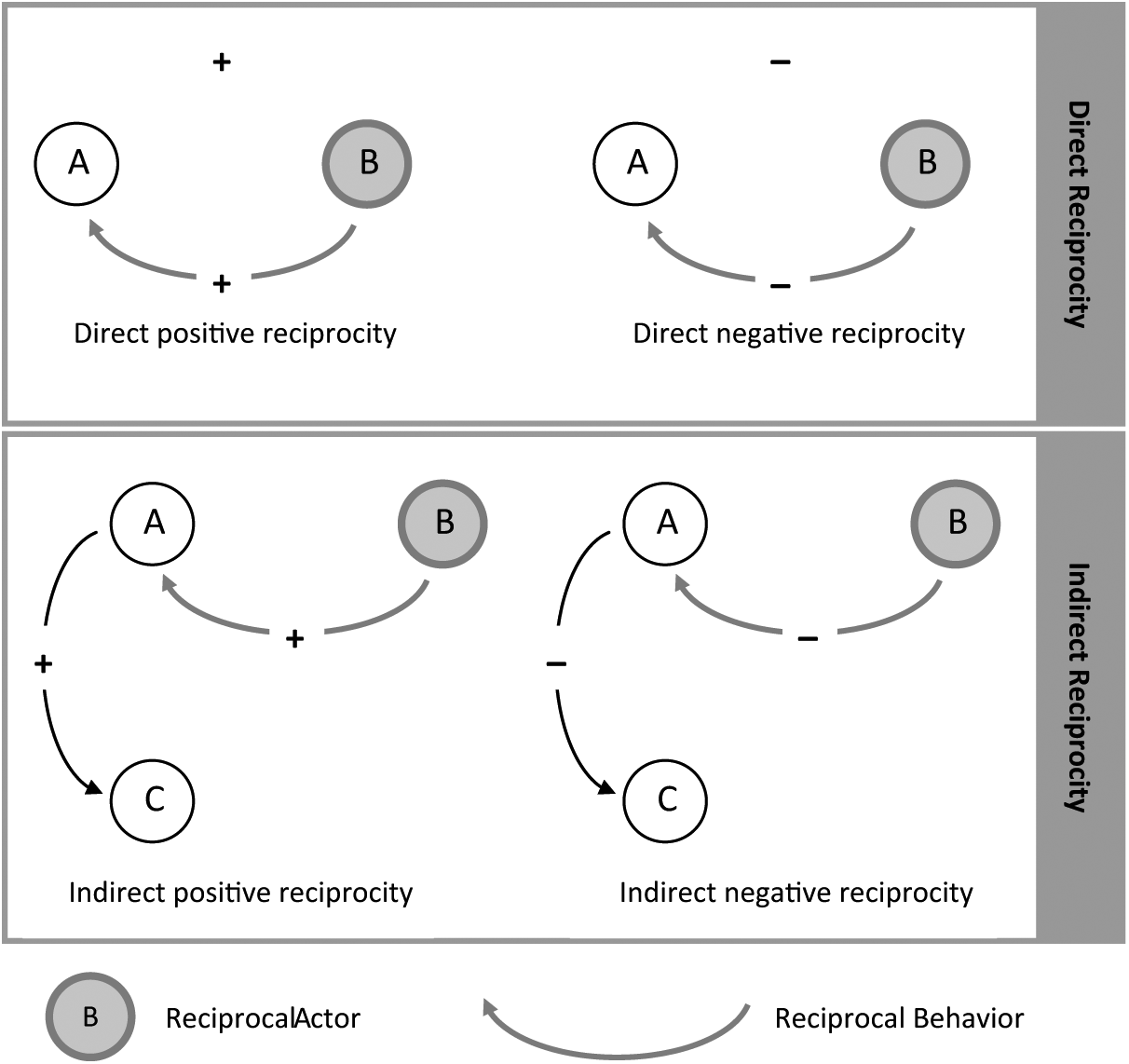
Different forms of reciprocal behavior.
Fairness Norms Trigger Reciprocal Behavior
Reciprocal behavior is norm-driven behavior. Whether reciprocal actors behave in a friendly or unfriendly way depends on how they perceive their counterparties’ behavior in the light of some underlying and implicit norms, beliefs, and rules. The literature on reciprocal behavior from experimental economics has coined the notion of fairness norms to operationalize these norms and rules. In this context, three types of fairness norms (distributional, intentional, and procedural) have been discussed and empirically tested. A similar well-established taxonomy that distinguishes distributive, procedural, and interactional justice exists in the field of social psychology (Colquitt, Wesson, Porter, Conlon, & Ng, 2001). However, the argument in this article is largely based on evidence from experimental economics and refers to the taxonomy of fairness norms used there. Such socially constructed fairness norms are at the base of reciprocal behavior as they provide the rationale behind perceptions of friendly and unfriendly behavior.
Norms for distributional fairness judge the fairness of a transaction on the basis of the material outcome of the transaction (Bolton & Ockenfels, 2000; Fehr & Schmidt, 1999). Actors thus perceive the behavior of transaction partners as fair, if this behavior contributes to achieve a final distribution that is perceived as fair. For this purpose, reciprocal actors compare their own outcome to the outcome of their peers. Thus reciprocal actors take into account not only their own outcome but also the situation of others.
Intentional fairness norms refer to the perceived or assumed behavioral motivation of actors. The behavior of reciprocal actors is triggered by their perception of the motivation of their counterparts (Falk et al., 2003; McCabe, Rigdon, & Smith, 2003). As reciprocal actors cannot directly observe the behavioral type or behavioral intentions of other subjects, reciprocal actors form beliefs about the intentions behind the actions of their transaction partners (Levine, 1998; Rabin, 1993). Reciprocal actors build such beliefs about the friendliness or fairness of behavioral intentions on the set of different alternatives available to actors.
Procedural fairness norms refer to how a decision is made and assess the fairness of the methods used to plan and implement decisions (Brockner, 2002; Konovsky, 2000). Reciprocal actors who follow norms for procedural fairness are willing to bear the cost of sanctioning transactions that result from procedures they perceive as unfair. However, in contrast to intentional fairness norms, procedural norms refer to the means rather than to the goals of organizational behavior.
However, none of the three conceptions of fairness can explain the full range of empirical observations of reciprocal behavior derived from behavioral experiments. Similar to competing perceptions of legitimacy, different fairness norms coexist and compete against each other (Bolton, Brandts, Katok, Ockenfels, & Zwick, 2002; Fehr & Falk, 2002a). Experimental evidence shows that strategic and institutional factors influence the type and specific content of the fairness norms that apply to specific situations (Bolton, Brandts, & Ockenfels, 2001; Frey & Bohnet, 1995).
The empirical findings on the fairness perceptions of reciprocal actors offer some fruitful insights into the determinants and strategic settings that influence the formation of normative judgments among stakeholders. In particular, the findings provide promising starting points for developing strategies for stakeholders to influence the formation of normative judgments in favor of their own expectations toward companies.
Reciprocal Behavior and the Enforcement of Prosocial Corporate Behavior
The experimental economics literature on reciprocal behavior argues that fairness perceptions trigger reciprocal reactions. In this context, one of the most important empirical findings is the power of reciprocity to enforce social norms (Fehr & Gächter, 2000b). In sociology, social norms represent informal rules that specify what actions are regarded by a set of persons as proper or correct, or improper or incorrect. […] Norms are ordinarily enforced by sanctions, which are either rewards for carrying out those actions regarded as correct or punishments for carrying out those actions regarded as incorrect. (Coleman, 1990, p. 242)
Thus social norms specify socially desirable behavior. According to Coleman (1990), social norms occur whenever an action creates a positive or negative externality that cannot be redressed by transferable rights.
As pointed out above, normative stakeholder demands for prosocial corporate behavior often correspond to externalities so that profit-oriented companies typically see no incentives to obey these demands (Mackenzie, 2004; Rowley & Berman, 2000). However, empirical evidence from experimental economics suggests that there may be a considerable cost of norm-breaching behavior for self-interested actors such as companies due to the behavior of reciprocal actors. Reciprocal actors punish those who do not conform to societal expectations as prescribed by social norms because this nonconformity is perceived as unfriendly (resulting in negative reciprocal sanctions). On the other hand, reciprocal actors may reward corporate behavior that is in line with a social norm (i.e., positive reciprocal sanctions). Empirical evidence from experimental economics shows that, when given the opportunity, reciprocal actors make extensive use of sanctions and bear the costs that are associated with this sanctioning even at a net cost (Andreoni, Harbaugh, & Vesterlund, 2003; Fehr & Gächter, 2000a).
One of the most important implications of these findings is that through their reciprocal behavior, reciprocal actors can translate societal concerns into economic incentives. Evidence from experimental economics shows that as soon as the costs due to negative reciprocal sanctions (punishments) or the benefits that accrue from positive reciprocal sanctions (rewards) exceed the costs of prosocial behavior, it becomes economically rational for self-interested actors to obey social norms. Reciprocal sanctioning can thus alter the incentives for selfishly motivated actors in favor of complying with social norms (Fehr & Gächter, 2000b).
Reciprocal Stakeholder Behavior
This section develops the notion of reciprocal stakeholder behavior based on the insights from experimental economics on reciprocal behavior and the enforcement of prosocial corporate behavior. The author argues that reciprocal stakeholder behavior provides a promising avenue to explain and understand the formation and implementation of normative stakeholder demands for prosocial corporate behavior. In the following material, the author applies the notion of reciprocal behavior from experimental economics to stakeholder behavior to develop a series of propositions for a better understanding of why and when companies behave in a prosocial way beyond legal obligations. Reciprocal stakeholder influence in resource exchange relations is discussed with regard to two separate aspects already identified above. First, the section addresses the question of why stakeholders act to implement normative demands for prosocial corporate behavior. This question ultimately refers to the behavioral motives behind stakeholder influence and—particularly in the context of reciprocal behavior—the formation of normative stakeholder demands for prosocial corporate behavior. Such norms trigger reciprocal stakeholder behavior. Second, the section refers to the question of how reciprocal stakeholders influence companies in favor of prosocial behavior and when such influence is successful. For this purpose, the author develops further the conditions and influence factors that determine the success of reciprocal stakeholder sanctions.
Reciprocity as a Behavioral Motive of Stakeholder Action
To address the question why reciprocal stakeholders act to influence companies in favor of prosocial behavior, the section first defines reciprocal stakeholder behavior. Subsequently, the section discusses the formation of normative stakeholder judgments based on fairness norms as such normative judgments trigger reciprocal behavior.
Definition of reciprocal stakeholder behavior
Reciprocal stakeholders judge corporate behavior based on their normative beliefs of what constitutes prosocial corporate behavior by applying different fairness norms. Stakeholders’ normative perceptions of corporate conduct trigger reciprocal stakeholder sanctions. Negatively reciprocal stakeholder behavior punishes corporate conduct stakeholders deem unfair or unfriendly, whereas positively reciprocal stakeholder behavior rewards corporate conduct that stakeholders perceive as fair, friendly, legitimate, or desirable. Most importantly, reciprocal stakeholders bear the costs of such positive or negative reciprocal sanctions even if they cannot expect any future material benefit for themselves from it. From the firm’s perspective, reciprocal stakeholder behavior directly translates into economic effects. By implementing reciprocal sanctions, stakeholders can either raise corporate costs of norm breaching behavior of companies (through negative reciprocal sanctions) or induce corporate benefits of prosocial corporate conduct (through positive reciprocal sanctions).
Applying reciprocity to stakeholder behavior presupposes that reciprocal motives can be found among any stakeholder group, that is, independently from the role and status of stakeholders vis-à-vis a company as to whether they are direct or indirect stakeholders. For example, increased employee satisfaction and retention (Riordan, Gatewood, & Bill, 1997) or successful recruitment of high profile applicants and employees (Greening & Turban, 2000; Turban & Greening, 1997) due to societal commitment provide good examples where positively reciprocal stakeholder behavior can reinforce prosocial conduct of companies. Consumer boycotts following perceived social misconduct of companies (Baron, 2002; Zalka, Downes, & Paul, 1997) can be explained by indirect negative reciprocal stakeholder behavior, whereas there are several examples where consumers reward socially desired product features or production methods by accepting higher prices or by a growing demand (Handelman & Arnold, 1999), which can be explained by indirect positive reciprocity of customers.
All forms of reciprocal stakeholder behavior have in common that they are based on and triggered by perceptions and normative judgments of corporate social conduct. Therefore, the following material addresses the formation of normative stakeholder demands by reciprocal stakeholders. These reflections serve for a better understanding why stakeholders engage in reciprocal sanctions in resource exchange relations with companies in favor of prosocial corporate conduct.
Reciprocal fairness judgments and the formation of normative stakeholder demands
The findings from experimental economics on reciprocal behavior offer some fruitful insights into how stakeholders form normative demands for prosocial behavior. As described above, fairness judgments of reciprocal actors are based on different fairness norms and trigger reciprocal action. The empirical results furthermore show that the strategic settings of an interaction influence which fairness norms are applied and how fairness judgments are formed in a specific situation. As introduced above, one can distinguish between distributional, intentional, and procedural fairness norms. Numerous experimental behavioral games have shown the relevance of all three types of fairness norms. In contrast to universal fairness norms that have been proposed to justify corporate responsibilities vis-à-vis stakeholders (Phillips, 1997, 2003), fairness norms as discussed in experimental economics are at the basis of normative stakeholder perceptions of corporate conduct that trigger reciprocal action.
The use of different fairness norms provides an important indication of the logic behind normative stakeholder demands for corporate prosocial behavior (analogously Falk, Fehr, & Fischbacher, 2001). In this context, the literature on the empirical findings from experimental economics identifies the choice of reference points and the behavioral scope as the most influential aspects regarding the formation of fairness judgments.
All theories of reciprocity follow the idea that actors compare a situation with a set of reference actors and reference situations (Fehr & Schmidt, 2000b). Stakeholders compare their current situation to other actors’ situations or similar situations to form their fairness judgments. In different situations, reciprocal actors refer to different reference points, that is, different actors and/or situations can serve for comparing and judging a situation (Fehr & Fischbacher, 2002; Kahneman et al., 1986). The choice of reference points is furthermore embedded into a wider historical, cultural, and social framework (Hayakawa, 2000). Reference points can vary in different respects. When forming their normative judgments stakeholders compare a company’s behavior to situations in the past or in other countries or other sectors, to established behavior in some peer group or to the behavior of pioneers. Furthermore, normative judgments can refer to different aspects of corporate behavior. More specifically, these judgments can refer to what a company does, through whom, and by which means (Dowling & Pfeffer, 1975; Scott, 1991; Suchman, 1995). Such reference points thus provide important insights into how stakeholders form normative judgments under different conditions. At the same time, the choice of appropriate reference points represents a strategic starting point to strengthen reciprocal stakeholders’ viewpoints and normative judgments of corporate behavior within the stakeholder network.
Furthermore, the empirical results in experimental economics have shown that the behavioral scope of corporate action plays an important role in fairness judgments of reciprocal actors (Andreoni, Brown, & Vesterlund, 2002; Brandts & Solà, 2001; Falk et al., 2003). In other words, when stakeholders believe that viable alternatives to the actual corporate behavior exist, stakeholders use these alternatives to underline and illustrate the demands and claims toward a company. Reciprocal stakeholders thus emphasize alternative behavioral options for corporate behavior to underpin their own normative demands of how a company should behave. However, in this context the empirical findings also show that reciprocal actors take into account the cost of behavioral alternatives (Bolton & Ockenfels, 2002; Brandts & Solà, 2001). Thus if companies succeed in demonstrating that behavioral alternatives involve high costs, then corporate behavior is less questioned.
In the process of forming normative stakeholder demands, different and sometimes competing normative judgments may occur. The question which views shape and dominate in the process of forming normative stakeholder demands within the network of direct and indirect stakeholders is thus crucial. Given that normative stakeholder demands often go beyond the individual benefits and affectedness of stakeholders, building stakeholder coalitions around some shared normative judgments requires strong stakeholder demands to dominate. The findings from experimental economics provide useful insights into which normative judgments of corporate behavior dominate under different conditions. The findings on the choice of reference points and the perceived behavioral scope lead toward three propositions on the dominance of the three different types of fairness norms.
Distributional fairness norms are concerned with a fair distribution of the benefits and harms that a company’s activities cause. Reciprocal stakeholders mainly use distributional fairness norms when the effects of corporate behavior are obvious and uncontested, that is, stakeholders perceive little or no scope for alternative corporate behavior in a given situation. When applying distributional fairness norms, stakeholders thus form their demands toward companies around the distribution of the effects of corporate activities among different constituents. Distributional fairness judgments thus depend on reference points such as the distribution of consequences of corporate behavior in comparable situations in the past, in other countries, or sectors. Established standards in some peer group or the behavior of pioneers may also serve as reference points to judge the distribution of the consequences of corporate behavior. Strong normative stakeholder demands based on distributional fairness norms thus depend on a dominant reference point referring to the distribution of outcomes of corporate behavior and the absence of viable behavioral alternatives for corporate behavior. This reasoning leads to the following proposition:
Proposition 1a: Distributional fairness norms will dominate normative stakeholder demands if there are widely accepted reference points for the judgment of the distribution of the consequences of corporate behavior and stakeholders perceive no viable alternatives to actual corporate behavior.
Intentional fairness norms refer to the fairness, legitimacy, and appropriateness of the assumed motivation behind corporate behavior. To judge the intentions behind corporate behavior—which are not directly observable—stakeholders compare the actual corporate behavior to different alternative behavioral options of the company. If stakeholders apply intentional fairness norms, stakeholders judge the appropriateness and legitimacy of corporate behavior in the light of possible behavioral alternatives. Consequently, stakeholders’ claims arise around the perceived motives behind corporate behavior. Intentional fairness judgments thus depend on the perceived behavioral scope of corporate action. As soon as stakeholders believe that there are viable alternatives to the actual corporate behavior that are more in line with prosocial expectations, stakeholders activate intentional fairness norms. This effect is particularly strong if there are low-cost alternatives to the actual corporate behavior. Such judgments are based on reference points that demonstrate the feasibility of more prosocial behavioral alternatives for companies as for instance in other countries, other sectors, or by pioneer companies. This reasoning leads into the following proposition:
Proposition 1b: Intentional fairness norms will dominate normative stakeholder demands if there are widely accepted, more prosocial behavioral alternatives for actual corporate behavior.
Procedural fairness norms address the appropriateness, legitimacy, and fairness of the methods a company uses to plan and implement decisions. Stakeholders apply procedural fairness norms in such situations where they see no viable alternatives to corporate behavior. With procedural fairness norms stakeholder claims develop around the question how and to which degree different groups that are affected by corporate behavior can participate in or influence corporate decision making. Other important issues of stakeholder claims in this context relate to the transparency and credibility of corporate behavior toward affected stakeholders. Procedural fairness judgments thus depend on reference points defined by how actors affected by the outcomes of corporate behavior could participate in the decision making in comparable situations in companies in other sectors or countries or by pioneer companies. Procedural fairness norms lead to the following proposition:
Proposition 1c: Procedural fairness norms will dominate normative stakeholder demands if there are widely accepted reference points for the participation of affected actors and if stakeholders perceive no viable alternatives to actual corporate behavior.
However, understanding how stakeholders form normative judgments of corporate behavior is not sufficient to explain corporate responses to normative stakeholder demands for prosocial corporate behavior. Rather, only sufficiently strong stakeholder action will strategically influence companies to adopt these normative demands. In what follows, the author develops how stakeholders can implement normative demands vis-à-vis companies through reciprocal behavior.
The Implementation of Normative Stakeholder Demands Through Reciprocal Behavior
Reciprocity as a strong mechanism to implement social norms (Fehr & Gächter, 2000b) becomes particularly relevant when companies face normative stakeholder demands for prosocial corporate behavior. The material below addresses the question of how reciprocal stakeholders try to influence companies in favor of prosocial behavior and when such influence is successful. Thus the focus is on how and under which conditions reciprocal stakeholder behavior can translate normative stakeholder demands into economic incentives for companies.
As defined above, reciprocal stakeholders will reward companies that they perceive to act in a desirable way and punish companies that they perceive to act in an undesirable way even if they cannot expect any benefits for themselves from such behavior (Fehr et al., 2002; Fehr & Gächter, 2000a; Gintis, 2000). Negative reciprocal sanctions (i.e., punishments) cause costs for companies, whereas positive reciprocal sanctions (i.e., rewards) induce benefits for companies. Following economic rationality, profit-oriented companies will only adopt normative stakeholder demands for prosocial behavior in the presence of economic incentives to do so. Companies often see no incentive to bear the costs of obeying such stakeholder demands. Companies do not benefit (sufficiently) from their implementation as such demands mostly put forward more general societal or third-party interests.
However, this situation can be changed through reciprocal stakeholder sanctions (i.e., though actors B in Figure 1) in two ways. (a) Through negatively reciprocal stakeholder sanctions, opposing normative stakeholder demands can become more costly for companies than to respond to such demands. (b) The benefits that accrue to companies due to positively reciprocal behavior can be higher than the costs of to the prosocial behavior. In either of the two cases, the incentive structure for companies regarding normative stakeholder demands for prosocial corporate behavior can change through reciprocal stakeholder behavior. The influence of stakeholder reciprocity on economic incentives for firms thus depends on the expectations of corporate decision makers on the effects of reciprocal stakeholder sanctions. Such sanctions are strong enough to alter the incentive structure for companies in favor of normative stakeholder demands if managers expect that (a) either the costs due to negatively reciprocal stakeholder behavior or (b) the benefits due to positively reciprocal stakeholder behavior exceed the expected costs of the demanded prosocial behavior.
This analysis leads to the two following fundamental propositions for the implementation of normative stakeholder demands for prosocial corporate behavior through reciprocal stakeholder behavior:
Proposition 2a: Reciprocal stakeholders can alter the incentive structures for companies so that companies have the economic incentive to comply with normative stakeholder demands for prosocial behavior if the expected costs due to negatively reciprocal stakeholder sanctions exceed the expected costs of the demanded prosocial behavior.
Proposition 2b: Reciprocal stakeholders can alter the incentive structures for companies so that companies have the economic incentive to comply with normative stakeholder demands for prosocial behavior if the expected benefits due to positively reciprocal stakeholder sanctions exceed the expected costs of the demanded prosocial behavior.
By implication, reciprocal stakeholders can influence companies to respond to normative stakeholder demands in two ways: Either through sufficient rewards of corporate compliance with normative stakeholder demands (i.e., positive stakeholder reciprocity) or through sufficient punishing of corporate noncompliance with normative stakeholder demands (i.e., negative stakeholder reciprocity).
Numerous experimental games show that successful reciprocal sanctioning depends on the strategic settings of a situation (Fehr & Gächter, 2000b). More specifically, the implementation of normative stakeholder demands through reciprocal behavior requires (a) scope and possibility for reciprocal sanctions, and (b) effective sanctions that are sufficiently important to persuade self-interested actors to comply with social norms (Fehr & Gächter, 1998; Güth & van Damme, 1998; Kagel & Wolfe, 2001).
Scope and possibility of reciprocal stakeholder sanctions
As introduced above, reciprocal stakeholder influence builds on and further develops interest-based stakeholder influence theory (Frooman, 1999) by introducing the element of behavioral motives behind stakeholder action. As developed above, stakeholders motivated by reciprocity provide their resources depending on their fairness judgments of corporate behavior. Evidence from experimental economics suggests that the possibility of such reciprocal behavior in company–stakeholder relations depends on the completeness of contracts and competition between stakeholders. Completeness of contracts and competition thus constitute two propositions on the scope and possibility of reciprocal stakeholder sanctions.
The first condition for the possibility of reciprocal stakeholder sanctions in resource exchange relations between companies and stakeholders refers to the completeness of contracts. If the resource exchange relation between a company and their stakeholders is fully specified by complete contracts (Jones, 1995), there is no scope for reciprocal stakeholder sanctions (Fehr & Falk, 2002b). Implicit and incomplete contracts differ from explicit and complete contracts in that they “do […] not fully specify the contracting parties’ duties and claims in every circumstances that may arise” (Fehr & Tyran, 1997, pp. 139-140). Thus incomplete contracts leave leeway for discretion in decision making and therefore also for reciprocal sanctions (Fehr & Falk, 2002b). Under real-world conditions, often not all obligations that arise in stakeholder relations can be unambiguously specified in a binding contract. Consequently, many contracts are incomplete. In addition, as reciprocal stakeholder sanctions are a response to perceived corporate behavior, obviously, the possibility of sanctions requires at least a two-stage interaction between stakeholders and the company. Two-stage interactions occur more often in long-term than in short-term stakeholder relationships.
Proposition 3a: Reciprocal stakeholders only have the scope and possibility for reciprocal sanctions if the contractual relationship between stakeholders and companies is not characterized by fully specified contracts. The less resource exchange relations between stakeholders and companies are specified, the higher the scope for reciprocal behavior of stakeholders.
Competition among resource-providing stakeholders can make reciprocal sanctions futile. Thus the second condition for the possibility of reciprocal stakeholder sanctions is that the resources of reciprocal stakeholders cannot easily be substituted by other, nonreciprocal stakeholders. If competing stakeholder groups that are motivated by self-interest can easily substitute the resources of reciprocal stakeholders, reciprocal actors have no possibility to influence corporate conduct through reciprocal sanctions. Empirical evidence from experimental economics suggests that high substitutability due to competition among actors can cancel out reciprocity (Fehr & Falk, 1999; Schotter, Weiss, & Zapatar, 1996), especially if the resources exchanged are highly standardized and fully specified concerning their quality and quantity (Brown et al., 2002; Fehr & Fischbacher, 2002). In contrast, if the quality and quantity of the resources provided by reciprocal stakeholders are not fully specified or resources are highly specialized, reciprocal sanctions withstand competition.
Proposition 3b: If the resource that reciprocal stakeholders provide to a company is highly standardized reciprocal sanctions can be canceled out by competition, as other stakeholders can easily substitute reciprocal actors.
Effectiveness of reciprocal stakeholder sanctions
The possibility for reciprocal sanctions is, however, not sufficient for a successful implementation of normative stakeholder demands for prosocial corporate behavior. In addition, reciprocal sanctions have to be effective. The empirical findings on reciprocity show that the effectiveness of reciprocal sanctions largely depends on information, the extent of sanctions, and the degree of social interaction. The availability of information on reciprocal traits and the different possibilities to increase extent of sanctions and social interaction lead to overall five propositions on the effectiveness of reciprocal stakeholder sanctions.
First of all, the effectiveness of reciprocal sanctions requires that reciprocal actors and their reciprocal traits are observable for others (Fehr & Schmidt, 2000a; Sethi & Somanathan, 2003). Companies need to have sufficient information on the existence of reciprocal stakeholders and their willingness to implement reciprocal sanctions even at a net cost. If companies have no such sufficiently reliable information, they have no reason to expect reciprocal sanctions with sufficient probability. As reciprocal traits are not observable per se, the effectiveness of reciprocal sanctions depends on whether reciprocal stakeholders succeed to credibly signal and communicate their willingness and determination to behave reciprocally (Bolton, Katok, & Ockenfels, 2001).
Proposition 4a: Reciprocal sanctions will only be effective if companies can observe reciprocal stakeholders and their behavioral types through signaling or communication.
A key determinant of effective reciprocal behavior is the extent of reciprocal sanctions. To be effective reciprocal sanctions must be strong enough to outweigh the costs that accrue to companies when they respond to normative stakeholder demands. This condition can be reached either by raising the cost of companies through negative reciprocal stakeholder sanctions or by providing sufficient benefits to the company through positive reciprocal stakeholder sanctions (see Propositions 2a and 2b above). In contrast, if the material effect of reciprocal sanctions remains too low, economically rationality will still lead companies to resist normative stakeholder demands (analogously Rabin, 1997). Stakeholders can influence the extent of sanctions in two ways. On one hand, the more stakeholders participate and cooperate, the more easily sanctioning reaches a critical level (Fehr & Fischbacher, 2003). Empirical evidence shows that the lower the costs of sanctioning, the more reciprocal actors are willing to engage in sanctioning (Falk, Fehr, & Fischbacher, 2000). On the other hand, reciprocal stakeholders can focus on resources that are most critical for companies to increase the extent of reciprocal sanctions. These two possibilities reflect the distinction of stakeholder influence based on mass participation and based on elite participation (den Hond & de Bakker, 2007).
Proposition 4b: The extent of reciprocal sanctions increases the higher the number of actors sanctioning corporate behavior reciprocally.
Proposition 4c: The extent of reciprocal sanctions increases if reciprocal sanctions focus on critical resources.
Finally, experimental evidence on reciprocal behavior shows that the degree of social interaction has an important influence on the effectiveness of reciprocal sanctions in several ways. A high degree of social interaction between different reciprocal stakeholders may increase the effectiveness of reciprocal sanctions (Hoffman, McCabe, & Smith, 1998). In particular, the effectiveness of reciprocal sanctions can multiply if different reciprocal stakeholders coordinate their reciprocal sanctions through communication. This coordination refers to both increasing the number of sanctioners as well as the resource exchange situations that stakeholders used for their sanctioning. Finally, social interaction can provide an additional sanctioning mechanism through social disapproval and symbolic sanctions in addition or alternatively to material sanctions (den Hond & de Bakker, 2007; Fehr & Falk, 2002a; Frey & Bohnet, 1995; Gächter & Fehr, 1999; Gächter, Fehr, & Kment, 1996).
Proposition 4d: The extent of reciprocal sanctions increases if reciprocal actors coordinate their sanctions through communication.
Proposition 4e: The extent of reciprocal sanctions increases if reciprocal sanctions include social sanctions.
As pointed out in the experimental economics literature on reciprocal behavior, the interaction between self-interested and reciprocal actors provides a key to explain why and under which conditions it is economically rational for self-interested actors to obey social norms (Fehr & Gächter, 1998; Fehr & Schmidt, 2000b; Sethi & Somanathan, 2003). Such an alteration of economic incentives does not necessarily require the actual implementation of reciprocal sanctions. In many cases, the credible threat and, as a consequence, the anticipation of effective sanctions will be sufficient (Andreoni et al., 2003; Fehr & Gächter, 2000a). Applied to company–stakeholder relationships, the argument recurs to the question under which conditions reciprocal stakeholders are in a position where they can modify the incentives structure through reciprocal sanctions so that companies obey normative stakeholder demands out of fully self-interested reasons.
Discussion of Main Implications
The model of reciprocal stakeholder behavior is based on the empirical evidence that a large fraction of actors is driven by reciprocity and not by self-interest. By applying the findings from experimental economics to company–stakeholder interactions the author argues that, depending on the strategic and institutional settings of a situation, reciprocal stakeholders can alter the incentives for companies in favor of responding to normative stakeholder demands for prosocial corporate behavior.
The notion of reciprocal stakeholder behavior as developed in this article leads to a number of promising implications for research and theory. Most importantly, applying reciprocity as developed on the basis of the empirical findings of experimental economics to stakeholder behavior provides new insights into how and under what conditions normative stakeholder demands for prosocial corporate behavior can be successfully implemented. The findings illustrate how social expectations based on normative judgments can act as the leading principle of stakeholder behavior in resource exchange relations with companies. The insights stakeholder reciprocity provides in this context are twofold.
First, stakeholder reciprocity helps to better understand how stakeholders form normative judgments of corporate behavior based on fairness norms. In this context, the findings are highly compatible with legitimacy theory and neo-institutional theory. However, while legitimacy theory mainly concentrates on explaining different forms and aspects of corporate legitimacy, reciprocal stakeholder behavior provides additional insights into the factors that influence the formation of legitimacy and fairness judgments. In particular, reciprocal stakeholder behavior clarifies the influence of different institutional and strategic settings on the formation of stakeholder expectations toward companies. Eventually, the insights from empirical research on reciprocal behavior on fairness judgments thus provide a better understanding on why reciprocal actors act as fairness judgments trigger reciprocal action.
Second, reciprocal stakeholder behavior shows how and under which conditions stakeholders can implement normative demands through reciprocal sanctions. Stakeholder reciprocity shows how normative stakeholder expectations can affect resource exchange relations with companies. Based on insights from resource dependence theory and stakeholder influence in resource exchange relations, the application of reciprocity to stakeholder behavior thus provides a powerful explanation of stakeholders’ influence on the incentive structure for profit-oriented companies in favor of normative stakeholder demands for prosocial corporate behavior. The article develops the conditions under which effective reciprocal stakeholder sanctions are possible and effective. Reciprocal stakeholder behavior thus contributes to a better understanding of “conditions that generate firm efforts to respond to societal interests” (Welcomer, 2002, p. 251) and thus provides a contingent perspective (Barnett, 2007; Rowley & Berman, 2000) in analyzing why companies adopt some normative stakeholder demands and not others. This helps to better understand the problem of explaining voluntary prosocial corporate behavior beyond legal obligations.
As a result, reciprocal stakeholder sanctions represent a behavioral pattern that translates normative stakeholder demands into economic incentives for companies. In this context, the reader should note that reciprocal stakeholder behavior does not require that companies share the same normative views of their stakeholders or are convinced by a moral argument. Rather, reciprocal stakeholder behavior can provide economic incentives for companies to respond to stakeholder expectations than to oppose them. In other words, reciprocal sanctions can persuade companies to obey normative stakeholder demands out of fully self-interested motives. This puts the question if “socially responsible corporate behavior [is] purely voluntary and dependent of having honorable people in charge, or [if] there is something more to it” (Campbell, 2007, p. 952) into a different perspective. The author provides an explanation of prosocial corporate behavior that does not require a shift away from standard assumptions about the motives of corporate behavior.
Implications for Stakeholder Theory
This article represents a fundamental shift from the general assumption of self-interested stakeholder behavior to a more heterogeneous distribution of different behavioral types among stakeholders. This shift implies new types of interaction between profit-oriented companies and different behavioral types of stakeholders. As such, the argument offers some fruitful implications for further developing stakeholder theory and the analysis of company–stakeholder relations. Stakeholder theory as a genre of management theory provides a framework or a set of ideas that can “function in an array of settings and serve different purposes” (Parmar et al., 2010, p. 406). The key point relevant to the present article is that “stakeholder-based reasoning provides a practical motivation for firms to act responsibility” (Parmar et al., 2010, p. 418) in response to stakeholder demands.
First, because the argument rests on the notion of social embeddedness of economic activity, the interaction between stakeholders and companies on social issues is obviously the first and foremost areas to derive implications for further research. Reciprocal behavior provides a fundamental shift in perspective within the stakeholder literature of how to analyze and explain stakeholder behavior and firm’s strategies in response to stakeholder demands for prosocial corporate behavior beyond regulation. This shift in perspective suggests reviewing the recent developments and discussions in stakeholder theory building (Donaldson, 1999; Freeman, 1999; Frooman, 1999; Jawahar & McLaughlin, 2001; Jones & Wicks, 1999; Rowley & Moldoveanu, 2003; Winn, 2001) through the lens of reciprocal stakeholder behavior. Further application and analysis of reciprocal stakeholder behavior could provide an important avenue to systematize and clarify the relation between instrumental and descriptive approaches in stakeholder theory (Jawahar & McLaughlin, 2001; Jones, 1995) on one hand and normative approaches (Donaldson & Preston, 1995; Phillips, 1997) on the other. The notion of reciprocal stakeholder behavior may help to overcome the controversy between strategic and normative approaches in the stakeholder literature. Reciprocal stakeholder behavior explains how and under which conditions normative stakeholder demands for prosocial corporate behavior can become strategically relevant for corporate decision making.
In addition, applying reciprocity to stakeholder behavior provides an important empirical and conceptual foundation of the stakeholder approach based on behavioral economics. This foundation will help to further establish the stakeholder model. At the same time, the notion of reciprocal stakeholder influence as proposed in this article is limited as the argument is restricted to one single alternative behavioral model, namely, reciprocity. In this context, future research should not onlybe restricted to further analyzing reciprocal stakeholder behavior but should also address other behavioral types. Strong empirical evidence from experimental economics suggests that self-interested and reciprocal behavior may not be the only types of motivation behind human behavior (Bowles & Gintis, 2000; Brandts & Schram, 2001; Fehr & Fischbacher, 2002; Fehr & Gächter, 1998; Sethi & Somanathan, 2003). Thus other behavioral types than reciprocal stakeholders and self-interested corporate decision makers may exist. In this context, further understanding of reciprocal stakeholder behavior obviously requires a finer grained analysis in particular with respect to the different levels of stakeholder behavior on the individual and/or group level (Rowley & Moldoveanu, 2003; Winn, 2001). Another question that should be addressed by future research in this context is which reciprocal stakeholders act. The author undertakes no distinction or characterization of reciprocal stakeholders with regard to additional criteria such as power or connectedness.
For the purpose of this article, the argument applies behavioral motive of reciprocity only to some stakeholders while the assumption of self-interested motives is held for other stakeholders as well as corporate actors. The reciprocal stakeholder behavior model explicated in this article is thus limited. In particular, the author treats all companies as if profit-oriented entities. Keeping the standard assumption of self-interested corporate behavior represents a modeling choice because this article intends to show that stakeholder reciprocity can explain corporate compliance with normative stakeholder demands for prosocial corporate behavior even under most adverse conditions, that is, without assuming any corporate motives (other than profit seeking) in favor of doing so. This aspect seems particularly important in the light of recurring voices in the corporate social responsibility and stakeholder debate that posit that the responsibility of companies should not go beyond profit seeking (e.g., Jensen, 2002). Whether this assumption is a conservative choice or not is of course subject to well-intended criticism; and the point is undoubtedly arguable. This modeling assumption implies that stakeholders in a particular firm that are business entities (e.g., banks, suppliers, and corporate customers) are also profit-oriented and thus—at least as organizational actors—do not belong to the set of normative stakeholder demands being studied here. The relevant stakeholders for the present argument must be nonbusiness entities (e.g., nongovernmental organizations) or individuals (e.g., customers, consumers, employees, or externality impactees). However, in this context, stakeholders can adopt different or multiple roles with personal motives and interests potentially competing with certain institutional roles and duties. Business employees are arguably the most relevant category, as working for profit-oriented entities and ask making prosocial demands through reciprocal behavior within those entities. Further research should relax this limiting assumption and explore the role and implications of reciprocal motives of—at least some—corporate decision makers and other stakeholder demands than normative ones. In this context, the question how reciprocally motivated managers deal with potential tensions between their professional duties and their normative beliefs seems particularly interesting.
A full theory of corporate social responsibility and reciprocity would involve incorporating both prosocial concerns for all actors (corporate and other entities, and individuals including business executives and directors) and reciprocity motives by all those actors. But such expanded motives and behaviors are beyond the scope of the present study, even if urgently desirable in a full theory of corporate social responsibility and stakeholder reciprocity. The limited model here explores prosocial demands by stakeholders and corporate responses due to economic incentives (positive and negative) generated by those stakeholders’ behavior. The approach is thus limited to the analysis of normative stakeholder demands for prosocial corporate behavior and corporate response to such demand. A full theory is beyond the present article, which is a first step in that direction. The object of the present article is to help promote a deeper conversation among scholars about the importance of reciprocity and the findings of behavioral or experimental economics in that regard.
Conceptually, this article introduces behavioral motives as a new element in the analysis of stakeholder influence. The author argues and shows that explicitly addressing different behavioral motives such as reciprocity provides further understanding of the effectiveness of stakeholder influence. Thus further research should adopt behavioral motives as a specific element in the analysis of company–stakeholder interactions. Recently, the notions of interest and identity have been conceptualized as a driver of stakeholder action (Rowley & Moldoveanu, 2003). In this context, the questions if and to which degree behavioral motives such as reciprocity can serve as a common identity among stakeholders or can define or group common interests deserves closer examination. This becomes even more interesting as the fairness judgments that have been found to trigger reciprocal behavior depend to a considerable degree on the social, cultural, and ideological environment of stakeholders.
Implications for Stakeholder Influence Strategies
In the context of stakeholder influence strategies in favor of prosocial corporate behavior, the notion of reciprocal stakeholder behavior links approaches based on resource dependence theory (Frooman, 1999) with the notion of social embeddedness of economic action as brought forward by legitimacy theory and neo-institutionalism (Campbell, 2007; Granovetter, 1985; Oliver, 1991, 1996; Suchman, 1995). Most importantly in this context and based on the empirical findings from experimental economics, the article develops the conditions under which reciprocal stakeholder sanctions are possible and effective. Future research should thus develop and test stakeholder influence strategies based on reciprocity.
Reciprocal stakeholder behavior allows one to address the strategic situation of implementing normative stakeholder demands for prosocial corporate behavior. Both direct and indirect stakeholders can hold such normative demands toward corporate conduct. The insights from experimental economics on the use of fairness norms in different situations offer a promising starting point for developing strategies for how to dominate the communicative process of forming normative demands within the stakeholder network. In particular, this may also offer new perspectives to analyze the influence strategies indirect stakeholders, that is, stakeholders who do not exert control over resources, could use to facilitate reciprocal sanctions in favor of their demands and claims.
One of the most important aspects in the context of the implementation of normative stakeholder demands refers to the question of why direct stakeholders commit themselves to influencing corporate behavior based on normative grounds, that is, why direct stakeholders pressure companies in favor of prosocial corporate behavior that will rather benefit third parties or society in general than themselves. According to the notion of indirect reciprocity, reciprocal actors also support fairness concerns that refer to third parties. Reciprocal stakeholder motives may thus be essential in this context.
A particularly important distinction between tit-for-tat strategies and reciprocal strategies comes to the fore in this context. Unlike actors that follow tit-for-tat strategies (Axelrod, 1984) that have already been applied to stakeholder theory (Hill, 1990; Jones, 1995), reciprocal actors are characterized by the willingness to keep up reciprocal behavior even at a net additional cost to themselves. In contrast, tit-for-tat strategies serve the self-interest of an actor, whereas reciprocity behavior represents a behavioral motive in itself. One promising avenue for future research could thus investigate how reciprocal behavior of stakeholders can be triggered strategically and what types of reciprocal stakeholder influence tactics evolve from this triggering. The typology of stakeholder influence tactics developed by den Hond and de Bakker (2007) provides a relevant starting point for such an endeavor. In this context, stakeholder reciprocity adds the element of behavioral motives to existing approaches that refer to decreasing benefits or increasing costs and increasing benefits or decreasing costs of companies as stakeholder influence strategies based on coercion and compromise (Frooman & Murrell, 2005) or stakeholder tactics to generate material or symbolic damages or gains to companies (den Hond & de Bakker, 2007).
Conceptually, the notion of reciprocal stakeholder behavior contributes a motive-based approach to explain stakeholder influence on companies. This perspective complements interest-based (Frooman, 1999), identity-based (Rowley & Moldoveanu, 2003), capacity-based (Barnett, 2007), and ideology-based (den Hond & de Bakker, 2007) approaches. Like these approaches, the findings from this article underline the importance of adopting a stakeholder perspective to analyze and better understand firm responses to normative demands for prosocial corporate behavior (den Hond & de Bakker, 2007; Frooman, 1999; Rowley & Moldoveanu, 2003). In other words “the nature of stakeholders relationships—the types of stakeholders, their influence strategies and how firms respond” (Rowley & Berman, 2000, p. 409) cannot be well understood if company–stakeholder relations are only analyzed from a corporate point of view. Rather, a bidirectional approach to exchange relations between companies and stakeholders is necessary (Goodstein & Wicks, 2007).
Finally, there is a clear need to test empirically the propositions on reciprocal stakeholder behavior proposed in this article. Testing is particularly relevant given that the model of reciprocal behavior is limited by the fact that this model has been developed under controlled conditions in laboratory experiments that cannot account for all real-world contingencies that appear in company–stakeholder relations. Thus, to complement the comprehensive empirical evidence on reciprocal behavior in experimental economics gained from experiments under laboratory conditions, future research should test reciprocal stakeholder behavior in explorative and qualitative case studies of real world company–stakeholder interactions. Such qualitative case studies may provide further insight to the conditions under which stakeholders succeed to implement demands for prosocial corporate behavior vis-à-vis companies.
At the same time, future research should further develop “a finer grained stakeholder analysis” (Winn, 2001, p. 136) and include a much greater heterogeneity of different behavioral motives. The present article analytically separates between profit-oriented business entities and reciprocal stakeholders with normative demands for prosocial behavior. The modeling device is thus limited and intended to illuminate certain considerations rather than being a full theory of corporate social responsibility and stakeholder reciprocity. A full theory will involve heterogeneous behavioral motives for all actors and thus some mix of self-interested and other-regarding behavior on one hand and the effects on incentives on the other hand.
Conclusion
This article applies the model of reciprocal behavior as developed in experimental economics to stakeholder behavior and the implementation of normative stakeholder demands. The notion of reciprocal stakeholder behavior as developed here offers a novel approach to explaining how and under which conditions stakeholders can implement normative demands for prosocial corporate behavior on corporate decision makers. By building on the empirical findings on reciprocity from experimental economics, the notion integrates different streams of the existing stakeholder literature. At the same time, the notion of reciprocal stakeholder behavior opens promising research avenues for the development of stakeholder influence strategies for implementing normative demands for prosocial corporate behavior.
Applying reciprocal motives to stakeholder behavior contributes to a better understanding of the conditions under which companies have the incentive to obey stakeholder demands for prosocial corporate behavior. More specifically, the article identifies the determinants of effective reciprocal stakeholder sanctions. Thus shifting paradigms from self-interested to reciprocal stakeholder behavior sheds new light on how stakeholder demands for prosocial corporate behavior are imposed on companies through stakeholder activity. For this purpose, the author introduces the notion of behavioral motives as a new element in the analysis of stakeholder influence. The article shows how and when reciprocal stakeholder behavior can translate societal concerns into economic incentives for companies. The argument in this article thus does not seek for a categorical answer to the question of whether corporate social commitment pays for companies. Rather, reciprocal stakeholder behavior provides an explanation of why and under which conditions it makes good economic sense for companies to behave in prosocial way and beyond legal requirements.
The argument presented in this article supports the hypothesis that reciprocal stakeholder behavior or, as Turillo, Folger, Lavelle, Umphress, and Gee (2002) state, “[…] virtue-as-reward effects regarding reactions to unfairness might help shed new light on citizen reactions to corporate conduct and perceived misconduct” (p. 863). However, the article provides more than a description of stakeholder behavior and offers important insights into the implications of reciprocal stakeholder behavior for corporate responses to societal demands. Analyzing company–stakeholder relations in the light of reciprocal stakeholder behavior establishes a causal link among societal goals, prosocial corporate behavior, and economic incentives of companies.
Footnotes
Acknowledgements
The author would like to acknowledge the three anonymous reviewers for their constructive feedback, Duane Windsor for his guidance through the editorial process, as well as Frank Figge, Monika Winn, Andrew Hoffman, and Anastasia O’Rourke for their helpful and constructive comments on earlier versions of this article. A previous and shortened version of this article was considered in the best paper proceedings of the Academy of Management conference 2004.
Declaration of Conflicting Interests
The author(s) declared no potential conflicts of interest with respect to the research, authorship, and/or publication of this article.
Funding
The author(s) received no financial support for the research, authorship, and/or publication of this article.
The article was accepted during the editorship of Duane Windsor.