




Abstract
The dissertation abstract and the reflection commentary present the work of Judith Schrempf. The dissertation examines the latest trends in corporate social responsibility (CSR) and advances a social connection approach to CSR to understand and explain those recent trends. The dissertation abstract provides an overview of the research questions and conclusions of the three-article dissertation. The reflection commentary discusses the author’s views of research process as a junior scholar (see Appendix).
Recently, a U.S. court allowed apartheid victims to continue their lawsuits against several multinational corporations (MNCs) for how their business activities facilitated human rights violations during the apartheid era of South Africa (Courthouse News Service, 2010). Even though the companies themselves did not commit any crimes, they are perceived by victims of human rights violations, nongovernmental organizations (NGOs), and others as accomplices who have a responsibility. Numerous further examples can be found such as Nokia Siemens Networks, which is alleged of being complicit in human rights violations that had occurred during the 2009 Presidential elections in Iran (Rhoads & Chao, 2009; Schrempf, 2011), or Hewlett-Packard, which is asked to take responsibility for the working and human rights violations occurring during the metal sourcing in conflict zones such as the Congo (Steinweg & Haan, 2007).
It appears that civil society actors increasingly attribute responsibility to corporations on the basis of their connection to an issue. Such demands cannot be understood under the prevailing liability understanding of responsibility. A liability approach to corporate social responsibility (CSR) follows a rather legal mind-set and assumes that an actor has responsibility if it can be proven that there is a direct causal link between an action and harm (Honoré, 1999). The focus on causality makes a liability approach to attributing responsibility untenable for the latest CSR demands. Instead, an alternative understanding of attributing responsibility is needed.
My dissertation aims at examining the usefulness of a social connection approach to CSR. First introduced by Young (2004), a social connection logic assigns responsibility based on the connection—direct and indirect—among all actors, their activities and their consequences on other actors. By using a social connection approach to CSR, I enlarge the debate for production- and consumption-related issues and offer a conceptual basis for extended CSR demands.
The two key questions of the dissertation are as follows: What are the limitations of a liability approach in attributing responsibility? How can a social connection approach comprehend the latest CSR demands? My dissertation consists of normative as well as observational elements. To answer the research questions, I elaborate on the liability and social connection approach to CSR and present three interpretations of social connection (Articles 1-3). I provide guidance as to how a social connection approach can help in understanding and explaining the latest CSR demands along three directions: Upstreaming the supply chain (Article 1), downstreaming the supply chain toward consumers (Article 2), and backward into history (Article 3). Figure 1 provides an overview of the three dissertation articles and their key CSR issues.

Dissertation overview
From Liability CSR to Social Connection CSR
One of the key propositions of the dissertation is that latest CSR demands can less and less be understood and explained by a liability approach to CSR, but rather by a social connection approach to CSR.
Liability CSR
The five distinctive features of liability thinking (Feinberg, 1970; Honoré, 1999) are causality, absolution of others once an actor is assigned guilt, retrospective argumentation, static background conditions, and a community focus. I refer to CSR concepts, which include liability components as liability CSR. First, the causal relationship between an actor’s activities and an outcome is central in assigning responsibility (French, 1984). Some early reflections on CSR that focused on the businessperson’s decisions and actions illustrate this aspect (Bowen, 1953; Drucker, 1954). Second, the liability model isolates those who are assigned a responsibility and those who are not (Fletcher, 1999). Classic examples are product liability cases such as the Mattel lead case (Story, 2007) when Mattel took responsibility through its product recall. Third, liability CSR regard responsibility as retrospective: It refers to an actor’s action and is assigned once an event happened (Fletcher, 1999). Again, product liability cases illustrate the retrospective approach: In the 1970s, car manufacturer Ford was alleged that flaws in the gas tank design lead to severe safety risks of its Pinto car resulting in deadly accidents (Gioia, 1992). The debate only emerged once fatal accidents happened and victims or their relatives demanded compensation (Danley, 2005). Fourth, background conditions are regarded as static. Legal rules and traditional moral custom have often been taken as given and used as a main reference point. In his reflection of the Ford Pinto case, Gioia (1992) stressed that the car crash tests were conducted under a standard, which was not legally adopted at that time. Finally, liability CSR takes the community as the reference point. As Jones (1991) once argued, an irresponsible act “is either illegal or morally inacceptable to the larger community” (p. 367). This view signals a communitarian and thus geographically limited understanding of responsibility.
The liability approach to CSR was a useful starting point for the general CSR discussion. It has been frequently applied to supply-chain-related matters such as the allegations against Firestone for the bad working conditions (forced and child labor) in its plants in Liberia (Baue, 2005), or Chiquita’s payments to military groups in Colombia (Maurer, 2009). Besides, a liability approach to CSR has also been successfully applied in past consumer-related CSR issues such as the Ford Pinto case (Danley, 2005) or the Rely tampon case, in which the usage of Rely tampon was linked to the toxic shock syndrome (Gatewood & Carroll, 1981). What made it possible to apply a liability logic in those cases was the fact that the CSR issues could have been reduced to a single problem (product ingredient, product design, corporate payments etc.), to a single actor (corporation), and to a causal relationship between action and harm.
However, the limitations of such a compliance-oriented approach to ethical questions were critically discussed as early as the 1990s (Paine, 1994; Weaver, Treviño, & Cochran, 1999). It appears that a more universal and cosmopolitan approach to CSR is needed. Hsieh (2004), for example, examines such a responsibility approach based on Rawlsian justice. Others refer to Kantian ethics (Arnold & Bowie, 2007; Sollars & Englander, 2007) or even use economic methods like rational choice and game theory (Pies, Hielscher, & Beckmann, 2009) to enlarge the CSR debate. Young (2006) proposes a further way of determining responsibility: Connection. Following Young’s terminology, the alternative approach to liability CSR is labeled social connection CSR.
Social Connection CSR
In contrast to liability CSR, social connection CSR assigns responsibility based on the connection—direct and indirect—among actors, their activities, and the (often systemic) harm produced by those activities. It understands harm-doing and injustice as the result of the interaction among numerous actors. Social connection CSR is based on a cosmopolitan thinking, social connection logic, shared responsibility, a prospective perspective, and a judgment of background conditions (see Table 1).
Liability CSR and Social Connection CSR Characteristics

First, the community focus fades away, and a cosmopolitan approach is adopted that reflects on responsibilities beyond the immediate communitarian context (Frederick, 1998; Logsdon & Wood, 2002). The sweatshop debate in which NGOs and other institutions argue for the improvement of working conditions and worker rights in factories in especially developing countries illustrates the universal and cosmopolitan nature of this movement.
Second, the crucial difference between liability and social connection CSR is that causality is replaced by a social connection logic. Responsibility derives “from belonging together with others in a system of interdependent processes of cooperation and competition through which we seek benefits and aim to realize projects” (Young, 2006, p. 119, emphasis added). Adopting such a social connection perspective allows for a better understanding of complex challenges such as human rights violations in conflict zones, global warming, water shortages, and obesity. Under a liability understanding of CSR, those issues can hardly be addressed as it is impossible to determine causal links between single actors and those issues. Social connection widens the CSR scope and the number of responsible actors. Third, determining the lines between various parties’ responsibilities becomes a challenging task in global societal issues. Complexity of issues such as global warming or obesity requires a concept of shared responsibility according to which responsibility is shared among all those actors who contribute through their actions and linkages to specific outcomes (May, 1993). Shared responsibility incorporates the notion that there are many actors that have responsibility: Consumers, governments, international institutions, corporations, and others bear a share in solving CSR issues. None of them are isolated or absolved as in the case of liability CSR.
Fourth, new CSR discussions like those on human rights violations in supply chains and on societal concerns such as obesity signal a shift from a retrospective to a prospective approach of responsibility. Social connection CSR aims at intervening in the complex system of networks and interdependencies in such a way that harm ceases to exist—or at least is reduced. In relation to the sweatshop debate, the primary goal of social connection CSR is to change the structures and processes that lead to worker rights and human rights violations so that future sweatshop workers do not suffer under bad working conditions (Elliott & Freeman, 2004).
Finally, social connection CSR judges existing standards and regulations. It demands that legal and moral gaps be filled in contrast to liability CSR where background conditions are perceived as static. The antisweatshop movement not only criticizes the missing labor rights regulations in developing countries but also questions the attitude of Western countries and the posture of corporations (Mandle, 2000).
In summary, social connection CSR enables an enlarged understanding of CSR upstreaming and downstreaming the corporate supply chain. In the following, I summarize the three articles of my dissertation.
Upstream CSR: From Sweatshop Responsibility to Political Responsibility
The first article explores corporations’ increasing responsibility along the supply chain, which is labeled upstream CSR. The debate has evolved from a narrow debate on worker right violations in business partners’ factories to a broad debate on human rights violations within the corporate sphere of influence.
Initially, civil society actors focused on the outsourcing practices of MNCs and their usage of sweatshops in developing countries (Appelbaum & Dreier, 1999). Since the 1970s, outsourcing has become attractive due to falling trade barriers, the establishment of overseas free trade zones, governmental incentives, and advancements in transport and communications (Beck, 2000; Held, McGrath, Goldblatt, & Perraton, 1999). As a result, numerous consumer goods are often produced in factories where employees, most often women, work long overtime hours sometimes at below minimum wage and work under low health and safety standards (Bigelow, 1997; Connor, 2002). In the 1990s, there was an explosion of news stories about these so-called sweatshops (see Sethi, 2003). NGOs started to hold MNCs responsible for worker rights violations at their business partners’ factories by launching company-specific or industry-wide campaigns (Kernaghan, 1998; The National Labor Committee, 1995). The upstream CSR debate, which mainly focused on worker rights violations in corporations’ direct supplier factories is referred to as sweatshop upstream CSR.
Today, NGO demands move beyond direct suppliers and include the complete production process from resource extraction to product assembly. The Environmental Justice Foundation, for example, critically approaches H&M and other clothes retailers because they source their cotton from Uzbekistan, where children are forced to harvest the raw product under severe conditions such as low payment and low health and safety standards (Environmental Justice Foundation, 2002, 2007). Besides, upstream CSR demands are becoming broader: Following an earlier and similar debate within the diamond industry (Global Witness, 1998), today, mobile phone (Global Witness, 2009), computer (Steinweg & Haan, 2007), and car manufacturers (Steinweg, 2010) are alleged of financing civil war and armed conflicts through their material sourcing in conflict zones. Moreover, MNCs are increasingly asked to play an active role in generating and maintaining peace (Fort & Schipani, 2004) and fighting corruption and bribery (Misangyi, Weaver, & Elms, 2008). This enlarged upstream CSR concept is referred to as political upstream CSR.
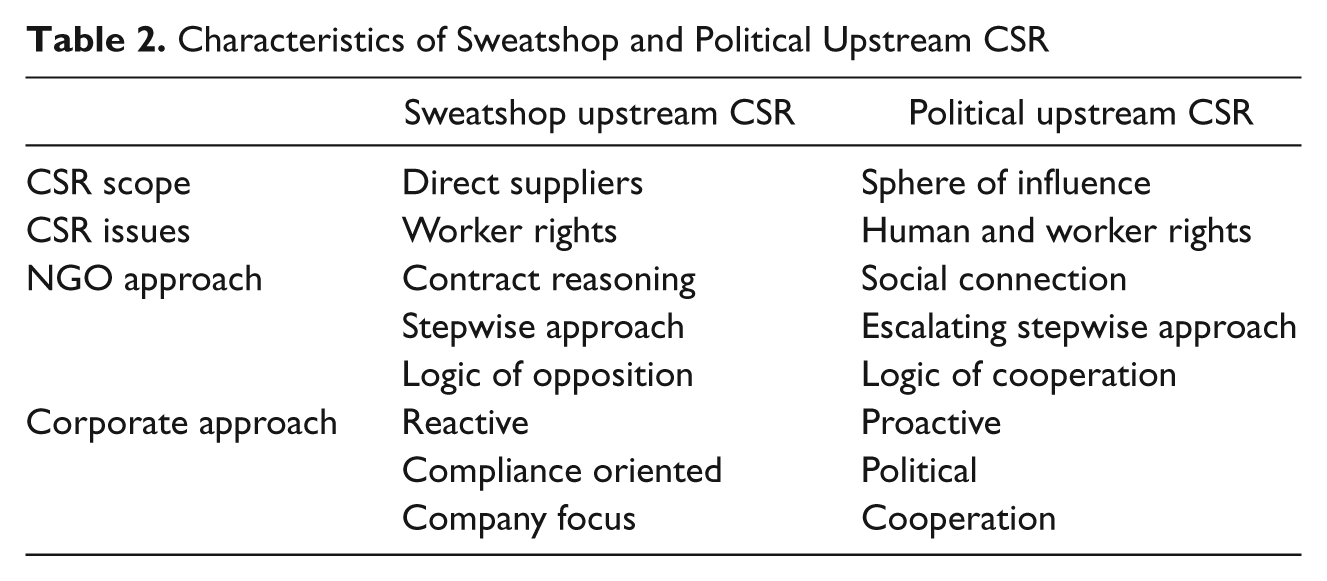
The purpose of the first article is to exemplify how upstream CSR has qualitatively evolved. This is done in three steps: First, major NGO activities in nine industries (coffee, chocolate, banana, garment, sportswear, diamond, oil, toy, and information and technology communications) during the last decades are reviewed. This empirical analysis of the CSR debate in those industries shows what kind of CSR demands are posed on MNCs and how those demands have developed until today. Those reviews are used to conceptualize the evolution of upstream CSR and differentiate between the traditional sweatshop debate and the current broader political upstream debate. Second, an analysis along four parameters allows the qualitative distinction between the current debate and the former one. The difference between the two upstream CSR streams can be understood along four parameters: CSR scope, CSR issues, NGO approach to CSR, and corporate approach to CSR (see Table 2). Finally, the upstream CSR debate and its evolvement are embedded in the social connection model to provide a theoretical context. Such a review and interpretation of the evolvement of upstream CSR over the past decades is missing in the literature so far and might add useful insights for the future debate on the role of business in society.
Characteristics of Sweatshop and Political Upstream CSR
Downstream CSR: Corporations’ Responsibility for How Their Products Harm Society 1
The second article complements the discussion of CSR along the supply chain by discussing CSR issues related to product consumption and usage. I examine the trend of holding MNCs responsible for their products’ effects on consumers and society at large. This expanded form of CSR is referred to as downstream CSR (Phillips & Caldwell, 2005). Examples include the automotive industry that is criticized for how consumers increase carbon emissions when driving (Laurie, 2007) or the fast-food industry that is criticized for contributing to obesity. The growing discussion on the contribution of fast-food to obesity is used as an illustration case.
Corporate responsibility for consumption-related issues is a classic topic in CSR: Prominent examples are product liability cases such as the Ford Pinto (Gioia, 1992), Rely tampon (Gatewood & Carroll, 1981), Metabolife (Crabtree, 2005), and the Tylenol cases (Stateman, 2008). However, those classic examples of consumer-related CSR issues differ from the obesity issue discussed in the second article. In the classic cases, scandals were in the focus and the product was most often defective (Pinto, Tylenol). Hence, in those cases a liability understanding of assigning responsibility was still well applicable because the harm was caused by clear identifiable product components (Pinto) or ingredients (Tylenol). However, regarding obesity, the product itself becomes problematic due to its side effects on the consumer. Obesity might not be explained by the decisions of one single actor whose direct actions cause those problems. Instead, downstream CSR can be better understood by applying a social connection logic (Young, 2006). I examine an extended form of consumption-related corporate responsibility that has not been conceptualized in the CSR literature yet. Using a social connection lens of analysis, the second article outlines the role of fast-food corporations in obesity and derives at certain responsibilities from Young’s (2006) reasoning criteria power, privilege, interest, and collective ability: action responsibility, information responsibility, education responsibility, damage control responsibility, and participation responsibility. Action responsibility is defined as any concrete CSR behavior that supports environmental changes and leads to favorable conditions to fight obesity. Activities such as adapting product ingredients, marketing practices, or offering healthier food alternatives fall under this category. Information responsibility can be defined as providing consumers with balanced communication about the corporations’ products and their effects. Damage control responsibility encompasses those activities that help minimizing and decreasing the consequences of obesity. The fast-food industry could, for instance, use parts of its profit by investing into treatments that aim at reducing the negative health effects of obesity (e.g., research and development). Education responsibility refers to activities that help to clarify the coherences of obesity and eating behavior, as well as food products in general. Financial support by fast-food corporations for public education campaigns could be one example. Finally, participation responsibility expects corporations to collaborate with other actors (other corporations, consumer groups, NGOs, governmental agencies, etc.) to jointly address the obesity problem.
The objective of the second article is twofold: First, it examines the expansion of CSR from upstreaming issues related to the production process to downstreaming issues related to product consumption and usage. Second, the article explores how the social connection logic contributes to a better understanding of social attributions of downstream responsibility.
I contribute to the existing literature on consumption-related CSR issues by illustrating the qualitative differences between classic product liability cases and more recent consumption-related issues such as obesity. The main contribution lies in enhancing an argumentation for this extended form of corporate responsibility toward consumers. By using a social connection approach to CSR, I enlarge the debate for consumption-related issues and offer a conceptual basis for extended responsibility demands for consumption-related issues, which are vividly debated in the media and elsewhere (Schlosser, 2002).
Historic CSR: Corporations’ Responsibility for Historic Injustices
In the third article, I examine corporations’ responsibility for historic injustices. There is a new and increasingly relevant debate in corporate practice: Corporations are examined today for their role in historic repressive contexts, which they were connected to through their business activities.
Scholars in historical sciences analyze corporate behavior in historic contexts of war, repression, or conflict such as slavery in the United States, the Vietnam War, and apartheid in South Africa. Those studies, however, are historical analyses but no conceptual CSR studies as they do not reflect on consequences for the current behavior of the examined corporations.
Also, in political philosophy and political theory, the discussion of historic injustices is highly vivid and conceptualized (Brooks, 1999; Thompson, 2002). However, in general, it addresses the application of reparations and the responsibility of governments for historic injustices and reparations (Ivison, 2006; Thompson, 2002). In this discussion, corporations are hardly targeted as actors with historic duties.
However, while a scholarly debate on historic cases of corporate complicity is virtually nonexistent, civil society activists and journalists have started to scrutinize MNCs for their past behavior demanding them to take action—ranging from financial compensations to public statements and apologies. This debate on the legal and moral obligations of companies for irresponsible behavior in their corporate past is referred to as historic corporate social responsibility (historic CSR). Reparation activists in the United States and elsewhere for instance approach corporations and public institutions regarding the profits they derived from their past involvement in these contexts of systematic human rights violations (Baker, 2005; Cox, 2002; “Brown University’s Debt,” 2006). Since the 1990s, Holocaust survivors and apartheid victims have started suing MNCs for their complicity in human rights violations and demand compensation (BBC News, 2009; Treaster, 2008). As a result, there is a debate on past contexts of repression and terror, in which the role of corporations is largely neglected, and there is a debate on corporate complicity that is blinding out the involvement of still existing companies in past contexts of repression.
The two debates on historic and current contexts of repression, war, and terror merge at the moment when existing corporations are confronted with legal or moral demands for historic complicity. Do corporations have a responsibility for their past activities? If they do, what does such a responsibility imply for their past behavior, their current duties, and their future activities? What follows from the claim that corporations have a historic responsibility? There is a new and increasingly relevant debate in corporate practice; however, scholars in management and philosophy have not delivered theoretical foundations for it yet.
The third article delivers a first conceptual analysis of historic CSR and its implications for corporations. The article captures the limitations of a liability approach to CSR as the demands toward MNCs regarding their role in historic injustices cannot be explained by a causal relationship. Corporations did not cause slavery, the Holocaust, or the Vietnam War, but they were socially connected to historic injustices through their business operations and activities.
In analyzing historic CSR, I focus on corporations that had business relationships with the Nazi regime in Germany between 1933 and 1945. The “Nazi nexus” not only is the most researched historic example of corporate involvement in political repression but also represents one of the rare cases of legal charges against managers for crimes against humanity (Ramasastry, 2002). Building on those analyses of historians, I argue that the debate on the responsibility of corporations for their complicity in historic injustices has evolved in three phases (Nuremberg Trials, 1990s litigations, and business as usual critique) in which moral norms have increasingly come to the foreground. In the first step, during the Nuremberg Trials, the focus of the responsibility debate was on criminal liability. In the second step, during the 1990s litigations, the focus shifted from criminal liability to civil liability and included increasingly moral concerns. Finally, in the current debate about historic injustices, it can be observed that legal argumentation is rather in the background and moral argumentation in the foreground. Here, corporations’ “business as usual” attitude is criticized. This tendency to moralize historic situations of complicity moves the debate to the center stage in the CSR field.
Conclusion
The dissertation asserts that MNCs are increasingly expected to be transparent about their social connectedness to CSR issues. Paradoxically, the articles illustrate three different consequences of such a transparency. The first article shows that increased transparency can lead to more responsibility. When MNCs establish audit and monitoring mechanisms, they increase their responsibility for worker and human rights violations along their supply chain as those injustices are supposed to be detected. Or, when MNCs disclose the list of their suppliers and subtier suppliers, they equally become more vulnerable as the publication allows NGOs to visit supplier factories and verify certain claims. Regarding the second article, transparency can actually lead to less responsibility. If fast-food chains become more transparent about the product ingredients and inform their consumers in a responsible manner about potential effects on consumer health, then fast-food chains shift the responsibility back to consumers. In the final article, increased transparency might actually lead to legal responsibilities. In both the Holocaust and the apartheid debates, MNCs are increasingly sued for their complicity in human rights violations that occurred during those times. Instead of perceiving such lawsuits as punishments, they could be perceived as a learning opportunity to clean one’s acts. Lawsuit-related costs can be compared with research and development costs, which eventually lead to learning from past behavior and avoiding doing similar mistakes again. In summary, transparency can be perceived as an obstacle (upstream CSR), as beneficial (downstream CSR), or it can lead to a dilemma (historic CSR).
Three contributions can be drawn from the dissertation. First, the application of a social connection approach in contrast to a liability approach to CSR provides useful insights in understanding latest CSR demands. CSR issues have become complex. Various actors in different parts of the world are connected to societal problems such as health epidemics and human rights violations. Linking concrete actions to harm as proposed by a liability logic is not possible anymore. The review of the evolution of upstream CSR illustrates how NGOs’ logic shifted from a liability understanding to CSR to a social connection understanding to CSR. The first article provides a solid review of how NGO demands toward corporations have expanded during the last decades. Such an expansion along the supply chain and beyond the supply chain presupposes a social connection logic to CSR. Second, the dissertation provides an overview of novel and innovative CSR concepts (downstream and historic CSR). The debate about corporations’ responsibility along the supply chain has dominated CSR. The discussion about downstream CSR in the second article complements existing upstream CSR discussion along the supply chain. In some industries, downstream CSR might become a key element of a corporation’s responsibility in society. The debate about historic CSR in the third article is novel and innovative. Corporations, which were spared from upstream or downstream CSR demands might get confronted with historic CSR demands. Third, the dissertation contributes to the political CSR research stream. Especially, the first and third article indicate that international business operations cannot be considered as transactions within and between stable societies with acceptable regulatory systems as management theory assumes (Sundaram & Inkpen, 2004). Instead, the two articles show that business activities are too often embedded in political and societal contexts that cannot be ignored. The dissertation contributes to the recent CSR literature on the political conceptualization of corporations (Scherer & Palazzo, 2007) as it provides further indications that the economic and political domains cannot be separated as the economic paradigm in management theory suggests.
Footnotes
Appendix
Declaration of Conflicting Interests
The author(s) declared no potential conflicts of interest with respect to the research, authorship, and/or publication of this article.
Funding
The author(s) received no financial support for the research, authorship, and/or publication of this article.