




Abstract
Firms are showing increasing interest in combining innovation and inclusive business models to contribute to sustainable community development. One framework to conceptualize such a business contribution is “corporate citizenship.” This article utilizes, extends, and critically reflects on the framework of corporate citizenship by identifying, explaining, and assessing the citizenship role toward sustainable community development that firms can perform. The article reviews a business model for delivering financial services to the rural communities in India. The business model is developed by a private firm “A Little World (ALW),” and the article argues that the firm and its sister not-for-profit organization Zero Mass Foundation (ZMF) perform a strategic bridge role between public sector organizations and rural communities and assist in achieving their respective developmental goals. Using this case study, the article argues that firms can act as corporate citizens through a strategic bridge role. In so doing, firms can change political and economic infrastructures by inducing institutional, governance, and cultural changes. While the article underlines the positive contributions, it also raises questions about the extension of market rationality in the public domain and its potential influence on governmental development policies.
Firms are commercial organizations and their contribution to economic and social development of communities emerges from the commercial activities they undertake (Friedman, 1970). This view of the nature and role of firms in societies has come under extensive re-examination in recent decades (Hamann, 2006; Idemudia, 2008; Margolis & Walsh, 2003; Moon, 2007; United Nations Development Programme [UNDP], 2008). On the one hand, firms are accused of generating, perpetuating, and escalating meta-problems (Westley & Vredenburg, 1997) such as climate change, corruption, cultural depletion, growth in relative poverty (Braungart & McDonough, 2002; Korten, 2001), and the global financial crisis of 2008. On the other hand, firms are regarded as key actors in contributing to and solving another set of meta-problems such as poverty (Margolis & Walsh, 2003), democratic deficits (Bernstein & Berger, 1998), and more generally in administrating citizenship rights to people (Matten & Crane, 2005) and providing consumption choices to the poor (Prahalad, 2004; Prahalad & Hart, 2002).
Crucially, in recent years, firms are viewed as resourceful actors in realizing the goals of sustainable community development through innovative and inclusive business models (Eweje, 2006; Griesse, 2007; Hamann, 2008; Hopkins, 2007; Idemudia, 2008; Moon, 2007; UNDP, 2008). The perspective of an innovative and inclusive business model combines and integrates the strategic corporate goals and imperatives of sustainable community development (e.g., UNDP, 2008; WBCSD & SNV Netherlands Development Organization, 2008). However, such a perspective offers limited analytical support for comprehending the application and sociopolitical and economic implications of inclusive business models, particularly in the case of developing countries where the role of state, as a development actor, is often regarded as critical for accomplishing sustainable community development (Idemudia, 2011). To address this gap, this article draws on the framework of “corporate citizenship” (Crane, Matten, & Moon, 2008; Matten & Crane, 2005; Moon, Crane, & Matten, 2005; Muthuri, 2007; Valente & Crane, 2010).
The framework of corporate citizenship pays stronger attention to the changing relationship between corporations and states (Matten & Crane, 2005; Matten & Moon, 2008; Moon et al., 2005) and introduces “context” as an important factor for considering corporate contributions to sustainable community development. The framework of corporate citizenship, in this sense, offers an analytically useful direction for defining, analyzing, and evaluating the new policies and actions of firms in diverse institutional environments (Lin, Lyau, Tsai, Chen, & Chiu, 2010; Matten & Moon, 2008; Matten, Crane, & Chapple, 2003).
Even though significant scholarly effort has been made to produce rich empirical accounts of the business models of corporate citizenship (Muthuri, 2007; Valente & Crane, 2010), scant attention has been paid to identify and define corporate roles that exhibit corporate citizenship with reference to sustainable community development. Also, little scholarly attention has been paid to the analysis of institutional, governance, and cultural changes induced by the performance of corporate citizenship roles in the context of sustainable community development. This article seeks to fill these gaps.
While this article aims to enrich the corporate citizenship literature with a South-centered perspective (Hamann, 2006, 2008; Idemudia, 2011), it also extends the framework of corporate citizenship by identifying, explaining, and assessing a citizenship role that a firm can perform while engaging in sustainable community development activities. With the analysis of a case study of a firm in India, the article also engages in critical reflection on the implications it may have on the development policies in India in particular and in developing countries in general.
The article is organized in five further sections: The second section introduces the notion of corporate citizenship as a way of understanding the involvement of firms in sustainable community development. Drawing on the works of Moon et al. (2005), Matten and Crane (2005), and Crane et al. (2008), the article first presents and discusses the notion of corporate citizenship and why it offers an appropriate analytical approach for understanding the involvement of firms in sustainable community development. Following the work of Valente and Crane (2010), the article then introduces the typology of corporate citizenship strategies that firms may use to engage in sustainable community development.
In the third section, the article introduces A Little World (ALW) and its sister not-for profit organization Zero Mass Foundation (ZMF), presents the research methodology, and discusses the significance of case study research for exploratory inquiry. The article presents the case study of the business model of ALW and ZMF, as a representation of corporate citizenship in the context of sustainable community development, in the fourth section.
In the concluding fifth section, the article critically reflects on the corporate citizenship role and considers how this role might shape the development action and policies in India in particular and developing countries in general.
Corporate Citizenship: A Political View of Firms’ Contribution to Sustainable Community Development
In the last decade, the role of firms in contributing toward sustainable community development has received significant attention from policymakers, scholars, and practitioners, particularly in the context of developing countries (e.g., Idemudia, 2008; Moon, 2007; UNDP, 2008; WBCSD & SNV Netherlands Development Organization, 2008). It is argued that firms can perform a central role in sustainable community development by addressing meta-problems such as poverty, climate change, human rights, and other social and economic development issues (UNDP, 2008; WBCSD & SNV Netherlands Development Organization, 2008).
Some argue that the firms can use current business models, based on profit maximization, to realize the goals of sustainable community development. This approach can be accomplished by extending business domains. For example, Prahalad and Hart (2002) and Prahalad (2004) argue that firms can be central in eradicating poverty by creating products and services for the poor in developing countries. Critics argue that the contemporary organization of markets and firms prevents the firms from performing meaningful roles in sustainable community development. They contend that there need to be new institutional rules of doing business, creating products and services for the poor communities, and innovating community-oriented inclusive business models and business processes (e.g., Banerjee, 2007; Leca, Kazmi, & Naccache, 2009).
In short, scholars are divided on the issue of the effectiveness of the current business model. To some scholars it can be used to contribute to the sustainable community development, while others advocate and promote alternative business models. Zadek (2007) argued for the creation of “civil corporations” that operate under the condition of constant performance evaluation by a multitude of institutional arrangements and processes. Muhammad Yunus, the Noble Prize winner, argued that a new business model is needed that aims to maximize social benefits rather than profits (Yunus, 2003, 2008). One possible solution to reconcile these two goals, this article argues, is to apply the framework of corporate citizenship that is increasingly used to comprehend the contribution of firms toward sustainable community development (Crane et al., 2008; Lin et al., 2010; Muthuri, 2007; Pies, Hielscher, & Beckmann, 2009; Valente & Crane, 2010).
The term corporate citizenship has been around since the 1930s, used first in India and later in the United States, to represent the philanthropic activities of firms (e.g., McIntosh, 2010). For the purpose of presenting themselves as “moral citizens,” many firms in the United States, the United Kingdom, India, and elsewhere adopted this term in the 1990s (McIntosh, 2010). By enlarging the “moral” and “philanthropic” notion of corporate citizenship, Logsdon and Wood (2002) proposed a strategic approach to corporate citizenship, arguing that an enlarged view can be used to balance the strategic orientations of business and social expectations.
Several scholars have explored the strategic approach to corporate citizenship by establishing its relationship to a firm’s strategy. For example, Hoeffler, Bloom, and Keller (2010) argue that corporate citizenship programs can increase profits as well as foster consumer and employee engagement. Likewise, Gardberg and Fombrun (2006) consider corporate citizenship initiatives as strategic investments and conclude that these initiatives create intangible assets that can assist firms to remove national barriers and have the competitive edge in local markets. Maxfield (2008) argues that the traditional economic view of strategy involves a tradeoff between competitive advantage and corporate citizenship. However, she suggests that the learning view of strategy can be used to align the imperatives of corporate citizenship with competitive advantage (Maxfield, 2008).
The strategic approach, it seems, considers corporate citizenship as a new way of contributing to the firm’s performance and growth and of reducing the tension between their profit motives and the imperatives of sustainable community development. Though the strategic approach to corporate citizenship is a step forward, it does, however, stress the economic justification without fully elaborating the contribution and roles that firms may perform in the context of sustainable community development. Crucially, it ignores the political configuration of relationships between firms, states, and communities, which the notion of citizenship might entail (Crane et al., 2008; Matten & Crane, 2005; Matten et al., 2003; Moon et al., 2005). Besides, it also overlooks the contextual factors that shape corporate citizenship (Arora, 2010; Moon, 2007).
Hence, the strategic approach to corporate citizenship by firms ignores the contextual conditions needed to deploy such business models in diverse institutional settings. Some scholars extended the strategic approach by giving analytical priority to the interaction between the firms, the state, and the communities. Moon et al. (2005) suggested that the increasing participation of firms in social partnerships can be viewed as an important practice of the political interaction between firms and communities. Matten and Crane (2005) suggested that increasingly firms are involved in administrating citizenship rights of the members of communities in which the firms operate and thus appropriate the governance space that traditionally belonged to the state. Shrivastava (2008) has further extended this view and argued that firms can take human roles and responsibility, and this view, he suggests, can be called “embodied corporate citizenship,” which requires firms to go beyond the responsibilities of providing fair wages.
The extended view of corporate citizenship regards firms as political actors, because they are increasingly performing state-like roles, and thus (re-)gaining power, responsibility, and influence to shape social, cultural, and economic lives of communities (Matten & Crane, 2005). In this sense, the contribution and roles of firms in sustainable community development represent a political act. Furthermore, this view regards firms as offering a civic arena where individuals connect with the society and engage with it (Crane et al., 2008). In this sense, firms become mediating institutions between individuals and society (Fort & Noone, 1999).
The extended view of corporate citizenship, it seems, challenges firms to change the way they govern themselves and strategize their business model, products, processes, and operations (Peter & Frynas, 2007). Crucially, it invites firms to consider communities as not merely consumers, buyers, employees, and workers—a unit of production or consumption—but primarily as citizens, with legitimate and varied expectations and needs (Prieto-Carron, Lund-Thompson, Chan, Muro, & Bhushan, 2006). Thus, corporate citizenship, it can be argued, aims to change the way firms view and perceive themselves and the communities in which they operate.
Acting as a citizen, hence, requires firms to develop new models of doing business, reflecting their political role. Valente and Crane (2010) proposed a typology of four strategies that firms have been employing to act as citizens in developing countries. Based on two crosscutting dimensions—core and non-core operations, and public services/political and economic infrastructure—they argue that firms can use the following four strategies to perform citizenship roles:
Firms can directly provide social services to communities, and in so doing they “fill the gap left by the public sector”;
firms can support governments in building governance structure;
firms can substitute for government by providing privatized social services; and
firms can stimulate alternative models of providing social services.
While all the four corporate citizenship strategies suggested by Valente and Crane (2010) warrant examination, reflection, application, and validation, it is the fourth strategy—“stimulate alternative models”—which this article utilizes and critically examines. Valente and Crane (2010) describe this fourth strategy as follows:
firms adopting a stimulate strategy drive new models of social provision through the development of political and economic infrastructure that addresses gaps in public welfare. Here … working towards the achievement of public goals represents a pivotal component of the company’s core operations. Under this strategy, firms leverage their products and services or their set of value chain activities to stimulate different forms of economic activity or regulatory behavior that directly or indirectly contributes to the achievement of public goals. (p. 68)
In this way, the strategy of “stimulating alternative models,” Valente and Crane (2010) further argue, involves changing “the political and economic infrastructure through which public goals are achieved” (p. 68). The United Nations Development Programme (UNDP) labels this strategy as inclusive business models. It states the inclusive business models:
include the poor on the demand side as clients and customers and on the supply side as employees, producers and business owners at various points in the value chain. They build bridges between business and the poor for mutual benefit. … The benefits from inclusive business models go beyond immediate profits and higher incomes. For business, they include driving innovations, building markets and strengthening supply chains. And for the poor, they include higher productivity, sustainable earnings and greater empowerment. (UNDP, 2008, p. 2)
From the discussion above, it can be argued that the corporate citizenship and the inclusive business model literatures articulate the following four criteria for firms performing as corporate citizens. First, it involves performing a state-like role (Matten & Crane, 2005); second, they aim at achieving strategic objectives of business and the imperatives of sustainable community development (Logsdon & Wood, 2002; Maxfield, 2008; UNDP, 2008); third, they are sensitive to the contextual factors (Arora, 2010; Moon, 2007). Finally, firms’ performance provides and transforms the civic arena: the political and organizational contexts through which individuals connect with wider society while engaging in sustainable community development (Crane et al., 2008; UNDP, 2008; Valente & Crane, 2010).
The perspectives of citizenship and inclusive business models usefully define the key elements of corporate citizenship. However, these perspectives are empirically underresearched, and therefore, the questions arise as to how firms might perform citizenship roles that entail stimulating different forms of economic activity or inclusive business models. Second, what political, economic, and organizational changes do these business models induce in the context of sustainable community development? These are the main concerns and contributions of this article. Both these questions are important to fully comprehend the emerging roles of firms and the state in the context of corporate citizenship and firms’ contribution to sustainable community development (Idemudia, 2011), as an area of increasing interest among scholars, policymakers, and practitioners.
In the next section, the article introduces the firm ALW and its sister not-for-profit organization ZMF and the research methodology used to answer the aforementioned questions.
Research Methodology
The case study 1 presented and discussed in this article was developed in 2009-2010 as part of a large research project of the United Nations Development Programme (UNDP), and the data collection and analysis were based on the research framework developed by the UNDP. 2 While the focus of UNDP’s GIM project was to identify and document inclusive business models, mainly for the purpose of policy and practice advocacy, certain dimensions of the case study of ALW/ZMF (Arora & Cummings, 2010) support corporate citizenship theory in the context of sustainable community development. Therefore, the case study of ALW/ZMF has been used for this article to extend and critically analyze the corporate citizenship framework and to contribute this developing country case study to the corporate citizenship literature.
An inductive, grounded, case study research design was followed to conduct the research and develop the case study. As a research method and tool for critically analyzing and explaining social reality, the case study method is considered appropriate, which, without losing sight of the context, helps gain an in-depth understanding of causal processes and accommodates the complexity of social reality (Yin, 2003). Another important reason favoring the case study approach is its ability to accommodate various sources and forms of data and data collection methods (Patton, 2002). Different data sources facilitate examination of the phenomenon more holistically, retrospectively, and contextually and increase the credibility, trustworthiness, and acceptability of research findings.
The empirical work for the case study was conducted from August 2009 to February 2010. The case study was developed with data collected through participant observations, semistructured interviews, field notes and review of India’s financial inclusion regulations and public policy documents, the internal documents and documents available in the public domain of the case study firm, and extensive secondary material on the topic.
Participant observations were carried out with beneficiaries and staff of the firm in two villages in the Andhra Pradesh state of India. Three instances of participant observation involving 6 to 13 participants were undertaken to gain deeper insights into the process of banking transactions, participants’ roles and behaviors, their expressions, and the dynamics of their interaction with the case study firm (ALW/ZMF), through the fellow villagers working as Customer Service Points (CSPs) and operating the mobile bank toolkit provided by ALW/ZMF. Initially, the researchers were silent spectators and took notes on CSPs and villagers’ participation in the banking transactions process. Later, one researcher interacted with villagers and the CSPs to understand the process of banking transaction at the village level and its advantages and disadvantages. The co-researcher took notes of participant observations and interactions. Observations of behavior of various actors provided a rich body of data, and participant observations were recorded in writing and were video recorded, as per UNDP’s requirement for gathering video footage. 3 Both written and video data were used for development of further questions and reviewed when developing the full case study.
The staff members of the firm were interviewed separately. They were mainly questioned about their profile, roles, experience working with the firm, and with the government and its officials at the state, district, and village levels; the villagers’ reactions and expectations; and the reactions of the government employees and the members of the village council.
The founder of the for-profit firm ALW and its sister non-profit organization ZMF, Anurag Gupta, and seven senior management team members were interviewed (see Appendix 1). This method was used in order to understand the firm’s business model, its historical development and evolution, and the development and challenges faced at the policy as well as at the execution levels of the model of business innovation (see Appendix 2). Two senior directors from the State Bank of India 4 (SBI), the main banking partner of the firm, were interviewed to gain insights into the interest, motivations, and policy environment as well as the benefits of a bank partnering the firm. One state government program director and two village-level officers in the Andhra Pradesh state were also interviewed, to grasp the governmental perspective.
On average, the interviews lasted between 15 and 20 minutes with staff, CSPs and villagers. Interviews with senior management of the firm and banking and government partners were typically of 2 to 3 hours duration, depending upon the time available and interest of the interviewees. Overall, approximately 20 hours of interviews and 4 hours of video footage were gathered through voice and video recording devices.
All the respondents, including villagers, were explained the purpose of the research and were specifically asked if they had any objections to being quoted and to their video appearances being used in reports and websites. Only two respondents objected and they have not been quoted nor have their videos been posted anywhere. Extensive secondary material on government policies, reports of consultants, and newspaper and expert articles on the topic of financial inclusion were gathered and analyzed to develop a contextual understanding of the topic globally and in India and the roles played by the firms the governments, banks, and other stakeholders.
Field notes were developed separately by both the researchers involved in the project as a means of capturing initial thoughts, impressions and questions about the firm, its business model, and about the stakeholders involved. Field notes improved data gathering in real-time and the iterative process between raw data and the writing of the full case (Lincoln & Guba, 1985). In the next section, the case study firm ALW and its sister not-for-profit organization ZMF are presented.
A Little World (ALW) and Zero Mass Foundation (ZMF)
ALW was established as a for-profit private limited firm by Anurag Gupta in 2000 in Mumbai. It was intended to act as a technology integrator and low-cost technology platform provider. Since its inception, ALW has created a track record of developing commercially viable innovative technology solutions, some of which have been hived off as separate entities after receiving private equity investment, thus yielding profits to ALW.
ALW first developed MCHQ (now mChek), a mobile phone to mobile phone payment solution, and sold it to an independent firm in 2006. The second innovative technology solution developed by ALW was Go-Mumbai, a low-cost contact-less smart card for automatic fare collection, used on high-tech validaters in Mumbai’s public transport system. ALW sold Go-Mumbai also in 2006. Thereafter, ALW developed another innovative technology solution, ZERO, India’s first domestic payment system with a specific focus on reaching out to masses with the lowest available communication infrastructure. ZERO’s development led to ALW being ranked amongst the Top 10 most innovative companies in India by U.S.-based Fast Company news magazine.
India’s leading public sector bank SBI bought a 20% stake in ALW for (Indian rupee) Rs. 80 crore (approximately US$ 18.6 million), valuing ALW at Rs. 400 crore (approximately US$93 million) in October 2010. ALW’s private equity shareholders now include Enam Financial, Bellweather Microfinance Fund, India Financial Inclusion Fund, and Legatum Ventures, a Dubai-based private equity fund.
Anurag founded the nonprofit organization ZMF in 2006, as a Section 25 company, to operate as a Business Correspondent (BC) using ALW’s technology platform ZERO. ALW and ZMF in conjunction offer financial/banking services and a secure, low-cost technology-driven delivery platform through special mobile phones that are capable of storing and managing a vast amount of customer account data, authenticating account holders through photo and biometric identification, which allows access to bank accounts at the Point of Sale (PoS) terminal. ALW’s technology platform works as a “bank in a box” and is operated by ZMF as a BC for villagers in rural India.
The services offered by ALW and ZMF at the time of data collection in 2009 included a simple bank account with facilities for cash deposits, withdrawals, and transfers and payments for government social security programs and welfare schemes. Other services ALW/ZMF plan to introduce include disbursal of loans and collection of loan installments, third-party cash bill collection (for instance, mobile phone and utility bills), insurance products, and premium payments.
ALW and ZMF conducted the first pilot project in 2006 with SBI. Since then there has been a rapid growth and by 2010 had expanded to 22 Indian states, with over four million rural customers, 8,314 points of presence, and an average of 25,000 new account openings every day (Arora & Cummings, 2010). In the next section, the case study firm is framed as a corporate citizen.
ALW and ZMF as a Corporate Citizen
The case of ALW and ZMF illustrates what Valente and Crane (2010) call the strategy of “stimulating alternative models,” which affect sustainable community development through an innovative and inclusive model of doing business. The point of interest here is the joint role ALW and ZMF perform in implementing this strategy. The twin organizations linked the public sector organizations and the rural poor, and in so doing helped both in achieving their respective sustainable community development goals. ALW and ZMF act as a strategic bridge (Stafford, Polonsky, & Hartman, 2000; Westley & Vredenburg, 1997) between the public sector organizations and the rural poor. Stafford et al. (2000, p. 123) argue that strategic bridging involves linking “diverse constituencies to address some problem domain.”
To date, the notion of strategic bridge has received greater attention in the literature related to the role of nonprofit organizations in the context of environmental NGO-business collaborations. However, it usefully reflects the roles of ALW and ZMF as the two organizations that together represent the interdependent relationship between for-profit and nonprofit organizations, particularly in the context of hard-to-reach communities (Stafford et al., 2000; Westley & Vredenburg, 1997). Thus, they act as a strategic bridge between the Indian government and its agencies, banks, and the rural communities.
Does the role of strategic bridge reflect corporate citizenship? Drawing on the discussion in the previous section, it can be argued that strategic bridge role can be viewed as a representation of corporate citizenship, if it meets the following four criteria: (i) It involves a role conventionally performed by the state (Matten & Crane, 2005); (ii) it is aimed at achieving both strategic and commercial objectives of business and the imperatives of sustainable community development (Logsdon & Wood, 2002; Maxfield, 2008; UNDP, 2008); (iii) it is sensitive to the contextual factors (Arora, 2010; Moon, 2007); and (iv) the firm’s performance provides and transforms the civic arena—political and organizational contexts through which individuals connect with wider society—while engaging in sustainable community development (Crane et al., 2008; UNDP, 2008; Valente & Crane, 2010). In the next section, the article illustrates how the strategic bridge role, performed by ALW and ZMF, meets the criteria of corporate citizenship.
Performing State-Like Role
The state government in Andhra Pradesh was among the first to adopt the innovative technology-based system of providing financial services, developed by ALW and ZMF. A state official said, “Now we have created an infrastructure! We are the first to do this in India. We are the role models” (Arora & Cummings, 2010, p. 21). The government official concluded that the technology-enabled service is a much better system for the poor as it helps the government in streamlining the welfare services provision with better information management and better planning for the poor. Also it benefits the poor with transparent and efficient delivery of financial and banking services, as envisaged in the social security and welfare schemes of the government. The officer declares, “The switch to ZMF was easy, we used to give 2 per cent to the post offices, now banks get 2 per cent” (Arora & Cummings, 2010, p. 21). 5
Here it is important to note the changes in political and economic infrastructure brought in by the new business model of ALW and ZMF. Indian Post, the public sector organization previously responsible for disbursement of payments in several government social welfare schemes in rural India, lost business to ALW and ZMF. However, it was judged that staff member attitudes and rent-seeking behavior prevented it from performing its public responsibility efficiently and effectively. So, while the gains of ALW’s technological innovation are manifold—for the government, the banks, and the community—these are at the cost of revenues to Indian Post and of opportunities for graft at lower levels of the bureaucracy—a source of much resentment among villagers. ALW/ZMF’s new technology-driven system ensures timely wage receipts, through fellow villagers, operating as CSPs, which actually increases the sense of trust in the government. As the Project Director for Government’s Smart Cards Project in Andhra Pradesh states, “there is happiness among the beneficiaries when they receive their full benefits” (Arora & Cummings, 2010, p. 21).
Significantly, the Government of India’s Committee on Financial Inclusion recommended extending financial services to a population of over 557 million excluded households by 2010 and to all households in India by 2015 (Karmakar, 2010). ALW and ZMF’s combination of technology platform and outreach may contribute to realization of these recommendations. Indeed, the Government of India’s Approach Paper on Financial Inclusion states, “The Business Facilitator/Business Correspondent (BF/BC) models riding on appropriate technology can deliver this outreach and should form the core of the strategy for extending financial inclusion” (Planning Commission, 2010, p. 2).
Reflecting on Indian government’s initiatives in rural development, Sharma (1999) had argued that in India successive governments had desperately attempted to modernize rural settings, and in doing so, they have established elaborate and extensive organizational structures. However, these failed to accomplish fully the goals of social justice and of improving the living standards of the rural population. This failure was in part due to these implementation shortcomings that ALW and ZMF’s bridge-like role through its innovative business models has overcome.
Although the majority of the funds distributed through the ZMF and ALW platform were for the National Rural Employment Guarantee Scheme (NREGS), this distribution could just be the beginning of new corporate roles in financial inclusion, where access to transparent and convenient financial services for rural population in India has been a major drawback, resulting in social injustice (Sharma, 1999).
While ALW and ZMF have been pioneers in the financial services delivery in India since 2006 (when the government liberalized financial service delivery), other firms like FINO Limited, Eko India Financial Services Private Limited, and Geosansar have also developed innovative business models and started delivering financial services in India with different strategic approaches and focus. All the firms have created twin organizational structures of for-profit strategy and technology provider and nonprofit organizations to operate in the financial inclusion services. With such innovative and inclusive business models, villages with above 2,000 population covered by banking services increased from 27,743 at the end of March 2010 to 53,397 at the end of March 2011 (Chakrabarty, 2011).
Accomplishing Strategic Business Objectives
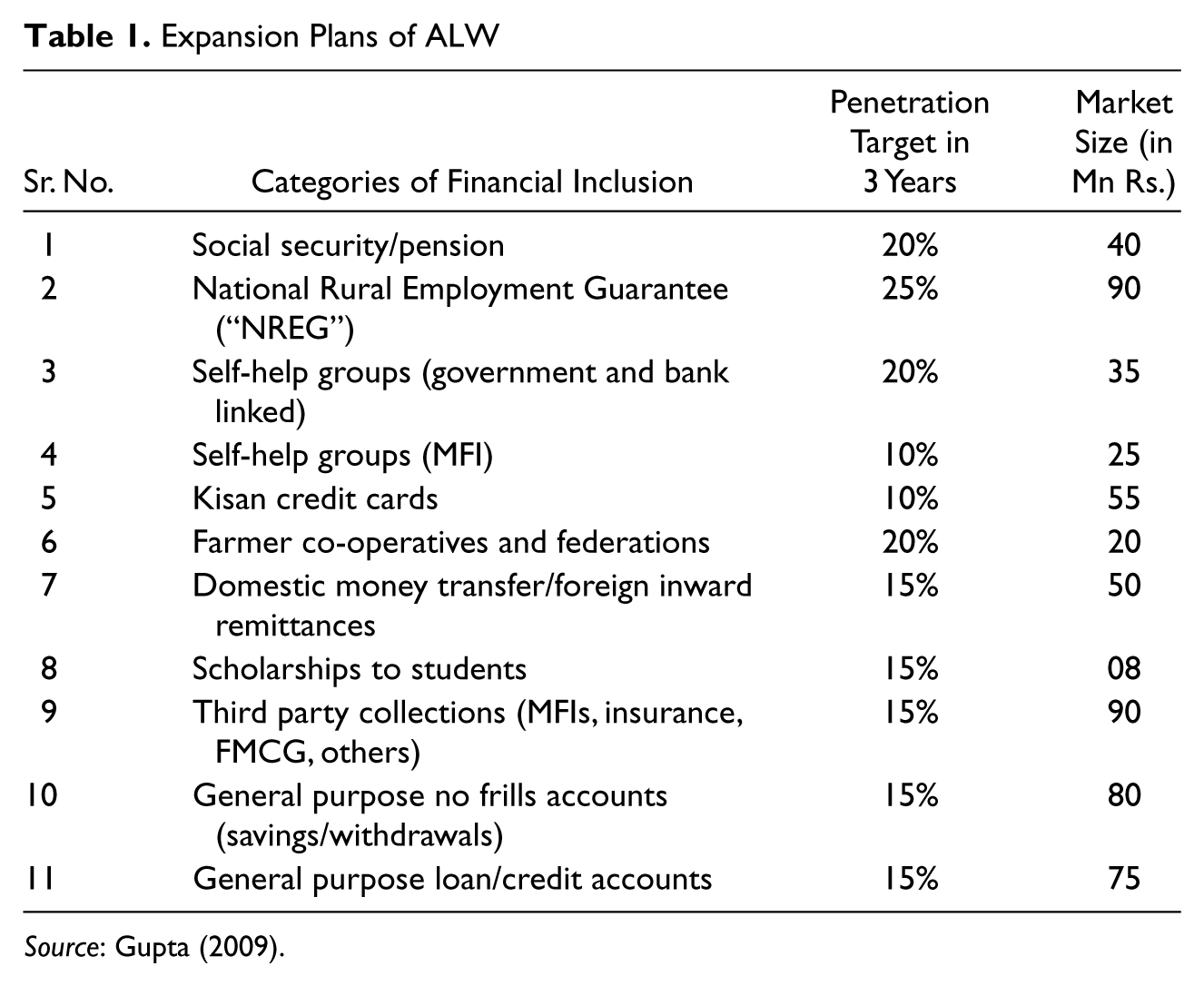
According to the Indian banking regulator guidelines for BCs, ZMF earns commission on the funds disbursed, but will also earn from disbursing other core banking services (which are yet to take off, as the first phase is about people getting used to basic banking; i.e., opening, using, and operating a bank account) (see Table 1, “Expansion Plans of ALW”). Commissions are negotiated with banks and vary by financial products offered and by banks. In 2010, with ZMF’s reach extending nationally, ZMF disbursed about Rs. 200 Crores (approximately US$46.5 million) to villages in NREGS and pension funds. Anil, the Country Operations Head at ZMF, was expecting to disburse Rs. 1,400 Crores (approximately US$325.50 million) in 2011.
Expansion Plans of ALW
Source: Gupta (2009).
During the pilot phase with SBI in 2006, the bank paid for the technology platform equipment, which was a fixed cost of approximately Rs. 20,000 (US$472). With further technological advancements, Anurag was expecting this fixed cost of the equipments to come down to about Rs. 12,000 (US$257). There are other costs borne by the banks, such as training the BC units, administration, cash management, financial literacy, and backend technology costs, which also support ALW and ZMF in their operations. Sources of revenue are mainly from the disbursal fee charged by ZMF for government payments disbursal, and secondarily a technology fee charged by ALW to active account users.
For NREGS funds disbursement, the commission varies between states and ranges from 1.75% to 2%. Commissions are also earned by BCs for disbursements of other government welfare schemes such as old age pensions and scholarships as well as on selling core banking services such as deposits, loans, mortgages, and so forth. For savings and deposits, BCs earn 0.5% of the amount and for loans 0.5% to 1.0% of the loan amount from banks. According to Kochhar (2009), a BC Point of Presence disburses on an average Rs. 1.2 million per annum (approximately US$27,000). ZMF was not earning a profitable margin, but reported having about 50% market share by February 2010. With scaling up plans and a proposal to increase commission from government program, ZMF will be able to achieve economic viability.
There is clear evidence then that strategic business objectives are being accomplished. In the following section, aspects of sustainable community development in the form of provision of public services to poor population as a core part of ALW and ZMF’s innovative and inclusive business model are discussed.
Imperatives of Sustainable Community Development as Core Business
Two women stand across the table in a remote village in Andhra Pradesh. One woman is the Mobile Bank Customer Service Point (CSP) appointed by ZMF to operate the mobile bank—a mobile phone attached with a small biometric reader and a receipt printer. The other woman—a fellow villager and a bank customer—displays a photo identity card, issued by ZMF, and presses her thumb on the biometric fingerprint reader. The CSP conducts the physical verification through the photo identity card and the biometric reader verifies it electronically. After successful verification, the bank customer receives money from her account along with a receipt printed in local language. The money in her bank account and the cash received by her in the transaction is part of her wage credited through a government-run social security scheme NREGS.
A large number of villages in India are now witnessing the snapshot of the activity described above. It represents a new and efficient way through which a large number of villagers accomplish their social, livelihood, and economic rights (Matten & Crane, 2005). The bank customer portrayed in the above snapshot states, “I used to get my payment from the post office with a delay of several weeks, sometimes months, after repeated trips; now I get it here, much earlier, in my village” (Arora & Cummings, 2010, p. 8).
By February 2010, this technology-driven socioeconomic interaction between over four million villagers and public sector welfare organizations in 22 states of India was fast becoming a normal way of life. The interaction ensured that the rural poor in those villages receive government-sponsored social security schemes and welfare benefits such as the NREGS wages, National Old Age Pensions, scholarships for poor students, and housing grants on time and without the manual and lengthy governmental procedures, often mired by corrupt practices of the lower bureaucracy and the powerful coterie of village headmen.
Normal though the new way of organizing social welfare has become, it has brought changes that, in a long run, may significantly shape the relationship between the government and the rural communities. Many respondents of this study stated that this new way of organizing welfare enhances their self-esteem. Wherever villagers collect payments at the government or post offices in India, they are usually made to feel as if they are receiving money from the individual at the till and not from the government. With ALW and ZMF’s mobile bank, people are not humiliated to get the money to which they are entitled, whether as wages or as benefits, and they receive it directly in their village. It seems that the ALW and ZMF are contributing to the replacement of a culture of paternalism with a culture of rights.
Furthermore, ALW/ZMF designed its business model, including human resources recruitment and management processes, in such a way as to undermine traditional patriarchy. Where once the village headman and their cronies had power to deal with government funds in villages, now there are three people, and two are guaranteed to be women (as Customer Service Point). This employment of women in villages further changes traditional gender relations. “No … my husband doesn’t mind my new job, and he is respected more now,” stated one CSP (Arora & Cummings, 2010, p. 18). A manager of CSPs at ZMF added, “The CSPs are viewed favorably by the fellow villagers and have earned more respect … they have developed confidence from mastering the technology and this has its own trickle-down effects, where young village girls can now look up to female role models from their own communities” (Arora & Cummings, 2010, p. 18).
Involvement of the firm in the distribution of welfare and other benefits has begun to establish a culture of rights and new opportunities for women. This situation, it can be argued, will reconfigure the technological, political, and organizational contexts through which governments and communities will accomplish their respective development goals. At the center of this change is a firm with an innovative business model, established by a visionary-entrepreneur (Gray & Wood, 1991) named Anurag Gupta. This context illustrates an interesting aspect of corporate citizenship in the achievement of cultural changes—in this case, from exploitation and paternalism to a culture of rights. The next section presents and discusses the contextual factors of corporate citizenship.
Sensitive to the Contextual Factors
Anurag Gupta believes that “conventional methods cannot meet an unconventional set of challenges” (Arora & Cummings, 2010, p. 15). Anurag’s entrepreneurial journey is an example of his statement. Working as an independent, self-employed housing and architecture consultant from 1991 to 2000, Anurag experienced difficulties in obtaining a credit card for himself. 6 This experience made him realize the difficulties and challenges for self-employed people in India in securing credit from formal financial institutions. Anurag used a smart-card-based electronic purse to manage expenses during one of his visits to Belgium in 2000. Exposure to the smart-card technology inspired Anurag to set up a domestic payments system in India capable of offering low value transactions at a much lower cost than the multinational corporation (MNC) competitors. 7
Thus, India’s low-cost technology-driven payment system resulted from Anurag’s ingenuity and efforts to mobilize and access critical financial, knowledge, and other resources (Valente & Crane, 2010). Anurag convinced some technology companies in Europe to work with him to implement a financial payments/transactions system in India. He formed the Zero-Mass Consortium by bringing together a group of technology companies from the smart-card industry and related companies such as Proton of Belgium, Gemplus International of France, Giesecke, Devrient and Infineon Technologies of Germany, and ERG Group of Australia.
Unlike in Europe and other countries where smart-card-based payments transaction technologies are used, the technology platform in India evolved around an unexpected source, the mobile phone, which allowed extensive outreach to remote rural areas, without the necessity of creating expensive physical infrastructures. ALW deployed NFC (Near Field Communications 8 )-enabled mobile phones, thereby connecting a mobile phone with a variety of peripherals like printers and biometric fingerprint scanners. 9 This innovation of deploying NFC was necessitated by the challenging operating conditions in India, such as the widely dispersed villages, the lack of a rural physical banking infrastructure, high transactions costs for payments, lack of control points for transparent transactions, vested interests of the lower bureaucracy, and low literacy among the rural population in India.
The visionary entrepreneurship was enabled by a favorable public policy environment. The Indian banking regulator RBI issued the BC guidelines in 2006, under its financial inclusion initiative. Prior to this initiative, and where the BCs are still not used, the costs to banks for delivering low value transaction services for poor populations living in far off locations are too high due to the lack of distribution networks as well as the absence of the low-cost technology outreach solutions. The banking regulator and the government of India proposed BCs as a solution. The BCs were to operate a third tier of banking services (after physical bank branches and ATMs, operated directly by banks), in unbanked and underbanked areas. 10
Anurag’s focus is therefore highly focused on the context of the remote, deprived, underprivileged, and unserved rural areas, where a large proportion of the financially excluded Indian population lives, and the aggregate of low-value transactions, coupled with ALW’s technology platform fees (Prahalad, 2004), will make his business model financially viable. The next section discusses the political, economic, and organizational changes induced by the innovative and inclusive business model of ALW and ZMF.
Transforming Political, Economic, and Organizational Contexts
Stimulating alternative models, as a strategy for corporate citizenship (Valente & Crane, 2010) or developing an innovative and inclusive business model (UNDP, 2008) in the context of sustainable community development entails changes in the political, economic, and organizational context. The case of ALW and ZMF, acting as a strategic bridge, in delivering financial/banking services to the unbanked rural population in India involved changes at several levels. While the traditional models of banking largely failed to develop solutions for people needing transactions in smaller volumes, ALW’s technology platform and ZMF’s outreach with CSPs brought the transaction costs down for banking with poor. This effect involved legitimization and scope for a new set of actors (BCs and technology providers) in financial/banking services delivery and at the same time the loss of revenues for the government-owned Indian Post.
With the entry of private actors, the government found an intrinsically motivated service provider in contrast to the compromised Indian Post, government officials at the ground levels, and village headmen. The government also secured the possibility of delivery of welfare and other services in a transparent and accountable manner and the added value of a Management Information System generated through ALW technology platform to better plan and implement welfare schemes for people in remote locations.
For many villagers in India, the new way of receiving welfare and social security benefits brought them the full income to which they were entitled. Other villagers acquired the ease, convenience, and timeliness in the receipt of their welfare benefits and wages. Yet other villagers, particularly women, acquired a new source of livelihood and a respected social status in the community. The government also saved money hitherto spent on benefits for dead relatives. 11
Furthermore, the experience created by the involvement of ALW and ZMF in the distribution of welfare and other services may also offer a wider opportunity for villagers to learn about the possibility of a major shift in the way they interact with the government and its social security and welfare schemes. People may soon learn greater confidence about their rights in claiming welfare benefits as entitlements, in contrast to the culture of paternalism associated with the erstwhile roles of the village headmen and functionaries of government at village level. Recruitment of local village women as CSPs by ZMF created role models for young girls in the villages, and a sense of pride for husbands and families in their wives and mothers so employed. The following section presents reflections and conclusions.
Reflections and Conclusions
The case of ALW and ZMF illustrates what Valente and Crane (2010) call “stimulating alternative models,” which affect sustainable community development through an innovative and inclusive business model. The business model of the twin organizations, as suggested by Valente and Crane (2010), and as in UNDP’s definition of inclusive business models discussed earlier in this article, is related to direct provision of public services. The empirical analysis presented shows that ALW and ZMF performed a strategic bridge role in public services provision for the public sector organizations, banks, and rural communities (Stafford et al., 2000; Westley & Vredenburg, 1997). In so doing ALW and ZMF supported and linked the three set of stakeholders in achieving their respective sustainable community development and strategic goals.
Crucially, the article shows that the strategic bridging role can be viewed as an act of corporate citizenship as it involves (i) performing a state-like role (Matten & Crane, 2005), (ii) simultaneously achieving both strategic objectives of business and the imperatives of sustainable community development (Logsdon & Wood, 2002; Maxfield, 2008; UNDP, 2008), (iii) being sensitive to the contextual factors (Arora, 2010; Moon, 2007), and (iv) providing and transforming the civic arena—political and organizational contexts through which individuals connect with wider society—while engaging in sustainable community development (Crane et al., 2008; UNDP, 2008; Valente & Crane, 2010).
The strategic bridge role, as a representation of corporate citizenship, helped the government to improve the governance and management of its welfare schemes by eliminating corruption and reducing the influence and power of bureaucratic and traditional authorities at the village level. By playing this role, the twin organizations performed a state-like role by being drawn into public policy and socioeconomic developmental issues, requiring them to justify their legitimacy as well as negotiate their existence with a multitude of interest groups. This change could be seen as an intensification of modernization at the village level as it introduces non-feudal authorities in the public domain (Bernstein & Berger, 1998). This change, as the analysis shows, should prove economically sustainable as ALW and ZMF are financially viable and have been improving their profits by reducing the costs and responding to the new opportunities of banking.
The article also shows that the strategic bridging role is context dependent as it requires an interlocking of visionary entrepreneurship and a public policy environment, which encourages public sector organizations to share power with profit and not-for-profit organizations. As the analysis shows, this interlocking could induce changes both in the organizational infrastructure of delivering welfare and in the perceptions of the member of rural communities about their self-esteem and social and economic rights. It can be argued that ALW and ZMF introduced a culture of rights and in so doing provided and transformed the traditional relationship between the members of rural communities in which they operate and the society and the polity (Crane et al., 2008). In this sense, ALW and ZMF could be seen as a mediating institution, providing and shaping civic arena.
As demonstrated, the framework of corporate citizenship offers a suitable approach to grasp the emerging role of innovative and inclusive business models in developing countries in addressing poverty at the implementation level, through financial inclusion. How this microlevel corporate citizenship is linked to the macrolevel development policies and actions is what matters most in the context of developing countries (Idemudia, 2011).
Crucially, at the macrolevel of public policy and action on development, the emergence of corporate citizenship as a strategic bridge between rural communities, banks, and public sector organizations can be viewed as what Shamir (2008, p. 14) calls “the economization of the political,” resulting from application of market rationality in the public domain. This application means that the sustainable community development, welfare services, poverty alleviation, or people’s empowerment is being framed as a business opportunity rather than a primary obligation of the state.
This perspective of making sense of corporate citizenship roles, particularly in the context of developing countries, may mean that those elements of sustainable community development that can be transformed into business opportunities would dominate the agendas of development actors, including the firms. This dominance may also imply that the application of market rationality may lead to the exclusion of some elements of sustainable community development. There is indeed a need to further investigate the impacts of marketization of the public domain. However, the case of ALW and ZMF suggests that the interdependent relationships between for-profit (ALW) and not-for-profit (ZMF) organizations inhibit the negative tendencies of market rationality, and therefore, it can be argued that the corporate citizenship roles entail a nexus of for-profit and not-for-profit organizations (Moon et al., 2005). Firms alone may find it challenging to perform corporate citizenship roles.
To sum up, the learning from this article for the firm performing corporate citizenship roles and the government in creating an enabling environment could be that the pressing need for sustainable community development in developing countries requires, and is possible to achieve with, the development of innovative and inclusive business models that create benefits for all concerned stakeholders.
Footnotes
Appendix 1
Appendix 2
Acknowledgements
The authors thank the anonymous reviewers and Guest Editors at Business & Society for very helpful suggestions on revising this article and to UNDP for consent to use the case study developed in the GIM initiative. Ms. Hema Swamy’s research assistance is appreciated.
Declaration of Conflicting Interests
The author(s) declared no potential conflicts of interest with respect to the research, authorship, and/or publication of this article.
Funding
The case study was developed as part of the research project commissioned by UNDP GIM initiative and the funding was provided by UNDP. However, authors(s) received no financial support for the authorship, and/or publication of this article.