



Abstract
Corporate social responsibility (CSR) was historically a business-oriented idea that companies should voluntarily improve their social and environmental practices. More recently, CSR has increasingly attracted governments’ attention, and is now promoted in public policy, especially in the European Union (EU). Conflicts can arise, however, when advanced welfare states introduce CSR into public policy. The reason for such conflict is that CSR leaves key public welfare issues to the discretion of private business. This voluntary issue assignment contrasts starkly with advanced welfare states’ traditions favoring negotiated agreements and strong regulation to control corporate conduct. This article analyzes the conflicts and compatibilities arising when advanced welfare states introduce CSR, focusing on how the two traditions diverge and on how conflicts are reconciled. Empirically the study focuses on four Nordic countries—Denmark, Finland, Norway, and Sweden—widely recognized as the most advanced welfare states, and increasingly as leaders in CSR public policy. From interviews of 55 officials of government ministries, nongovernmental organizations (NGOs), labor unions, and employer associations, the authors conclude that tension indeed exists between CSR public policies and advanced welfare state traditions in all four countries. Whereas CSR’s aims are compatible with Nordic institutional traditions, the means promoted in CSR is in conflict with such Nordic traditions as corporatist agreements and rights-based welfare state regulation of social and environmental issues. There is harmony of goals, but conflict in means between the four Nordic countries studied.
Corporate social responsibility (CSR) was a significant trend among corporations across Western economies 1 in the late 1990s and early 2000s and continues to spread worldwide. CSR has emerged as a topic of interest among international media outlets, from around 7,500 hits in 2000 to more than 55,000 in 2010 (Factiva, 2011). CSR reports by companies, according to the Global Reporting Initiative (GRI), have also multiplied, from hardly any in 2000 to more than 1,600 in 2010 (GRI, 2010).
CSR has also spilled over from business into politics. Several European countries, as well as the European Commission (EC), have now launched CSR policies and developed CSR-oriented institutions. The commission has played a pioneering role in the development of public policy to promote CSR ever since its 2001 Green Paper and the establishment of the European Multistakeholder Forum on CSR (EC, 2001). In 2006, the commission published a new policy whose central aim was strong support for a business-led initiative called the European Alliance for CSR, and in October 2011, it published a new policy on CSR (EC, 2006, 2011). In the United Kingdom, the Labour government appointed the world’s first minister for CSR in the spring of 2000 and has presented CSR reports since 2002 (Idowu & Leal Filho, 2009; Webarchive, 2012). In 2010, the Federal Cabinet of Germany adopted the country’s first National Engagement Strategy and the National Strategy for Corporate Social Responsibility, also referred to as the Action Plan for CSR (Federal Ministry of Labor and Social Affairs, 2010, 2012).
The spillover of CSR from business into government should not be a great surprise. CSR values, such as ethical awareness and raising environmental and social standards in the national business community, are traditional public policy concerns.
The study concerns the four Nordic countries: Denmark, Finland, Norway, and Sweden. 2 These countries have been among the CSR front-runners. Nordic companies are overrepresented in key global CSR initiatives, scoring above firms from Anglo-Saxon (the United Kingdom and the United States), Mediterranean (e.g., Greece, Italy, Portugal), and Continental European (e.g., Germany, France) countries (Midttun, Gautesen, & Gjølberg, 2006). Nordic governments have also engaged heavily in CSR with initiatives such as the Swedish “Partnership for Global Responsibility” (Swedish Government, 2012), the Norwegian government’s Consultative Body for CSR (Norwegian Government, 2012), the Danish “Action Plan for CSR (Danish Government, 2012), and the Finnish government’s efforts to achieve “responsible competitiveness” (Zadek, 2011).
Our interviews reveal, however, that considerable ambiguity exists in aligning CSR with traditions in advanced welfare states like the Nordic countries. Advanced welfare states are well known for strong government engagement in social and environmental policy issues, which provides high compatibility between the new CSR agenda and the traditional public policy concerns in such states. Shared goals do not necessarily imply agreement, however, on the means to achieve them. Fundamental to advanced welfare state policy is the idea of policy implementation through public regulation, as well as through corporate-based decision making, which limits corporate discretion. Corporatism refers to “economic tripartism,” where business, labor, and state interact to establish economic policy, characteristic primarily of the Nordic, Germanic (Germany and Austria), and Benelux countries (Belgium, the Netherlands, and Luxembourg). CSR, however, relies primarily on voluntary commercial initiatives. Corporatism is traditionally industry driven and leaves key welfare issues to business discretion, in stark contrast to advanced welfare states’ traditions for negotiated and regulatory approaches to control corporate conduct.
This article analyzes conflict and compatibility between CSR and advanced welfare states’ traditions, focusing on how the two traditions diverge and on how conflicts are resolved. The Nordic context provides an excellent ground for exploring this problem because the Nordic countries are universally recognized as the most advanced welfare states and as leaders in CSR policy (McCallin & Webb, 2004). The authors therefore expect potential compatibilities and conflicts between CSR and advanced welfare state traditions to be most pronounced in the Nordic welfare states.
The following part of the article is organized in six main sections: The first, “CSR and the Advanced Welfare State: Compatibility and Contradiction,” presents the essential characteristics of the CSR and Welfare State traditions and explores the arguments for compatibility or contradiction. The second, “The Authors’ Approach,” lays out the research design and method. The third section, “CSR Policies in the Nordic Countries,” presents an overview of CSR policies in each of the four large Nordic countries. Then follows a fourth section, “Harmony Versus Conflict,” which expands on potential symmetry or contradictions between CSR and the Welfare State model. A fifth section explores the “Strategies for Accommodation” including strategies to externalize CSR through the “International Welfare-Capitalism Model,” strategies to compartmentalize CSR through the “International Competitiveness and Innovation Model,” and strategies to supplement CSR through the “Domestic Welfare Protection Model.” A final section considers the “Nordic CSR Public Policies in Comparative Perspective.”
CSR and the Advanced Welfare State: Compatibility and Contradiction
The inclusion of CSR in advanced welfare states’ public policies involves reconciling two widely different traditions. The Nordic welfare state tradition emphasizes universal rights and duties, extensive state engagement in the economy, and negotiated agreements to regulate labor relationships. In contrast, the CSR tradition has originated in a neoliberal, Anglo-American context and emphasizes corporate discretion, voluntarism, and market-based policy solutions. The following subsections present essential characteristics of the two traditions and explore the arguments for compatibility or contradiction between them.
The Advanced Welfare State Tradition
The Nordic welfare states have traditionally combined economic growth with strong social and environmental welfare. They have achieved this combination in a highly egalitarian way, based on collective bargaining, supported by the state, and partly enacted through state institutions, strong democratic market regulation, and extensive taxation, while exercising national control of strategic sectors and companies (Joly & Olsen, 2011). Within this framework, business has the right to maximize profit, but within boundaries and regulations that enforce decent wages, employment, workplace democracy, and high environmental standards.
As Esping-Andersen (1990) pointed out an influential typology: A central element in the welfare state is the degree to which social policy transfer payments are “decommodified,” that is, made independent of the market mechanism and the degree of stratification they produce in society. Esping-Andersen places the Nordic countries among the social-democratic welfare state regimes, which he ranks at the top of the welfare state hierarchy due to these states’ active redistribution and universal citizens’ rights. The Continental European corporatist-statist regimes and the Anglo-Saxon liberal market regime have decreasing universalistic and redistributive ambitions, and social policy transfers are more closely aligned with employment-based entitlements. A third, Mediterranean regime, was later introduced as a label for Italy, Spain, or Greece, where the family network is important to provide welfare (Ferrera, 1996). Because of its traditional Soviet dependency, Finland was not included in Esping-Andersen’s original work, along with Eastern Europe. However, Finland has moved closer to the other Nordic countries in terms of welfare state policies (Einhorn & Logue, 2003).
Nevertheless, despite its central nonmarket components, the Nordic model is also known for its ability to deliver market results. In a comparative study of European political economy, Sapir (2005) praises the Nordic welfare states for delivering both efficiency and equity. The Nordic model’s proposed “double dividend” has continued to attract both popular and scholarly attention. It was hailed as “the future of capitalism” (Milne, 2009) and was highlighted in the 2011 Davos World Economic Forum both in 2011 and 2012 for its resilience to the European economic crisis. The welfare state literature and Sapir’s discussion of equity and efficiency are only two examples of a broad political economy literature that consistently places the Nordic countries in the socially responsible, collaborative, and democratically coordinated end of the market economy, although with somewhat different conceptual distinctions (Bambra, 2006). Political economy here refers to interdisciplinary studies drawing upon economics, law, and political science in explaining how political institutions, the political environment, and the economic system influence each other. This literature includes the Varieties of Capitalism (VoC) approach (Hall & Soskice, 2001), which classifies all four Nordic countries as coordinated market economies (CMEs). 3 Furthermore, Whitley’s (1999) comparative business systems approach 4 characterizes all the Nordic business systems as “collaborative.” The neocorporatist literature—which rates the social embeddedness of the European economies—also ranks the Nordic countries on top (Kenworthy, 2003; Organisation for Economic Cooperation and Development [OECD], 2005; Schmitter, 1981; Siaroff, 1999).
This broad political economy literature thus depicts the Nordic welfare states as delivering a sort of “civilized capitalism” in line with CSR ambitions, but with a strong dose of state and trade union intervention for which little room exists in CSR conceptions found in liberal market regimes. As indicated in the next section, CSR tends to substitute political bargaining with a stakeholder model orchestrated by the firm.
The CSR Tradition
As opposed to the welfare state tradition, the CSR tradition assumes that open societies with competitive markets and free media can drive business to adopt strong, voluntary self-regulation to enhance social and environmental performance. In other words, CSR delegates key welfare issues to business discretion.
Starting with the core justification of CSR at the corporate level, a vast literature involving various business disciplines has emerged to explore the business case for CSR. This literature seeks to demonstrate how strong CSR performance is in a company’s self-interest. For instance, marketing and communication theory thus highlights how CSR and cause-related marketing entail reputational gains that in turn improve a company’s ability to attract resources, enhance its performance, and build competitive advantage (Fombrun, 1996). The business strategy literature argues the business case for CSR, focusing on how collective social investment by participants in an industrial cluster can improve the context for all players, while reducing the cost borne by each (Porter & Kramer, 2006). Under the heading of socially responsible investments (SRI) or environmental, social, and corporate governance (ESG), a subset of the financial literature argues that strategies to include social and environmental dimensions into financial investments will enhance value creation by strengthening governance and minimizing risk exposure. Moreover, the business case for CSR has also emerged within innovation theory (Kanter, 1999), governance theory (Freeman, 1984), human resource management (Bhattacharya, Sen, & Korschum, 2008), and in supply chain management (Zadek, 2001).
The endogenous, business-driven CSR agenda in many ways complements political liberalism, with a strong emphasis on individual freedom and the doctrine of limited state interference, which subscribes to a small public sector and larger reliance on corporate and civil society initiatives. In a neoliberal perspective, CSR can be seen as part of a move away from traditional mandating strategies based on command and control legislation, and toward facilitating, partnering, and endorsing strategies (Fox, Ward, & Howard, 2002). By acting as participants, conveners, or facilitators, governments might stimulate complementary industrial self-regulation without taking the burden of regulatory control. Indeed, the many definitions of CSR emphasizing it as a voluntary practice, beyond compliance with legislation (EC, 2001), indicate that public policy is, by definition, peripheral to CSR.
The idea of societal and industrial self-regulation without strong state interference is also argued concerning increased transparency and media communication, which allows for “monitory democracy” (Keane, 2012). Keane argues that civil society organizations and the public voice their concerns in the media and thereby discipline both industry and society. He argues that the evolution of media society has drastically reduced the mobilization and organization costs, facilitating, in turn, civic power.
The CSR literature, then, presents corporate responsibility as a largely endogenously business-driven phenomenon that requires little state engagement. Essentially, CSR builds on a state–market–civil society model in which business and civil society are the main actors in securing decent social and environmental conditions. Thus, CSR draws the boundaries between state, market, and civil society in a fundamentally different way than the advanced welfare state model does, indicating that CSR has a close affinity to neoliberal ideals. As Sadler and Lloyd argue, it is no coincidence that CSR debates have been most prevalent in those societies at the forefront of neoliberalization, the United Kingdom and the United States (Sadler & Lloyd, 2009).
Compatibility or Contradiction?
Against the above-mentioned literature, what are the arguments for compatibility and what are the arguments for contradiction? With respect to goals, the CSR agenda, with its emphasis on fostering socially and environmentally responsible business practices, resonates well with the ethos of the Nordic welfare states. For example, the CSR idea of the triple bottom line (Elkington, 1999), securing a balanced development whereby financial, social, and environmental elements are all are factored in, compares well with Nordic welfare state policies whereby business development is regulated and/or negotiated to take into account distributive and ecological concerns. The CSR tradition’s idea of commercial responsibility for development in regional clusters (Porter & Kramer, 2006) apparently goes well with Nordic states’ emphasis on regional welfare and development. Furthermore, CSR’s focus on socially responsible investments fits the advanced welfare state ambitions of socially motivated economies. At first glance one might, therefore, see the Nordic states’ CSR engagement as an attempt to complement their welfare state traditions with new policy tools, thereby extending their avant-garde approach in welfare state policies into CSR leading to a first hypothesis:
Hypothesis 1: Welfare state traditions and CSR public policies in the four Nordic countries show there is harmony or complementarity of goals.
At the level of means, however, the two traditions differ. As opposed to the advanced welfare state model, CSR relies primarily on voluntary business initiatives. CSR is traditionally industry driven and delegates key welfare issues to business discretion. Consequently, the representation of stakeholder interests in CSR is not related to either numerical democracy or to traditional political bargaining or corporatist structures. In contrast, advanced welfare states emphasize that the responsibility for social and environmental concerns lies with government, and even the business sector in the Nordic countries is skeptical about voluntary solutions in securing key welfare goals (Lindell & Karagozoglu, 2001). Furthermore, labor unions are quite devalued in the CSR tradition because they are defined as “stakeholders” on par with NGOs, local communities, and other social groups. A corporate stakeholder is commonly defined as a party that can affect or be affected by the actions of the business as a whole or actors that can affect or are affected by a firm’s activities (Freeman, 1984). This definition is in stark contrast to the extensive rights and privileges labor unions enjoy within the corporatist system (Schmitter, 1981). Labor unions might therefore perceive CSR as a threat to their established legal rights granted by corporatist systems and are known to be skeptical toward CSR (Preuss, Haunschild, & Matten, 2006). Thus, although labor unions’ goals of solidarity and worker’s protection harmonize with CSR goals, CSR-style policy implementation collides with the tradition of tripartite bargaining among the state, the labor movement, and industry, which still has strong public support and legitimacy in the Nordic political systems. To conclude, several elements of CSR collide with the advanced welfare state tradition of democratic and corporatist decision making followed by implementation through public regulation, as opposed to a neoliberal government agenda, favorable to market-related policy instruments. Against this background, CSR—at the operative level—appears antithetical to the Nordic welfare state traditions, leading to a second hypothesis:
Hypothesis 2: Welfare state traditions and CSR public policies in the four Nordic countries involve a conflict of means.
The apparent compatibility between the CSR tradition and advanced welfare state tradition is therefore more contentious than previously indicated and might depend on whether one is speaking of goals or means. Although the goals of CSR are compatible with Nordic policy traditions, the means promoted by CSR may be more problematic because these means collide with the traditional reliance on collective bargaining and government regulation. The welfare state and CSR literatures, therefore, leave considerable ambiguity regarding the relationship between CSR and the advanced welfare state. Although the goal compatibility offers a promise of extending the welfare state program into the global economy, the conflict in means among the four Nordic states threatens to prevent that extension. The question is if, and how, CSR can be translated into welfare state–compatible forms, where either contradictions are softened or CSR engagements are focused on policy fields where tensions are less likely to arise.
The Authors’ Approach
To explore how the Nordic countries adapt their CSR policies to advanced welfare state traditions, this article examines government CSR engagement in Denmark, Finland, Norway, and Sweden and investigates their respective policy formulation and operational implementation of CSR. The article is based on 55 interviews with Nordic public administration, industry, unions, and NGO representatives, conducted by researchers at business schools in Copenhagen, Helsinki, Oslo, and Stockholm. Most interviews were conducted in 2007-2008, supplemented by some historical background from interviews performed in 2006, as well as by some additional but shorter interviews in 2009-2010 to follow up on key policy processes in the four countries. In each country the interviews were led by national CSR researchers with basic knowledge of national contexts relevant to CSR policy. All together 55 interviews were undertaken: 14 in Denmark, 18 in Finland, 14 in Norway, and 9 in Sweden.
Because the four countries have approached CSR differently, the selection of interviewees varied from country to country. First interviewed were representatives from the main ministry in charge of CSR, which is the Ministry of Foreign Affairs in Norway and Sweden, and the Ministry of Economy in Denmark and Finland. These interviews were supplemented by interviews of representatives from other involved ministries, mainly the ministries of environment and social affairs. Interviews with NGOs, labor unions, and employer associations were chosen depending on CSR engagement, which varied significantly across the four countries (see the Appendix A and B for an overview of all interviews). All interviews were recorded and performed in the local languages by the team of authors, with an initial joint analysis based on the research protocol. The Finnish interviews were translated into English or Swedish in order to be understood by the whole research team.
Interviews were semistructured, based on a common interview guide developed by the authors, to ensure a minimum of consistency. However, because the interviewees were highly skilled and opinionated professionals, the interviewers encouraged free discussion and dialogue to gain a deeper insight into their interpretation of CSR. The interviews are supplemented by studies of public policy documents from each country. To separate CSR policies from general public policies related to social and environmental issues, the empirical material includes an analysis of only policies specifically labeled “CSR.”
Taking the two hypotheses presented above concerning harmony of goals and conflict of means as a point of departure, the research team explored the respondents’ attitudes to CSR both with respect to goals and means. Yet our aim was also to move beyond a general answer toward understanding the wider processes related to the compatibilities and contradictions between CSR and the advanced welfare state. Moreover, our research seeks to identify the processes behind the observed Nordic policy formulations. Consequently, the interviews focused not only on mapping existing CSR policies but also asked the respondents to explain the visions and values behind the different public policy initiatives, the normative or instrumental justifications, and the internal and external drivers and barriers in the policy process. In this analysis, the authors therefore take a grounded theory approach, where they seek explanations by developing inductively inspired plausible explanations and sequentially evaluate them with further facts. This continuous dialogue between evidence and theoretical framing draws on Glaser and Strauss’ (1967) grounded theory. Grounded theory is a systematic generation of theory from data that contains both inductive and deductive thinking. This leads to a research practice where data sampling, data analysis, and theory development are not seen as distinct and disjunctive but as different steps to be repeated until one can describe and explain the phenomenon that is to be researched.
CSR Policies in the NordicCountries: An Overview
This section briefly summarizes the CSR public policies in each of the four Nordic countries. A subsection addresses each country in the sequence of the economic, population, or physical size of the Nordic economies: Sweden, Norway, Denmark, and Finland. Each subsection examines the evolution of CSR policies and presents their general thrust, as seen by national researchers, based on interviews and written documentation.
CSR Policies in Sweden
The Swedish government’s main CSR initiative is called Globalt Ansvar (Swedish Partnership for Global Responsibility), an initiative created by Prime Minister Göran Persson in 2002, and placed under the control of the Ministry of Foreign Affairs. The Social Democratic government established Globalt Ansvar to “strengthen Swedish companies’ work on human rights, labor standards, environmental protection, and anticorruption, based on the principles of the UN Global Compact and the OECD guidelines. Globalt Ansvar was initially intended as a Swedish version of the UN Global Compact and asked companies to show their commitment to CSR by signing the initiative. The initiative also functions as a National Contact Point (under the OECD) and has a reference group of firms, trade unions, and NGOs, similar to the Norwegian KOMpakt, the “Norwegian Government’s Consultative Body for Human Rights and Norwegian Economic Involvement Abroad” (which will be discussed later).
With the reform of the pension system in 2000, the placement policies for Swedish public pension funds were modified to include ethical and environmental concerns. The pioneering mandate within the investment community was, however, cautiously introduced without modifying the previous goal of maximizing return (Swedish Government, 2008). Furthermore, in 2007 the Swedish government increased the mandatory reporting requirements on sustainability issues, requiring all state-owned enterprises to use the reporting standard developed by the GRI. The responsibility for GRI reporting in state-owned enterprises lies with the Department of Trade and Industry, but the ministry has no further initiatives for promoting CSR in private companies in Sweden.
Globalt Ansvar has presently ceased recruiting and asks companies to sign on directly to the UN Global Compact instead, due to the government’s decision to promote global rather than national CSR initiatives. Apart from Globalt Ansvar, the Swedish government has few specific CSR policies. However, the new center-right alliance government has actively promoted CSR in trade delegations, and interviewees in the Trade Division of the Ministry of Foreign Affairs explicitly views CSR as an “instrument in trade policy.” These interviewees perceive CSR as an instrument to help developing countries improve their social and environmental standards and to help them qualify to export to European countries. CSR has been particularly prominent in Swedish trade relations with China, and in June 2007, the two countries signed a Memorandum of Understanding on Corporate Social Responsibility, which is the first of its kind in the world.
Apart from the initiatives described above, the Swedish government has not issued any dedicated CSR policy document, nor is such a document planned. In fact, interviewees insist that CSR should not be considered a separate policy topic; instead, they encourage its integration into existing policy areas. As expressed by this interviewee from the Ministry of Environment: “CSR does not have its own life; it is part of all other questions. It is integrated into everything and should not to be separated from other questions.” This statement reflects a trend in the individual ministries to integrate their work with CSR into their own, preexisting agendas related to trade, climate change, and labor issues. Sustainable development—a concept that seems to enjoy more legitimacy than CSR—seems to be the policy area that comprises most of the CSR questions.
Several interviewees are skeptical toward CSR and question the effectiveness of addressing global social and environmental problems at the business level. This skepticism toward CSR is mirrored in the strict delineation of CSR as pertaining only to business operations abroad. Interviewees describe CSR as “superfluous” domestically and see CSR as a relevant policy alternative only in situations where no legal framework exists: “The political leadership is very clear on this,” as one interviewee from the Ministry of Economy emphasized. Furthermore, the main motivation and justification for government involvement in CSR seem to be ethical. Political emphasis is on improving labor conditions, environmental protection, and economic prosperity in developing countries, rather than on improving the interests of the Swedish business community. In general, the interviewees perceive Swedish companies as capable of managing CSR without government assistance and do not experience the same demand and interest in CSR as they did 4 to 5 years ago.
To conclude, the Swedish government’s CSR policies have a humanitarian, foreign policy–oriented focus, with very few initiatives directed at domestic business operations, and a strong preference for multilateral approaches over national or regional approaches. However, the Swedish government started their activities fairly late, and soon lost momentum, deciding that the Swedish business community could manage without government assistance.
CSR Policies in Norway
The Norwegian government’s engagement in CSR emerged comparatively early, in 1998, with the establishment of a broadly oriented stakeholder forum “KOMpakt.” As indicated by the name, the purpose of KOMpakt was to strengthen the respect for human rights through increased communication and dialogue between human rights groups, Norwegian industry, and Norwegian public administration (Norwegian Government, 1999-2000). The focus on human rights issues expanded to a triple-bottom-line approach in the revised mandate of 2006, when KOMpakt was renamed “The Consultative Body for CSR,” and further strengthened in the 2011 revision by a closer alignment of the KOMpakt mandate to the UN Global Compact’s 10 principles.
The level of CSR engagement in the Norwegian government has since its inception been quite stable, despite changes in government. As the CSR agenda developed, the government launched new policies, the most notable being the ethical investment guidelines for the Norwegian pension fund, the world’s largest of its kind, and the mandatory reporting requirements on environmental impact, gender equality, and working environment. The Norwegian government is an important financial contributor to the UN Global Compact, hosts the secretariat of the Extractive Industries’ Transparency Initiative (EITI), and strongly supports international initiatives. These initiatives include the UN Special Representative on Business and Human Rights, the GRI, and International Labor Organization (ILO) and OECD guidelines. As indicated by the above examples, the public CSR initiatives firmly focus on international issues. Indeed, domestic CSR issues are excluded both implicitly and explicitly. The Ministry of Foreign Affairs has been the government’s coordinator of CSR since the beginning. Interviewees in the Ministry of Trade and Industry maintained in 2006 that CSR was relevant primarily regarding Norwegian business activities in developing countries and, therefore, saw no need to establish CSR as a domestic policy issue at the time. Most interviewees seem to share the view that CSR is somewhat superfluous in a domestic context, as expressed by this interviewee from the Ministry of Trade and Industry: We are at a more advanced stage in Norway than in the UK, for instance in relation to labor conditions and environmental protection, due to the Nordic Model and tripartite cooperation. (Interview, Ministry of Trade and Industry)
Lately, the Ministry of Trade and Industry has become more involved and has put CSR on its agenda. However, it did not, for instance, allocate any resources specifically to CSR activities in the 2011 budget for Innovation Norway, the body responsible for domestic industrial development in Norway. Furthermore, the nondomestic focus tends to dominate the debate on CSR in the Ministry’s portfolio of state-owned enterprises too, given their extensive international operations.
The main Norwegian CSR policy document, a White Paper on CSR released in 2009, confirms the general international emphasis: This White Paper stresses the importance of companies’ conduct abroad. To an increasing extent, Norwegian companies are engaging in commercial activities in, and trade with, countries that are affected by political instability, widespread poverty or corruption. It is particularly with regard to involvement in these markets that companies may need greater awareness and expertise. (Norwegian Government, 2008-2009)
However, the strong CSR engagement by the Ministry of Foreign Affairs has also been part of a conscious cobranding of Norway and Norwegian industry, in which the government is concerned with the CSR practices of Norwegian firms as part of the image of Norway abroad. Irresponsible behavior by Norwegian companies operating abroad would negatively affect the Norwegian government’s ambitious foreign policy goals of establishing Norway as a “humanitarian superpower.” As phrased by State Secretary Graham (2005), Norway’s reputation and the reputation of Norwegian companies often correspond. . . . We depend on cooperation with business to achieve important goals in foreign policy and development policy.
To conclude, the Norwegian government was an early mover in CSR, but promoted a selective agenda focusing almost exclusively on nondomestic issues, resulting in CSR policies and initiatives that are closely aligned with the general Norwegian humanitarian foreign policy ambitions. For a small open economy, with a large export sector, the international focus implies that CSR policies apply to a large part of the economy. Nevertheless, the limited domestic focus implies that other policy instruments are seen to be more important at home.
CSR Policies in Denmark
CSR has developed very differently in Denmark than in Norway and Sweden, as described earlier. The Danish government was by far the earliest mover, introducing CSR policies in 1993, when the then Minister of Social Affairs from the Social Democratic party launched the campaign “It concerns us all.” The campaign sought to introduce public-private partnerships to actively involve businesses in solving domestic, employment-related problems (Andersen & Mailand, 2002; Morsing, 2005). Throughout the 1990s and well into the new millennium, domestic labor market policy issues continued to dominate the Danish CSR debate to such an extent that promoters of a more mainstream, international approach to CSR often found a need to use alternative concepts such as “societal engagement,” because CSR was already “occupied” by the Ministry of Social Affairs and its labor market agenda.
In the new millennium, CSR made a gradual, but radical transition from labor market policy to economic policy whereby “competitiveness” became the new mantra in the governmental approach to CSR. The Danish government’s “Action Plan for Corporate Social Responsibility” published in May 2008 is a clear expression wherein the Danish government essentially subscribes to the notion of strategic CSR as conceptualized by Michael Porter and Mark Kramer (2006), who argue that value creation should be the guiding principle in CSR. Several interviewees in the Ministry of Economy and in the associated Danish Commerce and Companies Agency (DCCA) are eager to explain how they personally have seen a great potential for a “business case for CSR.” They enthusiastically embrace CSR as a competitive advantage for Danish businesses, especially in competition with Asia, and describe CSR as the “immeasurable, secret ingredient” of Danish economic success. In fact, Michael Porter himself was actively involved in shaping the Danish government’s CSR action plan. It clearly states that the government will promote business-driven social responsibility, and launches an ambitious list of actions, including a requirement for the largest companies to disclose social and environmental information.
Compared to the Norwegian, and especially the Swedish government’s approach, the Danish government has, in both its labor market and its competitiveness approaches to CSR, been strongly involved and launched extensive government-led activities. In particular, the government has, through the Danish Commerce and Companies Agency (DCCA), launched ambitious initiatives for small- and medium-sized enterprises (SMEs), such as the “Profits with Principles” program—a CSR training program that was offered to more than 12,000 employees in SMEs—as well as a practical tool for supply chain management in SMEs that is available free online, the “CSR Compass” (http://www.ecoinnovation.dk/English/Topics/Other+instruments/CSR+compass/).
To conclude, the Ministry of Economy clearly leads the current Danish approach to CSR, focusing on CSR as an industrial policy to improve the competitiveness of Danish companies operating internationally. The justifications are couched in business-oriented language, and the government initiates extensive policies and programs to facilitate Danish success in CSR.
CSR Policies in Finland
At the turn of the millennium, CSR entered the public debate in Finland comparatively late, when public debate concerning large-scale layoffs, factory relocations, and increased outsourcing to developing countries peaked. Thus, the public discussion initially focused on employment concerns in Finland, and was domestic in nature, which parallels the early Danish framing of CSR. Since 2000, CSR has steadily gained prominence in Finnish public discourse, although interviewees generally think that CSR is less developed in Finland than in other Nordic countries. Government representatives were initially skeptical toward CSR but have adopted an increasing number of CSR policies in response to the growing importance of CSR among Finnish companies (Loikkanen, Hyytinen, & Koivusalo, 2007).
The key government CSR initiative was MONIKA—the “Committee on International Investment and Multinational Enterprises”—established in 2001 by the Ministry of Trade and Industry in response to OECD guidelines for multinational enterprises, which require governments to establish National Contact Points. In October 2008, the Finnish government replaced MONIKA with a broader consultative committee, resembling the Norwegian government’s KOMpakt, having several ministries and a broad range of stakeholders, including companies, business organizations, trade unions, and NGOs (Finnish Government, 2008). At the operational level, the government has established several CSR policies, such as The Accounting Act, The State Pension Fund, The National Export Credit Agency (Finnvera), and The Finnish Fund for Industrial Cooperation (Finnfund). The Ministry of Employment and Economy holds a virtual monopoly in relation to CSR, and interviewees from other ministries openly admit that they leave CSR issues to them.
Generally, however, CSR is rarely mentioned in Finnish policy documents, and the common policy on CSR, expected in 2008, is still absent in 2011. The government’s CSR approach is rather reactive, whereby its policy initiatives emerge mainly in response to requirements and policy processes of international organizations—MONIKA was a product of OECD requirements, and the government’s information on CSR generally refers companies to EU, ISO (International Organization for Standardization), GRI, and UN initiatives. In particular, the EU Lisbon Agenda has provided an important framework for the Finnish approach to CSR because its focus on CSR in relation to innovation and international competitiveness matches the larger Finnish paradigm in industrial and foreign policy. Furthermore, the Ministry of Employment and Economy has outsourced the practical work and activities to the business organization Finnish Business & Society (FiBS). The result is a policy approach to CSR that is heavily centered on “the business case for CSR,” competitiveness, and innovation, as illustrated by the Ministry’s CSR website, where CSR is explained by referring to “responsible competitiveness,” innovation, and competitive advantage: responsible competitiveness can enhance the competitiveness of an enterprise and generate a competitive advantage for it. For instance, responsible product or service innovations can be created by integrating technology in novel ways with products or services, or through organisational innovations. (Finnish Government, 2012)
To conclude, the Finnish government has the least active approach to CSR and policies are generally limited to areas that overlap with the general Finnish economic policy paradigm of innovation and competitiveness, with an emphasis on protecting and promoting the Finnish business community’s interests.
Summing Up
While Nordic governments—with somewhat less enthusiasm in Finland—have all taken on CSR as a major supplement to traditional economic welfare policy, each government has given CSR different foci and institutional anchoring (see Table 1). In particular, one can easily identify a dividing line between the Norwegian and Swedish governments’ strong focus on humanitarian foreign policy goals in developing countries, in contrast to the Danish and Finnish use of CSR to further their own business communities’ international competitiveness.
Institutional Anchoring of Corporate Social Responsibility (CSR) in Four Nordic Countries.
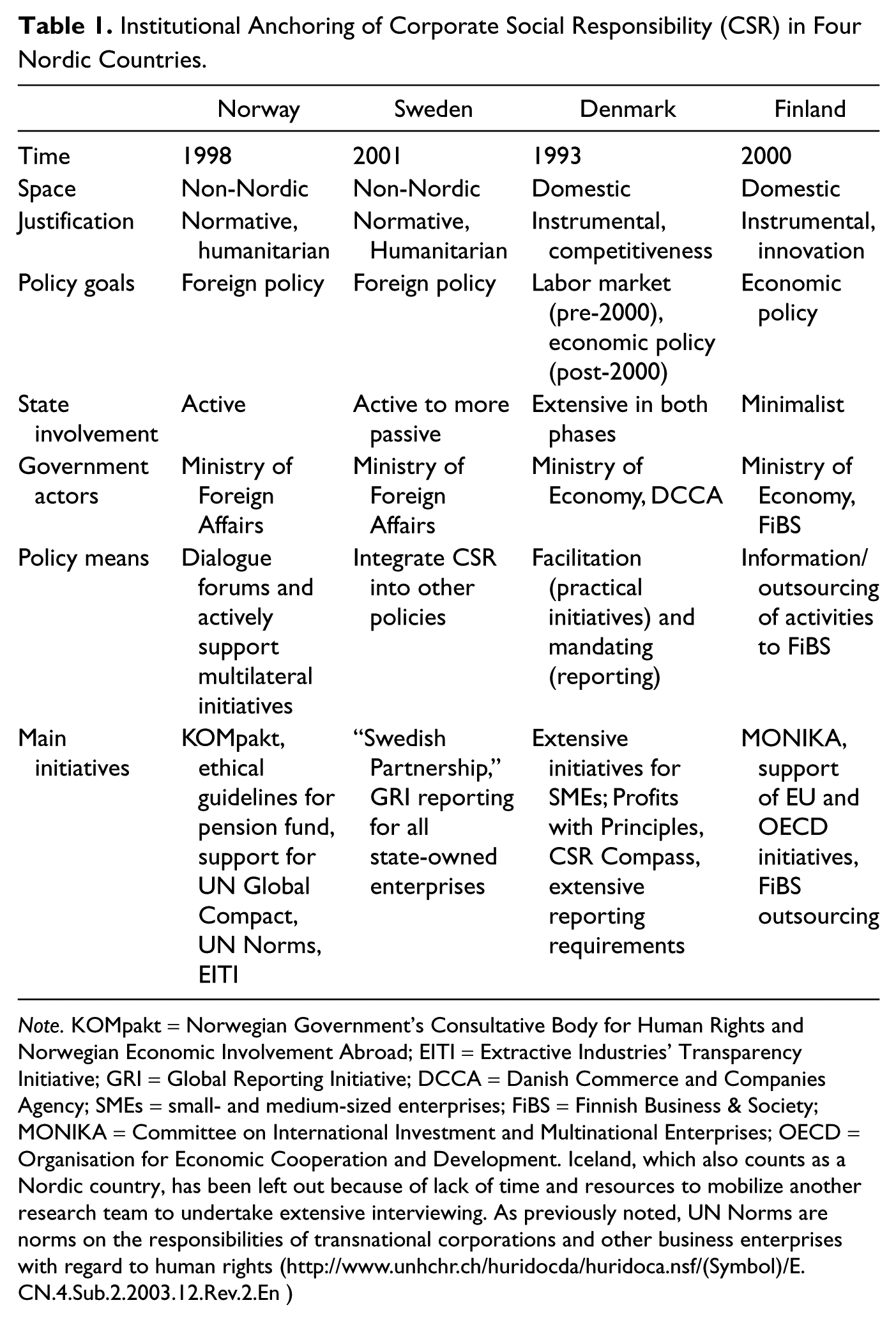
Note. KOMpakt = Norwegian Government’s Consultative Body for Human Rights and Norwegian Economic Involvement Abroad; EITI = Extractive Industries’ Transparency Initiative; GRI = Global Reporting Initiative; DCCA = Danish Commerce and Companies Agency; SMEs = small- and medium-sized enterprises; FiBS = Finnish Business & Society; MONIKA = Committee on International Investment and Multinational Enterprises; OECD = Organisation for Economic Cooperation and Development. Iceland, which also counts as a Nordic country, has been left out because of lack of time and resources to mobilize another research team to undertake extensive interviewing. As previously noted, UN Norms are norms on the responsibilities of transnational corporations and other business enterprises with regard to human rights (http://www.unhchr.ch/huridocda/huridoca.nsf/(Symbol)/E.CN.4.Sub.2.2003.12.Rev.2.En)
More specifically, Norway has pursued its internationally oriented CSR policy through dialogue forums and active support for multilateral initiatives. Sweden has increasingly transferred CSR to international partnerships. Denmark has moved from social to economic partnerships, providing extensive support for SMEs regarding CSR-oriented innovation. Finland has done likewise by having its Ministry of Economics work closely with Finnish business organizations in FiBS, to promote responsible competitiveness.
Harmony Versus Conflict
The article’s introduction outlined two plausible scenarios for the Nordic adoption of CSR policies. In the first scenario, the authors argue that Nordic welfare states would embrace CSR because its goals are in harmony with the welfare state traditions where the Nordic countries extend their leadership in welfare state policies into an equally enthusiastic policy engagement in CSR. In the alternative, and equally plausible, scenario we argue that the means promoted by CSR will create conflict—a conflict between the democratic and negotiated style of the advanced welfare state on one hand and the business-driven and voluntary CSR decision making on the other. This conflict, we argued, could lead to reluctance, skepticism, and ambiguity in public policies to promote CSR.
Not surprisingly, the authors find evidence for both scenarios in the empirical material. The governments enthusiastically embrace CSR goals, although the means to achieve the goals are sometimes perceived as quite problematic. All the Nordic governments eagerly promote and support international CSR initiatives like the UN Global Compact, the OECD guidelines, the UN Norms, 5 and the GRI. For instance, these four Nordic governments are represented in the group of 13 government donors to the UN Global Compact, the Norwegian government hosts the secretariat of the Extractive Industries’ Transparency Initiative (EITI), and the Swedish government has adopted the GRI guidelines as mandatory for all state-owned enterprises. The Nordic governments have also actively supported the UN Special Representative on Business and Human Rights, and other emergent juridification 6 processes of CSR and business responsibilities. Thus, at the level of policy goals, there appear to be considerable complementarity and room for CSR to reinforce the advanced welfare state agenda.
Regarding means, instances of compatibility exist, whereby CSR adds new ideas and vitality to preexisting political projects. For instance, the governments have adopted principles from the socially responsible investment community (SRI) in the management of public investment portfolios, they have added CSR reporting to accounting acts, and state-owned enterprises have adopted CSR policies. CSR-based processes are also explored in more innovative, experimental foreign policy processes, which Nordic governments have a history of embracing.
On both the ideological and operative levels, however, widespread skepticism exists toward CSR and toward relying on voluntary initiatives in general. Interviewees across the four countries consistently describe CSR as “second best” and see CSR as neither a viable nor a desirable policy alternative to traditional welfare state policies domestically. Their explicit policy preference is for mandatory regulations and negotiated, tripartite agreements to secure decent social and environmental standards. Thus, although the Danish and Finnish CSR policies are oriented toward their domestic business communities, they are intended to increase these companies’ success in international markets, and CSR policies are not pursued as an alternative to social and environmental domestic legislation at home. In explaining their skepticism, interviewees frequently refer to “The Nordic model”—alternatively the Danish/Finnish/Swedish/Norwegian model of strong welfare state regulations and corporatist agreements—as their primary policy preference.
The Nordic governments, therefore, often use CSR selectively, and at times speculatively, to strengthen preexisting welfare state policies. Although many interviewees seem outright skeptical of CSR and try to distance themselves somewhat from the concept, they report that CSR can “open the doors to the boardrooms,” because it is a popular concept in business circles, and therefore, a way for policy makers to engage with business. For instance, the Danish Ministry of Foreign Affairs embraces CSR because it “gives better gearing on money spent on development assistance,” and both the Danish and the Norwegian Foreign Ministries admit that they simply relabel preexisting initiatives. As explained by an interviewee in the Danish Ministry of Environment, “It is a ‘hit’ to call it CSR now. Business has introduced the label, and when they use it, and it means the same anyway, we don’t mind calling it CSR.” Similarly, interviewees in the Swedish Ministry of Foreign Affairs said they use CSR strategically to influence policy developments in China because discussing human rights and worker’s rights with the Chinese government is not an option. Thus, by engaging directly with the corporate entities through CSR initiatives, the interviewees feel they can better achieve their humanitarian foreign policy goals.
The strong skepticism toward business-driven voluntary CSR approaches by many interviewees, particularly representatives of the labor unions, might explain why all the Nordic governments consistently use the traditional tripartite structure in their CSR initiatives. For instance, all Nordic governments have chosen tripartite representation in their National Contact Points for the OECD guidelines, a structure that few other governments have chosen. Furthermore, bodies like MONIKA, KOMpakt, and Globalt Ansvar have tripartite representation, and all the interviewees refer to the extensive consultation with trade unions and employers’ associations as being vital to their CSR policy processes. Thus, although CSR is originally a business-centered idea, the Nordic governments seem to pour the new wine in their old bottles to ensure the legitimacy of their public CSR policies.
To conclude, our interviewees indicate that CSR policies might be successfully introduced in advanced welfare states, but only when they are carefully designed to avoid conflicts and contradictions. Next, the authors discuss the different strategies employed by the governments to reconcile or avoid conflicts between the CSR tradition and advanced welfare state tradition of corporate responsibility.
Strategies for Accommodation
Nordic CSR policy practice shows that potential conflicts at the operational level are largely resolved by introducing CSR policy as a supplement to the old welfare state agenda. However, tailoring CSR policy to supplement the welfare state agenda involves specific applications in each country and entails careful accommodation of CSR policies to national institutions and traditions. The interviews and the policy documents collected for this analysis indicate that there are three main strategies of accommodation, as illustrated in Figure 1:
Externalizing potential conflicts by confining CSR policies to a foreign policy for international welfare capitalism.
Compartmentalizing by confining CSR to a field less amenable to traditional regulation, namely, competitiveness and innovation.
Supplementing welfare state protection, but only in times of obvious welfare state limitations.
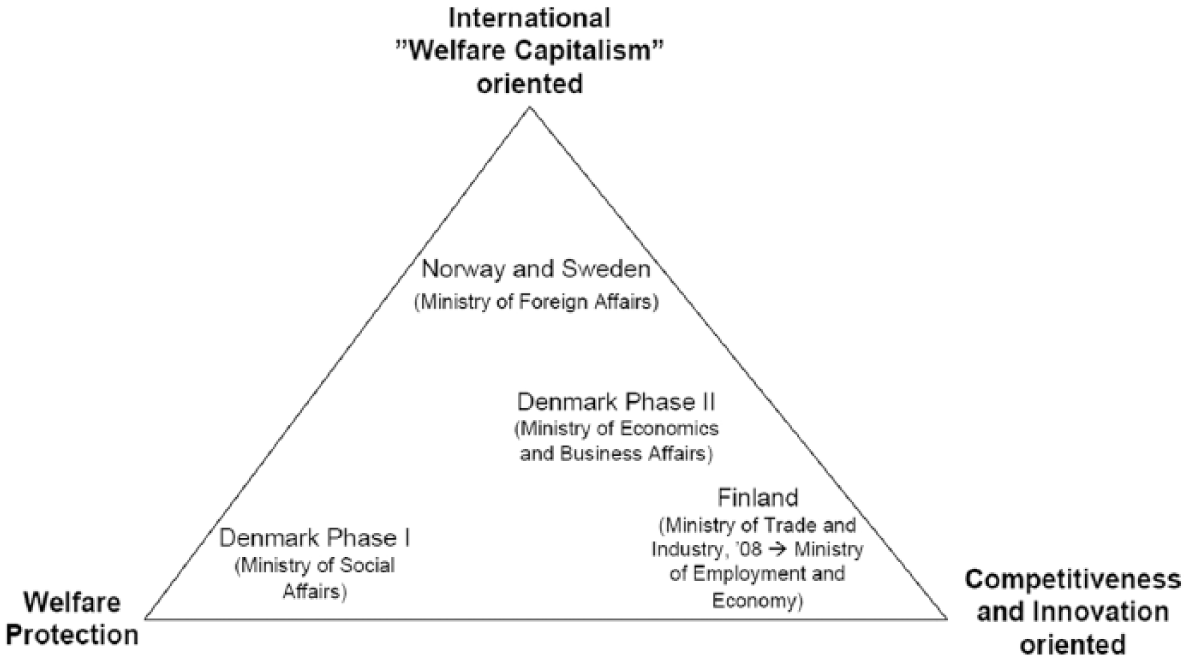
Government strategies to increase compatibility between CSR and advanced welfare states’ policies.
The following subsections address each strategy in further detail.
Externalizing CSR: The International Welfare Capitalism Model
As discussed earlier, a prominent use of CSR in Swedish and Norwegian public policy is as a tool to replicate the Nordic welfare state abroad. Interviewees from all four countries clearly prefer traditional welfare state regulation and tripartite agreements in their domestic contexts. But because these are not viable internationally, they perceive CSR as an alternative channel in international relations. The Norwegian and Swedish solutions of focusing CSR abroad are the most obvious cases, with CSR filling a regulatory gap in the global market economy that has not been amenable to traditional regulatory governance. In Sweden and Norway, known for their highest international ambitions in the Nordic countries, CSR is thus aligned with the strong Nordic political engagement for a socially responsible welfare model in the global economy. This effort to shape the global market arena in accordance with Nordic standards is couched in rhetoric of moral obligation; the aim is to increase social welfare, environmental protection, and economic prosperity in developing countries, as opposed to promoting the interests of domestic business communities. For such reasons, an interviewee from the Swedish Ministry of Foreign Affairs disliked the “Eurocentric focus on CSR as competitive advantage” as opposed to CSR as a means to improve social and environmental standards in developing countries. This humanitarian justification of and motivation for political engagement in CSR is mirrored in the Norwegian White Paper on CSR: Just as politics is not an end in itself, but a means of promoting social change for the benefit of the people and the environment, a company’s profits or activities are not goals that can be viewed in isolation from other considerations. Economic activities also require an ethical foundation that puts people, the environment and broader social considerations centre stage. (Norwegian Government, 2008-2009, p. 6)
Using CSR to promote international welfare capitalism ties in with Nordic foreign policy goals generally, which, in Kuisma’s words (2007), are strongly influenced by an internationalist, normative project of “spreading the good message of . . . social democracy to the world.” Promoting global welfare capitalism through CSR can be seen as a logical counterpart to, and extension of, the welfare state at home, in what Bergman (2007) terms a “co-constitution of domestic and international welfare obligations.” Correspondingly, CSR has been firmly led by the Ministries of Foreign Affairs, with the Ministries of Trade and Industry taking a second seat. Some interviewees even perceived CSR as a clever tool to bypass traditional politics by going straight to the corporate level, especially in countries like China, where the Swedish government has limited success in raising certain issues in the ordinary political channels: “CSR is used to promote politically sensitive issues such as labor rights and human rights, without any links to the political level” (Interview, Swedish Ministry of Foreign Affairs).
Elements of the international welfare capitalism model of CSR are, however, also present in all the Nordic governments, as they all emphasize multilateral solutions and institutions in their CSR policies. The governments are reluctant to form national initiatives and, thus, promote instead the initiatives of international institutions like the OECD, UN, GRI, ISO, and ILO, as well as EU policies in the cases of Denmark and Finland. Thus, by confining CSR to international issues, potential conflicts between CSR and the advanced welfare state are externalized and thereby largely avoided because the “second best” CSR approach is the only viable approach in promoting international welfare capitalism.
Compartmentalizing CSR: The International Competitiveness and Innovation Model
The most recent Nordic policy trend in CSR focuses on CSR as a competitive advantage in international trade. This competitive advantage view is the dominant trend in both Denmark and Finland and stands in stark contrast to the humanitarian, international welfare capitalism model of CSR favored by Norway and Sweden. Instead, the international innovation and competitiveness model, favored by Denmark and Finland, focuses on using CSR to further the domestic business community’s interests. The core idea is that the high Nordic social and environmental standards constitute a comparative advantage for success in CSR that should be used more actively to increase international competitiveness. As expressed in the Danish government’s action plan for CSR, It is the goal of the government to develop and to utilize this comparative advantage so that Danish companies can profit in the global market from being responsible. . . . The government wishes to promote and support CSR and to enable Danish companies to derive advantage from being global frontrunners in CSR.
In particular, interviewees from both the Danish Ministry of Economy and the Danish Confederation for SMEs reported an explosive growth in the need for CSR-related assistance among Danish export-oriented SMEs at the turn of the millennium. The interviewees therefore saw a greater need for government initiatives and practical advice, as reflected in the large-scale SME-oriented CSR initiatives from the Danish government.
In Finland, the framing of CSR in a competitiveness and innovation perspective fits the larger Finnish economic policy paradigm launched in 2003, the “New Industrial Strategy.” This comprehensive government program based on rapid liberalization and a clear orientation toward the EU transformed Finland’s former raw material–based economy into a knowledge economy based on innovation, technology, and R&D and seems to have motivated the convergence of CSR with these goals. Given the strong industrial reorientation with radical and active public policies to increase innovation when CSR entered the agenda, public policies for CSR were largely absorbed by the innovation paradigm.
The Finnish government’s lower CSR engagement mirrors its generally weaker welfare state and lower foreign policy ambitions, and the quite difficult economic times after the Soviet Union’s fall, when Finland lost its most important trading partner. Thus, this strategy for accommodation avoids conflicts by compartmentalizing CSR to areas less amenable to traditional regulation. There is no strong collision with traditional welfare state measures because innovation policy is typically pursued in complex market network approach rather than by strong regulation.
Supplementing CSR: TheDomestic Welfare Protection Model
The early Danish CSR policy model, with its focus on domestic labor market issues, contrasts with the Norwegian and Swedish CSR approaches and reflects the extraordinarily high Danish public unemployment expenses in the 1990s. Denmark has the most extensive practice of the so-called Nordic flexicurity model, with higher benefits and payments for job retraining than elsewhere in the Nordic countries (Nørgaard, 2007). The Danish government creatively included CSR in the labor market policy arena, traditionally dominated by regulations and tripartite agreements, thereby implementing CSR and encouraging voluntary industrial engagement to supplement the welfare state by way of confronting extraordinary sociopolitical challenges early in the 1990s. However, several interviewees question whether the Danish government’s use of CSR in flexicurity really amounted to anything new and claim that these CSR initiatives were in fact traditional incentive schemes that merely used “CSR” as a fashionable label. After unemployment was reduced, flexicurity issues were again dealt with via traditional welfare state policies and tools, whereas CSR was reconceptualized to conform to a more mainstream CSR approach, as discussed in the next section.
The early Finnish debate on CSR and outsourcing is also best understood in the context of securing their domestic welfare state foundations following Finland’s loss of economic arbitrage opportunities when the communist block transitioned to a market economy. CSR has occasionally been invoked in Norwegian debates about industrial outsourcing and layoffs, but Norwegian, and particularly Swedish interviewees, seem skeptical of introducing voluntary CSR tools in a domestic welfare state domain. A Norwegian interviewee even claimed invoking CSR in relation to domestic business issues was a misuse of the CSR term that “destroys the CSR debate.” As illustrated, the scope for using CSR in domestic policies that are close to the kernel of the welfare state seems quite limited in the Nordic countries, and using CSR domestically in key welfare state areas only seems legitimate in times of welfare state crisis.
Nordic CSR Public Policies in Comparative Perspective
Seen in a broader comparative perspective, the active but selective use of CSR in public policy counters expectations and arguments in the CSR literature because this literature leads one to expect that advanced welfare states will have little need for or interest in CSR as a public policy tool. Some authors, like Matten and Moon (2008) and Jackson and Apostolakou (2010), essentially argue for CSR as a substitute for the welfare state. In this perspective, CSR becomes an alternative to welfare state regulation and is therefore to be found predominantly in liberal market economies. In Matten and Moon’s terminology, CSR is explicit in liberal market economies, especially in the United States, but remains implicit in coordinated or social democratic market economies, like the Nordic welfare states. Likewise, Kinderman (2009) suggests that CSR in liberal or liberalizing market economies can function as a material and symbolic substitute for institutionalized forms of social solidarity, which are politically upheld in social market economies. Finally, Sadler and Lloyd (2009) argue that CSR is part of a political project of “rolling out” neoliberalism.
Our study counters these claims: CSR is clearly not seen as a legitimate substitute for the welfare state in the Nordic countries, and interviewees across countries and ministries stress that they perceive CSR as a second-best option. However, by actively accommodating CSR to the advanced welfare state traditions through externalizing, compartmentalizing, and supplementing strategies, the Nordic governments adapt CSR to fit their political traditions. At times, this adaptation may even lead to a quite radical change from the initial, liberal, business-driven origins of CSR. For instance, when the Swedish center-right alliance came to power, they considered terminating engagements in CSR because CSR had a “Leftist stamp,” according to one interviewee.
However, beyond the national welfare states’ reach, the governments may actively deploy CSR to expand and supplement their efforts to civilize the global market economy, even by soft law and voluntary means. The distinction between national and international, and between goals and means—as the authors have argued—may be a key to understanding the ambivalence of some interviewees. Judged by the means, CSR obviously fits better with liberal policy, but judged by the goals, CSR can easily be seen to reinforce values central to advanced welfare states that are harder to promote under liberalism. In fact, the famous neoliberalist, Milton Friedman, violently rejects CSR on liberalist grounds (Friedman, 1970), claiming that it is the responsibility of governments to define and enforce rules to protect social and environmental welfare—a view that corresponds quite closely to that expressed by many of our interviewees.
The key to understanding the compatibility between CSR and the advanced welfare state lies—as the authors have shown—in strategies of accommodation whereby countries adapt CSR to domestic needs and agendas. This adaptation is also found in analyses of other governments’ CSR policies. For example, in a comparative study of CSR and public policy in Norway, the United Kingdom and Italy, Albareda, Lozano, and Ysa (2007) found that Italy engaged most actively in CSR by linking it up to regional support policies for industrial districts, whereas the United Kingdom made CSR central to industrial policy—appointing a minister for CSR in the Ministry of Trade and Industry. Active accommodation can therefore break the traditional link between CSR and liberalism, thus allowing other types of welfare states than the liberal ones to engage in CSR.
To the Nordic welfare states, CSR is attractive foremost as an opportunity to expand beyond the reach of traditional welfare measures or to complement limited resources or failures in domestic welfare state domains. The Nordic countries remain adamant about governing the social and environmental responsibilities of business through tripartite negotiations and government regulations. Only as a supplementary approach will the governments welcome voluntary corporate self-regulation.
Footnotes
Appendix A
Appendix B
Declaration of Conflicting Interests
The author(s) declared no potential conflicts of interest with respect to the research, authorship, and/or publication of this article.
Funding
The author(s) received no financial support for the research, authorship, and/or publication of this article.