




Abstract
A number of international organizations have identified eliminating gender inequality as a critical element in poverty reduction and development. Given that the Global Compact (GC) was launched, in part, to work toward the achievement of these goals, this article argues that the GC should pay significant attention to gender inequality in its learning network. The article discusses the findings of a review of the GC learning network, which reveals that the issue of gender inequality was missing from its agenda in its first decade. The author suggests explanations for this finding, including the lack of participation by women’s organizations in the GC learning network, the lack of a gender discourse in corporate social responsibility initiatives generally, and the GC’s focus on the business case, which may deflect attention from gender inequality where no clear business case can be made.
Keywords
Women are disadvantaged in all societies, especially in developing economies (UNDP, 2005). According to the World Bank, “In no region of the developing world are women equal to men in legal, social and economic rights” (World Bank Gender and Development Group, 2003). There is increasing awareness that the achievement of women’s equality is key to solving the challenges of development and poverty (World Bank Gender and Development Group, 2003). Given that a primary goal of the Global Compact (GC) is to encourage firms to become involved in addressing these same issues (UN General Assembly, 56th Session, 2001), one could logically expect the GC to address issues related to gender inequality.
Unfortunately, women’s rights have tended to be ignored in the various debates and initiatives in the area of business and human rights and in corporate social responsibility (CSR) generally (Thompson, 2008). This situation is starting to change, albeit slowly. For example, the UN Special Representative on Business and Human Rights, John Ruggie, had his mandate renewed in 2008 on the condition that, among others, he “integrate gender issues and vulnerable groups (particularly children) in his work” (UN Human Rights Council, 2008). In 2008, the World Bank launched its Adolescent Girls Initiative, which encourages private sector involvement in promoting gender equality, and in 2009, the Global Reporting Initiative (GRI) and International Financial Corporation (IFC) published Embedding Gender in Sustainability Reporting: A Practitioners’ Guide (International Finance Corporation, 2009). However, addressing gender inequality still remains a secondary or underaddressed issue for many CSR initiatives. The world’s largest, the GC, has been in effect for more than a decade. This article discusses the extent to which it has addressed the issue of gender inequality within its learning network during its first ten years.
Despite the other roles attributed to it, the GC is primarily a multistakeholder learning network (Kell & Levin, 2003; Rasche, 2009b). It was designed to influence the behavior of firms and induce corporate change (Kell & Levin, 2003; Ruggie, 2001). Given the lack of enforcement mechanisms and explicit obligations by which signatories must abide (other than their Communication on Progress), the learning network is the primary means by which the GC can influence their behavior and thus achieve its objectives (Kell & Levin, 2003; McIntosh, Waddock, & Kell, 2004; Rasche, 2009a). Networks such as the GC play a role in the development and diffusion of norms, and the way a problem is framed within a learning network can affect the learning that takes place (Kardam, 2004). Thus, any assessment of the GC and its impact should focus, at least in part, on its learning network.
A number of different terms are used to refer to this phenomenon, including public policy networks and global public policy networks (GPPN), learning networks, learning fora, and multisectoral networks. The GC can be described as a learning network where organizations come together with the goal of learning from each other. From its inception, those involved in the design and direction of the GC have viewed it as a learning network engaging a diversity of actors from a variety of organizational types, with a “framework of values” to guide those actors. The GC describes the actors in this way:
The Global Compact involves all the relevant social actors: governments, who defined the principles on which the initiative is based; companies, whose actions it seeks to influence; labor, in whose hands the concrete process of global production takes place; civil society organizations, representing the wider community of stakeholders; and The United Nations, the world’s only truly global political forum, as an authoritative convener and facilitator, (UN Global Compact, 2009a)
In addition, networks also need to be inclusive and diverse (Reinicke & Deng, 2000). Waddock and Smith (2000, p. 48) agree:
The process of becoming a good corporate citizen involves engaging honestly in dialogues with stakeholders, that is, having conversations in which core values and assumptions are openly articulated, and where mutual concerns and issues can be discussed in a non-threatening (and non-threatened) way.
While there are a number of different types of actors involved in the GC, the GC itself acts as the facilitating agent in the network, promotes participation in policy dialogues, and facilitates public and private partnerships by the development of tools and training materials and the establishment of decentralized networks at the national or regional levels (Ruggie, 2004). Along with its other activities, these form the core of what will be referred to as the GC learning network.
This article has three key objectives. The first is to suggest that gender inequality is an issue that the GC should address for a number of reasons, including the fact that one of the two key objectives of the GC is to mobilize action in support of the Millennium Development Goals (MDGs) that have prioritized gender equality. The second is to summarize the findings of an empirical study that looks at the extent to which women were an explicit subject of concern in the GC’s learning network in its first decade. These findings suggest that women’s human rights received little attention. Gender awareness was lacking, and when women were mentioned, it was usually in the context of their participation as formal sector workers. The third objective is to advance explanations for these findings. The GC’s limited focus on women as workers, the lack of women’s voices in the learning network, and the framing of gender equality in the context of the business case are all factors that may explain why gender inequality has not been addressed.
Gender Inequality and the GC
Why should the GC address the issue of gender inequality? Given the attention it has received by the UN, the World Bank, and other international institutions, it is logical to ask about the implications this question has for the GC (Kilgour, 2007). This section argues that gender inequality should be an important subject of concern in the GC learning network, given its Ten Principles and the international instruments underpinning them, the GC’s objectives, and its place in the UN organization.
The way gender and women’s inequality have been conceptualized has continually evolved, especially in the work of feminist researchers (discussed, for example, in Jackson & Peterson, 1998). However, Peterson and Runyan (2010, p. 259) argue that returning, in part, to the question posed by feminists decades ago, “‘where are the women’, remains a productive starting point” for research. Both the concepts of women and gender are socially constructed, which results in women as a group being treated differently than men as a group. In addition, the process of gendering the world has resulted in a situation where gender becomes “the basis for relations of inequality between men and women” (Peterson & Runyan, 2010, p. 9), and although there are substantial differences across cultures, gendered systems create hierarchy and differential treatment in most, if not all, societies throughout the world (Peterson & Runyan, 2010; UNRISD, 2005). It is important for research on organizations such as the GC to have awareness that the world is gendered and that this gendering has created different situations and life chances for women and for men.
Addressing issues with a gender lens is crucial (Peterson & Runyan, 1999). For example, a gender lens helps to more fully understand the HIV/AIDS pandemic in sub-Saharan Africa, which has been a subject of considerable discussion in the GC learning network. Women represent more than half of those infected with HIV, and gender inequality greatly affects the way that women can protect themselves from being infected, cope with illness once infected or care for those who are infected. It plays a key role in increasing women’s vulnerability and it is the root from which this epidemic grows (Gupta, 2004). In addition, it is usually the older girls in the family who leave school and become the caregivers and home managers when a mother dies. This circumstance has a compounding effect on girls as those who have a lower level of education are at higher risk of contracting HIV/AIDS (Mushunje, 2006). This example reveals how using a gender lens allows for a more thorough understanding of any phenomenon. Attention is focused on power relationships and related concepts of marginalization, exclusion, and limited inclusion (Ackerly, 2008). Applying a gender lens to the GC learning network can reveal what is being addressed and what is not.
Interpreting the Ten Principles
The fact that there is no direct reference to gender equality in the Ten Principles, to which signatory firms commit, is not surprising as these principles were intended to be general rather than specific (Rasche, 2009a). However, the general nature of the Ten Principles requires an understanding of what they mean in different contexts, and how they should be interpreted to correspond with the goals of the GC. They were derived from The Universal Declaration of Human Rights, the International Labour Organisation’s (ILO) Declaration on the Fundamental Principles and Rights at Work, the Rio Declaration on Environment and Development, and the UN Convention Against Corruption; the first three contain specific gender equality provisions. For example, Principle 20 of the Rio Declaration requires a gendered perspective on the environment and development.
More specifically, Principle 1 states that “Business should support and respect the protection of internationally proclaimed human rights.” These rights clearly include women’s human rights contained in UN instruments such as the Convention on the Elimination of Discrimination Against Women (CEDAW; Kilgour, 2007). Adopted by the UN General Assembly in 1979, CEDAW addresses a wide range of women’s issues such as discrimination, prejudice, prostitution, political and public life, education, employment, health, economic and social benefits, and marriage and family life (UN General Assembly, 1979).
Overall, the GC has two main objectives, one of which is “to catalyse actions in support of broader UN goals, such as the Millennium Development Goals (MDGs)” (UN Global Compact, 2011). Progress toward meeting these goals has been identified as one of the indicators that the GC is a success (Kell & Levin, 2003). The eight MDGs were established in 2001, in order to “provide a framework for the entire UN system to work coherently together towards a common end” in the area of development and poverty reduction (United Nations, 2006). The formal linking to the MDGs by the GC corresponds with former UN Secretary-General Kofi Annan’s vision to encourage the private sector to become more involved in the UN and its broader mission, particularly as it relates to the challenges arising out of globalization (Bull, Bøås, & McNeill, 2004).
The direct link between the objectives of the GC and the MDGs has a bearing on any assessment of the GC, including its attention to gender inequality. Goal 3 specifically calls on all involved parties to “promote gender equality and empower women” and is considered a “leading goal among the MDGs” (Klasen, 2005, p. 245). In addition, specific MDG targets and indicators focus on such issues as decent work for women and reproductive health. This focus underscores the importance of addressing gender inequality in the GC’s learning network.
The GC’s objective of working toward “broader UN goals” can be interpreted in a number of ways. Given the GC’s raison d’être, UN instruments such as CEDAW, the Beijing Platform for Action (BPfA), and the UN’s policy on gender mainstreaming should inform how the GC provides guidance on the Ten Principles in its learning network (Kilgour, 2007). It is reasonable to assume that because broader UN goals target gender inequality, the GC would work toward putting those issues forward in its learning network.
The GC, as part of the UN, is bound by UN resolutions to implement BPfA. Adopted by the Fourth World Conference on Women in Beijing in 1995, the BPfA is
an agenda for women’s empowerment. It aims . . . at removing all the obstacles to women’s active participation in all spheres of public and private life through a full and equal share in economic, social, cultural and political decision-making. (UN Fourth World Conference on Women, 1995)
The UN General Assembly reaffirmed its commitment to the BPfA in 2005, explicitly linking it to the MDGs (UN General Assembly, 2005).
Being part of the UN also obliges the GC to comply with the UN’s policy on gender mainstreaming, adopted by the UN General Assembly, which resolved to
actively promote the mainstreaming of a gender perspective in the design, implementation, monitoring and evaluation of policies and programmes in all political, economic and social spheres, and further undertake to strengthen the capabilities of the United Nations system in the area of gender. (UN General Assembly, 2005, author’s emphasis)
One would therefore expect to see some evidence of this gender mainstreaming in the GC’s activities, including its contributions to the learning network. If the GC should be addressing gender inequality, what would constitute evidence of its implementation in the learning network?
Evidence of Attention to Gender Inequality
The goal of this research is to assess whether the GC has addressed the issue of gender inequality within its learning network. As discussed earlier, the concept of gender inequality is not static and its conceptualization has been in continual evolution (discussed, for example, in Jackson & Pearson 1998). The insights gained from this literature and the various ways in which gender inequality has been conceptualized by UN agencies or those that are associated with it has guided the research strategy in assessing whether or not the GC has addressed women’s inequality issues within the learning network. For example, the Gender Related Development Index, used by the UN’s annual Human Development Report since 1995, “rank[s] countries according to their absolute level of human development and their relative scores on gender equality” (Dijkstra & Hanmer 2000, p. 41). Critics argue that it does not accurately or fully capture gender inequality, as it focuses mostly on socioeconomic inequality (Dijkstra & Hanmer 2000). Another UN initiative, the UN Gender Empowerment Index, “focuses on gender inequality in key areas of economic and political participation and decision-making.” This approach has also been criticized for not capturing the wide number of variables that could be used to measure inequality (Dijkstra & Hanmer, 2000, p. 56).
More recently, the establishment of the MDGs has given rise to the development of numerous indicators that attempt to concretely measure progress toward the goals and the targets. In September 2010, the UN Statistics Division of the Department of Economic and Social Affairs published a summary of some of the indicators being used to measure progress on the status of women vis-à-vis the MDGs. The areas that are being measured include (UN Statistics Division, 2010):
Education attainment levels (including tertiary education); Member(s) of the household who collect water (women, men, girls, or boys); HIV prevalence rates in women as a proportion of the total population; Women’s representation in management positions within organizations; Proportion of girls and boys who are underweight at age 5; The representation of women in vulnerable employment activities.
Notwithstanding the commonality of purpose of many of the indicators and indices, measuring gender inequality is complex and fraught with difficulties, including how to conceptualize inequality or measure issues such as gender-based violence (Moser, 2007). However, a review of the indicators, such as those listed above, draws attention to issues that women face and affect their status in the societies in which they live. The types of issues being measured by these indices inform the analysis of the data from the GC learning network. In other words, the indicators provide additional guidance on what types of issues the GC should logically address within its learning network.
Each of the Ten Principles and their related issues has potential gender implications. For example, notwithstanding that the GC’s Policy Dialogue on HIV/AIDS in 2003 referred to the “gender dimensions” of the problem (UN Global Compact & International Labour Organisation, 2003), discussions within the GC have tended to ignore this issue. The HIV/AIDS issue is one issue where one could reasonably expect to see some evidence of gender awareness.
The GC discusses issues such as pesticide use, climate change, collective bargaining, and lobbying in its learning network. A gender-aware approach could be applied to each of these issues. For example, applying a gender-aware approach to environmental issues could help to promote awareness of the negative consequences of pesticide use in rural areas that can have an adverse impact on local women’s breast milk and reproductive systems. At another level, it could consider the gendered impact of climate change, given that women in pastoral economies in Africa are likely to be the group most adversely affected by this change (Simms, Magrath, & Reid, 2004). A gender-aware commitment to the right to collective bargaining could lead signatories to work with labor organizations to promote the inclusion of women in the collective bargaining process.
The GC suggests that a firm’s lobbying activities form a legitimate part of their commitment to the Ten Principles (see Georg Kell’s foreword in MacGillivray et al., 2005). A gender-aware approach could signal the need to consider the impact of a signatory’s operations on women and consider its broader activities such as lobbying and involvement in policy formulation at the national and international levels, especially when such actions on one level contradict (or cancel out) actions or statements at another level (Utting, 2005). For example, a firm’s lobbying for seed patent protection may have an adverse impact on women who are the majority of the world’s food producers. There may also be a direct conflict between a company’s commitment to gender equality and the impact of its core business activities on women as in the case of companies benefiting from the privatization of public services, such as water in sub-Saharan Africa, where women’s rights may be violated (Kilgour, 2007).
There is no shortage of examples of initiatives at the international level within and outside the UN system that attempt to integrate gender concerns into their policy documents and publications. For example, in 2003, the World Health Organization (WHO) published a guide to “Engendering the Millennium Development Goals (MDGs) on Health” in order to draw attention to the fact that “while only one of the MDGs is specifically about gender, addressing gender is of critical importance to every MDG” (World Health Organization, Department of Gender and Women’s Health, 2003). The WHO also published a report to promote a gender-aware approach that considers the MDGs in the context of violence against women (World Health Organization, 2007). Both of these documents demonstrate what a gender-aware approach to understanding issues within the GC learning network could look like.
In summary, for the purposes of this study, the conceptualization of “gender inequality” is based on the insights from the literature on gender inequality, the indicators discussed above, the GC’s links to various legal and UN instruments, and comparisons made with other initiatives such as the Calvert Women’s Principles (CWPs), which explicitly address women’s inequality. In other words, a type of gender audit is conducted on the GC learning network to determine the extent to which it addresses gender inequality (Moser, 2005). The next section discusses the methods used to collect and analyze the data.
Method
The GC should be evaluated based on what it purports to be, a learning network (Rasche, 2009b). The qualitative research strategy attempted to determine the extent to which gender inequality received attention in the GC learning network, and if so, in what context. It is not sufficient to say that all GC issues by default apply to both men and women and will stimulate learning that will automatically address women’s inequality because policies that appear gender neutral can have an adverse impact on women (Peterson & Runyan, 1999). Therefore, explicit discussion and learning tools and materials that, at a minimum, mention women would be required to stimulate learning on these issues. However, it is important to go beyond merely seeing whether women are mentioned to a more comprehensive analysis using a gender lens (Peterson, 2003). Merely mentioning women in the learning network has been characterized as a limited approach that changes little (Waylen, 2006). In addition, the GC learning network was reviewed for evidence that the concept of gender affected the ways in which issues, such as climate change or freedom of association, are discussed and promoted.
Sources of Data
One primary source of data were documents related to the GC learning network. As such, the GC relies heavily on the transmission of information in a virtual world (website and web links) but also conducts meetings, cohosts events with other organizations, and delivers speeches to various organizations throughout the world. A review was conducted of the material publicly available on the GC website and was supplemented by other information, including interviews with key participants and published secondary sources. Most of the products the GC contributed to the learning network were publicly available through their website, and the data collection methods allowed the researcher to collect and analyze most of these products over a 4-year period of data gathering. These products were heterogeneous in their form, thus allowing the researcher to gain a wide knowledge of how women’s inequality was addressed in a number of different GC arenas. They included the GC’s published texts (tools and publications), policy documents, GC Board meetings, speeches, PowerPoint presentations, web pages, CD-ROMs, and videos. The GC also produced a regular newsletter available on its website and to its subscribers by e-mail. The Compact Quarterly was produced 2 to 4 times a year from 2005 to 2008 and a typical edition would have approximately 18 articles on a wide range of topics. From its launch through to 2009, the GC produced hundreds of documents. The author thus consulted a wide range of documents concerning various topics bearing on women’s inequality.
Following the analysis of the documentary data, in-depth semistructured interviews were conducted with representatives of each of the main participant groups including the GC (staff and Board), signatory Transnational Corporations (TNCs), Global Union Federations, and nongovernmental organizations (NGOs). Purposive, key informant and critical case sampling strategies were used (Creswell, 1998; Marshall, 1996). For example, interviews were conducted with TNC signatories in the Global Fortune 500 who were recognized as CSR leaders and who had participated in the consultation process for the Women’s Empowerment Principles. Interviews were conducted with all Global Union Federations who responded to interview requests. The GC made available a staff person for an interview, and two board members were contacted and agreed to be interviewed. The specific goal of the interviews was to determine whether the preliminary findings and conclusions were valid and whether something had eluded the researcher in the major phase of data collection and analysis.
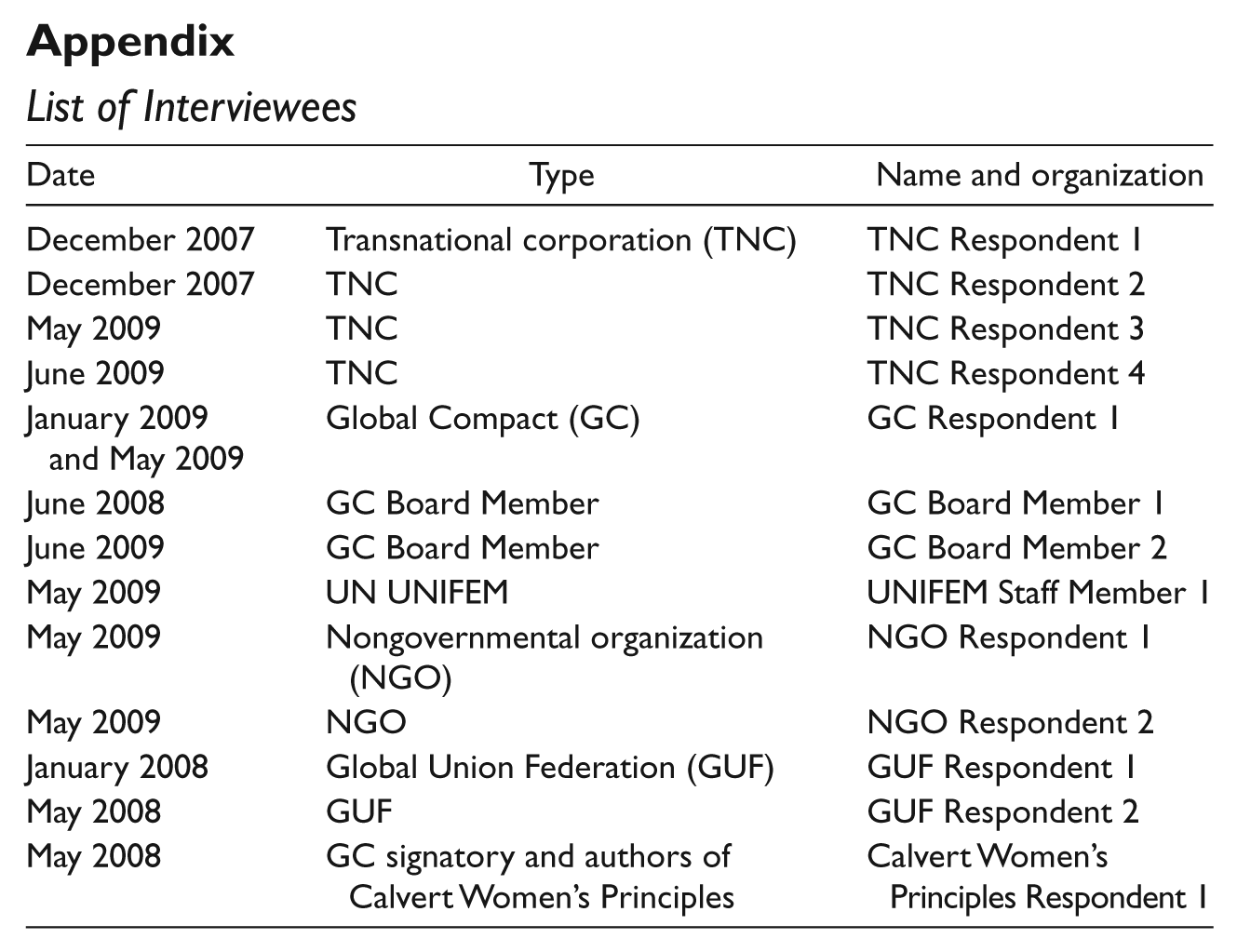
These interviews are listed in an Appendix. Additional data were gathered through participant observation at various GC-sponsored events to complement the other data gathering techniques. These observations confirmed the analysis of that data. For example, at some events there was no evidence of gender awareness, and at others gender awareness was more or less limited to discussions about equal opportunity, diversity, and women in management policies. This data collection technique allowed for a better triangulation of data.
Data Coding and Analysis
The data were coded using NVivo software. This process was part of both the data management and data analysis phases of the research (Richards, 2005). The coding employed in this study included open coding, key-word coding, and focused coding. Open coding was conducted on each document and interview as well as on the researcher’s notes. This initial review of the data revealed certain patterns, and the data were then coded by keywords, which were developed a priori (Berg, 2007), A number of identity-based keywords were used (women, sex, girl, gender, female) as well as keywords arising out of the review of the literatures (MDGs, HIV/AIDS, water, informal, discrimination, equal opportunity, diversity, Export Processing Zones, etc.) where one might expect to see issues of gender addressed. When the identity-based keywords were found, each occurrence was coded to represent the context in which it was used, for example, in relation to nondiscrimination policies, harassment, women in management, women entrepreneurs, HIV/AIDS, and workforce statistics. The next phase of coding was “focused coding,” which required paying attention to unexpected themes and issues that were not searched for but emerged from the data (e.g., the focus on the “business case”).
Once the data had been input, coded, and annotated, additional types of analysis were applied to understand the data. Qualitative content analysis was the main analytical method, supplemented by thematic analysis, memo writing, and categorizing and comparing (Berg, 2007; Charmaz, 2006). This approach has been used effectively in similar research (e.g., Grosser & Moon, 2008). Notwithstanding that part of the analysis included searching for keywords such as women, girl, and gender, it is important to note that just mentioning women and or indicating that policies have a gender element is not proof that a policy is gender aware (Pearson & Jackson, 1998). Such an approach to gender equality has been heavily criticized for being limited (Peterson, 2003). In other words, just mentioning “women” is not enough to show that the GC has addressed women’s inequality in its learning network. However, failing to even mention women may mean that the gendered elements of certain issues are ignored.
An important part of this research relates to the concept of negative evidence when data are not found. This type of evidence can provide valuable insights on an issue (Neuman, 2000). The concept of “gender-blind” is used to refer to situations where the gender dimensions of activities or policies are ignored (Esplen & Bell, 2007). This concept was very important as the research progressed and it became apparent that women were rarely mentioned and issues that one would have expected to see addressed were missing.
Gender Inequality in the GC Learning Network
The key findings of this research can be divided into three categories. First, a review of the activities of the GC’s learning network indicates that there was a general lack of attention to gender inequality. Second, women’s voices were noticeably absent from the learning network. Finally, there have been recent advancements such as the WEPs that promise to address this issue.
General Lack of Attention to Gender Inequality
To what extent did the GC learning network address issues relating to gender inequality? The data reveal that women were rarely mentioned in most of the GC’s products. The GC tools and publications, intended to provide guidance on a range of issues including how to interpret the Ten Principles and prepare the Communication on Progress (COP), contained very few references to women. For example, the Inspirational Guide to Implementing the Global Compact mentioned women in only one out of 17 case studies (UN Global Compact, 2011). Similarly, very few of the 219 GC Compact Quarterly articles surveyed referred to women. When women were mentioned, the reference was usually insignificant, even when the theme was “Spotlight on Human Rights and Business” (April 2008). Furthermore, in most meetings and conferences organized by the GC, few agenda items addressed issues of specific concern to women (UN Global Compact, 2011). These examples are illustrative of the overall findings of the review of hundreds of documents, which rarely referred to women.
When women/gender/sex/girl was mentioned in the learning network, it was usually in relation to a statistic or a generic listing of potential grounds of discrimination, for example, “no discrimination based on race, gender, religion, or ethnic group.” Most of the substantive references were to women as formal sector workers, most often in relation to equal opportunity and women in management programs and therefore limited to the GC’s Principle Six on eliminating discrimination in employment and occupation (Kilgour, 2007). This limited approach may promote the view that women only experience discrimination and human rights violations as employees in formal workplaces and that issues relating to the other labor principles and the environmental, human rights, and anticorruption principles are gender neutral. Unfortunately, the application of Principle Six constitutes only a small part of the solution to inequality.
The focus on initiatives that only address women’s inequality as formal sector workers, such as equal pay, sexual harassment, equal opportunity, and diversity, though essential, is limited in promoting gender equality in society at large, especially when gender inequality is so pervasive (Elias, 2008; Kilgour, 2007; Michaels, 2008). A 2008 ILO report on women concluded that the key problem for women workers in developing countries was not direct discrimination in the workplace but a whole range of other issues, including lack of training opportunities, lack of empowerment, and inequality in the private sphere (ILO, 2008).
The GC is similar to many other CSR initiatives that focus on women as formal sector workers, for example, in diversity programs. However, any analysis of how the GC learning network addresses issues pertaining to women and gender inequality needs to take into consideration not just the context of women who work for signatory firms as workers but also issues they encounter outside the formal workplace. In addition, it is important to recognize that gender inequality does not disappear automatically when women are fairly employed, despite its positive impacts on women’s lives, in part because in developing economies, only a small percentage of women are actually employed in the formal sector (Pearson, 1998). This reality underlines the importance of looking beyond the formal sector workplace and discussing gender inequality in potentially all areas of GC activity, including but not limited to the environment, climate change, water, corruption, trafficking, and lobbying.
Certain issues, references, and links often associated with violations of women’s human rights in the context of globalization were not addressed by the learning network. For example, despite increasing recognition that current and predicted water crises can exacerbate women’s inequality, the policy documents, meeting agenda, and summaries of meetings of the GC’s CEO Water Mandate initiative rarely mentioned women, and there was no evidence of gender awareness (UN Global Compact, 2011). Similarly, the issue of trafficking in women and prostitution in developing countries, which is closely linked with women’s inequality and is most likely to occur in the context of forced labor (Tepelus, 2006; addressed by GC Principle Four), did not receive attention.
The important issue of violence against women has also been neglected. Even after the UN Secretary-General Ban Ki-moon called on the private sector and “the entire UN system” to “Unite to End Violence against Women” (UN Secretary General’s Office, 2009), there was no mention of this initiative or of the issue on the GC website (UN Global Compact, 2011). The GC web page discussion of Principle Two links the use of security forces and human rights violations but does so without any gender awareness.
Many other issues relating to women’s human rights were not mentioned, including references to international conventions and instruments on women such as CEDAW. Despite the GC’s formal relationship with the GRI through its UNGC-GRI Value Platform and its Policy for the Communication on Progress, the 2009 launch by the GRI and IFC of its publication, Embedding Gender in Sustainability Reporting: A Practitioners’ Guide (International Finance Corporation, 2009) went unreported on the GC website. Similarly, the 2004 launch of the CWPs, the world’s first major CSR initiative dealing with women’s issues developed in conjunction with UNIFEM, was unreported and, until December 2008, was not referred to on the GC website.
Missing Voices in the Learning Network
Women’s voices in the learning network were also noticeable by their absence. The GC claims that the “perspectives, expertise and partnership-building capabilities [of civil society organizations (CSOs)] are indispensable in the evolution and impact of the Global Compact” (UN Global Compact, 2011). Notwithstanding this statement, the data reveal that feminist and women’s NGOs rarely participated in the GC learning network. A review of the GC’s approximately 400 civil society stakeholders in March 2006 shows that only 6 specifically represented women. In 2009, the numbers were similar—only 14 out of 1,238 had their primary focus on women (UN Global Compact, 2011). The reasons for this lack of participation vary.
For example, a representative from a NGO that focuses on women, the environment, and development indicated that this NGO was willing to be consulted by the GC but reluctant to join:
There are no women’s voices. We feel that the structure of the GC is flawed and our membership within it, as a strategy for changing that, would be insignificant. It is crazy to think that we would actually put a dent in it. (Interview with NGO Representative 2, May 2009)
Another women’s NGO expressed similar misgivings. A representative of the Women’s International League for Peace and Freedom (WILPF) wrote:
We worry that . . . access to the United Nations is becoming more and more limited, and that simultaneous to this, the Corporate Sector are gaining more access to our international decision makers. (Global Policy Forum, 2008)
A GC Board member suggested that the GC may not have been an enticing environment for women’s organizations:
I think it probably just wasn’t a space that looked too attractive to try to work in. (Interview with GC Board Member 2, May 2009)
Notwithstanding the reasons listed above, the lack of women’s voices may have had an impact on the issues that were addressed by the GC, given that its learning network was conceived to involve a variety of participants (Waddock & Smith, 2000). If the GC is “governance by dialogue,” with participants creating the learning that is going on (Slaughter, 2004), the lack of representation from women’s groups suggests limitations to this model as important perspectives are absent from the learning network.
Furthermore, there is little evidence to suggest that the GC benefitted from or was involved with UN organizations responsible for gender and women’s issues, such as the UN Inter-Agency Network on Women and Gender Equality, the UN International Research and Training Institute for the Advancement of Women (UN-INSTRAW), UN Development Fund for Women (UNIFEM), and WomenWatch. However, in recent years, the GC has started to collaborate with UNIFEM (now part of UN Women) resulting in the establishment of the WEPs.
Recent Advancements
Recent advancements have been made in attempting to deal with the issue of gender inequality. In 2010, the WEPs, the GC’s most significant initiative concerning women, were launched. These WEPS were adapted from the CWPs that have a relatively broad mandate. For example, they call on each firm to
Exercise proactive leadership in its sphere of influence to protect women from sexual harassment, violence, mutilation, intimidation, retaliation, or other denial of their basic human rights by host governments or nongovernmental actors and refuse to tolerate situations where cultural differences or customs are used to deny the basic human rights of women and girls. (Calvert Group, 2009)
The GC held an event in March 2009 entitled “Women in the Global Marketplace” as part of a consultation process to adapt the CWPs for use in the GC context. Notwithstanding the CWPs’ call for firms to proactively address women’s inequality in society at large, this event was conceptualized around the role that women play in relation to the market and presented a view of women through a formal workplace lens, with an emphasis on developed economies, workplace diversity, women entrepreneurs, and women in management. One of the participants, representing a GC-member TNC in the Global Fortune 500, expressed some disappointment with the meeting. Although it was “useful” from the point of view of learning about the CWPs, the interviewee said,
I definitely attended thinking that it was going to be focused on addressing women in the supply chain who do not have a voice. (interview with a TNC respondent, May 2009)
Although the case studies distributed to participants at the meeting referred to the promotion of gender equality in “the workplace, the marketplace and community,” the majority referred to women in the formal workplace (UN Global Compact, 2011). The broader issues identified by the CWPs, the MDGs, and the gender equality mandate of the GC were not addressed in any significant way.
Furthermore, there was a strong emphasis on establishing the business case for women’s equality. For example, one of the key goals of the Advancing Women in the Global Marketplace consultation was to “develop a robust global business case for the Women’s Principles, illustrated with examples of good business practice” (UN Global Compact, 2011). The resulting WEPs, launched in 2010, are described in this way:
Sub-titled Equality Means Business, the Principles emphasize the business case for corporate action to promote gender equality and women’s empowerment. (UN Global Compact, 2011)
This focus on the business case corresponds with the findings arising out of the other parts of the GC learning network.
There is additional evidence that the GC is attempting to address the dearth of resources on women in the learning network. For example, the GC’s “Human Rights and Business Dilemmas Forum,” launched online in 2009, has a section on gender equality that focuses almost exclusively on women as formal sector workers (the “Principle Six” approach to women’s equality). Nominal reference is found to women in the other sections of this forum (UN Global Compact & Maplecroft, 2010). This narrow focus again obscures the reality that women are affected by a whole range of non-work-related issues relating to the other nine principles.
Why Was Gender Inequality Neglected?
Despite the importance of addressing gender inequality in fulfilling part of the GC’s mandate and the potential that exists for the GC to make a contribution in this area, there was an overall lack of gender awareness in the learning network in its first decade. A number of reasons may explain why this was so, including the lack of women’s voices in the learning network, the neglect of gender issues in the broader CSR discourses, gender inequality in society, the limited view of women as formal sectors workers, and the GC’s focus on the business case. This section will briefly discuss each of these potential explanations.
Lack of Women’s Voices in the Learning Network
The study revealed that women’s and feminist groups were not active in the GC learning network, and this inactivity may have had repercussions on what issues were put on the agenda. The GC was constituted on the premise that the recalibration of global governance means new responsibilities for all groups. It was envisaged that civil society groups would play an important role in the network and in monitoring signatory firms and holding them accountable to their commitments (Kobrin, 2003), a view even supported by GC critics (Randriamaro, 2004). Existing research indicates that when women’s and feminist organizations have been involved in policy making, a wider variety of perspectives and alternatives are often discussed (Hoskyns, 1994; True & Mintrom, 2001). Their participation is therefore an important component of the process of inducing corporate change, which is why the GC was designed to include a diversity of voices. Hoskyns’s research concluded that
participation by women in the politics of the EC takes two main forms: a capacity to influence the context within which the EC operates, and actual involvement in the process itself . . . [participation refers to] the incorporation of alternative issues, concerns and perspectives into the policy-making process. (Hoskyns, 1994, p. 231)
Neither of these two components appears to have been in operation in the GC in the context of this research. The absence of women’s and feminist organizations may, however, have important repercussions on the functioning of the GC.
Randriamaro, a gender and human rights activist from Madagascar, agrees that feminist organizations need to participate in the GC:
When accountability mechanisms are voluntary, as is the case for the Global Compact, feminist engagement is a requirement for keeping gender and economic justice on the international agenda and ensuring effective accountability. (Randriamaro, 2004)
Steans supports this view: “good governance demands that women from diverse groups, cultures and societies are represented and participate fully in the global policy-making process; women’s voices have been missing for too long” (Steans, 2002, p. 103). Other scholars’ research on codes of conduct referred to elsewhere in this article has demonstrated that women’s voices can make a difference in the outcome of these types of mechanisms and processes. The dearth of women’s voices may explain in part why issues pertaining to women’s equality were addressed only minimally by the GC.
Neglect of Gender Issues in CSR Discourse
The neglect of gender inequality by the GC may not be that unusual. CSR and gender equality discourses appear to inhabit separate universes, and women’s voices are often missing from CSR processes, despite the prevalence of the stakeholder concept in CSR (Pearson & Seyfang, 2002; Prieto & Bendell, 2002; Steans, 2002). Generally, marginalized groups are not well represented in the development and implementation of soft law processes such as the GC, especially when the consultation process is discretionary (Newell, 2005). Furthermore, few international CSR initiatives deal with gender equality, except for references to equal opportunity and harassment (Grosser & Moon, 2005). Coleman even suggests that the CSR “industry” is male dominated and that this domination has an impact on the discourse, which serves to overlook women’s interests (Coleman, 2002). This separation between gender issues and CSR may have had an impact on the GC’s ability to promote and fully develop its mandate to address gender inequality.
There has also been a lack to attention to gender within the academic literature on CSR. Coleman (2002) pointed out this inattention and little has changed since then. A review of selected business ethics journals from 2006 revealed that there was rarely, if ever, gender content (Thompson, 2008). One stream has emerged that looks at gender and workplace equality issues in the context of CSR (as in Grosser & Moon, 2005). Another recent stream is concerned with the ethical arguments for addressing gender inequality within the context of CSR (Borgerson, 2007; Thompson, 2008). There is some “gender-aware” literature in a related area of CSR, which deals with women, CSR, ethical trade initiatives, and company codes of conduct (e.g., Pearson & Seyfang, 2002; Prieto-Carrón, 2004). Authors such as Prieto and Bendell have looked at women as the “policy target” of ethical trade initiatives. They have concluded, on the basis of case studies in Nicaragua, that company codes of conduct have little meaning for women and that “the voices of these women, and of the organizations working with them, are marginalised” (Prieto & Bendell, 2002, p. 11).
Pearson, who has written about gender and CSR issues (Pearson, 2007; Pearson & Seyfang, 2002) and women workers in developing economies (Elson & Pearson, 1981; Pearson, 1998), calls for a “gendering” of the discussions in the area of CSR and argues that it is essential to look at the role that women play in reproducing the labor force. She suggests that focusing on labor issues in the formal workplace is too limited and, therefore, it would be legitimate to extend the concerns of CSR to the community in which the labor force is produced and reproduced (Pearson, 2007). The GC learning network should thus pay attention to both of these areas.
Despite the calls from authors referred to above, recent publications on CSR and corporate citizenship (CC) illustrate how gender continues to be neglected. The Oxford Handbook of Corporate Social Responsibility contains no specific section referring to gender equality or women, despite the assertion that the “volume contains findings from numerous experts . . . who have summarized the body of CSR literature and also outlined an agenda for additional research” (Crane, McWilliams, Matten, Moon, & Siegel, 2008). A recent book by Crane, Matten, and Moon (2008), Corporations and Citizenship, refers briefly to gender as one of a number of identities that can be denied citizenship rights by corporations. Although the analysis presented is important, the gender-aware approach is limited. The approach is also missing from another ambitious compendium of research on CC and CSR, the Handbook of Research on Global Corporate Citizenship, edited by Scherer and Palazzo (2008). These examples, which represent important advances in the quest for a more rigorous, critical, and thorough conceptualization of CSR and CC, illustrate how CSR literature tends to be unaware of gender as an important variable. This lack of awareness may have important implications for the transformation of theory into practice.
Gender Inequality in Society
Other more deep-rooted factors may explain why gender equality was neglected by the GC. The continued invisibility of women in many areas and their social inequality stubbornly persist in all societies and may be explained by the fact that, as Bordieu (1998) observed, “Male domination is so rooted in our collective unconscious that we no longer even see it.” It could be also be due to the phenomenon of “gender fatigue,” whereby organizations and individuals have stopped viewing gender as a significant variable and gender inequality as a systemic problem because of the assumption that gender inequality no longer exists (Kelan & Jones, 2010). Organizations often view themselves as gender neutral and thus may find it difficult to admit that they have a role in causing and perpetuating gender inequality.
These factors may explain the lack of gender awareness by the GC. But what explains the finding that when women were mentioned—it was most often in relation to their role as workers in the formal labor market (the Principle Six approach to women’s equality)? And what is the significance of this focus on the business case?
Focus on the Business Case
The discretionary nature of the GC appears to be reinforced by the indirect push to encourage firms to be involved in issues for which there is a good business case despite inconclusive evidence on whether or not the market rewards good behavior (Blowfield, 2008; Utting, 2005).
The idea of the business case generally refers to the notion that there is a good business reason for participating in CSR activities (Scherer & Palazzo, 2007). The CSR literature and discourse often emphasize this issue. This research found that much of the logic of the GC was based on convincing firms to get involved in the GC because it would enhance their bottom line. Being involved in the GC (in other words, “doing CSR”) will be profitable for them.
There are debates about whether or not there is a business case for gender equality and whether or not there may even be a business case for maintaining women’s inequality (Elson & Pearson, 1981). TNCs and other institutions cannot be assumed to be gender-neutral actors (Elias, 2004). For example, some TNCs profit from the social construction of gender (Kabeer, 2004) when they specifically search out female workforces because of their assumption that women are less likely to unionize, will work for less money, and are more likely to accept the often difficult conditions and long working hours (Pearson, 2004; Pyle & Ward, 2003). The fact that women make up the vast majority of workers in Export Processing Zones may pose specific challenges for companies working in these areas that have committed to promoting gender equality. Not only can they profit from women’s unequal status in society, they may have also participated in creating the conditions that have allowed this inequality to occur (Elias, 2004).
The GC’s focus on the business case may result in firms choosing to address human rights based on how “friendly” they are to the market (Alston, 1997). Some human rights, such as political and civil rights, are “market-friendly” because they can contribute to the fluid functioning of the market (De Feyter, 2005). Some women’s rights may be beneficial to the market, for example, it benefits firms when women are available to be hired (De Feyter, 2005). And certain types of discrimination may be bad for business, thus motivating firms to action by adopting workplace diversity policies (Michaels, 2010). In this way, women’s rights which support the market can be palatable to firms.
However, in the context of a discretionary initiative such as the GC, framing rights around the market may be problematic in those cases when there may not be a good business case for respecting or promoting them because controversial or more costly rights may be given less priority than others or even ignored (Grugel & Piper, 2007). Inequality that arises as a result of the market tends to be ignored (Michaels, 2010). Furthermore, firms may not be motivated to address sites of women’s inequality that are invisible to consumers, activist shareholders, the media, and the general public. The GC emphasis on the business case in discussions about women’s equality and empowerment contradicts other GC messages concerning the MDGs, where the GC is promoted as a tool to “enhanc[e] business’ contribution to sustainable development and other UN goals” (Wynhoven & Stausberg, 2010, pp. 258-259). Finally, if there is such a good business case for addressing women’s inequality, one has to ask why the lack of response to this issue has been so pervasive and complete over the past few decades.
Conclusions
Given its objectives, its location within the UN, and its innovative structure as a global, multistakeholder CSR initiative, the GC has the potential to promote a gender equality agenda within its learning network. This article argued that, notwithstanding the importance of gender equality to the GC, little was done on this issue in the learning network during the first decade. Despite some encouraging actions, statements, and case studies that have emerged, to date the GC has not fulfilled its promise or potential in terms of addressing gender inequality. Even if the GC adopts an explicit gender perspective, it remains to be seen whether its signatories actually address the negative impact of their companies’ activities on women and implement an agenda to promote women’s equality and protect women’s human rights, as promised in their commitment. However, despite official acknowledgment that gender inequality is a legitimate and important area of concern for the GC, not much was done to address this concern in its first decade.
The development and launch in 2010 of the WEPs is an official and public acknowledgment by the GC that it needs to address gender inequality. The WEPs are “a set of Principles for business offering guidance on how to empower women in the workplace, marketplace and community” (UN Global Compact, 2011). The introduction to the WEPs states that they “seek to point the way to best practice by elaborating the gender dimension of CC, the UN Global Compact, and business’ role in sustainable development” (UN Global Compact, 2011). Not only does this statement acknowledge that gender equality is a legitimate part of the GC’s work but also emphasizes that firms should be addressing issues of importance to women not just in their own workforces but in society at large.
As of January 6, 2012, a total of 258 businesses, including large TNCs such as Total, Novartis, Coca-Cola, and PepsiCo, had signed the “CEO Statement of Support” for the WEPs. Although a significant achievement for the GC and the WEPs, this number represents less than 4% of the 6,807 GC business signatories. Furthermore, this statement of support does not imply any measurable or enforceable commitment on the part of the businesses that support the WEPs, thus inviting some of the same accountability problems that the GC itself has suffered from in the past. To proactively address concerns about accountability, the GC and UN Women have established a multistakeholder leadership group that includes representatives of women’s organizations, such as the Women’s Environment & Development Organization (WEDO), which has been critical of the GC in the past. The GC has also taken steps to formalize a partnership with UN Women in the form of a dedicated team to oversee the WEPs. Although these are important steps at increasing the representation of women’s voices within the GC, they are currently limited to the WEPs, which may lead to a marginalization of these issues outside the mainstream of the GC.
Critics of the GC argue that the lack of accountability measures weakens its potential impact. However, the concept of the learning network has a lot of potential to influence firms’ behaviors. Initiatives such as the GC play a role in constructing how gender is viewed by others (Elias, 2008; Kelan, 2007) and the “gender knowledge” of networks such as the GC affects both the definition of the problems and the proposed policy solutions (Stone, 2008). That is why it is important for the GC to pay much more attention to gender inequality issues, not just in supporting the WEPs, but in integrating it throughout all of the GC tools, publications, and learning network activities.
If the GC continues to see gender inequality almost exclusively as an issue affecting formal sector workers and in relation to the nondiscrimination principle, or to argue that firms should only act when there is a business case for doing so, the potential for firms to learn about gender inequality will be limited. “Discourse institutionalization” may occur by imposing a certain way of thinking and a limited approach to solving problems (Stone, 2008). The data show that these themes dominate much of the discussion around women in the GC. The conceptualization of the WEPs around the notion of the marketplace and the business case, for example, suggests that this idea has already become embedded into how issues about gender inequality are viewed.
It is clear that if the GC is to achieve integrity and legitimacy, it needs to build on its first steps with the WEPs and improve the way in which the issue of gender inequality is addressed and discussed in the learning network. It is important to integrate a gender-aware approach in the products developed by the GC for the learning network, whether they are on climate change, water, or other critical issues. Doing so may have the added benefit of increasing the participation of women in the learning network, benefitting the GC in turn, because both learning networks and CC initiatives require a diversity of voices to be effective and legitimate (UN Global Compact, 2011; Waddock & Smith, 2000).
One of the premises of this research was that it was important for the GC to address issues of gender inequality in its learning network. Now that the GC has started to address gender inequality more explicitly through the launch of the WEPs, the initiative needs to work toward integrating a gender-aware approach throughout the entire learning network in order for this issue not be considered as one of a number of secondary issues. In its first decade, the GC has effectively put key issues such as corporate complicity onto the agenda of many firms operating across the globe. This success shows that it is equally capable of putting other issues at the front and center of firms’ corporate responsibility agenda. The GC is well poised to continue its work into the second decade but needs to ensure that concrete steps are taken that will allow it to meet its objectives, including to “catalyse actions in support of broader UN goals,” not the least of which is eliminating gender inequality.
Footnotes
Appendix
List of Interviewees
| Date | Type | Name and organization |
|---|---|---|
| December 2007 | Transnational corporation (TNC) | TNC Respondent 1 |
| December 2007 | TNC | TNC Respondent 2 |
| May 2009 | TNC | TNC Respondent 3 |
| June 2009 | TNC | TNC Respondent 4 |
| January 2009 and May 2009 | Global Compact (GC) | GC Respondent 1 |
| June 2008 | GC Board Member | GC Board Member 1 |
| June 2009 | GC Board Member | GC Board Member 2 |
| May 2009 | UN UNIFEM | UNIFEM Staff Member 1 |
| May 2009 | Nongovernmental organization (NGO) | NGO Respondent 1 |
| May 2009 | NGO | NGO Respondent 2 |
| January 2008 | Global Union Federation (GUF) | GUF Respondent 1 |
| May 2008 | GUF | GUF Respondent 2 |
| May 2008 | GC signatory and authors of Calvert Women’s Principles | Calvert Women’s Principles Respondent 1 |
Declaration of Conflicting Interests
The author declared no potential conflicts of interest with respect to the research, authorship, and/or publication of this article.
Funding
The author received no financial support for the research, authorship, and/or publication of this article.