




Abstract
This article reviews the interdisciplinary literature on the UN Global Compact. The review identifies three research perspectives, which scholars have used to study the UN Global Compact so far: a historical perspective discussing the Global Compact in the context of UN-business relations, an operational perspective discussing the composition and impact of its participants, as well as a governance perspective discussing the constraints and opportunities of the initiative as an institutionalized arena for addressing global governance gaps. The authors contrast these three perspectives and identify key empirical as well as conceptual scholarly contributions. The remainder of this article contains focused summaries of the articles selected for this Special Issue. All articles are introduced and evaluated against the background of the three research perspectives.
Keywords
The UN Global Compact has grown into the largest voluntary corporate responsibility initiative in the world. Currently, more than 10,000 business and nonbusiness participants are part of the initiative (as of April 2012). The underlying idea of the Global Compact is that business participants—in partnership with other actors including NGOs, organized labor, UN agencies, and governments—advance broader UN goals (e.g., the Millennium Development Goals) as well as 10 universal principles in the areas of human rights, labor rights, the environment, and anticorruption (Kell, Slaughter, & Hale, 2007; Thérien & Pouliot, 2006; Williams, 2004). Compared with other initiatives, the Global Compact has significant geographic reach (covering more than 130 countries) and the moral legitimacy and political backing of the UN system with its 193 Member States (Ruggie, 2002).
However, the Compact’s growth also caused a debate around whether the initiative can live up to its promise of addressing the vast challenges that the rise of the global economy has created (Bigge, 2004; Bremer, 2008; Deva, 2006; Nolan, 2005; Waddock & McIntosh, 2011; Zammit, 2003). Ever since its launch in 2000, the Global Compact has been attacked from two different sides: On the one hand, some in the business community expressed fear that the initiative is a first step toward global business regulation, eventually creating adverse consequences for economic growth. On the other hand, several civil society groups were concerned about firms exploiting the legitimacy of the UN, while, at the same time, continuing unjust business practices (for an overview of these debates see Rasche, 2009).
Because it provides a platform for businesses, civil society actors and governments to form partnerships and initiate collective action, the Global Compact has been frequently discussed in the context of the emerging debate around a political understanding of corporate social responsibility (CSR; Scherer & Palazzo, 2007, 2011). The political perspective on CSR emphasizes the emergence of new multi-stakeholder governance arrangements allowing corporations to engage in processes of deliberation to respond to the pressing social and ecological problems of our time. In line with other scholars (Kell, 2005; Ruggie, 2004), we understand the Global Compact as such a new governance arrangement offering a platform for business and nonbusiness actors to engage in discussions around transnational policy issues such as global warming, human rights, and anticorruption. However, we also caution that the increased participation of corporations in multi-stakeholder initiatives like the Global Compact does not ipso facto imply a weakening of the power of nation states. Voluntary CSR initiatives in general, and the UN Global Compact in particular, complement governmental and intergovernmental regulation, but they are in no way a substitute for more stringent transnational regulation (Kobrin, 2009).
This introductory essay provides a review of the emerging literature on the Global Compact by differentiating three perspectives: (a) research discussing the Global Compact in the historical context of UN-business relations, (b) research investigating the operational dimension of the initiative (e.g., the composition and impact of participants), and (c) research discussing the Global Compact in the context of the changing dynamics of multiactor and multilevel global governance. Although the governance and historical perspectives reflect macro-level discussions, the operational dimension is more concerned with micro-level participant behavior and implementation practices. Of course, the three perspectives are interrelated. The operational dimension, for instance, cannot be meaningfully researched without knowledge about the Compact’s historical context and contribution to global governance. Research in all three perspectives is interdisciplinary blending insights from management theory, international relations, political science, sociology, and economics.
The objective of this Special Issue of Business & Society is to advance our knowledge about the Global Compact in these three areas. we are not arguing that the three perspectives are the only possible angles when researching the Global Compact. However, we believe that they can be used for classifying and contrasting a large part of previous research. Moreover, each perspective contains a variety of still unanswered questions and thus highlights opportunities for future research. In this sense, the three perspectives reflect the underlying focus of this Special Issue concerning The United Nations Global Compact: Retrospect and Prospect.
This article proceeds as follows. The next section introduces the key characteristics of the Global Compact and compares it with other corporate responsibility initiatives. We then identify, discuss and compare the three research perspectives and examine their potential to enrich the debate on the achievements and limits of the Global Compact. The following section introduces the articles, which were selected for this Special Issue, and discusses their contributions against the background of the three research perspectives. The final section identifies opportunities for future research by once again referring to the three underlying research perspectives.
Understanding the UN Global Compact
The Global Compact in the Context of Other Corporate Responsibility Initiatives
The Global Compact is often introduced as part and parcel of an emerging global institutional infrastructure for corporate responsibility (Vogel, 2008, 2010; Waddock, 2008). During the past two decades, different corporate responsibility initiatives have evolved asking corporations to voluntarily adhere to predefined sets of norms and values (Rasche & Esser, 2006). Although many of these initiatives have attracted significant research attention—for instance, the Global Reporting Initiative (GRI; Etzion & Ferraro, 2010), Social Accountability 8000 (Gilbert & Rasche, 2007), and the ISO 14000 series (Christmann & Taylor, 2006)—it is often not clear how to differentiate them.
We propose to distinguish among four different types of initiatives (see also Gilbert, Rasche, & Waddock, 2011): principle-based initiatives (e.g., the UN Global Compact and the Organization for Economic Cooperation and Development [OECD] Guidelines for Multinational Enterprises), certification initiatives (e.g., Social Accountability 8000), reporting initiatives (e.g., the Global Reporting Initiative), and process-based initiatives (e.g., the standards issued by AccountAbility). Whereas principle-based initiatives reflect broadly defined norms for corporate behavior without any monitoring, certification initiatives include verification and auditing mechanisms (Bernstein & Cashore, 2007). By contrast, existing reporting frameworks define comprehensive lists of indicators and guidelines to advance the disclosure of social and environmental information (Owen & O’Dwyer, 2008). It is worth pointing out that although the GRI reflects the de facto standard for sustainability reporting (Etzion & Ferraro, 2010), there are a variety of specialized smaller initiatives (e.g., the Greenhouse Gas Protocol or the indicators defined by the European Federation of Financial Analysts) as well as reporting requirements that are embedded in other initiatives (e.g., the EU’s Eco-Management and Auditing Scheme). Process-based initiatives define procedures allowing organizations to improve their management systems around corporate responsibility (Goebbels & Jonker, 2003). For instance, the recently released ISO 26000 standard can be understood in this way, as it outlines management processes to integrate socially responsible behavior into corporations. Obviously, there is overlap between these categories. ISO 14001, for example, is a certification initiative verifying the quality of environmental management processes.
Understanding the Global Compact as a principle-based initiative emphasizes two important points. First, the initiative does not reflect a set of regulations against which compliance can be measured and verified. Although critics have repeatedly urged the UN to turn the Compact into a regulatory tool (Deva, 2006; Nolan, 2005), there are good reasons why this is not feasible at this stage (see discussion below). Second, although the Global Compact requires all participating firms to report annually on implementation progress, it does not represent a reporting framework in its own right (Hamid & Johner, 2010). The initiative neither defines social or environmental indicators for reporting, nor does it provide external verification of participants’ submitted reports.
This, of course, raises the question of what exactly the role of the Global Compact is in the emerging landscape of global governance. Since the Global Compact does not enforce its standards via monitoring, the initiative’s contribution to global governance is less obvious and often questioned (Rasche & Gilbert, 2012). One key contribution of the Global Compact has been its impact on legitimizing the corporate responsibility agenda in different countries and regions. Given that corporate responsibility reflects a voluntary concept, its impact depends on the perceived legitimacy of its underlying rules. The Global Compact helps to establish such legitimacy, as (a) the UN itself is perceived as a legitimate actor (Cohen, 2001) and (b) because it provides institutionalized arenas for multi-stakeholder deliberation (e.g., through its Local Networks). Deliberation increasingly acts as a source of legitimacy, since public acceptance of corporate responsibility depends on “participating in public discourse and providing good reasons and accepting better reasons.” (Palazzo & Scherer, 2006, p. 79) As corporate responsibility reflects governance “beyond the nation-state,” legitimacy increasingly rests on rational communication among multiple actors about those norms and values that steer behavior. The Global Compact established arenas for multi-stakeholder discourses and hence contributed to the legitimization and widespread adoption of the corporate responsibility agenda in different parts of the world (Rieth, Zimmer, Hamann, & Hanks, 2007).
The initiative’s deliberative capacity also enhances compliance with its underlying rules. Although compliance with voluntary rules can be achieved via auditing and certifications (see above), research has also shown that arguing, learning and persuasion positively affect rule following (Risse, 2005; Steffek, 2003). A focus on learning can create peer pressure among participants to improve their corporate responsibility performance. Global Compact Local Networks can generate such peer pressure because they are restricted in size making participant behavior more transparent (Whelan, 2010). The Compact’s focus on learning and arguing also affects compliance by gradually “socializing” actors into new rules. As discussed by Risse (2005, pp. 182-185), voluntary compliance with rules cannot be achieved without a certain degree of rule internalization. The Global Compact offers a platform to achieve a reasoned consensus on how to interpret and apply rules on social and environmental behavior in a local context (for case examples see Rieth et al., 2007). Such decentralized deliberations strengthen the willingness and capacity of actors to voluntarily comply with rules (Fung, 2003). These reflections show that, although the Global Compact is not a regulatory tool in the narrow sense, it can still unfold significant effects on businesses corporate responsibility practices.
Basic Pillars of the Global Compact
Having distinguished the Global Compact from other corporate responsibility initiatives raises the question of how the initiative itself can be characterized. In the following paragraphs, we describe the Global Compact as a public and private, global and local, as well as voluntary initiative.
The public and private nature of the Global Compact rests on the conviction that the UN and the (global) business community have overlapping objectives (McIntosh, Waddock, & Kell, 2004; Rasche & Kell, 2010). For instance, combating corruption, protecting the environment, and working toward social inclusion not only support the UN agenda, but also help to create sustainable markets for business (Woo, 2010). Participants joining the initiative commit to deepen the interdependencies between both spheres by aligning their business strategies and operations with 10 universal principles (see Figure 1). In addition, participants are expected to form partnerships with civil society organizations as well as UN agencies and thus work toward achieving broader UN goals (e.g., the Millennium Development Goals). In this sense, the Global Compact can be understood as an institutional space for setting up collaborative solutions in support of broadly accepted societal objectives.

The 10 Principles of the UN Global Compact
The Global Compact operates on two interrelated levels. Although the initiative itself is designed as a global platform open to participants from all regions of the world, it is also clear that impact and bottom-line actions are bound to idiosyncratic local contexts (Kell & Levin, 2003). To strengthen and institutionalize the link between global principles and local practices, the Global Compact has created Local Networks. Such Networks reflect “clusters of participants who come together voluntarily to advance the Global Compact and its Principles at the local level [ . . . ] by providing on-the-ground support and capacity-building tied to distinct cultural, economic, and linguistic needs.” (Whelan, 2010, p. 318) So far, the Compact has established Networks in 99 countries. The global governance literature has emphasized the significance of such a multi-level approach to governance for a long time (Rosenau, 1992). Multi-level perspectives consider that global principles are often too remote from local realities and hence require contextualization (Picciotto, 2008). In one sense, then, the Compact is pioneering a voluntary network-based governance framework unlike others that have existed in the past.
Participant engagement in this public–private and global–local framework is voluntary and hence falls into the domain of soft law (Abbott & Snidal, 2000). Soft law, in the context of the Global Compact, is characterized by lower degrees of precision of the underlying rules, a delegation of implementation authority to firms themselves, and the absence of legally binding obligations (Abbott, Keohane, Moravcsik, Slaughter, & Snidal, 2000). However, characterizing the initiative as being completely voluntary can be misleading, as institutional pressures can force firms into becoming a signatory. Perez-Batres, Miller, and Pisani (2011), for instance, find that commitment to the Global Compact by large firms is driven by mimetic adoption behavior resulting in the belief that not “copying” the actions of peers might compromise a firm’s perceived legitimacy. Related to that, it has also been argued that participants often join because they experience pressure by salient stakeholder groups to join internationally recognized corporate responsibility initiatives (Cetindamar & Husoy, 2007).
One consequence of the Compact’s voluntary nature is the need for establishing accountability mechanisms (Black, 2008). Accountability, by which we mean the ability of Global Compact participants to be answerable to their stakeholders for their implementation actions (Hess, 2007; Utting, 2008), is enabled by the mandatory requirement to submit an annual Communication on Progress (COP) report. A company’s COP report lists its implementation actions against the background of the 10 principles. Repeated failure to submit such a report leads to participants being delisted from the Global Compact database. So far, more than 3,200 business participants have been delisted (as of April 2012). Since COP reports are publicly available on the Compact’s website, the belief is that civil society, consumers, media, academics, and the public at large will review reports to identify inconsistencies between a firm’s public commitment and its business practices (Wynhoven & Stausberg, 2010). However, it is unclear to what extent stakeholders are currently using COP reports as sources of information about firms’ implementation actions.
Three Research Perspectives on the UN Global Compact
The Historical Perspective: From Code to Compact
When former Secretary-General Kofi Annan addressed the business community during the World Economic Forum in Davos on 31 January 1999, he proposed that “you, the business leaders gathered in Davos, and we, the United Nations, initiate a global compact of shared values and principles, which will give a human face to the global market” (United Nations, 1999, p. 1). This speech not only marked the birth of the Global Compact, but also helped to redefine the relationship between the UN and the private sector. To fully understand what the Global Compact is, how it operates, and why it was set up in this specific way, we must consider the historical context of UN-business relations within research. Although the management literature has largely neglected the historical and political context of the Global Compact, the sociological, political science, and international relations literatures have frequently emphasized this aspect (Bair, 2007; Coleman, 2003; Ottaway, 2001; Ruggie, 2004; Sagafi-nejad, 2008; Tesner, 2000). Historically speaking, the Global Compact has shifted the relationship between the UN system and the private sector in two important (interrelated) ways.
First, the formation of the Global Compact visibly shifted the UN’s perspective on dealing with the impact of transnational corporations (TNCs) from a belief in solutions based on interstate negotiations (which dominated the debates from the 1970s to the mid-1990s) toward a more flexible and voluntary multiactor approach that incorporates businesses as well as state actors. In the 1970s, initial concerns over the spread and impact of TNCs gave rise to efforts to come up with a legally binding code of conduct regulating international business activity. Sagafi-nejad’s (2008) detailed study shows that much of the work on the code was slowed down by existing ideological schisms, mostly influenced by the Cold War bipolar power structure and conflicts between developing and developed countries (see also Feld, 1980 and Tesner, 2000). Ultimately, the idea of a legally binding code disappeared from the UN agenda by the mid-1990s. According to Coleman, the creation of the Global Compact in 2000 needs to be interpreted as a pragmatic act by former Secretary-General Kofi Annan, who “side-stepped opposing national interests by dealing directly with TNCs and other nonstate stakeholders.” (2003, p. 339) The Global Compact was launched as a UN Secretariat-driven initiative in which Member States initially played no pivotal role. Intergovernmental approval emerged incrementally and in a delayed manner through a series of General Assembly Resolutions (latest 2011: A/RES/66/223). This historical shift from traditional government-backed policy making to a more inclusive governance approach is crucial to understand and evaluate the institutional context in which the Global Compact currently operates.
Second, the adoption of a more inclusive, and less state-centered approach also shifted the very nature of UN-business relations from a largely confrontational/reactive attitude toward a more collaborative/proactive one. Early attempts to regulate TNCs via a code of conduct were based on the belief that the UN should police business conduct. Not much surprisingly, the UN was “openly hostile” (Coleman, 2003, p. 344) to TNCs during this time. The emergence of the Global Compact placed greater emphasis on a partnership approach focusing on the positive contribution of firms to the UN agenda (Bair, 2007). The conviction underlying the Compact is that businesses have a self-interest in working toward sustainable markets and long-term economic stability and, as a result, are willing to support the 10 principles. Of course, introducing new allies to reach UN goals also sparked critique. Nolan (2005), for instance, argues that the Global Compact’s partnership-based approach puts the public purpose of the UN at risk, while Zammit (2003) even sees the possibility of businesses “capturing” the UN agenda.
The Operational Perspective: Looking at Participant Composition and Behavior
While the historical perspective emphasizes the need to understand the Global Compact in light of the development of UN-business relations, research adopting the operational perspective focuses on three key areas: (a) the underlying motivations of firms to join the Global Compact, (b) the composition of participants (e.g., regarding their geographic spread), and (c) the impact of participation on firms’ operations and business strategies.
Motivations to join the Global Compact
Research examining the motivations of firms to join the Global Compact has uncovered different influencing factors. Adopting an event study methodology, Janney, Dess, and Forlani (2009) find that the decision by publicly listed firms to join the initiative led to cumulative abnormal positive returns on financial markets. In other words, signing up to the Global Compact creates a first positive impression in the eyes of investors. These results are consistent with Amer-Maistriau’s (2009) study who finds that participant delisting leads to abnormal negative returns on financial markets. Cetindamar and Husoy’s (2007) research follows a broader perspective by arguing that participants are motivated by a mix of economic and ethical reasons. Although economic reasons (e.g., cost savings and improvement of corporate image) seem to be a significant driver of participation, ethical reasons (e.g., finding a way to express espoused values) also influence firms’ decision to sign up to the initiative. Recent research has highlighted the importance of institutional pressure. Perez-Batres et al.’s (2011) findings show that peer pressure among a set of corporations (in this case firms listed on the NYSE) positively influences Global Compact participation.
Participants in a meeting of leading Global Compact participants offered other types of reasons for joining, including identification with the values espoused by the initiative, suggesting that these values “reflect who we are.” Some believed that there might be a source of competitive advantage for joining, whereas others hoped to learn how to drive principles into action. Still others focused on being part of the solution—or simply part of the “club” of active joiners rather than staying on the outside (Waddock, Mirvis, & Ryu, 2008).
Composition of participants
Research looking at the composition of participants has revealed a variety of interesting insights. Bremer (2008) finds that the Compact has gained a strong foothold in developing and emerging economies. Her discussion also highlights that Western European companies are overrepresented in the initiative when compared with their U.S. counterparts. Although U.S. participation has increased over time, there is still a noteworthy imbalance when considering the economic strength of the U.S. economy and its overall number of TNCs. There are a variety of potential reasons for this imbalance. Ziegler (2007) and Williams (2004) discuss the role of the more litigious U.S. business environment and the related risk of critical stakeholders using Global Compact participation in adversarial ways. Moreover, the general value of being associated with the UN is usually perceived to be higher in Europe than in the United States (Patrick & Forman, 2002), and perhaps in other parts of the world as well. Interestingly, research has not much focused on discussing participation patterns in the Asia-Pacific region, although China and India represent two of the largest Local Networks to date.
Bennie, Bernhagen, and Mitchell’s (2007) study of participant patterns shows that firms from the extractive industries participate more frequently in the initiative than firms from other industries. They also find that cross-country variation in commitment to the UN system affects participation levels in the Global Compact. The Global Compact attracts more participants from countries that are committed more strongly to the UN system. In a similar vein, Perkins and Neumayer (2010) find that companies from more democratic countries are more likely to participate in the Global Compact. Such country-level analyses build on arguments from institutional theory that the institutional environment of a country influences firms’ decisions to become engaged in corporate responsibility (Campbell, 2006). Participant composition has also been researched in the context of reporting patterns. Barkemeyer and Napolitano (2009) find that larger companies from OECD countries are more likely to submit COP reports on time, whereas small and medium-sized enterprises (SMEs) from non-OCED countries face a higher risk of being delisted.
Impact of Global Compact participation
Studies on the impact of Global Compact participation on business practices paint a mixed picture. The Compact’s own annual implementation survey highlights that participants are at very different stages of performance, ranging from companies with advanced corporate responsibility practices to firms with low levels of implementation performance (UN Global Compact, 2010). Given the heterogeneous nature of participants (e.g., in terms of firm size, geographic spread, and industry sector), these results are not much surprising. The survey also indicates that implementation is often restricted to corporate headquarters and does not yet spread enough to the subsidiary level. Case study-based implementation research paints a similar heterogeneous picture. Whereas Woo (2010) finds well-managed implementation efforts in the companies she studied, Runhaar and Lafferty’s (2008) research of firms from the telecommunication industry shows that the Global Compact is perceived as a “minimum requirement” but that responsible business practices are primarily driven by firms’ participation in sector-specific corporate responsibility initiatives. A similar skeptical view is expressed by Hamann, Sinha, Kapfudzaruwa, and Schild (2009) who analyzed South African listed companies and find that Global Compact participants do not show higher levels of human rights due diligence when compared with nonparticipants.
The Governance Perspective: Redefining the Global Public Domain
Whereas the operational perspective examines participant behavior on the micro-level, the governance perspective follows a macro-level approach discussing the Compact’s role in global governance. Scholars adopting this perspective see the Global Compact as an expression of a new global public domain—“an increasingly institutionalized transnational arena of discourse, contestation, and action concerning the production of global public goods, involving private as well as public actors” (Ruggie, 2004, p. 504). Although this new global public domain is not a substitute for traditional interstate governance, it creates various opportunities and constraints affecting the way global governance is exercised. The Global Compact is part and parcel of this new global public domain, because it builds on the contributions of state and nonstate actors. This understanding of global governance is informed by and embedded into the post-Westphalian context of policy making, a context in which nation states increasingly share regulatory authority with other actors due to the transnational nature of social and economic interactions (Scherer & Palazzo, 2011).
Scholars adopting the governance perspective have mostly reflected on the institutional design of the Global Compact and how it contributes to exercising governance in the new global public domain. Kell and Levin (2003), for instance, argue that the organization of participants in Local Networks enables localized solutions to governance problems, while, at the same time, embedding these solutions in a globally coherent governance framework. Ruggie (2002) points out that the multiactor design of the initiative and its emphasis on dialogue and learning can potentially enhance the legitimacy of governance solutions. However, the Compact’s institutional design has also been criticized. Numerous scholars have argued that the business-led character of the initiative creates unequal power relations among its participants. Soederberg (2007), for instance, claims that the Global Compact does not empower civil society actors and thus remains exclusionary. In her view the initiative assumes a frictionless level playing field and hence neglects existing power imbalances between participants from different domains. Fritsch (2008) argues that there is also an imbalance among nonbusiness participants. Although business associations and local NGOs form the majority of nonbusiness participants, organized labor is not very well represented. Ottaway (2001) even argues that the weak status of international organizations and power imbalances among actors constrain the new global public domain in general. In her view, the Global Compact’s idea of encouraging broad participation in global governance processes is limited, as self-selected civil society actors are often not representative of stakeholders affected by global governance gaps.
The three research perspectives are summarized in Figure 2. Of course, not all scholarly work on the Global Compact fits neatly into either one of these categories; there is considerable overlap and some contributions might not even fit at all. However, this framework is helpful (a) for organizing the vast majority of existing contributions and to explore relationships among them and (b) for uncovering areas where future research can extend our knowledge of the Global Compact.
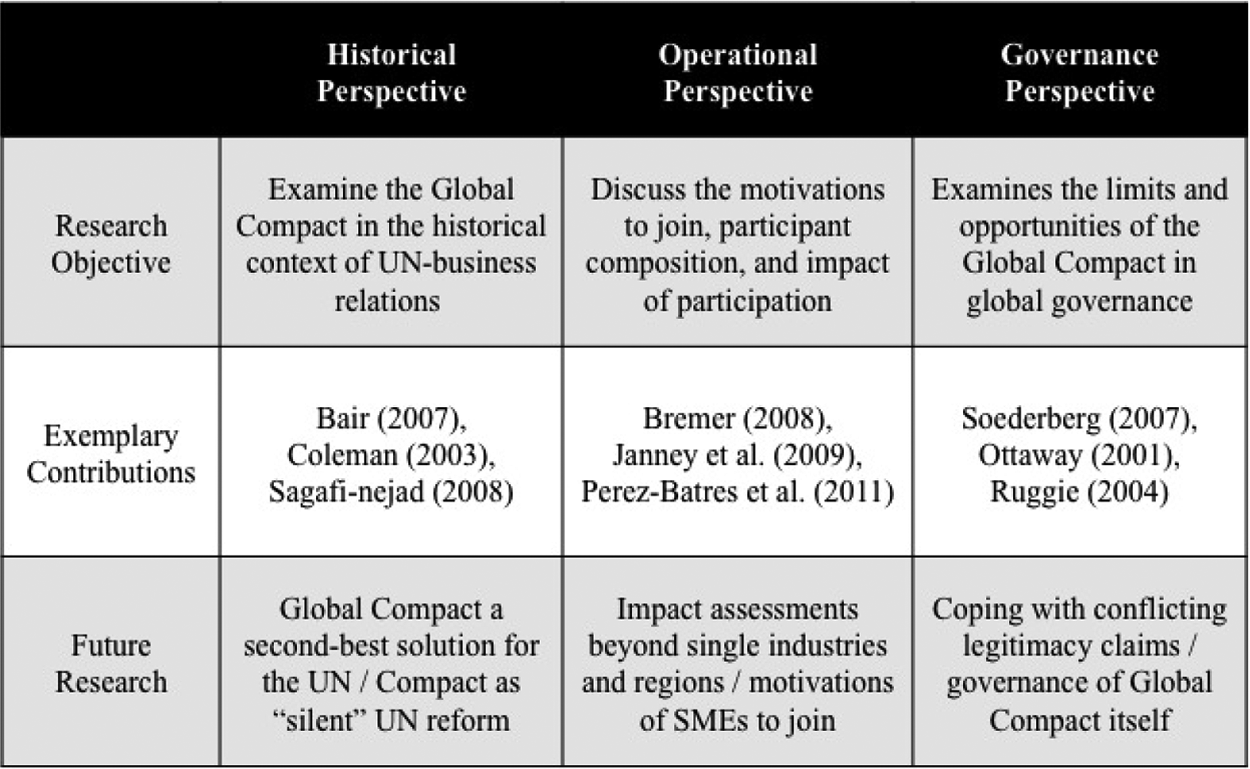
Three Research Perspectives on the UN Global Compact.
Novel Insights into the UN Global Compact: The Contributions to the Special Issue
The four articles and one commentary that are included into this Special Issue contribute in different ways to the three research perspectives identified above. Overall, we received 11 submissions for this Special Issue, of which nine were sent out for review. Three articles were finally selected for publication after two or three revisions. The article by Georg Kell and the commentary by James E. Post were especially commissioned for this Special Issue.
Georg Kell, in “12 Years Later: Reflections on the Growth of the UN Global Compact” (in this issue), primarily contributes to the historical perspective by providing a rare inside view into how the initiative developed. Kell, who has been leading the initiative from its inception, identifies four factors that have contributed to the Global Compact’s growth. First, the core idea underlying the initiative—to enable multi-stakeholder action around responsible business practices, while at the same time providing a platform for institutional innovation within the UN system—was appealing to a wide range of constituents from the outset. Kell emphasizes that this idea was flexible enough to not constrain the Compact’s adaptability to the changing nature of the international political, economic, and social environment as well as the corporate responsibility movement. Second, the initiative’s continued growth was supported by the leadership support of two consecutive UN Secretary-Generals. Historically speaking, the importance of the full backing of both Secretary-Generals cannot be stressed enough, as the creation of the Global Compact implied, as Kell remarks, that the UN was entering “into the area of the complex interface of trade, business, and civil society.” Third, sustained governmental support by UN Member States allowed the initiative to achieve intergovernmental legitimacy (backed by a series of UN General Assembly Resolutions). Fourth, Kell argues that the creation of new organizational structures (e.g., the formation of Local Networks) allowed the Global Compact to translate its underlying idea into action.
James Post’s commentary, “The United Nations Global Compact: A CSR Milestone” (in this issue), reflects an important supplement to Kell’s arguments. Whereas Kell’s historical analysis gives mostly reference to the political environment in which the Global Compact emerged, Post’s commentary discusses how the initiative grew out of a changing understanding of CSR itself. Reflecting on the history of corporate (ir)responsibility, Post argues that the creation of the Global Compact was propelled by an increased recognition that corporations cannot create solutions to social and environmental problems on their own, but that partnerships between firms, NGOs and governments were necessary. As Post argues, the creation of partnerships (under the umbrella of the Global Compact, but also numerous other initiatives) turned “the resistance to corporate responsibility that characterized multinational business affairs for so long […] in the direction of more cooperation, collaboration, and engagement.”
Jean-Pascal Gond and Valeria Piani, in “Enabling Institutional Investors’ Collective Action: The Role of the Principles for Responsible Investment Initiative” (in this issue), reflect on the impact of one of the specialized initiatives co-founded by the Global Compact (i.e., the Principles for Responsible Investment [PRI]) and thus contribute to the operational research perspective outlined above. As the creation of the PRI helped to clarify the role of investors in the context of the Global Compact, this article makes an important contribution by showing in which ways the investment community can support the Compact’s objectives. The analysis shows how institutional investors actively manage the perceived legitimacy and urgency of their claims against those corporations that are targeted by collective action efforts. Gond and Piani’s empirical reflections, which benefitted from “unprecedented and unique access to internal data from the PRI secretariat,” make two important contributions. First, the article theorizes how investors’ collective action processes can impact targeted organizations (e.g., by collectively reshaping the attributes of the presented claims). Second, the article also demonstrates how an enabling organizational platform, such as the PRI, can facilitate the development of collective action (e.g., by lowering barriers of entry for participants and creating conditions for long-term dialogue between investors). Drawing on work from collective action theory (Olson, 1965; Ostrom, 1990), this article enhances our understanding of what influences the impact of coordinated action among investors.
Maureen Kilgour, in “The Global Compact and Gender Inequality: A Work in Progress” (in this issue), discusses the Compact’s limited impact on gender issues throughout its first decade. Adopting a critical perspective, Kilgour’s analysis contributes to the operational research perspective by demonstrating that the tools and publications, which were provided by the Global Compact to guide participant behavior, did not give much reference to gender issues. Interestingly, Kilgour finds that the Compact’s approach to gender issues was mostly limited to discussions around equal opportunity and the role of women in management positions. Such a limited view, however, does not sufficiently address the role of women in the context of developing countries, where problems usually reach beyond the equal opportunity debate. Kilgour discusses reasons for the neglect of gender issues throughout the Compact’s first decade (e.g., the missing inclusion of organizations representing the voice of women) and argues that the initiative restricted its perspective on gender issues to those aspects for which a business case exists. Kilgour concludes with a discussion of the Global Compact’s launch of the Women’s Empowerment Principles (WEP) in 2010 and thus points to recent advancements in this area.
In “Trust and the United Nations Global Compact: A Network Theory Perspective,” Dirk Ulrich Gilbert and Michael Behnam (in this issue) advance the governance perspective on research about the Global Compact. Extending an existing stream of research, which has discussed how business and nonbusiness participants collaborate under the umbrella of the Global Compact (Kell & Levin, 2003; Rasche, 2009; Whelan, 2010), they argue that actors’ trust into the initiative is an important precondition for collective action and learning to emerge. Based on insights from network theory, the authors argue that enhancing the design of knowledge sharing routines (e.g., COP reports), improving the initiative’s governance structure, and better utilizing complementary capabilities with other corporate responsibility initiatives can enhance actors’ trust into the initiative. Their analysis contributes to the governance perspective in two important ways. First, Gilbert and Behnam discuss a central enabling condition for multiactor collaboration to occur in the first place. If businesses, civil society actors, and governments do not put trust into new governance arrangements like the Global Compact, it is unlikely that these initiatives will be able to redefine the new global public domain as envisioned by Ruggie (2004). Second, the authors show that trust can be enhanced, if the complementary effects between the Compact and other corporate responsibility initiatives are strengthened.
Future Research Directions
Although the contributions to this Special Issue have advanced the scholarly discourse on the Global Compact, there are still many untapped research areas. The following directions for future research serve as an exemplary, albeit not conclusive, list of opportunities. Once again, we use the three identified perspectives as a yardstick for our discussion.
Looking at the historical perspective, there are still unanswered questions when it comes to evaluating the Global Compact in light of the UN’s failed attempts to establish a more binding code of conduct. For instance, there is need to investigate whether the UN itself perceives the Global Compact as a second-best solution, reflecting what is realistically possible in the current political climate, or whether the initiative is simply an expression of the redefined global public domain and the need for more inclusive governance. Future research should also focus on whether the historical evolution of the Global Compact limits its ability to address future governance challenges. Adopting a path-dependency perspective (Page, 2006), research can discuss whether the creation of an initiative, which does not understand itself as a regulatory mechanism, inhibits the creation of more demanding solutions within the UN system and beyond. As research on path-dependency shows, historical decisions can limit the scope of alternatives for decisions in the present, although the characteristics that affected past decisions may not be applicable anymore. In this sense, it would be interesting to investigate to what extent the Global Compact created a path for the discussion of corporate responsibility within the UN system that may be hard to reverse.
Historically speaking, there is also need to clarify in how far the network-based character of the Global Compact has opened up the UN system for “silent” institutional reform. Efforts by UN agencies to partner with the private sector have increased ever since the Global Compact was launched in 2000. The question is whether these partnerships have helped to redefine how the UN itself works. When the Global Compact was launched in 2000, it was lauded as being “the most creative reinvention” of the UN system to date (Christian Science Monitor, 2000). Evaluating the impact of the Global Compact on the operational practices of the UN system thus seems like an interesting and timely endeavor. Historical research can also adopt a more reflexive perspective to show how particular historical accounts of the Global Compact present a specific view of reality. Such a “history of histories” (Rowlinson & Hassard, 1993) reveals how particular historical situations helped to produce a specific history of the Compact which then turned into an uncontested reality. Given that the Compact is usually portrayed as a multiactor response to the governance challenges of our time, such research could uncover why this particular image of the initiative emerged (e.g., by looking at the anti-globalization protests in 1999 that called for reforms of international organizations).
The operational perspective includes one of the most significant and pressing research challenges: determining the extent to which signatory companies take their participation in the Global Compact seriously by embedding the 10 principles into practice. To date, many of the studies undertaken on the Compact have reviewed COPs across numerous companies, but aside from anecdotal evidence (Barkemeyer, 2009; Woo, 2010), there is little research on the actual implementation processes used in companies. Further, the explanatory power of existing impact assessments is limited as they are either tied toward a specific industry (Runhaar & Lafferty, 2008) or focus too much on European participants (UN Global Compact, 2010). We believe that the challenge of conducting an impact assessment can be met best when constructing a representative panel of participants (e.g., considering firm size, geographic location, and industry sector) and researching changes in responsible business practices via a mix of large-scale quantitative and case-based qualitative methods. Methodologically speaking, the key challenge will be to isolate the effects of Global Compact participation, as firms often have implemented social and environmental policies before joining the initiative. Studies in this direction should build upon existing research on corporate social performance (CSP). Ruf, Muralidhar, and Paul (1998) propose an aggregate measure of CSP combining the actual performance of a company and stakeholders’ value judgments. Their approach can inform future impact assessments as it is based on a transformation of multidimensional performance scales into unidimensional scales and thus enables comparisons across industry sectors.
As the discussion on the historical development of the Global Compact attests, paying attention to the broader sociopolitical and economic contexts in which a voluntary initiative like the Compact arises is an important aspect of understanding its potential operational impact. The Compact did not arise in a vacuum and its future development will also be embedded within a historical context (Polanyi, 2001). Determining its effectiveness in bringing the 10 principles to reality means placing the Compact in its proper historical and societal contexts—as part of a larger set of initiatives that constantly with an ever-changing variety of approaches attempt to tame the power of corporations and ensure that they are serving constructive social ends.
Finally, the governance perspective also includes several research challenges. Future studies have to clarify how the Global Compact as a multi-stakeholder initiative deals with multiple legitimacy claims. Black (2008) has highlighted that corporate responsibility initiatives often face multiple (sometimes conflicting) claims from within and outside. How does the Global Compact respond to conflicting legitimacy claims (e.g., by businesses, NGOs, unions, and the UN itself)? This question is even more relevant when adopting a dynamic perspective—new actors with different claims may become relevant if the initiative continues its swift growth. Building on that, the literature at the intersection of corporate responsibility and governance studies has recently highlighted the need to study the potential for collaboration among different (sometimes competing) initiatives (Fransen, 2011; Rasche, 2010). For instance, we do not know much about the complementary effects between certification initiatives and the UN Global Compact. One important question is whether businesses and other stakeholders will accept an increasingly fragmented landscape of corporate responsibility initiatives or whether there is need for consolidation. Research in this direction will also need to specify how different social and environmental issues can be meaningfully linked across initiatives, not least to offer a more coherent approach to corporate responsibility for businesses themselves.
So, where does that leave us? The Global Compact presents many challenges and opportunities as it tries to grow in quantitative (i.e., number of signatories) and qualitative (i.e., their engagement with the initiative) ways. The fact that it fulfills its role as a norm entrepreneur based in New York and has some 100 Local Networks is worthy of far greater investigation than has heretofore been carried out. The former relies on the moral convening power of the UN and a charismatic leader in Georg Kell, and the latter in most cases on sound governance procedures. As we have pointed out in this article, the Compact represents a form of new multiactor and multilevel global governance which is particularly important because it reaches parts of the world that other initiatives fail to even begin to think about let alone reach.
Those of us who are concerned about the state of the world and the capacity of human civilization to thrive in the future given serious issues of climate change, ecosystem destruction, problems with the world’s food, energy, and water systems, and numerous other ills, have to ask the deeper question of whether corporate responsibility is enough? Perhaps even if all 10 principles were perfectly followed by all the signatories, but business as usual continues, meeting these principles will not lead to a future that sustains both humankind and others of earth’s creatures. If more fundamental systemic change is needed, then in a normative sense, what role can and should the Compact play in effecting that change?
Footnotes
Acknowledgements
We wish to thank Business & Society Editor-in-Chief Duane Windsor for his guidance throughout this project. We also like to thank Associate Editor Michelle Greenwood for organizing a review process for this introductory essay as well as two anonymous reviewers for their constructive feedback on this introductory essay. Angela Gibson (Warwick Business School) provided much appreciated editorial assistance. The anonymous reviewers, whose hard work we very much appreciate, included Brad Agle, Ralf Barkemeyer, Alexander Bassen, Shawn Berman, Steve Brammer, Frank de Bakker, Markus Beckmann, Judith Clair, Michelle Greenwood, Valentina Mele, Andrew Millington, Stephen Pavelin, Kathy Rehbein, Juliane Reinecke, Mike Russo, Ingo Schedel, Doug Schuler, and Mark Sharfman. They all deserve credit for helping to improve the manuscripts submitted to this Special Issue.
Declaration of Conflicting Interests
The authors declared no potential conflicts of interest with respect to the research, authorship, and/or publication of this article.
Funding
The authors received no financial support for the research, authorship, and/or publication of this article.
Author Biographies
