



Abstract
Through a rhetoric analysis of 776 projects from firms located in 22 Asian countries, the authors argue that companies are looking for new forms of legitimacy that cannot be completely explained using traditional management theories. The authors introduce political theory into the debate. First, this study proposes a three-approach model of legitimation: The first approach is based on the strategic rhetoric as a mechanism for achieving pragmatic legitimacy, the second one uses the institutional rhetoric for gaining cognitive legitimacy, and the third, the political approach, is one through which firms seek to obtain moral legitimacy. The political strategy is aimed at improving the discursive quality between corporations and their stakeholders. Second, since the motivation for differing legitimacy strategies should be understood within their institutional environment, the authors look for patterns within each strategy dependent on national, industry, and firm-specific characteristics.
Corporate social responsibility (CSR) has been thoroughly studied in the management literature as a source of legitimacy for firms (e.g., Deegan, 2002; Matten & Crane, 2005; Palazzo & Scherer, 2006; Sethi, 2002; Stratling, 2007; Trullen & Stevenson, 2006; Waddock, 2004b). Legitimacy can be understood as a generalized assumption that the actions of an entity are desirable, proper, or appropriate within some socially constructed system of norms, values, beliefs, and definitions (Suchman, 1995, p. 574). CSR projects are thus seen as an important activity conducted as part of the organization’s conformity with social norms, values, and expectations (Oliver, 1996). But, despite advances in the conceptualization of the different legitimation processes in their relationship to CSR (Berrone, Gelabert, & Fosfuri, 2009; Castelló & Lozano, 2011; Marquis & Qian, 2010; Palazzo & Scherer, 2006), studies that highlight the concrete strategies used to establish legitimacy through CSR for organizations are limited, especially among Asian firms (Chapple & Moon, 2005). Most of the previous research simply matches both concepts without looking into their internal characteristics and their interrelations, specifically as to which forms of CSR lead to which type of legitimacy.
Asia provides an ideal field for understanding CSR challenges of companies in different contexts (Bruton & Lau, 2008; Hofstede, 2007). The amount of political, social, and economic transformation in the region is aggravating the legitimacy struggles with which firms have to deal, especially in a context in which culture, religion, and governance systems are heterogeneous even within countries (Beck-Gernsheim & Beck, 2002). Unsurprisingly, there is increasing evidence that Asian business communities are indeed encouraged to promote more CSR activities (e.g., Baughn, Bodie, & McIntosh, 2007; Birch & Moon, 2004; Chapple & Moon, 2005; Gill, Dickinson, & Scharl, 2008; Lines, 2004; Welford, 2004). However, little is known about how firms in different Asian countries portray their CSR activities (Chapple & Moon, 2007) or how they use them in their legitimation processes (Luo, 2006). The authors believe that this research gap is problematic given how the dynamic societal pressure on Asian firms may be leading to distinct legitimacy strategies in response to these tremendous socioeconomic forces.
Furthermore, CSR has traditionally approached legitimacy from an action perspective, such as the impact of information disclosure (Deegan, 2002; Marquis & Qian, 2010) or stakeholder management (Phillips, 2003). However, recent studies have taken up the discursive approach showing how organizational discourses lead to institutionalization of practices (Phillips, Lawrence, & Hardy, 2004; Vaara & Tienari, 2008). Along that line, Fairclough (2003, pp. 98-100) proposes the study of “legitimation strategies” defined as “specific ways of mobilizing specific discursive resources to create a sense of legitimacy or illegitimacy” (in the words of Vaara & Tienari, 2008, p. 987). Studies that analyze concrete legitimacy strategies for corporate responsibility action remain limited, particularly those that examine the political aspects of discursive legitimation that include values, beliefs, and power relations among actors (Vaara & Tienari, 2008).
To fill in this gap, this article provides an exploratory analysis into the “legitimacy strategies” of Asian firms and their variation under different contexts. Through the rhetoric analysis of 776 CSR projects of firms operating in 22 countries throughout Asia during a 6-year period, this article provides a twofold contribution to the legitimacy and CSR literatures.
First, the authors propose a three-level model of legitimacy strategies that classifies the rhetoric of Asian corporations as strategic, institutional, or political and connects those rhetorics to the type of legitimacy—pragmatic, cognitive, or moral—these corporations are likely to gain. The authors argue that Asian companies are increasingly using new forms of legitimacy that express their active justification vis-à-vis society through communicative engagement and deliberation.
Second, the study provides an exploratory assessment of the contextual factors that affect legitimacy strategies. Through the empirical analysis of the factors influencing the legitimacy strategies, the authors find that political rhetoric is more salient in risky environments such those of foreign firms in less developed countries. This article argues that in a highly pluralized context (Fitzsimmons, 2008) cognitive legitimacy may prove insufficient given the diversity and complexity of Asian societies (Hofstede, 2007; Palazzo & Scherer, 2006) and the different interrelations among social claimants. Pragmatic legitimacy, under the strategic approach, would be too weak due to its limited firm-specific impact. Consequently, firms increasingly complement their legitimacy with political legitimacy strategies in an active debate on their role in society.
Given the exploratory nature of this study, the article will be structured into five more sections. The first section delves straight into searching for patterns within the firm reports. The second section provides a presentation of how the rhetoric themes that emerge from the qualitative analysis relate to the legitimacy literature. The third section proceeds into theorization regarding the organizational, industrial, and national characteristics that motivate legitimacy strategies and generates hypotheses as to how these characteristics explain the patterns in the legitimacy strategies. The fourth section provides a quantitative empirical analysis to validate and expound on the hypotheses generated. The article ends with a discussion of the results of the study wherein the authors provide directions for future research.
Rhetoric Analysis of Asian CSR Projects
Suddaby and Greenwood (2005) argue that, through discourse analysis, it is possible to identify different rhetoric strategies that actors use in the legitimation of organizational and institutional change. Rhetoric strategies are representative forms of legitimacy strategies (Vaara & Tienari, 2008). They can be analyzed by looking at the enthymemes or argumentations in use in the discourse of the speeches and written reports (Heracleous & Hendry, 2000). Enthymemes are rhetorical structures of argumentation that are only partially expressed, with their logic being completed by the audience. They are a way researchers can uncover values and beliefs that are taken for granted in a given analysis (Cheney, Christensen, Conrad, & Lair, 2004).
As a first step in this research, the authors analyze the argumentations in use as a means for understanding the stable patterns that underlie firms’ legitimacy strategies. Once these patterns are empirically established in themes, they can be categorized into overarching dimensions, which the authors then connect theoretically to the broader literature on CSR and legitimacy.
Research Sample
The authors utilized a multiyear, multicountry database of Asian CSR projects nominated for the Asian CSR Awards, the most important CSR award in the region, organized by the Ramon V. del Rosario Center for Corporate Social Responsibility of the Asian Institute of Management (CSR Asia, 2009). The study uses project nominations as a proxy for the rhetoric used by companies in their corporate discourse. As corporate awards are mechanisms of the legitimation process (Deegan, 2002), the discourse represented in the award nominations implicitly contain not only the values and culture of the firm but also the different forms of normative evaluation that might be used as forms of legitimacy strategies (Vaara & Tienari, 2008). A total of 776 entries from 22 different Asian countries through 6 annual reporting periods from 2003 to 2008 were analyzed for this research. Table 1 shows the countries represented in the sample and the number of projects submitted per year. Because of the location of the Asian Institute of Management in the Philippines, there are substantially more submissions from the Philippines and other Southeast Asian countries.
Total Number of Projects by Country Location of Project by Year.
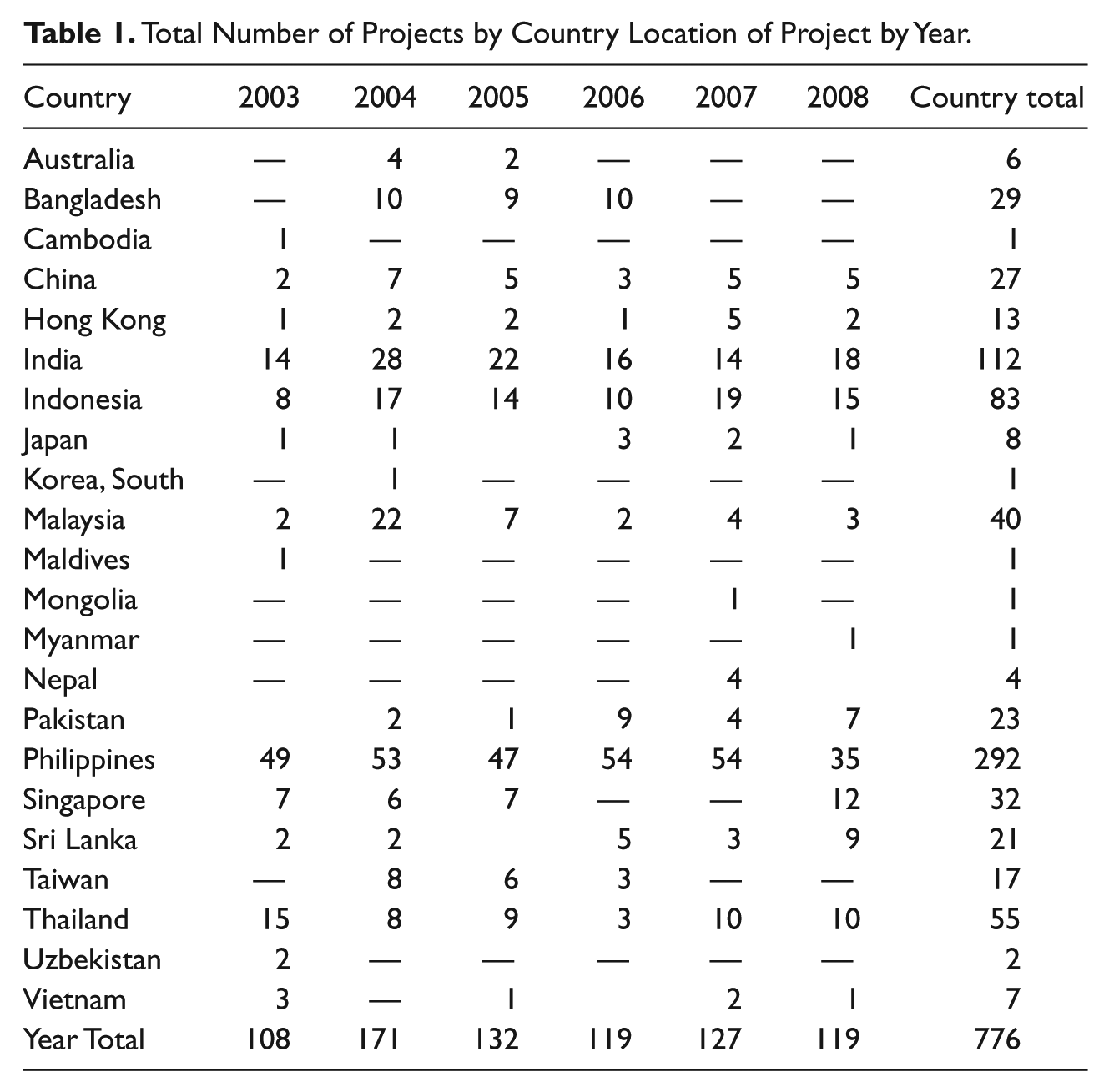
Each Asian CSR award nomination consists of an official nomination form with an approximate length of 1,000 words. All submitted documents are written in English, with translations provided to collateral materials that are written in a different language. The authors considered this award nomination an appropriate sample for research as these forms provides greater consistency and comparability than corporate reports and other company material, which could prove difficult to analyze due to the variety of language and format. The researchers encoded each submission separately; the analysis was centered on understanding the sentences that could help us to define argumentations in use. The researchers did not look at the general structure of the submissions that, although not predefined, could lead to misinterpretations related to the suggested guidelines for project submission. 1
Defining the Themes of the Legitimation Process
The nature of the research and the lack of accounts in relation to the subject of study made the authors adopt an interpretative approach for the purpose of exploratory richness (Nag, Corley, & Gioia, 2007; Russell, 2006). The first analytical task was to detect themes that could help us to make sense of the patterns of rhetoric. The study used thematic analysis (Boyatzis, 1998) as a process for encoding qualitative information with explicit “codes.” A code is a complex model with themes, indicators, and qualifications that are causally related. Thematic analysis allows for the incorporation of operant and open-ended measures in the design of the experiment by counting the presence of codes and organizing them by theme for group analysis.
The process of coding was developed by a total of four researchers. One researcher looked for initial patterns by analyzing a subsample of 60 nominations. That researcher began discerning enthymemes that were similar in their essence and related them to first order categories, which were comprised of the first definitions of a category at the level of meaning from the nominations. The researcher then started to discern links among the first-order categories and cluster them into second-order themes that formed theoretically distinct subgroupings that represent emerging theoretical concepts (Nag et al., 2007). A second researcher validated the first- and second-order categories, modifying the coding scheme with the first researcher until consensus was achieved. Two additional researchers were trained and put in charge of coding the entire sample. Before starting the coding of all nominations, the authors did an assessment of intercoder agreement. A broader subsample of 147 nomination entry forms was coded in parallel by the two researchers. These nomination forms comprised 18.9% of the entire sample, more than the 10% generally required for content analysis (Lombard, Snyder-Duch, & Bracken, 2002). The coding sheets completed by each individual researcher were compared to diminish the subjectivity of the coding process. Disagreements between the two coding sheets were discussed and adjudicated by the two authors, first coders. Intercoder reliability measures were calculated, indicating a moderate percent agreement of 74.7% and a Cohen’s kappa of .481, measures that were deemed acceptable given the exploratory nature of the rhetoric analysis (Banerjee, Capozzoli, McSweeney, & Sinha, 1999; Landis & Koch, 1977; Lombard et al., 2002). 2 With the nomination forms indicating sufficient harmony in the coding process, the rest of the 776 nominations were coded separately by the two researchers.
Results of the Qualitative Approach
This study was intended to define different legitimacy strategies of Asian firms. From the entire coding exercise of the 776 nomination forms the authors came up with the data structure showed in Figure 1.
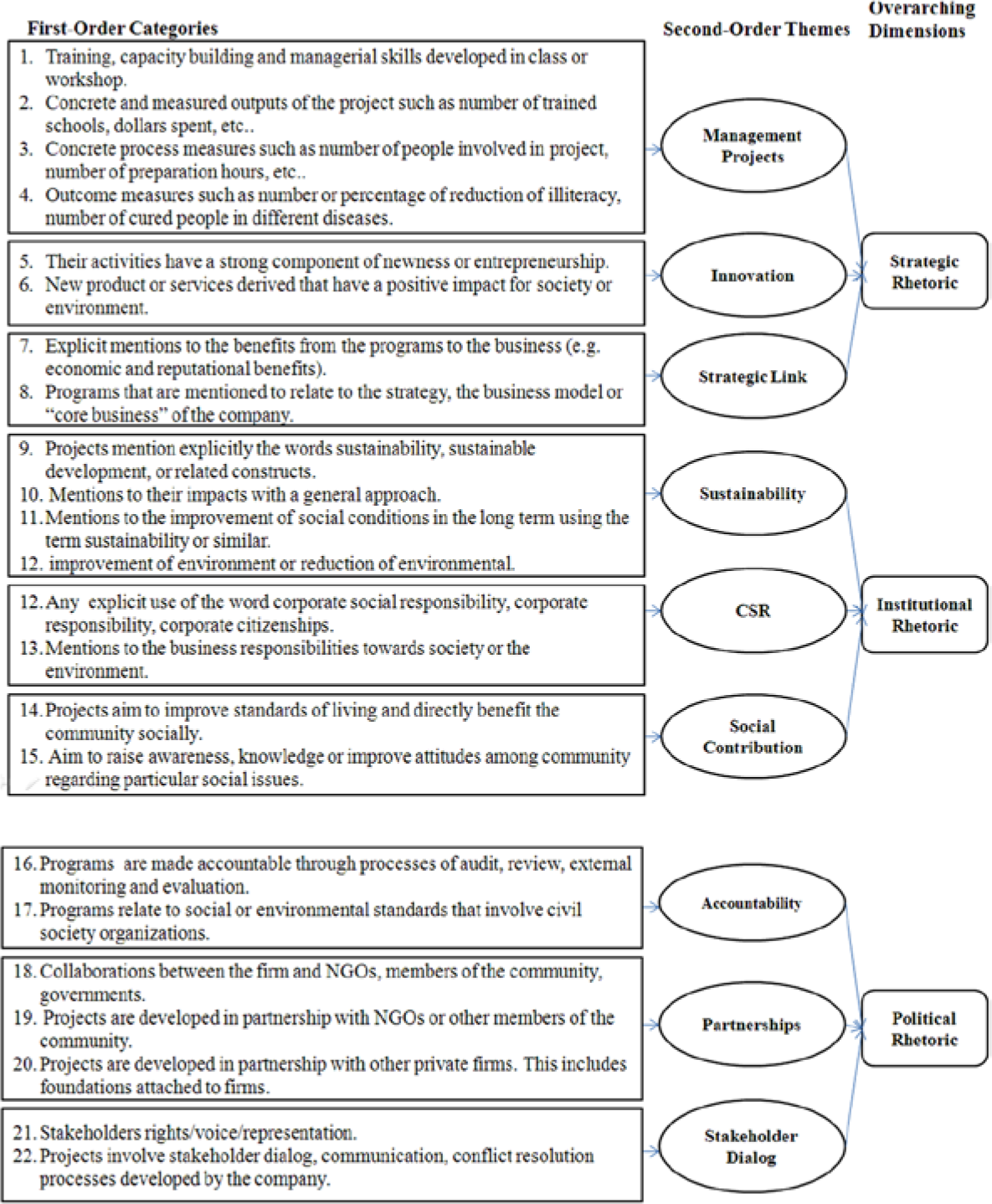
Coding structure.
The phrases in the boxes on the left side of the figure show the first-order categories; the concepts in the ovals show the assembly of the first-order categories into second-order analytical themes. The three boxes on the right show the overarching dimensions that emerged from the analysis. Table 2 contains additional supporting evidence showing representative quotes directly taken from the nominations analyzed.
Dimensions, Themes, Categories, and Quotations.

In going back and forth from the theory of legitimation to the data it became apparent that three broader dimensions could be defined, which the authors labeled as the legitimacy strategies: “strategic rhetoric,” “institutional rhetoric,” and “political rhetoric.”
The first dimension is named “Strategic Rhetoric” from the theory tradition that emphasizes the way in which organizations instrumentally manipulate and deploy evocative symbols to garner societal support (Suchman, 1995). Strategic rhetoric represents the tension between the ascription of the CSR activities and the aim of attaining the firms’ business objectives.
An example of the strategic rhetoric can be seen in the following quotation: “Sitel Footprints, it is quite a solution, addressing both the need to strengthen community relations, and the need for a steady pool of qualified applicants for the growing businesses.”
Through the strategic rhetoric, firms attempt to build symbolic links with values embedded in the strategic management tradition, such as efficiency in the management of projects, processes of innovation, and corporate returns, whose final aim is to increase corporate returns or improve firm reputation. Strategic rhetoric denotes an aim by the firm to calculate the strategic interest behind their CSR activities resting in what Suchman defines as pragmatic legitimacy, the organization’s selfish calculation of its interests (Suchman, 1995). Its main assumption is that in capitalist societies corporations must earn profits (Sundaram & Inkpen, 2004) and therefore all of the firms’ activities, including CSR, are advocated to contribute to this end (Margolis & Walsh, 2003; Vogel, 2005; Wartick & Cochran, 1985). CSR is viewed under the “business case” perspective (Wood, 1991) following the principle where CSR activities are only justified when they support business objectives.
The second domain, “Institutional Rhetoric,” contains a group of enthymemes whose aim is to find a form of identification with the CSR movement. These parts of the corporate discourse arise from the aim to gain legitimacy through the use of constructs such as CSR, sustainability, and social contribution, which represent a way to gain acceptance in the community. The authors relate this rhetoric to the legitimacy literature’s institutional tradition. The institutional tradition looks into the ways in which structuration dynamics generate cultural pressures that transcend any single firm’s purposive control (Elsbach, 1994; Powell & Di Maggio, 1991). It analyzes the socially constructed nature of legitimation (Gepert, 2003; Kostova & Zaheer, 1999). This willingness to comply with broader societal expectations provides corporations with cognitive legitimacy (Suchman, 1995). Cognitive legitimacy results from the acceptance of some broad taken-for-granted assumptions available through cultural models that provide plausible explanations for the organization and its endeavors (Scott, 1991). The CSR movement is starting to be embedded in the cognitive societal spectrum of what is considered good business practice (Bonini, Mendonca, & Oppenheim, 2006; Castelló & Lozano, 2011; Lozano, 2005). CSR, sustainability, and social contribution are very common representations of the CSR movement often utilized to demonstrate the organization’s worthiness and acceptability (Oliver, 1991). However, in a pluralized context such as Asia (Fitzsimmons, 2008), the cognitive legitimacy of CSR might be limited by the diversity and complexity of societies (Hofstede, 2007; Palazzo & Scherer, 2006) and its different relations with social claims. Furthermore, it is increasingly argued that those terms are, on many occasions, used in a fairly fuzzy way (Göbbels, 2002), with the terms lacking an in-depth meaning. Some authors, such as Göbbels, and Fergus (2005), argue that constructs such as CSR and sustainability might be losing their philosophical meaning while their principles are debased by overuse and inclusion in the dominant scientific-economic positivistic paradigm (Scherer & Palazzo, 2007).
Some of the examples of this type of rhetoric are provided here:
PT Astra International Tbk is one such company who implements its corporate social responsibility (CSR) seriously. . . . Having a low internet penetration rate, which is a basic of ICT, PT Telekomunikasi Indonesia, Tbk (TELKOM) grabs this opportunity to provide something towards the community as a form of Corporate Social Responsibility (CSR). Philanthropy and Corporate Social Responsibility (CSR) is serious business as Union Bank commits 1% of annual net income for CSR.
In these sentences, the authors recognize how organizations consciously or unconsciously use links to institutionalized structures, such as CSR, to demonstrate the organization’s worthiness and acceptability in claiming a cognitive legitimacy.
The third domain, “Political Rhetoric,” denotes a power tension between the firm and its stakeholders. With this rhetoric, firms endeavor in community-building via “civilizing” activities (Waddock, 2004a) that involve reporting to and being held accountable to sustainability standards defined by civil society (Vogel, 2010). It also involves a certain degree of stakeholder engagement and the creation of communicative bridges between the firm and its communities in the aim of finding mutual understanding. The political rhetoric includes second-order themes such as partnership, accountability, and stakeholder dialog. This article interprets these themes as an effort by firms to relate with their stakeholders on the basis of dialog and public deliberation.
The study exemplifies the political rhetoric with the following quote from one of the nominations:
To get willing cooperation of crucial stakeholders, workshops are conducted for elected representatives.
The study associates this rhetoric with an increasing desire of firms to gain a new form of legitimacy that the authors associate with moral legitimacy as understood in political theory (Palazzo & Scherer, 2006).
While traditional theories of legitimation such institutional theory and strategic management theory focus on a specific issue that needs to be legitimated by the organization, a political theory perspective emphasizes that the legitimation of organizations deals with the complex power relationships among the social actors involved (Vaara & Tienari, 2008; Van Dijk, 1998). Within the institutional theories, moral legitimacy has been widely defined as a process that reflects a positive normative evaluation of the organization and its activities (Aldrich & Fiol, 1994; Parsons, 1960; Suchman, 1995). Moral legitimacy refers to conscious moral judgments on the organization’s outputs, procedures, structures, and leaders. It is sociotropic, resting not on judgments about whether a given activity benefits the evaluator, but rather on whether the activity is “the right thing to do” in a given context (Suchman, 1995).
Palazzo and Scherer (2006, p. 74) have argued that the pluralization of modern societies in the context of growing globalization results in a loss of cultural homogeneity that erodes the normative taken-for-grantedness of the institutional conception of moral legitimacy. Political theory calls for a reconceptualization of moral legitimacy giving the corporation an active role in the process by interacting with the rest of the political institutions and being conscious of its power position (Palazzo & Scherer, 2006). Corporations gain moral legitimacy mainly through their vigorous participation in equal discussions with the rest of the political actors (Palazzo & Scherer, 2006). Managing moral legitimacy lies in deliberative communication through persuasion using rational arguments and not through enforcing positions (Scherer & Palazzo, 2007). The authors relate the CSR commitments toward stakeholders in the form of dialogs, partnerships, or accountability mechanisms to the political approach that emphasizes coordination oriented toward mutual understanding and agreement. The authors argue that cognitive legitimacy, under the institutional approach, might be limited by the diversity and complexity of societies (Hofstede, 2007; Palazzo & Scherer, 2006) and its different relations with social claims, especially in Asia where multiple cultures, religions, and norms are present even within countries. Pragmatic legitimacy, under the strategic approach, would be too weak due to its limited firm-specific impact. Consequently, firms increasingly complement their legitimacy with moral legitimacy strategies in an active debate on their role in society.
Table 3 summarizes the three approaches to legitimacy as described above.
Institutional, Strategic, and Political Approaches to the Legitimation Process.
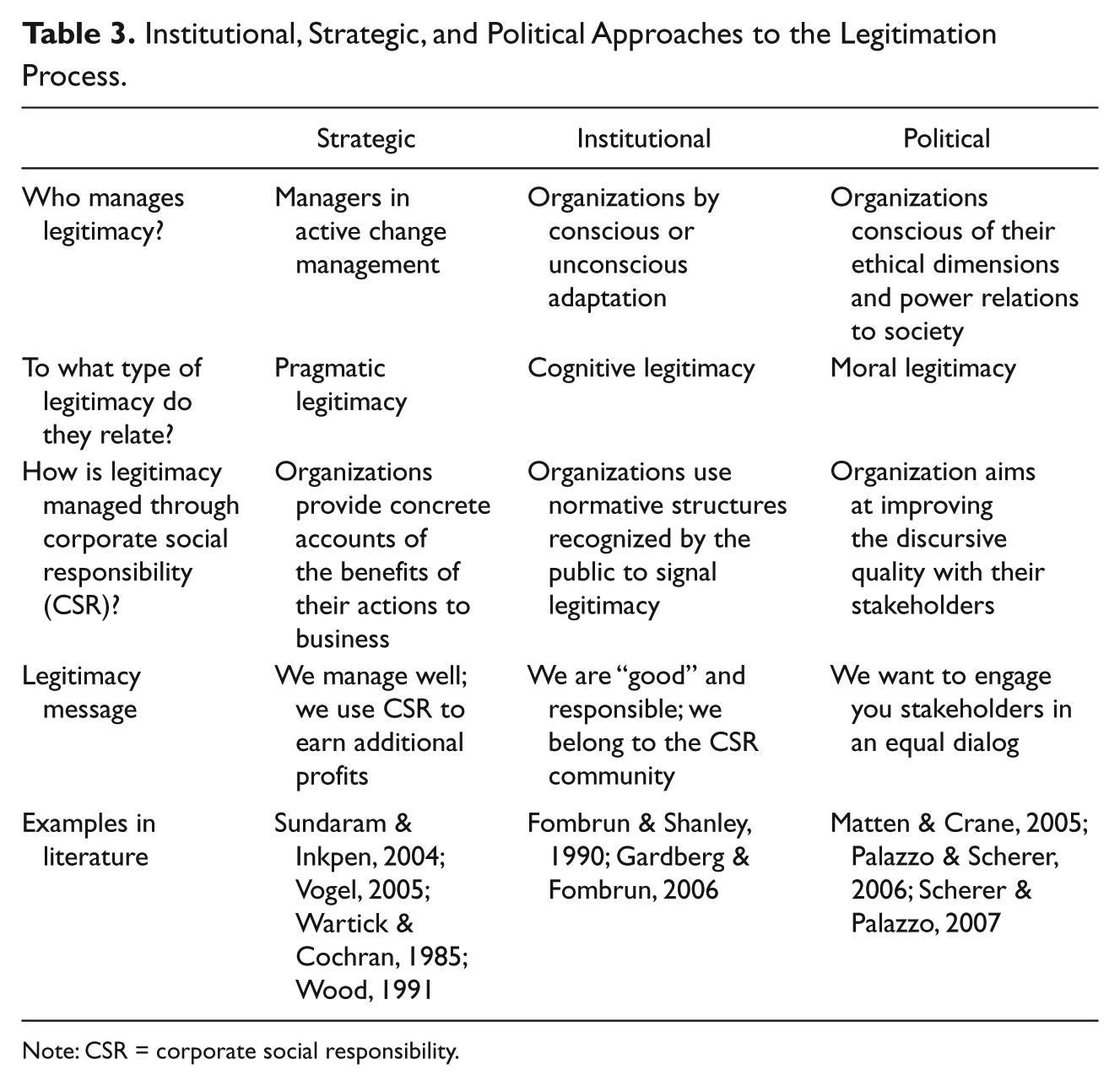
Note: CSR = corporate social responsibility.
Exploring the Relationship Between CSR Rhetoric and Firm Characteristics
The previous analysis is important for analytical reasons as it shows the initial emergent data structure and how the first-order concepts relate to second-order themes, as well as the overarching dimensions that define the rhetoric strategies and how those strategies relate to current theories of legitimacy. It represents, however, a first qualitative approach since it does not relate rhetoric to the particular context in which the firm finds itself. As Suchman (1995) argued, the management of legitimacy dynamics resides also in considering the differences in the extent to which organizational activities are perceived as desirable, proper, and appropriate within the given institutional context. In part, the actions of stakeholders are affected by their own perception of the appropriate firm behavior as dictated within each organizational and industrial context (DiMaggio & Powell, 1991; Gardberg & Fombrun, 2006). In essence, the motivation for differing legitimacy strategies should be understood as driven by multiple opportunities for managers to maneuver strategically within their institutional environment (Ashforth & Gibbs, 1990; Oliver, 1991), industrial situation, and firm resource capabilities (Gardberg & Fombrun, 2006). As such, the authors need to assess further the effect of context in terms of the different national, industrial, and organizational-based factors of the so-called strategy tripod (Peng, Sun, Pinkham, & Chen, 2009) that affect firm strategic processes.
Some literature has already attempted to explain the motivation behind CSR as influenced by the national, industrial, and organizational characteristics of firms in different Asian countries (e.g., Baskin, 2006; Baughn et al., 2007; Chapple & Moon, 2005, 2007; Welford, 2004). However, none of these articles have studied rhetoric strategies and related them more closely to legitimacy. The aim is to understand how much interplay context provides in defining CSR rhetoric and to address questions such as how CSR relates to economic development and whether there are any industry trends or trends related to firm size and origin that affect legitimacy claims.
In this section, the authors conduct further analyses on the rhetoric captured in the 776 nominations by linking them theoretically and empirically to the different national, industrial, and organizational factors. The authors highlight in each subsection below the extant literature emphasizing the different factors that influence legitimation and CSR at the national, industrial, and firm level to predicate the empirical analysis.
National Context
Scholars have often confronted the challenge of incorporating an evaluative dimension of legitimacy that explicitly acknowledges the role of the national context (Ginzel, Kramer, & Sutton, 1992; Matten & Moon, 2008; Neilsen & Rao, 1987). It follows that the characteristics of each nation’s institutions and business systems promote differing incentives for corporations in generating mechanisms for achieving legitimacy (Aldrich & Fiol, 1994). Given how political, financial, educational, and cultural institutions differ greatly across Asian countries (Whitley, 1992), CSR programs have been argued to vary significantly across different parts of the region (Chapple & Moon, 2005, 2007; Welford, 2004). For example, institutional variations have been said to be one reason why Asian firms have lagged far behind their competitors in other parts of the world in the provision of ethical codes (Baskin, 2006).
Among the variables that have been determined to have an impact on legitimacy, economic development has been one of the most prominent (Baskin, 2006; Visser, 2008). Compared with their Western counterparts, many countries in Asia are characterized by low income levels, rapid economic growth, relative political volatility, and deficient provision of government services (Hoskisson, Eden, Lau, & Wright, 2000). In such less developed country contexts, CSR most would likely be driven by a combination of two key factors: filling in the “governance gaps” by providing public services that governments do not provide (Visser, 2008) and increasing the awareness of the benefits accorded by firms to the population (Baskin, 2005; Nelson, 2003). As countries develop, CSR has been associated with improving national competitiveness (Zadek, 2006) through innovation and productivity gains. The authors therefore expect that
Hypothesis 1: Legitimacy strategies are dependent on the level of economic development of countries.
Industry Dynamics
Within countries, expectations of CSR activity vary depending on the industry characteristics (McWilliams & Siegel, 2001). Industry context influences expectations on the appropriate CSR projects in part because the organizational fields in which firms operate are influential in shaping expectations of legitimate behavior (Gardberg & Fombrun, 2006; Powell & Di Maggio, 1991). Gardberg and Fombrun argue that industry familiarity and visibility are the two major components affecting the local acceptability of companies’ CSR initiatives.
On familiarity, companies operating in industries that are less familiar to the local market face greater institutional distance: Local stakeholders are more likely to misunderstand the company’s products and production processes (Gardberg & Fombrun, 2006). Unknown products that threaten local cultural norms may increase the liability of firms from industries with little penetration in Asia and traditionally considered “foreign,” such as pharmaceuticals and extractive industries (Baskin, 2005), and will thus face greater hostility.
In industries with greater public familiarity, such as agriculture, manufacturing, and consumer products (Gardberg & Fombrun, 2006), most legitimacy maintenance tasks involve a policing of internal operations to prevent miscues, curtailing highly visible legitimation efforts in favor of more subtle techniques and developing a stockpile of supportive beliefs and support measures and processes (Ashforth & Gibbs, 1990). Organizations tend to relax their vigilance and content themselves with evidence of ongoing performance vis-à-vis their interests, with periodic assurances of “business-as-usual” (Ashforth & Gibbs, 1990) maintaining a low profile in their relations with salient stakeholders (Mitchell, Angle, & Wood, 1997). Therefore, the authors expect to find higher adoption of strategic or institutional rhetoric in more familiar industries since firms will rely on the day-to-day management of the firm and the fulfillment of the general expectations through CSR projects that are well accepted by the communities in which they operate.
Hypothesis 2: Legitimacy strategies are dependent on the level of familiarity of the general public to the industry. Strategic and institutional rhetoric will be salient in industries with greater familiarity.
On visibility, Gardberg and Fombrun (2006) have argued that companies that operate in industries with higher visibility to the general public face greater institutional and stakeholder pressures than those in less visible industries. Industry visibility generally comes from two industry characteristics: (a) the degree of risk that the company’s operations entail, and (b) whether those operations generate many resources for the local economy (Rosenzweig & Singh, 1991). The extractive, tobacco, alcohol, banking, and pharmaceutical industries are typical examples of highly visible industries (Rosenzweig & Singh, 1991). As such, these firms are often expected to compensate the local community for whatever environmental risk they generate by promoting the value of the company’s existence beyond the profit motive. The authors propose that legitimacy strategies depend on industry visibility and that political rhetoric will be salient in more visible industries.
Hypothesis 3: Legitimacy strategies are dependent on the level of visibility of the industry to the general public. Political rhetoric will be salient in industries with greater visibility.
Firm Size and Origin
Organizations usually face the challenge of gaining legitimacy when embarking on a new line of activity or entering a new market or country (Freeman, Carroll, & Hannan, 1983). In these settings, organizations face the task of winning acceptance either for the propriety of the activity in general or for their own validity as practitioners (Suchman, 1995). This “liability of newness” (Freeman et al., 1983) is of special consideration when operations are technically problematic, poorly institutionalized, or when entrants are small, as early entrants must devote a substantial amount of energy to define the practices in the new sector (Aldrich & Fiol, 1994). As companies grow and prosper, the need to partner with different shareholders diminishes and larger, more established firms become more concerned with the need to protect their burgeoning reputation in more routinized forms (Fombrun, 1996; Strike, Gao, & Bansal, 2006). Consequently, the authors propose that firms will use different legitimacy strategies dependent on their firm size and that small firms will tend to use more political rhetoric.
Hypothesis 4: Legitimacy strategies are dependent on firm size, and small firms will tend to use more political rhetoric.
Foreign firms are often exposed to the “liability of foreignness” (Freeman et al., 1983). Liability of foreignness relates to the additional costs incurred by foreign subsidiaries in excess of their local counterparts (Zaheer, 1995). This liability has been associated to factors such as physical distance from top management, local biases, and the firm’s lack of familiarity with the host-country institutions (Gardberg & Fombrun, 2006). Gaining legitimacy for foreign firms is especially important since, first, most foreign firms have global reputations to protect (Fombrun, 1996) that encourage them to focus on the strict management of their operations in their numerous sites (Husted & Allen, 2006). Second, gaining local acceptance is equally important and requires that firms maintain a strong component of understanding the cultural settings of the countries they operate in. The need to gain legitimacy makes them more responsive to the host country’s social and political needs (Luo, 2001). The authors therefore expect foreign firms to have different legitimacy strategies than local firms: Foreign firms will tend to use more the political and strategic rhetoric than small firms.
Hypothesis 5: Legitimacy strategies are dependent on firms being local or foreign. Foreign firms will tend to use more the political and strategic rhetoric than small firms.
Quantitative Analysis Methodology
Using the data from the thematic analysis above, the study conducts an empirical quantification to explore the relationship between the context and the resources possessed by each firm, and their impact on the way firms express and motivate their rhetoric. To do so, the researchers first generated nine separate dependent dummy variables from each of the thematic codes enumerated previously. When the coder observed an enthymeme containing any instance of one of the nine second-order themes (they are called themes hereby), the coder rated the entire nomination form with the number 1 or as containing that rhetoric type. Nomination forms without an enthymeme containing instances of each particular rhetoric type were coded as zero. Each project nomination was subsequently encoded based on the firm and project characteristics that serve as the independent variables for the research. The authors converted the project year variable into separate year dummy variables to control for any extraneous changes in the frequency of use of the rhetoric themes.
The authors created size dummy variables that captured whether firms were small, medium, or large on the basis of number of firm employees. In accordance with prior studies of Asian companies (e.g., Baskin, 2005; Peng, 2002), companies with less than 100 employees were categorized as small, companies with 100 or more employees but less than 1,000 employees were deemed as medium sized, and companies with 1,000 or more employees were categorized as large. It was not feasible to generate actual employment figures for each firm because many of these firms were privately held and provided limited data to the general public.
Firms were also categorized as to whether the company was a local firm or a foreign firm. Local firms were defined as those substantially owned by individuals or firms from the country where the CSR project was being conducted; foreign corporations were those whose owners were mainly entities from countries different from the location of the CSR project (Zaheer, 1995). Table 4 defines the number of projects by country of origin of firm vis-à-vis location of project.
Total Number of Projects by Country of Origin of Firm vis-à-vis Location of Project.
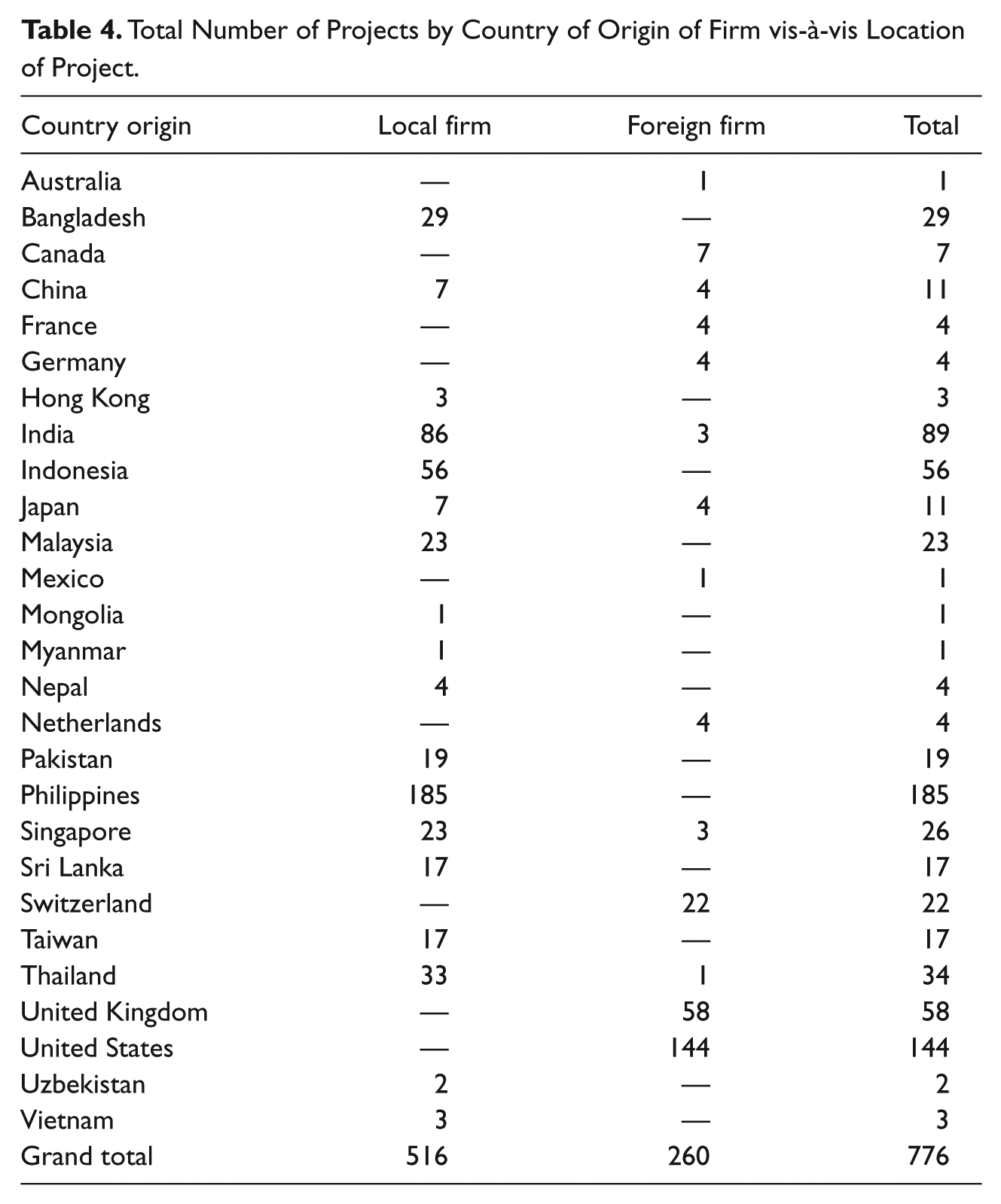
The authors generated dummy variables to categorize the industry that generated the largest amount of revenue for the firm. The authors separated the industries that have been termed as visible in the literature (e.g., Baskin, 2005) in the database, namely, extractive, tobacco, alcohol, banking, finance, and pharmaceutical companies. Extractive industries were involved the production of raw materials from natural resources, such as firms in the petroleum, mining, pulp, and paper industries. The rest of the sectoral variables were self-explanatory. 3 The authors also generated separate dummy variables for industries with familiarity to the general public (Gardberg & Fombrun, 2006), such as agriculture, manufacturing, and consumer services, with consumer services comprised of retailers, wholesalers, restaurants, hotels, and community services. Table 5 defines the number of projects by industry and their subsequent classification by familiarity and visibility.
Total Number of Projects by Industry by Year.

To capture the country-level effect, the authors calculated the logarithm of the gross domestic product per capita of the country where the project is being conducted. Furthermore, to correct for any unobserved effects driven by said effect, the authors added a separate dummy variable for each country.
The sample of nominations that were analyzed could not be treated as a panel data set, as the nominations consist of independently obtained project nominations that were collected at six points in time. There was no deliberate attempt to collect nominations from the same firm across time. In the sample, only four corporations, namely the Coca-Cola Corporation, Quezon Power, Royal Dutch Shell, and Unilever, have project nominations across all years. Out of the 325 companies in the sample, 182 (56%) have only one project nomination. In addition, there were 28 companies (9%) with more than one nomination per year. 4
Given a data structure with binominal dependent variables for each rhetoric code, the authors ran the regression analyses over the entire sample as a pooled logistic regression. Nine separate logistic regressions were generated, one for each rhetoric theme. Each of these regressions uses the same model specification to facilitate intertheme comparisons. The authors made additional statistical adjustments to correct for some characteristics of the data set. The authors generated control variables for each nomination category that was included in the analysis—environment, poverty alleviation, and education—to control for the differences in the rhetoric driven by the particular project nomination category. The authors specified the data to be stratified across the three nomination categories to generate adjusted standard errors that account for the potential intracategory correlation among the variables. To correct for the unbalanced structure of the country origins of the different nominations in the sample, the logistic regressions were run with a sample weighting system based on the inverse of the probability that the observation is included because of the sampling design. Put simply, responses from countries with abundant nominations, such as the Philippines and India, were weighted less heavily as compared to those from countries with fewer observations.
Table 6 summarizes the explanations of the variables and its sources. The summarized results of these regressions are shown in Table 7. Note that the logistic regressions include the full-model specification described in the earlier section, but in the interest of brevity and clarity, the individual country dummies have been dropped from the logistic regression table.
Independent and Control Variable Definitions and Sources.
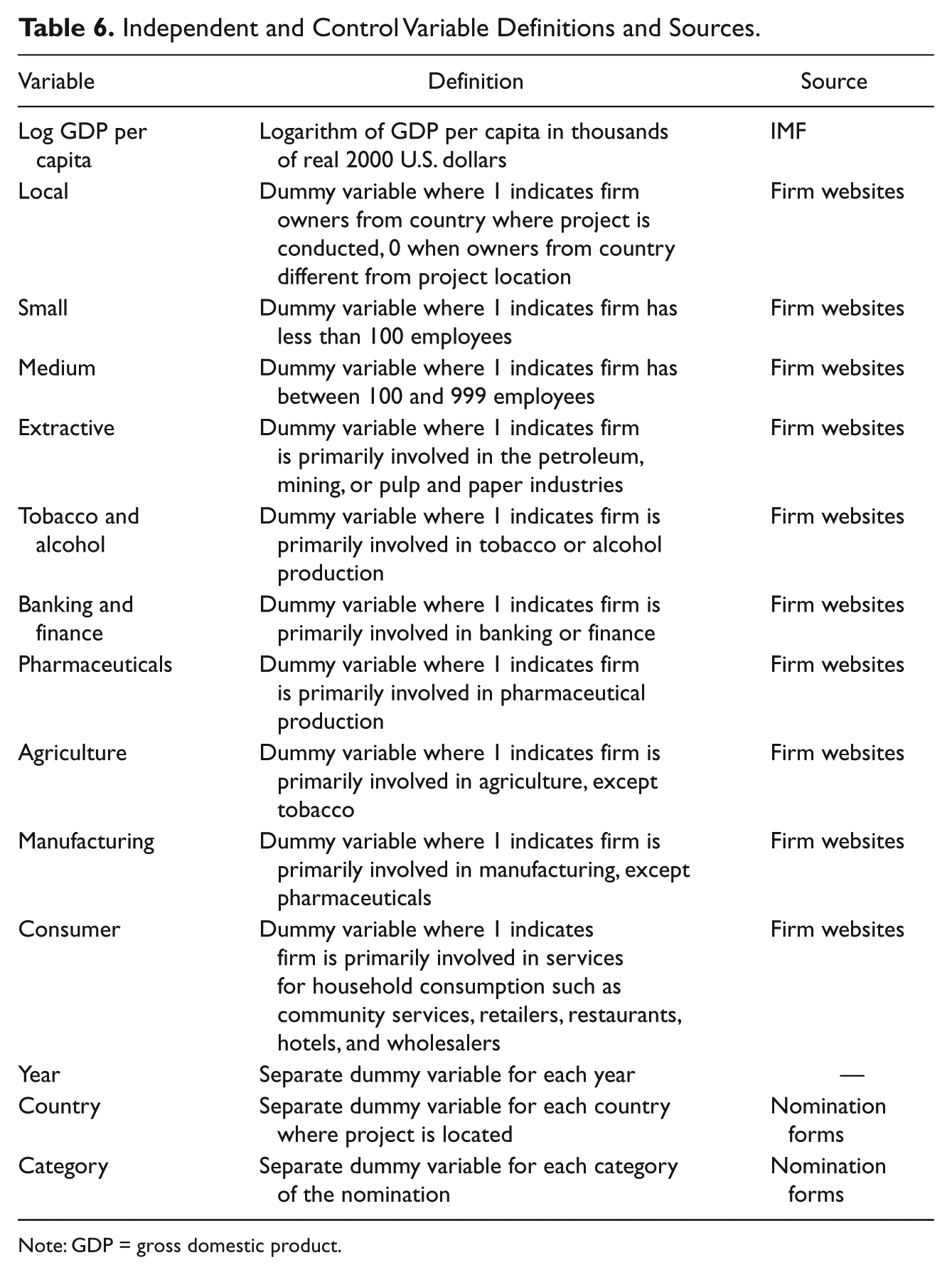
Note: GDP = gross domestic product.
Logistic Regression Results.
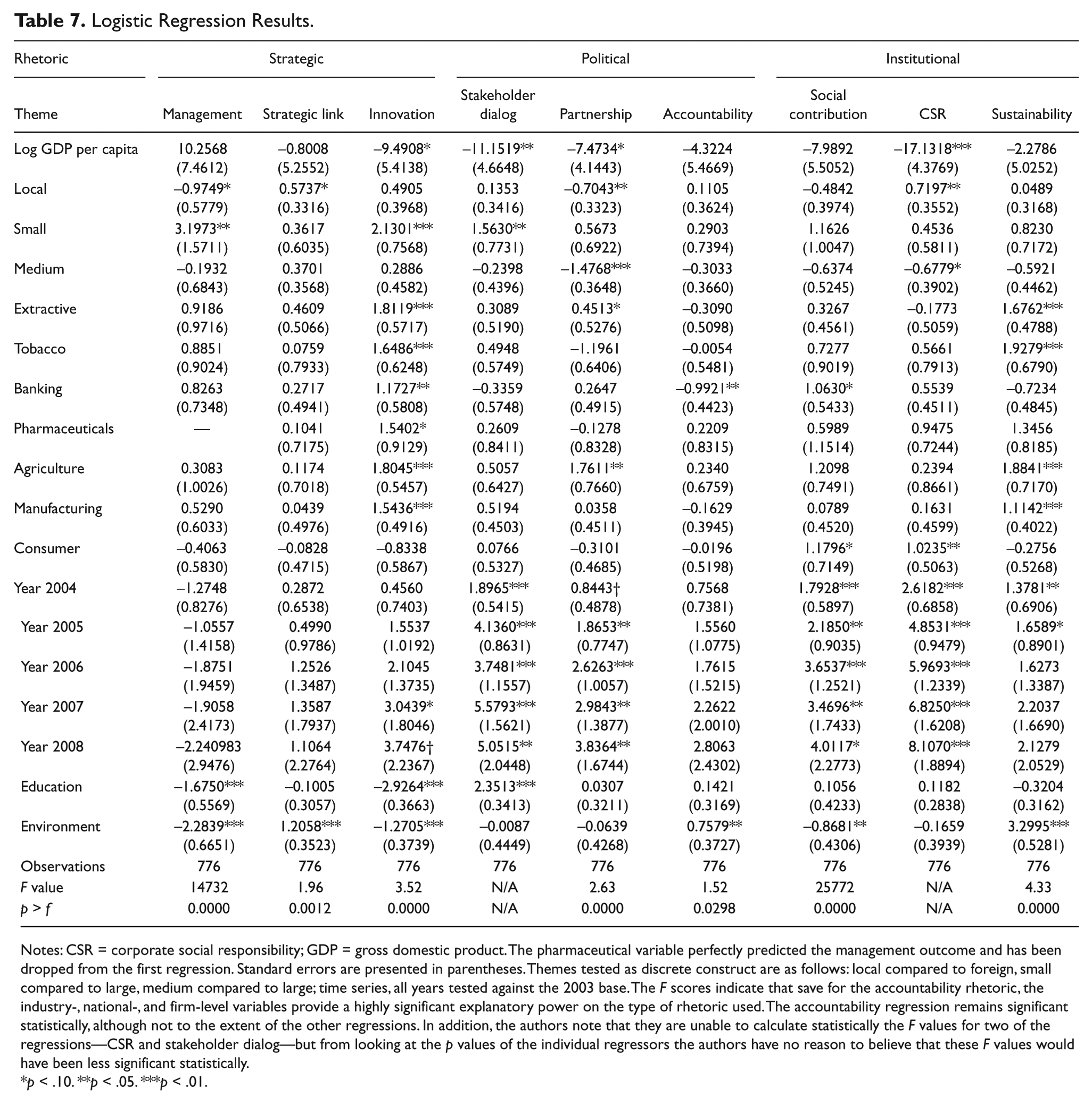
Notes: CSR = corporate social responsibility; GDP = gross domestic product. The pharmaceutical variable perfectly predicted the management outcome and has been dropped from the first regression. Standard errors are presented in parentheses. Themes tested as discrete construct are as follows: local compared to foreign, small compared to large, medium compared to large; time series, all years tested against the 2003 base. The F scores indicate that save for the accountability rhetoric, the industry-, national-, and firm-level variables provide a highly significant explanatory power on the type of rhetoric used. The accountability regression remains significant statistically, although not to the extent of the other regressions. In addition, the authors note that they are unable to calculate statistically the F values for two of the regressions—CSR and stakeholder dialog—but from looking at the p values of the individual regressors the authors have no reason to believe that these F values would have been less significant statistically.
p < .10. **p < .05. ***p < .01.
Legitimacy Strategies and National Characteristics
In the quantitative analysis, the authors found some empirical patterns that support Hypothesis 1, indicating that legitimacy strategies are dependent on economic development. The analysis demonstrates that firms located in less developed countries tend to use more of the institutional and political rhetoric as compared to their more developed neighbors. Regression results show there is a significant negative relationship between the country’s level of gross domestic product (GDP) with the themes stakeholder dialog (â = −11.1519, p < .05), partnership (â = −7.4734, p < .10), and CSR (â = −17.1318, p < .01), “â” indicates coefficients and “p” probabilities. However, the authors also find a negative significant relationship between GDP and the use of the innovation theme (â = −9.4908, p < .10), possibly due to the importance of wealth creation and entrepreneurship in rapidly developing countries such China, Indonesia, and India. This result supports the argument that processes of stakeholder engagement, partnership, and enforcement of civil regulations (Vogel, 2010) in the form of voluntary codes of conduct or adherence to civil society−driven standards (represented by the accountability theme) are ways in which companies might be addressing the regulatory voids in less developed nations. They represent an effort to develop new nonstate, political mechanisms for governing global firms and markets. Moreover, some researchers have argued that the absence of governing institutions in some developing countries in Asia has promoted greater activism, especially from international NGOs (Fitzsimmons, 2008; Mathews, 1997), highlighting the importance of dialoguing with the firm’s stakeholders in the legitimation processes as supported by the data.
CSR in less developed economies is also considered as a way to increase awareness among the population of the philanthropic activities developed by the firms (Baskin, 2005). The analysis supports the idea that the construct CSR is used in countries with lower GDP as a reputation enhancer and as a way of signaling the firm’s commitment to society. CSR is becoming a recognized “brand” in most Asian economies to the point that executives recognize “CSR” as the term most used by corporations to enhance their corporate reputation in relation to social issues (CSR Asia, 2009).
Legitimacy Strategies and Industry Dynamics
There is also some support to Hypothesis 2, which talks about how the familiarity of the public to the industry will lead to strategic and institutional rhetoric. Regression results indicate that agricultural and manufacturing firms were more prone to use the strategic theme of innovation (â = 1.8045, p < .01, for agriculture, and â = 1.5436, p < .01, for manufacturing), showcasing the salience of management and stockholders on their demands. However, these firms were also shown to be more likely to use the institutional theme of sustainability (â = 1.8841, p < .01, for agriculture, and â = 1.1142, p < .01, for manufacturing), a testament to the rise of environmental awareness among manufacturing and agricultural firms in Asia. On the other hand, consumer-oriented companies were shown to use more the institutional themes of social contribution (â = 1.1796, p < .10) and CSR (â = 1.0235, p < .05); this result may signify that the close interaction between consumer-oriented companies and their buyers translates to demonstrations of their social beliefs to their consumers.
From the regression analysis, the results find that tobacco and extractive firms use more of the sustainability theme (â = 1.9279, p < .01, for tobacco, and â = 1.6762, p < .01, for extractives) and the innovation theme (â = 1.9279, p < .01, for tobacco, and â = 1.8119, p < .01, for extractives). Firms in banking and finance are also more likely to utilize innovation (â = 1.1727, p < .05) and less likely to use accountability (â = −0.9921, p < .05). Pharmaceutical industry rhetoric seems very balanced with only a slight statistical significance in the theme of innovation (â = 1.5402, p < .10).
The results indicate that industry visibility might be related to different legitimacy strategies but, contrary to what was predicted in Hypothesis 3, the strategic and institutional rhetoric, rather than political rhetoric, are salient in highly visible firms. This finding might indicate that in Asia the license to operate is associated with the ability of firms to provide new products and services able to improve social welfare. Furthermore, the results show the importance of the institutional rhetoric of the sustainability theme for highly visible firms that are probably trying to signal their belonging to a group of firms committed to sustainability. Finally, results suggest that industry characteristics do not show a high level of variation in rhetoric indicating that industry differences might not be the fundamental factor in explaining different legitimacy strategies.
Legitimacy Strategies and Size and Origin of the Firm
For Hypothesis 4, the analysis also finds some partial support to the statement that smaller firms use more political rhetoric. The regressions indicate that small firms are more likely to use the political and the strategic rhetoric as compared to their larger counterparts. Management, social innovation, and stakeholder dialog themes show a positive significance across all three themes (â = 3.1973, p < .05, for management; â = 2.1301, p < .01, for innovation; and â = 1.5630, p < .05, for stakeholder dialog). The interpretation of these results relates to two phenomena. First is the fact that small firms might be using a strategic rhetoric to signal credibility in their respective ventures. Second, small corporations might be more willing to engage in stakeholder dialog to overcome the “liability of the newness,” but as companies grow, the need to partner with different stakeholders diminishes to a certain extent, especially if they are local.
However, the study also finds that medium-sized firms are less likely to use the partnership and CSR themes (â = −1.4768, p < .01, for partnership, and â = −0.6779, p < .10, for CSR). This result might raise the question as to whether the political rhetoric is often used by very small firms that need to form relationships with societal stakeholders in order to support their societal ventures and by very big corporations, usually foreign multinationals, due to their need to gain legitimacy from established organizations in the countries they enter.
The following results on locality of the firm support this preliminary finding, in conjunction with Hypothesis 5, which states that foreign firms use more strategic and political rhetoric. The results find there are significant differences in the use of certain rhetoric by local firms in relation to foreign firms. Local firms tend to utilize more institutional rhetoric and less political rhetoric than foreign firms. The study indicates that there is a greater likelihood in the use of CSR argumentations for local firms (â = 0.7197, p < .05) and less likelihood in the use of partnership (â = −0.7043, p < .05). However, the authors are not able to draw any conclusions on the use of the strategic rhetoric since the results also find a statistically significant positive relationship in the strategic link theme (â = 0.5737, p < .10) and a statistically significant negative relationship in the theme of management (â = −0.9749, p < .10).
The study argues that as concrete cultural settings are often difficult to attain and document, foreign firms opt to concentrate their efforts in embedding new structures and practices in networks of other already legitimate institutions by forming partnerships. Developing projects in coordination with stakeholders among other political legitimacy strategies is an example of the ways by which organizations actively redefine their role in the increasingly complex societies that firms are working in. These firms focus on ascribing to the moral legitimacy while trying to maintain cognitive legitimacy. Table 8 summarizes the above findings.
Rhetoric Strategies of Legitimation.
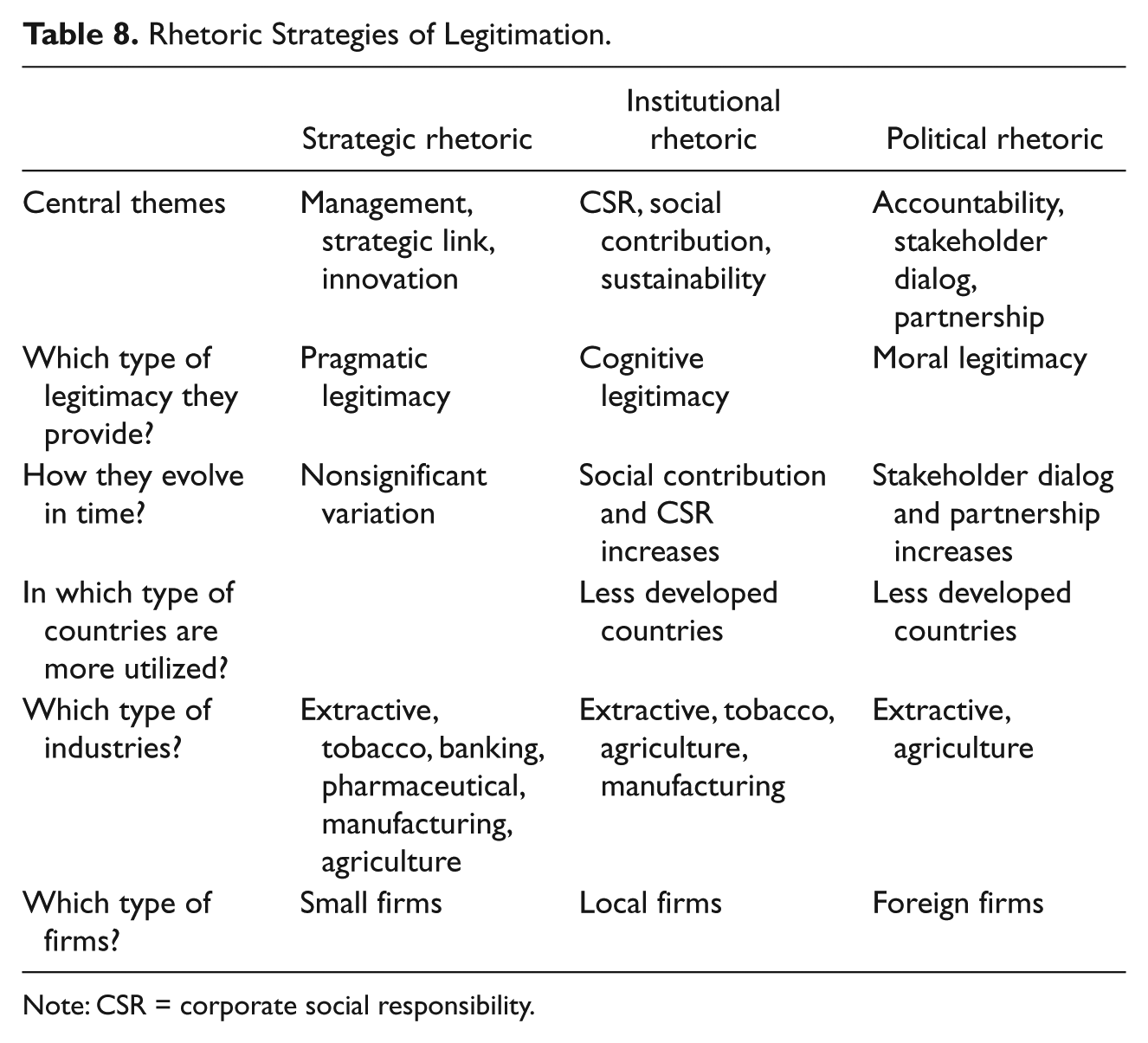
Note: CSR = corporate social responsibility.
Given the relatively brief 6-year time frame across such a diverse cohort of firms and contexts, the authors hesitate to make formal conclusions pertaining to the evolution of the rhetoric in Asia over time. Nonetheless, the authors wanted to mention as a final note in this section that controlling for firm-, industry-, and country-level factors, the study finds from the increasing coefficients of the year dummy variables in Table 7 that four themes have increased in use significantly over the past 6 years. Two are related to the political rhetoric: stakeholder dialog and partnership, and the other two are from the institutional rhetoric: social contribution and CSR. The rise of this political rhetoric supports the earlier arguments that the major transformations occurring in the Asian region, as well as the growing complexity of globalized society (Beck, 1992) through an ongoing process of individualization (Palazzo & Scherer, 2006), could be leading companies to search for a new form of moral legitimacy. This result provides some empirical support to the earlier conjuncture that neither cognitive nor pragmatic legitimacy may be sufficient to help new companies buy their license to operate, and as such, firms opt for political legitimacy strategies to gain moral legitimacy.
The study also notes the strongest rise is the use of the CSR theme relative to the other themes. As CSR becomes more mainstream, its use attracts more firms in an isomorphic process (DiMaggio & Powell, 1983), especially firms in emerging markets and small firms. This attraction supports the argument that defines the rhetoric related to CSR and sustainability as means to gain further cognitive legitimacy.
Discussion and Suggestions for Future Research
The potency of discourse in affecting organizational legitimacy is well accepted in the literature, and one of this study’s aims is to gain a deeper understanding of this constructive potential. The results encourage further debate on the changing nature of the societal understanding of the role of the firm. This understanding of a firm as a social and political actor that needs to provide new social and environmental values to society underscores the pressure that firms receive from its stakeholders. Corporations are responding to these pressures with new legitimacy strategies in the form of deliberative processes and new rhetoric in which they proclaim their responsibilities and accountability duties to society and to nature. Firms are more prone to use deliberative models of engagement with their stakeholders since they find that this approach is a good way to achieve higher levels of consensus and social stability. However, the results confirm the fact that these strategies might be promoted by the need to respond to stakeholders in conflict environments more than the active reflection about principles of stakeholder inclusion, responsibility, or citizenship. The authors also acknowledge that concepts such as sustainability are increasing in use especially among local firms in developing countries, supporting the idea of the isomorphic growth of the CSR movement and its increasing cognitive legitimacy.
The primary contribution of this article is to create a model of legitimacy strategies in which different modes of legitimation can be mapped out. The model defines three strategies: strategic, institutional, and political, which relate to gaining distinct legitimacy: pragmatic, cognitive, or moral, respectively. Conducting a broad exploratory analysis based on this mapping, the major finding is that corporations are adapting their legitimacy strategies toward a new understanding of their role in society. Corporations have incorporated the language of civil society, which is associated with the political rhetoric, into their legitimacy management, challenging the framework provided by the classical strategic and institutional theories. The current mainstream understanding of the role of the corporation as apolitical has defined the focus of the studies on legitimacy management in the compliance with national laws and fairly homogeneous and stable societal expectations (Palazzo & Scherer, 2006). However, a broader view of the management theories has helped us to incorporate the political context in the role of corporations. By bringing this approach into the debate, the study interprets how corporations understand their changing role in enabling, providing, and channeling societal needs (Cramer, Jonker, & van der Heijden, 2004). This article argues that corporate legitimacy is increasingly based on new forms of argumentations that relate to values and beliefs as well as in new forms of engaging with civil society. The process of looking at shared ways of operating in the form of partnerships, stakeholder dialogs, and accountability mechanisms, among others, is transforming not only the way corporations face conflicts but also the way they make sense of their activities. Nonetheless, further research is needed for understanding precisely how companies actively understand and define their political role.
The second contribution is the attempt to connect further the differences in the CSR rhetoric as dependent on the national, industry, and firm characteristics. Though exploratory in nature, this empirical research demonstrates how the political rhetoric is more utilized in the context of potential high conflict with civil society. The analysis shows how the political rhetoric is more prevalent in foreign firms operating in developing countries. The institutional rhetoric is salient in developing countries and local firms. Strategic rhetoric is more used by small firms.
These empirical results not only indicate that the variation in CSR is predicted significantly by firm characteristics and the context that the firm finds itself in but also help scholars to reflect on the changing nature of the role of the firm in complex societies. The greater use of political rhetoric by corporations might not only lead firms to make more informed and rational decisions that increase the acceptability of these decisions’ outcomes but also might promote a redefinition of their relationship with their stakeholders, leading to mutual recognition and consensually defined goals.
Finally, this research contributes to the limited number of studies that have been conducted in Asia by utilizing the region as a context for showing the impact of globalization on the diffusion across different types of firms. This article showcases the benefits of utilizing Asia as a place of research by capitalizing on the enormous disparity in institutional, cultural, economic, and administrative circumstances that the region provides. Nonetheless, these advantages also limit the generalization of these findings to the rest of the world. Previous research has shown that Asian CSR is distinct in certain aspects from its counterparts in the rest of the world (Chapple & Moon, 2005; Visser, 2008). Therefore, further research of an intercontinental nature must be generated to verify whether the empirical relationships remain equally valid whether in a European, American, or African context.
In addition, research should look more expansively into the particular conflict settings in which corporations are prompted to use the different forms of legitimacy strategies, be they strategic, institutional, and political rhetoric. A deeper understanding of how firm characteristics and the concrete institutional settings in which companies find themselves in influence the use of each type of rhetoric will help provide us with greater insight as to why and how corporations are redefining their roles in society. Future research must explore both the conflicts and synergies generated by the various legitimization dynamics. Since multiple legitimation is often the most effective form of legitimation (Vaara & Tienari, 2008, p. 988), further studies should explore the importance of the use of a combination of legitimacy strategies by different types of firms. As argued by Suchman (1995), the literature lacks an account on the understanding of the “typical” legitimization progression. Although an attempt has been done to understand this process in this research, further studies should analyze the wider range of legitimacy strategies within a common set of firm characteristics.
Footnotes
Declaration of Conflicting Interests
The authors declared no potential conflicts of interest with respect to the research, authorship, and/or publication of this article.
Funding
The authors disclosed receipt of the following financial support for the research, authorship, and/or publication of this article: The authors would like to acknowledge the support of the Asian Institute of Management, IESE Business School, Cátedra Ethos, ESADE, Universitat Ramon Llull and Professor Josep M. Lozano in providing the funding for this research. The authors would also like to express their gratitude for the help provided in the data collection and analysis by Sarah Queblatin, Alma Rose Roxas, Victoria Licuanan, Rose Quiambao at the AIM-Ramon V. del Rosario, Center for Corporate Social Responsibility and to Andreas Georg Scherer, Guido Palazzo, Dirk Matten and two anonymous reviewers for guiding us in the improvement of the paper.