



Abstract
This article describes how female managers with physical impairment negotiate their relationships in the workplace. It locates discussion of physical impairment and disability within an Interactional Model of Disability. Drawing on 20 interviews, this research identifies the factors that are central to the experience of female managers with disability in the workplace, including power, passing, and surface acting. When dealing with others who had power over them (such as their superiors), the leaders adopted approaches such as passing, in an attempt to minimize the visibility of both their impairment and their disability. This involved the leaders using surface acting to present an optimistic demeanor even when their actual feelings were very different. It will be argued that the use of surface acting and the reliance on passing begins to explain why people with disability are invisible in the workplace leadership literature and why this is damaging to diversity agendas in organizations.
Keywords
Traditionally, disability has been almost totally ignored in the leadership literature except when looking at leadership within the disability community (Roulstone & Williams, 2014). When people with disability (PWD) in mainstream leadership roles receive attention, the focus is on the novelty of their situation (Stephenson, 1996) or the superhuman capabilities of the individual concerned (Ferguson, 2011). Moreover, there has been a tendency to view PWD as one homogeneous group with no gender distinctions. The reality of being a woman with disability and having a physical impairment has to a large extent been overlooked by both the disability and feminist movements (Begum, 1992). Likewise, there is evidence that suggests that the experiences of male and female managers are often different, with female leaders facing hurdles and being subject to stereotypes that are different from those of their male counterparts (Agars, 2004; Grossman, 2013).
The aim of this study is to start to redress the balance on all counts by examining the experience of women leaders with physical impairment. There will be no attempt to dissect the data to determine the impact of gender on the participant’s experience, independent of their experience of being a manager or PWD. The value or even feasibility of such an activity is debatable (Vernon, 1999). A strong argument can be made that gender and disability identity are indivisible and that women experience disability quite differently from men (Asch & Fine, 1988). The identity category that will be explored can therefore be thought of as being women leaders with disability (WLWD).
Literature Review
The summary of the literature below is organized around the two characteristics of interest in this study: that of being a woman with a physical impairment and their occupation of a leadership role. There are a number of ways in which physical impairment can be theorized and a case will be made for the use of the Interactional Model. The extant literature on both female leaders, and disability and leadership will be examined, focusing on the various strategies that leaders with disability adopt to manage their identity as a leader. Particular attention will be paid to the ways in which women, PWD, and managers all use surface acting as a way of managing other people’s emotions in the workplace. It will be suggested that surface acting underpins most of the strategies WLWD employ to manage their workplace relationships, and only in a minority of circumstances can they show authentic emotions with regard to the impact of their impairment in the workplace. Furthermore, they engage in surface acting as a way of minimizing the visibility of their disability status, thus limiting the chances of them experiencing discrimination.
Definition of Disability
The concept of disability has been contested since the 1970s when viable alternatives to descriptions based purely on medical criteria (the Medical Model) began to be published (Shakespeare, 2014). The Social Model appeared in the 1970s and identified disability as stemming not from physical attributes but from systemic barriers, negative attitudes, and exclusion by society, purposely or inadvertently (Barnes & Mercer, 2003). The Interactional Model has emerged more recently and these theorists argue that what is required is an understanding of disability that is different from the dichotomy created by the social and medical models. According to the Interactional Model, disability ought to be regarded as a complex interaction between the traits inherent to a person (or one’s impairment), and how these traits manifest themselves in the environment a person finds themselves in (the disabling facts of one’s impairment; Riddle, 2013). The Interactional Model is a comprehensive theory that accounts for both impairment and disability.
The three ways of conceptualizing disability discussed above are fundamentally different. Disability can be thought of as a physical “reality” that can be definitively diagnosed or as a much more complex, socially constructed phenomenon (Scullion, 2010). If the latter conception is embraced, then the examination of how depictions of disability in public life and the social construction of disability affect the life of WLWD becomes important to this article. However, the Interactional Model counsels against ignoring the physical impact of impairment and the day-to-day challenges that impairment imposes on PWD. The article will therefore incorporate consideration of impairment along with disability.
With this in mind, and in line with the use of an Interactional Model, the terms impairment and disability will be used in this article to refer to two different aspects of the disability experience. Impairment will be used to refer to the physical, visceral experience, whereas disability (and the abbreviation PWD) will be used to refer to the experience of being socially oppressed as a consequence of having an impairment.
The Depiction of Disabled Leaders
While little has been written about PWD as leaders in business or the public sector, PWD in political leadership, sport, and public life in general have received more attention. Just as disabled public figures adopt particular approaches to manage the public perception of their disability identity, so too do leaders in organizations, though how they do this does not appear to have been documented.
It is hard to determine how many well-known political leaders have had a visible impairment because, by definition, it is unlikely to be on the public record. The most famous example is probably Franklin Roosevelt, about whose physical impairment (or at least the extent of it), little was known until well after his death (Gallagher, 1994). The argument for concealing the extent of his impairment made at the time of his presidency was that the American people could not have confidence in a wartime President who was significantly physically impaired. Extraordinary measures were taken to manage his public persona and included collusion by the press, the Secret Service, and the military (Gallagher, 1994).
The denial that visible physical impairment exists has been called passing, harking back to the term used to describe African Americans who pretended to be White (Piper, 1992). It may not be an easy path to pursue, but it is still possible to make impairment “undiscussable” or present the impression that it is of no account. It has been argued that PWD take this approach because of the perception that disclosing or drawing attention to an impairment (and especially requesting accommodations) will result in stigmatization and less equal treatment (Baldridge & Swift, 2013; Charmaz, 2010; Vickers, 2014). The practice of stigmatizing PWD has received extensive attention in the literature and is believed to be a critical factor in the decision of PWD, from childhood onward, to hide or minimize the presence and impact of their physical impairment (Corrigan, 2014). In terms of the Interactional Model, minimizing impairment is a way of minimizing disability (Olney & Brockelman, 2003).
An alternative strategy to passing adopted by PWD (willingly or unwillingly), especially those in the public eye, is becoming “supercrips.” This term has been used to describe the presentation of a person with an impairment as “overcoming” to succeed as a meaningful member of society and to live a “normal” life (Smart & Smart, 2006). Disability activists argue that this portrayal of PWD serves as a hegemonic device that keeps PWD at the bottom of the social hierarchy and deflects the culture’s responsibility for its ablest infrastructure (Hardin, 2012).
The most common group depicted in this way is sports people with an impairment, where the “supercrip” persona appears to be endemic (Hardin, 2012). In Australia, a prime example is the wheelchair athlete Kurt Fearnley, whose exploits (such as crawling the Kokoda Trail), received national attention and led to him being referred to as superhuman (Gridneff, 2009). One role of the “supercrip” is to inspire those without impairments. Young (2014) referred to this as inspiration porn and points to how this objectifies PWD, who “. . . are there so that you can look at them and think that things aren’t so bad for you: to put your worries into perspective.”
The two ways in which PWD that have a public persona are presented then is to deny or downplay the existence of an impairment and its impact, or to present as a “supercrip.” This affects all PWD, and how these social constructions play out in leadership roles will be explored below.
Disability in the Workplace
Disability in the workplace is remarkably under-researched (Mollow, 2004). The reasons for this are beyond the scope of this article (Boucher, 2014). Suffice to say that with the exception of Roulstone and Williams (2014), no one has looked at the experience of leaders with disability who work in mainstream (as opposed to disability-specific) organizations.
Most studies of PWD in the workplace have looked at disability in the context of workforce diversity (Hoque, Bacon, & Parr, 2014; Wilson-Kovacs, Ryan, Haslam, & Rabinovich, 2008). There is some evidence that PWD experience a glass ceiling similar to that experienced by women (Braddock & Bachelder, 1994). Davies-Metzley (1998) and Hoque et al. (2014) argued that in Britain at least, this has not changed despite significant legislation. They further contended that formal programs to promote the employment of PWD have had little success. Although workplaces may have formal affirmative action policies, this does not mean that they are more likely to engage in affirmative actions (or even equal opportunity) in practice (Hoque et al., 2004). Roulstone and Williams (2014) noted that, “. . . constructions of disability as deficit and difference are arguably at the heart of workplace exclusion” (p. 19). Vernon (1999), also referring to the workplace, wrote that the notion of disability with all its variations is problematic, and Sayce (2003) suggested that managers recruit in their own image. Thus, PWD, like women, find themselves (if employed at all), located in precarious roles (O’Flaherty, 2005; Ryan, Haslam, & Postmes, 2007).
As Shah (2005) and Roulstone and Williams (2014) found, it is unusual for PWD to occupy high-level professional and management roles in organizations. Wilson-Kovacs et al. (2008) have coined the term “glass cliff” (originally applied to women) to describe the barriers faced by PWD who aspire to senior professional, management, and leadership roles. According to them, these barriers include being given roles that are more precarious and those more subject to failure, a lack of opportunities for career advancement, a lack of organizational knowledge about disability, and a lack of reasonable accommodations.
Roulstone and Williams (2014) recently published what appears to be the first study to look specifically at managers with disability. They called the obstacles faced by PWD “the glass partition,” and argued that there is an assumption that employment in a senior position offers security, but that for PWD this security never really exists. Even when in secure employment, PWD may feel emotionally and materially insecure. Organizational change (e.g., a restructure or change of superior) or personal change (e.g., a change in physical impairment) can result in the person’s job being at risk. For PWD, this creates the possibility of economic difficulty such as not being able to pay for the additional costs associated with their impairment, or loss of employment and little chance of finding a new job.
This current study builds on the work of Roulstone and Williams (2014) to enhance understanding of the experience of WLWD by fleshing out the factors that influence how they manage both their impairment and disability status in the workplace and the strategies they adopt to manage important relationships.
Surface Acting, Disability, and Leadership
The use of one’s own emotions as a way of managing the perceptions of others and especially others’ emotions has been reported extensively in the literature. Hochschild (1993) has called this behavior of expressing positive emotions even when that is not the emotion being felt, surface acting. Surface acting involves managing the expression of one’s own feelings by using facial expressions, tone of voice, gestures, and so on, to demonstrate emotions different from those actually being felt. The emotions demonstrated through surface acting are usually more “positive” than those actually being felt (Mann, 2005). Previous research detailed below suggests that managers, women, and PWD in the workplace commonly use surface acting, as a relationship management strategy.
Since Hochschild (1993) started her groundbreaking work by examining work done almost exclusively by women (flight attendants), surface acting has continued to be explored with a focus largely on women’s work and, in many ways, has become synonymous with it, especially in the caring and service professions (Bolton, 2001). Similarly, Wilson-Kovacs et al. (2008) wrote of PWD expressing the “right” emotions to prove their credibility. Kulkarni and Gopakumar (2014) found that one career management tool employed by PWD is creating a positive impression by always being optimistic. Gignac and Cao (2009) wrote that PWD use their own emotions to help others manage their emotional response to disability, by being happy. Scully (2010) described the imperative for PWD to engage in this type of surface acting as being indicative of the unequal power relationship that exists between the able-bodied and PWD. There is also evidence that managers engage in surface acting when undertaking their leadership role (Humphrey, 2012).
It could be posited, therefore, that the status of the research participants in this study (as PWD, managers, and women), would mean that they would be likely to adopt surface acting as a key strategy for managing their relationships in the workplace. They would be likely to pretend to be more optimistic than they actually were, about the organization and its practices, and the way they were treated in the workplace.
The literature described above can be summarized by looking at the strategies PWD in leadership and management roles have adopted in practice to manage their identities as a leader, and as PWD. Roosevelt’s strategy of minimizing the perception of himself as a PWD by passing is also adopted by other PWD (Katz, Fleming, Keren, Lightbody, & Hartman-Maeir, 2002). A report by the RADAR Network (2010) suggests that given the choice, PWD will engage in passing and not reveal the details or impact of their impairment to their superiors in the workplace.
In the same way that leaders are stereotyped as “super-beings” (RADAR Network, 2010), PWD can take on the persona of a “supercrip.” “Supercrips” acknowledge their disability but strive to defy common stereotypes of PWD by taking on tasks deemed impossible for someone with their physical limitation.
The technique used to achieve both passing and supercrip status is surface acting. Surface acting downplays the impact of both impairment and of the negative social construction of disability. It is a passive acceptance of oppression. Neither of these ways of managing the perception of disability in the workplace is necessarily of an individual’s own making, nor is it necessarily a conscious or rational activity. Rather, it is an outcome of a complex system of personal, social, and cultural dynamics (Shildrick, 2000).
Central then to either passing or adopting the “supercrip” persona is the management of others’ emotions using surface acting. This review of the literature also strongly supports the contention that women and PWD use surface acting in the workplace when they are in leadership positions. However, the actual experience of female managers with disability has not been studied. The literature also supports the argument that the experience of WLWD has both physical and socially constructed elements. This has not been studied and lends itself to exploration from the perspective of the Interactional Model.
Research Question
The research question posed in this article is therefore the following:
Methodology and Methods
This study was undertaken in Australia during 2013 to 2014 and drew participants from a wide range of for-profit, not-for-profit, and government organizations located in Melbourne and regional and rural Victoria. As the research was located within a constructionist epistemology, it was undertaken based on the assumption “. . . that through perception and cognition the intrinsic and independent features of objects and events in the world and the principles on which they operate can be understood” (Hammersley & Atkinson, 1995, p. 26). Furthermore, attention was paid specifically to the sociocultural milieu in which the research took place and within which this construction occurred (Newton, Deetz, & Reed, 2011). As reflected in the research question, the aim was to articulate the lived experience of WLWD and to come to understand how they constructed their somewhat problematic identity. Such an approach assumes that human beings rationalize their experience by creating a model of the social world and how it functions.
It is important to note that the study did not draw participants from those who worked in the disability industry. This group has received attention in the past and it is clear that the role impairment and disability play in their work and the ways they and others both perceive and manage disability are different from that of those who work in “mainstream” organizations (Caldwell, 2011). The participants also did not include those with HIV/AIDS or mental health issues. Both of these labels have been identified as attracting significant stigma (Golden, 1996)—not to say other disabilities do not—and while certainly deserving of study, including them would have complicated the phenomena being explored here.
For the purpose of this research, manager will be defined using Shah’s (2005) description of high flyers as “. . . physically disabled individuals who have achieved a recognized standard of power and prestige in their professional lives” (p. 13). In addition, because this research is studying leaders, the focus will be on those who have line control of staff (Mintzberg, 2009).
There were 20 participants drawn from a range of professions. Most had undertaken postgraduate education, which means they are not representative of the vast majority of women with disabilities (Australian Bureau of Statistics, 2014). They were aged between 25 and 66 and had been in a leadership role for between 1 and 27 years. They managed between 4 and 445 staff, with most having at least 25 staff (see Table 1). The University Ethics Committee approved the research project. A copy of the approval is available upon request.
Demographics of Interviewees.

Note. HRM = human resource management.
More than half the participants were recruited for the study via an email list provided by an Australian disability advocacy organization. The rest were recruited using the researcher’s professional contacts and snowball sampling (Sheu, Wei, Chen, Yu, & Tang, 2009). The participants were contacted via an email containing the Participants Information Sheet and Consent Form, sent to them by the researcher. Pseudonyms chosen by the participants are used in the reporting of the interview data.
The aim of this study was to use the “insider accounts” (Bazeley, 2013) of the research participants to develop “thick descriptions” of their experiences. A thick description of a social event or action includes not only the immediate behaviors in which people are engaged but also their experiential understanding of those behaviors that render the event meaningful (Miles, Huberman, & Saldana, 2014).
Participants took part in unstructured interviews (Minichiello, Aroni, Timewell, & Alexander, 1990) and were asked to address three topics:
To describe events in their management career that had led them to reflect on how their identity as a WLWD affected their role as a manager,
To describe how they normally dealt with situations that made their impairment most visible to others,
To describe strategies they used to manage their day-to-day relationships with their superiors, peers, and subordinates.
As usual with these types of interviews, a formal interview protocol was not used, but rather the researcher encouraged the participants to discuss the issues listed above in ways that seemed most relevant to them.
As discussed by Cohen and Mallon (2001), stories are increasingly being acknowledged as a tool that researchers can use to access people’s subjective experiences of aspects of organizational life. The concept of “visible disability” was discussed with participants. They all described themselves in this way and also affirmed that others in the workplace would be aware that they had a physical impairment, though they may not know the medical diagnosis. A number of illnesses (e.g., chronic fatigue syndrome, colitis) may or may not be visible, but the participants in this study were in no doubt that others would be aware that they had a physical impairment.
The interviews varied from about 45 min to more than 2 hr and occurred in the participant’s office or in another private place of their choosing. Appropriate accommodations were provided if needed. The interviews were all audio-taped and transcribed. The interviewer’s role was to prompt each participant to describe several instances of what they thought were typical examples of their day-to-day experience. As the focus of the study was their workplace role, they were not asked about other facets of their life.
The data were analyzed using an analytic induction approach (Blaikie, 1993), which offered a systematic way of sifting and analyzing the large amounts of nonstandard data generated by the method used. It also provided a means by which the researcher could apply a rigorous data analysis technique. This was particularly useful because qualitative data are, at face value at least, difficult to manage and find one’s way through in any systematic way (Martin & Turner, 1986). Themes from the existing literature on the topic, as described above, formed the basis of an initial set of categories (Crabtree & Miller, 1992). These included items such as “minimizing the impact of impairment,” “covering with the help of others,”’ and “planning in advance.” A line-by-line approach was used to code the data under these categories. Grounded theory (Birks & Mills, 2011) was also used with the first 10 interviews to identify any additional themes after the initial coding was completed. While the literature identified how PWD might engage in passing or adopt the role of “supercrip,” the identification of the ways in which these leaders used surface acting as the technique for taking up these roles emerged from the analysis of the data and was found post hoc in the literature.
There was no attempt made to calculate how generalizable each finding was to the whole interview population. As Vickers (2014) wrote, research underpinned by a constructionist view is about finding themes, and the fact that one person reports an experience and others do not does not give it less weight or make it less significant.
Findings
With no exception, participants described the need to manage others’ perception of them as PWD in the workplace. They were all very aware of the need to do this and of being actively engaged in this activity every day. It involved preplanning (e.g., checking access, getting documents in an accessible form, “sussing out” what new people knew about them), seriously considering issues that may bring attention to their impairment during their daily activities (e.g., tabling of hard copy documents in meetings, maneuvering in small rooms, poor lighting, background noise) and dealing in real time with various aspects of interactions that they found problematic in terms of disability (e.g., others’ surprise, inappropriate comments, stereotyping).
They described how a number of factors were usually operating at any one time and that the decision about how to respond was often a balancing act, taking into account the person one was dealing with, the power relationships operating and the physical environment relevant to one’s impairment. The model in Figure 1 summarizes the factors that appeared to be considered by these leaders when determining how they would manage their disability identity in a particular relationship. These contingency factors operated individually or, more commonly, in conjunction with one another. Based on their absence or existence, the managers adopted different relationship management strategies as described in the figure below. Because multiple contingency factors could be in operation at any one time, the managers often adopted more than one relationship management strategies simultaneously, though it appeared that most of the time there was a dominant strategy. They were often not aware at the time of the strategies they were adopting or what contingency factors they were reacting to, but they were able to “unpack” events when asked to do so in the interviews and attribute the adoption of certain strategies to the presence of particular contingencies.
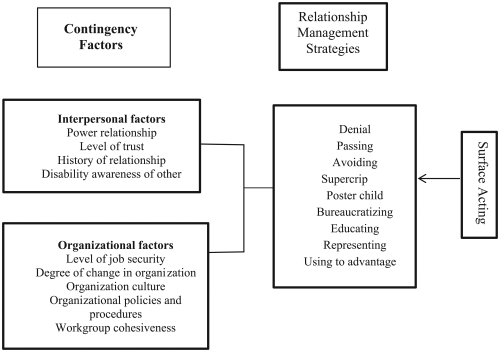
Relationship management strategies used by managers with disability.
The WLWD adopted a range of strategies when interacting with others, the choice of which depended on a series of factors. It is critical to reiterate that the rationale provided by the participants is post facto and they did not suggest there was a conscious process that went through before each interaction. A number of them also indicated that when interactions were spontaneous, short, with strangers, or of no real consequence, they probably gave little or no thought to how they managed that interaction either before, during, or after it happened.
Contingency Factors
The WLWD identified a range of factors that they thought were important to their determinations about how to manage relationships in the workplace. While many stated that it was somewhat of a false distinction to separate their relationship management strategies that focused on managing their impairment or disability status from those strategies they used to manage relationships around other issues (e.g., completion of workplace tasks), the contingency factors summarized in Figure 1 were considered particularly relevant in the context of their impairment and disability. They fell into two distinct categories:
Interpersonal factors, which focused on the relationship between the two individuals and in particular, the power relationship;
Organizational factors, which were related to the organization in which they worked.
Interpersonal factors were concerned with how the WLWD interacted with others. The data indicated that the most importance was given to the relative power of the WLWD and the person with whom they were interacting. In addition, past experience had taught them whether to trust that individual or not, and had given them an understanding of the assumptions that appeared to underpin that individual’s understanding of impairment and disability.
Although the interviewees seldom used the term power, relative power seemed to be central to their relationships with others. For instance, the interviewees used terms like “having authority” or “being the boss,” “someone with a lot of say in the organization,” a peer or colleague, “a more junior staff member,” or “one of their staff,” but the underlying phenomenon in the term chosen was the difference in power. How the power relationship mediated these interactions will be explored by describing three scenarios from the interviews, where the PWD was less powerful, powerful, and most powerful.
In all cases, the participants talked about how, when they met someone for the first time, they looked for verbal and nonverbal cues from the other person that gave clues about how the other person wanted to manage accommodation of their impairment and disability status. Did they mention it and in what context? Did they appear to understand the accommodations that were required? How did they talk about it? Were they patronizing, overly concerned, preoccupied or, most commonly, did they pretend not to notice? Did they make assumptions about what the interviewee could physically do or did they ask? Get a pretty good idea pretty quickly. Do they actually engage with me as a person who has a disability or do they pretend it doesn’t exist? Even worse, do they treat my like a patient, and do stuff for me and expect me to be grateful . . . (Briony).
All of the participants expressed some view similar to this. Even when prompted by the interviewer, they did not countenance the option that their being a PWD had not been noticed or was of no account to others. “Of course they notice. Everyone does, but not everyone shows that they notice” (Jenny).
When asked how the different ways of working with their colleagues developed, the participants in all cases said it was a slow and gradual process, where they “tested the water,” and took their cues from the other person. The cues they picked up on were not necessarily verbal, they may be actions, such as accommodating impairment without being asked.
I just let it happen over time. I know it takes some people a little while to get comfortable and also to work out what they can do to help. Most people want to help, they just need to work out how. Often it is better not to talk about it, not put pressure on them, just let them work out what they are comfortable with (Jane).
The WLWD seemed very comfortable with letting others develop their own way of managing the relationship with regard to impairment and disability issues and adopted a management relationship strategy that best met the needs of the other person, but only up to a point. “I’ll pretty much put up with anything from ignorance to indifference but I won’t put up with being disrespected or patronized” (Farhana).
The interviewees were generally very aware (and wary) of those with power and “sussed out” their prejudices. They were especially concerned about people they did not know or who did not know them. They managed their interactions with these people very cautiously initially, to ensure they appeared competent and that their impairment had as limited a visibility as possible until they felt they had gained credibility. If there was a way of not letting a more powerful person know that they had an impairment, they often preferred to keep it a secret. They seldom let on about the difficulties their impairment created for them in these interactions. Generally, they engaged in intricate planning to ensure it had as limited a visibility as possible and were wary about asking for accommodations unless absolutely necessary.
It takes a while to suss out a new boss. A few (bosses) just dive in and ask (about impairment) but most don’t want to go there now or sometimes ever . . . it’s invisible . . . just pretend it doesn’t exist . . . and I let that happen so I have a chance to work out where they stand and how it is going to work. If they want to talk about it then fine, at least I know early what they say they will do. If they don’t, just bide my time . . .
Do you ever raise it?
Early on? No, unless I have to, like they suggest I visit a place that’s not accessible and even then I’d usually find another excuse.
Depending on what they discovered about the powerful person, they adopted a long-term strategy. These strategies seemed to fall into three types. When they came to the conclusion that the powerful person was antagonistic or unsympathetic toward them as a PWD and that their job was at risk, they made even more effort to minimize the more visible aspects of their impairment (i.e., not using aids), and even avoided having physical contact with them. “I try to stay out of the firing line . . . communicate by email . . . I’m sure given any excuse she’d get rid of me. She made a decision on day one that she didn’t like me” (Ruth).
If they concluded that the powerful person was simply uncomfortable being around them (usually due to unfamiliarity with being with PWD), they adopted a similar technique and maintained the status quo.
He just doesn’t know how to cope, he seems really, really uncomfortable and avoids meetings with me and then they are as short as possible. I don’t get in his face and make it as easy a possible for him (Fang).
It was only when they got feedback from the powerful other that they were amenable to engagement around their impairment and were willing to discuss it, and what it meant for their working relationship, that they would gradually allow their impairment to become more visible by talking about it or asking for accommodations. “He is very empathetic and good at the HR stuff. He is really reasonable about helping by letting me work from home when I need to. He’s not condescending or anything, just polite and considerate” (Than).
A consideration that affected significantly on the extent to which the WLWD felt they needed to manage their interactions with powerful others was the amount of change going on in the organization and the extent to which this was likely to affect them. This is discussed in more detail below but suffice to say, the more precarious their position was, the greater the effort to manage the relationship and, at least initially, to limit visibility of their disability status. Seldom were the WLWD totally comfortable discussing their impairments with their superiors nor were they totally frank with them.
I’m never going to tell him everything and I’m never going to ask for everything. Some things could be easier but I still do them myself. Sometimes she asks me to do things that are really, really inconvenient and hard to organize, but I push myself and do them (Veronica).
In all cases, until the participants were confident they understood their superiors’ attitudes and intentions with regard to their impairment and status as a PWD, this was their preoccupation and they disclosed as little as possible.
Interactions with peers and colleagues could be quite different from those with powerful others, or they could have a number of similarities. It depended on the individual other, the nature of the personal relationship, respective work roles, and the sort of experiences shared on a day-to-day basis. What was not apparent in relationships with peers was the overarching concern about the power the other held over their jobs, which existed in relationships with superiors. In cases where peers were empathetic with regard to both the WLWD’s impairment and their disability status, a very functional working relationship would develop. “Not only does he watch out for me and I don’t have to ask, I can bitch about the small disability stuff and he doesn’t downplay it or tell me to get over it . . .” (Karen). Peers became advocates around disability, not just access and accommodation issues, but spoke up about how disability was talked about in the organization. A significant factor in the development of disability awareness among the interviewee’s peers was the extent to which their work tasks were interdependent (Mattingly, Oswald, & Clark, 2011). Engaging in interdependent tasks meant that both parties needed to find ways to collaborate that took into account the impairment and sometimes also prejudice that arose from disability. It also meant they were more likely to strike up friendships that went beyond the workplace.
We divide up the work according to who does it best. Obviously, it takes me longer to do the visual stuff so XXX usually does that. But she also will stand up for me if a client dismisses me or doesn’t give me credit . . . she makes it clear I’m part of the team (Kerrie).
Relationships with subordinates had similar variations to those with peers but the relationships were usually less close, influenced by the need the WLWD felt to appear to be competent and in control. “I get on really well with my staff but I’m less open, less vulnerable than I am with peers” (Rohan). This need for more psychological distance was based on a desire to be seen to be competent as a manager and the participants thought it had little to do with being a PWD. “I think you need to keep your distance. At times you need to make hard decisions and you don’t want friendship getting in the way” (Pam). Disclosure to subordinates around impairment and disability was more likely, as it was with peers, when the work involved a high level of interdependence.
Whether discussing subordinates, peers, or superiors, the WLWD were able to identify cases where they were not able to develop a relationship with a work colleague that was completely functional. “He treats me like I’m some sort of pariah, like he can catch being disabled, like I have leprosy. I’ve tried to make him comfortable but it was better he worked for someone else” (Than). Where the other had an entrenched view that impairment must result in inferior performance, the relationship was inevitably problematic.
The WLWD were able to articulate how critical the relative power of other individuals was to their relationships. Powerful others were a potential threat and dealt with cautiously. The ultimate fear was that they would decide that the WLWD could not do their job and would take action to have her removed. Of the contingency factors discussed by participants, the power of others over their future was the one they mentioned most and said they were most worried about.
A range of organizational-level factors also affected how the participants handled their interactions with others. Their sense of security in the job was paramount, both in terms of the certainty of their ongoing employment and the likelihood that the job might change in ways that would have a negative impact on them as a person with an impairment. More formal, macro-organizational policies and procedures, along with the less formal organizational culture were also factors. It appeared that the managers’ disability identity was paramount here, rather than their impairment. The issues concerned, as discussed earlier, their capacity as a member of a minority to receive the financial and other support necessary for them to participate as a fully functioning member of the workforce.
The paramount importance of working for an organization that offered job security to these WLWD cannot be overstated. As described above, their job meant they had an income and not just any income, but enough money to support an independent life. Many of them described how one of their main reasons for taking on a management role was the higher income and the subsequent ability to buy their own support services. “I hire and fire my own. I get the equipment I want. I don’t take handouts” (Colleen). Those who were nearing retirement also pointed to the fact that they were relying on their current income to support them through their retirement. “I know I will need more physical help but I want to stay in my own home and I want to be able to buy the help I need on my own terms” (Jie).
None of them thought that getting another job would be easy and many said they thought it might not be possible. This was, they contended, because they had worked in the same organization for many years (see Table 1) and this, combined with potential employers’ perception of disability, would work against them.
Because working for an organization that offered job security was so critical to their well-being, and a loss of employment would threaten their current lifestyle and their future plans, they were prepared to make considerable sacrifices to maintain it. As Lee so succinctly put it, for many of the WLWD, “. . . my boss controls my life.” Not only was job security a critical concern, but also it was coupled with a concern about the nature of the job changing. This concern was partly because it opened up the possibility that the organization might consider the WLWD could not do a reconfigured role, and fire them. It also disrupted the status quo, and the disability and impairment-related concerns for the WLWD, their manager and their work colleagues that had been hitherto resolved, reemerged. It brought back into stark focus their identity as a person with an impairment when they wanted the focus to be on their identity as a manager. “Here I was again, the blind person making trouble over the new computers. I couldn’t do my job but no one cared” (Karen). Overwhelmingly, the research participant raised job security as the critical organizational-level contingency factor they were concerned with, and as will be discussed below, they would adopt particular relationship management strategies in an effort to lessen the chances of organizational change adversely affecting them.
The task of being a leader was more difficult in organizations with a competitive culture (Suppiah & Sandhu, 2011), where highlighting disability and impairment could be used by others as a way of gaining advantage. “He makes a great story out of how he can take clients out on the town, get drunk, have a good time and how I can’t do that” (Fang). Some of the participants described how, in competitive organizations, not being able to engage in this type of behavior impeded their ability to be accepted. I’m just not one of the boys. To some extent, this reflected a culture that privileged not only being able-bodied but also stereotypically male (Miller, 2009).
Finally, general human resource management (HRM) policies and procedures with regard to issues such as accommodations were important though not critical. “It is easier that there is a policy and my manager and I just have to follow it but we can usually muddle through” (Briony). Although the existence of policy was of help, it was of little help if their superior was not supportive.
For these WLWD, keeping their job was their paramount concern and they would tolerate considerable inconvenience and even unfair treatment, if this was what it took to stay employed. Although changes to their job were disruptive, anything that threatened their ongoing employment and therefore their fundamental lifestyle was of the greatest concern. “This job pays for everything and keeps me going. I can’t afford to lose it, no matter how much they change it and make things harder for me” (Veronica).
In summary, it was clear that of greatest concern to these WLWD was managing their relationships with powerful others, usually their superior. They were very aware of the power these people held over their job and consequently the influence they could have on their general well-being. They were wary of organizational change because of its possible negative impact on their job security and the ways in which change brought their impairment and disability to the attention of others. Support from peers and subordinates, especially when they worked closely together, was helpful and allowed the managers to be more open about the impact of their impairment on the way they worked. Organizational culture and policies were seen as being less important.
Relationship Management Strategies
During the interviews, the research participants were asked to describe the ways in which they dealt with the impingement of their disability status and impairment into the workplace and upon their role as a manager. These relationship management strategies are listed in Figure 1. The data indicated that causal relationships did not exist. It could not be said that particular workplace circumstances (e.g., dealing with a powerful, nonempathic boss) would always result in the adoption of particular strategies, nor (as with the contingency factors) were decisions about what strategies to adopt necessarily conscious, although sometimes they were. Furthermore, it was not unusual for the participants to adopt more than one strategy at a time or to adopt different strategies over time with the same individual. However, there were some similarities in the main strategies used and the circumstances under which they were used.
What was particularly interesting was that when they discussed their relationship management strategies they focused on the strategies they used to address issues related to disability rather than impairment. It appeared that managing their perception and treatment, as a WLWD was the more complex and problematic of the two. This is not a surprise as this group of PWD had managed to carve out successful careers and had therefore presumably developed very effective ways of working around issues raised by the physical limitations imposed on them by their impairment.
A relationship management strategy that all the participants stated they used at some time was avoiding. It involved adopting strategies that resulted in disability and impairment not being talked about. Rather than deny the existence of their impairment, the participants acknowledged its existence but were not willing to discuss either their impairment or disability with others. This strategy was adopted in situations where impairment and its impact were obvious. The main reason given for adopting this approach was a fear, that if they discussed it, it might create an opportunity for discrimination by powerful others. “The HR people are just looking for a reason to get rid of me and as soon as they find a reason they’ll act . . . so I simply avoid discussing it. It works, sort of . . .” (Briony). A number of participants described how avoiding was a strategy they used early in their careers, before they developed other strategies. They continued to use it as a default strategy when they met people for the first time or with people who they experienced as “nosy” in an inappropriate way. “She wants to talk about it all the time and although she is good hearted, it is just not OK . . .” (Lee). It was also adopted in situations that were legal in nature (formal performance review processes) or where the WLWD experienced extreme discomfort when having a personal conversation with their manager.
Passing was the most common approach described by the WLWD. It involved minimizing the impact of one’s impairment and disability. It required the participants to develop strategies to limit the visible signs of impairment and they engaged in extensive preparation and planning so as not to draw attention to it. In terms of disability, it required denying that one’s disability status had any negative impact on one’s career or even life in general. The purpose of this strategy was described by Jane who said, “. . . in some ways it is easy, you don’t have to have personal conversations with people you hardly know but gee it is hard work . . .” This strategy was adopted because of the negative impact of being labeled a PWD rather than anything to do with impairment.
I don’t want to be defined by my disability and I don’t want to have to deal with other people’s stereotypes and prejudice. That’s not who I am and I’ve got better things to spend my time doing . . . (Lee).
The techniques used to pass were twofold. Some of the managers, when their impairment was raised in conversation, significantly minimized the impact it had, even to the point where they found it hard to fathom how people believed them. “I just tell them that I have used a wheelchair for so long that I forget most of the time and they believe me. I know that sounds silly but I think they want to believe it” (Jenny). A sign of successful passing was that one was not “treated as a person with a disability.” Lee said an example of this was “. . . when people say spaz or cripple in front of me and don’t even notice . . .”
When minimizing the impact of impairment did not deter others (especially superiors and peers) from wanting to discuss it, the WLWD engaged in surface acting (Hochschild, 1993), in an attempt to reassure the other that their impairment did not have a negative impact on them emotionally.
I want to avoid them thinking of me as disabled and all that goes with that, so I explain in a really positive way how being disabled can be a good thing and all the things like technology and stuff that make my life easy (Jenny).
The WLWD all mentioned the need to be alert to the need, at any time, to present a positive impression of the impact that their disability status had on them, even if it was not true. Rather than minimizing the impact of impairment, this use of surface acting aimed to present impairment and especially disability as a positive thing.
Almost the reverse of passing was the adoption of the “supercrip” persona, which was used by a few of the participants some of the time, though no one appeared to use it as their usual way of dealing with disability and impairment-related interactions. This approach, which required the WLWD to undertake feats normally not expected of people with impairments, was used when their ability to perform in a role was brought into serious question by their powerful superiors. “I needed to show them I didn’t want or need special treatment that I could do what everyone else was expected to do” (Farhana). It might also be employed to reassure their subordinates, with the participants describing incidents where they undertook physically risky activities to prove their physical endurance. The activities that “supercrips” engage in were normally physical in nature and designed to prove that the physical impairment was no limit to their capacity to undertake physical tasks. Although none of them described crawling the Kokoda Track (Gridneff, 2009), they did describe joining in risky activities such as skydiving, playing contact sports, and camping in remote locations. This strategy is of particular interest given the potential risk of permanent physical harm, but as Ruth said, “. . . it was time to prove a point and this was the way to do it and I don’t regret it.”
Another role taken on by a few of the participants was that of “poster child” (Fleischer, 2012), that is, becoming the disabled public face of the organization for whom they worked. Considered problematic in the disability community generally (Smit, 2003), a few participants took this approach, though some did so only reluctantly. “I just didn’t feel like I had a choice. As the most senior disabled person, when we need to front the public, when we need a face, it’s me” (Karen). While the role of “poster child” is more generally used to garner sympathy (and donations), in these cases their role was, like the “supercrip,” to provide inspiration to others and to present the organization in a favorable way to the public. One WLWD described how she enjoyed representing the organization: “I’m really proud of what we do on disability and I’m happy to represent that to shareholders or whoever. It’s just become part of my job” (Rohan). The one part of being a “poster child” that the interviewees did not like was that of defending the organization against claims of discrimination and Cam said, “. . . what I won’t do is become an apologist. If the firm has done the wrong thing then they have to admit it . . . I won’t help them cover it up . . .” They also disliked the sympathy it provoked. “. . . but then they focus on how hard it must be and how brave I am and I hate that stuff” (Rohan).
Being either a “supercrip” or “poster child” was one of the two relationship management strategies used by a small number of the participants who were based around actively engaging with the organization around disability issues and being public about their impairment. A number talked about occasionally using the bureaucratic systems, policies, and rules that existed in their organizations to try to control how they were treated by others, especially their superiors. In all cases, resorting to these processes was a last resort and only employed after other approaches had failed.
I don’t know how many times I pointed out how dangerous that site was for me and others, and no one would take notice. My boss wouldn’t even sign off on agreement with the union to fix it, so I had no choice but to go over his head and lodge a complaint (Tian).
The reason that more formal approaches to engaging with the organization were seldom used was that it inevitably failed in the long term.
In the last place I worked, the guy I worked for was just unreasonable and I couldn’t put in the hours he demanded. I formally asked for accommodations and the company had policies on this but it was mainly used by women returning from mat[ernity] leave and people coming back from injury. In the end, it became a nightmare trying to negotiate between him and HR and I left (Colleen).
Most of the participants had at some stage tried to educate their superiors, peers, and in one case, their subordinates about disability and impairment issues in the workplace. These interactions seemed motivated more by altruism and wanting to represent their disabled colleagues rather than being done with any expectation that it would improve their own personal circumstances. Most of these conversations involved sharing details of the day-to-day impact of their own impairment or disability status in the workplace. They were less likely to have discussions with others about disability issues such as discrimination although Jie said that she “. . . occasionally muttered DDA [Disability Discrimination Act] under her breath when she attended events that were not accessible, not that anyone was interested.”
This relationship management strategy is referred to in the literature as becoming an advocate for PWD in the organization (Roulstone & Williams, 2014). Apart from occasionally attempting to educate, only two of the participants described actively advocating and both were in very senior roles and had been with their organization for many years.
In the same way that I’m the senior woman, I’m the most senior person with a disability and I like to think that creates an impression that if we have issues I can represent those interests. I also chair the Diversity Committee (Rohan).
This relationship management strategy was quite different from those discussed above and was only used by two very senior executives.
The final strategy that was discussed by a few WLWD (and their description of it was laced with words that indicated discomfort, even guilt, about the fact they had used it at all) was employing their impairment or disability status as a technique to elicit a particular advantage. Than described using her impairment to argue that she could not travel to a particularly boring business event and Fang said, “. . . I know it’s pretty obscene but sometimes when I’m really tired I use it as an excuse not to work weekends.” One other participant described how, when all other ways of having her impairment accommodated failed, she would “. . . threaten to take it to HREOC, just to get someone to take notice” (Karen). The employment of this strategy was not condoned by those who used it, but why they used it was understood. “Sometimes you get to the point where you just need a break and that can be one way to get it” (Fang).
The interaction strategies described above indicate that the WLWD employed a diverse range of quite creative strategies in their endeavors to manage the perception and reality of their impairment and disability in the workplace. The strategies used most often by most of the interviewees involved minimizing the visibility of impairment and the impact of disability. In all cases, the WLWD as part of their day-to-day work put considerable emotional and cognitive effort into both thinking about how they would manage relationships and actually doing it. They engaged in significant surface acting as part of this process.
Discussion and Conclusion
Even though these WLWD were confident in their skills as managers and expressed the view that they had high self-esteem as individuals and as PWD, they still felt the need to manage the responses of others in the workplace to both their impairment and disability. The WLWD were clear about the factors that most influenced their choice of a relationship management strategy. Far and away the most critical contingency factor was whether the other person had the power to have an influence on the WLWD’s work life. This became even more significant if the organization was undergoing change and/or if the WLWD’s job role was in any way precarious. In these circumstances, the WLWD used surface acting and presented a positive demeanor as a way of avoiding discussions of their impairment and disability status, making it less visible or presenting it as an asset rather than a liability. As mentioned in the literature review, it is common for PWD, managers, and women to use surface acting in the workplace to manage the emotions of others (e.g., Hochschild, 1993; Iszatt-White, 2013; Wilson-Kovacs et al., 2008). What this study points to though is a “multiplier effect” in the need to employ such a strategy as a consequence of being at the intersection of all three categories.
The WLWD could develop constructive and authentic relationships with peers and colleagues, especially when their work was interdependent. In these relationships, they did not feel the same need to manage the other’s reactions or to present an overly positive representation of disability or impairment. Organizations that had a less competitive culture and more supportive human resource policies were also easier to work in. Previous studies have pointed to the role social support can play in facilitating the employment of PWD (Schur, Kruse, Blasi, & Blanck, 2009), and this study suggests that this is particularly helpful when the tasks performed are interdependent.
At times, rather than minimizing the impact of one’s impairment, some of the WLWD would engage in activities that accentuated their disability status by undertaking tasks in ways that defied usual the perception of people with impairments. This again involved engaging in surface acting in an attempt to show others that their impairment was of little consequence. Conversely, very few of the research participants felt comfortable being an advocate for PWD in their organization. Only those in the most powerful positions could do this.
An issue that was not raised by the research participants, but is worth noting, is the critical difference between Australian disability discrimination legislation (DDA), and the American with Disabilities Act in the United States. The ADA makes provision for the creation of an enforcement agency that can both investigate and prosecute organizations that engage in discrimination. The DDA does not allow for the Human Rights and Equal Opportunity Commission to prosecute those who are in breach of the Act (Allen, 2010), nor is it now able to instigate investigations into possible breaches (Keefe-Martin, 2001). Its powers are limited to mediation, and individuals, at their own cost, must instigate any legal action. Legislation in other similar economies such as in Canada and Europe contains a mix of provisions regarding the scope and the power of regulating bodies but most are provided with more authority than that given to the Human Rights and Equal Opportunity Commission in Australia (Mabbett, 2005).
Whether the lack of any convenient and affordable investigation and enforcement process in Australia influences the ways these women manage their relationship with their employer is beyond the scope of this article but is a factor worth consideration. This is especially relevant when statistical evidence points to a much greater tendency for employees in the United States to avail themselves of the remedies provided by the relevant legislation than do employees in Australia (Australian Human Rights Commission, 2014; Maroto & Pettinicchio, 2014).
Whatever the contingency factors driving the relationship management strategies that were being adopted, in most cases, it resulted in the WLWD adopting an optimistic demeanor and downplaying both the significance of their impairment and the degree of oppression that came with their disability status in the workplace (passing), or pretending that it did not exist (avoiding). It could be said that they engaged in intensive emotion work with others to make their disability (or at least the consequences of it) disappear as much as possible. As a consequence, they became invisible as PWD. In a few cases, they took on a visible role as a PWD but it was as a “poster child” or “supercrip,” neither of which was an authentic depiction of the experience of disability and both of which required the use of a good deal of surface acting.
The literature discussed above demonstrated that women, managers, and PWD in the workplace all use surface acting to manage others’ feelings and given the participants in this study fall into all three categories, it is not such a surprise to find that it was their predominant technique for managing their relationships with others. It has significant implications though for increasing the employment of PWD in organizations. If even those PWD who have achieved a great deal and gained management roles in organizations still feel the need to “disappear” as PWD by avoiding or passing, or to present as “supercrips,” what are the chances of organizations actively working to employ more PWD? This study supports the contention that concern about the stigma attached to disability and the potential for discrimination does not lessen just because PWD attain high professional status.
The diversity literature overwhelmingly supports the proposition that the best way to encourage the employment of minorities in organizations is to position role models in very visible jobs at the top of the organization (Kurtulus & Tomaskovic-Devey, 2011). However, this study suggests for the first time, that in the case of PWD, even when they reach those higher echelons, they are unable to act authentically as PWD because of their fear of losing their job. They feel compelled to engage in what can be personally stressful surface acting. The consequences of this for diversity in organizations is that if PWD as a minority are not visible at senior levels, then the stereotype that they are unemployable will remain.
Footnotes
The article was accepted during the editorship of Duane Windsor.
Declaration of Conflicting Interests
The author(s) declared no potential conflicts of interest with respect to the research, authorship, and/or publication of this article.
Funding
The author(s) received no financial support for the research, authorship, and/or publication of this article.