




Abstract
Corporate social responsibility (CSR) research has burgeoned in the past several decades. Despite significant advances, our review of the literature reveals a problematic gap: We know little about how culture, practices, and interactions shape CSR. On further investigation, we discover that limited research utilizes ethnography to understand CSR, which may provide some explanation for this gap. Thus, the purpose of this article is to illustrate the utility of ethnography for advancing business and society research via a multistage framework that demonstrates how three different types of ethnography may be applied to the exploration of CSR. We specifically focus on the alignment between stages in the research process, or methodological fit, as a key criterion of high-quality research. In doing so, we provide researchers embracing different worldviews a tool they may utilize to conduct and evaluate ethnographies in business and society research.
The shift in managerial consciousness from doing good to avoid punishment (Campbell, 2007) to doing good to fulfill a promise to society has placed the intersection of business and society at the forefront of academic research and practice (Ghobadian, Money, & Hillenbrand, 2015; Matten & Crane, 2005). To this end, corporate social responsibility (CSR) is a cornerstone of business and society research as it attends to how organizations obey both the legal and societal “rules of the game” (Palazzo & Scherer, 2008). Previous research has predominately embraced a macro-institutional perspective (Frederick, 1994; Lee, 2008) to examine how organizations attend to these rules by focusing on (a) how institutional pressures shape organizational responses via CSR initiatives (Campbell, 2007; Van Beurden & Gössling, 2008) and (b) how organizations derive value from CSR (Schuler & Cording, 2006; Wang, Dou, & Jia, 2015).
Although this stream of research provides strong insights, understanding how CSR is enacted in practice as well as how individuals in organizations navigate the complex relationship between business and society remains largely unexplored (Aguinis & Glavas, 2012; Costas & Kärreman, 2013). Yet, this understanding is particularly relevant for CSR research as it is through individual, voluntary behaviors that organizations strategically respond to institutional expectations of social responsibility (Grant, 2012). In other words, how individuals make sense of and enact CSR in their work shapes, at least partially, the organization’s CSR practices. To this end, Wood (2007) argued that to advance CSR research, an employee-centered understanding is needed. The underlying assumption driving this effort is that cultural dimensions of CSR (i.e., how individuals within and outside organizations make sense of and enact CSR) may be critical to building richer and more practically informed theoretical perspectives of CSR (Costas & Kärreman, 2013; Evans, Haden, Clayton, & Novicevic, 2013). Focusing on cultural dimensions of CSR enables researchers to uncover deeper ways in which organizations internalize the diverse claims of multiple stakeholders and how and why they formulate given practices in response.
Given this shift of focus on culture and individual practices, qualitative research in general and ethnographic research in particular may be useful for advancing CSR research. Ethnography is a qualitative research methodology in which the researcher describes and interprets the shared values, practices, behaviors, beliefs, and language within a particular context and over a period of time (Creswell, 2013; Sandberg & Tsoukas, 2011; Wolcott, 2008). Ethnography is useful for CSR research as it may uncover the symbolic as well as actual meanings of CSR in organizations as well as how CSR is enacted in the everyday work and interactions of individuals (Hibbert, Sillince, Diefenbach, & Cunliffe, 2014). Despite its promise, however, our review suggests that most qualitative research in CSR predominately relies on interviews as the sole data source for inquiry (Andreini, Pedeliento, & Signori, 2014; Öberseder, Schlegelmilch, & Murphy, 2013), providing only limited insights into how culture, practices, and interactions may shape CSR.
The purpose of this article is to illustrate the usefulness of ethnography in the field of business and society and how researchers may apply it as well as evaluate it in an effort to build a richer understanding of CSR. The usefulness of ethnography is perhaps most evident in its applicability to diverse research interests—whether those include understanding of the “regularities” within CSR (realist ethnography), the meanings of CSR (impressionist ethnography), or the power/dominance/marginalization that may occur through CSR (critical ethnography). To actualize this purpose and illustrate how ethnography may be more fully utilized in business and society research, we provide a multistage framework that encompasses (a) greater reflexivity in organizational research and a more explicit understanding of how our assumptions shape the questions we ask, (b) explicit fit among the stages in the ethnographic research process, and (c) diversity of types of ethnography—realist, impressionist, and critical—that researchers may utilize to advance understanding of business and society research. To this end, we specifically focus on CSR as our phenomenon of interest (given its importance to business and society research) and illustrate how CSR research can be advanced through ethnography.
In doing so, we pay special attention to the importance of the fit between stages in the research process—or, methodological fit. Edmondson and McManus (2007) introduced methodological fit as “an overarching criterion for ensuring quality field research” and defined it as “internal consistency among elements of a research project” (p. 1155). Methodological fit emphasizes the importance of reflection on our philosophical positions (i.e., our epistemological and ontological assumptions) and alignment between research questions, methodological approach, and desired outcomes (Denzin & Lincoln, 2000; Edmondson & McManus, 2007; Parkhe, 1993). In other words, methodological fit serves as a linchpin to advance CSR research by maximizing the utility of ethnography to create “new and possibly more contextualized theoretical insights” (Hibbert et al., 2014, p. 279).
Our multistage framework may be particularly useful for researchers with diverse backgrounds looking to explore the cultural dimensions of CSR and build richer theoretical understanding. In building the multistage framework, we provide several important implications. First, we illustrate the promise of ethnography as a robust, yet versatile methodological tool. Our review of CSR research suggests that only a fraction of studies utilize ethnography (Bjerregaard & Lauring, 2013; Costas & Kärreman, 2013; Gurney & Humphreys, 2006). Yet, ethnography, with its emphasis on prolonged, real-time observation, triangulation of various data sources, and diverse forms of data, provides a tool to better explicate the intricacies of CSR and overcome many of the obstacles common to retrospective research. We focus the discussion on three types of ethnography—realist, impressionist, and critical—but recognize that the utility of ethnography at least partially stems from its vast versatility. To this end, we hope to provide a useful toolkit for researchers interested in embarking on this methodological path to gain insights into culture-, practice-, and interaction-based understandings of CSR (Hibbert et al., 2014).
Second, in providing the multistage framework, we highlight the importance of methodological fit as a necessary linchpin to advance CSR research. We echo Edmondson and McManus (2007) that a hallmark of well-integrated field research is that the elements of the research project are clearly emphasized and reinforcing. We illustrate how, through methodological fit, well-integrated ethnography can be conducted. We also provide readers with criteria for evaluating ethnography (Creswell, 2013). Although methodological fit is important to any empirical pursuit, in this article, we illustrate how ethnography may advance CSR research through a more explicit focus on methodological fit.
Finally, we build off the work of others to argue that greater reflexivity is needed in terms of both the variety of philosophical positions researchers embrace and how those positions shape the questions asked and methods used (Alvesson, 1991; Creswell, 2012; Hibbert et al., 2014; Rosenberg, 2012). This awareness enables us to conduct more informed research (i.e., knowing why we ask certain questions and how they should be answered) as well as to appreciate the multitude of approaches to inquiry. This in turn helps us overcome the bounds of inertial knowledge generation (Hibbert et al., 2014), show greater appreciation of alternative worldviews, and engage in dialogues across perspectives (for an example of how competing philosophical positions advance knowledge, see Uhl-Bien and Ospina, 2012). Our overarching contribution is, therefore, a practical guide for business and society researchers with diverse philosophical positions looking to advance theory in a robust, yet integrated manner.
Ethnography in CSR Research: The Current State of Affairs
Qualitative research within organizational studies has experienced a tremendous increase over the past few decades producing some of the most innovative, and at times unusual, insights (Dacin, Munir, & Tracey, 2010; Harrison & Rouse, 2014; Lok & De Rond, 2013). Mirroring what is happening in organization studies in general, a growing number of CSR studies have embraced qualitative methodologies (see Figure 1). Qualitative CSR research has contributed to our understanding of how CSR is manifested across organizational forms and contexts (Andreini et al., 2014), how it is utilized for stakeholder management (Bagire, Tusiime, Nalweyiso, & Kakooza, 2011), and the nature of the relationship between CSR and corporate governance (Jamali, Safieddine, & Rabbath, 2008). To emphasize their importance, these insights from qualitative CSR research are relevant not only to organizational studies. Indeed, as depicted in Figure 1, qualitative CSR research has expanded to other fields, including tourism, environmental and resource management, and sociology. This illustrates not only the relevance of CSR to other fields of inquiry but also how different philosophical positions might expand our understanding of CSR.
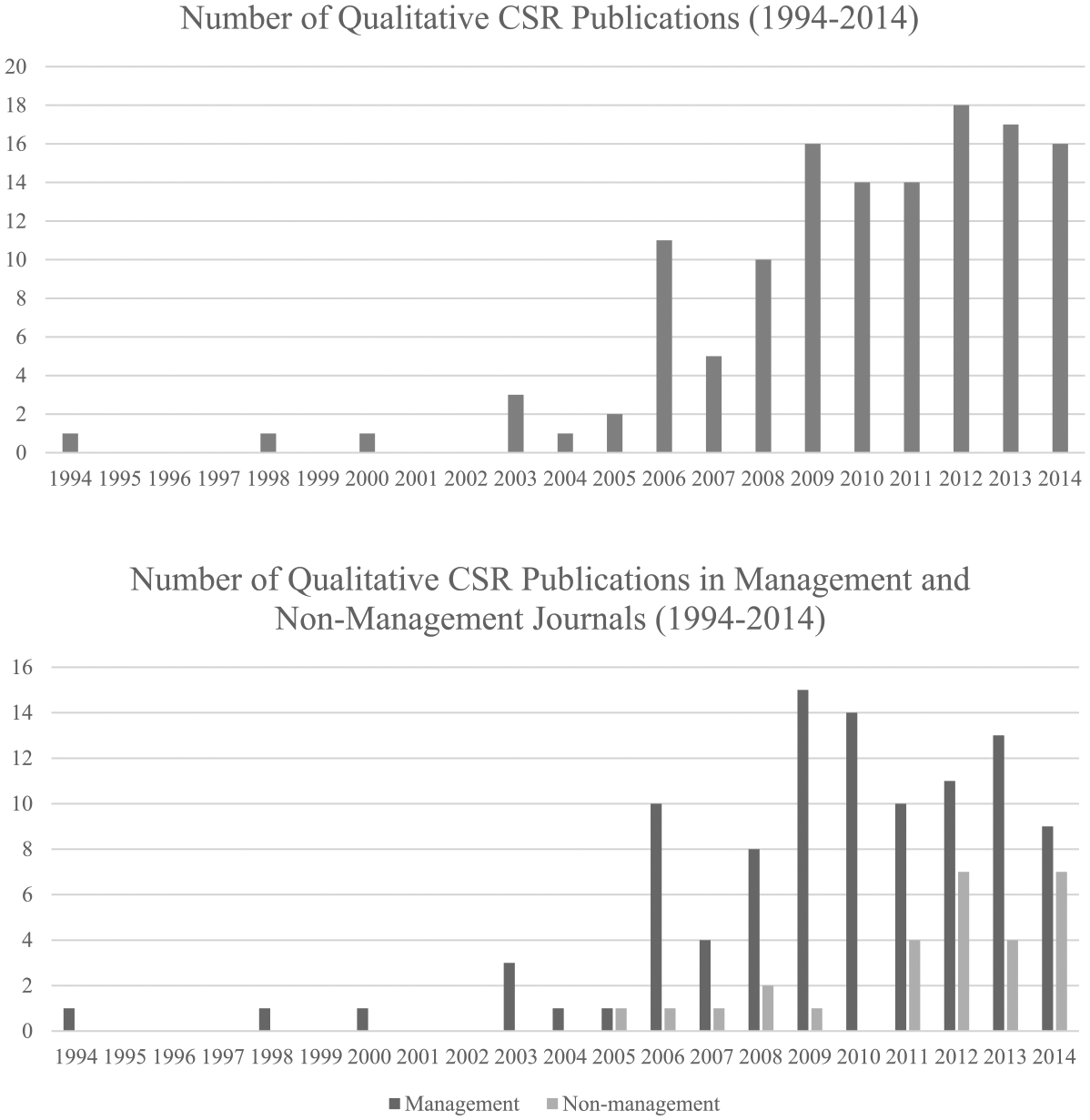
Qualitative research in CSR, 1994-2014.
Despite the rise in qualitative CSR research, the qualitative approach to investigating CSR has largely been monomethodological, utilizing interviews as the sole data source for inquiry (Andreini et al., 2014; Öberseder et al., 2013). This approach is problematic for at least two reasons. First, by relying solely on interview data in qualitative explorations of CSR, we may only be collecting retrospective descriptions of CSR (and often only from those in managerial or executive positions) that may or may not be rooted in the actual practices of individuals in organizations. Although interviews may provide clear insight, they also tend to simplify “the messy concepts and the soft issues” while focusing on “the outcomes but not the processes, and of nomothetically treating firms as black boxes” (Parkhe, 1993, p. 246). Second, overreliance on interview data may provide limited triangulation opportunities, producing potentially biased knowledge. Triangulation of multiple data sources allows for a more holistic and representative understanding of the phenomenon in question (Creswell, 2012).
Given these limitations, prolonged observation of individual practices and interactions coupled with carefully designed interviews and collection of archival data may provide substantially richer insights into culture-, practice-, and interaction-based understandings of CSR in organizations. That is, we really cannot learn much “about what ‘actually happens’ or about ‘how things work’ in organizations without doing the intensive type of close-observational or participative research that is central to the ethnographic endeavor” (Watson, 2011, p. 204).
The Promise of Ethnography for CSR Research
Ethnos is a Greek word that signifies a people, race, or cultural group (Smith, 1989). When coupled with graphic, it denotes descriptions of ways of life of the cultural group (Vidich & Lyman, 2000). Ethnography is a qualitative research approach characterized by in-depth exploration of social phenomena as they take place in a particular temporal and cultural context (Creswell, 2013; Geertz, 1973). Wolcott (1997) offered that the ethnographic method “discern[s] how ordinary people in particular settings make sense of the experience of their everyday lives” (p. 158). Ethnography allows researchers to be immersed in the context “in which things, people, actions, and options already matter in specific ways” (Sandberg & Tsoukas, 2011, p. 341). It enables researchers to explicate participants’ lived experiences of social phenomena in an effort to gain richer insight as it is experienced by individuals in context.
Ethnography may be particularly useful for advancing CSR research for multiple reasons. First, through prolonged participant observation as well as emphasis on triangulation of diverse data sources, ethnography offers rich insights into the ways individuals make sense of CSR and how they enact it in practice—insights that are often obscured or overlooked in other research methodologies. Second, ethnography tends to place particular importance on where the study is conducted, thus inviting researchers to consider how different contexts shape CSR in practice (Wolcott, 2008). Third, ethnography is sufficiently versatile to allow for diverse philosophical assumptions (Uhl-Bien & Ospina, 2012) as well as robust enough to support both theory testing and theory development, resulting in innovative, practice-relevant studies (Morey & Luthans, 1984; Wolcott, 2008). Fourth, ethnography is useful for developing theory in relatively nascent fields, such as CSR. Although interest in CSR traces far back in history (Evans et al., 2013), many important questions with regard to CSR practices remain unanswered.
To understand how ethnography has been used for CSR research, we conducted a robust literature review, following several steps. First, we utilized the Business Source Premier, PsychInfo, and PsychArticles databases and searched for articles using the term corporate social responsibility and each of the following terms: ethnography, ethnographic method, ethnoscience, and ethnomethodology. Second, we utilized the same databases to search using the terms corporate social responsibility and qualitative. To ensure the inclusiveness of our list, we also searched for all studies using qualitative methodology in the following business and society-oriented journals: Business & Society, Journal of Business Ethics, and Business Ethics Quarterly.
With the results acquired from our multiple searches, we (a) identified 169 articles that utilized some form of qualitative methodology and (b) analyzed these articles to identify whether they utilized a pure ethnographic method (i.e., focused on understanding how a culture-sharing group enacted and gave meaning to different practices) or borrowed ethnographic methodological techniques (i.e., participant observation and archival data collection without claims on how the data were utilized; Wolcott, 2008). As indicated in Table 1, the number of pure ethnographies in CSR research is surprisingly small (nine articles). Even when coupled with studies that borrowed ethnographic techniques (25 articles), the number is still minimal compared with number of studies relying solely on interview data (51 articles).
Review of Ethnography in CSR Research.

Note. CSR = corporate social responsibility; NGOs = nongovernmental organizations; CCI = corporate community involvement.
Not fully clear as it has constructionist principles of exploring individual experiences.
Despite these small numbers, studies that did utilize ethnography provided rich and often surprising insights into how CSR is enacted in practice (Table 1). For example, Costas and Kärreman (2013) used a critical approach to explore how managers utilize CSR to prescribe appropriate employee behaviors. They discovered that CSR discourse is utilized as a tool to exert control through the construction of employee identities. Similarly, Barker, Ingersoll, and Teal (2014) described how CSR narratives in an organization may contradict dominant cultural narratives. In addition, Bjerregaard and Lauring (2013) used ethnography to understand how individuals within a socially responsible organization manage the paradox of business imperatives, ethics, and social responsibility in their everyday practices. The authors found that ethical and economic logics can override socially responsible practices in organizations. These and other studies suggest that embracing ethnography may provide not just insights into how CSR is enacted in practice but also extend theory in unusual and unanticipated ways.
To further illustrate the potential of ethnography for CSR research, in the proceeding section, we develop a multistage framework that may help researchers advance understanding of CSR through ethnography. In building our multistage framework, we reference methodological fit as a key criterion of high-quality field studies (Creswell, 2012; Denzin & Lincoln, 2000; Edmondson & McManus, 2007), focusing on consistency among the stages of the research process. The result of our efforts is a methodological framework that provides direction along three paths for advancing CSR research. Along each path, we discuss how CSR is understood, how it is investigated, and the outcomes of the research (study design, narrative structure, and evaluation) to demonstrate the flexibility of ethnography as a research tool, and how ethnography can advance CSR research.
A Multistage Framework for Advancing CSR Research Through Ethnography: Illustrating Three Paths
Van Maanen (2011) identified three broad types of ethnography—realist tales, confessional tales, and impressionist tales—that capture the versatility and robustness of ethnography. Cunliffe (2010) further illustrated the robustness of ethnography by offering critical ethnography, which, in a way, extends confessional tales by emphasizing the reflexivity of the researcher. We incorporate the insights of Van Maanen (2011) and Cunliffe (2010) to focus on three ethnographies that are particularly useful for advancing CSR research—realist, impressionist, and critical. Realist ethnographies are characterized by an objective, matter-of-fact description of social phenomena whereby the researcher remains separate from the context being studied and focuses on objective facts and data (Cunliffe, 2010). Impressionist ethnography is a personalized account of everyday organizational life that emphasizes the practices of those being observed but also allows the researcher to reflect on his or her fieldwork experience (Creswell, 2013). Finally, critical ethnography entails a critique to establish understanding and embraces “an ethical responsibility to address processes of unfairness or injustice within a particular lived domain” (Madison, 2011, p. 5). Our multistage framework (Figure 2) illustrates how ethnography may advance CSR scholarship along three different paths. Although we recognize that one of the key strengths of ethnography is its almost infinite versatility and that many other variations may exist (Wolcott, 2008), we focus on the three types described above to parsimoniously illustrate the potential of ethnography for advancing CSR research.
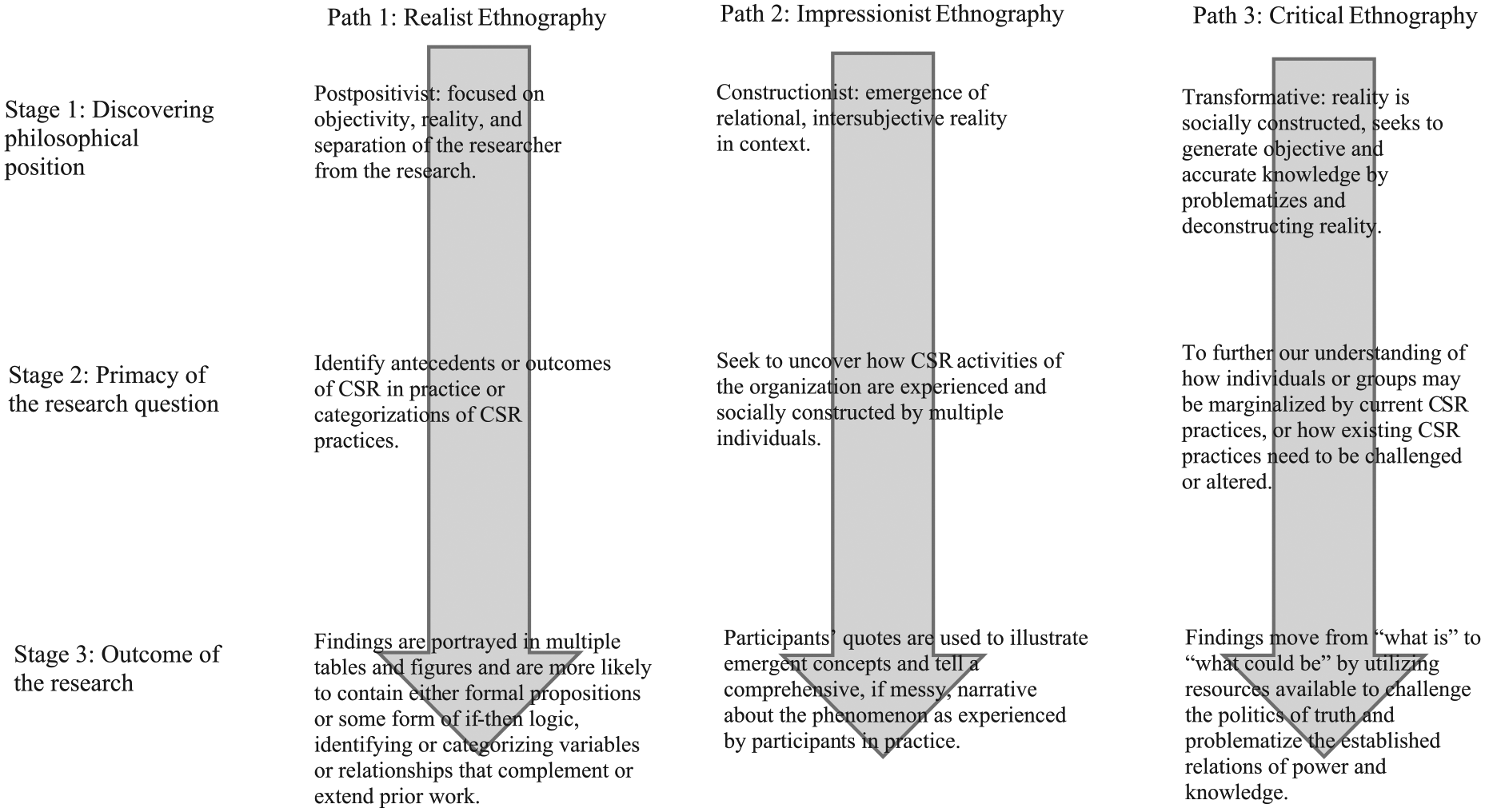
A multistage framework illustrating three paths of ethnography for advancing CSR research.
As depicted in each path in Figure 2, we emphasize methodological fit across the stages of the research process (Edmondson & McManus, 2007) for each of the three types of ethnography described above. In our focus on methodological fit, we first discuss different philosophical positions and how they shape our understanding of CSR (Stage 1 in Figure 2). We then illustrate how different ethnographies align with different philosophical positions to dictate the types of research questions that may be asked to investigate CSR (Stage 2 in Figure 2). Based on the philosophical position and research question, each path identifies different outcomes for advancing CSR research (Stage 3 in Figure 2). In illustrating the three paths, we hope to not only inspire diverse ethnographic explorations of CSR but also recognize the differences in approaches to encourage a productive dialogue (Uhl-Bien & Ospina, 2012) of individual practices of CSR. To this end, we offer a toolkit for researchers to conduct and evaluate high-quality CSR research.
Stage 1: Philosophical Positions and the Meaning of CSR
Being clear about a discipline’s philosophy is essential because at the research frontiers of the disciplines, it is the philosophy of science that guides inquiry. (Rosenberg, 2012, p. 3)
The way in which a researcher conceptualizes and approaches research is a reflection of the paradigm in which they operate. Denzin and Lincoln (2000) argued that researchers approach their work with a bundle of skills, assumptions, and practices that are used in the transition from paradigm into the empirical world. Philosophical positions are a manifestation of the paradigms individuals are embedded in, and thus represent a critical aspect of research. They shape how we see reality (ontology), what we believe counts as truth (epistemology), and the appropriate ways for uncovering both (methodology; Creswell, 2013; Guba & Lincoln, 1994; Rosenberg, 2012). In other words, how we ask questions and what we determine are appropriate ways to answer them are primarily shaped by our philosophical positions (Denzin & Lincoln, 2000).
Scholars have tried to group philosophical positions in recognizable camps. For example, Rosenberg (2012) discussed the rift between naturalism and interpretivism whereby naturalists lean more toward natural sciences believing in regularity, prediction, and the causal nature of human behavior, whereas those who ascribe to interpretivism believe that human action is fundamentally complex and the only way to understand it is through the interpretation of its meaning. Others have offered alternative categorizations. For example, Habermas (1971) identified three positions, or cognitive interests: Technical is concerned with the discovery of law-like relationships through manipulation and control, practical is concerned with the historical and traditional context of human life, and emancipatory is concerned with social injustice and liberation of restrictions and repressions of the established social order (Alvesson, 1991). Similarly, Fine (1994) outlined three positions relevant for qualitative researchers: the ventriloquist position, which entails objective transfer of information to maintain neutrality, objectivity, and distance of the researcher; the position of voices, in which focus is placed on the local knowledge of participants, inviting exploration and understanding of their indigenous experiences; and the activism position, in which the researcher adopts an active role in the research process to expose injustice and facilitate social change through problematization of the status quo and empowerment of marginalized groups.
In this article, we adopt the categorization provided by Creswell (2013) and Lincoln and Guba (2000), who grouped varying paradigms into three broad positions—postpositivism, constructionism, and transformative. We choose this categorization for several reasons. First, it parsimoniously captures the essence of other categorizations described above while covering more dominant positions in the field of organizational studies. Second, it provides utility to describe the versatility of ethnography. Third, it is sufficiently inclusive to provide a starting point for building our multistage framework. By adopting this categorization, we do not argue that one particular position is superior to the other. In addition, we recognize that other philosophical positions are equally important to advancing CSR research, but are not discussed here solely to maximize parsimony. Our main argument is that researchers should reflect on their philosophical position as a key part of the research process and think about how that position may affect the way they approach research. In the following paragraphs, we illustrate how each type of ethnography may provide a methodological expression for the above-identified positions.
Path 1: Realist ethnography and the postpositivist position in CSR research
Researchers holding a postpositivist position embrace objectivity, reductionism, and distance between the researcher and the context (Guba & Lincoln, 1994). The postpositivist position developed out of positivist position that dominated scientific inquiry throughout history, emphasizing prediction and control as hallmarks of scientific progress. In this view, the search for laws, akin to those in the natural sciences, became the only valid pursuit, giving rise to breakthroughs in social science such as Smith’s Wealth of Nations, or Skinner’s Behavior of Organisms (Hesse, 1980; Rosenberg, 2012). Postpositivism adopted many of these characteristics, such as the scientific method and the primacy of objectivity, but relaxed the assumption that a single reality can be discovered (Guba & Lincoln, 1994). Although the postpositivist view assumes that a single reality exists, it can never be completely understood, but only approximated (Creswell, 2012; Guba, 1990). As a consequence, postpositivists search for theory falsification (Popper, 1968) rather than verification.
The postpositivist position is evident in the systematic approach to qualitative research of Creswell (2012), the grounded theory work of Strauss and Corbin (1994), the case study analysis strategies of Yin (2009) and Eisenhardt (1989), and Van Maanen’s (2011) realist tales (realist ethnography). Van Maanen (2011) described realist ethnography as an objective description of culture as it “is” and separation of the researcher from involvement in the research context. Realist ethnography focuses on identifying repeated behaviors as well as factors that may influence those behaviors (social prescriptions, rituals, demands, etc.) over a period of time (often several months or even years) in an effort to provide an objective account of the activities in the context (rather than to interpret those behaviors). The lengthy observation coupled with extensive and exact quotations from research participants provides authority and authenticity of the researcher. To this end, the underlying assumption of realist ethnography is that any equally placed and educated ethnographer would observe and record the same activities and provide the same descriptions (Rode, 2011). As exemplified in Figure 2, given the focus on objectivity, an approach to a single reality, and separation of the researcher from the context, the realist ethnography may be useful for those holding a postpositivist position.
In the postpositivist view, CSR research using realist ethnography seeks precisely defined practices that can be almost universally applied. The purpose of research is to inquire into the factors that influence CSR practices (e.g., identifying variables, relationships, levels of analysis, etc.). An objective definition of CSR based on the existing literature is used to inform the research. The coupling of the postpositivist position with realist ethnography furthers our understanding of CSR as an objective, universally applied phenomenon and investigates (a) the behaviors that contribute to CSR, (b) the outcomes of CSR, (c) and the factors that influence CSR. The strength of the postpositivist position is that it allows the researcher to isolate the meaning of CSR to investigate the antecedents, outcomes, and contingencies of its existence.
Path 2: Impressionist ethnography and the constructionist position in CSR research
Although some qualitative researchers identify with the postpositivist position (Creswell, 2013; Wolcott, 2008; Yin, 2009) in the sense that they tend to approach the research process in a scientific manner, much of qualitative research is characterized by a constructionist worldview (Creswell, 2013; Denzin & Lincoln, 2000). Social constructionists view reality as multiple and socially constructed through interactions and meaning making of diverse individuals. As a consequence, generating knowledge about reality requires a close relationship between the researchers and the participants as well as sensitivity to the context in which the CSR practices occur (Creswell, 2012; Denzin & Lincoln, 2000). Indeed, in contrast to the ontological assumptions held within postpositivism, the constructionist position recognizes the inseparability of the researcher from the social context, where “the inquirer does not stand outside the problematic situation like a spectator; [s/]he is in it and in transaction with it” (Schön, 1994, p. 2).
Researchers holding a constructionist position may find utility in impressionist ethnography. In describing impressionist ethnography, Van Maanen (2011) drew inspiration from the way impressionist painters shifted focus from formal occurrences toward exploration of common activities in context, bringing their own perspectives to the story. In this way, impressionist ethnography provides an interpretation of everyday activities through the eyes of the ever-present researcher and offers “a tightly focused, vibrant, exact, but necessarily imaginative rendering of fieldwork” (Van Maanen, 2011, p. 102). It is an expressive personalized account of individual activities within a particular context (Cunliffe, 2010). Impressionist ethnography methodologically expresses the constructionist assumption that social reality is emergent, occurring in the interaction and conversations between people (Cunliffe, 2010). As such, researchers seek to portray multiple interpretations of reality and show how their own engagement may shape the interpretation and meaning making of their participants (Heyl, 2001). The works of Cunliffe (2008), Orr (1996), and Watson (2003) provide examples of impressionist ethnographies focused on the emergence of relational, intersubjective reality as individuals in context engage in their work.
For CSR researchers adopting the constructionist position, the focus is not necessarily placed on the factors that influence CSR practices as with the postpositivist position, but rather on how individuals make sense of CSR practices and how they interweave them in their work. For example, researchers with a constructionist position may choose impressionist ethnography to explore how individuals construct their identity around the CSR work they perform, how context shapes the meaning of CSR, and how interactions with dissimilar others create new meanings for CSR. The constructionist approach offers unique insights to further our understanding of CSR because it allows for an interpretive, contextualized meaning of CSR to emerge based on the beliefs and practices of those closest to the phenomenon—the participants.
Path 3: Critical ethnography and the transformative position in CSR research
The politically charged context of the 1960s led scholars to explore the transformative position stemming from frustration by the dominance fostered by capitalism (Agger, 1998; Giroux, 1983; Kincheloe & Pinar, 1991). The transformative position was an opportunity to critique knowledge representative of power structures and create a “discourse of possibility . . . [that] suggested to scholars that a reconstruction of the social science could eventually lead to a more egalitarian and democratic social order” (Kincheloe & McLaren, 2000, p. 280). Similar to the constructionist position, researchers assuming the transformative position see reality as socially constructed. However, unlike the constructionist position, the transformative position assumes that knowledge reflects the power structure of society, and thus, the purpose of the research is to help people improve their circumstances (Creswell, 2012; Madison, 2011). In the words of Foucault,
The real political task in society such as ours is to criticize the workings of institutions that appear to be both neutral and independent, to criticize and attack them in such a manner that the political violence that has always exercised itself obscurely through them will be unmasked, so that one can fight against them. (Chomsky & Foucault, 2006, p. 41)
Perhaps somewhat different from impressionist and realist ethnography, critical ethnography is seen as an explicit methodological expression of the transformative position—the line separating the two is somewhat blurred (Madison, 2011). Critical ethnography encompasses a cultural critique of the researcher’s ability to generate objective and accurate knowledge (Cunliffe, 2010). It problematizes the phenomenon in question (here, CSR) and deconstructs categories common to mainstream research such as “family,” “organization,” “property,” and so on, in an effort to uncover power structures and give voice to marginalized actors (Anderson, 1989; Madison, 2011). In doing so, critical ethnography becomes concerned with ethical responsibility—“a sense of duty and commitment based on principles of human freedom and wellbeing”—to attend to the unfairness and injustice of a particular circumstance (Madison, 2011, p. 5). It drives change in terms of how people think and helps them examine their lived experiences in an effort to create progress (Cunliffe, 2010; Madison, 2011).
CSR researchers holding the transformative position choose to use the resources and other privileges at their disposal to break down barriers and understand how CSR practices may create negative outcomes, or how pressures for CSR may result in conditions that are not fully equitable for all. The transformative position is less concerned with defining CSR (postpositivist position) or understanding social constructions of CSR (constructionist position) and more concerned with critiquing how CSR is implemented and practiced by focusing on the voices of the marginalized or underrepresented. For example, a CSR researcher adopting a transformative position might utilize critical ethnography to give voice to the multiple stakeholders who are affected by CSR, and especially focus on those who are ignored or negatively affected by CSR. The researcher would then identify ways that CSR could be adapted to improve the position of these stakeholders.
The transformative position is less prevalent in organization studies, and thus, its underrepresentation in CSR research is not surprising. However, transformative assumptions and correspondingly critical ethnography may be particularly relevant for advancing CSR research. Indeed, there is an opportunity within CSR research to “deviate from the mainstream” to “challeng[e] assumptions and/or provid[e] thought-provoking perspectives” (Crane, Henriques, Husted, & Matten, 2015, p. 6). To this end, critical ethnography may provide a new, thought-provoking perspective by challenging the status quo and disturbing established power structures. An excellent, albeit lone example is Costas and Kärreman’s (2013) ethnographic exploration of the controlling use of CSR to manage employee behaviors. This study provides an important illustration of the potential usefulness of the transformative position and critical ethnography for advancing CSR research.
Stage 2: Primacy of the Research Question in Advancing CSR Research
The key to good research lies not in choosing the right method, but rather in asking the right question and picking the most powerful method for answering that particular question. (Bouchard, 1976, p. 402)
Perhaps one of the most important aspects of research design is the research question because it guides the research process. This sentiment is suggested by Madison (2011) who stated that “[t]he degree and extent of utilization of each of these methods depends on the researcher’s purpose, the guiding questions, theoretical framework, and the scene itself” (p. 157). However, what is less well understood is how the research question flows directly from the philosophical position and shapes the subsequent stages of the research process in an effort to achieve methodological fit. To this end, we illustrate more explicitly how different philosophical assumptions shape the questions we ask and how those questions determine the methodological choices we make (i.e., illustrate methodological fit in the research process).
Because philosophical position determines how we see reality and what we consider knowledge, we may see phenomena as objective manifestations that can be accurately described (postpositivist position), as constructed in individual practice (constructionist position), or alternatively as manifestations of power structures (transformative position). Consequently, the research questions we ask reflect these philosophical positions. For example, researchers embodying a postpositivist position may seek to identify the factors that affect CSR practices (Epstein & Widener, 2010; Kim, Amaeshi, Harris, & Suh, 2013). Researchers embracing the constructionist position may explore how individuals construct CSR practices in their everyday work (Barker et al., 2014; Stewart & Gapp, 2014). And, researchers embracing the transformative position may challenge the way CSR practices are utilized to exercise control (Costas & Kärreman, 2013). In the following section, we examine how philosophical position shapes the research question in each of the three paths identified to advance CSR research.
Path 1: Discovering CSR through realist ethnography
The purpose of research under the postpositivist position is to create new knowledge about reality, often through identification of new variables and comparisons among groups (Creswell, 2012; Strauss & Corbin, 1994). Consequently, research questions driving realist ethnography are aimed at discovery of cause and effect relationships and/or generation of theoretical categories and facts that describe a particular culture-sharing group (Morey & Luthans, 1984). In this view, stronger emphasis is often placed on theoretically derived categories rather than on the voices of the participants (although the participants’ voices are utilized for the development of the theoretical categories). Realist ethnography utilizes extended observation to discover antecedents or outcomes of CSR in practice, or categorizations of CSR practices. In other words, realist ethnography allows researchers with the postpostivist position to inquire into variables and relationships that were not previously considered, advancing CSR research by gaining novel insights (Hibbert et al., 2014).
As noted in Table 1, the research questions of many existing CSR studies reflect the postpositivist position in their focus, albeit implicitly, on variables and relationships relevant for understanding CSR. For example, in their study of leadership styles and CSR practices, Angus-Leppan, Metcalf, and Benn (2010) sought to “understand ‘how’ and ‘why’ CSR leadership happens” focusing their attention on identifying relevant factors. They detect two types of CSR leadership that coincide with either implicit or explicit CSR (Matten & Moon, 2008). Realist ethnography thus seeks to uncover a universally applied understanding of CSR by isolating how CSR is defined (implicit and explicit CSR) and the factors that may affect CSR.
Given the focus on variables, relationships, and categorizations, realist ethnography may enhance the findings of Angus-Leppan et al. (2010) by asking the following questions: How do these two types of CSR leadership influence the organization? And more specifically, what are the key CSR leadership behaviors in this context? These questions build from previous insights to add incremental knowledge to our existing understanding. The first question extends the findings of Angus-Leppan et al. (2010) by uncovering the outcomes of the leadership styles detected in their study (i.e., the relationship between CSR leadership and outcomes). The second question seeks to build categories of CSR leadership behaviors based on the designations put forth by Angus-Leppan et al. (2010; implicit and explicit CSR leadership).
As another example, given the relatively conflicting findings, realist ethnography would be particularly useful to shed light on the particularities of the CSR–financial performance relationship (Wang et al., 2015). To further this important area of inquiry, researchers using realist ethnography may ask the following questions: What are the practices that affect the relationship between CSR and financial performance? And, what are the categories of CSR practices, and how does each category influence financial performance? Based on these questions, realist ethnography could be used to identify which CSR behaviors repeatedly contribute to financial performance in an effort to extract these specific behaviors to a more generalizable understanding of the CSR–financial performance relationship. In summary, realist ethnography may be a particularly useful tool for researchers whose questions are shaped by postpositivist assumptions.
Path 2: Discovering CSR through impressionist ethnography
The purpose of research within the constructionist position is to build understanding about the context in which individuals live and work by exploring processes that are embedded in the interactions between individuals (Creswell, 2012). To this end, the researcher often embarks on data collection with an open-ended research question—almost disregarding extant theory (Creswell, 2012; Gioia, Corley, & Hamilton, 2013). This is important as open-ended questions create space for the emergence of insights as well as conflicting narratives, which are critical to impressionist ethnography given the focus on multiple realities. In this way, the researcher does not impose theoretically derived insights onto participants, but assumes that participants are knowledgeable and the role of the researcher is to inquire into that knowledge (Tracy, 2010). In the words of Gioia et al. (2013), “[w]e follow wherever the informants lead us in the investigation of our guiding research question” (p. 20). Consequently, the researcher gains insight from the data and develops theory that is more applicable and relevant to the lived experiences of the participants.
For the impressionist ethnographer, importance is placed on defining questions that allow multiple voices to be heard. Impressionist ethnography allows researchers with the constructionist position to gain novel insights regarding how individuals make sense of CSR and how they interweave that understanding in their work. However, instead of seeking to define variables, relationships, or categories, impressionist ethnography uncovers how multiple individuals construct and experience CSR activities. To this end, researchers may ask the following questions: How do organizational members experience CSR? And, how do organizational members interweave CSR practices in their work? Perhaps most importantly, impressionist ethnography allows for exploration of how the local historical context in which individuals are embedded shapes their experiences, thus furthering our understanding of CSR in context.
As noted in Table 1, several ethnographies utilize the constructionist position to inform the research question and inquire into individuals’ experiences, albeit implicitly. For example, Driscoll’s (2006) study of the Canadian forest sector asks how organizations use language to change definitions of social legitimacy to enhance their environmental record. Following Driscoll’s research question and findings (and as exemplified in Table 1), we add that utilizing an impressionist ethnography, CSR research could be advanced by asking the following questions: How do organizations construct different symbolic mechanisms? And, what is the nature of the different symbolic mechanisms that organizations engage in? Impressionist ethnography treats existing research not as a point of closure from which incremental research can be built (as with realist ethnography) but rather as a starting point for future inquiry in an effort to gain or develop new insights. Thus, the first question offered above expands the insights of Driscoll’s (2006) study to uncover the symbolic mechanisms of CSR (i.e., how CSR materializes in an organization’s culture). Similarly, the second question seeks to explore the multitude of symbolic mechanisms that underlie CSR practices in an organization. Thus, impressionist ethnography may be a particularly useful tool for exploring the “black box” of CSR by providing insights into how organizational CSR initiatives are enacted and transformed through the activities and sensemaking of multiple individuals (Evans et al., 2013).
Path 3: Discovering CSR through critical ethnography
The purpose of research within the transformative position is to illuminate social issues and search for ways to empower marginalized groups (Adler & Adler, 2008; Anderson, 1989; Madison, 2011). Consequently, research questions are aimed at exposing domination, oppression, and exploitation as the researcher searches for ways to give voice to participants and raise their awareness. As a consequence, and in contrast to the postpositive and constructionist positions, the research question is not neutral but recognizes that injustice exists and that established power structures should be questioned (Creswell, 2012). In this view, stronger emphasis is placed on deconstructing, rather than constructing, reality to empower participants. The transformative position allows for traditionally “positive” concepts, such as CSR, to be scrutinized. Paired with critical ethnography, this line of inquiry allows for a broader understanding of what CSR means and its impact.
Critical ethnography may further our understanding of how individuals or groups may be marginalized by CSR practices. This approach allows for an analysis of CSR to shed light on both positive and negative outcomes of CSR practices. Another unique facet of critical ethnography is that it offers a normative approach, making room for suggestions of how and why existing CSR practices should be altered to empower those marginalized by CSR.
As noted in Table 1, few ethnographic CSR studies utilize the transformative position to inform the research question. An exception is Moriceau and Guerillot (2012), in their study of donations and CSR, who ask “whether a donation can be accounted for outside the frames and language of CSR” (p. 154). Their transformative position enables them to criticize a monolonguistic approach to CSR, offering that more than one “language of CSR” is needed to fully understand that it does not always describe “successes.” Following their research question (and as exemplified in Table 1), we add that, utilizing critical ethnography, CSR research could be advanced by asking the following question: How does the shifting meaning of CSR create marginalized groups? This approach enhances what we know about CSR by deconstructing its meaning and focusing on a negative outcome, here marginalization, of CSR. In addition to deconstructing reality and uncovering negative outcomes, critical ethnography also allows for recommendations of what could be done to the meaning of CSR so that it empowers marginalized groups. As another example, critical ethnography may be particularly useful to explore identity conflicts that emerge as a consequence of differing interpretations (Costas & Kärreman, 2013) as well as how CSR initiatives may be utilized for manipulation of external and internal stakeholders. For example, a CSR researcher using critical ethnography might ask, “how do organizations use CSR to manipulate or control stakeholders?” In sum, we suggest that research questions informed by the transformative position and critical ethnography may be particularly useful for advancing CSR research.
Stage 3: Constructing and Evaluating the Final Narrative About CSR
Ethnographers desire to write ethnography which is both scientific—in the sense of being true to a world known through the empirical senses—and literary—in the sense of expressing what one has learned through evocative writing techniques and form. (Richardson, 2000, p. 253)
Unlike quantitative research, qualitative research in general and ethnography in particular lack a “boilerplate” for writing the final narrative (Pratt, 2009). Despite this, many argue that the inherent flexibility and lack of constraints of qualitative research are its key strengths (Bansal & Corley, 2012; Pratt, 2009; Tracy, 2010). For example, Bansal and Corley (2012) expressed some concern with regard to trends in qualitative research to embrace a dominant style as an indicator of quality. At the same time, however, this “equifinality,” as Pratt (2009) and Creswell (2012) suggested, can lead to difficulties for those who write and evaluate ethnographic research. As a consequence, ethnographic researchers continue to balance these competing demands and carefully craft flexible directions as to how final narratives may be structured to facilitate a theoretical contribution as well as aid with proper evaluation (Creswell, 2012; Cunliffe, 2010; Pratt, 2009; Van Maanen, 2011).
There are several characteristics that tend to be common in much of the high impact ethnographic research. Given the primacy of participant’s experiences, importance is placed on carefully interweaving data with extant theory to provide a more engaging story (Bansal & Corley, 2012; Pratt, 2009). Indeed, a compelling story, permeated with theory and data, is considered a defining characteristic of high-quality studies (Golden-Biddle & Locke, 2007; Pratt, 2009). To this end, researchers offer detailed accounts of their journey in an effort to provide transparency and richness in their narrative (Tracy, 2010). They often search for creative ways to collect data, display representative quotes in text and tables, and illustrate the findings through visual depictions (Creswell, 2012). We contribute to this discussion by offering flexible guidelines directed by methodological fit and specific to the three ethnographies that comprise the three paths for advancing CSR research. This illustration may offer a more robust toolkit for researchers conducting and evaluating ethnographic CSR research.
Path 1: CSR narrative in realist ethnography
In its focus on theory and objective reporting, realist ethnography begins with a clearly defined theoretical issue followed by a strong and extensive theoretical background to the inquiry. Indeed, theoretical sections are often organized alongside multiple streams of research that previously examined the same or similar issue. The organization of the narrative mimics the hypothetico-deductive model in which research questions are derived from the extant literature and findings are utilized to extend current knowledge (Adler & Adler, 2008; Creswell, 2013). Findings are portrayed in multiple tables and figures to communicate systematic analysis. The narrative is likely to contain either formal propositions or some form of if–then logic (Adler & Adler, 2008) that identifies or categorizes variables or relationships that complement or extend prior work. The theoretical focus extends through the narrative as researchers interweave their findings with extant theory to situate their study (Puddephat, Shaffir, & Kleinknecht, 2009). The language used is often passive, formal, and scholarly to both connect the article to the literature and be legitimized by the audience. In doing so, the researcher works to “capture wider academic interest and make a more lasting contribution to scholarship” (Puddephat et al., 2009, p. 2).
In an effort to communicate a systematic approach to research and objectivity informed by the postpositivist position, realist ethnographers tend to use multiple data forms including interviews, questionnaires, participant and non-participant observation, and various archival data, methods, and levels of data analysis (Wolcott, 2008). For CSR researchers, this includes gathering interviews or questionnaires from participants regarding the CSR practices used by the organization, observation of these practices (e.g., documenting the waste management processes of the organization or attending the organization’s facilities or engineering meetings), and collecting internal documents, flowcharts, forms, and media coverage of the organization’s CSR practices.
Realist ethnographers often utilize quantitative methods to locate participants within the larger population as well as embrace traditional notions of validity and reliability in their research (Creswell, 2012; Denzin & Lincoln, 2000; Eisenhardt, 1989). Consequently, in their final narrative, realist ethnographers often provide justification for the use of ethnographic methods and detailed discussion of the steps they took to distance themselves from the context to ensure objective reporting (Adler & Adler, 2008). They also discuss in some detail the steps they took to ensure reliability (such as cross-checking and inter-coder agreement; Miles & Huberman, 1994) and validity (such as triangulation of data sources and member checking; Creswell, 2012) of their findings. Thus, the CSR researcher adopting realist ethnography would identify the research question, detail how the data were collected and analyzed to answer the research question, and describe how the data analysis and results were validated. The overall aim is to provide a final narrative that is grounded in theory and existing understanding of CSR to be legitimized by a wider audience.
The final outcome of realist ethnography is identification or categorization of key variables or relationships that seek to advance understanding of CSR. The aim of realist ethnography of CSR is to add or refine variables, categories, or relationships to produce a definition or understanding that approaches a universally applicable, objective truth. For example, in the abovementioned study of leadership styles and CSR practices, Angus-Leppan and colleagues (2010) discovered that “explicit CSR was closely linked to autocratic leadership” (pp. 207-208), whereas “implicit CSR was closely linked to authentic and emergent leadership,” thus extending existing theory (Matten & Moon, 2008). As discussed above, the authors first categorized CSR leadership and then linked CSR leadership to existing understanding of CSR (implicit vs. explicit). The focus in this research was on extracting the insights from the study to a more generalized understanding of CSR that extends our existing understanding.
As another example, in the previous section, we highlighted the use of realist ethnography to understand the CSR–financial performance relationship. The realist ethnography could provide answers via detailed and objective ethnographic accounts that (a) identify CSR practices, (b) categorize those practices, and (c) uncover the relationships between those categories, practices, and financial performance. In the next step, the researcher would categorize those practices into higher level categories (e.g., individual vs. collective or internal vs. external). The researcher would then seek to validate these categories by asking other researchers, experts, or participants whether the categories were appropriate, or having any one of these groups create the categories to attain inter-rater reliability. The researcher might then connect these categories to financial performance or other pertinent outcomes collected from the data. The final step would be a narrative that describes the new or refined categorizations and how they are related to organizational outcomes, as well as how this study contributes to what is already known about CSR practices and financial performance.
Path 2: CSR narrative in impressionist ethnography
The main focus of impressionist ethnography is to “bring out the experiential, interpretive, dialogical, and polyphonic process at work” while representing multiple voices from the field (Marcus, 2007, p. 1128). The writing style tends to be literary, in an active voice, and more reflexive in an effort to emphasize that research is value-laden, in contrast with realist ethnography. Impressionist ethnography begins with either an empirically driven issue—one that intrigues many, such as the increase in organization-created disasters; or a theory-driven issue—one that is insufficiently explored or has conflicting findings, such as the financial implications of CSR. Compared with realist ethnography, impressionist ethnography does not tend to provide extensive theorizing upfront. Indeed, the main focus is on the lived experiences of participants and not on theoretically derived propositions. As such, literature reviews tend to be shorter with much of the theorizing occurring after the findings are presented (Creswell, 2012).
The findings are communicated with an emphasis on multiple voices and nuances from the field. Participants’ quotes are used to illustrate emergent concepts and tell a comprehensive, if messy, narrative about the phenomenon as experienced by participants in practice. To this end, one of the hallmarks of impressionist ethnography, and the reason why it is argued to be particularly relevant to organizational scholarship (Cunliffe, 2010; Weick, 1989), is its sensitivity to interactions and multiple voices in the field. Personal involvement on the part of the CSR researcher paired with thick descriptions of the processes and interactions in the field enables the researcher to comprehensively illustrate complex processes and meanings that characterize CSR in contemporary organizations (Weick, 1989).
To this end, validity in impressionist ethnography is realized through the researcher’s transparency, reflexivity, and credibility (Denzin & Lincoln, 2000). Transparency is achieved through an extensive narrative that embodies the details of data collection and analysis throughout the research, which tends to be more extensive than quantitative studies (Bansal & Corley, 2012; Tracy, 2010). For example, the CSR researcher using impressionist ethnography might provide details of how the data were collected, even discussing the difficulties or challenges experienced in collecting CSR data. Reflexivity is evident in the researcher’s mindfulness of the values, backgrounds, and ideologies they bring to their research, as suggested above (Tracy, 2010). Thus, the CSR researcher using impressionist ethnography might discuss their own perspective of or experiences with CSR, and how this influenced data collection and analysis. Credibility is established via triangulation, member-checking, and thick descriptions. Triangulation among different data sources improves the robustness of the resulting findings. Member-checking is a conversation during which the researcher asks participants to assess whether the interpretation accurately captures and represents the participant’s position (Creswell, 2012). Finally, thick descriptions provide “detail, context emotion, and the webs of social relationships” to ensure that “the voices, feelings, actions and meanings of interacting individuals are heard” (Denzin, 1989, p. 83).
The final outcome of impressionist ethnography is less likely to be a “nice neat one where everything fits,” such as in realist ethnography (Cunliffe, 2010, p. 231), and more likely to be a messy text that includes multiple voices, personal stories, accounts, and experiences of the participants (Cunliffe, 2010; Marcus, 2007). The CSR researcher using impressionist ethnography would rely on extensive observations and informal conversations to uncover multiple and often conflicting narratives about CSR practices or experiences. This is done not to deduce these multiple narratives into a single meaning of CSR, as with realist ethnography, but rather to inductively build understanding from these multiple narratives. Those narratives are presented in an engaging manner to provide a mosaic of voices on a particular issue, here CSR.
For example, Driscoll’s (2006) study of the Canadian forest sector described above asked how organizations use language to change definitions of social legitimacy to enhance their environmental record. Driscoll described multiple voices of the participants enriched with the observations of interactions in context in the final narrative of procedural, substantive, and symbolic mechanisms that underlie the legitimation process. Thus, a CSR researcher using impressionist ethnography focuses on process—the process of data collection (multiple data sources, challenges in the data collection process), the process of data analysis (based on the multiple voices and the researcher’s values and experiences), and the process of describing the findings (using a thick, sometimes messy, description of multiple experiences or practices of CSR).
Path 3: CSR narrative in critical ethnography
The outcome of critical ethnography is a cultural critique aimed at exposing power inequalities and advocating for social betterment (Adler & Adler, 2008; Ellis & Bochner, 1992; Madison, 2011). In an effort not to further marginalize participants, critical ethnographies are written so that any claim to authority is evaded, given that truth is considered to be subjectively constructed. The narrative takes center stage in critical ethnographies with an accent on storytelling (Adler & Adler, 2008; Ellis & Bochner, 1992) and reflection that the research emerged through the interaction between the researcher and the participants as they were embedded in context (Cunliffe, 2010). Language tends to be colloquial. Similar to impressionist ethnography, the critical ethnographer juxtaposes multiple and often conflicting interpretations of the phenomenon. However, the critical ethnographer departs from the approach of the impressionist ethnographer by providing a plot and arriving at a point of departure that illustrates how reality can be changed (Creswell, 2012; Ellis & Bochner, 1992).
The CSR researcher adopting critical ethnography writes the findings in a way that focuses on the problem (e.g., how an organization’s CSR efforts create communication silos among departments, or how employees experience a paradox as they engage in work practices aimed at creating economic value and CSR practices aimed at creating social value). Although critical ethnographies are driven by the experiences of the participants and the researcher, compared with impressionist ethnographies, the theoretical grounding is somewhat more significant with emphasis on how theory implies power differentials or creates marginalities (Adler & Adler, 2008). For example, the CSR researcher using critical ethnography might ground the research in existing literature on institutional voids, but instead of focusing on how CSR can be used to fill those voids, focus on how those voids are created by social and economic power differentials that are, perhaps, exacerbated through existing CSR practices.
The findings are presented so that the researcher takes the reader beneath what is already known by disrupting neutrality and taken-for-granted assumptions using deconstruction and vivid, thick descriptions (Creswell, 2012; Madison, 2011; see the example of institutional voids above). Focus is placed on both deconstruction of the identified power structures and on creation of positive social change (Guba & Lincoln, 1994). In the “Findings” section of the article, the critical ethnographer moves from “what is” to “what could be” by challenging the politics of truth and problematizing the established relations of power and knowledge (Madison, 2011). As an illustration, in the example of institutional voids above, the critical ethnographer might offer new CSR practices that are designed to break down the power differentials that contribute to institutional voids. In challenging the established institutions on one hand and empowering individuals on the other, the research process itself becomes collaborative in that the research is completed with participants rather than on participants (Baumbusch, 2011; Creswell, 2012; Madison, 2011).
However, the critical ethnographer must remain aware of his or her own power and not impose his or her own expectations on the research process. As a consequence, reflexivity is the key validity concern in critical ethnography (Creswell, 2012; Creswell & Miller, 2000; Madison, 2011). Reflexivity forces the critical ethnographer to acknowledge and examine his or her privilege, thus decreasing the likelihood that participants may be further marginalized (Cunliffe, 2010; Madison, 2011). That is, the CSR researcher must acknowledge that his or her position as a researcher and his or her knowledge of CSR create a power differential between the researcher and the participants. To this end, Madison (2011) argued that critical ethnographers must maintain accountability for the consequences of their research and the message it sends. The CSR researcher must be sensitive not to heighten the problem for participants and suggest a solution that is perhaps difficult or impossible to implement. Anderson (1989) further recognized that because the transformative position entails ideological research, traditional notions of validity are not useful. As a consequence, critical ethnographers must rely on heightened (due to the sensitive nature of their research) credibility, transparency, and reflexivity (Anderson, 1989; Baumbusch, 2011), as well as engage in collaborative research with their participants (Creswell & Miller, 2000).
As noted in Table 1 and discussed earlier, despite the promise of critical ethnography, the method is largely underutilized in mainstream CSR research. Costas and Kärreman (2013) and Demuijnck (2009) are perhaps some of the best examples of how critical ethnography may enable researchers to problematize the status quo in CSR scholarship and provide insights into its “dark side.” Critical ethnography provides, we argue, the most potential for advancing CSR research by challenging our established understanding of (a) what CSR means, (b) the experiences of individuals as they engage in CSR practices, and (c) the positive (and negative) outcomes of CSR, among other facets of CSR research. For example, Moriceau and Guerillot (2012), in criticizing a monolonguistic approach to CSR, challenge the idea that CSR always creates positive outcomes and offer that there are other outcomes (negative or otherwise) that stem from CSR. Taking this research one step forward might result in some solutions to the negative outcomes of CSR, or investigating how CSR language can be altered so that negative outcomes are reduced.
Implications and Conclusions
Continuous growth of a field, such as the field of CSR, in a diverse, yet integrated way requires philosophically informed inquiry that embraces a multitude of methods (Daft & Lewin, 1990; Guba, 1990; Parkhe, 1993; Uhl-Bien & Ospina, 2012). A relative dominance of the “normal science mindset” (Daft & Lewin, 1990) threatens to inhibit scholarly progress via exclusion of alternative approaches that do not fully conform to a singular philosophy or methodology. More specifically, Daft and Lewin (1990) suggested that “reviewers for established journals seem to value papers whose theses are anchored in established theories or that use ‘legitimate’ methods, thus implicitly creating a publication barrier for research that falls outside mainstream topics or methods” (p. 1). Cunliffe (2010) echoed this concern in her observation that we tend to judge rigor and value of research based on our own assumptions, thus inappropriately limiting the scope of inquiry and potentially overlooking novel insights.
This is particularly problematic in CSR research as CSR studies span multiple disciplines and embrace multiple conceptualizations. As depicted in Figure 1, CSR is relevant not just to organizational scholars but is an increasingly important topic of inquiry for tourism, environmentalism, and other related disciplines. Therefore, the threat of a lack of a productive dialogue informed by an explicit awareness of the tenets of methodological fit can preclude full exploration of the complexity and dynamism embedded in organizational and socially responsible practices. We argue that the CSR field may most productively develop through the careful interplay of diverse methodologies shaped by the awareness that each methodological tool may provide useful, albeit diverse and flexible, insights into culture-, practice-, and interaction-based understandings of CSR. This invokes challenges for CSR researchers—to step outside traditional methodological approaches and utilize underrepresented approaches that could potentially yield novel insights. We are optimistic that, given its wide reach, the CSR literature provides a fruitful ground for crosspollination of diverse methodological traditions, thus narrowing the schism that currently plagues organizational scholarship.
To this end, we suggest that ethnography may not be just a useful yet underutilized methodological tool in CSR research but also a critical platform for advancing CSR research. The flexible and versatile nature of ethnography creates room for a more informed dialogue among diverse perspectives and diverse methodological traditions, resulting in a more complete approach to CSR scholarship. Indeed, we argue that it is only through inclusion and interweaving of multiple perspectives that we can begin to understand the complexity of CSR. The paradigmatic interplay in which the rules, albeit fragile ones, are clearly articulated and understood, is key for this advancement. We offer that these fragile rules include (a) explicit recognition of diverse philosophical positions, (b) how those positions inform the research questions we ask, (c) the methods we choose to answer them—quantitative or qualitative—and, (d) the outcomes of the research. Consequently, by imposing these fragile rules on the exploration of CSR, we create a research platform that embodies multiple methodological traditions without determining the appropriateness of the method solely based on a narrow set of criteria. For CSR researchers, this provides a set of loose guidelines we hope will invoke new explorations of culture-, practice-, and interaction-based understanding of CSR.
In this research, we incorporate these arguments and offer that the field of CSR can benefit from the use of ethnography and explicit focus on methodological fit or consistency between different stages in the research process. We illustrate three different paths for advancing CSR research and explain how researchers may utilize each path to achieve methodological fit and produce high-quality ethnographic research. In doing so, we demonstrate the utility of ethnography as a versatile, yet robust methodological tool for advancing CSR scholarship. However, we also hope that our multistage framework will be useful for reviewers who evaluate the rigor and value of diversity in the field and thus be in a better position to advance alternative approaches and aid in the field’s development. This in turn may enable a more productive paradigmatic dialogue in CSR research and over time may minimize the schism between different traditions through more informed understanding. Our overarching contribution is, therefore, a toolkit for CSR researchers that lends itself to a variety of philosophical positions but in concert provides guidance for advancing CSR researcher in an integrative and innovative manner.
Footnotes
Declaration of Conflicting Interests
The authors declared no potential conflicts of interest with respect to the research, authorship, and/or publication of this article.
Funding
The authors received no financial support for the research, authorship, and/or publication of this article.