



Abstract
This essay articulates two aspects of a changing Social Issues in Management (SIM) Division of the Academy of Management (AOM). First, the essay highlights the ways in which SIM’s central focus has shifted and changed over the years. Then, it briefly looks at the forces that are currently shaping SIM within AOM, particularly in spreading what used to be the central core of SIM throughout AOM, and discusses some of the implications of this shift. This devolution of content suggests the need for further change that paradoxically does two things seemingly at odds with each other: brings SIM back to its normative roots and begins to articulate the type of distinctive orientation to business operating within society that might continue to differentiate SIM from other divisions within AOM in the future.
This essay focuses on how the mission of SIM, the Social Issues in Management (SIM) Division of the Academy of Management, seems to have shifted and suggests some ways of moving forward. First, a bit of background on how this essay came to be. In 2012, I was invited to take part in a professional development workshop called “Taking Stock of SIM” at the AOM Annual Meeting in Boston. SIM’s mission has always seemed to involve staying at the cutting and somewhat critical edge of management practice, and thinking and reflecting seriously about the (proper) roles and impacts of businesses in society. My fear, however, was that the questioning (even critical) edge—indeed, the edginess—with which SIM was founded when AOM first split into divisions in the early 1970s has been lost. Possibly, that loss can be attributed to the so-called “crits,” the Critical Management Studies group within AOM, and possibly it happened for other reasons that are to be explored later. Possibly, the edginess has been largely replaced by attention to what Kuhn (1970, p. 212) called normal science. This shift takes place in a management academy, broadly defined, which is itself generally suffering from an inability or unwillingness to risk asking or trying to ask or answer the big and managerially or societally relevant questions (Aldag, 2012; Alvesson, & Sandberg, 2013; Ireland, 2012; Martin, 2012; Pearce & Huang, 2012a). It is also difficult to craft article-length manuscripts on the broad topics that SIM addresses, which in the division’s early years were often found in books rather than papers. Furthermore, the humanistic edge that SIM might be expected to have based on its normative roots has been taken over by the Humanistic Management Network, the Positive Organizational Scholarship (POS) group, and the 50+20 Initiative to reform management education.
With respect to the current state of SIM, one interpretation might be that in some respects, SIM has succeeded beyond its wildest collective imagination. Many of the issues and topics historically central to SIM now have become spread throughout the management disciplines represented in AOM. Alternatively, of course, one could suggest that social, organizational, and world circumstances and imperatives have shaped issues in ways that made them attractive to scholars in other disciplinary specialties. For whatever reason, the reality is that topics that used to be housed pretty much centrally within SIM can now be found in numerous other places within (and beyond) AOM.
Second, although this notion is somewhat more difficult to provide evidence around, it seems that SIM scholars have fallen prey to the same narrowing of research scope and attempts to improve “rigor” (and obtain publication in top-tier journals along with many citations) that beset the rest of AOM (Alvesson & Sandberg, 2013; Giacalone, 2009; Martin, 2012; Podsakoff, MacKenzie, Podsakoff, & Bachrach, 2008; Walsh, Tushman, Kimberly, Starbuck, & Ashford, 2007). This trend has recently received much criticism, creating a diminished breadth of focus and questioning attitude that once characterized SIM.
Although the idea of “taking stock of SIM” suggests a look at the current state of the art within the field, it is important to focus energy not only on the past and how it has shaped the present but also on the potential future(s) of the division. Of course, as with any commentator, I come with a bias that is reflected in my own thinking and set of interests, so let me be clear. These days, I believe that our businesses, societies, and ecology are in serious trouble, particularly with respect to their potential to continue to support human civilization in a manner to which all might like to become accustomed. Thus, I am interested in the issue of systemic change toward a more sustainable and equitable world—particularly the roles that companies can potentially play (or are already playing) in effecting positive change. This topic goes way beyond corporate social responsibility (CSR), which I do not think can get us to a sustainable and just world, even in its more current framing of corporate responsibility (CR) or what Wayne Visser calls the “new” CSR, corporate sustainability and responsibility (Visser, 2008). This issue of system change is at the heart of what SIM stands for now and has always done. Hence, the focus here is openly normative, somewhat critical, and systemic in its orientation. The main point of this essay, however, is to generate conversation, even controversy, about the changes that SIM has experienced and will experience going forward, not to have all the answers. Thus, this essay is speculative and deliberately meant to provoke and engage.
Who/What Is SIM as Officially Defined?
As a division, SIM has evolved considerably over the years. In some respects, the early SIM was all about social and organizational change for the better—particularly about what Frederick labeled CSR1 (Frederick, 1994, 1998)—the idea of holding corporations responsible for their impacts. While a complete history of SIM’s domain statements over the years is not readily available, I was able to find a few relevant statements. In the 2005 Professional Division Review Report submitted by the then division chair Bryan Husted, the domain/mission is given as follows: The purpose of the Division is to promote research and teaching in the field of social, ethical, and governance issues, and other public policy matters constituting the internal and external environments of organizations and, therefore, affecting the study and practice of management. (SIM Constitution, http://sim.aomonline.org/docs/SIM_Constitution_10-14-2013.pdf)
Note here the emphasis on public policy matters as they relate to SIM, and the general reference to organizations, presumably of all types, rather than just to businesses, and the explicit attention to social, ethical, and governance issues as specific to the domain of SIM.
Next, let us look at a version of SIM’s vision statement as it was articulated in a contested business meeting chaired by the then division chair Dawn Elm in 2000, which has largely been forgotten and has certainly been ignored, though never officially dismissed: As a part of the Academy of Management, the Social Issues in Management Division’s mission is to sustain a community of enthusiastic, committed scholars and practitioners consciously questioning the social, political, ecological, global, and ethical issues raised by business activities in relationship to multiple stakeholders. Through a strong network, we integrate multiple disciplines and perspectives into rigorous scholarship and teaching, and influence practice in the interest of forwarding a legitimate, values-based, and critical assessment of business practice to build a better world. We work in a community of people who, while actively integrating knowledge and practice across disciplines, enjoy our own community and our work and service to our stakeholders: students, managers, our colleagues, and society. (Found in my files and confirmed with Dawn Elm, emphasis added)
We can note several things in this statement that reflect the character of SIM as its leaders and membership viewed it during the early 2000s. First, we can note the “consciously questioning” orientation and the explicit attention to asking how it is that businesses affect socio-political, ecological, global, and ethical issues as they relate to stakeholders. Second, we might observe the integrative and multidisciplinary nature of whatever disciplines might be necessary to ask—and answer—the broad and difficult questions to be addressed by SIM membership. Third, we can clearly see the explicitly normative stance of the vision statement—the core purpose of SIM is to use legitimate scholarship, based on values, to build a better world (which, as noted below, reflects the parent organization, AOM’s, stance today, albeit not then). Fourth, we can identify something quite unambiguous about the character of SIM as a division—it is oriented toward community and, in particular to enjoying that community as it serves its various stakeholders, that is, there is an implicit element of fun in the SIM community and enjoyment of the world.
This vision statement was adopted during a contentious business meeting of the division. The main point of controversy, as I recall it, was whether to include the words “build a better world.” Some SIMians argued that we were or should be “objective scientists,” who should not build an explicit normative core into our work. Others strongly believed that SIM’s work (and all scholarship) was inherently normative and could not be separated from underlying ethical issues and hence needed to be acknowledged. As one in the latter camp, I believe first that scholarship is fundamentally about building a better world, whether acknowledged or not, as no one wants to do research that will result in a worse world. Second, while we can and should try to be as neutral as possible with respect to our data and analysis, to attempt to separate the normative from the scientific is to commit what stakeholder theorist Ed Freeman has called the “separation fallacy” (Freeman, 2010; Parmar et al., 2010). As Freeman argues, ethics cannot be separate from action or from theory.
The SIM domain statement was revised at some point during the early 2000s to a new domain statement (broken into bullets for readability), which guided the division until about 2015: Specific domain: encompasses the exploration and analysis of various environments’ and stakeholders’ influence upon the organization and the organization’s effect upon these groups.
Specifically, the domain includes
the Social Environment (which includes topics such as CSR, corporate philanthropy, stakeholder management, and corporate social performance);
the Ethical Environment (which includes topics such as corporate codes of ethics, corporate crime, individual ethical behavior, the influence of the organization on ethical conduct, ethical implications of technology, and the assessment of personal values and corporate culture);
the Public Policy Environment (which includes topics such as political action committees, and the legal and regulatory areas);
the Ecological Environment (which includes topics such as environmental management and various ecological issues);
the Stakeholder Environment (which includes topics such as the impact of corporate use of technology, workplace diversity, corporate governance, and public affairs management); and
the International Environment (which includes international dimensions of topics in each of the previously mentioned environments plus the topic of how the nation state system affects international organizations).
Although the general topical orientations of the vision and domain statements are similar, they could hardly be more different in character. All sense of the questioning of the system or of a critical edge, which was deeply embedded in SIM’s early days (e.g., and is implicit in the vision statement, has disappeared in the domain statement. What remains are acceptance of the system as it is and a list of topics that attempts to be inclusive but remains a list of topics. SIMians, according to this domain statement, apparently simply study the system and its impacts as given without questioning its underpinnings. Furthermore, there is little effort to highlight the cross-disciplinary or integrative nature of the business in society field that SIM represents. Rather, topics are approached as if they could be distilled into disciplines and understood in a fragmented way. (Full disclosure: I was among the many parties creating this domain statement, which was an overt effort to encompass the many subdisciplines within SIM and be as inclusive as possible.)
In addition, the explicitly normative orientation of the earlier statement is gone in favor of a presumably “objective” “exploration and analysis of various environments and stakeholders’ influence.” In the statement, there is no reference to why such analyses might be undertaken other than possibly for purportedly purely scientific reasons, despite that we can make an analogy from physics that there is no such thing as “objective,” and that both observation and one’s perspective always matter and make impacts on the outcomes of research (Gergen, 1978). As Barry Mitnik stated in reviewing this article, “You affect what you touch, and what you see depends on where you look at it from.” Furthermore, all of the language about community among the people who actually do this work and presumably relate to each other has disappeared. In short, the core purpose of the division, to build a better world by critically assessing the roles of businesses in society, and the “heart” of the division—its people as community—have been excised and, in a sense, sanitized in the domain statement of the early 2000s.
Finally, let us look at the current domain statement, passed at the business meeting largely without contention in 2015 (although there had been significant discussion around earlier drafts): The Social Issues in Management (SIM) Division studies the social issues, institutions, interactions, and impacts of management. The common logic of SIM scholarship is our shared interest in understanding responsible behavior by organizations and the people and groups working in and around them. Such investigation leads us to ask fundamental questions about the ethical systems, roles, functioning, and legitimacy of business institutions. Members also bridge scholarship to applied social practices, developing understanding and methods to promote social change and sustainable development.
Specifically, we address the following:
Individual and organizational ethics: Descriptive, including behavioral, work covers individual characteristics, group/organizational influences, and firm–environment interactions. Prescriptive work includes ethical theories, for example, rights and justice, and the study of norms, values, and moral principles.
Organizations and systemic governance: The study of relationships and responsibilities covering both top-level corporate and within-organization governance, and social/environmental governance, including regulatory partnership, corporate corruption/compliance, strategic issues/public affairs management, and corporate political activity.
Stakeholder behaviors, relationships, and systems: Descriptive approaches illuminate interactions with multiple stakeholders, for example, corporate philanthropy and management of natural environmental issues. Instrumental approaches investigate the impact of stakeholder management on firm goals. Prescriptive approaches consider the organization’s responsibilities to stakeholders, for example, CSR, corporate social performance, corporate citizenship, and stakeholders’ responsibilities to the organization.
Here, we see a modest attempt to bring back the idea of focusing on “fundamental questions” and some emphasis on business legitimacy that framed the earliest SIM scholarship. There is also an effort to bridge into actual practice of management. Issues of sustainability and questioning of the system as a whole are, however, mostly omitted from the 2015 domain statement, except in the brief mention of firm–environment interactions. There is no significant reference to the (positive or negative) impacts of businesses on either broader societies or the natural environment, except as a governance issue in the second bullet and little acknowledgment of the global or (lack of) sustainability context in which today’s multinational businesses operate, nor the numerous attempts to constrain business or financial system behaviors, unless those questions are subsumed within the broad notion of ethics or governance. (I will note here that I was also on the committee that worked on this draft and basically gave up attempting to bring in a broader and more questioning perspective.)
Of course, one might also note that the SIM division is embedded within the broader AOM. Hence maybe, this mostly positivist stance is appropriate because, after all, SIM scholars like many AOM members sometimes think they can be objective and scientific in their scholarly pursuits despite growing recognition of the socially constructed nature of research and our perceptions of businesses and society. Perhaps, there was a time when that argument might have been largely correct. Today, however, one need to only look at the AOM’s mission statement as of this writing to see that AOM itself, at least on the leadership level, has moved forward in its thinking.
Mission, Objectives, and Values
The AOM is an organization of members who are passionate about their work, research, teaching, and knowledge in the field of management. The Academy works to reach key objectives set out by our leadership, which has also been driving statements throughout our current Strategic Plan.
Mission To build a vibrant and supportive community of scholars by markedly expanding opportunities to connect and explore ideas. Vision We inspire and enable a better world through our scholarship and teaching about management and organizations. Values Our mission is guided by key values: We value high quality research, teaching, and practice in the field of management and organization. • We cultivate and advocate ethical behavior in all of aspects of our work. • We provide a dynamic and supportive community for all of our members, embracing the full diversity of our backgrounds and experiences. • We respect each of our members’ voices and seek to amplify their ideas. • We build cooperative relationships with other institutions committed to the advancement of scholarship and teaching about management and organization. (http://aom.org/strategicplan/)
Hmmmm. Unlike SIM, which seems to have abandoned its purpose of fostering a community of scholars engaged in making the world a better place, and which has always claimed to value community as a source of inspiration, the broader AOM seems to have decidedly moved in that direction. Interestingly, AOM as a whole seems quite willing to recognize the normative and social betterment nature of its work, to value the community that can be generated among scholars, and to have a future-oriented perspective.
SIM Domain Devolution
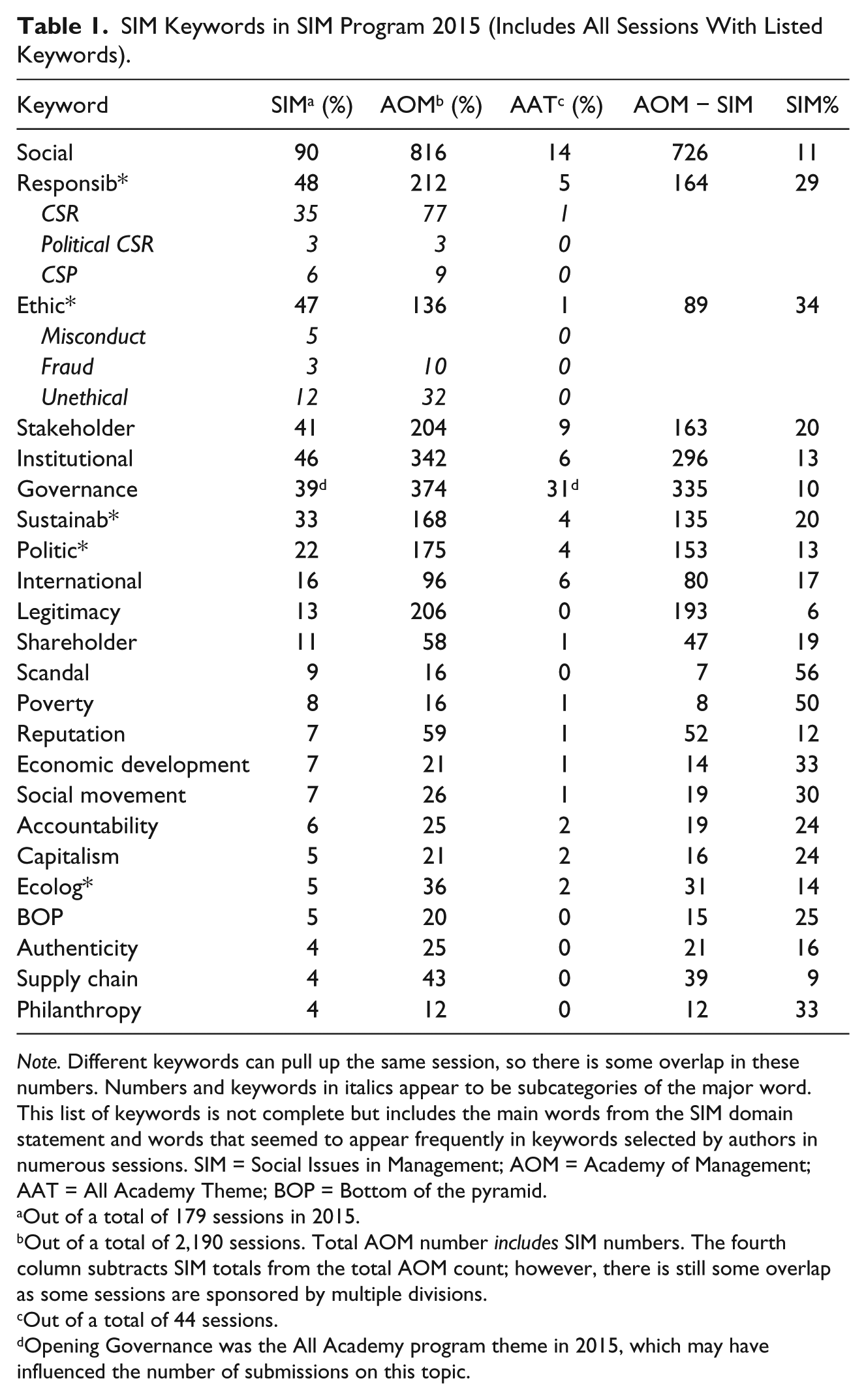
The other important shift that has happened is that topics that were once pretty much of interest only to SIM scholars have now devolved throughout the entire AOM. To assess where SIM research stands today, I undertook a keyword count of the AOM Annual Meeting Program for SIM and the entire scholarly program for 2015, using keywords from the current and recently surpassed domain statement plus others that appeared numerous times in the SIM program. That distribution, it seems, should adequately reflect SIM research topics (in 2015), with the assumption that authors are the best judges of the content of their work. Table 1 lists the results of that search, which also includes mentions of each keyword in the overall program and All Academy Theme (AAT) program.
SIM Keywords in SIM Program 2015 (Includes All Sessions With Listed Keywords).
Note. Different keywords can pull up the same session, so there is some overlap in these numbers. Numbers and keywords in italics appear to be subcategories of the major word. This list of keywords is not complete but includes the main words from the SIM domain statement and words that seemed to appear frequently in keywords selected by authors in numerous sessions. SIM = Social Issues in Management; AOM = Academy of Management; AAT = All Academy Theme; BOP = Bottom of the pyramid.
Out of a total of 179 sessions in 2015.
Out of a total of 2,190 sessions. Total AOM number includes SIM numbers. The fourth column subtracts SIM totals from the total AOM count; however, there is still some overlap as some sessions are sponsored by multiple divisions.
Out of a total of 44 sessions.
Opening Governance was the All Academy program theme in 2015, which may have influenced the number of submissions on this topic.
Major topics are listed in Table 1 as reflected in the 2015 SIM program with more than four SIM keyword listings. The most mentioned keyword was “social,” with 90 SIM sessions and 816 total AOM sessions. “Social” obviously could include many different definitions of social, hence may not be as relevant as some of the others that are more SIM specific, albeit it is interesting to note that SIM mentions of “social” are only 11% of the total. Next most popular in SIM was “responsib*,” that is, some version of responsible or responsibility, with 48 SIM sessions versus 212 or 29% of total mentions. Because of their centrality to SIM, the terms CSR and CSP (corporate social performance) were also run as subcategories, with CSR appearing in 35 SIM sessions and another 42 AOM sessions (77 total sessions), with political CSR limited to SIM, and CSP with six of nine total mentions in SIM. The third most popular keyword was ethic*, truncated to include ethics and ethical, which was named in 47 SIM sessions and 89 other AOM sessions, with SIM garnering 34% of total mentions. While the near third representation of both these categories is important in indicating SIM’s prominent position with respect to these keywords/topics, it is also important to note that their use is widely dispersed throughout the AOM.
This dispersion becomes even more evident with other keywords taken from the SIM domain statements: stakeholder, institutional, governance, and legitimacy, each of which has 20% or less SIM representation. “Stakeholder” was the keyword for 41 SIM sessions and another 163 AOM sessions outside of SIM or 20% of total mentions, reflecting broad adoption of that term by all divisions. “Institutional” was noted in 46 SIM sessions and 296 other sessions or 13% SIM keywords, also reflecting a broad and possibly quite varied usage of that term. The term sustainability was noted 33 times by SIM authors as a keyword and 135 times in other sessions (20% SIM). Sustainability was mentioned 35 times in the ONE (Organizations and the Natural Environment) division, which is now the “home” of ecological sustainability thinking, though the numbers clearly reflect much broader dispersion of interest in that topic across AOM. Interestingly, SIM mentions of keyword “governance,” which figures rather prominently in the SIM domain statements, were only 10% of total mentions (39 SIM/374 AOM), with Business Policy and Strategy (BPS) accounting for 75 (20%) of the total. In part, this dispersion reflects the fact that program theme in 2015 was “Opening Governance”; hence very likely drew many submissions on that theme from all divisions.
Other topics with fewer SIM mentions include some form of politic*, legitimacy, shareholder, scandal, poverty, reputation, economic development, social movement, accountability, international, and capitalism, as noted in Table 1. Generally, the topics listed most frequently seem to reasonably well reflect the current domain statement, although the public policy environment seems to have faded in interest and emphasis with only one mention as a keyword in SIM and 22 across AOM as a whole (with three of those in the Public Policy and Nonprofit [PNP] division).
Note in Table 1 that keywords social, responsib*, ethic*, stakeholder, international, and governance are all prominently reflected in domain statements, however, except for ethic*, for which SIM represented 34% and responsib* at 29% (including specific mentions of CSR, political CSR, and CSP) of mentions, the rest are all at or less than 20% SIM representation. Even the keywords responsib* and ethic* at around a third of SIM mentions suggest a wide dispersion throughout the AOM. For all keywords with more than 10 mentions with these exceptions, SIM’s representation is less than 20% across all divisions and the theme program. Specific and more narrowly constrained SIM-related keywords, including scandal, poverty, economic development, social movement, accountability, bottom of the pyramid, and philanthropy, have fewer mentions, albeit higher SIM representation.
For each of these SIM domain words, as well as for all words except “scandal,” “poverty,” fewer than half of the author-selected keywords fell within SIM sessions, and the majority occurred in other divisions. Table 1 suggests that SIM may have lost its sustainability orientation to ONE (which is perhaps not surprising), and which could also potentially claim that this topic has devolved throughout the rest of AOM. The governance edge is at least shared with the BPS division with 75 mentions (albeit a far bigger division than SIM). The SIM emphasis on ethics and responsibility (of various sorts) seems to have spread throughout AOM, though both are still notable elements of SIM.
To further highlight the devolution of content, I draw from SIM-like sessions in the programs of three of the biggest AOM divisions in 2015. Here is a short list of a few main headers of some sessions from the BPS track in 2015: Monitoring, Misconduct, and CSR; External Pressure, CSR, and the Environment; Government, Political, and Legal Issues; Political Ideology and Organizations; Evolution, Legitimacy, and Institutions; Political Ties and Firm Performance in Emerging Economies; Leader Character: Reimagining Governance; Stakeholders, Social and Human Capital; Corporate Governance and Corporate Social Performance; Stakeholder Management and CSR; Sustainable Innovation: The Evolutionary Journey; Corruption, Misconduct, and Performance; CSR: Macroeconomic Crises, Natural Disasters, and Industry Environment; CSR Antecedents and Organizational Performance; Interorganizational Trust; Corporate Political Strategy: Implications for Firm Performance and Behavior. Note the clear overlap with SIM domain statement topics in many of these sessions.
The Organization and Management Theory (OMT) division evidences similar overlaps, including main headers for sessions on Opening the Synergies between Sustainability Oriented Innovation and Governance: Systems Building; Trust between Individuals and Organizations; Collaborative Capitalisms: Building Community Capacity for Social Innovation; Are Sustainability Certifications a Sustainable Form of Governance? Capacity Building in the Face of Extreme Poverty; Alternative Economic Futures; Business and Human Rights: Quo Vadis? Reactions to Misconduct: Explaining Variations; Legitimacy Struggles in the Financial Services Industry; Politics, Ideology, Business, and Social Responsibility; Accommodating Stakeholders and Audiences: Ambivalence, Ambiguity, Misalignment, & Prioritization; Repositioning Crisis Management: The Role of Resilience; Activists, Social Movements, and Firms’ Non-Market Strategies; and Control, Trust, and Organizational Design.
In the Organizational Behavior (OB) track, one can find similar overlaps: Engaging Millennials for Ethical Leadership; Facilitating Faculty Responses to Diversity Dilemmas; Unleashing the Potential of Migrants, Diaspora, and the Boundaryless Workforce; Toward a Better Understanding of Workplace Mistreatment; Dysfunctional Reactions to Unethical Behavior (SIM co-sponsor); With Power Comes Great Responsibility? On Power, Status, and Prosocial Behavior; Rebuilding Ethical Governance to Tackle Systemic Governance Failures in Private and Public Sectors; Ethics in Decision Making; and Exploring Alternative Questions: Established Versus Emerging Issues in Justice Research.
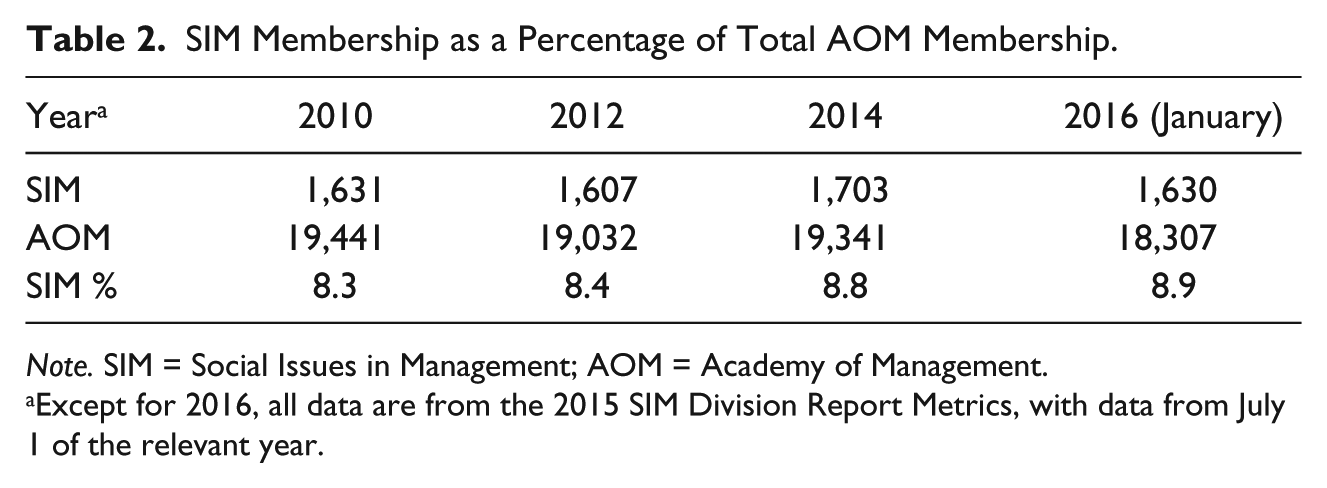
Of course, this devolution is a good thing in the sense that it suggests cross-disciplinarity of some important topics such as ethics, responsibility, and sustainability, across the whole of AOM, which could be read as a sign of great success for SIM. However, this diffusion makes it more important for SIM today, and in the near term to think about what its distinctive features and particular contributions are and should be. Core to SIM are topics of CR, ethics, stakeholder theory, sustainability, and governance, all of which are reflected in the current domain statement. Furthermore, SIM appears to be healthy in terms of membership numbers, which are slightly improving over the period from 2010 to 2015 as a percentage of total AOM membership (see Table 2).
SIM Membership as a Percentage of Total AOM Membership.
Note. SIM = Social Issues in Management; AOM = Academy of Management.
Except for 2016, all data are from the 2015 SIM Division Report Metrics, with data from July 1 of the relevant year.
SIM and Current Research Imperatives
Over the past 60 plus years, the management academy broadly has moved to respond to what were two highly critical reports about management education and the state of management research in the 1950s (Gordon & Howell, 1959; Pierson, 1959). These reports cited lack of research rigor as a fundamental problem of business education at the time. Since that time, there is little doubt that research rigor has improved dramatically. Indeed, some more recent critiques might claim, as Hayes and Abernathy did as long ago as 1980, that we are now “managing our way to economic decline” (Hayes & Abernathy, 1980) and, as scholars putting analytic rigor and theoretical conceptualization way ahead of relevance (Adler & Harzing, 2009; Bennis & O’Toole, 2005; Ghoshal, 2005; Giacalone, 2009; Lorsch, 2009; Pfeffer, 2005; Pfeffer & Fong, 2002). Indeed, a 2012 issue of the Academy of Management Learning and Education Journal devoted special section and follow-up articles to the issue of ensuring that management research is “actionable” (Aldag, 2012; Bartunek & Egri, 2012; Ireland, 2012; Martin, 2012; Pearce & Huang, 2012b; Stewart & Barrick, 2012).
That the management academy has been afflicted with a “chase” toward rigor and theory seemingly at the expense of relevance seems relatively obvious from the numerous critiques of management education and scholarship in recent years. Ghoshal’s famous article “Bad Management Theories Are Destroying Good Management Practices” is perhaps the most notable salvo (Ghoshal, 2005). Certainly, however, there are other important critiques, not all of which are particularly new, some of which relate to management education and others to practice (Adler, 2010; Adler & Hansen, 2012; Adler & Harzing, 2009; Aguinis, Suárez-González, Lannelongue, & Joo, 2012; Datar, Garvin, & Cullen, 2010; Giacalone, 2009; Khurana, 2010; Leavitt, 1989; Pfeffer, 2005; Pfeffer & Fong, 2002).
Management scholar Bill Starbuck goes so far as to say, I see an academe in which many researchers try to extract meaning from very bad data. As a result, people having great ability and much education are wasting their time and generating research “findings” that have little or no long-term value. Indeed, the flood of meaningless, noise-laden “findings” is probably obscuring the small percentage of truly useful findings. (Walsh et al., 2007)
Suffice to say, there is controversy about the state of management research generally, and that some of the current emphasis has resulted in what can only be called a “mania” to get published in so-called “A” journals and to get one’s work cited by others publishing in such journals, almost regardless of whether one has something interesting or important to say. The result is what amounts to a frenzy of academics citing each other and assuming that such citations represent “impact,” without regard to whether the work is actually useful or makes much difference in practice (Adler & Harzing, 2009; Aguinis et al., 2012).
One study in 2005 argued that, despite the AOM’s founding mission of helping meet society’s social and economic objectives, that is, clear SIM objectives, that there had even been a systemic bias against publishing SIM-related materials in management’s most highly rated journals (Walsh, Weber, & Margolis, 2003). SIM scholars have certainly not been immune to pressures toward higher levels of rigor with little regard for relevance. What seems to drive too many academics today is to get articles accepted into top-tier mainstream (so-called “A” level) journals with high “impact factors” (i.e., citation counts), thereby increasing one’s chances of getting one’s work cited.
Increasingly, these A-level journals now require not only new findings from studies but also new theory (see, for example, the Academy of Management Journal’s information for contributors), making replication impossible and impractical, and all but ensuring that interesting new empirical trends that rest on refuting or validating old theory cannot be published (Aguinis et al., 2012; Northcraft & Tenbrunsel, 2012; Podsakoff et al., 2008). Combined, the need for both new theory and empirical results makes doing research or thinking that might question the status quo, where there might be neither good theory nor the type of data that lends itself to rigorous quantitative analysis, that much more difficult. Particularly, as the demands on untenured professors to publish in top-tier journals have increased, SIM scholars too have focused on getting rigorously developed manuscripts into A-level journals with high impact factors, so that they can get cited by other scholars. The AOM is somewhat attempting to respond to these critiques with a journal launched in 2015 and called Discoveries, which “publish[es] new empirical research that strengthens our understanding of substantively important yet poorly understood phenomena concerning management and organizations,” according to its website. Despite this effort, however, the bulk of research continues on its problematic trajectory.
Please do not misunderstand. Moving toward more empirical and theoretical rigor is much to be applauded, and is certainly necessary if we are to trust in the results of our research. But this quest is problematic when it results in a narrowing of the types of questions considered appropriate to ask and when relatively narrowly defined topical scope is what is being accepted in the top-tier journals. That shift spells trouble for a division historically oriented to asking big questions about the system, critical questions, and questions without neat answers or well-constructed theory, or, for that matter, large datasets of quantitative information that, for example, might fit the mission of Discoveries.
Furthermore, for a division whose scholars historically relied more upon books rather than articles to deal with the complex questions raised by its central concerns about messy (Ackoff, 1974) problems of business in society, the emphasis on articles in A journals is problematic at best (Aguinis et al., 2012; Podsakoff et al., 2008) and can mean that big topics and important questions simply cannot be addressed. One could readily argue that many of the questions that SIM has dealt with over the years are what are known as “wicked” problems—for which there are no neat solutions (Churchman 1967; Weber & Khademian, 2008). A consequence of the emphasis on peer-reviewed articles is that in the effort to scope problems down to article size, the wickedness has necessarily been lost—along with much of interest and, dare I say it, importance and potential for real-world impact of the work.
What does all this mean in terms of the current state of SIM? Does SIM need to retain the capacity to question that system as it is? Should SIM argue for something (normatively) better as a way of retaining its character and also recognizing the shifts in explicit mission that the broader entity of the AOM itself has made? Or should SIM continue to fall prey to the objectivist, atomistic, A-journal-seeking mentality that, whatever the stated mission of AOM might be, infuses much too much of management scholarship today? I am reminded of a (slightly modified) statement by Leavitt (1989), which seems á propos here in thinking about the management academy generically: [W]e have built a weird, almost unimaginable design for MBA-level education [substitute academic scholarship in management]. We then lay it upon well-proportioned young men and women, distorting them (when we are unlucky enough to succeed) into critters with lopsided brains, icy hearts, and shrunken souls. (p. 39)
In raising these issues, we come full circle to where we began. One of SIM’s early prominent scholars was Edwin Epstein, who has written eloquently about the fundamental nature and purpose of SIM. The following is the abstract of Epstein’s (2000) article titled “The Continuing Quest for Accountable, Ethical, and Human Corporate Capitalism: An Enduring Challenge for Social Issues in Management in the New Millennium”: From their inception, the social issues in management (SIM) field and the SIM Division within the Academy of Management have provided venues to examine the complex, dynamic, two-way relation between economic institutions of our society and the social systems in which they operate. They have blended the normative with the scientific, the speculative with the empirical, and the philosophical with the pragmatic. The field and the Division have served, perhaps most importantly, as the conscience of management education and the Academy. Their enduring quest and raison d’étre is to foster corporate capitalism that is accountable, ethical, and humane. (p. 145, emphasis added)
Epstein’s statement raises the question: Have we forgotten our roots in the big business in society questions? That is, have we left behind the inquiry and questioning of the system, or the complex and rich interaction that exists among businesses and societies—and, today, nature? SIM scholars historically addressed the broad picture and understanding of the responsibilities, behaviors, impacts, and ethics of businesses and management in all types of enterprises. Such a quest is all the more important today in a world of increasingly blurred sector boundaries on societies (as the world globalized), where the interaction among businesses, societies, and nature has resulted in uncontrolled and seemingly uncontrollable climate change, where sustainability questions pervade any serious look at human existence, and where equity, social justice, and the impact of the financial system, to name just a few things, are problematic at best. Questions around macro-issues such as the functioning and proper roles of businesses in society, the effectiveness of capitalist economic system that now dominates, and the need for system change; meso-issues such as the responsibilities, standards, principles, accountability, transparency, and sustainability of enterprises of all sorts, particularly businesses; and micro-issues such as individual and organizational ethics and responsibilities are among the crucial issues at the heart of SIM’s mission both in the past and even more today.
The fundamental issues of business in society and SIM, it seems to me, have to do with questioning the proper roles and legitimacy of businesses (and other enterprises) in society (Votaw, 1972, 1973), and what system best supports both successful businesses and, increasingly, sustainable societies and human civilization. Frankly, while the field of business in society was founded on the big picture and sometimes highly critical questions about the proper role(s) of businesses, I think we are doing a better job these days with the ethics and more micro/meso-issues than the big picture issues.
Looking Forward
Basically, given the very real issues facing businesses and the planet, falling into the A-journal and citation trap that a careerist mind-set leads to is harmful not only to SIM but also to our students and anyone who happens to read our scholarship. If Ed Epstein is right that SIM serves as the conscience of AOM, then particularly those of us who have achieved the status of tenured professors need to find the courage to raise the important issues affecting AOM, business, and the world in our research and writings.
That type of questioning is already happening within the broader AOM, as evidenced by recent AATs (e.g., 2013’s meeting theme is “Capitalism in Question,” 2015’s was “Opening Governance,” while 2016’s is “Making Organizations Meaningful,” and earlier ones have included “What Matters Most” and “Daring to Care”). Indeed, in her 2012 Presidential Address, the then AOM President Anne Tsui noted three main challenges for AOM broadly: (a) Our research is not relevant to society, (b) business schools are harmful to society, and (c) it is not a “happy life in the field” of management scholarship, particularly for more junior scholars who fall prey to the (unreasonable?) publication demands noted above (see http://www.youtube.com/watch?v=FySqgu_RFvE for the speech). The desire for change and questioning of the system is evident in the popularity of the POS movement, and burgeoning interest in humanizing management education that comes from across the AOM (e.g., the Humanistic Management Network, the 50+20 initiative, etc.).
It is less evident within SIM. That theme is echoed in a comment from Bill Frederick, senior member of the SIM division, and Emeritus Professor of Business Administration, University of Pittsburgh. Frederick worried that too many SIM scholars are doing what he called in a 2009 speech to receive a book award, the “same old, same old” work, without tackling significant new issues. In a review of an ethics book, Frederick (2012) articulated this point of view even more strongly, having used an analogy to Sartre’s “No Exit” to describe the state of SIM, he pointedly asks, Will we say to each other, as Garcin says at the play’s end, “Well, well, let’s get on with it . . .,” and then tell each other the same stories over and over again forever and ever? Is that our own brand of ethics-and-CSR hell? Are we collectively and conceptually dead, though unaware of it? (p. 4)
I would probably not go as far as Frederick in suggesting that SIM scholarship is conceptually dead (though there is a fair amount of navel gazing and redundant work, some of which I have been guilty of myself). But certainly, we need to find the courage to ask (again) the bigger, normative, and more critical questions about the role(s) that businesses and other enterprises are playing in society today, especially in light of all the problems humanity is facing. We may need to find ways to address how the future is evolving and what that means for businesses, societies, and humanity. We may need to address what may be existential threats for humanity in the form of climate change and sustainability crises, as well as the implications of growing inequality for businesses and other societal stakeholders.
We are in a situation where it is increasingly obvious that change, systemic change, is needed. Should not SIM scholars be on the leading edge of asking the hard even if theoretically or empirically challenged questions? Should we not acknowledge, and perhaps even celebrate, our normative roots? Should we not as scholars concerned with the impacts of enterprise on stakeholders and nature (and vice versa) at multiple levels be thinking about in which ways and how the system might change for the better? And can we not do good quantitative, qualitative, and conceptual work on those topics?
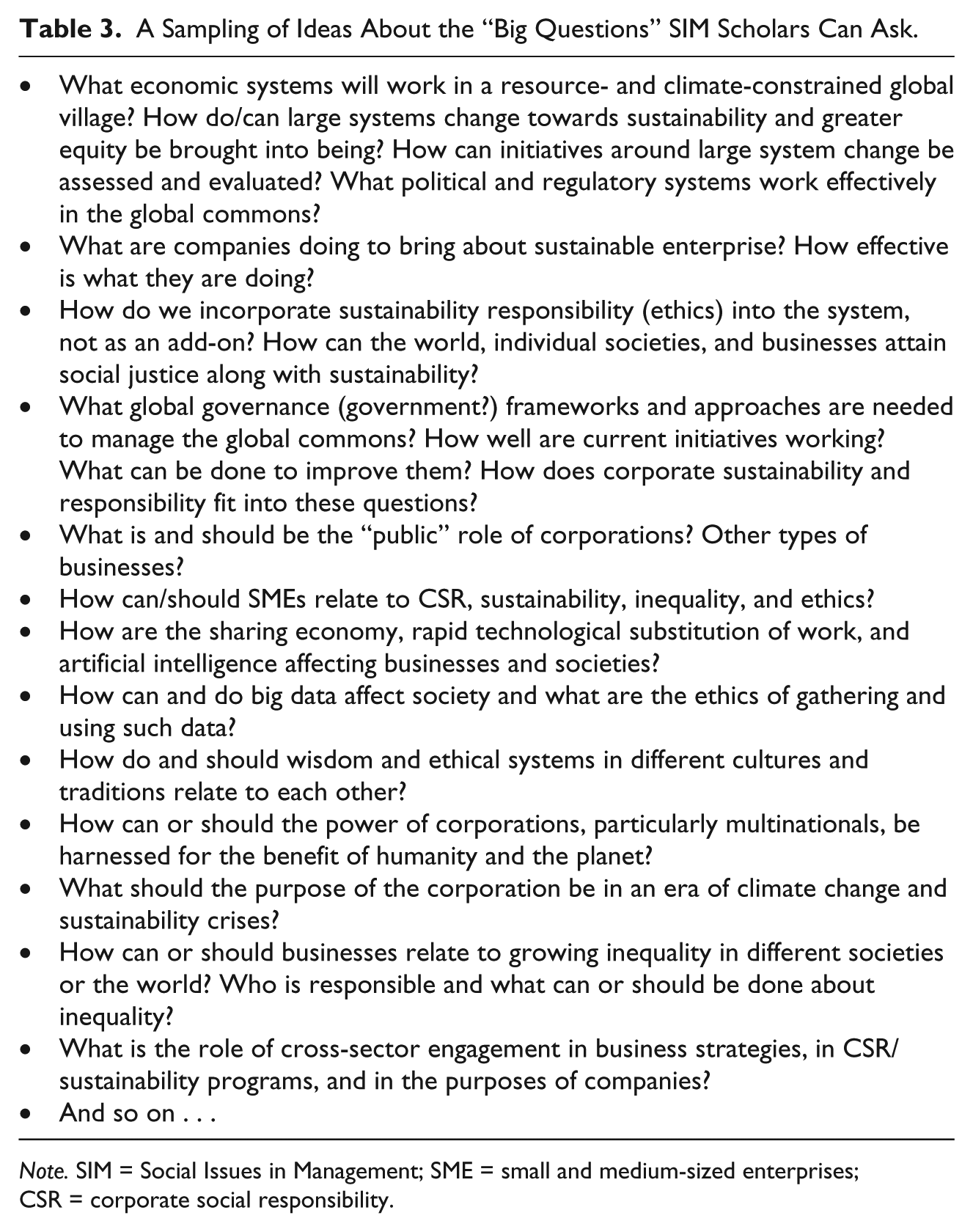
There are plenty of big issues to think about and research that get us to the big issues facing the world of managers, leaders, businesses, and other enterprises operating in the increasingly resource-constrained environment that sustainability concerns present. Let me conclude simply by pointing to some of the big questions about the relationship of businesses to society, the core element of SIM’s domain, and hence the SIM division (see Table 3). Of course, some people are already dealing with these issues but not enough.
A Sampling of Ideas About the “Big Questions” SIM Scholars Can Ask.
Note. SIM = Social Issues in Management; SME = small and medium-sized enterprises; CSR = corporate social responsibility.
Fundamentally, SIM scholars need to reengage with the big questions and not be afraid to address the inherent normative issues in these questions. Invent your own questions. As business in society scholars, we can and need to take the risks inherent in questioning what is clearly a troubled and ethically challenged system that lies at the core of what SIM has always stood for—and, arguably, still needs to stand for in the future.
Footnotes
Declaration of Conflicting Interests
The author declared no potential conflicts of interest with respect to the research, authorship, and/or publication of this article.
Funding
The author received no financial support for the research, authorship, and/or publication of this article.