




Abstract
A large body of literature looks at how firms develop and maintain their reputation. Little is known, however, about factors leading to a damaged corporate reputation. In this article, the authors compare two sets of predictors of reputational damage following a reported breach of norms: the characteristics of the breach and the characteristics of the actor reporting the breach. Theoretically, the authors argue that the latter is likely to prevail over the former. The authors test this proposition in the highly normative context of corporate social responsibility (CSR). Building on a global data set of over 8,600 CSR-related norm breaches, directed against 451 firms on the Fortune ranking reputation over the 2006-2009 period, the authors find empirical support for the idea that reputation damage is not really driven by the severity and novelty of the allegation, but by the type of source reporting the issue as well as the credibility of this source. Hence, these results lend some support to a socially constructed view of reputational damage, in which being portrayed by prominent actors as deviating from the norm is more important than the actual deviation from the goal of the norm itself.
Four hundred years ago, reputation was already inspiring poets and playwrights such as William Shakespeare. In Othello, Shakespeare (1603/2004) states that reputation is “oft got without merit, and lost without deserving” (Othello: II, 3: 260). This article aims to shed light on the question of whether this provocative statement applies to the corporate context and, in particular, investigate the factors that drive corporate reputation loss. The motivation behind this is that existing research on corporate reputation deals mostly with Shakespeare’s merit part: both processes of building up reputation and its benefits are widely studied (Barnett, Jermier, & Lafferty, 2006). Thereby, reputation is generally considered the “result of substantive and symbolic” corporate and environmental actions and reactions over time (Mahon, 2002, p. 419), in which “firms send signals to [environmental] observers and observers use these signals to form impressions of these firms” (Basdeo, Smith, Grimm, Rindova, & Derfus, 2006, p. 1205). Once built, reputation is then described alternatively as a form of individual corporate asset, status, esteem, or quality (Deephouse & Carter, 2005; Fombrun, 1996) that is essential for a firm’s competitive performance (Barney, 1991; Davies & Chun, 2002; Roberts & Dowling, 2002).
Various empirical studies test the positive effects of reputation on a firm’s financial performance, or examine the impact of financial and social performance on the development of reputation. The results of both research streams are, like the causal direction between reputation and financial/social performance, ambivalent and inconclusive (De la Fuente-Sabate & de Quevedo-Puente, 2003). In some cases, reputation is found to create financial value, but in others, it is not. Sometimes financial/social performance seems to facilitate the development of a positive reputation, but sometimes performance destroys it. Similarly, little is known about how firms lose reputation, and what factors drive such reputational damage.
In this article, we build on institutional theory and the literature on legitimacy (Bansal & Clelland, 2004) to explore the guiding question of drivers of reputational loss. Previous research on corporate reputation using this institutional lens concentrates on the question of conformity, or how firms conform to preexisting social norms. Philippe and Durand (2011), in particular, argue that firms can conform to norms in various ways, depending on whether these firms conform to the goal of a social norm—for instance, reducing pollution—or conform to socially approved procedures representing the norm. The authors hypothesize that firms conforming to both will gain reputation, whereas those which conform only to procedures—or the appearance of the norm—might be penalized. The authors find support for the first part, but not for the second: They do not find that firms lose reputation by not conforming to the goal of the norm.
Compared to the Philippe and Durand (2011) study, this article does not look at the strategic behavior of firms regarding conformity, but rather explores whether firms might suffer from reputation loss when these firms are criticized in the media by outside players such as nongovernmental organizations (NGOs) and environmentalists (Eesley & Lenox, 2006). When a firm is being exposed this way, firm conformity or nonconformity to social norms is seen through the lens of the media or of these outside players. In a nutshell, our argument is that corporate reputation is likely to be damaged if a firm’s deviating behavior from existing norms is portrayed by credible sources as illegitimate. A corporation, if it is presented as deviating from institutionalized norms (by employing children, bribing politicians, polluting water and air, etc.), will risk its license to operate, or its legitimacy, especially when influential players—which we call here “norm guards”—are perceived as advocates of public interest and expose the firm.
Based on this mechanism, we will also argue that the type of source reporting the breach of norm, its credibility, as well as the newness of the issue will determine whether reputation loss is likely to occur. Reputation loss should thus be viewed as a socially constructed phenomenon in which the framing of the issue and the person/entity who frames it matter much more than the severity of the issue or how often a firm is criticized. This proposition is in line, but also extends, with the results of the Philippe and Durand (2011) study: For reputation loss, it matters less whether a firm has conformed to the goal of a norm or its related procedure, but rather whether its potential lack of conformity has been exposed by prominent norm guards. The mechanisms leading to reputation gain and reputation loss might thus be different.
We test these hypotheses in the context of reported norm breaches in the field of corporate social responsibility (CSR). We built a unique data set of 8,600 CSR-related “firm-critique” observations of social, environmental, and economics issues concerning 461 corporations between 2006 and 2009. As in previous research (Philippe & Durand, 2011), we use data from Fortune’s “Most Admired Companies” survey to evaluate the impact of the norm-breaching criticism on firm reputation.
One obvious endogeneity issue in this setting, however, is that the firms that are criticized are often criticized for a reason. For instance, it is likely that, in the context of the socially constructed process described above, advocates of public interest such as NGOs and environmental groups will choose firms that will be the most likely to suffer from reputation damage. To deal with this sample selection bias, we use two-stage least squares (2SLS) estimations, in which we account first for the likelihood of a firm being exposed, and then assess the likelihood of reputational damage for the remaining firms.
Overall, the results support our hypotheses. Large firms, with well-known brands and superior environmental practices, tend to be chosen as targets, which is in line with previous research (Breitinger & Bonardi, 2016), and these firms suffer from reputation damage when they are exposed. In addition, new criticism by NGOs and which come from more credible sources tend to have a more damaging impact on the targeted firms’ reputation.
The remainder of this article is organized in four parts. In the first, we briefly outline the relevant literature review on corporate reputation and show that the existing work does not really account for the phenomenon of reputation damage and in particular its drivers. The second part develops our theory of how reputation loss affects firms which are portrayed as breaking some preexisting social rules, and articulates hypotheses. The empirical analysis in the context of CSR activities is provided in the third part. The final part discusses our results and concludes.
Corporate Reputation
Reputation—Conceptual Roots
From a broad perspective, two main theoretical streams can explain how corporate reputation is built. The first can be found in economics and builds on game theory (see Kreps & Wilson, 1982; Milgrom & Roberts, 1982). Reputation there is considered as a necessary product to overcome imperfect information and uncertainty among players. Reputation is “built on a record of actions” (Baron & Diermeier, 2007, p. 621), whereby reputation gains are achieved through repeated consistent behavior proven over time. Barro (1986) and Rubinstein (1985) model such a reputation-building process among politicians involved in monetary policies. They indicate that only politicians’ reliable behavior over time creates credibility and reputation for the central bank, which therefore achieves monetary stability and uncertainty reduction. The actor is responsible for deciding whether to invest in reputation or not. Fudenberg and Levine (1992, p. 561) suggest that, if games are repetitive, a rational actor “invests in his reputation by playing the strategy even when doing so incurs short-run costs, provided the costs are outweighed by the long-run benefit of influencing his opponents’ play.”
Transferred to the corporate context, striving for good reputation on imperfect markets can be seen as essential for becoming a credible actor and, hence for generating economic rents. Companies send out signals that these firms’ constituents, if aware of the criticism (Barnett et al., 2006), accumulate into “collective judgments that crystallize into reputational orderings of firms in organizational fields” (Fombrun & Shanley, 1990, p. 234; see DiMaggio & Powell, 1983). Corporate reputation is successfully built if firms rationally decide to repetitively send positive signals that are consistent with laws, contracts, and agreements between players (Vickers, 1986; see also Kreps & Wilson, 1982).
The second theoretical stream that provides a general definition of reputation is rooted in the sociology literature. This literature typically argues that economic models of reputation overlook reputation as the “product of social construction and validation” (Rao, 1994, p. 31) by the organizational environment. From that lens, corporate reputation is viewed as being socially constructed by the actors surrounding the firm (Whetten & Mackey, 2002). It is “formed by the beliefs that people hold about an organization” (Sims, 2009, p. 454), by aligning the organizational value conception with their own. “Outside observers scrutinize” firm behavior (Philippe & Durand, 2011, p. 971), “interpret this posture, and finally communicate with one another in a search for meaning of these actions” (Mahon, 2002, pp. 419-420; see Basdeo et al., 2006; Rindova, Pollock, & Hayard, 2006).
In the corporate context, such assessment can be based on observers’ direct experiences, memories, and perceptions of the firm (Winn, MacDonald, & Zietsma, 2008)—or on “social comparison processes” (King & Whetten, 2008, p. 193) using the available information issued by the corporation or uncovered by the media 1 and NGOs (Fombrun & Shanley, 1990). Good reputation is built if the firm’s behavior is positively interpreted over time (King & Whetten, 2008; Rao, 1994). Therefore, it is less the corporate action and more the environmental interpretation of that action that counts.
To summarize, whereas in economics reputation loss is perceived as a cost that a firm is ready to accept, the sociological view sees it as determined by the firm’s environment: A firm might be subject to reputation damage without having anticipated that this damage would happen. In this article, we will not intend to take a stance on the question of whether corporate reputation is constructed by a firm or the product of its social environment, but will rather consider that both perspectives matter.
Corporate Reputation: Empirical Studies
Empirically, numerous studies have been conducted that examine the concept of reputation. Reputation is assessed either as a predictor or an outcome of a firm’s financial (and social) (dis)advantage. Because we are interested in the output of corporate reputation, or more precisely in the causes of reputational damage, the following review includes only those studies that treat reputation as a dependent variable. That is why we exclude the work on reputational penalties by Karpoff and Lott (1993) and Karpoff, Lott, and Wehrly (2005), for instance.
To keep this article focused, we summarize this review in Table 1. What these studies have in common is the following. First, the obvious idea is that more legitimate firms will enjoy a better reputation. Second, some of the scholars listed examined to what extent deviating behavior affects corporate reputation. Their results confirm negative reputational effects for firms that lack general trustworthiness and reliability, or indicate strong (market visible) records of negative sustainability performance. This literature also suggests that companies that do not signal compliance with environmental expectations or encounter negative publicity struggle to enhance their reputation.
Review of Studies With Reputation as a Dependent Variable (Papers Presented in Historical Order).

Based on this review, one can infer that the building of reputation—which we define as “a social comparison among organizations on a variety of attributes” (King & Whetten, 2008, p. 199), such as relative corporate esteem, status, or standing—closely depends on a firm’s consistent, hence legitimate, behavior. To develop our analysis of what drives corporate reputation damage, we thus first explore the relation between reputation and legitimacy.
Corporate Reputation and Legitimacy
It is widely understood that organizational legitimacy is considered as the “social control or acceptance resulting from [the firm’s] adherence to [established] regulative, normative or cognitive norms and expectations” (Deephouse & Carter, 2005, p. 332, see also Bitekine, 2011; Ruef & Scott, 1998; Shenkar & Yuchtman-Yaar, 1997). Therefore, companies receive legitimacy when they conform to social prevailing standards “associated with a particular population [stakeholder group]” (King & Whetten, 2008, p. 192; see also Deephouse & Carter, 2005). Such social legitimation 2 means not only the normative justification of organizations, but also the cognitive validation of an entity [firm] as desirable, proper, and appropriate in a widely shared system of beliefs and norms” (Rao, 1994, pp. 30-31, referring to Berger & Luckmann, 1966).
Companies that comply with institutionalized social norms and values are assumed to achieve legitimacy. However, only those firms that manage to maintain their legitimacy over time enhance their reputation (King & Whetten, 2008). Each legitimate corporate behavior is likely to contribute to the building of a positive reputation, whereas each illegitimate activity is likely to deteriorate the firm’s reputation. Therefore, the relationship between corporate legitimacy and reputation is interdependent because both “arise from common social comparison processes, whereby stakeholders use institutionalized standards to assess and compare organizations [companies]” (King & Whetten, 2008, p. 193; see also Rindova & Fombrun, 1996). Both legitimacy and reputation are “needed to create impressions on [firm] audiences” (Rao, 1994, p. 30; see also Feldman & March, 1981).
Hence, reputation can be inferred as being the extension (King & Whetten, 2008) or, more precisely, the outcome of legitimation processes (Rao, 1994). In what follows, we build on this idea to identify why and how reputation can be damaged.
Reputation Damage and its Drivers
Institutional theory emphasizes that organizations strive for conformity to receive social legitimation (DiMaggio & Powell, 1983; Meyer & Rowan, 1977; Philippe & Durand, 2011). It is achieved “by conforming to the norms and regulations imposed by the external environment” (Bitekine, 2011, p. 14; see Deephouse, 1997). Therefore, any nonconforming or deviant behavior is likely to negatively affect such a legitimation process by causing reputational harm.
Contributions to game theory and organizational behavior have already used the term “loss of reputation” to describe the outcome of inconsistent and negative behavioral attitudes of individuals (Barro & Gordon, 1983; Withey & Cooper, 1989). Descriptions of reputational damage also exist within firms (Amer & Bonardi, 2014), where contributions to social movement theory reason about the “potential threats of negative publicity” (Den Hond & de Bakker, 2007, p. 911), the social risks from industrial crises (Shrivastava, Mitroff, Miller, & Miglani, 1988), and “normative delegitimation campaigns” (Yaziji, 2004-2005, pp. 88-89). Economists speak, similarly, about reputational penalties for illegal behavior (see Karpoff & Lott, 1993; Karpoff et al., 2005).
Previous conceptual works on organizational crises define such trigger events as the potential beginning of “organizationally-based disasters which [can] cause extensive damage and social disruption, involve multiple stakeholders, and unfold through complex technological, organizational and social processes” (Shrivastava et al., 1988, p. 285). Thus, in the corporate context, a breach of (institutionalized) norms—hence illegitimate actions—can be considered the starting point that is likely to reveal legitimation doubts among stakeholder groups (see Philippe & Durand, 2011).
An initial trigger can be any deviant behavior of a corporate actor who is perceived as somehow intentionally or unconsciously breaching an explicit law, a written contract, or who deviates from an implicit albeit institutionalized social norm or prevailing value. In the following, all of these are subsumed as a breach of norm. 3 Cheating and colluding but also employing children, bribing politicians, or polluting water and air are examples of such corporate norm breaches. If this corporate breach of norm is considered illegitimate and reported by influential stakeholders advocating this norm (Deephouse & Carter, 2005; Rao, 1994), their publicly articulated legitimation doubts can turn into reputational damage for the targeted corporation.
If corporate norm breaches reveal legitimation questions that can turn into reputational damage, it is necessary to discuss the factors that potentially cause such reputational damage. We will elaborate five variables that we assume to drive such destruction of firm reputation.
Hypotheses
Factors that drive reputational damage might be either related to the content of the reported norm breach or to the reporting subject or source. First, with regard to the reporting sources, a reporter is likely to reveal the firm’s breach of norm if he or she considers a particular corporate behavior as illegitimate. Whether the general public then reconsiders granting legitimacy to the company as well depends on whether it continues to “judge the organization and its activity [ . . . ] as beneficial” (Bitekine, 2011, p. 13). Therefore, each stakeholder also places his/her judgment on the source that reports about a specific firm’s (deviant) behavior (Puncheva, 2008). The reporter’s credibility can be considered as the (first) essential influence factor in causing reputational loss (Bonardi & Keim, 2005).
If a breach of norm is reported, the company in question does not necessarily encounter reputational damage. This may reside in insufficient influence and credibility on the part of the actor reporting the breach. Stakeholder theory suggests that the more powerful, legitimate, and urgent a stakeholder claim, the more substance it receives to trigger reputational damage by influencing other stakeholders (Mitchell, Agle, & Wood, 1997). In addition, research in journalism indicates that the more power and legitimacy can be attributed to the origin of the criticism, the more capable and likely the source will be to sell the criticism to the public, or even manipulate the latter in its own judgment (Gaziano & McGrath, 1986; Lyon & Maxwell, 2008):
Second, and apart from the reporting source’s general credibility, some particular reporting groups are ascribed high influence with regard to the sanctioning of corporate norm-deviating behavior. So-called individual and collective elites such as opinion leaders, elected leaders, and public interest groups are generally considered norm guards (Benford & Snow, 2000; Keck & Sikkink, 1998; Mahon & Wartick, 2003). Perceived as linking actors between the firm and the public (Oliver & Myers, 1999), they advocate public interests against private ones (Doh & Guay, 2006), and are deemed to be more legitimate than others because they are not driven by profit (Lyon & Maxwell, 2008). Some of these guards have become influential actors questioning firm legitimacy (Bonardi & Keim, 2005; Deephouse & Carter, 2005; Rao, 1994).
In particular, NGOs, specialized in topics such as corporate governance (Transparency International), environmental protection (notably Greenpeace), and human rights (notably Amnesty International), successfully raise awareness of social and environmental harm (norm breaches) caused by companies that employ children, pay minimum wages, and pollute water and air (Livesey, 2001). Therefore, NGOs—as self-proclaimed norm guards holding firms responsible or accountable—should be expected to objectively report potential norm breaches without the invention or contortion of facts (see Bunn, 2003-2004).
Nevertheless, norm guards cannot be perfect monitoring agents (see Raustiala, 1997). In fact, to advance their interests, they are likely to include “noise” (Anand, Di Tella, & Galetovic, 2007) in the reporting of norm breaches, especially if they do not succeed in sanctioning the deviating firm otherwise. Because norm guards depend on publicity to make their cause known to the public (Bonardi & Keim, 2005; Eesley & Lenox, 2006; Martin & Kracher, 2008), and to gain weight against often more powerful corporate actors, they often apply framed rhetoric “to identify the problem and the ‘victims’ ( . . . ), and help attribute blame and responsibility” (King & Soule, 2007; Lamin & Zaheer, 2006, p. 16).
Framing can be generally understood as the “strategic creation and manipulation of shared understandings and interpretations of the world, its problems, and viable courses of action” (Lamin & Zaheer, 2006, p. 16). In the corporate context, framing is deemed a powerful tool in “galvanizing societal pressure to affect change”: The “better” an uncovered norm breach is framed (sold)—that is, the stronger the reported breach collides with established norms—the higher the probability that the public will respond to the revealed issue, reassessing the firm’s reputation (Lamin & Zaheer, 2006).
Following this reasoning, reputational damage then results, at least partially, from the guards’ successful framing of corporate breaches of norms, as Benford and Snow (2000) have posited without further conceptual deepening and empirical investigation. To achieve the desired outcomes, norm guards might sacrifice substance for symbols (Risse, 2004), and select “their campaigns less for the significance of the cause than for their ability to attract publicity” (The Economist, 2003, pp. 49-50). Therefore, we associate norm breaches revealed by such norm guards with framed reporting leading to reputational damage, and state the second hypothesis as follows:
If corporate reputations are destroyed through a social process based on actors making firms illegitimate, then new issues reported should have much more impact than those that have already been reported before. Once an institutionalized norm has been broken and reputation damage has occurred, additional information about the same issue is unlikely to add much to how external evaluators perceive the sanctioned firm.
Note that this is also in line with the typical behavior of the media, which often is the vector through which breaches of norms are conveyed, and which focuses on “what is new at the expense of history and tradition” (Alvesson, 1990, p. 384). The media “relegate recent historical experiences as rapidly as possible into the past” (Alvesson, 1990, p. 384). Similarly, media audiences should tend to react stronger about attacks of established norms that are reported for the first time.
Thus far, we have hypothesized that companies are “more likely to be [negatively] noticed” (Elsbach & Sutton, 1992, p. 699) if they are portrayed as violating institutionalized norms by credible “norm guards” that are likely to frame the criticism (such as NGOs). The counterfactual, however, would be that the loss of reputation would come from more objective reasons. In what follows, we explore these potential objective reasons for reputation loss. The psychological literature, for instance, assumes a negative relationship between criticism exposure and reputation. Studies on individual behavior and judgment specify that individuals pay more attention to bad news than to good news, because “negative information is weighted more than positive information in the evaluation of people, objects, and ideas” (Dean, 2004, p. 193). As individuals also tend to memorize bad news longer than good news (Baumeister, Bratslavsky, Finkenauer, & Vohs, 2001; Detert, Treviño, Burris, & Andiappan, 2007), it can be inferred that high amounts of CSR-based criticism (norm breaches) make individuals reduce their esteem (reputation) for the corporation involved:
Finally, if we associate the amount of reported breaches as a criticism or content-related factor causing reputational damage, we also need to consider the severity of the breach as a potential driver of reputational loss. In this case, the reputational consequences of norm breaches would depend on the costs imposed on others. The costs may also depend on whether contract or norm breaches occur purposefully or unconsciously and accidently—due to bounded rationality or incomplete information (see Rubinstein, 1985). Thus, if incurred costs are negligible, the breach might be considered less severe than if it were to cause high costs:
Empirical Analysis
Context
The reputational effects of breaches of norms will be studied in the context of CSR. CSR still has manifold facets, ranging from philanthropic to strategic activities, and self-regulative initiatives (see Scherer & Palazzo, 2007). Without deepening or discussing the various meanings of CSR, we define it here—in line with the most recent “CSR school”—as any corporate attempt at “not causing harm” in business activities (Scherer & Palazzo, 2007, 2011). 4
CSR has become an institutionalized (recognized) field of its own, accompanied by high normative expectations (Campbell, 2006; Freeman, 1994). While corporations acting in purely socially responsible ways used to be considered economically irresponsible, according to neoclassical economics (see Jensen, 2002), a so-called isomorphistic (imitating) shift toward (more) CSR has been instated among many corporations due to the growing number of corporate social and environmental scandals revealed around the globe (The Economist, 2008). In view of economic globalization, transnationally operating companies have dispersed their sourcing, production, and marketing activities to (more) firm-favorable regulative environments (Henderson, Dicken, Hess, Coe, & Wai-Chung Yeung, 2002; Rondinelli, 2002), where state regulation is insufficient, unenforceable, or even absent (see Kaul et al., 2003; Kaul, Grunberg, & Stern, 1999). Hence, it is highly likely that these firms will encounter new challenges in legal and legitimate terms (intentionally or unconsciously) and will produce new negative headlines and scandals.
As previously hypothesized, NGOs especially have evolved into influential corporate watchdogs and norm guards diligently scrutinizing whether firms pursue socially, economically, and environmentally illegal and illegitimate business practices (see Yaziji & Doh, 2009). NGOs effectively exploit technological developments such as the Internet to scan for corporate norm breaches on the global playground (Gardberg & Newburry, 2013; Spar & La Mure, 2003; Teegen, Doh, & Vachani, 2004). CSR-related breaches of norms are not limited to the infringement of laws and norms in one specific national legal context, but also include violations of institutionalized social and environmental norms and values of internationally operating corporations—for instance, employing children, paying famine wages, bribing politicians, polluting water and air (see Della Porta & Tarrow, 2005).
Apart from the global dimension of CSR, CSR-related sanctions are taken by multiple social actors “rather than by a central state authority” (Philippe & Durand, 2011, p. 970), which further enlarges the research context with regard to the possible sources reporting corporate norm breaches. Thus, all in all, CSR constitutes a large and varied field of high normativity (Philippe & Durand, 2011; see also Kraatz & Zajac, 1996; Scott, 1987) that makes it a promising research context.
Sample and Data
To estimate the impact of reported CSR-related norm breaches on corporate reputation, we collected data on both the reputation and criticism exposure of firms. For the estimates of corporate reputation, we revert—like several previous researches—to Fortune’s reputation ranking system. Since 1990, its ranking system contains approved indicators to proxy the reputation of large corporations. 5
We use Fortune’s global ranking system, which elects the world’s most admired companies on a yearly basis. It is particularly useful because it reflects the global dimension of business activities, NGO/media activity, and CSR-related norm breaches as previously outlined. For the estimation window of 2006-2009, 642 companies are included. Each annual ranking is the result of a survey of over 15,000 top managers, industry experts, and financial analysts, who select their most admired firms among a preselected sample. To become eligible, corporations must surpass $10 billion in revenue and rank among the largest firms within their industry peers, by revenue. Raters assess each eligible corporate candidate on various attributes such as financial and social soundness, innovativeness, leadership, and product/service quality, assigning a score from 10 (excellent) to zero (poor).
As we are interested in a firm’s general reputation performance, we use Fortune’s overall reputation score, computed as the average of the individual attribute scores. Regarding the survey timing, the “electoral lists” are sent out by the end of each year, between October and November. To be included, the surveys must be returned by mid-December. The lists are then published early March of the following year. Companies that are ranked above the upper 50% threshold in their industry are defined as “most admired companies.” Their scores are published.
The database on CSR-related criticism was, in its original form, provided by the specialized Swiss-based consultancy RepRisk 6 , collecting ESG criticism on corporations, in particular for investment decisions. It includes criticism information (norm breaches) for all firms that were elected at least once among Fortune’s most admired companies during the estimation period. Each firm-specific criticism (breach of norm) contains the content, date, and location of the reported accusation as well as its level of severity, the reporting source, as well as the information pertaining to whether the reported breach was new for the firm.
The merged database of Fortune scores and criticism exposure comprises over 8,600 criticism observations for 451 out of the 642 Fortune rated companies, reported in or over 1,000 different news sources covering nine languages. This unique variety and quantity of both data sets is of particular advantage. Even though Fortune’s firm reputations might concern a “limited set of [business-related] stakeholders” (Deephouse, 2000, p. 1094) of corporate executive, financial, and industry experts, it can be assumed that (a) due to 15,000 reputation assessors, most of the criticism reported by 1,000 newspapers, news agencies, and NGOs is somehow absorbed by and integrated in the reputation ranking, and that (b) 1,000 different news sources cover most of the relevant corporate breaches that occurred during the calendar year.
Measures
Dependent variable
Reputation damage is proxied with the Fortune reputation score for the world’s most admired companies. However, due to protective disclosure policies, Fortune only publishes the scores above the 50% threshold; companies that are below this threshold in 1 year disappear from the available data. To deal with this unobserved data problem and ensure methodological soundness, we use relative instead of absolute reputation scores. Hence, we compute reputation damage as a dichotomous dependent variable that takes the value of one if the Fortune reputation score of the following year (t + 1) has decreased or disappeared compared with that of year t.
Independent variables
To compute the estimates for the explanatory variables, we revert to the RepRisk criticism database. For any firm-specific criticism observation (breach of norm), we elaborate five criticism variables that correspond to our hypotheses.
Credibility of the source: The influence of the stakeholder reporting the norm breach is calculated by the consulting firm—which provided the criticism data—as an index composed of two main dimensions. First, the index incorporates the geographical reach of the source providing the data, with four categories: international, regional, national, local. The second data used to calculate the index are related to how wide the target public is, and is categorized into three levels, from low to very high. Together both factors, incorporated in an algorithm, determine the overall credibility of the reporting source, which ranges from one (low credibility) to three (very credible).
Direct NGO criticism: To test the influence of NGO criticism as proposed in H2, we scanned all 8,600 individual criticism observations for any directly NGO-reported breach; we computed a binary variable that equals one if the source for a reported breach of norm is an NGO.
Criticism newness: To estimate whether the reporting of new norm breaches causes reputational harm, as proposed in H3, we created a binary variable of criticism newness. It equals one when the reported breach is associated with a particular firm for the first time. To calculate this measure and make sure that the issues are really new, we scanned media articles for the firms in our sample starting from 2000, 6 years before the beginning of our database.
Number of reported issues: The number of issues reported about a firm has been proposed as another potential driver of reputational damage (H4). It is calculated as the sum of all criticism observations for one individual corporation, accumulated over a calendar year. Each specifically reported issue is coded as a unique criticism observation. Two or more reported observations on exactly the same issue at the same location are not taken into consideration for a time window of 6 weeks. Within this period, any repetitive information about the same breach of norm is blocked from being inserted in the database unless (a) the credibility of the second sender is higher than that of the first issue reporter and/or (b) the severity of the norm breach has increased in the meantime. This empirical approach prevents redundant issue reporting.
Issue severity: Apart from the number of reported issues, the quality, that is, the severity of the issue reported, has also been suggested as a driver of reputation damage (H5). In this case, we used a measure calculated by the data provider RepRisk. The evaluation of issues was executed by two independent CSR analysts from the consultancy, based on a strict coding scheme. The issue severity ranges from low to severe and very severe. Most issues compiled in the CSR database have a predefined severity level. For instance, issues such as animal testing or fraud have a severity default level of one. Most issues such as corruption or the selling of banned or illegal products have a severity level of two. Violations of human rights such as using child and slave labor are preassessed as severity level three.
Despite such default severity levels, each reported issue can reach a higher severity level if (a) the consequence of the norm breach turns out to be medium or large (injuring or killing of people); (b) the extent of the reported issue becomes average or major (one, 10, or a 100 injured/killed people); or (c) the type of incident or accusation is no longer a one-time accident but becomes an intentional action or one due to neglect or systematic failure. To obtain one single measure of average issue severity per year and firm, we calculated the weighted average of all three severity levels, and then divided it by the sum of each firm’s individual criticism (quantity) per year.
Table 2 provides descriptive statistics for the main variables of interest.
Descriptive Statistics.
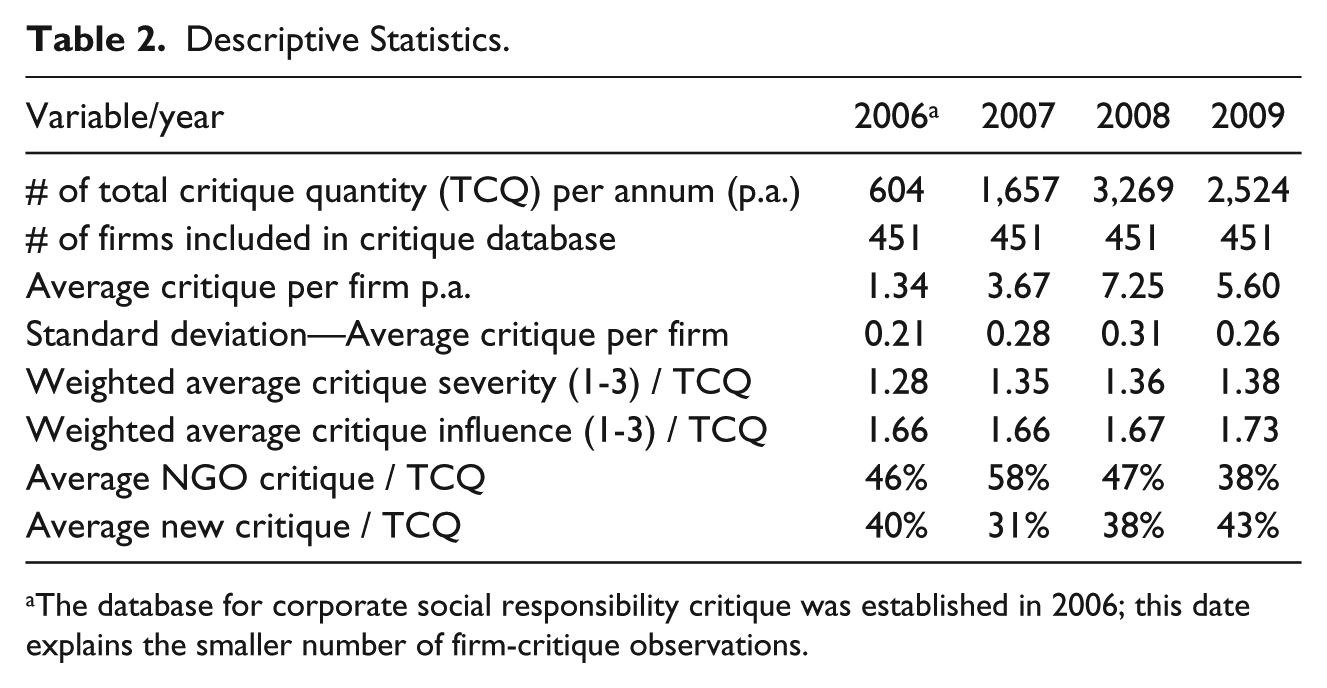
The database for corporate social responsibility critique was established in 2006; this date explains the smaller number of firm-critique observations.
Control variables
To account for unobserved heterogeneity, we added a series of control variables commonly applied in reputation studies. From the corporate perspective, we insert various financial variables to control for firm performance, size, and visibility. To test the reputational influence of firm visibility and size, we included firm sales. To account for financial performance, we included the firm’s free cash flow. The latter may indicate how many “excess resources” a company possesses to potentially “absorb any disruption costs” due to external criticism (King, 2008, p. 407).
We also controlled for the bias that more profitable firms “may garner more positive media coverage” (Lamin & Zaheer, 2006, p. 30), by inserting the firm’s return on assets (ROA), calculated as the ratio of net income to total assets into the equation. All financial data were obtained from Thomson Datastream. We logarithmized all financial indicators, a standard procedure to account for outlying variances between the firms. To account for idiosyncratic industry effects, we also added industry fixed effects, based on Global Industry Classification Standard (GICS) codes.
Methodology
Our units of analysis are unique firm-critique events. The panel data set used in our empirics finally includes 1,440 firm-critique observations between 2006 and 2009. To account for the delayed publication of Fortune, we regress the Fortune scores of year t + 1 (published in March of year t + 1) on the critique variables of year t. We therefore ensure that norm breaches occurring sometime during the entire calendar year t can be integrated into Fortune’s reputation survey, except for the last 2 weeks of each year (as the survey closes mid-December).
As explained earlier, however, the structure of our data raises an important endogeneity concern. Issues reported about firms are unlikely to occur randomly, and are often related to specific targeting strategies developed by environmental activists, NGOs, and various other potential actors to create reputational costs for firms (Baron & Diermeier, 2007; Bonardi & Keim, 2005; Eesley & Lenox, 2006). In other words, there is a sample selection bias in our data that will make ordinary least squares (OLS) regressions inaccurate. To handle this issue, we use a 2SLS approach. 7 The most common 2SLS estimation procedure, in a case like this, would be the Heckman selection model (Heckman, 1979; Shaver, 1998), in which sample bias correction takes place in two stages: In the first stage, the probability of observing a positive outcome of the dependent variable is estimated, and in the second stage, OLS regressions are run including additional explanatory variables for self-corrected predicted probabilities from stage one.
However, once again Fortune’s protective disclosure policy, with the 50% threshold explained earlier, prevented us from using this model. Due to the high fluctuations in the Fortune system—for instance, only 20% of all firms remain “Fortune evergreens” above the threshold during the 5 years—future scores falling below this barrier become untraceable, and hence make the classical Heckman estimation impossible (STATA, 2007, p. 595). Instead, we used two-stage Heckman probit regressions, which set probit models both in the first and in the second stage (see King, 2008). In the first stage, as in the classic Heckman model, a probit regression estimates the selection effect coefficient λ, or inverse Mills’ ratio (Greene, 1993), which describes a “monotone decreasing function of the probability that an observation is selected into the sample” (Heckman, 1979, p. 156). Sample selection bias is avoided by the selection equation, which determines whether an observation makes it into the random sample (Kennedy, 2003). In our case, we determine whether a norm breach has been reported in year t in the first stage by maximum likelihood estimations (MLE). Therefore, any endogenously motivated firm selection is empirically controlled for. In the second stage, we estimate, again with MLE, the likelihood of reputation damage for all the Fortune firms that had been accused and reported of norm-deviating behaviors. Therefore, the selection effect coefficient λ, generated in the first stage, is included as an additional explanatory variable in the second stage (probit regression), and controls for the probability that a corporation will not be criticized (see Kennedy, 2003; King, 2008).
To run these two-stage Heckman probit models, we computed a binary dependent variable for the first stage indicating whether a corporate breach of norm had been reported in a specific year. We used a set of additional variables to estimate this selection equation. Apart from the financial measures described previously, we included (dummy) variables that indicate whether a firm holds “top brands” in its corporate portfolio (approximated by the annual Interbrand ranking 8 ), is perceived as socially responsible (proxied by a firm’s appearance on the Dow Jones Sustainability Index 9 ), discloses environmental performance data (carbon footprint, monitored by the Carbon Disclosure Project 10 ), or is publicly listed on the stock market.
Results
The results of the 2SLS probit estimations are presented in table 3. Column (1) indicates the results regarding the probability of a reputation score decrease (second stage), with industry fixed effects. Columns (2) provide results for the selection equation (first stage), and evaluate the likelihood that one firm in our sample is exposed in one specific year.
Estimating the Likelihood of Reputational Damage 2SLS Estimates with Industry Fixed Effects.

Standard errors in parentheses
p<0.01, **p<0.05, *p<0.1
The first important observation is that the coefficient for the inverse Mills’ ratio, λ, is positive and significant, indicating that there is indeed a sample selection issue and that our approach corrects the associated bias. Beyond the pure methodological issue, this also suggests that firms that are publicly exposed as illegitimate face reputation loss; a critical aspect of the approach proposed in this article.
The estimates of the first stage (Column 2), controlling for the likelihood that a breach of norm is reported, indicate results that are in line with our approach: financial assets brand awareness as well as the disclosure of environmental performance data all increase the likelihood that a firm breaching a norm will be reported. In other words, large and visible firms tend to be targeted more than others; a result that is in line with the literature looking at firm-activist relationships (Baron and Diermeier, 2008; Eesley and Lenox, 2006). Interestingly, firms disclosing environmental performance (carbon footprint here) tend to be criticized more. Again, this result fits with the literature suggesting that firms which make corporate social responsibility investments and communicate on this also attract attention and open the door to illegitimacy criticism (King and McDonnell, 2015).
Looking at the central variables for our study, the significant influence of “new” and “NGO-reported” breaches on reputational damage is confirmed, thus suggesting support for Hypotheses H2 and H3. Corporations face reputational damage if they commit new breaches and, or violate norms that NGOs uncover and report directly. Further, the influence of the reporting source becomes significant, indicating that CSR criticism made public by powerful or credible reporting sources increases the likelihood of reputational downgrades, and hence supports Hypothesis H1 (with p<0.1).
By contrast, the content-related Hypotheses H4 and H5 still do not receive any statistical support. Number and severity of reported norm breaches still exert no significant influence on the likelihood of reputational downgrades. At least the estimate of critique quantity becomes positive, indicating a positive likelihood of reputational damage with a growing number of CSR-related issues reported.
Further, the estimates of the industry fixed effects indicate that “producing” industries that are close to final consumers (automotive, pharmaceuticals, retail) increase the likelihood of reputational damage, whereas service industries (telecommunication, travel/leisure, financial services) do not seem to generate such effects. Surprisingly, controversial industries such as oil and gas, tobacco, and mining do not display significant impacts, which might be related to the fact that tobacco producers are rarely included in reputation rankings.
Because of the non-linearity of the probit models used in our empirics, coefficients cannot be interpreted directly (Liao, 1994).To interpret our results quantitatively, we thus provide marginal effects in Table 4.
Marginal Effects for Two-Stage Least Squares (2SLS) Estimations.
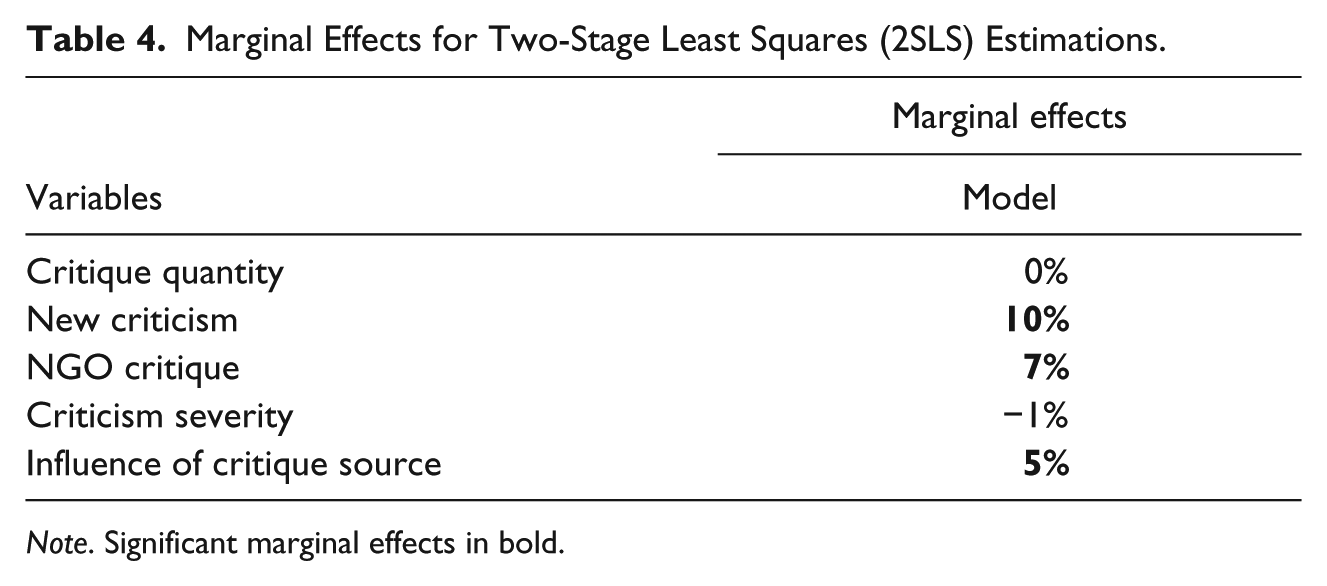
Note. Significant marginal effects in bold.
Among the significant coefficients, the newness of the norm breach has the highest impact on reputational damage (10% in Table 4). The likelihood that NGO-reported criticism downgrades a firm’s reputation also increases with the more accurate estimation procedures (7% in Table 4). Finally, the credibility of the source increases the likelihood of reputational damage when controlling for industry fixed effects by 5%.
Limitations
Before discussing these interesting findings, we deem it is important to particularly mention two limitations. First, we do not study corporate responses to the reported norm breaches. Therefore, we may have deprived “good” firms of documenting potentially positive corporate reactions to CSR allegations with credible attempts to respect norms in the future. Second, we did not contrast the highly admired Fortune firms with companies that are not at all admired. Contrasting extreme cases (Eisenhardt, 1989) might have delivered interesting insights about low-reputation firms. It might reveal whether poorly admired companies encounter reputational damage for the same reasons (critique newness, NGO criticism). However, such comparisons with “bad” firms would have preconditioned that reputation scores would be available for such highly nonadmired or even detested firms.
Discussion and Conclusion
What can be inferred from these results? Two main answers emerge, in our view. The first is that one major reason for reputation loss is related to socially constructed processes, controlled by NGOs and other credible sources, which tend to make certain firms less legitimate. A reported illegitimate behavior thus tends to question a firm’s “licence to operate” and creates serious reputation damage. These socially constructed processes leading to reputation loss are often strategically operated by social actors and norm guards—in our case, NGOs—who target the most visible firms, and often also those making CSR investments, to promote a certain cause (Baron & Diermeier, 2007; Bonardi & Keim, 2005).
The second important result of this study is that we do not find support for the idea that objective dimensions of issues, for instance issue severity or frequency, truly impact a firm’s reputation. Rephrased, this speaks again in favor of socially constructed processes as main drivers of reputation loss. Pushing further, this suggests that framed critiques against firms are those that lead to significant reputational damage, whereas substance criticism seems to fall flat.
From a theoretical stance, these findings present an interesting message for social movement and stakeholder scholars: The identified dominance of framed criticism in reputation damage provides explicit evidence for the hitherto merely implicit assumption in social movement and stakeholder theory that NGOs pursue symbolic rather than information politics (Keck & Sikkink, 1998; Sasser, Prakash, Cashore, & Graeme, 2006), and advance opinions rather than facts (see Alvesson, 1990; Anand et al., 2007). Moreover, these sanction mechanisms applied by NGOs are effective in terms of reputational damage—making the targeted firms look bad. Therefore, our results lend support to the proposition that reputation loss needs to be studied as a legitimacy issue and not only as a legal or financial one, and so the relationships between legitimacy and reputation are to be rethought and tightened (Bitekine, 2011; King & Whetten, 2008).
From a managerial perspective, our findings underline the intertwined relationship between NGOs and media actors. If NGOs do not succeed alone in their (reputational) sanctioning, they often revert to, ideally highly credible, hence powerful, media actors (Bonardi & Keim, 2005), who scan the corporate environment for new “stories,” that is, new norm breaches (Hunter, Le Menestrel, & De Bettignies, 2008). Critique substance is then sacrificed for critique symbols. The combination of new negative headlines reported by powerful media sources and well framed by professional NGOs makes firms likely to encounter reputational damage—with the critique substance becoming secondary.
Nevertheless and independently of whether reputational damage is driven by symbols or substance, it constitutes a considerable obstacle for the firm. As its constituents, investors, employees, and customers, “routinely rely on the reputations of firms in making investment decisions, career decisions, and product choices” (Fombrun & Shanley, 1990, p. 233), and are increasingly interested in the way corporations behave—or appear to behave (Pruzan, 2001, pp. 50-51). Thus, reputation damage must be repaired as fast as possible. Close and proactive collaboration and dialogue with NGOs and media constitute proven bridging strategies to avoid framing mechanisms from becoming (too) dominant in the stakeholders’ reporting of corporate contract breaches.
Footnotes
Declaration of Conflicting Interests
The authors declared no potential conflicts of interests with respect to the research, authorship, and/or publication of this article.
Funding
The authors received no financial support for the research, authorship, and/or publication of this article.