




Abstract
This research explores the field dynamics that facilitated the emergence of a dominant understanding of business’ role in sustainable development (SD). Based on a study of the U.N. Earth Summits, we examine how actors meet every decade to battle for definitional control of what SD means for business, and what business means for SD. Through a discourse analysis of texts from business, policy, and civil society actors during each Summit, we illustrate how an ensuing discursive struggle shifts the role of business in SD from being largely undefined in 1992, to being considered an SD partner in 2002, and finally to becoming a driver of SD by 2012. We contend that these shifts occurred largely due to two field dynamics: (a) rearranging of field boundaries and (2) forming of a discourse coalition. Accordingly, our study highlights how disparate actors coalesce around a shared-meaning system and collectively shape the role of business role in SD. However, we argue that despite the allure of a unified meaning-making process between once antagonistic actors, business–SD relations are underpinned by politicized interaction where certain actors come to dominate, and, in doing so, marginalize others.
Keywords
Since its inauguration on the international political stage during the 1992 Earth Summit in Rio de Janeiro, sustainable development (SD) has been widely acknowledged by governments, civil society, and businesses as a worthy endeavor (Sachs, 2015). Despite its acceptance, few concepts seem to spark as much dispute as SD. There is particular debate around SD’s basic assumptions: as Lélé (1991) asks, if SD is to be pursued, then what is to be sustained (nature or the economy) and for whom? Among the many interpretations of these questions, from the perspective of mainstream policy and business, SD seems to be embedded within a “weak” sustainability discourse (Hopwood, Mellor, & O’Brien, 2005). This largely technocentric discourse tends to prioritize the economy over the natural environment at the expense of a “strong” sustainability discourse that emphasizes systems thinking and nondiscrimination between humans and nature (Gladwin, Kennelly, & Krause, 1995; Starkey & Crane, 2003).
This interpretation of SD is not accidental. A growing literature specifically examines how business constitutes its own understanding of SD, thereby perpetuating a weak sustainability discourse (Livesey, 2002; Livesey & Kearins, 2002; Milne, Tregidga, & Walton, 2009; Tregidga, Milne, & Kearins, 2014, 2015). However, as this literature often focuses on corporate disclosures alone, it tends to overlook other key sites of contestation through which meaning is constituted relationally, that is, among multiple, often conflicting, actors that both struggle and cooperate with one another to fix meaning. To address this gap, we draw from the concept of strategic action fields, or socially constructed arenas within which actors with varying interests and resource endowments vie for a dominant power position (Fligstein & McAdam, 2012). We focus in particular on how certain field dynamics—that is, changes in the field’s key organizing principle, actors jockeying for a dominant position vis-à-vis other actors, and the “contentious periods” that break down established field logics (Fligstein & McAdam, 2011; Maguire & Hardy, 2009)—facilitate a discursive struggle surrounding business–SD relations.
A particularly salient arena in which such struggles take place regarding SD are large transnational fora, often hosted by the United Nations. Although instrumental in the construction of SD (Dodds, Laguna-Celis, & Thompson, 2014), these mega-conferences have received scant explicit attention in the business–SD literature (Springett, 2013). Our focus is on the 1992, 2002, and 2012 U.N. Earth Summits, 1 which have been hailed by some for being a catalyst of SD’s mainstreaming (Grubb, Koch, Munson, Sullivan, & Thomson, 1994), though lambasted by others for furthering a neoliberal ideology (Banerjee, 2012a). As commentators often express when attending an Earth Summit, tension and contestation are palpable because something is at stake: the regulation of transnational corporations (TNCs, Chatterjee & Finger, 2014). This alludes to the battlefield-like atmosphere of the U.N. Earth Summits as disparate players both compete and cooperate to seize definitional control of business’ role as an SD actor.
We are specifically interested in the discursive constitution of business’ role in SD, and the effects thereof; that is, how, through the production, dissemination, and consumption of text, certain business–SD discourses succeed as dominant, whereas others falter and become subjugated (Phillips, Lawrence, & Hardy, 2004). As such, we situate our study within the critical organizational discourse studies tradition (Hardy & Phillips, 1999; Mumby, 2004, 2013) and analyze official outcome documents of each Summit, coupled with certain exemplar texts from business, civil society organizations, and policy actors. This was further supplemented by an analysis of U.K. and U.S. news articles about the U.N. Earth Summits that specifically addressed the role of business in SD. Our analysis illustrates how an ensuing struggle between “transformative,” “centrist,” and “business-as-usual” discourses shifted the role of business in SD from being largely undefined in 1992 to being considered an SD partner in 2002 and finally a driver of SD in 2012. We demonstrate how these shifts were facilitated by two dynamics: the rearranging of the transnational SD field’s boundaries during the Johannesburg Summit in 2002 and the forming of a discourse coalition, which occurred 10 years later during the Rio+20 Summit. Furthermore, we illustrate how business attained its impressive influence over the SD agenda based on the support of certain policy and civil society actors, many of whom previously opposed business’ involvement in the transnational SD field. This of course has certain implications, which we discuss, including how future research can address the increasingly precarious state of “SD in flux.”
This study contributes to ongoing discussions regarding the construction of business–SD relations by expanding the field of discursivity beyond the confines of the firm to include the voices of multiple actors. Thereby, we emphasize how disparate actors engage in a complex discursive dance as they vie to secure definitional control of business’ role in SD. In doing so, we attempt to answer Tregidga and colleagues’ (2015) call for researchers to “move away from understanding what [SD] means to business, to understanding how those understandings came to be, why they are not inevitable, and how they could be different” (p. 6).
Strong Versus Weak Sustainability, and the Middle-Ground Perspective
Sustainability discourses are often distinguished on a weak versus strong continuum. On one hand, discourses indicative of “weak” sustainability advocate for change to happen within a pro-growth, market-based paradigm and, hence, for SD to become part of the current economic system (Hopwood et al., 2005). The natural environment is, thus, forced to adapt to culture of progress and growth (Banerjee, 2003; Meadowcroft, 2000; Redclift, 2005). Therefore, SD is interpreted as a means to an end in which the end is economic growth and the means are technocentric—that is, a strong reliance on technological innovation and human ingenuity (Eden, 1994). On the other hand, “strong” sustainability discourses draw largely from ecocentric tenets and argue that humans form part of an interconnected, fragile system (Hart, 1995; Purser, Park, & Montuori, 1995; Shrivastava, 1995; Starkey & Crane, 2003). Anthropogenic attempts to control the environment through science and technology are, therefore, futile, or even dangerous (Dryzek, 1997; Milne et al., 2009). Importantly, strong sustainability discourses are considered more radical and are tied to deep-ecology theory, which does not necessarily discriminate between the rights of humans and nature (Colby, 1991). Strong sustainability discourses, thus, regard issues such as climate change as systemic, to be dealt with through a systems change as opposed to incremental change (Purser et al., 1995).
That business generally subscribes to a weak sustainability discourse is exemplified when critically examining corporate disclosures about SD (Tregidga et al., 2014). Business, somewhat expectedly, interprets its role in SD through confines of a managerial/business logic, where SD is understood as a commercial opportunity (Hart, 1997; Laine, 2005; Rutherford, 2003; Springett, 2003; Tregidga, Kearins, & Milne, 2013). As such, business actors themselves shape their role in SD based on a narrow and economistic understanding of nature that perpetuates a “business-as-little-less-than-usual” mantra (Tregidga et al., 2015, p. 4). Notions of “eco-managerialism” and “eco-efficiency” become etched into the mainstay vocabulary that mediates business and the natural environment (Welford, 2013). Corporate disclosures, thus, frequently construct SD as something that business embraces, despite in some cases—for example, in the fossil fuel industry—SD is a running counter to business’ core purpose (Livesey, 2002).
SD, particularly when operationalized by business, does not necessarily present itself either as indicative of a weak or strong sustainability discourse, but instead often appears as if occupying a middle-ground position between these idealistic extreme poles (Hajer & Fischer, 1999; Hoffman & Ehrenfeld, 1998; Olsen, Lodwick, & Dunlap, 1992). In such cases, environmental management and economic growth are imagined as a positive-sum game that works both for business and nature (Egri & Pinfield, 1996). However, as Milne and colleagues (2009) demonstrate in an empirical study of the New Zealand Business Council for Sustainable Development, middle-ground approaches can in fact “reinforce rather than challenge the status quo [as] business dominance, economic logic and management are perpetuated while presented as alternative and ‘middle-way’” (p. 1241). In this vein, scholars often draw from critical theory (Livesey, 2002; Springett, 2003; Tregidga et al., 2015) to expose how SD becomes “captured” (O’Dwyer, 2003) or “hijacked” (Welford, 2013), which enables businesses “to enjoy economic growth, environmental protection and social improvements with no trade-offs or radical restructurings in the social order” (Laine, 2005, p. 395).
By foregrounding corporate text and talk, the current literature provides an important account of how business shapes its own role in SD by reinforcing a weak sustainability discourse. But business–SD relations are not constitutive of business interpretations, or indeed corporate disclosures, alone. Instead, the process of constructing business–SD relations involves the collective effort of multiple actors, including certain “non-business” actors such as policy makers and nongovernmental organizations (NGOs; Pinkse & Kolk, 2012). As such, meaning-making happens relationally, involving antagonism and consensus, competition and cooperation (Dryzek, 1997). As Hajer and Versteeg (2005) argue, “concepts, such as sustainable development [ . . . ], are not and cannot simply be imposed in a top-down way, but are continuously contested in a struggle about their meaning, interpretation and implementation” (p. 176). To address the politicized construction of the role of business in SD, we draw from Fligstein and McAdam’s (2012) understanding of strategic action fields, and focus specifically on the constitutive role of discourse.
Fields as Discursively Constituted
Strategic action fields are conceptualized “as socially constructed arenas within which actors with varying resource endowments vie for advantage” (Fligstein & McAdam, 2012, p. 10). Along with particular industries, markets, and professions as common examples of fields, certain issues—in this case SD—can also define a field, thereby resembling a center “of debate in which competing interests negotiate over issue interpretation” (Hoffman, 1999, p. 351). We focus specifically on the transnational SD field given that SD issues, such as climate change, transcend national boundaries and lack an overarching authority that formally regulates field members (Scherer, Palazzo, & Matten, 2013). Our approach foregrounds the role of discourse, by which we mean “a system of texts that bring an object into being” (Hardy & Phillips, 1999, p. 2)—the object, in our case, concerns the role of business in SD. We conceptualize the transnational SD field as a contested discursive space in which actors struggle to secure a particular definition of what SD means for business, and what business means for SD (Hajer, 1995). In this vein, discourses do not merely reflect field interaction, but play a fundamental role in the active structuration of fields by constituting shared meanings and taken-for-granted rules that determine field life (Hardy & Maguire, 2010, p. 1367). What is considered legitimate or acceptable, and what is not, is largely a matter of ongoing field-level discursive struggles seeking to privilege, or temporarily fix, meaning. In this vein, field structuration is the result of ongoing discursive battles fought with text as weaponry, which include, among others, written reports, speeches, manifestoes, and presentations (Hardy & Phillips, 2004, p. 300). Through the production, dissemination, and consumption of these texts, certain SD discourses succeed as dominant, whereas others falter and remain subjugated (Phillips & Hardy, 1997).
This perspective is useful for exploring the transnational SD field for three interrelated reasons. First, the discursive constitution of fields reveals how disparate actors within the transnational SD field—that is, business, policy, and civil society—negotiate shared meaning and form a consensus, despite being in contention with one another. Shared meaning is organized around certain field frames, which hints at the prevailing orthodoxy within the field (Maguire & Hardy, 2009, p. 149). For example, Ansari, Wijen, and Gray (2013) demonstrate how actors, over a 40-year period, changed their personal framing of climate change policy to move toward a unified field frame, and thereby established a consensus around climate issues. Accordingly, this is a collective process as actors “‘get outside of their own heads,’ take the role of the other, and work to find some collective definition of interest” (Fligstein, 2013, p. 43). In doing so, discourse coalitions begin to form, which are a crucial component of field structuration because they forge a shared-meaning system that allows actors pursue similar goals. Such coalitions generally regard “a group of actors that, in the context of an identifiable set of practices, shares the usage of a particular set of story lines over a particular period of time” (Hajer, 2005, p. 302).
Second, focusing on field-level discursive struggles highlights how the potency of an actor’s discursive activity is relative to their position vis-à-vis the position of other actors. Incumbent actors are granted discursive legitimacy—that is, the “right to speak” (Hardy & Phillips, 1999)—and work to maintain dominant institutional arrangements at the center of the field. Conversely, challengers and new field entrants lurk at the field’s periphery, from where they work on destabilizing those discourses furthered by incumbents (Maguire, Hardy, & Lawrence, 2004). Tracing shifting positions exposes how actors engage in “position jockeying” as they aim to secure a central spot within the transnational SD field; making moves that others must interpret and respond to (Fligstein & McAdam, 2011, p. 5). Through this dynamic, actors collectively promote a particular SD discourse, at the expense of another. Field change can also originate from external sources, for example, as a foreign actor seeks entrance or launches a takeover, or due to exogenous shocks such as regulatory reform (Fligstein, 2001). Indeed, the transnational SD field’s boundaries—or the limits of “who and what is ‘normal,’ standard and acceptable”—are never fixed and always in jeopardy (Merilainen, Tienari, Thomas, & Davies, 2004, p. 554).
Third, and relatedly, recognizing the salience of when fields enter a crisis underscores certain critical junctures regarding the construction of business–SD relations. These “periods of contestation” result in the “emergent, sustained contentious interaction between [field] actors utilizing new and innovative forms of action vis-à-vis one another” (Fligstein & McAdam, 2012, p. 21). This occurs with regard to transnational SD field as disparate actors that normally lack opportunity to engage come together during specialized mega-conferences—usually organized by the United Nations—to address social and environmental issues on a global scale (Haas, 2002; Lafferty & Eckerberg, 2013). During these events, incumbents and challengers, for a limited period, “face off to capture some gain” (Fligstein & McAdam, 2011, p. 11); they are the power-arenas where meaning systems related to SD are produced, broken down, rebuilt, and maintained (McInerney, 2008).
Overall, applied to business–SD relations, a field perspective provides a unique framework that goes beyond the confines of business alone to conceptualize meaning-making as a relational, often contentious, affair between multiple actors. By examining the above discussed field dynamics—shifting field frames, position jockeying, and periods of contention—we aim to demonstrate how, over time, a discursive struggle unfolds, as certain business–SD discourses succeed in becoming dominant, whereas others falter and are marginalized. Accordingly, we pose two research questions:
Research Approach
Selected Texts
In attempting to answer the above questions, we base our study within the context of the U.N. Earth Summits and examine three main bodies of text (see Table 1). First, we used the official outcome document of each Summit, downloaded from each summits’ official website. Although these documents are nonbinding, they are agreed to and signed by member-states and are negotiated, produced, and amended before, during, and sometimes after the summits. Therefore, they represent a snapshot of the official Summit proceedings (Lafferty & Eckerberg, 2013). Second, we analyzed certain “texts that leave traces” (Phillips et al., 2004, p. 640) that explicitly sought to either problematize, or legitimate, the idea of business as an SD actor. We selected two extreme cases from a particularly vocal and well-recognized environmental NGO (Friends of the Earth [FOE]) and from the most prominent representative for business and industry (World Business Council for Sustainable Development [WBCSD]). 2 We also included two key texts from the United Nations Environment Programme (UNEP) that were particularly salient regarding the role of business at the Rio+20 Summit in 2012. Third, we analyzed newspaper articles 3 that covered the summits during 1992, 2002, and 2012. Newspaper articles are often considered useful for analyzing discursive struggles because of the media’s dual role as both mirroring public debate (Beelitz & Merkl-Davies, 2011), while actively shaping the character of society by giving meaning to its institutions (Bell, 1995; van Bommel & Spicer, 2011). We analyzed articles from the Financial Times, The Guardian, The Wall Street Journal, and The New York Times. We selected these newspapers first because of their diverse set of contributors including journalists, academics, politicians, business professionals, and members of the public, and second because they are relatively distinct in terms of their ideological orientations, and therefore useful in illuminating struggles between viewpoints (Brandenburg, 2006; Stroud, Muddiman, & Lee, 2014).
Corpus of Text.
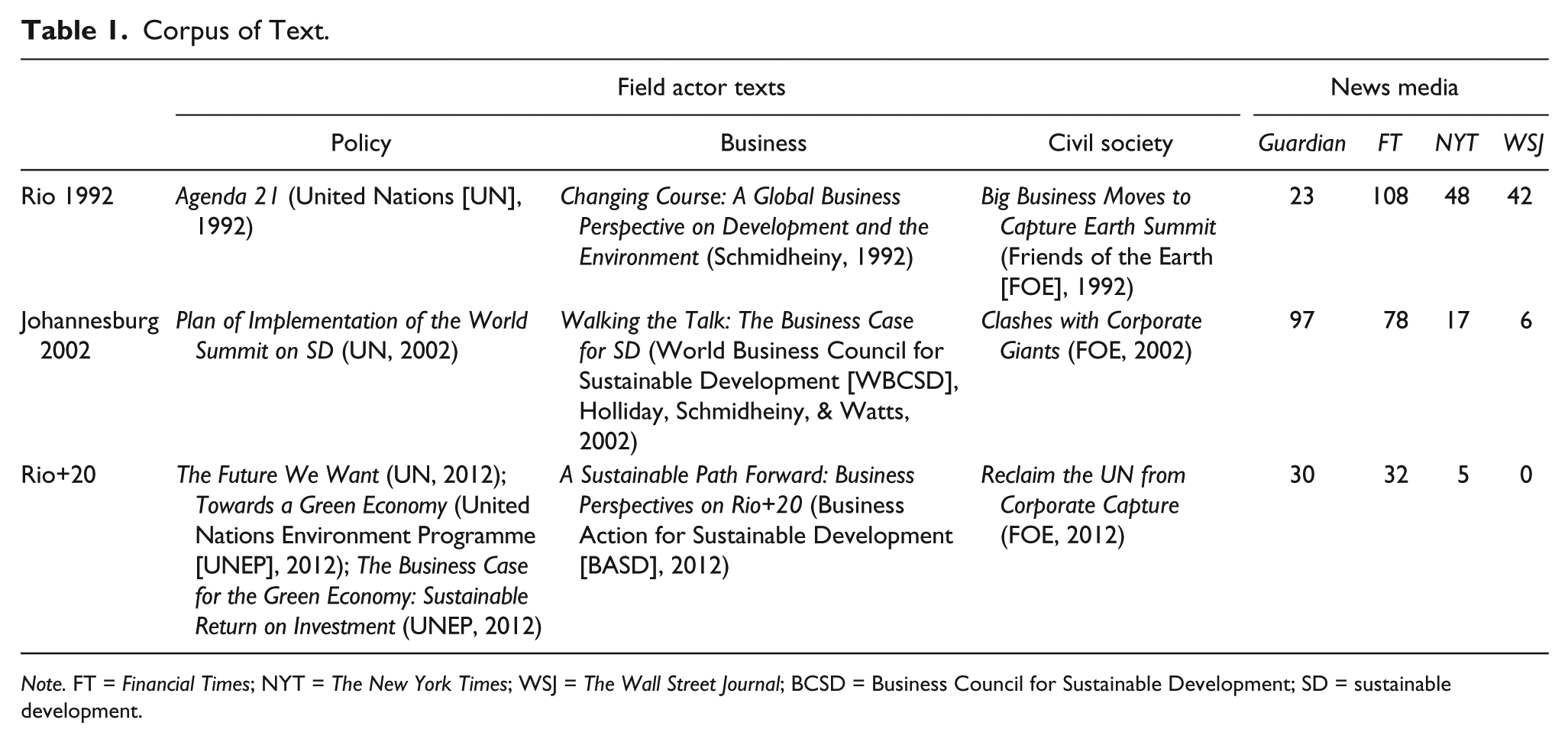
Note. FT = Financial Times; NYT = The New York Times; WSJ = The Wall Street Journal; BCSD = Business Council for Sustainable Development; SD = sustainable development.
Analytic Approach and Process
We situate our study within the critical organizational discourse studies tradition (Hardy & Phillips, 1999; Mumby, 2004, 2013). Therefore, our analysis specifically focuses on the dialogical struggle that occurs between field actors seeking to fix the role of business in SD, which becomes “reflected in the privileging of a particular discourse and the marginalization of others” (Keenoy, Oswick, & Grant, 1997, p. 150). This approach is useful for field-level studies for two reasons. First, it exposes the mutually constitutive interplay between broader macro-level discourses and dynamics within a field. Without considering intertextuality (Fairclough & Wodak, 1997) between field- and macro-level discourses, the transnational SD field would operate in a vacuum, only constitutive of itself. Second, and relatedly, critical organizational discourse analysis focuses on how constituting context “privileges some actors at the expense of others and how broad changes in the discourse result in different constellations of advantage and disadvantage” (Phillips & Hardy, 2011, p. 25). In our case, context is the transnational SD field; its construction is, therefore, based on producing, distributing, and consuming texts. Despite the prevalence of certain step-by-step frameworks for critical discourse analysis (Leitch & Palmer, 2010), our approach resonates with Chouliaraki and Fairclough (2010) who largely reject such attempts that aim to impose strict methodological rigor to critical discourse studies (see also Phillips & Oswick, 2012, p. 460). Chouliaraki and Fairclough (2010) instead propose moving
more towards stronger conceptual links between discourse, power, and other “moments” of the social process [ . . . ], as well as towards more versatile and porous methodologies that make space for novel, interdisciplinary research designs in the field. (p. 1214)
We analyzed our data in three phases. During the first phase, we developed a field narrative of the transnational SD field by engaging deeply with our data—especially with the large set of media articles—to chronicle both, “who did what, and when” and “who said what, and when” (Maguire & Hardy, 2009, p. 153, emphasis added). In doing so, we could identify shifts over time in terms of (a) who the main field members are and their respective positions vis-à-vis other actors within the field, (b) the field frames that signify the main organizing principle for each Summit, and (c) salient contentious periods.
During the second phase, we identified all instances within our corpus of text in which the role of business in SD was referenced. Based on an inductive coding process (see Figure 1) inspired by the inductive stage model of Gioia, Corley, and Hamilton (2012), we coded all these instances to create descriptive categories (resulting in more than 700 individual codes). 4 For example, we coded the statement: “ . . . business and industry should increase self-regulation. It is time to reboot the Rio+20 summit agenda” as “regulation” and “reboot.” We then identified relationships between all the codes and, where significant overlap existed, formed three themes: “change,” “control,” and “power.” As these themes emerged, we noticed that each was constituted by a specific dialectical tension: “change” was constituted by a struggle between radicalism and conservativism, “control” by proregulation and antiregulation, and “power” by bottom-up and top-down. Accordingly, we grouped the poles of each struggle into two discourses: “transformative” (radical, proregulation, and bottom-up discourses) and “business-as-usual” (conservatism, antiregulation, and top-down discourses).
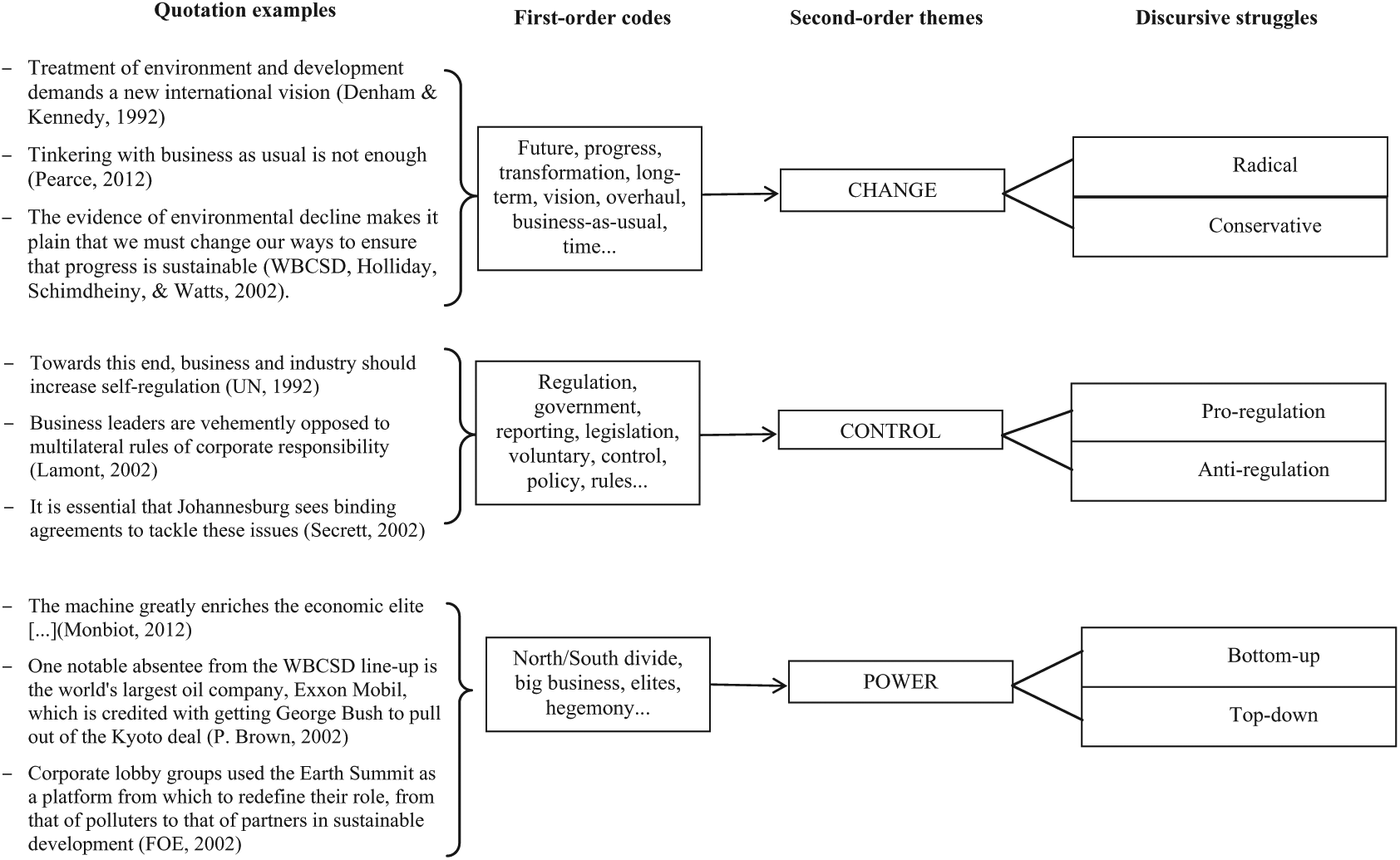
Inductive coding process.
The third phase examined how the three field dynamics we identified in the first phase facilitated the discursive struggles that emerged in the second phase. Regarding the field positions dynamic, we engaged with the texts produced by each actor separately—particularly with our key texts from the WBCSD and FOE—and examined their shifting field position in relation to the specific discourse promoted by that actor. In terms of shifting field frames, we similarly examined how “winning or losing” a struggle was reflected by the extent to which actors conformed with each Summit’s field frame. Finally, in terms of contentious periods, we examined certain events that “shocked” the entire transnational SD field, such as the entry of new field members or major shifts in actor positions, which also greatly affected each struggle. Overall, by exploring how these three field dynamics influenced the outcome of the discursive struggles, we identified the most salient dynamics that, we argue, facilitated a shift in business’ role in SD over the three summits.
The Shifting Role of Business as an SD Actor
We find that over a period of two decades, business’ role as an SD actor shifts significantly. Business moves from the periphery of the transnational SD field in 1992, where its role is largely undefined, to field’s center in 2002 after being officially inaugurated by the United Nations as an SD partner. Finally, upon the Summit returning to Rio in 2012, business became integral to the transnational SD field as a driver of SD. We illustrate how these shifts occur below by presenting the discursive struggles that constitute business–SD relations during each Summit (see Table 2), including the field dynamics that facilitated a shift in business’ role in SD (see Figure 2).
Overview of Discursive Struggles and Claims.
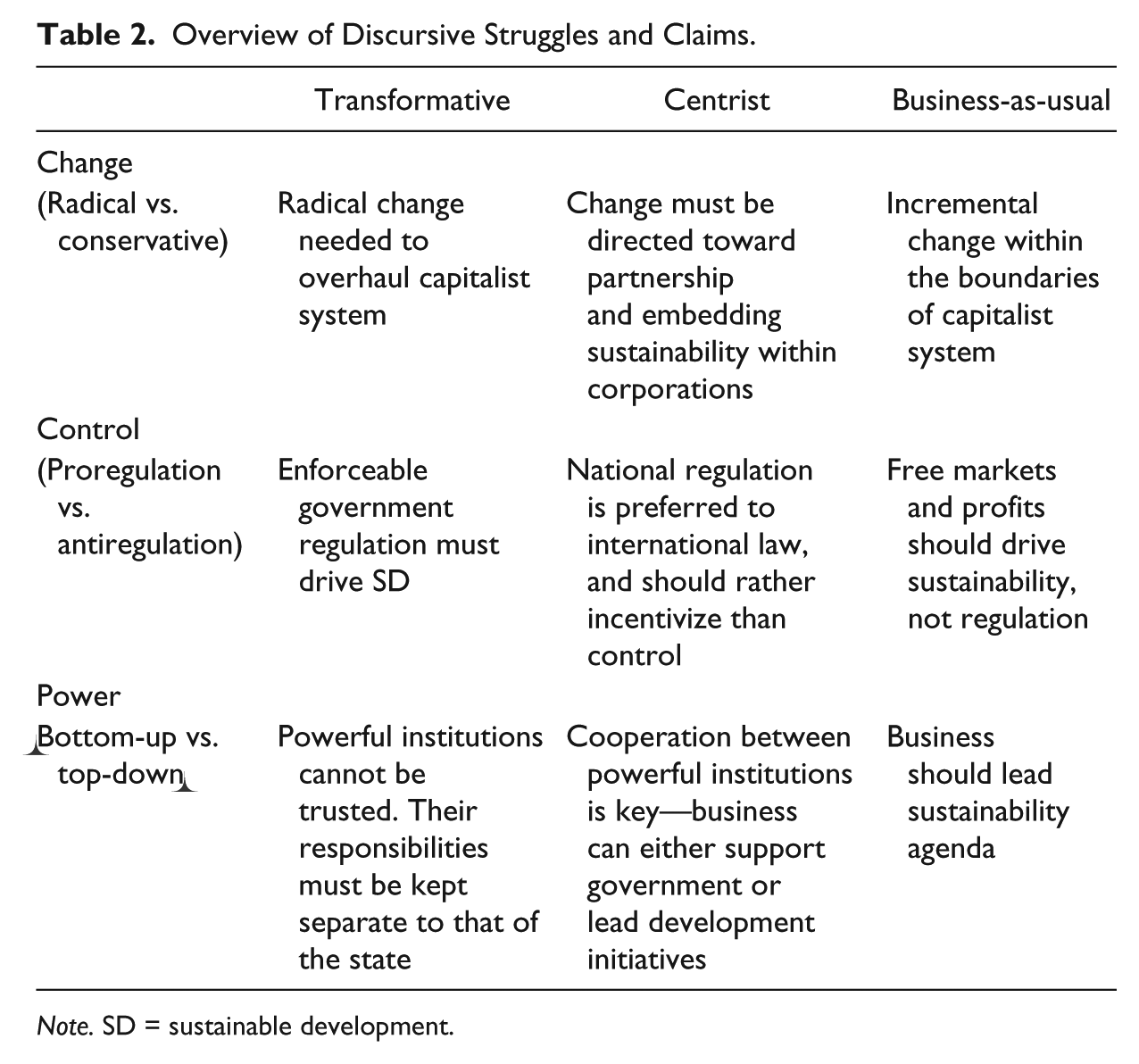
Note. SD = sustainable development.
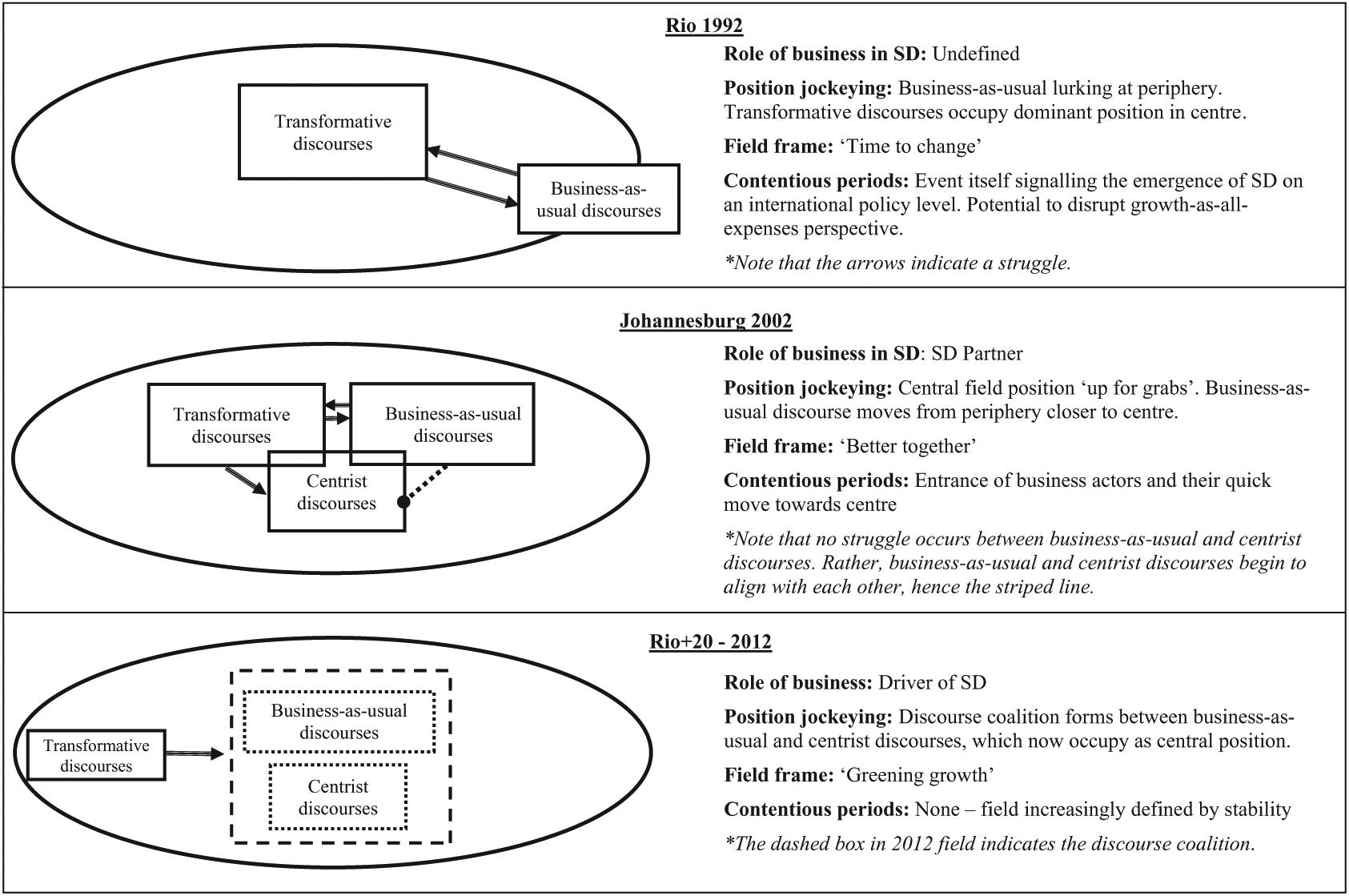
Transnational SD field dynamics and the evolution of discursive struggles.
Rio 1992: Business Role in SD—Undefined
The Rio Conference in 1992 was somewhat “special.” Not only was it the first conference that attracted such an unprecedented collection of international actors including 108 heads of state, 2,400 representatives from civil society organizations and NGOs, and 10,000 on-site journalists (UN, 1997), but it also set the scene for the proceeding two decades of SD policy, as highlighted by a representative of the World Wildlife Fund: “Rio will be a legacy for many years to come” (Tessa Robertson, pollution-policy officer for World Wildlife Fund [WWF], in Allen, 1992). The spirit of the event was captured in the Summit’s field frame, “Time for change,” as exemplified by the Summit’s implementation plan—Agenda 21—which is littered with language indicative of grand change. For example, in its preamble, Agenda 21 (UN, 1992) states, “[humanity] stands at a defining moment in history” (para. 1.1) and that Agenda 21 “aims at preparing the world for the challenges of the next century” (para. 1.3), which requires an “order-of-magnitude” (para. 1.4) approach. Yet, that SD would potentially revolutionize our understanding of economic development was not appreciated by all actors—alluding to the first major discursive struggle: radicalism versus conservativism.
Given our reading of Agenda 21, policy actors seemed keen to further SD as a transformative concept. Similarly, civil society purported a radical SD discourse by, among others, emphasizing the need to redefine the ecology–economy relationship, as Helen Denham of the U.S.-based youth group commented, “treatment of environment and development demands a new international vision” (Denham & Kennedy, 1992). However, business actors—operating as emergent actors on periphery of the transnational SD field—were reluctant to accept any sort of grand systems change. This was evidenced by the Business Council for Sustainable Development (BCSD), the leading business advocacy group led by Swiss billionaire Stephan Schmidheiny (1992), arguing in their manifesto, “[we] call for a long-term view, for far-reaching changes, and for action. But we do not base our hopes for success on radical changes in human nature or on the creation of a utopia” (emphasis added). BCSD was, therefore, clear that although change was necessary, it was something that must happen within the confines of the status quo. Other business actors shared this perspective, as Jan-Olaf Willums, executive director of the International Chamber of Commerce (ICC) Office on Environment, stressed the profits that can be made from appropriating the natural environment: “environment is an asset. Sustainable development is about learning to develop and maintain this asset so we live off the income, not the capital” (Lamb, 1992). Notwithstanding, with both civil society and policy actors inhibiting a center field position, coupled with the hope resting in SD’s transformative potential, radical SD discourses dominated at the Earth Summit in 1992.
A much less clearly defined battle concerned the regulation of TNCs. Here, a stalemate tug-of-war transpired between, on one hand, those urging for increased regulation of businesses, and, on the other, those who imagined SD as a voluntary affair. This exposes the second major struggle between proregulation and antiregulation discourses. Civil society actors largely promoted a proregulation discourse, as Richard Tapper of WWF demanded “to see strict rules obliging TNCs to adopt the highest national or international standards in their overseas operations” (Watkins, 1992). However, such sentiments stood in contrast to most major policy actors. For instance, despite referencing the term “regulation” 55 times, it does not appear once in the Agenda 21’s four-page chapter dedicated to “Strengthening the role of business and industry.” Rather, the term “self-regulation” is preferred: governments are urged to “encourage” and “incentivize” businesses to become environmentally concerned. Other policy actors followed suit—the U.S. delegation, for instance, rejecting any increased regulation of businesses by insisting that it would “not let environmentalists shut down the U.S.” (Gutfeld, 1992).
In addition to policy actors, business actors promoted antiregulation discourse. Again, the BCSD played an important role, as Schmidheiny stated in an interview with the Financial Times:
. . . either we resist and we will suffer, or we anticipate the changes and we will have more profits and more personal satisfaction. [ . . . ] SD will shape the future of our business, and to learn to understand it and shape it is really in our interest. (Simons, 1992)
Arguably, the BCSD’s efforts resembled a foundational attempt to put forward a business case for SD, which had not yet entered business mainstream. But the positive framing of SD by the BCSD—as they “shape” SD to “have more profits” (see quote above)—remained confined to business advocacy groups.
In many ways, relations between civil society actors and business were defined by antagonism as The Wall Street Journal put it: “Greens, Industry Face Off at Rio Summit” (Kamm, 1992). Much of this contestation was spurred by the ambiguity surrounding the governance of SD—after all, should SD be driven by big business alone, by big business in partnership with governments and civil society, or by governments and civil society without the direct involvement of big business? These questions capture the third significant struggle between bottom-up and top-down SD discourses. Accordingly, bottom-up SD discourse dismisses powerful actors’ control of the summits and argues that the interests of powerful actors, especially big business, economic elites, and the Bretton Woods Institutions, have resulted in sustainability-related issues. Skepticism regarding the intentions of powerful organizations often manifests as TNCs are accused of undermining the Summit’s policy process, or, as Andrew Lees of FOE, stated, “big business is trying to capture the agenda at the Earth Summit so that it can pursue its own version sustainable development” (FOE, 1992, p. 1). Conversely, a top-down SD discourse rejects such claims—ICC U.K. director, Richard Bate, addressed the above accusations of TNCs manipulating Summit outcomes as “absolute nonsense” (Cowe, 1992). Instead, resources of powerful actors are cast as advantageous, if not essential; proponents of a top-down discourse, thus, proposed that “the Summit will fail if it does not adopt a businesslike approach to matters which are all too often colored by emotion allied to special interests” (Clark, 1992).
In sum, Rio set the scene for discursive battle between, on one hand, radical, proregulation, and bottom-up SD discourses (transformative) and, on the other hand, conservative, antiregulation, top-down discourses (business-as-usual). Arguably, due to the momentous spirit of the event, radical tenets of transformative discourses dominated. Furthermore, given the disjointedness between two central field actors—civil society and policy makers—coupled with disagreement among business actors themselves as to whether SD was good for business, the role of business in SD at this point was largely undefined, and, we felt, at times confused. However, a decade later during the Johannesburg Summit, this changed significantly.
Johannesburg 2002: Business as a Partner in SD
Rio’s successor, the Johannesburg Summit, was attended by 22,000 people including 100 heads of state and 10,000 delegates from civil society organizations (UN, 2006). Notably, the attendance of the private sector with over 2,000 representatives from 700 businesses, including 50 CEOs, was unprecedented for a U.N. conference (Business Action for Sustainable Development [BASD] in Lamont, 2002). As the Financial Times put it, “The Johannesburg Summit will be crucial in determining whether business comes to be seen as the hero or villain of sustainable development” (Beattie & Houlder, 2002). The private sector was recognized as a “partner” of SD, for example, as evidenced during a much-celebrated speech by the Secretary-General of the United Nations, Kofi Annan (2002):
[ . . . ] more and more we are realizing that it is only by mobilizing the corporate sector that we can make significant progress [ . . . ]. The corporate sector need not wait for governments to take decisions for them to take initiatives.
The act of legitimating business as an SD partner sparked a particularly contentious period for the transnational SD field and was, we argue, a decisive start to a shift in business’ role in SD: “The United Nations is delivering a new message at the [Summit]: It is open for business” (Ball, 2002). This development included an influx of field members, notably business associations and business leaders, and was accompanied by new development mechanisms such as Type II Partnerships that were specifically designed in include the private sector into the United Nations’s governance system (Pinkse & Kolk, 2012). The transnational SD field’s boundary was, thus, in some ways, torn down to accommodate a new meaning system, which included a new discursive repertoire that both field incumbents and entrants could associate with, which included terms such as “win-wins.” Leading this march was the WBCSD, a continuation of the BCSD that featured in Rio 10 years earlier. The WBCSD made its mark at the Summit by unveiling its seminal publication—Walking the Talk: The Business Case for Sustainable Development—coauthored by three business–SD heavyweights: Chad Holliday (CEO of Du Pont), Stephan Schmidheiny (Chairman of Eternit Group), and Philip Watts (Chairman of Royal Dutch Shell). In its introduction, the authors, at length, argue,
For the past decade or so we in the WBCSD have been championing a term [SD] that is unknown to most of the world’s inhabitants but is universally known among environment and development actors and thinkers, where it seems to mildly annoy them all. (WBCSD, Holliday, Schmidheiny, & Watts, 2002, p. 14)
The WBCSD, in aiming to provide clarity on business–SD relations, were likewise attempting to secure definitional authority over business–SD relations. Coupled with the conference, being sponsored financially by TNCs, including, among others, HP and Daimler Chrysler (Mason & Beattie, 2002), a significant shift in the position of business within the transnational SD field was signaled. This was further buttressed by previously antagonistic actors such as Greenpeace and BP “joining forces” at a WBCSD-organized event to stress their shared commitment to endorse policy commitments to stem climate change: “Their partnership, though limited, was emblematic of a new view of environmental problem-solving that emerged at the United Nations conference” (Revkin, 2002). Crucially, whereas new field entrants usually lack social and economic capital to immediately affect field structuration (Fligstein & McAdam, 2011), business actors in this case already possessed significant resources. In addition, the business-as-usual discourses espoused by new entrants reinforced the United Nation’s preexisting market-based ideology (Banerjee, 2003). Therefore, business actors were able to capitalize on the Summit’s field frame—“Better Together”—and quickly start their move toward the center of the field.
Given these developments, we noticed how struggles between discourses evolved considerably. On one hand, top-down SD discourse gradually gained prominence given that large TNCs were increasingly considered important for SD: “an encouraging sign that the U.N. is finally starting to understand that the best way to help the developing world over the long term is to make it a place where corporations can reliably make a buck” (Ball, 2002). On the other hand, both proregulation and bottom-up SD discourses only increased their distrust toward business’ involvement with SD. That the WBCSD was led by executives from resource-intensive industries, including fossil fuels (Philip Watts), cement (Stephan Schmidheiny), and chemicals (Chad Holliday), only furthered discontent of civil society organizations. As such, direct struggle ensued as several environmental NGOs, during an official U.N. press conference, collectively accused TNCs of “hijacking” the Summit: “Corporate lobby groups used the Earth Summit as a platform from which to redefine their role, from that of polluters to that of partners in sustainable development” (FOE, 2002, p. 6). This sentiment was echoed in Tony Juniper’s (2002) accusation of the ICC of “blocking the agreement of several international environmental standards, including the Kyoto protocol on climate change.” However, the ICC responded by propagating a centrist discourse, as their director, Lord Holme (2002), responded to Juniper’s comments:
The stereotype he perpetuates is that business resists all regulation in the sacred name of free markets. This is untrue. [The ICC], which he singled out for criticism, represents businesses that are, in general, strongly in favour of improved reporting and appropriate regulation.
Centrist discourses, acting to mediate the extreme poles, germinated during, or at least some time surrounding, the Johannesburg Summit. For instance, the WBCSD were “now more convinced than ever that companies can do themselves good through doing right for society at large and the environment. [ . . . ] It is not ‘either/or.’ The new paradigm is ‘and also’” (WBCSD et al., 2002, p. 8). There was finally a vocabulary that reconciled the starkly contrasting discursive battles of Rio 1992. Policy actors were also increasingly in favor of centrist approaches. For example, Steve Hilton (2002), a policy advisor to British Conservative Party wrote an article in The Guardian praising win–win scenarios between ecology and economy, arguing that “it is possible for businesses to combine profit-making with the principles of sustainable development.” This is also noticeable within the Johannesburg Plan of Implementation, which promoted “balanced integration of the economic, social and environmental dimensions of sustainable development” (UN, 2002, p. 60). In addition, there was an abundant reference to partnerships in the Johannesburg Plan of Implementation (mentioned 54 times) between business, civil society, and governments.
Rio+20: Business as a Driver of SD
Two decades after the first Earth Summit in Rio, the Summit was again held in Brazilian capital. Civil society and business presence was strong with more than 50,000 organizations attending (Watts, 2012), of which 2,000 were “business leaders” (Rio+20 Corporate Sustainability Forum, 2012). Perhaps most important, the private sector was framed as the driver of the Green Economy, which was one of the two Summit themes (the other being redesigning SD’s governance framework). The underlying tenet of the Green Economy concept is that “the greening of economies need not be a drag on growth [rather] has the potential to be a new engine of growth” (UNEP, 2011, p. 16). In other words, from a business perspective, “[we] need to move from protecting the environment from business to using business to protect the environment” (Potočnik, 2012).
As the role of business became essential to providing the technology and investment needed to advance the Green Economy, governments were increasingly placed in a supportive role. For example, as stated in the Summit’s outcome document, The Future We Want (authored by Pavan Sukhdev, a Deutsche Bank executive on sabbatical), “national regulatory and policy frameworks [should] enable business and industry to advance sustainable development initiatives” (UN, 2012, p. 7). Unlike the Johannesburg Summit, U.N. organizations, particularly UNEP, stressed the role of market mechanisms and private investment as crucial in facilitating the transition toward a Green Economy. In a concluding paragraph of their colossal 631-page Towards a Green Economy report, UNEP (2011) states,
Although the bulk of the investments required for the green transformation will come from the private sector, public policy will also play a leading role in overcoming distortions introduced by perverse subsidies and externalised costs. In addition, public investment will be required to jump-start an effective transition to a green economy. (p. 628)
Based on our interpretation, the private sector is foregrounded as somehow more responsible for the Green Economy, whereas the public sector, despite being referred to as “key,” seems to be charged only with jump-starting the process and cleaning up externalities after business does the job. Highlighting the role of business is also evident by UNEP releasing another report that ran alongside the Towards a Green Economy report titled, The Business Case for the Green Economy: Sustainable Return on Investment, in which they showcase “the tremendous opportunities that business can capitalize on by transitioning to a [ . . . ] Green Economy” (UNEP, 2012, p. 4).
The private sector was now, to large degree, seen as integral to the conference and its position within the field concentrated in the center alongside policy makers and mainstream civil society actors. This close bundling of major players had particular implications for the unfolding of discursive struggles because these actors, as a collective, neither ascribe solely to business-as-usual discourses, nor to transformative discourses. Instead, central actors become embedded within a discourse coalition involving business-as-usual and centrist discourses, as expressed by the BASD (2012):
Business has an obligation to broaden and deepen its engagement, to explore new means of partnering and addressing a wide range of challenges, and to work with government to support the enabling environment, specifically market mechanisms which encourage innovation, in order to address the sustainability challenges at the scale necessary. (p. 2)
At its core, the discourse coalition relies upon business-as-usual discourses; the quote above highlights top-down approaches to solving social and environmental challenges through an ideology of market-based capitalism. Centrist discourses are a noncore element of the discourse coalition and provide the moderated vocabulary—in the quote above, emphasizing partnership and incremental change needed to address a wide range of challenges—that actors operating in the field center require to form a shared-meaning system. In doing so, disparate actors can collectively relate to, and pursue, the Summit’s “Greening Growth” field frame.
Actors that reject the discourse coalition risk becoming marginalized. This is illustrated by a schism that unfolds between certain environmental NGOs. On one hand, what some might consider mainstream NGOs such as Greenpeace and WWF changed their previously critical tone regarding the use of market-based mechanisms to solve environmental issues, especially with regard to the EU emissions trading scheme. WWF was, for instance, particularly emphatic about the idea valuing nature in economic terms, promoted as part of the Valuing Natural Capital Initiative. On the other hand, more “radical” actors, such as local Brazilian civil society organization, Justiça nos Trilhos, were less enthusiastic of SD’s marketization: “It’s a shame. Many people should be questioning this” (Barnes, 2012). However, such claims were often disregarded by a now powerful coalition, which also included state actors, such as Pascal Canfin, the French development minister, who “denied that the green economy was a Trojan horse for free market and big business” (Chrisafis, 2012). In all, the above findings highlight how, over a period of 20 years, previously antagonistic actors became embedded within a discourse coalition that, while producing a dominant understanding of business’ role in SD, has also marginalized those understandings and actors that do not adhere to its core tenets.
Discussion and Conclusion
The purpose of this article was to explore the discursive struggles and field dynamics that led to a dominant understanding of business’ role in SD. We were particularly interested in expanding the current literature’s focus on corporate disclosures to include voices of other key SD actors that, vis-à-vis business actors, shape business–SD relations. Accordingly, we adopted a field perspective (Fligstein & McAdam, 2011) and based our study within the context of the U.N. Earth Summits, a contentious discursive space where actors battle every 10 years for definitional control over what SD means for business and what business means for SD (Dodds, Strauss, & Strong, 2012). In doing so, we highlighted two field dynamics that we argue facilitated a shift in the role of business in SD from being largely undefined in 1992 to an SD partner in 2002 and, ultimately, an integral driver of SD in 2012. The first field dynamic was an influx of business actors during the Johannesburg Summit in 2002: business was not only unofficially inaugurated by Secretary-General Kofi Annan (2002), but officially incorporated into new forms of governing the global commons, among others, Type II Partnerships. This significant period of contention resulted in boundaries of the transnational SD field imploding as previously established understandings of business–SD relations, including actor positions within the SD field, entered into a state of flux. Given these developments, coupled with the need for a shared vocabulary that could mediate seemingly irreconcilable tensions between “transformative” and “business-as-usual” discourses, a third set of “centrist” discourses emerged during the Johannesburg Summit in 2002. This laid the foundation for the second field dynamic—the forming of a discourse coalition between centrist and business-as-usual discourses—which occurred 10 years later during the Rio+20 Summit and ultimately led to a dominant understanding of business’ role in SD. In the ensuing section, we discuss how our study contributes to literature on business–SD relations, including implications for the field of SD and scholars interested in the business–nature–society interface.
Despite literature on SD frequently contrasting two opposing discourses—weak versus strong sustainability—our study suggests an alternative tension between transformative versus business-as-usual discourses. Indeed, elements of this dichotomy overlap in some respects with previous attempts to map SD approaches. For example, our finding regarding the struggle of radicalism versus conservativism is supported by Hopwood and colleagues’ (2005) distinction between “status quo,” “reform,” and “transformation” views of SD. However, whereas many existing studies focus on the tension between ecological and technocratic/anthropogenic worldviews (Colby, 1991; Olsen et al., 1992), we specifically emphasized the relationship between business and the natural environment. This is reflected in our distinction between transformative and business-as-usual discourses incorporating, among others, attitudes about the power of governing institutions and regulation of TNCs. Because the findings of our study largely emerged inductively rather than applying the weak versus strong framework to business–SD phenomena, we provide a distinction between SD discourses that is more fittingly related to, in particular, business and its engagement with SD. This is important because, as our study emphasizes, business involvement with SD is fundamental to understanding SD itself.
Crucially, whether either transformative or business-as-usual discourses dominate is dependent on successfully seizing a third set of centrist discourses that provide a nuanced middle-ground position that mediates between the two extremes (Colby, 1991; Hopwood et al., 2005; Olsen et al., 1992). Of course, middle-ground discourses are well referenced in business–SD literature (Milne et al., 2009; P. Prasad & Elmes, 2005) as organizations often employ a “not too hot, not too cold” Goldilocks approach by neither entirely supporting the status quo, nor wanting to seem to endorse ecocentric values (Livesey, 2002). In our case, middle-ground positions were evident as centrist discourses contained elements of partnership between government and business, or win–wins between profits and the environment. However, centrist discourses, as we noted, are only meaningful in relation to other evolving discursive struggles and, therefore, cannot in isolation define the transnational SD field. This underscores Tinker et al.’s (1991, p. 46) assertion: “‘middle ground’ is not an ‘eternal category’ but is disputed territory that changes with struggles and conflicts” (in Milne et al., 2009, p. 1245). We take this a step further by illustrating how these struggles and conflicts constituted a discourse coalition that, in our case, resulted in business’ role in SD being underpinned by an economic, market-based logic.
This dominant understanding most prominently materialized during Rio+20 where centrist and business-as-usual discourses began to align, and, as collective, marginalized transformative discourses as idealistic, doctrinaire, and extreme. Although not directly congruent, the “partnership” between discourses resonates with Hajer’s (1995) notion of a discourse coalition. In this vein, discourse coalitions bring together multiple, often contending, story lines, practices, and routines organized around a unifying discourse (Lefsrud & Meyer, 2012; Meyer & Höllerer, 2010). Hajer (1995) based on his analysis of the emergence of ecological modernization discourse, stresses the “interaction and coalescence of discourses [ . . . ] that constantly adjusts, transforms, resists, or reinvents social arrangements” (p. 58). In a similar vein, as the discursive struggles we identified evolved over time, the coalition between business-as-usual and centrist discourses similarly evolved, becoming increasingly interwoven. Through creating this shared understanding, over time the struggle between transformative and business-as-usual discourses that persisted during the 1992 and 2002 U.N. Earth Summits became diluted. However, it is important to mention that the coalition in many ways represents “meaning in the service of power” (Fairclough, 1995, p. 14). As such, the coalition’s vagueness functions both to conceal some of the contradictions that underpin business–SD relations, and acts as a legitimizing tool. Nonetheless, the coalition in a sense remains “productive” as it provides a common language that disparate actors in the field’s center require to engage in dialogue—that is, through concepts such as Green Economy and inclusive growth. This is what Hajer (1995) refers to as the “communicative miracle” (p. 45) of a discourse coalition as divergent actors are able to maintain their distinctiveness without forgoing a shared understanding of issues.
Our adaptation of Hajer’s discourse coalition concept resonates with Tregidga and colleagues’ (2015) reference to a hegemonic discourse of SD. In this respect, the authors, in their review of research on corporate SD discourses, illustrate how such discourses reproduce the status quo and, therefore, perpetuate “a dominance of capitalist and economic ideology et al., 2016, p. 23). Indeed, the discourse coalition referenced in this article is similarly dominated by what we referred to as business-as-usual discourses. In addition, comparable with how corporate discourse of SD often “glosses over conflicts of interest subsumed under the rubric of [SD]” (Livesey, 2002, p. 323), so does the discourse coalition’s inherent fuzziness mask the actual identity of some of its adherents—for example, as many of its founders (such as Phillip Watts of Shell) hail from industries where trade-offs between ecology and economy are inevitable. Interestingly, Tregidga et al. (2014) have elsewhere argued that corporations resist change toward more sustainable business practices by perpetually engaging in identity transformations, or claiming to be that which they are not. Nevertheless, as we have stressed in this article, it is not merely due to the intent of business actors that business–SD relations, and indeed SD more generally, become embedded within a discourse coalition. Instead, this occurs through the efforts of multiple actors who, as an aggregate, engage in field structuration. In this respect, we concur with Levy and Newell’s (2005) formulation of this complex power-play between actors as they “engage in negotiation, alliance formation, and compromise, in an effort to build a hegemonic coalition of firms, governmental agencies, NGOs, and intellectuals with the capacity to establish policies, norms, and institutions” (pp. 74-75).
Importantly, the interaction between coalition members would not have been possible without transnational fora—in our case, the UN Earth Summits—that facilitated the interaction of disparate actors, normally not associated with one another, in a physical space. Although our study’s main focus was not necessarily about the inner workings of UN Earth Summits—as we instead focused on discourses surrounding the summits—we do stress the importance of taking into consideration how such international fora influence SD, including the role of business in SD (Bäckstrand, 2006; Lafferty & Eckerberg, 2013). Springett (2013) stresses this point as she reflects on the evolution of SD discourse over the past decade: “[these] fora have underlined the power that corporates can exercise, in seizing a level of ‘legitimacy’ over the debate while appropriating it to represent something more comfortably in keeping with neo-liberal corporate agendas” (p. 75).
Despite their importance, organization scholars have only recently begun to focus on how such events shape the business–society–environment interface (Ansari et al., 2013; Banerjee, 2012b; Carter, Clegg, & Wåhlin, 2011; Hardy & Maguire, 2010; Schüssler, Wittneben, & Rüling, 2014). The importance of such fora was reflected during Johannesburg Summit, which not only received scant scholarly attention but also, as our data set illustrated, limited media attentioniii. Yet, as we demonstrated in our findings, certain developments occurred during the Johannesburg Summit that were somewhat unprecedented, including, for instance, that the Summit was funded by TNCs (Mason & Beattie, 2002), and that Greenpeace and BP were brought together by the WBCSD to express their unified support for the Kyoto Protocol (Newell & Timmons Roberts, 2016, p. 171). Precisely, these sorts of shocks prompted the legitimation of corporate interests as an integral part of the transnational SD field. One could certainly argue that mainstream policy actors such as the United Nations have always been sympathetic toward TNCs, largely because of their favorable stance on free-trade and globalization (Banerjee, 2012a). Yet, what is striking is how, upon business actors entering the transnational SD field en masse around the time of the Johannesburg Summit, major NGOs gradually started to “let bygones be bygones.” They began to accept and later even strongly endorse market-based mechanisms to address SD issues, a practice that many NGOs fervently denounced during the Rio Summit in 1992 (Ansari et al., 2013).
Limitations, Future Research, and Implications
There are certain limitations to our study. For example, that the shifting role of business in SD, including the relationship between actors within the transnational SD field, contrasts so starkly is in part due to our study skipping the years between summits. We focused specifically on each Earth Summit as these were salient contentious periods for the transnational SD field. Notwithstanding, other contentious periods, such as recent global financial crisis (Böhm, Misoczky, & Moog, 2012), could provide fruitful research opportunities. In addition, by focusing on the summits that have a strong environmental focus, we neglected social issues such as poverty and the rights of indigenous peoples, a general shortcoming of the United Nations’s approach to SD (Barkemeyer, Holt, Preuss, & Tsang, 2014). As such, future research should explore how social issues are constructed by field dynamics. Besides foregrounding ecological sustainability, we recognize that we also gave prominence to Western views of economy–ecology relationship. This was mainly due to our intent to explore the efforts of “major players,” which are mostly Western despite the conference’s location in developing countries. In addition, our data set reflected this limitation given that we drew on outcome documents, key texts, and newspaper articles representative of a Western worldview. Although outside the scope of this research, future studies could consider how data generated from actors residing in the Global South shape SD (Morgan, Gomes, & Perez-Aleman, 2016). Despite these limitations, our findings demonstrate certain implications for the current state of business–SD relations, and for the field of SD itself.
Perhaps the most explicit implication of this study is that business actors, in partnership with other civil society and policy actors within the coalition, can steer the agenda of SD. Given this agenda-setting privilege, those matters which stand in contrast to the interests of the coalition may be omitted from what is considered materially important to SD. This is particularly worrying because many SD issues, such as environmental sustainability, operate on a systems level; silencing certain elements can have particularly harmful consequences for the system as a whole (Whiteman, Walker, & Perego, 2013). For example, certain greenhouse gases, in particular methane, do not receive near the celebrity status of other “less-harmful” gases such as carbon dioxide (Kluger, 2011). Similarly, whereas chemical and food waste each receive their own target within the United Nation’s Sustainable Development Goals, the disposal of electronic waste hardly features (Leach, 2016; UN Department of Economic and Social Affairs [UNDESA], 2015). Perhaps issues such as these, despite their importance to social and environmental welfare, are silenced from the SD agenda because powerful actors within the coalition have not yet succeeded in creating win–win solutions—that is, they are not profitable. This alludes to the potential for future research to explicitly explore instances in which issues are silenced, including the power effects therein (A. D. Brown, 2005). Relatedly, future research should consider those actors that are particularly disadvantaged by being silenced—are the silenced being ignored, or even suppressed? As Sherlock Holmes famously investigated “why did the dog not bark in the night-time?” so should researchers question the increasingly muffled bark of many “radical” civil society organizations. Not only could such enquiries further our understanding SD but also giving voice to what remains unsaid or unheard could have emancipatory outcomes for silenced actors.
A second implication highlighted in this article is that U.N. Earth Summits—insistent on finding practical solutions to complex issues by requesting consensus among its members—have arguably contributed to the stagnation and deradicalizing of SD. As such, instead of the U.N. Earth Summits acting as a platform for change, Rio+20’s focus in particular became one of field maintenance as the Summit began to reinforce and perpetuate already established logics. Indeed, although such events are characterized as a space of conflict, as fields mature, events increasingly become defined by agreement (Garud, 2008; Lampel & Meyer, 2008). We highlighted how this occurs through the formation of a discourse coalition, which would not have emerged without actors being brought together to negotiate a common, middle-ground position as espoused by centrist discourses. Therefore, despite providing actors with a unique platform to repeatedly engage in search for positions of compromise, any compromise will likely be more in favor of central, dominant actors (e.g., TNCs) than those on the periphery (Fligstein, 2001). This raises concerns regarding the democratic ideals of U.N. summits and conferences; after all, it is unlikely that business would have gained such influence without having attended the U.N. Earth Summits.
A third, and final, implication of this study is that the transnational SD field has acquired such an extensive array of disparate actors—attaching themselves to an all-encompassing understanding of SD—that it verges on “plunging into meaninglessness” (US National Science Foundation, 2000, in Hopwood et al., 2005, p. 40). As this melting pot, so to speak, continues to accommodate more meaning and acquire an increasing number of diverse actors, it enters a precarious state of flux. On one hand, the drawback is that radical discourses aiming to overthrow the coalition will likely be co-opted, their critique absorbed into the coalition (de Lange, Armanios, Delgado-Ceballos, & Sandhu, 2016). On the other hand, that the transnational SD field continues to reinvent itself is a strong sign that it has yet to stabilize completely. This opens opportunities to conceptualize SD as more inclusive and less in favor of forms of economic growth that are at the expense of environmental and social well-being. However, we are concerned that management and organization academics, surprisingly (or maybe not), seem to have joined the discourse coalition at best, or at worst, continue to perpetuate a business-as-usual discourse through their research (Orlitzky, Schmidt, & Rynes, 2003). In this regard, although we agree with Hahn, Figge, Aragon-Correa, and Sharma’ (2017) suggestion that corporate sustainability scholars both broaden and deepen their research focus, we resonate with Tregidga and colleagues’ (2015) proposition that academics consider their work as a form of political activism.
Extending Tregidga and colleagues’ (2015) call, which focuses largely on hegemonic resistance as practiced discursively, we suggest that corporate sustainability scholars be materially active as well. Here, the notion of critical performativity is a useful means for academics to subvert corporate sustainability practices by intervening in organizational life (Banerjee, 2012b; A. Prasad & Mills, 2010; Wickert & Schaefer, 2015). As recently suggested by Cabantous, Gond, Harding, and Learmonth (2016), in their revamped conceptualization of earlier work on critical performativity (Alvesson & Spicer, 2012; Spicer, Alvesson, & Karreman, 2009), scholars should take practical steps toward the betterment of organizations that involves consideration for both discursive and material practices. Accordingly, we as academics must not shy away from being physically present “on the front lines” by, in relation to our study, attending national and international fora to directly influence the construction of business’ role in SD. Engagement with influential business actors (e.g., WBCSD) “through selective and informed critical-constructive questioning” (Spicer et al., 2009, p. 546)—which is our intention as a next step in this broader research project—is key to this aim, while also recognizing the implications of both our own physical intervention and nonhuman objects. Regarding this latter point, taking a critical performativity perspective involves considering resistance toward hegemonic corporate sustainability discourse as implicated by the sociomaterial effects of, for instance, the researcher’s analytic tools (Doganova & Eyquem-Renault, 2009), the use of two-by-two matrices (Pollock & D’Adderio, 2012), and the materiality of the body (Redclift, 2005). This is of course supplemented by the discursive-type activism as proposed by Tregidga and colleagues (2015). In doing so, academics may regain both the physical and ideological zest needed to reconceptualize SD, and thereby disrupt discourses deemed unfit for a finite planet.
Footnotes
Acknowledgements
The authors would like to acknowledge, with thanks, Aliette Lambert, Maik Günter, Marcus Gomes, and John Amis for providing insight and support. The authors also thank the editor and anonymous reviewers who were integral to the development of this article.
Declaration of Conflicting Interests
The authors declared no potential conflicts of interest with respect to the research, authorship, and/or publication of this article.
Funding
The authors received no financial support for the research, authorship, and/or publication of this article.