



Abstract
The global spread of corporate social responsibility (CSR) practices is widely explained in institutional-isomorphic terms: Corporations worldwide adopt CSR in reaction to isomorphic pressures exerted on them by a pro-CSR global environment, including normative calls for CSR, activist targeting, civil regulation frameworks, and educational activities. By contrast, this article considers the proactive agency of corporations in CSR diffusion, which is informed by nonmarket strategies that seek to instrumentally reshape the political and social environment of corporations. Applying a “channels-of-diffusion” perspective, we show that in the initial phase of CSR’s transnational diffusion—as exemplified by the cases of Venezuela (1962-1967) and Britain (1977-1981)—CSR traveled through learning exchanges between business elite “exporters” and “importers” whose engagement in diffusion addressed crisis-enhanced political threats and opportunities in the receiving country. The focal agents established national CSR business associations, which disseminated among local corporations CSR practices adapted to confront the challenges at hand. We identify the features of such “business-led cross-national diffusions of CSR”; formulate propositions regarding their conditions, dynamics, and effects; and suggest that further research of this mode of diffusion would advance a more nuanced and balanced understanding of CSR’s globalization.
In most capitalist countries today, large companies have implemented corporate social responsibility (CSR) policies, and civil society and the government take part in CSR discourses and institutions. What explains the diffusion of CSR practices all over the world? The dominant scholarly view of this process is institutional-isomorphic: Corporations worldwide adopt CSR in response to isomorphic pressures exerted on them by a pro-CSR global environment, including normative calls for CSR; activist monitoring and targeting of firms; frameworks of “civil regulation”; consumer, investor, and worker expectations; public regulations; and professional and educational activities (Aguilera, Rupp, Williams, & Ganapathi, 2007; Campbell, 2007; Delmas & Montes-Sancho, 2011; Gilbert, Rasche, & Waddock, 2011; Jamali, Lund-Thomsen, & Khara, 2017; Matten & Moon, 2008; Vogel, 2010). As a result of these environmental forces, the legitimacy of globally dispersed firms becomes increasingly conditioned on CSR adoption.
In focusing on the emergence and effects of the pro-CSR global environment, however, institutional-isomorphic explanations tend to neglect the proactive, rather than reactive, role that corporations might play in the global diffusion of CSR. The present article addresses this issue by identifying an alternative mode of diffusions that is business-led. In this category, CSR’s spread is driven less by external pressures on corporations to conform to CSR norms and more by corporations’ proactive CSR strategies that seek to render the receiving country’s environment more supportive of corporate pursuits. In theorizing about these business-led cross-national diffusions of CSR, our purpose is not to discredit but to complement institutional-isomorphic accounts, and thus to contribute to a more nuanced and balanced understanding of CSR’s globalization.
The current investigation departs from institutional-isomorphic approaches on two accounts. First, rather than understanding CSR adoption in terms of an effect of the pressures exerted by the environment, we address CSR as corporations’ strategy to instrumentally shape their environments (Barley, 2010). From this perspective, CSR adoption is a “proactive” (Oliver & Holzinger, 2008) or “buffering” (Meznar & Nigh, 1995) nonmarket strategy (NMS) deployed by collectives of corporations seeking to defend or advance free-market capitalism. Accordingly, second, we depart from the notion that patterns of diffusion are to be traced back to mechanisms of institutional isomorphism. Instead, we apply Marie-Laure Djelic’s (1998, 2004, 2008) channels-of-diffusion theory, which turns attention to the embedded yet purposeful agency of concrete “exporters” and “importers,” who interact on the transfer of forms of organization from one country to another.
Our argument builds on a comparative study of two unfamiliar historical episodes: the travel of CSR from the United States to Venezuela (1962-1967) and Britain (1977-1981). Those were two of the world’s earliest non-U.S. countries—in the global South and North, respectively—to see large collectives of local corporations adopting modern CSR practices.
We return to the origins of CSR’s globalization for two reasons. First, as noted by the editors of this journal, the business and society field “has largely suffered from an ahistorical perspective,” notwithstanding that such perspective is “important in defining the field” (Crane, Henriques, Husted, & Matten, 2015, p. 431; see also Stutz & Sachs, 2018). We respond to their call by trying to shed light on some fundamental but still underexplored questions: How did modern CSR begin to globalize? What were the sources, trajectory, and dynamics of its early diffusion? And how does history figure in today’s global CSR? The current historical perspective suggests that the familiar, contemporary phase of CSR’s globalization is in fact embedded in a longer and more diverse process. In turn, as we elaborate below, this historical perspective raises questions regarding the extent to which past forms of diffusion have persisted through today and offers theoretical and methodological tools with which to explore such continuities.
Second, the choice of historical cases suits our theoretical purposes because these past cases clearly exemplify the dynamics of the business-led mode of diffusion and thus provide a convenient basis for comparative case study–based theory development (Eisenhardt, 1989), as well as the use of historical analysis for generating new theoretical constructs (Maclean, Harvey, & Clegg, 2016). Specifically, back in the 1960s and 1970s, the isomorphic pressures on corporations to assume social responsibility—which, expectedly, would have complicated our analysis—hardly existed. Historically speaking, global CSR discourses, norms, and frameworks have gained momentum from the 1990s (Utting, 2002; Zadek, 2001), with a few precursors dating back to the 1970s (Segerlund, 2010; Sethi, 2002). The practice of corporate targeting by activists (or “private politics”), which emerged earlier in the United States (Soule, 2009), was in the 1970s still nascent elsewhere. As Matten and Moon (2008) pointed out, in pre-1990s Western Europe, CSR was “implicit”—that is, grounded in national and local-level statutes and corporatist arrangements rather than in direct stakeholder pressure on corporations to assume social responsibility. In that former setting, a pro-CSR global environment hardly existed, which could explain the global diffusion of CSR in terms of the effect of global isomorphic forces.
Rather, as we strive to show, the two cases examined were nearly pure or “extreme,” if diverse, instances of what we characterize as business-led diffusions. Hence, we could extract from the findings a pronounced image of this type of diffusion, which befits the exploratory nature of this study. Future works would be able to build on the features identified and propositions tailored to the study of more recent business-led diffusions, including adjustments to the complexities added by the meanwhile emergent pro-CSR global environment. In the conclusion, we project that business-led diffusions have likely persisted post-1990.
The Institutional-Isomorphic View
Neoinstitutional theory in organization studies posits that practices diffuse among organizations as a result of isomorphic pressures exerted on them by their institutional environments to conform to legitimized norms of practice (DiMaggio & Powell, 1983; Hoffman, 1999; Meyer & Rowan, 1977). While there are alternative theories of diffusion, the institutional-isomorphic approach is consensual and informs most accounts of the global diffusion of CSR. Those accounts, while otherwise diverse, commonly suggest or imply that corporations across borders adopt CSR practices directly or ultimately in reaction to isomorphic pressures exerted on them by the environment to become socially responsible. Our brief, perforce reductionist review of this rich body of knowledge singles out this shared institutional-isomorphic thrust.
The pathbreaking formulations date to the late 2000s. In one of them, Matten and Moon (2008) hypothesized that “explicit CSR” (pp. 411-412) is spreading globally thanks to coercive, mimetic, and normative isomorphisms, which redefine the parameters of corporate legitimacy. As governments, along with intergovernmental organizations and nongovernmental organizations (NGOs) generate pro-CSR pressures, firms are coerced into conforming to CSR norms, corporations also mimic what their environments consider to be CSR “best practices,” and educational and professional authorities “exert normative pressures on business to adopt CSR.”
Two other seminal articles from the same period invoked a similar imagery of diffusion, whereby the global spread of CSR practices was shaped by environmental pressures. Campbell (2007) suggested that corporations were unlikely to behave in socially responsible ways unless made to do so by institutional forces external to them—for example, state and industry regulations, NGO monitoring, and normative expectations for CSR. Similarly, for Aguilera and colleagues (2007), the “catalyst” for CSR adoption around the world was pressure exerted on firms worldwide by employees, consumers, NGOs, governments, and intergovernmental organizations seeking “to push firms to engage in social change through CSR.”
In yet another influential articulation, Vogel (2010) suggested that if “virtually all major global firms now issue an annual CSR report, subscribe to one or more codes of conduct, develop partnerships with NGOs, monitor their supply chains, initiate community development programs, and so on” (p. 79), it was in reaction to the emergence of “civil regulation” frameworks in the global environment (see also Vogel, 2005, 2008). Again, Vogel’s concept of civil regulation highlights the instigating role of activities and institutions whose purpose is to subject firms to prosocial norms of conduct—NGO monitoring of firms, activist “naming and shaming” campaigns, persuasion and educational activities, and the establishment of multistakeholder codes of corporate conduct—in pushing corporations worldwide to secure their legitimacy through CSR adoption.
More recent studies of global CSR have further developed—but hardly diverged from—the institutional-isomorphic perspective. In citing a few examples, Delmas and Montes-Sancho (2011) explain the global diffusion of ISO 14001 subscriptions in terms of the normative, regulative, and economic pressures for adoption exerted on corporations by their nonbusiness and business environments. For Gilbert and fellow researchers (2011), an “emerging global institutional infrastructure for corporate responsibility” composed of international accountability standards (i.e., civil regulations) drives firms to adopt CSR practices. A case in point is the United Nations’s Global Compact initiative, which facilitates CSR diffusion by instilling prosocial values in its corporate members (Gilbert & Behnam, 2012), as well as through soft governance (Rasche, Waddock, & McIntosh, 2012). As another example, the likelihood of company participation in multistakeholder governance initiatives increases correspondingly with their exposure to NGO pressure (Fransen & Burgoon, 2014). Beyond civil regulation, “the pre-existing culture of a particular context,” too, determines the degree to which corporations will face pressure for sustainability adoption and their propensity to adhere to these norms (Caprar & Neville, 2012). Castelló and Galang (2014) proposed that CSR adoption emanates from “the organization’s conformity with social norms, values, and expectations” and document how diverse institutional environments shape Asian firms’ use of legitimating CSR rhetorics. According to Jamali and colleagues (2017), Indian industries adopt CSR practices because they need to demonstrate conformity to the “global CSR agenda,” notwithstanding that actual adoption involves a substantial measure of “selective decoupling.”
To be sure, the institutional-isomorphic approach captures the evolving role—since the 1990s—of environmental pressures (e.g., civil regulation) in facilitating the global diffusion of CSR norms of practice. However, as it begins the analysis from the pro-CSR environment, the picture produced is of the corporation “as an instantiation of the environment in which it is embedded,” rather than as an actor capable of reshaping its environment (King, Felin, & Whetten, 2010). It seems that corporations across borders adopt CSR orientations reactively: They abide by, or try to deflect, the web of pro-CSR pressures, norms, and mechanisms woven around them. In contrast, we suggest that corporations may transfer CSR practices across borders independently of institutional-isomorphic pressures for CSR—that is, proactively rather than reactively. Next we present our theoretical framework on its two interrelated components: the concept of CSR employed and the theory of diffusion applied.
Theoretical Framework
Proactive CSR Strategies
From the firm’s perspective, CSR is an NMS that addresses challenges in the firm’s sociopolitical environment. The NMS literature recognizes that NMS may either “bridge” or “buffer”: Bridging implies organizational adaptations that “conform with external expectations,” while buffering seeks to resist or control environmental change by trying to “insulate [the firm] from external interference or to actively influence its environment” (Meznar & Nigh, 1995, p. 976). Similarly, Oliver and Holzinger (2008) distinguished between “reactive” corporate political action (CPA) strategies—which are about “compliance or conformity with institutional pressure, such as social and political standards”—and “proactive” CPA, with which firms “shape and manipulate the underlying values and beliefs of important constituents in their institutional environment” (pp. 508, 511).
While the NMS literature has clearly shown how CPA can pursue buffering/proactive goals, most treatments of CSR strategies focus on their bridging/reactive function (Mellahi, Frynas, Sun, & Siegel, 2016). The prevailing notion of “strategic CSR” refers to how firms secure and capture value in the context of external pressures for CSR generated by a pro-CSR environment; CSR strategies react to pro-CSR critiques and expectations by addressing them as economic risks and opportunities (McWilliams & Siegel, 2001, 2011; Orlitzky, Siegel, & Waldman, 2011). This economic approach is consistent with the above-reviewed institutional-isomorphic view of CSR’s globalization, as it complements the picture of how normative-translated-into-economic pressures underpin the spread of CSR.
Our concept of “proactive CSR strategies” shifts the focus from the firm’s defense of its market position to how collectives of corporations defend and instrumentally reshape the national market system as a whole (Barley, 2010). National capitalist systems vary in the form and degree to which markets and corporations are subjected to external controls (Esping-Andersen, 1985); in extreme cases, capitalism may be replaced altogether by alternative economic systems such as state-centered socialism. In the struggle over the nature of economic institutions, business (often mobilized by peak business associations) participates as an interest group typically seeking defense of and further liberation of markets from external intervention (Useem, 1984). In the context of that struggle, and in addition to CPA efforts, collectives of corporations may go on to adopt CSR. They do so not in reaction to pro-CSR external pressures but, proactively, in an attempt to redirect social change (Meznar & Nigh, 1995) while shaping and manipulating beliefs in their institutional environment (Oliver & Holzinger, 2008). 1 The context originative of such pursuits is typically one whereby corporate prerogatives are threatened by impending hostile reforms, or firms identify an opportunity to promote an advantageous structural change, or both. 2
As critical accounts of CSR have shown, CSR may be deployed proactively when the environment generates pressure to see strict (rather than CSR-based) regulation of corporations. In such cases—while external pro-CSR pressures may be nonexistent, insignificant, or irrelevant—corporations may move to adopt CSR preemptively, as an attempt to shift the terrain of the debate from state to self-regulation (Fooks, Gilmore, Collin, Holden, & Lee, 2013; King & Lenox, 2000; Levy, 1997; Rowe, 2005; Shamir, 2004; Werner, 2012). In such cases, corporations adopt CSR not because external stakeholders expect them to (i.e., reactively) but as part of their proactive promotion (expectedly, also through CPA) of a self-originated blueprint of regulatory change, which is meant to subvert anti-business efforts at strict regulation.
Second, in addition to or instead of regulatory threats, corporations may adopt CSR in the context of a political opportunity that has presented itself to thereby promote corporate-favorable structural reforms—typically, those that advance liberalization. CSR is applied proactively to reshape (a) the political environment, by pushing government and other elites to accept the notion of self-regulation, and (b) the social environment, wherein CSR policies are designed to alter opinions and habits among affected populations. For example, the British CSR discussed below was adopted as a means to fortify the social and ideological foundations of corporate capitalism, through the privatization of employment policy and the instillment of entrepreneurship values and habits among populations prone to anti-capitalist radicalization.
Thus conceptualized, proactive CSR strategies are means by which corporations—in the context of political threats and/or opportunities—try to instrumentally reshape their political and social environments. It follows that, if corporations wish to reshape new environments, they may move CSR strategies across borders. This is the logic animating the presently discussed business-led diffusions. Clearly, such instances of diffusion do not originate from isomorphic pressures exerted by the environment but from the instrumental rationality of corporations confronting political threats and opportunities. To study the dynamics underlying this type of cross-border diffusion, we apply Djelic’s nonisomorphic channels-of-diffusion approach.
A Channels-of-Diffusion Approach to the Study of CSR Diffusion
Djelic’s (1998, 2004, 2008) approach addresses diffusion processes in terms of interactional channels of transfer, through which ideas and practices that were initially adopted by organizations in one country are transmitted to and adopted by firms in another (see also Frenkel, 2005; Guillén, 1994; Westney, 1987).
These cross-national (typically binational) diffusion channels are constituted by interactions between what Djelic calls “exporters” and “importers” (of the source and adopting country, respectively). Exporters and importers are the organizations and individuals that erect and operate the channel. Researching their strategies and actions allows one to address questions about the agency and politics of diffusion. At the same time, channels materialize within “rich, complex and unique context[s]” (Djelic, 2008, p. 548) that must be elucidated if the fact, timing, and specific nature of diffusion are to be accounted for. In so addressing the agentive as well as structural factors that figure into the “nature, origins, dynamics and concrete workings” of diffusion channels (Djelic, 2008, p. 545), this approach strives to produce concrete, comparative accounts of instances of diffusion.
While recognizing the importance of institutional-isomorphic diffusion, the current approach places a premium on “relational diffusion,” in particular, through exporter–importer interactions (Djelic, 1998, 2004). Exporters and importers are typically elites that recognize the desirability of—and go on to promote—diffusion. As implied by Djelic and explicated here, the relative involvement of exporter and importer members in diffusion varies across cases. Sometimes, if the exporters’ stake in the adopting country is high and their interest in diffusion is strong, they may try to push relatively inactive locals to adopt. In other cases, the transfer is led by importers, with exporter agency ranging from passive role-modeling, to assistance, to a more active involvement in the adopting country’s scene. The cases of Venezuela and Britain, respectively, demonstrate these variations.
In accounting for the shape taken by local adoption, the present approach shifts attention from isomorphic pressures and global-level models to the organizational means by which local adoption is facilitated. Indeed, the main challenge of exporters/importers is political and organizational: to diffuse the foreign practice among local organizations while overcoming institutional inertia and, possibly, active resistance to change (Djelic, 1998, 2004). To address that challenge, exporters/importers tend to set up agencies tasked with overseeing the dissemination of the imported practice—for example, the French Planning Council, which worked across French industry to promote the American model of the firm (Djelic, 1998, 2004). When CSR practices are the substance that is diffused, both our cases suggest that exporters/importers set up national-level business associations specializing in CSR to function as mechanisms of national-level diffusion. Our study centers on those organizations, which continue to exist today as leading CSR organizations in their countries: Venezuela’s Dividendo Voluntario para la Comunidad (Voluntary Dividends to the Community; henceforth Dividendo) and Britain’s Business in the Community (BITC).
Local adoption involves “translation” (Czarniawska & Sevón, 1996, 2005), whereby “social agents actively translate what travels to them in order to fit their idiosyncratic needs in a particular location at a particular time” (Abrahamson, 2006, p. 512). Translation is conducted by importers, local adopters down the line, and possibly exporters, too. As suggested by existing translation studies, the nature of translation may be influenced by multiple factors at multiple levels (Boxenbaum, 2006). In this article, we limit our accounting of the shape taken by translation to the examination of one factor: how translation reflected the goals pursued by exporters/importers. Our approach presumes that these goals would inform decisions about how local CSR will be adapted. 3
In sum, the channels-of-diffusion approach changes the focus from “normative and socialization logics” (Djelic, 2008, p. 545) to specific exporter and importer decisions, actions, and connections; the context in which they are shaped; and their effects on the fact and nature of diffusion. This perspective is appropriate for our purposes because it refrains from assuming that CSR practices diffuse consequentially to the cross-country diffusion of CSR norms, or the emergence of a pro-CSR global environment. Hence, it allows us to examine the proactive-strategic agency of business-world exporters/importers in moving CSR across borders.
Background: The Emergence and Evolution of CSR in the United States, 1945-1979
American CSR is rooted in developments dating back to the late 19th and early 20th centuries (Carroll, Lipartito, Post, & Werhane, 2012; Heald, 1970; Khurana, 2007; Marchand, 2001; Mitchell, 1989; Wells, 2002). However, we accept Kaplan’s (2015) claim that 1945 marks the point after which CSR as we know it today (call it “modern CSR”)—a generalized, professionalized, explicit corporate engagement in social action and self-regulation—was institutionalized in the United States 4 (see also Carroll’s, 1999, designation of the 1950s as the beginning of “the modern era” of formal writing on CSR, with Ireland & Pillay, 2010; Marens, 2008; and Spector, 2008, reinforcing the point; see Cheit’s, 1964, and Heilbroner’s, 1964, observation of a general shift toward CSR after the war).
According to Kaplan (2015), the post-1945 surge had three features: (a) Corporations noticeably increased their emphasis on social responsibility in their public rhetoric, (b) a majority among the largest corporations implemented “community relations” programs, and (c) firms increased their charitable donations until they averaged, by 1960, 1% of pretax profits. Initiated by business elites, public relations consultants, and the Harvard Business School, the turn toward, and institutionalization of, CSR practices was meant to forestall a trend toward statism in the United States (Kaplan, 2015). Next, we briefly describe how American CSR continued to evolve in the following two decades.
From the mid-1960s, American CSR resurged, mutated, and underwent further professionalization. That period was one of social unrest, increasing governmental intervention, and—according to the Committee for Economic Development (1971)—of corporations “undergoing the most searching public scrutiny since the 1930s” (p. 14). Circa 1965-1979, nearly 90% of large American firms instituted public affairs departments (PADs), with PAD aggregate budgets amounting to billions of dollars (Post, Murray, Dickie, & Mahon, 1982). PADs represented a reorganization of the public relations function of firms which, according to public relations practitioners, was “increasingly tak[ing] on a public affairs thrust” (Skinner & Shanklin, 1978, p. 42).
The leading engagement of most PADs was community relations and, specifically, “urban affairs.” By 1970—following the outbreak of urban riots in the period 1965-1967—81.4% of surveyed Fortune 500 companies had implemented urban affairs programs (Cohn, 1970). As executive interviewees recounted, the main motivations for adopting these programs were—in descending order of frequency—to create a healthy social environment for business, to strengthen company reputation, to comply with governmental anti-discrimination policies, to preempt anti-corporate attacks (e.g., boycotts), and to market to minority-group customers (p. 70).
The purpose of this brief review has not been to provide an in-depth accounting of the early development of American CSR but rather to indicate that the postwar United States saw the emergence of CSR as an institutionalized corporate function. Our study (and all other studies that we know of) found little evidence to suggest that Americans were modeling their CSR practices and structures (e.g., donations, community relations, PADs) on ones preexisting in other countries; instead, as far as we know, postwar American CSR was largely of domestic design. This insight serves as a background for the analysis below of the channels through which CSR was exported from the United States to other countries during the postwar years and 1980s.
Research Design
Case Selection and Structural Factors Accounting for the Early Travel of American CSR to Venezuela and Britain
The early, robust development of American CSR positioned the United States as a potential exporter. American multinational corporations (MNCs), as well as other channels of American influence, could facilitate the global diffusion of CSR. However, for diffusion to complete the circle, locals have to adopt the model exported. Hence, the question is, “Who adopted CSR, and why in those countries and not others?”
Kinderman (2015) explored the global proliferation of “national CSR [business] associations” (henceforth, NCSRAs) which, by 2010, were established in 72 countries. According to Kinderman (2015), the years 1963 to 1981 saw the five earliest inaugurations of such organizations: in Venezuela (1963), the Philippines (1970), South Africa (1976), and Britain and Paraguay (1981). We used this list of five countries as a starting point for our investigation of the early global diffusion of CSR (Figure 1). From the list, we chose to focus on the cases of Venezuela and Britain, whose NCSRAs were the earliest to be established in the global South and North, respectively. This choice of cases applies a “most different systems design” (Przeworski & Teune, 1970), which is customary in small N comparative studies (e.g., Skocpol, 1979). The analyst selects cases that are as heterogeneous as possible (in this case a global South country and a global North one) but are similar in terms of the dependent variable (in this case the emergence of an NCSRA). If, despite the great cross-case variation, cross-case patterns of cause and effect are traced, they are more likely to be generalizable. Our research found that, around the time of NCSRA establishment, modern CSR ideas and practices influentially traveled from the United States to both focal countries.

An NCSRA-based perspective on the early trajectory of modern CSR’s global diffusion.
Why, of all countries, were Venezuela and Britain among the earliest to adopt CSR? Our answer is that in these specific countries there existed, at the time of diffusion, a mix of two necessary conditions for adoption: (a) a heightened connectivity to the United States and (b) a national-level crisis of corporate capitalism. Table 1 lists indications of connectivity and provides summarized descriptions of the crises that favored CSR reception (for further details, see below).
Structural Factors Accounting for the Early Diffusion of CSR into Venezuela and Britain.
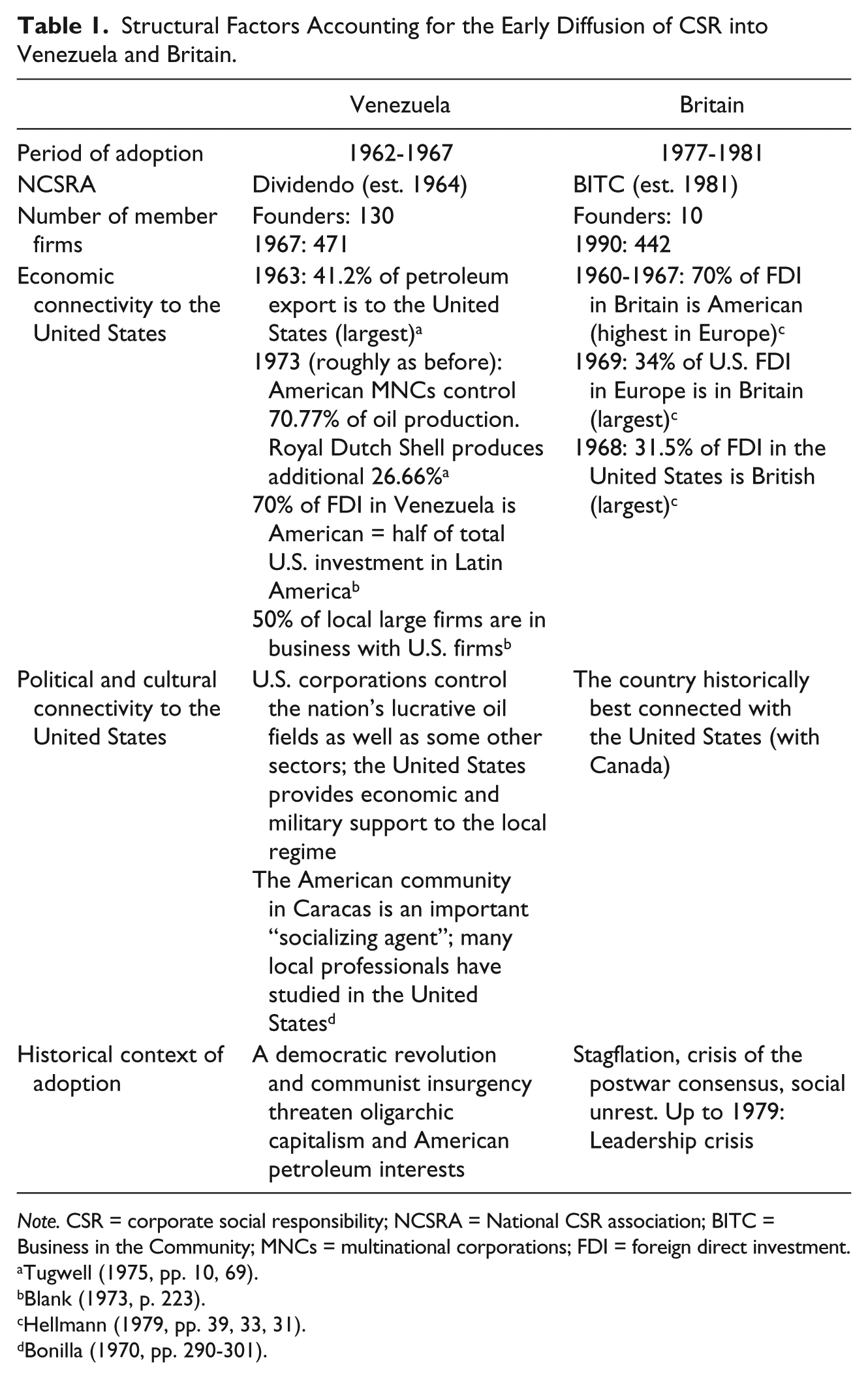
Note. CSR = corporate social responsibility; NCSRA = National CSR association; BITC = Business in the Community; MNCs = multinational corporations; FDI = foreign direct investment.
Tugwell (1975, pp. 10, 69).
Blank (1973, p. 223).
Hellmann (1979, pp. 39, 33, 31).
Bonilla (1970, pp. 290-301).
CSR Practices?
The practices that corporations adopted in the focal cases included private-sector social initiatives, corporate donations to development NGOs, and the lending of employees to community projects. It is important to stress that these practices were instances of modern, explicit CSR rather than of something else.
CSR has been defined by Matten and Moon (2008) as “clearly articulated and communicated policies and practices of corporations that reflect business responsibility for some of the wider societal good” (p. 405). Such were the practices of concern. Second, CSR behaviors are remarkably heterogeneous and innovative: One study lists around 200 different CSR practices, grouped into seven categories and 32 subcategories (Ashridge Centre for Business and Society, 2005). Under the categories of “community activities” and “stakeholder management,” the survey identifies the practices of “giving cash” and “giving employee time” to the community, as well as “partnering with charities and community organisations [and public authorities] for sustained involvement in resolving social issues” (Ashridge Centre for Business and Society, 2005, pp. 22, 20, and 23). The practices in question fall under those definitions. Finally, a universal feature of CSR practices seems to be the rhetoric attached to them: They are talked about as instances of CSR (indeed, “explicit CSR”; Matten & Moon, 2008). The practices in question were couched in an explicit rhetoric of CSR (or interchangeable terms).
Data and Analysis
The study of channels of diffusion entails “generation of complex and multidimensional narratives” (Djelic, 2008, p. 549) of their emergence, operation, and effects. Narratives, or “process research” (Langley, 1999), explain outcomes “as the product of unique, temporally ordered, and sequentially unfolding events that occur within cases” (Mahoney, 1999, p. 1164). Thus, in the construction of narrative explanations, the general criterion of validity is “to document as completely as possible the sequence of events pertinent to the processes studied” (Langley, 1999, p. 692). To meet this validity requirement in cases where processes “involve multiple levels and units of analysis whose boundaries are ambiguous,” data collection should be eclectic (Langley, 1999, pp. 692-694, 696; Rowlinson, Hassard, & Decker, 2014). Rather than working with one or two clearly delimited datasets, a variety of sources are collected in pursuit of as many useful pieces of information as possible; the narrative then weaves these into a richly detailed, multidimensional account.
Channels of diffusion are indeed multidimensional phenomena. Channels-of-diffusion theory prescribes the examination of three interrelated problems: (a) what was diffused, including how the original practice was modified in the process of transfer; (b) how exporter/importer actions and interactions facilitated (caused) diffusion; and (c) how the relevant historical context precipitated and shaped exporter/importer activity. Eclectic data—regarding the nature of diffusion, actors, strategies, actions, interactions, and structural and circumstantial context—are needed to address these questions. At the same time, the reliance on eclectic data comes with a methodological price: The analysis is less replicable than it could have been had the analyst focused on “a predefined set of chronologically continuous sources” (e.g., the contents of periodicals) or a quantitative dataset (Rowlinson et al., 2014, p. 265).
To support a multidimensional narrative, our data collection system was open-ended and accumulative. We started by searching the Web of Science and Google Scholar databases for secondary literature on pre-1990 CSR in Venezuela and Britain (using “CSR” and interchangeable terms—for example, “corporate responsibility”—as keywords). Second, we read books and articles on the political-economic context of 1960s Venezuela and 1970s Britain. Third, we procured all the pre-1990 documents archived with Dividendo and BITC. This initial search yielded useful information and, more important, provided leads for further exploration. Thus began a step-by-step process, throughout which the sources consulted progressively broadened the horizon of the inquiry and pointed the way to additional sources. The process was concluded when we felt that enough key pieces of the puzzle had been gathered, and that incoming data were no longer adding much to what we already knew. In sum, 104 texts were found that directly inform the current narratives. Fifty-eight of them are cited below and appear in the article’s reference list (see Table 2).
Properties of Textual Sources.

48 is the total number of speeches given in the 1963 Maracay Seminar (see below). Our narrative includes reference to common themes that cut across most of these speeches. Yet we bring quotes from merely two speeches, and only them are individually included in the reference list. The rest of the textual sources in Table 2 are included in the reference list.
All the sources in Table 2 are in English, excluding 33 Maracay speeches and the four Venezuelan organizational reports that are in Spanish. We used the services of a Spanish-speaking PhD to translate these texts for us.
In terms of reliability, we comply with “verification logic” by providing reference to all of our 104 textual sources (including all the Maracay speeches, which are contained in Maracay, 1963), thus allowing for external verification of whether or not they support our narratives (Rowlinson et al., 2014, p. 258). Second, it is conventional among historians that sources that were produced contemporaneously with the past in question are more reliable (Rowlinson et al., 2014, p. 255). As Table 2 demonstrates, the vast majority (roughly 90%) of the sources consulted meet this criterion. Those include, naturally, the primary sources but also most of the secondary sources—insofar as they were written by insiders to, or contemporaneous observers of, the processes in question. Third, to the extent that we drew from secondary materials, we were careful not to rely on observations and measurements that seemed to us under-substantiated. Here we also employed “data triangulation” (Denzin, 2006, p. 472), that is, we incorporated a piece of information only if it was found to be consistent with information provided by other sources.
Finally, in an attempt to further extend and diversify our data, as well as increasing reliability through “methodological triangulation” (Denzin, 2006), we conducted a small number of interviews with key players (n = 5) in the British episode (Table 3). The number of interviews conducted reflects our success rate in attempting to secure interviews with a larger number of living actors. (Unfortunately, all Venezuelan insiders were deceased by the time of our research.) Such deeply retrospective interviews raise problems of reliability. Hence, in a few cases wherein interviewee accounts contradicted our textual materials, we leaned toward the latter. Nonetheless, one of our informants who had been deeply involved in setting up BITC (Pelling) emerged as a treasure trove of highly detailed insider information that was invaluable for our Britain narrative. In his case, his mastery of detail as well as the consistency of his reports across a number of interviews indicated accuracy.
List of Interviews and the Identity of Respondents.

Note. BITC = Business in the Community; ARC = Action Resource Centre; LENTA = London Enterprise Agency.
In terms of analysis, narrative construction “involves construction of a detailed story from the raw data” in an attempt to communicate “the richness of the context to readers” and to provide an accurate description of the process at hand (Langley, 1999, pp. 695-697). At the same time, for narratives to generate transferable theoretical implications, they should be constructed around theoretical themes that “serve as sensemaking devices” (Langley, 1999, pp. 695-697). Thus, our analysis of the materials was informed by channels-of-diffusion theory, including the three problems mentioned above (what was diffused, exporter/importer activity, and contextual factors). For each country, we organized all the pieces of data collected that were relevant to these problems on a timeline. Second, we outlined causal links between earlier and later phenomena (e.g., a crisis broke at T, it produced perceived threats at T + 1, which encouraged the export/import of an adapted form of CSR at T + 2). Third, we assessed whether our data adequately supported those causal links and, if they did not, went on to search for more data. When we failed to find enough evidence or found contradictory data, we reconsidered the links. The eventual narratives interweave the links that were successfully established.
The narratives as a whole (i.e., the higher level intertwining of more specific links) are organized around one main theme that corresponds to the primary theme of this article: how exporters/importers trying to realize proactive CSR strategies facilitated diffusion. The strategies examined are of corporations and business leaders and, where applicable, other actors that were involved in diffusion (particularly the British government). “Strategy,” according to many definitions (e.g., Steiner, 1997), is about how organizations read the situation, set goals, make plans, and take systematic action to pursue the goals. The current analysis reconstructs strategies from the records of what key actors said about their assessments of the situation, rationales, goals, and plans. Second, it evaluates those utterances against (a) the historical context, (b) the actions taken by the focal agents, and (c) the translation into local organizational forms of CSR. When those elements clearly align, strategic agency is strongly indicated.
To increase clarity, the following Venezuela and Britain narratives are divided into three subsections. The first is “Local Adoption,” of which a brief overview is offered. Then, under the title “Context, Actors, and Strategies,” we empirically provide the background for the story of diffusion. Local-historical peculiarities decree much cross-case variance in the contents—For example, in Venezuela, exporters heavily populate this subsection, while in Britain it is importers. The third subsection, “Channels of Diffusion,” documents the exporter–importer interactions underlying diffusion and the nature and rationale of translation.
Venezuela
Local Adoption
The setting up of Dividendo marked the adoption of a CSR orientation by many of Venezuela’s large corporations and would serve to expand this process in the ensuing years. In Dividendo’s inaugural constituent assembly of February 1964, some 400 business executives ratified the organization’s charter, and 130 founding-member firms committed to making an annual contribution of 2% to 5% of their pretax profits to social causes, including through Dividendo. The objectives of Dividendo (1964) were to
1. “advance the principle of the responsibility of private enterprise in the country’s socio-economic development”; 2. “coordinate and further the activities of its associates in meeting that responsibility”; 3. “provide associates with the necessary information in the most effective way to cope with social problems”; 4. “administer funds supplied by its associates . . . in order to advance the community’s welfare.” 5. “endeavor to create among the public a true image of the role played by private enterprise in Venezuela’s social and economic development.” (p. 1)
Thus, in its fourth function, Dividendo resembled the American corporate foundation, but one that concentrates the collection of funds from the entire national corporate community. In addition, as was the case with the other objectives, Dividendo was entrusted with the promotion of a pro-CSR awareness and know-how among the nation’s firms, national-level coordination of CSR efforts, and enhancement of reputational benefits for the private sector derived from CSR engagements.
Dividendo would pursue these objectives energetically. Within a period of less than 4 years, corporate membership in Dividendo grew to 471, aggregate member allotments increased 50%, funds were allocated to 212 social action organizations, and 1,385 corporate volunteers were personally engaged in social projects (Dividendo, 1966, 1967a, 1967b). Dividendo soon emerged as an important planner, catalyst, and coordinator of private and public–private development initiatives in the areas of education, employment, agriculture, the family, and sports (Turner, 1979, Chapter 9). For example, in 1964, it initiated—in collaboration with church and state organizations—a program of prevocational schools which, by 1973, expanded to include 75 centers servicing approximately 27,000 students (Turner, 1979, p. 387). In another instance, Dividendo collaborated with social action NGOs on the establishment of “youth opportunity centers” where teenagers could receive educational and occupational support (Turner, 1979, p. 391). Finally, Dividendo advertised the private sector’s social responsibility through annual reports, bulletins and pamphlets, and radio advertisements (Turner, 1979, pp. 402-404).
Context, Actors, and Strategies
What explains the emergence of Venezuela as the world’s first country with an NCSRA? Our answer highlights the role of American petroleum MNCs (PMNCs) that, together with Royal Dutch Shell, had dominated the production of Venezuelan oil since the 1920s and that would emerge—by the early 1960s—as highly active exporters of CSR.
As long as the nation was ruled by a PMNC-friendly dictatorship, PMNCs enjoyed generous concessions, low taxes, and tremendous profitability (Tugwell, 1975, pp. 38-44). To illustrate, in 1954, Standard Oil of New Jersey’s subsidiary, Creole—Venezuela’s biggest PMNC—was producing as much oil as the entire USSR (the world’s third-largest producer), was the single largest American investment anywhere overseas, and accounted for 48% of the mother company’s dividend income (Taylor & Lindeman, 1955, pp. 1-2).
By that point (1954), though, PMNCs were already being pushed back. Several years earlier, led by the reformist party Acción Democrática, a short-lived populist revolution known as the trienio (1945-1948) had caused an abrupt jump in oil taxes from 16% to 50% (Lieuwen, 1954, Chapter VIII). While the dictatorship returned in 1948 and ruled for another decade, a world precedent had been set, and PMNCs were unable to restore tax rates to their pre-trienio levels. Thus, in 1954, while dividends were still high, Creole was paying US$232 million in taxes and royalties to Venezuela.
The trienio made clear for the PMNCs that future tax raises and, eventually, nationalization were not unlikely. Hence, as early as 1947, they moved to adopt CSR practices. The strategic rationale of PMNC CSR adoption was twofold: (a) to craft a friendly public image for them in the host country, and (b) to use corporate resources to actually improve the “standard of living of the Venezuelan people” that was seen as conditional to “an atmosphere favorable to the maintenance of [PMNC] business with satisfactory earnings” (a Creole executive, quoted in Wharton, 1954, p. 69).
The form of CSR adopted by PMNCs was a translated version of the CSR that was concurrently being institutionalized in the United States (Kaplan, 2015). In terms of a rhetorical shift, an American scholar familiar with the Venezuelan PMNC scene recounted that PMNCs’ traditional insistence on their “legal rights” had given way to a rhetoric emphasizing the PMNCs’ contribution to national goals (Wilkins, 1975, p. 318). Second, PMNCs instituted community relations schemes. Initially, Creole, Shell, and two additional PMNCs agreed to stream funds to the nonprofit American International Association for Economic and Social Development (AIA), which had been established a year earlier by Standard Oil shareholder Nelson Rockefeller. By 1954, the PMNCs streamed US$3.2 million to AIA, which invested in programs in the fields of agriculture, education, and health (Wharton, 1954, pp. 69-71). In investing in AIA, PMNCs were “concerned with three issues: avoiding high costs, insuring that AIA programs became Venezuelan programs, and gaining favorable publicity” (Rivas, 2002, pp. 163-164).
Within a few years, dissatisfied with the publicity generated, PMNCs discontinued their commitment to the AIA and went on to develop their own community relations capacities (Rivas, 2002, pp. 163-164). By 1955, according to an American study, Creole’s public relations department was realizing the company’s “public responsibility” through a plethora of community relations activities (Taylor & Lindeman, 1955). In 1955 and 1958, respectively, Creole and Shell set up their own foundations, which, like the AIA before them, invested in development initiatives that were not directly connected to the operations of the mother firm (Turner, 1979, pp. 296-300).
Meanwhile, beginning in the late 1940s, a handful of wealthy Venezuelan families established philanthropic foundations that bore their names, among which the most notable was the Eugenio Mendoza Foundation, established in 1951 (Turner, 1979, pp. 291-292). Mendoza, a leading industrialist, was a major trade partner of American businesses, an associate in at least one of Nelson Rockefeller’s social enterprises (Rockefeller himself was a director in the Mendoza Foundation), and future founder of Venezuelan CSR (see below). Yet in the pre-1958 period and up until 1962, domestic corporations hardly developed any CSR orientation.
The turning point was the 1958 democratic revolution that terminated the era of business-friendly dictatorship. Immediately upon their return to power, Acción Democrática reformists embarked on an ambitious plan to foster national development through statist means, an orientation that was perceived by many businessmen as a socialist threat (Friedmann, 1965, Chapter 1). Making things even worse for business, in 1960 an armed rebellion was launched by a vibrant communist movement that perceived the government as not socialist enough. This was the context wherein, in the 1962 Mérida convention of Fedecámaras (Venezuela’s premier business association), Mendoza issued a well-received call to create a development organization that would organize corporate engagements in social responsibility. Therein began Dividendo’s official process of establishment.
Channels of Diffusion
The unofficial process began earlier, with exporters. Post-1958, the PMNCs faced the gravest danger, for both Venezuelan reformists and communists were determined to nationalize oil whenever possible (nationalization would go down in 1976). Indeed, shortly after Acción Democrática’s electoral victory in 1958, it increased oil taxes from 50% to 65%. The PMNCs reacted by pursuing a new strategy for survival: to nurture an alliance with the domestic economic elites in the hope of buffering anti-PMNC steps by the government (Bonilla, 1970, pp. 298-299; Tugwell, 1975, pp. 32, 80).
The issue of CSR entered the agenda of this alliance following a 1961 study commissioned by the Creole Foundation, which revealed that seven PMNCs accounted for 90% of total private-sector financial contributions to education and welfare in Venezuela. According to a contemporary observer, that study led Creole to initiate the process that led to the establishment of Dividendo (Blank, 1973, p. 226). We do not know if Mendoza’s 1962 call to action had, in fact, been engineered by Creole. Still, American initiative factored into Dividendo in many ways.
Together with the Mendoza Foundation and the Venezuelan Executives Association, the Creole Foundation sponsored and implemented the planning process that led to the establishment of Dividendo (1962-1963). The key stage in this process was the Maracay seminar in February 1963, where business leaders, church educators, and development NGO people convened to discuss the prospective Dividendo. Of 48 speakers in the seminar, 13 (27%) were Americans, who typically congratulated the Venezuelans for the initiative and informed them about the American experience in CSR.
Our reading of the Maracay proceedings (Maracay, 1963) found that American speakers transmitted to the locals two leading strategic rationales for CSR adoption. (Many Venezuelan speakers reiterated these rationales, which dominated the conference. The following quotes are from American speakers.) First, an anti-communist rationale echoed the fear from the communist insurgency and emphasized the potential of private-sector development initiatives in undercutting communist recruitment and instilling pro-capitalist values and habits in the population: It is
essential for the social welfare of the community to be a major concern, so as to nourish the soil for the democratic process and for a viable society, and as an insurance policy, if you will, against ruthless mass passions and revolutionary upsets of useful institutions. It is in such a context that corporate responsibility, corporate opportunity, corporate participation must be evaluated. (Maracay, 1963, p. 139)
Second, an anti-statist rationale posited that corporations could, through collective adoption of CSR, check the expansion of governmental functions and acquire some control over the trajectory of national development efforts:
In the evolution of our system in the US, there has been a definite trend towards socialism. I think we would have to call it state socialism . . . Our fight, for those of us in free enterprise, is to keep these things in proper perspective in the U.S. . . . we feel that the general basic tendency of our government is to take on more and more of these things and we of the free enterprise system are trying to keep the thing in proper proportion [through private sector social involvement]. (Maracay, 1963, pp. 95, 97)
By leading their Venezuelan counterparts to recognize the anti-communist, anti-statist potential of CSR adoption, the PMNCs were seeking to broaden the base of the strategy they had already been pursuing on their own (impression management and investment in development to undercut anti-MNC and anti-capitalist insurgency). Now, faced by intensified statist and communist threats, they estimated that by recruiting the Venezuelan business community to the CSR effort, its favorable effects could be enhanced. This, it was hoped, would make the host environment more PMNC-friendly.
Finally, American influence decisively factored into the translation into Dividendo’s organizational design. CSR in the United States in the 1950s was largely decentralized, whereas each large corporation had its own CSR programs and corporate foundation (post-1950, the latter were set up by the thousands; Nelson, 1970). No NCSRA existed in the United States to catalyze and coordinate the effort at the national level. Rather, the world’s first NCSRA, Dividendo, was modeled on a PMNC organizational invention: the aforementioned arrangement with the AIA. That arrangement embodied the following model: a nonprofit that concentrates allotments from multiple companies and is managed by development specialists who invest the revenues in third-sector and public–private projects (Rivas, 2002, Chapter 6; Turner, 1979, Chapter 9). Thanks to the input of the Creole Foundation (or as a matter of learned imitation, or both), this would also be the organizational fabric woven into Dividendo.
Britain
Local Adoption
Founded in 1981, BITC began with 10 corporate members and strong involvement on the part of Margaret Thatcher’s government. The constitutive purpose of BITC was to oversee the diffusion of local enterprise agencies (LEAs) throughout Britain (Pilkington, 1984). The organizational model of LEAs entailed local-level mobilization of companies in collaboration with first- and third-sector agencies. LEAs were established to combat unemployment and urban decay by providing support to small businesses (mainly counseling and training services provided by corporate secondees). BITC oversaw the rapid proliferation of LEAs, circa 1981-1989, from 23 to 314 (Johns, 1991, p. 11). Simultaneously, by 1990, the number of BITC’s corporate members had grown to 442 (BITC, 1990), and they—along with hundreds of additional companies—collectively provided close to half of LEAs’ budget and staff (Marinetto, 1998, p. 63). The rest was provided by the central and local governments (Smallbone, 1991). This section accounts for the acceptance of and effort to disseminate LEAs, the leading organizational manifestation of modern CSR in Britain from the late 1970s until 1990.
Context, Actors, and Strategies
The context in which this process took shape was one of economic crisis and industrial and social unrest (Figure 2). During the 1970s, the economy increasingly experienced a tendency toward stagflation and, in 1976, high budget deficits and pressure on sterling led to a bailout by the International Monetary Fund. One of the important factors driving low productivity and inflation was labor militancy, which reached record heights during the decade. Allied with the militant unions and reflecting popular anti-capitalist sentiment, the 1974-1979 Labour government began its incumbency with a promise to “bring about a fundamental and irreversible shift in the balance of power and wealth in favour of working people and their families” (Labour Party, 1974, p. 20). Yet as Labour’s plans to increase state and labor control of the economy failed to pass, or passed but brought no notable recovery, the result was an “orgy of pessimism and self-doubt among British leaders” (Boswell & Peters, 1997, Chapter 7; Brittan, 1978, p. 245). Still under Labour, the 1979 Winter of Discontent saw the culmination of workers’ protests, with the public sector striking in opposition to pay restraint and 17% interest rates to fight inflation. Following her victory at the polls in 1979, Thatcher asserted leadership, but recovery was unsuccessful in the short term. Initially, the economy fell into a recession; more troubling, Thatcher’s monetarist policies dramatically exacerbated unemployment—which hitherto had risen slowly—from 5.4% in 1979 to 11.8% in 1984 (Glyn, 2006, Chapter 2). Riots in several major cities followed, culminating in the summer of 1981.

Indicators of economic and political crisis in Britain, 1965-1985.
Beginning in the mid-1970s, both state and business elites became concerned with urban decay. At first, however, responses to the problem diverged. Traditionally oriented toward public, top-down policy solutions, the Labour government passed in 1978 the Urban Areas Bill, which outlined a program of urban renewal based on public projects to be carried out by local governments, with the central government strongly involved in planning and resource allocation (Marinetto, 1998, pp. 58-59).
At the same time, British corporations began to do something almost unprecedented (with the exception of IBM UK; see below): They set up their own social initiatives, ones that typically operated at the local level, were public–private (run cooperatively by firms and local authorities), and focused on the boosting of small businesses. These were the pioneering LEAs. One of them, the Community of St. Helen’s Trust (CSHT), was established in 1978 by Pilkington Glass following massive layoffs by the company, which devastated employment in St. Helen; its efforts were focused on helping the unemployed set up their own businesses (Fazey, 1987). Another was the London Enterprise Agency (LENTA), which was set up in 1979 by a group of major corporations led by Shell and the London Chamber of Commerce. Following its establishment, LENTA would orchestrate the provision of secondees and other resources in support of start-ups and small firms by its nine corporate members (Barclays, BOC, BP, CFC, GEC, IBM, Marks & Spencer, Midland, and Shell; Wright, 1980). A few other enterprise agencies emerged in the same period, but CSHT and LENTA were the most famous and would serve as explicit models for the LEA movement of the 1980s.
The initiation of LEAs was informed by two interlinked corporate proactive strategies. As in Venezuela, one goal of CSR engagements—as long as social unrest persisted—was to mitigate anti-capitalist sentiments, which tended to thrive on unemployment and decay. For example, according to a LENTA (1980) research paper, “There is a real and justifiable fear that where whole communities have lost any real prospect of employment . . . there will be widespread alienation adding to what is already an increasingly hostile climate for business” (p. 15). Similarly, one of our interviewees recounts, “Many employers sought means to divert criticism for layoffs by supporting re-training and pressing for substitute jobs to come from the small firms locally” (A. Pelling, Interview, April 14, 2016).
Second, the specific focus on small enterprise boosting was consistent with the neoliberal plans of some key pioneers of the LEA movement. The most important among them was C. C. Pocock, Managing Director of Royal Dutch Shell and Chair of the London Business School. In his famous 1977 Ashridge Lecture, Pocock asserted that the road to recovery passed through the encouragement of small business within cities. Government and business had complementary roles in his agenda: Government should encourage free enterprise by cutting taxes, red tape, and employment and wage protections, and by neutralizing the resistance of labor unions to individualism, inequality, and risk. Corporations were to collaborate with local authorities in lending support to small entrepreneurs through the provision of training, advice, premises, equipment, credit, and purchasing and contracting opportunities (Pocock, 1977; see also Pocock, 1979a, 1979b). From this perspective, the role of LEAs was to help redirect the trajectory of national development along neoliberal lines—that is, emphasizing private initiative, competition, and risk-taking. Beginning with CSHT and LENTA (Pocock’s Shell was one of the latter’s initiators), LEAs would, indeed, embody the second part of Pocock’s blueprint: entrepreneurship-facilitating CSR action.
Pocock’s other wish—to see the government reshaping its involvement along pro-market lines—would be fulfilled shortly after the Thatcher administration took office. The new government altered the policy on employment and urban problems by placing new emphasis on wealth creation instead of public provision, forming “enterprise zones,” and identifying the small-firm sector as key to recovery (by 1983, 108 separate policies to assist it were enacted; Marinetto, 1998, pp. 60-61). In addition, as anticipated by Pocock, it acknowledged the compatibility of private-sector social action to its broader neoliberal agenda and, hence, turned LEAs into a national policy.
Business lobbying, with Pocock as a main player, helped to facilitate that acknowledgment. Two weeks into his tenure, the LENTA group introduced the new Secretary of State for the Environment, Michael Heseltine, to the LEA agenda. The meeting was hosted by Pocock at the Shell Center and included LENTA’s facilitators, Lord Byers (the Liberal Party’s leader and public affairs consultant for Marks & Spencer), Shell UK’s CEO John Raisman, and top executives of LENTA’s corporate members IBM, Barclays, Marks & Spencer, GEC, and BP. Additional attendees were Pilkington Glass’s Alastair Pilkington (who was also the cofounder of CSHT) and Anthony Pelling of the Department of the Environment (A. Pelling, Interview, April 14, 2016). Following this meeting and his subsequent visit to CSHT, Heseltine embraced the idea of LEAs. Consequently, the Department of the Environment and the U.S. embassy went on to co-organize the Anglo-American Conference on Corporate Community Involvement, to be held in Sunningdale Park in April 1980 (hereafter referred to as the Sunningdale conference). At the Sunningdale conference, the attendants arrived at a “clear agreement that the business sector had a major role to play in the renewal of local communities” (Pilkington, 1984, p. 15), and a working party was established to organize the setting up of BITC (on the role of the Sunningdale conference as a channel of diffusion, see below).
With BITC, the LEA movement turned from a private endeavor to a government-business one. Upon BITC’s inauguration in June 1981, Secretary Heseltine set as a target the establishment of 30 LEAs throughout Britain and, shortly thereafter, updated the number to 300 (A. Pelling, Interview, September 29, 2014). During the 1980s, the government was strongly involved in the management of BITC and initiation of LEAs. (See also Moon, 2004, on the role of the government in being a driver of CSR during the 1980s.) According to LENTA’s founding manager, by 1983, the private-sector initiative in the LEA movement had been “watered down” (B. Wright, Interview, April 13, 2016).
In this case, the political strategies of business and of the neoliberal government converged. In August 1981, while urban riots were at their peak, Prime Minister Thatcher bestowed on BITC her personal endorsement and offer of help. She noted, “I am convinced that there is scope for a much wider involvement of industry and commerce with local communities, and I am pleased that Government Departments are associated with you in your venture.” Thatcher (1981) added,
The recent troubles in some of our inner city areas well illustrate the need for action by all concerned. I hope, therefore, that you will be able to encourage more firms to take a keen interest in meeting the needs of those who live there.
In that critical moment, when her monetarist turn seemed only to aggravate the crisis, Thatcher’s wish to see CSR diffused among as many corporations stemmed from her hope that the LEA blueprint would serve as a viable mechanism of alleviation, an alternative to public provisions. CSR was consistent with Thatcher’s neoliberal revolution because it shifted responsibility from the state to the private sector and because its LEA variant was applied to promote a culture of entrepreneurship. At the same time, through CSR, corporations could improve their public image, help restore social stability, and promote the notion that CSR could substitute for state regulation of corporations and redistributive policies.
Channels of Diffusion
As mentioned above, urban problems in the United States had already exploded in the mid-1960s, leading to a quick, collective response on the part of most large corporations in the form of “urban affairs” programs. These programs included donations of cash, staff, executive time, and facilities, as well as hiring and training schemes for minority groups and the hard-core poor (Cohn, 1970; National Industrial Conference Board, 1968). In addition, American companies partnered with numerous local, public–private initiatives focused on urban renewal—for example, the Detroit Renaissance Group, formed in 1970 (McCabe, 1980).
By contrast, in mid-1970s Britain, when the urban challenge surfaced, corporations were slow to respond with CSR programs and public–private partnerships. This was so because in Britain, comparing with the United States, a conception of business as having a social, noneconomic role was less well-developed; instead, such a role was considered the domain of the interventionist government (Epstein, 1976). As has been detailed above, it took several years, several experiments (including CSHT and LENTA), government facilitation, and the creation of a central NCSRA (BITC) to reorient British business toward the LEA variant of CSR. Next, we will show that this reorientation was inspired by and modeled on the American example and included numerous learning interactions between British importers and American exporters.
A leading early exporter was IBM UK. By 1967, the subsidiary had already established the first PAD in Britain and thereafter initiated an employee volunteer program modeled on the one operated by the U.S. mother company. This was the pioneering institutionalized and publicized expression, in Britain, of what would later become a main organizational feature of the LEA movement: corporate lending of employees to community projects. Furthermore, rather than serving merely as a passive role model, IBM took active organizational steps to universalize its CSR approach among British firms. IBM’s PAD initiated, in 1970 and 1973, respectively, the United Kingdom’s two pioneering interfirm, public–private, CSR organizations: Trident Trust and Action Resource Centre (ARC). Trident and ARC functioned as catalysts of community projects and coordinators of secondments from hundreds of firms (Hargreaves & Dauman, 1975, pp. 263-268; Heap, 1977; Skey & Baxter, 1976).
The impact of these efforts on diffusion was twofold. First, they disseminated U.S.-originated CSR practices among the local companies directly affiliated with them. As reported by its director in 1976 to 1980, ARC was “the first systematic attempt in the UK to draw companies’ attentions to the need and potential of corporate social responsibility to the community” (Johns, 1991, p. 4). Second, the LEAs of the 1980s would resemble the organization model pioneered by Trident and ARC, including (a) centralized stimulation and coordination, at the local level, of corporate social action 5 ; (b) the public–private nature of the initiative; and (c) the use of manpower lending as the main resource deployed (ARC was a clearinghouse for company secondments).
Yet CSHT, LENTA, and subsequent LEAs—unlike the more eclectic pursuits of ARC—were oriented toward pursuing a specific organizational goal: the development of small business. In the late 1970s, this goal crystallized in the form of growing awareness to the urban challenge, as well as Pocock’s blueprint of entrepreneurship-facilitating CSR action. As it happened, both IBM and ARC were involved in this shift in focus. In March 1977, IBM’s PAD co-convened a conference titled “Creating Work Through Small Enterprise,” which concluded by recommending the establishment of “local or regional groups [of a cross-sector composition] . . . to provide advice and sponsorship of small businesses” (IBM UK & Urban & Economic Development Group [IBM & URBED], 1977, p. iv; Pocock mentioned this conference in his lecture the following November). In the same year, ARC began to study the problems of small businesses in the Islington borough and, in 1978, facilitated the establishment of the public–private, secondment-based Islington Small Business Counseling Service. The director of ARC at the time has since suggested that the LEA movement was directly modeled on the Islington initiative (Johns, 1991, pp. 8, 12; Interview, December 5, 2015). In 1995, ARC would merge into BITC.
While IBM—which was also a cofounder of LENTA and BITC—acted as an effective exporter of both CSR practices and CSR interfirm, intersector forms of organization, multiple additional U.S.–U.K. exchanges informed the establishment of LENTA and BITC. The British business and state elites that created these organizations were not only well aware of the American experience, they also saw themselves as coordinators in its application to Britain. For instance, LENTA’s founding director told us, “When we launched in April 1979 we thought we were copying a US idea” (Wright, Interview, September 10, 2014). BITC’s founding chairman saw his organization as catching up with practices long established in America: “Almost 20 years more experience has put the USA generally well ahead of the UK in terms of corporate social responsibility and collaborative action to regenerate communities” (Pilkington, 1984, p. 14). BITC’s communications director from 1985 to 1989 told us, “The US model was uppermost in my mind, and inspired many corporates” (Evans, Interview, September 22, 2014).
Learning was actively facilitated, first through a series of visits to the United States, circa 1978-1986, by LENTA, BITC, and Department of the Environment affiliates, most of them sponsored by two American organizations, the American embassy in London and the German Marshall Fund. The visits acquainted the Britons with, among others, New York’s National Urban League and New York Partnership, the Boston Compact, Philadelphia’s Old Town Development Corp., Cleveland Tomorrow, and CSR initiatives in Baltimore, Pittsburgh, and Minneapolis (Pelling, Interview, July 2, 2015; Wright, Interview, September 10, 2014). Transatlantic learning was also taking place on the level of the individual LEA. For example, the 1980-founded LEA Project North East was, according to its cofounder, “very heavily influenced by what we learnt from the US—both before we started and in our early years” (Grayson, Interview, April 15, 2016). Thus, following their 1982 visit to enterprise incubators in New York, Boston, and Baltimore, Project North East’s founders had established in 1983 Britain’s first Youth Enterprise Center, which was subsequently replicated by other Youth Enterprise Centers throughout Britain (Grayson, Interview, May 20, 2016; Grayson & Irwin, 1983).
Second, American exporters operated simultaneously in Britain. Two London-based Americans who “urged learning from the US example” (Pelling, Interview, September 29, 2014) and were involved in planning and networking for LENTA and BITC were Leslie Slote, vice president of RCA’s subsidiary (and former press secretary to Nelson Rockefeller), and Deputy Ambassador Richard Morris. Slote and Morris were also involved in initiating the consequential Sunningdale conference (see immediately below). An American visitor to London who influenced the process was the Rev. Leon Sullivan—the founder of Philadelphia’s urban development initiative Opportunities Industrialization Centers, a board member of General Motors (GM), and founder of the Sullivan Principles (a CSR initiative in South Africa). In another instance, following the Brixton Riots, a Citibank employee who had worked on low-cost social housing in Queens joined LENTA (Wright, Interview, September 10, 2014).
Third, the Anglo-American Sunningdale conference was designed “to provide the opportunity for an exchange of experience between those in the two countries” with regard to issues of CSR-based urban development (Department of the Environment, 1980, p. 1). Of the seven lectures included, two were given by CSR executives of American corporations (Bank of America and GM) and two by the leaders of U.S. public–private initiatives (Rev. Sullivan’s Opportunities Industrialization Centers and the Detroit Renaissance). A common theme running across the lectures was that corporations had to adopt CSR practices, first, because capitalism would be endangered unless corporations adapted to social change (the Bank of America executive titled his lecture “Dinosaurs Did Not Survive”), and second, because the U.S. experience demonstrated, according to the president of Detroit Renaissance, that “the public and private sectors can join in a partnership of business and government which can reverse that downward trend” (Department of the Environment, 1980, pp. 36, 69). The lectures provided information on American programs, partnerships, achievements, and methods of organization. The Sunningdale conference directly precipitated the establishment of BITC one year later.
Still, British adaptors exercised way more translational creativity than their Venezuelan counterparts. Starting with the initial prototypes set up by IBM UK, British CSR organizations embodied significant departures from American models—for example, the focus on secondments as a main CSR practice rather than on monetary contributions, which remained far less generous than in the United States. (Secondments had existed in the United States, but their rise to prominence in the United Kingdom entailed selective imitation.) As another example, the post-1977 concentration of most efforts at encouraging small entrepreneurship was a Britain-specific feature, tailored to a Britain-specific conception of the problem to be addressed. According to a Project North East cofounder, “we didn’t copy anything directly” (Grayson, Interview, May 19, 2016). Moreover, sometimes Britons preferred to camouflage imitation: “We seldom pressed US examples on prospective recruits to BITC causes. We tried to pretend to be home-grown” (Pelling, Interview, July 2, 2015). Finally, Britons implemented innovations that would, in turn, encourage instances of reverse-learning by Americans (Wright, Interview, September 10, 2014).
Discussion of Findings: Features of Business-Led Diffusions and Propositions
In focusing on two early diffusions of CSR, we have highlighted corporate proactive CSR strategies and applied a channels-of-diffusion approach, which shifts attention from the isomorphic pressures generated by the global environment to the role of exporter–importer interactions in diffusion (Djelic, 1998, 2004, 2008). As expected, the two processes examined vary considerably in many respects. For our purposes, however, the cross-case commonalities are more informative. In the following discussion, we build on the latter observation to develop a preliminary theory of business-led diffusions that strives to be parsimonious, testable, and logically coherent (Eisenhardt, 1989, p. 548). Specifically, we first identify three features of the construct ofbusiness-led diffusions of CSR, which (a) are common to our two cases and (b) clearly distinguish business-led from institutional-isomorphic diffusions of CSR. Second, we proceed from the features to develop four propositions regarding the conditions, dynamics, and effects of business-led diffusions. The propositions are induced from causal links between phenomena identified in the focal cases and whose existence in other similar cases is logically expected (Griffin, 1992; Skocpol, 1979).
Feature 1: Business-Led Diffusions Are Driven by Corporate Strategies That Address Political Threats and Opportunities, Rather Than CSR Norms
As anticipated, both focal cases saw the environment pushing corporations to export/import CSR practices. Yet the environments in question were not the pro-CSR global environments, which generate isomorphic pressures on corporations to voluntarily accept and expand their social responsibilities—for example, civil regulation frameworks. Rather, in postwar Venezuela and pre-Thatcher Britain, corporations reacted to environments that created pressure to curtail their functions and authorities. They adopted CSR in the context of these political threats, rather than of external, normative expectations for CSR.
In Venezuela of the early 1960s, change-seeking movements, elites, and sectors tended to perceive large corporations as bastions of the entrenched oligarchy (Tugwell, 1975, pp. 31-32). Accordingly, pressure for change was directed not at them but at other organizations in society. The leading one was the popular ruling Acción Democrática party (winner of the 1948, 1958, and 1963 elections), which enjoyed the support of peasant and worker organizations (Blank, 1973, pp. 228-235). While accepting the capitalist system, Acción Democrática was bent on advancing inclusive development, including higher taxes and reform of the pro-corporate system inherited from the era of oligarchic dictatorship. The other notable force attracting expectations for change was the communist movement, representing the slum-dwellers and poorest peasants and radical individuals and movements among workers and the middle class (Blank, 1973, pp. 190-192). In adopting CSR, corporations reacted to expectations of seeing their institutional position undermined, even destroyed, rather than voluntarily embracing a mission of social responsibility. Pressures of the latter kind hardly existed in Venezuela at the time of adoption.
In pre-Thatcher Britain, a radical Labour government, militant labor unions, and anti-capitalist sentiment fueled by urban decay and rising unemployment placed corporate freedoms under constant risk, and uncertainty persisted into the early 1980s. Unlike in Venezuela, in Britain of the 1970s, civil society was vibrant (Lent, 2001). Indeed, corporate targeting by activists was beginning to emerge, particularly in the context of British foreign direct investment in Apartheid South Africa and the global South (Fieldhouse, 2005; Muller, 1974). However, in the domestic arena, the vast majority of NGOs directed their pressure at the state, in pursuit of public policy reforms (Black, 1992; Dryzek, Downes, Hunold, & Schlosberg, 2003; Hilton, McKay, Crowson, & Mouhot, 2013; Lowe & Goyder, 1983; Vogel, 1986). At the same time, the Labour government and labor movement were promoting far-reaching collectivist blueprints for change. An example is the 1977 Bullock report on “Industrial Democracy,” which recommended supervisory boards for corporations with equal representation to unions and shareholders, plus a government-appointed deadlock breaker. (Business resistance and a more general lack of popularity would forestall the industrial democracy blueprint; Boswell & Peters, 1997.) The driving influence of CSR norms on adoption was negligible compared with the drive generated by the political uncertainty experienced by corporations.
Correspondingly, exporters/importers in both countries—as attested to by their expressed intentions, actions, and the organizational design of the CSR adopted (the nature of translation)—acted on political goals, not on competitive strategies of the individual firm (McWilliams & Siegel, 2001; Orlitzky et al., 2011), or manager and stakeholder internalization of CSR norms (Dashwood, 2012; Flohr, Rieth, Schwindenhammer, & Wolf, 2010). In Venezuela, the Dividendo-coordinated CSR was adopted in terms of a proactive CSR strategy seeking to undercut communist recruitment, curb state expansion, orient the trajectory of national development toward pro-capitalist directions, and dismantle the aforementioned public perception of business as the agent of reaction. In Britain, the proactive CSR strategy underlying the LEA movement reacted to the danger entailed in the corrosion of capitalist institutions caused by stagflation, rising unemployment, the deterioration of popular welfare, the ensuing trend of social disintegration and alienation, and the tendency of labor militancy and leftist radicalism to thrive on these conditions.
Those threats—in the context of which exporters/importers channeled CSR practices from the United States—were amplified by situations of crisis: the post-1958 crisis of oligarchic capitalism in Venezuela and the deterioration of the economy and postwar consensus in 1970s Britain. Political-economic crises in the receiving country predict business-led diffusions of CSR because, in times of crisis, threats to corporate capitalism tend to multiply.
Crises also predict business-led diffusions of CSR because they may create opportunities for favorable change that proactive CSR strategies can potentially help to seize. In such periods, as shared meanings and traditional arrangements are destabilized, various social forces put forward competing blueprints for change (Fligstein & McAdam, 2012). In the case of Britain, key importers such as Pocock advanced CSR as a component of a broader transformative agenda of recovery via liberalization. In this instance, the crisis produced not only threats that CSR adoption sought to preempt but also opportunities to step up liberalization, whereas CSR is established to undergird such transformation (by substituting private social initiative for public policies). This nexus between crisis, CSR, and liberalization explains the Thatcher government’s support of diffusion, which stemmed from its neoliberal orientation, and thus was unique to the British case. (In Venezuela, the pro-statist Acción Democrática government was suspicious of CSR, though it chose not to repress it.) Following the Thatcherite transition, the strategy underlying CSR adoption (the LEA movement of the 1980s)—by now a business-government strategy—was increasingly more about facilitating the neoliberal transformation than preempting intentions aimed at curtailing corporate rights and powers.
Feature 2: On the Country-to-Country Level, Business-Led Diffusions Are Learning-Based, Rather Than Isomorphic
Beyond the situation of crisis, Venezuelan and British corporations were early adopters because they were well connected to the exporting country: the United States.
Our findings suggest that the mechanism of diffusion in play was learning: The locals learned from Americans about the benefits and “how-to” of adoption (Rogers, 2003; Westney, 1987, p. 173). Learning from the experience of others is distinct from emulation: While emulation is to some extent irrational—an effect of the institutional connectedness of structurally equivalent agents—learning involves reflexive evaluation by agents of the prospects and potential utility of imitation (Lee & Strang, 2006). In contrast to “mindless emulation,” learners decide to adopt insofar as learning changes their “beliefs about cause and effect” (Dobbin, Simmons, & Garrett, 2007, pp. 460-462; Rogers, 2003, pp. 177-179).
The U.S.–U.K. diffusion was an instance of “learning from reference groups,” whereas the adopters prefer to model themselves on “countries that are similar to theirs” (Elkins & Simmons, 2005, p. 45). British importers widely believed that their own urban challenge was similar to the one that American corporations had engaged in since the mid-1960s with a perceived measure of success. Reckoning that they had much to learn from the Americans, they read about American CSR, made visits to the United States, and organized Anglo-American information exchanges. American “teachers” shared their experience with Britons, and some were actively involved in the creation of the British CSR arena, among them IBM UK and the American embassy.
An important hybrid of “students”/“teachers” were British MNCs familiar with American domestic or MNC CSR. MNCs spearheaded the establishment of LENTA and BITC and figured in the foundation of CSHT. (One of the two founders was an ex-Shell executive, and the other—Pilkington—was a member of BP’s board.) The most notable among MNC relays of learning was Shell, which had been exposed to American CSR (including in Venezuela) and, from 1977 on, emerged as a leading local promoter of British CSR.
In Venezuela, PMNCs’ efforts to push the locals into CSR adoption were so vigorous that their teaching bordered on “coercion”—if defined as pressures that “may be felt as force, as persuasion, or as invitations to join in collusion” (DiMaggio & Powell, 1983, p. 150). Still, the interaction between exporters and importers was mostly pedagogic. In the Maracay conference, PMNC affiliates and American experts in various related fields (e.g., labor relations) provided information that highlighted the anti-communist, anti-statist utility of CSR; shared U.S. experience and lessons derived therefrom; advised the locals about the specifics of adoption; and congratulated them (Maracay, 1963). A 20-month process of deliberation, evaluation of alternatives, and consensus building led to the establishment of Dividendo: a carefully designed, locally adapted instrument of CSR.
Unlike the top-down, rationality-constraining nature of isomorphic forces, learning is a mechanism of diffusion that operates horizontally and creates a connection between reflexive agents. In business-led diffusions, a nation’s corporations that face political threats and opportunities borrow CSR solutions from experienced others, or are pushed into adopting them by those experienced others—predictably, MNCs invested in the adopting country.
Feature 3: Intra-National Diffusion Is Driven and Shaped by Purpose-Inspired NCSRAs, Rather Than Global Models
The role of national-level business associations in bringing CSR into countries has received little attention (but see Kinderman, 2015; Marques, 2017). Matten and Moon (2008) suggest that such associations (they mention BITC as an example) are where firms come to “learn and develop best CSR practice” (p. 412). As implied, business associations, among other organizations, function as relays of global CSR norms and management knowledge.
Yet in business-led diffusions driven by proactive CSR strategies, these associations are the main vehicle by which exporters/importers disseminate CSR in the adopting country. As suggested by the cases in focus here, and consistent with Djelic’s (1998, 2004) observations of non-CSR diffusions, for small groups of exporter and importer elites who decide at some point to bring CSR into a new country, the establishment of a central organization to stimulate, shape, and coordinate CSR adoption among indigenous companies presents itself as a compelling way to pursue this goal effectively.
NCSRAs have several functions in respect to importation. First, considering that only collective action at CSR can potentially address the political threats and opportunities that drive importation, NCSRAs are tasked with mobilizing the nation’s corporations for collective CSR adoption. Mobilization takes place by assembling company members that commit to adopting the practices promulgated by the association and, more indirectly, exert pressure on nonmembers to join or imitate these practices. CSR frameworks such as the Global Compact embody a similar diffusional scheme (Gilbert & Behnam, 2012).
Second, while the Global Compact subjects its members to a code of ethics, NCSRAs incorporate them into a strategic plan. In light of this plan, NCSRAs coordinate the deployment of CSR practices at the national level. They collect and allocate resources, define goals, disseminate knowledge, coordinate efforts, and catalyze and operate public–private social initiatives. Coordination is informed by the proactive political goals underlying importation. For example, Dividendo allocated about half of its resources to education, because vocational training and instillment of conservative values were considered key to the sustainability of Venezuelan capitalism (Turner, 1979, pp. 386-398). BITC was tasked to generalize the LEA variation of CSR, which was designed to promote both stabilization of the social and political environment and its transformation along market-oriented blueprints.
Third, and as part of coordination, NCSRAs emerge as influential translators. The practices they disseminate are adapted to serve local goals and to fit local capacities. While the American CSR of the time had been largely decentralized, the architects of Venezuelan CSR opted for a centralized model, where corporate allotments of cash are streamed to Dividendo, and Dividendo’s development experts allocate the funds to selected NGO and public–private projects. In Britain, translation was a more gradual process that started with IBM UK’s CSR associations, further evolved through CSHT and LENTA, and was ultimately reconfigured and generalized through BITC. By the 1980s, CSR practices throughout Britain were largely shaped by the BITC-disseminated LEA variant of CSR, with its British-specific emphasis on the encouragement of small business and corporate secondments as the main resource in use.
Finally, NCSRAs are publicity and lobbying organizations. Publicity aims to amplify the corporate-favorable effect of CSR adoption on public and elite opinion. NCSRAs may engage in business community-level publicity, which portrays the private sector as a whole, as a force of progressive change, and CSR as a national-level pillar of development efforts. Dividendo was tasked “to create among the public a true image of the role played by private enterprise in Venezuela’s social and economic development” (quoted in Turner, 1979, p. 380). Lobbying addresses state elites in an attempt to gain their recognition of CSR as a welcome instrument of development and governance, and to suggest that the social capacities of corporations reduce the need for state intervention, thus paving the way for further liberalization. (For an analysis of lobbying by and around BITC in 1980s Britain, see Kinderman, 2012.)
While our case studies suggest that NCSRA establishment is predictable in business-led diffusions, their control of diffusion should not be exaggerated. Corporations may choose not to join them, and they (as well as joiners) may develop personalized CSR styles that fit better with their individual needs and capacities, and reflect more diverse sources of learning and imitation. Also, as suggested by the cases of Dividendo and BITC, NCSRAs that are established in the context of diffusion may well continue operation and expansion after the initial episode of importation is concluded, including adaptation of their operations to address new challenges. Subsequent to its first-decade, LEA-focused engagements, BITC “has taken a leading role in identifying and articulating a wider range of CSR issues for British business and it continues to work relatively closely with the Department of Trade and Industry” (Moon, 2004, p. 9).
Post-1990 Business-Led Diffusions?
The current theory of business-led diffusions is grounded in the study of pre-1990 processes, which took place prior to the emergence of a significant pro-CSR global environment. As we stated earlier, the return to the past has been advantageous in terms of simplifying the inquiry and thus allowing for the induction of parsimonious theoretical insights (Langley, 1999). Yet it also limits the applicability of the theory to the study of more recent instances of CSR diffusion. To address this problem satisfactorily, the theory should be tested on post-1990 cases of diffusion, which is beyond the scope of this article. In this section, we take a small step forward by speculating about whether business-led diffusions have persisted post-1990 and by providing implications for further research.
It is possible that such diffusions have not persisted. As historical institutionalists suggest, in the evolutionary course of an institution, the forces that reproduce it may be different from the ones that produced it in the first place (Thelen, 2004). It may be, then, that even if CSR began to diffuse through corporate channels as a corporate strategy, from a certain point on, civil, governmental, and intergovernmental actors “kidnapped” CSR and turned it—for example, through CSR frameworks—into a mechanism of regulation. Consequently, the impetus for business-led diffusions has diminished: If activists, governments, and transnational CSR frameworks disseminate CSR norms to which corporations can react, they no longer encounter the need to spread CSR through proactive efforts. It may be, then, that corporate agency in diffusion has been reduced to the choice of whether to adopt or evade legitimized practices available from the global environment.
While institutional-isomorphic accounts indicate that this has indeed been the trend in recent decades, we suggest that the full picture may be more nuanced. First, even if isomorphic diffusions have increasingly succeeded business-led ones, it is reasonable to assume that the transition has been gradual rather than abrupt, implying continuity of the latter into the post-1990 period. Second, as institutional-isomorphic accounts focus on CSR adoptions that stem from environmental pressures—for example, ISO 14001 subscriptions diffused through international trade (Delmas & Montes-Sancho, 2011), or the eradication of child labor in compliance with “international norms and expectations pertaining to CSR” (Jamali et al., 2017, p. 23)—CSR activity that originates independently from these norms and pressures remains below the radar of these studies. There is no certainty, then, that business-led diffusions have not persisted concurrently with isomorphic ones.
Consider a more positive indicator. As discussed above, a feature of business-led diffusions is their facilitation through NCSRAs. While the herein examined Dividendo and BITC were among the earliest NCSRAs, by 2010, 70 additional countries saw their NCSRAs established, 62 of them post-1990 (Kinderman, 2015). So far we know little about the impressive global diffusion of the NCSRA model. Taking an institutional-isomorphic approach, Kinderman (2015) hypothesized that NCSRAs proliferated in reaction to “global institutional pressure,” which was transmitted to the countries in question by international NGOs.
This may be partially correct, although historical timing presents a problem. According to Kinderman’s data, by 1995, 20 NCSRAs had already been established and, by 2000, that number had increased to 37. In these years, the pro-CSR global environment was still in its infancy: While some high-profile anti-sweatshop campaigns date to the early 1990s, most pro-CSR multistakeholder initiatives and state policies date to the late 1990s and the 2000s (Steurer, 2010; Utting, 2002). Can these developments explain the establishment of NCSRAs in, for example, Japan (1989), Hungary (1992), Peru (1994), and Bulgaria (1998)? Our own hypothesis would be that, among the NCSRAs established post-1990, an unknown number originated from business-led diffusions involving corporate-to-corporate learning and, as in Britain in 1980, attempts to seize political opportunities related to liberalization.
One source (Grayson & Nelson, 2013, pp. 246-261) implies that Britain has emerged from the 1990s—a period in which many countries underwent neoliberal turns—as an active exporter in business-led diffusions. Following its establishment in 1990, Business in the Community International (renamed International Business Leaders Forum)—an extension of BITC—has operated in a score of postsocialist and global South countries. The organization’s activity, which was based on “shared learning between experts from the region and their counterparts from the UK” (BITC, 1990, p. 248), spun off NCSRAs in Hungary (1992), the Czech Republic (1992), Bulgaria (1998), Indonesia (1998), Vietnam (1999), Poland (2000), and Slovakia (2004). In these and additional countries (including Russia, Brazil, and India), it promoted the idea of “partnership between business, civil-society organizations and government bodies” and fostered “business-led programs to support development activities tailored for the local market and led by local business leaders and staff,” in particular, encouragement of private enterprise (BITC, 1990, pp. 247-248).
In this story, the timing, exporter identity, NCSRAs, and focus on partnership and entrepreneurship all point to the possibility that the above-analyzed U.S.–U.K. business-led diffusion had present-day ramifications. Future channels-of-diffusion research could clarify the circumstances constitutive of British exporter interest in that list of countries, and probe the dynamics underlying diffusion—the actors and strategies involved, the context against which strategies and actions were shaped, and patterns of translation.
More generally, the diffusion of NCSRAs to dozens of other countries calls for comparative exploration. Across cases, how did locals learn about the NCSRA model? Were there other (non-UK) exporters in play? What are the common organizational features of NCSRAs, and how and why do they vary? And what has been their impact on the shape taken by other CSR institutions—for example, national pro-CSR policies? (Recall that in the Britain case, a business-led diffusion had evolved into a partnership with the incoming neoliberal government, which turned CSR promotion into a national policy.) We suggest that continued neglect of these and similar questions about NCSRAs, and, possibly, alternative instruments and forms of business-led diffusion, perpetuates a potentially significant gap in our knowledge of CSR’s globalization post-1990.
Contributions and Limitations
This article’s main contribution has been to bring to theoretical attention a heretofore unrecognized nonisomorphic, business-led mode of transnational diffusion of CSR practices. Drawing on NMS (Meznar & Nigh, 1995; Oliver & Holzinger, 2008) and channels-of-diffusion (Djelic, 1998, 2004, 2008) theories, we developed an approach for the comparative investigation of such instances of diffusion, including provision of testable propositions, that departs from and seeks to complement institutional-isomorphic accounts. We discussed the potential importance of additional inquiries into business-led diffusions for the generation of a more complete understanding of CSR’s globalization. We suggest that CSR diffusion studies would benefit from acknowledging both the institutional-isomorphic and business-led paths of diffusion, including future inquiry into the mutual interaction of these two paths, post-1990.
As part of developing our approach, we suggested that the meaning commonly attributed to “strategic CSR”—as the firm’s pursuit of economic performance through interaction with pro-CSR pressures and norms (McWilliams & Siegel, 2001, 2011; Orlitzky et al., 2011)—can be extended. We argued that collectives of corporations across borders may move to adopt CSR practices informed by their proactive CSR strategies, which are designed to act as a buffer against anti-corporate political threats and to exploit political opportunities to advance liberalization. This concept of CSR adoption and diffusion highlights the pertinence of CSR to macro-level political struggles and relations of power in societies, a nexus that is largely absent in the business and society literature, including the “political CSR” debate (Mäkinen & Kourula, 2012; Whelan, 2012).
A limitation of the current study is the question of its generality. Theory building based on case studies, while apt for the generation of novel theories, runs the risk “that the theory describes a very idiosyncratic phenomenon” (Eisenhardt, 1989, pp. 546-547). In this article, that risk is further enhanced, thanks to the historical nature of the materials, which calls into question the applicability of the generalizations made to more contemporary and future contexts. In the previous section, we have attempted to temper the problem of historical applicability, but further inquiry into additional instances of CSR cross-border diffusion—including testing of the current propositions and confronting the complexity added by the inclusion of the recently emergent pro-CSR global environment in the analysis—is needed to get a handle on the actual profusion of business-led diffusions.
This article’s historical contribution is to remove some of the ambiguity surrounding CSR’s past (Crane et al., 2015) by providing knowledge on the origins of what we called modern CSR, specifically, the beginnings of this construct’s global spread. Our research confirms previous assumptions regarding the U.S. origins of CSR, and the globalization of CSR as—in an important sense—a process of “Americanization” (Matten & Moon, 2008). Second, by demonstrating the business-led nature of pre-1990 diffusions, which diverges from the way in which most research perceives the dynamics of CSR diffusion today, this article has provided a historical perspective that raises new questions. In particular, what explains the transformation of CSR, around 1990, from corporations’ applied and diffused instrument to reshape their sociopolitical environments to a regulatory instrument employed by civil, intergovernmental, and governmental actors? How sharp has this shift actually been? And how and to what extent were corporations’ prior attempts to proactively reshape sociopolitical environments across borders, as discussed in this article, instrumental in bringing about the contemporary global CSR?