




Abstract
Companies seeking to effectively manage the ethical dimensions of their business have created formal and informal practices, including those with the labels “ethics and compliance” and “corporate social responsibility” (CSR). However, there is little research describing how practitioners who create and implement these practices understand their meaning and relationship. Leveraging a communities of practice theoretical perspective, this qualitative study proposes that these practices can be studied as artifacts of managerial learning. Thematic analysis of interviews with senior managers suggests that practices have diverse meaning, with only informal relationships between them in most cases. Theoretically, this research offers a new lens through which to view compliance and CSR practices as socially negotiated, contextual, and dynamic. Practically, it suggests that there may be new opportunities for learning if managers create practices through an intentional exploration of shared meaning.
Keywords
Companies seeking to effectively manage the ethical dimensions of their business have created formal and informal practices, including those with the labels “ethics and compliance” and “corporate social responsibility” (CSR). However, there is little research describing how practitioners who create and implement these practices understand their relationship. Two dozen in-depth interviews were conducted with senior managers in the United States to understand the meaning they ascribe to these practices and how they may be related.
Through a communities of practice lens, this research explores the meaning and relationships that managers give to the ethics and compliance and CSR practices they create and implement. This research contributes to the business and society literature by suggesting that practices are both contextual and dynamic. Additionally, applying a communities of practice lens offers a clear explanation for the lack of organizational alignment between compliance and CSR managers and practices. Finally, this research suggests that these boundaries could be purposefully bridged to create innovative practices if scholars or practitioners broker between communities and intentionally engage to create areas of shared meaning.
The article is organized as follows: First, the conceptual and empirical relationship between ethics and compliance and CSR practices is reviewed. Then, communities of practice theory is proposed as an alternate lens for exploring the meaning of ethics and compliance and CSR practices. Next, the research findings are presented based on in-depth managerial interviews. Finally, implications, including engagement, imagination, and alignment opportunities that could create shared meaning and steward innovation in the relationship between ethics and compliance and CSR, are offered.
Ethics and Compliance and CSR Practices
Scholars have been considering the role of business in society for more than six decades (Carroll, 1999), including the ethical dimensions of business (Crane & Matten, 2010) and a company’s responsibilities to its stakeholders beyond shareholders (Freeman, Harrison, Wicks, Parmar, & De Colle, 2010). Both normative and empirical studies have built a deep research field and yet the concepts of business ethics and CSR remain dynamic and contested in the literature (Crane, McWilliams, Matten, Moon, & Siegel, 2008).
At the same time, the practical implementation of business ethics and CSR in U.S. corporations has been explored through multiple lenses in the business and society literature, including in the form of ethics and compliance and CSR practices. There are many reasons companies implement these practices. Kurucz, Colbert, and Wheeler (2008) suggest that cost and risk reduction, gaining competitive advantage, increasing reputation and firm legitimacy, and creating value for business and society are the main justifications for investing in responsible business practices. Treviño, Weaver, Gibson, and Toffler (1999) have characterized the nature of those practices as being driven by compliance, values, external, and protection motivations, though their work did not contemplate how those practices might combine or overlap.
However, the conceptual relationship between business ethics and CSR remains unclear. Many scholars interpret business ethics and CSR as having a close relationship, as demonstrated by Fassin, Van Rossem, and Buelens (2011) in their summation of the debate and their comprehensive review of the literature on this topic. An adaptation of Schwartz and Carroll’s (2008) integration of existing frameworks and Fisher’s (2004) review of seminal teaching texts across the management and business ethics disciplines suggest three central interpretations:
They are equivalent, meaning that business ethics and CSR are conceptually the same thing just applied to different units of analysis or part of the organization. For example, business ethics applies to people and employee conduct and is, therefore, more of an internal focus, while social responsibility applies to organizations and business conduct and is more of an external focus (Davidson & Griffin, 2000). Joyner and Payne (2002) explicitly state that CSR and business ethics can be used interchangeably (p. 300).
One is part of the other, meaning that business ethics is one part of CSR or vice-versa. Many of the central models in the business and society literature take this view. For example, Carroll’s (1991) CSR pyramid includes economic, legal, ethical, and philanthropic responsibilities. Dahlsrud’s (2008) review of the term CSR describes five common dimensions, with “voluntariness . . . based on ethical values,” expressing the interrelationship (p. 4). Alternately, Goodpaster (1991) describes a company’s responsibility toward its stakeholders as a central tenet of business ethics.
They are distinct yet related, meaning that business ethics and CSR have different purposes, but also have some relevance to the other. Epstein (1987) was an early scholar to declare business ethics and CSR and a third term—corporate social responsiveness—as different yet related. From this perspective, business ethics has moral reflection at its core, CSR is focused on beneficial outcomes for stakeholders, and corporate social responsiveness is the decision-making processes managers leverage to take action, according to Epstein. He called for a corporate social policy process to ensure that business ethics and CSR were central inputs to a company’s decision making and, therefore, their responsiveness. Few scholars have focused on this distinction since.
Additionally, Schwartz and Carroll (2008) suggest that business ethics and CSR have both broad and narrow meanings. With its normative roots in moral philosophy, business ethics broadly defined incorporates ethics, integrity, and values, while a narrow definition focuses primarily on the law and compliance. CSR is driven primarily from the management literature, and while an early focus was on reducing harm to stakeholders, it has “appeared to shift over time to the more general notion of “doing good for society” (Schwartz and Carroll, 2008, p. 156). Their broad definition includes ethical and discretionary impacts, while a narrow one focuses primarily on economic and legal impacts. These definitions are visualized in Figure 1.
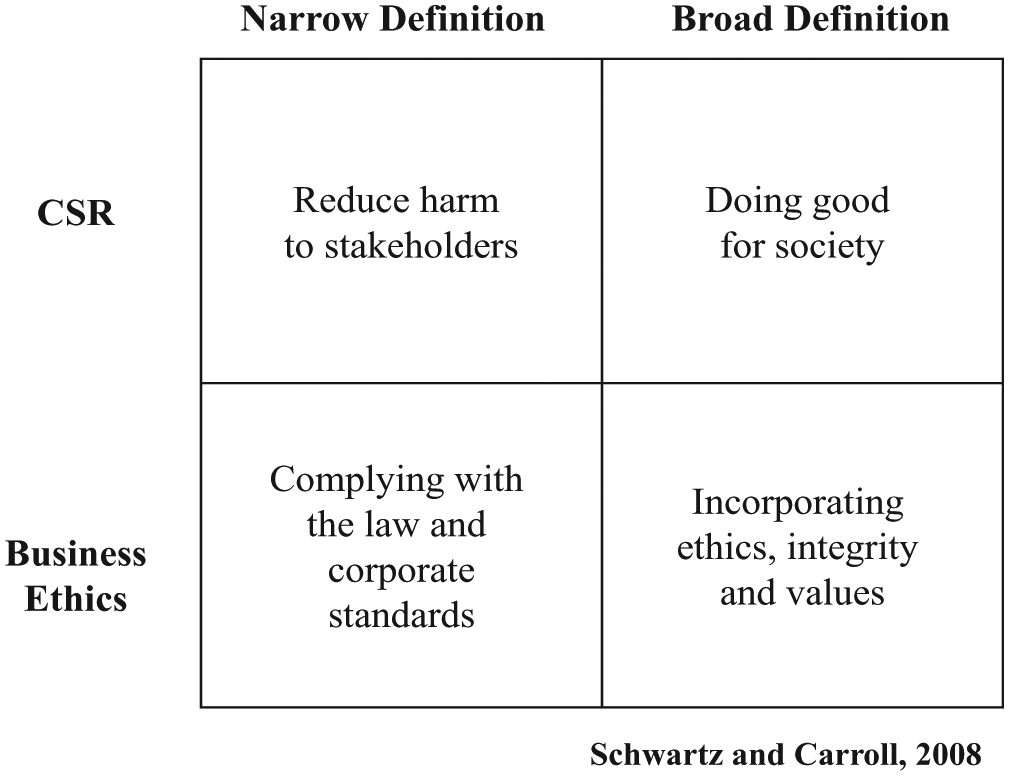
Defining CSR and business ethics in practice.
In contrast to the depth of debate around the conceptual relationships between business ethics and CSR, the relationship between the relevant practices implemented by managers in companies to manage this work has been examined less often. Bondy, Matten, and Moon (2008) looked at the relationship of practices from an organizational perspective by challenging the assumption that codes of conduct are tools managed by CSR programs. They concluded, “Codes are more often used as tools for governing traditional business issues such as ensuring compliance with laws and regulations, improving the corporation’s reputation, and guiding employees in terms of expected workplace behavior” (Bondy et al., 2008, p. 303). This study highlights the implicit assumptions made about how various practices interact and underscores the need to better understand their meaning and relationship in practice.
Houghton, Gabel, and Williams (2009) studied employee behavior and investigated the link between volunteerism and compliance with firm standards. While describing both practices as “faces” of CSR, their research acknowledged that “they may be administered differently within the organization,” with compliance linked to the legal department and CSR linked to human resources, marketing, or a standalone CSR function (Houghton et al., 2009, p. 478). The researchers found some evidence of a relationship between these practices but it was not conclusive and it appeared to vary based on the type of compliance issue and the nature of the volunteer activity undertaken by the employee. Additionally, the researchers state, “We have interviewed both Vice Presidents of CSR and Compliance Officers and found that they rarely work together or consult each other on their activities,” leading them to conclude that better alignment between practices would benefit the organization (Houghton et al., 2009, p. 490). This study demonstrates that more research needs to be conducted before the relationship between practices is well understood.
One way to increase this understanding is to engage directly with managers who create ethics and compliance and CSR practices. Treviño and Weaver (2003) found that while institutional pressure is the main motivator for company decisions to adopt relevant practices, importantly, managers have more influence on which practices are adopted and how they are implemented. Additional research has also shown that manager perceptions of these practices play an important role in their implementation (Banerjee, 2001; Hahn, Preuss, Pinkse, & Figge, 2014; Sharma & Good, 2013; Treviño & Weaver, 2003). As a result, this study seeks to describe the meaning managers make of their ethics and compliance and CSR practices to describe how they may relate to each other.
Communities of Practice Theory
To better understand the relationship between ethics and compliance and CSR practices, this research suggests looking through an alternate theoretical lens called communities of practice. Underpinned by a social construction epistemology, this approach helps to forefront the meaning of these practices as socially negotiated by the managers creating and implementing them. From this perspective, the practices themselves hold no objective meaning (Berger & Luckmann, 1966). Indeed, as Parker (1998) explained,
. . . if we accept this social construction of morality . . . then this effectively presses upon us a suspension of our judgment, an attempt to go (for now) beyond finger-pointing about good and evil in the interests of a thicker description of everyday conduct. (p. S29)
Practices become resident in communities of people who work with a common purpose and these communities can be found both within and between organizations (Brown & Duguid, 1991; Wenger, 1998). Because communities of practice develop around those purposefully engaged in common work, together they negotiate the activities and behaviors needed to get the work done and what that work means, with meaning being made more explicit through the creation of practices to transfer learning to other members (Roberts, 2006; Wenger, 1998). Brown and Duguid (1998) explain that social engagement and practice creation result in a “world view,” and that “a community of practice develops a shared understanding of what it does, of how to do it, and how it relates to other communities and their practices” (p. 96). As such, this perspective supports the exploration of practice meaning and community engagement by understanding how the managers undertaking the work make sense of it all.
This theory sits between theories of structure and agency on the one hand, and between theories of practice and identity on the other, positioning it as a midlevel theory (Blaikie, 2009; Wenger, 1998). Through the communities of practice lens, managers have agency in creating practices through social engagement within their work communities and these practices bring about structures and norms that then guide their interactions in the social world (Wenger, 1998). It also articulates these practices as a history of shared learning for those involved in creating them (Brown & Duguid, 1991; Wenger, 2000). As a result, one way to understand that learning is to engage with those within a community of practice to explore the meaning they have assigned to their activities and the relationship between their practices. That approach is taken in this study.
Communities of practice theory has had limited application in the business and society literature. The few studies that exist have focused effectively on leveraging the organizational learning benefits that come from communities of practice within the business and society context, and have chosen to focus less on its theoretical foundation in social construction (Benn & Martin, 2010; Griffiths & Petrick, 2001). However, with roots in the practice turn, similar explorations can be found in the accounting, marketing, organizational theory, and institutional theory literatures (Ahrens & Chapman, 2007; Jarzabkowski, 2004; Lawrence & Suddaby, 2006; Skålén & Hackley, 2011; Whittington, 1996, 2001). While there is not a singular approach under the practice turn, Schatzki, Knorr-Cetina, and Von Savigny (2001) suggest that overall it reflects a move away from dualist thinking and understands practices as “embodied, materially mediated arrays of human activity centrally organized around shared practical understanding” (p. 11). Practice-based theorizing has been widely applied in the fields of health care, education, and information technology (Whittington, 2001), but has had only an emergent application in the business and society field to date, specifically in the form of business ethics as practice (Clegg, Kornberger, & Rhodes, 2007; Painter-Morland, 2008).
Practice
The concept of practice is defined as,
doing, but not just doing in and of itself. It is doing in a historical and social context that gives structure and meaning to what we do . . . [and] includes both the explicit and the tacit . . . It includes language, tools, documents . . . [and] implicit relations, tacit conventions, subtle cues. (Wenger, 1998, p. 47)
Practices represent, therefore, both “the production and reproduction of specific ways of engaging with the world” (Wenger, 1998, p. 13). In essence, engaging in practice and creating practices in relationship with those sharing the same enterprise is how people learn.
Practices are constantly changing through the participation of community members and their attempts to make meaning more concrete and transferable through the creation of standards, routines, language, and tools. The meaning given to these practices is embedded in both the community of practice surrounding the relevant work, as well as the work experience of the managers creating and implementing them (Bechky, 2003; Brown & Duguid, 1998). It follows then that these practices are also artifacts of the meaning managers assign to their work at any given time, and, therefore, can also be used to demonstrate the evolution of their understanding of ethics and compliance and CSR practices over time.
Community
The process of becoming a legitimate member of a community of practice is identity-forming, according to communities of practice theory. In other words, “Membership in a community of practice translates into an identity as the form of competence” (Wenger, 1998, p. 153). Participation and nonparticipation are key concepts in communities of practice because they determine how members understand their own work and its meaning in a broader context, as well as those with whom it is important to interact or avoid, what is valuable to learn or bypass, and how time and talent are spent (Lave & Wenger, 1991). Participation and nonparticipation also create trajectories that can lead to becoming a more central member of a community or to leaving the community all together.
Participation can result in a sense of belonging to a community of practice, and there are three parts to the concept of belonging: engagement, imagination, and alignment. Engagement occurs when members of a community are actively involved in negotiating the meaning of their practices. Imagination relates to the ability of members to visualize or consider options outside their current context or new ideas about their own identities (Roberts, 2006; Wenger, 2000). And through the communities of practice lens, alignment between practices is not understood as a strategic or operational process, but instead as an identity-forming process aimed at “coordinating energy and activity in order to fit in with broader structures and contribute to the broader enterprise” (Wenger, 1998, p. 174).
Research Method
This qualitative study seeks to understand the meaning managers give to the practices they create and implement. As such, the goal is not to clarify a truth or reality, but to provide an interpretation of the interviewees’ perspective (Alvesson & Skolberg, 2000) by gathering an insider’s view and in-depth descriptions of practice through interviews with those directly responsible for creating and implementing ethics and compliance and CSR practices. By seeking to paint a rich picture of the meaning behind these practices, this research offers a thick description of practice to the business and society literature, and encourages future practice studies.
Similar studies focused on workplace and professional learning support the choice of qualitative interviewing to explore and describe work practices. The focus of these studies is to describe meaning from the subjects’ point of view, including that given to their practices and their engagement with others in context of work (Boud & Middleton, 2003; Hall-Andersen & Broberg, 2014), which is also the approach taken in this study.
To understand these practices, the author conducted 21 interviews in 2012 and 2013 with senior managers who self-described their work as related to ethics and compliance or CSR practices. 1 These managers represented 19 companies from diverse industries, including five business services companies, four health care companies, three manufacturing companies, two retail companies, two financial services companies, plus one mining, one transportation, and one conglomerate company. Thirteen companies were public, four were private, one was a mutual company, and one was a not-for-profit service provider. The managers held titles such as Chief Ethics and Compliance Officer and Senior Vice President of Corporate Responsibility and Risk Management. Table 1 contains a comprehensive overview of the managers interviewed.
Interview Descriptions.
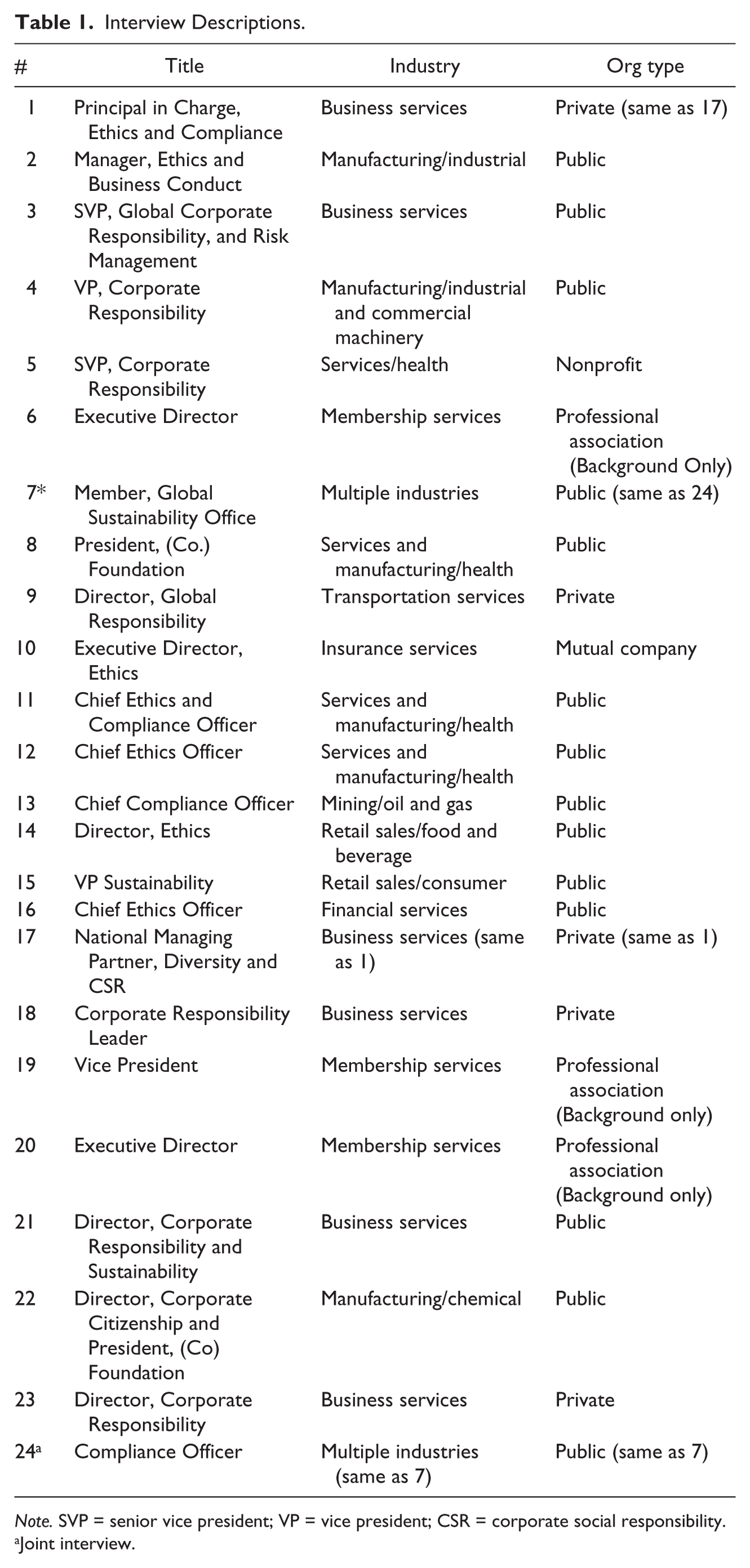
Note. SVP = senior vice president; VP = vice president; CSR = corporate social responsibility.
Joint interview.
Potential conversation partners were identified by reviewing the members of the boards of directors for the major professional associations in the ethics and compliance and CSR fields in the United States, namely the Ethics and Compliance Officer Association (ECOA) 2 and the Society for Corporate Ethics and Compliance, as well as Business for Social Responsibility (BSR) and the Corporate Responsibility Officers Association. Engagement in membership organizations was used to signal managers’ integral involvement in shaping, and being shaped by, current and future ethics and compliance and CSR practices, a distinguishing marker of central members within a community of practice. Several additional managers were then purposefully selected because previous research identified their companies as having an intentional approach to the relationship between their practices (ERC Fellows Program, 2011).
From that pool of managers, two additional criteria were applied to identify those to invite for an interview, namely their level of seniority and experience, and the size and location of their company. Senior managers with significant knowledge of, and experience in, one or more area of responsible business were identified as a proxy for competence. Additionally, senior-level positioning provided greater likelihood that these managers had both been responsible for creating practices and for justifying those practices within the wider organization, thereby providing greater opportunity for reflection on their meaning. Managers who worked for companies with revenues greater than $1 billion that have their headquarters or significant operations in the United States were also identified to ensure all participants were representative of large companies, where responsible business practices are noted to differ from small- and medium-sized enterprises (Spence & Painter-Morland, 2010). Additionally, this research sought to focus primarily on the United States, as scholars have noted the differences in the U.S. political economy that has resulted in a distinct set of ethics and compliance and CSR practices than might be found in other countries (Matten & Moon, 2008).
The interviews were semistructured and began with a set of questions that sought to explore the meaning of managers’ practices and the communities in which they engaged to create and implement those practices. Questions related to practices included: How did you develop your understanding of your field/work? What path did you follow and from whom did you learn? What concepts, tools, documents, or lore are essential to “getting” your field? In other words, what would you encourage a new practitioner to understand/explore/figure out? What do you think is the goal of your profession? Questions related to community included: What people/departments do you work with to get your job done (functionally and cross functionally)? What is the common goal? What skills or experience do you think are essential to being successful in your field? What would be left out of a formal job description? Are there related fields/work that provide an obvious transition into this work?
In all cases, the discussions incorporated new questions and ideas generated by the managers and, therefore, went beyond those represented in the interview guide. Interviews were transcribed, cleansed of identifying information, and were then coded both structurally around the interview questions and around emergent themes related to participant experiences and understanding (Saldaña, 2009). This process was both inductive and reflexive to interpret each of the manager’s meaning (Alvesson & Skolberg, 2000; Denzin & Lincoln, 2005) in the volume of interview text collected. Codes include practice and community as primary theoretical themes, as well as boundaries and identity as emergent themes from the interviews. The practice code was used to note descriptions of role, career path, key learning, major career milestones, and the purpose of the participants’ work or profession. The community code was used to note descriptions of internal partners, shared goals, and external engagement. The boundaries code was used to note descriptions of divergent practices, partners, or communities that were identified by managers. The identity code was used to note descriptions of competencies that managers shared that they believed distinguished them from other professions and professionals.
Findings
This study produced three significant findings. The first finding is that practices have diverse meanings as described by the managers that create and implement them, and they exist to manage a variety of ethical challenges and pressures. As such, ethics informed the meaning of both compliance and CSR work and was not used as a label by managers to describe a distinct set of practices. Additionally, there were several different work communities internally and externally which managers identified, and they saw important distinctions in their practices. Finally, most managers created informal relationships between these distinct communities of practice, with only a few instances of formal organizational structures linking compliance and CSR managers.
Practice
Managers described a diverse spectrum of meaning related to their practices and the reasons they were created. The practices were artifacts of managers’ responses to a wide range of ethical challenges and opportunities. Some practices were intended to prevent misconduct and these tended to have strong legal and regulatory ties. For others, practices were expected to create positive impact and are more closely tied to business model innovation and social and environmental change opportunities. Based on manager descriptions, ethics served more as a conceptual adjudicator of right and wrong or good and bad practice in anchoring the meaning of compliance and CSR practices, and was not described as a distinct set of practices in and of itself.
Some managers discussed practices including hotlines, nonretaliation policies, and employee training, and referenced “compliance” or “ethics and compliance” as the bucket into which their practices fell. Manager 2 described his practices succinctly by saying, “We want to help people make good choices and that’s to reduce the risk that our company faces.” Manager 10 said, “[W]e view ethics and compliance . . . as a problem management/risk management function and at least as far as ethics goes a success metric for a CEO [chief executive officer] is not hearing from their ethics person.” Manager 13 said, “I can . . . answer that by the letter of the Federal Sentencing Guidelines which is to prevent and detect misconduct.”
At the other end of the spectrum, managers discussed practices including stakeholder engagement and product and service innovation, and broadly described their practices as “corporate social responsibility.” Managers used language that described their work primarily in terms of impacts and value creation. Manager 17 said, “[In] the corporate responsibility profession, the goal should be enhancing the value of the enterprise and the communities. It’s that shared value notion.” Manager 9 described the purpose of her work as “using the resources in the span of her control for the maximum benefit of society,” with specific emphasis on leveraging competences around company products and services. She described a new initiative in her company, saying, “We’re one of only three companies in the world with the skill” to address a global societal problem and that the company, therefore, had an imperative to use their abilities to do so. And Manager 23 said, “[The] higher meta-goal . . . is to bring business to the table as an actor and a player in solving some of those vexing societal challenges that we have.”
Managers also described several areas where practices shared or could share meaning. Managers suggested that values, standards of conduct, and decision-making behaviors at both the individual and organizational levels were a common logic across practices in some organizations. Manager 15 described it by saying, “To me the natural nexus is it’s all about operating responsibly, whether it’s the internal associate or external. It’s all around the values of the company and how the company is living those out. It’s all about doing good.” However, no one described these as ethics practices and instead described ethics as an umbrella concept or logic informing compliance and CSR practices
On the other hand, some managers felt strongly that a focus on compliance practices often undermine their relationship to ethics. Seeming to reject a definition of ethics as the absence of misconduct, they expressed the view that ethics had more in common with CSR than with compliance practices. Manager 15 shared that
at the end of the day, most Ethics & Compliance programs are more about compliance. And at the end of the day, CSR programs are more arguably about ethics or . . . responsibility. It’s the gray areas that [are] most of what we’re dealing with in sustainability and corporate social responsibility, not compliance with law, but it’s going way beyond that. In dealing with doing what is right and doing good. So those are really separated. It’s not about compliance.
And in parallel, managers described the increasing emphasis on compliance practices within U.S. multinationals as a simple reality. Manager 8 said,
[We’re] in a world of compliance. You know, not that it’s anybody’s fault but that’s kind of the world we are forced to live in because of the enforcement of laws and the world of litigation and inspector generals that we have to deal with. You become a little bit hyperfocused on compliance.
Manager 7 stated, “Business ethics is really about compliance . . . [and] compliance is adhering to rules and regulations.”
However, managers with a strong risk management orientation saw some emergent overlap of meaning between compliance and CSR practices, in particular around supply chain risks like human rights, conflict minerals, and transparency requirements. One manager suggested that a movement from voluntary to compulsory standards in the United States has caused compliance and CSR practices and their managers to “swim in the same pool.” Manager 14 stated that
our needs are somewhat similar when we look at supply chain risk. The goal of the Global Responsibility team around ethical sourcing is all about supply chain, ensuring that the product is sound, etcetera. And then we’re looking at things like anti-corruption risk and OFAC risk and conflict minerals risk.
Notably, two managers who had formal responsibility for practices they described as both compliance and CSR tied them together using a risk management logic. The codification of voluntary norms into regulatory norms, therefore, has provided the opportunity for shared meaning across compliance and CSR practices in some organizations.
At the same time, some managers with a strong compliance focus expressed concerns that their practices could be made less effective if they were managed alongside CSR practices. Manager 13 said, “If C[S]R becomes the tail wagging dog of compliance, it will have a negative impact on the company . . . When the compliance and ethics program becomes an instrument of corporate responsibility . . . , [it] will atrophy” because of the lack of prioritization of the company’s top risks. Additionally, managers that saw compliance as an important and central role for their organizations were more likely to dismiss CSR practices as an “aspiration” or trying to “get credit,” and did not share the view that CSR practices can be value creating for the company. Manager 17 said bluntly “You want to make sure that you have the compliance piece not muddied with the corporate responsibility piece.”
A final theme in understanding the diverse meaning of practices was the change noted by several managers that practices focused on philanthropy and volunteerism were giving way to practices focused on value creation and business impact. Manager 9 said, “I wish I could have exited the building and come back as a different person with a different name,” because senior leaders thought of her as “the nice lady who manages the community programs,” and it took longer than it should have to educate them about evolving CSR practices as connected to core business and strategic issues. Manager 17 said,
We were very intentional in dropping the term “social [from Corporate Social Responsibility]” . . . Any time you throw the term “social” out or “philanthropy,” it’s kind of the do gooder, right? And it’s harder to connect it with the overall business strategy.
Manager 23 said,
As C[S]R has matured, in some respects, it’s become kind of the innovation center, if you will . . . I see . . . a good C[S]R program, and one that is strategic about what it’s doing . . . as almost being an incubator of [shared value]. That’s how I approach it.
Community
Another finding is that managers self-identify into distinct work-related communities. Broadly, those whose described their practices under the “compliance” nomenclature saw themselves as distinct from those who use the “CSR” nomenclature and vice-versa. This distinction was exemplified by the number of managers who expressed having limited understanding of the practices under other labels. For example, Manager 1, who was a long time compliance executive, said,
For the people that are uninformed and uninitiated about [CSR]—and everybody’s still learning, including me—there needs to be a conversation, a dialogue. Some awareness, training, good research, little news bites, there needs to be a buzz for people to start to understand . . . [we need to] move to a mindset beyond recycling bins.”
Manager 8, who had been an “ethics and compliance officer” before moving his career into “C[S]R,” shared his surprise when taking on his new role that “C[S]R was a real profession,” and had “such a large group thinking about it.” He also discussed the large volume of knowledge and competences he had to develop beyond his ethics and compliance expertise to manage his CSR responsibilities, including reporting, philanthropy, running a foundation, and understanding environmental issues. Manager 13 went as far as to express distrust of her CSR colleagues, saying, “A compliance and ethics person should review the corporate social responsibility report because I personally have read sustainability reports written by corporate social responsibility types that make outrageous claims.”
This delineation between work communities was also communicated by managers when discussing competence, a cornerstone of identity. For example, Manager 16 said, “I only look to attorneys to build out our program” because a bulk of the job involves [hotline] case management and investigation, adding that when their ethics and compliance program was reorganized, there were not a lot lawyers and that “had to change” because “they couldn’t spot issues and couldn’t provide advice.” Manager 17 suggested that senior CSR managers “ . . . need to have some financial acumen because you can’t operate in this space without understanding what really is the investment that we’re making, how do we measure success.” Two managers who combined compliance and CSR practices also viewed themselves as outliers within their professional communities. Manager 3 said, “I feel like I’m an ethics scientist in a lab sort of mixing things up.”
Additionally, distinct communities emerged when analyzing the internal and external colleagues that managers described as key partners, the colleagues with whom managers engage to learn about and negotiate their practices, and with whom they partner to perform their work. Those with compliance practices under their charge described their primary internal engagement with the Audit Committee of the Board of Directors, internal audit, legal department, human resources, the equal opportunity liaison, and the security team. Those managing CSR practices work with internal partners including the Executive Team (CEO, chief financial officer [CFO], etc.), legal department, human resources, brand and marketing, public and government affairs, sustainability, and diversity and inclusion. And despite the fact that all but three companies represented in this research had distinctly structured departments for “ethics and compliance” and “CSR” practices, only one manager with CSR practice responsibilities named their ethics and compliance counterpart as an important partner, and none of the managers with compliance practice responsibilities named their CSR colleagues as playing that role.
The external partners described by managers as key collaborators from whom they learned also differed. Like a number of CSR managers, Manager 22 shared that “[One] place that I gravitated towards was the U.N. Global Compact, once we became a member in 2007, has been a key place for learning.” Similarly, Manager 9 said key external partners included Boston College Center for Corporate Citizenship, Committee for Encouraging Corporate Philanthropy (CECP), and BSR. Ethics and compliance managers pointed to organizations such as the ECOA 2 , the Ethics Resource Center, 2 and Bentley College’s Center for Business Ethics as key external partners for learning.
Manager 14 also described a disconnect between these external stakeholders when he shared that he went to a BSR conference back in 2003, thinking “doesn’t it just fit?” with his ethics and compliance responsibilities but said he found little at the BSR conference that helped to inform his practice. Manager 8 echoed this sentiment by saying,
Look at the conferences that are being offered. You see things that are directed toward compliance and things that are directed more to corporate social responsibility. I don’t think that there is anybody that I’ve seen that thinks about the intersection of the two.
Practice and Community Relationships
The majority of the managers interviewed described informal relationships between compliance and CSR practices and managers, ranging from a once-every-3 year conversation about the Code of Conduct to joint service on relevant leadership committees, as noted in Table 2. Manager 11 shared this perspective when saying,
Where is the line between corporate social responsibility and ethics and compliance? I don’t think there’s a line . . . [however] I think there’s a difference between the fit or lack there of conceptually and the fit or lack thereof organizationally.
Organizational Relationship Between Ethics and Compliance and CSR.
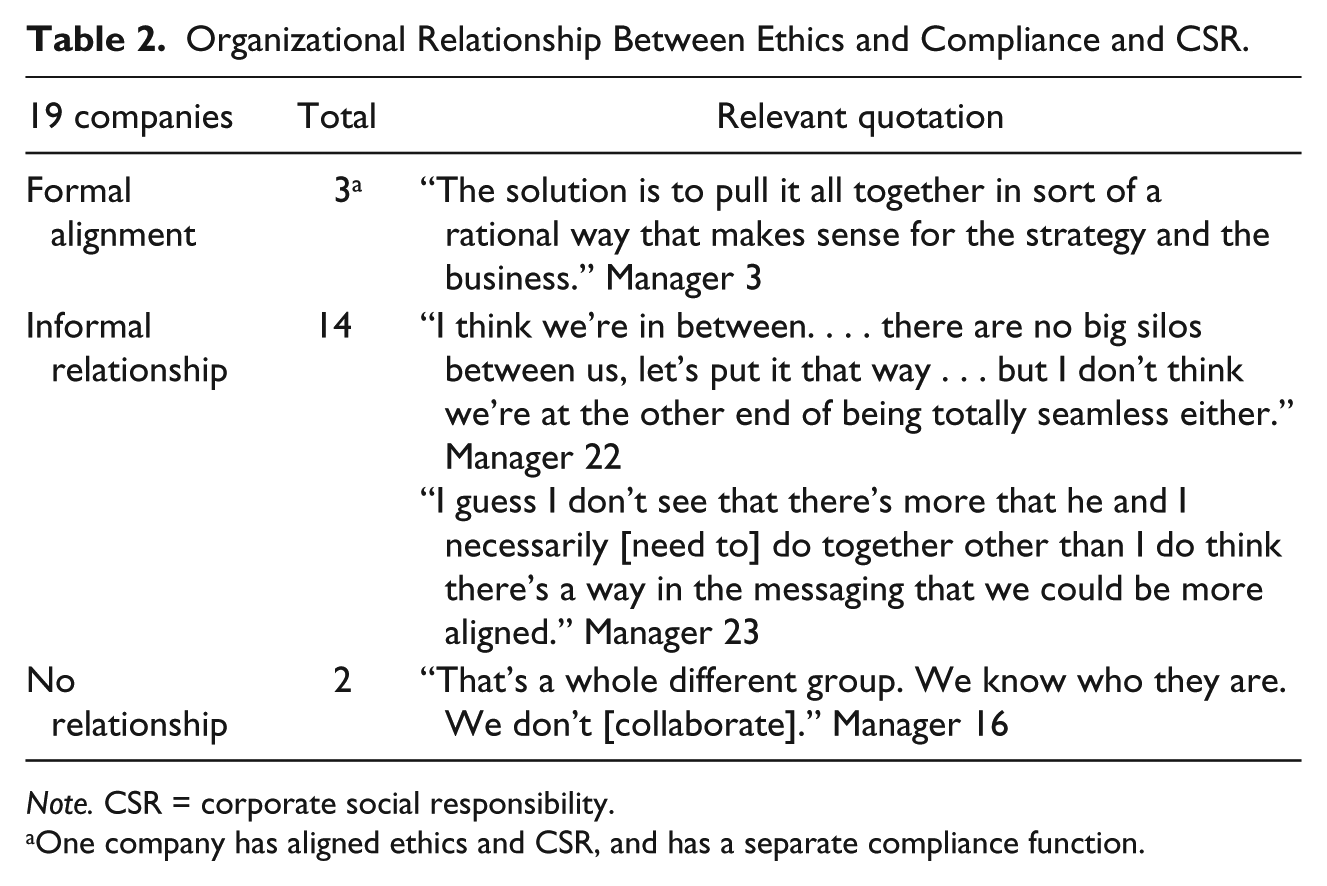
Note. CSR = corporate social responsibility.
One company has aligned ethics and CSR, and has a separate compliance function.
Manager 14 said, “The overlap, the extent to which there are synergies . . . is where . . . I see the growth occurring. I’m under the impression those two circles will never overlap entirely.” Manager 22 stated, “I think we’re in between . . . there are no big silos between us, let’s put it that way . . . but I don’t think we’re at the other end of being totally seamless either.” And as was described in the first finding, some managers found that the presence of a strong set of compliance practices ensured there would not be a close relationship with CSR practices and managers. Manager 5 said, “To the extent that the ethics and compliance function or ethics and compliance program activities are more compliance in their orientation, the harder it will be from my perspective to get synergies with corporate social responsibility.”
None of the managers interviewed expressed a view that engagement or practices needed more formalization or to be connected structurally. Manager 12 described how “we’re interconnected,” yet said that aligning practices was “not something you can devise from organizational structure—it has to be organic.” Similarly, Manager 18 also rejected the need for structural alignment, saying,
People can get hung up on the location of these things. So I try not to care too much where corporate responsibility [sits]. I think it’s about whether or not it’s an organization that regardless of where things sit, you can bring together these groups to have a good working relationship . . . . It doesn’t matter that Ethics reports up to a different side of the organization than CR does, and I think people sometimes feel that unless everything’s under one umbrella, like Corporate Responsibility maybe is actually reporting to Ethics . . . it’s not about that. It’s about being able to navigate the organization in order for those silos to be able to work together.
Manager 14 describes his colleagues in the CSR program as “bedfellows,” but that he does not expect the “utopia” of combining practices. Manager 22 said,
There are some episodic situations where the two conversations come together at a fairly senior level around corporate responsibility and ethics, kind of the external and internal being viewed in the same conversation, but we don’t have an ongoing structured mechanism other than that.
The structural alignment of compliance and CSR practices and managers was rare but present in two companies. When asked if other senior managers shared his more comprehensive view of how compliance and CSR practices fit together, Manager 4 said, “Honestly? No . . . it’s sort of tunnel vision.” Manager 15, when asked about structurally aligned programs was able to share one example and then said, “That’s the only one that I know of [where] there has been kind of a mixing of those . . . two responsibilities.” Importantly, both of these managers expressed that the shared meaning across these practices as one of risk management.
Discussion
This article explores the meaning managers give to ethics and compliance and CSR practices, informed by communities of practice theory. Interviews with senior managers revealed the diversity and dynamism of meaning, including a wide spectrum of ethics, that underpins compliance and CSR practices. Additionally, managers self-identify as residents in different work communities and most managers saw reason for only informal relationships between these practices. The section to follow elaborates on how these findings contribute to the business and society literature and extend the existing understanding of these practices in U.S. multinationals.
First, compliance and CSR practices can be understood as artifacts of how managers have learned to address the ethical dimensions of their business. By understanding practices as socially constructed by managers, this research offers a pragmatic way to explain that the collective understanding of right and wrong, and good and bad, is contextual and dynamic. The current treatment of these practices in the literature conceptualizes them normatively (Donaldson & Preston, 1995) and instrumentally, including as inputs for organizational performance (I. Berger, Cunningham, & Drumwright, 2007), and as static activities that can be measured or compared (Treviño & Weaver, 2001). For example, managers in this study would likely take issue with Houghton and colleagues’ (2009) characterization of volunteerism and compliance as “two faces of CSR” as a foundational assumption for their study, and instead would describe the relevant practices as distinct in both purpose and management.
As an alternative, this research proposes that practices and their meaning evolve over time through social engagement and negotiation between those creating and implementing them. As such, it calls for more descriptive research on practice and for scholars to engage with managers via qualitative exploration to contribute a detailed and contextual understanding of their practices to the literature. The emergent conversation on business ethics as practice is one stream through which to drive this research conversation (Painter-Morland, 2008).
Importantly, ethics also informed the meaning of both compliance and CSR practices, but did not have a standalone set of practices, according to these managers. The findings support those scholars who have suggested that CSR is a part of business ethics, and reject those who believe business ethics and CSR are interchangeable, at least in business practice. Only those who define business ethics narrowly as compliance could make the claim that business ethics and CSR are distinct yet related, as all but two managers managed compliance and CSR practices separately and had informal relationships between them at best.
Managers described a spectrum of meaning underpinning their practices that ranged from understanding ethics as the absence of misconduct to ethics as the presence of positive impact. Practices could be thus described as ranging from value preservation to value creation. The explicit codification of stakeholder expectations through law or regulation was another key difference, with a range between mandatory to voluntary practice. In other words, the distinction between compliance and CSR practices results from the level of institutionalization of the ethical expectation, meaning that regulation falls into a compliance realm, and voluntary practice falls into the CSR realm. Combining these two sets of distinctions provides a reinterpretation of Schwartz and Carroll’s (2008) narrow and wide definitions of business ethics and CSR to instead define compliance and CSR practices along these two axes and under the broad umbrella of business ethics. This reinterpretation is visualized in Figure 2.
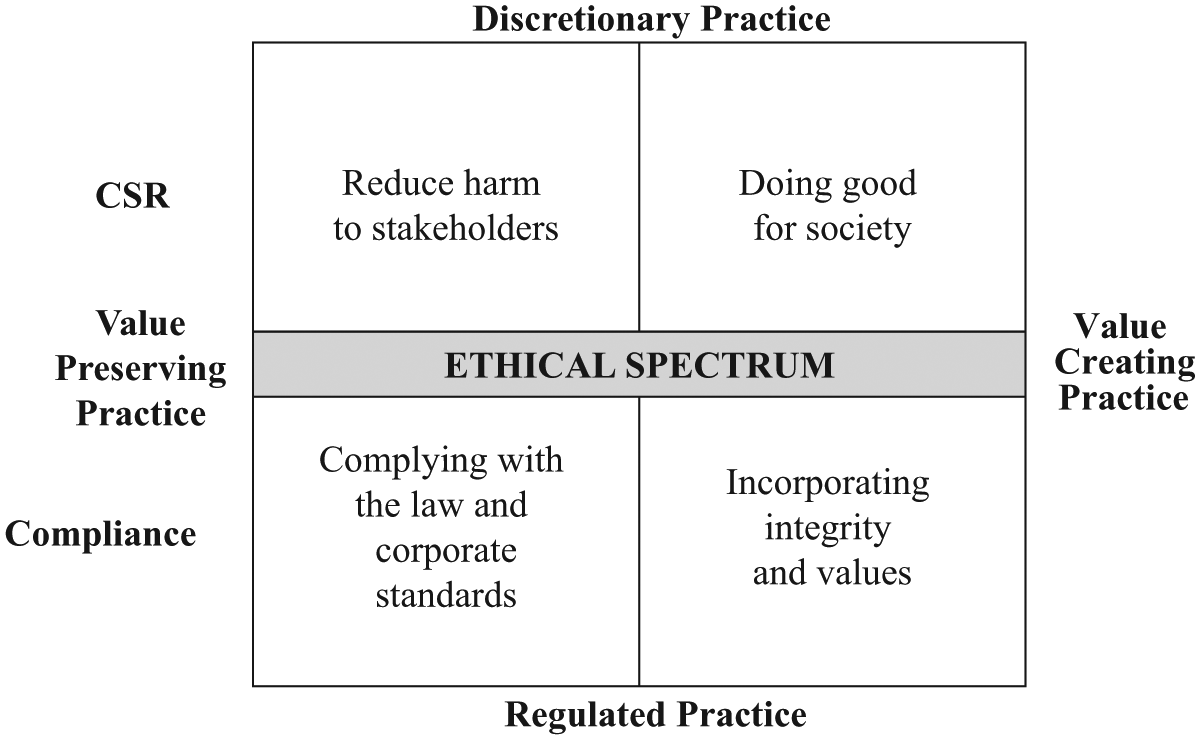
CSR and compliance as business ethics practices.
The conflation of “business ethics” and “ethics and compliance” also needs to be addressed by both scholars and practitioners. While compliance managers and their related professional organizations have claimed the “ethics” nomenclature, CSR managers described practices informed by ethical aspirations beyond legal requirements. Pragmatically, the compliance community may need to relinquish sole claim to ethics or the CSR community may need to claim their connection to ethics more centrally.
Additionally, if business ethics informs both compliance and CSR practices, then managers may want to consider the need for ongoing moral reflection as a distinct part of the practice within each community. This aligns with Epstein’s (1987) view on the central role that ethics plays within business practice. Without this explicit intention, it can be easy to understand how compliance practices focused on regulatory risk management and CSR practices focused on value creation may result in a company not accounting for some of the ethical middle ground that falls outside of their siloed interpretations of ethics in practice and lead to managers missing important ethical considerations in their companies. O’Mara-Shimek, Guillén, and Bañón Gomis (2015) support this conclusion with their suggestion that companies adopt the notion of organizational ethical quality to drive ethics throughout their CSR and compliance practices.
Through a communities of practice lens, the reasons why managers have been “slow in integrating their ethics and compliance functions with the CSR and sustainability areas of the business” are suddenly clear (Crane & Matten, 2010, p. 191). This research calls for reflection and discussion by scholars and practitioners who recommend organizational alignment between managers and practices (Painter-Morland, 2006; Rowe, 2006) given that the diverse meaning behind compliance and CSR practices and the dynamic nature of that meaning over time offers a more complex view of the relationship between them. As a result, alignment decisions need to account for local and contextual meaning held by the managers who create and implement company practices. In other words, alignment may be relevant for some companies and not for others because of the presence or absence of shared meaning between compliance and CSR practices and the meaning of ethics that informs them. Assuming that conceptual, organizational, or operational alignment will translate to an alignment of meaning between existing practices could constitute a “reckless crossing of boundaries,” resulting in impaired, not enhanced, organizational learning (Wenger, 1998, p. 129). Put simply, alignment within the wrong context would likely fail.
From a communities of practice perspective, alignment is an important aspect of belonging to a community, and it requires parallel investments in both manager engagement and imagination. Alignment through this lens is an identity-forming act whereby managers intentionally combine their efforts to establish joint or commonly understood practices. Changes to the organizational chart are, therefore, unlikely to be effective on their own, and a majority of the managers interviewed expressed their comfort with informal relationships between their practices.
Informal relationships could, however, be the beginning of engagement that supports managers’ ability to envision how their work fits together or where innovative practices might emerge over time (Benn & Martin, 2010; Wenger, 2000). In places where this shared meaning and engagement develops, formal alignment is more likely to succeed. For example, compliance and CSR practices could ultimately be managed by practitioners who align around a shared risk management orientation, regardless of where the practice falls on the discretionary to mandatory continuum. In other words, the naming and claiming of practices could evolve over time, given the dynamic nature of their meaning. As demonstrated in Figure 3, an evolution could in fact reorient the communities of practice over time, with the meaning embedded in “compliance” and CSR” practices disappearing and the realignment of practices across the preservation to creation spectrum, which would fundamentally redefine business ethics practice.
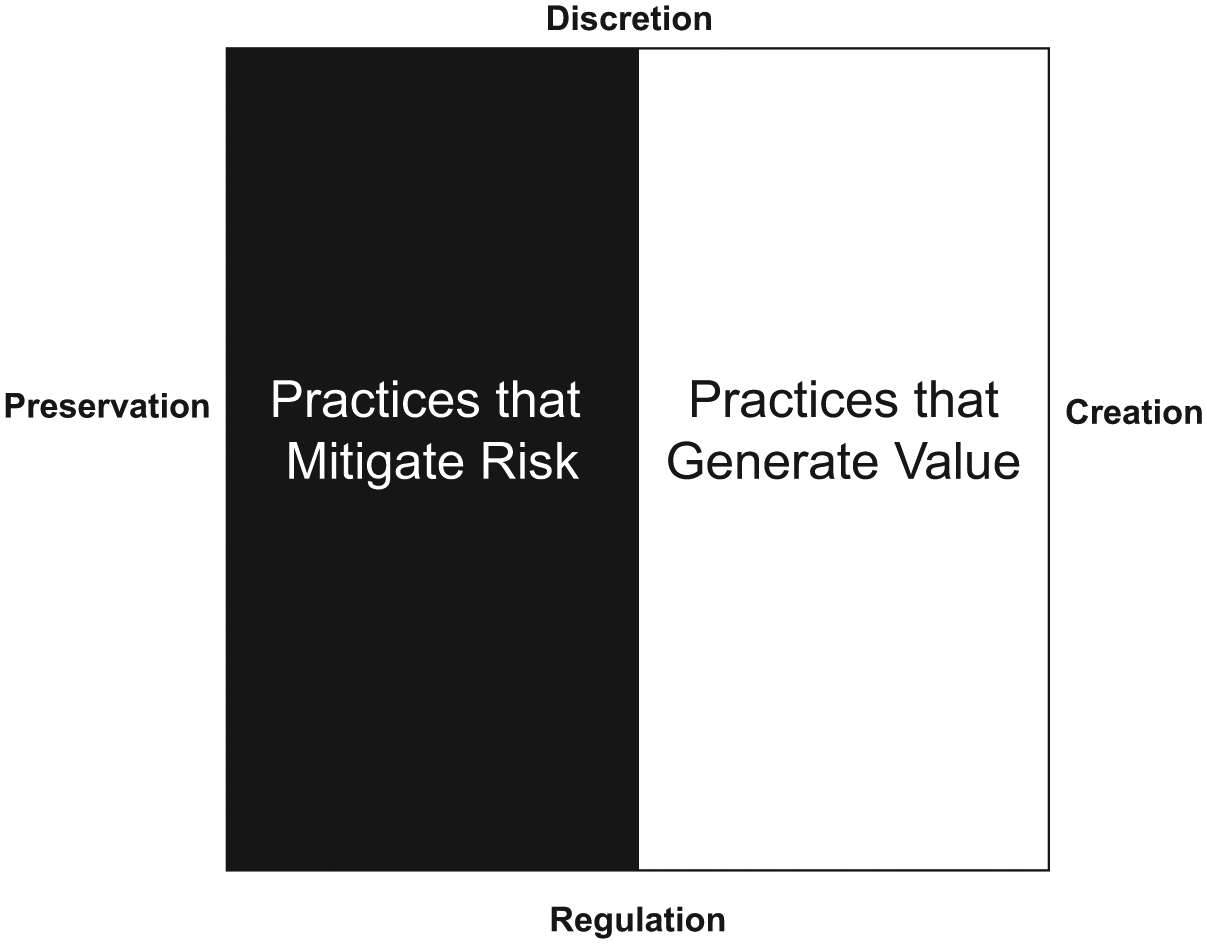
Future communities of business ethics practice.
Finally, communities of practice theory also highlights that differences in meaning between practices offer significant opportunity for learning and innovation. Scholars or practitioners may, as a result, be interested in pursuing opportunities for shared learning more intentionally. Those who wish to explore increased coordination between compliance and CSR practices and managers could commit to a brokering role between those who create and implement these practices to purposefully open space for engagement and imagination (Akkerman & Bakker, 2011; Wenger, 2000). At an organizational level, this could occur through shared management committees, collaboration around communication projects like ethics or compliance training or CSR reporting, or joint strategic planning processes to imagine what the company could achieve through more collective effort. At a community level, this could occur through purposeful sharing of knowledge, ideas, and future trends between the professional associations stewarding ethics and compliance and CSR practices, cross-association invitations to conferences with a specific effort to find areas of mutual interest, and more general recognition by association leaders of the potential overlaps in work practices and the aspirations behind them.
Future Research
Work remains to fully explore the relationship between business ethics, ethics and compliance, and CSR, both conceptually and in practice. This research seeks to contribute a lens that provides a thicker description of the meaning made by the managers who create and implement these practices in U.S. multinationals. Future research might include the intentional furthering of the business ethics as practice conversation, in particular by tracing the meaning of ethics and definitions of normativity over a specific historical period . A comparative study focused on the meaning of practices from managers across different countries and regions would also be valuable. Alternately, a study focused on the meaning of the practices and their relationship as understood by the Chief Executive Officer or the board of directors as a foil to the meaning held by managers would also be informative. Additionally, a deep dive into the specific role of regulation and the institutionalization of stakeholder expectations over time would offer a lens focused more on structure than on agency. Finally, as the “ethics scientists” one manager described explore more formal alignment of practices, research into their experience and the evolution of their practices and shared meaning would also be worthwhile.
Footnotes
Declaration of Conflicting Interests
The author declared no potential conflicts of interest with respect to the research, authorship, and/or publication of this article.
Funding
The author received no financial support for the research, authorship, and/or publication of this article.