



Abstract
Corporate social responsibility (CSR) has repeatedly been described as an “essentially contested concept,” which means that its signification is subject to continuous struggle. We argue that the “CSR institution” (CSRI; i.e., the set of standards and rules regulating corporate conduct under the banner of CSR) is legitimized by narratives which “decontest” the underlying concept of CSR in a manner that safeguards the CSRI from calls for alternative institutional arrangements. Examining several such narratives from a structuralist perspective, we find them to be permeated with six recurrent ambiguities that we show to be reflective of three deep-set taboos: the taboo of the noncongruency between corporate profit objectives and societal needs, the taboo of multinational firms’ continued contribution to the emergence of global socioenvironmental issues, and the taboo of the CSRI’s moderate results in solving these problems. We contend that the perpetuation of these taboos contributes to inhibiting substantial change in the way of doing business, and we sketch out possibilities for initiating a “recontestation” of CSR’s meaning.
Keywords
In the scholarly literature, corporate social responsibility (CSR) has repeatedly been referred to as an “essentially contested concept” (Gond & Moon, 2011; Moon, 2007; Okoye, 2009). This implies that whoever makes use of this notion has to sufficiently “decontest” it vis-à-vis the targeted audience (Freeden, 2003, 2005, 2006). Decontesting a concept means attempting to gain control over its signification, by embedding it in a discourse which privileges certain meanings over others. Decontestation often involves defusing logical inconsistencies entailed by the advocated meanings so as to allow for enough interpretive leeway to generate the semblance of logical coherence (Freeden, 2003, pp. 55-57). Importantly, decontestation is not per se reprehensible: Vagueness and elusiveness are often functional in society as they can facilitate communication and permit sufficient consent and mobilization around inherently debatable ideas (Eisenberg, 1984; Freeden, 2003, pp. 56-57, 2005, pp. 121-122; Leitch & Davenport, 2007). But decontestation can also be problematic, in that it can obscure important issues and thereby contribute to sustaining questionable social orders (Alvesson & Kärreman, 2016; Browne, 1984; Thompson, 1990, pp. 52-60).
A prime means through which decontestation can be achieved is “narrativization” (Thompson, 1990, p. 61), which means that the essentially contestable concept is incorporated into a story. Indeed, narratives have the power to “magnetize” (Shenhav, 2015, p. 1) and “transport” (Green & Brock, 2000, p. 701) their audience, thereby reducing its vigilance with regard to possible inconsistencies (Deighton, Romer, & McQueen, 1989; Green & Brock, 2000).
The notion of CSR becomes decontested, inter alia, in what we call institutional CSR narratives. These are stories which evoke the origins, historical evolutions, and prospected developments of CSR and which are propagated by organizations whose purpose is to promote the “CSR institution” (CSRI; i.e., the institutionalized norms of conduct which regulate corporate behavior under the banner of CSR; Bondy, Moon, & Matten, 2012; Brammer, Jackson, & Matten, 2012; Kaplan, 2015). Interestingly enough, these narratives have so far remained largely out of sight of the scholarly literature. This is all the more remarkable as they can be assumed to fulfill a critical role in legitimizing the CSRI. To achieve this purpose, these stories must decontest the concept of CSR in a manner that establishes the CSRI’s worth to society. This article investigates the decontesting role and functioning of these narratives, in addressing a twofold question: How does the concept of CSR become narratively decontested with a view to legitimizing the CSRI? And, given the possibly double-edged nature of such decontestation, to what extent shall this be considered conducive to attaining broader social and environmental ends?
To investigate these questions, our study proceeds as follows. After laying the conceptual foundations of our argumentation, we present the corpus of our study—46 narrative stretches issued by three influential organizations that stand representative of the CSRI—and describe the methodology through which we gradually unpacked the decontestation work performed by these stories. After presenting the findings of our interpretive analysis, we reflect on the performative effects of this decontestation work. Arguing that institutional CSR narratives forge an understanding of CSR that is comforting but largely inconsequential, we finally outline possible ways to unsettle and “recontest” the meaning of CSR.
In uncovering the decontestation work carried out by institutional CSR narratives, we make a threefold contribution. First, we add to the literature which approaches CSR through the lens of institutional theory. Following a recent call for investigating the role of communications in institutional formation and maintenance (Cornelissen, Durand, Fiss, Lammers, & Vaara, 2015), we stress the CSRI’s vital need for becoming narratively legitimized and examine the discursive means through which this is achieved. Second, we contribute to the literature which conceives of CSR as an “essentially contested concept.” We argue that the legitimation work performed by institutional CSR narratives precisely consists in “decontesting” the underlying notion of CSR, in a manner that justifies the eponymous institution against possible alternatives. In line with the paradox literature on CSR (Hahn, Figge, Pinkse, & Preuss, 2018), we thereby assume that this decontestation requires negotiation between conflicting claims and demands which are concurrently being placed on the term. While previous empirical studies have contributed to this stream of research through the identification of tensions underlying the sensemaking and sensegiving processes of CSR (Carollo & Guerci, 2018; Hoffmann, 2018; Smith, Gonin, & Besharov, 2013; Van der Byl & Slawinski, 2015), the present study goes one step further by investigating how the foregrounded tensions actually relate to one another. In fact, unlike customary content analyses, narrative inquiries operate on the premise that the studied texts possess, in their quality as “stories,” an inner logic that is worth being brought to light and examined (Riessman, 1993). Third, we trigger a discussion about the implications of this narrative decontestation work. We argue that institutional CSR narratives constitute “paradoxical frames” (Hahn, Preuss, Pinkse, & Figge, 2014) of a problematic sort: In tacitly sustaining rather than explicitly thematizing decisive contradictions, these stories forestall serious reflection and action on the issues at stake. In the spirit of “critical performativity,” we ultimately outline possible ways to initiate a “recontestation” of CSR’s meaning.
Conceptual Premises
The CSRI
In the lineage of Bowen’s (1953) institutionalist approach to CSR (Acquier, Gond, & Pasquero, 2011), a growing body of research has argued that a corporation’s propensity for engaging in CSR practices does not only depend on individual and firm-level factors but is also influenced by forces operating at a supra-organizational level (Aguilera, Rupp, Williams, & Ganapathi, 2007; Campbell, 2007; Gjølberg, 2009; Marquis, Glynn, & Davis, 2007; Matten & Moon, 2008; Muthuri & Gilbert, 2011). Pushing this view further, some researchers contend that alongside such institutional pressures, CSR practices themselves have “institutionalized” (i.e., standardized across firms, geographies, and industries; Brammer et al., 2012; Haack, Schoeneborn, & Wickert, 2012; Matten & Moon, 2008; Pedersen, Neergaard, Pedersen, & Gwozdz, 2013). Some of these scholars consider that this institutionalization process can by now be deemed sufficiently advanced to legitimately talk about a full-fledged CSRI which operates at a global level and spans across industry sectors (see, in particular, Bondy et al., 2012; Brammer et al., 2012; Kaplan, 2015; Levy & Kaplan, 2008; for similar considerations, though not explicitly referring to CSR as an “institution,” see Fleming & Jones, 2013; Hanlon & Fleming, 2009; Shamir, 2011).
Institutions operate at a supra-organizational level (Friedland & Alford, 1991, pp. 240-241) and can be defined as a “relatively enduring collection of rules and organized practices, embedded in structures of meaning and . . . prescribing appropriate behavior for specific actors in specific situations” (March & Olsen, 2006, p. 3). This definition emphasizes three important characteristics of institutions.
First, institutions consist of “rules and organized practices” that prescribe adequate conduct. As regards the CSRI, these rules have frequently been described as a “soft law,” consisting of standards, principles, guidelines, and the like, which require firms to take certain types of action that are deemed to be in the interest of the society and the environment (Shamir, 2011).
Second, these practices are endowed with “meaning,” which is to say that they carry socially constructed and shared significations (Berger & Luckmann, 1967, pp. 53-54).
Third, institutions concern “specific actors,” sometimes also referred to as institutional “participants” (Fairclough, 2013, p. 41). Multinational corporations (MNCs) can be considered the prime protagonists of the CSRI because they represent the main bearers of the “social responsibility” demanded by the concept of CSR. 1 In addition, many other types of participants contribute to the CSRI, such as civil society organizations (CSOs), governments, and intergovernmental organizations (IGOs), notably agencies affiliated to the United Nations System. Curbach (2009, p. 245) divides these various participants into two categories: those who belong to what she calls the “corporate-social-responsibility-movement,” which actively develops and fosters the standards and guidelines of the CSRI, and those whom she attributes to the “corporate-irresponsibility-movement,” which calls public attention to corporate misdeeds by engaging with the business sector in a confrontational manner.
Of particular interest in our article are participants of the former category who, in reference to Fairclough (2013, p. 41), can be typified as institutional “subjects.” By this, we mean organizations which do not only contribute to furthering the “rules and organized practices” of the CSRI but whose very reason for existence is actually geared to that purpose. “Subjects” are dedicated to, and therefore also fully associated with, the CSRI. The term “subject” points to their dual role vis-à-vis the CSRI: On one hand, they are “subjects of” the CSRI (i.e., in a position to actively shape its rules and practices). On the other, they are concurrently “subjected to” the CSRI (i.e., bound to it by their very identity). There exists a myriad of such “subjects” of the CSRI, known examples of which include CSR Europe, the Fair Labor Association (FLA), the Forest Stewardship Council (FSC), the Global Reporting Initiative (GRI), the United Nations Global Compact (UNGC), and the World Business Council for Sustainable Development (WBCSD).
These “subjects” shall be distinguished from what Fairclough (2013, p. 41) refers to as “clients”. These are organizations which also belong to the “corporate-social-responsibility-movement” but whose identity is largely detached from it. For instance, CSOs like the Rockefeller Foundation or IGOs like the World Bank are actively engaged in the development of the CSRI (Shamir, 2004, p. 679; Utting, 2005, p. 379), but they do not draw their raison d’être from this involvement, because they are engaged in many more activities that are largely unrelated to CSR.
The CSRI’s Need for Legitimation
Importantly, institutions are effective only if they are considered “legitimate” (Berger & Luckmann, 1967; Bodansky, 1999; Grafstein, 1981; Jones, 1996, pp. 7-8; Lyotard, 1984). This means that their existence must be justified by “second-order” meanings which put the “first-order” meanings attached to their rules and practices into a broader normative perspective (Berger & Luckmann, 1967, p. 92). Specifically, the “soft law” prescribed by the CSRI can only be considered purposeful against the backdrop of a particular conception of the relationship between firms and society, which makes it appear socially desirable.
Legitimizing the CSRI necessarily involves “decontesting” the concept of CSR in which it is conceptually anchored (i.e., singling out a preferred conception of the term while concurrently attenuating resultant inconsistencies; Freeden, 2003, 2005, 2006). In that context, it is important to note that the CSRI is but one of many institutions that regulate corporate activity: It is embedded in a wider complex of national and international laws, corporate governance regulations and accounting principles, trade and investment agreements, fiscal and monetary policies, economic policy frameworks and guidelines, trade custom, and so forth. As any social arrangement, this assemblage of institutions is fundamentally contingent, meaning that it is always possible to envisage other institutional configurations to guide business firms’ behavior (Berger & Luckmann, 1967, p. 103).
This is especially so because the various institutions that regulate corporations’ conduct stand in a relation of partial substitutability with each other. For instance, instead of appealing to MNCs’ “responsibility” with regard to a certain issue, it would also be conceivable to straightforwardly forbid unwanted practices or to correctively interfere in the functioning of the market via a bonus-malus system consisting of tax incentives and penalty fees (Acquier et al., 2011, p. 616; Bouckaert, 2003, p. 84; Luhmann, 2012). Moreover, it would also be possible to strengthen external surveillance mechanisms, to intervene in corporations’ governance structure, or, even more radically, to transform the ground rules that govern corporate activity, such as the dogma of property rights that undergirds the capitalist system or the monetary system that fuels it (Felber, 2015). Even if these alternatives to the CSRI may appear unrealistic or impractical at first sight, they remain nevertheless possible in principle. They thus constitute a conceptual threat against which the CSRI must become sufficiently protected to remain operative.
Being a “social regulation tool” (Acquier et al., 2011, p. 612) among several, the CSRI needs to become legitimized in a way that wards off alternative ways of steering corporate conduct into socially desirable directions. This implies that the concept of CSR becomes decontested in a way that not only upholds a preferred understanding of the term (i.e., that tacitly claims “such, and not otherwise, is CSR to be understood”) but also lends support to the idea that the favored conception of CSR constitutes the most appropriate way to regulate business (“such, and not otherwise, is corporate conduct to be steered toward desirable goals”).
Upholding the worth of an institution is necessary to maintain sufficient motivation of those who keep it running (Boltanski & Chiapello, 2007; Kazmi, Leca, & Naccache, 2016). In the first place, the legitimation of the CSRI is thus targeted at the members of the “corporate-social-responsibility-movement,” who are directly involved with the “rules and organized practices” of the CSRI: professionals working in a “CSR industry” (Shamir, 2011, p. 324) of consultancies, social auditing firms, and accreditation organizations that develop and promote these rules, as well as CSR managers and their staff, who ensure that they become applied in their respective companies. Besides that, the legitimation of the CSRI is also targeted at all those whose work is unrelated to CSR, but whose consent, or at least acquiescence, is required to ensure the CSRI’s continued functioning: firm owners, managers and employees, consumers, policy officials, and, to some extent, also the public at large, which can at any time mobilize against the CSRI and demand alternative socioeconomic arrangements. To garner sufficient agreement among this wider circle of interested parties, the legitimation of the CSRI needs to sufficiently defuse the criticism expressed by the “corporate-irresponsibility-movement,” which confronts the corporate world with its misdevelopments and tends to be skeptical about the sincerity and sufficiency of its efforts toward more “responsible” management practices (Corporate Watch, 2006).
Generally speaking, the lower the “taken-for-grantedness” of an institution, the higher the need for producing “second-order” meanings that legitimize its existence (Berger & Luckmann, 1967, pp. 92-104). The CSRI is comparatively young (Kaplan, 2015) and has been continuously confronted with skepticism and cynicism, arising not only from within the ranks of the “corporate-irresponsibility-movement” but also from various other quarters, including academic scholars (Fleming & Jones, 2013), journalists (Crook, 2005), management practitioners (Humphreys & Brown, 2008), and the wider public (Ipsos MORI, 2015). The CSRI thus finds itself to be a “contested institution” (Brammer et al., 2012, p. 10), which is insufficiently self-evident to be exempted from the requirement to become legitimized by justificatory accounts.
We assume that the task of producing such legitimating accounts naturally falls to the “subjects” of the CSRI. As their organizational identity is firmly rooted in the CSRI, their organizational legitimacy also directly hinges on the latter’s institutional legitimacy. To justify their own organizational existence, “subjects” concurrently must act as “legitimators” (Berger & Luckmann, 1967, p. 95) of the broader institution they belong to.
The Role of Institutional CSR Narratives in Legitimizing the CSRI
There are manifold ways of producing “second-order” meanings which justify an institution’s existence. Means of institutional legitimation include, among others, proverbs, maxims, sayings, and theories (Berger & Luckmann, 1967). In his book The Postmodern Condition, Lyotard (1984) pointed out the paramount role of another mean of institutional legitimation, namely narration. Narratives are, simply and generally speaking, “stories” (i.e., textual stretches relating a course of events arranged in a time line; Rimmon-Kenan, 2002).
For Lyotard (1984), the major advantage of narratives compared with other legitimation devices lies in their ability to blend claims of different natures, notably descriptive and normative ones. The CSRI, for instance, relies on a double assumption: that corporations qualify as “moral agents” in their own right, and that they also shall live up to this capability (French, 1979; Shamir, 2008). Hume’s “is-ought problem” stipulates that no rational argument can ever bring together these two claims because they cannot be logically derived from one another. According to Lyotard (1984), however, this problem can be overcome by narration (i.e., by weaving the two claims into a seemingly consistent story).
More generally speaking, narratives are a means of dealing with the impression of disorder and fragmentation. They have the capacity to create a sense of coherence (Crossley, 2000; McAdams, 2006) and to emotionally absorb their audience into the story that is told, thereby shifting its focus of attention away from potential inconsistencies (Deighton et al., 1989; Green & Brock, 2000). This makes narratives particularly suitable for decontesting fundamentally contestable concepts (i.e., for constricting the range of possible understandings of the notion at issue while creating the impression of an overall consistency in the line of argument; Freeden, 2003, pp. 55-57).
The notion of CSR naturally faces such attempts of narrative decontestation. So far, business and society scholars have studied the decontesting functioning of CSR-related narratives produced by individual employees and management students (García-Rosell, 2016; Humphreys & Brown, 2008), nongovernmental organizations (NGOs) and business firms (Joutsenvirta & Uusitalo, 2010), and industry sectors (Boje & Khan, 2009; Bridge & McManus, 2000). However, the decontestation work carried out by institutional CSR narratives has only been alluded to through cursory remarks (Gray, 2010; Sklair & Miller, 2010). Institutional CSR narratives differ in two aspects from the stories examined in the aforementioned studies: First, they are distinct in terms of authorship, since they emanate from “subjects” of the CSRI (i.e., organizations dedicated to promoting CSR within the business world). Second, they differ in terms of content, as they do not only confer an ancillary role to CSR but revolve around CSR as such, above and beyond specific organizational or industry settings. They narrate why, how, and when companies came to adopt CSR, outline how CSR has evolved up until now, and conjecture about what may be expected from CSR in the future.
A video clip marking the 15th anniversary of the UNGC (2015a) provides a concise and at the same time representative example of such narratives. The clip is entitled “Global Compact + 15: Business as a Force for Good.” It gives a brief account of the corporate world’s past, present, and future CSR-related action, run under the aegis of the UNGC. Figure 1 provides the full transcript of its voice-over, which will serve later on to illustrate the main analytical and interpretive steps we have undertaken in our study. Sentences have been numbered for that purpose.
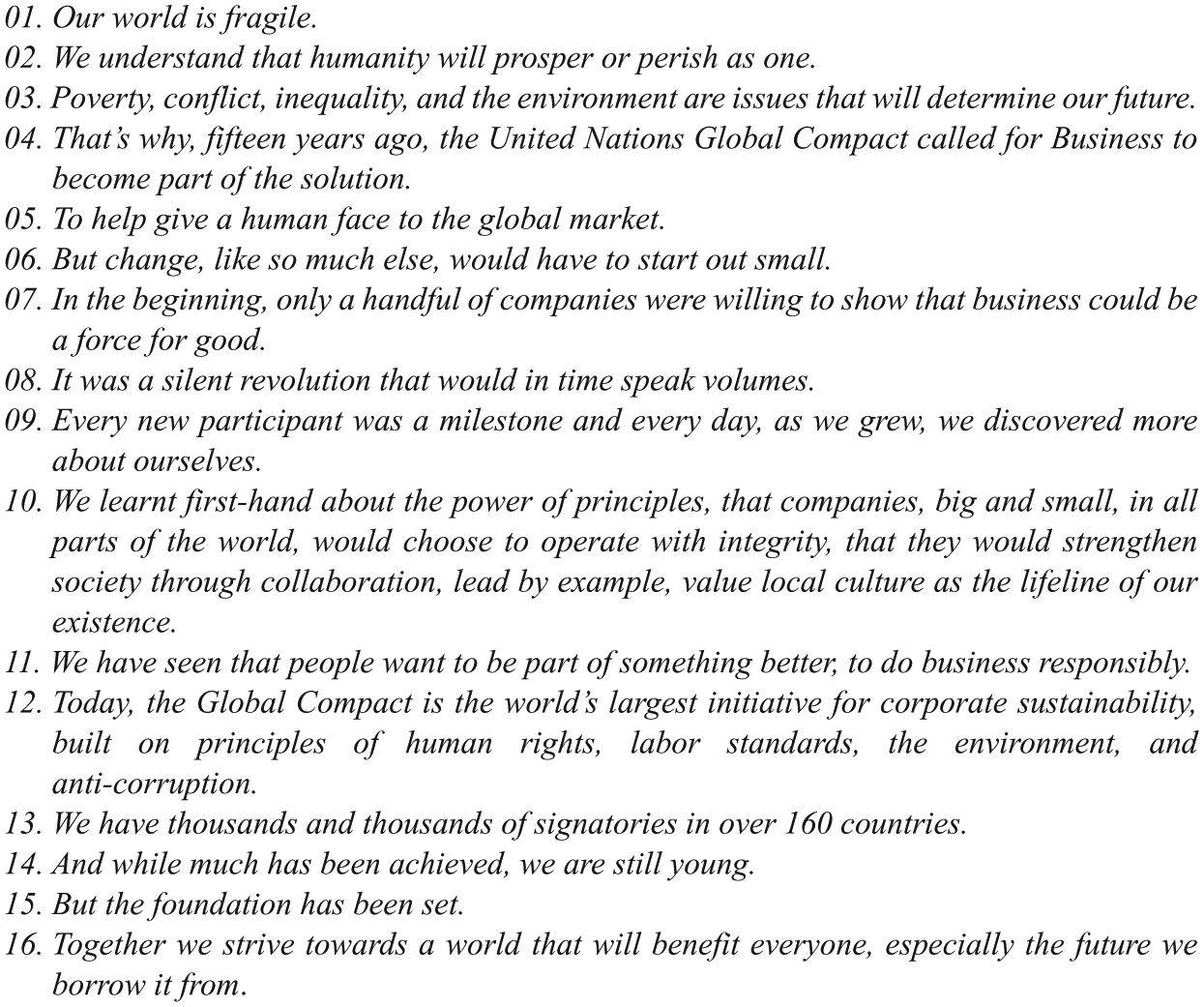
Voice-over transcript of the video “Global Compact + 15: Business as a Force for Good.”
From a functionalist narratological perspective (Labov & Waletzky, 1967), the above story can be broadly divided into four parts. Sentences 1 to 5 “orient” (p. 27) the audience, which means that they lay down the context in which the need for CSR emerges. The problem that shall be addressed is framed concurrently as a series of contemporary ills to be tackled (“poverty, conflict, inequality, and the environment”), as an aspirational future that shall be strived for (“prosper . . . as one”), and as a threatening dystopian future that is to be avoided (“perish as one”). Sentences 4 and 5, introduced by the logical connector “that’s why,” assert business firms’ responsibility to address these issues, in recalling Kofi Annan’s (1999) appeal to companies’ sense of responsibility. 2
Sentences 6 to 11 outline the motivations that have prompted corporations to address global issues (“were willing to show”; “want to be part of something better”), as well as the actions these corporations therefore have undertaken (“operate with integrity, . . . strengthen society through collaboration, lead by example, value local culture”). These references to firms’ undertaking toward more “responsible” behavior are intermeshed with elements of “evaluation” (Labov & Waletzky, 1967, p. 28). For instance, change in corporate conduct is qualified as a “silent revolution,” a phrase to which we will devote further attention later.
Sentences 12 to 15 are exclusively evaluative. They form the “apex” of the narrative (p. 41) which suspends the action before the closure. Sentences 14 and 15 oscillate between elements of praise and an acknowledgment of the UNGC’s action’s (current) insufficiency.
Sentence 16 closes the story in combining an element of incantation (“Together we strive”) with a proleptic aspirational outlook (“a world that will benefit everyone”) while reasserting corporations’ responsibility toward society (“the future we borrow it from”).
The text may trigger a vague impression of déjà vu which is, as we argue later in this article, no mere coincidence. It is indeed striking that a considerable number of documents issued by “subjects” of the CSRI begin with a narrative account of CSR or at least include narrative elements about CSR in their introductory sections. And, as will be seen from our analysis, these narrative stretches actually do share many similarities—both in terms of form and content. Our explanation for the prevalence of such narratives lies in the CSRI’s lack of self-evidence. Unlike institutions that are more established, such as the long-lasting institution of accounting (Waymire & Basu, 2008), the CSRI must resort to the decontesting powers of narration, to credibly uphold the inner coherence of the conception of CSR it is based on, and to assert its preferableness over alternative modes of regulating corporate conduct. Its “subjects” serve as the primary articulators of these self-legitimizing stories.
We may illustrate this point with a hopefully intuitively compelling example. Lecturers in CSR customarily start their first course session with a form of broader narration—say about globalization, the emergence of governance gaps, the rise of civil society, and the untenability of Friedman’s (1970) position in current times. This seems a natural and somehow necessary preliminary. Lecturers in accounting, however, can perfectly well jump right into the basics of corporate bookkeeping, without having to stress accounting’s worth to contemporary society and referring back to its origins. The reason is fairly easy to grasp: Lecturers in CSR need to justify the subject matter they teach; lecturers in accounting do not. It becomes palpable here that institutional CSR narratives are not merely a mean of entertainment or pedagogy: Their primary function is to legitimize the CSRI.
Method
Corpus Selection: 46 Narrative Stretches Issued by “Subjects” of the CSRI
To explore the narrative decontestation work carried out by the CSRI, we examined a corpus of 46 institutional CSR narratives, which were selected in three steps.
First, we identified organizations prone to producing such narratives. Given the large number of “subjects” participating in the CSRI, we had to make a choice as to which ones to consider in our study. Drawing from articles providing overviews of organizations participating in the CSRI (Fransen & Kolk, 2007; Mena & Palazzo, 2012; Utting, 2005), we started by establishing a long list of 60 of its “subjects,” which are listed in Appendix A (supplemental material). Because our focus of attention lies on narratives revolving around CSR at large, we narrowed down this long list according to three criteria: (a) Comprehensive scope, leading us to only retain “subjects” promoting CSR in its entirety (i.e., across its social and environmental dimensions), while organizations focusing on specific subtopics of CSR (such as the FLA which is only dedicated to protecting labor rights) were excluded from the list; (b) Cross-industry reach, which implied removing from the list “subjects” focusing on a particular industry (e.g., the FSC whose activities are targeted at the forest industry); (c) Global focus, which led us to exclude “subjects” operating in a geographically limited area (for instance, CSR Europe which is a solely European business network). This left us with a short list of seven “subjects”: one organization promoting CSR practices under the aegis of the United Nations (the UNGC), three organizations developing CSR reporting standards (AccountAbility [AA], the GRI, and ISO 26000), and three business associations furthering the cause of CSR (Business for Social Responsibility [BSR], the International Business Leaders Forum [IBLF], and the WBCSD).
For further focus, we picked from this short list three “subjects” that we consider to be among the more influential ones: the UNGC, the GRI, and the WBCSD. In fact, all three organizations are of considerable importance to the CSRI: The UNGC is frequently described as the world’s largest CSR initiative (Rasche, 2012), whereby firms publicly commit to adhere to a set of CSR principles. The reporting guidelines developed by the GRI have become widely adopted by MNCs across industries and geographies (KPMG, 2015). The WBCSD is an influential CEO-led organization which unites over 200 MNCs representing a combined revenue of more than US$8.5 trillion (Banerjee, 2011; WBCSD, 2016, p. 23).
In a second step, we retrieved reports and brochures from the public web libraries of the three selected organizations. We then searched the executive summaries, forewords, and introductions of these publications for narrative accounts about CSR (i.e., text passages which in a way or another “tell the story” of CSR). To identify these narratives, we abided by the minimalist definition of a story as a “narration of a succession of events” (Shenhav, 2015, p. 17). Specifically, we considered the existence of a discernible plot chronology as a necessary and sufficient condition for regarding a text as a proper “narrative.”
In a third and last step, we “downsized” the number of texts according to the criterion of thematic fit (Reisigl & Wodak, 2009, p. 99). We removed from the corpus narratives which only marginally dealt with CSR or solely focused on specific subaspects of it. This left us with a sample of 46 texts of varying length, published between 1999 and 2017, and ranging from 83 words for the shortest narrative to 994 words for the longest. The appendix provides an overview of the references. As becomes apparent from this compendium, “subjects” of the CSRI do not work in isolation but sometimes collaborate together (GRI, UNGC, & WBCSD, 2015) or publish joint reports with MNCs, CSOs, business consultancies, or IGOs like the International Finance Corporation from the World Bank Group. This corroborates Curbach’s (2009) postulate as to the existence of a “corporate-social-responsibility-movement” that collectively propagates a certain idea of CSR and its associated practices.
Approach: The Abductive Surfacing of Structural Oppositions
Decontesting a concept such as CSR means counteracting the essential indeterminacy of its signification in attempting to enforce a particular understanding of it. Privileging particular meanings over others can generate logical inconsistencies, which need to be smoothed over so as to create the appearance of logical coherence (Freeden, 2003, pp. 55-57). Elucidating the decontestation work performed by institutional CSR narratives thus requires revealing the logical oppositions which these narratives conceal.
This can be achieved through what Reisigl and Wodak (2009, p. 88) call “text . . . -immanent critique,” which consists of “discovering inconsistencies, self-contradictions, paradoxes and dilemmas in the text-internal . . . structures.” Underlying this definition is the assumption that the origins of a text’s ambivalences are to be located at the level of its underlying “structures”: Contradictions which are only vaguely perceptible at the level of the manifest text can become apparent and understandable in the light of its structural foundations.
Embracing this assumption, and in line with a long-lasting tradition of structuralist narratology (Eco, 1989; Greimas, 1971; Greimas, Courtés, & Rengstorf, 1989; Van Dijk, 1976), we in fact presume that the stories of our corpus are not of an arbitrary shape but characterized by underlying “narrative structures.” These structures can be conceived of as propositions which stand in logical relations to each other and which enable and, at the same time, constrain the manifest formulation of a particular story (Rimmon-Kenan, 2002, p. 10). Importantly, these propositions can also conflict with one another, meaning that one and the same narrative can mediate between contradictory or even contrary assertions (Greimas et al., 1989; Rimmon-Kenan, 2002, pp. 11-13). In investigating institutional CSR narratives from a structuralist lens, we thus pursue a line of research that embraces, rather than denies, the existence of paradoxes in the discursive constitution of CSR’s meaning (Hahn et al., 2018; Hoffmann, 2018).
Importantly, a narrative’s structure is “immanent” (Rimmon-Kenan, 2002, p. 7), as it consists of essentially untold meaning. As Greimas (1971, p. 796) puts it, “the manifest text of a narrative . . . hides its signification” in the structures that lie beneath it. Thus, the meaning contained in a narrative’s subjacent structure is not readily accessible: It needs to be “abstracted” from the text (Rimmon-Kenan, 2002, p. 10), which is inherently an interpretive endeavor (Riessman, 1993).
To unpack the structural oppositions papered over by the narratives of our corpus, we opted for a gradual and iterative approach (illustrated in Figure 2), which bears resemblance with the Gioia methodology for grounded theory articulation (Gioia, Corley, & Hamilton, 2012). The analysis was carried out in three main stages.
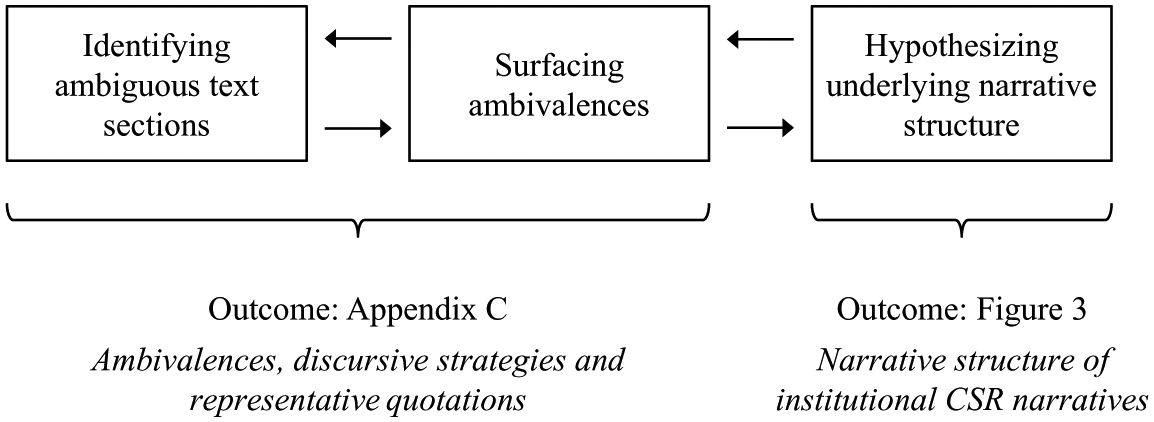
Approach for uncovering the narrative structure of institutional CSR narratives.
In a first stage, we read every narrative several times, searching for text passages that were ambiguous, elusive, or otherwise intriguing. Taking the narrative of the UNGC (2015a) as an example, Sentence 8—“It was a silent revolution that would in time speak volumes”—was among the sections which caught our attention, due to its mixture of pathos and vagueness.
In a second stage, we tried to elicit the ambivalences that we sensed to be contained in the excerpted text passages. In the above-quoted sentence for instance, we found that the phrase “silent revolution,” which qualifies the change induced by the early adopters of the Global Compact, could be considered as a quasi-oxymoron: While the substantive “revolution” implies a form of “sudden, radical or complete change” (Merriam-Webster, 2017), the preceding attribute “silent” works counter to this impression of a radical alteration. On one hand, the text indicates that companies’ embracing of CSR represented a major upheaval within the corporate world, but on the other it surreptitiously suggests that this upheaval was “silent” (i.e., not readily recognizable as such). The remainder of the sentence then explains that this quietness was only provisional: The “revolution” in question “would in time speak volumes.” The phrase “in time” therein leaves it open as to when exactly the announced effects will become apparent. As the transitive verb “will” is used in its past form “would,” it is even unclear whether or not this point in time has already arrived. Besides, the phrase “speak volumes” is equally ambiguous, namely in respect to the results we are entitled to expect from the “revolution” in question.
In sum, Sentence 8 conceals a threefold ambivalence. First, it concurrently characterizes the change in corporate behavior as “revolutionary” (i.e., as abrupt and fundamental) and as “evolutionary” (i.e., as gradually unfolding). Second, it leaves it unclear whether or not, at present, this change can be considered to have produced the announced effects (i.e., whether the initially “silent” revolution has by now revealed its truly “revolutionary” character). Third, it also leaves it open where this “revolution” will exactly lead us.
These and other ambivalences proved to be recurrent in our corpus of institutional CSR narratives and manifested discursively in varying ways. For instance, the ambivalence between “evolutionary” and “revolutionary” change was also found to be contained in narratives’ recurring calls for “accelerat[ing]” (WBCSD & IFC, 2008), “catalyzing” (UNGC, Unilever, & Dalberg, 2011), or “scaling up” (UNGC & ICC, 2015) change. In fact, these verbs all create the impression of a drastic departure from current business practice, which sometimes is reinforced by the prefixing of the adverb “radically” (e.g., “We . . . need to radically scale up action,” WBCSD, 2013b). However, they also include an element of evolutionary continuity, which precisely restrains this impression of radicalness in change. “Accelerating,” “catalyzing,” or “scaling up” change does not mean breaking entirely with current business practice, but rather unfolding—although in an accelerated mode—the full potential of a mutation which supposedly has already begun (i.e., which exists at least in seed form). Appendix C (supplemental material) provides an overview of the main ambivalences we spotted in the narratives, along with some representative quotations. In linking the textual raw material to the recurring ambivalences distilled therefrom, this table constitutes what Gioia et al. (2012, p. 20) refer to as the “data structure” of our study.
In a third stage, we tried to make sense of these ambivalences in developing a narrative structure which “articulates and weaves [them] together” (Gioia et al., 2012, p. 24). As was mentioned before, we conceive the identified ambivalences as apparent manifestations of immanent structural tensions between assertions standing in logical opposition to each other. For instance, we suggest that the ambivalence between “evolutionary” and “revolutionary” change (Ambivalence 4 in Appendix C, supplemental material) can be comprehended as reflecting a tension arising from possible combinations between two pairs of mutually contradictory propositions, which institutional CSR narratives neither can clearly assert nor can afford to refrain from asserting. The narrative structure that we generated from this interpretive step is functionally equivalent to Gioia et al.’s (2012, p. 22) “grounded model,” as it constitutes a theoretical scheme with explanatory purposes.
As can be seen from Figure 2, the process of inference by which we brought to the fore these structural tensions was not sequential but iterative. Reasoning abductively, we progressed in recursive inferential cycles (Fischer, 2001; Gioia et al., 2012), where we progressively surfaced ambivalences in the course of a back-and-forth movement between the text material, the emergent ambivalences, and the provisionally hypothesized narrative structure. To increase the intersubjective “credibility” of our findings (Lincoln & Guba, 1985, p. 301), the two authors alternated between individual work and group discussions: Having read and interpreted the narratives independently from one another, we shared and agreed upon our findings at regular intervals. This inferential process was stopped when we reached the point of “theoretical saturation” (Gioia et al., 2012, p. 20).
Findings
The Six Main Ambivalences Enclosed in Institutional CSR Narratives
As a result of this recursive process, we found the narratives of our corpus to be permeated with six recurrent ambivalences. Appendix C (supplemental material) provides a comprehensive overview of the discursive “strategies” (Reisigl & Wodak, 2009, p. 94) and linguistic devices through which these ambivalences become manifest, as well as representative quotes. We present each of these ambivalences below.
Ambivalence 1: Duty versus self-interest
Scholars have repeatedly pointed out that the predominant CSR discourse tends to turn a blind eye to possible trade-offs between corporations’ profit objectives and socioenvironmental concerns (Crane, Palazzo, Spence, & Matten, 2014; Fleming & Jones, 2013, pp. 20-22; Hahn, Figge, Pinkse, & Preuss, 2010). Our analysis of institutional CSR narratives confirms this observation: No mention whatsoever is made of the possibility of a divergence between business firms’ financial goals and societal interests.
The narratives depict an antagonism-free and depoliticized world (Kallio, 2007; Mouffe, 2013), which is essentially marked by unity in destiny, shared values, and common interests. The corporate world is presented as unified in its interests and undertakings (e.g., “companies, big and small, in all parts of the world,” UNGC, 2015a) and intertwined in a symbiotic relationship with broader society (e.g., “business cannot succeed in societies that fail,” WBCSD, 2013b). The inextricability between the business sphere and wider society is further stressed by the often ambiguous use of the character-narrator pronoun “we” (such as in UNGC, 2015a 3 ), a pathos of shared fate (e.g., “humanity will prosper or perish as one,” UNGC, 2015a), the recurrent invoking of the “business case” for CSR (e.g., “to be sure, the business case for . . . the principles [of the UNGC] . . . has never been stronger,” UNGC & Deloitte, 2010), and the ubiquitous but equivocal use of the notion of “value” (e.g., “companies will . . . generate real and lasting value for their business, stakeholders, and society at large,” UNGC & Deloitte, 2010). When alluded to at all, conflicts of interest are euphemistically framed as cognitive “barriers” to change (e.g., WBCSD, 2017b). Some narratives contend that these barriers result from a perspectival narrowing, and would naturally vanish if only we could offload “the perspective of the past” to “freely think about what is actually required and possible” (WBCSD, 2017b). Alternatively, it is suggested that notions like “capital,” “growth,” “success,” and “value” should be understood in a more encompassing sense than they currently are (e.g., “by 2050 a business’s success should be measured by its ‘True Value’,” WBCSD, 2015a).
The negation of any sort of trade-off between business firms’ financial interests and socioenvironmental demands logically leads to what Bouckaert (2003) describes as “the ethical paradox of management”: It raises the question of why firms should adhere to ethical principles if their own (well-informed) interests are anyway aligned to those of their stakeholders. Which type of motivation shall then drive “responsible” corporate conduct: motives of moral duty or motives of self-interest (see also Hoffmann, 2018, pp. 673-675)? And if it is the latter, is it then at all necessary to invoke a corporate “responsibility”? The narratives of our corpus mediate this tension in intermeshing altruistic and opportunistic considerations, whether in juxtaposing them (e.g., “to create positive impact as well as generate profits,” UNGC & Rockefeller, 2012, emphasis added) or in suggesting that the latter were naturally satisfied with the former (e.g., “acting in a socially responsible manner is more than just an ethical duty for a company but is something that actually has a bottom-line pay-off,” WBCSD, 2002, emphasis added).
Ambivalence 2: Firms as problem solvers versus problem creators
The majority of narratives justify the need for more “responsible” corporate behavior with the necessity of addressing a series of pressing global issues, including climate change, environmental degradation, and rising inequality. But strikingly, the antecedents of these problems remain obscure.
Statements in the passive voice such as “Our planet faces massive economic, social and environmental challenges” (GRI, UNGC, & WBCSD, 2015) were found to be typical opening sentences. In treating the “planet” (GRI, UNGC, & WBCSD, 2015) or the “world” (GRI, 2012) as a passivized totality enduring these problems, such sentences distract from the possibility of an agency having brought them about in the first place. In the spirit of what Boltanski and Chiapello (2007, p. 4) call “historical neo-Darwinism,” societal problems are “treated as forces external to the human beings and nations that experience them, in the way one endures a storm” (pp. 3-4). The topoi of urgency, worsening, unprecedented gravity, and fatefulness (e.g., “The world is facing a series of rapidly intensifying social issues which, unless managed, will escalate exponentially . . .,” WBCSD, 2015b) create a sense of “inescapability” which suggests that “we,” taken in our entirety as a “humanity” (UNGC, 2015a) or “species” (WBCSD, 2008a), would have no choice but to “adapt or die” (Boltanski and Chiapello, 2007, p. 4).
Corporations’ contributing role in the creation of global problems remains silenced. Firms only enter the scene as needed (e.g., “We cannot achieve a more equitable, prosperous and sustainable future without business engagement and solutions,” UNGC, 2013), well-intentioned (e.g., “Business is now . . . recognizing the needs and the opportunities presented by the world’s poor people,” WBCSD, 2004), and sometimes even “humanizing” rescuers (e.g., “to help give a human face to the global market,” UNGC, 2015a).
At a systemic level, capitalism’s growth imperative (Binswanger, 2009; Boltanski & Chiapello, 2007; Kallio, 2007; Smith, 2010) is not put in question either. Economic growth is presented as inextricably linked with societal well-being (e.g., “Prosperous, stable societies and a healthy planet are the bedrock of political stability, economic growth and flourishing new markets,” UNGC & DNV GL, 2015a). Some narratives combine the notions of “growth” and “sustainability” into the catchphrase “sustainable growth” (e.g., UNGC, 2010b). Only two texts appear at first sight to question the capitalist growth paradigm: “Infinite growth is not possible on a finite planet” (DNV GL Group, UNGC, & Monday Morning Global Institute, 2015; UNGC & DNV GL, 2015c). This drastic formulation could indeed have stemmed from the most system critical within the “corporate-irresponsibility-movement.” But later on in the text, the apparently so radical questioning of the growth imperative turns out to merely be directed at our current understanding of the term “growth,” and not at the idea of “growth” as such (e.g., “We need to reinvent growth and harness the power of global business to create a new way of growing—fit for human reality in the 21st century,” DNV GL, UNGC, & Monday, 2015). This progressive diluting of seemingly radical claims for change is indeed a typical characteristic of institutional CSR narratives (see also Ambivalence 4).
Ambivalence 3: Praise versus acknowledgment
This ambivalence was already sensed in Sentence 8 of UNGC (2015a), which left it open whether the announced “revolution” had, by now, brought about its effects. Generally speaking, the narratives of our corpus are marked by considerable ambivalence as to the actual efficacy of CSR practices carried out to date. They intermesh or alternate between elements of praise for present achievements and acknowledgment of their (current) insufficiency (e.g., as in Sentences 14 and 15 of UNGC, 2015a: “And while much has been achieved, we are still young. But the foundation has been set.”), exhort the reader to “look ahead” rather than back (e.g., “If we are too narrowly focused on the problems, we miss the great stories . . . . Let’s instead look for the ideas, opportunities and solutions that are indeed out there. Let’s explore what’s next,” UNGC & DNV GL, 2015b), or suggest that we would only stand at the “beginning” of a much larger development (e.g., “These are exciting times, and they are just beginning,” GRI, 2012), at the commencement of a new “era” that calls for a tabula rasa from which to start anew (e.g., “A new era of sustainability reporting requires a new vocabulary,” GRI, 2014).
Ambivalence 4: Continuity versus discontinuity
Many narratives promote, at least on the face of it, a “radical” transformation of business (e.g., “business-as-usual cannot get us to sustainability or secure economic and social prosperity; these can be achieved only through radical change, starting now,” WBCSD, 2010b). But a closer look reveals that these stories are, in reality, highly ambiguous about the actual “radicalness” of the change to be performed. As was mentioned before, they recurrently resort to terms such as “accelerat[ing]” (WBCSD & IFC, 2008), “speed[ing] up” (UNGC & DNV GL, 2015c), “catalyzing” (UNGC, Unilever, & Dalberg, 2011), or “scaling up” (UNGC & ICC, 2015), which all appear to conceal elements of evolutionary and revolutionary change. The aforementioned quasi-oxymoron “silent revolution” (UNGC, 2015a) is emblematic of this ambivalence.
Beyond that, it is also left unclear where CSR actually is supposed to lead us. When a vague “vision” is outlined in lieu of the usual open-ended “journey” (Milne, Kearins, & Walton, 2006), then the “pathway” to get there is described as necessarily “turbulent” and unforeseeable (WBCSD, 2012). The topoi of innovation and exploration (e.g., the framing of CSR as a “learning journey,” WBCSD, 2010a, or as an “exploration process,” UNGC & Rockefeller, 2012) suggest that solutions remain still to be found and add to this impression of uncertainty.
Ambivalence 5: Emphasizing versus downplaying firms’ responsibility capacity for solving global issues and commitment versus disengagement in this regard
As etymology reveals, being “responsible” means being amenable to a “response” (French, 1979). While institutional CSR narratives depict business firms as being requested (e.g., “Once isolated from public and non-profit sectors, the private sector is now being welcomed into the development field as an essential engine for progress,” UNGC & Dalberb, 2010) and able (e.g., “Business has the technology, innovation capacity, resources, and skills to play a key role in providing the radical solutions the world desperately needs,” WBCSD, 2013a) to endorse a “responsibility” toward society, they at the same time systematically hamper societal judgment as to corporations’ actual performance in fulfilling this “responsibility.” The narratives stress the arduousness of the task of addressing societal problems (e.g., “all of this is easier said than done,” WBCSD & IFC, 2008) and insist on the necessity of having favorable policy conditions in place (e.g., “But business cannot do it alone. Governments, civil society and business must be prepared to join forces in establishing the appropriate framework conditions for development that is . . . sustainable,” WBCSD, 2010a). The GRI (2007) predicts that “[b]ecause inevitable sceptics will be focusing on short term gains . . . change will be neither linear nor evenly spread,” which can be seen as an anticipated excuse for foreseeably insufficient results.
Besides, stories repeatedly evoke firms’ heroic courage, notably through the topoi of journeying and pioneering (e.g., “A few years ago, the WBCSD embarked on a bold journey,” WBCSD, 2002). This nimbus of heroism shields companies from critique. Indeed, who could possibly reproach a hero for not having succeeded in his daring endeavor? Heroes act, per definition, above and beyond the norm (Franco, Blau, & Zimbardo, 2011) and hence cannot be considered “answerable” or “accountable” in the proper sense of the word.
Ambivalence 6: Urgency versus deferral
To justify the need for CSR, the narratives under study often stress the gravity and urgency of global issues (e.g., “Dramatic global developments over the last few years,” AA & UNGC, 2013; “The time to act is now,” UNGC, Unilever, & Dalberg, 2011). The topos of acceleration further adds to this impression of emergency (e.g., “increasing the number of organizations that disclose sustainability information one at a time is not fast enough,” GRI, 2014; “Let us work together now to radically accelerate the pace of change,” UNGC & DNV GL, 2015c). But at the same time, the narratives argue in favor of adopting an “incrementalis[t]” (Milne et al., 2006, p. 804) approach, which counterbalances this sense of urgency. Besides ostentatiously praising incremental improvements (“Every new participant was a milestone,” UNGC, 2015a), they use formulaic maxims to suggest that only a gradualist approach could lead to the desired impact (e.g., “According to Chinese philosophy ‘a journey of a thousand miles begins with a single step’,” WBCSD & IFC, 2008).
The Narrative Structure of Institutional CSR Narratives
Embracing a structuralist perspective, we assume that the six ambivalences described above can become comprehensible in the light of the structure that lies beneath the narratives of our corpus, because they may be considered symptomatic of tensions between logically conflicting assertions. Figure 3 illustrates our structuralist interpretation of institutional CSR narratives. It has been developed with the aid of Greimas’s structuralist narratology, as well as Eco’s (1989) theory of narratives arising from a textual cooperation between the narrator and an imagined reader, which Eco calls the “model reader.” For Eco, the generation of a narrative text is inherently a strategic endeavor: A narrative must anticipate the model readers’ comprehension and doubts so as to guide his or her interpretation in the desired direction. As regards institutional CSR narratives, the model reader is a generalized mental representative of the various audiences that must become convinced of the worth of the conception of CSR that underlies the CSRI.
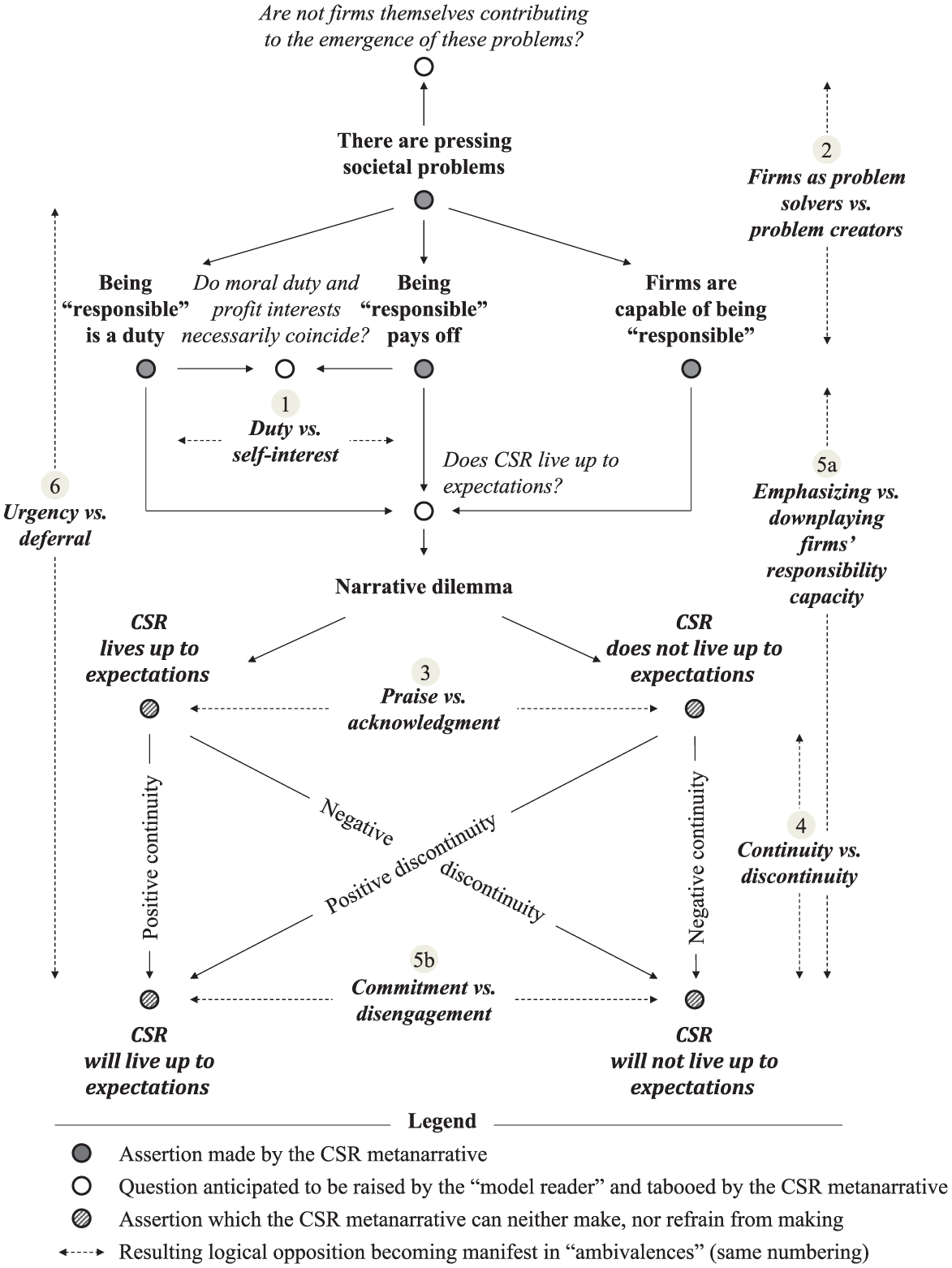
Narrative structure of institutional CSR narratives.
Institutional CSR narratives justify the necessity of CSR with the existence of pressing societal issues. They depict corporations as being able to hold a “responsibility” for addressing these issues and assert that such “responsibility” would be both profitable and motivated by a sense of duty. This leads to a first possible question on the part of the model reader: “Do moral duty and profit interests necessarily coincide?” The “duty versus self-interest” contradiction sensed by the model reader needs to be downplayed via the discursive strategies identified as part of Ambivalence 1.
However, the work of persuasion is not yet done. The initial assertions of the narratives may indeed trigger two further questions, which need to be addressed in a way or another. The first question concerns the actual root causes of global issues (and firms’ potential involvement therein), which leads to a second logical opposition that the stories must suppress (“firms as problem solvers versus problem creators,” which manifests in Ambivalence 2). The second question is even thornier. The model reader is likely to confront CSR with what one may call a “reality tes[t]” (Boltanski & Chiapello, 2007, p. 25): Simply put, he or she may wonder whether CSR in the advocated sense actually works or not, all the more because it is far from being a novel concept and has given birth to a set of institutionalized practices that may by now be judged on their merits.
In view of the modest results CSR has yielded in solving the global problems it pretends to address (Locke, 2013; Whiteman, Walker, & Perego, 2013), institutional CSR narratives find themselves in a predicament: They cannot refrain from taking a position on this question, but they also neither can credibly assert CSR’s effectiveness nor openly admit its ineffectiveness (opposition of “praise versus acknowledgment,” which manifests in Ambivalence 3). To alleviate this opposition, the narratives try to postpone the “reality test” to some indefinite point in the future (e.g., “that would in time speak volumes,” UNGC, 2015a). But this solves the problem only in part, as the CSRI cannot entirely refrain from making a commitment for the future either. Institutional CSR narratives hence find themselves forced to revolve around four conflicting assertions, whose relations to one another bear resemblance with Greimas’s “semiotic square” (Rimmon-Kenan, 2002, p. 12). As can be seen in Figure 3, this generates four more structural oppositions: “continuity versus discontinuity” in the evolution of the efficacy of CSR (manifest in Ambivalence 4), “emphasizing versus downplaying firms’ responsibility capacity,” and “commitment versus disengagement” with respect to solving the societal issues at stake (together becoming manifest in Ambivalence 5), as well as “urgency versus deferral” in addressing those issues (Ambivalence 6).
In essence, the structural oppositions are thus due to the narratives’ predicament in dealing with three core questions likely to be raised by the model reader: the question of the possible contradictoriness between corporate profit interests and socioenvironmental demands (engendering the opposition of “duty versus self-interest”), the question of capitalist corporations’ contributing role in generating the problems CSR avowedly addresses (generating the tension of “firms as problem solvers versus problem creators”), and the question of CSR’s current and foreseeable (in)effectiveness in solving these problems (which generates the remaining oppositions). Institutional CSR narratives neither openly discuss nor clearly settle these sensitive questions. On the contrary, they work toward silencing and obscuring them, which generates logical oppositions that need to be mediated accordingly.
In reference to Kallio (2007), one may call these three questions the “taboos” of institutional CSR narratives. Initially borrowed from Polynesian language, the word “taboo” can be defined as “an often tacit but shared and general inclination not to address or question an issue” (Lombardo, Meier, & Verloo, 2010, p. 106). Taboos are largely institution-specific (i.e., they can vary from one social context to another; Brain, 1979, and Radcliffe-Brown, 1939). Voicing a tabooed issue constitutes a breach of norm, which becomes manifest in the diffuse perception that doing so would be “out of place” (Brain, 1979, p. 8). As taboo norms are tacit, people usually are not utterly conscious of them. Nevertheless, these norms tend to be intuitively followed, and at the same time perpetuated, through particular ways of speaking and acting that are subtly indicative of the existence of discursive prohibitions. The relation between the taboos and the ambivalences of institutional CSR narratives is thus a dialectical one: To evade as far as possible the tabooed questions raised by the model reader, authors of institutional CSR narratives must resort to ambivalent language. Becoming conventionalized, this ambivalent language in turn contributes to reinforcing the underlying taboos.
Our structuralist interpretation elucidates the way in which institutional CSR narratives decontest the concept of CSR. They advocate for a meaning of CSR which can be qualified as “capitalism-friendly” (i.e., which holds fast to capitalism’s growth imperative and promises not to compromise business firms’ pursuit of maximum profit). But as the need for CSR is justified by the necessity of addressing a series of severe and pressing global issues, and given the CSRI’s present ineffectiveness in doing so, this results in logical oppositions which need to be stifled as part of these stories’ decontestation work.
Discussion
Conceiving of Institutional CSR Narratives as Variants of a Common “Metanarrative”
Prior to our empirical investigation, one could have expected the narratives of our corpus to significantly differ from one organization to another as the three “subjects” under study operate under very different governance mechanisms: The GRI functions as an independent CSO, the UNGC works under the aegis of the United Nations, and the WBCSD is purely business-led.
Our findings contradict this presumption. To be sure, the narratives of our corpus may appear different at a first glance, notably because they sometimes imbue their arguments with a nimbus of unprecedented novelty and discovery (WBCSD, 2010b) and because they tend to stamp the advocated conception of CSR by regularly renewed labels (e.g., as for the WBCSD: “sustainable livelihood,” WBCSD, 2004; “inclusive business,” WBCSD, 2010a; “circular economy,” WBCSD, 2016). Some of the stories also relate to topical events such as the 2008 financial crisis (WBCSD, 2008a) or the 2010 United Nations Summit on the Millennium Development Goals (UNGC, 2010b). But on closer consideration, it becomes apparent that these differences are of rather superficial nature. As can be seen from Appendix C (supplemental material), the narratives under consideration are characterized by a common “wa[y] of talking” (Fairclough, 2013, p. 43) about CSR: They resort to the same topoi as well as to similar wordings and sentence structures, regardless of the organization they emanate from. These discursive regularities suggest that these stories pertain to a same “discourse” (Fairclough, 2013; Reisigl & Wodak, 2009). As discourses generally emanate from particular institutions (Fairclough, 2013, pp. 30-55; Reisigl & Wodak, 2009), this finding corroborates the assumption which stood at the outset of our corpus selection, namely that the organizations under study indeed belong to a common “CSRI.” Our structuralist interpretation suggests that the origins of these discursive conventions are to be found at the level of the narratives’ structures. In view of their common structural foundations, we think that institutional CSR narratives are better conceived as “variants” of one and the same self-replicating “metanarrative” (Lyotard, 1984, Introduction, p. xxiii; Shenhav, 2015, p. 25) than as genuinely independent stories: Despite their seeming originality, institutional CSR narratives are indeed “masked repetition[s]” (Foucault, 1971, p. 13) of an ever same story of CSR. They are “simultaneously conservative and innovative” (Argyros, 1992, p. 667) in the sense that they proliferate through a process of concurrent “repetition and variation” (Shenhav, 2015, p. 66). While taking up topical issues and rephrasing some of their rhetoric time and again, institutional CSR narratives nevertheless conform to a common structural trunk.
The Performative Effects of Institutional CSR Narratives
So far, we have limited ourselves to examining the discursive functioning of the institutional decontestation of CSR. We shall now launch a reflection on how institutional CSR narratives affect the way their readership thinks and acts: To what extent are these stories conducive to attaining the social and environmental ends the CSRI avowedly strives for? Do they enable, or rather inhibit, the change required to contain global world problems?
One’s judgment of the performative impact of institutional CSR narratives may depend on one’s belief in the fundamental possibility of remedying global world problems by moralizing corporate conduct in a way that is compatible with capitalism’s growth logic. Who trusts in the potential of “conscious capitalism” (Hanson, 2011; O’Toole & Vogel, 2011; Sisodia, 2011) may indeed contend that perpetuating the “taboos” of the institutional CSR metanarrative can have a motivating and mobilizing effect: Institutional CSR narratives may heighten awareness about the gravity of global socioenvironmental issues and at the same time divert attention away from the divisive and still unsettled question of how exactly to articulate capitalisms’ growth logic with societal demands. In evading the potentially discouraging reality of the CSRI’s present ineffectiveness in addressing those global world problems, these narratives may also maintain their audiences’ motivation for engaging in CSR and seeking new forms of business that can be mutually advantageous for large capitalist firms and the broader society.
However, those who are critical of the CSRI’s “win-win” paradigm and also skeptical about capitalism’s capacity for sufficient moral self-restraint, as is the case with the authors of this article, are likely to be more inclined toward considering that institutional CSR narratives inhibit rather than enable the required transformation of the global economy. We believe that the decontestation work performed by institutional CSR narratives serves a problematic discursive “appropriation” of criticisms voiced by the “corporate-irresponsibility-movement” (Boltanski & Chiapello, 2007; Kazmi et al., 2016). As was shown before, these narratives stress the need for CSR by referring to the existence of pressing contemporary world problems and by calling for a major (quoted verbatim: “breakthrough,” WBCSD, 2017b; “fundamental,” Deloitte & WBCSD, 2016; “game-changing,” UNGC, 2015c; “transformational,” GRI, 2016; “radical,” WBCSD, 2013a) shift in corporate conduct. The clarity with which these stories express the necessity of a profound change may remind of claims voiced by Marxist, ecological economics, alter-globalization, and degrowth movements. But in depicting the phenomenon of capitalist globalization as quasi-natural, inescapable, and irreversible (Fairclough, 2013, pp. 454-478; Steger, 2005), potential solutions such as mutualization, renationalization, reregulation, and deglobalization (e.g., through alternative currencies and short food supply chains) seem to be ruled out from the outset: CSR, in its advocated “capitalist-friendly” sense, appears as the only viable option for addressing the global threats which would descend on mankind in the manner of a plague. In obscuring the links between global grievances and the systemic constraints of the capitalist economic system, and furthermore eluding the question of CSR’s current and foreseeable inefficacy, institutional CSR narratives progressively water down the ostensibly radical claims professed in the first place, in a manner that can easily go unnoticed at first reading. WBCSD (2017b), for instance, begins with an emphatic call for a “radical transformation across all sectors.” But a few lines further down, this statement is attenuated by a formulaic statement on the supposedly necessarily gradual character of any change: “Most change tends to be incremental; sustainability is no different.” This induces what one may call the “fallacy of gradualism,” suggesting that little, experimental, and system-conform steps toward increased “responsibility” could, through the accelerating and extrapolating virtues of the market (the “green race” invoked by WBCSD, 2012), ultimately lead to the radical change required to heal the planet. Narratives are equally ambivalent when it comes to the end state of this “transformation.” The “journey”-metaphor, which we found to pervade the narratives of our corpus, is typical of this ambiguity. As was noticed by Milne et al. (2006, p. 812), “journeying offers no grand vision or utopia, yet paradoxically hints at such a possibility” (p. 812). As if it were to prevent themselves from this critique, we found more recent CSR narratives to precisely replace or complement the “journey”-metaphor by formulating such a “grand vision”: The WBCSD invokes a “vision 2050,” which is that of “a world where nine billion people live well, within planetary boundaries” (WBCSD, 2017b); UNGC and DNV GL (2015) outline a “vision of a sustainable and inclusive global economy”; and UNGC and Oxfam (2015) sketch out a “vision of a world without poverty.” But these “visions” by no means do away with the ambiguity between “commitment” and “disengagement” because they are knowingly and willfully kept implausible. As management doctrine teaches us, a “vision” needs to be unrealistic to fulfill its aspirational purpose (Collins & Porras, 1996). “Visions” thus conceal a tacit admission of the likelihood of their own nonattainment. We think there are grounds for questioning whether the grandiose “visions” sketched out by institutional CSR narratives really stimulate action for change or only represent a token gesture. In a similar manner, the frequent framing of global societal and environmental ills as “challenges” (e.g., WBCSD, 2013a) conjures up the possibility of solving these severe and intricate problems, but paradoxically also prevents the corporate world from being held accountable for it: One can be reprimanded for having refused to take up a challenge but not for having failed to master it.
We can see here how the self-legitimizing stories propagated by the subjects of the CSRI work as “means-end decoupling” devices (Bromley & Powell, 2012): While holding out the prospect of a profound and abrupt change (the “end”), they distract from alter-capitalist ways of doing so and at the same time blur their readership’s expectations regarding the actual rapidness, radicalness and even effectiveness with which such change can realistically be brought about, ultimately suggesting that one can, and must, content with little, market-conform adjustments (the “means”). We may wonder whether the reader is simply a victim or partly complicit of this means-end decoupling. In fact, there may be something reassuring in the idea that the solutions to contemporary world problems can only lie in the business world as we know it and in keeping telling ourselves that we would pursue lofty “visions” by carrying out minor, yet perhaps “breakthrough transformational” measures (WBCSD, 2017b). Viewed from this angle, the variants of the institutional CSR metanarrative represent instances of a “ritualized optimism” (Clark & Salaman, 1996, p. 101) which perpetuate, through their ambiguity, a self-delusive and largely inconsequential “comforting rhetoric” (Hurrell, 1994, p. 153) that rather inhibits than furthers substantial action. In line with this presumption, research on social cognition and self-deception argues that people do not always experience ambiguity as unpleasant and worth being dispelled: Ambivalence can also become cultivated as a means to protect oneself against disappointing outcomes (Reich & Wheeler, 2016) or to deceive oneself into holding beliefs that are deemed desirable (Baumeister & Leith, 1997, p. 107).
Our analysis has relevance beyond the narratives diffused by “subjects” of the CSRI: More broadly, it also sheds a new light on certain language conventions that have become widely employed to talk about CSR. According to Eco (1979, pp. 25-26), even individual sememes (i.e., single discursive units of meaning) can encapsulate narrative meaning. Particular words or images thus can, by disseminating via the means of “intertextuality” and “interdiscursivity” (Fairclough, 2013, p. 175; Reisigl & Wodak, 2009), pursue the problematic decontestation work carried out by institutional CSR narratives.
One example are pictures of green sprouts, which we noticed to be ubiquitous in the publications of CSRI “subjects” (such a picture also appears in the video of the UNGC, 2015a). The sprout can be seen as standing metaphorically for a conception of CSR as something having only recently germinated, but being capable of evolving to something much bigger. At the same time, it conveys an impression of fragility, which sometimes is amplified by displaying two protective hands holding the soil in which it is planted. Such pictures imply that despite all the care taken, the outcome of the sprout’s development process is far from certain. On closer examination, the “CSR as a sprout” metaphor “tells a story” about CSR which conceals five of the structural tensions uncovered by our analysis: “praise versus acknowledgment” (CSR is no more than a germinating sprout, but it still is a sprout with possibly significant growth potential), “continuity versus discontinuity” (the sprout holds the prospect of developing, but it can also abruptly die), “emphasizing versus downplaying firms’ responsibility capacity” (the protective hands can decisively help the sprout to grow, but they cannot guarantee this will happen), “commitment versus disengagement” (accordingly, the commitment relates to the care that is given to the sprout, and not to the outcome of its growth process), and “firms as problem solvers versus problem creators” (the sprout conjures up the idea of a necessity of “growth,” and in some cases the supposed inextricability between sustainability and capital accumulation is made explicit by representing the sprout as planted in a pile of coins). We suspect that the success of the “CSR as a sprout” metaphor is precisely based on the fact that this trope perpetuates the narrative decontestation of CSR carried out by the “subjects” of the CSRI.
Toward a Recontestation of CSR
The question now arises as to whether and how one can initiate a “re-contest[ation]” (Alvesson & Kärreman, 2016, p. 146) of CSR’s meaning, which may ultimately induce a more decisive transformation in the way of doing business.
Opposing the meaning of CSR advocated by institutional CSR narratives is not an easy task, because it is now well entrenched in the corporate world: It is promoted by a large “CSR industry” (Shamir, 2011, p. 324) for which the CSRI constitutes a substantial source of economic revenues; it materializes in MNCs’ organizational structures and routinized practices, and—as was argued in this article—it is justified by a self-reproducing metanarrative that powerfully wards off criticism by presenting CSR as the only conceivable solution to world problems while concurrently curtailing our expectations as to its actual efficacy. The CSRI is thus characterized by what Levy and Scully (2007, p. 985) call an “alignment of material, organizational, and discursive forces,” which endows it with a relative stability and resistance to criticism.
However, that does not mean that we must resign ourselves to accept the understanding of CSR on which it is based. All institutions, even comparatively entrenched ones, remain fundamentally contingent and vulnerable to performative interventions, which can call into question and possibly reconfigure their inner logic (Gond & Nyberg, 2017; Levy & Scully, 2007). Hence, it is also possible to act on the CSRI, by attempting to destabilize and shift the acceptation of a “corporate social responsibility” in which it is rooted. The critical interpretation of institutional CSR narratives carried out in this article can be considered a first step in this undertaking: By revealing and problematizing the discursive mechanisms through which CSR becomes decontested in these stories, we have contributed to unsettle the thereby conveyed understanding of CSR, thus opening up possibilities for renegotiating CSR’s meaning.
We believe that this undertaking can and must be taken further, namely by actively engaging in such renegotiation of CSR’s acceptation. In the spirit of “critical performativity” (Alvesson & Spicer, 2012; Cabantous, Gond, Harding, & Learmonth, 2016; Spicer, Alvesson, & Kärreman, 2009), we thus call scholars and practitioners, who find themselves dissatisfied with the meaning of CSR disseminated by the CSRI, to participate in its “recontestation.” Below we outline three complementary tactics through which this could be done.
First, we call for actively breaking the three “taboos” revealed by our analysis. Taboos are deep-set, and often unconsciously perpetuated proscriptions, which shield social arrangements from critique (Brain, 1979). When these arrangements prove unsatisfactory for some reason, taboos become problematic because they hinder improvement of the situation (Browne, 1984). As was uncovered by our analysis, institutional CSR narratives install and maintain taboos around three central questions: the question of the continued unsustainability of capitalist MNCs’ activity, the question of the noncongruency between firms’ profit objectives and their societal impact, and the question of the present ineffectiveness of the CSRI. Leaving these questions unspoken creates an “intellectual blockage” (Jones, 2009, p. 335) which impedes the search of solutions outside those provided by the CSRI in its present form. We suggest making them a subject of overt reflection, debate, and empirical research.
Regarding the first of the aforementioned taboos, the question of the adverse effects of the capitalist growth regime has already aroused considerable interest and debate over the past decades (e.g., Carvalho & Rodrigues, 2006; Hirsch, 1976/2005; Meadows, Randers, & Meadows, 2004). Despite institutional CSR narratives’ evasiveness on this matter, there is now relative agreement about the fact that at least some of the global problems supposedly addressed by the CSRI—most notably global warming and growing inequality—have been, and continue to be, generated by the expansionary tendencies of capitalism (Clark & York, 2005; Klein, 2014; Piketty, 2015). MNCs constitute the main organizational manifestation and driver of this development (Fleming & Jones, 2013; Shamir, 2004, 2011; Sklair & Miller, 2010). Some critical CSR scholars are skeptical about the potentialities of a “corporate social responsibility” whose development is largely left to the hands of the corporate world itself because this would leave unaltered the basic tenets of global capitalism (e.g., Fleming & Jones, 2013). However, the exact limits of such a corporate self-regulation have so far remained undersearched and undertheorized. We thus call for better circumscribing the possibilities and limitations of a “soft law” that emerges out of market-like bargaining processes between corporations and their stakeholders (Shamir, 2008, 2011), in the lineage of Locke’s (2013) work on the insufficiencies of private voluntary regulation in ensuring decent working conditions along global supply chains.
As concerns the taboo of the incongruence between corporate profit interests and societal concerns, we call for actively breaking with the CSRI’s pervasive “win-win” paradigm by systematically identifying and naming “win-lose” situations and putting them at center stage of a thorough reflection. Considering the importance of the material dimension of performativity (Cabantous et al., 2016; Learmonth, Harding, Gond, & Cabantous, 2016), we suggest performing such analyses with the aid of tools (or “artifacts”) such as the “business activity impact matrix” developed by Jones (2009). Reminding us that win-win situations are not the rule, and drawing our attention and interest to cases in which ethics precisely does not pay, such tools can help us disembed our understanding of morality from the market logic (Shamir, 2008).
In a similar vein, we call for departing from the taboo of the CSRI’s current inability to solve global issues. We see “statactivism” (i.e., the activist mobilization of aggregate statistics) as a promising way to create clarity and awareness about the CSRI’s past and present (lack of) performance in preventing global problems, such as social inequality and the destruction of the environment (Bruno, Didier, & Vitale, 2014; Gond & Nyberg, 2017, p. 1139).
Second, we call for a reflexive engagement with the language used and spread by “subjects” of the CSRI. We shall be aware that when we communicate about CSR in replicating pictures of little sprouts, or in using stereotypical terms like “challenge,” “journey,” or “vision,” we (mostly unwittingly) reproduce the problematic decontestation carried out by the institutional CSR metanarrative: We raise hope for CSR’s ability to solve world problems and, at the same time, again diminish our faith in this possibility; we indulge in imagining the possibility of a radical change and, in the same breath, reassure ourselves that such a change maybe can leave unaffected the underlying socioeconomic mechanisms that have generated global grievances in the first place. In encapsulating the contradictions of the institutional CSR metanarrative, these images and words function as what Hahn et al. (2014) call “paradoxical frames”: These are cognitive templates through which we make sense of the relationship between business and society in a manner that sustains, in a “both/and” way, the contradictions inherent to a capitalism-friendly yet ostensibly ambitious understanding of CSR. While the bulk of the paradox literature on CSR expects such paradoxical frames to generate superior socioenvironmental outcomes as compared with “either/or” conceptualizations of CSR (Hahn et al., 2018; Hahn et al., 2014; Van der Byl & Slawinski, 2015), we are more doubtful of their actual impact on our way to think and act upon socioenvironmental matters. Once they become lodged in our minds, paradoxical frames such as the “CSR as a sprout” metaphor may well lead us to resign ourselves to the contradictoriness of the meaning of CSR underlying the CSRI, rather than inciting us to disentangle it (see Benson and Kirsch, 2010, and Foster, 2010, for a similar argument).
In the spirit of “critical language awareness” (Fairclough, 2013, pp. 529-557), we thus encourage a more cautious handling of these images and words. Moreover, we call for engaging in what critical discourse analysts refer to as “prospective critique” (Reisigl & Wodak, 2009, p. 88), which consists in elaborating and using alternative vocabularies that are deemed preferable to those promoted by the “subjects” of the CSRI. This also involves the development and dissemination of “counter-narratives” (Roe, 1994), that tell the story of CSR in ways that do not circumvent, but rather firmly engage with its taboos.
Third, we call for developing propositions for redefining CSR’s meaning in a manner that may be more conducive to societal change. We perceive three possible routes to take: The first one is to advocate for rejecting the very concept of CSR (Corporate Watch, 2006; Fleming & Jones, 2013). Such an approach should not be hastily dismissed as necessarily counterproductive: In view of the term’s advanced appropriation by the business world and its present ineffectiveness in ameliorating global issues, discarding the idea of a “corporate social responsibility” may indeed function as a wake-up call that reminds us of the harshness of the capitalist logic (Jones, 1996) and redirects our efforts toward exploring resolutely different ways to bring corporate activity under control. It may notably reinvigorate the demands for more stringent “hard laws,” which had been mitigated by the “corporate-social-responsibility-movement” in the early 2000s (Shamir, 2004). However, this also entails the risk of missing the opportunities offered by corporate self-regulation which—however insufficient to solve global problems—can have a palliative role.
By contrast, a second option is to uphold the worth and the necessity of CSR while, however, restraining its ambitions. More concretely, one may attempt to strip the term of its moral overtones and lofty aspirations, for instance, by explicitly limiting its sphere of application to “win-win” situations (Amaeshi & Adi, 2007) while insisting on the existence, if not predominance, of “win-lose” settings that require very different societal responses (Jones, 2009). This tactic would usefully call attention to the limitations of the CSRI, but with the drawback that CSR would be confined to an instrumental understanding of the term, which curtails its emancipatory potential.
The third possibility is to attempt to reinvest the meaning of CSR in a manner that works toward recovering its progressive ideals (Gond & Nyberg, 2017). From the CSRI’s current inability to solve planetary problems, it does not necessarily follow that the idea of CSR as such must be discarded or reduced to a secondary role in the demands for a more sustainable economy. The inadequacy of the currently prevailing understanding of CSR may actually be used as a starting point to trigger a reflection about what a corporate “responsibility” worthy of that name, and living up to the CSRI’s proclaimed ambitions, could actually look like. Such an understanding of CSR may be incompatible with the logics of the capitalist system in its current form (Jones, 1996), but precisely this may predestine it to provide the impulse for imagining an alternative economic order. Rather than sticking to the view that CSR’s role is necessarily confined to barely “filling the gaps” that arise out of the unbridled pursuit of economic growth at a global scale, one may, instead, start by imagining what a genuinely “responsible” corporate behavior may look like and then explore the structural conditions that would actually enable and promote such conduct.
Conclusion
In this article, we have studied the discursive mechanisms by which the fundamentally contestable notion of CSR becomes narratively “decontested,” with a view to legitimizing the institutionalized practices that are carried out under its name. Having revealed the structural tensions that underlie this decontestation, and sensitized the reader to the various communicative strategies by which these tensions become accommodated, we have triggered a discussion about the actual effects of this narrative decontestation work. We claim that despite their seemingly radical claims, institutional CSR narratives actually contain CSR’s subversive potential and forestall any serious examination of the current economic system. Reassuring us that a profound change toward a socially and environmentally viable future is possible, they concurrently intimate that the only possible way to achieve such change is a conception of a corporate “responsibility” which leaves untouched the tenets of contemporary capitalism, thereby reinforcing the infamous adage that “there is no alternative.” We call for resisting the language used by these narratives and sketch out possibilities for actively “recontesting” the meaning of CSR in a manner that allows us to reconsider more broadly and thoughtfully the role of corporations in society.
Supplemental Material
Supplemental_material – Supplemental material for Unpacking the Narrative Decontestation of CSR: Aspiration for Change or Defense of the Status Quo?
Supplemental material, Supplemental_material for Unpacking the Narrative Decontestation of CSR: Aspiration for Change or Defense of the Status Quo? by Aurélien Feix and Déborah Philippe in Business & Society
Footnotes
Appendix
Corpus of Narrative Accounts.

| Reference | Full title and link | Page no. |
|---|---|---|
| AA and UNGC (2013) | AccountAbility & United Nations Global Compact. (2013). Growing into your sustainability commitments: A roadmap for impact and value creation. Retrieved from https://www.unglobalcompact.org/docs/publications/AA_UNGC_Report.pdf | 2 a |
| Deloitte and WBCSD (2016) | Deloitte & World Business Council for Sustainable Development. (2016). License to innovate: Breakthrough strategies for social impact. Retrieved from http://www.wbcsd.org/Clusters/Social-Impact/Resources/License-to-Innovate-Breakthrough-Strategies-for-Social-Impact | 3 |
| DNV GL, UNGC and Monday (2015) | DNV GL Group, United Nations Global Compact & Monday Morning Global Institute. (2015). Global opportunity report 2015—Your guide to a world of opportunities. Retrieved from http://globalopportunitynetwork.org/the-2015-global-opportunity-report.pdf | 5 |
| GRI (2007) | Global Reporting Initiative. (2007). The GRI’s Sustainability Report July 2004-2007. Retrieved from https://www.globalreporting.org/resourcelibrary/GRI-Sustainability-Report-2004-2007.pdf | 8 |
| GRI (2012) | Global Reporting Initiative. (2012). A new phase: the growth of sustainability reporting—GRI’s Year in Review 2010/11. Retrieved from https://www.globalreporting.org/resourcelibrary/GRI-Year-In-Review-2010-2011.pdf | 3 |
| GRI (2014) | Global Reporting Initiative. (2014). Annual Activity Review 2012/2013—From information to transformation: The next step in sustainability reporting. Retrieved from. https://www.globalreporting.org/resourcelibrary/GRI-Activity-Report-2012-13.pdf | 6-7 |
| GRI (2016) | Global Reporting Initiative. (2016). Empowering Sustainable Decisions—GRI’s Annual Report 2015-2016. Retrieved from https://www.globalreporting.org/resourcelibrary/GRI-AnnualReport2015-2016.pdf | 4 |
| GRI, UNGC and WBCSD (2015) | Global Reporting Initiative, United Nations Global Compact, & World Business Council for Sustainable Development. (2015). SDG Compass—The guide for business action on the SDGs. Retrieved from https://www.unglobalcompact.org/docs/issues_doc/development/SDGCompass.pdf | 2 |
| UNGC (2010a) | United Nations Global Compact. (2010). Blueprint for corporate sustainability leadership. Retrieved from https://www.unglobalcompact.org/docs/issues_doc/lead/Blueprint_english.pdf | 1 |
| UNGC (2010b) | United Nations Global Compact. (2010). A global compact for development. Retrieved from https://www.unglobalcompact.org/docs/issues_doc/development/A_Global_Compact_for_Development.pdf | 3 |
| UNGC (2013) | United Nations Global Compact. (2013). Global Corporate Sustainability Report 2013. Retrieved from https://www.unglobalcompact.org/docs/about_the_gc/Global_Corporate_Sustainability_Report2013.pdf | 2 |
| UNGC (2015a) | United Nations Global Compact. (2015a). Global Compact+15: Business as a Force for Good (Voice-over transcript). Retrieved from https://www.unglobalcompact.org/library/3021 | n/a |
| UNGC, (2015b) | United Nations Global Compact. (2015b). A global compact for sustainable development. Retrieved from https://www.unglobalcompact.org/docs/issues_doc/development/GCforSDbrochure.pdf | 3 a |
| UNGC (2015c) | United Nations Global Compact. (2015c). Global compact LEAD—Advancing sustainability leadership through innovation and action. Retrieved from https://www.unglobalcompact.org/docs/issues_doc/lead/LEAD-Brochure-2015.pdf | 2 a |
| UNGC (2017a) | United Nations Global Compact. (2017a). Making global goals local business—A new era for responsible business. Retrieved from https://www.unglobalcompact.org/docs/about_the_gc/MakingGlobalGoalsLocalsBusiness2017.pdf | 3 |
| UNGC (2017b) | United Nations Global Compact. (2017b). Making global goals local business—A new era for responsible business. Retrieved from https://www.unglobalcompact.org/docs/about_the_gc/MakingGlobalGoalsLocalsBusiness2017.pdf | 5-7 |
| UNGC and Dalberg (2010) | United Nations Global Compact & Dalberg Global Development Advisors. (2010). Innovating for a Brighter Future—The Role of Business in Achieving the MDGs. Retrieved from https://www.unglobalcompact.org/docs/issues_doc/development/Innovating_for_Brighter_Future.pdf | 3 |
| UNGC and Deloitte (2010) | United Nations Global Compact & Deloitte. (2010). UN Global Compact Management Model—Framework for implementation. Retrieved from https://www.unglobalcompact.org/docs/news_events/9.1_news_archives/2010_06_17/UN_Global_Compact_Management_Model.pdf | 2 |
| UNGC and DNV GL (2015a) | United Nations Global Compact & DNV GL Group. (2015a). NEXT—Sustainable business. Retrieved from http://globalcompact15.org/report/downloads-and-multimedia/next-sustainable-business | 9 |
| UNGC and DNV GL (2015b) | United Nations Global Compact & DNV GL Group. (2015b). NEXT—Sustainable business. Retrieved from http://globalcompact15.org/report/downloads-and-multimedia/next-sustainable-business | 10 |
| UNGC and DNV GL (2015c) | United Nations Global Compact. (2015c). Impact—Transforming business, Changing the World. Retrieved from https://www.unglobalcompact.org/docs/publications/ImpactUNGlobalCompact2015.pdf | 2 a |
| UNGC and ICC (2015) | United Nations Global Compact & International Chamber of Commerce. (2015). Scaling up sustainability collaboration: Contribution of business associations and sector initiatives to sustainable development. Retrieved from https://www.unglobalcompact.org/docs/issues_doc/development/BusinessAssociationsSectorandSD.pdf | 4 |
| UNGC and Oxfam (2015) | United Nations Global Compact & Oxfam International. (2015). Poverty footprint—A people centred approach to assessing business impacts on sustainable development. Retrieved from http://www.globalcompactvietnam.org/upload/attach/PovertyFootprint.pdf | 5 |
| UNGC and Rockefeller (2012) | United Nations Global Compact& Rockefeller Foundation. (2012, June). A framework for action: Social enterprise & impact investing. Retrieved from https://www.unglobalcompact.org/docs/issues_doc/development/Framework_Social_Enterprise_Impact_Investing.pdf | 4 |
| UNGC, Unilever and Dalberg (2011) | United Nations Global Compact, Unilever & Dalberg Global Development Advisors. (2011). Catalyzing transformational partnerships between the United Nations and business. Retrieved from https://www.unglobalcompact.org/docs/issues_doc/un_business_partnerships/Catalyzing_Transformational_Partnerships.pdf | 6-8 |
| UNGC and WBCSD (2013) | United Nations Global Compact & World Business Council for Sustainable Development (2013). Joint report to the high-level panel of the post-2015 UN development agenda. Retrieved from https://www.unglobalcompact.org/docs/issues_doc/development/Joint_Report_HLP.pdf | 1 |
| WBCSD (1999) | World Business Council for Sustainable Development. (1999). Corporate social responsibility: Meeting changing expectations. Retrieved from http://old.wbcsd.org/pages/edocument/edocumentdetails.aspx?id=82&nosearchcontextkey=true | 1 |
| WBCSD (2000) | World Business Council for Sustainable Development. (2000). Corporate social responsibility: Making good business sense. Retrieved from http://old.wbcsd.org/pages/edocument/edocumentdetails.aspx?id=83&nosearchcontextkey=true | 2 |
| WBCSD (2002) | World Business Council for Sustainable Development. (2002). Corporate social responsibility: The WBCSD’s journey. Retrieved from http://old.wbcsd.org/pages/edocument/edocumentdetails.aspx?id=145&nosearchcontextkey=true | 2 a |
| WBCSD (2004) | World Business Council for Sustainable Development. (2004). Doing business with the poor—A field guide: Learning journeys of leading companies on the road to sustainable livelihoods business. Retrieved from http://wbcsdpublications.org/project/doing-business-with-the-poor-a-field-guide/ | 4 |
| WBCSD (2007) | World Business Council for Sustainable Development. (2007). Doing business with the world—The new role of corporate leadership in global development. Retrieved from http://wbcsdpublications.org/project/doing-business-with-the-world-the-new-role-of-corporate-leadership-in-global-development/ | 2-3 |
| WBCSD (2008a) | World Business Council for Sustainable Development. (2008). What a way to run the world—WBCSD annual review 2008. Retrieved from http://www.yooyahcloud.com/MOSSCOMMUNICATIONS/hriP4/WBCSD_rapport_annuel_08.pdf | 3 |
| WBCSD (2008b) | World Business Council for Sustainable Development. (2008). Sustainable consumption facts and trends—From a business perspective. Retrieved from http://wbcsdpublications.org/project/sustainable-consumption-fact-et-trends-from-a-business-perspective/ | 4 |
| WBCSD (2010a) | World Business Council for Sustainable Development. (2010). Business & development—Challenges and opportunities in a rapidly changing world. Retrieved from http://en.vbcsd.vn/upload/attach/BusinessAndDevelopment.pdf | 2 |
| WBCSD (2010b) | World Business Council for Sustainable Development. (2010). Vision 2050—The new agenda for business. Retrieved from http://www.wbcsd.org/Overview/About-us/Vision2050/Resources/Vision-2050-The-new-agenda-for-business | 3 |
| WBCSD (2011a) | World Business Council for Sustainable Development. (2011). A vision for sustainable consumption—Innovation, collaboration, and the management of choice. Retrieved from http://www.colorado.edu/AmStudies/lewis/sustain/visionconsumption.pdf | 2 |
| WBCSD (2011b) | World Business Council for Sustainable Development. (2011). Collaboration, innovation, transformation: Ideas and inspiration to accelerate sustainable growth. Retrieved from http://wbcsdpublications.org/project/collaboration-innovation-transformation-ideas-and-inspiration-to-accelerate-sustainable-growth-a-value-chain-approach/ | 2 |
| WBCSD (2012) | World Business Council for Sustainable Development. (2012). Changing pace—Public policy options to scale and accelerate business action towards vision 2050. Retrieved from http://www.greengrowthknowledge.org/sites/default/files/downloads/resource/Changing_Pace_WBCSD_0.pdf | 0-1 |
| WBCSD (2013a) | World Business Council for Sustainable Development. (2013). Scaling up inclusive business—Solutions to overcome internal barriers. Retrieved from http://www.inclusive-business.org/WBCSD_Internal_barriers_and_solutions_to_scaling_up_inclusive_business.pdf | 2 |
| WBCSD (2013b) | World Business Council for Sustainable Development. (2013). Measuring socio-economic impact—A WBCSD guide for business. Retrieved from http://www.pwc.com/gx/en/sustainability/publications/assets/pwc-wbcsd-guide-to-measuring-impact.pdf | 3 |
| WBCSD (2015a) | World Business Council for Sustainable Development. (2015). Towards a social capital protocol—A call for collaboration: Measuring social impacts and dependencies for better business. Retrieved from http://www.wbcsd.org/Clusters/Social-Impact/Resources/Towards-a-Social-Capital-Protocol-A-Call-for-Collaboration | 4 |
| WBCSD (2015b) | World Business Council for Sustainable Development. (2015). Towards a social capital protocol—A call for collaboration: Measuring social impacts and dependencies for better business. http://www.wbcsd.org/Clusters/Social-Impact/Resources/Towards-a-Social-Capital-Protocol-A-Call-for-Collaboration |
6 |
| WBCSD (2016) | World Business Council for Sustainable Development. (2016). Unlocking more value with fewer resources: A practical guide to the circular economy. Retrieved from http://www.wbcsd.org/Projects/Education/Leadership-program/Resources/Unlocking-More-Value-with-fewer-resources-A-practical-guide-to-the-circular-economy | 5-6 |
| WBCSD (2017a) | World Business Council for Sustainable Development. (2017). Social capital protocol: Making companies that truly value people more successful. Retrieved from http://www.wbcsd.org/Clusters/Social-Impact/Social-Capital-Protocol/Resources/Social-Capital-Protocol | 3 |
| WBCSD (2017b) | World Business Council for Sustainable Development. (2017). Futures Thinking: A guide to using futures thinking to help drive corporate resilience and transformational innovation. Retrieved from http://www.wbcsd.org/Clusters/Sustainable-Lifestyles/Resources/A-Guide-to-Futures-Thinking | 4 a |
| WBCSD and IFC (2008) | World Business Council for Sustainable Development & International Finance Corporation. (2008). Measuring impact—Framework methodology: Understanding the business contribution to society. Retrieved from http://www.ifc.org/wps/wcm/connect/7ddc9a80488552c3ac8cfe6a6515bb18/Measuring+Impact+Framework+Methodology.pdf?MOD=AJPERES&CACHEID=7ddc9a80488552c3ac8cfe6a6515bb18 | 5 |
Counted from the first page of the document when document is unnumbered.
Acknowledgements
We wish to thank special issue editor Professor Dennis Schoeneborn for his clear and constructive guidance throughout the review process, as well as the three anonymous reviewers for their helpful comments on earlier versions of this article. Our work has also greatly benefited from discussions at the EGOS Pre-Colloquium Workshops on “CSR and Communication” in 2016 and on “Marxism and Organization Studies” in 2017.
Declaration of Conflicting Interests
The authors declared no potential conflicts of interest with respect to the research, authorship, and/or publication of this article.
Funding
The authors disclosed receipt of the following financial support for the research, authorship, and/or publication of this article: This research was supported by the Swiss National Science Foundation [grant number 156966].
Supplemental Material
Supplemental material for this article is available online.
Notes
Author Biographies
References
Supplementary Material
Please find the following supplemental material available below.
For Open Access articles published under a Creative Commons License, all supplemental material carries the same license as the article it is associated with.
For non-Open Access articles published, all supplemental material carries a non-exclusive license, and permission requests for re-use of supplemental material or any part of supplemental material shall be sent directly to the copyright owner as specified in the copyright notice associated with the article.
