




Abstract
This article explores the role of changing memes in large systems change toward marriage equality—popularly referred to as same-sex marriage—in the United States. Using an abbreviated case history of the transformation, the article particularly explores the shifting memes or core units of culture, in this case, word phrases associated with marriage equality over time, influencing the social change process. Using both the case history and the empirical work on memes, the article identifies nine lessons to support others tackling large systems change challenges.
Few, if any, gay rights activists in 1996 would have predicted that within two decades, marriage equality would be the law of the land in the United States. That was the year that the Defense of Marriage Act (DOMA) defining marriage as the union of one man and one woman was signed into law by then President Bill Clinton, with support of 342 out of 435 members of the House of Representatives and 84 Senators. Only 27% of the population then supported marriage equality. Yet, in June 2015 the Supreme Court ruled it a constitutional right; by 2016, it was supported by 55% of adult Americans—including 71% of those born after 1981 (Pew Research Center, 2016).
“Marriage” as a social institution comprises a set of beliefs, values, norms, and practices that are inculcated into society through ceremonies, stories, symbols, and artifacts. These phenomena, as we will discuss below, are memes, and they are important, albeit often-overlooked aspects of social change, helping to shift sentiment as they themselves change (Waddock, 2015). Opponents to marriage equality for the LGBT (lesbian, gay, bisexual, and transgender) population viewed marriage’s definition as the union of a man and woman as an unchanging reality since time immemorial, a powerful meme that helped define what marriage was for many people. The shifting idea of what marriage with respect to the LGBT population represents is a classic example of how changing memes underpin social narratives that shape thinking and action, for good or for ill, thereby providing a basis for social change and indeed, for social movements (Zald & Ash, 1966).
This article advances understanding of the case history of surrounding marriage equality and shows how particular memes associated with the evolution of that history were introduced and shifted over time. Changing memes underpin significant social change because they shape attitudes and ultimately behaviors (Blackmore, 2000) and were used by activists to reshape core social norms and understandings (themselves memes), observed here through the lens of marriage equality. The basis for this article is historical and archival research on shifting memes (words and phrases, in this case). That research combines with a biographical case drawn from the second author’s personal experiences. The history emphasizes social changes in the United States around ideas about marriage from the late 1960s until the 2015 U.S. Supreme Court decision legalizing same-sex marriage. 1
Transformation and Memes
The shift to marriage equality for LGBT persons is an example of large systems change or societal transformation. Transformation or systemic change is conceived as radical change from the status quo, in contrast to more incremental approaches to systemic change (Brand, 2016; Georgantzas, 2012). These concerns raise questions like what drives such changes in society? What are the preconditions for change? and What examples might provide insight into how such, hopefully positive, change can be fostered? (Hackman & St. Clair, 2012).
Shifting memes play an important yet little studied part in system transformation and change (Waddock, 2015). This article hopes to provide some insight into that role in the marriage equality case. Memes are core cultural artifacts (e.g., words, ideas, symbols, images, and rituals) that pass from one person or group to others (Blackmore, 2000). The term “meme” was coined by biologist Richard Dawkins (1976) as a cultural analog to the biological term “gene,” and is meant to represent core units of culture. Memes merge into stories, narratives, and other types of complex sets of ideas that shape narratives. Narratives in turn frame understanding of how the world works, our relationship to that world, as well as what is and is not acceptable at a given time (see Pentland, 1999). Memes are the units of “cultural conversations” analogous to the words and signs within pivotal, meaning-making interpersonal conversations in phenomenological theory (Berger & Luckmann, 1966).
The goal of phenomenology, according to George Psathas (1989), is “the understanding, description, and analysis of the life-world as experienced by those who live it” (p. xii). To achieve this understanding, we must examine the cultural shifts that reflect alterations in the assumptions people are making over time. Changing memes are a window on these shifts. Phenomenology “examines the very assumptions that structure the experience of actors in the world of everyday life” (Psathas, 1989, p. 14). Moreover, Berger and Luckmann (1966) posit that each person’s assumptions are continually “reaffirmed in the individual’s interaction with others” (p. 149), interactions that would include the words and phrases (memes) that are used to tell stories and shape understandings and, ultimately, attitudes, practices, and behaviors (Blackmore, 2000).
To understand how transformational system change occurs, we need to better understand shifting memes and the narratives that emerge from those memes over time as part of the framing processes of transformative social change (Chong & Druckman, 2007). The term “transformation” has been used both as a loose metaphor and as a more rigorous analytic concept (Feola, 2015). Here we adopt the latter approach that identifies societal transformation as . . . fundamental, persistent and irreversible change across society . . . the process through which social innovations gain “durability, scale and transformative impact” by interlocking with system innovation, narratives on change, game-changers and societal transformation. (Avelino et al., 2014, p. 14)
Memes can be words, phrases, symbols, images, brands, or any number of other types of representations that shape cultural understandings and, ultimately, behaviors, policies, and practices (Blackmore, 2000). When they are resonant, memes—like genes—replicate or transfer from person to person (or from mind to mind), though less accurately than that of genes as different people can interpret memes differently. Still, resonant memes are like lenses through which we humans see and frame the world and our relationship to it (Blackmore, 2000).
Memes are the basis of the stories or narratives (i.e., the cultural mythologies) that form our understanding of what the world is about and how we relate to it (Blackmore, 2000; Harari, 2014). As Harari (2014) discusses in Sapiens, such narratives or cultural myths shape differences in cultures, communities, and societies, building our relations to others, to the world, to nature, and even to ourselves. In short, cultures and cultural change build on foundational memes that shape institutions, social order, and economies, as well as how their participants view their place in the world.
Marriage, for example, is a meme that indicates what is socially acceptable in committed relationships. Different cultures provide different meanings to the meme of marriage, along with rituals and ceremonies, legal practices and policies, and cultural understandings that support it in different ways (cf. Blackmore, 2000). For most of its history, memes associated with marriage in the United States ignored or outright rejected the possibility that LGBT individuals might engage in marriage (Lannutti, 2005). Fundamental to bringing about systemic change (though obviously only one of many steps and changes), we argue, is changing the “story” or narrative that shapes understanding. Changing narratives means shifting the memes that support dominant narratives or cultural mythologies so that consequent beliefs, attitudes, and practices can correspondingly shift, though, of course, not all memes or narratives are socially constructive. For example, many have criticized the Trump election campaign slogan (meme) “Make America Great Again” for its implicit racist and anti-progress messaging, yet that powerful meme surely resonated with many other people. The marriage equality struggle represents societal transformation, we argue, underscored by a shift in memes (i.e., the type of lived experience addressed by phenomenology and whose assumptions, here memes) need to be addressed to understand it fully (Psathas, 1989).
A Brief History of Marriage Equality 2
Previous to the marriage equality struggle, court cases on marriage equality in the United States associated marriage with five core concepts or, in our language, memes, reflected in numerous legal briefs that formed the basis of the traditional marriage. These concepts are encompassed in two competing views, the conjugal view and the revisionist view (Girgis, George, & Anderson, 2011). The conjugal (and more traditional) view is that marriage involves (a) the union of a man and a woman (b) in a permanent, exclusive commitment with (c) the purpose of childbearing, hence related to the common good, which explains state regulation of the practice (Girgis et al., 2011, p. 246). Furthermore, frequently such unions were viewed as sanctioned by God, hence the involvement of various religious institutions. The revisionist view, in contrast, sees marriage as “the union of two people (whether or the same or of opposite sexes), who commit to romantically loving and caring for each other and to sharing the burdens and benefits of domestic life” (Girgis et al., 2011, p. 246). In the revisionist perspective, the marriage meme is state sanctioned because “there is an interest in stable romantic partnerships” especially with respect to children’s well-being and because such stability helps with social cohesion (Girgis et al., 2011, pp. 246-247).
The transformation to marriage equality (a new meme) left only the dimension of commitment as the core quality of the marriage meme. Although claims of the unchanging nature of marriage since time immemorial were clearly overblown (e.g., it was only in 1967 that interracial marriage was constitutionally protected in the United States), the core qualities had been part of the marriage meme since before the founding of the American republic (Reinsborough & Canning, 2017).
1969 to Early 1980s: Building Gay and Lesbian Community
In 1960, homosexual intimacy was a criminal offense in all 50 U.S. states and homosexuality was considered a mental disorder (for more background on attitudes, see Loftus, 2001). The following decade was one of social turmoil over the Vietnam War, civil rights, and flower power. For the gay community, it was only in the closing year of the decade that the fight for rights came into full public view. In the early morning hours of June 28, 1969, police began routine harassment of patrons at a gay bar called the Stonewall Inn in New York. Rather than docilely submit as usual, gay men, drag queens, and transgender customers fought back and a riot ensued. Rioting repeated on subsequent nights. Although there had been many quiet protests by the gay community, the Stonewall Riots are commonly considered the birth of a movement that became known as “gay liberation” working for “gay rights,” two early memes.
A “Gay Pride” (an early meme) Parade was initiated to mark the first anniversary of the Stonewall riots in 1970 in New York City, and from there grew to annual and visible political/festive events in cities around the world. Already in 1970, in Minnesota, the first claim for the right to marry a spouse of the same-sex (note here the meme of same-sex marriage and related meme of same-sex partner) was filed in court; it was dismissed by the U.S. Supreme Court without even an oral argument Community organizing took off with the founding of the first national high profile advocacy group, the National Gay Task Force in 1973. It was joined by the Human Rights Campaign, founded in 1980 to raise money and lobby for general LGBT issues, which became known as “gay rights,” ultimately an important meme.
A media first came in 1971 with an episode of the highly popular All in the Family, which became the first sitcom (and among the most popular of TV shows) to depict a homosexual character. It even went so far as to challenge stereotypes by presenting an effeminate straight male and a former National Football League player who was gay. In 1974, the American Psychiatric Association declassified homosexuality as a mental disorder.
The 1970s saw enormous growth in a gay subculture in major cities, where bars, clubs, baths, and house parties flourished, as well as lesbian communities, intertwined with the flowering of the women’s movement. The 1970s activity was, generally speaking, among gays and lesbians themselves. They built ties and community among themselves. Being “in the closet” in terms of workplace and biological family relationships remained the norm, even as public opinion shifted (Brewer, 2003, 2014).
Early 1980s to Early 1990s: AIDS-Fueled Action
On June 5-6, 1981, major media publicized a report of the U.S. Centers for Disease Control and Prevention that described a rare lung infection and immune system issues with five young gay men. This marked the first recognized instances of acquired immunodeficiency syndrome (AIDS), commonly called the “gay disease” in its early days, in the United States. AIDS disfigured, debilitated, and killed victims, and the wide publicity about it ruptured the closet norm. Biological family members, often facing for the first time their relative’s sexual orientation, often felt torn between moral anguish and familial love. Then U.S. President Ronald Reagan did not mention the disease until 1985 when it was reaching epidemic proportions. The AIDS Coalition to Unleash Power (ACT UP) started in 1987 became famous for its ardent and creative protests over the next decade or so (ACT UP, n.d.). The focus of the gay community in the 1980s was generally, however, on medical treatment rather than political rights. The AIDS crisis deeply affected the hedonistic, sex-focused “liberation” characteristic of the 1970’s gay culture. Bath houses closed and sexual contact became more cautious.
On the legal front, in 1984, Berkeley, California, become the first city to provide same-sex couples benefits, referred to as “domestic partnership” benefits (another meme). However, the Supreme Court ruled in 1986 that laws criminalizing sodomy were constitutional. The religious right, a pillar of support for the Republican government, under the leadership of Jerry Falwell and the Family Research Institute, stoked anti-gay sentiment and claimed AIDS was God’s wrath for sinful practice by gays (Bull, 1996). Despite these efforts, the first mass same-sex marriage wedding ceremony was performed on the National Mall in Washington in 1987. By 1989, the New York State Court of Appeals had declared that same-sex couples could be defined as families (ProCon, n.d.).
All of this intense activity had remarkably little impact on public opinion about same-sex relationships. A report on General Survey Statistics summarized, “From 1973 through 1991 there was little change in public attitudes towards homosexual behavior. From two-thirds to three-quarters consistently said it was ‘always wrong’ while 10-15% considered it ‘not wrong at all’” (Smith, 2011; Yang, 1997).
Mid-1990s to 2004: Building the Gay Marriage Case
The gay community actually felt very divided about the issue of (meme of) gay marriage at the opening of the 1990s. Gary Buseck, legal director of Gay and Lesbian Advocates and Defenders (GLAD), recalls that many rejected marriage as a patriarchal institution contrary to gay values and out of worries that it would lead to assimilation and loss of the distinctive qualities of gay culture (Buseck, 2015).
A 1993 Hawaii’s Supreme Court ruled that the state could not deny same-sex couples the right to marry without a “compelling reason” (ProCon, n.d.). That same year, a legal battle over acceptance of gays in the military produced another meme, “Don’t Ask, Don’t Tell,” which could have been a win over the traditional policy to eject gays from the military; however, application lead to substantially more discharges because of sexual orientation. The U.S. 1996 Defense of (heterosexual) Marriage Act (DOMA) signed by then President Bill Clinton was formally a loss (ProCon, n.d.). The fact that gay marriage opponents deemed the legislation necessary, however, demonstrated shifting attitudes, despite anti-gay sentiment by the Republican Party and some evangelical groups.
The battle grew in the public domain. Also in 1993 an estimated 800,000 to one million people participated in the March on Washington for Lesbian, Gay, and Bi Equal Rights and Liberation. The entertainment industry began producing gay-positive movies, among them, the 1993 Broadway hit Angels in America, which placed the AIDS epidemic and gay life front and center. In 1997, mainstream Time magazine put comedienne Ellen DeGeneres on its cover with a bold title in red ink stating, “Yep, I’m gay.” In 1998, Will and Grace became the first television sitcom to feature a gay man as its lead character; it had a large audience. Many other movies and television shows began to depict gay people more positively as well.
Proponents organized
In 1993 in Massachusetts, proponents formed the grassroots activist organization, the Freedom to Marry Coalition (another meme) with the LGBT community as its initial focus. “You had to educate people that marriage comes with rights,” recalls former Coalition Advocacy Director Josh Friedes. “It’s not just about love” (Friedes, 2014). Indignation over being a wronged minority deprived of rights proved an effective LGBT community rallying cry. The Coalition counted over 1,100 federal rights at stake; particularly important were health insurance, inheritance, and hospital visitation rights. Community support grew as gay couples having children became more common, which raised a whole range of marriage issues. A paramount one was adoption by same-sex couples. Like marriage, adoption is a state issue in America, although state action must fall within federal constitutional bounds. Many states had laws prohibiting adoption by same-sex couples, which began to fall to local and national political and legal battles.
Memes were a battlefield. “We at GLAD,” explained Buseck (2015), “are very determined never to say ‘same-sex marriage’ or ‘gay marriage.’ What we won was marriage, not some new kind of marriage. Our opponents talked of ‘same-sex marriage’ as some new entity that had no historical basis; we said we should have access—like all other citizens—to the institution of marriage. It is an easy shorthand and talking about marriage equality or marriage for same-sex couples is more cumbersome, but we have always thought that the language choice is important.”
A key successful effort established the Religious Coalition for the Freedom to Marry, formed in 2001 and launched in 2003 formally, which represented 23 faith traditions and some 1,000 clergy (Freedom to Marry, n.d.). Freedom to Marry participated in the emergence of a lead activist organization around the emerging meme of marriage equality, called MassEquality, in the late 1990s and early 2000s. Its founding marked a new stage of development beyond grassroots into sophisticated political campaigning with very substantial sums of money—reflecting the Coalition’s and others success at rallying the LGBT community.
Nationally, legal issues were coordinated by a loose group from all the major LGBT and civil rights organizations in the early 1990s, referred to as “The Gay Rights Litigators’ Roundtable” (Graff, 2017). A conscious decision was made to focus on marriage equality first, then transgender rights (the commitment to transgender rights was indeed later followed through successfully). This strategy aimed first for marriage as a right under state constitutions, then to federally challenge DOMA, and finally to secure marriage as a federal constitutional right. They carefully analyzed jurisdictions by their laws, constitutions, legislators, public, and judges to identify which ones would be the most favorable arenas (Buseck, 2015).
As more media personalities came out, more broadcast media included gay characters, and activism, both public and less so, continued unabated, things began to shift. The proportion of Americans who reported knowing someone who was gay increased from 25% in 1985 to 74% in 2000 (Klarman, 2013). People seeing sexual relations between two adults of the same sex as “always wrong” decreased from 73% in 1990 to 56% in 2004 (Smith, 2011). Cities began creating “domestic partnership registries,” where couples could obtain some modest city rights associated with marriage. In 2000 the State of Vermont, neighboring Massachusetts, recognized “civil unions” (another emerging meme) for gay or lesbian couples, which awarded all the rights of marriage, but specifically reserving “marriage” for heterosexual couples. In 2004, through a ruling of Massachusetts’s most senior court, the state began providing same-sex couples legal union with use of the word “marriage.” Arguing for this very word to the court, GLAD attorney Mary Bonauto (2003) stated, “One of the most important protections of marriage is the word because the word is what conveys the status that everyone understands is the ultimate expression of love and commitment.”
2004 to 2015: Becoming the Norm
The opposition was intense. By 2012, 31 of 50 state constitutions had been amended to prohibit same-sex unions. The year 2012 was a watershed when, for the first time, voters (in four states) threw their weight in favor of marriage equality. To broaden support, around 2004 the focus shifted to issues of love and family to support the marriage equality meme, reflecting values of love and commitment as well as rights. This shift appeared in numerous popular culture outlets, including television shows, movies, and plays, putting LGBT individuals and their relationships into the news media spotlight. In 2013, the journalist Dennis Leap, who opposed marriage equality, observed: The media love it (the marriage equality issue): Images of same-sex couples lustfully embracing are popping up everywhere on television, the internet, and magazine covers.
The many supportive popular movies, television shows, and included the popular sitcom Modern Family, which premiered in 2009, highlighted a gay couple as a positive role model and the movie Brokeback Mountain in 2005 vividly demonstrated a gay cowboy relationship as a love relationship.
During this period, support from the business community was growing. In the late 1990s, about 10% of firms with more than 200 employees offered same-sex partner benefits (another meme). By 2006, 263 of Fortune 500 companies offered them. In 2011, 70 corporations and professional associations asked the courts to overturn DOMA. By 2014, 67% of Fortune 500 companies offered health benefits for same-sex couples (Ellis, 2013; Gunther, 2006).
The pace of legal challenges grew. Almost all were successful, and by October 2014, marriage equality was law in 35 states, on the basis that they were in conflict with the federal constitution. In June 2015, the debate ended as the Supreme Court declared marriage between same-sex couples a constitutionally protected right. In the next section, we outline an approach to understanding how relevant memes associated with this history actually shifted (see Table 1 for timeline of major events over these years).
Marriage Equality Timeline (Key Events).
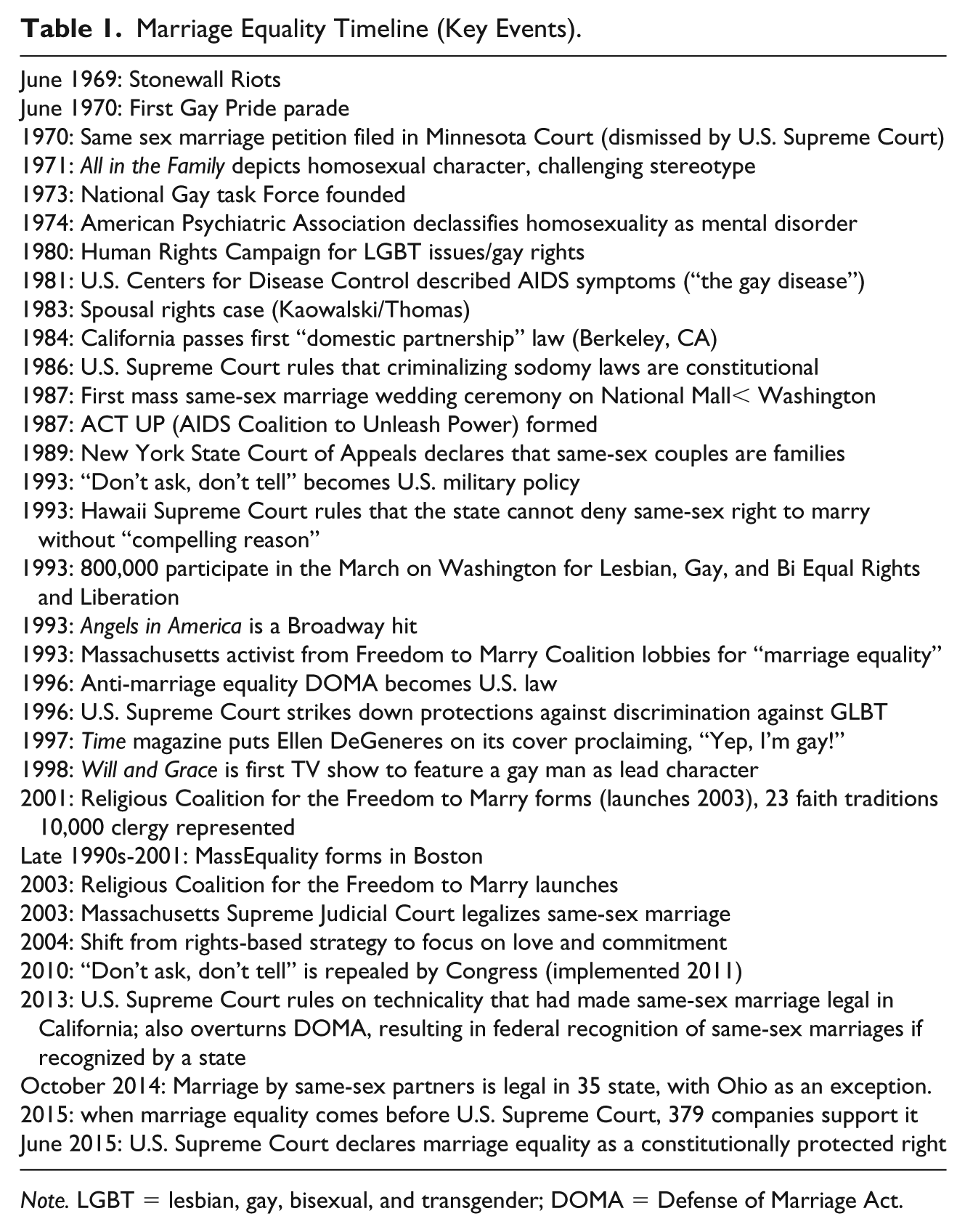
Note. LGBT = lesbian, gay, bisexual, and transgender; DOMA = Defense of Marriage Act.
Method
The purpose of the empirical part of this study is to explore the shifting memes around marriage equality in the United States from about the late 1960s/early 1970s to 2015, when marriage equality became part of the United States’s rule of law. Shifting memes underscore how a new story supplanted an older story about gay rights and gay pride, along with memes of civil unions and domestic partners, memes that themselves arose in the 1970s. The proposition here is that the growth of new memes with different connotations was a critical part of the significant shifts in public attitudes and consequent social change. This shift underpins a new narrative about marriage equality and attendant commitment that brought about the U.S. Supreme Court’s 2015 ruling that marriage between same-sex partners is a constitutionally protected right.
Memes actually became a topic during the marriage shift. The term “meme” here had a variety of expressions. Memebase.cheezburger.com collected a variety, including cartoons, under the tag “gay marriage” (Various, n.d.). “The 15 Gay Marriage Memes You NEED to See” (Droesch, 2013) focused on visual and video representations. Time magazine gathered twitter feeds of memes associated with the 2015 Supreme Court decision (Waxman, 2015). Shifting memes were also associated with articles about shifting attitudes documented through surveys (Newport, 2011), and exploring the changing meaning of marriage (Brewer, 2014; Lannutti, 2005).
One way to look at meme evolution is the frequency of use of specific words or phrases to determine whether their usage shifted. Using words as surrogates for meme comes with a number of cautions. One is that the contextual use of a single or pair of words is not captured. Another is that the meaning of words also changes over time, which is indicative of a meme shift, of course. Furthermore, at best we can determine correlations, not causality, with this approach.
Six sets of memes suggested by the case history and personal knowledge were used: gay rights, gay marriage, same-sex marriage, same-sex partner, freedom to marry, and marriage equality. Memes of “domestic partner,” “civil union,” “gay pride,” and “gay liberation” are also included in two of the charts for comparative purposes, as these memes helped focus new kinds of attention on the GL community.
Where data were available we selected 1965 as the beginning date for the study, as that was before the Stonewall riots brought issues of gay pride and rights into public view. The data end in 2015 when marriage equality became a constitutional right in the United States. Obviously, data here are U.S.-centric.
Multiple sources are used to determine popularity of relevant memes and to triangulate the data and ensure a degree of face validity. To assess the popularity of memes in the popular press at a given point in time, we searched key phrases in two major U.S. newspapers (combined) from 1970 to 2015. One newspaper is the New York Times, which is the newspaper of record in the United States. The other is the Washington Post, which was the leading newspaper in the nation’s capital, where federal policy decisions are made. Although other choices could be made, the combination of these two sources, in our view, best reflects the national conversation. The year 1970 is the first year for which these data were available.
We also included the use of memes in Google Scholar (1965-2015), which was selected to reflect scholarly output using these memes over the relevant period, as scholars can be expected to pick up themes from what is going on in popular culture. As we note below, there is an expected delay in scholarly publications relative to newspapers, because of time lags for studies, the review process, and publication delays. Business Source Complete (by year and in the title and abstract), which includes a wide variety of publications, was used to reflect what was going on in the business press. Businesses were deeply involved in delivering domestic partner and other benefits. Another possible source of shifting ideas in popular culture is books. Google Ngrams, which details mentions of words in books, were used to cover memes in books from 1965 to 2008 when the data end. We recognize that other possible sources of data exist; however, the triangulation provided by these multiple sources seeks to ensure that the data are representative of the relevant time periods across multiple possible audiences.
Data are descriptive rather than predictive (e.g., word counts), our surrogate for relevant memes. They are presented in charts in 5-year increments to provide visual evidence of the relevant shifts in meme popularity over the period from 1965 to 2015. Results are discussed below.
Results: Shifting Memes
Figure 1 presents a chart of mentions of the six core memes, gay rights, gay marriage, same-sex marriage, same-sex partner, freedom to marry, and marriage equality, in the New York Times and Washington Post, combined over the period 1970-2015 in 5-year increments (i.e., from when the data became available). The first thing to note is that none of the memes were in much usage at all in the popular press prior to the 1970s. About 1975, mentions of gay rights begin, climbing steadily until 2005 when use of the “gay rights” meme stabilizes then begins to decline.
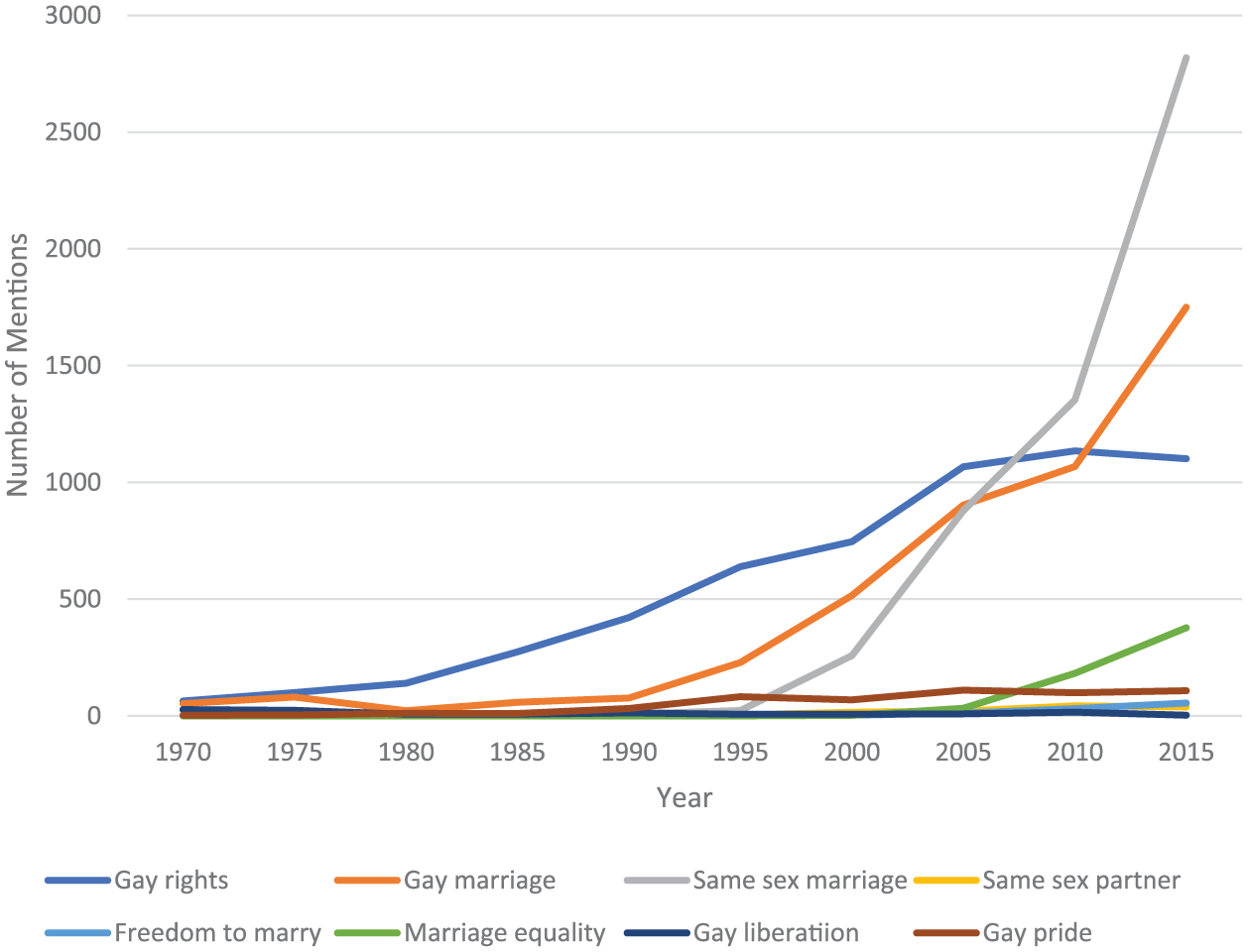
Newspaper (New York Times and Washington Post) mentions of six marriage equality memes, 1970-2015.
Other terms like freedom to marry and same-sex partner receive few mentions at all over the whole period. What is most notable is that the term “gay marriage,” which had received a few mentions in 1975 then declined in usage, begins a steady climb in mentions in 1980, while “same sex marriage” begins a notable and very steep increase starting in 1995. The meme of “marriage equality” does not enter the newspaper lexicon until just before 2005 (as the case history suggests), when it starts to rise, notably in an opposite trend to what was happening to the term “gay rights” during that period. The “gay liberation” and “gay pride” memes never gained much traction in the mainstream media, despite their popularity within the gay communities, although “gay pride” was somewhat more used.
We used Google Scholar, which encompasses scholarly publications, to look at mentions of the same six terms plus the addition of domestic partner and civil unions, which gained some traction as ideas about same-sex relationships became more prominent in the 1990s. These data are presented in Figure 2 for 1965-2015, also in 5-year increments. Figure 3 simplifies this data to the five memes directly associated with marriage: gay marriage, same-sex marriage, marriage equality, civil unions, and domestic partner. Note again that there is no mention of any of the specifically marriage-related memes prior to 1975.
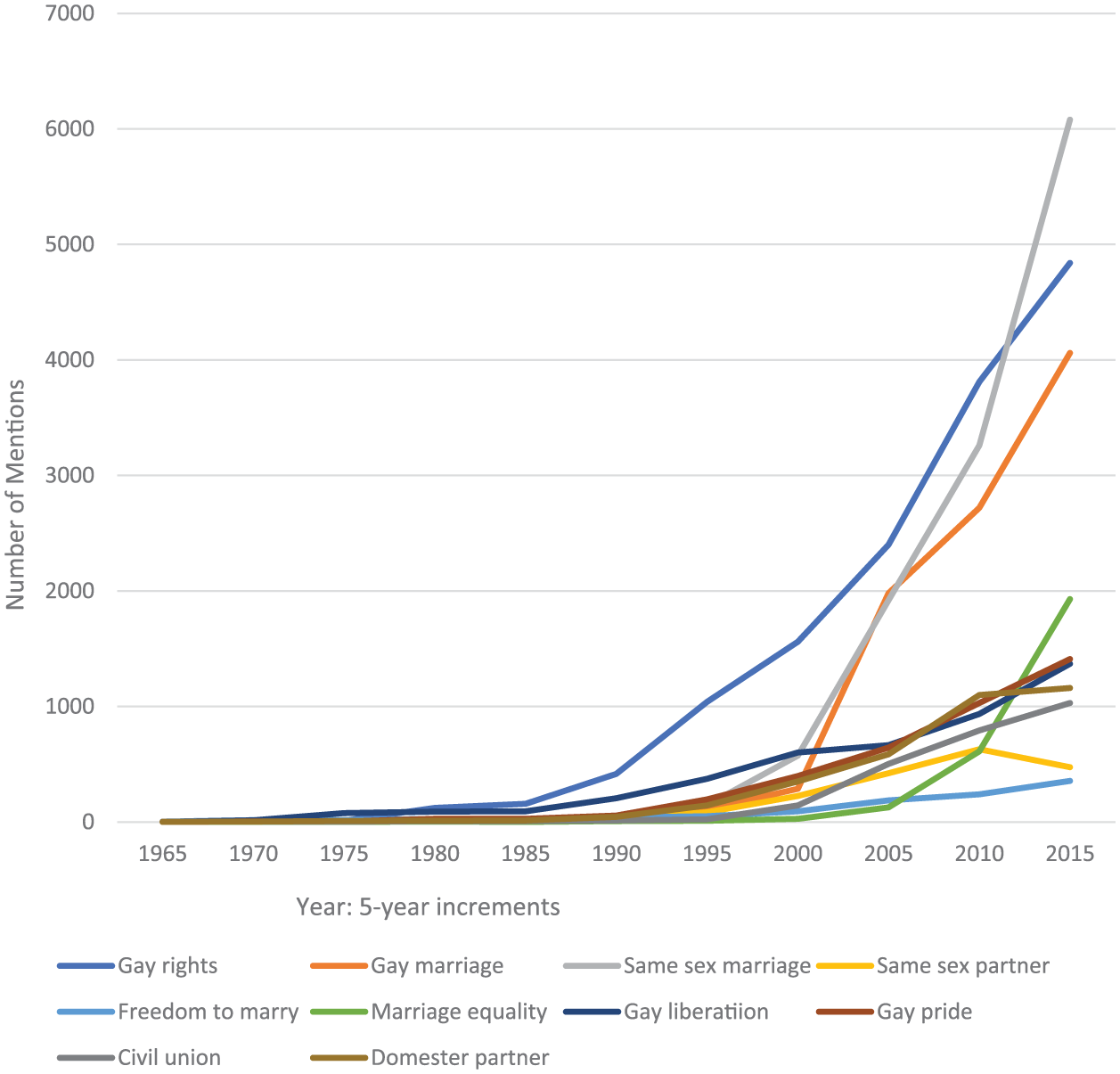
Google Scholar mentions of marriage equality memes (1965-2015, 5-year increments).
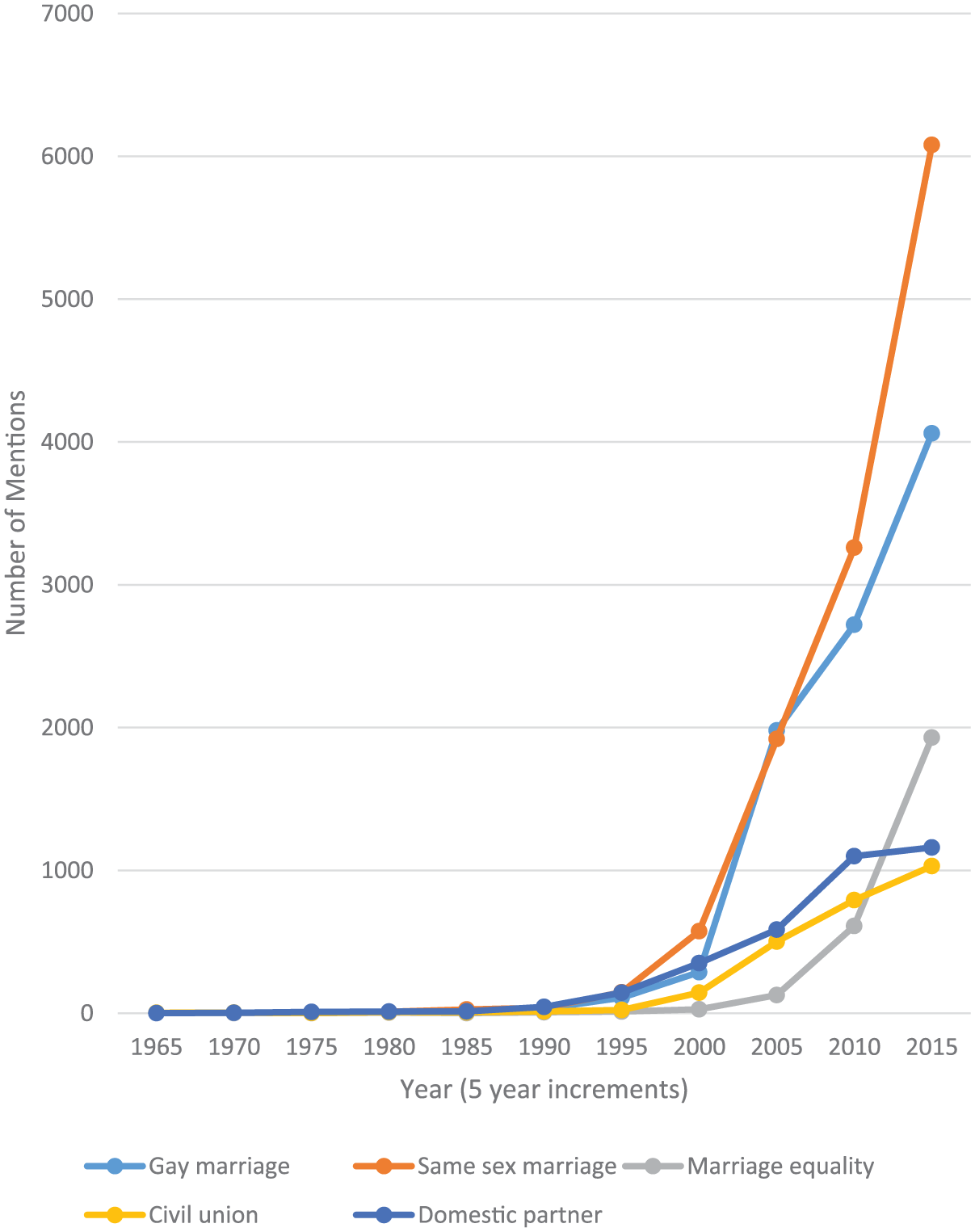
Marriage-specific memes, 1965-2015.
The first meme to gain popularity, as with the newspaper data cited above, is “gay rights.” That term is essentially the only term used at all in scholarship from 1970 to about 1990-1995, when other memes begin to gain visibility (see timetable as well). By 1995 or so, “same sex marriage” has begun a similarly steep trajectory to the newspaper data, following closely by the meme “gay marriage.” There is relatively little attention to “freedom to marry” overall in scholarly work as measured by Google Scholar, although it does begin to be mentioned starting around 2000. The meme of “same sex partner” starts to rise slightly about 1995, peaking in 2010 and actually declining in 2015, as does the meme of “marriage equality,” which appears around 2000 and starts a steep rise from 2005 to 2015, when marriage equality was made a constitutional right. “Gay liberation” and “gay pride” gain traction around 1990, increasing steadily throughout the rest of the period. Note that despite the time lags expected because of scholarly publication cycles, the patterns in these two figures are much the same.
Figure 3 uses the same data in a simplified chart with only the marriage- or partner-specific memes included for the sake of clarity. In this chart, it is easier to see the dominant memes of gay marriage and same-sex marriage, which gained prominence early (along with domestic partner and civil unions). The latter two never gained as much attention—apparent resonance—as the former two. Once the idea of marriage equality was introduced between 2000 and 2005, as the case details and timetable suggest, the marriage equality meme begins a rapid ascent in popularity; by way of interest, there were about the same number of mentions in 2016 after the Supreme Court’s ruling, as in 2015.
Using Business Source Complete as a data source provides an interesting comparative perspective to Google Scholar (though there are clear scale differences) for the combination of scholarly and popular press articles on the subject of marriage equality, particularly as related to business. Six key memes were used, omitting gay liberation and gay pride because of their relatively low level of usage. Here again, there are essentially no mentions of any of the memes until after 1990 when “gay rights” gains a bit of traction, with mentions stable until 2015 when they also rise. Both “same-sex marriage” and “gay marriage” memes start rising in 1995 (possibly in the same articles). They have a generally upward trajectory except for a decline in 2010, which is when both “marriage equality” and “gay rights” begin to rise steeply, although at lower rates than the two most popular memes. Figure 5 presents the more simplified view of just the marriage-related memes, again for the sake of clarity. This chart makes clear the dominance of “same-sex marriage” as a meme; again, there was a relatively quick rise in the “marriage equality” meme just before the Supreme Court’s ruling, while other related memes did not have as much popularity.
One more source of data on shifting marriage equality memes is Google Books, using Google’s Ngram viewer, whose data unfortunately only go up to 2008. The Ngram provides an interesting snapshot of meme emergence (see Figure 4), demonstrating the popularity of “gay rights” mentions in books, with steady growth starting around 1970. In this diagram, we also used the memes “gay marriage,” along with “domestic partner, “civil union,” same sex marriage,” and “marriage equality.” The chart shows the relative popularity of “gay rights” over other memes from 1970 onward. “Gay marriage” makes a quick ascent starting around 2003, with other marriage-related memes mentioned in books remaining relatively unrecognized. Unfortunately, because the data end in 2008, we cannot assess whether “marriage equality,” which just began to be mentioned around 2003 or so, continued its upward trajectory, although we suspect from data in other charts that it did.
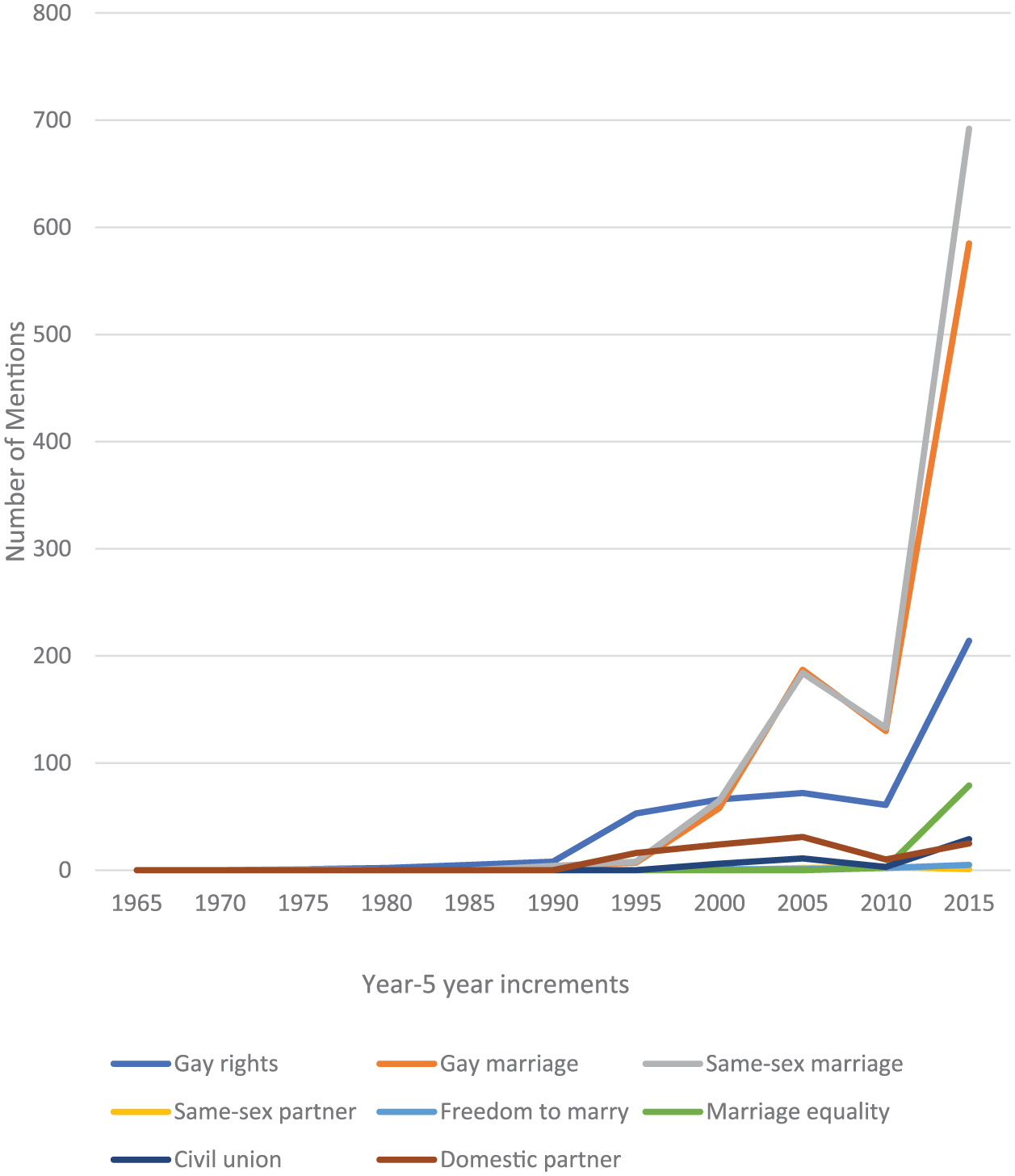
Business Source Complete mentions.
Discussion
Usually changes such as the marriage equality history describes are considered either as legal-political strategies that focus on lobbying, legislation, and courts (Eskridge, 2015; Frank, 2012; Solomon, 2015). They can also be seen as social movement strategies that focus on collective action (Dorf & Tarrow, 2014; Fleischmann & Moyer, 2009) or with a more historical events analysis (Klarman, 2013). Here, using a phenomenological lens, we explored the shifting meaning of a range of marriage-related memes (Olsen, 2014) or the language that underpins the sociopolitical changes, and consider strategic lessons from that perspective.
As we can see from the description above, the memes that described LGBT relationships emerged and shifted over time as different perspectives on being gay and being married evolved, and different language began to be used (i.e., as memes shifted), underpinning what eventually amounted to a major social movement. The shifting memes demonstrate the success of the movement because they reflect an emerging, agreed-upon cultural reframing (Benford & Snow, 2000). The charts illustrate the emergence of a variety of different memes that informed the narrative about what eventually became known as marriage equality.
What began as attention to gay rights in the 1970s eventually shifted to include memes related to marriage, gay marriage, and same-sex marriage (see Figures 1, 2, and 3). The meme of marriage equality, which appears to be highly resonant, was a relative latecomer in the public conversation; it began its steep ascent in popularity around 2005. Notably the shift occurred right after activists shifted strategy away from a rights-based strategy to focus on love and commitment in the context of marriage equality (see Table 1).
Memes of gay marriage continued their popularity, while mentions of the meme of gay rights leveled off as ideas about marriage equality were pushed forward by activists. Notably, it is the idea of marriage equality on which the Supreme Court issued its judgment, a meme that carries connotations of both rights and of the memes of love and commitment typically associated with heterosexual marriage.
Considered as part of a societal change process, the changing memes around marriage for same-sex partners highlights the importance of language and framing that highlights fundamental values (Lakoff, 2014). While the rights argument is a potentially powerful one, it has militaristic overtones of fighting to gain those rights. The rights argument was inspired by the framings of earlier civil rights and women’s movements (cf. Benford & Snow, 2000), but the people who felt threatened and aggrieved by the success of these movements served as a check on the success of this “fighting” strategy in the case of gay marriage. Employers granted benefits for what they termed domestic partnerships, but that too has legalistic overtones, which invited resistance in the courts. Similarly, the meme of civil unions did not have the same resonance as that of marriage, with its multiple connotations. In contrast, the meme of marriage equality allowed activists to normalize same-sex relationships in the context of something familiar to all: marriage as a committed love relationship, diminishing some of the stigma formerly associated with LGBT relationships.
Insights and the Challenge of Meme Change Strategies
Looking at the case history combined with patterns of meme usage suggests specific strategic insights for activists and practitioners interested in change, as well as scholars who seek to understand how these types of issues, and their associated memes, shift over time. Each of these insights presents distinctive challenges for change-makers interested in large-scale system change.
Identifying and Strategizing Around Associated Memes
The story of the marriage equality meme illustrates the importance of understanding and strategically tackling components of the focal meme. Marriage equality was intertwined with other memes, most notably sex, civil rights, religion, family, procreation, commitment, and love. Each of these issues had to be addressed. The civil rights meme, which gained power in the 1960s, was perhaps the critical one for legitimizing the LGBT struggle. It provided space for raising the historically taboo issue of LGBT sex in the context of sexual liberation more broadly. As sexual relations are definitional to the LGBT community, the “civil rights” component was important in mobilizing the LGBT community to fight for “equal” marriage (a term obviously sidelining the more touchy “sex” issues of “same-sex marriage” and making political-legal arguments). Ultimately, it was the civil rights framing that won the day in court, which speaks to the power of that earlier meme.
Existing memes associated with religion and “God’s will” also had to be tackled directly. Doing so was particularly important given that in the 1990s between nearly 90% of Americans consistently ranked religion in their lives as “very” or “fairly” important (a percent that had decreased to about 75% by 2016; Gallup, 2016). The religious battle was characterized in extreme form by Fred Phelps of the Westboro Baptist Church. Phelps continues to promote the view that “God hates fags” (Westboro Baptist Church, n.d.). The basic viewpoint at the heart of mainstream church debates revolves around the view that homosexuality is a sin (Wood & Bloch, 1995). This perspective raised dissonance that was important for LGBT individuals to address (Rodriguez & Ouellette, 2000; Thumma, 1991), and the broader religious community. Organizing of leaders of the religious community who supported marriage equality as authentic spokespersons of religious perspectives was a critical task.
The gay community took a clearly defiant posture around the family meme with the 1979 hit song “We Are Family,” which emphasized “We’re giving love in a family dose”; the song was wildly popular in the LGBT community and throughout the marriage campaign. Although the civil rights meme was important for mobilizing the gay community and political-legal action, the family meme was the core one aimed at the general public. It required a shift in tactics: Third Way, a centrist think tank working in coalition with Freedom to Marry, began to unpack exactly how straight people reacted to these (rights-based) tactics. The group found that when straight people were asked what marriage meant to them, they spoke of love, commitment, and responsibility. But when asked why they thought gay people wanted to marry, they cited rights and benefits. Tapping into anti-gay stereotypes, they suggested gay people wanted marriage for selfish reasons, whereas they themselves wanted to express love and commitment. (Frank, 2012)
Out of these ideas, LGBT activists developed a campaign called “Why Marriage Matters” in 2010 that emphasized love, commitment, and family, as part of a public education and political strategy (Freedom to Marry, n.d.; see Figures 1-5). The association of procreation with family as an interlinked meme was increasingly important both for the LGBT and broader community as an increasing number of LBGT individuals became parents and wanted the basic protections of marriage for their parenthood, children, and partners. LGBT parents increasingly stepped forward as influential spokespersons, with their children, to challenge the meme that tied procreation and family together. Legally, the meme was attacked by pointing to many married couples who did not have, and had no intention to have, children.
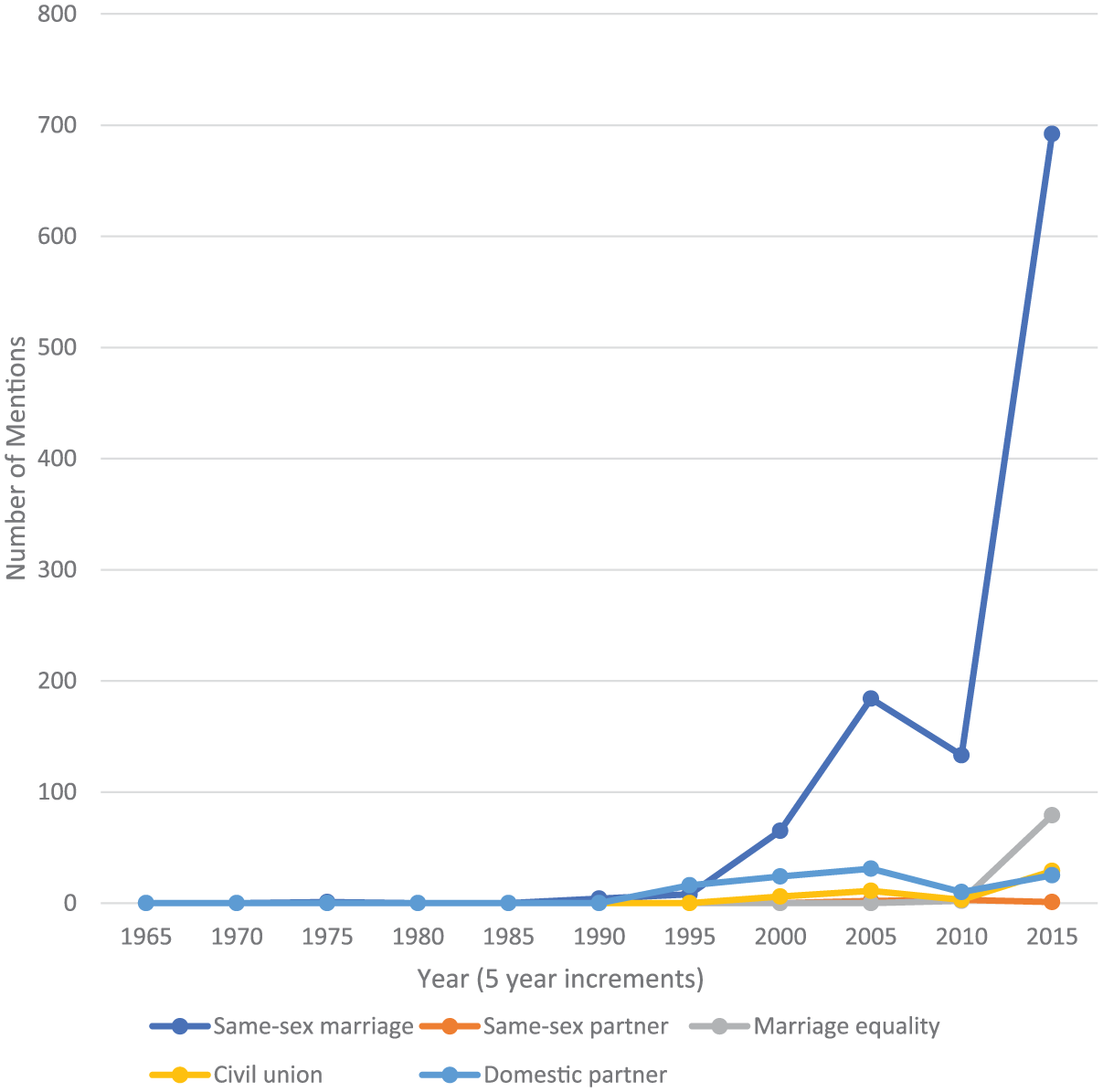
Marriage-specific meme mentions in Business Source Complete, 1965-2015.
The breakthrough came with an emphasis on shared family values in two ways: through LGBT individuals reaching out to their own historic families, and through reframing LGBT couples as family—something strengthened by the increase in children in such families.
Identifying Distinctive Memes for Different Transformation Stages
The case and empirical work illustrate that different memes become focal at different stages of transformation (Figures 1-6). The first challenge was with the lesbian-gay meme. The gay community was dominated by a very negative attitude toward them, to the extent that many suffered from internalized homophobia. They felt GL people were “bad” people and sinners; they were continually told they were pedophiles. The meme of gay pride then, was supportive of the construction of positive identity for gays and lesbians, as people with rights just like cisgender people.
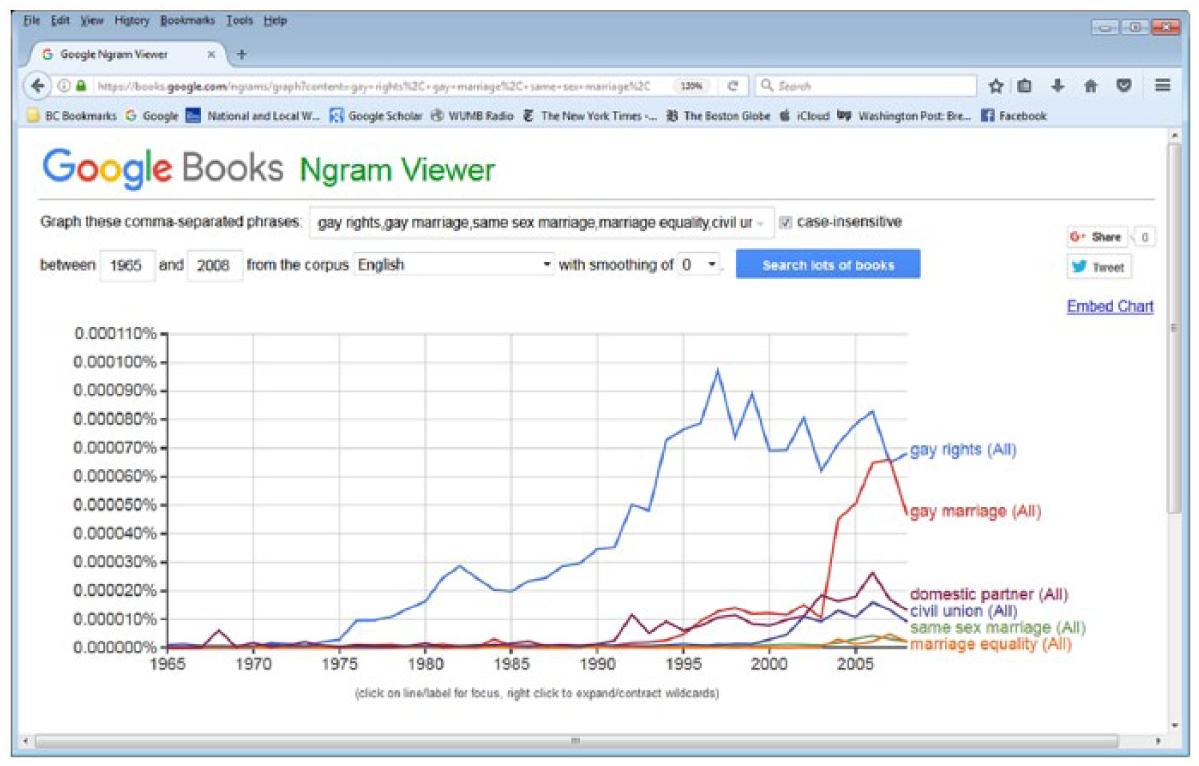
Ngram of Google Book mentions of marriage equality memes, 1965-2008 (last data available).
The second meme was around civil rights for the LGBT community (most notable in Figure 3). This meme focused the community mobilization. It first came to the fore as a gay rights meme, in isolation in a few communities to produce elected people from the community. It was around the AIDS crisis, however, where people felt outrage over inadequate response by government, where the community really started to coalesce. This civil rights issue and denial of access to government benefits associated with marriage that proved the critical mobilizing element internal to the community for the marriage equality meme.
The external community, however, was not so sympathetic with the civil rights meme, which was associated with “forcing” views on others. Indeed, the Black community felt the LGBT community was “taking advantage” of their struggle to gain legitimacy. In that context, it became clear to activists that they needed pivot to memes of love, family, and commitment to gain acceptance by the broader community. In the marriage equality case, this shift even produced different organizations: In Massachusetts, the Freedom to Marry Coalition focused on internal mobilizing around civil rights, and MassEquality addressed the broader pallet of memes associated with marriage, which shows up in the figures as a rise in mentions of marriage equality, gay marriage, and same-sex marriage.
Including Entertainment Media
LGBT issues were core to the “culture wars” battle between traditionalist and progressive values (Hunter, 1992). The culture wars made popular media particularly important, as developers of popular culture; however, change advocates are often outside popular culture and they tend to focus on laws, policies, and community organizing. The marriage equality case and LGBT movement meme change more broadly provide unusually clear examples of the role of popular media in meme change. Popular entertainment media before the millennium consisted of television, stage, and movies, where undoubtedly the disproportionate presence of LGBT individuals played an important role in developing a sympathetic portrayal as briefly noted earlier.
Finding Iterative Change Pathways
Creating bridges and stepping-stones to the marriage equality meme were critical both for the LGBT community and the broader population. A major effort was required to simply support LGBT individuals to come out. The ABC 2017 mini-series, “When We Rise” on the LGBT movement, highlights this point. It showed a demonstration in the late 1970s when one leader, after great apparent internal conflict, stood in front of TV news cameras announcing “I am Ken Jones from NJ,” to indicate publicly who he was and that he was gay (Donnelly, 2017). The AIDS crisis was a critical stepping-stone for much of the gay community, and the marriage proponents built on a decade of growing numbers of “out” people to tackle the final great bastion.
The path to marriage equality itself had clear milestones. First, was simply the act of living together with recognition of a small number of people. Living together was followed in the 1980s by increasing numbers of “commitment ceremonies,” with broadening attention to such public declarations; such ceremonies were associated with celebration of key anniversaries. By the late 1980s and 1990s, the emerging meme of “domestic partnership” became an increasingly common form of recognition offered by local jurisdictions and organizations. Civil union, providing all rights to marriage except the name marriage, was a major breakthrough (and new meme) developed in Vermont in 1999. Only with some debate did advocates determine that civil unions were still insufficient and decide to continue fighting for full marriage equality. These stepping-stones provided ways for people—LGBT individuals as well as the broader community—to adjust iteratively as relevant memes shifted correspondingly, paths that are clear in the empirical study.
Undertaking Experiments
System transformation is associated with experiments, where transformative alternatives can be tested. States in the United States are often referred to as laboratories (Brandeis, 1932); in the marriage equality case, other legal jurisdictions were also laboratories in this sense. As Vermont experimented with civil unions in 2000 and beyond (ProCon, n.d.), that idea became a new meme. When the Massachusetts Supreme Court accepted same-sex marriage (another meme) in 2003 (ProCon, n.d.), that decision provided fertile ground for the meme of marriage equality to prosper. Different states provided spaces for trying the various memes associated with same-sex marriage, to actually test their impact before widespread adoption. Experiments in different states provided time to both refine arguments, demonstrate to opponents the veracity of proponents’ claims, and time for people to adjust to changes.
Using Forcing Change Disruptors
There were two major disruptors that supported the rise of the marriage equality meme. One was associated with Stonewall and the following decade, when people in New York and San Francisco in particular forcefully advanced LGBT rights. These developments, however, might have simply remained in the internally focused community in isolated locations if not for the advent of AIDS, which forced many people out of the closet. The change was not without violence. San Francisco’s openly gay Board of Supervisors official Harvey Milk, a visionary civil right leader, and Mayor George Moscone were assassinated in 1978, bringing significant public attention and, in a sense, making a martyr out of Milk (Cheng, 2011). Matthew Shepard, a 21-year-old openly gay student at the University of Wyoming, was tortured and murdered in 1998. His killing was perhaps the most notorious example of violence on LGBT people. During this period, there were numerous demonstrations, marches, and protests, accompanied by additional threats, harassment, and violence to, and more rarely by, LGBT individuals. Rather than use these disruptors as reasons to pull back, activists used their images to engage the public discourse as new memes and as reasons to persist.
Weaving Together Cultural–Legal–Political–Movement
The history and data also illustrate the importance of strategically integrating legal, political, and movement organizing actions to change the marriage meme. Simply focusing on entertainment media and cultural production, as it is narrowly understood, would not have been successful, but neither would a simple focus on the other change efforts. Changing memes, of course, is not enough to generate action. Behind the scenes, these new memes have to be effectively used to change culture, public policy, and the discourse in the public square, as suggested by the memes data actually began to happen over time.
Thinking in Decades, Identifying Tipping Points
Memes are social and cultural phenomena, and transforming societies is an arduous task. Although there was earlier work by activists, the LGBT meme change in the United States really got underway in the late 1960s after the Stonewall riots. Bringing marriage equality into reality as a key indicator of equality took 45 years. Yet many older LGBT activists say that in the 1990s they could never have imagined that gay marriage could have arisen in such a short time! The marriage equality battle was the proverbial tipping point for the societal LGBT gay meme and for greater, albeit not yet fully achieved, acceptance of gays and lesbians as full members of society. The idea that LGBT people have rights grew rapidly and persisted over time, as can be seen in Figures 1, 2, 4, and 6. As noted earlier, however, the idea of marriage equality took longer to emerge, possibly as a subset of the whole issue of rights, and as part of a strategy deliberately fostered by activists once they realized the power of the love and commitment aspects of the meme.
Creating Intense Dialogue
Legislation and court cases in democratic societies that institutionalize memes rarely are in advance of public opinion, as the shifting of memes demonstrates empirically. Although new memes may represent a leading edge, they must have significant public support. They need to be resonant, and that requires a great deal of behind-the-scenes political and social activism, not fully addressed in the brief history included here. Such support requires citizens having intense discussions and debates—one-on-one, in families and among friends and beginning to accept (e.g., the broadened meaning of the meme of marriage [equality] for all, including LGBT persons). Public fora like newspapers, books, and articles, as well as popular media like television, plays, and movies, are important stimulants to these informal discussions, but they cannot replace them. Individuals must learn how to reconcile new memes with their traditional beliefs and behaviors, or the culture will not really change. In other words, new memes really do need to begin to resonate with people before they can begin to replace existing memes and, ultimately, changing behaviors.
Limitations, Future Research, and Conclusion
Meadows (1999) noted that shifts of mind (mind-set change, as she called it), or in a later version of the paper, the ability to transcend mind-sets, is the most powerful change lever for major social change. Recognizing that marriage equality was not just a legal issue but also a cultural one, activists organized for bringing about significant shifts of mind-set among opinion leaders and the general public, so that changes could be brought about in the law. They wrapped themselves in Americana tradition, even in their names, such as the Human Rights Campaign Fund and Freedom to Marry.
As Hunter (1991) commented, “We often forget that politics is, most often, an expression of deep cultural ideals and commitments.” Activists fundamentally and quite deliberately shifted the conversation from memes of rights and freedom to memes associated with love and commitment that still encompassed rights and freedom, a shift that shows up in the data.
In this article, we have tried to document major aspects of the history of marriage equality in the United States through the case study. Then we combined that history with a study of the evolution of memes associated with marriage equality over approximately 45 years. Memes were evidenced by word phrases used in a variety of print media. Clearly, the study has limitations related to the single case history used, the relatively simple approach to the memes data, and its largely descriptive nature. Future research could, we believe, build on this study to do more comparative case analyses that can test the points made in the “Discussion” section above as propositions about large system change, and to further explore the evolution of memes using more rigorous methodologies. Popular press magazines, gay and lesbian periodicals, and broadcast media sources might be relevant sources of shifting memes in future research, and might allow for actual hypothesis testing.
Achieving marriage equality in the United States represents a transformational shift in the marriage meme, and for the LGBT community more broadly. However, the case history as well as the memes data illustrate that specific concepts rise and fall. It is difficult to determine what these shifts mean. One argument would be that declining memes are unsuccessful: that their decline in usage indicates that they have fallen in popularity and are no longer useful. Another argument could be that the particular concept is simply part of a bigger meme, with that concept integrated and no longer debated. Possibly, a new meme that transcends the old and perhaps incorporates it in some way has emerged, creating the potential for mind-set shift. For example, the memes of “gay pride” and “gay liberation” (Figures 1 and 2) seem to stabilize or decline as specific rights like marriage equality, broadly defined, rise in popularity. This pattern suggests a supplanting of the old meme by new, more compelling memes that have a specific action bias—ensuring that particular rights are granted. Furthermore, as we noted earlier, the issues of “rights” has a more militant side, while marriage can be portrayed very differently—as part of a loving and committed relationship that has broad general appeal.
In their discussion of institutionalization, Berger and Luckmann (1966) point out that via habituation, meanings “become embedded as routines in [man’s] general stock of knowledge, taken for granted by him [sic] . . . ” (p. 53). To see the rise of gay rights/marriage equality as “successful,” however, should not be taken as in any way final. There is a substantial group of people who continue to reject these memes, although the broader societal meme has changed, particularly with the Supreme Court’s decision. There are many historic examples of a meme becoming dominant and integrated as a social norm, only to be overturned later. In the United States, the meme around the right for workers to join labor unions and the right for women to choose abortion are great examples of continually contested memes in terms of the boundaries of how they are interpreted. Tolerance of Jews in Germany as a meme was replaced by the holocaust. The battles are ongoing, and legal rules are being continually challenged and reinterpreted.
While recognizing the unpredictable turns of history, the marriage equality example provides a powerful example of changing memes and lessons in how to do so that can be useful for others. Perhaps the most important lesson is the importance of nurturing human spirit and its highest aspirations.
Footnotes
Declaration of Conflicting Interests
The authors declared no potential conflicts of interest with respect to the research, authorship, and/or publication of this article.
Funding
The authors received no financial support for the research, authorship, and/or publication of this article.