




Abstract
To contribute to the continuing challenge of explaining how managers identify stakeholders and assess their salience, in this article, we chronicle the history, assess the impact, and evaluate the possibilities opened by Mitchell, Agle, and Wood (MAW-1997). We do so through two types of qualitative analysis, and also through utilizing a quantitative network analysis tool. The first qualitative analysis categorizes the major contributions of the most influential papers succeeding MAW-1997; the second identifies and compares the relevant issues with MAW-1997 at the time of initial publication and today. We apply main path analysis, a quantitative tool, to map how this scholarly domain has evolved. These three analyses robustly depict the impact of MAW-1997 and the ensuing scholarly conversation, and they enable us to illustrate the current state and trajectory of stakeholder identification and salience scholarship. We close by discussing pressing topics related to the broader body of stakeholder theory literature.
In conceptualizing the management universe, combining the twin tasks of stakeholder identification and of ascertaining stakeholder salience stands in contrast to other conceptualizations. For example, neoclassical economic theory has long put shareowners, and to a lesser extent bondholders, at the center of corporate management’s universe. Each group has claims on corporations because of freely entered-into agreements, and, thus, voluntary contracts are a prime focus. Stakeholder theory challenges this perspective, claiming that business exists in society, not as a separate entity, and that, therefore, business managers are responsible not only for profit making (to fuel dividend distributions and share-price increases) and debt repayment but also for managing claims and lessening harms within an intricate network of societal relationships. In this respect, stakeholder theory is more inclusive because it posits that claims can be noncontractual and harms can be dealt to parties who are in an involuntary relationship with a company.
In this article, we aim to explain the development of Mitchell, Agle, and Wood’s (1997; henceforth, MAW-1997) model of stakeholder identification and salience as well as—based on an analysis of the literature that has developed and in some way utilized the model—to explore further the relevance of the MAW-1997 model to the business and society field and to other fields as well, over the 20 years since MAW-1997’s publication. An underlying assumption of the model, while acknowledging that there are factually important stakeholders for any corporation, is that managers may or may not accurately perceive who their stakeholders are and whether/how they are important, or salient and, therefore, be unaware of or inaccurately interpret some noncontractual claims and harms. MAW-1997’s focus on the interactions of three attributes—power, legitimacy, and urgency—has helped scholars to understand how managers view the stakeholders of their firms and, thus, enable more informed and more inclusive management of stakeholder relationships.
Thus, for example, stakeholder identification and salience are vitally important to any consideration of corporate social responsibility (CSR) and corporate social performance (CSP). Managers can be blindsided by, or cause indelible harms to, unidentified claimants; they can squander resources on identified stakeholders who have legitimacy or power but little claim, or on those who have a claim but neither legitimacy nor power. The MAW-1997 identification and salience model demonstrates that “who matters to managers,” at times, can be too narrow, too broad, or otherwise unrealistic. Furthermore, MAW-1997–enhanced managerial perception enables managers to recognize flux in stakeholders’ attributes, so that a stakeholder who is neither recognized nor salient at Time 1 can become so at Time 2 by aligning with other stakeholders or by changing its own configuration of critical attributes. For CSR/CSP, this means that managers cannot consider responsibility a “once and done” chore; they must continually attune to the nature, needs, and demands of their stakeholder network.
MAW-1997 represents, and in some sense speaks for, the many contributors to the identification and salience conversation that led up to its writing. We believe that an understanding of the historical context prior to its writing can be useful in our assessment of the historical context after. The article proceeds as follows. First, we relate the history of the Toronto Stakeholder Conferences of the 1990s, in which MAW-1997 had its origin within the context of the limited earlier scholarship on stakeholder theory. Then, we engage the literature developed since, to capture the various applications and interpretations of MAW-1997 and to graph a genealogy of subsequent literature. Finally, we look to the future to consider what is newly opened or remains unfinished in stakeholder theory development.
The Background: Moving Beyond the Bicycle Wheel Approach
We drop into the narrative during the late 20th century, at a time when political science had long made good use of the concepts of constituents and interest groups, and mostly everyone understood the idea of stakes in a poker game and staking a claim in a gold rush. The concept of stakeholders, thus, was not new. But in our view, R. Edward Freeman’s (1984) book, Strategic Management, A Stakeholder Approach, introduced the stakeholder concept to a large audience of management scholars as an alternative perspective on “who matters” to firms. 1 His book articulated the case for acknowledging and managing stakeholder relationships as a strategic and governance imperative of companies.
From 1984 to 1989, no significant development of the stakeholder concept occurred. In the early 1990s, however, more development began to emerge. Logsdon, Reiner, and Burke (1990) tied corporate philanthropy to both stakeholder management and corporate strategy, suggesting philanthropy as one way to measure companies’ responsiveness to stakeholder claims. Freeman and Evan (1990) reinterpreted corporate governance mechanisms in light of stakeholder claims. Stead, Worrell, and Stead (1990) and Carroll (1991) argued for a stakeholder template in assessing business ethics. The strategy emphasis in stakeholder thinking continued, with Savage, Nix, Whitehead, and Blair (1991) proposing that companies needed to “manage their stakeholders,” and Preston and Sapienza (1990) arguing that effective stakeholder management was intimately tied to corporate financial performance (FP).
Wood (1991) had defined the principle of public responsibility (with a nod to Preston & Post, 1975) as a corporation’s obligations to its stakeholders, but her primary concern was with CSP, not stakeholder theory. Hill and Jones (1992) took a major leap into suggesting a stakeholder theory of the firm, expanding the scope of agency theory to encompass the explicit and implicit contracts, enforcement mechanisms, and incentives among companies and their stakeholders. In related moves, Grillet (1992) applied transaction cost economics to stakeholder analysis in the insurance industry, and Macey and Miller (1993) applied a contracts lens to corporate stakeholder relations.
Some years after Freeman’s (1984) book, the stakeholder concept, thus, had become fairly common, but only modest conceptual and theoretical progress had been made beyond the bicycle wheel model of “the corporation and its stakeholders.”
The Toronto Stakeholder Conferences
Max Clarkson, intrepid businessman and dean of the Rotman School of the University of Toronto, was impatient with this slow scholarly pace. It seemed clear to him that companies and stakeholders existed in symbiotic relationships, and that when companies focused exclusively on their shareholders and bondholders, they lost many of the benefits of symbiosis and actually increased their risk of failure. The theory of the firm espoused by neoclassical economists and widely taught in business schools did not acknowledge these potential losses and risks; but a proper stakeholder theory of the firm could do so. In 1993, Clarkson invited two dozen or so scholars to a roundtable conference on stakeholder theory. Thus, the Toronto Stakeholder Conferences (TO-1 through TO-5) were begun.
That first roundtable, TO-1, yielded a great deal of participant enthusiasm and a collective sense that progress could indeed be made. During the first full day, several papers were presented, all of which later became well-published and much-cited articles. Tom Donaldson and Lee Preston (1995) introduced their contention that stakeholder theory could be normative, instrumental, or descriptive. Ed Freeman (1994) argued that stakeholder theory was fundamentally and indisputably normative, whatever else it might be. Max Clarkson (1995) presented his view of primary stakeholders as those on whom the firm is dependent for survival and secondary stakeholders as all others in relationship with the firm. Tom Jones and Dennis Quinn (later, Jones, 1995) proposed an instrumental stakeholder theory, based on the assumption that developing mutual trust within a stakeholder network would promote corporate profitability. Denis Collins claimed that managers needed to balance paradoxes in stakeholder relations, changing from stable to flexible relationships as circumstances demanded. Archie Carroll presented a number of stakeholder-related propositions using stakeholder satisfaction as the primary outcome variable. (Other participants in TO-1 included Jeanne Logsdon, Jean Pasquero, Prakash Sethi, Phil Cochran, Mark Starik, and Donna Wood.)
Intense and sometimes heated discussion of these ideas generated an extensive set of reasons why stakeholder theory was (would be) superior to neoclassical economic theory, and also allowed participants to articulate a number of questions that scholars needed to address to advance the theory. In defense of stakeholder theory’s superiority, participants noted its more accurate descriptive capacity, its acknowledgment of the intrinsic value of people and nature, and the resultant obligations incumbent upon organizations, its connection to various outcomes of corporate behavior, and its rich ethical underpinnings. Some of the questions were these: What exactly is a “stakeholder”? What are the implications of adopting a stakeholder perspective and of considering them to have intrinsic worth? Do companies and their stakeholders have mutual as well as conflicting interests? What if managers misperceive their stakeholders’ interests? Can managers be trusted to manage stakeholder relationships?
Clarkson sponsored a second stakeholder conference in 1994 (TO-2) with most of the same attendees as TO-1 but also including Ron Mitchell as a final-year PhD student invited by Max after an International Association for Business and Society (IABS) stakeholder session; and, out of this conference came several important articles, including Mitchell et al. (1997). Discussion at TO-2 centered on attributes of persons or groups that made them stakeholders. Three attributes were identified and mostly agreed upon: power to affect the firm and legitimate standing (both of which had somewhat strong consensus in the literature) and an urgent claim (added by participants in the conference: the subject of debate then, and still ongoing). Archie Carroll took the floor and drew concentric circles representing (outward from the center) power, legitimacy, and urgency. Participants could not grasp why one attribute would be central and another peripheral. Ron Mitchell then went to the board to draw a Venn diagram, saying, “What if we saw it like this?” and he offered names for several of the subsets to illustrate. While Ron spoke, Donna Wood immediately began a matrix analysis, to identify the seven Venn subsets, considering the same questions Ron had considered before he spoke: What kind of stakeholder has power, but no legitimacy or urgent claim? What kind has legitimate standing, but no power or urgency? What kind has legitimacy and urgency, but no power? And so on. When Ron had finished his discussion, Donna called Ron over to continue the analysis, and together, they completed a preliminary version of the Venn. Thus, as shown here in Figure 1, the MAW-1997 model of stakeholder identification and salience was born (and appeared as Figure 2 in MAW-1997).

Excerpt of figure 2 from Mitchell, Agle & Wood (1997).
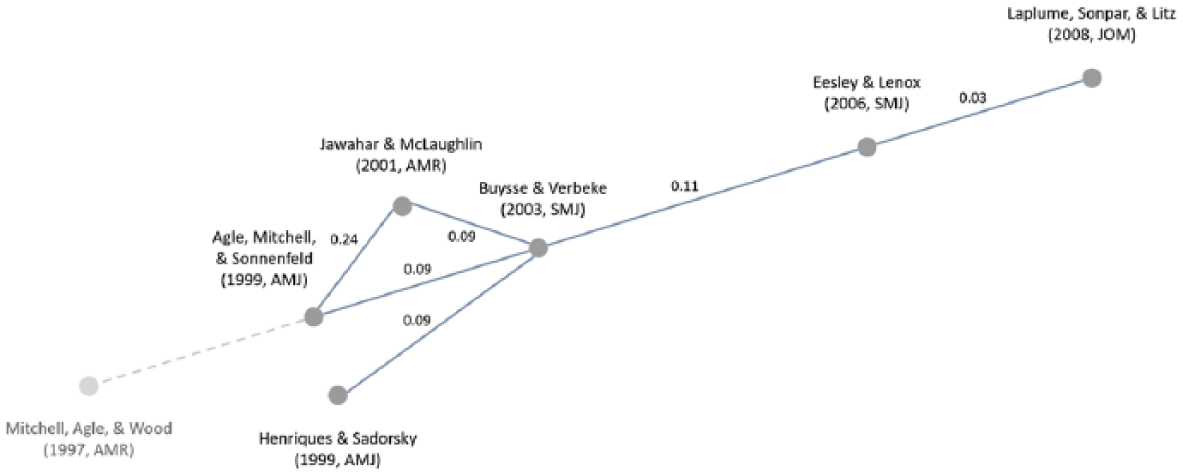
Main Path Analysis Map.
None of TO-1’s questions was resolved at this point in time, but discussion in the field moved on to encompass other questions. If CSP was to be assessed via stakeholder analysis, how could it be measured? How could stakeholder theory be operationalized? Under what conditions is stakeholder theory relevant? What exactly is a stake? How do stakes arise, grow, and decline? Who should be on a corporate stakeholder panel? Do stakeholders have “life cycles” like issues do? How is stakeholder theory related to other extant theories?
TO-3 actually occurred in Santa Fe, prior to the 1996 annual conference of the IABS. Max Clarkson, Lee Preston, and Jim Post had been awarded a substantial grant from the Sloan Foundation for stakeholder research and theory building, and they sponsored this third convening. Some new faces were included among participants, including economist Margaret Blair (1995) of the Brookings Institution, economist Robert Frank (1996), international business and society expert Juha Nasi (1995), and governance specialist Lori Ryan (1995). By this time, some articles from TO-1 and TO-2 had been published, and others, including MAW-1997, were in late stages of revise and resubmit.
The existence of the Sloan grant steered discussion for a while toward scholarly organization and outputs. Modes of communication among researchers, published papers and books, a stakeholder bibliography, and smaller scale sponsored research possibilities took center stage. The substance of stakeholder theory development was not neglected, however. Deeper, more fundamental questions were raised and argued: Can socially responsible companies survive, or is the fact of survival evidence of social responsibility? Why do markets fail to recognize implicit contracts (e.g., labor’s desire for stability or harms to involuntary stakeholders)? Can a corporation really be “owned” by shareholders, when they do not possess all the rights and duties of ownership? If shareholders are not owners, why is economics so focused on them? Is stakeholder theory amenable to a social science approach, or is it simply a metaphor?
TO-4 was held 2 months later, back in Toronto this time. New participants included political scientist Andrew Stark; Wharton School legal studies professor Eric Orts; Mike Olson, executive director of the Caux Roundtable; Michael Polonsky (1995) of the University of Newcastle, Australia; Tom Dunfee of the Wharton School; and Steve Lydenberg of Kinder Lydenberg Domini (KLD), the social investment and ratings firm. TO-4 was sponsored by the Sloan grant, “Redefining the Corporation,” and so stakeholder discussions focused on that theme.
Orts (stakeholder identification work and stakeholder prioritization work 1992, 1998) proposed three ways of defining the corporation: (1) Who provided equity and, thus, has ownership? (2) Who is in contractual relationship with the firm? (3) To whom do managers owe fiduciary responsibility? He termed these the property, contracts, and agency models, respectively. He then applied these models to the emerging trend of so-called “stakeholder statutes,” by which some states permitted or required executives to consider stakeholder interests as well as those of stockholders. Margaret Blair (1995) argued that a more complex contracts model is needed to account for the firm-specific assets represented by employees and their skills. Michael Olson explained the history and purpose of the Caux Roundtable and its relationship to emerging theories of stakeholder–firm relationships. Steve Lydenberg and Karen Paul (1997) spoke about social investing and KLD’s efforts to document and measure CSP and stakeholder outcomes in various domains. Following the formal presentations, all participants discussed the current and potential future states of stakeholder theory, expressing both pleasure at progress and frustration at continuing questions and issues.
TO-5, held in Toronto in 1998, was the last of the Toronto stakeholder conferences. In the previous year, the Sloan grant had funded a number of mini grants to scholars proposing to continue development of stakeholder theory. TO-5 was a working conference at which results of the mini- grants were presented and further research needs discussed. Several mini-grant recipients attended the Toronto conference for the first time, including Tim Rowley (1997) of the University of Toronto, Virginia Gerde of Virginia Tech, William Halal of George Washington, Brian Schaffer of the University of Maryland, Harry Van Buren (2001) of the University of Pittsburgh, Shawn Berman of the University of Washington (see Berman, Wicks, Kotha, & Jones, 1999), Kim Davenport (2000) of the Fielding Institute, and Patsy Lewellyn of the University of South Carolina at Aiken (see Logsdon & Lewellyn, 2000). Most of the mini grants focused on some aspect of enacting or measuring CSP and stakeholder relationships (Logsdon, Wood, & Benson, 2000).
Beyond Toronto
There were, of course, other influences on stakeholder thinking in the 1990s. One was Juha’s 1994 conference in Helsinki, resulting in the edited book Understanding Stakeholder Thinking. A conference on corporate philanthropy at Indiana University yielded, among other publications, Wood and Jones’ (1995) analysis of stakeholder mismatching. The Sloan Foundation project resulted in an important book centered on case studies of Motorola, Cummins Engine, and Shell (Post, Preston, & Sachs, 2002). And, Clarkson (1998), in addition to nurturing the Toronto conferences, also edited a volume that pulled together the best of extant stakeholder theory and research.
Two volumes titled Unfolding Stakeholder Thinking appeared in 2002 and 2003, edited by Jorge Andriof, Sandra Waddock, Bryan Husted, and Sandra Rahman. Volume 1 included empirical, theoretical, and case study articles examining the theme of stakeholder responsibility and engagement. Volume 2’s articles focused on managing relationships and communicating with stakeholders, corporate reporting, and performance indicators. Both volumes were republished by Routledge in 2017.
In addition, quite a number of papers (not cited here) appeared in the various annual Proceedings of the International Association for Business & Society. Some of these peer-reviewed short papers were expanded and published in journals; some were not; but the sheer volume of these contributions indicated that stakeholder theory—including MAW-1997’s focus on stakeholder identification and salience—was generating much scholarly excitement.
A Look at MAW-1997’s Impact
As this article was being finished in early April, 2018, Google Scholar reported that MAW-1997 had been cited by 11,192 other publications. To better assess the potential impact of MAW-1997 in terms of citations, we examined these citations to extract 540 publications that had at least 100 citations themselves. Among these, 156 journals and 48 books were represented.
A wide variety of areas of study made use of MAW-1997 in some way. Business and society, business ethics, general management, corporate governance, and corporate strategy, of course, led the way in making use of MAW-1997. Other fields had perhaps less intuitive but definitely relevant importance for MAW-1997–related work, including behavioral economics, corporate law, public relations and business communications, environmental policy and practice, human resource management, entrepreneurship, and policy studies.
Farther afield from general management areas were MAW-1997 citations in marketing, tourism, sociology of sport, sports management, technology studies, system dynamics, event management, construction management, project management, business history, wildlife management, higher education, accounting, and even agriculture. We were surprised at first by some of these MAW-1997 applications and citations, but after considering how important stakeholder salience could be to these various areas, the results made more sense.
To more fully understand how the domain of stakeholder identification and salience has grown over time, and to better understand the contribution of MAW-1997 within the field, we utilized a multipronged approach. First, in more qualitative analysis, we engaged in a sorting-and-winnowing analysis to narrow down contributions under such contribution headings as validate, extend, critique, replace, and bridge, with respect to MAW-1997. Second, we undertook a larger qualitative and comparative sense-of-the-literature approach, where we developed a 20-years-after table that parallels, in its analytic approach, that taken to develop Table 2 in the original article (MAW-1997). This approach enables us to distinguish among issues relevant in 1997 and in 2017 and sets MAW-1997 more squarely within the larger stakeholder theory literature. Third, we used quantitatively based analytical tools to construct a map of MAW-1997’s influence—a kind of genealogy of idea nodes that stem from MAW-1997.
Sorting-and-Winnowing Analysis
To accomplish the initial sorting and winnowing task, we aggregated papers into a list of those citing MAW-1997, and ordered them by how many times they have been cited. This list was narrowed substantially by examining the papers’ relevance and focus on stakeholder identification and salience. We then further explored this narrowed set of papers by reading them to gain an understanding of each paper’s key contributions to stakeholder identification and salience, as well as how each paper interacted with (if at all) the MAW-1997 salience framework of power, legitimacy, and urgency. This process resulted in a list of 27 highly cited and relevant articles dealing with stakeholder identification and salience, presented in Table 1, and it also yielded several key insights about MAW-1997’s contributions to this specific literature.
Sorting and Winnowing the Impact of MAW-1997.

Note. MAW = Mitchell, Agle, and Wood.
In this first qualitative analysis, we organized the table by each paper’s role within the identification and salience domain. In the following paragraphs, we discuss the five primary roles that emerged in our analysis from among the 27 articles.
Validate
This role is given to articles that empirically validate the MAW-1997 framework. The first of several to empirically test and validate the power, legitimacy, and urgency triad were Agle, Mitchell, and Sonnenfeld (1999). The main findings corroborated MAW-1997’s contention that the three attributes predicted stakeholder salience, and in particular, urgency was the strongest predictor of the three. As time moved on, scholars clearly continued to be interested in testing the MAW-1997 framework, and it was validated several times. Scholars utilized the framework to analyze stakeholder salience in settings such as manufacturing firms in Spain, sporting event organization committees, and environmental accidents. These scholarly contributions employ a variety of methods including qualitative case studies as well as quantitative statistical analysis.
Extend
Although validation has been vital to MAW-1997’s ability to stand as a credible and useful theory, scholars have not been satisfied solely with validation—many have sought to build on MAW-1997 to contribute further to the scholarly understanding of stakeholder identification and salience. This role is given to articles that contribute a meaningful extension to the MAW-1997 framework. Scholars have been able to identify areas in which the model can become more theoretically sound and practically useful. For example, in an early extension of MAW-1997, Coombs (1998) uses the framework instrumentally through the lens of stakeholders to suggest that stakeholders can increase their salience to a firm’s managers by using the Internet to spread their message and attract other groups to their cause.
Other scholars engaged in extending MAW-1997 employed theory and empirical methods to highlight moderating effects of particular practices or characteristics of firms. For example, Henriques and Sadorsky (1999) discuss the moderating effects of firm environmental approach on firm perceptions of its stakeholders. Jones, Felps, and Bigley (2007) highlight culture’s moderating effects on prioritization of power and legitimacy, suggesting that moral cultures will prioritize stakeholder legitimacy, and self-interested cultures will prioritize stakeholder power. And, Parent and Deephouse (2007) find that managerial characteristics within firms (such as hierarchical position and organizational role) moderate how managers perceive and mediate the relationship between stakeholder attributes and stakeholder salience.
There were also scholars who fundamentally extended MAW-1997 by changing the perspective lens. For example, Eesley and Lenox (2006) proposed an addition to the MAW-1997 model—the stakeholder–request–firm triplet unit of analysis; the authors argue that the attributes of a stakeholder’s specific request will also affect managers’ perceptions of salience. So, for example, a powerful and legitimate stakeholder might make a claim that is seen by managers not only as not urgent but also as illegitimate, thus provoking negotiations or denial or some other potentially conflictful response.
Aaltonen, Jaakko, and Tuomas (2008) conducted a case study to empirically validate MAW-1997, and in the process, they aggregated a list of eight strategies stakeholders can use to increase their salience.
Clearly MAW-1997 has been validated in a variety of ways and is still used today, but it also represented a starting point for the insightful additions of scholars throughout the last 20 years.
Criticize
In addition to being highly utilized and occasionally extended, MAW-1997 has also been criticized by some scholars who find limitations in its scope or in its assumptions. There are two notable groups of critics: those who critique MAW-1997 and then extend it, and those who critique MAW-1997 and propose a different, or replacement, model of stakeholder identification and salience.
First, critics have highlighted limitations in the scope of MAW-1997. Jawahar and McLaughlin (2001) critique MAW-1997’s lack of insight regarding strategies management can use to address the varying salient stakeholders. The authors then propose a model, which draws on the resource dependence and prospect theories (from organization theory and behavioral economics, respectively) to highlight what really grants stakeholders salience in managers’ perceptions, and how managers can respond at different life cycle stages of the firm.
Another notable insight from critics is a rejection of MAW-1997’s assumption that salience is a function of managerial perception (Currie, Seaton, & Wesley, 2009). These authors prefer to consider actual salience as opposed to perceived salience. This critique is followed by a proposal to include less biased third parties in the stakeholder identification process, in the hope that this will yield more accurate judgments of stakeholder salience as opposed to mere managerial perceptions.
Several other articles highlight problems in the assumptions on which MAW-1997 is based. Wolfe and Putler (2002) note that priorities within a stakeholder group vary, and they critique MAW-1997’s lack of insight into what managers should prioritize under conditions of priority heterogeneity within stakeholder groups. Again, this critique appears to reflect a conflict between perceived and actual salience. Hart and Sharma (2004) criticize MAW-1997’s assumption that stakeholder salience is a function of current power, legitimacy, and urgency, and they propose a model inclusive of fringe stakeholders who as yet have none of the critical attributes. Pajunen (2006), by contrast, does not criticize MAW-1997’s assumptions, but instead finds limitations in its scope; he notes that the MAW-1997 model is not specific or normative enough to help management prioritize during crisis situations.
Critiques of MAW-1997 add valuable insights into how the conceptual model of stakeholder identification and salience can be extended and made more relevant. They can also illustrate how the research community itself perceives and sometimes misperceives the intentions and results of colleagues’ efforts.
Replace
This role is given to articles that build their own theoretical frames for stakeholder identification and salience, effectively proposing a replacement for MAW-1997. As discussed in the previous section, some scholars have built unique models of stakeholder identification and salience based on criticism of MAW-1997. There are also, however, scholars who have built models that do not seem to arise out of assessing MAW-1997 as wanting. Vos (2003), for example, builds on Ulrich’s (1988) critical system heuristics to create a typology of stakeholders that differentiates “affected” stakeholders with normative claims from “involved” stakeholders with power to affect the focal firm. Bundy, Shropshire, and Buchholtz (2013) build a theoretical model of issue salience that can be tested against a firm’s strategic frames and organizational identity to classify salient issues to the firm. These models do not draw heavily on MAW-1997’s identification and salience model, and they represent robust and unique contributions to the field.
Bridge
There is one more category that we have identified that is somewhat less direct, but nonetheless is important in our view. Although this category did not come directly from the sorting-and-winnowing process described earlier (and does not appear in Table 1), as we examined the impact of MAW-1997 and its reach across disciplines, we felt our analysis would be incomplete without a discussion of the bridging effect MAW-1997 has had. As we have noted at the beginning of this article, the model from MAW-1997 has been incorporated in a wide variety of disciplines, as the stakeholder idea has continued to spread throughout the social sciences. At its core, the MAW-1997 model is representative of and dependent on the assertions of stakeholder theory as it becomes ever more inclusive in supporting the notion that claims on a business can be noncontractual, and harms can be dealt to parties who are in an involuntary relationship with a company. But to remain relevant, stakeholder theory must remain practical; and—although farther afield from direct extensions of MAW (1997), we also note scholarship that has worked to bridge this potential gap.
Beginning around 2002, the argument surrounding the practicality of stakeholder theory took on a sharper edge: sharper in the sense that two specific criticisms of the stakeholder approach to conceptualizing the firm were articulated clearly—both by Jensen (2002). First was the position that “any organization must have a single-valued objective as a precursor to purposeful or rational behavior” (p. 237). The second criticism, relating to accountability, touched on the more general stakeholder accounting problem: “Because stakeholder theory provides no definition of better, it leaves managers and directors unaccountable for their stewardship of the firm’s resources” (p. 242). Jensen’s second assertion then led to the wider question of how stakeholder interests could be accounted for from a practical standpoint.
The foregoing assertions have invoked two rejoinders thus far in the literature: (a) a response that constructs a philosophical argument to rebut the “must have a single-valued objective” presumption (Mitchell, Weaver, Agle, Bailey, & Carlson, 2016) and (b) a response that revisits accounting’s entity convention for corporate accounting, which limits the recording and reporting of financial information to shareowners and bondholders, to suggest that multiobjective accounting just might be practical after all (Mitchell, Van Buren, Greenwood, & Freeman, 2015). With respect to the philosophical issues, Mitchell et al. (2016) argue for a pluralist (i.e., a multiple objective) conception of the corporation. They introduce “an account of a multi-objective corporation as a means for enabling a greater range of management decisions, so as to permit more direct corporate engagement in the diverse goals of various stakeholders” (p. 252). Also, in an article published just a few months earlier, Mitchell et al. (2015) proposed a solution to the entity accounting problem, arguing that the entity convention of accounting should be replaced, using instead a version of accounting’s generally accepted proprietary convention (partnership accounting) as a working substitute—to envision value creation stakeholder partnerships that overcome the limitation of entity-convention accounting to only shareowner and bondholder financial impacts (p. 864). Partnership accounting permits the ownership percentage to be decoupled from the income/loss distribution percentage, thus enabling stakeholder participation in value creation to become the basis for value distribution.
Another bridging development is an endeavor to consolidate concepts contained within the stakeholder literature under a more comprehensive umbrella such that the coalescence of the literature as a body of work can be encouraged. Lee and Mitchell (2013) and subsequently Lee’s (2015) dissertation, imported the notion of “work” from its application in various other literatures, for example, in boundary work (Gieryn, 1983; Kreiner, Hollensbe, & Sheep, 2009), identity work (Ibarra & Barbulescu, 2010; Snow & Anderson, 1987), and institutional work (Lawrence & Suddaby, 2006). They, therefore, suggested interpreting the stakeholder literature through the lens of “stakeholder work.” Lee (2015) has suggested five work domains that represent the temporal stages of interaction of management with stakeholders: stakeholder awareness, stakeholder identification, stakeholder understanding, stakeholder prioritization, and stakeholder engagement work. Two publications thus far have further developed the ideas of stakeholder identification work and stakeholder prioritization work (Mitchell & Lee, 2019; Mitchell, Lee, & Agle, 2017), respectively. The idea of stakeholder work appears to be intended to serve as a comprehensive system for organizing the many strands of stakeholder theory around the concept of value creation, to explain how each type of stakeholder work links to value creation, ultimately through stakeholder engagement.
The notion of stakeholder engagement per se is relatively new in the literature. Beginning in 1999, the idea of stakeholder engagement, that is, of taking specific actions with respect to stakeholders, was introduced in relation to environmental stakeholder management (Henriques & Sadorsky, 1999). In the almost two decades since its introduction, the notion of stakeholder engagement has been viewed as virtually synonymous with stakeholder action; but as the idea has developed, it gradually has become an umbrella concept for gathering—under one conceptual roof—the ideas of stakeholder action, corporate responsiveness, and certain types of CSR. More recently, there has been theory and empirical evidence to suggest “a direct positive and economically substantive relationships between stakeholder support and financial market valuation” (Henisz, Dorobantu, & Nartey, 2014, pp. 1742-1743) adding support to the “virtuous circle” idea earlier suggested by Waddock and Graves (1997) that connects stakeholder engagement with positive economic outcomes.
Various definitions of stakeholder engagement have appeared in the literature. For example, stakeholder engagement has been characterized as a mechanism by which organizational accountability and responsibility toward stakeholders can be acquitted (Gray, 2001, 2002), as a means to encourage contributions (Sillanpaa, 1998), as a means to manage the risks posed by influential stakeholders (Deegan, 2002), as a form of managerial control (Owen, Swift, Humphrey, & Bowerman, 2000), and as a way “to involve stakeholders in a positive manner,” such as through public relations, customer service, supplier relations, management accounting, and human resource management (Greenwood, 2007, p. 318). Research in stakeholder engagement is a highly promising area, given the interest that appears to be building within the research community. To get a deeper sense for these and other such developments, we next turn to the second qualitative analysis we conducted.
Sense-of-the-Field Analysis
Our more broad-form qualitative analysis consisted of delving deeply into the contributions of the literature that has emerged over the past 20 years to ascertain the issues addressed, and then comparing them with the contributions to the pre-1997 literature that were summarized in MAW-1997’s Table 2. The basis for this analysis was 267 published works citing MAW-1997 that themselves had 100 or more citations or that were too new to have such a record but were deemed relevant to stakeholder theory. These included the 27 works from Table 1, categorized differently. Further examination yielded 50 of these articles that were directly relevant to MAW-1997.
Following Up on MAW-1997.

Note. SMO = social movement organization.
As a point of reference for this analysis, we first briefly summarize the 1997 issues addressed in the original article, and then discuss in more depth the issues that have emerged since then—some of which might be attributable to the foundation provided by the original article but which all-in-all constitute the forward-looking foundation from which the literature is building.
In MAW-1997, the issues centered on the rationales for stakeholder identification, which included the following: a relationship exists, power dependence (comparing relative dominance: stakeholder, firm, or mutual), the basis for legitimacy in the relationship (contract, general claim, something at risk, moral claim), and finally stakeholder interests where legitimacy was not implied (pp. 860-862). Thus, as indicated by our literature review at the time of writing MAW-1997, the important issues (in the literature to that date) were power and legitimacy. As noted previously in the description of the TO-2 conference, the attribute of urgency was added as a necessary condition for identification and salience (although the authors had extensive discussion with reviewers concerning this addition—why urgency and no other constructs?—a discussion that may be seen to persist in current literature).
Since MAW-1997’s publication, the conversation has developed much more broadly in one sense and more narrowly in another. In expanding the breadth of the stakeholder theory conversation, MAW-1997 seems to have released explorers in the field from the descriptive constraints of identification and salience. However, advancing a model for use in resolution of the descriptive issue, especially one that has been influential, has also—perhaps due to the skepticism inherent in pervasive use of the logic of scientific inference (e.g., Stinchcombe, 1968)—resulted in the narrowing of focus to accomplish the required examination of the model. As might be expected, many of the articles that populate our review of the literature that cites MAW-1997 are of this second type: examination of the model.
As provided in more detail in Table 2, this follow-on literature has coalesced around six areas of focus: relevance and validity of the model, the nature of the stakeholder environment, a continuation of the long-running analysis of the dimensions of stakeholder power, a new and understandable conversation about how and why managers respond to stakeholder pressures, the operation of the model as one that is dynamic, and finally, critical positions on stakeholder theory in general and MAW-1997 in particular.
The relevance of MAW-1997 is evident from the number of scholarly works that cite it, make use of it, extend it, or critique it. Validity has so far been confirmed, with a number of scholars choosing to extend the model to include additional variables or to note circumstances in which one stakeholder attribute or another becomes more or less influential. The most interesting findings of this analysis are in the other categories of Table 2, as described below.
How is the stakeholder universe constituted?
Research since MAW-1997 has shown that business managers populate their stakeholder universes differently according to their firms’ characteristics (e.g., type of ownership), the characteristics of stakeholders (threatening or cooperating, able to act and to voluntarily accept impacts from the firm), and the interstakeholder coalitions and arrangements that serve to increase the visibility of a stakeholder or an issue.
What are the dimensions of stakeholder power, and how is it exercised?
Our understanding of this ever-present concern of stakeholder theory has benefited from scholars who have introduced and expanded upon concepts from other theoretical domains. From social movements theory, the importance of stakeholders’ access to resources of their own is emphasized, along with the processes of mobilization, information dissemination, and coalition building. Resource dependence theory offers the stakeholder tactics of withholding or providing resources to the firm, including the sometimes-overlooked resource of reputation. From identity theories and social network theory come the idea that stakeholders’ ideological positions, social identities, and positions in their social networks will greatly influence the strategies they choose to try to influence firms’ behavior. From a public policy perspective, we learn that both legal protections and regulatory threats or promises can encourage or enable certain firm behaviors with respect to certain stakeholders and their issues. Institutional theory, finally, informs us about how industry isomorphism can be used by stakeholders to pressure outlier companies to conform to industry standards.
How do managers respond to stakeholder pressures?
Over the 20 years since MAW-1997’s publication, scholars have made significant progress in this very practical dimension of stakeholder identification and salience. Management responses are influenced by a general orientation to threats or to benefits, by firm size, by arguments or concerns over fair treatment of stakeholders, by need for and access to resources, by the firm’s life cycle stage, and by stakeholders’ actual or prospective impact on the firm’s identity or strategic position.
Firms have developed a number of stakeholder response strategies. Some encourage limited (very limited) stakeholder participation in firm governance. Some tout their “stakeholder engagement” practices, which may or may not be beneficial or responsive to stakeholders’ actual interests and issues. Some employ ambiguous information techniques to deflect attention from some stakeholders who may be more critically affected by, say, a crisis. Some will use philanthropy to provoke a positive image among more powerful stakeholders, or a more extensive set of stakeholders, whereas negating negative images and covering up negative impacts.
Some evidence has been provided that stakeholder theory in general, and MAW-1997 in particular, can be useful to managers in developing strategic approaches to unfamiliar situations. In addition, there is now evidence that managers’ awareness of a broad-based stakeholder environment with many demands and interests at stake tends to correlate with greater firm social responsibility.
Corporate identity has been hypothesized as a result of stakeholder actions and responses, not just as a predictor. And, there is evidence that communicating appropriately with stakeholders can strengthen the commitment of managers and other employees to a firm.
MAW-1997 is a dynamic model
Dynamism is an absolutely essential characteristic of MAW-1997. Although the model is necessarily portrayed in two dimensions, it must be redrawn at various points in time to accurately represent any firm–stakeholder situation or process. Quite a lot of subsequent literature has emphasized the dynamic character of MAW-1997 or the need to incorporate dynamism into any stakeholder identification and salience model.
Some of the variables that need to be viewed dynamically are the firm’s life cycle stage, its position in its industry with respect to isomorphic pressures vis-à-vis stakeholders, and perceptions of fairness in firm–stakeholder relationships. Particularly important here are the processes of coalition building, collaborating, and coalition reconfiguring or dissolving, as these processes will affect a participant stakeholder’s power to affect the focal firm. In addition, a firm’s access to resources can change over time, affecting its ability to respond effectively to stakeholders; similarly, stakeholders’ resource access can also change, with similar effects.
Critical positions on stakeholder theory and MAW-1997
Finally, the critics of stakeholder theory and MAW-1997 are of four basic types: more variables needed, different variables needed, no normative content, and bad normative content. The first two categories are also reflected in the “extend” and “replace” categories of the previous analysis. Some of the extension variables suggested are the firm’s stakeholder culture (attitudes toward stakeholders, ranging from self-interested to altruistic), perspectives beyond those of managers, the various roles that stakeholders play with respect to a focal firm, within-group heterogeneity of stakeholder interests, and the salience of a stakeholder’s issue to the firm. Variables that are proposed to replace power, legitimacy, and urgency include the stakeholder’s social identity, stakeholder participation in the firm, “fringe” stakeholders, the type of effect a firm’s actions will have, and the moral claims on which legitimacy is based.
In a critical sense, several scholars observe that MAW-1997 has no normative content. We note that this is correct; descriptive models such as MAW-1997 can only have the implicit normative content that guides the choice of variables used; otherwise, they can be seen as placeholders for various normative contents to be added by other analyses. The idea that MAW-1997 has bad normative content is perhaps the most troubling; some authors claim that MAW-1997 may inadvertently be “prescribing” which stakeholders “actually count” versus accomplishing its purpose of describing the stakeholders that managers perceive as salient. Seen in this way, MAW-1997 can unintentionally become an encouragement to managers to ignore the powerless, the voiceless, and/or the illegitimate—a usage the original authors would vigorously oppose. The critique is correct, but MAW-1997 was always intended to be a descriptive model, not a normative one. Expanding MAW-1997 with ethical arguments and proposals remains to be addressed in future research.
In sum
Rather than being a reflection of the field to date—as was table 2 in MAW-1997—the current Table 2 is more a reflection of the original article in its larger setting, with a window into the field as it has developed over the past 20 years. One appealing notion that has emerged from this analysis is that we might be able, as seen through the lens of Table 2, to see at least some portions of the stakeholder minefields both helpfully and critically. This review is helpful in the sense that refinements and additions to the identification and salience task can become foundational for the exploration of the model’s impact on stakeholder environments, and on managerial responsiveness, for example.
Quantitative Analysis: The Influence Map
Finally, we wanted to explore MAW-1997’s scholarly impact in a more graphic way. Using the computer-aided social network analysis tool, Pajek, we analyzed the citation network for the 21 articles we found that most explicitly focused on stakeholder identification and salience from our sorting and winnowing qualitative task. As a result, we were able to produce a diagrammatic illustration—as we earlier suggested—a kind of genealogical chart to track the “conceptual progeny” of MAW-1997.
Method
In line with much of our qualitative analysis, we used MAW-1997 as a starting point for analyzing the domain of stakeholder identification and salience. To create the network for our analysis, we utilized the ISI Web of Science database to collect the network of articles citing MAW-1997, a network of 2,095 total articles. We input this network of 2,095 citing articles into CitNet Explorer, a citation network visualization and analysis tool. Within CitNet Explorer, we identified as many of the 27 articles mentioned in Table 1 as possible—21 of the 27 were included. 2 Once identified, we narrowed the network to these 21 articles, and then expanded the network to include any articles citing at least two of these 21 articles within the overall network of 2,095—this yielded a network of 299 articles. From there, we performed the same expansion (articles citing any two of the 299 articles within the broader network of 2,095) a second time to create a “second-order” network of 659 articles. This was the core network on which we performed our analysis.
We performed main path analysis (MPA) on the network of 659 articles utilizing Pajek. MPA is a bibliometric method (Godfrey & Lewis, 2018) that identifies the importance of the connections between citations and yields a subnetwork of the most influential and necessary nodes and connections within a broader network. This method is particularly useful in tracking the evolution of a body of literature over time by analyzing which articles are most necessarily cited by ensuing articles as a scholarly domain moves forward. This method unearths the main path by which older, nonciting articles (sources) are subsequently cited by successors, and eventually by the most recent, noncited articles (sinks; de Nooy, Mrvar, & Batagelj, 2005). The method by which MPA calculates the main path is through traversal weighting—the result of dividing the total number of paths from source to sink nodes by the actual number of paths flowing through a particular connection. Within our MPA network, it is clear to see the most influential connections (in terms of highest traversal weight) within the movements of stakeholder identification and salience literature. We further condensed the MPA network by excluding article connections with traversal weights less than 0.03. This exclusion criterion yielded a main path focused on stakeholder identification and salience from a management perspective, and it resulted in excluding five articles from 2015 to 2017 with a primary focus on project management, construction, or clean production. The resulting main path is shown in Figure 2—with an implied primary connection to MAW-1997.
As shown in Figure 2, the primary articles that have proceeded from MAW-1997 are Agle et al. (1999), Jawahar and McLaughlin (2001), Henriques and Sadorsky (1999), Buysse and Verbeke (2003), Eesley and Lenox (2006), and Laplume, Sonpar, and Litz (2008). Interestingly, each of these contains a conceptual thread that represents an extension of the original article. In the following paragraphs, we briefly discuss and evaluate each of these conceptual threads—once again, as a way to help to assess the impact of MAW-1997.
Analysis
As discussed briefly in Tables 1 and 2, Agle et al. (1999) perform empirical analysis to validate the MAW-1997 model. This empirical study represents one of the two first conceptual threads stemming from MAW-1997—validation that the model works and represents reality among managers. It goes without saying that empirical validation is of vital importance to the survival, adoption, and utility of a theory—so, it follows that Agle et al.’s (1999) contribution to stakeholder identification and salience was critical to the perpetuation of this scholarly domain.
The second of the two initial conceptual threads is represented by Henriques and Sadorsky’s (1999) Academy of Management Journal article. These authors study how firms’ commitment to environmental stewardship moderates their perception of the importance of environmental stakeholders. Clearly, one of Henriques and Sadorsky’s important contributions to the field of stakeholder identification and salience is the notion that stakeholder salience may be influenced by preexisting firm commitment to certain goals or causes. Although not explicitly tied to the MAW (1997) model within the article, Henriques and Sadorsky’s model hints at the effects that firm commitment may have on the power or legitimacy of a certain stakeholder.
Stemming from the initial thread of Agle et al. (1999), Jawahar and McLaughlin (2001) represents yet another important contribution within the evolution of the identification and salience field. Although the authors did not completely reject the MAW-1997 model, Jawahar and McLaughlin constructed a modified model of stakeholder identification and salience based on critiques of MAW-1997. The authors also employed external theories to inform stakeholder identification and salience—in their case, resource dependence and prospect theories. Conceptually, Jawahar and McLaughlin may represent the critical extension of the field of stakeholder identification and salience through expanded theoretical understanding and newly proposed models.
It is important to note that the traversal weight of the connection between Jawahar and McLaughlin (2001) and Agle et al. (1999) is the highest by more than double in the MPA. This suggests that more paths from source to sink nodes flow through this one connection than through any other link between articles. Conceptually, this high traversal weight on the Jawahar and McLaughlin (2001) connection to Agle et al. (1999) may represent a wide array of implications for stakeholder identification and salience; however, one of the most important may be the insights mentioned above: extension of the field through theoretical building and critical insight.
Buysse and Verbeke’s (2003) Strategic Management Journal article utilizes each of the previous three conceptual threads to contribute to stakeholder identification and salience. The article combines the approaches of Jawahar and McLaughlin (2001; though through notably less criticism) and Henriques and Sadorsky (1999) by expanding the theoretical view of the determinants of stakeholder salience. At the same time, Buysse and Verbeke use empirical validation to further understanding within the domain—similar to Agle et al. (1999). By acknowledging the possibility of reverse causality, Buysse and Verbeke opened the theoretical door to the possibility that firm stakeholder identification and salience may have effects on other areas of firm performance. This may constitute an important thread that moves the scholarly study of identification and salience forward.
Succeeding Buysse and Verbeke (2003) in the main path map, Eesley and Lenox (2006) represent another possible conceptual development in the evolution of the domain of stakeholder identification and salience. Eesley and Lenox expand the theoretical umbrella of MAW-1997 through further clarity in the unit of analysis: the stakeholder–request–firm triplet. The authors also employ empirical testing of a unique data set, which allows them to be able to measure salience through action as opposed to the empirical testing of salience perceptions that Agle et al. (1999) perform. The combination of these two contributions represents a broader redoubling of effort at improving or clarifying the original MAW-1997 model—an effort that has resulted in robust, impactful scholarship.
Finally, Laplume et al.’s (2008) Journal of Management article comprises the last node on the main path map. Although the authors do not focus extensively on stakeholder identification and salience, they identify it as one of five major themes (as mentioned in Table 2) within stakeholder literature. The authors identify MAW-1997 as the key article addressing one of the two primary questions within the domain of stakeholder definition and salience: “Which stakeholders do managers really care about?” The other question is normative in nature, and it addresses who and what managers should care about. These two questions make up the fundamental tenets of stakeholder identification and salience. At its core, the article by Laplume et al. (2008) represents a retrospective look at the body of research performed, and what questions have been answered within the domain of stakeholder identification and salience. The contributions of these authors are not focused explicitly on stakeholder identification and salience; however, the broader theme indicates to us an important evolutionary step—a theoretical pause to perform an accounting of progress in an academic domain. Similar to our purposes in this article, this interpretation of the importance of Laplume et al. (2008) on our main path map suggests that insightful retrospection may, in fact, be extremely forward looking—by identifying what scholars have accomplished, the path becomes clearer for what remains to be done, both in terms of opportunity and challenge.
The Future of Stakeholder Identification and Salience: (What Would Max Do Next?)
In casting stakeholder identification and stakeholder salience as “twin tasks,” we then have, by inference, suggested that there is an underlying linkage that shapes inquiry. One important link that was central to MAW-1997, and which has continued to be pursued in the 20-plus years of research that has followed, surrounds the ever-present tension between power and legitimacy, especially as the social performance of the corporation (CSP) continues to be a focal point in the research conversation. So, in undertaking to suggest some of the possibilities, one approach that we have found to be helpful to us in our conceptualization of possibilities for the future of this research stream, is for us to inquire—using insights from those of us who knew Max Clarkson—what he might do next. We offer for consideration, the following interpretive perspective.
Max Clarkson died unexpectedly just weeks after TO-5 in 1998, leaving a great entrepreneurial hole among stakeholder scholars. The Toronto stakeholder conferences came to an end, but their influence remains to this day. At the Toronto 3 conference in 1996, Max proposed that advances in stakeholder theory should identify appropriate research questions and make data and ideas more accessible to scholars, and also that ways to involve the business community and identify companies’ ways of managing stakeholder relationships should be pursued. Following his lead, other Toronto 3 participants suggested these research questions:
Our analysis in this article has shown that some of these questions have been advanced considerably, whereas others remain to be answered or have been addressed in scholarly domains other than stakeholder identification and salience.
So, given developments to date, if Max Clarkson were still with us, and we were to pose the question “what would Max be most interested in investigating now?” here are some of the ideas that might surface. In his research and writing, Max emphasized what he called “primary” stakeholders—voluntary participants who are required for a company’s survival, prioritizing their interests over those of “secondary” stakeholders—everybody else. Now, with a vastly expanded scholarly emphasis on ethical conduct in business, we suggest that a natural extension of this focus would be to better understand and explain involuntary stakeholder relationships, whether primary or not. In this regard, Max would likely be interested in the role of corporate governance in stakeholder relationships and CSP. And, because of his business background, Max would likely be very interested in the theoretical/logical relationships between various CSP indicators and various FP outputs (e.g., see Godfrey’s, 2005, explanation of why charitable giving would be related to FP).
Another area of keen interest for Max, which emerged in the TO-2 discussions, was dynamism in stakeholder relationships. Accordingly, the MAW-1997 stakeholder identification and salience model was offered as a dynamic model: Stakeholder groups can change their salience to a company’s managers by acquiring a missing attribute or aligning with other stakeholders, or conversely, by losing an attribute or an alliance. In our view, Max likely would want to know what drives these changes, and how do managers keep up with shifting stakeholder configurations? Thus, as a follow-on exploration, we would also anticipate that Max would be intrigued by the effects of organizational transformations (mergers, acquisitions, divestitures, spin-offs, leadership transitions, major changes in corporate culture or climate, etc.) on stakeholder relationship management and CSP. And, although Max might not want to pursue this himself, he would surely encourage others to study the network dynamics of stakeholder relationships and stakeholder theory.
Another approach that we have found to be helpful in conceptualizing possibilities for additional future research, is for us to suggest attention to the ever-growing common ground that exists between stakeholder theory—with special attention to identification and salience—and the closely tied fields of organization theory and strategic management research. A remarkable cadre of scholars has provided significant improvements in our understanding of stakeholder theory and value creation. Examples include the following: Asher, Mahoney, and Mahoney’s (2005) property rights foundation for stakeholder theory; Barney’s (2015) argument that if firms have residual cash flows, then stakeholders other than shareholders have claim on some of those residual cash flows; Burns, Barney, Angus, and Herrick’s (2016) observation that enrolling stakeholders in entrepreneurial ventures often requires beyond-contractual relationships; Bosse, Phillips, and Harrison’s (2009) demonstration of how the reality of justice perceptions leads to reciprocity for all stakeholders with attendant performance implications; Bosse and Coughlan’s (2016) explication of the theory of relationships and its importance for understanding firm–stakeholder interactions; Harrison, Bosse, and Phillips’ (2010) demonstration of the power of treating stakeholders with justice in facilitating stakeholders’ ability to help the firm serve them more effectively, opening up greater capacity for value creation; and Noland and Phillips’ (2010) review of the ethics literature regarding the moral bases for stakeholder engagement. Each of these articles provides useful suggestions for future development in stakeholder theory.
During the past few years others, have also suggested research avenues for stakeholder theory and management. We encourage our readers to look at Freeman’s (2017) general suggestions for stakeholder theory, as well as Neville, Bell, and Whitwell’s (2011) specific suggestions for the theory of stakeholder identification and salience. However, we do disagree with their contention that stakeholder urgency is not an important element in stakeholder identification and salience.
There are several other avenues of future research. For example, in their analysis of stakeholder influence and its inability to provide sustainability, Barnett, Henriques, and Husted (2018) call for a departure from libertarian thinking in stakeholder theory with an attendant call to bring government into the stakeholder equation. This is particularly important as we think about the major world economic shift from the Western hemisphere to the Eastern hemisphere with its attendant cultural and structural differences. What implications do sustainability and a shifting economic world have for stakeholder theory? As an example, when the late Jeff Lenn of George Washington University was teaching in Beijing, he reported that the students wanted to know why the government circle in the standard wheel-and-spoke model of stakeholders was not significantly larger than all the other circles.
Also, how does heterogeneity in stakeholder groups effect those relationships? For example, some stakeholders want a high level of engagement, whereas others would prefer low levels; some stakeholders are, or desire to be, anonymous, whereas others are, or prefer to be, known.
Finally, there are looming questions of what it means to a company to have stakeholders in the digital communications age. In the 1980s, as the concept of stakeholder spread through management thinking and scholarship, a stakeholder was an identifiable, recognizable thing, typically a group with members, interests, action agendas, and usually a name. In today’s world of individually targeted advertising, online trolls and bullies, “fake news,” Internet memes, 24/7 cable news talk shows, Facebook and Google data analytics, dark-web recruiting of would-be scammers and terrorists, and so forth, who—or what—is a stakeholder? One recent example of the changes in the relationship between organizations and their stakeholders occurred at Facebook, which was roundly criticized for selling without permission the significant data they have obtained from their users. Another change occurred when L.L. Bean needed to change their return policy from a lifetime guarantee to a 1-year return policy, when individuals began buying L.L. Bean products online and then returning them for a full refund.
In addition, the prevalence of digital media accelerates communications and magnifies the volume of information available. Stakeholders and managers alike can know much more about each other than was possible in earlier decades; in a sense, the cycle of stakeholder engagement is, thus, compressed. Recently, it has been suggested that “stakeholder work” (Lee, 2015) follows a somewhat typical cycle of first, stakeholder awareness work, then stakeholder identification work, followed by stakeholder understanding work, prioritization work, leading to stakeholder engagement work (Mitchell et al., 2017). Whereas, in the past, this stakeholder work cycle may have taken weeks, months, or even years, the prevalence of digital media access can compress the stakeholder work cycle into seconds, minutes, and hours—although possibly in some cases the fifth element of the cycle, stakeholder engagement work, could be extended almost indefinitely due to the additional accessibility that digital media provide.
A final concern of stakeholder identification and salience in the digital age is the verifiability of information. How does one know whether information is true? How does one judge the veracity of sources? How can one counter false and damaging information? Consider, for example, the trials of Procter & Gamble (P&G) when its long-standing “man in the moon” logo was tagged as a secret symbol of the Church of Satan and P&G’s president was accused of contributing his profits to devil worship. Condemnatory leaflets were distributed throughout the United States, preachers delivered fire-and-brimstone sermons, many thousands of people boycotted P&G’s extensive and popular product line, and P&G spokespeople responded “balderdash!” and “poppycock!” That was not good enough. Later, the company hired detectives to track down the rumor’s source, issued its own leaflets rebutting the false claim, set up a toll-free hotline to deal with hostile phone calls, and eventually redesigned its logo to get rid of the “devil’s horns” and “666,” “the mark of the Beast” (e.g., Blumenfeld, 1991) and ultimately dropped the artwork altogether. In 1995, P&G won a US$19.25 million judgment against Amway for promulgating and resurrecting the demonic rumor (Stampler, 2013).
The social sciences offer some possible answers on why and how people accept information as legitimate and true (or not). Mitnick (2000), for example, offers a theory of testaments to explain beliefs about CSP. From sociology, we learn that people tend to accept the beliefs of people who are personally known and trusted, people who are trusted by those others, and people in positions of great authority. From psychology, we learn about rationalizing mechanisms such as stereotyping, repression, denial, displacement, and confirmation bias. When stakeholders get information about companies online, or vice versa, any of these mechanisms can come into play to legitimize that information. The actual truth may never be known, and in the minds of managers and/or stakeholders, there may be “alternative truths,” or different expressions of perceptions of reality. What do these social and psychological mind tricks mean for the study of stakeholder–company relationships? The question cannot be answered at present, but it must be asked. One article dealing with several of these questions makes the argument that because of cognitive limitations, the rise of the Internet and social media has actually made stakeholder influence more, not less, difficult (Barnett, Henriques, & Husted, 2018).
Conclusion
In the 25 or so years since MAW-1997 originated at an early Toronto conference, enormous progress has been achieved in stakeholder theory and research. This progress is exciting, gratifying, and challenging; and, as we have noted in our introduction to this article, MAW-1997’s combining of the twin tasks of stakeholder identification and of ascertaining stakeholder salience stands now in firm contrast to other conceptualizations. But we have noted also that the stakeholder conceptualization of the firm depends in great measure on the perceptions of managers, because despite the factual importance of stakeholders for any corporation, managers may or may not accurately perceive who their stakeholders are and whether/how they are important or salient; managers can, therefore, be unaware of or inaccurately interpret some noncontractual claims and harms.
Thus, in our observation, the neoclassical theory of the firm—where the interests of stakeholders continue to be perceived as subordinate to those of shareholders—is still dominant, despite the increasing legitimacy of stakeholder views. From the perspective of a manager, then, this hierarchical perception, as it has repeatedly been expressed to us in our engagement with managers, means “profits first, then whatever else.” From the perspective of society, however, the superconnected nature of participants within the present business environment means that mismanaging stakeholder relationships—particularly ignoring harms to involuntary stakeholders—can result in substantial and lasting damage to those stakeholders and to society and, perhaps, loss of legitimacy for bad-actor firms (Venkataraman, 2002).
But as we have been looking toward the future, we also have begun to wonder: What if bad actors do not lose legitimacy? What if some bad actors continue to be rewarded financially and otherwise for bad behavior in some stakeholder domain? What if the institutions of society (e.g., government, societal values) have not yet developed to the point where good actors are routinely rewarded and bad actors routinely punished? For example, Mazutis (2018) analyzed 25 years of KLD data, expecting to find growing implementation of CSR over the years and a decline in irresponsible acts. The results, however, showed quite the opposite: CSR implementation has not increased significantly, and assessments of corporate irresponsibility have actually increased.
In 2007, Tom Donaldson (Agle et al., 2008) advanced the idea that we, as a society, are in the midst of a Copernican Revolution in business: an implacable movement toward stakeholder theory. So then, what if, despite the length of the road, the movement does continue inexorably toward greater performance and equity for all stakeholders (Agle et al., 1999), toward greater value creation for all stakeholders (Freeman, Harrison, Wicks, Parmar, & de Colle, 2010; Windsor, 2017), toward greater stakeholder happiness enhancement (Jones & Felps, 2013), toward a more pluralistic conception of the corporate objective function (Mitchell et al., 2016), and toward a world in which there will be the inclusion of stakeholders as a matter of standard practice, where stakeholders will receive benefits and harms from the corporation commensurate with the contribution they have provided to the firm, and that all morally legitimate stakeholder rights will be respected, whether or not they have contributed or are in voluntary relationship with the firm (Freeman, 2017). In this sense, stakeholder identification takes on added importance, and stakeholder salience assumes new meaning.
In a world in which the gap between rich and poor continues to widen, and in which we hear many important business and society voices calling for corporations and their management to do good in the world, we conclude by wondering aloud whether the powerful will continue to utilize their power to enrich themselves (e.g., Clifford, 2017), whether the benefits and costs of corporate activity will be meted out fairly or unfairly such that all morally legitimate stakeholders are properly respected, and whether the urgent claims of stakeholders—especially those who involuntarily are absorbed into the corporate vortex (vs. voluntarily included in the corporate nexus; e.g., Hill & Jones, 1992)—will be satisfied?
Footnotes
Acknowledgements
We express appreciation for institutional support from the Wheatley Institution and the Bagley Foundation, for research assistance from Jeremy Loutensock and James Scoville, for the insights of our colleagues Sybille Sachs and Ben Lewis, and help from our editors in the review process.
Declaration of Conflicting Interests
The authors declared no potential conflicts of interest with respect to the research, authorship, and/or publication of this article.
Funding
The authors received no financial support for the research, authorship, and/or publication of this article.