



Abstract
We investigate what determines a multinational enterprise’s (MNE) propensity to engage in lobbying and bribing in host countries where the overall institutional development for market exchanges is insufficient, and thus, their governance systems are relatively weak. We extend the current literature on institutional strategies by theorizing and showing the persistent and significant impacts of home country institutions on an MNE’s choice of influencing activities to address institutional constraints overseas. More specifically, our results demonstrate that the MNEs from a home country with a stronger governance system are less involved in bribery, but have a higher tendency to lobby in transition economy countries, which have been characterized by relatively weaker institutional development, particularly in the area of governance. This tendency still holds even when these MNEs rely more on the local market for sales. We draw theoretical and practical implications from these observations.
With rapid institutional changes across the world and the global integration of markets, how firms navigate and respond to complex institutional conditions has become an important research inquiry (Ahuja & Yayavaram, 2011; Doh, Lawton, & Rajwani, 2012; Dorobantu, Kaul, & Zelner, 2017; Marquis & Raynard, 2015). A major thesis in this stream of research is that by influencing institutions, firms can shape institutional conditions, such as regulatory and policy environments, in more favorable ways and thus can gain performance benefits. Ahuja and Yayavaram (2011) explain such performance benefits using the concept of influence rents, “the extra profits earned by an economic actor because the rules of the game of business are designed or changed to suit an economic actor or a group of economic actors” (p. 1631).
While this line of research tends to have the strategic orientation of emphasizing the utility of influencing activities in enhancing firm performance, growing attention has been devoted to the ethical and social implications of these activities (Dahan, Hadani, & Schuler, 2013; Lawton, McGuire, & Rajwani, 2013; Mantere, Pajunen, & Lamberg, 2009). The concerns are largely twofold: First, in influencing public policies, firms may engage in outright corrupt practices such as bribery (Lawton et al., 2013; Windsor, 2007); second, even though firms conduct legal and legitimate corporate political activities (CPAs) such as lobbying, the pursuit of corporate interests in the political arena may lead to government decisions undermining public interests (Alzola, 2013; Mantere et al., 2009). Although the two issues are closely intertwined (Rodriguez, Siegel, Hillman, & Eden, 2006), they have been examined largely in separate literatures with different conceptual groundings and empirical foci.
For example, the literature on corruption has focused on illegal influencing activities such as bribery. As corruption tends to be prevalent in settings where the institutional system that monitors and punishes corrupt behaviors is weak, the empirical focus has been on firms conducting business in developing countries (Cuervo-Cazurra, 2006, 2008; Uhlenbruck, Rodriguez, Doh, & Eden, 2006). However, the literature on CPAs has been developed based on the notion of “freedom of speech” in a democracy (Coen, 1997; Dahan et al., 2013). In this literature, the legitimacy of CPAs has been challenged (Alzola, 2013; Christensen, 1997; Dahan et al., 2013; Mantere et al., 2009; Rival & Major, 2016), but a majority of studies have considered CPAs legitimate corporate activities through which corporations express their voice and concerns as citizens (Dahan et al., 2013). This conceptualization of CPAs has led the predominant empirical focus of the literature to be on the United States or the European Union (EU), which are institutionally developed countries (see Hillman, Keim, & Schuler, 2004; Lawton et al., 2013, for a brief review).
As the distinction between developed and developing countries has increasingly blurred, however, scholars have called for a synthesis of knowledge on corruption and CPAs (Lawton et al., 2013; Rodriguez et al., 2006). Synthesizing knowledge is warranted because institutional development, especially in the area of governance, has failed to keep pace with recent rapid economic growth in many countries (Marquis & Raynard, 2015). In such economies, political activities are weakly governed and thus it is difficult to clearly distinguish between legitimate CPAs and corruption (Dahan et al., 2013; Lawton et al., 2013; Rajwani & Liedong, 2015). Moreover, the insufficiently developed governance systems in these countries may allow multinational enterprises (MNEs) to exert disproportionate power over local stakeholders to a greater extent through CPAs than a stronger governance system would do, thereby raising higher social concerns and ethical issues.
Corresponding to this call, this study aims to extend scholarly discussions concerning the ethical and social implications of corporate activities conducted to influence institutions. This study also aims to advance the knowledge of corruption and the CPAs observed in institutional environments in which the overall institutional development for market exchanges is insufficient, and thus, the country’s governance system is relatively weak. In particular, while scholars have raised the question “Who cares about corruption?” (Cuervo-Cazurra, 2006) and explicated the institutional influences on an MNE’s engagement in bribery (Spencer & Gomez, 2011), little is known about who (which MNE) is more likely to change public policies through CPAs in such a host country. To extend this knowledge, we distinguish between outright illegal practices to bend the rules of the game (e.g., bribery) and seemingly legitimate political activities to change the rules (e.g., lobbying). Subsequently, we investigate which MNEs engage more (or less) in each of these two influencing activities in the context of transition economies, and why.
Theoretically, we draw on an integrated theoretical perspective that combines insights from new institutional economics and institutional imprinting theory. According to the former perspective, institutions create the rules of the game, which heavily affect how firms behave (Coase, 1937; North, 1990; Williamson, 2000). This perspective suggests that if rules change, firms change their behaviors as well, as institutions provide incentive structures and constraining factors that affect firms’ strategic decisions (Meyer & Peng, 2005; North, 1990). While this theory provides productive insights into how firms respond to institutional limitations and constraints in a host country, this theory alone provides only a limited understanding. In international business contexts, unlike purely domestic firms, MNEs are embedded in multiple institutional environments, including their home country (Hillman & Wan, 2005; Kostova & Zaheer, 1999). Therefore, not only the host country’s institutional condition but also that of the home country affects how MNEs act in a host country setting. We therefore bring in institutional imprinting theory, which highlights the systematic and persistent impact of the founding environment on a firm’s behavior (see Marquis & Tilcsik, 2013; Simsek, Fox, & Heavey, 2015, for a review).
For our analysis, we use the data from the Business Environment and Enterprise Performance Survey (BEEPS) conducted in transition economy countries by the World Bank. Our results demonstrate that MNEs from a home country with a stronger governance system engage more in lobbying and less in bribery in transition economy settings. Furthermore, even when MNEs rely more on the local host country market for sales (and thus, exposure to local institutional constraints becomes higher), these MNEs still engage more in lobbying and less in bribery than MNEs from a home country with a weaker governance system.
These findings raise an issue: Although firms from a home country with developed institutional conditions show a lower tendency to bend the laws and regulations through bribery, they actually attempt to change them to a greater extent (compared to those from less-developed institutional conditions) in host countries with weaker institutional development. Our results call for more scholarly attention to the legitimacy of CPAs conducted in weaker institutional settings (Dahan et al., 2013; Lawton et al., 2013; Rajwani & Liedong, 2015).
In what follows, we first review prior studies on the interplay between institutions and organizations to establish our theoretical lens. Next, we develop our theory and hypotheses. Subsequently, we explain the methodology, followed by our findings. Finally, we discuss the implications for theory and practice.
Theoretical Background
New Institutional Economics and Institutional Strategy
We first adopt North’s (1990) notion of institutions: “Institutions are the rules of the game in a society or, more formally, are the humanly devised constraints that shape human interaction” (p. 3). New institutional economics emphasizes the role of institutions in determining how exchanges between actors occur (Coase, 1937; North, 1990; Williamson, 2000). In recent strategy literature, scholars have extended this understanding from new institutional economics by elaborating the arguments regarding how firms proactively respond to institutional constraints, beyond merely being influenced by institutions (Ahuja & Yayavaram, 2011; Doh et al., 2012; Dorobantu et al., 2017; Marquis & Raynard, 2015). The theoretical reasoning of how and why firms influence institutions starts by recognizing the incompleteness of institutions. North (1990) maintains, “Institutions are not necessarily or even usually created to be socially efficient; rather, they or at least the formal rules are created to serve the interests of those with the bargaining power to devise new rules” (p. 16). In this theory, actors are seen as boundedly rational; actors try to maximize their utility (e.g., pursuing their own self-interests) by making choices, but with their limited knowledge and cognitive capacity. Furthermore, institutions consisting of informal norms, as well as formal rules and enforcement mechanisms, shape the limited set of choices available to actors (North, 1990).
The incompleteness of institutions is more acute in countries where the overall institutional development for market exchanges is insufficient, and thus their governance systems are relatively weak, as in transition economy countries (Khanna, Palepu, & Sinha, 2005). By governance, we mean “the traditions and institutions by which authority in a country is exercised” (Kaufmann, Kraay, & Mastruzzi, 2008, p. 5). The public institutions and policies created by government as a framework for economic, legal, and social relations constitute the country’s governance system (Globerman & Shapiro, 2003). Therefore, we focus on the level of country governance as an indicator to study the level of institutional development of home and host countries in our research.
In countries that have a weaker governance system, idiosyncratic local norms and rules still interfere with newly enacted promarket policies, which amplifies transaction costs for market exchanges. In this regard, Dorobantu and colleagues (2017) differentiate the costs incurred by the attributes of the institutional environment from the costs incurred by the attributes of the transactions (Williamson, 1979, 1981). For instance, while market imperfection inherently raises transaction costs due to information asymmetry and the unequal distribution of bargaining power, transaction costs may still change, depending on how tightly a country governs market transparency and protection of property rights. Dorobantu and colleagues (2017) define these institutional costs as the costs representing “a given institutional environment’s fixed effect on the transaction costs associated with each governance form, holding transaction attributes constant” (p. 117).
Facing substantial institutional costs, firms strategically act to reduce such costs (Dorobantu et al., 2017) and gain “influence rents,” extra profits gained by shaping the rules of the game to favor them (Ahuja & Yayavaram, 2011). We refer to such actions as institutional strategies. While a variety of institutional strategies have been identified and classified (Ahuja & Yayavaram, 2011; Dorobantu et al., 2017; Marquis & Raynard, 2015), we focus on two particular activities that aim to directly influence public policies—lobbying and bribery. Ahuja and Yayavaram (2011) classify these activities as co-optation and capture, referring to them as “the influence that firms may establish over the decision-making of institutions” (p. 1643). While various other political activities are possible for the purpose of co-optation and capture, such as campaign contributions, government membership on company boards, and participation in political action committees (Lawton et al., 2013; Lux, Crook, & Woehr, 2011), most of these political activities, with the exception of corporate lobbying, have been largely unobserved in transition economies (Weymouth, 2012). Therefore, we focus on corporate lobbying as a focal influencing activity in this study, and on bribery, as the most prevalent corrupt behavior throughout the world.
Lobbying and Bribery as Co-optation and Capture
Lobbying and bribery have often been compared, given their similar goals: Both activities are aimed at reducing policy uncertainty and “obtain[ing] help from the public sector in exchange for some favor” (Campos & Giovannoni, 2007, p. 1). These activities reflect a firm’s purposeful action to co-opt or capture adverse institutional environments by “bring[ing] the interests of a challenging group into alignment with its own goals” (Trumpy, 2008, p. 480). The difference between the two is, however, still unclear (Rodriguez et al., 2006). The outright distinction discussed in the literature is that lobbying is regulated and legal in many countries, whereas bribery is not (Harstad & Svensson, 2011; Rodriguez et al., 2006). In addition, some studies differentiate between the two by focusing on the means of influencing public policies. Lobbying provides information to persuade policy makers (Hillman & Hitt, 1999), whereas bribery involves paying money to government officials in anticipation of preferential treatment.
These distinctions, however, are challenged in an institutional setting with weaker governance. As opposed to countries with strong institutional systems that govern lobbying activities with explicit laws and regulations (e.g., the Lobbying Disclosure Act of 1995 in the United States), lobbying tends to remain “a gray area” with various accompanying manipulations in institutionally less-developed countries (Anand, 2006). According to Chari, Hogan, and Murphy’s (2012) comparisons of lobbying regulations across countries, although a number of transition economy countries such as Lithuania, Poland, and Hungary have enacted lobbying laws since the 2000s, these regulations are limited in scope in most cases, and few lobbyists are registered. Consequently, these regulations are largely ignored (Chari et al., 2012). In such countries where the lobbying process is weakly governed, it is difficult to observe how lobbying is exercised.
Given our research question and objective, we distinguish between lobbying and bribery by focusing on their distinct purposes rather than the different means used (e.g., information vs. money) (Campos & Giovannoni, 2007; Harstad & Svensson, 2011; Rodriguez et al., 2006). Accordingly, lobbying activities are directed at policy-making institutions, whereas bribery is directed at the bureaucracy (Campos & Giovannoni, 2007). This distinction is not only suited to our study context, but it also aligns well with the conceptualizations of lobbying and bribery in previous studies. For instance, raising the ethical issues involved in the law-changing aspect of lobbying in the United States, Keffer and Hill (1997) define lobbying as “simply an attempt to persuade members of city councils, community commissions, state legislature[s], or the US Congress to support legislation favorable to one’s goals or desires” (p. 1372). In contrast, bribery has more to do with the execution of laws. In his research on the bribery practices of firms in China, Gao (2011) defines bribery as “offering, promising, or giving something in order to influence a public official in the execution of his/her official duties” (p. 176). Based on this discussion, we conceptualize lobbying as a firm’s attempt to change the content of laws or regulations in ways that favor the firm, and bribery as a firm’s attempt to break or bend the laws or regulations for an operational purpose.
Costs and Benefits Involved in Lobbying and Bribery
The different purposes of lobbying versus bribery (changing vs. bending the rules) imply that the costs and benefits involved in the two are different. Understanding the different costs and benefits involved in each of these activities is important in that the understanding affects managers’ cost–benefit calculations, which lead to their decisions regarding how they approach institutional challenges in a given setting. Lobbying, for instance, involves high up-front implementation costs with uncertain payoffs. As lobbying is aimed at changing a law or regulation, it incurs costs for learning complex legal and regulatory details and the policy-making process, researching potential allies and opponents, building reliable relationships with supportive policy makers, and training lobbyists about firm-specific factors (Kerr, Lincoln, & Mishra, 2014). Given the high costs and long lead time, it is natural for a firm to assess the expected benefits and odds of succeeding before deciding to lobby. The expected benefits can vary on a case-by-case basis, but the common aspects of the benefits from lobbying are that, despite the high costs, once a rule is changed as a result of lobbying, the effect lasts for a long time (Campos & Giovannoni, 2007; Harstad & Svensson, 2011).
However, bribery can seem less expensive to implement since it is not about changing a law or regulation; rather, it is about obtaining preferential treatment from corrupt government officials. Therefore, extensive learning is not required, and the bribes—money or gifts—are easily fungible across different contexts; thus, the exchange is much simpler. Bribery, however, incurs higher ex post risks, as there is a chance that a firm’s bribery attempt will be uncovered. Citing Noonan (1987) who discussed pervasive bribery across countries, Martine, Cullen, Johnson, and Parboteeah (2007) state that “there is not a country in the world which does not treat bribery as criminal on its lawbooks” (p. 1407). Due to its illegality, once firms get caught, they will receive legal sanctions with financial penalties as well as the loss of legitimacy in the market. Despite such ex post risks, firms are easily tempted to engage in bribery, given its temporary yet immediate benefits, which include receiving “a good (e.g., a contract, a permit, etc.) or preventing a bad (e.g., compliance with regulation, payment of taxes, etc.)” (Cuervo-Cazurra, 2016, p. 36). Although corruption tends to be pervasive in weak institutional settings, and thus firms are under increased pressure to bribe, firms do not automatically or uniformly follow the bribe demander’s pressures. Instead, it is the firm’s own decision as to how actively and purposefully it seeks such unfair advantages by using bribery (Martin et al., 2007).
Institutional Imprinting
Given that MNEs originate from their home country, which has a different institutional environment from that of the host country, institutional imprinting theory provides a perspective that complements prior knowledge by allowing us to consider home country institutions in addition to those of the host country. Institutional imprinting theorists emphasize the critical influence of institutional conditions during the “founding” period in establishing organizational activities (Kriauciunas & Kale, 2006; Marquis & Tilcsik, 2013; Stinchcombe, 1965). Marquis and Tilcsik (2013, p. 199) refer to imprinting as “[. . .] a process whereby, during a brief period of susceptibility, a focal entity develops characteristics that reflect prominent features of the environment, and these characteristics continue to persist despite significant environmental changes in subsequent periods.” Firms tend to establish their organizational practices and capabilites that deal with institutional contingencies during the founding period. This founding period is particularly important because, in that period, firms tend to lack resources; therefore, to survive, they must develop the strategies and practices that the external environment endorses (Kriauciunas & Kale, 2006).
Once organizations are imprinted by the institutional conditions during the founding period, their practices and capabilities persist, even when the contexts change. Kogut (1993) argues that the country of origin affects the capability of firms because “the firm develops [. . .] out of the socioeconomic conditions of its home environment. Even as the firm internationalizes, it remains imprinted by its early developmental history and domestic environment” (p. 106). Holburn and Zelner (2010) also state that a firm’s experience in its home country institutional environment “arguably represents a more fundamental influence” in increasing its capacity to deal with institutional hazards overseas (p. 1292). These studies suggest that in addition to the host country’s institutional environment, home country institutions also exert their influence when an MNE chooses its influencing activities in the host country.
Theory Development and Hypotheses
Institutional Influence on the Costs and Benefits of Lobbying and Bribery
As discussed earlier, lobbying incurs high up-front costs with uncertain payoffs while bribery bears ex-post risks with more certain payoffs. Accordingly, whether or not firms attempt to lobby is largely a function of the probability that lobbying will succeed, given the high costs; whether or not a firm engages in bribery is largely a function of the probability that bribery will be uncovered and, due to their illegality, the extent to which economic, legal, and social sanctions will be imposed. Considering a country’s institutional condition particularly in terms of the governance quality is important because the country’s governance directly affects the costs and benefits involved in lobbying and bribery.
When a country has a well-established governance system, the policy-making process tends to be monitored effectively, and thus is accountable because of checks and balances. Under such a system, political competition tends to be reasonable and fair, thereby enabling “market-like political competition” (Bonardi, Hillman, & Keim, 2005). Despite the high costs, under such conditions, firms can reasonably calculate the costs and benefits involved in lobbying (Hillman & Hitt, 1999). Thus, when there is a political agenda strong enough to pursue, firms may invest in lobbying. In contrast, in a country with weaker governance, the policy-making process is usually interrupted by idiosyncratic factors such as personal ties and private interests. In such an environment, as the state does not have to be accountable for its actions, private interests tend to supersede public interests. Thus, firms are hesitant to invest in lobbying due to the relatively high costs in relation to the potentially unfair and opaque process of policy making, which creates difficulty in calculating investment payoffs (Weymouth, 2012).
However, under a weaker governance system, monitoring corrupt behaviors as well as the legal and economic sanctions imposed on them tends to be weak, which makes corruption more prevalent (Martin et al., 2007). In an environment where corruption prevails, there could also be pressure for a firm to follow norms regarding how things are done in that environment (Spencer & Gomez, 2011). In that setting, social sanctions such as losing legitimacy and reputation with bribery are unlikely to be substantial. In addition, in such environments, government officials expect to “sell” their authoritative power, and they allocate their power and efforts disproportionally to bribers versus nonbribers (Lee & Weng, 2013).
In an opposite condition, however, both the demand for and supply of bribery are discouraged (Martin et al., 2007) because the economic and legal sanctions (e.g., imposed fines and potential prison sentences) are significant and the social sanctions (e.g., the risks of losing one’s legitimacy and reputation) are severe. Given all of these risks, the expected costs involved in bribery outweigh the potential gains, on both the demand and supply side. Therefore, in an institutional environment with a stronger governance system, firms have few incentives to engage in bribery for preferential treatment from government officials, who also have few incentives to take risks by receiving bribes. For this reason, it is difficult to expect bribery to be an effective strategy in influencing public policies in countries with a stronger governance system.
This discussion suggests that the expected costs and benefits involved in lobbying and bribery are different and are significantly affected by the institutional conditions in which the influencing activities are undertaken. A real challenge confronted by MNEs is that they are embedded in both their home and host countries; thus, their choice of influencing activities is also affected by their home country’s institutional conditions, independent of those of the host country. Furthermore, we consider that, even under the same institutional condition in a host country, the amount of institutional costs incurred by an MNE differs, depending on its level of exposure to local market transactions (Dorobantu et al., 2017; Feinberg & Gupta, 2009).
The Impact of Home Country Institutions on Lobbying and Bribery
While a firm repeatedly engages in a particular domain of activity (e.g., lobbying or bribery) under the home country’s institutions, institutional imprinting occurs. While doing so, the firm learns what is (and is not) allowed by external institutional environments. Even if a firm is not politically active in the home country, the firm still learns socially accepted political activities through social interactions, given that the legitimacy of CPAs and corruption are profoundly engraved in the ideologies, beliefs, and social norms in a given society (Marquis & Tilcsik, 2013).
These imprinted organizational practices tend to persist, even if the external contexts change. MNEs institutionalize a particular influencing activity and establish their own knowledge structures, perceptions, and attitudes toward the particular activity corresponding to the home country’s institutional contingencies. Once these structures, perceptions, and attitudes are established, they provide the firm with a framework and schemes to interpret events (Baron, Hannan, & Burton, 1999). Moreover, according to Schreyögg and Sydow (2011), “These initial frames and schemes imprint decision-making processes in organizations, and eventually, amount to replicated patterns” (p. 326).
The institutionalization of imprinted practices in a corporate setting affects managers’ sociocognitive processes, especially when they face uncertain and ambiguous conditions (Benner & Tripsas, 2012). First, the imprinting effect manifests itself via managers’ cognitive processes. Facing uncertainty, managers tend to make sense of confusing and often conflicting signals using references to their past experiences (Weick, 2000). Benner and Tripsas (2012) show that prior industry experiences influence how firms behave in a nascent industry. Such a tendency comes from the decision makers’ cognitive bias as a result of imprinting; with these accumulated experiences, decision makers easily overlook information and evidence suggesting other possibilities. In our study context, when MNEs need to conduct an influencing activity in a host country, they may take a course of action imprinted by the home country’s institutions rather than thoroughly searching for information regarding the host country’s different institutional contingencies and possible alternatives.
Second, the imprinting effect becomes persistent and even reinforced through institutional forces within the MNE’s internal institutional field. Institutional scholars have argued that firms tend to reduce uncertainty by imitating other firms. In our study context, when MNEs conduct business in a host country setting, they confront high uncertainty stemming from their “foreign” status (Zaheer, 1995). However, local firms cannot always provide a proper reference point for MNEs to imitate, especially in less-developed institutional settings. In this case, the MNE’s host country subunit is likely to resort to home-based practices, because although foreign subsidiaries are subject to institutional forces from the host country, they are also continuously influenced by the transfer of home-based practices (White, Fainshmidt, & Rajwani, 2018). As foreign subsidiaries rely heavily on home country headquarters’ support for critical resources, “subunits are often more dependent on the parent company than their local external environment . . . [Thus, MNEs] are likely to consciously create and strengthen their intra-organizational field so as to reinforce and disseminate a shared business model” (Kostova, Roth, & Dacin, 2008, cited by White et al., 2018, p. 3).
Taken together, we argue that MNEs’ influencing activities—lobbying and bribery—are institutionalized with repeated direct and indirect experiences in their home country. Once they are set corresponding to the institutional contexts of the home country, they persist even in the different institutional contexts of a host country, owing to the influence of imprinting on managers’ cognitive processing and the MNE’s internal institutional forces. Our earlier discussion suggested that an institutionally developed setting with a stronger governance system favors lobbying over bribery; an opposite condition favors bribery over lobbying. Hence, we propose the following:
Institutional Costs in Using the Local Market
Along with home country institutions, MNEs are directly affected by the host country’s institutional environment in deciding how to respond to institutional challenges in that country. Country-level institutional conditions are the same for all firms conducting business in those environments; thus, institutional costs are country-level fixed costs, as discussed earlier (Dorobantu et al., 2017). However, such institutional costs are incurred when firms use local markets. Therefore, depending on their exposure to the local market, the level of institutional costs faced by MNEs may vary (Dorobantu et al., 2017; Feinberg & Gupta, 2009).
As previously discussed, new institutional economists draw attention to institutions, since these institutions devise incentives and constraints for human exchanges and affect transaction costs (North, 1990; Williamson, 2000). The market system is far from perfect, given its information and power asymmetries; the issue of an imperfect market becomes more (or less) serious depending on the institutional conditions surrounding the market (Ahuja & Yayavaram, 2011). More specifically, insufficiently developed institutions tend to result in procedural ineffectiveness, capacity problems, and corruption, thereby aggravating these information and power asymmetry issues (Ahuja & Yayavaram, 2011). Responding to such institutional constraints, firms develop various institutional strategies.
One immediate and considerable solution for MNEs (even before considering specific influencing activities for co-optation and capture through lobbying and bribery) is avoidance. Ahuja and Yayavaram (2011) consider avoidance as “a simple mechanism to control the institution” by “preventing or delaying the institution from coming into existence or beginning to function effectively” (p. 1641). In an MNE context, by leveraging the MNE’s subunits dispersed across multiple countries, the MNE can minimize the use of local markets if these markets substantially incur institutional costs. Feinberg and Gupta (2009) indeed demonstrate that MNEs increase their internal market transactions to a greater extent (e.g., within-firm sales) in countries where institutional risk is high. They argue that by increasing internal transactions, MNEs can minimize their exposure to and dependence on the external institutional environment within a host country (Feinberg & Gupta, 2009). Given that institutional costs are considered a toll to use the market (Dorobantu et al., 2017), minimizing the MNE’s exposure to the local market and increasing its internal transactions can be a viable solution to reduce the institutional costs incurred in a host country.
When an MNE cannot exercise the avoidance strategy and must use the local market to a greater extent, higher institutional costs are incurred; therefore, the MNE will attempt to reduce such costs by adopting various institutional strategies, including both lobbying and bribery. Regarding lobbying, when the local markets are inefficient due to institutional limitations, changing the rules in ways that favor the MNE’s subunit would provide enjoyable benefits. However, given the high up-front costs of lobbying, MNEs will decide to lobby only when the expected benefits outweigh the high costs. If they are not strongly committed to the local market, the firm has few incentives to deal with the complex process and monetary costs involved in changing the rules. Thus, higher reliance on local markets for sales provides significant incentives for the MNE to pursue lobbying as, if successful, the MNE can enjoy benefits over a long period despite the high costs.
As MNEs use the local market to a greater extent, they must develop not only a long-term solution such as lobbying, they also need to deal with day-to-day operational challenges that warrant immediate solutions. In host countries with a weaker governance system, local firms would be prone to engage in bribery. As discussed earlier, the perception that “other firms do the same” can create normative pressure for an MNE to follow this norm and justify their illegal behavior of bribery as being the way things are done in the local environment (Spencer & Gomez, 2011). In such a setting, the institutionalized ways of monitoring and punishing bribery are also likely to be lenient. Therefore, the actual probability of getting caught and receiving social and legal sanctions is indeed lower. Such normative pressure, as well as lenient institutional conditions, will allow managers to inflate the benefits and discount the costs in their calculation. Therefore, firms are more likely to seek ways to break or bend the rules by bribing government officials. Considered together, as MNEs rely more on the local market for sales, they will be more likely to lobby and will also more actively engage in bribery to reduce the institutional costs incurred by increased exposure to the local market. Thus, we propose the following:
Interaction Effects
While the need to reduce institutional costs in using the host country market would lead to MNEs’ increased engagement in both lobbying and bribery, the home country’s institutional imprinting will still affect MNEs’ decision on how they approach institutional constraints in the host country. When MNEs are from a country with a stronger governance system, the home country’s institutional imprinting will affect decision makers’ cognitive processing and will exert institutional pressures over local subunits to execute the influencing activity aligned with the home country’s institutional condition (White et al., 2018), which is lobbying in this case. However, these MNEs will perceive the ex post risks involved in bribery—such as economic, legal, and social sanctions—as being higher than those from a weaker governance condition, partly due to decision makers’ cognitive bias resulting from unfamiliarity with bribery (since the home country’s institutions do not allow it) and partly due to the stronger formal institutional mechanisms of the home country that increase the odds of getting caught and receiving more severe sanctions.
In comparison, for MNEs from a weaker governance condition, lobbying is largely an unfamiliar practice because the home country’s institutional environment does not provide favorable conditions for this political action. In contrast, these MNEs are more likely to directly or indirectly experience corrupt practices—such as bribery—in their home country. Subsequently, such corrupt practices are likely to be imprinted and persistent through a similar sociocognitive process that we discussed earlier (Baron et al., 1999; Cooper, Folta, & Woo, 1995; White et al., 2018): Decision makers repeat the routines they are familiar with, while the intra-MNE institutional process leads to similar behaviors across subunits. As a result, these MNEs are more likely to pursue bribery over lobbying when they need to engage in influencing activities, as their reliance on the local markets becomes higher. Therefore, we propose an interaction effect, as follows:
Method
Data and Sample
We test our hypotheses using data from BEEPS, jointly conducted by the World Bank and the European Bank for Reconstruction and Development (EBRD) in 2002 and 2005. As our study examines institutional strategies particularly pertaining to countries in which the overall institutional development for market exchanges is insufficient and thus their governance systems are relatively weak, we focus on the surveys conducted in transition economy countries while excluding a few others such as Germany and Ireland. Transition economies refer to the countries that belonged to the former Soviet Union, Eastern Europe, and East Asia. Across these countries, the degree of market building has varied since the initial shock (the collapse of the Soviet Union), but there is a reasonable level of consensus that transition economy countries have a “less developed government and regulatory structure, suggesting that market regulation, corporate governance, transparency, accounting standards, and intellectual property protection may not be as reliable or mature as those in more advanced economies” (Marquis & Raynard, 2015, p. 300; see also Peng & Heath, 1996; Shinkle & Kriauciunas, 2012).
BEEPS is a comprehensive firm-level survey conducted in each of the selected countries. Through face-to-face interviews, top managers and business owners responded to survey questions. When the respondents were incapable of answering a question, they often called the managers in charge of the relevant functions (http://ebrd-beeps.com/methodology). In selecting the sample, this survey adopted stratified random sampling based on the characteristics of the firm populations operating in each country. Therefore, the sample was not skewed toward large firms, as is often the case with many other studies using listed firms.
As the survey questions contain sensitive components, such as business–government relations and bribery-related topics, the EBRD and the World Bank carefully administered the survey using rigorous interview protocols. For example, the EBRD and the World Bank hired private contractors as interviewers with no involvement of government agencies to ensure interviewees’ candid participation. Also, to facilitate more active participation and unbiased answers from the interviewees, confidentiality was assured. Given these efforts, BEEPS has been recognized as a credible source of firm-level data, comparable across different countries (Krammer, 2019; Lee & Weng, 2013; Martin et al., 2007; Spencer & Gomez, 2011).
Although BEEPS has been conducted every 3 to 4 years until recently, only the surveys taken in the years 2002 and 2005 contain information regarding the home country of a focal MNE. Therefore, we combined the surveys conducted in these 2 years. Among the sample participants, we selected firms whose foreign ownership shares are greater than 50%, as this study focuses on MNEs operating in host countries. After excluding observations with missing variables, the final usable data contain 911 MNEs, with 37 home and 26 host country pairs (see the appendix for more information regarding the home and host countries included in this study). Among the 911 observations, only 50 participated in the survey in both years. Thus, this data set is largely cross-sectional. We compared the answers with our key variables between the samples that excluded observations for missing variables and those that did not by conducting t tests. No systematic differences were detected between these groups.
Variables
Dependent variables
We adopted a dichotomous variable of lobbying to examine an MNE’s engagement in lobbying in a host country, which equals 1 if the MNE answered “yes” to the question of whether it sought to influence the content of either national- or local/regional-level laws and regulations over the last 12 months, and 0 otherwise. This information is available from BEEPS, and the same measure has been used by S.-J. Choi, Jia, and Lu (2014). Such a dichotomous variable in examining lobbying has also been adopted by other studies in the strategic management and political science literatures on CPAs (Bernhagen & Mitchell, 2009; Jia, 2014). We ensured the validity of this measure by checking its correlation with another theoretically related variable: an MNE’s membership in a business association or a chamber of commerce (Campos & Giovannoni, 2007; Jia, 2014). As firms that are members of business associations are more likely to pursue collective action, their membership should be correlated with our measure. The correlation of our measure with the criterion (i.e., membership in a business association) is positive and highly significant (r = 0.27, p < .001).
Bribery is measured as the amount of bribes paid to host country government officials over the MNE’s total sales in the host country. Prior studies have adopted this measure to reduce the potential effect of firm size (Krammer, 2019; Lee & Weng, 2013). In the BEEPS data, managers were asked to indicate the amount of unofficial payments or gifts paid by firms like yours to government officials to get things done with regard to customs, taxes, licenses, regulations, services, and so on. The question’s emphasis on the operational purpose of bribery fits closely with our conceptualization of bribery. Furthermore, the questionnaire, which was phrased indirectly by referring to “firms like yours” rather than pinpointing “your firm,” reduces concerns regarding social desirability (Krammer, 2019; Spencer & Gomez, 2011; Svensson, 2003).
We also noted that firms based in different countries may have different perceptions and yardsticks concerning bribery with respect to the amount of money paid to government officials (Martin et al., 2007). In this sense, our measure has merit: Rather than directly asking about the amount of bribery—the higher order complex concept (e.g., how much did a firm bribe?)—the question asks about the specific empirical manifestation of the concept by clearly referring to the unofficial payments or gifts to public officials. Nevertheless, we checked the cross-country validity of this measure by correlating our measure with an external country-level measure to ensure that our measure corresponds to cross-country differences in the perceptual level of corruption; we used the Corruption Perception Index (CPI) of the years 2002 and 2005 that are provided by Transparency International. The correlation between the CPI measure and ours is positive and highly significant (r = .17, p < .001).
Independent and moderating variables
To examine the influence of the home country’s governance quality, we measured the variable, home country governance, using Kaufmann, Kraay, and Mastruzzi’s (2008) World Governance Indicators (WGI), provided by the World Bank. The WGI is a multidimensional governance score comprising six dimensions to reflect a country’s governance quality: (a) voice and accountability, (b) political stability and absence of violence, (c) government effectiveness, (d) regulatory quality, (e) rule of law, and (f) control of corruption. Each of these governance indicators is measured based on an analysis of several hundred variables drawn from various sources such as the International Country Risk Guide of Political Risk Services, the Economic Freedom Index of the Heritage Foundation, and the Global Competitiveness Report of the World Economic Forum.
As country governance is a multidimensional concept, and the six dimensions of the WGI are highly correlated, we used a composite score of the WGI, an approach consistent with that of prior studies (Dikova & Van Witteloostuijn, 2007; Globerman & Shapiro, 2003; Slangen & Beugelsdijk, 2010; Sugathan & George, 2015). While these previous studies have used the estimated scores (-2.5 to 2.5) of each dimension for their analyses, we used the percentile ranking of a given country (among 203 countries in the database) to facilitate our analysis and interpretation.
To examine the extent to which a focal MNE depends on the local market for sales, we measured the ratio of the MNE’s domestic sales to its entire sales revenue in a given year, a measure used in previous studies (Nachum & Zaheer, 2005; Yu, Lee, & Han, 2015).
Control variables
We included a number of control variables. First, to control for the potential substituting or complementing effects between the two influencing activities, we included bribery (lobbying) when we examined an MNE’s engagement in lobbying (bribery). Second, we included the size and age of focal MNEs in host countries because they are the key antecedents of CPAs (Hillman et al., 2004). Size was measured by the log of the number of employees. Age was measured by the difference between the surveyed year and the year in which the MNE was established in the host country. Controlling for the age of focal MNEs in host countries is particularly important because an MNE can learn about and adapt to local practices as it spends more years in a host country. We also included the level of foreign ownership to capture an MNE’s commitment to the local market, along with the local sales variable. As we only included firms in which foreign ownership is greater than 50%, there is no observation that had government ownership in our sample. To control for an MNE’s international experience and learning, we included a dummy variable indicating whether the MNE has facilities or affiliates in other countries.
As another control variable related to an MNE’s home country, we included a dummy variable indicating whether the home country of an MNE is an Organisation for Economic Co-operation and Development (OECD) member. This is an important variable used to examine whether the home country’s influence on lobbying and bribery that we observed is caused by institutional imprinting and subsequent learning, upon which we based our argument, or simply by more formal regulatory sanctions restricting the chances for an MNE to engage in bribery overseas (Cuervo-Cazurra, 2006; Spencer & Gomez, 2011). At the host country level, we included the level of host country governance to control for the effect of the overall institutional development of a host country; for this, we used a composite measure of the WGI index. We also controlled for the effect of a host country’s economic development by including the gross domestic product (GDP) of a host country in a given year. Finally, we included year and industry dummy variables. The survey contains information on a focal MNE’s industry, classified using International Standard Industrial Codes (ISIC): 15-37, 45, 50-52, 55, 60-64, and 72. We created industry dummy variables using one-digit codes due to multicollinearity when using two-digit codes.
Given that we used survey data, there is the potential concern for common method variance (CMV; Chang, van Witteloostuijn, & Eden, 2010; Podsakoff, MacKenzie, Lee, & Podsakoff, 2003). However, we believe that our data set is not severely threatened by this issue. First, CMV bias is of great concern particularly when surveys employ a single-scale format (e.g., a 7-point Likert-type scale) and common-scale anchors (e.g., “strongly disagree” vs. “strongly agree”) (Podsakoff et al., 2003). All of the survey items for each variable employed in our study used different scales and response formats, thereby reducing the risk of CMV. Second, none of the variables using the survey data employed a perception-based measure; all of the variables are fact-based. These fact-based measures are relatively straightforward to answer (Jensen, Li, & Rahman, 2010) and thus are less susceptible to CMV (Lee & Weng, 2013). It has also been argued that method variance due to measurement is substantially lower when a survey employs externally verifiable referents, as is the case for our measures, compared with social psychology-driven constructs, which tend to be more abstract (Crampton & Wagner, 1994; Rindfleisch, Malter, Ganesan, & Moorman, 2008). Third, not all of the key variables used in our study are from the same source. Our key explanatory variables are at the country level and were collected from a different source. Finally, the BEEPS survey was carefully designed (e.g., the order of the questions) and executed to minimize various methodology-related biases, including CMV (S.-J. Choi et al., 2014).
Analysis
To test our hypotheses with respect to lobbying (H1a, H2a, H3a), in which the dependent variable is binary, we used a logistic regression model for the analysis. In the other hypotheses related to bribery (H1b, H2b, H3b), we used an ordinary least squares regression model.
We checked for multicollinearity with the variance inflation factors (VIFs) of all variables in each model. The highest VIF is 2.39, and the average VIF in our full model is 1.24. Given that the VIFs are well below the commonly accepted threshold of 10 (Hair, Anderson, Tatham, & Black, 1998), our study does not suffer from multicollinearity. We used robust standard errors in our analysis.
Results
Table 1 shows the correlation matrix and descriptive statistics. These mean values indicate that, on average, 26% of the MNEs in our sample engaged in lobbying. In addition, on average, 1.13% of an MNE’s total sales from the host country was paid to government officials in that country as a bribe. To have a better understanding of how many MNEs in our data set were active in lobbying and bribery, respectively, we counted the number of MNEs indicating that they have been involved in the respective influencing activities. Among our sample of MNEs (N = 911), 235 MNEs engaged in lobbying (26%), and 376 MNEs engaged in bribery (41%). A total of 395 MNEs (43%) indicated that they have not engaged in lobbying, nor have they engaged in bribery. The correlation matrix in Table 1 shows that host country governance has correlations with the explanatory variables, home country governance and local sales (.46, −.16, respectively, at the .01 level). It appears that MNEs from countries with better governance conditions are more likely to enter transition economy host countries that have a relatively stronger governance system.
Descriptive Statistics and Pairwise Correlations (N = 911.).

Note. GDP = gross domestic product; OECD = Organisation for Economic Co-operation and Development.
p < .05. **p < .01.
Tables 2 and 3 present the results of testing our hypotheses. Before we discuss the results of the hypothesis testing, it is worth discussing several interesting findings related to our control variables. First, the size of an MNE in a host country is a strong predictor of lobbying engagement, consistent with findings in the CPA literature (Hillman et al., 2004). Second, host country GDP and host country governance show strong negative relationships with an MNE’s engagement in lobbying. These findings suggest that when the market is working reasonably well, foreign firms may not want to be involved in the political activities of a host country setting. This finding is well aligned with Mitchell’s (1995) observation in the United States, suggesting that foreign firms tend not to be engaged in explicit political activities such as lobbying. Finally, the strong predictors of lobbying such as size, host country GDP, and host country governance do not show strong relationships with bribery. In particular, the effect of host country governance on bribery is noteworthy. When we ran the model with the control variables only, host country governance showed a strong negative relationship with bribery, thereby demonstrating a strong influence of host country governance on constraining an MNE’s engagement in bribery. However, when we included our explanatory variables, home country governance and local sales, the effect of host country governance disappeared. Furthermore, the results of the full model suggest that it is home country governance, rather than host country governance, that affects an MNE’s bribery engagements in a host country setting. OECD membership does not show a strong effect, comparatively. These results highlight the importance of home country governance in an MNE’s influencing activities overseas.
Logistics Regression Results.

Note. Robust standard errors appear in parentheses. The VIFs of all variables have been checked in the full models. In Model 2, the VIFs range from 1.02 to 2.26; In Model 3, they range from 1.02 to 2.39. In both models, the variable showing the highest VIF is Home Country Governance. DV = dependent variable; GDP = gross domestic product; OECD = Organisation for Economic Co-operation and Development; VIF = variance inflation factor.
p < .1. *p < .05. **p < .01. ***p < .0001.
OLS Results.

Note. Robust standard errors appear in parentheses. The VIFs of all variables have been checked in the full models. In Model 2, the VIFs range from 1.02 to 2.27; In Model 3, they range from 1.02 to 2.39. In both models, the variable showing the highest VIF is Home country governance. DV = dependent variable; OLS = ordinary least squares; GDP = gross domestic product; OECD = Organisation for Economic Co-operation and Development; VIF = variance inflation factor.
p < .1. *p < .05. **p < .01. ***p < .0001.
In H1a, we predicted a positive relationship between the level of home country governance and an MNE’s engagement in lobbying in a host country. The coefficient of home country governance in Model 2 of Table 2 is positive and highly significant (p < .0001). In estimating the limited dependent variable models (such as logit, which we used), it was important to conduct a supplementary analysis to examine the value and significance of the explanatory variable’s marginal effect, which varied with the value of all model variables (Hoetker, 2007; Wiersema & Bowen, 2009). We thus computed the value of the marginal effect at each observation, as suggested by Wiersema and Bowen (2009). Our analysis showed that all values of the marginal effect are positive, ranging from 0.001 to 0.006. The z-statistic value ranges from 1.45 to 6.5; the z-statistic value associated with any given marginal effect value exceeds 1.96, with only a few exceptions. The marginal effect at the variable means is 0.004 (standard error: 0.001; z statistic: 3.75; p < .0001). These results indicate strong significance of the marginal effect of home country governance. This effect practically means that at the variable means, as home country governance increases by one unit of the percentile ranking (e.g., 50 to 51), the probability for an MNE to attempt to lobby goes up by 0.4%. Based on these results, we concluded that H1a is supported.
In H1b, we expected a negative relationship between the level of home country governance and the extent of an MNE’s bribery engagement in a host country. In Model 2 of Table 3, the coefficient of home country governance is negative and significant (p < .01), thereby demonstrating a strong negative relationship between the level of home country governance quality and the MNE’s use of bribery in a host country. Therefore, H1b is supported.
In H2a and H2b, we predicted that an MNE’s reliance on the local market for sales is positively associated with both lobbying and bribery. The coefficient of local sales in Model 2 of Table 2 is positive and significant (p < .1). We further examined the marginal effect of local sales. All values of the marginal effect are positive, ranging from 0.01 to 0.1. The z-statistic value ranges from 1.21 to 2.52, with a majority of the values exceeding 1.96. The marginal effect at the variable means is 0.07 (standard error: 0.04; z statistic: 1.86; p < .10). These results support the overall significance of the marginal effect of local sales; thus, we concluded that H2a is modestly supported. Regarding bribery, as shown in Model 2 of Table 3, the coefficient of local sales is also positive and significant (p < .05); therefore, H2b is supported. These results suggest that as an MNE uses the local market to a greater extent, and thus institutional costs increase, the MNE tends to engage more in both lobbying and bribery in the host country.
H3a and H3b concern the interaction effects of home country governance and local sales. We argued that even when MNEs face higher institutional costs by using local markets to a greater extent, how the MNE influences the institutional environment is affected by home country governance. In Model 3 of Table 2, the interaction term of local sales and home country governance is positive and significant (p < .05). This result needs to be further verified by examining the sign and significance of the values regarding the marginal effect of home country governance on the relationship between local sales and lobbying over all sample values of the model variables (Wiersema & Bowen, 2009). We thus examined all values of the local sale’s marginal effect on the relationship between home country governance and lobbying, which are positive, ranging from 0.01 to 0.02. The z-statistic value ranges from −1.52 to 3.37. Compared with those from the main effects, the z-statistic values are spread along a larger range; some values are not statistically significant.
In an additional analysis, we examined how the relationship between local sales and lobbying changes, depending on the level of home country governance. As shown in Table 4, the coefficients of the marginal effect of local sales on home country governance are .38 (p < .001), .49 (p < .001), and .60 (p < .01) when the level of home country governance is low (the mean minus one standard deviation), mid (the mean), and high (the mean plus one standard deviation), respectively. These results show that a higher tendency to lobby when an MNE relies on the local market for sales increases as the MNE’s home country governance quality increases. Based on all of our analysis results, we concluded that H3a is partially supported.
Marginal Effects of Explanatory Variables in the Logic Estimation.

The marginal effects are calculated at the means of all other variables.
†p < .1. *p < 0.05. **p < 0.01. ***p < 0.0001.
Regarding bribery, shown in Model 3 of Table 3, the coefficient of the interaction term is negative and significant at the .1 level. Thus, H3b is modestly supported. To present the moderating effect of home country governance on the relationship between local sales and bribery more intuitively, we plotted two regression lines (see Figure 1). The top (bottom) line in the figure shows the slope and intercept of regressing local sales on bribery while fixing home country governance at its mean minus (plus) one standard deviation. Consistent with our estimated coefficient on the interaction term, the regression line is steeper at the low (vs. high) level of home country governance. We also found that the relationship between local sales and bribery is significant at a low level of home country governance (p < .05), while the relationship is insignificant at a high level of home country governance. These results may be the reason for the modest level of significance regarding the interaction effect we examined. These results are also consistent with our conclusion that MNEs from countries with better governance have a lower tendency to bribe, even when they rely on the local market for sales.
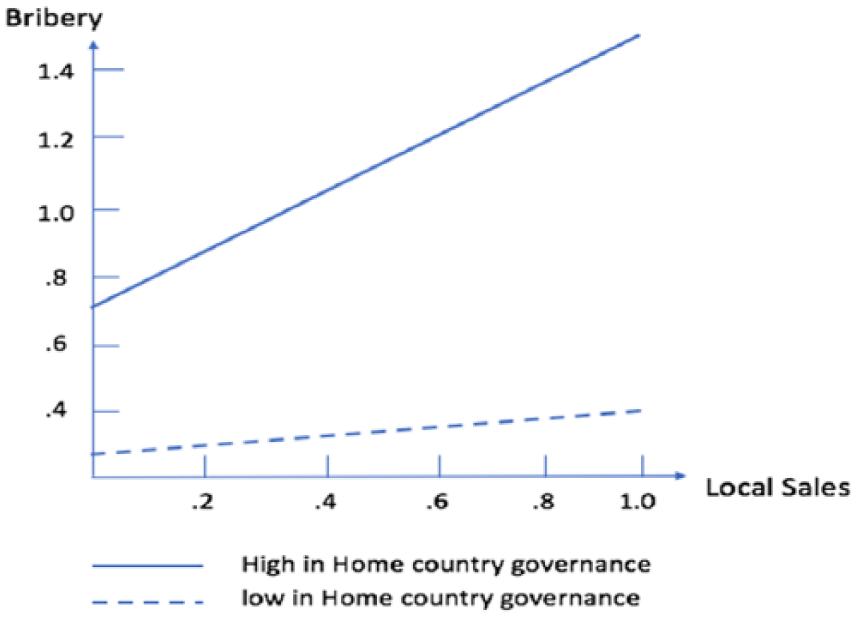
Moderating effect of home country governance on the relationship between local sales and bribery.
To ensure the robustness of our results, we made sure we ruled out a potential problem created by a high correlation between home country governance and home country OECD membership. First, we ran the models without the home country OECD membership variable and found that the results were qualitatively similar. Second, we also orthogonized the two home country-level measures (i.e., home country governance and home country OECD membership) to each other, an approach used to address the possibility of multicollinearity (J. J. Choi & Prasad, 1995; Lee & Makhija, 2009). By orthogonizing them, the correlation between the two is close to 0. We replaced the original measures of the two variables with the orthogonized measures in the equations. The results are consistent. All hypothesis-testing results are summarized in Table 5.
Summary of the Results.

Note. MNE = multinational enterprise.
We use the expression “modestly supported” when the hypothesis is supported at p < .1.
The Logistics model is supported at p < .05; all values of the marginal effects are positive, but some of their z-statistic values are less than 1.96.
Discussion and Conclusion
The objective of this study is to enhance our understanding of MNE’s influencing activities that are conducted in an institutionally weak host country. We also aim to draw ethical and social implications from the research findings. Our findings highlight several important points in this regard.
Our results support the main and interaction effects of home country governance on an MNE’s engagement in lobbying and bribery in transition economy host country settings. First, MNEs from a home country with a stronger governance system show significantly lower engagement in bribery within host countries. This result suggests that home country governance matters in restricting MNEs’ engagement in corrupt behaviors overseas. Even when the local market is important for MNEs’ sales revenue, and thus the institutional costs incurred by them are high, these MNEs show lower levels of engagement in bribery. These results complement Cuervo-Cazurra’s (2006) finding that MNEs from countries where strong legal and normative sanctions are imposed on corruption have a lower tendency to enter corrupt countries. Complementing this understanding, our study further suggests that once an MNE enters a corruption-prone country, the home country’s governance still affects an MNE’s choice of action in dealing with institutional challenges: A strong home country governance system clearly constrains an MNE’s host country engagement in corrupt activities such as bribery.
Second, and perhaps more important, we find strong evidence that MNEs from home countries with a stronger governance system tend to engage more in lobbying. Stated differently, these MNEs undertake greater efforts to change the laws or regulations when in a host country setting with weak governance than do MNEs from home countries with a weaker governance system. We may interpret this finding as MNEs’ alternative institutional strategy of not engaging in corruption when dealing with high institutional costs. However, in a weaker institutional setting in which the lobbying process is poorly governed, it is unclear whether an MNE’s lobbying can be separable from corruption (Dahan et al., 2013; Lawton et al., 2013; Rajwani & Liedong, 2015).
This study makes three major theoretical contributions to the extant knowledge of institutional strategies. First, the institutional characteristics of a given business environment are seen as central features that determine the different institutional strategies adopted by firms (Ahuja & Yayavaram, 2011; Doh et al., 2012; Dorobantu et al., 2017; Marquis & Raynard, 2015). However, prior studies have focused on the institutional environments in which a given firm conducts business. Our study emphasizes that not only the host country’s institutional conditions but also MNEs’ embeddedness in their home country institutions affects how they respond to institutional challenges in the host country. Prior studies have considered the impact of home country institutions on MNEs’ capabilities and practices, but mostly in terms of technological capabilities and innovation (Kogut, 1991; Porter, 1990). Our study contributes to the literature by redirecting scholarly attention to the significant and persistent effects of home country institutional imprinting on an MNE’s influencing strategies overseas.
An understanding of the persistence of home country imprinting effects advances the literature because it allows for different predictions than when imprinting effects are not considered. For example, as we have argued, firms in a weak governance setting are less likely to engage in lobbying due to high up-front costs as well as the uncertainty involved in the lobbying process. However, these firms are more likely to engage in bribery due to weak monitoring as well as lower levels of economic, legal, and social sanctions with regard to bribery. In this respect, our host country settings generally can be seen as environments unfavorable to lobbying but favorable to bribery. However, our results demonstrate that MNEs from a stronger governance system behave differently: They choose influencing activities that are less aligned with the institutional conditions of a host country, but more aligned with those of the home country.
Second, a majority of studies concerning corruption in institutionally weak countries tend to single out explicitly corrupt practices such as bribery (Cuervo-Cazurra, 2016; Spencer & Gomez, 2011). Extending these studies, we provide a perspective with which to examine the two important influencing activities, bribery and lobbying, in an integrative manner. Particularly given that the conventional approach to differentiating the two based on their methods of transactions (illegitimate money vs. information) is inapplicable in a weak institutional setting, we propose an alternative perspective that compares the two practices by focusing on their different purposes (changing vs. bending the rules) and considering the different types of costs and benefits involved in these activities. This alternative approach to comparing the two may stimulate more scholarly discussions on the two activities in an integrated manner.
Finally, our study extends the current understanding of CPAs, particularly in less-developed institutional contexts. While CPAs have long been a topic of interest for management scholars, the literature has been developed predominantly based on the observations of CPAs in well-developed institutional settings. In less-developed institutional contexts, scholars pay more attention to implicit political actions such as building and securing political ties (Okhmatovskiy, 2010; Sun, Mellahi, & Thun, 2010). Among the small number of research studies on CPAs (e.g., lobbying) in less-developed institutional contexts, most have involved one-country investigations or cross-country comparisons of CPAs (S.-J. Choi et al., 2014; Jia, 2014). A number of international business scholars, however, have examined how MNEs address institutional challenges in light of the home country effect, but these scholars have mostly compared the location choice or the entry/exit decision of MNEs. Therefore, what MNEs do to deal with institutional challenges after entering a host country has been relatively understudied (Feinberg & Gupta, 2009). Our study, in this respect, provides a useful perspective that includes the home country’s institutional environment as an important determinant of an MNE’s political activities.
From a practical standpoint, our study suggests that home country governance can be an effective mechanism in controlling MNEs’ illegal political activities, even outside of their home boundaries. Thus, policy makers in each country may consider strengthening the home country governance system as a way of reducing their MNEs’ unwanted involvement in corruption overseas. Our study further indicates that unlike bribery, which is generally perceived as an unethical and inappropriate activity that must be circumvented, perceptions of the legitimacy of CPAs vary widely as do the ways of regulating CPAs across countries (Dahan et al., 2013). Such diverse and often ambiguous perspectives on lobbying may result in a more profound and lingering effect of home country institutions on a firm’s decision of whether or not to engage in lobbying in other countries. It may be a considerable task for policy makers to assess whether and how to expand the extraterritorial explicit governance mechanism for lobbying activities conducted outside of their home boundaries.
This study has several limitations. First, our host countries only include the transition economies in Eastern Europe and Central Asia. Further examination with a more diverse and expanded data set would improve the generalizability of the study findings. Second, given that we use survey data for our focal variables, our measures have limitations in providing the rich contexts involved in these influencing activities. While the simplified survey items have the advantage of parsimony, other methodological approaches that capture various meanings and contextual influences in understanding these activities would allow for a more comprehensive understanding. In particular, a promising future research would be concrete case studies focusing on the micro-dynamics of how MNEs approach specific institutional challenges in a host country and how their attempts to change the regulatory conditions and government policy is understood from local stakeholders’ perspectives. Such an understanding of micro-dynamics based on concrete cases will complement our study by providing a more nuanced insights into the social implications of MNEs’ influencing activities. Finally, while various political activities are possible, in this study we focus on two explicit political activities, lobbying and bribery. Especially given that implicit political actions such as building and securing political ties are prevalent in institutionally weak settings (Okhmatovskiy, 2010; Sun et al., 2010), incorporating both explicit and implicit political activities in theory-building would benefit the literature.
In conclusion, this study demonstrates the significant and persistent impact of an MNE’s home country governance when the MNE faces and manages institutional challenges, especially in a weak institutional setting, as in transition economy host countries. Our findings suggest that an MNE’s engagement in lobbying or bribery in a host country are not determined idiosyncratically case-by-case. Rather, an MNE’s engagement is deeply influenced by its home country’s governance conditions along with its exposure to the local host country market. Overall, given the understudied nature of how MNEs manage institutional constraints, especially after they enter a host country, this study enriches the literature on how MNEs manage adverse institutions. This study also calls for more scholarly attention to the social and ethical issues underlying MNEs’ approach to influencing a host country’s public policies.
Footnotes
Appendix
List of Home and Host Countries Included in This Sample.

| Host country | Home country |
|---|---|
| Albania | Armenia |
| Armenia | Austria |
| Azerbaijan | Azerbaijan |
| Belarus | Belarus |
| Bosnia-Herzegovina | Belgium |
| Bulgaria | Bosnia |
| Croatia | Bulgaria |
| Czech Rep | Canada |
| Estonia | China |
| Georgia | Croatia |
| Hungary | Czech |
| Kazakhstan | Denmark |
| Kyrgyzstan | Estonia |
| Latvia | Finland |
| Lithuania | France |
| Macedonia | Georgia |
| Moldova | Germany |
| Poland | Greece |
| Romania | Hungary |
| Russia | Italy |
| Serbia Montenegro | Japan |
| Slovakia | Korea |
| Slovenia | Latvia |
| Tajikistan | Lithuania |
| Ukraine | Macedonia |
| Uzbekistan | Netherlands |
| Yugoslavia | Poland |
| Russia | |
| Slovak | |
| Slovenia | |
| Spain | |
| Sweden | |
| Turkey | |
| United Kingdom | |
| Ukraine | |
| United States | |
| Yugoslavia |
Declaration of Conflicting Interests
The authors declared no potential conflicts of interest with respect to the research, authorship, and/or publication of this article.
Funding
The authors received no financial support for the research, authorship, and/or publication of this article.
