




Abstract
Entrepreneurship is important in economic growth and development. This study explores the likelihood that societal-level well-being and country-level self-expression values positively influence individual entrepreneurship across countries. Self-expression values mediate and reinforce the effect of societal well-being on entrepreneurship. Well-being is not simply an individual-level expression of positive emotions or an individual’s accumulated human capital alone. It is also a country’s stock of psychological as well as social resource and a macrolevel culture-specific emotion supporting entrepreneurship. This study provides a multidimensional approach to exploring the effects of societal well-being and country-level self-expression values on entrepreneurship. The proposed conceptual model uses three theoretical propositions to delineate an indirect effect of societal well-being mediated through country-level self-expression values. The study also compiles measures of societal well-being terms from secondary data sets for use in cross-country comparative empirical research into entrepreneurship.
As a process of self-organizing, entrepreneurship is closely associated with well-being (Shir, 2015). Despite this realization, we still know little about the relationship between entrepreneurship and well-being (Uy et al., 2013). Entrepreneurship scholars, however, are becoming increasingly interested in the causes and consequences of well-being (Shepherd & Patzelt, 2018; Shir, 2015; Shir et al., 2019; Stephan, 2018; Uy et al., 2013; Wiklund et al., 2019) which is highlighted by the theme of the recent 2018 Academy of Management Annual Meeting: “Improving Health and Wealth-Being in Society: How Can Organizations Help?” and another special issue published in 2019 by the Journal of Business Venturing entitled “Entrepreneurship and Well-being.” I acknowledge the significance that this important line of inquiry promises to hold and endeavor to extend this rapidly growing body of literature while also steering away from themes that appear to have recursively featured in studies linking well-being and entrepreneurship. Adopting a relatively unique and lesser studied perspective, the current research conceptualizes the linkages between societal-level well-being and individual-level entrepreneurship. Specifically, a conceptual model that delineates the indirect effect of societal well-being, through country-level self-expression values, on individual-level entrepreneurship is proposed. I posit that self-expression values mediate the relation between societal-level well-being and entrepreneurship. Put differently, societal-level well-being is a distal, whereas self-expression values are a proximal, influencer of individual entrepreneurship. I adopt an exploratory inquiry approach to address several gaps in extant literature on well-being and entrepreneurship that discussed below.
First, the last decade has predominantly looked at well-being as an important entrepreneurial outcome, focusing on the psychological and coping mechanisms that can affect entrepreneurs’ mental health (Stephan, 2018; Uy et al., 2013), or choice of occupational work—entrepreneurship (or self-employed) versus wage employment yielding varied levels of well-being, and so on. In other words, entrepreneurship has been thought to be the cause and well-being its effect. In this study, I depart from this conventional route and treat well-being as also an important antecedent of individual entrepreneurship as opposed to the popular practice of it being an outcome alone. Hence, the conceptualization would suggest reverse causation such that the links between well-being and entrepreneurship may not be merely unidirectional but also bidirectional.
Second, another pronounced gap concerns the characterization of well-being. Entrepreneurship research have been confined to treating well-being as people’s evaluations of their lives that encompasses both cognitive judgments of life or job satisfaction and affective appraisals of moods and emotions (Diener & Lucas, 1999). This is the hedonic approach to well-being, often called happiness or subjective well-being (SWB) and have been widespread in extant entrepreneurship literature. What appears to have been left out from research on well-being and entrepreneurship is the characterization based on eudaimonic perspective of well-being, that renders well-being as a derivative of personal fulfillment and expressiveness (Waterman et al., 2010), personal development (Erikson, 1959), self-actualization (Maslow, 1968), individuation (Jung, 1933), and self-determination (Ryan & Deci, 2000) and that reflects a fully functioning life (Rogers, 1962; Ryff, 1989; Ryff & Singer, 2013). Recent studies have raised concern and offered corrective measures in that well-being must integrate both these views (Ryff, 2019; Wiklund et al., 2019) prior to studying links with entrepreneurship. The current research pays heed to such recommendations and through comprehensive literature review reinforces well-being as a multidimensional concept whose meaning and definition covers a variety of human experiences and conditions (e.g., life satisfaction, positive affect involving happiness, vitality, autonomy, self-acceptance, meaning and purpose in life, self-esteem, fulfillment, optimism, positive engagement, and the ability to form meaningful relationships through effective management of complex environments), and that captures both objective and subjective aspects of the human experience. I distinguish between components and offer a holistic explanation of characterizations of well-being in a later section.
The third gap that this study addresses concerns levels of analysis of well-being invoked in the entrepreneurship literature. Individual-level well-being as a construct is rooted in the psychology literature and have been borrowed in entrepreneurship research to look at well-being of entrepreneurs or those of self-employed. However, international surveys of (subjective) well-being show consistent mean level differences across nations (Inglehart & Klingemann, 2000; Veenhoven, 1993), suggesting that variance exists in well-being between cultures. Empirical studies, for example, have examined the predictive power of cultural factors on the cross-country differences in happiness, and explored how different dimensions of cultural indices differ in their effects on well-being (Ye et al., 2015) and that cultural values were observed to enhance SWB above and beyond just financial well-being (Steel et al., 2018). Combined, these observations elucidate the multilevel nature of well-being—that it operates above and beyond just the individual-level and is a highly contextualized and culturally implicit construct.
In spite of this reckoning, there is dearth of studies that examine if societal-level well-being account for the cross-national variance in individual entrepreneurship. A pertinent research question to pose therefore could be “are some societies, by virtue of higher levels of well-being more predisposed than others to encourage entrepreneurship?” Recent evidence suggests affirmatively. A significant and important indicator of socioeconomic progress, societal well-being constitutes an important social resource linked with entrepreneurship. National well-being accounts are being called for capturing many aspects of the good, flourishing life or what is considered as happy state of affairs in a country that can complement traditional economic measures (Diener, 2000; Kahneman et al., 2004; Tay et al., 2015), such as GDP. Starting with the seminal work of the Commission on the Measurement of Economic and Social Progress in 2009, a variety of initiatives around the world have been launched that aim to provide a more complete picture of socioeconomic progress. The Organisation for Economic Co-operation and Development (OECD), for example, is now tracking “how life is going” in eleven distinct quality of life categories using both objective and subjective indicators of well-being. As another example, Gross National Happiness (GNH) index of Bhutan, is now its benchmark for socioeconomic progress (Musikansi, 2014; Valliere, 2014) and that correlates positively with its rates of entrepreneurial activity and other happier countries (e.g., Switzerland, Austria) are reporting positive correlations with rates of entrepreneurship in repeated measures studies such as the Global Entrepreneurship Monitor (GEM, 2018). Are these mere correlations or is there a causation between societal well-being and entrepreneurship? Given that answers could not be found in extant entrepreneurship literature, understanding societal perceptions of well-being and its influence on individual-level entrepreneurship is thus warranted.
Rendering well-being as also a (macrolevel) societal-level construct above and beyond an individual-level one addresses another associated gap in extant literature—the need to emphasize and reconceptualize well-being as a country’s stockpile of social and psychological resource supporting entrepreneurship. Individual’s well-being is associated with several key aspects critical for entrepreneurship such as higher quality social interactions, better relationships, and prosocial behavior (Lyubomirsky et al., 2005). Well-being infuses sense of being in control, self-esteem, mindfulness, optimism, autonomy, and so on and also assists in alleviating stress leading to effective coping—key activities needed to persist with entrepreneurship. Thus, societies with individuals who on an aggregate report higher levels of well-being would therefore be more resourceful to positively evaluate the feasibility of engaging in entrepreneurship. The proposed conceptual framework provides insights into how societal well-being serves as critical resource supporting entrepreneurship in a country.
Further insights would also be needed toward ascertaining if societal well-being exercises merely direct effects or if its effects on individual entrepreneurship follows an indirect pathway. In that regard and as subsequent natural extension, it would be worthwhile to examine if these effects are mediated by other national-level cultural values. The current research proposes both direct and indirect (mediation) effects of societal well-being on individual entrepreneurship—that self-expression values defined as expression of thoughts, beliefs, feelings, ideas, creations, emotions and being independent and assertive—mediate the relationship between societal-level well-being and entrepreneurship making the former as a more proximal whereas the latter a more distal influencer of individual entrepreneurship. The theoretical perspective is supported by a simplistic conceptual model and involves (a) invoking individual-level psychological theory of broaden-and-build theory of positive emotions and social and human capital theory, (b) extending them to apply to a higher societal-level context, and subsequently (c) integrating the two theories to explain how societal-level hedonic and eudaimonic views of well-being collectively shape individual-level entrepreneurship.
Finally, extant empirical studies linking well-being with entrepreneurship appear to be limited in their employment of well-being items, with happiness and life-satisfaction measures as the two frequently used. Therefore, within the realm of measurement of well-being items, the study provides an exhaustive compilation of both hedonic, and more importantly, the lesser used eudaimonic items as well as their associated secondary data sources that could be used as proxies for national-level scores of well-being in future empirical research in general and cross-country comparative entrepreneurship research in particular.
To comprehensively understand the linkages between well-being and entrepreneurship, I present a conceptual framework that overcomes the shortcomings in current literature and addresses mentioned gaps through offering three separate propositions that correspond to—(a) main effect of societal (national) level well-being on individual entrepreneurship, (b) main effect of societal (national) self-expression values on individual entrepreneurship, and (c) indirect effect of societal (national) level well-being on individual entrepreneurship, that the main effect of societal well-being on individual entrepreneurship is mediated by self-expression values. The conceptual framework proceeds from a systematic review of literature enabling us to propose the mentioned linkages while simultaneously guided by the availability of measures that appropriately define national-level indicators of well-being and self-expression values. Review of literature was done to establish, respectively, (a) characterizations of well-being, (b) extant landscape about the linkages between entrepreneurship and well-being, (c) the multilevel (societal-level) nature of well-being, (d) proposed linkages between societal well-being, self-expression values and individual entrepreneurship, and (e) a repository of empirically usable measurements of the various characterizations of well-being drawing from available scores from secondary data sources that would enable future research to empirically test the proposed linkages.
Multiple contributions emerge from this approach. The significantly comprehensive literature review familiarizes readers with the current state of affairs and perspectives in the domain of well-being and entrepreneurship research, identify gaps in it, and by steering away from topics typically studied propose directions and groundwork for new theory development. First, I claim to make contributions by establishing well-being as a multidimensional and multilevel construct affecting individual entrepreneurship—that it is not just an entrepreneurial outcome but also an important antecedent of it. In doing so, I contribute to the cross-level exploration of macrolevel conceptualizations of psychological constructs of well-being as they relate to individual entrepreneurship (Stenholm et al., 2013), something that remains relatively understudied. Second, I contribute to the theory on culture-entrepreneurship fit perspective by situating well-being as culturally implicit and contextually embedded phenomena and highlighting its role in explaining observed variance in rates of entrepreneurship across cultures. Nations that are shifting from traditional indicators of social progress, such as GDP, and adopting societal-level well-being as a more inclusive one to define progress are reporting rise in entrepreneurial activities. This may well be attributed to their levels of well-being serving as stockpile of psychological and social resources being channeled into entrepreneurial efforts. Well-being is more than just a mere outcome but rather an important psychological resource (Lyubomirsky et al., 2005). Using individual-level psychological theory such as the broaden-and-build theory of positive emotions and social and human capital theory, I create unprecedented use of individual-level hedonic and eudaimonic well-being theories to explain societal-level well-being’s influence on individual entrepreneurship. Perceived resourcefulness in societies shape their self-expressive values that subsequently increase likelihood of individual entrepreneurship. A study such as this is a starting point into extending individual-level well-being theories to higher levels (cultural level in this case) to explain how societies might channelize well-being into increased entrepreneurship.
Third, I posit an important theoretical addition by identifying the novel mediating mechanism of country-level orientations toward self-expression values that act as conduit for the influence of societal-level well-being on individual entrepreneurship to be felt. Societies noted for higher levels of self-expression values are known for embracing personal advancement, creativity, and growth, as opposed to societies focused on insularity and survival (Inglehart, 2006). Macrolevel well-being aids in creating sociocultural environment where self-expression values are more prevalent, which in turn leads to a higher level of entrepreneurial action within those societies. Hence, the notion of societal-level well-being as distal and self-expression values as proximal predictors of individual entrepreneurship is brought to the fore front. Finally, I offer a holistic characterization of well-being, one that includes descriptions of hedonic and eudaimonic well-being and their operationalizations as constructs using secondary data sources, to be used in cross-cultural comparative empirical research.
The remainder of the article is structured as follows. First, I provide a review of extant literature on the characterizations of well-being, its linkages with entrepreneurship, and its multilevel (societal-level) nature. Next, I would make three propositions, two of which would discuss the cross-level effects of (a) societal-level well-being, (b) self-expression values on individual-level entrepreneurial activities, and the third would establish the mediating role that self-expression values play in the relationship between societal well-being and individual entrepreneurship. Subsequently, I would conclude by discussing the contributions of this article.
Literature Review and Hypotheses Development
The conceptual model reflects the cross-level relationships of societal well-being and self-expression values, and their direct and indirect effects on individual entrepreneurship as shown in Figure 1.
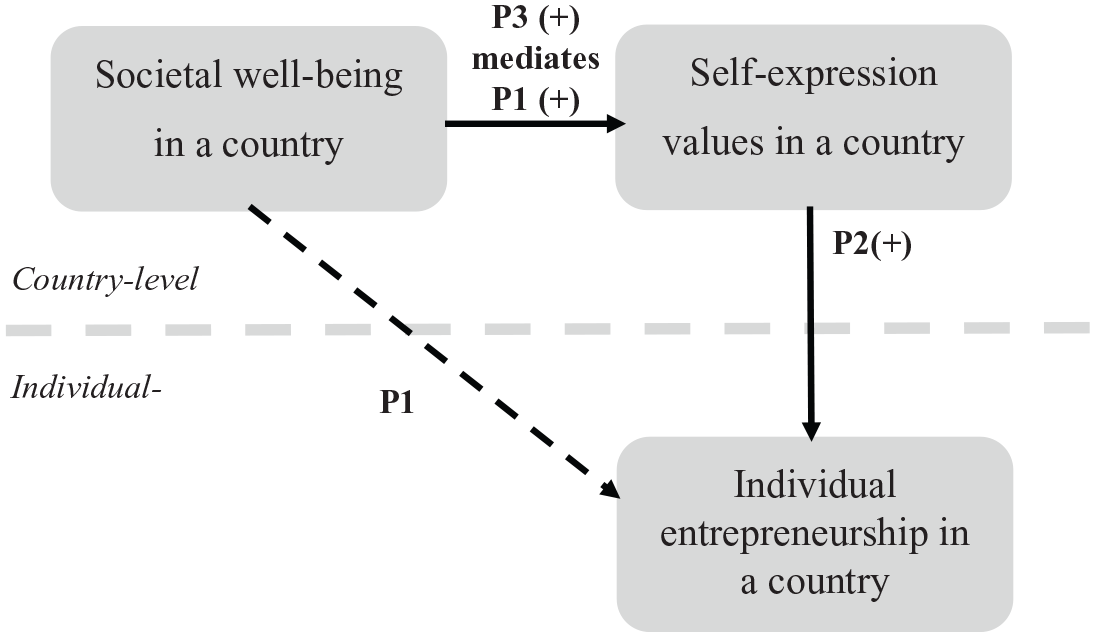
Conceptual framework: self-expression values reinforce (mediate) the effects of societal well-being on individual entrepreneurship.
Literature Review of General Characteristics of Well-Being
Well-being is a positive outcome that is meaningful for people and for many sectors of society, because it tells us that people perceive that their lives are going well and what they think and feel about their lives, such as their physical health, the quality of their relationships, their positive emotions and resilience, the realization of their potential, or their overall satisfaction with life—that is, their “well-being” (Diener, 1994, 2009; Diener & Seligman, 2004). The notion of well-being thus integrates mental health (mind) and physical health (body) holistically. Well-being generally includes global judgments of life satisfaction and feelings ranging from depression to joy (Diener et al., 2009). Well-being, in sum, captures a “global assessment of all aspects of a person’s life” (Diener, 1984, p. 549).
As observed, a variety of conceptualizations, definitions and perspectives on well-being have been offered in the psychology research in so much so that it can sometimes get daunting to extract its true meaning or make distinctions between them. A proper characterization of well-being is therefore in order at this point to be able to succinctly understand and employ it as needed in research in general and in entrepreneurship research in particular. Fundamentally, well-being is classified into two categories—physiological well-being and psychological well-being—that integrate to present the psycho-physiological aspect of well-being. Furthermore, the psychological aspect of well-being classifies into two different viewpoints—(a) hedonism or hedonic well-being and also interchangeably referred to as subjective well-being (Kahneman et al., 1999) and (b) eudaimonia or eudaimonic well-being (also spelled as “eudemonia”)—that collectively originate from different ontological and ethical assumptions about human nature and the state of well-being and is tied to specific outcomes which encompass these two viewpoints (Deci & Ryan, 2000; Diener, 1984; Ryff, 1989; Ryan & Deci, 2001). The basic difference between them is that while hedonic well-being refers to the subjective feelings of happiness, eudaimonic well-being refers to the purposeful aspect of psychological well-being. Further yet, hedonic well-being (or SWB) has two classifications—(a) cognitive or evaluative well-being (satisfaction with life) and (b) affective (of emotions and affect; high positive affect and low negative affect) well-being—whereas eudaimonic well-being has six facets to it—self-acceptance, environment mastery, positive relationships, personal growth, purpose in life, and autonomy. A detailed characterization of well-being is shown in Figure 2. In the remainder of this section, I provide detailed descriptions of each of these items that constitute well-being.

General characterization of individual-level well-being.
Physiological well-being concerns an individual’s state of physical well-being, not just the absence of disease or stress. It includes lifestyle behavior choices (such as exercise, balanced and nutritious diets, and meditations) to ensure health, avoid preventable diseases and conditions, and to live in a balanced state of body, mind, and spirit. McEwen and Stellar (1993) coined the term “allostatic load” which refers to the “the wear and tear on the body” that accumulates as an individual is exposed to repeated or chronic stress and represents the physiological consequences from such exposures. For example, the inability of the body to shut off while stress accelerates and levels in the body exceed normal levels, for example, elevated blood pressure. Ensuring physiological well-being is paramount for individuals who are exposed to repeated or chronic stress. Specific to those engaged in professions such as self-employment and entrepreneurship, recent study (Patel et al., 2018) has shown that self-employment will have an indirect negative association with mental as well as physical health, as mediated by allostatic load and that this load will increase the longer individuals are self-employed. The old saying “a healthy mind resides in a healthy body” reflects the notion of psycho-physiological well-being—that physiological well-being contributes to one’s overall mental well-being (psychological well-being).
Psychological well-being concerns two important aspect—the subjective happy feelings brought on by something individuals enjoy (hedonic well-being) and the feeling that what individuals do with their lives have some meaning and purpose (eudaimonic well-being). I will explain these two aspects of well-being next.
The term “hedonic” well-being is normally used to refer to the subjective feelings of happiness. It comprises of two components, an affective component (high positive affect and low negative affect) and a cognitive or evaluative component (satisfaction with life). It is proposed that an individual experiences happiness when positive affect and satisfaction with life are both high (Carruthers & Hood, 2004). Hedonism, which is defined as what makes experiences as well as life, overall, pleasant and enjoyable versus unpleasant not enjoyable (Diener, 2000; Kahneman et al., 1999), is at the microlevel grounded in the pleasure and pain associated with the many different elements of a person’s life. These elements can include both physical pleasure and pain but can also be tied to the pleasure and pain associated with goal accomplishment and successful (or unsuccessful) work effort (Suh et al., 1998). Most research within the domain of psychology has linked hedonic principles to SWB and has successfully tied these principles at the microlevel to measures of life satisfaction and the presence or absence of positive or negative moods as a means to describe what is generally termed as “happiness” (Diener & Lucas, 1999).
In addition to hedonic views of human well-being, eudaimonic well-being also captures well-being, but from a somewhat contrasting viewpoint. Eudaimonia (quite literally eudemonia, or “bliss”) and the eudaimonic view posits that well-being is not simply a subjective view of happiness. Rather, the eudaimonic perspective of well-being results from the striving of individuals to accomplish things that are congruent with their “true selves” (Waterman, 1993). As such, eudaimonic well-being is centered not on SWB, but on psychological well-being, and is reflected by the actualization achieved through greater personal autonomy, independence, growth, self-confidence, and self-acceptance (Ryff & Keyes, 1995), meaning and purpose in life, positive engagement and the ability to form meaningful relationships through effective management of complex environments.
So far, I discussed well-being as an individual-level construct. In the next section, I will discuss relationship between well-being and entrepreneurship.
Literature Review of Perspectives Linking Entrepreneurship and Well-Being
With the characterizations of well-being in place, I present an overview of a brief literature review on the linkages between entrepreneurship and well-being and isolate those topics that have been found predominantly common in studies that undergo either conceptualizing or testing (or do both) the proposed linkages. These studies have mainly remained unidimensional (focusing mainly on the hedonic view of well-being and specifically considering the happiness and life-satisfaction aspects of it as opposed to using both hedonic and eudaimonic views) (Wiklund et al., 2019) and unidirectional (focusing mainly on how well-being is an outcome or a performance indicator of entrepreneurship as opposed to how well-being leads to individual entrepreneurship) in their approach. Before, I will highlight a few perspectives here, I would direct the attention of readers to two recent studies that provide comprehensive review of the proposed linkages. They are (a) the 2019 special issue at the Journal of Business Venturing entitled “Entrepreneurship & Well-being” featuring nine articles, and (b) another article entitled “Entrepreneur’s well-being: A bibliometric review” (Sánchez-García et al., 2018) featuring a review of 41 articles that clusters the linkages between well-being and entrepreneurs across six different theoretical perspectives grounded in entrepreneurship related to: culture, education, innovation, sustainable development, and small business; psychological well-being; social entrepreneurship and economic development; women and employment; self-employment; and life satisfaction and economic growth, and business administration. Next, I highlight summaries of the literature review including those of these two sources.
First, while comparing individuals across work occupations, it was observed that entrepreneurs and self-employed, despite lower incomes, generally reported elevated levels of happiness and (job) satisfaction than employed or wage workers (Baron et al., 2016; Binder & Coad, 2013; Hessels et al., 2018; Larsson & Thulin, 2019; Stephan & Roesler, 2010; Uy et al., 2013). For self-employed, these indicators of well-being were even higher in those with employees relative to those without any (Sánchez-García et al., 2018). Hessels and colleagues (2018) also investigated whether a positive relationship between life satisfaction and self-employment (vs. paid employment) existed while simultaneously considering two occupational dimensions: white-collar versus blue-collar work and high-skilled versus low-skilled work. Their findings confirmed that self-employed workers were more satisfied with their lives than paid employees are. A life satisfaction premium is also found when the self-employed and paid employees are compared within similar occupations in terms of collar type and skill level and that self-employment was observed to potentially help overcome low life satisfaction scores associated with blue-collar and low-skilled work. Entrepreneurial well-being is also spatially dependent—that it is contingent upon the physical location as to where the entrepreneur operates on the urban-rural (Abreu et al., 2019)—with entrepreneurial well-being being higher in locations that offer greater work flexibility. Self-employed in semi-urban areas experience greater job satisfaction, whereas those in rural or deprived areas experience greater life satisfaction.
Second, given there is so much heterogeneity in the types of entrepreneurs, predicting exact linkages between entrepreneurship has been challenging (Bujacz et al., 2019; Shir, 2015). Regarding the type of entrepreneurship and their linkages with well-being, the literature suggests that opportunity entrepreneurs would exhibit higher SWB than necessity entrepreneurs (Binder & Coad, 2013; Larsson & Thulin, 2020) owing to the former deriving higher SWB from their occupational choices and the latter unable to do so. Other previous studies from Germany (Block & Koellinger, 2009), Sweden (Sevä et al., 2016), and Finland (Kautonen & Palmroos, 2010) have concluded that necessity entrepreneurs (self-employed by necessity) are less satisfied with their work situation. Using a person-centered approach, Bujacz and colleagues (2019) suggest that to fully understand entrepreneurship–well-being relationship, one needs to not only consider the heterogeneity of the self-employed population but that they need to be profiled across six indicators of well-being—unhappy, languishing, happy, satisfied, passionate, and flourishing. Extant literature has investigated the linkage between well-being and yet another type of entrepreneurship—social entrepreneurship. On one hand, given that social entrepreneurs drive a sense of satisfaction from their endeavors that are intended to achieve social well-being, they tend to be happier than their commercial counterparts (Sánchez-García et al., 2018; Van Ryzin et al., 2009). On the other hand, stress is a significant problem for social entrepreneurs. When trying to achieve commercial goals and give back to the community at the same time, these entrepreneurs are likely to overload themselves with too many responsibilities and, consequently, deplete their personal resources. The cost of resource depletion can include reduced time with family and poor sleep quality, leading to lower well-being (Kibler et al., 2018, 2019). Prosocial motivations negatively affect even the life satisfaction of commercial entrepreneurs; however, it has been demonstrated that through exercising autonomy, entrepreneurs can simultaneously realize prosocial and economic goals without harming their SWB (Kibler et al., 2018, 2019).
Third, from a gender perspective, according to the GEM (2018) report, women report higher levels of well-being than male entrepreneurs or those who do not run companies, with work–family issues often serving as a motivator for women to move into entrepreneurship (Murphy, 2017; Parasuraman & Simmers, 2001). However, women entrepreneurs face prejudice when acquiring funds, gender profiling and discrimination, and so on, more than male entrepreneurs thus affecting venture performance; yet when controlling for performance, it is reported that given women entrepreneurs have lesser initial expectations, their sense of fulfillment and satisfaction is higher than male entrepreneurs (Cooper & Artz, 1995). For women entrepreneurs, the higher levels of satisfaction may reflect a view that they have fewer attractive alternatives; it may also be that they discover greater relative satisfaction from the day-to-day aspects of business ownership. It is also reported that women entrepreneurs who are high in creativity (i.e., a masculine or agentic characteristic) and men entrepreneurs who are high in teamwork (i.e., a feminine or communal characteristic) will perceive themselves as being well-suited for their work and in turn achieve enhanced levels of SWB (i.e., high work satisfaction and low work–family conflict) and firm performance (Hmieleski & Shepherd, 2019). Women entrepreneurs have a tendency to focus on multiple measures, such as self-realization, recognition, innovation, role, independence, and financial success, when gauging their entrepreneurial success or well-being (Manolova et al., 2012). Therefore, when researching linkages between well-being and women entrepreneurship, multiple measures need to be included.
Fourth, by considering different units of analyses—either individual entrepreneurship or firm/organizational level entrepreneurship or both—studies have also reported several outcomes of entrepreneurial well-being. For instance, based on a review of 28 articles, entrepreneurs’ mental health and well-being have been shown to produce six distinctive outcomes, those of persistence in entrepreneurship, opportunity recognition and work behaviors, firm performance, entrepreneurs’ stress and health, entrepreneurs’ work–family balance, and collective entrepreneurial outcomes (Stephan, 2018). Entrepreneurs are particularly vulnerable to role stress when developing and managing new ventures that may lead to increased propensity to quit (Örtqvist & Wincent, 2010). Although traditionally role stress has been thought to lead to exhaustion and diminishing satisfaction, recent study found strong support for reverse causation—exhaustion and satisfaction affecting role stress (Örtqvist & Wincent, 2010). Entrepreneurial well-being could thus be significant not just for engaging in entrepreneurship but being able to persist in it and keep performing the role of an entrepreneur. The notion that entrepreneurial well-being (satisfaction) can alleviate role stress therefore ties back to the significant outcomes of reducing role stress and persisting in entrepreneurship. It may also bear upon decisions by individual entrepreneurs about whether to continue or close down their ventures, decisions pertaining to whether to invest more time and money or to cut back, and so on. It may be that more satisfied entrepreneurs could assume more effective roles when it comes to working with their customers and employees, thereby leading to greater success (Cooper & Artz, 1995). At the organizational level too, work-place well-being of employees working for entrepreneurial firms have been linked with sustainable entrepreneurial success and innovative growth of firms (Gopinath & Mitra, 2017).
Fifth, few studies have looked above and beyond the more commonly used hedonic view of well-being (life satisfaction, happiness, positive affect, etc.) and included the lesser utilized eudaimonic view to conceptualize how task characteristics of entrepreneurship (such as autonomy and decision-making latitude) links to entrepreneurial well-being. For example, decision autonomy (one of the six components of eudaimonia) provides the self-employed with the opportunity to more effectively use those tools (such as problem-focused or emotion-focused coping) that have the greatest effect on eliminating stressors and reducing negative emotions (Patzelt & Shepherd, 2011) thus ensuring well-being. To minimize the risk of project failures that generate fear and grief (Shepherd et al., 2009), the self-employed can decide that their business will focus on less risky projects thus reducing the stressor causing them negative emotions (Patzelt & Shepherd, 2011), also ensuring well-being. By advancing the self-determination theory (SDT) and using a two-stage multipath mediation model, a recent study shows that the satisfaction of the basic psychological needs of autonomy mediates the relationship between active engagement in entrepreneurship and well-being through its effect on psychological competence (learning and development through realization of personal potential) and psychological relatedness (formation of meaningful relationships through effective management of complex environments) (Kara & Petrescu, 2018; Shir et al., 2019).The key importance of bringing eudaimonia to the field of entrepreneurship research is that the essential core of this type of well-being involves realization of personal talents and potential. Such active pursuit of such personal excellence, in the spirit of Aristotle, is fundamental to entrepreneurship (Ryff, 2019).
Finally, from the perspective of the contextual nature of well-being (that of culturally embedded), there is a significant volume of literature that establishes the multilevel, higher level nature of well-being, something that I discuss in a later section. However, the literature is rather thin when it comes to proposing or testing the influence of macrolevel (mainly societal-level) well-being on individual-level entrepreneurship or national rates of entrepreneurship. A recent article, without making any reference to entrepreneurship, provided empirical evidence on how cultural dimensions influence SWB in general (Steel et al., 2018). We are starting to observe some, although limited, studies that test the linkages between national-level measures of well-being and individual entrepreneurial activity (Larsson & Thulin, 2019; Naude et al., 2014). What was tested in both these studies was how national rates of (a) total early-stage entrepreneurial activity (TEA), (b) opportunity entrepreneurship, and (c) necessity entrepreneurship shape national SWB, and was shown that a country’s entrepreneurial activity positively contributes to its life satisfaction with opportunity-driven entrepreneurial activities making the most significant contributions to national life satisfaction. In another cross-level empirical setting comprising of 4,856 self-employed from 27 countries, it was observed that the influence of individual-level (a) autonomy and (b) relatedness on the well-being of the self-employed was contingent upon cultural dimensions of individualism and uncertainty avoidance (Kara & Petrescu, 2018), thus highlighting the moderating effects of culture on the well-being of self-employed.
Although this review of literature is not exhaustive by any means, I have still been able to highlight six key themes that have been frequently studied than others. What emerges out the review is a recursive pattern of (a) use of the hedonic view of well-being while shying away from engaging the eudaimonic view in spite of the acknowledgment that both views need to be employed when studying the linkages between entrepreneurship and well-being, (b) well-being being treated as an outcome of entrepreneurship as opposed to an antecedent of it, (c) well-being being limited in its characterization to happiness and life or job satisfaction, (d) well-being limited to its operationalization at the (lower) individual level as opposed to (higher) societal level and studies that do treat them as a higher level phenomena are still less common and continue to treat societal-level well-being as an outcome of rates of entrepreneurship as opposed to treating them as macrolevel contextual higher order antecedents of individual entrepreneurship. I offer a conceptual model to explain how well-being can be a societal-level antecedent to individual entrepreneurship—distally, via the mediating effects of national self-expression values. But first, I set forth to establish the macrolevel nature of well-being.
Establishing Well-Being as a Societal-Level Construct
The central line of argumentation in this section is that societies differ in their expressions of emotions including positive emotions of well-being, making it a culturally embedded and culturally implicit emotional expression. Cultures are defined by values and norms that, to a large extent, form the basis of what is valued by individuals in a society. These norms or implicitly held standards determine the meaning of emotions, their expressions, and their control (Eid & Diener, 2001).
At the end of the day, well-being is still an individual-level emotion. However, given that emotions are also implicit beliefs and that their experience, expression, and management are known to be driven by cultural values, I suggest well-being to be culturally embedded and culture-specific also. Extant research shows that emotions vary across cultures both in their meaning and expression. Although some societies may attribute financial or economic success as indicators of well-being, in others, contentment, honesty, humility, hard work, spirituality, being at peace with life, acceptance of what life has to offer, and so on may be the prevailing norms that embody well-being. Given that there are unique local languages and local moral orders, cultures can use the same emotion and express it in very different ways (Harré, 1986). Thus, emotional expressions are culturally prescribed performances rather than internal mental events including that of the expression of positive emotions of well-being.
Furthermore, knowing a social script for a certain emotion allows one to enact the emotional behaviors that are appropriate for the cultural context (Gross & Barrett, 2011). This makes the display of such emotional behaviors implicit to the context. One can also infer that the macrolevel nature of emotions can be established using the social construction models wherein emotions are based on experience and context. When most individuals in a collective have similar or comparable emotions, then that emotion becomes the dominant one for the collective. Societies are predisposed to express emotions one way or the other. With respect to expressions of happiness, perceptions and feelings of satisfaction in life, and so on, societies will have unique ways of expressing so, and such expressions on an aggregate would become the societal expressions of emotions of well-being. Hence, members from different cultures will differ in their perceived well-being, which is a function of life satisfaction, optimism, happiness, and self-esteem. Some cultures will perceive well-being and express it higher than others based on both economic progress and cultural norms regarding what is seen as a happy state of affairs. In conclusion, positive emotions of well-being have a multilevel nature to it—expressed at both the individual as well as at societal level.
There are several qualitative reviews on the direct, mediating, and moderating effects of culture on SWB (Diener et al., 1995, 2003; Diener & Suh, 2003; Spector, 1997), and in a chapter reviewing national differences in SWB, Diener and Suh (2003) conclude that “culture norms appear to be promising candidates for factors that influence SWB beyond wealth” (p. 444). International surveys of SWB show consistent mean level differences across nations (Inglehart & Klingemann, 2000; Veenhoven, 1993), suggesting that variance exists in SWB between cultures. Diener and Diener (2009) examined life satisfaction and self-esteem across 31 nations to determine the degree to which wealthier versus poorer countries differed across this important hedonic measure. Recent empirical studies offer evidence that consolidates the cultural embeddedness of well-being, that well-being is highly contextualized and that cultures matter for national well-being. For example, Ye and colleagues (2015) examine the predictive power of cultural factors on the cross-country differences in happiness and explore how different dimensions of cultural indices differ in their effects on SWB, referring to how people experience the quality of their lives that include both emotional reactions and cognitive judgments. In another study (Steel et al., 2018) cultural values were observed to enhance SWB above and beyond just financial well-being. Individual SWB was found to be most strongly associated with cultural values that foster relationships and social capital, which typically accounted for more unique variance in life satisfaction than an individual’s salary. Using dimensions of cultural indices from both GLOBE study and Hofstede, the two studies observed statistically significant effects of cultural practices on SWB, I provide a summary of findings from the two studies on the effects of cultures on SWB in Table 1. Combining what has been proposed conceptually, theoretically, or observed from empirical studies, I consolidate the culturally embedded nature of well-being, that it maintains a multilevel structure and is an indispensable societal-level construct. In the next section, I will propose the relationship between societal-level well-being and individual entrepreneurship.
Observed Empirical Evidence of the Influence of Cultures on Subjective Well-Being.
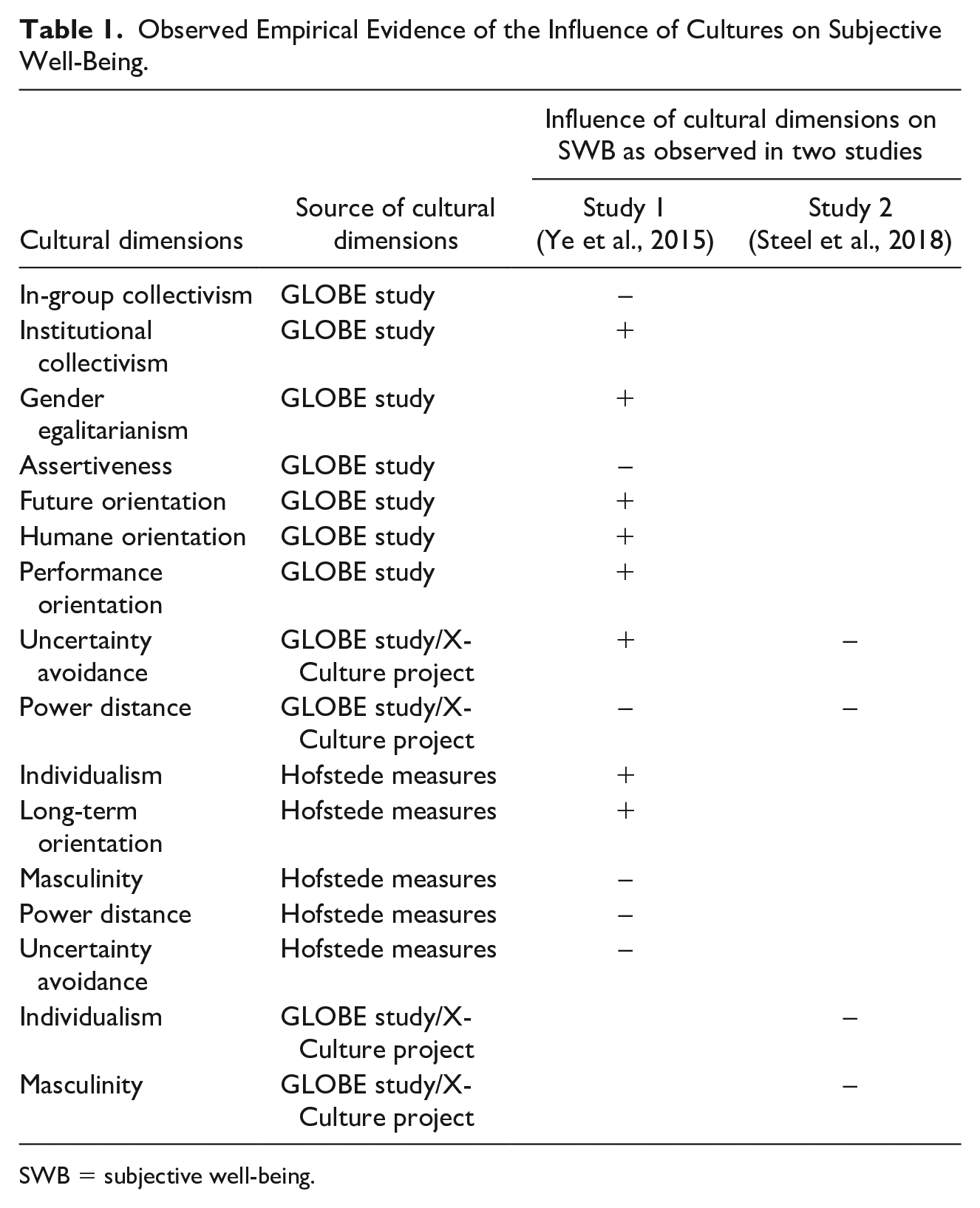
SWB = subjective well-being.
Cross-Level Effects of Macrolevel Well-Being on Individual Entrepreneurial Activity
It is believed that macrolevel measures of well-being can strongly influence an important activity associated with happiness, independence, autonomy, and growth—activities commonly seen in entrepreneurial start-up endeavors. Individual-level entrepreneurship refers to those people (a) who are actively engaged in the start-up process, but who have not yet launched, as well as (b) those people who have launched recently. Multiple conceptualizations of this construct exist—conceptualizations typically revolve around some variant of the number of newly registered limited liability companies (per 1,000 working adults) or the number of new companies appearing on a specific registry (Kim & Li, 2014; Meek et al., 2010; Stenholm et al., 2013), or the total number of individuals within a country engaged in starting or managing a new venture (Anokhin & Schulze, 2009), or engagement in activities and capability development leading to innovations and creating smarter futures (Lee & Trimi, 2018; Rajapathirana & Hui, 2018).
Within the purview of hedonic well-being, the broaden-and-build theory of positive emotions (Fredrickson, 2004) suggests that positive emotions such as those of enjoyment, happiness, joy, life satisfaction, and fulfillment broaden one’s awareness and encourage novel, varied, and exploratory thoughts and actions such that individuals with higher perceived well-being are more likely to pursue entrepreneurship. Positive emotions enhance cognitive flexibility by enabling entrepreneurs to build on or connect cognitive frameworks in a novel manner (Baron, 2004; Ward, 2004). When any decision-maker is in a state of positive affect, then he or she can use mental resources to broaden his or her thought-action repertoire (Fredrickson, 1998). Thus, individuals who experience positive emotions are more likely to discover nonobvious alternatives that would enable them to put aside any steep challenges that may be associated with exploiting new opportunities (cf. Baron, 2008). In doing so, they would have demonstrated the creativity that underlies successful innovation processes (Bharadwaj & Menon, 2000).
Happier individuals are also more likely to engage in positive situational assessments (Spector, 1998), resulting in a different risk–benefit calculus (Miller et al., 2012) compared with those who are less happy. Instead of viewing difficulties as barriers, individuals with high perceived well-being devise creative solutions to address unmet needs (Dutton, 1992) and unsolved problems. Their predisposition to interpret challenging situations as manageable translates into lower perceived risk as well as higher willingness to take risks and are more likely to believe that there are fewer risks associated with exploiting a new opportunity (Shepherd & Patzelt, 2018). This puts their risk-taking threshold higher over those who are less happy. When individuals experience positive affect, they are also more likely to believe they have control over environmental influences (Alloy & Abramson, 1979), thus influencing the level of risk and outcome uncertainty these individuals perceive, both of which can be significant barriers to new opportunity exploitation (McMullen & Shepherd, 2006; Mullins & Forlani, 2005). Well-being provides an augmented sense of direction that enables clarity in overcoming ambiguous situations and uncertainty and instills perceptions of being in control over the uncertainties associated with opportunity exploitation enabling action on a novel opportunity (Mullins & Forlani, 2005). Higher perceived well-being thus diminishes the fear of failure in the first place further enhancing the feasibility of engaging in entrepreneurship.
Within the purview of eudaimonic view, its items can influence entrepreneurship. Self-acceptance includes having positive attitudes toward oneself, and may be a critical asset, such that key challenges that represent entrepreneurship such as effective problem-solving and dealing with uncertainties would seem to demand one’s self-evaluation. Alternatively, individuals low or lacking in self-perceptions may be particularly vulnerable in managing setbacks that are likely inherent in the entrepreneurial journey and recover or thereafter cope from them. Environmental mastery denotes one ability and skills in managing the surrounding environment, including making effective use of available opportunities, while also creating contexts suitable to one’s personal needs and values. These qualities seem highly relevant to entrepreneurs who pursue tasks that require effective management of unique opportunities and being able to effect change in the surrounding context and change other peoples’ lives—a motivation held by most entrepreneurs. Positive relations encompass having interpersonal trusting ties and warm relationships with others, being concerned about the welfare of others, understanding the give and take of social relationships, and having the capacity for empathy and affection—qualities that are imperative for an entrepreneur’s success as no entrepreneur succeeds without warm relationships with others, be it his suppliers, investors or customers. This aspect of eudaimonic well-being thus underscores the fundamentally social features of entrepreneurial pursuits, making it a key asset to possess for social entrepreneurs in general or commercial entrepreneurs with prosocial motivations in particular. Personal growth is concerned with self-realization and achievement of personal potential and is reflective of perceived growth, expansion, and flourishment over time in ways that reflect ever greater self-knowledge and effectiveness. A lack of such perceptions would signal personal stagnation and inability to develop new attitudes and behaviors key to entrepreneurship. As Ryff (2019) quotes, Both the presence and the absence of personal growth seem fundamentally important to entrepreneurial pursuits. In the best of times, the high functioning entrepreneur may perceive that s/he is effectively negotiating new challenges and tasks that are nurturing a deepened sense of growth and self-realization. In the worst of times, entrepreneurial mishaps may contribute deeply to feelings of personal stagnation (being stuck and unable to move forward).
Purpose in life concerns viewing one’s life as having meaning, purpose, sense of direction, and goals that propels individuals to intentionally thrive toward creativity or productive endeavors toward meeting objectives for a thriving and fulfilling life. As pointed by Victor Frankl, this aspect of well-being features as a capability to find meaning in the face of adversity. Entrepreneurial endeavors would meet with failure in the absence of these qualities. Autonomy aspect of well-being is also key to entrepreneurship as it emphasizes that one is self-determined. This quality seems inherently relevant for the self-initiated, often risky, features of entrepreneurial pursuits (Ryff, 2019). Drawing upon social capital, as well as human capital (Becker, 1964; Schultz, 1961; Sweetland, 1996) as social resources embedded in relationships (Burt, 1992; Louri, 1977), such as social support, shared values (including legitimacy for entrepreneurship), trust and trustworthiness, or one’s self-confidence, self-knowledge, need for achievement based upon skills, knowledge, and levels of education, renders the key constituents of the eudaimonic view of well-being as critically required assets, resources, and capital that enhances the feasibility of pursuing entrepreneurship. As several studies have pointed out, like physical and human capital, social capital is a productive resource, facilitating actions that matters for an individual’s occupational attainment (Lin & Dumin, 1986; Lin et al., 1981; Marsden & Hurlbert, 1988), entrepreneurship being one such occupation. The motivation to select any behavior, including entrepreneurial ones, is driven by the cognitive process of how an individual process the ability to perform those behaviors. Eudaimonic well-being, which encompasses one’s social and human capital, I posit, assist in such processes.
The constituent elements of both hedonic and eudaimonic views therefore represent psychological as well as social and cognitive resources that are critical assets when it comes to performing key tasks within the entrepreneurship context, extending from risk-taking propensities, identification and use of available opportunity, forming trusting relationships with stakeholders, dealing with daily challenges and uncertainty, and even persisting in entrepreneurship. Thus, well-being is not just a state of mind but also a critical resource for entrepreneurship. Although the above theories have been proposed from an individual-level perspective, given that emotional expressions are also culturally implicit, their utilities can be extended to explain how societal well-being influences individual-level entrepreneurship. For example, drawing upon the broaden-and-build theory of positive emotions (that represents the hedonic view of well-being), one can make an extension that societies with higher perceived well-being will be predisposed to encourage its members to engage in novel, creative, and exploratory thoughts and actions. Societies where people are mostly happy will exude impressions of support and acceptance for engaging in risky behaviors. On the eudaimonic side of things, a society’s reserve of social and human capital, attained mainly because majority of its members have the ability to build social relationships or possession of skills, knowledge, purpose and meaning in life, self-confidence, and so on, would enhance the feasibility of the pursuit of entrepreneurship. Hence, if significant proportions of a society, by and large, display or possess hedonic or eudaimonic or both aspects of well-being, then it is likely that entrepreneurially inclined individuals who are situated in more positively oriented well-being environments, given aforementioned reasons, will more readily pursue new venture launch, and conversely those country-level environments that have lower macrolevels of well-being will discourage such behavior. Well-being becomes more of a social resource for individuals to act upon new opportunities. I believe that both macrolevel hedonic and eudaimonic measures of well-being, generally speaking, are important predictors of individual-level entrepreneurial activity. Hence,
The findings from the World Values Survey (WVS) (Inglehart & Welzel, 2005) reveal that societal values are closely related and can be grouped in to two major dimensions of cross-cultural variation: (a) traditional/secular-rational, and (b) survival/self-expression values. These two dimensions explain more than 70% of the cross-national variance on key variables, and each dimension is strongly correlated with scores of other important attitudes.
Inglehart (2006) claims that the shift from “industrial” society to “knowledge” society is linked with a shift from survival values to self-expression values. He defines survival versus self-expression values as the extent to which individuals value personal choice over the needs for survival and therefore will allot topmost priority to personal choice versus survival needs. Time series analyses from the WVS show that with economic development, societies tend to give up values prevalent in low-income societies and embrace those prevailing in high-income societies (Inglehart & Baker, 2000). In countries that experience economic prosperity, concerns for survival are reduced thereby making values associated with survival less important than those that govern personal choices. This change—which is linked to a country’s economic prosperity—liberates individuals from the pressures of survival and resource scarcity and allows them to use personal discretion (Inglehart, 2006). When societies are plagued with scarcity, individuals tend to avoid indulging in activities that have higher chances of failures leading to further losses, whereas when societies are prospering, individuals feel more empowered and are more likely to aim for success through initiative and creativity. We can therefore infer that self-expression values are associated with personal advancement and growth. Individuals in societies that value self-expression (vs. survival) are more likely not to miss any opportunities of advancement and more likely to be imaginative and engage in highly creative initiatives (Inglehart & Oyserman, 2004)—central tenet of entrepreneurship. Perhaps not surprisingly, there is evidence indicating that as a country reaches higher levels of self-expression values, there is a favorable impact on opportunity-based entrepreneurship rates (Hechavarria & Reynolds, 2009).
Societies with high self-expression values also prioritize rising demands for participation in decision-making in economic as well as political life. They tend to be more tolerant and even conducive to individuals who decide to pursue entrepreneurship and economic success. When societies tend to operate in survival modes, then the desire for individual freedom and democracy may not be a top aspiration. However, when basic physiological and safety needs are fulfilled, growing emphasis on self-expression values makes the emergence of democratic institutions increasingly likely. WVS findings demonstrate a strong and consistent correlation between self-expression values and democratic institutions—fair and equitable institutions, well-enforced incentive structures, and equality in the allocation and disbursement of resources. And, in such societies, individuals’ perception of the available institutional support would promote entrepreneurial efforts (Stephan et al., 2014). Related to this line of thinking, extant research shows that self-expression values have a positive relationship to opportunity entrepreneurship—that is, countries with self-expression values will likely encourage individuals to engage in entrepreneurial activity as a means to satisfy their needs for achievement and personal fulfillment (Hechavarria & Reynolds, 2009). Hence,
The Mediating Role of Self-Expression Values
Central to the model is the notion that greater well-being will lead to greater self-expression. In particular, we know that hedonic well-being (i.e., life satisfaction, happiness) facilitates greater self-expression in terms of emotions as well as creativity. And, we know that eudaimonic well-being (i.e., psychological well-being) is linked to greater independence and autonomy as well as self-confidence and self-realization. This is consistent with theory and findings related to how when lower order needs (e.g., well-being) are met with higher order needs (e.g., self-expression, self-actualization) can be pursued (Birley & Westhead, 1994; Davidsson, 1989; Maslow, 1954; Thai & Turkina, 2014). Overall, this line of thinking provides insight into theory-based model (see Figure 1) in which well-being, at a country-level, leads to greater activity central to the desires of an individual—that is, they are able to express themselves. This, in turn, enables those individuals who desire to pursue entrepreneurial activity to do so. Hence,
Discussion
Overview
The present work proposed a theory-based conceptual framework in which country-level self-expression values mediated the relation between country-level well-being and the outcome of entrepreneurship. Multiple contributions emerge from the prosed framework.
Contribution Through Literature Review
I present comprehensive literature review on three themes (a) general characterization of well-being, (b) six perspectives that commonly links well-being with entrepreneurship, and (b) well-being as a societal-level construct thereby providing a wide gamut of potential research directions, some building on what is known while others new to the field. They provide clarity in differences between well-being items and highlights the lesser studied eudaimonic well-being views while simultaneously consolidating the hedonic view, which upon integration presents a multidimensional view of well-being serving as antecedents of entrepreneurship as opposed to extant literature that has predominantly examined the role of hedonic views of well-being for entrepreneurship. Establishing well-being as a higher order societal-level construct renders it as a multilevel construct (operating at individual and higher levels). With this conceptualization, theories that have thus far been employed at the individual-level, such as the hedonic and eudaimonic views of well-being, broaden and build theory of positive emotions (happier people have higher risk-taking propensities), social and human capital theory (sense of having great relationships with others as well as a purpose and growth aspiration and autonomy in life), self-determination theory (human motivation and personality that concerns people’s inherent growth tendencies and innate psychological needs), discrepancy theory (people compare themselves to standards or benchmarks constituted by other people), goal theory (well-being stems from setting, striving toward and reaching goals), activity theory (well-being results from performing desirable actions), personality theory (some have a temperament predisposed to happiness), and so on, may have a higher order component. The conceptual model offers ways in which individual-level theories in psychology could be extended to equivalent higher level theories that could then explain why well-being orientations across countries shapes entrepreneurial behaviors differently across them.
Contribution to Culture-Entrepreneurship Fit Theory
The question of “what makes an entrepreneurial culture?” has captured the attention of researchers as well as policy makers who view entrepreneurship as a means of stimulating economic growth and job creation. The research is fueled by the observation of persistent cross-country differences in entrepreneurship levels, which cannot be explained by economic factors alone (Freytag & Thurik, 2010). Researchers have turned to cultural values—the shared ideals and long-term goals of societies—to characterize entrepreneurial cultures (Krueger et al., 2013). Drawing upon the notion of “culture-entrepreneurship-fit” (Autio et al., 2013; Kedmenec & Strašek, 2017), they expected those cultures that value key aspects of entrepreneurship, such as the willingness to bear uncertainty and individual competitive actions, to enable entrepreneurship. But despite the intuitive appeal of this assumption, the rapidly growing literature on culture and entrepreneurship is characterized by mixed findings. Some studies find the expected relationships of entrepreneurship, for example, with cultural uncertainty avoidance and individualism values, but others find the opposite, and still others that there are no significant relationships. Such mixed findings are not surprising considering that cultural values are rather distal drivers of specific behaviors such as entrepreneurship (Stephan & Pathak, 2016). Cultural values are shared ideals that are abstracted from specific behaviors and may influence them only indirectly (Stephan & Pathak, 2016). The literature review on the fact that well-being is multilevel and that it operates at the societal level corroborates the fact that cultures shape well-being. The conceptual model subsequently posits that it is the societal-level and cultural embeddedness of well-being that influences individual entrepreneurship differently across nations. As such, I contribute by highlighting the cultural implicitness of well-being as having a special and unique position in the culture-entrepreneurship fit perspective that may well serve as a conduit via which the influences of cultural values on individual entrepreneurship is felt differently across nations.
Furthermore, given that studies treating societal well-being as an antecedent of individual entrepreneurship have been few, the understanding of causalities and mechanisms through which societal well-being influences individual entrepreneurship are limited. The conceptual model delineates the indirect effect of societal well-being, through country-level self-expression values, on individual-level entrepreneurship, making societal-level well-being distal, whereas self-expression values proximal influencer of individual entrepreneurship. From a psychosocial resource perspective, societal well-being, as per the conceptual model, represents some societies as having a larger reserve of critical assets needed for entrepreneurship. The entailing culturally implicit perceived resourcefulness makes some societies, and not others, as better equipped to interpret entrepreneurship as something feasible further highlighting the role of societal well-being in the culture-entrepreneurship fit perspective. I add theoretical insights directly related to the cross-level exploration of macro-psychological constructs as they relate to individual-level phenomena in entrepreneurship.
Contribution to Significant Other Theories in Entrepreneurship
Theories used in entrepreneurship research like institutional (configuration perspective) theory, theory of cognition, expectancy theory of motivations, theory of entrepreneurial emotions, and so on can benefit from adaptations and accommodation of the theoretical perspective. For example, a general sense of well-being in societies and its display in behaviors, norms, or shared values may indicate to potential entrepreneurs as available informal institutional support. How might such institutions influence entrepreneurial behaviors could be an insightful inquiry. The few representations of the cognitive dimension in the entrepreneurship literature focus on formal knowledge or educational attainment, to the neglect of the subjective beliefs, attitudes, and emotions regarding self-employment that are generated through shared social experiences. Societal emotions of well-being can thus be accommodated within cognitive theories in entrepreneurship. The expectancy theory of motivation explains the behavioral process of why individuals choose one behavioral option over the other and that they can be motivated toward goals if they believe that there is a positive correlation between efforts and performance. The proposed resource based view of well-being leverages entrepreneurs’ beliefs about their ability to successfully perform entrepreneurial behaviors.
Contribution to Empirical Research
Societal well-being dimensions and self-expression values as discussed earlier in this study could be operationalized using WVS that offer national aggregate measures or country-mean scores. The corresponding item descriptions are provided in Table 2. These scores could be used to test the propositions on the direct and mediating effects of societal-level well-being on individual entrepreneurship using either ordinary least squares (OLS) or random-effect multilevel regressions using indicators of entrepreneurship—either national rates of entrepreneurship from data set like the World Bank Group Entrepreneurship Snapshot (WBGES) or country-wise individual-level clustered data from GEM, or European Social Survey (ESS), respectively. Proposed measures from Table 2 could be used in future empirical research to test the propositions and for possible endogeneity between societal well-being and national aggregate rates of entrepreneurial activities for evidence on whether well-being is an outcome or an antecedent of entrepreneurship or both.
Societal-Level Measures of Well-Being Items and Self-Expression Values.
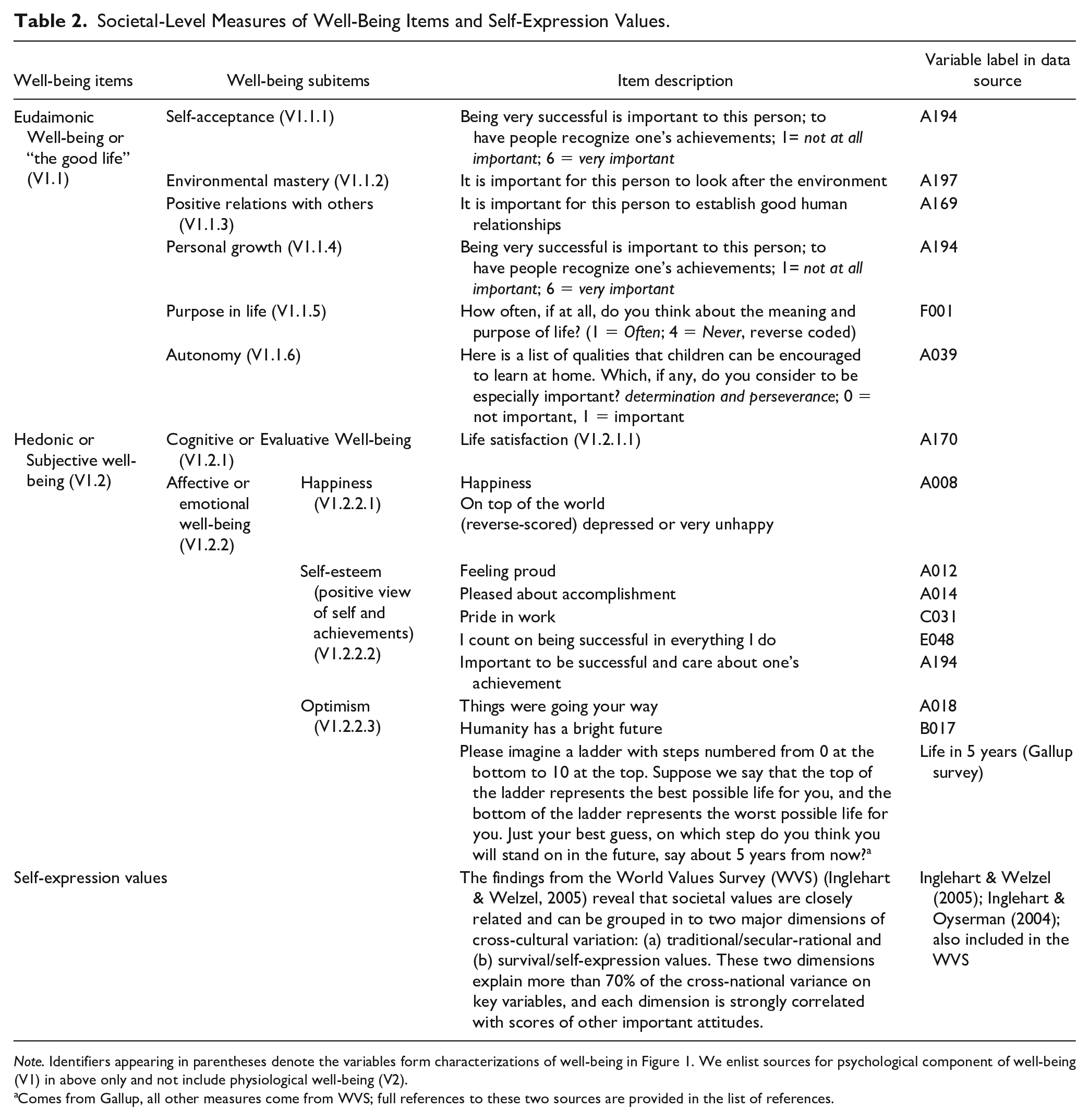
Note. Identifiers appearing in parentheses denote the variables form characterizations of well-being in Figure 1. We enlist sources for psychological component of well-being (V1) in above only and not include physiological well-being (V2).
Comes from Gallup, all other measures come from WVS; full references to these two sources are provided in the list of references.
Affective well-being could be operationalized using positive emotions as reflected in Happiness or reverse coding scores on negative emotions such as depression, angst, sadness, and very unhappy. Cognitive or evaluative well-being as internally consistency and temporally reliable measure of life satisfaction (Diener et al., 1985). Eudaimonic well-being items were computed following Ryff (1989) as well as Ryff and Keyes (1995) who proposed six distinct dimensions as key elements of eudaimonic well-being that encompass a breadth of wellness including positive evaluations of oneself and one’s past life (Self-Acceptance), a sense of continued growth and development as a person (Personal Growth), the belief that one’s life is purposeful and meaningful (Purpose in Life), the possession of quality relations with others (Positive Relations With Others), the capacity to manage effectively one’s life and surrounding world (Environmental Mastery), and a sense of self-determination (Autonomy). For self-expression, the WVS uses 10 subpillars including “teach children obedience and faith rather than independence and determination,” “respect for authority,” “priority for economic and physical security (materialist values),” “feeling of unhappiness,” “abstaining from signing petitions,” “distrusting in other people,” and so on. A second-order factor analysis on the responses collected for the 10 subitems for each country load on to two factors that WVS calls “traditional versus secular-rational values” and “survival versus self-expression values.”
Practical Implications
This study has practical implications for the development of sustainability conditions. Although ensuring human, economic, and environmental well-being are critical for sustainability, governments must see the indirect benefits that establishment of well-being brings too. The conceptual model should suggest that an indirect effect of sustainability conditions—especially seeking to achieve human well-being—would be to encourage entrepreneurial activities. Good living conditions (housing, electricity, water, employment, etc.) are fundamental to well-being, which when established would increase likelihood of individual entrepreneurship in such societies, in addition to taking advantage of the more directly and formally established entrepreneurship-promoting structures. Hence tracking these conditions is important for public policy.
For entrepreneurs who may be asking themselves whether they want to embark on an entrepreneurial journey, it makes sense to consider the well-being and self-expression climates. That is not to say that considering resources, goals, family, and experiences are less important—rather, the environment in which an entrepreneur exists can influence decisions to engage in entrepreneurship. This has implications for the emerging literature on the ecosystem approach to facilitating entrepreneurship—for example, initiatives focused on improving the climate of well-being and self-expression may impact the ecosystem in which aspiring entrepreneurs emerge (Estrin et al., 2013; Lyubomirsky et al., 2005; Nambisan & Baron, 2013; Zacharakis et al., 2003).
Future Directions
Although a general direction into how research can link societal well-being with entrepreneurship have been provided—via its influence on self-expression values—the causality of every item of societal well-being (hedonic and eudaimonic) has not been delved into. Inspired by the perspective offered in this study, future work could explore how any well-being item (as listed in Figure 1) relates to entrepreneurship. It would be fascinating to explore if one form of societal well-being emerges as the most dominant and significant predictor of entrepreneurship over the other, or if the various characterizations of societal well-being interact with each other—if one mediates the other—to then predict entrepreneurship. These possible queries could even be tested using the compilation offered in Table 2.
Another emerging, and very promising, stream of research on entrepreneurs pertains to the role of affect—feelings and emotions—in enhancing the potential success of entrepreneurial ventures. For example, research indicates that positive emotions may enhance entrepreneurial creativity, including opportunity recognition (Baron, 2008). In addition, entrepreneurs who display passion—positive, intense feelings—about their ventures tend to be more successful than those who do not display passion (Baum & Locke, 2004). Positive emotions also influence an entrepreneur’s ability to turn past experiences into present solutions through heuristic processing (Baron, 2008), and to deal effectively with the persistent stress (Carver & Scheier, 2001) that often plagues entrepreneurs. Given these, it would be insightful to explore if and how societal well-being shapes the emotional well-being of potential entrepreneurs.
Furthermore, the relationship between income inequality at the country-level and well-being is contentious at best. Several studies report confounding evidence, some report it as negative, others as positive, and some have neutral findings. Generally, inequality is assumed to lead to lower levels of well-being. However, that might not always be the case, or the links may not be as straightforward as thought previously. For example, one study (Helliwell, 2010) suggests that in countries where well-being depends more strongly on one’s rank in the income distribution, people are less happy across the entire income distribution. Conversely, another study (Katic & Ingram, 2017) suggests that well-being is higher where income inequality is higher and that this relationship is moderated by perceptions of poverty being caused by unfairness, an individual’s relative socioeconomic standing, as well as beliefs about hard work leading to success. It still needs to be ascertained if economic well-being is the only way to improve emotional well-being. It is only after future research provides more insights into how national institutions (formal and informal) influence the relationship between inequality and well-being is when we would begin to understand how societies perceive well-being. Once we establish the antecedents of societal well-being, we could predict economic activities, including entrepreneurship, more accurately.
Future research could investigate the effect of negative affect on entrepreneurship. Although extant literature and even this study highlights the role of well-being and its expression as positive affect, it is worthwhile to examine how negative affect, such as unhappiness influences entrepreneurship. For example, societies largely unhappy may be indicative of institutional voids or lack of support structures. One significant area leading to unhappiness in societies could be national levels of unemployment (Clark & Oswald, 1994). Under such circumstances, will individuals in such societies be prompted to indulge in entrepreneurial activities with the motivation to fill institutional voids—especially through creation of more jobs and thus eliminating unemployment?
Extant research related to influence of environments in which entrepreneurship emerges is a critical area of focus for both researchers and practitioners. Proposed model renders well-being as a multilevel construct that manifests itself as a country’s stockpile of social and psychological resources supporting entrepreneurship and provides a fundamental re-specification within the literature regarding how we conceive of the relation between well-being and entrepreneurship. The model also offers to situate country-level self-expression values as the mediator of the relation between country-level well-being and entrepreneurial activity lending critical advancement in the literature that hopefully will promulgate and redefine our focus on how well-being and entrepreneurship are related for generations to come.
Footnotes
Acknowledgements
I acknowledge the valuable suggestions from Professors Jon Carr and Jeff Pollack of North Carolina State University and Professor Etayankara Muralidharan of MacEwan University. I also extend my most sincere thanks to the two anonymous reviewers at the Academy of Management Annual Meeting, 2016. I am also grateful to the three anonymous reviewers at Business & Society and Associate Editor Professor Stephen Pavelin for their developmental suggestions and guidance all along the editorial process.
Declaration of Conflicting Interests
The author declared no potential conflicts of interest with respect to the research, authorship, and/or publication of this article.
Funding
The author received no financial support for the research, authorship, and/or publication of this article.
