




Abstract
Neotraditional organizations are those that exist to sustain indigenous cultures, practices, and institutions as they compete in modern markets. This study examines how a single mechanism, leader transparency, influences change outcomes in neotraditional organizations. We predict that leader transparency will enhance employee cognition- and affect-based trust toward leadership during times of change, thereby supporting relational dynamics within the organization that enable a smooth transition. We also predict that leader transparency will elevate employee acceptance of new technology during change, thereby enhancing desired functional adjustments within the organization. Finally, we predict that leaders who embrace the indigenous heritage of the firm while implementing change will benefit more from being transparent than leaders who ignore the indigenous heritage of the firm. We find overall support for our predictions. These results enhance our understanding of how leaders of neotraditional organizations can manage change successfully while preserving historical cultures, practices, and institutions.
Neotraditional organizations are those that deliberately sustain historical cultures, practices, and institutions as they operate in new political and economic contexts (Pearce et al., 2000; Schröder, 2003). For instance, for-profit companies established to manage the financial assets of Native American groups are examples of neotraditional organizations that are tasked with competing in modern markets while preserving elements of the culture and heritage of the people they are entrusted to serve (Legg et al., 2021; Robinson, 1991). Currently, our understanding about the factors that enable neotraditional organizations to adapt to technological changes while preserving their cultural heritage has remained limited. This is problematic, because modernist organizations—firms that do not carry the expectation of maintaining historical cultures, practices, and institutions while competing in markets (Pearce et al., 1998)—have broadly outperformed neotraditional organizations in adapting to change, and studies have shown that members of indigenous communities have suffered alongside the stagnant or deteriorating economic conditions of the neotraditional firms that exist to preserve their cultural heritage and economic well-being (Schröder, 2003; Szlemko et al., 2006).
The value of indigenous organizations to society is immense, as they frequently champion causes that look beyond profit maximization. Compared with modernist organizations, indigenous neotraditional organizations place a significant emphasis on social entrepreneurship (Henry et al., 2017), closely integrate cultural values with their practices (Salmon et al., 2022), fuse their economic objectives with tribal goals (Scheyvens et al., 2017), and strongly consider their impact on the communities they operate within (Pushkarskaya et al., 2021). These differentiating features result in socially beneficial organizations (Chang et al., 2010) that seek to tackle pressing social challenges, such as combatting poverty (Peredo & McLean, 2013). As Salmon and colleagues (2022) have noted, an indigenous neotraditional organization “may adopt a holistic perspective when assessing [a business] initiative, considering its impact on cultural traditions and environmental sustainability, as well as its alignment with indigenous governance processes.”
Although socially beneficial, these differentiating features present challenges to leaders of neotraditional organizations seeking to implement changes necessary to compete in modern markets (Pearce et al., 2000). Neotraditional organizations are formed by unique cultural elements, such as indigenous knowledge systems and beliefs (Warner & Grint, 2006) stemming from distinct values related to leadership (Stewart et al., 2017). While leaders generally carry substantial knowledge of the historical culture they are entrusted to preserve (Strommer & Osborne, 2014), employees often do not uniformly share this understanding, because they herald from cultural backgrounds that often fall outside of indigenous tribal communities (Schröder, 2003). Leaders of neotraditional organizations are therefore faced with the challenge of embedding culturally significant messages and practices into actionable directives that enhance employee performance. These challenges substantially test the ability of leaders of neotraditional organizations to manage change effectively. Specifically, they amplify challenges related to weaving together the indigenous heritage of the organization with modern change imperatives so that change directives are coherent, clear, and convincing to employees who might not fully appreciate the cultural heritage of the firm.
Given the difficulty of embedding the firm’s historical tribal foundations in change initiatives, some leaders choose to ignore pertinent cultural elements in change initiatives, with the expectation that employees who are less familiar with the tribal origins of the organization will be more likely to support change if they see the change as a legitimate professional undertaking. However, leaders who discount the indigenous foundations of the organization risk distancing the organization from its tribal roots over time, yielding a professionalized firm that is increasingly unrecognizable to the tribal communities it exists to serve. Given the socially beneficial role that neotraditional organizations play in modern markets (Henry et al., 2017; Salmon et al., 2022), there is a need to examine how leaders of neotraditional organizations can cultivate trust and facilitate technical skill enhancements to keep pace with a continuously changing world while preserving the cultural heritage of the firm (Edmondson & Moingeon, 1999; Lines et al., 2007)?
In this article, we examine how a single mechanism—leader transparency—influences change outcomes in neotraditional organizations by asking, “does leader transparency enhance change outcomes in neotraditional organizations?” Transparency is increasingly examined in studies of workplace surveillance (Bernstein, 2017), stakeholder management (Pirson & Malhotra, 2011), and employee engagement (Schnackenberg et al., 2021). Yet, despite the growing popularity of transparency in the management sciences, its relationship with change outcomes has yet to be deeply examined. Although scholars commonly presume that transparency supports outcomes conducive to change success, such as employee trust and adaptation (Jahansoozi, 2006; Rawlins, 2008; Roberts, 2001; Willemyns et al., 2003), as Ananny and Crawford (2018, p. 8) have noted, “there is little conceptually rich empirical work confirming this” (Ananny and Crawford, 2018, p. 8). In an effort to advance knowledge on the relationship between transparency and organizational change outcomes, we posit that the ability of the leader to give transparent accounts that clearly and convincingly connect the change initiative to all aspects of the firm, including its indigenous heritage, is particularly important to orchestrating successful change.
We consider two outcomes of organizational change that are especially salient to neotraditional organizations: trust in leadership and technology acceptance (Pearce et al., 2000). When leader transparency exists, we predict that trust in leadership will be elevated, thereby supporting relational dynamics within the organization that enable a smooth transition. Recognizing that leaders must present information to employees in ways that bolster their confidence in the leaders’ change management skills and strengthen the relational bonds between leaders and their employees; we examine how transparency relates to two types of trust in leadership: cognition- and affect-based trust (McAllister, 2017). Furthermore, we predict that leader transparency will enhance employee willingness to learn new technology, thereby enhancing desired functional adjustments within the organization. We recognize that the adoption of new technologies is a multifaceted undertaking that begins with employee acceptance of new technology. Therefore, we examine how leader transparency relates to two indicators of technology acceptance: the perceived usefulness and ease of use of technology (Davis, 1989).
Since leaders of neotraditional organizations vary in the extent to which they embrace the cultural heritage of the firm during times of change, we also test the importance of leader transparency for orchestrating change across two Native American neotraditional firms approaching change from different angles. The first organization—Delta corporation—is a holding company located in the Alaskan region of the United States that operates on behalf of the Alutiiq Native American community. Delta is approaching change from a deeply indigenous angle by developing software that is rooted in the cultural heritage of the Alutiiq people. The second organization—Gamma corporation—is an organization located in the Midwestern region of the United States that operates on behalf of the Mashantucket Pequot Tribal Nation. Gamma is approaching change from a market-based angle by procuring software from an external vendor. We predict that leader transparency is more important to trust and technology acceptance when change is based on the indigenous heritage of the firm. In partial support of our prediction, we find that transparency is equally important for cultivating trust across both contexts, and more important for enhancing technology acceptance when the change initiative is indigenously rooted.
Our study makes several noteworthy contributions. First, we examine factors that enable positive change outcomes in neotraditional organizations—a category of organizations that is systematically underrepresented in management research. As part of this contribution, we study organizational change outcomes that are particularly salient to neotraditional organizations—trust and technology acceptance—as they not only provide a holistic picture of change success (Islam et al., 2021; Venkatesh & Bala, 2008), but have also been noted as areas that neotraditional organizations fare worse in than their modernist counterparts (Pearce et al., 2000). Second, we show that organizational change outcomes vary based on the indigenous heritage of the firm. In doing so, we bring to light an important moderator in organizational change research. Third, we emphasize the specific construct of leader transparency as an important factor enabling change (Schnackenberg & Tomlinson, 2016). By focusing on being more transparent, our results indicate that leaders who embrace the indigenous heritage of the firm can manage change more effectively by improving perceptions of trust and enhancing technology acceptance. This contribution adds to our understanding of the contextual importance of leader transparency in neotraditional organizations.
Neotraditional Organizations
The concept of neotraditional organizations stems from neotraditionalism, or the study of how organizations and institutions navigate the dual mandate of preserving historical ways of life while confronting modernist ideals and political forces, such as globalization (Jowitt, 1983; Krämer, 2020; Womack, 1991). Neotraditionalism is based in the past, as it involves efforts to continuously reproduce traditional values in the face of pressures to modernize in accordance with predominantly Western values. Scholars have recognized neotraditionalism as a contemporary phenomenon that is helpful to explain the actions of political entities, state-owned enterprises, and organizations that exist to safeguard the cultural heritage of specific indigenous groups (Krämer, 2020; Pearce et al., 2000; Womack, 1991). These entities “draw heavily on indigenous cultural patterns of authority, interest aggregation, and leader-follower relations as prime sources of legitimation” in modern political and economic contexts (Robinson, 1991, p. 1). Neotraditional organizations are distinct from modernist organizations, which adhere to universalistic principles emphasizing the application of general rules for market competition (Pearce et al., 1998; Walder, 1986).
The maintenance of cultural practices and institutional arrangements has been difficult for indigenous communities in the wake of global capitalistic change. In the United States alone, over 570 Native American tribes exist, each with a unique language, culture, and self-governance system for establishing rights for a complicated assortment of indigenous assets, including tribal trust lands, tribal fee lands, fee simple lands, and allotted lands (Asare, 2022). These tribes have fought vehemently to preserve their cultural heritage and ensure adequate education resources are made available for tribal community continuity across generations (Tapahe, 2019). Members of tribal communities frequently frame the preservation of their culture and practices—such as ancient traditions, language, and dance—as a matter of maintaining their indigenous identities (Hilleary, 2022). Neotraditional organizations assist in accomplishing these objectives by weaving together the indigenous practices, values systems, and ceremonial elements of the communities they serve into business initiatives aimed at completing in modern markets.
To illustrate, the principle of kinship is deeply rooted in Native American neotraditional organizations. Kinship involves the bonds that connect tribal members via ancestry and social solidarity (Sahlins, 2011). In Alutiiq culture, kinship practices emphasize a sense of duty to protect tribal members, even if those members are unable to directly make contributions deemed beneficial to the tribe (Dana, 2015). Such practices often manifest in the unique treatment of tribal employees within neotraditional organizations, such as through Tribal Council positions in Native American casinos (Legg et al., 2021). Although these practices are important to maintain tribal values, the advancement of tribal employees under tribal self-determination laws can cause rifts in the workplace, such as when nontribal employees see tribal workers as lacking merit for their high-ranking positions (Pearce et al., 1998). In addition, many Native American tribal members use ornamental displays to signal their rank within tribal society, and these ornaments (e.g., physical attire) are often featured in organizational events and rituals (Sahlins, 2011). These aspects of neotraditional firms can appear confusing and biased to nontribal employees, and when leaders fail to adequately explain how tribal practices fit with professional objectives, tribal and nontribal employees can trust one another less, shirk more, and invest less in learning new technology (Pearce et al., 1998; Pearce et al., 2000).
Maintaining indigenous heritage is particularly difficult today because neotraditional organizations are increasingly subject to “neotribal capitalism,” in which tribal norms and leadership structures are supplanted in favor of professional norms and structures (Rata, 2000). Forces related to neotribal capitalism encourage the organization to professionalize in ways that can distance it from its tribal roots (Schröder, 2003). Notably, the organization is compelled to solicit skilled labor from nontribal talent pools to aid in its professionalization, while tribal elites gravitate to leadership positions within the firm to maintain tribal control and foster healthy tribal community relationships (Legg et al., 2021; Rata, 2000). Thus, although neotraditional firms are frequently led by individuals who are deeply familiar with the cultures, practices, and institutions they are entrusted to preserve, employees are often unfamiliar with these principles, magnifying the challenges faced by leaders to manage change effectively. Changes seen as too modern can be construed as antithetical to the values and ways of life of tribal community members, resulting in strained tribal relationships, while changes seen as too culturally rooted can be interpreted by employees as confusing or pointless, limiting change effectiveness.
Organizational Change Outcomes
Organizational change can be defined as “the process in which an organization changes its existing structure, work routines, strategies, or culture” (Li et al., 2021, p. 2). The successful implementation of change initiatives fosters benefits that accrue across the organization, such as superior profitability (Acquaah & Yasai-Ardekani, 2008), higher customer satisfaction (Gumport, 2000), and enhanced market share (Schneider et al., 1996). To gain these benefits, organizational change hinges on the performance of those tasked with implementing the change, or the organization’s employees (Tushman & O’Reilly, 1997). When employees respond negatively to organizational changes, the benefits derived from change can dissolve quickly (Barczak et al., 1987). The relational friction that accompanies employee resistance to change can result in the organization “losing market share, losing key employees, jeopardizing shareholder support, and possibly even demise” (Rosenberg & Mosca, 2011, p. 140). Given the importance of employees to change effectiveness, researchers have taken a keen interest in examining various workplace factors that indicate whether employees are responding positively to change (Armenakis & Bedeian, 1999).
A salient indicator of change success is the trust employees place in leadership to properly orchestrate change (Lämsä & Savolainen, 2000; Lines et al., 2007; Morgan & Zeffane, 2010). Trust entails the “willingness to be vulnerable . . . based on the expectation that the other will perform a particular action important to the trustor” (Mayer et al., 1995, p. 712). The issue of trust “arises when a decision or an action needs to be taken in a situation involving some degree of uncertainty” (Edmondson & Moingeon, 1999, p. 158) Therefore, trust is particularly important during times of change, as change initiatives are frequently fraught with uncertainties that require relational continuity to be navigated successfully (Bansal, 2016; Ertürk, 2008). Yet, “organizational change [also] represents a critical episode for the . . . destruction of trust” (Lines et al., 2007, p. 221) because it stretches the capacity of employees to empathize with one another when inevitable setbacks arise during change. Thus, trust is both pivotal for organization change effectiveness and at risk of destruction during times of change, making it an important outcome to consider in studies of organizational change.
In addition to trust, organizational change centers on employees’ understandings of new systems that enable them to be more efficient and effective at work (Hsu & Lin, 2008). Given the accelerating pace of digital change unfolding within and between organizations today, many change initiatives hinge on employees’ acceptance of new technologies (Amoako-Gyampah, 2007). Research on technology acceptance has shown that willingness to adopt new technologies is based on the perceived usefulness and ease of use of the new system (Davis, 1989). Technology acceptance is pivotal to achieve desired performance outcomes of organizational change, such as new practices that increase efficiencies and enhance competitiveness (Augustsson et al., 2017). While outcomes such as trust are important to support employee reflexivity when change initiatives encounter inevitable setbacks (Allen et al., 2007), outcomes such as technology acceptance constitute the nexus upon which new routines and competitive advantages are built (Swink & Song, 2007).
Leader Transparency
Organizational leaders—defined as top managers tasked with guiding the strategic direction of the organization—matter a great deal to the success or failure of organizational change (Hambrick & Mason, 1984; Oreg & Berson, 2019). The organization’s top leaders are not only responsible for charting the strategic direction of the organization, which entails balancing the need for continuity and change (Taylor-Bianco & Schermerhorn, 2006) but also for translating events that unfold outside of the organization (e.g., emerging business trends and technologies) into new initiatives within the organization (Jäppinen, 2017). Such initiatives often result in leaders communicating the parameters for change directly to employees (Yue et al., 2020). The entire leadership team has the visibility to understand how different organizational units provide value, the formal authority to pool resources to support change, and the ability to legitimize projects by signaling their importance through their communications (Heyden et al., 2017). Thus, leaders not only craft the strategic direction for change but also communicate the need for change and the boundaries of change internally toward employees (Agote et al., 2016).
Opaque and unreliable communication is problematic in general, but particularly so for leaders of neotraditional organizations (Heracleous & Barrett, 2017). The parameters for change can be ambiguous when leaders explain their decisions using language rooted in cultural tradition (e.g., indigenous language, customs, emblems, and values), making it more difficult for employees to understand the practical reasons for change (Philips, 2004). Given the dual mandate of preserving historical cultures, practices, and institutions while competing in modern markets, leaders can easily disclose too little relevant information about change initiatives to employees, convey information using terms that combine elements of the historical tribal context of the organization and its change objectives, and pursue multiple cultural and functional objectives simultaneously that render the actual purpose for change ambiguous (Granados & Gupta, 2013; Larsson et al., 1998). Each of these can produce a confusing picture of the goals and parameters of the change to employees.
To examine how leaders can effectively communicate change initiatives in neotraditional organizations, we consider the concept of transparency (Berggren & Bernshteyn, 2007; Holland et al., 2018; Norman et al., 2010; Vogelgesang et al., 2013). Recent theoretical advancements suggest that information conveyed by leaders should be disclosed, clear, and accurate for it to be transparent (Schnackenberg & Tomlinson, 2016). Information disclosure ensures employees have access to the information they need to adapt their daily tasks and objectives appropriately during times of change (Dando & Swift, 2003; Perotti & von Thadden, 2005). Clarity ensures important terms and objectives are well defined rather than hidden in jargon or unknown languages during times of change, helping employees to decode received information so they can understand the goals and intentions of change (Larsson et al., 1998; Quaak et al., 2007). Accuracy ensures employees are able to develop confidence in the veracity of received information as unbiased so the purposes and goals of change initiatives can be embraced and internalized (Schnackenberg et al., 2021).
Although theoretical accounts have suggested that transparency might be critical to the implementation of new technology (Vorm & Combs, 2022), scholars have yet to empirically examine the influence of leader transparency on the perceived usefulness and ease of use of new technology. As well, in organizational trust research, several studies have examined whether leader transparency cultivates trust in modernist organizations, showing that transparency sometimes fosters trust (Jahansoozi, 2006; Rawlins, 2008) and at other times fails to build trust (Pirson & Malhotra, 2011; Roberts, 2001; Willemyns et al., 2003). These studies reveal that the benefits of transparency are “situated within contexts” that depend on the “developmental histories of practitioners” within them (Ananny & Crawford, 2018, p. 980). Building on this insight, we argue that the neotraditional context is particularly well suited to benefit from leader transparency. Specifically, we posit that the burden to translate change objectives into actionable initiatives is higher for leaders who are charged with sustaining the cultural heritage of the firm, and the leader’s ability to convey explanations transparently should carry a premium for enhancing trust and technology acceptance during times of change. Thus, the more deeply connected the change initiative is to the indigenous heritage of the firm, the more the neotraditional organization will benefit from leader transparency.
Hypotheses
We consider how leader transparency influences change outcomes in two neotraditional organizations: one approaching change from a deeply indigenous angle by developing communication software that is rooted in the cultural heritage of the firm, and another approaching change from a market-based angle by procuring communication software from an external vendor (Amoako-Gyampah, 2007; Li et al., 2021). In the subsequent sections, we first consider the influence of leader transparency on trust in neotraditional organizations in general. We then propose associations of the relative effects of leader transparency on trust for neotraditional firms approaching change in different ways. We follow this same structure for the influence of leader transparency on technology acceptance. As previously discussed, trust in leadership is broken into two factors—cognition- and affect-based—that capture the extent that employees are willing to be vulnerable to the actions of leadership based on calculations of the leader’s capacity to perform, versus the values of the leader (Tomlinson et al., 2020). Technology acceptance is also broken into two factors—the perceived usefulness of new technology and its perceived ease of use—which indicate the extent to which employees are inclined to adopt new technology (Venkatesh et al., 2003).
Trust in Leadership
McAllister (2017) has specified that cognition-based trust stems “from the head,” meaning that trust is developed from evidence and calculative decision-making about the leader’s ability (Tomlinson et al., 2020). Within neotraditional organizations, we predict that leader transparency acts as a signal of the leader’s ability to implement change effectively. Disclosure signals to employees that the leader is sufficiently competent about what the change entails in terms of its scope (i.e., what it does and does not include) as well as the capacity to balance the indigenous heritage of the firm with the need for change. Providing understandable accounts signals to employees that leaders are skilled at distilling inherently complex ideas into coherent directives for implementing change. As Elsbach and Elofson (2017, p. 81) have noted, “the understandability of the language used to explain a decision may be viewed symbolically as evidence of the decision maker’s ability.” Furthermore, employees respond positively to change when they have accurate information to reduce uncertainty, feel in control of their contribution to the bigger picture, and are confident in their beliefs about the organization’s ability to handle change (Greenberger & Strasser, 1986; Griffin et al., 2017; Heyden et al., 2017; Sharma & Good, 2013), suggesting that accuracy also predicts cognition-based trust:
Affect-based trust is described by Chua and colleagues (2017) as involving empathy and values rapport. McAllister (2017) similarly conceptualizes affect-based trust as “from the heart,” as it has been found to be determined by perceptions that the leader is acting according to values that are laudable (Tomlinson et al., 2020). For leaders of neotraditional organizations, affect-based trust is established when employees believe that leaders are virtuous and benevolent (Schnackenberg et al., 2021). Here, we argue that leader transparency signals that leaders are inviting employees to share in the indigenous values of the organization as they implement change. Perceptions of leader disclosure indicate that leaders are willing to reveal all relevant information about the change in a benevolent fashion. Clarity signals that leadership cares enough about employees to resolve any ambiguities pertaining to the change, including questions pertaining to the firm’s indigenous heritage. The perception that leaders are speaking accurately and honestly about the change initiative enhances affect-based trust when employees similarly value accuracy and honesty. Transparency therefore demonstrates admirable qualities such as care for others and benevolence that, taken together, will result in affect-based trust toward leadership during periods of organizational change:
We predict that the effect of leader transparency on trust is stronger for leaders who are attempting to bring coherence to deeply indigenous change initiatives. That is, we predict that leader transparency is more important to trust when new technology is developed internally based on the tribal heritage of the firm than when it is procured externally from a professional vendor. A cognitively trusting employee is willing to be vulnerable toward the leader based on the perceived competence of the leader (Steelman & Rutkowski, 2004). Although cognition-based trust can be earned from explaining the need for change thoroughly, the impact of transparency is stronger when the indigenous heritage of the firm is featured explicitly as a reason for change. This is because leaders must not only make transparent claims about the parameters for change but also address reasons for change that are rooted in the heritage of the firm. Thus, cognition-based trust will be enhanced when leaders distill tribal principles and goals into terms that employees can easily understand such that employees will place more confidence in leaders to execute change effectively.
A perception of affect-based trust hinges on how well cultural values connect to values deemed important to employees (Tomlinson et al., 2014). We argue that affect-based trust is enhanced for employees who understand and embrace all facets of the leader’s tribal custodial objectives rather than just their economic objectives, rendering the effect of leader transparency on affect-based trust stronger for leaders who are implementing indigenously rooted change initiatives. An affectively trusting employee is willing to be vulnerable toward the leader based on how the leader demonstrates values that are commendable to the employee (Meyer et al., 2010), and to generate this, we argue that leaders who transparently convey indigenous values so they are clearly understood will enhance affect-based trust to a greater degree than those who ignore the tribal values of the firm. This entails emphasizing shared values that are venerable so that they are foregrounded rather than hidden to the employee, made comprehensible rather than abstruse to the employee, and upheld as valid rather than treated as indigenous relics. Together, we expect that the effect of leader transparency on cognition- and affect-based trust will be higher for leaders that embrace the tribal heritage of the firm during a period of change:
Technology Acceptance
Within neotraditional organizations, the influence of leader transparency on the perceived usefulness of technology is based on the leader’s ability to provide disclosed, clear, and accurate reasons for technology adoption (Amoako-Gyampah & Salam, 2004). Leaders who openly and clearly explain to employees how the use of a new technology will enhance their job performances are likely to positively influence the extent to which employees view that tool as useful. This entails disclosing facets of the technology that are integral to the employee’s job, clearly explaining how the technology fits with the organization’s indigenous culture and objectives, and accurately describing it’s benefits and limitations (Wixom & Watson, 2001). Furthermore, being responsive to difficulties experienced by employees in the implementation of technology—including challenges involving differences in cultural understanding between tribal and nontribal employees—will likely enhance their desire to adopt it. Therefore, transparent instructions from leadership about the parameters for using the new technology are important to bolster the utility employees see in the new technology:
Perceived ease of use refers to “the degree to which a person believes that using a particular system would be free of effort” (Davis, 1989, p. 320). For leaders of neotraditional organizations, we posit that transparency increases the perceived ease of use of new technology because leaders’ explanations enhance tribal and nontribal employees’ knowledge of how to use the technology and self-efficacy for incorporating it into their daily routines. Leaders who can accurately and clearly speak to the technical functions of the technology should increase employee confidence in—the perceived ease of use of—the system (Chin & Todd, 1995). For example, an employee of a neotraditional organization who opens an e-mail from a leader that speaks about a new company initiative involving the implementation of an online discussion board will be less likely to see the system as easy to use without transparent explanations about how to engage with it. Perceived ease of use is enhanced when the leader sends the same email but includes a disclosed, clear, and accurate explanation about how to access and engage with the new platform:
For leaders who choose to develop new technology as a direct outgrowth of the organization’s indigenous heritage, the challenge of justifying the purpose of the technology and developing comprehensive and clear explanations for how to use it become more complex. When change is indigenously rooted, differences in understanding about the nature and purpose of new technology can arise when historical cultures, practices, and institutions are inadequately emphasized alongside economic justifications for change. In this case, leaders face a critical translation problem involving explaining the functional merits of new technologies to employees in the context of the historical cultures, practices, and institutions they are entrusted to preserve. This is not a trivial challenge, as many new technologies are not only confusing to understand in their own right, but their implementation can also be hampered when their fundamental purpose is not well understood (Pich et al., 2002). We expect that the ability of top leaders to transparently intertwine tribal objectives with practical explanations for how to use new technology is more likely to generate a perception that the new technology is useful.
Furthermore, we argue that transparency is especially vital when leaders seek to leverage cultural symbols and icons in their explanations so that employees perceive new technology as easy to use. For example, employees of a neotraditional organization who are asked to implement a new communication technology that was designed to support intraorganizational dialogue patterns modeled after those found in indigenous communities (e.g., communicating patterns that follow certain tribal status markers; Philips, 2004) will see the technology easier to use when the leader openly, clearly, and convincingly justifies the merits of tribal community communication models to employees and explains how the new technology can be used to accrue performance gains within the organization. Based on this reasoning, for leaders of neotraditional organizations who introduce new technology as an outgrowth of the historical culture of the firm, we expect that leader transparency will have a stronger effect on the perceived usefulness and ease of use of new technology than for leaders who choose to ignore the indigenous heritage of the firm:
Method
We distributed an online questionnaire to employees of two neotraditional Native American organizations located in the United States (hereafter referred to as “Delta corporation” and “Gamma corporation”). We examined the effect of leader transparency on trust in leadership and technology acceptance during change initiatives at each organization that involved the implementation of new technology (Edmunds et al., 2010). We surveyed company employees at two points in time during the organizational change initiative. The Time 1 survey was used to collect data on pertinent control variables and leader transparency after much information sharing from top leaders toward employees about the organizational change initiative. The Time 2 survey was used to collect data on trust in leadership and technology acceptance (Park & Chen, 2007). The second survey was administered roughly 2 weeks after the Time 1 survey to minimize possible effects from method variance (MacKenzie & Podsakoff, 2012). The implementation of the new platform began roughly one month prior to the Time 1 survey and continued past the Time 2 survey for both Delta and Gamma.
Research Contexts
Delta Corporation
Delta was incorporated in the mid-20th century to manage land and capital assets on behalf of Alutiiq Native Americans villages residing in the Alaskan region of the United States. Through a variety of business initiatives, Delta has grown into a diversified holding company with portfolio companies and investments spanning multiple industries. At the time of the study, Delta corporation employed 752 employees. Delta corporation has continued to outwardly promote the Alutiiq culture and advocate for traditional Alaskan values while competing in modern markets. However, consistent with many other neotraditional organizations, Delta corporation has evolved to operate with a leadership team that represents the historical tribal community and an employment base that is increasingly professionalized. As it has grown, Delta has continued to give back to indigenous communities by providing financial and nonfinancial benefits, including educational and youth scholarships, shareholder benefits to Alutiiq community members, and tribal elder financial distributions.
Given challenges experienced by the COVID-19 pandemic and internal strategic imperatives, in late 2020 the leadership team at Delta decided to internally develop and implement a new technology platform that they referred to as “the POD” to help them manage interactions with employees digitally. While developing the POD, the leaders of Delta considered how the platform would reflect the Alutiiq culture and heritage. The orca is an essential symbol with historical significance to the Alutiiq people. The orca is therefore the official seal of Delta corporation, and like a “POD” of orcas, Delta leadership believed that the new technology would allow members of the organization to coordinate their movements more efficiently. The aim of the POD was to serve as a mechanism that leadership could use for communicating pertinent news and information about the organization, given feedback from employees that team members were falling behind in receiving correspondence and failing to hear important news from leadership about cultural and strategic objectives. In short, the leaders of Delta developed the POD to become a one-stop-shop for company news and workplace content that would help shape the employee experience in a way that was consistent with its values.
The leadership team believed that if Delta Corporation could coordinate employee movements, communicate across the entire organization, and work together more directly with employees through the POD platform, then the benefits from their collective efforts would serve as a source of competitive advantage. They were therefore heavily involved in both the design of the POD platform and its communication to employees. Once the POD was developed, the leadership team took it upon themselves to communicate broadly and frequently with employees to bring awareness of the new platform, explain its purpose, encourage its adoption, and inform employees of how to use it. Specifically, Delta corporation leaders sent numerous emails to employees discussing the use and benefits of the new internal communication system. The leadership team also hosted a company-wide virtual meeting to train employees on how to use the POD platform while also highlighting its benefits. Each of these engagements relied on a skillful interspersing of words that referenced historical cultures, practices, and institutions while motivating a call for functional change. Our study captures employee reactions to the transparency that the leadership team exhibited in the Time 1 survey. Outcomes of these initiatives were captured in the Time 2 survey.
Gamma Corporation
Gamma was founded in 2004 to help federal agencies to optimize government programs in the United States, and has a wide portfolio of clients including the U.S. Department of Defense, U.S. Department of State, U.S. Department of Energy, U.S. Agency for International Development, and U.S. Department of Homeland Security. It operates on behalf of the Mashantucket Pequot Tribal Nation, which consists of Native Algonquin tribes that have resided in the continental United States for centuries. As a business owned by the Pequot Tribal Nation, Gamma follows the seventh generation principle to train tribal members who will bring their education back to the tribe and continue building generations of better-prepared and better-educated tribal members under tribal entity self-determination laws (Strommer & Osborne, 2014). It also actively adheres to the Pequot Tribal Nation’s “5P’s” aims of focusing on purpose, people, profit, planet, and the Pequot Nation. Gamma also engages in tribal revenue sharing and helps nonprofit organizations that support tribal communities. At the time of the study, Gamma corporation employed 354 employees.
In early 2022, Gamma approached the issue of developing internal communication by procuring software from an external vendor. After several years of continuous expansion, leaders at Gamma identified that it was becoming more challenging to communicate effectively across the company. In response to these internal communication challenges, Gamma decided that the company’s level of maturity warranted increased investment in technology to address internal communication. The company procured a web application known as SharePoint from an external vendor. The application had capabilities that allowed employees to post announcements, manage shared calendars, maintain consistency in operational processes through the use of standardized forms, and have access to knowledgebase articles from Gamma leadership. Gamma leaders believed that having this information in a centralized location would reduce confusion among employees, who were believed to be overly reliant on decentralized communication and tacit knowledge.
The implementation of SharePoint involved a collaborative effort between the leaders of Gamma and their employees across the company. Leaders met with selected groups of employees during different stages of the web application’s customization. While customizing the application, a strong focus was placed on ensuring that employees felt that the tool would enhance employee productivity. To achieve this goal, the software was configured to only show employees the features that applied to their roles within the company. Upon release of SharePoint, the team emailed a training video to employees showing them how to navigate the new application and use its features. Other materials were also emailed to employees explaining in more detailed the policies and procedures for using SharePoint.
Procedure
Data collection in both organizations unfolded as follows: all employees received an e-mail from the CEO to encourage their participation in the study. Each employee was also informed that their name would be entered into a raffle to win one of several Amazon gift cards in exchange for their participation in the study. A few days later, the Time 1 survey was administered to employees. Pertinent control variables, including age, gender, ethnicity, and organizational tenure were collected alongside employee perceptions of leader transparency as part of the Time 1 survey. We received 170 Time 1 responses for Delta and 138 Time 1 responses for Gamma. The response rate at Time 1 was therefore 23% for Delta and 39% for Gamma. The difference in response rates might have been due to the survey being administered during a busy time of year at Delta. Roughly 2 weeks later, the Time 2 survey was administered to the same set of employees. We collected data on our focal dependent variables in the Time 2 survey.
We received 209 responses to the Time 2 survey for Delta and 108 Time 2 surveys for Gamma. After matching cases, 76 Delta employees responded to both the Time 1 and Time 2 surveys (i.e., “matched” cases) and 76 Gamma employees responded to both Time 1 and Time 2 surveys. These matched samples represent 10% of the employees at Delta and 21% at Gamma. Although the final size is not exceedingly large, neotraditional organizations such as Delta and Gamma represent a unique context that is not easily accessed for research purposes. Some tradeoffs are necessary when examining harder-to-reach populations, and consistent with best practices, we completed a post hoc power analysis to ensure our results were robust at conventional thresholds (Bolland et al., 2017; Crosby et al., 2010; Green, 1991). Given the relatively strong overlap between those who took the Time 1 survey and the Time 2 survey at Gamma corporation (62% at Gamma vs. 40% at Delta), we examined mean differences between respondents and nonrespondents across two variables at Gamma—age and organizational tenure—to see if respondents were representative of the broader organization. We found no mean differences, indicating the sample is representative.
For Delta, 49% (N = 37) of respondents were female, the respondents’ ages ranged from 25 to 74 years (Mean = 47.04, SD = 11.77), the average tenure with the organization was 2.3 years, and the predominant ethnic classification was Caucasian (72%) (the remaining employees included Native American, Asian, African American, Latino or Hispanic, two or more, and other). For Gamma, 55% (N = 42) of respondents were female, the respondents’ ages ranged from 24 to 70 years (Mean = 46.75, SD = 10.07), the average tenure with the organization was 3.3 years, and the predominant ethnic classification was Caucasian (59%) (the remaining employees included Native American, Asian, African American, Latino or Hispanic, two or more, and other). Consistent with broader trends impacting neotraditional organizations, the leadership teams of Delta and Gamma, including the board of directors and officers such as the Chairman & CEO and the President, heralded from tribal communities while most employees were hired from nontribal talent pools.
Measures
Unless otherwise noted, responses ranged from 1 (“strongly disagree”) to 5 (“strongly agree”).
Leader Transparency
We adopted Schnackenberg and colleagues’ (2021) 12-item scale (Delta α = 0.94; Gamma α = 0.93) to measure leader transparency. This scale measured the extent to which leadership was perceived to be disclosed (four items), clear (four items), and accurate (four items). An example disclosure item is, “The information I receive from Delta/Gamma leadership covers all the topics I want to know about.”
Trust in Leadership
We adopted Yang, Mossholder, and Peng’s (2009) measure of cognition (five items) and affect-based (five items) trust. An example item for cognition-based trust (Delta α = 0.93; Gamma α = 0.94) is, “I can depend on Delta/Gamma leadership to meet their responsibilities.” An example item for affect-based trust (Delta α = 0.94; Gamma α = 0.95) is, “I’m confident that Delta/Gamma leadership will always care about my personal needs at work.”
Technology Acceptance
We adopted Hsu and Lin’s (2008) scale to measure perceived ease of use (three items) and perceived usefulness (four items) of a technology system. An example item for perceived usefulness (Delta α = 0.93; Gamma α = 0.94) is, “Using the POD/SharePoint enables me to accomplish my work more quickly.” An example item for perceived ease of use (Delta α = 0.98; Gamma α = 0.96) is, “Learning to operate the POD/SharePoint is easy.”
Control Variables
We also collected data on gender (male = 0; female = 1), age (years) education (degree level achieved; Gamma only), location (metro = 0; other = 1; Gamma only), and organizational tenure (years). We coded ethnicity dichotomously (Caucasian = 0, other = 1). Although the survey captured more precise information pertaining to the subject’s ethnicity (nine separate categories including African American, Hispanic, etc.), the responses from non-Caucasian participants were combined into a single category and ethnicity was coded dichotomously given the limited data available for each of the non-Caucasian response categories. Finally, we also controlled for propensity to trust because this variable has been shown to influence the extent that individuals place trust in others (Moorman et al., 1993). We measured propensity to trust using Schoorman and colleagues’ (1996) eight-item scale. An example item is, “Most people can be counted on to do what they say they will do.”
Results
We ran an ordinary least squares (OLS) regression to test Hypothesis 1 (H1). Table 1 presents descriptive statistics and Table 2 presents the regression results used to test H1 and H2. As seen in Table 2, leader transparency served as a significant predictor of cognition-based trust after controlling for other variables and propensity to trust, supporting H1 (Delta: β = .704, p < .001; Gamma: β = .704, p < .001). We conducted a similar analysis to test Hypothesis 2 (H2), which examines leader transparency’s influence on affect-based trust. Leader transparency was found to have a significant relationship with affect-based trust (Delta: β = .577, p < .001; Gamma: β = .704, p < .001), providing support for H2.
Correlations Among Variables.
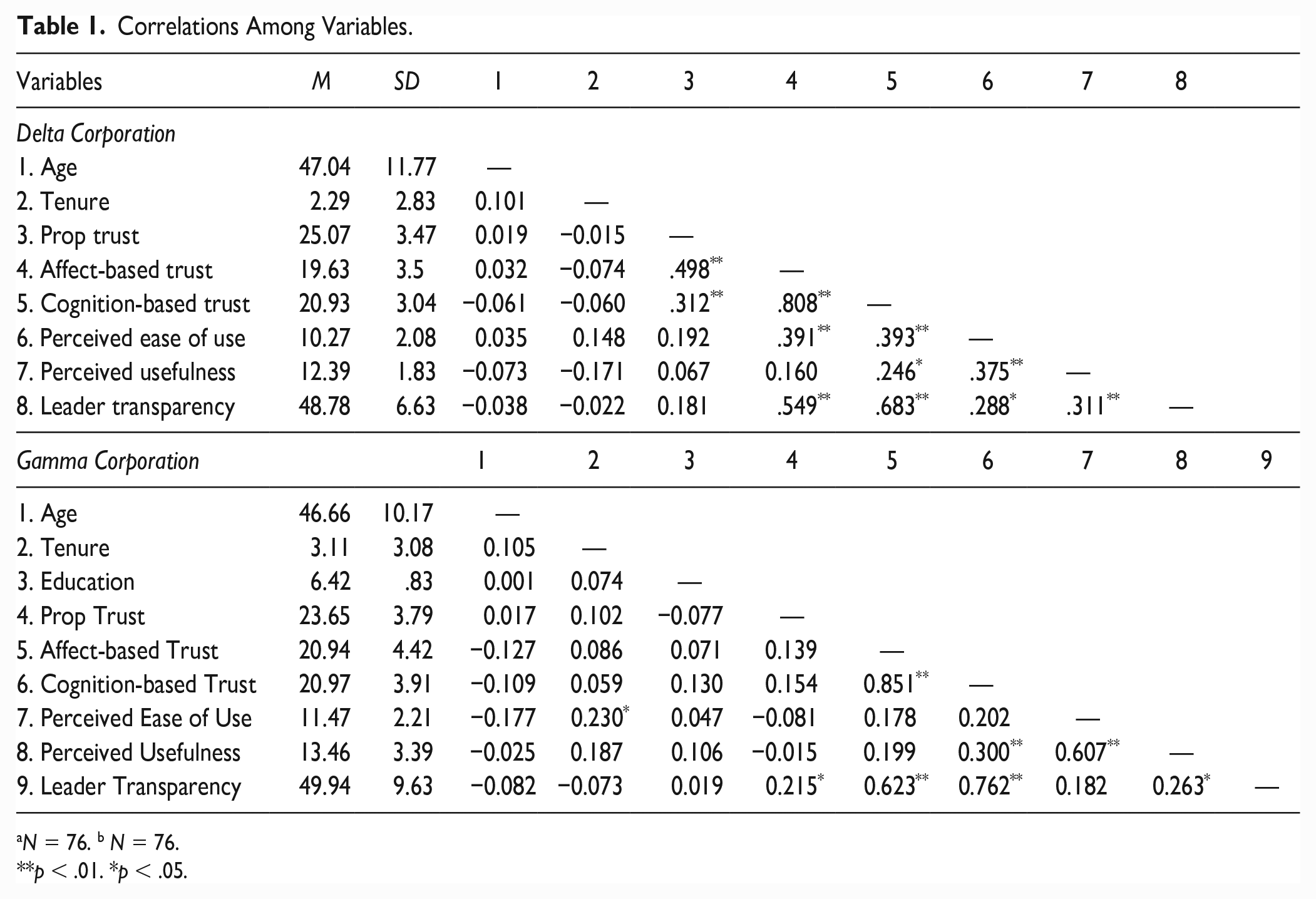
N = 76. b N = 76.
p < .01. *p < .05.
The Influence of Leader Transparency on Trust in Leadership and Technology Acceptance.
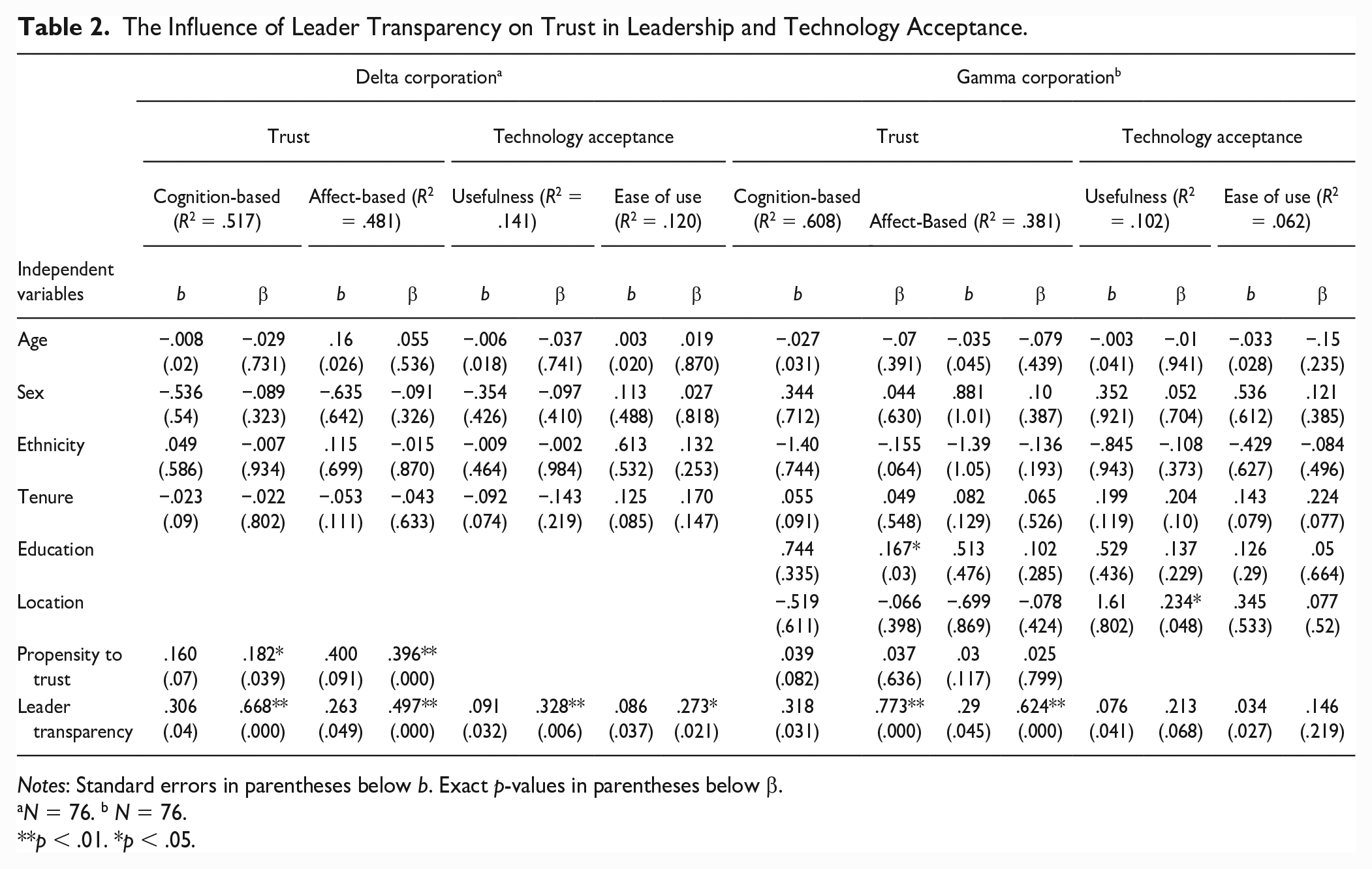
Notes: Standard errors in parentheses below b. Exact p-values in parentheses below β.
N = 76. b N = 76.
p < .01. *p < .05.
To test Hypothesis 3 (H3)—the effect of leader transparency on trust is stronger for indigenously rooted change initiatives—we relied on relative weights analysis using R (Tonidandel & LeBreton, 2015). Relative weights are focused on examining which predictors are explaining non-trivial variance in outcomes. Because the output is expressed in “weights” that are relative to each other, this analysis is capable of expressing the degree to which each independent variable is important to predicting the dependent variable. Moreover, it is possible to test for significant differences between relative importance weights in evaluating whether a given predictor has a stronger relation to a dependent variable than other predictors (Tonidandel & LeBreton, 2011). Results from our relative weights analysis are presented in Table 3. We found that leader transparency was not significantly more important to predict cognition- or affect-based trust for organizations that root their change initiatives in the indigenous history of the firm. Thus, H3 is not supported. Together, our findings support the view that leadership transparency can indeed function as a mechanism to foster the trust needed to navigate change in neotraditional organizations. Furthermore, the degree to which leader transparency affects trust does not vary depending on the indigenous rooting of the change initiative.
Relative Importance Analysis Results.

Note: CI-L lower bound of confidence interval used to test the statistical significance of difference in predictors and CI-U upper bound of confidence interval used to test the statistical significance of difference in predictors (if “0” is not included in the CI between CI-L and CI-U, predictors are significantly different).
p < .05.
We also ran an OLS regression to test the hypothesized relationships between leader transparency and technology acceptance, and Table 2 again includes the results of our analyses. Hypothesis 4 (H4) evaluated the influence of leader transparency on the perceived usefulness of the technology being implemented as part of the organizational change. A significant relationship was found between leader transparency and the perceived usefulness of technology that was indigenously rooted (i.e., Delta’s POD; p < .01) but not for technology that was externally procured (i.e., Gamma’s SharePoint; p > .05), yielding partial support for Hypothesis 4. A significant relationship was also found between leader transparency and the perceived ease of use of technology that was indigenously rooted (i.e., Delta’s POD; p < .05), but not for technology that was externally procured (i.e., Gamma’s SharePoint; p > .05), rendering partial support for Hypothesis 5 (Figure 1).

Path Model of the Influence of Leader Transparency on Trust in Leadership and Technology Acceptance During Organizational Change (Delta Corporation Left, Gamma Corporation Right).
Finally, we examined Hypothesis 6 (H6)—the effect of leader transparency on technology acceptance is stronger for indigenously rooted change initiatives—by again relying on relative weights analysis using R (Tonidandel & LeBreton, 2015). Results from our relative weights analysis are presented in Table 3. We found that leader transparency was significantly more important to predict perceived usefulness and ease of use for organizations that root their change initiatives in the indigenous history of the firm. Thus, H6 is supported.
Taken together, our results suggest leader transparency is vital to enhance change success through its influence on the cognition- and affect-based trust employees place in leaders of neotraditional organizations. In addition, leader transparency is significantly more important to predict technology acceptance for neotraditional firms that envelop their change efforts in language that connects new technology to the cultural heritage of the firm. Thus, although leader transparency appears to operate as a mechanism to enhance relational outcomes that are important to change success via its influence on cognition- and affect-based trust in both neotraditional organizations, it is more potent as a tool to enhance functional change outcomes—via its relatively more important influence on the perceived usefulness and ease of use of new technology at Delta—when used by leaders who fully embrace the indigenous heritage of the firm. We discuss the implications our results below.
Discussion
Along with navigating ever-changing competitive landscapes that are globally interconnected and increasingly prone to disruption (Mithani, 2020; Uhl-Bien & Arena, 2018; Uhl-Bien et al., 2007), leaders of neotraditional organizations are charged with ensuring that their businesses safeguard historical cultures, practices, and institutions. This dual mandate presents a challenge to leaders who seek to retain the continuity of their indigenous heritage and encourage adaptation in modern markets. Leaders’ accounts of change should be comprehensive and coherent for employees to fully understand and embrace organizational change initiatives. When they are not, the resulting uncertainty can lead to stress, anxiety, and confusion for employees, straining internal organizational relationships and potentially harming firm performance (Lüscher & Lewis, 2008). Ensuring that employees trust their leaders and embrace new technology is important for change success, especially as neotraditional organizations attempt to navigate disruptions from new technologies and unpredictable shocks such as the COVID-19 pandemic (Amankwah-Amoah et al., 2021; Lee & Trimi, 2021; Parker et al., 2020).
Placing the firm’s indigenous heritage front and center as the guiding impetus for change can be challenging to leaders of neotraditional organizations who face a translation problem of conveying just the right amount of information to employees, ensuring employees will understand the organization’s professional and cultural goals, and providing precise enough accounts of the parameters of change initiatives so that employees can have confidence in the leaders’ abilities to manage change in ways that are not biased (Allen et al., 2007; Fox & Amichai-Hamburger, 2001; Sharif & Scandura, 2013). To navigate these challenges, leaders can choose to ignore the cultural heritage of the firm and frame change based on professional factors that are unassociated with its indigenous inheritance. Yet, leaders who choose to ignore the indigenous heritage of the firm risk distancing the organization from its cultural underpinnings over time, rendering a more professionalized firm that is increasingly unrecognizable to the tribal communities it exists to serve. Thus, the ideal approach is to embrace the firm’s indigenous heritage during times of change. However, the factors that support leaders in achieving indigenously rooted change have yet to be deeply explored.
We ask, “does leader transparency enhance change outcomes in neotraditional organizations?” Through an examination of two neotraditional Native American organizations, we find that leader transparency is broadly important for cultivating trust during times of change. We also find evidence that leader transparency is more important for technology acceptance in neotraditional organizations that embrace their indigenous heritage during times of change. Given accelerating trends toward digital transformation, we view leader transparency as critically important to help explain communication dynamics that underlie successful adaptation while preserving historical cultures, practices, and institutions. We discuss the theoretical implications of our results, with a direct focus on the need to better examine how leaders shape change in neotraditional organizations. We also discuss several pertinent practical implications for how leaders of neotraditional organizations can directly and positively foster relational and functional dynamics that underlie successful change.
Discussion of Results
The result that leader transparency enhances cognition- and affect-based trust across both organizational contexts suggests transparency carries relational benefits for neotraditional firms pursuing change. However, our finding that leader transparency only predicts technology acceptance when change is rooted in the indigenous heritage of the firm is intriguing, because scholarship has shown that changes involving new technology are generally more difficult in neotraditional organizations relative to modernist organizations (Pearce et al., 1998; Pearce et al., 2000). Given that leaders of neotraditional organizations are increasingly incentivized to hire from professional talent pools outside of indigenous communities to enhance their competitiveness in modern markets (Rata, 2000), it is possible that professionalized employees who do not carry a strong connection to the tribal origins of the firm might be more comfortable with changes involving technology procured form an external vendor. In line with our results, this explanation suggests that leader transparency is less of a critical determinant of the extent to which professional employees would perceive procured technology as useful and easy to use.
Nevertheless, our results also stress the importance of transparency for leaders who seek to feature rather than ignore the indigenous heritage of the firm. Framing change initiatives based on indigenous principles can be daunting to leaders who are dealing with a complex assortment of operational challenges (Coen & Schnackenberg, 2012; Rousseau & Tijoriwala, 1999) while seeking to embrace the unique culture and practices of the tribal communities they serve (Pearce et al., 2000; Schröder, 2003). For leaders who seek to embed the tribal heritage of the firm into change initiatives, our findings suggest that leader transparency is vital to enhance technology acceptance, possibly because it enables employees to better understand indigenous justifications for change. This finding advances research on leader transparency by providing further evidence of its contextual benefits (Ananny & Crawford, 2018). Although the dominating view is that transparency is positively related to outcomes such as technology acceptance across settings, our results suggest that this is not the case. Specifically, our findings suggest that leader transparency is important to translate indigenous principles into actionable initiatives involving internally developed technology but not necessarily for technology procured from an external vendor.
Theoretical Implications
This study advances the organizational change literature in several noteworthy ways. Perhaps most importantly, our findings stress the importance of examining Native American neotraditional organizations—a category of organizations that is largely absent in management research—alongside their modernist counterparts. Globalization has caused a variety of changes within Native American neotraditional organizations that have contributed to a loss of cultural diversity and challenged traditional notions of tribal vested interest (Norris & Inglehart, 2009). The present article has implications for how leaders of neotraditional organizations can ensure that employees will place trust in leadership and accept new technology as change initiatives unfold. Along with providing evidence of the influence of leader transparency during times of planned organizational change, these findings encourage inquiry into the influence of leader transparency when neotraditional organizations face even more dramatic forms of change, such as unanticipated downsizing events, mergers, or acquisitions (Cameron, 1994; Tian et al., 2021).
This study also has implications for advancing research on leadership and organizational change. As Oreg and Berson (2019, p. 272) have pointed out, “whereas we know much about leadership and change, we know relatively little about the integration of the two.” Despite growing interest in examining transparency in general, most research has taken place in workplace contexts that are stable (Meyer & Kirby, 2010) and examined employee reactions to change in predominantly modernist organizations (Agote et al., 2016; Bakari et al., 2017). Our study stresses that leaders of Native American neotraditional organizations occupy a particularly important role as translators of indigenous culture to employees. These findings have implications for bridging divides between tribal and nontribal employees, and we see opportunities to examine whether leader transparency can also aid in facilitating healthy external tribal stakeholder relationships during change (Higgins et al., 2020; Yuan et al., 2019).
We also contribute to research on change outcomes in neotraditional organizations. Although the organizational change literature is vast, covering many seminal contributions appearing in the scholarly literature since the mid-20th century (Amis & Janz, 2020; Porras & Silvers, 1991; Weick & Quinn, 2003), it has yet to carefully consider the dynamics of change unfolding within neotraditional organizations. Consequently, trust and technology acceptance have yet to be deeply studied in neotraditional organizations, despite their prominent appearance in studies that examine successful change in modernist organizations (Chua et al., 2017). This is a noteworthy gap, particularly when we consider the important role that Native American and other indigenous neotraditional organizations play in society. We show that organizational change outcomes vary based on the indigenous heritage of the firm. Thus, we bring to light an important moderator in organizational change research that can be ported into other contexts of change, helping us to understand how new technologies implemented in the course of mergers, acquisitions, restructuring, downsizing, and layoffs affect organizations that are charged with maintaining historical practices and institutions (Hanelt et al., 2021; Oreg & Berson, 2019; Stouten et al., 2018; Yue et al., 2020).
Practical Implications
Our study provides several tangible insights for executive leaders seeking to implement change in neotraditional organizations. Our results indicate that leader transparency is essential for successful change, because if leaders fail to provide employees with adequate knowledge about the parameters, goals, and cultural underpinnings of change, employees will likely resist change and trust their leaders less. These results should be applicable to other types of neotraditional organizations, such as state-owned enterprises (Pearce et al., 2000). Given our results, leaders carrying a desire to build trust within neotraditional organizations during periods of change should consider ways of increasing the levels of disclosure, clarity, and accuracy in their communications with employees. Furthermore, our study provides evidence that functional changes within neotraditional organizations (i.e., the adoption of new technology) are particularly enhanced when leaders provide relevant information about the historical culture of the firm to employees in a clear and concise manner. Taken together, these findings suggest the importance of ensuring transparency when leaders of neotraditional organizations are pursuing change.
Limitations
We recognize that the contributions of our study must be interpreted in the context of its limitations. One limitation of our study relates to its relatively small sample sizes. The relatively small sample sizes we achieved from Delta and Gamma corporations were principally due to matching responses between the Time 1 and Time 2 surveys. Indeed, the sample sizes we achieved in Time 1 (23% for Delta and 39% for Gamma) were not exceedingly low. We mainly observed attrition in responses for subjects who took the Time 1 survey but not the Time 2 survey or vice versa, and therefore could not be matched. Although the decision to collect data across two points in time limited our sample size, it also enabled us to minimize the influence of method-induced effects (Podsakoff et al., 2003). Furthermore, far fewer neotraditional organizations exist in industries relative to modernist organizations, making data collection more cumbersome in general. Despite this, we consider our findings robust and generalizable to other neotraditional organizations, particularly in light of post hoc power analyses we conducted to ensure the integrity of the observed relationships, which revealed statistically significant and positive effects with adequate power.
Nevertheless, the results of our study are representative of the changes unfolding at two neotraditional firms only. Although our statistical results are robust within the two contexts we examined, we cannot be sure that they will be replicable across other neotraditional contexts. As we discuss in more detail below, we see additional research on neotraditional organizations as a fruitful arena for future research, both to confirm the results we obtained and to extend them in new directions. Another limitation pertains to omitted variables. Despite the inclusion of control variables in our study (e.g., age, sex, ethnicity, tenure, and education), it is possible that other variables might exist that would impact our results. Regarding our selection of outcome variables, although we see trust and technology acceptance as two equally important indicators of change success, we acknowledge the possibility that the effect of leader transparency on technology acceptance might be influenced by trust. We encourage future research to examine the causal linkages between transparency, trust, and technology acceptance as well as to study potential moderators of these relationships.
Finally, correlations between leader transparency, affect-based trust, and cognition-based trust were somewhat high. To assess the adequacy of our measurement model, we examined the model fit of several factor structures using Confirmatory Factor Analysis (CFA). Specifically, we compared a single factor model where all items were loaded onto the same factor, a two-factor model where transparency items were loaded on to one factor and affect- and cognition-based trust were loaded on another factor, and a three-factor model where transparency, affect-based trust, and cognition-based trust were loaded onto their respective factors. Using several fit indices for comparison, including the comparative fit index (CFI), root mean square error of approximation (RMSEA), standardized root mean-square residual (SRMR), chi-square (χ2), and the ratio of chi-square to the degrees of freedom (χ2/df), we found that the best fitting model was the three-factor model, indicating that transparency, affect-based trust, and cognition-based trust should be treated as separate factors.
Future Research
Our study suggests several additional paths for future research. First, we encourage scholars to continue examining how neotraditional organizations orchestrate change while accomplishing their dual mandate. For example, given the strength of our results pertaining to the relationships between leader transparency and cognition- and affect-based trust, we see merit in further examining the pivotal role that leader transparency plays across a broader set of outcomes (e.g., perceptions of leader behavioral integrity, employee satisfaction, organizational commitment, organization justice, and psychological contract fulfillment) to produce a more robust body of knowledge about how leader transparency influences behavioral dynamics unfolding in neotraditional organizations during times of change (Luo et al., 2016; Oreg & Berson, 2019; Simons, 2002; Turnley et al., 2003). In pursuit of these objectives, we see opportunities to develop more nuanced measures of antecedents and outcomes that are specific to the neotraditional context. Although the measures employed in this article are well validated in the modernist context, they might gain from contextual extensions that provide a more precise picture of the unique dynamics governing neotraditional organizations.
Second, we stress the need for additional research on Native American neotraditional organizations. Native American tribal communities are governed by a distinct set of laws, customs, and practices. Given the novelty of their approaches to self-governance and sustainability, we expect that insights gained about Native American neotraditional organizations will have useful implications for modernist organizations. For example, we see merit in pursuing questions such as, “what mechanisms enable Native American neotraditional organizations to maintain strong local community bonds while successfully pursuing capitalist business objectives?” and “what mechanisms enable Native American neotraditional organizations to successfully pursue social (e.g., poverty reduction) and economic (e.g., funding for tribal education scholarships) objectives simultaneously?” Developing answers to questions such as these might illuminate new ways that modernist organizations can approach competition while supporting broader social objectives.
Conclusion
Despite all the attention that organizational change has received in recent years, there is scant evidence of the factors that enable successful change in neotraditional organizations. This is problematic, because neotraditional organizations encompass a large fraction of global economic activity (in the United States alone, Native American casinos generated over US$39 billion of revenue in 2021; Bittenbender, 2022), and neotraditional organizations face acute challenges for successful change relative to modernist organizations given their dual mandate (Pearce et al., 2000; Robinson, 1991). With so much emphasis on leaders as critical cogs in the change management process, surprisingly little is known about the mechanisms that enable leaders to support successful change in neotraditional organizations (Johansson & Heide, 2008; Oreg & Berson, 2019). Our findings highlight the importance of leader transparency in driving positive change outcomes in neotraditional organizations. We hope that isolating the critical role of leader transparency in our study will result in additional research into the mechanisms for managing change in neotraditional organizations that extend beyond the Native American corporations we examined.
Footnotes
Acknowledgements
We gratefully acknowledge the guidance of our editor Alan Muller, as well as the helpful comments of our anonymous reviewers and of colleagues from the Daniels College of Business at the University of Denver.
Declaration of Conflicting Interests
The authors declared no potential conflicts of interest with respect to the research, authorship, and/or publication of this article.
Funding
The authors received no financial support for the research, authorship, and/or publication of this article.
