



Abstract
The COVID-19 pandemic provided an opportunity for management scholars to address large-scale and complex societal problems and strive for greater practical and policy impact. A brief overview of the most-cited work on COVID-19 reveals that, compared with their counterparts in other disciplines, leading management journals and professional associations lagged in providing a platform for high-impact research on COVID-19. To help management research play a more active role in responding to similar global challenges in the future, we propose an integrative framework that emphasizes a phenomenon’s impact, the conditions that the phenomenon creates at multiple levels, and the responses of actors to such conditions, as well as the dynamic relationships and interactions among these actors. By shifting attention to phenomena and their overall impact, this framework can help scholars better position their work to address large-scale and complex problems and also to assess research for its contribution to generate impact beyond academia.
As of January 2024, the World Health Organization (WHO) reports 775 million cases of COVID-19 infections and over seven million deaths. Among its many repercussions, the pandemic has exposed and worsened social, economic, and health inequalities between different classes of people (Bentley, 2020; van Dorn et al., 2020); contributed to the rise of political populism (Bayerlein et al., 2021; Prasad, 2020); and challenged our ability to relate to one another (Philpot et al., 2021). Organizations and their leaders were forced to revisit and redesign work to maintain physical distance, which, in turn, accelerated a global movement of working from home (WFH). The dramatic swings in demand and supply conditions forced millions of businesses to close and prompted others to adapt their corporate purpose, strategy, business model and operations (Bapuji, de Bakker, et al., 2020). Together, these conditions created appropriate conditions for a special issue on COVID-19 to examine its implications for business and society.
As COVID-19 unfolded in the wake of calls to address grand challenges such as societal economic inequalities and to strive for greater practical and policy impact (Bapuji, Patel, et al., 2020; Buckley et al., 2017; Doh, 2015; Doh et al., 2023; Wickert et al., 2021), it provided an appropriate context for business scholars to make a difference with their research. Expectedly, business researchers rapidly recognized the wide-ranging impact of COVID-19 on business and society and published almost 10,000 articles that addressed the topic in some fashion, unpacking the myriad, wide-ranging effects of COVID-19 on business and management. Reflecting this interest, our special issue received 64 submissions.
As scholars across various disciplines have published research on COVID-19, this phenomenon provides an opportunity to draw lessons for conducting impactful research, by examining how scholars within and outside of business have approached COVID-19 research. By impactful research, we mean research that not only achieves scholarly impact but also holds potential for informing practice and policy. This is consistent with Wickert et al.’s (2021) contention that while management research can—and, more importantly, should—produce scholarly, practical, policy, societal, and educational impact, it all too often stops at the first form of impact, with little genuine consideration given to the other four. To make use of the rare opportunity provided by COVID-19 to compare how management research has engaged with the phenomenon relative to other disciplines, we conduct a brief review of the most-cited research on COVID-19 in business and management and other disciplines to highlight two critical points.
First, we note that, barring a few exceptions, most elite business journals did not take the opportunity to publish high-impact scholarship on the topic generally, nor in shaping the discourse through editorials, commentaries, and other contributions. This is in contrast to the elite journals and professional associations in other fields. Second, similar to most-cited research in other disciplines, most-cited management research has predominantly focused on examining the impact of the pandemic on various groups. We argue that this problem of lack of leadership by elite management journals is at least partly a result of norms in our field, which value full-length research papers that must provide both a deep theoretical contribution and rigorous empirical testing, expectations that may be at odds with messy phenomena of a real world, particularly so of an unfolding global pandemic.
We argue that the pursuit of scholarly as well as practical and policy impact can succeed if we complement the strengths of management research with a more phenomenon-centered approach. Toward this end, we use this editorial to sketch a framework that can accommodate a wide range of conditions relevant to large-scale global phenomena that have implications for stakeholders across multiple levels of analysis, analyze the variety of ways in which such stakeholders respond, and outline inter-relationships among these, which together generate an impact that should form the focus of scholarly inquiry. More broadly, our arguments and proposed framework are consistent with prior calls for greater focus on phenomenon-based research that builds better businesses and societies (e.g., Bapuji & Beamish, 2019; Buckley et al., 2017; Davis & Marquis, 2005; de Bakker et al., 2021; Graebner et al., 2023; Schwarz & Stensaker, 2014; Von Krogh et al., 2012).
In this editorial, we first provide a brief overview of the most-cited work on COVID-19 in business and management and in other disciplines to underscore the similarities and differences between them. Arguing that complementing management research with a phenomenon-focused research would help us achieve scholarly impact as well as broader impact, we introduce an integrative, phenomenon-centered framework, using the pandemic as an example. Finally, we introduce the papers in this special issue by relating them to the framework we offer and outline future research opportunities. We conclude with a call for business-school researchers to engage more directly with events and crises that impact the global population.
A Brief Overview of Most-Cited Research on COVID-19
To draw lessons for conducting impactful research, we focus on the most-cited works on COVID-19 in management and other disciplines. Even though there are limitations of relying on citations as the measure of scholarly impact, we consider citations as one proxy of the impact of these works. To form a basis for our discussion, on November 9, 2023, we conducted a “topic search” in Web of Science (WOS) using the terms “COVID-19” and “corona,” with the time period of publication restricted to 2019 onward (to avoid works on coronavirus that occurred before the pandemic or those that may have been erroneously retrieved). Our search yielded a total of 470,697 works across disciplinary categories in WOS, of which 9,588 were from business and management categories. From these sets, we selected the 1,000 most-cited works in business and management categories, and the 1,000 most-cited works across all other disciplinary categories and computed the annual average cites they received to normalize citations for the age of publication 1 for purposes of comparability.
We recognize that there is wide variation across disciplines in terms of the number of journals, the frequency of their publication, the size of each issue, and so on. We are also mindful of the fact that, for obvious reasons, research from the medical and health sciences had an outsized role in COVID-19 compared with other disciplines, which limits the inferences one can draw. Nevertheless, our intention with this comparison is to examine the broad disciplinary patterns emerging from COVID-19 scholarship to derive insights on conducting impactful research, which we hope will serve as pointers for reflection for business and management scholars. We present these patterns in Table 1 and elaborate on them.
Output Type and Journals in 1,000 Most-Cited Works.
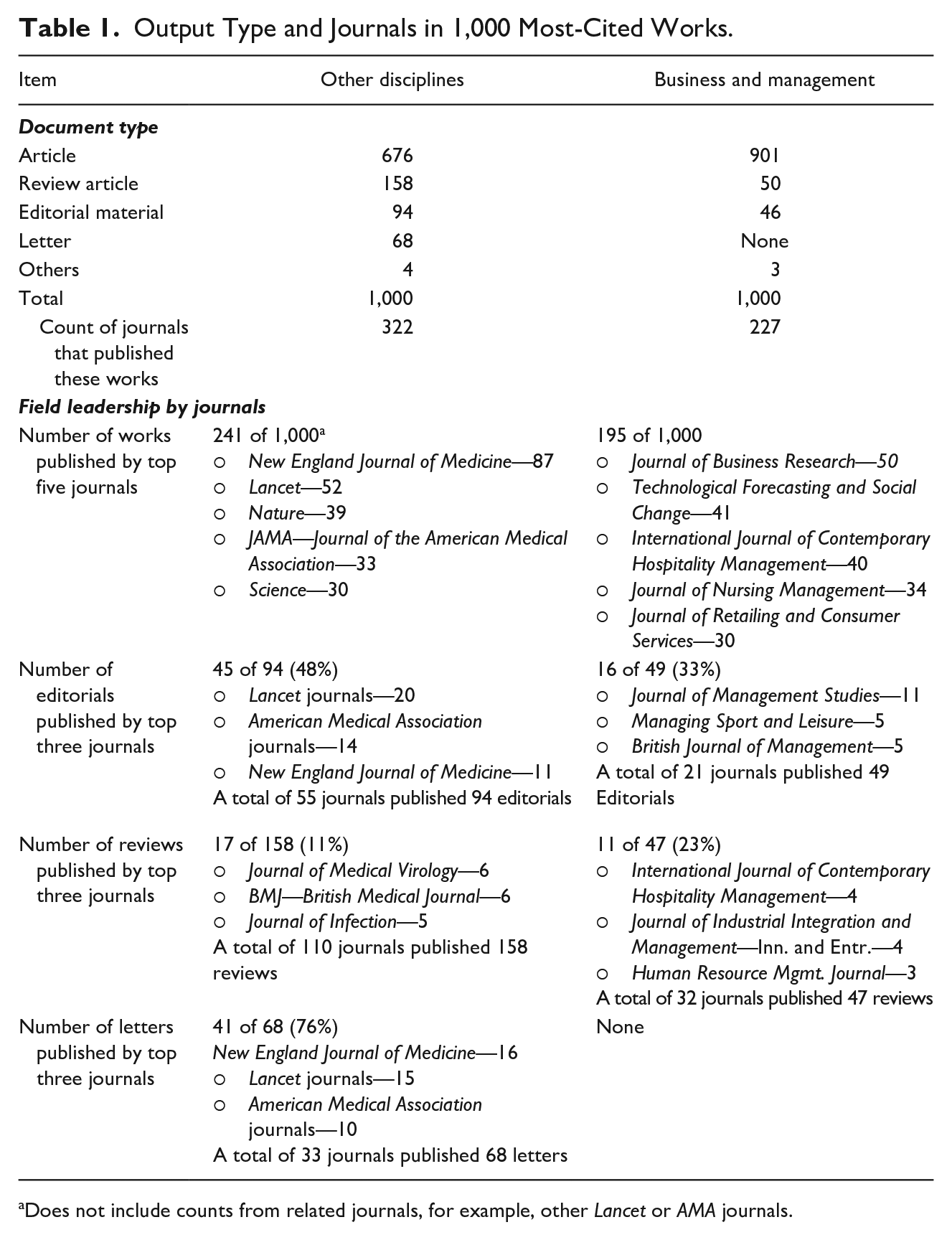
Does not include counts from related journals, for example, other Lancet or AMA journals.
Publication Patterns in Most-Cited Works Outside Business and Management
Expectedly, articles (676 works) and review articles (158) constitute the bulk of scholarship in the broader social and natural sciences disciplines, but what piqued our interest are works categorized as Editorial Material (94) and Letters (68). Our examination of these editorial material and letters, as well as the other most-cited works, led us to the three points below on the leadership provided by leading journals, value of short articles, and the type of content contained in the most-cited articles.
Clear Leadership of Prominent Journals and Associations
Almost half of editorials (45 of 94) were published by Lancet (20, with 10 in the Lancet itself and another 10 in its suite of journals), journals of the American Medical Association (AMA) (14, with 12 in JAMA—Journal of the American Medical Association and two in other journals of AMA), and the New England Journal of Medicine (NEJM) (11). Furthermore, all but two of the 94 editorials were published in 2020, indicating the rapid manner in which journals pooled their editorial resources to curate evidence and publish guidance to stakeholders. The clear leadership of these particular journals is also reflected in the fact that the remaining 49 editorials in the 1,000 most-cited works were published by 42 different journals.
The role of the NEJM and the journals of the AMA and the Lancet—leaders for the purposes of our illustration—was not limited to publishing editorials, but extended to publishing most-cited work in other formats too. For example, these journals together published 269 of the top-cited 1,000 works, and 164 of the 676 works classified as articles, which is the most common format. However, when it comes to publishing reviews, these journals did not publish many reviews and ceded leadership to other journals.
Value of Short Articles
Of the 1,000 most-cited works, WOS classified 68 as “Letters.” Here too, 41 (76%) of these were published in the NEJM and the journals of the AMA and the Lancet. The content of these highly cited “Letters” ranged from outlining the dashboard to track COVID-19 cases (Dong et al., 2020) to analyzing the viral loads in patients (Zou et al., 2020). These short pieces, mostly a page or two, from practitioner-researchers were evidently useful complements to published research. Furthermore, such short articles provided an avenue to subject published research to further scrutiny, validate and nuance published research with additional evidence, and help accumulate a knowledge base to shape practice and policy.
Content in the Most-Cited Articles
The most-cited works not only disseminated information about COVID-19, who it affects most, and how to manage it but also set agendas for research and practice on specific themes. As an illustration, the two most-cited works (Guan et al., 2020; Zou et al., 2020) both discussed clinical course and risk factors of COVID-19. In the next most-cited article, classified as an editorial, Wu and McGoogan (2020) summarized key findings from the report of the Chinese Centers for Disease Control and Prevention; reported case trends, patient characteristics, and comparison of COVID-19 with previous respiratory diseases (e.g., SARS); and provided a brief outline of the overall response to COVID-19 and its critique. The next two most-cited articles reported the effectiveness of a treatment (Horby et al., 2020) and the efficacy of a mRNA vaccine (Polack et al., 2020).
Focusing only on the editorials reveals the agenda-setting nature of the most-cited editorials. For example, of the four most-cited editorials, besides Wu and McGoogan (2020) discussed above, one focused on outlining the implications of COVID-19 for mental health (Pfefferbaum & North, 2020) while another provided large-scale survey evidence of that same relationship (i.e., effect of COVID-19 on mental health) from China (Qiu et al., 2020). Two others focused on comparing fatality rates in Italy with those in China (Onder et al., 2020) and documented and shared the case-management approaches in Italy (Grasselli et al., 2020).
In sum, in broader sciences, leading journals played a prominent role in platforming most-cited research in diverse formats and setting agenda by focusing on the impact of the pandemic and its management.
Publication Patterns in Most-Cited Works in Business and Management
In business and management, too, articles (901 works) and review articles (50 works) constitute the bulk of the most-cited 1,000 works. Although none of the most-cited 1,000 works were categorized as Letters, 49 were categorized as Editorial Material. As we did for other disciplines, we again consider this set of most-cited works to offer three points, namely, the leadership by journals and professional associations, lack of diversity in types of research output, and the content in most-cited articles.
Leadership by Journals and Professional Associations
While a notable feature in broader sciences was the role-played by a few leading journals in publishing the bulk of editorials and letters, no such pattern was evident in business and management. Although Journal of Management Studies (JMS) published the highest number of editorials (11 of 49, or 22%) 2 in the 1,000 most-cited works, the other two journals that published the next highest number of editorials (five each) were Managing Sport and Leisure and British Journal of Management. A lack of clear leadership by highly ranked journals is also reflected in the fact that the remaining 28 editorials in the 1,000 most-cited works were published by 18 different journals, of which Journal of Management (JOM), which published three editorials, and Journal of International Business Studies (JIBS), which published one, were the only top ranked journals.
Expanding our focus to leading professional associations, only one of the 49 editorials, Greenberg and Hibbert (2020), was published in the journals of the Academy of Management (AOM), while none appeared in the journals of other leading professional associations (e.g., Strategic Management Society, European Group for Organizational Studies). Of the 49, one, Bapuji, de Bakker, et al. (2020), was published in this journal, and was among the first to appear in a business and management journal.
Focusing more broadly on the 1,000 most-cited works, the journals that published the most number of works in this set were Journal of Business Research (JBR), which published 50 works, followed by Technological Forecasting and Social Change (41 works) and Gender, Work and Organization (30 works). These numbers show the leadership demonstrated during this time of crisis by journals that are otherwise not widely considered as leading lights (or field leaders)—comparing favorably to, for example, JAP (with 29 works) and JMS (23 works), which are the only two journals considered leading mainstream journals that had more than 10 records in the 1,000 most-cited works.
Many other elite journals, including those published by professional associations, published little or no work that appeared in the 1,000 most-cited works. For example, Academy of Management Journal, Administrative Science Quarterly, Strategic Management Journal, and Organization Science collectively published no papers among the 1,000 most-cited works in business and management, as per data we retrieved from WOS. In terms of other journals from the associations that publish these journals, Academy of Management Perspectives, Academy of Management Learning & Education, and Strategic Entrepreneurship Journal published one paper each, and Management Science published two papers in that list.
The minimal presence of leading journals in the most-cited works is even more evident when we focus on the most-cited 100 and 200 articles. The only field-leading journals that had papers in the top 100 most-cited were JAP (five papers) and JIBS (one paper). The only two broad-tent leading journals to have papers in the 200 most-cited works were JOM (two papers, both editorials) and JMS (one paper, a commentary). Our observation related to the insignificant leadership of broad-tent field leading journals is also consistent with that of Bolino and colleagues, whose scoping review of 69 articles on COVID-19 included 55 articles from JAP alone (which published a special issue by expediting the review process) but a total of 14 from 11 other “top-tier management journals” (Bolino et al., 2024, p. 414). 3
Lack of Diversity in Types of Research Output
While editorials and letters among the most-cited works caught our attention in broader sciences, in business and management it is the preponderance of articles that is noteworthy. This is understandable because research articles are the mainstay of scholarship in this field. Nevertheless, they far outstrip other formats, constituting over 90% of most-cited works in business and management, compared with 68% in broader sciences. The second most common type of research output, review articles, were 5% in the most-cited business and management works, compared with 9.4% elsewhere. Moving on to editorial material as the next most common type of research output, they constituted 4.6% of the most-cited business and management works, compared with 9.4% in the broader sciences.
Content in the Most-Cited Articles
Similar to articles in broader sciences, the content of the most-cited articles in business and management was focused on examining the impact of COVID-19 on various groups and how they manage that impact, as well as setting agenda for research and practice. For example, the most-cited work in business and management, Sigala (2020), was an article that conceptualized the impact of COVID-19 on tourism and outlined a research agenda. Of the reviews, the most-cited one examined the effectiveness of coping behaviors among health care workers during the pandemic (Labrague, 2021). The most-cited editorial, by Parnell et al. (2022), discussed the impact of COVID-19 on sporting mass gatherings and strategies to mitigate the spread of COVID-19 in such events. Standing out for its focus on a particular set of gatherings and how to manage the spread of virus, this editorial was intended to “stimulate discussion, analysis, interest and research on what the initial impact of COVID-19 has on sport” (Parnell et al., 2022, p. 78).
To summarize, business and management scholarship differed from other disciplines in terms of the negligible leadership provided by leading journals and professional associations and diversity of research outputs. However, the most-cited articles across disciplines, both in business and management and outside of it more broadly, were characterized by a focus on the impact of COVID-19 on various stakeholders and their responses, which we discuss in the next section. It is noteworthy that this type of content is not commonly pursued and does not regularly appear in leading journals.
Why Do We not See Much Phenomenon-Oriented Research in Management?
Notwithstanding the peculiarities of the pandemic and the expected prominence of medical journals in most-cited works, we see the differences that we noted above as occurring due to norms in the field that prioritize theory-driven research, incentive structures that reward publication of full-length research articles, and paucity of integrative frameworks to conceptualize phenomena. We elaborate on these below.
First, given the norms prevailing in the field, management scholarship tends to be theory- rather than phenomenon-driven (see Doh, 2015; Fisher et al., 2021; Prasad, 2023). Our publication process, which directly influences research priorities, favors depth of evidence regarding each one of a number of theory-driven drivers, mechanisms, and outcomes in isolation. This approach to conducting research generally yields a theory-driven view of phenomena where the emphasis is on the novelty of theoretical nuances rather than on the context (e.g., healthcare) or the phenomena being studied (e.g., coping with the pandemic). As a result, it is rare to see management scholars take one phenomenon and empirically examine its implications across a wide range of organizational functions or stakeholders. Such examinations are necessary to achieve not only scholarly impact but also impact on practice and policy. Indeed, scholars have bemoaned the tangential relevance of management research to practice and policy across editorials and calls to action—the circumstances that are linked to a pandemic bring such concerns into even sharper focus (Wickert et al., 2021).
Second, incentive structures in our field and academic careers are tilted highly in favor of full-scale research articles in reputed journals, even more so for early career academics. Output in less reputed journals are received with less enthusiasm, if not outrightly dismissed. As a case in point, the review of Bolino et al. (2024) published in JOM has included only 30 (29 from JAP and one from Management Science) of the 1,000 most-cited articles in business and management that we identified. Outputs of other types are equally dismissed. But knowledge production and application is a community enterprise in which other types of works, common in the sciences, play an important role in questioning the veracity of findings (e.g., via letters related to published articles) or substantiating findings in a different setting or a different sample (e.g., via research notes and short articles that report results). Furthermore, journal editors in other sciences play an important role by writing topical editorials that shape conversations and synthesize findings. Not only do most management journals lack such formats, but journal editors in our field (shaped predominantly by their own experience of publications in top-tier journals) may also be focused more on assessing the rigor of studies than developing research agendas with clear real-world impact and shaping conversations around those impacts. In addition, even when journal editors make such attempts (e.g., by writing editorials, commissioning special issues, or introducing new formats), these may not lead to noticeable change in the short to medium term if authors, reviewers, and handling editors do not share that vision and actively contribute to and foster it. Without a meaningful change in the short to medium term, the field cannot generate the momentum necessary to realize long-term change.
Third, publication norms and incentive structures in our field limit the development of an integrative approach to understanding a phenomenon (i.e., the pandemic in this case but also large-scale societal problems more generally). When integration is achieved in our field, it is often through review articles that consolidate a range of outcomes of an antecedent or a set of antecedents of an outcome. To be more focused and rigorous, such approaches often resort to synthesizing evidence on a specific outcome by examining its antecedents and the theoretical mechanisms underlying the relationships that produce the outcome. Another path that scholars take is integrating outcomes at various levels of analysis—individual, organizational, institutional, and societal. While these means to integrate knowledge can provide a depth of theoretical understanding, they may also prevent scholars from producing meaningful collective inference on the pervasive effects (e.g., across multiple outcomes) of a phenomenon across business and society (e.g., individuals, organizations, institutions, and society). As a result, we do not have widely used tools and frameworks necessary to engage in broad and integrative thinking about phenomena to help scholars to carve out their rigorous research studies, yet be focused on larger problems at hand.
Need for Integrative, Phenomenon-Centered Frameworks
Integrative, phenomena-centered frameworks can complement research from theory-driven and relatively narrow studies by providing ways to aggregate, synthesize, connect, and map the insights from those studies. So, the “content” of those studies is very much a needed input to develop and populate such frameworks. In turn, the process of developing those frameworks, and the resulting frameworks themselves, can help us identify relationships that patently occur in real life but that research has not paid wide attention to, and it can do the same for levels, stakeholders, groups of individuals, or outcomes—for which/for whom the phenomena of interest clearly has relevance/impact, but management and business researchers have not been paying corresponding attention. In addition, working on such frameworks also helps us to identify links and commonalities among facts and outcomes that might have been studied separately, without previous acknowledgment of such shared aspects.
Our perspective is consistent with recent calls for greater phenomenon-based research in international business (Doh, 2015) and for research that tackles societal grand challenges through a phenomenon-oriented lens by adopting systems perspectives (Mair & Seelos, 2021) or employing interdisciplinary approaches (Wiessner et al., 2023; de Bakker et al., 2019); engaging in multi-level methods; and acknowledging the dynamic interactions among business, government, and societal stakeholders involved in these complex global-scale problems (Buckley et al., 2017; George et al., 2016, 2024). The direction we propose also complements the work of initiatives such as Responsible Research in Business and Management and the British Academy of Management’s “Principles for Purposeful Business” declaration.
Integrative frameworks related to a phenomenon would also help journals and professional associations to better understand large-scale, complex events and problems and respond accordingly in a timely manner. Furthermore, such frameworks can help us appreciate the importance of developing an overarching and collective understanding of a phenomenon by adding pieces to the larger puzzle of different contributions. This can occur in the form of different formats, such as letters and short articles that can question, nuance, and substantiate the published work of other scholars. Given these advantages, we sketch out one such framework in the next section using the pandemic as an illustrative case.
An Integrative Phenomenon-Centered Framework
Here we present a framework in two broad components: (a) impact of the pandemic and (b) the conditions the pandemic created for actors across multiple levels of analysis and their responses.
We suggest that one parsimonious way to develop an integrative understanding of the effect of the pandemic is to treat the pandemic as a transformative, disruptive event for business and society and consider the nature of its impact. 4 Such a focus on the nature of COVID-19’s impact would call for deeper, more integrative discussions on the nature of the disruption, such as considering for whom and how the disruption is manifested. This perspective would place the impact of the pandemic at the center of our scholarly inquiry, and—we suggest—would help us gain a more accurate and complete understanding of the pandemic, and more broadly, other disasters, crises, and large-scale, complex societal problems.
A focus on the nature of impact directs attention to the phenomenon, but does not provide insight on how such impact can be managed. For this, it is necessary to understand how phenomena disrupt the status quo and create conditions that change our underlying assumptions about both human and organizational behavior. These environmental conditions then engender responses by an actor, which can feed into the conditions for other actors and also create a feedback to change the original conditions that engendered these responses. The responses of all actors collectively influence the impact of the phenomenon on specific actors or groups of actors across multiple levels of inquiry—individuals, organizations, institutions, and society.
Understanding the Impact of the Pandemic
Advancing current discussions on rejuvenating system perspectives to analyze and theorize transformation and change in efforts to tackle societal challenges (Grewatsch et al., 2023; Mair & Seelos, 2021), we suggest that the impact of the pandemic or other large-scale phenomena can be assessed based on three key transformation attributes: state, distribution, and temporality.
Transformation refers to a marked change in form, nature, and appearance. In the context of the pandemic in a societal context, transformation can be discussed in terms of (a) its effect on the condition of a focal actor before and after the pandemic, or the “state transformation” of impact; (b) its effect on a specific actor or groups of actors, and the unevenness in that effect, or the “distribution” of impact in terms of who is affected by how much; and (c) its effect based on time, pacing, recency, or the “temporality” of impact. Based on the reality of the pandemic, this approach would attempt to highlight the nature of the pandemic’s impact in terms of marked changes regarding “what” (state), “who/how much” (distribution), and “when” (temporality). We see the highlighting of these aspects as being necessary to produce research that is more useful to stakeholders and their actions, which in turn increases a study’s impact. In fact, the most-cited article in business and management did exactly this by conceptualizing the impact of COVID-19 on the tourism industry during the stages of response, recovery, and reset (Sigala, 2020).
State transformation refers to pandemic-induced changes in the assumptions, actions, processes, and outcomes from the operating models before the pandemic. One often-used descriptor of state transformation is resilience. Discussions about resilience to the pandemic have focused on the capability of individuals, organizations, and systems to revert to their original state of operations before this disruptive event. Resilience could also reflect the ability to withstand shocks and capacity to absorb negative consequences, even if these have materially changed how systems operate. Another important feature of state transformation is permanence, that is, the enduring effects or stability of any state transformation. These considerations are reflected in questions such as “Have specific outcomes materially changed or stayed the same?” or “Has there been reversion to prior operating routines or behaviors?” For example, have work-from-home policies broadly altered how firms operate or are these changes contingent on the type of work and the physical, cultural, and institutional conditions of specific countries or regions? On this point, to shine light on changes in purchase behaviors, one of the most-cited articles examined the characteristics of individuals who use online food-delivery services, thus reflecting the resilience of such food-purchasing behaviors (Mehrolia et al., 2021).
Distribution of impact refers to the consequences of disruptive events in terms of “who” is impacted and “how much.” While there is no doubt that the pandemic had idiosyncratic effects on different individuals and groups of people, there were also systematic differences regarding the costs (and benefits) of the pandemic to actors across varied social and economic strata, as well as based on technological and geographic access. Thus, the distributional consequences of the pandemic merit attention to better track its varied impact. For example, in India, the sudden lockdowns that were imposed to contain the spread of COVID-19 disproportionately affected millions of migrant workers who had to return to their homes in rural communities. Given the lockdown of the transport infrastructure, migrant workers and their displaced families had to make the journey of hundreds of miles on foot, causing severe distress, hunger, and death (Suresh et al., 2020). Such examples underscore the need to consider the uneven distribution of impact, why that particular distribution occurred, and how the impact can be managed and mitigated for those who are less equipped to deal with it. Yet, none of the papers in the 1,000 most-cited works in business and management examined such migrant workers, who provide services to large organizations and their employees.
Although business and management research paid little attention to migrant workers, it has certainly paid attention to the differential impact of COVID-19 on other actors. For example, the most-cited quantitative paper (and the third most-cited paper in business and management) described how the pandemic impacted dual-earner parents’ employment, noting that mothers have reduced work time significantly more than fathers. In addition, while both parents contributed more in terms of home and child care, women’s higher commitment on those fronts was amplified during COVID-19, further exacerbating the gender imbalance in unpaid work (Collins et al., 2021). Interestingly, this short paper (11 pages) did not test any hypotheses and instead described the phenomenon using panel data from the U.S. Current Population Survey during the first peak of the pandemic. This does not mean, however, that the paper lacked a theoretical basis; indeed, it was anchored in prior research on gender differences in carer responsibilities. Likewise, another short paper of seven pages that was fifth most-cited overall in business and management (Mo et al., 2020) examined the work stress faced by nurses.
Temporality of impact captures the effects of the pandemic across time, as well as the progression of the pandemic itself. The “when”—or the time-based nature of the effects of the pandemic experienced by individuals, organizations, and societies—could be captured in terms of short-, medium-, and long-term effects of outcomes. Some of the impacts of the pandemic were felt immediately, such as the shortage of food or physical resources. In addition, some of these effects, such as those based on supply-chain disruptions and the re-organization of supply chains in the long-term to avoid dependence on specific geographic or distribution nodes, continued to be felt beyond the immediate time window of the pandemic. While the pandemic has been officially declared over by WHO, the period between the official start and end of the pandemic, and the “waves” by which the pandemic progressed through communities and countries, all had material effects on the nature of impact felt.
Illustrating the importance of considering the temporality of impact, some of the most-cited works examined short- and long-term effects of the pandemic on organizations. For example, Shen and colleagues (2020) showed the negative effect of the pandemic on the performance of Chinese firms, which was more pronounced for firms that were smaller, that operated in high-impact industries, and that were located in regions impacted highly by the pandemic. Another article (Chowdhury et al., 2020) examined the short-, medium-, and long-term performance consequences of the pandemic on food and beverage firms in Bangladesh.
In sum, we see a greater need for management and business research to assess the impact of the pandemic, or other large-scale disruptive events and complex societal problems, in terms of its state (how much does it matter, that is, significance or substantive nature of impact), distribution (for whom, that is, felt effects by the different groups of actors involved and differences among them), and temporality (when, that is, conditions of timing, sequence, persistence of felt effects). At the same time, to generate a comprehensive understanding of the phenomenon and develop actionable insights, these efforts will need to be complemented by examining the conditions created by the phenomenon for various stakeholders and their responses, which collectively shape the impact.
Conditions and Responses
As an organizing framework, we use the felt effects of the pandemic to shape the conditions that trigger responses (behaviors) across four levels of analysis (individuals, organizations, institutions, and society). This approach helps us illustrate the types of effects and the depth of the pandemic’s impact on business and society. In Figure 1, the bullet points in the boxes depicting illustrative conditions and responses indicate the potential dimensions that scholars can examine.
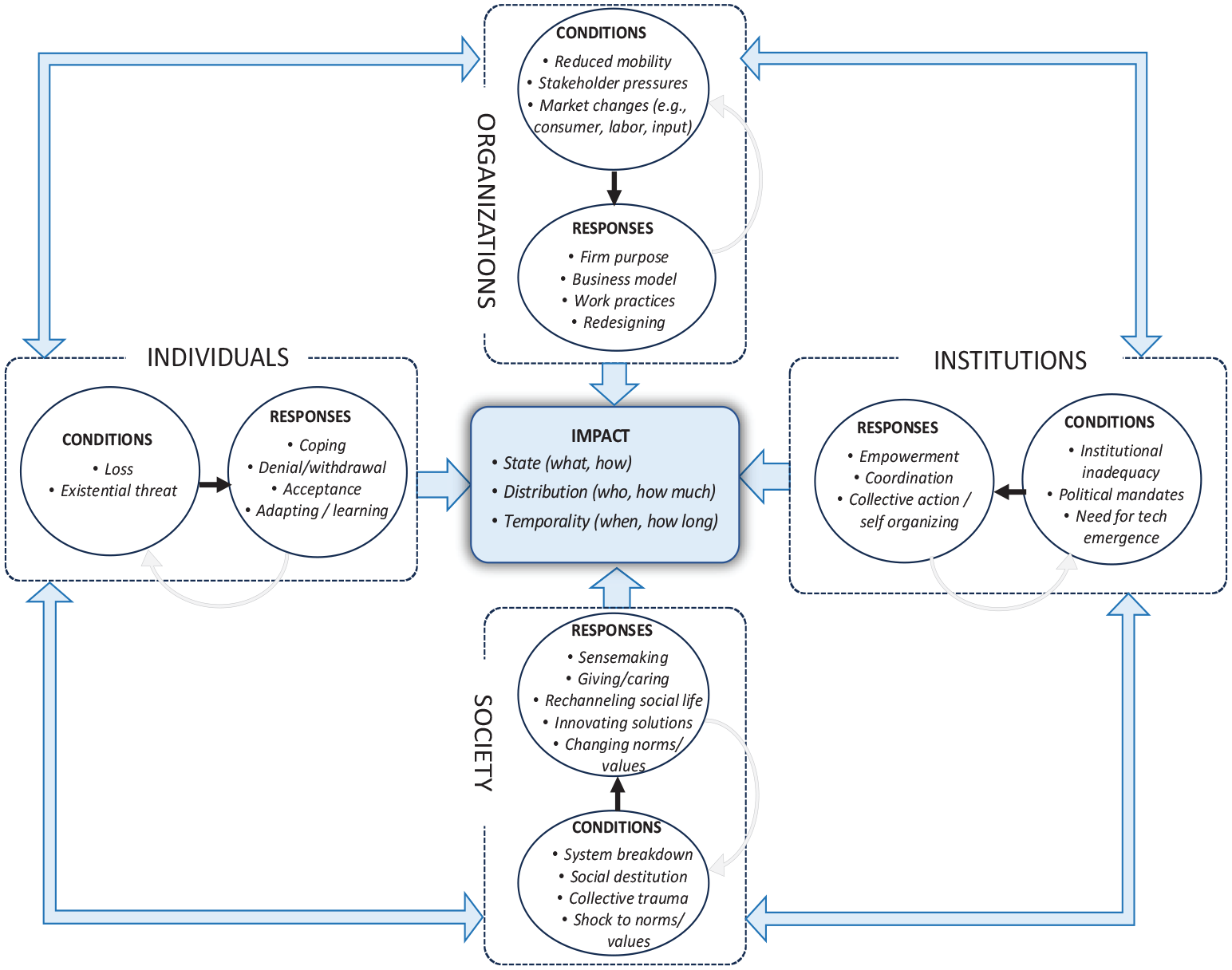
An Integrative Framework for Phenomenon-Based Research
Individuals and the Pandemic
Unlike disruptive events or crises where the felt effects are relatively localized to a set of stakeholders either by geography (for natural disasters) or communities (for humanitarian disasters), the pandemic was globally pervasive—it affected all of us, even if the scope and the intensity of its felt effects differed across individuals.
At the individual level, the felt effects varied based on social (e.g., for those living alone or with family, for those who had or needed support structures), geographic (e.g., West/East, province/region, rural/urban), and economic (e.g., rich/poor, different occupations) factors, and the list can be extended to factors based on natural, physical, emotional, and technological contexts. Attempts to itemize the individual felt effects would create a long but also necessarily incomplete, list of individual contexts that serve as triggers. Instead, while we acknowledge that individuals vary in their felt effects based, for example, on their social conditions, we see it as critical to highlight the deep sense of loss and the existential nature of the threat from the pandemic. These served as a trigger for individuals to act, on the basis of a sense of responsibility toward their own self but also to one’s family, colleagues, and the community at large. The responses to these triggers varied across individuals, ranging from denial to coping and adapting, with changes in these responses over time as well. Indeed, research in business and management on the effects of the pandemic highlighted the stress that individuals experienced due to mental health challenges, loneliness, and disrupted family structures or social routines, as well as the coping mechanisms they adopted in the face of loss and tragedy.
In terms of the responses of individuals, scholars studied, for instance, unusual purchasing behaviors (e.g., hoarding of food and other necessities as well as personal protection gear) and noted the factors associated with these behaviors, such as intention to self-isolate and perceived severity of the pandemic (Laato et al., 2020). Another study conducted in a multi-country setting found that perceptions of scarcity of product and time elevated consumer arousal and resulted in impulsive and obsessive buying, and that social media exposure strengthened these effects (Islam et al., 2021). Yet another study examined the sharing of unverified COVID-19 information on social media and found that trust in online sources and information overload were associated with such sharing (Laato et al., 2020). As another example, Trougakos et al. (2020) showed that COVID-19 health anxiety impaired critical outcomes related to work, home, and health, due to increased emotion suppression and lack of psychological need fulfillment.
Organizations and the Pandemic
Perhaps the most-discussed kinds of impact of the pandemic among business and management scholars are those that relate to organizations. From reduced mobility during lockdowns in different parts of the world to structural shifts in consumer preferences, the pandemic had systemic and transformative felt effects on businesses. Across the entire range, from for-profit to non-profits, from foundations to social enterprises, and from private to state-mandated firms, organizations had to reassess their strategy, operations, and human-resource functions.
From an organizational-design perspective specifically, the felt effects primarily stemmed from a reduced ability to coordinate distributed work—a challenge to a foundational assumption of the modern corporate form that implicitly assumes physical co-location. McKinsey’s survey of employees in the U.S. workplace reveals that 58% of Americans had the opportunity to work at least one day a week from home in 2022 (McKinsey, 2022). Yet distributed work was already common among software-related roles, where the difficulties in coordination among members and integration of knowledge are known challenges (Srikanth & Puranam, 2011). This challenge persists. For instance, Yang et al. (2022) tracked the communication and work hours of 61,182 U.S. Microsoft employees over the first six months of 2020, finding that firm-wide remote work caused the collaboration network of workers to become more static and siloed, with fewer bridges between disparate parts, making it harder for employees to acquire and share new information. At the same time, the pandemic facilitated the emergence of new technologies to adapt to distributed work. There was a mass migration across the U.S. and other countries, hollowing out expensive city centers in favor of affordable rural or semi-urban locations. These physical changes to location and mass migration of talent away from urban centers has made it harder for firms to bring back mandatory co-location in many businesses, changing the way we work.
Varying levels of access to consumer markets, disruptions to global supply chains, and shifts in geopolitics all lead to a questioning of market principles around trade, the roles of the government and the private sector, the primacy of stakeholder versus shareholder claims, the fragility of firms’ business models, and the ability of labor and capital structures to withstand such immense shocks to the system. Organizations also responded by innovating around their constraints—for example, by rolling out new workplace practices to accommodate a changed reality from reduced mobility and other felt effects.
Organizational response to the conditions created by the pandemic was a focus of much research, as evidenced by an article that reviewed 59 papers set in the creative industries. This article found that the firms in these industries faced many challenges, but that firms’ digital capabilities and their ability to adapt contributed to their resilience (Khlystova et al., 2022). Another review paper noted the emergence and persistence of hybrid health care practices in response to the pandemic (Lee & Lee, 2021). Belhadi et al. (2021) examined the short- and long-term response strategies adopted by the supply chains in automobile and airline industries to find that executives in the former prioritized localization while the latter focused on business continuity. However, both groups of executives focused on the use of IT and analytics to deal with the crisis.
Institutions and the Pandemic
The inadequacy of existing systems and institutional infrastructure, especially the failures to respond with speed and effectiveness during the initial phases of the pandemic, tellingly revealed the institutional felt effects of the crisis. While it might take us years to learn more about the relative permanence of the institutional changes wrought by COVID-19, it is important to understand how elastic or rigid, and adaptive or resistant, certain institutions were to the contextual triggers to change—and what factors contributed to their behaving in such a manner.
During the pandemic, dramatic socio-political shifts led to mandates from governments around the world for organizations and institutions to be more responsive, including the adoption of new laws, relaxation of criteria for support to the underserved and disenfranchised, implementation of measures to support businesses, particularly small and medium enterprises, and processes for coordination between institutional and regulatory actors. Similarly, new technology applications emerged to allow better coordination, facilitate philanthropic giving, and the governance of vast amounts of federal and state funds to prop up the economy and preserve social fabric.
These institutional responses led to novel ways of organizing to allow for collective action in managing crises. For example, traditional boundaries among public and private actors regarding the provision of health care equipment, and in some cases food supplies, were blurred such that public sector actors stepped in to take responsibility for what would normally be private market provision. Both the local and global nature of the pandemic created surprisingly empowered grassroot organizing in local, community-level institutions as it amplified the voice and role of citizens (Gegenhuber et al., 2023; Mair & Gegenhuber, 2021). Understanding the sources, dynamics, and varying levels of success of such behavioral responses to institutional inadequacies, rigid structures, and market inefficiencies provides important avenues for empirical research.
Research on institutional responses has been limited in business and management research so far, perhaps because four years is a short period of time to observe such responses and examine their outcomes in a rigorous manner. However, for example, one study noted that the Australian higher education sector expected that employees would design their own solutions related to provisions, such as caring leave that would facilitate women’s full participation in the labor force, rather than making institutional provisions as was done by their international institutional counterparts (Nash & Churchill, 2020).
Society and the Pandemic
It is important to understand why and how change occurred in the society, including the triggers and responses that underpin them. Social scientists will study the effects of COVID-19 for decades, but with our interest in the intersection and interface of business and society, there is already much for us to investigate. Societal felt effects of the pandemic include the trauma of shared loss and the fractured social structures within families and communities, challenges to underlying value systems of individualism and free market-based principles, testing the sufficiency of “safety nets” in social funding initiatives, and the fragility in the achievements of poverty eradication over the decades, among others.
Responses to these triggers include societal-level sensemaking of grief and loss, transformative changes in individual and organizational actions and attitudes toward collective mobilization of resources and philanthropic giving, changing norms and values regarding reciprocity and purpose, meaning-making and meaning-giving in occupations such as nursing and essential workers, channeling social life into productive community development causes, and inviting broader questions into how businesses can play a pivotal role in crises.
In sum, a key departure in our approach to developing the framework is a clear focus on the phenomenon, that is, the pandemic itself, rather than an emphasis on the theoretical lens through which it is examined. Using a theoretical lens, by design, narrows and limits what we can understand when it comes to urgent encompassing events and complex problems that we need to engage with. By contrast, a phenomenon-centered approach and integrative frameworks can redefine our research questions, expand the boundaries of our studies, and place even more narrowly conducted studies in the context of broader phenomenon being examined.
Articles in This Special Issue
We received 64 submissions for the special issue call. After a rigorous review process, we accepted six papers for publication from that set. The issue also includes three papers which were submitted for regular review process after the special issue deadline and were handled by the editorial team of Business & Society. As these fit with the content of the special issue, we include them in this issue. In this section, we provide a brief overview of these nine papers and relate them to the framework above.
Organizational Level Responses
Organizational implications of COVID-19 and organizations’ responses to the pandemic are important areas of inquiry for business and society scholarship. Three papers in this special issue address these. Collectively they focus on various organizational responses to the conditions created by the pandemic, such as the development of partnerships, mobilizing of technologies and capabilities, sustainability strategies, and development of resilience.
Based on a qualitative analysis of cross-sector partnerships operating in East-Africa, Central America, and Indonesia, Henry (2024) shows how such partnerships remained functional despite facing adversity (a pandemic-induced condition) by engaging in practices of resilience building (i.e., forming unconventional alliances, mobilizing digital technologies, and building subnetworks). This study also reveals how organizations developed new capabilities that were beneficial for longer-term stakeholder management. Henry addresses how partnership practices helped improve organizational resilience and also touches upon the relative permanence of the pandemic’s effect on new capability formation.
Hamann and colleagues (2024) examine the pandemic’s impact on the sustainability strategies of 25 companies in four African countries. They use cross-case comparison and fuzzy-set Qualitative Comparative Analysis (fsQCA) to identify two pathways associated with strengthening responses and restricting responses. These authors’ work helps unpack the configurational effects of prior sustainability investments and governance contexts on organizational responses to crises. Such efforts reveal the complexity of the pandemic’s effect and organizations’ ability to evaluate and respond to crises.
Scholz et al. (2024) highlight the challenge of inequitable access to vaccines during the pandemic using a political corporate social responsibility lens. They narrate the evolution of COVAX and question whether firms lived up to their implicit responsibility to ensure access due to contractual obligations, company strategy, and reputational pressures.
Responses at Institutional and Societal Levels
As we outlined earlier, business research on COVID-19 has paid less attention to examining implications and responses at the levels of institutions and society. Therefore, it was gratifying to see three papers in this special issue focus on these levels. Together, these studies have examined how institutions influence public policy and societal compliance with it, issue maturation in public discourse, and alternative organizations as a tool to transform social systems.
Gomez and Spencer (2024) investigated societal compliance during the COVID-19 pandemic by examining how country-level economic institutions and cultural values impacted the roll-out of government policy with the progression of the pandemic. Using data from 88 countries, the authors show that a country’s economic freedom and culture (specifically, the dimensions of individualism and masculinity) are associated with early implementation of stringent policies. In addition, they found that the cultural dimension of individualism helps explain compliance of a society with stringent measures.
Shining light on how the pandemic is understood in society, Schwoon et al. (2024) study the social construction of issues as a complex and uncertain process. They examine public discourse in Germany, Switzerland, and the United Kingdom during the initial phases of the COVID-19 pandemic to capture the concept of issue maturation in public discourse. By applying a social-problem work lens, the authors identify the perceived degree of affectedness, orientation toward the collective, tolerance for ambiguity, and discourse quality as mechanisms to explain the maturation of the pandemic into a grand challenge.
Hachigian (2024) responds to the renewed interest in alternative forms of organizing business and investment due to COVID-19 and conducted a thought experiment using the analogy of a commercial trust to encourage new ideas and critical reflection on community wealth building. The article introduces systems hijacking—a process of leveraging incumbent forms and systems in which they are embedded for new purposes—as an analytically useful concept for understanding how alternative organizations can transform social systems. The article showed that organizational governance is necessary to transcend structural deficiencies in inherited or borrowed forms to make way for transformation.
Individual Level Responses
Reflecting that much of the COVID-19 research in business and management has focused on understanding individual responses to the pandemic and its effects on them, three papers in this special issue examined stakeholder perceptions of female leaders, consumer intentions to adopt infection prevention measures and moral sensemaking of responsible business behaviors during the pandemic. All of these three papers were processed as regular submissions and were accepted by the regular editors of Business & Society, and not by the guest editors.
Examining stakeholder perceptions in the context of grand challenges, Oliver et al. (2024) find, using data from lab experiments, that stakeholders advantage female leaders based on mental schemas of what is required in a pandemic—relational leadership—and stakeholders’ prescriptive expectations of female leaders as more relational. Using a moral decoupling and delegation lens, Böhm and Orth (2024) studied how mask-wearing, social distancing, and vaccination transgression influence the intention to adopt these safety measures. Reed (2024) examined the initial hesitance and moral sensemaking around economic and public-health problems at the onset of the pandemic.
Future Research Opportunities
Overall, the papers included in this special issue focused mainly on responses of individuals, organizations, institutions, or society. Studies exploring dilemmas, behaviors, and effects at a single level certainly matter. Therefore, empirical studies will likely proliferate on these topics, and subsequently, we will likely see numerous meta-analyses of slivers of individual effects on specific individual or workplace outcomes. Integrative reviews (Cronin & George, 2023) can prove beneficial in such endeavors and help to improve the collective impact of these studies.
In addition to integrating scholarship at each level, future research will need to bridge levels of analysis in two ways. First, it can aggregate the implications of decisions, behaviors, and outcomes at one level to those at higher levels. For example, from individual level to organizational, institutional, and societal levels; from organizational level to institutional and societal levels, and so on. Second, future research can examine cross-level interactions. For example, future research can examine how societal responses created conditions for organizational responses, as well as for responses at other individual and institutional levels. Furthermore, it can examine whether and how individual-level responses to the pandemic interacted with societal responses.
Although still lacking in this special issue, we encourage future research to systematically address the conditions—the assumptions or environmental context—that changed and then address how such changes have elicited behavioral responses at various levels. Without understanding the conditions that caused responses, we will be limited in our understanding of responses and subsequently, our ability to influence practice and policy by suggesting responses suitable to a given set of conditions.
Finally, we encourage future research to focus on the impact of a phenomenon, in this case the pandemic. Management research can not only achieve scholarly impact, but also influence practice and policy by examining the effect of a phenomenon on various groups, the differential effects, the length of such effects, and so on. Such studies help stakeholders to better understand the course of a phenomenon, the resources required to address it, and the actors who need those resources.
In conclusion, the pandemic presented and still presents an unprecedented challenge for society and business and, thus, an opportunity to reflect on management research, particularly in the context of calls to strive for social impact. Our brief overview of the most-cited works in business and management and other disciplines has highlighted the need for leading journals and associations to show more leadership in creating avenues to facilitate, and provide platforms for, impactful research. To help in that endeavor, we need integrative frameworks that focus on the impact of a phenomenon. The framework presented here, discussed in terms of the pandemic, can serve as an example to think about other societal problems that constitute important phenomena that we ought to study to be impactful.
Footnotes
Acknowledgements
The authors thank Colin Higgins and Frank de Bakker for their comments on earlier versions of this paper, the authors who submitted their work for this special issue, and the many reviewers who provided supportive comments to the authors.
Declaration of Conflicting Interests
The authors declared no potential conflicts of interest with respect to the research, authorship, and/or publication of this article.
Funding
The authors received no financial support for the research, authorship, and/or publication of this article.
Notes
Author Biographies
 .
.