



Abstract
Technology corporations increasingly deploy commons language while maintaining extractive ownership structures. We develop the charity-rights framework to explain how enclosure becomes normalized under progressive rhetoric. Drawing on moral economy perspectives, commons theory, and corporate social responsibility critique, the framework distinguishes charity logic (benefits as discretionary corporate benevolence) from rights-based governance (enforceable entitlements grounded in democratic participation). We present a process model specifying antecedent conditions, the central mechanism of charity logic, outcomes of durable enclosure, and boundary conditions under which rights-based governance emerges. Using a contrast case design, we examine OpenAI and Worldcoin as instances of charity-based governance and the Alaska Permanent Fund Dividend, the MIDATA cooperative, and Indigenous data sovereignty frameworks as rights-based alternatives. The cases, drawn from varied regulatory contexts including North American, European, African, and Asia-Pacific settings, illuminate how constitutional protection, collective ownership, and community authority counteract charity logic. We derive institutional design principles by adapting Ostrom’s commons framework to digital governance.
Keywords
Introduction
Elon Musk predicts that “AI and robots will replace all jobs” and that “working will be optional” (Musk, 2025). Sam Altman has funded a $60 million study on universal basic income and now advocates for “universal extreme wealth” in which everyone receives ownership shares in what AI creates (Chandonnet, 2024). Jack Dorsey has committed significant funding to guaranteed income experiments through his Start Small initiative (Guo, 2021), and Mark Zuckerberg has urged society to “explore ideas like universal basic income,” a position he reiterated while praising Alaska’s dividend model (Kosoff, 2017; Zuckerberg, 2017). Across Silicon Valley, technology executives building systems designed to replace human labor have become prominent advocates for redistributing the wealth these systems generate.
This advocacy presents a puzzle. Why are the same individuals and corporations that are extracting value through digital platforms now proposing mechanisms for benefit distribution? The surface explanation holds that forward-thinking entrepreneurs recognize AI’s disruptive potential and seek to mitigate social harms. Yet a pattern emerges: those who control infrastructure mediating essential dimensions of contemporary life (employment, healthcare, education, civic participation) invoke collective welfare and shared prosperity while maintaining extractive ownership structures and unilateral governance authority. When Sam Altman’s OpenAI proposes converting from nonprofit to for-profit structure while claiming to “ensure AGI benefits all of humanity” (OpenAI, 2024), or when his Worldcoin venture scans millions of irises in exchange for cryptocurrency tokens positioned as democratizing digital identity (Chow, 2023), progressive rhetoric accompanies rather than challenges enclosure. This represents a distinctive legitimation strategy through which platform capitalism responds to legitimacy crises.
We argue that understanding these dynamics requires distinguishing between two fundamentally incompatible governance logics. Technophilanthropic initiatives frame redistribution as charity: voluntary transfers dependent on corporate benevolence, where recipients hold no enforceable claims to participate in governance or demand accountability. Commons-based alternatives establish rights: institutionalized obligations grounded in democratic participation and collective ownership that exist independently of corporate consent. This charity-rights distinction proves analytically powerful because it cuts across superficial similarities among initiatives that all deploy commons language, revealing which arrangements preserve versus redistribute power.
The stakes extend beyond theoretical clarification. As digital platforms increasingly mediate essential aspects of social, economic, and political life, the governance of these infrastructures becomes a matter of fundamental public concern (Cohen, 2019; Zuboff, 2019). Algorithmic systems shape access to employment, housing, credit, and democratic participation (Eubanks, 2018; O’Neil, 2016). Data extracted from human activity fuels business models worth trillions of dollars (Sadowski, 2019). Whether these arrangements constitute a new common or a new enclosure is a consequential question for the governance of contemporary economic and civic life.
Several lines of inquiry illuminate parts of this phenomenon. The economic logic of datafication and the surveillance business model are now well-documented (Srnicek, 2017; Zuboff, 2019), as is the way information capitalism reconstructs legal infrastructures (Cohen, 2019), with relational approaches to data governance offering an alternative legal vocabulary (Viljoen, 2021). Ostrom’s (1990) institutional analysis of common-pool resources has been extended to knowledge and information (Hess & Ostrom, 2007; Meyer & Hudon, 2019), while critical work has challenged technological solutionism (Morozov, 2013) and named the colonial pattern in contemporary data extraction (Couldry & Mejias, 2019). Corporate social responsibility (CSR) initiatives can serve legitimation functions that preserve rather than challenge existing power relations (Etter et al., 2019; Shamir, 2008). Building on these foundations, we ask how enclosure persists despite commons rhetoric and how charity-based legitimation operates as a mechanism of control.
We make three contributions. First, integrating moral economy perspectives (Polanyi, 1944; Thompson, 1971), commons theory (Meyer, 2020; Ostrom, 1990), and corporate responsibility critique (Bietti, 2020; Shamir, 2008) through the charity-rights framework, we develop a process model explaining how enclosure becomes normalized under commons rhetoric. The model specifies antecedent conditions, articulates charity logic as the central mechanism through which enclosure achieves legitimacy, traces the outcomes that result, and identifies boundary conditions under which rights-based governance emerges. This addresses a space in scholarship that has documented platform power without explaining the legitimation processes through which such power becomes durable.
Second, we provide conceptual clarity for distinguishing arrangements that genuinely constitute commons governance from those that deploy commons language while reproducing corporate enclosure, a practice we term commons-washing. The distinction between charity and rights offers analytically tractable indicators: Does benefit depend on corporate discretion or institutional entitlement? Do stakeholders possess governance authority or merely access? Is accountability voluntary or binding?
Third, we derive institutional design implications from the explanatory model, adapting Ostrom’s commons design principles to digital contexts. Each adapted principle targets a mechanism through which charity logic operates, providing pathways from explanation to institutional reform. The analysis demonstrates how constitutional protection (as in Alaska’s Permanent Fund), cooperative ownership (as in MIDATA), and community authority (as in Indigenous data sovereignty frameworks) establish boundary conditions that displace charity logic with enforceable rights.
The analysis proceeds as follows. The next section develops the theoretical foundations, synthesizing moral economy, commons theory, and corporate responsibility critique into the charity-rights framework. We then articulate the process model, specifying its antecedent conditions, the central mechanism of charity logic with its core processes and cultural registers, the outcomes the mechanism produces, and the boundary conditions under which it fails. After presenting the case selection methodology, we examine contrasting governance arrangements: technophilanthropic initiatives (OpenAI, Worldcoin) and rights-based alternatives (Alaska Permanent Fund, MIDATA, Indigenous data sovereignty). The analysis of feedback dynamics and spiral effects follows, showing how charity logic becomes self-reinforcing over time. We then derive institutional design implications by adapting Ostrom’s commons principles to digital contexts, before concluding with reflections on the broader stakes for governance in an age of platformization.
Theoretical Foundations
When corporations control infrastructure mediating employment, healthcare, education, and civic participation while claiming to serve collective welfare, we confront tensions that existing theories of markets, states, or voluntary association struggle to address. This section develops a theoretical framework synthesizing insights from moral economy scholarship, commons theory, and CSR critique into the charity-rights framework that anchors the analysis.
Moral Economy and Legitimacy Crises
The concept of moral economy centers on normative expectations that communities develop regarding the fair distribution of essential resources. Thompson’s (1971) analysis of eighteenth-century English food riots revealed that popular protest emerged from violations of deeply held norms about legitimate market behavior rather than from scarcity itself. Crowds’ objections extended beyond high prices to practices that violated customary expectations about how markets should operate during times of scarcity. The significance lies in recognizing that economic relations are always embedded in broader systems of social obligation and that legitimacy crises erupt when those controlling resources violate these normative foundations.
Polanyi’s (1944) double movement extends this insight by theorizing how societies respond to market disruptions. As markets penetrate domains previously governed by reciprocity or customary rights, protective countermovements emerge to defend social stability. This framework illuminates how contemporary conflicts over data governance represent protective responses to the commodification of intimate information and social relations, analogous to 19th-century responses to labor commodification (Sadowski, 2019). The datafication of social life represents a new frontier of market expansion into domains previously outside market logic.
These perspectives prove valuable for analyzing platform capitalism because they explain why data extraction generates intense contestation. When individuals create content, relationships, and attention that platforms convert into proprietary assets, the arrangement violates intuitive norms about fair exchange. The moral economy lens reveals these as legitimacy crises demanding responses that address normative foundations rather than mere efficiency adjustments (Zuboff, 2019).
Legitimacy operates through cultural frameworks that shape what appears natural, appropriate, and possible (Suchman, 1995). Organizations depend on legitimacy for resources, cooperation, and survival. When legitimacy is threatened, organizations engage in legitimation work: symbolic and material practices designed to restore alignment between organizational activities and stakeholder expectations (Greenwood & Suddaby, 2006). Such legitimation work may involve substantive changes to organizational practices, or it may involve symbolic responses that manage impressions without altering underlying arrangements. The charity-rights framework developed below analyzes how technophilanthropic initiatives function as legitimation responses to platform capitalism’s normative contradictions.
Commons Theory and Digital Adaptation
Ostrom’s (1990) seminal work demonstrated that communities can successfully manage shared resources without either privatization or state control. Challenging Hardin’s (1968) influential “tragedy of the commons” thesis, which predicted inevitable degradation of shared resources absent private property or government intervention, Ostrom’s empirical investigations revealed that communities develop sophisticated institutions for collective resource management. Through systematic comparison, she identified eight design principles characterizing robust commons institutions, including clearly defined boundaries, congruence between rules and local conditions, collective choice arrangements, monitoring systems, graduated sanctions, conflict resolution mechanisms, recognition of the right to organize, and nested governance at multiple scales. These principles, which we adapt to digital contexts in the Institutional Design for Rights-Based Digital Commons section, provide a framework for evaluating whether governance arrangements constitute genuine commons or merely invoke commons language.
Digital data present distinctive challenges, complicating direct application of these principles. Unlike traditional common-pool resources such as fisheries or irrigation systems, data exhibit non-rivalry in consumption: one person’s use of data does not diminish another’s ability to use the same data. Yet this apparent abundance masks profound asymmetries. Data enable unprecedented surveillance and asymmetric power accumulation (Zuboff, 2019). Infrastructure mediating data access typically involves proprietary platforms controlled by corporations with incentives misaligned with collective welfare (Srnicek, 2017). The scale and speed of digital extraction far exceed anything Ostrom’s fishers or irrigators confronted. The free software movement demonstrated early that digital resources could be governed through commons principles, with collaborative production under open licenses creating shared resources that rival proprietary alternatives (Benkler, 2006; Stallman, 2002). Recent scholarship extending the framework to knowledge commons (Hess & Ostrom, 2007), digital commons (Frischmann et al., 2014), and emerging data governance models, including data cooperatives and public data trusts (Micheli et al., 2020), recognizes that successful digital commons must address infrastructure ownership, computational concentration, and the distinctive political economy of platforms.
Critically, digital commons cannot be purely voluntary associations in the way that traditional commons often were. When platforms mediate essential services, including employment, housing, credit, healthcare, and civic participation, participation becomes effectively mandatory regardless of nominal consent (Cohen, 2019). The choice not to use dominant platforms increasingly means exclusion from economic and social participation. As Meyer (2020) emphasizes, commons represent institutionally constituted forms of collective action requiring deliberate design rather than spontaneous phenomena. Meyer and Hudon’s (2019) analysis of complementary currencies illuminates how systems may invoke collective benefit yet rely on governance structures that lack genuine self-management, yielding “commercial commons” rather than genuine commons. The relevant question concerns whether their governance structures establish democratic participation, enforceable rights, and collective ownership rather than whether they deploy commons language.
CSR and Ethics-Washing
CSR scholarship has long recognized that corporate responsibility initiatives may serve legitimation functions that preserve rather than challenge existing power relations. As Shamir (2008) argues, the rise of CSR reflects capital’s capacity to absorb critique and convert accountability demands into voluntary initiatives, preserving managerial discretion. Responsibility becomes a form of “responsibilization” that shifts obligations from binding regulatory requirements to discretionary corporate practice. Scherer and Palazzo (2007) argue that corporations increasingly assume quasi-governmental roles in providing public goods and setting standards, yet the voluntary nature of CSR initiatives means such expanded responsibility operates without accountability mechanisms characteristic of democratic governance.
Ethics-washing describes how corporations deploy ethical language to deflect criticism while maintaining extractive practices (Bietti, 2020). Voluntary commitments substitute for binding obligations; ethical discourse becomes a competitive advantage rather than institutional reform (Fleming & Jones, 2013). The proliferation of “responsible AI” frameworks exemplifies these dynamics: organizations adopt ethical principles, establish ethics boards, and publish responsibility statements that create symbolic responsiveness without establishing enforceable obligations (Etter et al., 2019). The result is what critics term ethics theater: performances of responsibility that absorb critique without ceding substantive control.
Recent work on AI washing extends these insights to technology contexts. Elhajjar and Itani (2025) define AI washing as the practice of exaggerating, misrepresenting, or falsely claiming AI capabilities in products, services, or processes. AI washing operates through technological opacity that prevents stakeholder verification of capability claims, marketing exaggeration that presents basic automation as sophisticated AI, and governance washing that overstates commitments to responsible AI development. The concept proves important for the present analysis because AI washing intensifies the antecedent conditions (opacity, crisis framing, stakeholder vulnerability) that enable charity-based governance. When organizations can make unverifiable claims about AI capabilities, they can also make unverifiable claims about benefit distribution and ethical commitment.
These constructs warrant explicit differentiation. Ethics-washing functions as the broader genus from which AI washing and commons-washing represent contemporary species (Bietti, 2020). AI washing exaggerates or misrepresents AI capabilities specifically (Elhajjar & Itani, 2025), intensifying within our framework the antecedent conditions of algorithmic opacity, crisis framing, and stakeholder vulnerability that enable charity-based governance. Commons-washing deploys commons language specifically (Dulong de Rosnay et al., 2019), functioning as the rhetorical register through which charity logic is articulated and through which arrangements that reproduce enclosure become legible as commons-like. Charity logic itself names the underlying mechanism. When benefits flow as discretionary benevolence rather than enforceable entitlement, the rights-based critique that would expose washing strategies for what they are becomes culturally unavailable. The washing strategies provide the language; charity logic supplies the structural relations that give that language its hold.
Synthesis: The Charity-Rights Framework
These three traditions offer complementary resources for understanding data governance conflicts while pointing toward a shared analytical need. Moral economy scholarship identifies why extraction generates legitimacy crises but focuses more on crisis dynamics than institutional alternatives. Commons theory offers design principles for collective governance but originated in contexts radically different from digital platforms. Corporate responsibility critique exposes ethics-washing but risks cynicism without constructive paths forward. What connects them is a recurring tension between discretionary and enforceable approaches to benefit distribution, a tension that the charity-rights framework makes analytically explicit.
When corporations position the distribution of value generated by data contributions as charity (voluntary offerings motivated by benevolence), they invoke logics obscuring power relations and precluding structural accountability demands. Charity relations depend on discretionary giving and recipient gratitude. The benefactor chooses to give; the recipient accepts with thanks; demands for more or different arrangements appear as ingratitude. Applied to data governance, charity framing suggests platforms generously provide valuable services while users voluntarily contribute information that platforms kindly monetize on their behalf. This delegitimizes claims for binding obligations or democratic governance because charity, by definition, cannot be demanded. One does not have a right to charity; one can only hope for benevolence.
Rights claims, conversely, position data governance as a matter of justice requiring institutionalized obligations rather than voluntary generosity. Rights inhere in persons or communities based on their relationships to resources rather than on the discretion of those controlling access (Satz, 2010). Rights framing establishes that individuals and communities have enforceable claims to participate in governance of resources they help create, to receive fair shares of benefits from collective value creation, and to demand accountability when obligations are breached (Goodin, 1988; Reich, 2018). Rights can be demanded, enforced, and vindicated through institutional mechanisms that do not depend on the goodwill of those against whom they are asserted. This dialectic between charity and rights aligns with Peredo et al.’s (2020) mapping of the ethics of the commons, which situates commons claims at the intersection of institutional design and normative orientation.
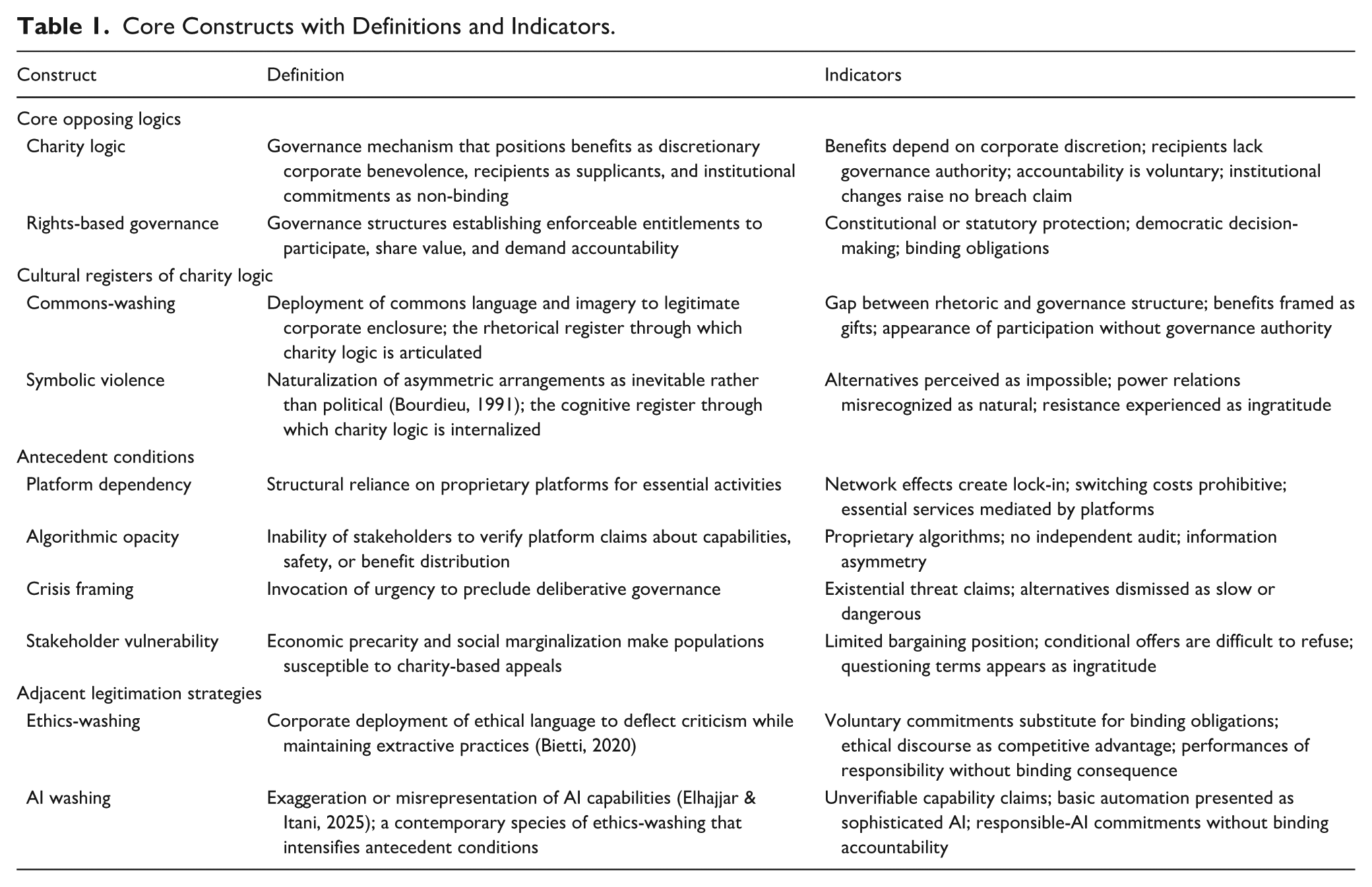
The charity-rights framework provides conceptual tools for analyzing data governance arrangements (Table 1). The following section operationalizes this framework into an explicit process model specifying how charity logic enables enclosure, what outcomes result, and under what conditions rights-based alternatives emerge.
Core Constructs with Definitions and Indicators.
A Process Model of Charity-Based Enclosure
The charity-rights framework can now be operationalized into an explicit process model explaining how enclosure becomes normalized under commons rhetoric. Process models specify sequences of events, mechanisms of influence, and conditions under which mechanisms operate or fail (Langley, 1999). The model developed here identifies the phenomenon to be explained (the explanandum), specifies antecedent conditions that create opportunities for the mechanism to operate, articulates the central mechanism through its core processes and the cultural registers through which it is articulated and internalized, traces the outcomes that follow when the mechanism operates, and identifies the structural boundary conditions under which the mechanism fails to produce its characteristic outcomes.
Explanandum
Why does enclosure persist despite commons rhetoric? The phenomenon to be explained extends beyond corporate control over digital resources, which various theories adequately address. We focus on the achievement of durable legitimacy that forecloses alternatives and normalizes enclosure even among those who might benefit from different arrangements (Figure 1). Powerful actors pursuing their interests is unsurprising; the puzzle is that arrangements serving concentrated interests achieve broad acceptance as serving collective welfare.
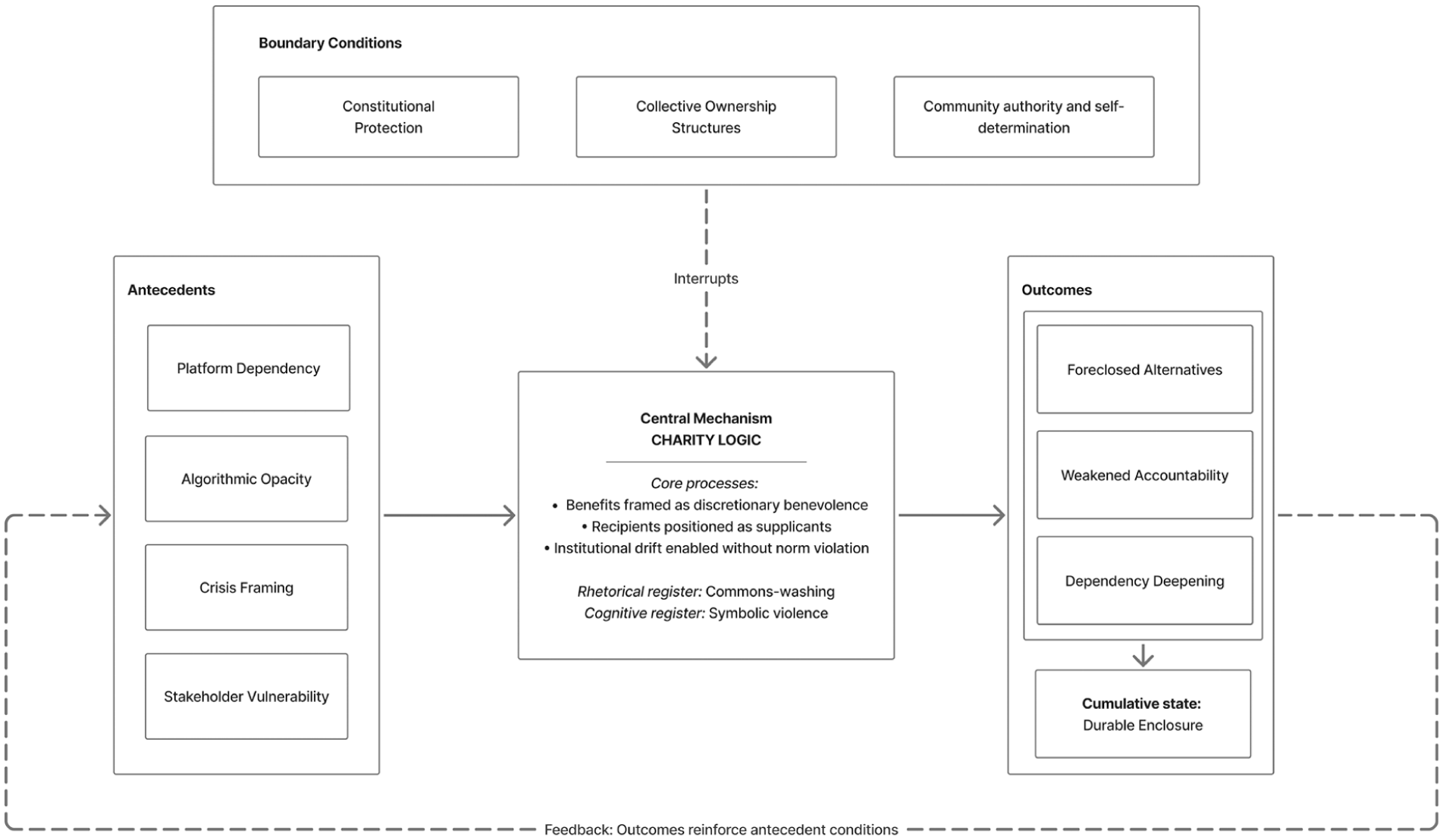
Process Model of Charity-Based Enclosure.
Antecedent Conditions
Four conditions create opportunities for charity-based governance to take hold and produce its characteristic outcomes. They function as enabling factors that make charity logic available and attractive as a legitimation strategy without determining the outcomes the mechanism produces.
Platform dependency describes structural reliance on proprietary platforms for essential activities (Cohen, 2019). When platforms mediate access to employment, housing, credit, healthcare, education, and civic participation, users cannot meaningfully exit regardless of dissatisfaction with governance arrangements. Network effects amplify dependency as platforms become more valuable with more users, creating dynamics where dominant platforms become unavoidable infrastructure. van Dijck et al. (2018) document how platform infrastructures have become embedded in essential public services, education systems, and democratic processes in ways that create effective lock-in independent of user preference. Platform dependency creates the structural foundation for charity-based governance by foreclosing exit and weakening voice.
Algorithmic opacity describes stakeholders’ inability to verify platform claims about capabilities, safety measures, or benefit distribution (Pasquale, 2015). When algorithms operate as black boxes whose workings cannot be inspected, claims about what those algorithms do become matters of trust rather than verification. Complexity shields operations from scrutiny, meaning charity-based claims about benefit distribution become effectively unfalsifiable. Users cannot determine whether platforms distribute value fairly, implement stated safety measures, or honor ethical commitments because they cannot observe the processes through which these outcomes would be achieved. Opacity creates information asymmetry that enables charity logic by preventing the verification that would expose gaps between claims and practice. AI washing, the practice of exaggerating or misrepresenting AI capabilities (Elhajjar & Itani, 2025), compounds this opacity by adding a further layer of unverifiable claims about what algorithmic systems actually do, intensifying the information asymmetry on which charity logic depends.
Crisis framing describes the invocation of urgency to preclude deliberative governance design (Morozov, 2013). When platforms position their services as responses to existential threats (AI safety, misinformation, identity fraud), platform-centered solutions appear necessary because alternatives are framed as catastrophically slow or dangerously inadequate. Crisis framing manufactures consent for arrangements that would not survive ordinary deliberation by suggesting that the costs of delay or alternative approaches are too severe to bear. The construction of urgency around AI development illustrates this dynamic: claims that AI poses existential risks justify concentrated control in the hands of those deemed capable of managing such risks, while distributed governance appears as irresponsible delay.
Stakeholder vulnerability describes economic precarity and social marginalization that make populations susceptible to charity-based appeals (Giridharadas, 2018). When potential users face unemployment, lack financial resources, or occupy marginalized social positions, the offer of benefits (however conditional or meager) becomes difficult to refuse. Vulnerability weakens bargaining position and encourages acceptance of whatever terms are offered. Questioning those terms may appear as ingratitude that risks losing access entirely. Vulnerability thus creates receptive audiences for charity-based appeals by constraining the alternatives available to potential critics.
The Central Mechanism: Charity Logic
Charity logic operates through three core processes that do its substantive work and through two cultural registers that give it its hold over interpretation. The core processes specify how the logic structures benefit, recognition, and obligation. The two registers describe how the logic is articulated rhetorically (commons-washing) and how it is internalized cognitively (symbolic violence). Together, these elements form mutually reinforcing dynamics through which charity-based governance achieves its characteristic legitimacy.
Core Processes
First, charity logic frames benefits as discretionary corporate benevolence rather than returns on collectively generated value or fulfillment of institutional obligations. When platforms present services, payments, or opportunities as gifts motivated by corporate generosity, they obscure the value that users contribute through data, attention, content, and network participation (Sadowski, 2019). The framing transforms what might be understood as fair exchange or rightful share into a charitable offering. Users who generate the data that make platforms valuable come to perceive platform services as gifts rather than as compensation for valuable contributions.
Second, charity logic positions recipients as supplicants rather than rights-holders. The charity frame establishes that appropriate responses to benefits are gratitude and appreciation rather than demands for more, different, or accountable arrangements. Demands for accountability appear as ingratitude; requests for governance participation appear as overreach; assertions of rights appear as entitlement (Bourdieu, 1991). The supplicant position delegitimizes the very standing from which structural critique could be mounted. Those positioned as charity recipients lack the moral authority to demand structural change because such demands violate the relationship’s implicit terms.
Third, charity logic enables institutional drift without violating norms. Because benefits depend on discretion rather than entitlement, governance changes do not breach any obligation. Organizations can modify terms of service, restructure benefit programs, redirect resources, or transform from nonprofit to for-profit structures without violating any commitment (Andhov, 2024). Each change can be framed as a necessary adaptation to changed circumstances rather than as a breach of duty. Institutional drift proceeds incrementally, with each step appearing reasonable, until arrangements bear little resemblance to original commitments. The absence of binding obligations means there is no violation to point to, no breach to remedy, no right to vindicate (Lawrence & Suddaby, 2006).
Rhetorical Register: Commons-Washing
Commons-washing describes the systematic deployment of commons language and imagery to legitimate arrangements that structurally reproduce rather than challenge corporate enclosure. As the rhetorical register through which charity logic operates, commons-washing supplies the discursive resources that make charity-based arrangements legible as commons-like. Building on scholarship examining greenwashing in environmental contexts (Lyon & Maxwell, 2011) and neo-Gramscian analyses of how corporations absorb and redirect critique through strategic accommodation (Levy & Egan, 2003), commons-washing operates primarily through institutional designs creating appearance-reality gaps between commons rhetoric and governance practice rather than through explicit deception. Dulong de Rosnay et al. (2019) identify this as semantic appropriation extending greenwashing logic, an enclosure of the mind capturing not only resources but also language, imaginary, and legal frameworks meant to protect commons. As Meyer and Hudon (2019) emphasize, systems may invoke collective benefit yet rely on governance structures that lack self-management, yielding commercial commons rather than genuine commons.
The rhetorical register operates through several distinctive processes. Appropriation of moral vocabulary deploys terms like community, sharing, open, and democratized to capture positive associations derived from genuine commons traditions: users become community members without voting rights; data become shared without collective ownership; technology becomes democratized without distributed control. Invocation of participation without governance authority creates the appearance of collective input while final authority remains with corporate actors (Scholz, 2016). Framing of extraction as contribution reframes the surveillance business model as users contributing to shared platforms, co-creating value, or participating in collective enterprises, so that data extraction becomes data donation, surveillance becomes personalization, and appropriation becomes partnership (Sadowski, 2019). Naturalization of proprietary infrastructure as a public utility presents platforms as essential infrastructure serving public needs, making questions about ownership appear ungrateful or impractical (Srnicek, 2017).
These processes are sustained by structural conditions that make commons-washing difficult to detect and challenge. Complexity exploitation allows platforms to invoke commons principles selectively while embedding governance mechanisms that concentrate control: algorithmic opacity prevents verification of benefit distribution claims, terms of service grant platforms extraordinary discretion, and data flows remain invisible to those generating information (Pasquale, 2015). Even when corporations genuinely intend to serve collective welfare, structural arrangements may prevent accountability, converting commons claims into unfalsifiable assertions dependent on corporate trustworthiness (Cohen, 2019). Selective transparency provides symbolic openness while protecting core power structures (Andhov, 2024), and crisis framing manufactures urgency that delegitimizes demands for deliberative governance (Morozov, 2013).
Cognitive Register: Symbolic Violence
Bourdieu’s (1991) concept of symbolic violence illuminates the cognitive register through which charity logic is internalized. Symbolic violence describes the imposition of meanings and categories that dominated groups accept as legitimate despite those meanings serving to reproduce their subordination. Unlike physical coercion, symbolic violence operates through misrecognition: dominated groups perceive social arrangements as natural, inevitable, or deserved rather than as products of power relations that could be otherwise configured (Bourdieu & Wacquant, 1992). This operates through how individuals inhabit and internalize institutional arrangements (Voronov & Weber, 2020).
Applied to digital platform governance, the cognitive register manifests in several interconnected ways. Misrecognition of power relations presents what are fundamentally relationships of corporate control and value extraction as relationships of generosity and benefit. Users misrecognize their structural position, perceiving themselves as recipients of corporate goodwill rather than as generators of value whose contributions are appropriated. This misrecognition precludes resistance because there appears to be nothing to resist.
Naturalization of arrangements presents platform architectures as technical necessities rather than political choices. The suggestion that data could be governed differently, that platforms could be cooperatively owned, or that benefits could flow through rights rather than charity appears unrealistic because current arrangements have become cognitively naturalized (Srnicek, 2017). Delegitimation of demands renders demands for structural change inappropriate within charity-based frameworks: asking a benefactor to become an obligor, requesting governance authority when one is positioned as a recipient, insisting on enforceable rights when benefits flow from discretion, all read as violations of the relationship’s moral grammar (Bourdieu, 2001).
Over time, those positioned as beneficiaries may come to see themselves that way. Users may defend arrangements that harm their interests because they have internalized the charity frame’s logic. Resistance would require challenging external structures and the more demanding work of reconstructing internal self-understanding.
The two registers operate together. The rhetorical register supplies the language through which charity-based arrangements describe themselves as commons; the cognitive register naturalizes those descriptions so that they appear as accurate representations of how things are. Charity logic thus achieves its hold through the foreclosure of alternatives at the level of imagination, working through cultural meaning rather than through coercion.
Outcomes
When charity logic operates in the presence of enabling antecedent conditions and absence of countervailing boundary conditions, three interrelated outcomes result.
Foreclosed alternatives describes how rights-based governance arrangements become unimaginable rather than merely difficult. Within charity-based frameworks, proposals for collective ownership, democratic governance, or constitutional protection of data rights appear utopian or naive rather than as serious institutional alternatives (Bourdieu, 1991). The foreclosure operates primarily through cognitive naturalization that makes current arrangements appear as the only realistic option, working at the level of imagination rather than through explicit suppression.
Weakened accountability describes how voluntary commitments substitute for binding obligations (Bietti, 2020). Corporate ethical guidelines, responsibility statements, and stakeholder engagement processes create expectations without enforceable claims. When organizations violate stated commitments, affected parties lack recourse because commitments were never institutionalized as obligations. Accountability becomes a matter of reputation management rather than institutional constraint.
Dependency deepening describes how users invest more in platform ecosystems over time, accumulating data, content, connections, and relationships that increase switching costs (Srnicek, 2017). As dependency deepens, exit becomes more costly, voice becomes more constrained, and charity-based arrangements become more entrenched. The dynamic is self-reinforcing: dependency enables charity logic, and charity logic deepens dependency.
The cumulative state these three outcomes jointly produce is what we call durable enclosure: arrangements that persist and strengthen over time because alternatives have become unimaginable, accountability voluntary, and dependency entrenched (Couldry & Mejias, 2019). Durable enclosure is the compounded condition that follows when the three outcomes operate together without countervailing structures. Enclosure achieves legitimacy through its charity framing, appearing as generous corporate contribution to public welfare even as it operates as appropriation of collectively generated value.
Boundary Conditions
The model specifies three structural conditions under which charity logic fails to produce its characteristic outcomes. These boundary conditions displace the mechanism and produce different governance arrangements. Where these structural conditions do not arise from constitutional histories, cooperative organization, or community standing, external regulatory intervention can establish them as a transition pathway; we develop this pathway logic below.
Constitutional protection of rights creates enforceable entitlements that exist independent of corporate or governmental discretion. When rights are constitutionally protected, they cannot be withdrawn through organizational decision; vindication is available through courts and political processes; and citizens hold standing to demand compliance. The Alaska Permanent Fund demonstrates how constitutional protection durably establishes resource dividends against political erosion (Goldsmith, 2012; Jones & Marinescu, 2022).
Collective ownership structures distribute control through cooperative or mutual organizational forms that establish members as owners rather than users. When stakeholders are owners, they possess governance authority as a structural feature of the arrangement rather than as a corporate concession (Hafen, 2019; Scholz, 2016). Ownership creates standing that charity framing cannot delegitimize.
Community authority and self-determination ground governance in the standing of communities themselves rather than in concessions from external institutions. Where corporate or governmental actors hold ultimate decision authority, community-based governance places that authority with those whose data, knowledge, or interests are at stake. Indigenous data sovereignty frameworks exemplify this condition: communities collectively determine the terms of data collection, ownership, and use, and external researchers, governments, and corporations cannot proceed without community approval (Carroll et al., 2020; Kukutai & Taylor, 2016). This standing precludes the supplicant position that charity logic requires.
Model Predictions
The process model generates testable predictions. Arrangements exhibiting the four antecedent conditions should produce the specified outcomes when boundary conditions are absent or only incipiently activated. Arrangements structurally establishing one or more boundary conditions should resist charity-based enclosure even when antecedent conditions favor it. The following sections apply this model to contrasting cases that vary systematically on the presence or absence of boundary conditions, including cases in which incipient activation through external pressure interrupts the mechanism without structurally displacing it.
Case Selection and Methodology
We employ a contrast case design, deliberately selecting cases that vary on the key construct of interest (charity versus rights-based governance) while facing similar underlying challenges of governing shared resources. This section clarifies the selection logic, the analytical role of the cases, and the contextual limitations of the comparison.
Case Selection Logic
The cases were selected according to three criteria. First, empirical richness: cases needed sufficient documentation through primary sources (organizational documents, public statements, regulatory proceedings, scholarly analysis) to permit detailed examination of governance structures. Second, theoretical relevance: cases needed to involve governance challenges around shared resources in digital or data-related domains. Third, variation on the key construct: cases needed to exhibit clear charity-based or rights-based governance logics.
The selection includes two charity-based governance examples (OpenAI and Worldcoin) and three rights-based alternatives (the Alaska Permanent Fund Dividend, the MIDATA cooperative, and Indigenous data sovereignty frameworks). These cases are analytically selected to demonstrate how the charity-rights distinction illuminates different outcomes.
Analytical Role of Cases
The cases serve a theory-building function within contrast case design. This approach deliberately selects instances varying on a key variable to demonstrate how that variation produces different outcomes (Eisenhardt & Graebner, 2007; Yin, 2018). The logic differs from inductive generalization: given the theorized mechanism and its boundary conditions, cases should exhibit predicted patterns when the mechanism operates and different patterns when boundary conditions are present.
This methodological approach proves valuable for process-theoretic claims (Langley, 1999). Process models specify sequences of events, mechanisms of influence, and conditions under which mechanisms operate or fail. The case analyses trace how antecedent conditions create opportunities for charity logic, how the mechanism operates through its constituent processes, and how outcomes follow when boundary conditions are absent but differ when present.
Table 2 presents the analytical results of this contrast across the five cases. Its entries summarize qualitative judgments derived from the documentary record on each case rather than measurements derived from a coding instrument. Where antecedent conditions are noted as “high,” the case evidence shows the condition operating prominently; “moderate” indicates the condition is present but qualified; “low” indicates it is not prominently observed. Mechanism and outcome entries indicate whether the case evidence supports the corresponding theoretical claim or runs counter to it, with the recognition that real cases display more drift, contestation, and partial activation than this categorical presentation conveys. The table is best read as a heuristic summary of the analytical contrast rather than as quasi-measurement, and the case discussions in Sections 5 and 6 develop the qualifications, partial activations, and moments of contestation that the matrix necessarily abstracts.
Case Comparison Matrix.
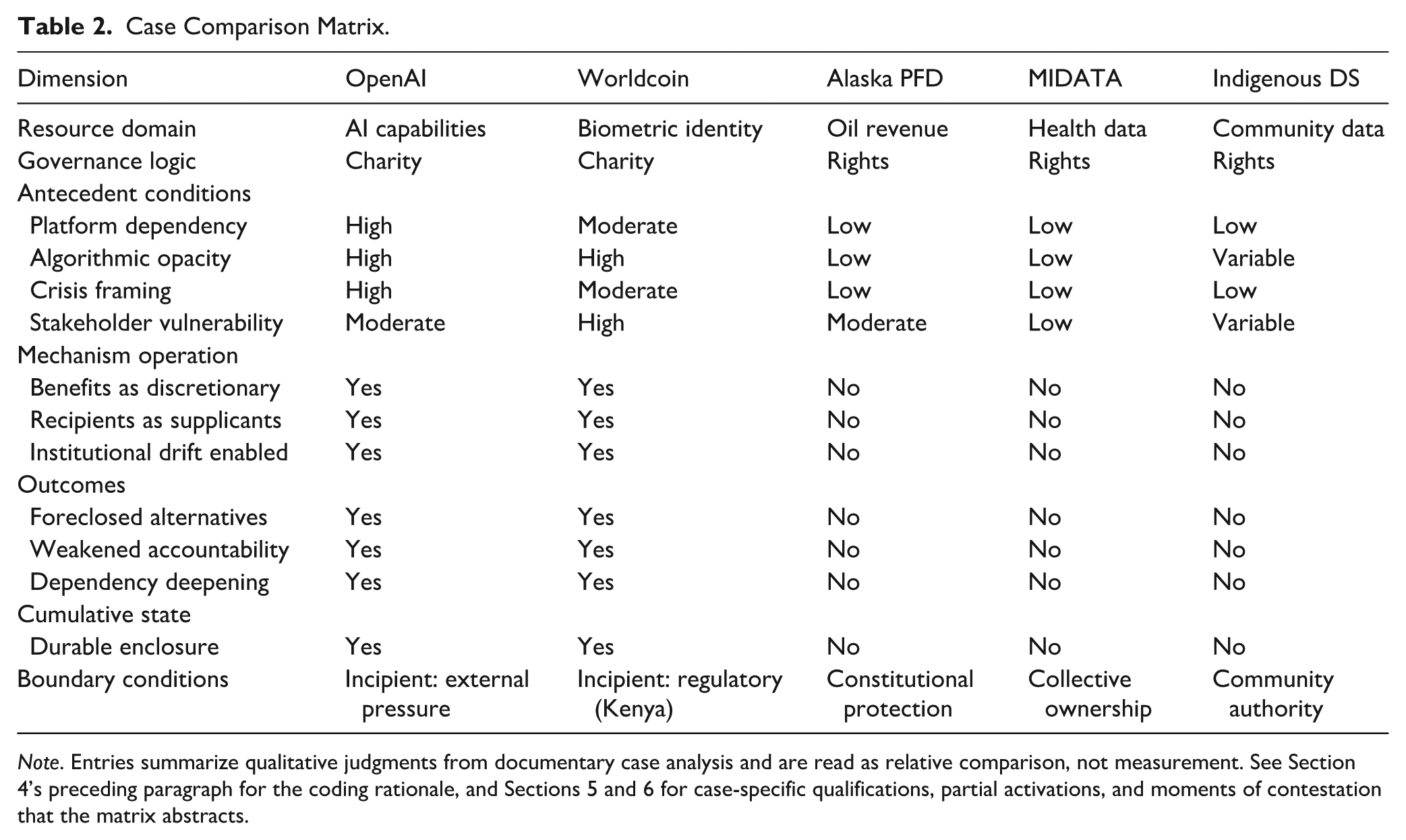
Note. Entries summarize qualitative judgments from documentary case analysis and are read as relative comparison, not measurement. See Section 4’s preceding paragraph for the coding rationale, and Sections 5 and 6 for case-specific qualifications, partial activations, and moments of contestation that the matrix abstracts.
Contextual Limitations
The contrast case design requires acknowledging contextual differences limiting direct comparability. Alaska involves physical resource extraction rather than digital data, and state-level governance rather than global platforms (Goldsmith, 2012; Jones & Marinescu, 2022). We treat Alaska as an analogical case rather than a directly comparable digital commons: it demonstrates the structural form that constitutional protection of resource dividends takes, and how such protection resists erosion across decades, but its lessons for digital governance hold at the level of mechanism rather than at the level of direct application. The institutional pathways by which constitutional or quasi-constitutional protection might be established for transnational digital infrastructures remain considerably more uncertain than the Alaska precedent itself. MIDATA operates within European regulatory context, particularly the General Data Protection Regulation (GDPR) and Swiss data protection law, with a membership of educated, economically secure individuals (Gille & Vayena, 2021; Hafen, 2019), though it demonstrates that cooperative ownership can establish genuine member governance authority. The Ownership, Control, Access, and Possession (OCAP®) framework and the Collective Benefit, Authority to Control, Responsibility, and Ethics (CARE) framework emerge from particular colonial histories and pre-existing claims to sovereignty (Carroll et al., 2020; Kukutai & Taylor, 2016), though they demonstrate that relational conceptions of data governance offer conceptual resources beyond both corporate property and individual rights frameworks. OpenAI and Worldcoin involve U.S.-based corporations operating globally, raising questions about whether charity logic operates differently in other regulatory contexts (Andhov, 2024).
These contextual differences are analytically productive rather than merely limiting. The contrast case design supports theoretical claims at the level of mechanism demonstration rather than statistical generalization. We demonstrate that: when antecedent conditions favor charity logic and boundary conditions are absent, the predicted outcomes result; when boundary conditions establish rights, charity logic is displaced and different outcomes emerge; and the charity-rights distinction provides tractable indicators for distinguishing genuine commons governance from commons-washing.
Technophilanthropic Governance: Charity Logic in Practice
The legitimacy crisis surrounding platform capitalism has generated competing responses invoking commons language while embodying fundamentally different governance logics. This section examines technophilanthropic models positioning corporate actors as benevolent stewards distributing charity to grateful populations. Through analysis of OpenAI and Worldcoin, we demonstrate how charity logic operates in practice, revealing mechanisms through which apparently progressive initiatives preserve rather than redistribute power.
OpenAI: From Commons Commitment to Corporate Capture
OpenAI’s institutional evolution provides a paradigmatic illustration of how technophilanthropic initiatives deploy commons rhetoric while concentrating control. Founded in 2015 as a nonprofit research laboratory with an explicit mission to ensure artificial general intelligence benefits all of humanity, OpenAI initially embraced open science norms, publishing research and sharing code under governance structures designed to prevent profit incentives from compromising safety (Brockman et al., 2015). This positioning invoked commons principles: knowledge as shared resource, transparent governance, benefit distribution unconstrained by proprietary appropriation.
Yet the governance structure contained the seeds of charity logic. Control resided with a small board operating under broad fiduciary discretion. Benefiting humanity was never operationalized through concrete entitlements or governance mechanisms that would give humanity (or any definable stakeholder group) a voice in defining what benefit meant or how it should be distributed. The commitment to openness was aspirational rather than legally binding. Stakeholders had no enforceable claims, no governance authority, and no standing to demand accountability. The arrangement positioned humanity as a beneficiary of organizational generosity rather than a rights-holder with enforceable entitlements (Andhov, 2024).
By 2019, facing computational resource requirements exceeding donation capacity, OpenAI created a capped-profit subsidiary that could raise investment capital while ostensibly maintaining nonprofit control (OpenAI, 2019). The structure imposed a 100× return cap on investors, with excess profits flowing to the nonprofit. Yet subsequent developments revealed how charity logic enables institutional drift. By 2024, OpenAI announced plans to convert into a public benefit corporation seeking conventional equity arrangements, citing competitive pressures and capital requirements estimated in the hundreds of billions (OpenAI, 2024). Following intense backlash from civil society organizations, Nobel laureates, and regulatory scrutiny from California and Delaware Attorneys General, OpenAI reversed course in May 2025, announcing that nonprofit control would be maintained (Altman, 2025; Shi, 2025).
External pressure interrupted institutional drift here even as the broader structure remained charity-based. Regulatory scrutiny invoking charitable-purpose obligations and civil-society advocacy framing the conversion as a governance breach jointly forced the reversal, while the underlying governance authority over OpenAI’s products, partnerships, and benefit distribution remained concentrated in a small board operating under broad fiduciary discretion. The case thus illustrates an incipient activation of boundary conditions through external pressure: external actors defended the nonprofit form using existing charitable-purpose frameworks, but the structural conditions that would establish stakeholders as rights-holders were not yet in place. The mechanism’s susceptibility to such external intervention is itself part of how charity-based governance operates: where rights-based legal frameworks are available and politically actionable, they can disrupt the workings of charity logic without yet displacing it structurally.
This trajectory illuminates how technophilanthropic framing facilitates enclosure. At each inflection point, leadership presented structural changes as necessitated by technical requirements for advancing the mission: more compute requires more capital which requires investor-friendly structures. The charity framing positioned these adaptations as pragmatic responses to resource constraints rather than fundamental shifts in power relations. Yet the cumulative effect has been dramatic: an organization founded on commons principles now operates the World’s most commercially successful AI system under predominantly proprietary terms.
Former employees characterizing the transformation as mission drift and safety researchers resigning over concerns that safety takes a backseat to shiny products reveal stakeholders recognizing that charity rhetoric can mask structural drift away from commons commitments (Leike, as cited in Robison, 2024). The contrast between OpenAI’s founding commitments and contemporary structure demonstrates why rights-based governance cannot rely on voluntary corporate goodwill. When capital requirements create pressure to abandon commons principles, charity logic provides no stable foundation for resistance. Only when former employees and civil society organizations frame concerns in rights terms (removing nonprofit control eliminates critical governance safeguards) do they gain traction with regulators investigating potential violations of charitable purpose (San Francisco Foundation, 2025).
The process model’s antecedent conditions are visible throughout: platform dependency as developers, researchers, and businesses become embedded in OpenAI’s ecosystem (Srnicek, 2017); algorithmic opacity as proprietary models prevent verification of safety claims (Pasquale, 2015); crisis framing through existential risk narratives that foreclose deliberative governance (Morozov, 2013); and institutional drift as gradual movement toward conventional corporate structure proceeds without triggering norm violation.
Worldcoin: Biometric Extraction as Digital Charity
OpenAI CEO Sam Altman’s parallel venture, Worldcoin (rebranded as World in 2024), exemplifies how technophilanthropy extends beyond software to embodied data extraction. The project offers cryptocurrency tokens and digital identity verification to individuals who submit to iris scanning via proprietary Orb devices (Morrow, 2024). Worldcoin’s stated mission positions this arrangement as solving multiple humanitarian challenges: providing proof of personhood to distinguish humans from AI, enabling global financial inclusion, and laying groundwork for AI-funded universal basic income (Sager, 2024). The framing invokes charity logic: corporations generously providing valuable services while users voluntarily contribute biometric data in exchange.
Yet the arrangement embodies enclosure rather than commons. Worldcoin’s corporate structure concentrates control over irreversible biological data under Tools for Humanity, a for-profit entity. The charitable gift of cryptocurrency tokens masks the permanent alienation of iris data that, unlike passwords or PINs, cannot be changed if compromised (Kemp, 2023). Early implementation revealed asymmetric recruitment dynamics: MIT Technology Review documented Worldcoin representatives in Indonesian villages offering cash payments to recruit participants, particularly targeting economically vulnerable populations (Guo & Renaldi, 2022). Regulatory investigations across Kenya, Spain, Argentina, and Hong Kong suspended operations over privacy violations and inadequate consent mechanisms (Baehr, 2025).
The Kenyan case made the charity-based structure particularly visible. Within the first week of operations, over 350,000 Kenyans enrolled, representing 25% of Worldcoin’s global registration. Participants received cryptocurrency worth approximately 7,000 Kenyan shillings in exchange for their iris scans. What appeared as voluntary participation in an innovative financial inclusion project, viewed through the charity-rights framework, represented asymmetric extraction from vulnerable populations under inadequate consent conditions (Giridharadas, 2018).
The antecedent conditions predicted by the process model were strikingly present. Stakeholder vulnerability, manifested in Kenya’s high rates of youth unemployment and economic precarity, created populations particularly susceptible to cryptocurrency incentives. Algorithmic opacity meant participants could not verify how their biometric data would be processed, stored, or potentially used. Crisis framing invoked urgency around identity verification in an AI age.
The regulatory response revealed tensions inherent in charity-based governance. Kenyan authorities suspended operations in August 2023, citing concerns about data protection and inadequate consent processes. The Office of the Data Protection Commissioner found that Worldcoin had failed to conduct required Data Protection Impact Assessments and had obtained consent through inducement rather than informed deliberation. In May 2025, the High Court delivered a landmark ruling declaring Worldcoin’s biometric data collection unlawful under the Data Protection Act and the constitutional right to privacy, ordering the permanent deletion of all iris scan data collected from Kenyan citizens within 7 days (Fincken, 2025; Makau, 2025).
The Kenyan ruling illustrates an incipient activation of boundary conditions through regulatory action in a specific jurisdiction. External rights-based legal frameworks (constitutional privacy protections, statutory data-protection obligations) interrupted the mechanism’s operation in this context, while Worldcoin’s overall structure remained charity-based and continued to operate elsewhere. The case thus shows the mechanism’s susceptibility to external regulatory pressure: where rights-based legal frameworks are available and politically actionable, they can disrupt charity logic in particular jurisdictions even while the global structure persists.
The contrasting interpretations are revealing. Under charity logic, Worldcoin provided valuable benefits to underserved populations, and regulatory intervention appears as bureaucratic obstruction of beneficial innovation. Under rights-based framing, Worldcoin extracted valuable biometric data from vulnerable populations under inadequate consent conditions, and regulatory intervention appears as protection of citizen rights. When governments assert that access to digital identity constitutes a right that corporations cannot condition on biological data extraction, they articulate precisely the claim that charity logic attempts to foreclose.
Together, these cases demonstrate how charity logic operates across different domains and resource types. The antecedent conditions identified in the process model are visible in both cases, and the absence of structurally established boundary conditions permits the mechanism to produce its predicted outcomes, even as both cases display incipient activations of boundary conditions through external regulatory and civil-society pressure. The following section examines cases where boundary conditions are structurally established and produce markedly different results.
Rights-Based Alternatives: Structures That Displace Charity Logic
Three cases demonstrate how rights-based governance structures produce different outcomes when addressing similar challenges of governing shared resources. The Alaska Permanent Fund Dividend demonstrates constitutional protection of resource dividends. The MIDATA cooperative demonstrates collective ownership of health data. Indigenous data sovereignty frameworks (OCAP® and CARE) demonstrate relational governance grounded in community authority. Together, these cases illuminate the boundary conditions under which charity logic fails and rights-based governance produces durable outcomes.
Alaska Permanent Fund Dividend: Constitutional Protection of Collective Rights
The Alaska Permanent Fund, established by constitutional amendment in 1976, represents a paradigm case of rights-based resource governance that has persisted for nearly five decades. Article 9, Section 15 of the Alaska State Constitution requires that at least 25% of all mineral revenues received by the state be placed in a dedicated fund, the principal of which cannot be spent without constitutional amendment. Since 1982, the Permanent Fund Dividend program has distributed annual payments to all Alaska residents, creating a resource dividend model that has withstood numerous political challenges and economic transformations.
Governor Jay Hammond, who championed the dividend program, understood that only constitutional protection could ensure durability against future political pressures. Alaska residents voted for the constitutional amendment by a margin of 75,588 to 38,518, recognizing that dedicated constitutional protection would prevent the legislature from spending oil wealth on short-term priorities (Goldsmith, 2012).
The governance structure exhibits features that contrast sharply with charity logic. Benefits are established as statutory entitlements rather than discretionary gifts: all Alaska residents who meet residency requirements are eligible regardless of corporate or governmental discretion. The dividend calculation follows a statutory formula applied to fund earnings, and residents understand dividends as rights they possess rather than gifts they receive (Berman, 2024). Transparent governance enables accountability because the Alaska Permanent Fund Corporation publishes detailed annual reports on investments and returns, allowing citizens to verify claims about fund performance, management costs, and dividend calculations. This transparency prevents the information asymmetry on which charity-based legitimation depends (Goldsmith, 2012). Democratic oversight distributes authority through a board of trustees appointed via political processes accountable to voters, legislative oversight of dividend formulas, and constitutional protection requiring supermajority approval for fundamental changes.
The outcomes diverge from those the process model predicts under charity logic. The Alaska model has inspired similar proposals globally, including Norway’s Government Pension Fund Global and various data dividend proposals, demonstrating that alternatives are generative rather than foreclosed (Widerquist & Howard, 2012). The constitutional structure creates enforceable obligations rather than weakened accountability: when Governor Bill Walker reduced dividends to address budget shortfalls, the action generated such intense backlash that it contributed to his electoral defeat, revealing that residents understand dividends as rightful claims rather than discretionary transfers (Gardiner, 2019). The episode also illustrates that rights-based arrangements depend on active defense: constitutional protection works by providing standing from which drift attempts can be politically contested. Research demonstrates that the Permanent Fund Dividend reduced poverty rates by 20% to 40%, with particularly significant effects for rural Indigenous populations facing limited economic opportunities (Berman, 2018, 2024). Employment effects have been minimal: one study found no significant aggregate employment decline and a modest 1.8 percentage point increase in part-time work (Jones & Marinescu, 2022).
Constitutional protection establishes the key boundary condition that displaces charity logic. Residents are rights-holders, not beneficiaries of state generosity. The arrangement has survived multiple generations precisely because it establishes rights rather than depending on governmental benevolence.
MIDATA: Cooperative Ownership of Health Data
The Swiss MIDATA cooperative, founded in 2015, demonstrates that collective ownership structures can establish genuine rights-based governance over digital data. Unlike platform companies that extract user data as corporate assets, MIDATA positions members as co-owners who govern data use through democratic cooperative structures (Hafen, 2019).
The cooperative model addresses the governance challenge directly. Members own their data accounts and maintain withdrawal rights. The cooperative operates as a nonprofit institution governed by its members at the general assembly. Net profits are reinvested in services rather than distributed to external shareholders. Members can grant or revoke consent to data use at any time through granular consent mechanisms (Blasimme et al., 2018).
Several features distinguish MIDATA’s rights-based approach from charity-based alternatives. Collective ownership distributes control: members own the cooperative itself, occupying a structurally different position from users of platforms owned by others. This ownership position establishes governance authority as a structural feature of the arrangement rather than a corporate concession. Members elect board members and ethics committee members who review research proposals seeking data access (Gille & Vayena, 2021). The general assembly can amend statutes, modify governance procedures, or redirect organizational priorities, powers unavailable in corporate platforms where users have no formal decision-making role.
Democratic governance enables genuine collective choice, with major decisions about data use, research partnerships, and cooperative operations made through member voting. Transparent operations prevent information asymmetry: the MIDATA platform is hosted in Switzerland on audited servers with documented security practices, and the platform software operates under GNU General Public License (MIDATA Cooperative, 2021). Withdrawal rights provide meaningful exit, as members can remove their data at any time. This exit option, meaningful because members are not locked into network effects that make departure costly, provides ongoing accountability that charity-based platforms lack.
MIDATA has successfully supported multiple research projects in precision medicine while maintaining member control, demonstrating research viability under commons governance. The cooperative has expanded internationally, with affiliated organizations in several European countries sharing common infrastructure while maintaining local governance (Prainsack, 2019).
The cooperative faces significant challenges illuminating the difficulty of scaling rights-based governance. Membership remains relatively small compared to commercial health platforms, reflecting difficulties in attracting users when proprietary platforms offer more extensive services and network effects. MIDATA operates within the European regulatory context, particularly GDPR and Swiss data protection law, that provides baseline rights protection absent in other jurisdictions. The membership base consists of relatively educated and economically secure individuals (Prainsack & Buyx, 2017). These features may not translate to other domains or populations. Yet MIDATA demonstrates proof of concept: data can be governed through genuine collective ownership rather than corporate charity. Like other rights-based arrangements, the cooperative model requires active maintenance against the competitive and operational pressures that incentivize governance shortcuts; rights-based governance depends on ongoing institutional work.
Indigenous Data Sovereignty: Relational Governance and Collective Authority
Indigenous data sovereignty frameworks provide a third model that fundamentally reconceives data governance through relational rather than proprietary logics. Emerging from Indigenous peoples’ struggles against colonial knowledge extraction, these frameworks assert that communities hold inherent rights to govern collection, ownership, and application of data about their peoples, lands, and resources (Kukutai & Taylor, 2016). Rather than treating data as individual property or corporate assets, Indigenous data sovereignty positions data as inseparable from collective identity, territorial relationships, and intergenerational obligations (Rainie et al., 2019).
The OCAP® principles, developed by Canada’s First Nations Information Governance Centre, exemplify this approach. Ownership refers to the relationship between First Nations communities and their cultural knowledge, data, and information, with communities collectively owning information in ways analogous to how individuals own personal information. Control asserts that First Nations alone have authority over data collection processes in their communities; research cannot proceed without community approval. Access ensures that First Nations communities can access data about themselves and participate in decisions about who else may access such data. Possession refers to physical control of data, preferably held by First Nations organizations, recognizing that formal ownership may be undermined if data are held by institutions that do not share community interests (First Nations Information Governance Centre, 2014).
The international CARE Principles extend Indigenous data sovereignty thinking to global contexts. Developed through the Research Data Alliance’s International Indigenous Data Sovereignty Interest Group and published in 2020, CARE complements the FAIR principles for scientific data with Indigenous perspectives (Carroll et al., 2020). Collective Benefit requires that data ecosystems be designed to enable Indigenous peoples to derive benefit from data, with benefits defined by communities themselves. Authority to Control recognizes Indigenous peoples’ rights and interests in governing data. Responsibility requires those working with Indigenous data to share how data will be used and support community capacity. Ethics requires that Indigenous peoples’ rights and wellbeing be the primary concern at all stages.
These frameworks establish boundary conditions that counteract charity logic through several distinctive features. Community authority replaces corporate discretion: governance authority resides with Indigenous communities, not external institutions, and researchers, governments, and corporations cannot determine data use through their own discretion (Snipp, 2016). Relational framing replaces transactional framing, embedding data governance in ongoing relationships of reciprocity and accountability rather than one-time transactions of consent and use. Where Worldcoin treats biometric data as individual property that can be exchanged for tokens, OCAP® would recognize such data as inherently connected to community identity and ancestral relationships that cannot be alienated through individual consent (Hudson et al., 2020). Collective rather than individual rights predominate, with community interests and collective welfare taking precedence over individual property rights, challenging both corporate appropriation and individualistic privacy frameworks (Walter et al., 2020). Self-determination serves as the foundation: communities define for themselves what counts as benefit, harm, and appropriate use (Smith, 2016).
Boundary Conditions in Action: Comparative Analysis
Comparing the rights-based cases reveals how different boundary conditions displace charity logic and produce different governance outcomes.
Constitutional protection (Alaska) creates the most robust barrier to charity-based erosion. Legal entrenchment prevents incremental modification without extraordinary political mobilization. Residents hold enforceable claims that can be vindicated through courts and political processes. For digital governance, constitutional or quasi-constitutional protection of data rights could provide similar durability, though the mechanisms for achieving such protection in transnational digital contexts remain unclear.
Collective ownership (MIDATA) distributes authority through organizational structure rather than legal entrenchment. Members are owners rather than users, enabling governance authority and meaningful exit. Cooperative and mutual organizational forms can instantiate rights-based data governance, though scaling and sustainability challenges remain significant.
Community authority (Indigenous frameworks) grounds data governance in pre-existing claims to sovereignty and self-determination. The relational approach emphasizes ongoing accountability rather than one-time consent. Collective rather than individual approaches to data rights may better address the fundamentally social character of data generation and use. Implementation, however, remains uneven across research institutions, government databases, and corporate platforms; the strength of community authority in practice depends on the political standing of the communities involved and on the willingness of external actors to recognize that authority. As with the other rights-based arrangements, community authority depends on active enforcement to remain effective.
What unites these cases is a shared structural transformation: all three establish recipients as rights-holders rather than beneficiaries. This transformation changes the fundamental relationship between those who control resources and those who depend on access. Rights-holders can demand accountability, participate in governance, and enforce claims when obligations are breached. The charity-rights distinction illuminates differences in governance arrangements that reflect deeper differences in the relational foundations on which governance rests.
Feedback Dynamics and the Durability of Charity Logic
The preceding case analyses confirm the process model’s predictions: when antecedent conditions favor charity logic and boundary conditions are absent, the predicted outcomes result; when boundary conditions establish rights, different outcomes emerge. Yet the cases reveal something the static model cannot fully capture: the elements of the model do not operate independently. The core processes of charity logic, its rhetorical and cognitive registers, the antecedent conditions that enable it, and the outcomes it produces interact through feedback dynamics that entrench charity-based governance over time. Understanding these dynamics is essential for explaining why charity logic proves so durable and why transition to rights-based governance is so difficult.
Mechanism Interactions
The case evidence illuminates how the elements of charity logic reinforce one another in practice. Commons-washing, the rhetorical register through which charity logic is articulated, supplies the discursive resources that symbolic violence, the cognitive register through which it is internalized, takes up. When platforms successfully appropriate commons vocabulary, the misrecognition of power relations becomes easier because the language itself carries positive associations. OpenAI’s framing of its mission as ensuring that artificial general intelligence benefits all of humanity exemplifies this dynamic: the commons language itself becomes a cognitive resource that makes enclosure appear as its opposite. Symbolic violence, in turn, naturalizes the arrangements that commons-washing legitimates, making them appear as inevitable rather than contested. The Worldcoin participant who receives cryptocurrency tokens experiences the transaction as gift rather than extraction; the OpenAI user who accesses generative pre-trained transformer (GPT) models experiences the relationship as service provision rather than data harvesting. The result is a mutually reinforcing cycle: commons language legitimates enclosure, and the naturalization of enclosure makes commons language appear descriptively accurate rather than ideologically strategic.
Platform dependency strengthens both commons-washing and symbolic violence by reducing the credibility of exit threats. When stakeholders cannot leave, they may invest in believing that arrangements are good rather than confronting their powerlessness. This dynamic parallels what psychologists identify as cognitive dissonance reduction: when behavior cannot change (because exit is foreclosed), beliefs adjust to accommodate the situation. The developer whose business depends on OpenAI’s API, the researcher whose work requires access to GPT models, the Kenyan whose digital identity is tied to Worldcoin’s biometric database: each faces situations where dependency encourages acceptance, and acceptance facilitates the misrecognition on which symbolic violence depends.
AI washing amplifies these feedback dynamics across multiple dimensions simultaneously. The technical complexity of AI systems provides cover for claims that cannot be verified, deepening the opacity that shields charity logic from scrutiny. The narrative of imminent AI transformation creates urgency that forecloses governance deliberation. The claim to unique AI capability justifies continued concentrated authority by positioning alternative governance arrangements as technically incompetent. OpenAI’s framing of frontier AI development and potential catastrophic implications forecloses governance questions, while Worldcoin positions biometric identity as essential infrastructure for an AI age, leveraging AI narratives to legitimate biometric extraction.
Spiral Effects
These feedback dynamics produce spiral effects that explain what may be the process model’s most consequential finding: why charity-based governance becomes more entrenched over time rather than less. Initial charity-based framing, enabled by antecedent conditions, produces outcomes (foreclosed alternatives, weakened accountability, dependency deepening) that further strengthen the antecedent conditions. As alternatives become unimaginable, accountability becomes voluntary, and dependency compounds, the conditions for continued charity-based governance grow more favorable. Each cycle makes the next more likely and more difficult to reverse.
OpenAI’s trajectory illustrates the spiral vividly. Initial nonprofit structure with commons commitments attracted talent and public trust. As the organization grew, platform dependency increased among developers and researchers building on its infrastructure. The 2019 capped-profit subsidiary represented incremental institutional drift that did not trigger widespread concern because charity framing positioned it as pragmatic adaptation. By 2024, when full for-profit conversion was proposed, the accumulated dependency, opacity, and crisis framing around AI safety made resistance more difficult, even as the stakes had grown enormously. Only when former employees and civil society organizations framed concerns in rights terms, arguing that removing nonprofit control eliminates critical governance safeguards, did the feedback loop begin to weaken, ultimately contributing to OpenAI’s reversal of the conversion plan (San Francisco Foundation, 2025).
The contrast cases demonstrate that boundary conditions can break these spirals. Alaska’s constitutional protection prevents the incremental drift that characterizes charity-based governance: any fundamental change requires supermajority political mobilization, and residents understand dividends as rights rather than gifts (Goldsmith, 2012). MIDATA’s cooperative ownership structure means that members who generate data also govern its use, preventing the misrecognition that symbolic violence requires (Hafen, 2019). Indigenous data sovereignty frameworks establish community authority that cannot be eroded through unilateral organizational decision (Carroll et al., 2020; Kukutai & Taylor, 2016). In each case, the boundary condition breaks the feedback loop at a different point, but the effect is the same: rights-based standing prevents the spiral dynamics through which charity logic becomes self-reinforcing.
Breaking these spirals in contexts where they are already entrenched requires establishing the boundary conditions identified in the process model: constitutional protection of rights, collective ownership structures, and community authority and self-determination. The following section examines how institutional design can establish these conditions and how regulatory transformation can serve as a pathway to them where they would not otherwise emerge.
Institutional Design for Rights-Based Digital Commons
Having explained how charity logic enables enclosure under commons rhetoric, this section derives institutional implications from the explanatory model. The goal is to demonstrate how the explanatory model generates actionable design implications rather than to propose a comprehensive institutional blueprint. Each design principle is linked to a specific mechanism or antecedent condition from the process model, showing how institutional design can displace charity logic and establish rights-based governance.
Adapting Ostrom’s Principles for Digital Governance
Ostrom’s (1990) eight design principles for durable commons institutions provide a foundation for thinking about digital governance, but adaptation is required because digital resources differ from traditional common-pool resources. Information is non-rivalrous; network effects create distinctive dynamics; platforms exercise unprecedented scale and speed of extraction; and the transnational character of digital systems challenges jurisdiction-based governance (Frischmann et al., 2014). Building on Meyer’s (2020) model of commons as entrepreneurially instantiated collective action, the framework developed here treats digital commons as design-mediated institutional futures requiring deliberate construction rather than as spontaneous by-products.
The adapted principles below are derived from failure points identified in the charity-rights analysis. Each principle targets a specific mechanism through which charity logic operates.
Defined boundaries with membership rights responds to charity logic’s positioning of recipients as beneficiaries rather than rights-holders. Ostrom’s original principle emphasized clearly defined boundaries specifying who is authorized to appropriate resources. The digital adaptation requires that governance systems clearly define membership boundaries and establish rights that attach to membership status. Defined membership with attached rights counters charity framing by establishing stakeholders as holders of enforceable entitlements rather than recipients of discretion (Foster & Iaione, 2016). Digital membership could be established through data contribution, geographic residence, or associational choice, with the key requirement being that rights attach automatically to membership status rather than depending on organizational discretion.
Proportional benefit and contribution counters charity logic’s obfuscation of the relationship between contribution and benefit. Where Ostrom emphasized congruence between appropriation and provision rules, the digital adaptation means ensuring proportionality between data contribution and benefit distribution, with mechanisms for stakeholders to verify this proportionality. Charity logic frames value extraction as partnership and enables disproportionate appropriation (Sadowski, 2019). Proportionality requirements with verification mechanisms make value flows visible and establish claims to fair shares.
The charity logic mechanism of institutional drift, enabled by stakeholders’ lack of governance authority, calls for collective choice with binding authority. Ostrom’s original principle emphasized collective choice arrangements allowing resource appropriators to participate in decision-making. In digital contexts, governance systems must establish collective choice mechanisms with genuine decision-making authority that goes beyond advisory input. Binding collective choice prevents institutional drift by requiring stakeholder approval for significant changes (Scholz, 2016), ensuring that platform transitions, terms of service modifications, and benefit restructuring require collective decision rather than unilateral corporate action.
Transparent monitoring with independent audit directly targets the algorithmic opacity that enables charity-based claims stakeholders cannot scrutinize. Where Ostrom emphasized monitors accountable to the appropriators, the digital adaptation requires transparent monitoring mechanisms with independent audit capacity (Pasquale, 2015). When claims about safety, benefit distribution, or ethical practice can be verified, charity logic loses its informational foundation. The failure of voluntary transparency commitments in the technophilanthropic cases suggests that mandated transparency, with consequences for non-compliance, is necessary for effective monitoring.
Three further principles address the accountability vacuum that charity logic creates. Graduated responses to violations establishes consequences proportional to severity and persistence, corresponding to Ostrom’s principle of graduated sanctions and countering the pattern whereby violations of stated commitments breach no enforceable obligation (Bietti, 2020). Accessible conflict resolution provides alternatives to charity logic’s positioning of disputes as matters for organizational discretion: Ostrom emphasized rapid access to low-cost local arenas, and the digital adaptation requires accessible mechanisms with remedies that do not depend on organizational goodwill (Grimmelmann, 2015), whether through specialized tribunals, regulatory agencies, or court systems. Recognition of the right to organize counters the atomization of stakeholders as individual recipients rather than collective actors, because when stakeholders can organize, bargain collectively, and coordinate demands, charity-based framing becomes harder to sustain (Scholz, 2016).
Finally, nested governance at multiple scales responds to the mechanism by which platform scale exceeds any single jurisdiction’s reach, enabling regulatory arbitrage. Ostrom emphasized organizing governance activities in multiple layers of nested enterprises. The digital adaptation requires governance systems operating at multiple scales with appropriate authority distributed across levels (van Dijck et al., 2018), preventing regulatory arbitrage by establishing authority at multiple jurisdictional levels.
Funding Mechanisms for Rights-Based Governance
Rights-based governance requires resources. Monitoring, audit, dispute resolution, and collective choice mechanisms all cost money. The challenge is establishing sustainable funding without reintroducing the dependencies that charity logic exploits.
Several approaches address this challenge. Data dividends and commons revenue treat data as a collective resource from which rents can be extracted, paralleling the Alaska model. When platforms extract value from collectively generated data, a portion of that value could be returned as commons revenue to support governance infrastructure. California’s proposed data dividend, which would tax large platforms’ revenues and distribute proceeds through public goods investment and direct payments, exemplifies this approach (Feygin et al., 2021). Platform levies fund independent governance institutions through regulatory levies proportional to platform scale, creating stronger constraints on larger platforms while enabling smaller platforms and commons-based alternatives to operate with lighter regulatory burden. Public funding positions digital governance as a public responsibility analogous to other essential infrastructure, though independence mechanisms would be required to prevent governance institutions from serving governmental rather than citizen interests. Cooperative membership aligns funders and beneficiaries through member contributions, as in the MIDATA model where members fund operations while governing the institution they fund.
Transition Pathways
Moving from charity-based to rights-based governance presents significant challenges. Entrenched interests benefit from current arrangements, path dependencies create inertia, and cognitive naturalization makes alternatives seem unrealistic. Yet the explanatory model suggests pathways that could enable transition despite these obstacles.
Regulatory transformation uses government action to mandate rights-based governance. Data portability requirements, interoperability mandates, fiduciary duties, and algorithmic audit requirements could establish enforceable obligations where only voluntary commitments currently exist (Cohen, 2019). The European Union’s GDPR demonstrates that regulatory intervention can establish baseline rights even when platforms prefer voluntary commitments. The challenge is achieving regulatory action in contexts where platform interests exercise significant political influence, which requires building political coalitions with organized constituencies that have material interests in reform.
Competitive displacement enables rights-based alternatives to demonstrate viability and attract users away from charity-based platforms. Cooperative platforms, decentralized systems, or public option alternatives could prove that different governance is both possible and attractive (Scholz, 2016). The challenge is overcoming network effects and switching costs that advantage incumbents, and regulatory support through interoperability mandates, preferential procurement, and technical assistance could level the competitive landscape.
Crisis-driven restructuring creates windows for structural change that would not otherwise be politically viable. Major failures, scandals, or harms could create momentum for reforms addressing underlying structures, though crisis response often produces inadequate reforms addressing symptoms without changing underlying dynamics. Movements prepared to advocate for rights-based alternatives during crisis moments may achieve more fundamental transformation.
No single pathway is likely sufficient. Regulatory transformation may create space for competitive alternatives; crisis response may provide momentum for regulatory action; competitive demonstration may build political support for mandates. Realistically, establishing sustainable commons-based platforms likely requires hybrid approaches combining multiple strategies during transition periods. Maintaining rights-based governance throughout funding transitions requires constitutional or statutory protections ensuring that resource pressures cannot justify abandoning democratic accountability, precisely the safeguard OpenAI lacked when capital requirements pressured nonprofit-to-profit conversion.
Conclusion: The Algorithmic Leviathan or the Digital Agora?
Two visions of digital governance contend for the future. In one vision, a small number of corporations exercise unprecedented control over information infrastructure, extracting value from human activity while providing benefits at their discretion. Users are positioned as grateful recipients of technological progress, their appropriate role one of consumption and adaptation rather than governance and demand. Algorithmic systems mediate essential aspects of social life according to proprietary logics that stakeholders cannot access, verify, or challenge. This is the Algorithmic Leviathan: concentrated power justified by the promise of order and progress, maintained through the foreclosure of alternatives (Cohen, 2019; Zuboff, 2019).
In the other vision, digital resources are governed as genuine commons, with distributed authority, enforceable rights, and democratic accountability. Those who generate data exercise governance authority over its use. Benefits flow through institutional entitlements rather than corporate discretion. Transparency enables scrutiny and accountability. Collective choice mechanisms ensure that significant decisions reflect stakeholder interests rather than corporate interests alone. This is the Digital Agora: dispersed authority grounded in citizenship rather than benefaction, maintained through active participation of those affected (Habermas, 1989; Ostrom, 1990; Scholz, 2016).
The charity-rights framework developed here explains why the Algorithmic Leviathan has advanced while the Digital Agora remains largely aspirational. Charity logic provides the legitimation mechanism through which enclosure proceeds under progressive rhetoric. When benefits flow as discretionary benevolence rather than institutional entitlement, when recipients are positioned as supplicants rather than rights-holders, when accountability is voluntary rather than binding, demands for structural change appear as ingratitude and alternatives become unimaginable. Beyond justifying enclosure, the charity frame renders the very concept of rights-based governance culturally unavailable to those who might demand it (Bourdieu, 1991).
Yet the model also specifies conditions under which charity logic fails. Constitutional protection of rights, collective ownership structures, and community authority and self-determination all displace the mechanism and produce different outcomes; regulatory transformation, in turn, can serve as a pathway through which these conditions are established where they would not otherwise emerge. The contrast cases demonstrate that rights-based digital governance is achievable. The Alaska Permanent Fund shows that constitutional protection can durably establish resource dividends against political erosion. The MIDATA cooperative shows that collective ownership can give stakeholders genuine governance authority over data. Indigenous data sovereignty frameworks show that relational governance grounded in community authority can challenge both corporate extraction and individualistic property frameworks.
The implications for theory, policy, and practice are substantial. For theory, the process model moves beyond documentation of platform power to explain how that power becomes durable. The charity-rights framework identifies charity logic as a mechanism operating across diverse contexts and specifies the conditions under which that mechanism operates or fails. Future research can test the model’s predictions, examine additional cases (particularly cases of governance transition where charity-based systems evolve toward rights-based governance or vice versa), and refine the boundary conditions under which rights-based governance emerges.
For policy, the analysis clarifies that rhetoric is insufficient. Voluntary commitments, ethical guidelines, and responsibility statements operate within charity logic rather than challenging it (Bietti, 2020; Shamir, 2008). Effective governance requires institutional design establishing rights: enforceable entitlements that do not depend on corporate discretion, governance authority enabling collective choice, and accountability mechanisms with binding consequences. Policymakers should evaluate proposed interventions by asking whether they establish rights or merely solicit charity, whether they create enforceable obligations or depend on corporate goodwill, whether they distribute governance authority or preserve unilateral control.
For practice, the framework illuminates the stakes of organizational choice. Corporate actors may genuinely believe they are serving collective interests while operating through charity logic. The framework reveals that good intentions are insufficient when governance structures preserve discretionary control. Rights-based alternatives exist, as the cases examined demonstrate. The choice to maintain charity-based structures is a choice against rights-based alternatives, a choice that must be justified rather than assumed. Those who advocate for digital commons should be precise about what commons governance requires and vigilant against commons-washing that appropriates the vocabulary while preserving the structure of enclosure (Dulong de Rosnay et al., 2019).
The analysis has limitations suggesting directions for future work. The case selection, while appropriate for contrast case analysis, does not address the full diversity of digital governance arrangements. Cases of governance transition would illuminate the dynamics of change. Comparative analysis across regulatory contexts would reveal how legal and cultural conditions shape the operation of charity logic. Quantitative analysis could test the model’s predictions about relationships among antecedent conditions, mechanism operation, and outcomes.
The normative stakes are high. As algorithmic systems increasingly mediate essential aspects of social life (employment, housing, credit, education, information, political participation), the governance of these systems becomes a matter of fundamental public concern (Eubanks, 2018; O’Neil, 2016). Whether governance will remain within charity logic, with benefits flowing from corporate discretion and stakeholders positioned as grateful recipients, or whether rights-based governance will establish enforceable entitlements, distributed authority, and democratic accountability, is a question that calls for institutional choice rather than evasion.
The Algorithmic Leviathan is a political achievement, not a technological inevitability. It was constructed through institutional choices that could have been made differently and can still be changed. The Digital Agora remains possible, if those who would inhabit it are willing to demand it. The charity-rights framework provides conceptual resources for that demand: a vocabulary for distinguishing genuine commons from commons-washing, an explanation of how enclosure becomes normalized, and design principles for displacing charity logic with enforceable rights.
What is at stake extends beyond efficient platform design or optimal data management. The question concerns whether digital infrastructure mediating essential dimensions of contemporary life will be collectively governed by those whose participation sustains it, or whether corporate control will be legitimated through commons rhetoric while reproducing relations that commons governance was meant to challenge. Silicon Valley’s enthusiasm for universal income might represent genuine concern about technological displacement, or it might constitute what critics term a social license strategy: pre-emptive legitimation enabling continued extraction while deflecting demands for structural accountability (Bélisle-Pipon, 2025). Distinguishing these possibilities requires examining institutional structures rather than rhetoric, whether initiatives establish enforceable rights or maintain charity-based discretion, create democratic governance or preserve corporate authority, redistribute power or merely its fruits.
The choice between Leviathan and Agora is ours to make.
Footnotes

Funding
The author received no financial support for the research, authorship, and/or publication of this article.
Declaration of Conflicting Interests
The author declared no potential conflicts of interest with respect to the research, authorship, and/or publication of this article.