



Abstract
How does organizational decision-making change with the advent of artificial intelligence (AI)-based decision-making algorithms? This article identifies the idiosyncrasies of human and AI-based decision making along five key contingency factors: specificity of the decision search space, interpretability of the decision-making process and outcome, size of the alternative set, decision-making speed, and replicability. Based on a comparison of human and AI-based decision making along these dimensions, the article builds a novel framework outlining how both modes of decision making may be combined to optimally benefit the quality of organizational decision making. The framework presents three structural categories in which decisions of organizational members can be combined with AI-based decisions: full human to AI delegation; hybrid—human-to-AI and AI-to-human—sequential decision making; and aggregated human–AI decision making.
How to structure organizational decision making—that is, designing where, when, and how to make and integrate decisions involving groups of individuals 1 —has long been a cornerstone concern in organization theory and micro-economics. 2 Herbert Simon defined rational decision making as the process of selecting the alternative that is expected to result in the most preferred outcome. 3 This process involves identifying and listing the alternatives, estimating their consequences, and comparing the accuracy and efficiency of each of these consequences. Organizations can be viewed as “networks of decisions” 4 that need to be structured in such a way as to best attain organizational goals. Choosing the most appropriate decision-making structure—for example, delegating decisions to experts or aggregating the decisions of a group of individuals—has important implications for organizational performance.
While the challenges of designing decision-making structures involving human actors are fairly well understood, the recent rise of decision making by artificial intelligence (AI) algorithms introduces a new set of challenges to this age-old problem. 5 By synthesizing robust patterns from large data sets, AI—and, in particular, machine learning algorithms—enables the creation of new information and predictions from data (provided that the future can be fairly well predicted by existing data). The promise of fast, accurate, repeatable, and low-cost decisions, with quality approaching human-like intelligence, has been an important driver of the rapid developments in AI. 6 Indeed, experts in various professions—including medicine (e.g., surgery allocation), psychological counseling (e.g., therapeutic conversational agent), human resource management (e.g., hiring decisions), banking (e.g., credit risk predictions), science (e.g., astronomy), transportation (e.g., self-driving vehicles), public administration (e.g., immigration decisions), and legal counseling (e.g., bail decisions)—increasingly rely on the guidance of AI-based algorithms when making important decisions. 7
While the rapid adoption of AI attests to the many measurable benefits of AI’s learning and prediction power, its application in organizational decision making needs to be based on an adequate understanding of its strengths and weaknesses. 8 Indeed, managers who involve AI in decision making ultimately remain responsible for decision outcomes. Yet, recent events and mounting evidence from research show that the application of AI-based decision making may introduce and amplify a host of grave and often hidden biases and challenges for upholding fairness, accountability, transparency, and, consequently, trust in AI-based decisions. 9 Thus, although the appeal of AI-augmented human decisions has raised high expectations, how to design organizational structures that combine human and AI-based decision making so as to maximize its benefits and minimize risks remains an open question. 10
In this article, we address this lacuna in the literature by building a framework that addresses the practically relevant question: What is the most appropriate organizational structure for decision making involving AI?
How Do Human and AI-Based Decision Making Compare?
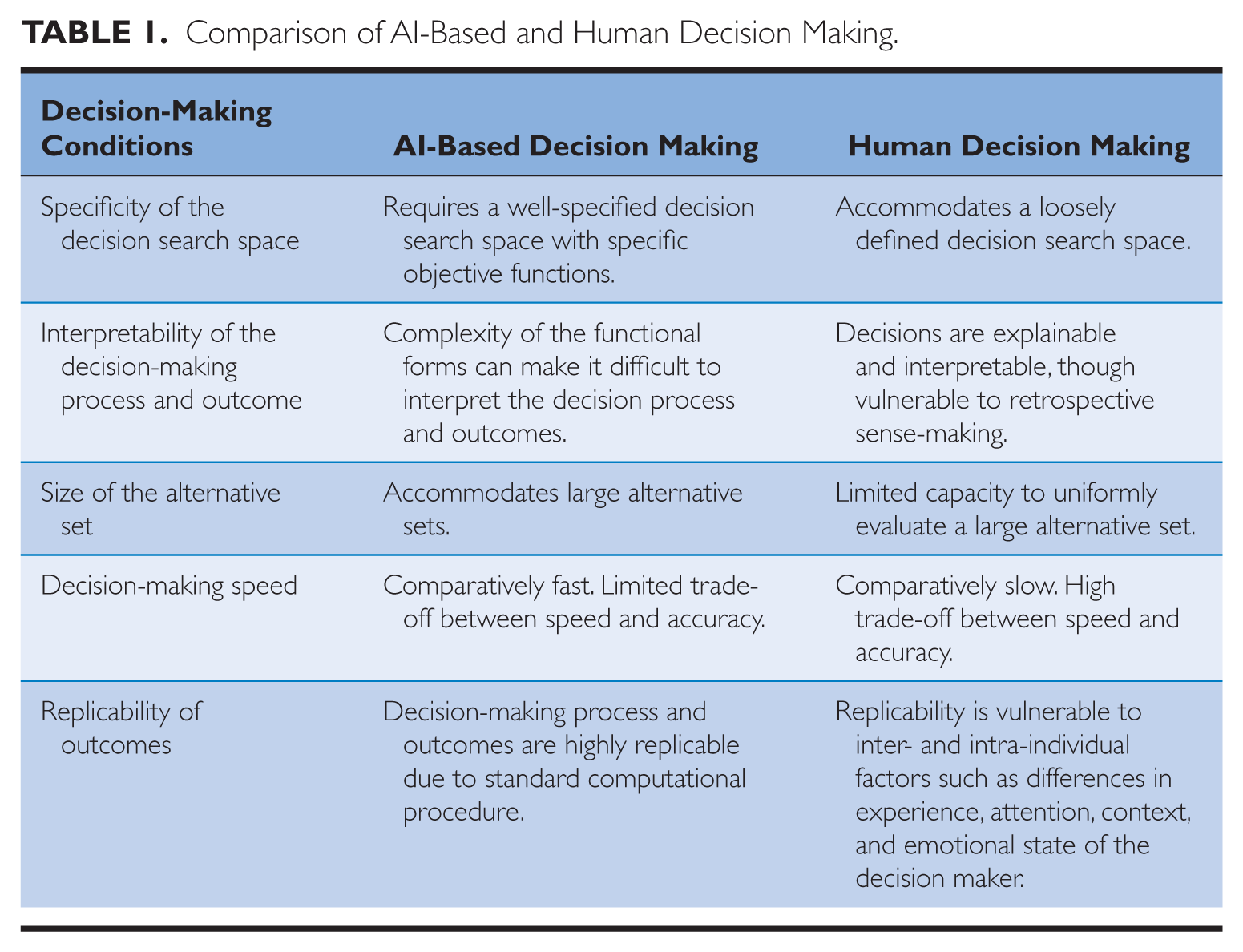
Before addressing the organizational structures through which human and AI-based decision making can be combined, we compare their characteristics along five key decision-making conditions: specificity of the search space, interpretability of the decision-making process and outcome, size of the alternative set, decision-making speed, and replicability. Table 1 summarizes the characteristics of human and AI-based decision making along these conditions.
Comparison of AI-Based and Human Decision Making.
Specificity of the Decision Search Space
Because AI algorithms make decisions based on computational optimization, the “space” wherein the decision is searched needs to be carefully specified and restricted in terms of the objective function. Consider, for example, an AI algorithm designed to propose to human decision makers the “best” candidate from a set of applicants. This process demands a specific definition of the desired qualities and characteristics that need to be optimized—such as a candidate’s predicted long-term productivity after hiring and sociability with other team members—as well as a set of variables that should be considered for selection, such as the candidate’s education level, age, and domain of expertise. Today’s AI technology is limited to well-structured (modular or “decomposable”) decision objectives and is thus often referred to as “narrow” or “weak” AI. While Artificial General Intelligence—a “strong” version of AI capable of performing any type of decision—has drawn substantial research attention in recent years, experts agree that this technology will take several more years to mature and achieve the desired level of accuracy. 11 Human decision makers, in contrast, can exercise judgment and intuition in decision making and can thus address ill-structured decision objectives—often with counter-intuitive decision decompositions. As a result, decision making by humans may be difficult to explicitly describe (code) by an objective function. 12 In the hiring example, a human decision maker may “intuitively” base their decision on a set of tacitly held preferences (e.g., fit of the candidate with the organizational culture) without being able to explain why and with what weights such criteria were considered. 13
Interpretability
Current AI algorithms typically identify patterns in data using automated search processes that result in an optimal prediction model. This search-for-patterns process usually involves so-called local optimization techniques (e.g., stochastic gradient descent) 14 where an objective function is incrementally optimized at each step of the algorithm. However, such procedures do not provide a holistic explanation of how AI arrives at its decision. Moreover, as the entire procedure is automated, identified patterns and models can have extraordinary complexity.
In our recruiting example, a well-performing model could have learned that the value of the variable education to the power of five interacted with the candidate’s age to the power of nine is an important predictor of sociability. Because such a pattern would have emerged without any explanation and is thus difficult to interpret, AI algorithms are often referred to as “black box” models. The lack of interpretability of AI-based decision-making algorithms makes it difficult to identify biases embedded in the algorithmic process, and consequently, generate trust in AI-based decision outcomes. 15 This is particularly problematic in applications of deep learning algorithms, which typically combine the behavior of single nodes in hundreds of layers of neural networks. The opacity of algorithms also leaves AI-based decisions vulnerable to concealed tampering and adversarial attacks. 16
Human decision makers can more readily backtrack their reasoning steps and provide explanations and justifications for why they made a certain decision. Yet, while explanations or narratives of decision-making processes may be more comprehensible, they may not always be accurate, truthful, or comprehensive. 17 For example, when asked why a certain job candidate was selected, human decision makers may find it difficult to disentangle the set of factors they considered. Indeed, there exists robust evidence that human decision makers are prone to provide distorted retrospective accounts of situations and decisions and hold biases that are relatively inaccessible to others. 18
Alternative Set Size
Because AI-based algorithms use an automated search for the best fitting model, they can be used to evaluate the same set of objective functions uniformly and consistently over millions of alternatives. For example, once it is defined what constitutes the “best” candidate, the same criteria can be autonomously and efficiently evaluated over millions of applicants. Human decision making is limited by cognitive constraints that make it practically impossible to uniformly process large numbers of alternatives. When a large number of seemingly equivalent alternatives are available, human decision makers quickly become overwhelmed with the multitude of potential outcomes and the inherent risks that may result from making the wrong choice (“choice overload”). 19 A larger alternative set increases the likelihood that the decision maker will make the wrong choice—leading to cognitive dissonance, a state of mental discomfort where the decision maker holds multiple contradictory beliefs. 20 An overload of alternatives might also result in an inability to decide (“paralysis by analysis”). 21
Decision-Making Speed
Advances in computing hardware—particularly in general processing units and tensor processing units—and efficient algorithms have enabled AI-based decision making to occur at a near-instantaneous speed. 22 This algorithmic feature has made great impact on decision making in high-velocity contexts, such as high-frequency foreign exchange trading. The need to make speedy decisions can be detrimental to human decision-making outcomes. 23 Under high time pressure, decision makers often utilize heuristics to overemphasize some and ignore other information, leading to a speed-accuracy trade-off. 24 Indeed, Kahneman distinguishes human decision making into System 1 thinking—fast, intuitive, automatic, unconscious, and effortless—and System 2 thinking—slow and deliberate. System 1 makes decisions quickly by relying on heuristics such as associative thinking. Therefore, decision making in high-speed environments that activates System 1 can be subject to substantial deviations from reality and be vulnerable to systematic errors. 25 Researcher have also discovered an inverse relationship between the amount of time it takes to deliberate on a decision and a decision maker’s confidence in that decision. 26
Replicability
AI algorithms follow standard and non-ambiguous—yet relatively inflexible—decision processes that provide consistent outcomes given consistent inputs. 27 Human decision making, in contrast, involves inter- and intra-individual variance in experience, attention patterns, emotions, and information processing that influence the type of information individuals attend to, encode, and retrieve when making decisions. Such idiosyncrasies make replication of results highly problematic. 28 For example, psychology research has shown that decision fatigue may lead to deteriorating quality of decisions as an individual’s mental energy is gradually depleted, 29 and research in cognitive science and neuroscience has shown that emotions constitute powerful and sometimes unpredictable factors in decision making. 30
Combining Human and AI-Based Decision Making: Three Decision-Making Structures
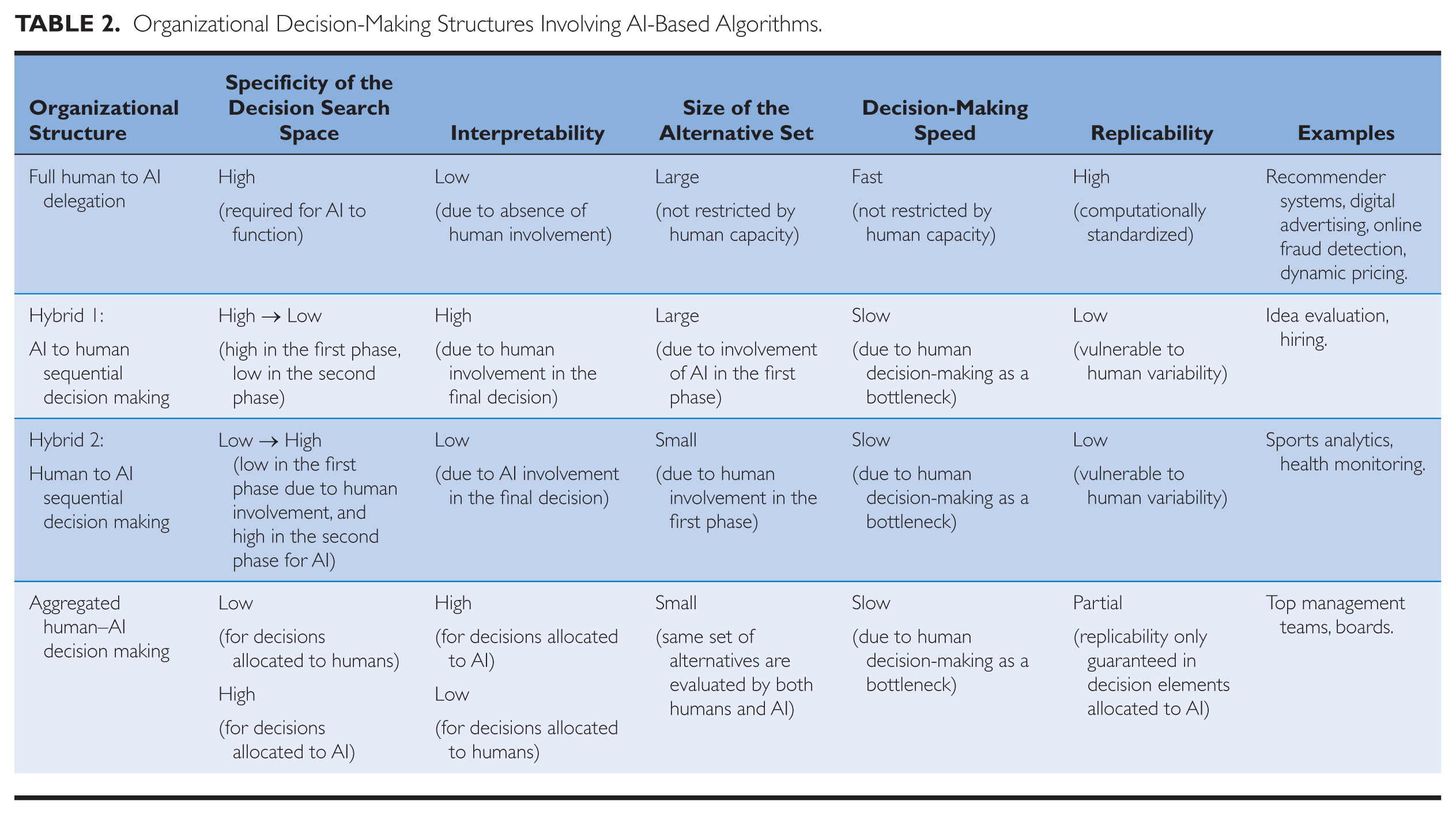
Based on our comparison of human and AI-based decision making, we provide a framework that outlines how both modes may be combined to optimally benefit the quality of organizational decision making. Our framework (see Table 2) comprises three structural categories: full human to AI delegation; hybrid—human-to-AI and AI-to-human—sequential decision making; and aggregated human–AI decision making.
Organizational Decision-Making Structures Involving AI-Based Algorithms.
Full Human to AI Delegation
In designs involving full delegation of decision making, AI-based algorithms make decisions without human intervention—similar to organizational settings where managers delegate decision-making authority to human experts. Human decision makers, however, still retain responsibility for the decision. Full delegation is particularly useful in decision-making scenarios where the decision search space is specific and restricted, interpretability of the decision-making process is less important than the accuracy of the prediction, the alternative set is large, decision-making speed is critical, and replicability of decision outcomes is desirable.
While pure forms are still limited, current applications of full delegation to AI include traffic planning, real-time product recommender systems, dynamic pricing (e.g., pricing in airlines and hotels, high-frequency trading), and online fraud detection. In all of these examples, algorithm designers can accurately specify a concrete objective function. For example, recommender systems—such as those used to recommend products (e.g., Amazon) or streaming video (e.g., YouTube and Netflix)—are designed to maximize consumer engagement, sales, and ad revenues, while fraud detection systems are designed to detect unexpected activity and minimize losses. To perform these objectives, AI-based algorithms instantaneously scan and evaluate millions of data points for millions of users—a process that would be practically impossible with human involvement. Stability in the data generation process and the possibility to specify and restrict the decision search space is necessary for the AI-based decision-making algorithms to perform accurately. As the aggregate patterns of the behavior of many users do not change radically over time (while that of some users can), AI-based systems are able to predict preferences of classes of users at scale with high accuracy.
The premium placed on decision-making speed and optimization of the objective function typically involves a trade-off with human interpretability. Recommender systems, for example, can be designed to improve themselves without a human designer’s understanding of the mechanism underlying the improvement. Using large amounts of data on granular user interactions and instantaneous feedback from user of digital platforms enable AI algorithms to learn user behavior such that decision-making efficiency and accuracy increase over time. Recommender systems can improve their performance (e.g., user engagement, profit maximization) by allowing machine-learning algorithms to automatically identify a set of features (e.g., placement order or suggestions) that influences the algorithm’s performance. The algorithm then experiments by tuning (i.e., increasing or decreasing) those features and observing their influence on performance—a process that involves techniques such as randomized confirmatory tests and user experiments. 31 Similar conditions apply to real-time dynamic pricing in the airline and hotel industry, ad auctions, and high-frequency trading—where the speed of bidding and/or buying is critical. In all of these settings, human involvement would induce a debilitating delay in decision making and, most likely, reduce decision-making quality.
Full human to AI delegated decision making also involves several critical limitations. Studies have shown that machine-learning algorithms can acquire and replicate implicit human biases toward race and gender from the online textual data they use to derive insights and inform their decisions. For example, scholars have documented how popular online translation systems—which perform natural language processing using statistical machine translation (SMT)—construct gender-stereotyped translations from gender-neutral languages. To illustrate, Caliskan and colleagues note that Google Translate translates the Turkish gender-neutral “O bir doktor. O bir hemşire.” to these English sentences: “He is a doctor. She is a nurse.” 32 In a similar way, search engine results, Google’s autocomplete function, and Facebook ads have been shown to embed hateful query suggestions and negative biases against women of color, religious groups, and the poor. 33 These examples show that, left unchecked, AI-based decision making may not only perpetuate but amplify cultural stereotypes and discrimination. 34
In addition to these concerns, organizational structures with fully delegated decision making may come under scrutiny due to the design ethics of managers and computer engineers. Indeed, minimizing harmful outcomes of automated decisions require ethical choices in the objectives of the algorithms, data collection methods, data cleaning and pre-processing, feature selection, simulation of algorithm behavior, and data representation. As recent examples show, algorithms designed with the narrow objective of maximizing user engagement and ad revenues can expose users—and society at large—to dangerous vulnerabilities and harmful consequences for public well-being and democracy. As a case in point, YouTube’s recommender system has come under fire for steering users to misleading material and inflammatory videos. Such content—while optimizing viewers’ attention, engagement, and consequently, the company’s ad revenues—have been linked to radicalization of viewers and divisiveness. 35 Similarly, research has shown that the personalization algorithms that curate and filter newsfeeds on social media platforms such as Facebook and Twitter and news aggregators such as Google News have contributed to a dynamic in which users are increasingly exposed to less diverse points of view. 36 The creation of such “filter bubbles” or “echo chambers” has been argued to foster perilous polarization and the spread of misinformation in society. 37
Addressing these concerns requires the joint efforts of policy makers, the academic community, business leaders, and designers of algorithmic decision-making systems. Such efforts begin with the realization that managers can delegate authority to AI, but not responsibility. Thus, to reap the benefits while minimizing the risks of full delegation to AI-based decision makers, business leaders should both develop an understanding of how emerging legal frameworks such as the European General Data Protection Regulation (GDPR) may affect algorithmic quality, fairness, accountability, and transparency and take a proactive stance in ensuring the ethical design of algorithmic decision making. Such efforts include adopting novel solutions for debiasing data and contributing to the development of new methods for fair, accountable, and transparent algorithms. 38
Hybrid Sequential Decision-Making Structures
Hybrid decision-making structures concern organizational designs where humans and AI-based algorithms sequentially make decisions such that the output of one decision maker provides the input to the other. 39 Hybrid structures enable organizational designers to benefit from the strengths of both human and AI-based decision making, yet may also amplify each other’s weaknesses. We next consider two stylized hybrid structures: algorithmic decisions as input to human decision making and human decisions as input to algorithmic decision making.
Algorithmic decisions as input to human decision making
This structure consists of two phases. In the first phase, AI-based decision making is applied to the initial set of alternatives. AI functions as a filter that rejects redundant or inappropriate alternatives and passes a subset of suitable alternatives to the second phase in which a human decision maker selects from these alternatives. Placing AI-based decision making in the first phase allows human decision makers to effectively handle situations involving a large set of alternatives. This structure is analogous to the process whereby expert advisors offer recommendations on a set of alternatives to a decision maker with authority over the final decision, allowing decision makers to exercise discretion with respect to whether or not they take an expert’s advice into consideration. 40 Similar to the full delegation design, effective functioning of AI in this structure requires specificity in the decision search space. While human involvement renders the decision more interpretable, the decision-making process loses replicability and speed.
This structure finds applications in crowd sourcing contests, healthcare monitoring, hiring, and loan application assessment. Crowdsourced innovation contests, for example, enable firms to involve large groups of individuals from outside the firm in the search for solutions to its problems. 41 By formulating a problem and broadcasting it to the crowd, firms can attract a diverse set of solutions. In so doing, the cost of problem-solving shifts from generating solutions to evaluating and selecting solutions. Sifting through a large set of solutions is tedious, time consuming, and costly. Using AI to categorize solutions, differentiate among various alternatives, and suggest a narrower alternative set allows human decision makers to evaluate solutions more efficiently. Moreover, for each decision, the algorithm can be configured to calculate and inform the confidence level of its suggestions.
Similar to the full delegation structure, designs in which human decision makers rely on the inputs of AI-based decision-making algorithms are vulnerable to certain errors and biases. Importantly, AI-based decisions involve the risk of omission errors in which viable alternatives are discarded (false negatives). Because rejections are automated, discarded alternatives remain concealed from human decision makers. Moreover, given that AI-based selection decisions are trained on prior human decisions, rejections are prone to reproducing institutional and systemic biases that subsequently feed into human decisions. For example, an AI recruiting tool developed by Amazon to identify promising job candidates was found to output decisions biased against women. Trained on résumés the company received over a 10-year period, the computer model learned to favor male candidates on the basis of the overrepresentation of male candidates in technical roles during that period. As a result, Amazon’s AI taught itself to penalize résumés from candidates from all-women’s colleges and other gender identifying content. Following internal and external condemnation, Amazon discontinued the project. 42 In another alarming incident, Angwin and colleagues found that COMPAS (Correctional Offender Management Profiling for Alternative Sanctions)—an algorithmic system used in U.S. courts to estimate the risk of recidivism and support bail and sentencing decisions—was biased against black defendants. As the tool’s error rates were asymmetric, black people were more vulnerable to be incorrectly labeled as higher-risk compared with white defendants. 43 Such examples call for caution with blind confidence in AI-based recommendations to human decision making in settings where the right for equal treatment and equal opportunities is at risk. 44
These limitations notwithstanding, researchers in machine learning have been actively working on developing AI systems that learn responsibly by making decisions only when its predictions are reliably aligned with the system’s objectives, considering both accuracy and fairness. Such algorithms enable a more reliable collaboration with human decision makers. For example, research has shown that designing an algorithm to learn to defer or choose to pass a decision on to a human agent can greatly improve the accuracy and fairness of an entire system. Researchers have also designed AI systems that when working in tandem with a human decision maker can adaptively learn to defer decision making depending on both its confidence in the model’s accuracy and the human decision maker’s expertise and weaknesses. 45
Human decisions as input to algorithmic decision making
In this structure, human decision makers first select a relatively small set of alternatives from a larger pool of alternatives, and then pass this set on to AI algorithms for evaluation and selection of the best alternative. This structure is effective in scenarios where human decision makers have high confidence in a small set of preferred alternatives, but the effective evaluation of this small set either requires the processing of large amounts of data and careful attention of decision makers over long period of time. This structure can effectively exploit the predictive capability of algorithms in situations where humans are uncertain about the best alternative out of the selected small set of alternatives. Because this structure relies on human decision making in the first phase, it is suitable for settings in which the size of the alternative set is small. AI-based decision making in the second phase requires high specificity of the decision search space. The optional involvement of human decision making as the third step allows for the final decision to be interpretable, yet as in the case of AI-to-human structure, this step reduces decision-making speed and replicability.
Billy Beane, the manager of the professional baseball team Oakland Athletics, adopted this decision-making structure for picking his players. 46 Baseball team managers traditionally rely on personal experience, instinct, and the knowledge of professional scouts and agents when choosing players. Billy Beane took a data-driven approach and applied the predictive power of algorithms to assist his decision making by first selecting a small set of potentially suitable players and subsequently verifying these candidates using massive quantities of granular performance data and algorithmic prediction. This approach became so successful that it was soon adopted in other teams and sports, growing into a field now known as sports analytics.
In health care, this structure finds application in AI-based monitoring of bodily functions (e.g., heart rate, temperature, blood pressure) in groups of high-risk patients so as to predict and detect risks of patients developing acute disorders. Because monitoring bodily functions requires the dedicated attention of medical professionals over long periods of time, it is an attractive setting for AI. Deep learning models process anonymized electronic health records and decide which potential emergencies clinicians should attend. 47 In a recent study, researchers used such an approach using AI-based computer vision to monitor patients in an intensive care unit. The system would automatically notify care providers when a patient was experiencing discomfort or had fallen out of bed. 48
Despite its many potential applications and benefits, this decision-making structure is vulnerable to most of the limitations discussed previously in the full delegation structure. Moreover, the lack of interpretability of the AI-based decision in the second phase can potentially deprive human decision makers from the opportunity to learn from past cases and events.
Aggregated Human–AI Decision-Making Structures
In this structure, decisions—or aspects thereof—are first allocated to human and AI decision makers based on their respective strengths. Human and AI-based decisions are then aggregated into a collective decision using an aggregation rule such as majority voting or (weighted) averaging. In this structure, the AI-based decision maker can be seen as a “member” of the decision-making group, whose decision counts toward the decision outcome. Aggregated decision-making structures can be designed such that human decision makers and AI-based decision makers focus on different or overlapping elements of the decision according to their strengths and weaknesses. In our hiring example, human decision makers may focus on more difficult-to-define factors, such as social fit, and leave it to algorithms to evaluate and predict more objective factors such as productivity—which requires querying specific questions over large amounts of data.
One scenario in which aggregation can be useful concerns decisions taken by investment committees. Consider, for example, Deep Knowledge Ventures (DKV), a Hong Kong based Venture Capital firm focusing on age-related disease drugs and regenerative medicine ventures. DKV formally appointed an algorithm named VITAL (Validating Investment Tool for Advancing Life Sciences) to its board. As the sixth board member, VITAL was given the right to vote on investment decisions. Unlike human board members, VITAL bases its decisions on a computational analysis of vast amounts of data covering prospective investment companies’ financing, clinical trials, intellectual property, and previous funding. Such an analysis involves observing and identifying the role of hundreds of variables and their interactions on investment outcomes and can capture elements of the decision space that are likely to be overlooked by humans. As a case in point, Dmitry Kaminsky, DKV’s managing partner, suggests that VITAL has played an important role in helping DKV’s board avoid irrational investment decisions in “overhyped projects.” 49
In contrast to hybrid decision-making structures—where there is high interdependence between the human and the AI-based decision maker—this structure allows AI-based and human decisions to be combined independently. In this way, the risk that human decision-making errors and biases are amplified by AI-based decision makers (or vice versa) may be minimized. Moreover, algorithms can find new applications alongside human decision makers to expose biases and errors incorporated in past decisions. 50 Such applications have the potential to turn algorithms into a powerful counterweight to human decision-making errors. Nevertheless, aggregating AI-based decisions with human decisions still exposes organizations to problems of transparency and reliability. For example, in the investment board example above, algorithms can be tweaked so as to output decisions in accordance with the preferences of those with the power to influence the algorithms functioning.
Conclusion
Designing organizational decision-making structures has long been a major concern for managers and organization scholars. The rapid advancement in AI is gradually establishing algorithmic decision makers as key organizational actors. The framework developed here provides a basis for understanding in what ways human and algorithmic decision making can be effectively combined to exploit the advantages of each approach and enable better decisions. This may have the potential to improve organizations if approached with prudence and diligence.
The framework emphasizes that in designing hybrid human–AI decision-making structures, managers should consider the specificity of the decision search space, the interpretability of the decision-making process and outcomes, the size of the alternative set, decision-making speed, and the replicability of decisions. In designing the most appropriate decision-making structure, managers are advised to map these five dimensions to the unique strengths and weaknesses of human and AI-based algorithmic decision making in terms of human’s judgment and interpretability and AI’s capability of alternative filtering and predicting with high accuracy.
Adding to the more familiar limitations of human decision makers, practitioners and scholars need to advance understanding of the implications of AI’s limitations for organizational decision making. First, there is a risk that AI is “fooled” into altering decision outcomes—either through the manipulation of the data it uses as input or through its design (e.g., by changing weights of predictors). These issues can be difficult to discover due to algorithms’ inherent opacity. Thus, inviting algorithmic decision making into organizations will require new regulation and procedures for auditing AI algorithms. 51 Encouraging developments in the AI community will conceivably deliver new techniques for enhancing the robustness and defenses of neural networks against biases and adversarial attacks. 52
Second, there is by now a vast body of evidence that AI-based decisions amplify human biases in available data. Bias and unfairness embedded in AI decisions are particularly detrimental to vulnerable groups in our society. Countering these grave concerns requires a stronger emphasis on the development of algorithms that can expose biases in data and human decision making, as well as collaboration between the AI community, legal practitioners, policy makers, corporates, and scientists to develop new measures for fair, accountable, and transparent applications of AI in organizations. 53
Third, introducing AI-based decisions into organizations becomes relatively effective when some level of transparency or interpretability of decisions can be achieved. Managers need to keep abreast of the developments in interpretable and explainable AI. 54 Finally, algorithmic decision-making skills remain highly specialized such that decision outcomes are often difficult to interpret. In introducing AI to organizational decision making, managers must build internal capabilities to decide on the inputs to the algorithm, the algorithms themselves, and the interpretation of predictions. Because AI technologies advance rapidly, organizations must remain vigilant to the strengths and limitations of AI in fully delegated and hybrid human–AI decision-making structures.
Our paper opens up a host of questions for further research. For example, how should performance be evaluated when decisions are partly taken by AI? What are the implications of algorithmic decisions for managerial responsibility? What are the implications of the different decision-making structures presented in our framework for organizational performance? How does the nature of the decision-making context influence the appropriateness of the various approaches? How can concerns regarding trust and accountability be alleviated in a world where AI becomes increasingly important in decision making? and How does the loss of decision-making authority to AI influence the motivation and performance of human decision makers? Addressing these and other questions will make managers and organizational scholars alike, better prepared for an unpredictable future.
Footnotes
Author’s Note
The authors contributed equally to this article. The authors thank Michael Haenlein and the three anonymous reviewers for their helpful comments.
Declaration of Conflicting Interests
The author(s) declared no potential conflicts of interest with respect to the research, authorship, and/or publication of this article.
Funding
The author(s) received no financial support for the research, authorship, and/or publication of this article.
Notes
Author Biographies
Yash Raj Shrestha is a senior lecturer and researcher in the Department of Management, Technology, and Economics at ETH Zurich (email:
Shiko M. Ben-Menahem is a senior lecturer and researcher in the Department of Management, Technology, and Economics at ETH Zurich (email:
Georg von Krogh is a professor and Chair of Strategic Management and Innovation in the Department of Management, Technology, and Economics at ETH Zurich (email: