



Abstract
Collaborations between established firms and startups are increasingly considered an ingredient of corporate strategy. This article describes a startup collaboration model that has emerged in practice, a model that complements today’s predominantly used engagement vehicles of corporate accelerators and corporate venture capital. Startup supplier programs are outside-in programs that enable firms to get access to innovations that increase competitiveness of products or productivity of processes by engaging with startups based upon supplier relationships. This article presents empirical data from companies that have run successful startup supplier programs, and it explores the firms’ reasons for implementing these programs, identifies key elements of startup supplier programs, and determines how firms can run them effectively.
Keywords
Outside-in startup programs have emerged as an important vehicle for established firms to access startups’ innovations. 1 More than ever, large firms are using corporate accelerators (CAs), a subset of outside-in startup programs, to get in contact with innovative entrepreneurial firms. 2 CAs are accelerator programs managed or sponsored by one or more established firms. 3 These programs offer cohorts of startups temporary access to mentoring, education, and company-specific resources. 4 Leading companies such as Microsoft, Coca-Cola, and Bayer run CAs.
Today, CAs seem to be the state of the art for engaging and collaborating with startups. 5 A closer look at these programs, however, reveals that they are not perfect. As CAs offer funding and mentoring to early-stage ventures, they compete for the best startups with professional, independent accelerator programs such as Silicon Valley’s renowned Y Combinator. While large and reputable firms are probably attractive enough to obtain enough applications to run an accelerator, many other firms struggle to fill their batches. 6
However, not all outside-in startup programs of established firms are organized as CAs. For instance, AT&T Foundry, AT&T’s venture unit, collaborates with startups on three-month projects with the objective of sourcing the startups’ technologies upon completion of the joint project. 7 Another example is the premium automaker BMW, which has established the BMW Startup Garage to facilitate supplier relationships with startups in order to become their venture client—a startup’s first paying customer. 8 The Spanish telecommunications provider, Telefónica, originally set up its venture unit Wayra as a CA but then adapted it to an approach similar to BMW’s and focused more on testing and integrating startups’ technologies and making them available for its core business. An important advantage of establishing buyer-supplier relationships with startups was seen in clarifying the expectations of both sides and reducing the risk of dissatisfaction and failure. 9
Indeed, the objectives of CAs can be very diverse, ranging from gaining access to a startup’s technology over exploring ideas, attracting talent, or helping startups to set up their businesses. 10 In contrast, the AT&T, BMW, and Telefónica programs have a clear focus on selecting, integrating, and developing promising startups as suppliers by facilitating direct collaboration with their internal departments, business units, or divisions. We therefore consider these programs as a subset of outside-in startup programs and term them “startup supplier programs.”
For startups and for corporations, startup supplier programs offer many advantages over the more prominent engagement vehicles, which are CAs and corporate venture capital (CVC). Offering a startup supplier program shows a corporate’s willingness to become a startup’s customer. It sometimes is difficult for startups to understand the true motives of established firms when starting a collaboration. 11 As observed by Shankar and Shepherd, “the predominant goal of entrepreneurial ventures is to find customers” 12 in order to grow their business. Having a paying customer helps a startup to build legitimacy through which it can attract further potential customers. The startup also retains its independence, which allows collaborations with other established firms and keeps the startup agile. In particular, acquisitions often destroy the product development capabilities of startups. 13 Finally, established firms can fully focus on the innovation transfer while leaving the educational part to professional and independent incubators, accelerators, and venture capital funds (VCs).
The only publication we are aware of which describes a startup supplier program and suggests that established firms should favor supplier relationships with startups over traditional corporate venturing approaches offers insights into BMW’s “venture client” model. 14 Our article builds on these ideas and contributes to the emerging startup supplier literature an in-depth analysis on how these new outside-in programs differ from the dominating CA model. In addition, by developing a universal stage gate process from empirical data of three startup supplier programs, we offer guidance on how firms can implement and run startup supplier programs. Consequently, this article helps improving established firms’ success rates of accessing and integrating startup innovations that increase productivity of processes or competitiveness of products.
About This Research
The empirical evidence we present in this article is drawn from a larger qualitative investigation of how established firms can partner with startups. In the course of this investigation, we identified three particularly innovative approaches of corporate-startup partnering that were clearly outside-in startup programs but not CAs. We decided to examine them more closely. Hence, the novelty of the programs was the major criterion for selecting the three cases. All other firms engaged and collaborated with their startup suppliers either via traditional corporate venturing approaches or via standard supplier structures and processes. To our surprise, all three programs overlap in their content, structure, and procedure—although the programs were developed independently. Besides novelty, another reason to study these programs was that all three firms shared their dissatisfaction with traditional corporate venturing approaches as their main motivation to develop new startup programs. Finally, although it is still too early to empirically (or even statistically) assess the effectiveness of startup supplier programs in terms of innovation impact, the established firms as well as the startups perceived the programs as particularly helpful to build a supplier relationship in a structured and systematic way.
All three programs are located in Western Europe. Two are rail transport service companies that are also major logistics service providers in and beyond their countries. One firm, that we call “LogisticsCo,” has a slightly stronger focus on logistics activities than the other firm, “RailCo.” The third company, “AutoCo,” is a leading European automotive OEM (original equipment manufacturer). All three firms established their startup supplier programs in 2015.
The primary data source pertaining to these three cases were 12 interviews, from which eight were conducted with established firm managers and four with startup employees. The semi-structured interviews lasted on average 65 minutes and were recorded, transcribed, and coded. To deepen our understanding of these programs and to triangulate our initial findings, we collected extensive archival data in the form of newspaper articles and press releases, which covered either specific startup collaborations or the corporations’ startup programs. In addition, we analyzed the companies’ startup-related websites. Table 1 summarizes the companies’ and their programs’ characteristics and the data we collected. Given the limited access to LogisticsCo’s and AutoCo’s managers, we could only collect data from multiple informants of RailCo. However, in the case of LogisticsCo we could interview two different startups that passed the program and we could analyze more than 140 pages of archival data. In addition, AutoCo’s startup supplier program had the most comprehensive website from which we could obtain supplementary information.
Overview of the Cases.
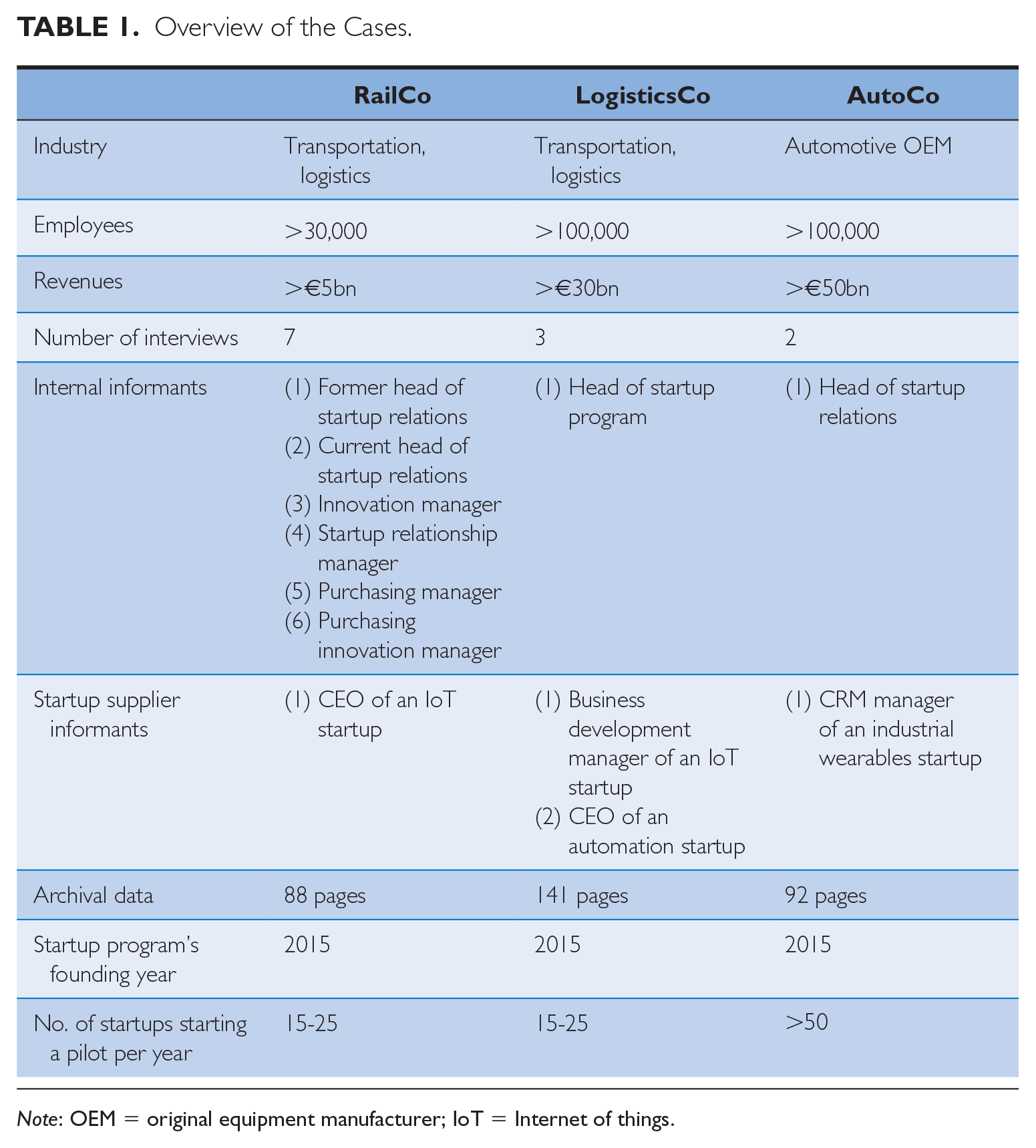
Note: OEM = original equipment manufacturer; IoT = Internet of things.
Why Corporations Need a New Model for Managing Their Startup Collaborations
The three firms we analyzed share the goal to benefit from startups’ innovations that help increase the competitiveness of products or the productivity of processes. They created a new approach to collaborate with startups, having realized that neither the traditional startup engagement models they used nor the standard structures and processes that they used for established partners were suitable for them. For instance, RailCo had a startup program that did not work. It had previously run an incubator-like organization, where startups had to move their business into a co-working space. In this space, startup founders and employees brainstormed and prototyped with some of RailCo’s innovation managers. This startup unit, however, was isolated from the company’s business units and dedicated to very early-stage products. When the startups then approached business unit managers with their ideas or prototypes, the managers were not willing to provide funding from their budget since they had no useful application for these products.
It is well-known that startups have difficulties at shifting their early user base, which usually consists of moving from technology enthusiasts who simply enjoy their product to real customers that buy their technology for economic reasons. 15 The gap between those two customer groups—innovators and early adopters on one side and the early majority on the other side—is so significant that Moore described this gap as a chasm. 16 Identifying strategies for crossing the chasm has become an important topic in the technology diffusion literature. 17 As the RailCo example shows, the chasm can also exist within a company. Technology enthusiasts are typically R&D engineers and innovation people who are working with startups on improving their technology while product and category managers who make the spending decisions are more pragmatic and risk-averse. The involvement of those decision makers is therefore crucial for generating significant revenues with a customer. Traditional startup engagement models usually do not address this problem, as the following example shows.
AutoCo ran its own CVC fund and participated in an accelerator program through which it collaborated with a couple of startups per year. However, AutoCo’s startup manager admitted that in recent years there had not been a single innovation from a startup that was supported by one of these two programs that could be integrated into AutoCo’s new car models. Consequently, this startup manager was critical of traditional startup collaboration models: If we as corporations continue to use only CVC and acceleration programs, then it will become very difficult for us [to integrate innovations]. I mean, CVC makes sense, for later-stage investments, if one invests heavily and not only as the fifth follow-up investor. . . . But for fostering the innovation potential in our core business not just for our cars but also for production and distribution, our [startup supplier] program is better suited. (AutoCo)
This manager could only remember one single startup that had become a supplier. The startup had not received CVC nor was it part of the accelerator program. Instead, it took the standard route through purchasing and became a supplier after a cumbersome and prolonged evaluation and approval process. Maneuvering through purchasing processes is particularly difficult for startups as purchasing managers request not only a track record of high quality and delivery performance, but also solid balance sheets, various certifications, or even documented risk management and escalation processes of the startup firm; all requirements that most startups cannot meet.
18
In addition, in most organizations, the purchasing department is not interested in contracting new suppliers as the reduction of the supply base is one of their major KPIs (key performance indicators). Supplier management-related processes are driven by regulatory requirements, which can delay projects substantially. Moreover, purchasing managers rarely participate in innovation or startup projects. Hence, they often simply do not know that it makes a huge difference for startups whether they receive a contract or an order today or in several weeks down the road: Our purchasing process is really slow. We first needed to clarify with [the startup] the contract details simply because we say that our terms and conditions apply and the supplier has nothing to say. . . . Then, operational procurement had to place an order which took around three weeks because [the startup] was not a listed supplier. . . . Then during the ordering process, our purchasing managers were not sure what type of order they had to put into the system, as it was a service in combination with hardware. (RailCo #3)
Besides the dissatisfaction with existing startup engagement models and the challenge of corporations’ rigid internal processes, all three companies recognized that they need to offer startups more than just another acceleration program. Although all three are large and reputable firms, they understood that competing with independent accelerators would be difficult. Instead, they recognized that they had to offer attractive startups something that other programs do not. As AutoCo’s startup manager explained, Why should a team of five smart Caltech students come to us? . . . it will be hard for us to build a team like the Y Combinator [leading accelerator] has and if we demand 5% of their equity then the best startups will definitely not come . . . we thought about it and concluded that we should not offer just another accelerator but position our program one step after an accelerator program. Then, the startups are still young, they still need to customize their products, and they still need a client. (AutoCo)
Seeing startups as potential suppliers constitutes a major paradigm shift, since business practice and the academic literature have traditionally ignored startups’ role as supply chain partners. 19 Instead, startup collaborations have been studied predominantly from a corporate venturing perspective. From this new vantage point, corporations consider startups as business partners that develop and deliver innovative technologies for which they receive market validation and money, not as funding but as revenue. The three companies we studied designed their outside-in startup programs to facilitate the formation and management of such asymmetric buyer-supplier relationships.
The Key Elements of Startup Supplier Programs
When comparing the three startup supplier programs with CAs, both approaches seem to share several important elements. For instance, startup supplier programs and CAs are short-term, engage startups in a joint project, and provide mentors from top management as well as relationship managers that belong to a dedicated startup function and support the startups throughout the collaboration. At the same time, there are some remarkable differences between these two types of outside-in programs in strategic scope, program content, and provided resources (see Table 2).
Key Features Distinguishing Startup Supplier Programs from Corporate Accelerators.
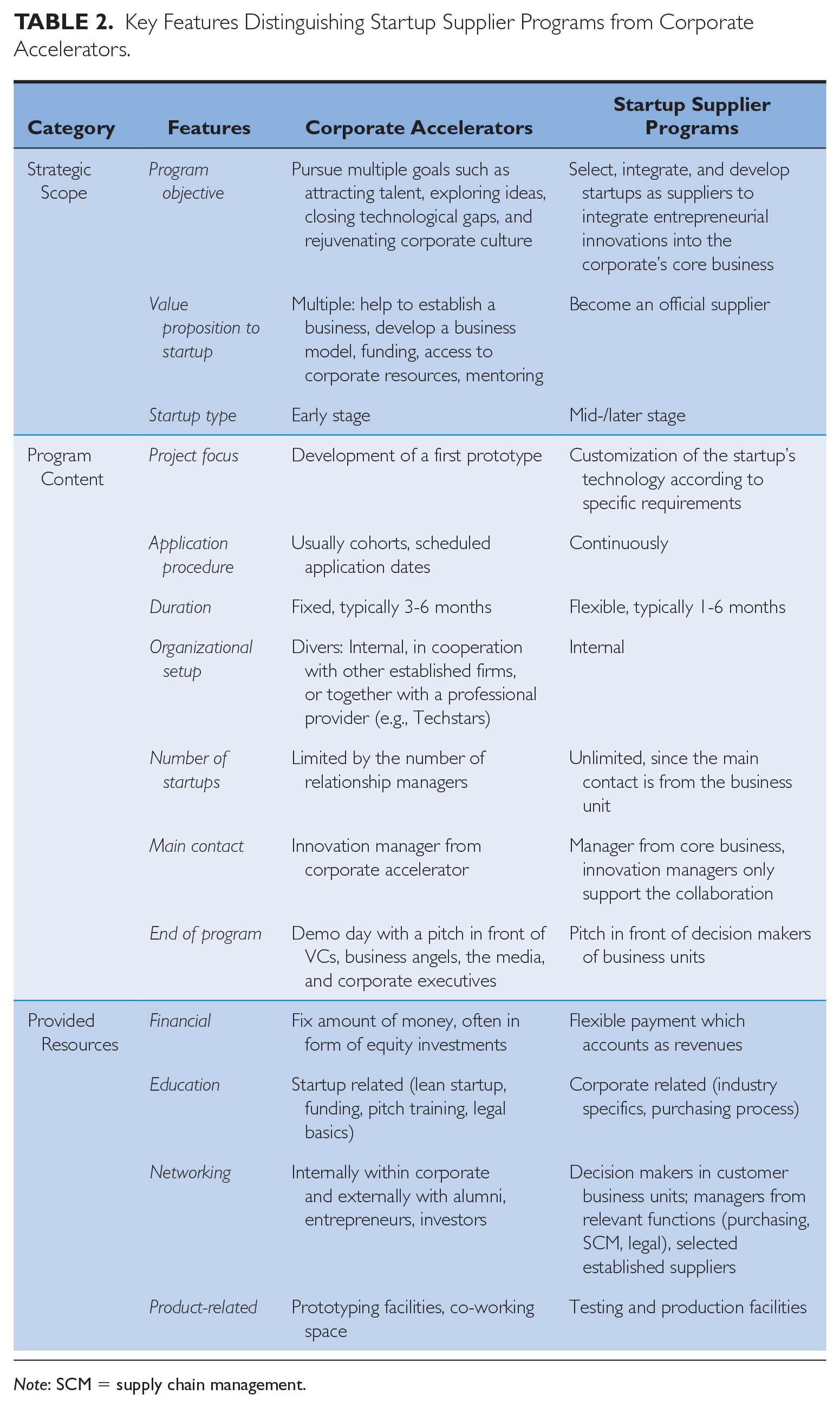
Note: SCM = supply chain management.
Strategic Scope
Startup supplier programs offer a path into the supply base outside the standard processes and regulations that can only be met by large, established suppliers. These programs are intended to integrate a startup’s technology into the corporation’s core business and test it in a real project. CAs also facilitate innovation transfer but their objectives seem broader. They are used to attract talent, explore ideas, and access early-stage innovations outside of the corporation’s core business. Furthermore, they help startups launch their business, establish legal structures, validate their business model, and connect them with potential investors. 20
However, CAs are not the only ones who pursue multiple objectives. Startups can also have a variety of expectations from their collaborations with corporations. Startups might want access to funding, distribution channels, support for product development, education and training, but also a committed customer. Many startups fail at clearly communicating their customer value proposition when engaging in a collaboration.
21
A startup supplier program facilitates the alignment of goals between parties as startups primarily expect to win a paying customer, as the following quote of one of LogisticsCo’s startup suppliers suggests: Our goal was to get a new customer and to gain experience in working with customers, and their goal was not to miss out on an innovation that could be useful to them.
Program Content
While both programs offer startups temporary joint projects, the content of these projects differs. During the acceleration project, startups are grouped in batches developing a first prototype, whereby innovation managers from the dedicated startup function as their main contacts. 22 At a demo day at the end of these projects, the startup presents its prototype to VCs, business angels, corporate representatives, and sometimes also the media or managers from other firms. The program may thus result in funding, a follow-up project with the corporation, or a new project with another firm.
Participants in startup supplier programs tend to be more mature, as advanced prototypes or functioning products are a prerequisite. In addition, the companies in our study prefer startups that have already completed an accelerator program and received funding from a VC. The pilot is thus more about customizing the technology, implementing the solution, and testing it for market fit. Therefore, startups’ main contacts sit in the business units where there is a need and where the product is integrated and tested. Startup relationship managers from the startup unit have a more supportive function.
Since the startups’ main contacts are in the business unit, startup supplier programs can potentially process significantly more participants than CAs where the number of innovation managers limits the number of collaborations. At the time of our interviews, only AutoCo was realizing this potential by starting collaborations with more than 50 startups per year. Startups present the results of the pilot in front of decision makers from the business units with which they have collaborated. These managers decide whether or not to purchase the technology. Hence, if they decide in favor of the startup, the startup is rewarded with status as a formal supplier.
In contrast to many CAs, external accelerator providers such as Techstars are not involved in startup supplier programs. Such professional accelerator companies possess valuable connections to VCs and know-how about startup development, but they can barely support established firms in finding a use case for a startup’s product in one of its business units. Managers within the business units usually have a better sense about where the problems lie and which technologies they need.
Provided Resources
There are also significant differences in terms of resources that the two types of outside-in models provide. For example, while startups receive a fixed amount of money from a CA,
23
startups participating in startup supplier programs receive a payment that is contingent on the startups’ expected development costs. In addition to financial support, training and coaching are a central element of many acceleration programs. Such educational sessions can also be part of startup supplier programs, but they are offered less frequently and only if a startup demands it. Moreover, their content is geared to instill a better understanding of a corporation’s internal processes or its industry. The following quote of a startup supplier that went through RailCo’s program summarizes a typical experience: The program provided all kinds of offerings like sessions with coaches, presentation trainings, etc. But we decided early on that we wouldn’t make use of these offerings. . . . They call another module “doing business with [RailCo].” This is also about exchanging ideas with other suppliers. [Through this module] we could build up our network and that’s where they really put a lot of emphasis on. That was the most important thing for us—building the network was really the big advantage. (Startup supplier of RailCo)
Furthermore, both programs support startups’ efforts to build a network within their organizations. In this way, startup supplier programs aim to provide contacts to key decision makers within the business units and within corporate functions that are responsible for managing supplier relationships such as purchasing and supply chain management. In addition, startups can be introduced to other suppliers that work on similar technologies and could become future business partners. On an interorganizational level, CAs try to connect startups with the startup ecosystem, consisting of other founders, business angels, and VCs. Hence, the networking is broader and less focused on supply chain functions. Finally, CAs offer resources that support startups’ prototyping activities. Resources therefore may also include access to equipment such as 3D printers. In contrast, participants in startup supplier programs require fewer prototyping resources. They might co-locate to the corporation’s site to test their products or to produce small batch series. To this end, the supplier programs offer testing facilities, tools, or production machinery.
A Stage Gate Process of Startup Supplier Programs
The three startup supplier programs we analyzed are similar in structures and procedures. The analysis of these programs reveals substantial similarities to stage gate processes that emerged in the mid-1980s with the objective of bringing more discipline to product development. 24 Their purpose is to break the product development process into stages (e.g., idea generation, development, and launch) and evaluation gates. At these gates, gatekeepers decide whether a project will proceed to the next stage. Stage gate processes possess several advantages such as providing managers with an overview of their innovation and product development portfolios and helping them to rank projects. Moreover, projects are evaluated more consistently and fairly as predefined criteria are applied to all projects. They also reduce the risk of putting too many resources into wrong projects as investments are low at earlier stages where the uncertainty is high. Given the overlap in program content, structure, and procedure of the three startup supplier programs we analyzed in our study, we can summarize the main stages and gates as shown in Figure 1.

Startup supplier stage gate process.
The startup supplier stage gate process consists of four stages and three gates. All three analyzed programs begin with the identification of promising startups in the market. It follows the first gate, where gatekeepers sort out all startups who miss certain quality standards or whose products do not fulfill the technical requirements. Managers of the startup program then connect the remaining startups with a division, business unit, or department that is interested in the startup’s technology. The gatekeepers of the second gate decide whether this match also represents a viable business case. Subsequently, the most promising startups enter into a pilot project with the goal to customize their technology to the buying firm’s requirements and to test it under real conditions. It follows the evaluation of the pilot where the gatekeepers, in case of a successful pilot, either decide to directly source the startup’s product or, in case further development is necessary, to begin a new product development project. If the buying firm decides to continue the relationship, it follows a transition stage in which the collaboration moves to the standard processes that are used for established suppliers. At each evaluation gate, not only the established firm, but also the startup can choose an alternative collaboration model (e.g., CVC, M&A, or joint venture), which provides both sides with flexibility.
Stage 1: Identification
In all three analyzed programs, a dedicated startup function is tasked with identifying attractive new ventures whose products, technologies, or services are aligned with their organizations’ strategic priorities. For instance, RailCo engages with new ventures that help streamline its internal processes, increase customer satisfaction, and make its main products more appealing to its customers. In general, the programs pursue two identification strategies: they screen the market for suitable startups, and then invite startups to submit innovation proposals through an application form on their website. The three firms even push startups that had been actively identified to apply via the central application form; having all contacts go through the same process ensures a uniform evaluation procedure. LogisticsCo, however, emphasizes the importance of complementing this passive wait-and-see strategy with an active search, as it currently does not attract large numbers of high-quality new ventures. A current startup supplier confirms this view: Without participating in the program, we probably would not have considered [LogisticsCo] as a potential customer, because we were very focused on the automation industry. It was rather a fortunate coincidence for us that they were interested in our solution. (Startup supplier of LogisticsCo)
LogisticsCo has several employees who regularly screen the market for promising new ventures. However, since these screening and scouting activities are labor-intensive and costly, all three firms use specialized external firms such as technology scouts, external accelerators, or VCs to find suitable startups. These intermediaries receive search requests from relationship managers for areas where these companies have gaps in their innovation and product development portfolios. These requests are based on discussions with the business units: We talk with the business units and ask them: What is your strategy? Where do you see an opportunity for an innovation project? Then, we turn this into a briefing for the screening partners. (RailCo #1)
Gate 1: Preselection
A startup’s organizational limitations and its lack of a track record make it challenging for established firms to apply their standard evaluation metrics to determine a startup’s current supplier capabilities. Entrepreneurial firms can hardly prove a stable financial situation or provide evidence of their prior delivery performance. Consequently, the three firms consider a startup’s potential to become a qualified supplier. LogisticsCo, for instance, developed a catalog of more than 30 criteria, including a startup’s legal situation, the credentials of the founding team, and whether the startup graduated from an accelerator program or received VC. The criteria differ substantially from evaluation criteria used for established suppliers that usually target a supplier’s quality, cost, and delivery performance. 25 Consequently, the studied firms emphasize that for the preselection process special skills are required that are not available in the purchasing department that is normally responsible for performing supplier selection contests. Instead, managers from the startup unit independently evaluate the applicants according to the criteria presented above. Most of these managers have gained experience in the startup environment working for startups, accelerator programs, or scouting firms. Finally, they merge the individual results and discuss the ranking. Only startups that reach a certain rating proceed to the next stage.
In contrast to LogisticsCo’s comprehensive list of evaluation criteria, RailCo applies only six criteria: the startup’s idea must fit the company’s strategic objectives; the business model must be scalable and ready for a collaboration; there must be a team of two to four founders; six months of funding must be secured; the new venture has been registered as a legal entity; and finally, the product must be almost fully developed. These criteria show that RailCo is interested in new ventures whose real business has already been established. As the former head of startup relationships puts it, [Our program] is not about showing startups how to develop a suitable business model or to teach them how they can raise money—we already expect that from them. The relationship managers rather help to establish a business relationship with our business units. . . . Basically, we see ourselves as a direct business partner, we are not an accelerator or an incubator. (RailCo #1)
Using such “hard” evaluation criteria quickly culls the number of startups for the subsequent stages and gates. After assessing the skills of a startup, the focus shifts to the technology it offers. According to our informants, startups only would be considered as suppliers if their offered technology holds the potential for the buying firm to achieve a substantial technological advantage over competitors to justify the higher risk of the collaboration. To evaluate whether the startup’s technology is significantly better than others on the market, R&D engineers analyze and test the offered technologies and compare them with solutions from established suppliers. The companies told us that they quickly adapt their evaluation criteria as soon as they recognize that startups with certain characteristics perform poorly during the pilot project. For instance, RailCo had several collaborations with startups whose products required significant development efforts, and not only customization and testing. During the pilots, RailCo recognized that co-developing technologies is not really one of their strengths; thus, RailCo adapted the requirements for startups entering the program to offer an “almost fully developed product.” This leaves enough leeway to work on exciting new technologies but puts a clear emphasis on customization and testing and not on co-development.
Stage 2: Internal Matchmaking
This second stage attempts to resolve a common issue in many startup initiatives: the gap between the startup unit and the actual customers (i.e., business units). A startup can become a supplier only if someone within the corporate organization is willing to pay for its product. Relationship managers from the dedicated startup unit usually manage this matching process. They search internally for potential use cases for the offered technologies. They then discuss the technologies with managers they see as most receptive to a collaboration and who have the authority to set budgets and to make spending decisions. The internal matchmaking stage is therefore crucial for the transition of the relationship from managers of the startup department who have been enthusiastic about the technology to managers of product groups or business units who are pragmatic and primarily interested in economic or strategic benefits. In general, the business units are keen to start collaborations with new ventures via the program since relationship managers bring 50% of the budget for the collaboration stage. The former head of RailCo’s startup supplier program underlines their importance for matchmaking: It takes a lot of effort to bring the startups’ ideas together with those of the business units. This is the main task of the relationship managers. They usually do not only manage one case, but two or three. Their work addresses the question how we set up a pilot, what budget do we need, what KPIs should we measure, whether it was a good or a bad pilot, contract negotiations, etc. With our team, we build a bridge between the startup and our company. (RailCo #1)
Gate 2: Market Fit
At RailCo, approximately 40 startups every year are allowed to pitch their innovations to the gatekeepers of the second gate; only 20 of them pass and start a pilot project. The head of RailCo’s new venture relations emphasizes that they could start many more projects but they prefer to scale up their program slowly in order to dedicate sufficient time to each collaboration. The pitches are held in front of a jury of gatekeepers from different areas of the company. Gatekeepers are senior managers from the business units, managers from corporate business development, and also functional managers from R&D or purchasing. Our informants stress the importance of inviting attractive startups shortly after their application, since otherwise the best of them tend to be already collaborating with other established firms and are then unavailable. RailCo’s internal objective is therefore to notify startups about its decision within four weeks. The main difference to traditional corporate venturing programs is that the only startups to proceed to the next stage are those that can convince at least one business unit to pay for their technology and to work together on a pilot project. In contrast to CAs, startups know that if they perform well during the pilot, the chances will be high to become an official supplier to the buying firm.
Stage 3: Pilot Project
An integral part of a startup supplier program is a short pilot project between a business unit and the selected startup from the pitch event. This project customizes a startup’s technology to the buying firm’s requirements and tests the technology under real conditions. For instance, in one pilot, one of RailCo’s startup suppliers tested whether its sensor system, which was originally developed for predicting downtimes of production lines, could also be used for measuring the conditions of RailCo’s rail infrastructure. The tests were performed during winter to gain experience in a harsh environment. The outcome of the test was negative. The system was significantly less reliable than promised. Consequently, RailCo decided to terminate the relationship after the pilot. This decision was not only triggered by the disappointing development status of the technology, but also by an increasing mistrust into the startup’s credibility. RailCo felt deceived by its younger partner who explained that the system was already running with another firm, which was apparently not true. Before RailCo introduced these pilot projects, it was very difficult to foresee the impact of a new venture’s product. In the words of one informant, When we started collaborating with startups, we spent months trying to figure out how a reasonable business case would look like. But our calculations have all been based on assumptions, not on facts. This was extremely difficult, since startups often operate in completely new business areas where we have no experience. That didn’t work well. Now, the process is designed to test something fast such that we can calculate a fact-based business case after the pilot. (RailCo #2)
It is clear that not everything can be tested in a few months; however, the time is usually sufficient to get an impression about the startup’s capabilities and whether the technology is applicable to a specific problem. Thereby, the pilot stage clearly helps reducing information asymmetries as it represents an opportunity to assess a startup’s capabilities directly. Information asymmetries are a common problem in innovation partnerships—particularly in startup collaborations, 26 because compared with mature innovation partners, it is more difficult for established firms to assess the value of the technology and the startups’ capabilities in advance. 27
Officially, this stage lasts between three and four months. However, the studied programs did not set a hard deadline for this stage. For instance, in LogisticsCo’s collaboration with a predictive maintenance startup, it took nearly six months to test the startup’s technology under real conditions. In contrast, a software application of another startup could be tested in only three weeks, so Gate 3 was rescheduled. This flexible timetable addresses one of the main criticisms of stage gate processes as too slow for today’s fast-changing business environment. 28
The projects are also designed to pick up new ventures’ speed. The contracting phase is relatively short. Since the technology will only be tested and customized but not co-developed, it is clear that the intellectual property (IP) fully belongs to the startup. Discussions about IP rights are a common reason for delays or conflicts in asymmetric partnerships. 29 To prevent startups from immediately selling the technology to a direct competitor, the case firms sometimes contractually prohibit collaborations with direct competitors for a few years or try to keep their younger partners busy by offering follow-up development projects. Our informants told us that because of startups’ limited resources, they know that startups often cannot handle multiple collaborations at the same time.
Another way to accelerate pace is that the project teams receive a budget and the power to provide resources without drawn-out approval processes. In addition to their contacts within the business unit, startups are supported by a relationship manager who puts the startup into contact with decision makers within the buying firm so that they can quickly build an internal network. Having such a “neutral” contact helps to obtain information more quickly, to resolve upcoming conflicts, or simply to accelerate certain processes. Nonetheless, besides this information, a pilot project makes it possible to observe other important aspects such as cultural differences between the two firms, which is an often-observed challenge in asymmetric collaborations. 30
Gate 3: Pilot Evaluation
At the third gate, the gatekeepers evaluate the pilot project and decide whether to directly source the product, to refine it in a joint development project, to access the innovation (not via a buyer-supplier relationship, but instead through licensing, a joint venture, or an acquisition), or to terminate the relationship altogether. In the case of RailCo, the gatekeepers are senior managers from the business unit that would become the customers of the startup. Other companies such as AutoCo involve additional functions such as the head of startup relations or related R&D and purchasing managers. LogisticsCo’s informant stresses the importance of evaluating the pilot from different perspectives.
Although the evaluation is very specific and depends on the content and outcome of the pilot, all three firms evaluate the maturity and the applicability of the technology. The insights from the pilot project can be used to ascertain whether the product is ready for series production or if additional development time is required. Sometimes, the pilot reveals that the product is better suited to another business unit. Then, a new project would be set up to validate the applicability of the product in that area. The other dimension that gatekeepers look at is the readiness of the startup itself. According to a manager at RailCo, In the beginning, it’s all about the product and the idea of bringing an innovation to the company, and at some point it shifts toward the question of how a startup can become a supplier. . . . If we want to order 400 cameras, then we would check in this phase whether the startup can do that . . . the relationship manager steps back and goes to the next startup and it was an important learning for us that we need to make the purchasing manager fit for working with startups. (RailCo #6)
Despite the extensive testing, there is still much uncertainty regarding startups’ capabilities. Operations, purchasing, and supply chain managers can help gatekeepers evaluate whether a startup will be able to deliver the promised value. With their experience, they can help to create a roadmap for preparing the startup for production and delivery.
Stage 4: Transfer into the Supply Base
We observed two common paths for startups that have completed the pilot project and passed the third gate into a corporation’s supply base. One path is for the established firms to directly initiate the sourcing process; the other path is to collaborate on a follow-up product development project, which then may result in sourcing. This product development project can also include other development partners. Other possible options include a complete acquisition of the startup, licensing the startup’s technology, or establishing a joint venture. However, these paths are less common and typically do not lead to a startup’s integration into the supply base.
Product development
In most instances, the pilots are not long enough to get the startups’ technology ready for sourcing. While startups frequently could prove in the pilot project that their technology can generally be applied to a specific problem or need of the buying firm, subsequent product development is still necessary. Our informants told us that the project team from the pilot manages the follow-up product development and coordinates with the startup the next steps to get its technology ready for series production. While most digital products can be used by the buying firm immediately after customization, the development and testing cycles for hardware products are substantially longer, especially if the technology will be used in a safety-critical area. For example, RailCo collaborated with a startup that had developed a special camera that combined several technologies to alert railroad engineers about obstacles on train tracks. During the pilot, it became clear that the camera needed to become better at identifying different signals and switches along the railway tracks; this entailed additional development effort from the startup. It is obvious that this technology needs to work reliably before it can be sourced. In addition, as suppliers, startups become members of a wider supply network where delays or disruptions can cascade down the supply chain, multiplying costs.
31
However, startups are often not aware of the consequences of being a supplier in a B2B context, as the following statement of LogisticsCo’s startup manager suggests: If they install their product and it breaks after three years, then I promise them, that they need to replace it at their expense, which starts at half a million—that’s how much it costs and we will get the money back. Then they often say, “Oh, I did not think about this at all.” It is definitely much easier with startups developing apps. (LogisticsCo)
As typical for collaborative R&D projects, we find that differing timelines, expectations, and goals are formidable barriers for these collaborations. However, with a stream of new startup projects, our case firms learned how to manage them. They became aware of the sometimes unrealistic expectations about the timeline of the development project. They also accelerated their own pace by setting up project teams with characteristics similar to those of startups. For example, the teams then consist of only a few people who are allowed to make their own decisions and only work on one project. In addition, through the joint pilot project, each side knew how the other side worked and arrived at a mutual understanding. There is usually a strong shared commitment to the project as the startup has already started to generate revenue at this stage and knows that it is possible to acquire a long-term customer. Conversely, the corporation’s team knows that it is collaborating with a very aspirational startup since it has already passed a long and thorough evaluation process. In addition, top managers from the business unit have formally decided in favor of this project. Therefore, the pilot seems to increase the likelihood that the follow-up product development project will succeed.
Sourcing
The second option for both partners is direct sourcing, where the corporation and its startup supplier prepare for the production ramp-up. A team that usually supports production ramp-ups of established suppliers manages this stage. However, with startup suppliers, this team has a much more active role. They receive support from managers who have already participated in the pilot and in the product development project, so they are familiar with the startup and its product. Simply ordering the startup’s product is not possible. As RailCo’s purchasing innovation manager explains, Our business units simply want to order. According to them, the startups themselves should take care of the certifications and production issues, etc. But in reality, it looks different. I have to do many things to push the startups to a certain level. They are simply not typical suppliers, from which we can just order something. (RailCo #6)
Since RailCo transports dangerous goods such as toxic and explosive chemicals, new ventures’ products that are integrated into its trains must acquire the same certifications and meet the same standards as established suppliers. RailCo’s managers initially did not blame themselves if startups failed to obtain the required certifications, but they quickly realized that this could considerably delay the introduction of new products. Many established buying companies already engage in projects to enhance the operational capabilities of underperforming suppliers. These supplier development programs are designed to improve suppliers’ operational productivity by applying strategies such as lean, six sigma, visual management, or just-in-time production. 32 Since startups have operational problems that established suppliers do not, supplier development programs need to accommodate startups’ special requirements. Instead of just improving their productivity, startups need to learn operational basics such as automating their production, integrating themselves into the customer’s ERP (enterprise resource planning) system, or handling their own supplier problems. Buying firms should therefore favor direct development activities where they commit resources to the startup such as on-site visits by the buying firms’ engineers or even temporary transfer of personnel, in contrast to just setting improvement targets and monitoring the startup’s progress, which is usually the first step of these programs. 33
Furthermore, in this stage, supply managers discuss with the startups the timeline of the ramp-up and operational KPIs such as service and inventory levels and delivery frequency. As purchasing managers from firms with startup supplier programs become increasingly familiar with such asymmetric supplier relationships, they do not expect startups to achieve the same operational performance levels as established suppliers. RailCo, for instance, plans the production ramp-up of its new camera supplier in a more gradual way than they would do with an established supplier: We cut the order volume into several pieces. We first wanted to see if it works before we order everything. We have also defined some additional options. This is a precautionary measure that we probably would not have made with an established supplier. (RailCo #3)
Conclusion and Implications
This study describes a new type of outside-in startup program that can help established firms to access entrepreneurial innovations. The three companies in this study developed their programs because of their dissatisfaction with and the low success rates of their other startup initiatives in transferring startup innovations into their core business. We synthesized the three analyzed programs into a startup supplier stage gate process. Dividing the collaboration into stages and gates facilitates the management of startup relationships and ensures that time and other resources are allocated only to the most promising startup suppliers, reducing the risk for resource misallocation and frustration with failed collaborations. This can also increase the organization’s acceptance of and commitment to startup collaborations. This kind of transparent collaboration strategy is also a valuable signal for startups. Established firms with a startup supplier program offer startups a highly attractive value proposition by giving them a fast track into the firm via a supplier relationship. While not every startup requires a corporate investor or mentor, every startup needs a paying customer. These programs deliver exactly this message, and help established firms to differentiate themselves from the competition. Besides these advantages, our investigation reveals three important implications.
Integrating Different Internal Startup Activities
This study has shown that established firms often run several simultaneous startup initiatives. The firms we interviewed offer one-day events such as hackathons, participate in accelerator programs, or are involved in CVC. However, before they established their startup supplier programs, these activities were only loosely integrated. The implementation of their startup supplier programs fundamentally changed the situation. The firms began organizing their other startup initiatives around their startup supplier programs. That way, their accelerator programs and CVC units could tap into an increasing pool of evaluated startups. With a portfolio of startup initiatives, the firms have the option at each gate to reroute the startups from one initiative to another. For instance, if a startup turned out not to be mature enough for the supplier route it could participate in the accelerator program. And startups that hold critical technologies for a firm’s core business could take the CVC route so that firms can secure proprietary access to these innovations. On one hand, this would naturally require a different organizational and legal setup but; on the other hand, the time for due diligence could potentially be reduced because both partners already know each other. A corporation’s VC fund could also be involved after the pilot when the established firm has gained more information about the potential of the startup’s technology. This should substantially improve the effectiveness of their CVC investments. Hence, startup supplier programs cannot replace more traditional startup engagement and collaboration models but rather complement, integrate, and reinforce them.
Preparing Purchasing for Its New Role
Another important implication of our study relates to the purchasing function and its role in startup collaborations. So far, purchasing has not been considered as particularly relevant for the success of startup collaborations. However, since startup supplier programs use a “purchasing process” to benefit strategically from startups and provide an additional path into a firm’s supply base, purchasing seems to have a reasonable role in this process. The three firms in our study were still experimenting with the best way to involve purchasing. A major issue seems to be the lack of know-how, since innovation collaborations and especially startup collaborations are not part of most purchasing managers’ everyday routine. 34 Firms in which purchasing has a more active role in innovation projects seem to face fewer challenges. For example, AutoCo has special innovation groups within purchasing that regularly participate in supplier innovation projects. Therefore, they were assigned responsibility for the startup. They attend meetings and pitches, support the project team and the gatekeepers, and lead preparation for the startup from the sourcing stage and manage the transition to the sourcing team. In all three firms, there has been a shift in thinking about this issue. The informants agree that purchasing needs to give startups enough time to improve, and that it should actively support them. For instance, supply managers at LogisticsCo explain to the startups’ employees how orders should be processed and what to do when a delivery is delayed. These are typical operational tasks, which are routine for established suppliers. However, for startups, even these simple tasks are new, so that buying firms’ supply managers can have a major impact on how rough or smooth the sourcing process is. Involving purchasing into startup collaborations early on seems to be an effective measure for overcoming the chasm problem ensuring that established firms will not become late majority customers or even laggards in adopting innovative technologies. 35
Fostering Exchange with External Entrepreneurial Ecosystems
There is intense competition for the best startups. In addition to corporations competing for partnerships with startups, independent accelerators and VCs compete to provide the funding. The firms analyzed here explained to us that avoiding competition was a strong motivation for establishing startup supplier programs. Their programs are positioned one step after a typical accelerator program, focusing on startups that have already set up their organizational structures and processes with technologies that are (almost) ready for the market. Hence, they leave the educational part largely to the professional startup support system and might even require startups to have previous experience in an accelerator program. In this way, they not only avoid competition, but they even profit from the startup ecosystem by engaging with more skilled startups that have the time to focus on developing and customizing their technology.
These external partners are open for collaboration as our analyzed firms also contribute to the ecosystem. Most importantly, by granting a supplier status to startups, their market value can increase substantially, which improves the overall valuation of VCs investment portfolios. Our case firms also invite members of the ecosystem to attend pilot presentations, where they acquire in-depth information about the state of a startup’s technology and its ability to collaborate with customers. In turn, members of the ecosystem (e.g., VCs) might provide established firms with information about other suitable startups or the most recent technological developments in international startup hubs. In addition, our study shows that established firms use a large set of different members of the startup ecosystem as intermediaries for startup identification. During the screening stage, firms consult scouts, accelerators, or startup events to receive proposals for promising startups. These actors are proud to have “their” startups acquire an established firm as their customer. In general, startup supplier programs improve a firm’s visibility to external startup ecosystems and help firms to participate and exchange more actively with the most important players.
Footnotes
Acknowledgements
We are grateful to four anonymous reviewers for their helpful comments and suggestions on earlier versions of this article. We also acknowledge our expert informants for their valuable contributions.
Notes
Author Biographies
Stefan Kurpjuweit was a Research Associate at the Chair of Logistics Management, Swiss Federal Institute of Technology Zurich (ETH Zurich), Switzerland, and is now a Business Development Manager at ABB, Switzerland (email:
Stephan M. Wagner is Professor, Chair of Logistics Management, and the Faculty Director of the Humanitarian Operations and Supply Chain Management Lab, Swiss Federal Institute of Technology Zurich (ETH Zurich), Switzerland (email: