



Abstract
Shared beliefs on digital readiness among management and employees are a precursor to successfully guide and implement organizational change. There is, however, little examination of how digital knowledge and skills are distributed among managers and employees, or whether their perceptions of digital readiness systematically differ. The findings of a survey of the banking industry reveal that, while there are similar perceptions of attitude and empowerment toward change, perceptions of individual readiness, competences, and innovation barriers differ significantly. This research advances the framework of change readiness toward digital readiness with theoretical as well as practical implications for digital transformation management.
Keywords
The expansion of digitalization is ramping up and putting pressure on established firms. Nowadays, companies have to deal with the disruptions emerging from digital technologies, rethink their business models, and get ready for change. 1 The pressure of change is heavily felt in the financial services sector, as business press headlines illustrate: “The Blockchain Will Do to the Financial System What the Internet Did to Media.” 2 JPMorgan Chase CFO Marianne Lake states: “We are a technology company.” 3 Yet retail banks are struggling to transform the economic model of a branch with human and machine-assisted capacities. 4 At the same time, global investment in fintechs has been growing, reaching $135.7 billion in 2019 with 2,693 deals worldwide. 5 These facts show that the core nature of banking is changing at an accelerated pace. 6 One highly visible implication of this development has been a significant loss of jobs in the banking industry. This development is likely to continue and also to affect the perceptions of employees on issues related to digital transformation.
Banks need to rethink their client interactions, especially in the light of occurring crises, and redefine their operations as a holistically digital enterprise. 7 However, not all banks are well prepared for digital transformation. 8 More precisely, they have difficulty changing from a traditional bank into a digital bank, where banking mainly occurs via the Internet, mobile, and other social media channels, processes are automatized, and robo-advisors are used to support customer interactions. In order to master such a transformation, banks need to get ready and prepared. A bank’s “digital readiness” refers to both the readiness of their people 9 —in terms of positive beliefs, knowhow, and skills, for example—and the readiness of their organization 10 —in terms of capabilities like budget restrictions, organizational capacity, leadership buy-in, or innovation culture, for instance—to manage the necessary transformation. There is evidence that digital readiness positively influences company success 11 and that organizations have to be ready as well as their managers and employees. A deeper understanding is needed of the differences in perceptions between managers and employees and within management levels to guide and implement the required organizational change successfully. 12
This article explores the characteristics of and differences in the perceived digital readiness of managers and employees on an individual and organizational level. The empirical study focuses on the financial services industry in the DACH region, surveying 111 members of commercial and cooperative banks. Of the bankers participating, 56.8% hold a management position and 43.2% declared themselves as employees.
The findings reveal that there are similar perceptions between managers and employees of attitude toward change, digital empowerment, and digital involvement. Perceptions of individual digital readiness, however, significantly differ. Managers feel less prepared to meet the new requirements, though they perceive themselves as digitally more skilled than their employees perceive themselves. Employees also feel more concerned about innovation culture, monetary restrictions, and reaction speed. The results further demonstrate that there are significant differences in perceptions of digital readiness between the distinct management levels. Middle and lower management members are falling behind compared with top management in regard to their attitude, involvement, knowledge, and skills. Furthermore, middle and lower management levels are more skeptical compared with top managers about the organizational digital readiness of the firm.
Overall, managers have to be aware that their perceptions may not resonate with the employees’ perceptions. Having this in mind, they can adapt better strategies, manage expectations accordingly, address discrepancies, and identify and tailor digital training needs. The practical implications from the encountered results suggest that managers may need to provision trainings to build employees’ digital skills, offer enough opportunities for actively taking part in the digital transformation, set up extra meetings with lower and middle management, and also work on organizational capabilities to overcome cultural barriers and speed up the transformation process.
Theoretical Background
Successful transformation of a company in the digital age requires strong change management and a sound understanding of digital readiness. This is important in order to make the right decisions, elaborate and manage an adequate change plan, and take all the necessary action to guide the organization and its employees through the transformational journey.
The Concepts of Change Readiness and Digital Readiness
Given that digital transformation and the inherent change in organizations necessitate an individual’s readiness to practice a new behavior, our research is framed around the concept of digital readiness. The concept of digital readiness is based on and further elaborates the concept of change readiness. In the transformation and change literature, distinct perception and change theories can be found that contribute to the explanation of the nature of change. 13 They demonstrate how change can be encouraged and facilitated for long-term success.
Successful implementation of change generally proceeds through three stages: readiness, adoption, and institutionalization. 14 Readiness refers to the state of being fully prepared for something. It reflects the level of preparedness to execute a desired action or achieve the intended outcome, change, or state. In regard to change, readiness occurs when the environment, the structure, and the attitudes of the organizational members are receptive to the forthcoming change. Adoption occurs when the organizational members temporarily alter their attitudes and behaviors to conform to the expectations involved in the change. Institutionalization occurs when the change becomes a stable part of employee behavior. 15
Kaplan and Norton 16 explain the concept of readiness as the extent to which organizational assets, processes, and activities indicate that the organization is ready to move from a current state to a new desired state. The organization and those involved should be individually and collectively primed, motivated, and technically capable of executing the change. This means that organizations have to have the processes, structures, and tools in place that allow them to execute it. At the same time, individuals’ readiness matters, as it is a precursor to an intended behavior. For managers and employees alike, it implies that they feel prepared to adopt the desired behavior. 17
From change readiness to digital readiness
Digital readiness represents a specific change scenario where digital technologies play a major role. Thus, it may be interpreted as a context-specific operationalization of change readiness, adding certain tech-specific challenges, attitudes, and capabilities. The digital aspects include changes that are necessary for organizations and individuals to make use of digital technologies and developments like artificial intelligence and data analytics, blockchain, chatbots, or the Internet of things, and to develop a positive attitude toward these technologies.
Individuals must perceive themselves as being capable of meeting the expectations and of fulfilling the job tasks that the digital transformation requires. 18 Digital transformation includes people’s knowledge of digital business models and digital technologies as well as their skills to embrace and use new digital technologies in their jobs. 19 Lack of digital skills is frequently cited as a major hurdle to the success of digital transformation. 20 Digital competence can be broadly defined as the confident, critical, and creative use of information and communications technology (ICT) to achieve certain goals. 21 Ferrari 22 provides an overview of five areas that should be taken into account when determining one’s digital competence: information management (e.g., analyzing digital information and judging its relevance and purpose); communication (e.g., communicating in digital environments and collaborating through digital tools); content creation (e.g., creating and editing new content); safety (e.g., data protection and security measures); and problem solving (e.g., solving conceptional problems through digital means).
Digital readiness framework
Based on the change readiness framework of Holt and Vardaman, 23 and in combination with Ferrari’s areas of digital competences, 24 we propose the digital readiness framework (see Table 1) to describe individuals’ as well as organizations’ digital readiness in more detail. Our digital readiness framework consists of two dimensions and two levels. The dimensions are difference factors that relate to an individual’s beliefs and to characteristics of those being asked to change; and structural factors that relate to circumstances under which the change occurs, firm members’ competences and firm capabilities. Both dimensions can be measured on an individual level (individual beliefs and competences) and an organizational level (shared beliefs and capabilities).
Conceptual Framework of Digital Readiness.

Daniel T. Holt, Achilles A. Armenakis, Stanley G. Harris, and Hubert S. Field, “Readiness for Organizational Change: The Systematic Development of a Scale,” Journal of Applied Behavioral Science, 43/2 (June 2007b): 232-255; Daniel T. Holt and James M. Vardaman, “Toward a Comprehensive Understanding of Readiness for Change: The Case for an Expanded Conceptualization,” Journal of Change Management, 13/1 (March 2013): 9-18.
Henri Barki and Jon Hartwick, “Measuring User Participation, User Involvement and User Attitude,” MIS Quarterly, 18/1 (March 1994): 59-82.
Expert based.
Anusca Ferrari, “DIGCOMP: Digital Competence in Practice: An Analysis of Frameworks,” in JRC Scientific and Policy Reports, ed. Y. Punie (Luxembourg City, Luxembourg: Publications Office of the European Union Luxembourg, 2012), pp. 1-91; Anusca Ferrari, “DIGCOMP: A Framework for Developing and Understanding Digital Competence in Europe,” in JRC Scientific and Policy Reports, ed. Y. Punie and B. N. Brecko (Luxembourg City, Luxembourg: Publications Office of the European Union Luxembourg, 2013), pp. 1-45.
Holt et al. (2007b), op. cit.; Gerald C. Kane, Doug Palmer, Anh N. Philipps, David Kiron, and Natasha Buckley, “Strategy, not Technology, Drives Digital Transformation: Becoming a Digitally Mature Enterprise,” MIT Sloan Management Review, 58/1 (July 2015): 1-27.
Holt and Vardaman, op. cit.; Kane et al., op. cit.; expert based.
Anna De Carolis, Marco Macchi, Elisa Negri, and Sergio Terzi, “A Maturity Model for Assessing the Digital Readiness of Manufacturing Companies,” in IFIP International Conference on Advances in Production Management Systems Hermann Lödding, Ralph Riedel, Klaus-Dieter Thoben, Gregor von Cieminski, Dimitris Kiritsis, eds., Cham, Germany: Springer, 2017), pp. 13-20.
Difference factors (Table 1, segments 1 and 3) relate to one’s positive and negative beliefs toward digitalization. On an individual level (segment 1), it is one’s self-perceived readiness rather than one’s actual level that matters for humans to start taking the desired actions. Literature shows that perceptions are basically the filter through which individuals decide whether there is a need for change and whether their company is capable of implementing it or not. 25 Alongside overall attitudes toward digital transformation, the difference factors refer to whether organizational members feel capable of adjusting to new working conditions and meeting the new requirements that the digital transformation will bring. Individuals—employees and managers alike—may be more likely to engage in change if they perceive themselves as ready to cope with the change, and also if they have formed a positive attitude toward the change. 26
On an organizational level, difference factors relate to members’ shared collective beliefs on digital empowerment and involvement (segment 3). If employees perceive their organization as supporting them, they are more likely to be convinced that change is necessary and achievable. Even if employees find themselves emotionally depleted during organizational changes, particularly those that are resistant to change, these negative effects are buffered when the perception of organizational support is high. 27 Digital empowerment refers to whether management supports the digital transformation with full effort, encourages employees to embrace the digital transformation as an opportunity, and provides them with the necessary relevant resources. Digital involvement includes taking part in discussions about digital transformation as well as being actively engaged in digital transformation projects of the firm.
The structural factors (Table 1, segments 2 and 4) consider competences and organizational capabilities. On an individual level (segment 2), structural factors relate to the individuals’ competences to perform when a change is implemented. 28 The competences in the study framework refer to digital knowledge and skills. Knowledge contains knowhow about digital business models, artificial intelligence, and blockchain. Based on Ferrari, 29 skills refer to using digital tools to collaborate with others, protecting devices and digital content, and programming/coding.
On an organizational level (segment 4), structural factors refer to the perceived organizational digital readiness. 30 This means an appropriate organizational structure has been set up, there are enough digitally experienced managers within the organization, and there is the willingness to react to digital trends fast enough and in an appropriate manner. Structural factors also include innovation barriers such as a missing innovation culture, budget restrictions, focus on daily business, legal boundaries, missing leadership buy in, missing technological skills, missing clarity about the topic, and lack of understanding of urgency. To sum up, digital readiness may differ along individual and organizational levels as well as in regard to difference and structural factors.
The Role of Managers and Differences in Perceptions
Managers play an important role in the digital transformation of a company. First, they have to be ready and prepared themselves to embrace change. Second, they have to empower and involve their employees actively in digital transformation projects and ensure the necessary organizational capabilities. Third, they have to be aware that their readiness perceptions may differ from those of their employees.
Managers’ own beliefs
As the most powerful actors in a company, managers play an important role in the digital transformation process. They function as role models and have to lead the organization and its employees through these bumpy times in the face of uncertain outcomes. A role model can be defined as one whose behavior and values can instill similar beliefs, values, and behaviors among observers. 31 In the context of change readiness, role modeling requires the manager’s own readiness and employees’ trust in the manager’s ability to successfully implement the desired change. Individual employees can also serve as role models among peers, 32 but managers as role models remain instrumental for organizational change of this scope. Employees’ perceptions of role models constitute a cognitive precursor to their own response to change (resistance or support). Only managers who strongly believe that they feel prepared and can make the change happen are able to spread the confidence and trust necessary to convince their employees to embrace the change.
Digital empowerment and organizational capability building
Another important means for managers to get their employees ready for digitalization is through empowerment. Digital empowerment refers to the support provided by managers and organizations to employees so that they can use and fully embrace the new digital technologies in their jobs. 33 The more positive the employees’ perceived digital empowerment is and the more they get actively involved in the process right from the beginning, the higher their motivation and willingness to change and achieve the desired action or state. Managers must further ensure that relevant organizational capabilities exist by promptly allocating the resources required for technological change. Thus, organizations have to build, integrate, and reconfigure internal and external competencies and resources dynamically to cope with their rapidly changing environments. 34 In summary, to make change happen, managers have to believe in their own readiness, work on both individual and shared beliefs, and also take care of organizational capabilities. 35
Differences in perception and why they matter
There are systematic differences in perception between managers and employees. 36 Managers strive for different actions than employees. They also participate in other networks and are surrounded by peers different from those in the employees’ environment. Moreover, those with the power to decide which change to implement may also be more motivated to justify their decisions. Managers might also be biased due to their personality, as well as due to their role in and responsibility for the successful digital transformation. 37 These factors can explain systematic discrepancies in perceptions between managers and employees.
While all management levels of a firm (lower, middle, and top management) are essential, top management plays an especially important role. It is not only that the change readiness of top managers can influence employees’ perceptions, but that according to upper echelons theory, their perceptions have a huge effect on the chance of success. 38 According to this theory, organizational outcomes are influenced and partially predicted by the beliefs of the top-level management team. 39 Moreover, management studies have shown that different management levels may have different perceptions. 40 Previous research analyzing CEO overconfidence has found that characteristics like extroversion, narcissism, or core-self-evaluation explain differences in CEO judgments. For example, Fuchs et al. 41 found that being a higher-level employee induced self-efficacy, which in turn affected their idea overvaluation along innovation processes.
Whereas top managers are isolated from actual day-to-day activities, the perceptions of middle and lower-level managers may differ due to their roles and involvement in the daily business. 42 Middle managers especially function as a kind of transmission belt between top managers on the one hand and lower management and employees on the other, and are important as agents of change. 43 Middle managers’ perceptions and their differences therefore play a vital role in contributing to or neglecting the digital readiness of the organization, and in enabling or failing to enable employees.
Perceptions of change readiness may systematically differ between managers and employees as well as between lower, middle, and top management. We assume that awareness of such systematic differences is important in order to master digital transformation. Managers conscious of perceptual differences can adapt better strategies, manage expectations better, address discrepancies, and identify and tailor digital training needs. But we know little about the differences in perceptions of digital readiness of employees and different management levels. Thus, with this study, we focus on two main aspects: digital readiness on an individual and organizational level in the banking industry; and a more nuanced picture of systematic differences in perceptions between managers and employees as well as within the different management levels.
Empirical Study
We carried out a quantitative analysis with bankers from the DACH region, covering employees and managers from lower to upper management levels across the financial sector. The sample focuses on private business banks, credit cooperatives, and cooperative banks. In total, 111 respondents 44 were included in the data analysis from banks that have existed for more than 20 years (86.5%). The companies mainly range from mid-size (35.1%) to large (64.0%). Managers and employees come from the same banks and are spread over the different banking types so that we can exclude a systematic bias. The study covers different company functions, which include employees from general management, IT, marketing, operations, product development, finance, sales, human resources, customer services, innovation management, and risk management. Marketing (17.1%) was the most represented company function within the sample, while all other functions scored between 0.9% and 11.7%.
Of the total sample, 56.8% (63 participants) were managers. Of these, 33% held a management position at the lower level, 49.2% at the middle level, and 17.5% at the upper top level (see Figure 1). Regarding the population, 76.6% were male and 23.4% female, with an average age of 39.8 (SD = 9.58 years). With 66.6% holding a college degree and 39.3% having a gross monthly salary of more than EUR 5,000 (n = 89), the sample is well educated and earns more than the average European citizen. It is noteworthy that 75.7% of the respondents have worked in the financial services industry for longer than ten years, and 50.4% were employed at the same banks for more than ten years.

Survey participants subdivided into management levels and gender.
This research study is explorative and based on insights and propositions from theory. The measurement items used in the online survey were adopted from the literature and also drawn from professional and expert experience. They cover bankers’ perceptions of their own digital readiness and were created based on the readiness for change framework of Holt et al. 45 and Holt and Vardaman. 46 Furthermore, they contain items for measuring digital skills in terms of digital communication and collaboration, safety/data protection, and content creation in the form of programming/coding in different programming languages. These items were derived from Ferrari. 47 In addition, we applied expert-based items concerning digital knowledge (digital business models or blockchain technology, for example). On an organizational level, perceived digital empowerment was measured with items based on Holt et al. 48 and Kane, 49 plus expert-developed items for the construct of digital involvement along the digital readiness process of a firm. Furthermore, the questionnaire contained items regarding the perceived organizational digital readiness that were created based on the Holt et al., 50 Kane, 51 and expert inputs. Items for measuring the innovation barriers and organizational reaction speed were used in accordance with Carolis, Macchi, Negri, and Terzi. 52 The survey thus covers the relevant aspects of all four segments—the individual difference factors and the structural factors on both the individual and organizational level.
Results
An overview of the results (see Table 2 and the appendix) shows that digital readiness in the banking industry is perceived as low. Though digital transformation of the financial sector is regarded by 58.6% of participants as positive, 21.6% still regard it as negative, and 19.8% are indifferent (attitude toward digital transformation [ADT]). In the following, the findings of this study are presented within the four segments of the digital readiness framework.
Study Findings on Perceptions of Digital Readiness.

Segment 1: Individual Beliefs—Perceptions of Digital Readiness
Though they should be role models, managers perceive their digital readiness as lower than employees perceive theirs
Looking at individual digital readiness and the related change efficacy, the findings show that a large number of organizational members are still not digitally prepared enough and do not feel able or motivated to adopt the necessary behaviors. On closer inspection, it is revealed that 54.9% feel capable of meeting the changing expectations easily (PIDR3), whereas nearly half of the participants (45.1%) state that they are not sure if they can easily adapt to all the new requirements needed for their jobs that the digital transformation brings, or even say that they do not feel capable of doing so (PIDR3). Concerning perceptions among managers and employees, one can see that managers evaluate their individual digital readiness as lower than employees evaluate theirs (PIDR***, 3.74 compared with 4.10, respectively), which is true for adjusting to new working conditions (PIDR1**), job tasks required (PIDR2*), and meeting the new necessary requirements easily (PIDR3**). In regard to meeting the necessary requirements that the digital transformation brings, 15.9% of managers feel that they are not ready or not ready at all.
Within the different management levels, the results reveal that the attitude toward digital transformation is significantly worse at the level of middle management than at the top and lower management levels. Concerning the digital transformation in their sector, 51.6% of middle managers view it as bad or are not sure how to regard it, compared with 9.1% at the top management level and 33.3% at the lower management level (ADT***, 3.29, compared with 4.64 and 3.67, respectively).
Segment 2: Members’ Digital Competencies
Skill levels are modest across management levels and even lower among employees, with coding skills scarcely present at all
Looking at the structural factors on an individual level sheds light on reasons for the negative evaluation of perceived individual digital readiness. As mentioned in the theoretical background, knowledge, skills, and abilities do matter when it comes to change and digital readiness performance. Though most managers and employees are dealing with digital transformation intensively, the findings show that the participants have little competence regarding digital technologies in the financial area and consider their digital knowledge and skills (DK, DS) to be mostly average. Though bankers like to discuss topics concerning digital transformation (DIN1), managers are not yet successful in sufficiently enabling employees when it comes to their digital skills, which is reflected in the fact that, on average, employees rate their skills as significantly worse than managers rate theirs (DS***, 2.92 compared with 3.37, respectively). This refers to using digital tools for collaboration with others (DS1**), where 27.2% of employees do not have this skill, compared with 12.7% of managers. This tendency also shows up regarding the ability to protect digital content and understand cyber risks (DS2**), where 30.6% of the participants asked consider themselves capable, 28.8% claim to be not sure, and a further 40.5% do not feel capable of protecting their digital content well. Of these 40.5%, employees fall significantly behind again, with 50% of employees lacking this skill, as opposed to 33.3% of managers. Special programming/coding skills are scarcely present in the banking industry at all, with only 3.6% of participants possessing this skill.
The lack of enough digitally enabled members within the organizations is also reflected in the result that digital knowledge concerning future trends has room for improvement. For example, more than two-thirds of the participants have no sound knowledge of blockchain or artificial intelligence (DK). Moreover, although middle and lower-level managers have an average level of digital knowledge as a whole, they fall significantly behind top management in this regard (DK*, 2.94 and 2.98, compared with 3.58, respectively). These results concerning digital competencies become even more important in regard to age, as older managers and employees are less skilled than younger ones.
Segment 3: Shared Beliefs—Digital Empowerment and Management Support
Employees and managers assess digital empowerment and management support as insufficient
More than 75.7% of the bankers interviewed have been in the financial sector for more than 20 years, with 67.6% already having worked for their company for longer than ten years. These personal characteristics are important to consider when looking at the digital empowerment of employees, as they may affect the employees’ individual needs and the role that managers play in supporting them. The findings show that employees and managers agree that there is no sufficient organizational management support present to foster digital transformation. Regarding the statement that management encourages them to embrace digital transformation as an opportunity (PDE1), 64.9% of participants are not sure or do not feel encouraged at all. The opinion that managers do not promote digital transformation strongly enough (PDE2) is shared by 51.4% of participants. Whether or not managers provide resources to draw the best advantage from digital transformation is rated negatively, with only 8.1% of the persons asked agreeing that necessary resources are provided (PDE3). The leadership buy-in concerning digital transformation in their firm is approved of by 39.6% of the persons asked, whereas 60.4% disapprove or rate it as average at the most (IB5).
These results demonstrate that employees do not trust the organizations’ managers to be committed enough to the digital transformation of their companies. In the perception of employees, managers do not support digital transformation efforts to the extent necessary for making change happen successfully. The findings show that digital empowerment through the management team in the banking industry is still improvable. Though they are aware of the transforming power of digital ubiquity, only 36.5% of managers are convinced that they are currently encouraging employees to see digital transformation as an opportunity (PDE1). In regard to the promotion of digital transformation, 17.5% of the managers asked agree that they put all their efforts into doing so (PDE2), whereas 82.5% are not sure, or neglect to promote it at all. Providing necessary resources is rated even lower, with only 7.9% of managers agreeing to do so (PDE3).
Results on digital involvement show significant differences in perceptions between the management levels (DIN***). Responsible persons in the top management rate their involvement in discussing digital transformation issues, working on projects concerning digital transformation, and intensive observation of digital developments significantly higher than middle or lower management levels rate theirs (DIN***, 3.88, compared with 3.56 and 3.13, respectively). In regard to working on digital transformation projects, 81.8% of top managers strongly agree that they are involved. Only 67.7% of middle management representatives, followed by 47.6% at the lower management level, agree that they are. These results show that middle and lower management levels are still not sufficiently involved in the digital transformation efforts of the firms (DIN2).
Segment 4: Organizational Capabilities
Different perceptions of organizational digital readiness, with managers’ task of fostering organizational capabilities, leave room for improvement
On an organizational level, a supportive climate is necessary in order for change to happen at all. Nearly 60% of bankers agree that the digital transformation in the banking industry is good (ADT), but at the same time companies are not able to transmit this attitude to the organizational level: managers and employees share the opinion that organizational digital readiness as a whole is only just beginning to exist on a broader scale (PODR, 2.53 and 2.51, respectively). Moreover, they agree that there is a lack of digital readiness among managers in the organization (PODR2): only 12.6% of the participants share the view that their company has enough digitally enabled and experienced managers at its disposal, which means that 87.4% are not convinced or do not believe that the management meets the necessary requirements for the upcoming change.
In spite of these shared perceptions about the lack of digitally experienced managers, the results on perceived organizational digital readiness reveal significant differences in perceptions between management levels: although only to a modest extent, top managers perceive organizational digital readiness as significantly better than middle and lower management levels do (PODR**, 2.94, compared with 2.63 and 2.16, respectively). In regard to the organizational structure of their company, 29.0% of middle managers and 4.8% of lower-level managers perceive it as appropriate for a successful digital transformation, compared with 36.4% in the top management group.
These differences in perceptions between management levels concerning organizational digital readiness are accompanied by significant differences in perception between managers and employees concerning organizational response capacity. Managers can still improve reaction speed—a relevant factor in the digital age—which is perceived more negatively by employees than by managers (2.08, compared with 2.52, respectively, ORC**). There is also a significant gap in perceptions within the different management levels (ORC**), with only 27.3% of top management considering reaction speed to be too slow, but with 58.1% and 61.9% of middle management and lower management representatives claiming this to be a problem. This demonstrates that top managers do not fully succeed in bringing their key middle management on board to be committed to change, and also indicates that they do not share the same beliefs.
The results, moreover, show that managers consider the focus on day-to-day business to be the largest barrier to innovation (IB 3), whereas employees consider the lack of innovation culture (IB1) to be the largest barrier to innovation. Lack of innovation culture and budget restrictions (IB1**, IB2**) are also the barriers to innovation that employees rate as significantly more severe than managers do. The lack of innovation culture, focus on daily business, and lack of clarity about areas of innovation are rated with significant differences between management levels. Top management does not consider these to be barriers as much as their colleagues in middle and lower management levels do (IB1*, IB3*, IB7**).
To sum up, these results (Figure 2a and b) shed light on the fact that organizations do not yet have the necessary structures or tools fully in place, or a suitable capacity to innovate. Managers and employees do not perceive themselves or their organizations as being ready.
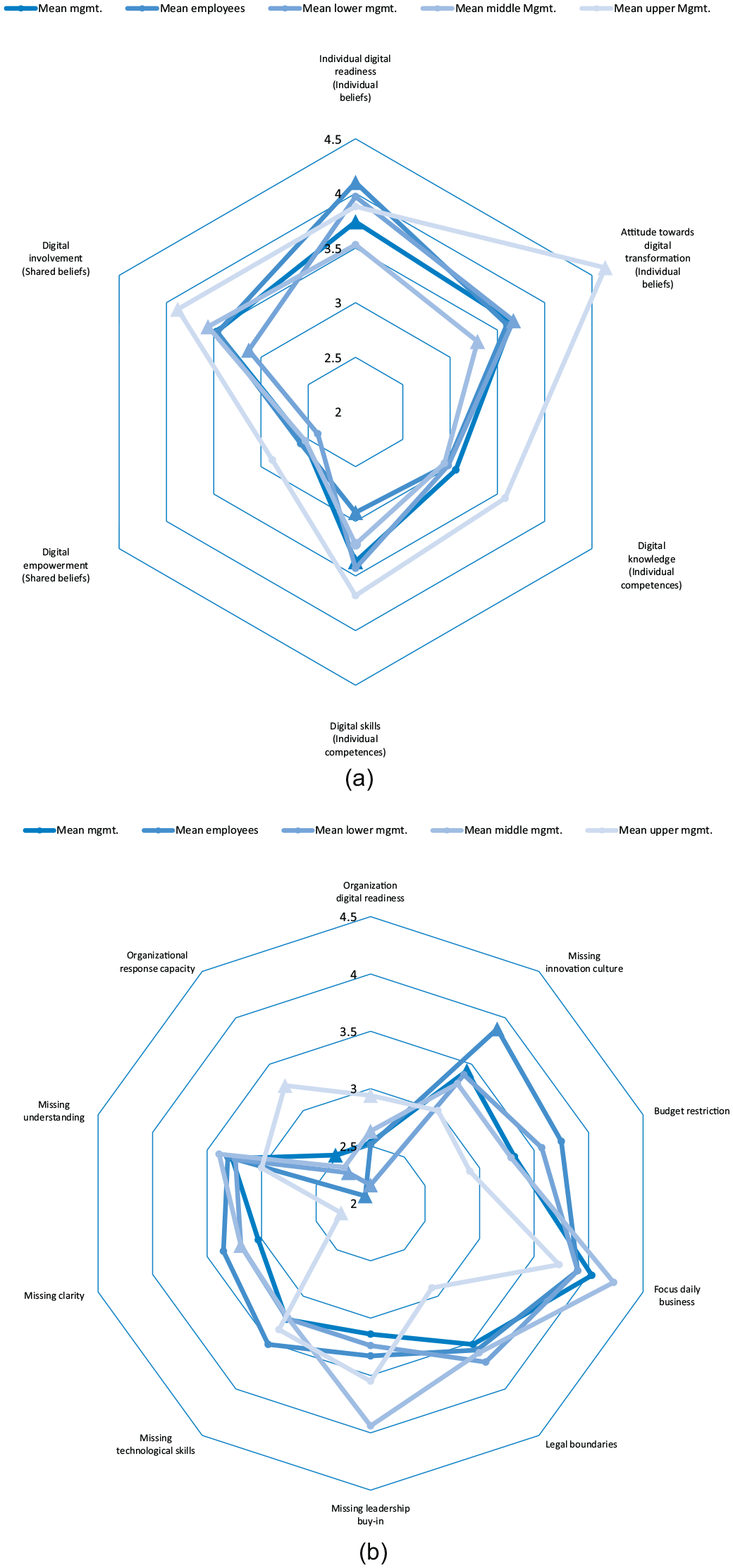
(a) Segment 1 to 3—Digital Readiness differences in the means between various management positions. (b) Segment 4—Digital Readiness differences in the means between various management positions.
Discussion and Implications
The study revealed significant differences in perceptions in all four digital readiness segments. There are gaps between the perceptions of managers and employees. Though managers and employees agree on a lack of digital readiness within the firms, significant differences in perceptions exist on an individual and organization level as well. They mainly regard:
Individual Beliefs: Managers rate their individual digital readiness significantly lower than employees rate theirs. Especially at the level of middle management the attitude toward digital transformation is worse compared with other management levels.
Competences: Employees perceive their skills as significantly worse than managers rate theirs.
Digital Involvement: Top managers feel significantly more involved in digital transformation topics than the other internal target groups.
Capabilities: Even on the same topics of organizational capabilities, managers and employees as well as the diverse management levels differ in their views.
Top managers perceive the organizational digital readiness as significantly better than middle or lower management members do. One major aspect—reaction speed of the firm—is perceived as significantly worse by employees versus top managers. Most importantly, major innovation barriers such as lack of innovation culture and budget restrictions are rated by employees as significantly more severe than by managers. Top managers differ in their views concerning these barriers compared with the other management levels as well. This matters in regard to upper echelons theory, according to which top managers’ own perceptions massively affect the odds of succeeding and influencing organizational outcomes. 53
Concerning the theoretical implications, our findings expand the change readiness concept with the digital aspect. We added tech-specific challenges, attitudes, and capabilities that are necessary for digital transformation, and proposed a digital readiness framework as a specific change readiness scenario. Moreover, we demonstrated the discrepancy between managers’ and employees’ perceptions. Doing so enabled us to expand our knowledge about different perceptions of organizational target groups that are relevant within the change context on an individual and organizational level. In regard to Holt and Vardaman’s 54 framework of change readiness, we expanded the dimensions of change readiness to include perceptions of different organizational target groups (managers and employees; and management levels) by distinguishing and examining perceptions of top, middle, and lower management levels explicitly and on a separate scale. This allows an analysis of where perceptions of different target groups are similar, and where differences in perception between these target groups exist.
Our findings of different perceptions between managers and employees concerning digital readiness confirm a qualitative study on change perceptions 55 by revealing the specific effects and differences along the readiness dimensions and by strengthening the results quantitatively. The qualitative study proposed explaining these differences in terms of the different roles that managers and employees play during change. While managers have a key leadership role in the change process, the impact of change might be different for them than for employees. Employees focus more on how the change would affect them in day-to-day work routines and their immediate jobs. Furthermore, this research contributes to change theories by providing a more nuanced picture of different perceptions between management levels and employees. The dimension of structural factors on an organizational level appears to be the most critical segment, where in general differences in perception between top managers and other management levels and employees can be expected. Top managers’ perceptions show a positive distortion compared with other management levels and employees. This might constitute a systematic difference that comes with their strategic and shaping role, which makes top managers the most powerful actors in the firm. Top managers need to be aware of this to address these differences accordingly.
This research study suggests implications for digital transformation management in three areas of action.
First, managers should foster their self-efficacy and enable employees to extend their digital competence. As the study revealed, managers need to be aware of the fact that the perceived individual digital readiness level may not be reflected in one’s skill level. As their role model function is relevant for employees, 56 managers should take care of having more positive beliefs concerning their own readiness. At the same time, managers need to prepare employees for life-long learning and for becoming more digitally mature. Managers should consider tailored trainings for different internal target groups and for individual needs. This includes not only employees in the headquarters, but also front-level employees who should be taught how to think innovatively. According to Ferrari, 57 relevant skills include the protection of digital content, which might become even more important in the future as a basic competence and where the results revealed a perception of low expertise.
Second, the findings demonstrated that top managers of the firm should pay special attention to differences in perception that exist compared with middle and lower management levels and be aware of their potential identity-induced bias. Since top managers may differ in their perceptions from other internal target groups due to their personality, function, and responsibility, 58 top managers need to clearly focus on middle and lower management level members. This is even more important due to the fact that literature showed that middle and lower management level members act as an important transmission belt to employees. 59 The results indicate that top managers should offer enough opportunities for middle and lower management members to actively take part in the digital transformation, set up extra meetings with them to get them positively on board, foster their ownership, and make them accountable for digital transformation success. Top management needs to take care of clear and transparent communication on the innovation strategy and the related innovation areas. This presupposes as a main leadership task that the CEO and the top management team know what the perceptions of the distinct management level members are.
Third, managers need to work on organizational capabilities to overcome cultural barriers and speed up the transformation process. This includes an open innovation culture, lifting monetary restrictions, and reaction speed. If employees do not consider these capabilities to be sufficiently present, companies can hardly transform their business to become digitally mature. Consequently, on the one hand, management needs to uncover and address these gaps accordingly in their communication. Installing online communications blogs where employees can pose direct questions and suggestions to the management team, for example, could be useful measures to improve the understanding of organizational readiness. On the other hand, managers need to accelerate their innovation activities and adjust the corporate culture. Special innovation formats like design thinking workshops or innovation sprints might be useful to strengthen an appropriate innovation culture, as would easy access to experimental funding. Overall, the study demonstrated that transformation management measures are necessary in all four segments of digital readiness as perceptions differ in each.
Conclusion
The purpose of this study was to explore the perceptions of digital readiness in the banking industry, and to identify systematic differences in perceptions between different target groups—managers and employees. The main takeaways of the study are that digital readiness on an individual and organizational level is a strategic key element for corporates’ future success and a primary leadership task. Only a small stream of literature has begun to discuss differences in perceptions of digital readiness between managers and employees, and also between management levels. The findings of this study reveal that differences in perceptions do exist concerning beliefs on individual readiness, skills, and capabilities. Looking forward, it is evident that knowing and addressing these different perceptions accordingly in all four segments of digital readiness is important for managers to ensure the successful digital transformation of their firm.
Managers act as role models for digital readiness and should increase their awareness of this fact. They should work on their mindset, get closer to employees’ beliefs, and become more sensitive to the lack of readiness requirements on an individual and organizational basis. Finally, knowing employees’ perceptions and addressing their readiness might become even more important for managers in a world where virtual meetings and other virtual communication formats with company members are becoming more prominent.
Footnotes
Appendix
Digital Readiness Descriptive Statistics.

| Topic | Factor/Variable |
Factor Specification/Question of Variable |
Mann-Whitney U |
Kruskal-Wallis |
|||
|---|---|---|---|---|---|---|---|
| Mean Management | Mean Employees | Mean Lower Management | Mean Middle Management | Mean Upper Management | |||
| Segment 1: Individual beliefs | |||||||
| Perceived individual digital readiness With regard to the digital transformation . . . |
PIDR | Cα = 0.86, AVE = 0.67 |
|
|
3.97 | 3.53 | 3.88 |
| PIDR1 | I do not anticipate any difficulties adjusting myself to the new working conditions. |
|
|
4.10 | 3.77 | 4.18 | |
| PIDR2 | certain job tasks will be required, that I can simply put into practice. | 3.90 | 4.12 | 4.14 | 3.71 | 4.00 | |
| PIDR3 | I can meet all new requirements easily. |
|
|
3.67 | 3.10 | 3.45 | |
| Attitude toward digital transformation | ADT | I consider the digital transformation in my industry sector as . . . bad/ good. | 3.65 | 3.60 |
|
|
|
| Segment 2: Individual competences | |||||||
| Digital knowledge I have profound knowledge of . . . |
DK | Cα = 0.64, AVE = 0.49 | 3.06 | 2.97 | 2.98 | 2.94 | 3.58 |
| DK1 | digital business models. | 3.67 | 3.65 | 3.57 | 3.61 | 4.00 | |
| DK2 | artificial intelligence and machine learning. | 2.97 | 2.75 | 2.90 | 2.84 | 3.45 | |
| DK3 | blockchain and distributed ledger technology. | 2.56 | 2.50 | 2.48 | 2.35 | 3.27 | |
| Digital and coding skills I have profound skills about . . . |
DS | Cα = 0.84, AVE = 0.70 |
|
|
3.43 | 3.21 | 3.68 |
| DS1 | using digital tools to collaborate with others. |
|
|
3.67 | 3.77 | 4.18 | |
| DS2 | protecting devices and digital contents and understanding the risks and dangers. |
|
|
3.19 | 2.65 | 3.18 | |
| DC | programming/ coding in different programming languages. | 1.54 | 1.33 | 1.43 | 1.71 | 1.27 | |
| Segment 3: Shared beliefs | |||||||
| Perceived digital empowerment The managers in my organization . . . |
PDE | Cα = 0.90, AVE = 0.76 | 2.54 | 2.58 | 2.40 | 2.53 | 2.88 |
| PDE1 | encourage all employees to embrace the digital transformation as a chance. | 2.98 | 2.92 | 2.81 | 3.03 | 3.18 | |
| PDE2 | promote the digital transformation with full effort. | 2.44 | 2.71 | 2.29 | 2.39 | 2.91 | |
| PDE3 | provide employees with all resources, to be able to derive best benefit from the digital transformation. | 2.21 | 2.10 | 2.10 | 2.16 | 2.55 | |
| Digital involvement | DIN | Cα = 0.9, AVE = 0.76 | 3.47 | 3.46 |
|
|
|
| DIN1 | I like to discuss about digital transformation topics. | 4.30 | 4.33 |
|
|
|
|
| DIN2 | I work often and a lot on digital transformation projects. | 3.81 | 3.83 |
|
|
|
|
| DIN3 | I observe the developments of the digital transformation intensively. | 4.30 | 4.21 |
|
|
|
|
| Segment 4: Organizational capabilities | |||||||
| Perceived organization digital readiness For a successful digital transformation my organization has . . . |
PODR | Cα = 0.89, AVE = 0.73 | 2.53 | 2.51 |
|
|
|
| PODR1 | the appropriate organizational structure. | 2.49 | 2.50 |
|
|
|
|
| PODR2 | enough digitally enabled and experienced managers. | 2.35 | 2.29 | 2.00 | 2.52 | 2.55 | |
| PODR3 | the willingness to react to digital trends fast and in an appropriate manner. | 2.75 | 2.73 | 2.52 | 2.71 | 3.27 | |
| Innovation barriers What barriers do you see in your organization concerning the realization of digital projects? |
IB1 | Missing innovation culture |
|
|
3.86 | 3.29 | 3.00 |
| IB2 | Budget restrictions | 3.32 | 3.75 | 3.57 | 3.29 | 2.91 | |
| IB3 | Focus mainly on daily business | 4.03 | 3.90 | 3.90 | 4.23 | 3.73 | |
| IB4 | Legal boundaries | 3.52 | 3.58 | 3.71 | 3.61 | 2.91 | |
| IB5 | Missing leadership buy-in | 3.14 | 3.33 | 3.24 | 2.94 | 3.55 | |
| IB6 | Missing technological skills | 3.25 | 3.52 | 3.24 | 3.23 | 3.36 | |
| IB7 | Missing clarity about areas of innovation | 3.03 | 3.35 |
|
|
|
|
| IB8 | Missing understanding of the urgency | 3.27 | 3.31 | 3.24 | 3.39 | 3.00 | |
| Organizational response capacity | ORC | I consider my organization as fast reacting. |
|
|
|
|
|
Note: Figure 2a and b, Table 2, and the appendix show the results of a confirmatory factor analysis (CFA) with ordinal data and the statistical differences within management positions (management vs. non-management) and management levels (lower management, middle management, higher management). The CFA is computed by the SEM software package LAVAAN with the following specifications: optimization method = NLMINB, number of free parameters = 272, number of observations = 111, estimator = DWLS, model fit test statistic = 728.199, degrees of freedom = 836, p value (chi-square) = 0.997. The additional fit indices evaluate the model fit: comparative fit index = 1.000, Tucker-Lewis index = 1.009, root mean square error of approximation = 0.000, standardized root mean square residual = 0.082. All factors are confirmed by Cronbachs alpha and the average variance extracted (AVE; Fornell & Larcker 1981); compare the appendix. The resulting factor loadings are verified and are located in an appropriate range. The Mann-Whitney U and the Kruskal-Wallis test are used to give an accurate determination whether two or more independent samples, which are given by a division into management positions (management vs. non-management) or management levels (lower management, middle management, upper management), originate from the same distribution. In the appendix, the results of the Mann-Whitney U and the Kruskal-Wallis test are given by font characteristics: A bold font indicates a p value < .05 (marked as ** within the article and *** for p value < .01) and an italic bold one a p value < .1 (marked as * within the article). Items in the appendix are based on a 5-point Likert scale from 1 (I do not agree) to 5 (I fully agree).
Notes
Author Biographies
Anne Gfrerer is Managing Director and Advisory Board Member for Digital Transformation and Communication. She is doing her PhD at the University of Innsbruck, and before founding her own company, she was SVP for Corporate Communication for more than ten years at UniCredit Group (email:
Katja Hutter is Professor for Innovation & Entrepreneurship at the University of Innsbruck, a Visiting Fellow at the Laboratory for Innovation Science at Harvard (LISH) at the Institute for Quantitative Social Science (IQSS), and Senior Research Associate at HYVE, an innovation company (email:
Johann Füller holds the Chair for Innovation and Entrepreneurship in the Department of Strategic Management at the University of Innsbruck. He is Fellow at the NASA Tournament Lab-Research at Harvard University and CEO of Hyve AG, an innovation and community company (email:
Thomas Ströhle is part of the Department of Innovation & Entrepreneurship at the University of Innsbruck (email: