



Abstract
Contrary to existing literature, startups can be successful orchestrators of ecosystems. Based on nine qualitative case studies, this article introduces four archetypes that shed light on how a startup can fulfill the tasks of an orchestrator and overcome challenges. The findings identify dimensions of standardization/customization and sources of value creation as defining the role of ecosystem orchestrators and demonstrate the consequences for small and medium-sized enterprises (SMEs), corporates, investors, and accelerators involved in such ecosystems.
An ecosystem is usually managed by a focal actor, 9 called an orchestrator, who plays a key role within an ecosystem. 10 Given this pivotal role, existing research has largely agreed on big and powerful corporates being the logical orchestrators. 11 However, some studies are questioning this established belief and mention startups as ecosystem orchestrators without explaining how such a small and vulnerable firm can orchestrate an ecosystem of several and potentially much larger and more powerful companies. 12 Jacobides, Cennamo, and Gawer, setting the foundations of the structural stream on ecosystems, take up this open question and call for research that answers whether small firms are equally suitable for orchestrating ecosystems and, in case they are, how they manage to do so. This question is particularly important since startups have a major influence on today’s economy. 13 On top of this, startups as ecosystem orchestrators might be an intriguing new phenomenon, combining the speed and innovativeness of startups with the power of an ecosystem of several and large firms. This changes the dynamics of competition and questions existing beliefs on the role and impact of startups. It also opens up new questions for startup investors or corporates being members of startup-led ecosystems.
We were able to identify several startups that have built up and currently are managing ecosystems, and we used these empirical insights to conduct a qualitative multi-case study 14 with nine cases. This allowed us to understand how a startup can successfully orchestrate an ecosystem, despite the inherent challenges that come from its lack of resources, power, or credibility. 15
In the course of our qualitative study, we identified two key dimensions: the question of whether the ecosystem is “standardized” or “tailor-made,” and the source of the value creation (i.e., “partners only” or “orchestrator and partners”). Thus grounded, our framework determines four types of startup-led ecosystems. Our findings demonstrate the approaches that startups use to orchestrate these different types of ecosystems. Startups can be successful orchestrators despite their inherent disadvantages.
Literature Review
Key Characteristics of an Ecosystem and Ecosystem Orchestration
According to the structural view, 16 the ultimate goal of an ecosystem is the materialization of a joint value proposition by the firms involved, which provide modules for this joint value proposition. 17 This value proposition may take several forms, such as products, services, or improvements of internal processes. However, not all of the firms involved are ecosystem members: only firms whose modules fulfill two critical criteria 18 are considered to be part of the ecosystem. The first criterion is that the modules need to be complementary, that is, they increase each other’s value (the so-called supermodularity) 19 or cannot function without each other. 20 This implies that actors need to explicitly create new modules—or at least mutually adapt existing modules—to achieve complementarity with the modules provided by the other partners. 21 The second criterion is that the modules are “unique,” that is, the partner providing them cannot easily be replaced. As a result, ecosystem partners are mutually dependent on each other: if one of them is failing or leaving the ecosystem, then the ecosystem as a whole will fail. This interdependence has two crucial implications. First, it defines the boundaries of an ecosystem since firms providing modules that are relevant for the joint value proposition but are not characterized by complementarity and uniqueness must be regarded as suppliers, not ecosystem members. Second, the orchestrator’s main task is to align this interdependent set of partners toward the joint value proposition.
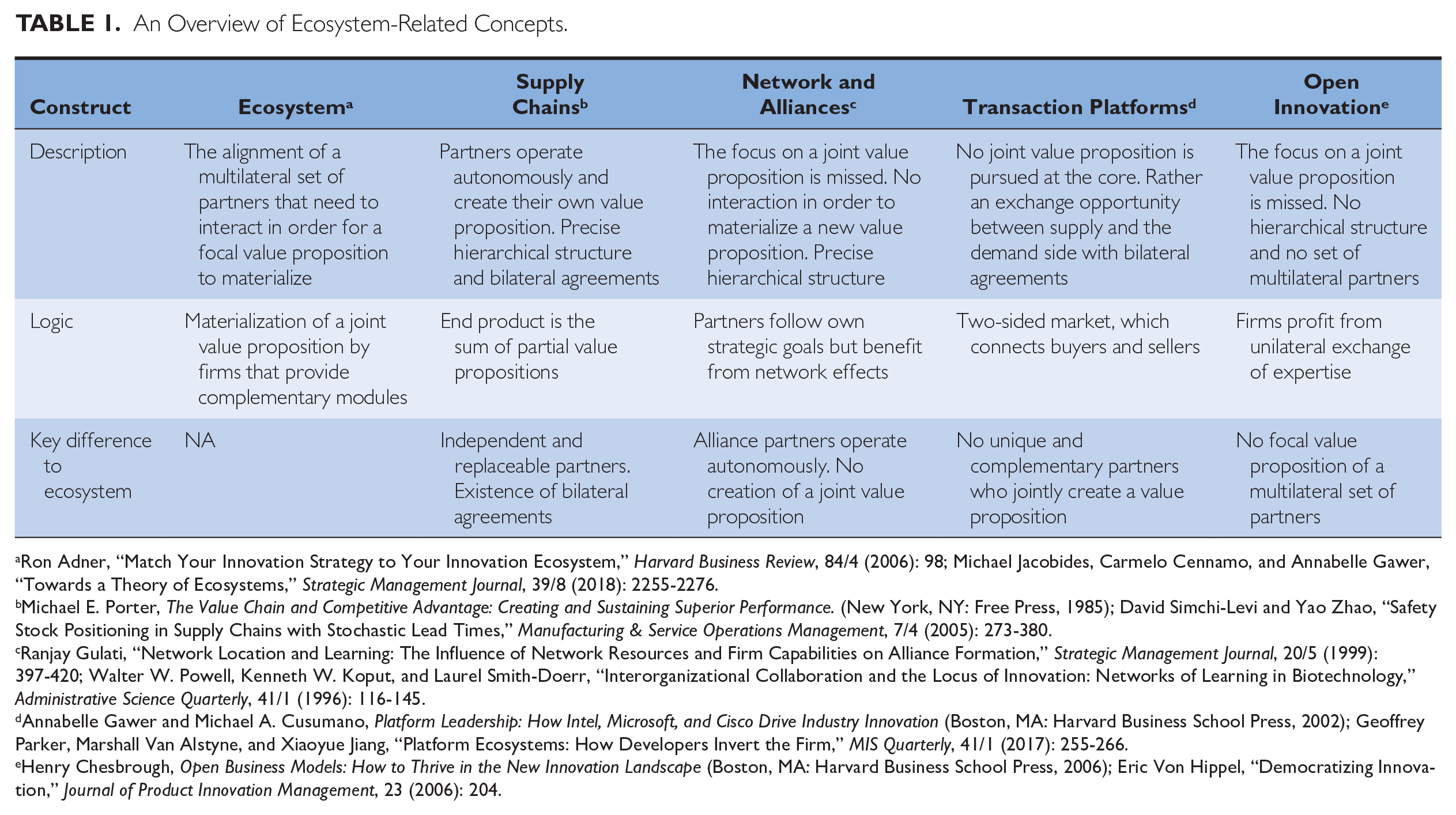
Beyond the ecosystem concept, streams of literature on related concepts (such as alliances and networks) also discuss the role of startups 22 (or firms with similar resource constraints, such as small and medium-sized enterprises [SMEs]). 23 However, since these concepts lack the aspect of orchestration, which is central to ecosystems, they do not explain how startups can take over the particular tasks related to such orchestration. 24 In addition, ecosystems are different than platforms. 25 For instance, a platform offers heterogeneous groups that would not otherwise interact the possibility for exchange. 26 Hereby, the value proposition of a platform can be defined as the result of the increasing interaction between customer and provider. 27 For differentiation of ecosystems from related concepts, please see Table 1.
An Overview of Ecosystem-Related Concepts.
Ron Adner, “Match Your Innovation Strategy to Your Innovation Ecosystem,” Harvard Business Review, 84/4 (2006): 98; Michael Jacobides, Carmelo Cennamo, and Annabelle Gawer, “Towards a Theory of Ecosystems,” Strategic Management Journal, 39/8 (2018): 2255-2276.
Michael E. Porter, The Value Chain and Competitive Advantage: Creating and Sustaining Superior Performance. (New York, NY: Free Press, 1985); David Simchi-Levi and Yao Zhao, “Safety Stock Positioning in Supply Chains with Stochastic Lead Times,” Manufacturing & Service Operations Management, 7/4 (2005): 273-380.
Ranjay Gulati, “Network Location and Learning: The Influence of Network Resources and Firm Capabilities on Alliance Formation,” Strategic Management Journal, 20/5 (1999): 397-420; Walter W. Powell, Kenneth W. Koput, and Laurel Smith-Doerr, “Interorganizational Collaboration and the Locus of Innovation: Networks of Learning in Biotechnology,” Administrative Science Quarterly, 41/1 (1996): 116-145.
Annabelle Gawer and Michael A. Cusumano, Platform Leadership: How Intel, Microsoft, and Cisco Drive Industry Innovation (Boston, MA: Harvard Business School Press, 2002); Geoffrey Parker, Marshall Van Alstyne, and Xiaoyue Jiang, “Platform Ecosystems: How Developers Invert the Firm,” MIS Quarterly, 41/1 (2017): 255-266.
Henry Chesbrough, Open Business Models: How to Thrive in the New Innovation Landscape (Boston, MA: Harvard Business School Press, 2006); Eric Von Hippel, “Democratizing Innovation,” Journal of Product Innovation Management, 23 (2006): 204.
According to the structural view, an ecosystem is defined as the alignment of partners, by an orchestrator, toward a joint value proposition. This definition allows us to define the key tasks an orchestrator has to fulfill. First, the materialization of a joint value proposition is at the very heart of the ecosystem concept, and the orchestrator’s key task is to make sure this value proposition comes true. 28 We refer to this task as product development, which includes activities related to the materialization of the joint value proposition. Alignment refers “not only to compatible incentives and motives, but also raises the question of actors’ consistent construal of the configuration of activities.” 29 The first part of this task, the provision of incentives for partners to join the ecosystem and stay with it, is persuasion. The second part, which is based on the exchange of information among partners, 30 is coordination. However, ecosystems are usually not static—rather, as with most economic activities, the usual aim is to grow the ecosystem and to scale the value proposition. This growth is particularly relevant in an ecosystem context, since an increasing number of partners might shift incentive systems as well as dynamics within the partner structure, and thus might also shift the alignment of partners. Therefore, studies on ecosystems should not view orchestration as a static task but must consider its growth as well. 31 We refer to the task of growing the ecosystem as scaling. Beyond these four key tasks, which are directly derived from the definition of an ecosystem according to the structural view (product development, persuasion, coordination, and scaling), there might be a multitude of other tasks relevant to the orchestration of ecosystems. However, in this article, we only focus on these four tasks, since they are at the very heart of the ecosystem concept.
Key Challenges Startups Face When Orchestrating an Ecosystem
The four tasks lead to significant challenges for startups, which is why scholars have repeatedly claimed that large firms are better suited to orchestrate ecosystems. 32
The tasks of persuasion and scaling, in particular, require an ecosystem orchestrator to display compliance and conformity in order to secure ecosystem membership and also to be the provider of stability within the ecosystem. 33 These aspects are arguably associated with corporates, not startups. In this regard, the advantages that come from size and bargaining power are helpful when it comes to persuasion and scaling. 34 On top of this, the tasks of product development and coordination generate significant efforts and transaction costs for the orchestrator. 35 This might be particularly challenging for startups, given their limited resources. 36
This raises the question of how startups can orchestrate ecosystems, despite these challenges. Some authors have claimed that the orchestrator does not have to be the most resource-rich actor in the ecosystem, but rather the one that uses particular skills or power to steer the ecosystem, that is, intellectual capital to stimulate and shape the business ecosystem, 37 “informal authority” based on knowledge and status, control over crucial resources and technologies, 38 or the capability for “problem-framing” to understand and solve problems to stimulate innovation and capture its value. 39 Others have argued that the firm’s capability to innovate, scan, and sense the environment, and the capability to integrate are all crucial for successful ecosystem orchestration. 40 Startups might display some critical advantages in this regard in terms of learning, sharing their knowledge, and adaption. 41 However, even though these scholars propose that startups might use these specific strengths to overcome the challenges of orchestration, they have not sufficiently explained how they are doing so. Thus, we used our qualitative multi-case study to explore this crucial question.
Method
A case study is a suitable methodological approach to address these questions. 42 This is because the ecosystem concept is still under-researched and lacks empirical foundations. 43 We followed established notions in case study research, 44 observed different patterns of “how” startups orchestrate ecosystems, and described the boundary conditions driving the differences among them—the “why.”
Based on the four tasks of orchestration, we used several criteria to sample our nine cases. First, we selected the cases according to our definition of an ecosystem. This definition of an ecosystem also defined its boundaries, that is, which firms are part of the ecosystem and which are not. In this sense, we only considered partners who offer a unique and complementary contribution to the joint value proposition. Mere suppliers, who provide generic modules, are not included. Second, all of the ecosystems studied needed to be orchestrated by startups.
We applied the following criteria to distinguish startups from established firms. They had to be innovation-driven firms that aim to create products or services that do not yet exist. 45 They had to have a short operating history 46 and be less than ten years old. 47 They had to be growth-oriented 48 despite having limited resources (such as knowledge, talent, and capital) 49 as well as facing high uncertainty. 50 They had to be at an early stage of operation. 51 The case data in Table 2 show that our cases fulfill these criteria. The value propositions of all the ecosystems are either based on novel technologies and/or novel to the market, which points toward innovativeness and uncertainty. The firms were clearly younger than ten years at the time of data collection (2017-2019) and, thus, still at an early stage of operation. (Access, the only exception, has existed for a longer time but was focusing on product and technology development for around five years. Thus, they started business operations only recently at the time of data collection.) Finally, within this short period of time, the firms managed to grow their staff significantly and even enter several additional markets. This demonstrates the growth orientation of the firms studied.
Case and Data Overview.
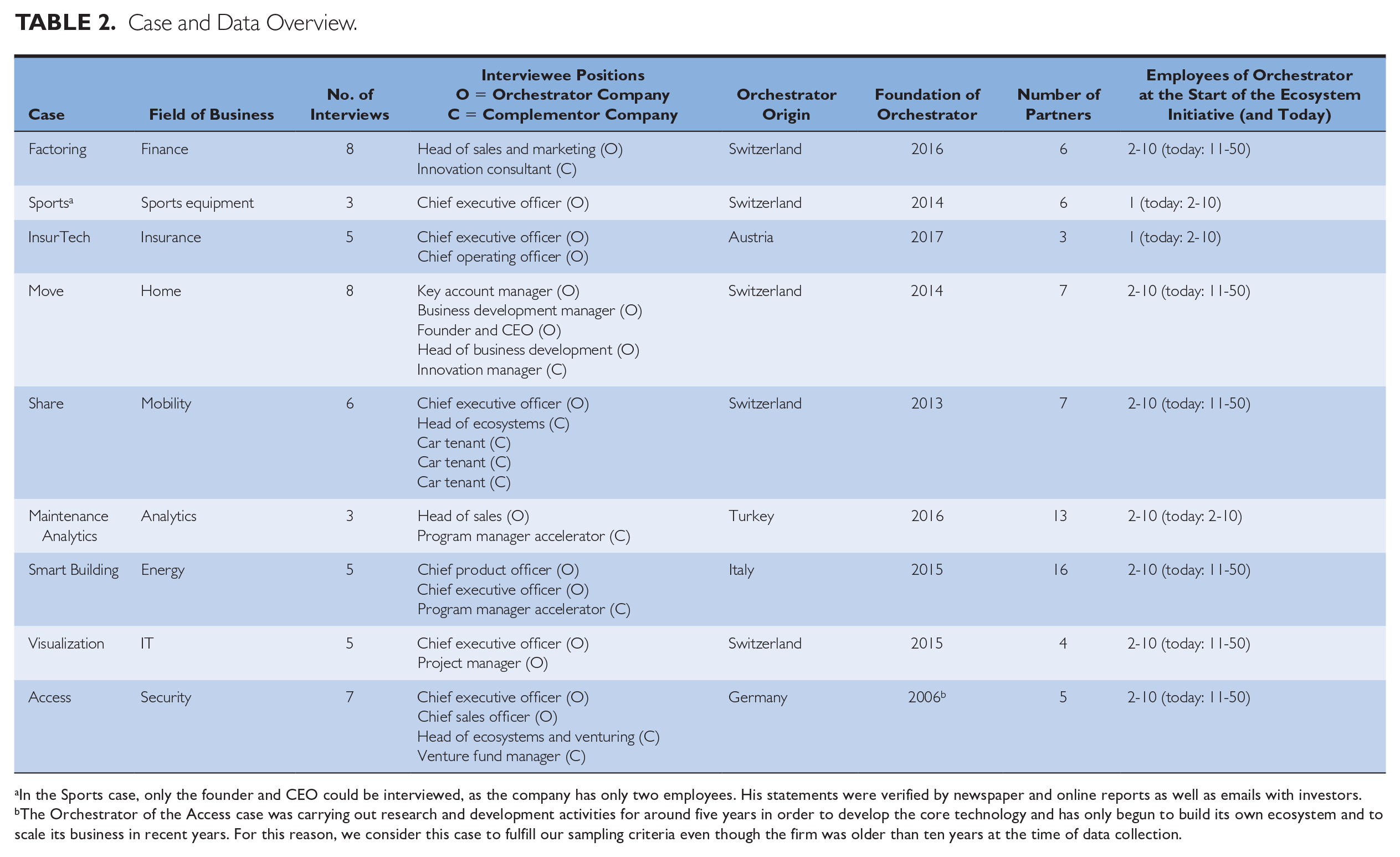
In the Sports case, only the founder and CEO could be interviewed, as the company has only two employees. His statements were verified by newspaper and online reports as well as emails with investors.
The Orchestrator of the Access case was carrying out research and development activities for around five years in order to develop the core technology and has only begun to build its own ecosystem and to scale its business in recent years. For this reason, we consider this case to fulfill our sampling criteria even though the firm was older than ten years at the time of data collection.
In addition, we verified that all startups were orchestrators and were performing orchestration tasks. In order to ensure generalizability, we chose cases with high diversity in terms of value propositions, following an established approach in case study research. 52 Previous ecosystem research has also used such sampling techniques to provide a more comprehensive overview, while ensuring that results are not distorted by cross-industry differences. 53 We use polar cases in order to derive clear and extreme patterns. 54
The focus of our data collection was on interviews with startup managers responsible for orchestration, C-level staff, and/or co-founders, since these people are mainly responsible for performing the tasks of orchestration. (Given the nature of startups, these roles may overlap in some cases.) To triangulate and deepen our results, we conducted additional interviews with other ecosystem participants, investors, accelerator staff, and even customers. Furthermore, we consulted external data for the evaluation of the funding and costs. For instance, we used investor reports and startup news, and included standard key ratios to understand what funding has usually been obtained. In addition, we interviewed experts regarding main cost drivers and checked the type of investor and the associated investment (e.g., an early-stage venture capital firm might only provide small amounts; a later stage venture capital firm or even a corporate venture capital firm might provide large amounts). Last, we conducted a consistency check on all these sources. In all cases, we collected secondary data, such as media reports, internal documents, or presentations, to triangulate our findings. 55
Our case sampling includes a diverse set of value propositions: Business-to-Customer (B2C) and Business-to-Business (B2B) (e.g., Factoring case), physical goods (e.g., Sports case), as well as services (e.g., Move case). In addition, Maintenance Analytics provides infrastructure support, and the Smart Building Case focuses on process optimizations.
We analyzed our data by inductively searching for patterns and emerging themes across the cases. 56 Our coding scheme is shown in Figures 1 and 2. While the analysis of the case studies was guided by the four tasks of orchestration, one additional task emerged in the course of our analysis, namely, funding. Startups are usually not profitable during their early stage of operating, which requires them to collect funds from investors in order to cover their expenses. 57 It is to be noted that by “funding,” we do not mean the funding of the ecosystem per se but merely of the startup. As shown by our empirical data, funding was tightly linked to the four tasks of orchestration as derived from theory: depending on the product development, the startups had to collect more or less funding. The differing coordination efforts led to significant differences in costs and therefore funding needs. The same accounts for scaling and persuasion. Given its significance, we added funding as a fifth task of orchestration in the context of startup-led ecosystems. This is consistent with the literature on startups since funding is widely considered as one of the key aspects of the startup world. 58
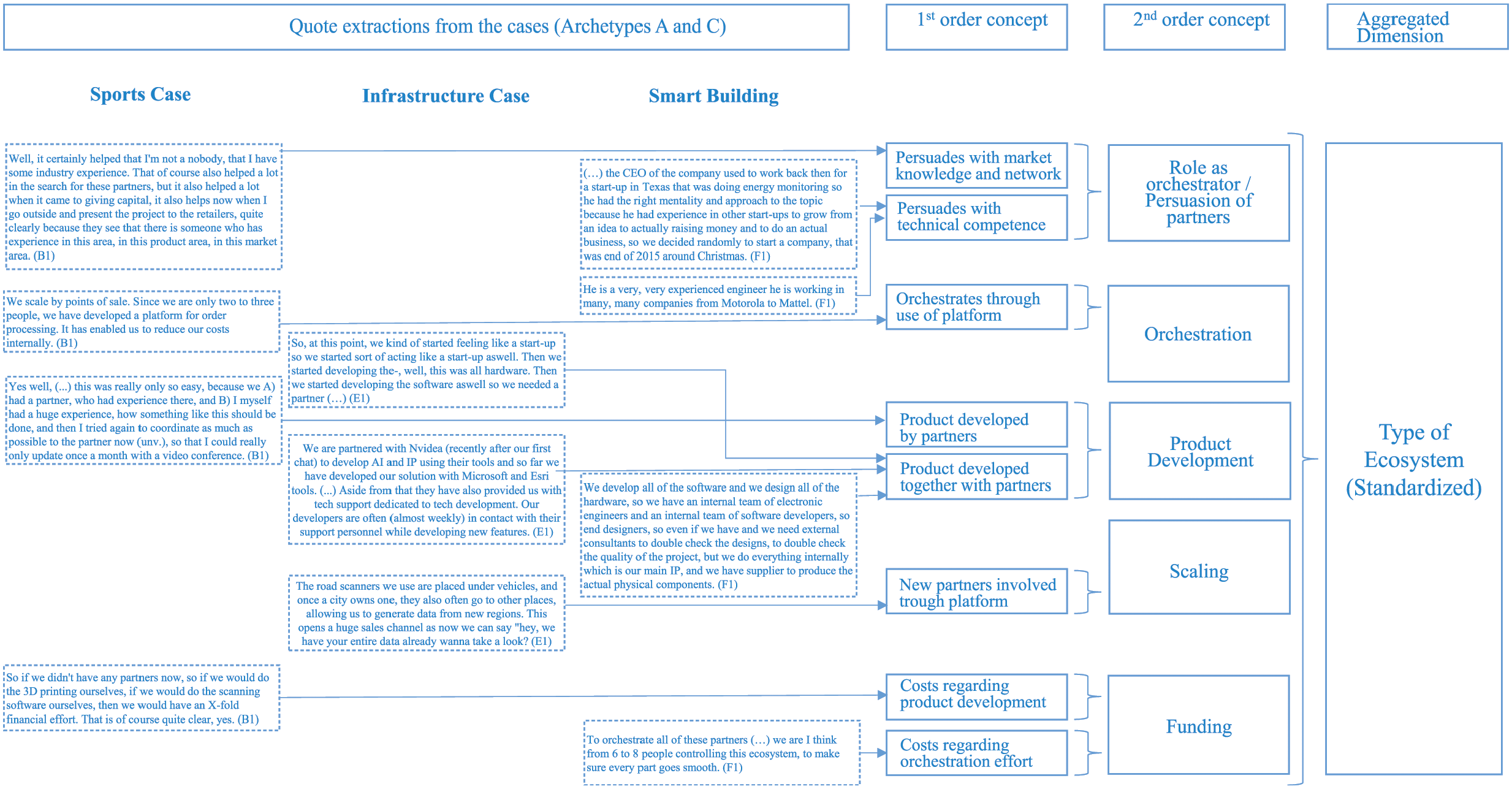
Coding Scheme (1/2).
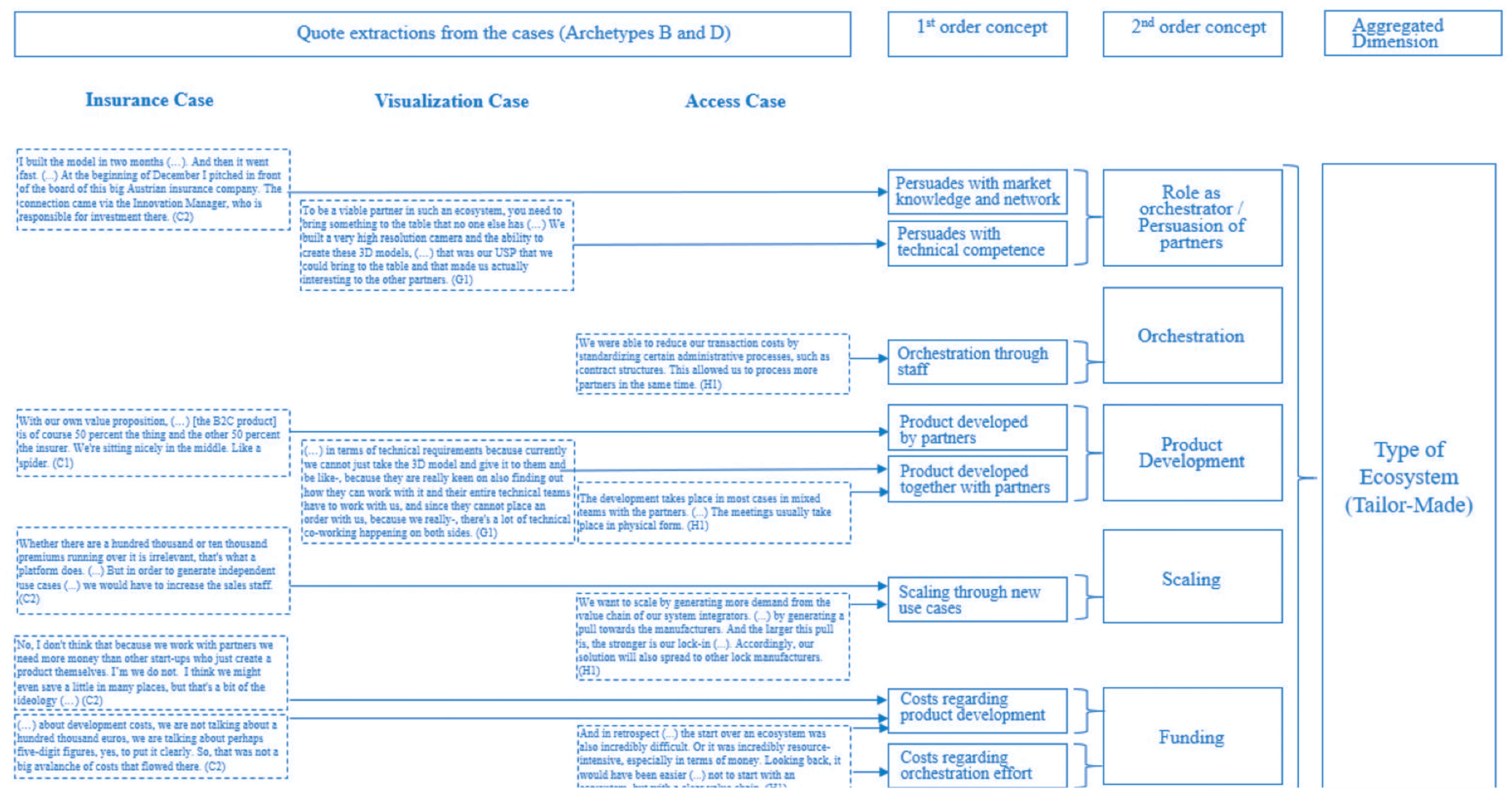
Coding Scheme (2/2).
In the course of both data analysis and data collection, it was essential to ensure that the four tasks of orchestration were actually performed by the startup. Given its significance, we explain for each task how we ensured this critical matter: product development (i.e., activities related to the materialization of the value proposition) was both checked based on data and external validity checks. Since the ecosystems studied aimed to sell their value propositions, external data (such as sales brochures, homepages) were available and allowed for consistency checks with the descriptions given by the interview partners (both from the orchestrator and from the partners). Thus grounded, we were able to double-check (both based on the interviews with actors involved in the ecosystem and externals) what was needed for this value proposition to come true and who was the main driver behind that. We see a strong validity of this finding since all interviews with both orchestrators and partners, external data, and external estimations were consistent throughout all the cases. This is all the more true since in all cases, the orchestrator was the only player being in interaction with all partners involved in the product development. Thus, it is very unlikely that another player within the ecosystem performed the task of product development even though this player did not deal with all relevant partners being involved in that task. The same is true for the tasks of coordination and persuasion. Given the multilateral nature of ecosystem interactions, coordination needs to embrace all partners involved in the ecosystem and can, thus, only be performed by the firm being connected with all partners. 59 On top of this, coordination was done either by a platform or by people. In the case of the first, it was easy to track who was in charge of implementing that platform and, in case of the latter, whose employees were coordinating the other players, such as setting up and managing meetings. Scaling involved activities such as the integration of sales and additional module partners. We were able to trace back these activities to the orchestrator for the same reasons as mentioned above: based on interviews with the orchestrator, but also with the partners involved for the purpose of scaling, we were able to double-check who actually involved these partners to set up meetings and contracts. Finally, funding could only be performed by the orchestrating startup because this firm was the one selling its shares and receiving funding in return. Obviously, selling shares can only be performed by the company owning them.
As a result of our analysis, we observed that some of our cases show similar patterns, while others are considerably different from each other. We found that these patterns can be traced back to two surrounding conditions, which we call value creation and type of value proposition. The first dimension indicates whether the orchestrator participated in the value creation for the joint value proposition (i.e., providing a module) or whether the modules are provided solely by the partners, with the orchestrator merely focusing on the task of orchestration. The “Findings” section shows whether the orchestrator provides a complementary and non-generic module for the joint value proposition or whether that firm merely acts as an orchestrator. The second dimension, type of value proposition, indicates whether the ecosystem is “standardized” or “customized.” A standardized value proposition is one that delivers the same value proposition to every client by always involving the same partners in the same way. On the contrary, a customized ecosystem provides a unique value proposition to each customer.
This implies that the value proposition changes for each customer. Consequently, different modules, and thus different partners, are required. For the sake of a clear differentiation, we define an ecosystem as customized if even one type of partner has to be changed in order to address different customer needs. Based on these two dimensions, we were able to define four different archetypes of startup-led ecosystem orchestrators. 60 Although these archetypes emerged from our inductive analysis, they correlate nicely with the “types” of ecosystems identified by Iansiti and Levien (2004), which increases their validity and generalizability as well as the link to further studies on ecosystems. Figures 1 and 2 illustrate how quote extractions from the cases are used to determine the startup’s role in the value creation, which allows us to classify it as one of the four archetypes. Also, the figures illustrate the classification of the cases based on the type of value proposition (standardized vs. customized).
We further used a matrix that addresses each of the four archetypes and the four core tasks of orchestration executed by a startup. The principal differences between the four archetypes are, on one hand, which actors provide the necessary modules for value creation and, on the other hand, whether the value creation is standardized or customized. For instance, Archetypes A and C both offer a standardized value creation. In Archetype C, the startup itself contributes a module to the value proposition, thus going beyond the mere role of orchestrator of the ecosystem. In contrast, the startup in Archetype A is only responsible for the orchestration of the ecosystem and does not contribute a generic module toward the value creation. Please see Figure 3 for an overview of the archetypes and associated cases. This framework allowed us to structure our findings and connect the patterns (i.e., approaches of “how” startups orchestrate ecosystems) with the underlying boundary conditions (i.e., “why” they are doing so 61 ).
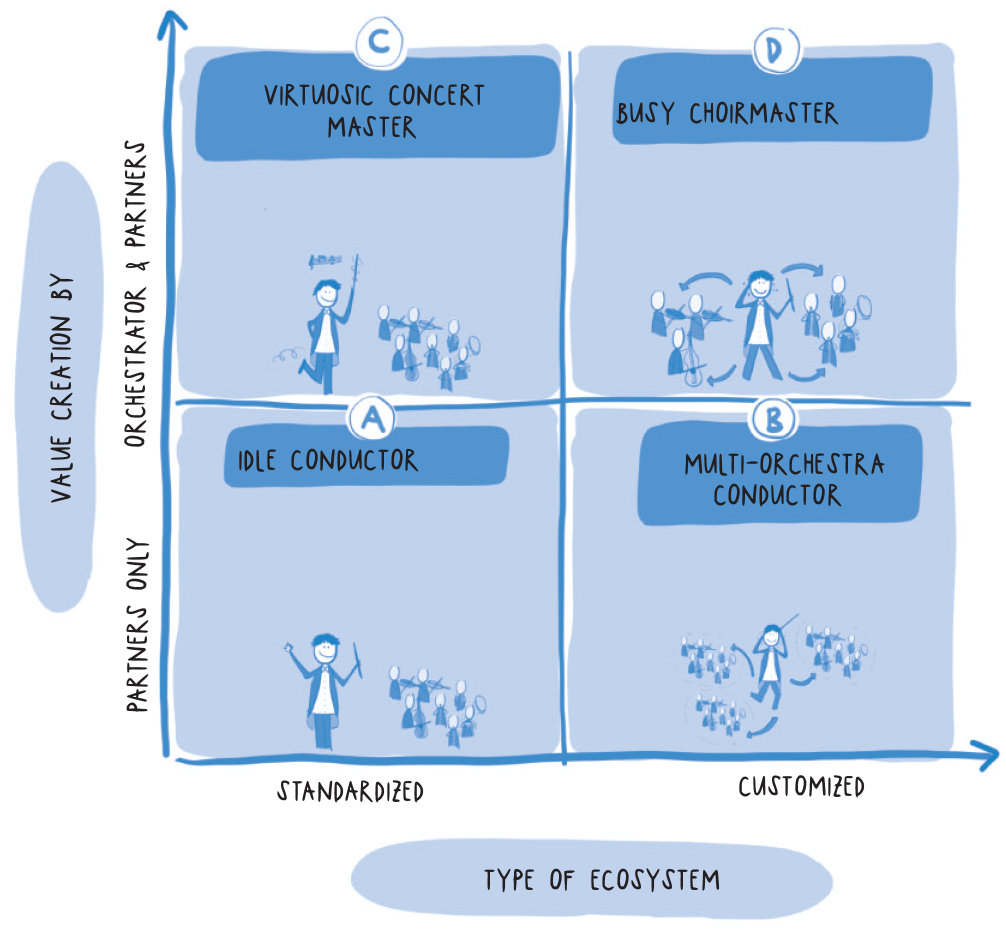
Framework showing the role of startups in ecosystems.
Findings
Archetype A: Idle Conductor
The first archetype is represented by the Sports and the Factoring cases. The Sports company provides a solution to create customized soles for running shoes. The soles are made using 3D (three-dimensional) printer technology, and they promise a unique and pain-free sports experience. In this ecosystem, there are different, important players that provide the modules needed for value creation. For example, there is the partner who provides the 3D printer technology and the partner who provides the scanning solution. The Factoring case operates in a different context, as it offers a factoring solution for SMEs doing business in developing countries. SMEs in this field of business are usually confronted with long payment periods and increased risks. The Factoring company offers a solution to overcome these liquidity bottlenecks, while the ecosystem involves investors, an insurance company, banks, and a software company that assesses the risk of the SMEs’ claims.
Arguably, when considering joining an ecosystem, firms evaluate the trade-off between the opportunity and the potential risks incurred. Therefore, the orchestrator needs to provide evidence that the ecosystem is likely to succeed, which relates to the challenge of persuasion. To persuade new partners to join their ecosystems, the orchestrators in the Factoring and Sports cases showed their potential partners that they have an excellent network and knowledge of the market. In both cases, the startup fulfilled the tasks of product development and cooperation that define an orchestrator by actively searching for partners to implement their ideas for a new joint value proposition, which they were not able to realize in isolation. As the CEO from the Sports case sums it up: I have found the partners through my many years of experience in the industry . . . It certainly helped that I am not a nobody in the industry.
Indeed, in this first archetype, in which the orchestrator does not contribute a module to the joint value proposition, and where the value proposition is standardized, the founders of the analyzed firms had worked in the industry concerned before and were well regarded. They then used their knowledge of the industry and their networks to engage with potential partners and convince them to join the ecosystem. Therefore, their roles as startups were solely to build and orchestrate the ecosystems, and their networks and their knowledge gave them the ability and legitimacy to do so.
As the startup does not contribute a content-related module to the value proposition, its minor role is to coordinate. We observed in both the Factoring and Sports cases that the standardization of the ecosystem enabled the use of a platform.
62
(In this article, the term “platform” can be understood as a coordination possibility.) In this context, using a platform affects the running costs of the ecosystem since the platform allows for a reduction in costs, for example, by coordinating with partners about new inquiries, which previously had to be carried out by the employees of the orchestrator. Furthermore, the platform facilitates scaling of the ecosystem. The head of sales and marketing in the Factoring case described it as follows: That’s when a software provider came into play . . . with whom we developed a platform. It allows us to automatically manage the interplay among funding partner, the insurance company, and our customers.
In the Sports case, the partner provided the scanning software, which was installed at the electronic point-of-sale devices. The devices scan the client’s feet and send the data to the orchestrator, who forwards it to the manufacturer. Hence, rather than providing a complementary module for the value creation, the Sports startup’s primary role was to make sure the partners are aligned.
In addition, the orchestrator in the Sports case tried to keep transaction costs low by optimizing communication behavior, as illustrated in the following quote: Yeah, how can you be an orchestrator? . . . By trying to communicate as efficiently as possible. Do not travel to Italy, but make a FaceTime call, because one hour later you will be able to talk to Canada and the hour after that to Belgium. (Sports case CEO)
As mentioned, in this archetype, the orchestrator does not contribute a module to the value proposition. In both of our cases, we saw that the orchestrator developed the value proposition based on insider knowledge and subsequently gathered the different partners together to set up the ecosystem. Because the orchestrator had experience in the industry and could trust the partners, the orchestrator was able to focus on controlling and developing the ecosystem rather than product development.
Further down the line, scaling happened through involving additional sales partners, who brought new customers to the ecosystem. This growing pool of partners and customers was first managed by the orchestrator’s team until an internal platform for order processing was launched. From that moment, the business grew more rapidly, while enabling the startup to reduce its coordination efforts, as described by the Sports company’s CEO: We scale by points of sale. Since we are only two to three people, we have developed a platform for order processing. It has enabled us to reduce our internal costs. (Sports case CEO)
In terms of funding, both of our cases have shown that coordinating the first partners to ensure alignment and, later, building the platform were the main cost drivers. However, once the platform was running, the business rapidly became profitable since the platform enabled quick scaling while keeping transaction costs low. More importantly, the startup did not develop a key component or technology for the ecosystem’s value proposition, which kept the expenses low. For these reasons, the need for funding was relatively low, which is highlighted by the following quote from the Factoring case: If we had built the solution on our own, our financing requirements would have been much, much, much higher. So if that had been possible at all, the funding would have been . . . ten, twenty, fifty times higher. (Factoring case, head of sales and marketing)
Regarding the type of funding, it is to be noted that in both cases, companies received capital in the form of smart money. This is money provided by an investor who has knowledge, a background, and a network in the field the startup is in. 63
Archetype B: Multi-orchestra Conductor
Since the Move company displays two distinct value propositions, we split the Move case into two sub-cases for the purpose of our investigation. Move 1 describes Move’s main value proposition, which consists of a platform for a personally tailored relocation process. This aims to relieve the customer of the burden of communicating individually with each company involved in a relocation process. The all-around solution ranges from organizing cleaning and transport of furniture to an included insurance solution for the household. However, beneath its main value proposition, the relocation platform (Move 1), there is a second case, Move 2. Indeed, for aspects that are not intrinsic to the relocation process, such as a client requesting the pickup of newly purchased furniture, Move hands the client over to an ecosystem partner. The partner will then coordinate the ecosystem to perform the task rather than using the initial orchestrator’s platform. Move 2 fits in the current archetype, Multi-orchestra Conductor, because of its ecosystem structure and the provenance of its value proposition, while Move 1 will be described through the next archetype, Virtuosic Concert Master. In the context of the Move case, the challenge of the task coordination can be shown by the fact that the startup coordinates and tailors the ecosystem partners for each client, leading to significant coordination effort. In the InsurTech case, the ecosystem combines a physical product with a tailored insurance solution. In concrete terms, the company interacts as an insurance intermediary between B2C companies producing physical products and insurance companies.
Similar to Archetype A, the orchestrator in this second archetype does not contribute to the value proposition. However, the startup fulfills the role of an orchestrator by actively searching for ecosystem partners. Accordingly, the InsurTech case shows similar persuasion patterns as the first archetype, since the founder used his existing personal network as a serial entrepreneur to convince the ecosystem’s first and most important partner, the insurance company, to work with them. This evidence is demonstrated by the following statement from InsurTech’s COO: I was building the model within two months . . . And then it went fast . . . At the beginning of December, I pitched in front of the board of this big Austrian insurance company. The connection came via the Innovation Manager, who is responsible for investment there.
This pattern was predictable since the value proposition happened through the partners only, meaning that the orchestrator had no key component to offer. The role of the startup was solely to build and coordinate the ecosystem, and the founder’s network and knowledge gave it legitimacy and helped convince partners to join the ecosystem. These insights show that the startup actively sought ecosystem partners as it had to align a large number of different partners. And they demonstrate how the startup successfully overcame the challenge of coordination.
In our cases, the InsurTech company built a platform as an overarching solution that it then adapted to every new use case. Similar to the previous approach, building an ecosystem for communicating with the core partners can help to reduce the coordination effort. In Move 2, the orchestrator assigned each orchestration task that was not essentially related to the core relocation process to one of its partners, who then coordinated its ecosystem partners to perform the task. Hence, for this particular value proposition, Move 2 can be described as a strategic orchestrator of the ecosystem, while the assigned partner became the operative orchestrator. Therefore, the value proposition happens only through the partners within the operational orchestrator’s ecosystem. However, the value proposition can only be created through the assigned partners because of Move as a strategic orchestrator. Also, the value proposition is adapted to every particular client request, leading to a customized value proposition process.
As in the last archetype, the orchestrator does not contribute a complementary module to the ecosystem. Here again, its sole role is the coordination of the partners in the ecosystem, who, in turn, contribute to the value proposition. However, we observed that as the value proposition becomes customized, product development becomes more complicated. Indeed, the InsurTech startup’s first function was to understand all of the partners’ pain points and to conciliate them during the implementation process. Since the value proposition had to be adapted for each customer, the contribution of each partner changed, which required an even more considerable coordination effort.
Since InsurTech’s value proposition was customized, scaling was only possible in new use cases that involved additional partners who brought new customers to the ecosystem. The InsurTech Startup needed these partners because it does not own any end-customer products. Indeed, the InsurTech startup was continually looking for new companies that might be interested in insurance solutions to augment their core product (InsurTech’s solution is Business-to-Business-to-Consumer [B2B2C]). Developing these use cases and convincing new partners took a great deal of time, effort, and resources, which was the reason the orchestrator chose to be funded through corporate venture capital from one of its core partners. Indeed, this quickly available amount of money enabled the startup to scale more rapidly. Also, building the previously described platform helped to reduce operating expenditures, such as coordination efforts, and also contributed to speeding up growth, as demonstrated by the following quote from InsurTech’s co-founder: Whether there are a hundred thousand or ten thousand premiums running over it is irrelevant, that is what a platform does . . . But in order to generate independent use cases . . . we would have to increase the sales staff.
Both InsurTech and Move 2 did not face high product development costs since their partners were responsible for this activity. However, due to the customized structure of its value proposition, the coordinating startup faced higher costs—in terms of persuasion and coordination—than in the previous archetype, and profits emerged at a later stage. This led to high capital needs, which were covered in the second funding round through corporate venture capital that came from the core partner. Capital needs are different for every archetype and case study; that is why they cannot be described as absolute needs. When talking about capital needs, we always refer to relative capital needs regarding the industry and the size of the startup. In the following quote, the InsurTech Case’s co-founder explains what was essential to convince the core partner to invest: The proof of concept was essential in the seed round in order to prove that it works and that we already have a decent income.
The orchestrator described this source of funding as a strategic maneuver that strengthened the bond between the orchestrator and the partner. This was particularly important because in the InsurTech case, the value proposition only happened via the partners of the ecosystem, making the orchestrator more vulnerable in case one of the partners withdrew.
Archetype C: Virtuosic Concert Master
The third archetype is described by the cases of Move 1, Share, and Smart Building. As noted, Move’s main value proposition is a platform that functions as a coordination possibility for a personally tailored relocation process. The platform aims to relieve the customer of the burden of communicating individually with each company involved in the relocation process. This ecosystem, named Move 1, is classified in the Virtuosic Concert Master archetype because of its ecosystem structure and the provenance of its value proposition. The value proposition of the Share case is a platform that exchanges peer-to-peer carsharing opportunities. In addition to this core offering, an independent insurer provides insurance solutions for rental cars and several other players, such as garages, petrol stations, and supermarkets, providing additional services or benefits to the users. The Maintenance Analytics company has developed software that analyzes data about potholes, rocks, bumps, and other types of damage/potential threats on public roads and evaluates the data with a unique algorithm. The company collaborates with many different players in the ecosystem, mainly with the public sector, which provides crucial information about the roads, but also with private companies that supply geodata. Finally, the Smart Building case company has developed smart air conditioning and heating solutions to achieve an optimal and sustainable indoor climate. Sensors measure different parameters, such as temperature and CO2 concentration in, for instance, offices, shopping malls, or metros, which then automatically regulate ventilation and heating. All these startups fulfill the role of an orchestrator since they defined the joint value proposition and earnestly sought partners.
In this third approach, both the orchestrator and its partners contribute to the value proposition, and the value proposition is standardized. Our cases have shown that convincing partners is easier when the orchestrator has not only a particular knowledge or network but can also provide the ecosystem with a key component. For example, in both the Maintenance Analytics and Smart Building cases, the startups were the companies in their ecosystem to have the know-how to build an innovative key module, while they required partners only for communication, design, supply, and other services. Therefore, the respective coordinating startup built a prototype of their key component, which was then presented to the potential partners, convincing them to provide further components to the ecosystem. The startup consequently fulfilled a triple role: it not only coordinated the ecosystem and brought knowledge and connections from its founding team, but it also actively contributed to developing the ecosystem’s joint value proposition.
In this configuration, where the value proposition is standardized, half of our cases coordinated and scaled through a platform as soon as it was possible. Indeed, Move 1 and Share cases, which both enable their clients to buy services through a two-sided platform, also used this platform internally to coordinate their partners. The Maintenance Analytics and the Smart Building cases, however, did not use a platform to coordinate their partners, since their clients were businesses and governments, meaning that the number of customers (less than 100) was lower compared with B2C models and could be handled manually.
As the orchestrator also contributes to the value proposition, the partners’ components must be aligned with the orchestrator’s. In the Maintenance Analytics case, the developers from the coordinating company worked closely together with developers from the partnering companies to ensure this alignment, as the following quote from the head of sales at Maintenance Analytics highlights: We have partnered with . . . to develop AI and IP using their tools, and so far, we have developed our solution with . . . and . . . tools . . . Our developers are often almost weekly in contact with their support personnel while developing new features.
The cases of Move 1 and Share, with business models based on B2C, using peer-to-peer platforms to scale their business internally (to acquire new partners), as well as externally (to acquire new customers), assuming they reached a sufficient network effect. The Maintenance Analytics and Smart Building cases both used an internal platform, but they were used for calculations and not suited for partner management or scaling. To gain new customers, the Maintenance Analytics company instead used already existing data, which were collected through other users or market agents. The head of sales at Maintenance Analytics described how they reached out to local governments, which are their main customers: The road scanners we use are placed under vehicles, and once a city owns one, they also often go to other places, allowing us to generate data from new regions. This opens a huge sales channel as now we can say, “Hey, we have your entire data already—wanna take a look?”
In terms of funding, the need for capital in these cases was much higher than in the previous archetypes, because the Virtuosic Concert Master orchestrators developed a component of the value proposition for their respective ecosystems. Our examples in this archetype covered these capital needs differently regarding their ecosystem’s use cases. In Move 1 case, which is a B2C platform and represents Move’s main value proposition, the company needed to market its product to build up a very significant network effect. This need for resources to be able to scale was the reason Move had five funding rounds in a short period. In their fifth and final round, the company sought funding through venture capital, as described by its CEO: VCs are enormously well trained to let you grow very fast and strong.
The Smart Building company, on the contrary, targeted businesses and governments, leading to a longer sales process than in the B2C market, and meant that the company required additional capital. However, selling to businesses and governments also has advantages, as the number of clients is lower. This also means that there was no need to use an external platform to sell the product and that the orchestrator started to earn revenues very soon, as explained by the following quote from the Chief Product Officer of Smart Building: Both first seed rounds . . . were provided by angels, which is more about a long-term investment, as they do not expect very quick returns . . . And we only asked for a small funding, because we were able to earn some money on the way, with early products.
In this archetype, funding needs are much higher than in the previously described cases, as the orchestrator builds a technical component for the ecosystem. However, these relative capital needs differ in their amount and source, depending on the ecosystem’s use cases.
Archetype D: Busy Choirmaster
Finally, the last archetype was built on the Access and Visualization cases. The Access case provides keyless access to rental cars. It developed an app for the end customer and the technological equipment for the rental cars, which enables cars to be opened using a smartphone. The Visualization case creates an extremely accurate 3D digital twin of the world, a so-called “true mirror world,” making it visible to software. This technology, which is based on high-resolution cameras, enables the building of spatial applications of the highest quality. Both cases had defined the value proposition of their ecosystems and were looking for partners to finalize and implement it. Similar to the last approach presented, the startup in the Busy Choirmaster archetype fulfilled a triple role: it coordinated the ecosystem and brought knowledge and connections into it, and it also actively contributed to developing the ecosystem’s joint value proposition.
In this approach, regarding our two global dimensions, both the orchestrator and its partners contribute to the value proposition, and the value proposition is customized. In both the Visualization and Access cases, the startup developed a prototype of their component that could be tested by potential partners in order to convince them to get on board. The Visualization case’s CEO describes this as follows: To be a viable partner in such an ecosystem, you need to bring something to the table that no one else has . . . We built a very high-resolution camera and the ability to create these 3D models . . . that was our USP that we could bring to the table, and that made us actually interesting to the other partners.
Since the orchestrator also participated in the value proposition by providing a key module to the ecosystem, tech-savvy people were needed to develop the component and later align the high number of partners with it. In the Visualization case, finding these people was particularly challenging, to the extent that the startup relocated its office to be closer to universities teaching these technologies. Furthermore, the customized nature of the value proposition made it even harder to coordinate, as the partners needed might differ from one value proposition for one customer to the other. As it is therefore not possible to standardize the coordination process through a platform, the Access case tried reducing transaction costs by processing certain administrative tasks more systematically, as described by the CEO: We were able to reduce our transaction costs by standardizing certain administrative processes, such as contract structures. This allowed us to process more partners at the same time.
In order to create value, the partners’ components must be aligned with the orchestrator’s. Also, with the value proposition being customized, a vivid and regular exchange is needed between the partners. To ensure this alignment, our cases have shown that the coordinating company needs people who perfectly understand the module they provide and develop the product together with the partners.
In the situation where each ecosystem is different, every new value proposition has to be rebuilt—with different partners—around the orchestrator’s component. The situation is even more difficult when the orchestrator not only aligns the partners but also develops a module. We have seen in our cases that this makes the scaling process very challenging because each new value proposition requires different partners and thus coordination effort. In the Access case, for example, demand had to be generated via the B2B customers, who then exert pressure on the other customers, as the CEO noted: We want to scale by generating more demand from the value chain of our system integrators . . . by generating a pull towards the manufacturers. And the larger this pull is, the stronger is our lock-in . . . Accordingly, our solution will also spread to other lock manufacturers.
The capital needs in this fourth archetype are the highest because the orchestrator faces costs for the development of its module and because the value proposition is customized, meaning that coordination efforts are increased. However, because scaling is a long and challenging process for this archetype, some types of funding are not well suited. In the Visualization case, for example, venture capital was explicitly not an option because of its tighter deadlines. Consequently, only business angels, former entrepreneurs, and high-net-worth individuals invested. Also, in the Visualization case, the orchestrator refused to take money from its ecosystem partners, as it wanted to remain independent in case one of the partners needed to be replaced. As the CEO explained, We did not consider raising money from our ecosystem partners . . . Because, in the end, we want us to remain independent. I mean, having partners is nice, but you need to be independent in terms of maneuverability.
The Access company did turn one of its partners into an investor, but regretted it for the reasons mentioned in the Visualization case, as illustrated by the following quote from Access’s chief sales officer: That’s where we . . . came to the conclusion that it’s not so beneficial to turn your customer or partner into an investor, and we’ve been avoiding this ever since.
In contrast to Archetype B, where the orchestrator willingly strengthened the bond with its core partner, both the Access and Visualization cases intentionally avoided this source of funding. The reason is that in this fourth archetype, the orchestrators mainly contributed to the value proposition with their key technology, providing them with more power over their ecosystem partners. Having this power, the orchestrators were then able to maintain their independence toward partners in case one of them needed to be replaced. For all of these reasons, this last archetype needs long-term and independent investors.
Conclusions and Implications
The findings above are summarized in the previously introduced matrix, providing hands-on insights for researchers and practitioners alike (Figure 4).
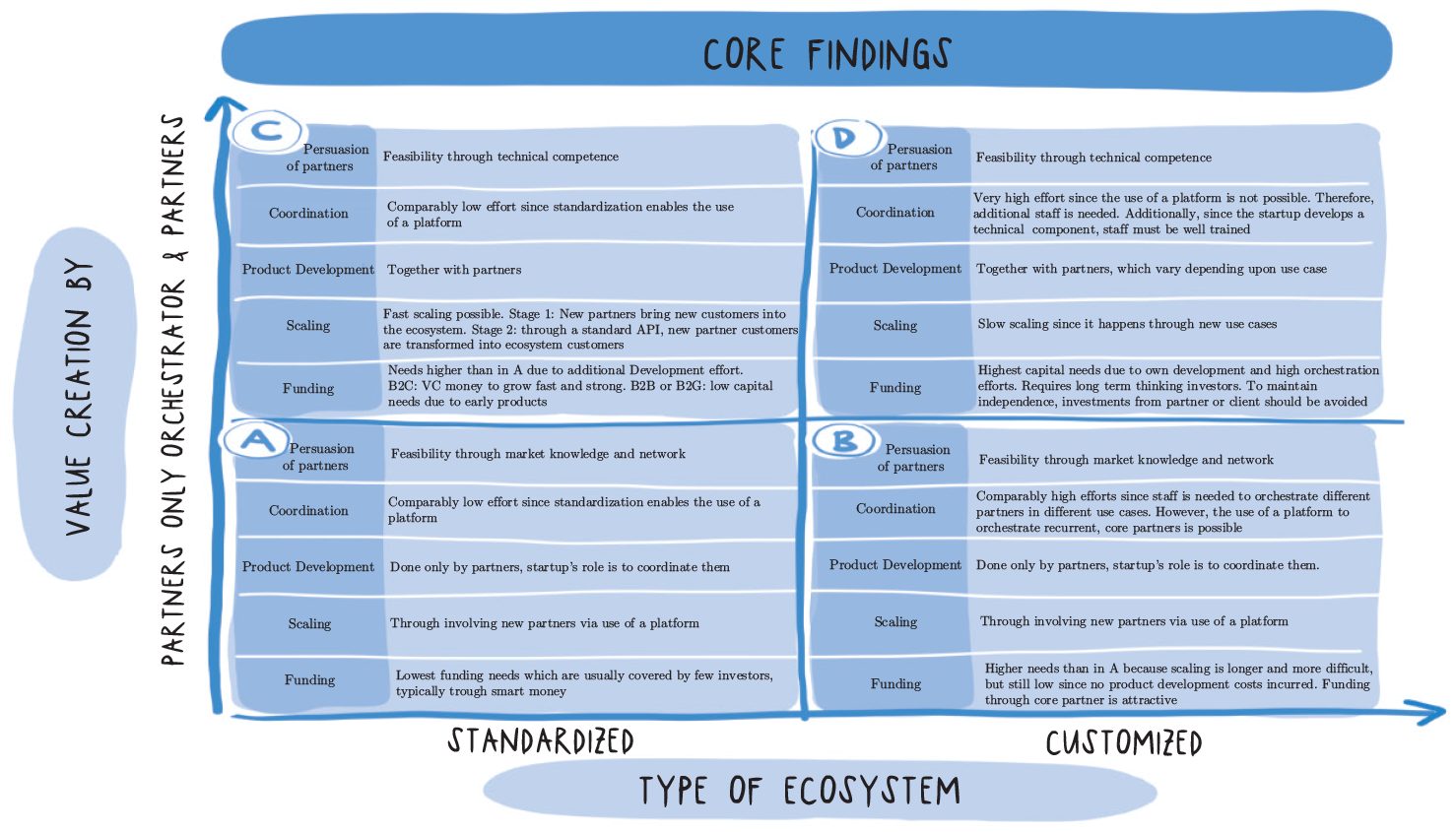
Overview of Core Findings.
The matrix offers value for startups orchestrating an ecosystem in several ways. First, it allows the firm to classify itself as one of the archetypes and use the respective recommendations provided as guidance on how to do so. Furthermore, it allows the startup to assess whether it is suitable to perform the implications given, which helps to assess whether it is feasible to orchestrate the ecosystem at hand. Beyond these guidelines, our findings and the framework provide several interesting implications for startups as well as other types of organizations interested in the topic of ecosystems, as follows.
For Startups
First and foremost, our findings demonstrate that startups can be successful ecosystem orchestrators. Even more, our research shows that to do so, they do not even need to provide a core competency in the form of a technical module or key module to the ecosystem, as shown in Archetypes A and B. Thus, the role of the orchestrator offers new possibilities for founders with small teams and few resources, as an orchestrator’s core contribution may lie solely in the network and market knowledge its founders bring to the ecosystem. We show that it is possible for startups to build up an ecosystem without contributing a module. For this type of orchestration, the startup must at least have market knowledge and a network. The downside is that the orchestrator must be careful when selecting the necessary ecosystem partners: the startup must make sure that not all of the partners are aware of each other’s involvement, otherwise they could make the orchestrating startup redundant. However, taking on the role as an orchestrator can also disclose some challenges, for instance, when the value proposition is customized, as in Archetypes B and D. These ecosystems require a lot more human resources, which is a resource many startups lack. As a result, the capital needs are much higher, especially for persuasion and coordination.
For Corporates
The findings presented in our framework are also of value to corporate firms. First, when being the orchestrator, corporations and SMEs (which face challenges similar to those startups face when it comes to ecosystem orchestration, 64 especially the challenge of resource constraints) might also profit from our study, since we show how to orchestrate an ecosystem. Regarding resource constraints, standardization must be considered. Indeed, the number of resources needed decreases with the degree of standardization of the ecosystem, regardless of whether the orchestrator is a startup or corporate. For this reason, customized value propositions are not well suited to startups or corporate teams, where few employees are available to be assigned to the tasks necessary for ecosystem orchestration.
From the perspective of firms involved in a startup-led ecosystem as complementors, corporates also profit from this research as they can now assess if a startup might be able to orchestrate the type of ecosystem at hand. Hence, corporate firms have an additional decision-making basis for whether they should engage in a startup-led ecosystem or not.
For Investors and Accelerators
The findings presented in our framework are also valuable to investors and accelerators. The framework helps investors to evaluate startups that fulfill the roles of orchestrators. In particular, our findings help investors and accelerators assess the startup’s capital needs and success potentials. Concretely, our research shows that funding needs may radically differ in terms of amount and duration from one orchestrator to another, depending on its position in our framework. Obviously, funding needs increase in the case when the orchestrator develops a part of the value proposition, such as in Archetypes C and D. However, they are also higher when the value proposition is customized as compared with standardized, as depicted in Archetypes B and D. Therefore, Archetype A displays the lowest capital needs and Archetype D displays the highest. The funding type also depends on these two dimensions. Indeed, when the orchestrator does not contribute a module to the value creation, it will be interested in seeking funding from one of its core partners, such as in Archetype B. On the contrary, when the startup contributes to the creation of value, such as in Archetype D, it will avoid being funded by its partner or client to keep its independence. Furthermore, our study shows that the type of funding also differs depending on the type of ecosystem. Indeed, in customized value proposition structures, such as Archetypes B and D, scaling is slower and more complicated and, therefore, only suited for long-term investors.
Supplemental Material
sj-zip-1-cmr-10.1177_00081256211005497 – Supplemental material for Even a Small Conductor Can Lead a Large Orchestra: How Startups Orchestrate Ecosystems
Supplemental material, sj-zip-1-cmr-10.1177_00081256211005497 for Even a Small Conductor Can Lead a Large Orchestra: How Startups Orchestrate Ecosystems by Bernhard Lingens, Maximilian Böger and Oliver Gassmann in California Management Review
Footnotes
Notes
Author Biographies
Bernhard Lingens is the Head of Area Innovation at University of Lucerne, Switzerland, and a Visiting Professor at Aalborg Business School, Denmark (email:
Maximilian Böger is driving innovation at Reichle und Partner, an Austrian marketing agency (email:
Oliver Gassman is a Professor of Innovation Management at the University of St. Gallen (email:
Supplementary Material
Please find the following supplemental material available below.
For Open Access articles published under a Creative Commons License, all supplemental material carries the same license as the article it is associated with.
For non-Open Access articles published, all supplemental material carries a non-exclusive license, and permission requests for re-use of supplemental material or any part of supplemental material shall be sent directly to the copyright owner as specified in the copyright notice associated with the article.
