



Abstract
Organizations can attempt to improve strategy implementation by developing strategy execution maps, which aim to translate strategic objectives into specific activities and provide sufficient clarity to inform employees’ decisions and actions. However, managers often encounter pitfalls, both in framing the process and in developing maps. This article suggests how to overcome these pitfalls, describes several applications of causal maps to further enhance strategy execution, and illustrates strategy execution maps for organizations with distinctive strategies.
Keywords
The key elements of our strategy are as follows:
continue our focus on delivering operational excellence;
leverage the benefits of our integrated model;
reinforce our technological leadership; and
make intelligent and disciplined investments. 1
Imagine being an employee of this company. Is it clear to you what strategic choices your leaders have made or what alternatives they have rejected? Is it clear what activities you should undertake to support implementation of the strategy or how your actions will contribute toward achieving strategic goals? The answer to both questions is clearly no. This strategy statement is so generic as to mean almost nothing. It offers no guidance as to the direction in which this organization is moving; specifies none of the choices that have been made; and leaves employees in the dark as to how they can help via their day-to-day actions. It would be less concerning if this was an isolated example, but vague and generic strategy statements like this can be found in abundance.
Generic and ambiguous statements create lack of clarity—something long recognized as a problem in strategy. 2 Employees sometimes don’t know their organizations’ strategic choices or what alternative options have been rejected. They often don’t understand how to translate lofty strategic objectives into the specific actions they must undertake to achieve these objectives. 3 Our own research has illuminated the extent of this problem. Between 2014 and 2019, we surveyed 2,146 managers at all levels in 48 organizations spread across 58 countries. 4 We asked them to rate the clarity of their organizations’ overall objectives, strategic choices, trade-offs made, and critical activities necessary to implement the strategy—in each case using a five-point scale. Whereas clarity of organizations’ overall objectives was rated an average of 4.2 on the scale, all the other factors were rated around 3.5. It seems that managers have some idea of what their organizations are ultimately trying to achieve but are much less sure about how they are trying to do this.
Strategy execution is widely recognized as representing a significant challenge for organizations. 5 It has been defined as, “managerial interventions that align organizational action with strategic intention” and “the process of indirectly manipulating the pattern of resource and market interactions an organization has with its environment in order to achieve its overall objective.” 6 Organization success clearly relies on important activities being successfully delivered, for example, via effective projects and processes. But for this to occur, the ongoing identification, shaping, refinement, and renewal of these critical activities must happen. In this article, we focus specifically on the clarity with which critical activities are identified. Organizations need to find ways to translate their conceptual goals into specific actions that people can implement. How can committed and capable employees obtain sufficient clarity about which activities to undertake (and which to avoid), so as to make an optimal contribution to successful strategy execution? The challenge is to offer sufficient direction and guidance to avoid chaos but not so much as to suffocate creativity, initiative, experimentation, and responsiveness to changing conditions. This sweet spot has been called “mid-level abstraction.” 7 If this is managed successfully, people can answer fundamental questions about their work—what they should do, why they should do it, what they should prioritize, and what they should not do. The identification of critical activities cannot by itself guarantee success but is a key part of the strategy execution process. 8
One approach proposed in the academic literature to achieve this is the systematic and intelligent application of cause-and-effect thinking. Cause-and-effect thinking relates to the understanding of relationships between phenomena in which one phenomenon is the reason behind another. This has long been used—albeit with a particular focus on feedback loops—in the field of systems dynamics. More recently, it has been “imported” into the field of strategy to explore strategy dynamics. Mainstream strategy scholars have applied cause-and-effect thinking to explore how to design and (to a much lesser extent) execute strategies through the use of tools such as cognitive maps, cause maps, activity-system maps, and strategy maps. 9 Appendix A summarizes the emergence of causal mapping in the literature and provides working definitions of key types of causal map.
Despite general agreement that cause-and-effect thinking can be useful to the field of strategy, limited research exists on how it is applied in practice by managers seeking to execute strategy. We undertook action research in 41 organizations that developed causal maps in support of strategy execution. The primary purpose of these maps was to make explicit the connections between organizations’ strategic choices and the activities that must be undertaken to implement them. We found that practitioners readily employed causal thinking to construct maps, but often encountered pitfalls—in framing the process and in developing maps. In addition, our action research uncovered several applications of causal maps useful for executing strategy that hitherto have not been explored in the literature. These applications can iteratively inform choices around critical activities and enhance their clarity.
In what follows, we explain these pitfalls and new applications to inform how causal mapping can best be used in organizations to support strategy execution. We anticipate that causal mapping that is less prone to error and more valuable to practitioners will be used more widely by them to the benefit of strategy execution efforts in a wide variety of contexts.
Strategy Execution Maps
Although causal mapping has not been widely explored in the strategy execution literature, this methodology can be used to develop maps that focus on implementing strategy. 10 We call these strategy execution maps, which we define as visual representations of activities and outcomes critical to an organization’s strategy implementation and directed means-ends relationships believed to exist between them. 11 Strategy execution maps thus aim to depict key causal relationships central not only to formulated strategy, but also how it will be implemented. They should include critical activities that competent individuals and teams can deliver without further strategic decision making and direction from senior leaders. The inclusion of such activities is the feature of strategy execution maps that most distinguishes them from other causal maps, including “strategy maps.”
An example of a strategy execution map is shown in Figure 1. It summarizes the strategy and its means of execution for Handelsbanken, a bank with 12,000 employees and 750 branches based mainly in six “home markets”—Sweden, Denmark, Finland, the Netherlands, Norway, and the United Kingdom. By almost any measure, Handelsbanken has been one of the world’s most successful banks for decades. It has one clear overall objective, which it has met for the last 48 consecutive years: “to have better profitability than the average of peer competitors in its home markets.” 12 How has the bank achieved sustained success? The strategy execution map aims to make this clear, not only in terms of the bank’s strategy, but also the activities seen as critical to executing that strategy.
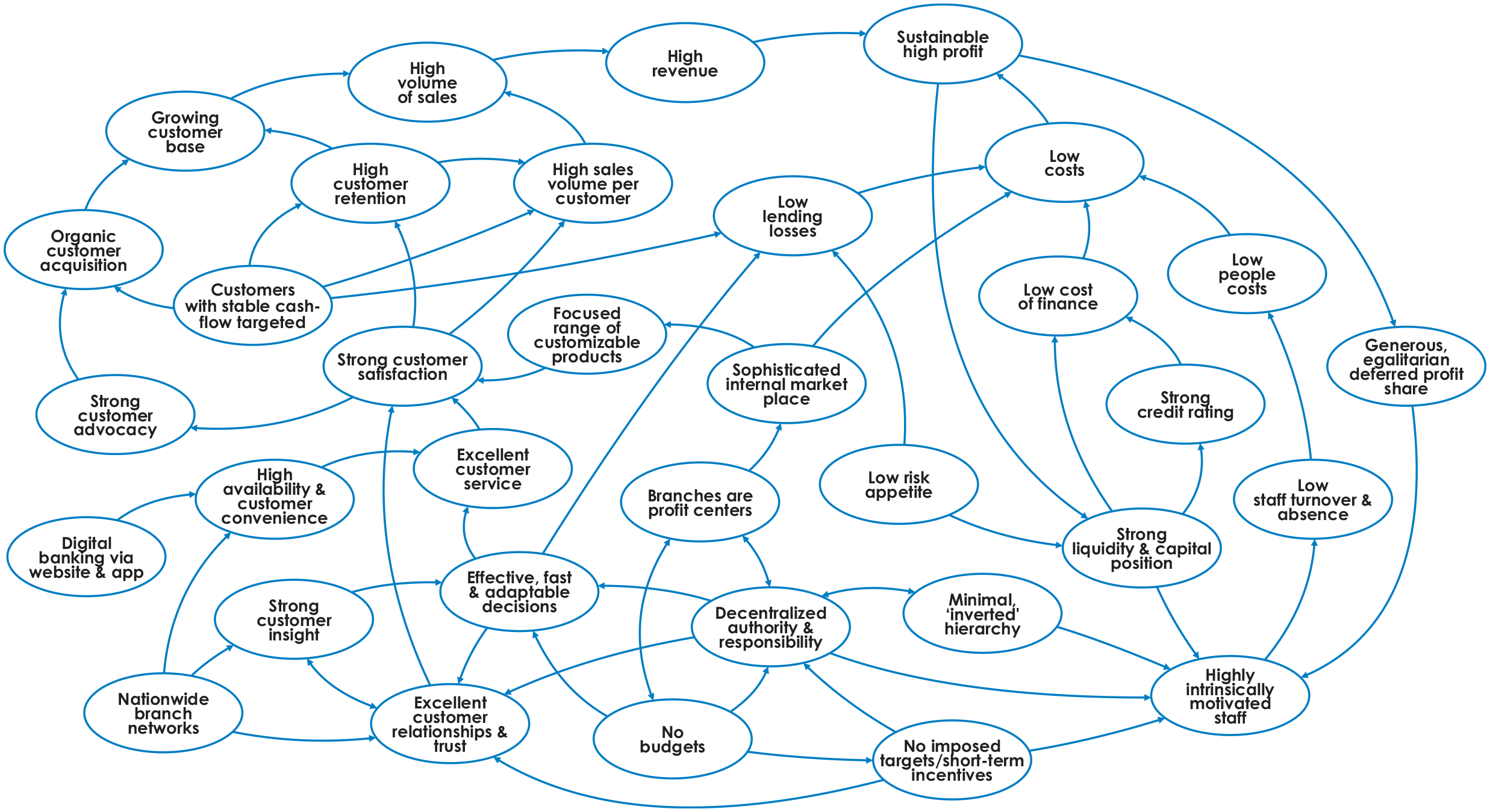
Strategy execution map for Handelsbanken.
The organization’s overall objective is summarized at the top of the map (“sustainable high profit”). The critical activities that, it is believed, indirectly cause that outcome, are found at the “cause” end of the causal chains, lower in the map. Arrows, depicting causality and its direction, link all the variables on the map. The map in Figure 1 can be used by those in the bank, alongside commentary and discussion, to explore the core reasoning that drives Handelsbanken’s decisions and activities. Anyone seeking to understand how the organization’s strategy is to be executed can start with the overall objective and trace its plausible causes—direct and indirect. Equally, anyone seeking to understand why particular critical activities have been chosen can start with these and trace the effects to which they plausibly contribute. For example, the role of digital banking is made clear by its depicted outcomes. The map provides the basis for a shared language and understanding of strategy and its means of execution.
As the literature already demonstrates, causal maps can be used to inform the development of performance measures—in this case, customized according to the causal relationships uniquely important in an organization, rather than any pre-determined format or categories. 13 Where appropriate, measures can be used to calibrate goals, further clarifying the performance variables depicted in a map—for example, setting a profit or sales volume target.
An organization need not have only one version of a strategy execution map—variations can be developed for different purposes. For example, most people can comfortably consume more detailed maps as they become familiar with their basic structure (much as with geographic maps), so a map used for new staff induction could be a simplified version of one used by senior managers. Highly sensitive details of strategy—for example, acquisition intentions or truly secret know-how—can be omitted from widely circulated versions.
The primary purpose of a strategy execution map is to translate overall objectives into critical activities and articulate the logic behind this. However, in breaking down overall objectives, the map also needs to summarize the key elements of strategy. In doing so, it performs some testing of strategic logic—uncovering whether choices are coherent when the detail is worked through and whether the required activities are actually implementable. As Kenneth Andrews cautioned, “corporate strategy . . . is never complete, even as a formulation, until it is embodied in the organizational activities which reveal its soundness and begin to affect its nature.” 14 This makes strategy execution maps useful as part of the wider strategy toolkit. If strategy execution mapping seems especially difficult, it may be time to reconsider the strategy itself. 15
Ally Satterly is CIO of M&S Bank, a joint venture between major UK retailer Marks and Spencer and HSBC. He notes that strategy execution mapping, “forces you to take a deeper look into your overall strategic priorities.”
Maps such as the Handelsbanken one can strengthen “line of sight” by helping individual employees and teams to explicitly connect their own activities with strategic objectives.
16
With this improved “line of sight,” people are more likely to make good choices in their day-to-day work—the right small trade-off decisions about what to do and how to prioritize work, allocate resources, and focus attention—all the time bearing in mind the bigger trade-off choices the organization has made.
17
Maurits Klavert, President Director of dairy foods multinational FrieslandCampina’s Indonesian business, recently introduced strategy execution mapping to his organization. He reflects that: vision and strategy tend to be very abstract and people struggle to find real meaning in them. But strategy execution mapping is concrete and grounded. It gets to how things really happen—individuals and teams can see how their work contributes to the enterprise.
In addition to improving operational trade-off decisions, increased “line of sight” between people’s day-to-day activities and strategic objectives has two other important benefits. First, it is highly motivating for people to understand how they contribute to the overall objectives of an organization—seeing the means by which one contributes gives meaning to one’s work. 18 Second, those with good “line of sight” are more likely to recognize the significance of insights they develop about the environment and thus contribute more effectively toward strategy development and planning its successful execution. 19 For example, salespeople who become aware of strategically important changes in customer behavior or competitor activity can share these valuable insights with colleagues.
Unsurprisingly, to accrue these benefits, strategy execution maps are best used and shared widely. In the organizations we studied, they were included in strategy documents and leader presentations and appeared on posters, desk cards, mouse mats, screensavers, and in employee onboarding materials. They have been used to kick off project workshops, frame team meetings, and inform performance feedback discussions.
A perhaps surprising characteristic of strategy execution maps is that they often depict key decisions about not only what an organization does, but also what it does not do. Such trade-offs are central to strategy, but often remain unclear to people and lead to confusion, dilemmas, and weak strategic positions. 20 For example, as Figure 1 indicates, Handelsbanken focuses on serving customers with strong cash flows. This includes both wealthy individuals and businesses (especially property companies and owner-managed enterprises) that typically have significant banking needs. The bank deliberately does not, for example, offer small personal loans and has never sold payment protection insurance (PPI)—the mis-selling of which has cost competitors dearly. In another trade-off, economies of scale that might be achieved through centralization are eschewed in favor of customer-centric localization. There is a widely used saying in the bank: “the branches are the bank.” 21 Such trade-off decisions are vital—but they can be difficult to make, sometimes demand counter-intuitive behavior, and do carry some risk. Strategy execution maps help organizations to explore and communicate the compatibility of critical activities and their outcomes.
Causal Mapping in Practice
The literature on causal mapping describes how it can be used by organizations to improve strategy formulation and—to a much lesser extent—execution. Relatively little research exists on how this methodology is applied in practice, by managers seeking to execute strategy. As a result, we still do not know the extent of its use, how organizations apply it, or which factors influence its effectiveness. From 1999 to 2020, we studied 41 organizations developing and using strategy execution maps to support the implementation of strategy. We not only observed this activity, but also undertook action research to examine mapping as “insiders” and in real time. Appendix B describes our research methodology in more detail. This research allowed us to make two sets of discoveries. First, although managers understood the rationale for the methodology, they made mistakes in applying it in two areas: framing the development of maps; and the causal thinking used when constructing maps. Second, we discovered that strategy execution maps can be applied in ways not currently elaborated in the literature.
Framing Pitfalls
We identified four specific pitfalls related to the framing of how to develop causal maps:
poor “unit of analysis” decisions;
failure to make trade-offs and prioritize focus;
limited data gathering and participation; and
lack of clarity over time horizon.
We explore each of these below and offer suggestions to ensure that participants (as we shall refer to all those involved in developing maps) can contribute effectively.
Poor “Unit of Analysis” Decisions
Strategy execution maps can be developed for whole organizations or for subunits such as Strategic Business Units (SBUs) or functional departments. 22 One mistake that we observed managers making is trying to develop maps for “units of analysis” that are too broad and complex. This can lead to frustration and abandonment of efforts to develop causal maps.
In organizations with reasonably homogenous SBUs, it makes sense to develop maps at the highest organizational level and let these maps inform those units of analysis in which subsequent maps may be constructed. In Handelsbanken, for example, although there are differences between country-specific business units, these SBUs have a great deal in common. The fundamentals of the strategy and its means of execution are fairly consistent across the six home markets. Hence, it makes sense to start with a bank-wide map.
However, the more complex an organization is—for example, being involved in multiple industries, product categories, market segments, and routes to market—the more complex the task of developing a company-wide map. 23 Starting with a mapping exercise for a very complex organization often leads to confusion and frustration with slow progress, as numerous performance variables and diverse chains of causal logic collide with unmanageable complexity. Such maps may be abandoned because they offer little insight and rarely succeed in translating strategic objectives into concrete actions.
In such cases, it is better to start mapping at the subunit level. However, this also carries a potential risk. Strategizing from within subunits can constrain thinking and lead to the development of maps that do not properly consider the organization’s overall strategic context. Such maps may support the execution of subunits’ strategies but also create or exacerbate misalignments with the overall strategy. 24 As one bank CEO said to us, “we cannot allow the structure tail to wag the strategy dog!” To manage this risk, maps can be developed for multiple subunits of an organization and then compared and contrasted to illuminate strategic fit or synergies (or lack thereof) between the subunits. These maps can then potentially be “merged” or used to inform a composite map for the whole organization. 25 In one FMCG company that we studied, this approach revealed such fundamental incompatibilities between SBU critical activities, that some were eventually selected for divestment. Conversely, a financial services company saw so few strategically significant differences between the maps of its SBUs, that it decided to merge several call centers and IT platforms, before consolidating numerous brands into a single one—an outcome no one foresaw before mapping commenced.
A third option is to use separate teams to develop strategy execution maps at both the organization and subunit levels in parallel. Insights drawn from these different approaches can be used to stimulate debate, decisions, and more refined maps at each level. 26
Whatever approach is used in selecting “units of analysis,” the key insight we draw is the value of iteration. Maps can be informed or refined by other maps. Reviewing emerging maps fosters rich debate and stimulates questioning of strategic assumptions—which may in turn drive changes to strategy or its means of execution. Maps are not merely passive representations of assumptions or decisions; they can be used proactively to shape thinking and the action that follows it. Thus, maps should be refined and updated continually, as the environment changes (and thus the way in which it conditions key causal relationships changes) and as insight about causal relationships develops within different “units of analysis.”
Failure to Make Trade-Offs and Prioritize Focus
In the process of developing a strategy execution map, two critical decisions requiring judgment are necessary. Our research revealed that if organizations fail to make these decisions explicitly, map development efforts can flounder.
First, for each outcome on a map, there may be several potential causes. For example, higher sales volumes may be achieved through low prices or differentiation. As these options are identified, decisions need to be made as to which strategic choices an organization can or wants to make. Options that are not selected must be dropped from the map. Similarly, some proposed activities or their outcomes may conflict with each other, meaning that they cannot be achieved simultaneously, in which case again, choices have to be made. For example, a business may decide to focus on securing low costs through a no-frills offering and therefore not pursue premium prices. The latter should thus not appear on the map, although it may previously have been considered a viable option. There is always uncertainty surrounding choices and judgment is often necessary to make decisions, but choices must be made. Otherwise, maps become a complex mix of possibilities and intentions, which creates more confusion than clarity. Organizations must make clear trade-off decisions if strategy execution is to succeed. 27 Because these choices are difficult to make, managers sometimes fail to make them, and the result is confusing and unhelpful maps.
A second decision that has to be made is how many possible causes for each outcome to include in a map. It is tempting to try to incorporate every conceivable cause of each outcome. This is counterproductive. Maps become unmanageably complex if every conceivable intermediate objective and activity is depicted—one manager described an overly complicated map emerging in his team as, “looking like a bowl of spaghetti.” Some prioritization must occur to allow focus only on critical activities. It is important to identify the most influential and plausible causes of desired outcomes and this again often requires the use of judgment. Moving from many causes to only the critical ones makes maps progressively more manageable, simpler and more useful to depict an organization’s strategy and means of its execution.
Developing maps will, therefore, raise crucial questions for participants. What are the best strategic choices to make? Which activities and outcomes are most critical? The validity and relative strengths of the relationships hypothesized on a map become essential issues. In practical terms, these decisions must be applied early on and throughout map development; they cannot be “left until the end” if a map is to create clarity and focus. For example, in the process of developing its map, FrieslandCampina in Indonesia swiftly decided against running a major TV advertising campaign, recognizing the likelihood of achieving its goals more effectively via other channels.
There also must be room for debate and constructive conflict to work through uncertainties. 28 Refined strategy execution maps typically depict causal relationships that organizations believe already exist or reasonably could in the future. But maps can be constructed to reflect the outputs at different stages in a decision-making process spanning strategy formulation and execution. 29 It is best that participants clearly agree on the intended status of maps and the planned path for their continued refinement to avoid confusion and unconstructive conflict. There is a balance to be struck—avoiding the pitfalls of analysis paralysis on one hand, and reckless reliance on rhetoric and assumption on the other. 30
As they develop maps, organizations can progressively augment the subjective assessments and heuristic judgments that practically have to be made with evidence from existing performance measurement data and proactive empirical research that strengthens the decision-making process. 31 Such research can include robust experimentation, prototyping, and piloting of solutions. 32 That said, it is wise to be humble and recognize the residual uncertainty that exists in most causal logic. Even the best maps will always to an extent be incomplete or inaccurate. Alfred Korzybski’s famous caution that “the map is not the territory” is particularly apt. It’s impossible to eradicate causal ambiguity but a map doesn’t have to be “perfect” to create clarity, stimulate valuable dialogue, and provide a structure to empirically examine what works. 33 Maurits Klavert at Friesland Campina sees a core value of strategy execution mapping as highlighting where key uncertainties lie and has noticed new language emerging as a result. He notes that in team discussions, “we now often ask if something is assumption or fact and whether a relationship between variables is correlation or causation. We need to think like that—otherwise we’re spending money without knowing the impact!”
Limited Data Gathering and Participation
Building causal maps that uncover beliefs, develop understanding, and create collective wisdom is not always easy. A common pitfall into which we observed organizations falling was not gathering enough insight and not involving a broad enough range of participants. These two issues are tightly related—it is people who hold critical insights in their heads, know what information is available, or can be motivated to gather new data where gaps exist. This reliance on people to secure insight is even more pronounced in relation to strategy execution than strategy development—“the devil is in the details,” and top leaders rarely know the details as those nearer the “coal face” do.
We observed that many organizations tended to rush into decisions about how to develop maps. Most commonly, a leader might be tempted to gather a top team for a half-day workshop to “bash out” a map that can then be communicated to the rest of the organization. However, this is likely to be met with limited success.
Who should be involved in the process of developing a strategy execution map? Ideally, as many as possible of those who will be working to execute the strategy. There is evidence that successful implementation relies on planning involving both leaders and those responsible for execution. This outperforms approaches that separate these groups—leaders are wise to work closely together with teams rather than issue “edicts” to them. 34 It is also important that those making decisions (for example, using performance measures based on a map) understand the causal logic of the map. 35 Such understanding is more likely with involvement in map development. A team leader at an events company recently remarked at the end of a strategy execution mapping workshop that “I can’t believe how much I’ve learned—or how important my team’s work is to the organization’s success.”
Involving many people in a workshop may be unrealistic in some circumstances. But the process to develop a strategy execution map is best not seen as an episode; rather it should be a continual series of interactions. 36 Previous research into causal mapping has identified several stages in typical map development, including:
identifying potentially important performance variables that may belong on the map;
identifying individual causal relationships between variables; and building up maps from individual causal relationships. 37
Although all three stages can be tackled in one or two workshops, we found that it is better if they are deliberately separated to ensure scope for wide involvement and to reduce the risk of rushing the process in one or two high-pressure events. For example, a wide range of colleagues can be invited to identify performance variables that may be important enough to appear on a map. This preparatory task is useful to widen the sources of data used and stimulate thinking that will lead to positive outcomes—and crucially it widens ownership in the mapping effort and its outputs from the start. 38 This approach allows participants to start the mapping process in an undemanding fashion, which encourages them to start thinking about what “performance” means and its most important aspects. Building on these foundations, small groups can process such inputs (for example, identifying the most commonly suggested variables) and start the map development process. As noted above, emerging maps can be “merged,” so it is feasible to invite an almost unlimited number of individuals or groups to start drafting maps, if given sufficient guidance. Ultimately, larger workshops are a popular method to build on these foundations. Using a mix of different data gathering methods also increases the chances that important performance variables or causal relationships will surface and be cross validated. 39
Another FrieslandCampina leader who recently introduced strategy execution mapping is Imran Husain, CFO of the business in Pakistan. The organization wanted to crystalize its strategy and prioritize execution plans. Within a few weeks, a cross-functional team drawn from different organization levels developed ten iterations of a map via intense workshops. The exercise has been received overwhelmingly positively by teams, generating “understanding, clear direction, pride, ownership, and a sense of responsibility for the future of the organization.” Imran reflects that “every time we went back to the drawing board, we emerged stronger with clearer linkages and a fresh perspective.” His colleague, Maurits Klavert, emphasizes the importance of cascading the methodology to more junior employees rather than “finalized” maps produced by leaders.
Whatever approach is used, it is wise to ensure a strong diversity of perspectives. Cross-functional teams should be widely used. Also important is to engage people at different levels of seniority to avoid “elite bias.” 40 It is prudent to involve those with particular knowledge and expertise in topics being explored and those who will best be able to influence strategy execution. 41 Many top leaders seemed a little surprised by the suggestion that relatively junior employees should be included in a strategy-related process and sometimes agreed to this with trepidation. However, in no cases did they come to regret wider inclusion. In the words of a chemicals company CEO with whom we worked, “we have to get all the brains in the game!”
The key then, to avoiding this pitfall, is to gather data from multiple sources and involve as wide a group of participants as possible at different stages of map development. This improves outputs—but also crucially boosts the chances that critical activities identified will be implemented, owing to the sense of ownership in these outputs. 42
Lack of Clarity over the Time Horizon
The “time horizon” is an important choice when developing causal maps: participants need some idea of the period over which they are trying to optimize performance. They would make very different decisions if an organization was fighting to survive the next six months than if it was aiming to prosper for the next 60 years. We observed that failing to make this clear can lead to some confusion and conflict. Maps can represent causal relationships from the past, present, and/or future. 43 Strategy execution maps usually capture the present and look to the future, so it is also useful to explicitly agree on their time horizons—that is, how far forward thinking should extend in relation to the various performance variables represented. 44 For example, an overall objective may be a very long-term goal, whereas a new critical activity should be delivered and optimized quickly. It is better that participants analyze and plan for the “reasonably foreseeable future” on an issue-by-issue basis rather than set a fixed period. But the most important point is for participants to develop a shared view, so that differing perspectives are better understood. If time horizons are unclear, so too will be the arguments that emerge around the strengths of causal relationships and which activities are critical.
Related to this, it is useful to explore expected time lag between causes and effects. We have seen some destructive conflict between participants that was attributable to varying underlying assumptions about time horizon and time lag. 45 With the issue made explicit, strategy execution maps can be useful to connect long-term goals with activities and changes to them that will be implemented in the near-term.
Finally, many strategies that we saw depicted in organizations were “change-only”: they neatly outlined new products to launch, new markets to enter, and new channels to develop. However, they failed to explain which existing activities (which were driving current performance) would continue. Moreover, this made it very difficult to see how—or even if—new initiatives could be integrated with ongoing ones. We observed that a significant benefit of strategy execution maps was the meshing of strategic changes—reflected in new activities and outcomes—with ongoing activities and their outcomes.
Map Construction Pitfalls
As with other forms of causal mapping, strategy execution mapping is susceptible to problems that emerge from dysfunctional organizational patterns and groups making cognitive errors. In our research, we identified four key map development pitfalls:
failure to specify actionable activities;
ambiguous language;
confusing causality with sequential task dependency; and
making “leaps of logic.” 46
We explore each of these pitfalls below, offering advice on avoiding and overcoming them. Our advice to managers is also summarized in Appendix C.
Failure to Specify Actionable Activities
Perhaps the most important characteristic of strategy execution maps is that they aim to translate conceptual strategic goals all the way to critical activities. 47 However, we sometimes observed mapping that “stopped short” with what were not activities, but still rather conceptual performance variables. The problems this causes are clear. People cannot see what they should actually do to execute strategy. Even the feasibility of strategy execution remains unclear. This phenomenon is evident in some strategy-related causal maps in the existing literature. For example, effects depicted at the “cause” end of causal chains in maps include: “technology that facilitates process improvement,” “multidisciplinary skills,” “achieve a high-performance service culture,” and “align organization.” 48
The solution is clear: keep developing maps until actionable activities are reached. This raises the interesting issue of how to recognize if you have reached an implementable activity. We think the “acid test” to apply is that competent individuals and teams should be able to implement identified activities without significant further instruction from or intervention by senior leaders. For example, Figure 1 depicts activities that are feasible for teams to undertake, such as handling customer calls in branches or maintaining a minimal “inverted” hierarchy. Competent branch staff can build strong trusting relationships with customers and adopt a low-risk appetite when making credit decisions that rely heavily on the strong customer insight they have developed.
Ambiguous Language
In common with researchers observing the development of other types of causal maps, a related and extremely common problem we detected was the use of ambiguous language. 49 Organizational life is replete with vague phrases such as “world class,” “operational excellence,” or “high-performance culture.” These buzzwords are used liberally—perhaps most when people aren’t really sure what they mean—and are relatively easy to spot. Easier to miss are seemingly innocuous words that without specificity mean equally little: “alignment,” “innovate,” “digitize,” and “growth.” Strategy execution maps suffer terribly if they include such language. Not only do critical activities and their outcomes become unclear, but so too do the implied causal relationships between them. One senior leader told us that “as management becomes more ‘sophisticated’ and ambiguous phrases become part of the lexicon, it’s very easy for managers to lose track of what really drives outcomes.”
The “acid test” is to ask, “can we measure this?” If not, it’s probably too vague. Overcoming this pitfall demands the use of plain, clear language. It seems worth testing out this language—for example, by checking that those not involved in a mapping exercise can interpret its outputs as intended.
Confusing Causality with Sequential Task Dependency
A mistake that we frequently observed participants make, but are not aware of other researchers reporting, is confusion between causality and task dependence. Action-oriented managers with strong project management skills were readily able to determine the order in which activities should be completed, given sequential dependencies between them. 50 But of course, sequential task dependencies are not causal relationships. For example, developing software must precede testing of it, but the development will not cause the testing. We regularly observed participants mapping numerous related activities but failing to identify the outcomes these activities were intended to cause. This can lead to serious failure of the mapping process—activities and strategic objectives clearly could not be causally connected with this approach. To overcome this pitfall, checks should be made that the only activities on an emerging map are at the “cause” end of each causal chain depicted. Other performance variables should be outcomes—that is, intermediate and overall objectives.
Making “Leaps of Logic”
In employing causality, another mistake we frequently observed was participants making big “leaps of logic”—for example, implying that revenue can be increased by improving customer service. Although this is a plausible relationship, it is not plausibly direct. As Figure 1 depicts, in Handelsbanken there are several intermediate outcomes that connect these variables. Much detail was lost when such leaps of logic were made. Dialogue was less focused, analysis was less structured, and risks were ignored. Research to test assumptions becomes difficult if hypothesized relationships are not precisely articulated. That said, we think some small leaps of logic knowingly made in refined strategy execution maps can be useful to manage the balance between precision and simplicity. To overcome this pitfall, links in emerging strategy execution maps should be examined for plausibility as direct causal relationships.
New Applications of Causal Mapping in Strategy Execution
As FrieslandCampina’s Maurits Klavert says of strategy execution mapping, “the concept is simple, but it’s not always easy to avoid the pitfalls—you have to really think about it.” But he argues that it is worth it. After 35 years in the business and long involvement in strategy and execution processes, he observes that “strategy execution mapping is different and much more powerful—it’s got a lot of legs and can go a long way.” Indeed, developing strategy execution maps seems valuable in itself: the process prompts useful reflection, drives rich dialogue, increases clarity of thought, and focuses attention on critical activities and outcomes. 51 And the outputs of this work are valuable; these benefits are reinforced as colleagues review refined maps and use them to develop their own mental models and contributions to planning and implementation. However, maps have value beyond this, through specific applications—many of which serve to enhance maps and further refine and clarify the critical activities they include, in an iterative cycle. For example, one application already explored at length in the literature is the development of performance measures. Strategy execution maps of the sort depicted in Figure 1 seem to serve this purpose well, particularly as they translate strategy all the way to concrete activities. However, other applications have not been widely explored in the literature and have become apparent to us only via undertaking action research with practitioners developing strategy execution maps in organizations. We outline here several of the most useful applications. In support of strategy implementation, strategy execution maps can help managers to clarify:
outcome risks;
subunit contributions;
critical collaborations; and
the impact of potential strategic change.
Clarifying Outcome Risks
One of the most useful applications of strategy execution maps that we uncovered was the identification of outcome risks. Managers in the organizations we studied were typically skilled and experienced in spotting delivery risks—events or situations that might prevent successful execution of initiatives. However, even when initiatives were delivered perfectly, they sometimes failed to have their desired effects: the seemingly brilliant new product that didn’t generate demand; or the new CRM system that was installed exactly as promised but hardly anyone used. As discussed above, causal assumptions can be or become invalid. In addition, there is the risk of negative unintended effects, which sometimes appeared even when desired outcomes were achieved—and could go unnoticed for prolonged periods. Such outcome risks can be difficult to anticipate, especially for innovative ventures in uncertain contexts. However, our research established that once a strategy execution map has been developed, it can be used systematically to identify:
failures of intended causality, by examining each causal relationship and asking what could weaken or break this link?; and
negative unintended effects, by examining each variable and asking what negative outcomes might plausibly also be caused by this?
This rather forensic approach—enabled by the precise causal hypotheses captured in a good strategy execution map—proved to be extremely useful in a wide variety of contexts. It uncovered risks that in some cases dramatically changed thinking, decisions, plans, and critical activities hitherto included in maps. Activities were frequently deleted, added, reshaped, or reprioritized as a result of outcome risk identification, illuminating the value of iterating strategy execution maps.
Returning to our example from Handelsbanken, Figure 2 illustrates examples of risk identification using this approach. For simplicity, only a few risk examples are provided:
A failure of intended causality would arise if the growing customer base did not lead to higher sales because new customers purchased only single products. Handelsbanken guards against this risk in its targeting and acquisition of customers. For example, it does not court customers who require only a savings account, instead seeking those who will benefit from the deeper relationships the bank is good at building.
A negative unintended effect—limited sharing of best practices—could arise between subunits in Handelsbanken, given its decentralized authority and minimal hierarchy. The bank manages this risk by using an accounting system that offers complete transparency to colleagues and ensuring intensive ongoing discussion between subunits.
Some risks represent both failures of intended causality and negative unintended effects at the same time. For example, the increased use of digital banking may have the unintended effect of reducing personal contact with customers, which could in turn threaten customer relationships and trust.
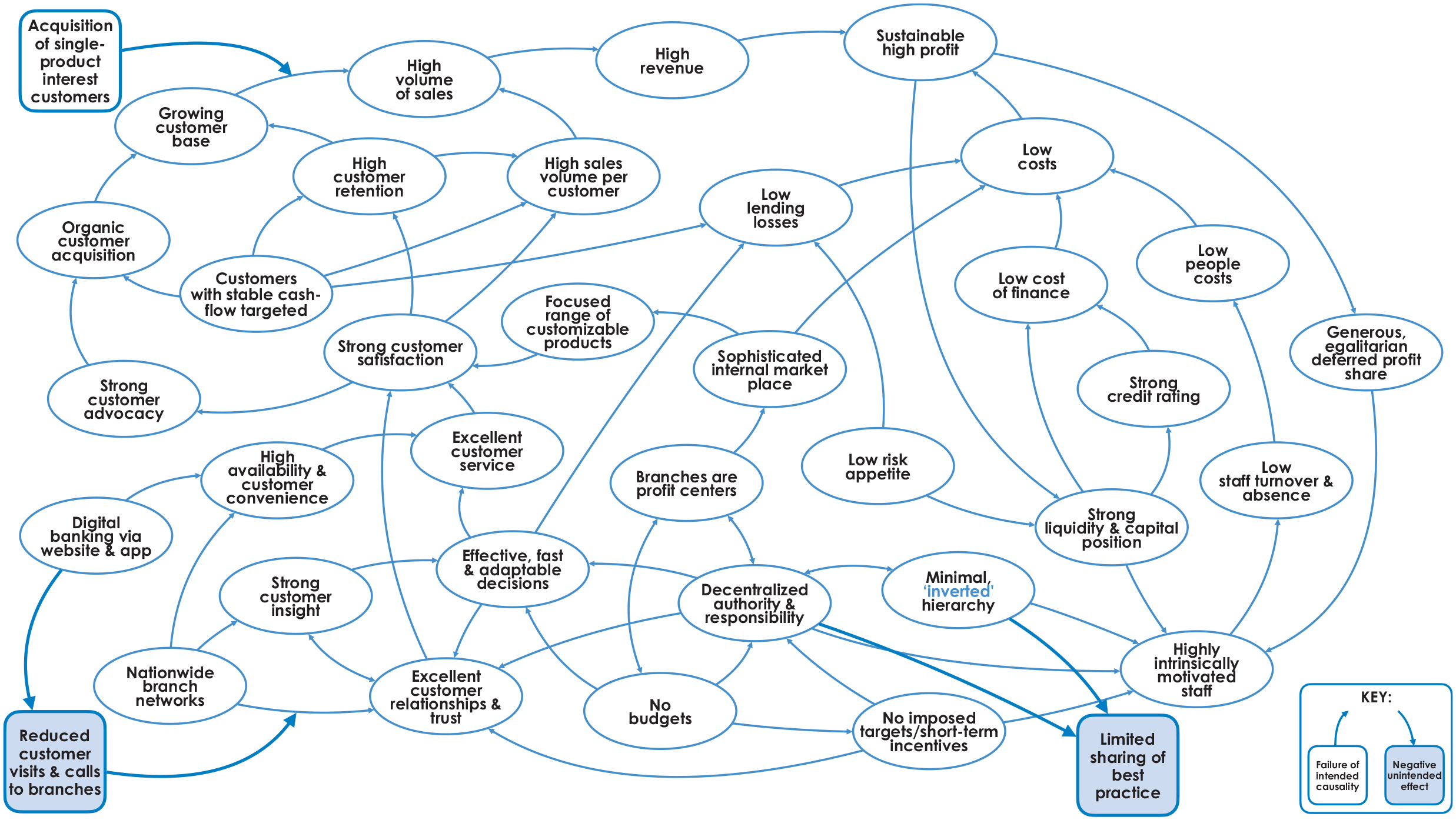
Selected outcome risk identification for Handelsbanken.
This form of risk identification can be elaborated with well-established risk analysis methods, for example, by depicting one risk in turn causing others or combinations of risks that together could produce more serious consequences. 52 Outcome risks can be analyzed (for example, to assess likelihood and impact), prioritized, and managed using the same methodologies as are commonly employed for delivery risks. In some of the cases we observed, their identification had far-reaching consequences for strategies and implementation plans—including changes to major decisions. For example, a retailer considering introducing a customer loyalty program concluded that there were so many outcome risks it could not effectively manage, given its cost leadership positioning, that it abandoned the idea in favor of other developments. Even in less dramatic cases, we found that organizations performing this analysis across an entire strategy execution map built detailed pictures of where their greatest uncertainties lay—leading to focused responses to manage risks, for example, by experimenting, prototyping, and piloting solutions to calibrate risks more precisely or test different solutions.
Clarifying Subunit Contributions
Just as individuals can use strategy execution maps to enhance their “line of sight,” organizational subunits can use them to identify where they might best add value. 53 For example, several IT functions in organizations we studied decided that rather than devising a “technology strategy,” they should use their organizations’ strategy execution maps to establish where they could pull levers to execute the strategy. Similarly, several HR functions identified people-related “hot spots” in their organizational maps and used these as the basis for their own planning. Subunits can progressively ensure that all of their key activities are aligned with the outcomes in a strategy execution map. In doing so, they may help to refine the map—stimulating further iterative refinement of its critical activities.
Figure 3 provides an example strategy execution map for Costco—one of the world’s biggest retailer/wholesaler businesses. It has almost 800 warehouses and over 100 million members worldwide, generating revenue of almost $150 billion.

Clarifying subunit contributions (for procurement) at Costco.
Figure 3 provides an example of where in the Costco map the procurement function might best contribute—bringing both context and focus to its work. Procurement specialists can leverage the high volume of sales that the organization generates and the narrow range of quality brands it carries to build strong bargaining power and ensure low cost of goods, capital, and logistics. Keeping costs low is essential, alongside the capped margins that Costco uses, to offer low prices. Co-founder and former CEO, Jim Sinegal is clear that “when a customer sees a product in Costco, they expect that it’s going to be the best value that they can find. We really very zealously work on protecting that image. That’s what we’re all about, saving customers money.” 54 The team must also ensure that Costco procures only a limited range of fast-selling stock units to further simplify logistics and ensure low levels of inventory and unsold items. Costco benefits hugely from selling most of its stock before it has to pay for it, so the procurement function’s management of these interrelated dimensions is a vital contribution to the success of the business.
Our research suggested that subunits can also consider the balances that need to be struck when they examine whole maps. For example, Handelsbanken’s model ensures that branch staff care at least as much about credit losses and customer service as they do about sales volumes. In many organizations, accountability is framed much more narrowly. For example, salespeople might have “line of sight” between their activities and strategic objectives. However, they may be insensitive to the need for customer retention, sustainable pricing, optimized customer acquisition costs, or fraud avoidance, among other things. A strategy execution map can help to illustrate the wider system within which everyone works—and support more informed and balanced operational trade-off decisions. They can also starkly illustrate where self-interested trade-off decisions might be made by individuals or teams, for example, because of misaligned performance measures, targets, or contingent rewards.
Clarifying Critical Collaboration
The organizations we studied also created clarity in another key area. It is very common to hear leaders encourage colleagues to collaborate—to break down the silos that separate them and work together in new ways. However, subunits cannot collaborate with everyone on everything all of the time, just in case some value emerges from doing so. They need more efficient and focused ways to identify where collaboration offers true potential. They need a more strategic lens and participants found that strategy execution maps provide one. If two subunits examine a map to identify their critical contributions, it is a small additional step to cross-reference their perspectives and pinpoint where collaboration is essential. For example, if the analysis in Figure 3 for Costco’s procurement function is cross-referenced with an equivalent analysis for its logistics function, intersections appear in only a few specific areas:
ensuring low levels of inventory and unsold items;
maintaining a limited range of fast-selling stock units;
securing a narrow range of quality brands and own label products; and
ensuring low cost of goods, capital, and logistics.
This can be depicted on a map and clearly helps to bring strategic focus to collaboration efforts. Imran Husain at FrieslandCampina notes that strategy execution mapping also “opened dialogue across functions, helping to bridge silos and create a strong sense of ownership and unity between leaders.”
As with other applications, clarifying critical collaboration drives iterative refinement of maps and activities—for example, shaping information flows or key process design. One retail bank we studied recognized that its account management and credit card subunits were failing to collaborate around critical activities: their disjointed platforms meant customers lacked a single online login and view of their accounts—and the bank lacked a single view of customers, increasing credit risk and handicapping marketing efforts. These problems were known but their criticality was not appreciated until mapping began, which stimulated far closer cooperation to iron them out.
Clarifying the Impact of Potential Strategic Change
We observed that once a strategy execution map has been developed, it helped the organizations we studied to explore and examine—starting at the activity level—the impact that potential strategic changes might have. 55 For example, there are huge shifts underway in retail banking, as technology evolves and allows more customers to conduct transactions digitally. Many banks are seeing branch visits by customers declining at around 30% per annum. Sweeping branch closures are thus underway in multiple markets. Naturally, Handelsbanken might question whether it should follow this trend or risk being “left behind” with an expensive distribution network that has become outdated.
Figure 4 highlights the contribution that the nationwide branch network makes in executing the bank’s strategy. It’s immediately obvious that branch closures could risk undermining customer insight, customer relationships and trust, and the bank’s availability and customer convenience. The knock-on implications are also made clear. Handelsbanken can consider whether and how digital banking can also deliver these outcomes or generate other advantages, such as cost savings, that justify altering the current model. Of course, such considerations should be made with reference to the competitive context; there is a clear risk of becoming more like rivals. In fact, Handelsbanken is shrinking its network in Sweden, where it had a very high number of branches. However, in other countries, the network has changed little. In fact, as other banks have been closing branches, Handelsbanken appears to be gaining from their retreats. 56

Clarifying potential strategic change impact for Handelsbanken.
Alternative trade-off choices and strategic positions can be considered using such maps. For example, consider how well placed Handelsbanken would be to pursue sub-prime retail customers or become an entirely online bank. Although such choices might be wholly appropriate for other banks, the map suggests that neither choice would fit well with Handelsbanken’s strategic position or build on its strengths. Handelsbanken is skilled at building relationships with and serving the needs of customers with strong cash flows—precisely the opposite type of customer to those in the so-called sub-prime segment. Similarly, becoming a wholly online bank would undermine its ability to build local knowledge and strong customer relationships or serve customers face-to-face. It would make Handelsbanken much more like competitors—discarding its unique strengths in favor of head-on competition with rivals better placed to pursue that strategy.
Strategy execution maps appear to be useful to test out proposed changes and inform decisions at various levels. In some instances, strategic options may be accepted, rejected, or reshaped following this kind of analysis. More often, changes to activities are sufficient to “make a strategy work.” In each case, the iterative interplay between an evolving map and the application of it adds value.
Summary and Conclusion
Despite general agreement that cause-and-effect thinking can be useful in strategy, its explicit use by managers has not been widespread. We believe a key reason for this has been the failure to develop tools that allow managers to competently apply this thinking in a simple and practical way in their strategy work. Strategy execution mapping offers a language and a methodology that appears well suited to the challenge of translating strategic objectives into critical activities that people can then undertake and, in doing so, help to implement strategy. Through the use of this approach, strategy can be refined and employees can be mobilized to participate in its execution. However, various pitfalls—some of which are rather subtle—await managers who employ this approach. Knowledge of these pitfalls and how to circumnavigate them should increase the value of causal mapping for organizations as they seek to execute strategy. This value can be further enhanced with the additional applications of maps that we have illustrated here.
The insights from this research offer managers a pragmatic method to explore strategy and its implementation, inform trade-offs, prioritize attention, and enhance “line of sight.” Causal maps—and the thinking and dialogue they foster—have the potential to enable clearer identification of critical activities that manage outcome risk, subunit contributions, and critical collaborations. More widespread use of causal mapping within the strategy execution field will help to improve clarity around the critical activities that organizations must deliver and thus has the potential to improve strategy execution itself.
As with all studies, there are important limitations to our research. Our reliance on cases from the limited number of organizations to which we gained deep access and in which practitioners developed and applied strategy execution maps means we are tilted toward “petite generalizations,” in the words of Robert Stake. 57 If more organizations apply causal mapping methods to support strategy execution, it will offer researchers opportunities to study how clarity is created around critical activities in a wider range of contexts. They will be able to draw stronger inferences about related strategy execution and organizational performance outcomes—as well as any contingencies and boundary conditions that are important. Further research can also be undertaken into numerous micro-details of map development, likely building on existing research exploring other types of causal map. Useful theory is emerging but much of this exciting field remains unexplored territory.
Karl Weick said that “[s]trategy implementation is often judged successful when the organization is moving roughly in the same direction.” 58 To Weick’s wisdom we can add that of Alvin Toffler: “You’ve got to think about ‘big things’ while you’re doing small things, so that all the small things go in the right direction.” 59 The insights from our research can help those in organizations to do just that, and thus improve strategy execution.
Footnotes
Appendix A
Appendix B
Appendix C
Acknowledgements
The authors are most grateful to the three anonymous reviewers for their valuable feedback on the manuscript, to the many organizations and leaders who kindly allowed us to conduct research with them, and to the colleagues who provided invaluable advice as we undertook the studies — especially to Dr Iain Henderson and the late Prof Alex Scott.
Notes
Author Biographies
Andrew F. MacLennan is an Affiliate Faculty member at London Business School, London, UK and Managing Director of Strategy Execution Ltd, Edinburgh, UK (email:
Constantinos C. Markides is the Robert P. Bauman Professor of Strategic Leadership at London Business School, London, UK (email: