



Abstract
This article identifies barriers that small and medium-sized enterprises (SMEs) encounter when they openly innovate, according to the open innovation (OI) mode used (inbound, outbound, coupled). A qualitative analysis—involving seven case studies of SMEs active in digital (high-tech) or social economy (low-tech) sectors—reveals that they face more internal than external OI barriers. Overall, the nature of the barriers does not vary across OI modes, but their intensity does. With regard to external barriers, the results reveal a “tribe syndrome,” such that SMEs resist opening up to other firms that do not share the same values.
With few exceptions, OI barriers mostly have been identified in studies of the antecedents of OI in SMEs, resulting in a relatively fragmented picture. 11 As Sandberg and Aarikka-Stenroos propose, 12 fuller understanding of OI by SMEs requires considerations of its barriers. That is, research might analyze innovation drivers, or it can take a barrier approach and focus on factors that impede innovation. 13 The two approaches are complementary, but a barrier approach is informative in that it identifies specific bottlenecks “among the myriad factors potentially affecting innovation.” 14 It also clarifies that barriers to OI are not simply negative counterparts of antecedents, but instead should be detailed in terms of their typologies 15 and perceptions. 16 Therefore, we seek to adopt and apply a barrier approach to OI, which remains a sparser research stream than studies focused on innovation drivers. 17 As Bogers et al. note, 18 we still lack a clear understanding of the full limits and barriers to OI. Dziurski and Sopi ska 19 similarly insist on the need “to differentiate ‘innovation barriers’ and ‘barriers for OI’; some types of barriers may overlap, while some may be specific.”
In particular, among barriers to OI, those related to knowledge acquisition (inbound OI), co-creation (coupled OI), or knowledge transfer (outbound OI) likely vary, insofar as these three modes do not rely on the same resources. 20 However, a disproportionate amount of research focuses on the inbound mode. 21 With a barrier approach, we seek to clarify the risks associated with OI, 22 by establishing which barriers are more prominent for SMEs, according to the OI modes they adopt. 23 In brief, we seek to answer two broad questions: which OI barriers do SMEs face, and do the barriers vary according to OI mode?
Accordingly, we relied on a multiple case study design and examined seven SMEs that operate in the digital and social economy sectors. We collected data from the frequently studied high-technology digital sector, 24 in which OI is a critical success factor. But we also solicited input from the social economy sector, 25 “made up of voluntary, non-profit and co-operative sectors that are formally independent of the state,” 26 such that it features low-tech organizations that engage in market activities to achieve social development goals, guided by a community logic, reciprocity, and a commitment to shared values. 27 This diversity is important; the lack of research on OI in sectors other than high-tech, including those that seem somewhat counterintuitive for its application, can limit a full understanding. 28 By addressing these gaps and answering the central research questions, this study offers both academic and practical value: it applies the barrier approach to OI among SMEs, and it reveals whether and how barriers to OI vary depending on OI mode. In so doing, we identify a new cultural barrier, which we refer to as the “tribe syndrome,” to reflect resistance from individuals and/or organizations toward inbound, outbound, or coupled flows of knowledge involving external actors that do not share the same values, resulting in either suboptimal utilization or rejection.
On the basis of these insights, we provide recommendations for firms and for the public actors that support OI projects.
Literature Review
OI and SMEs
Defined as the “use of purposive inflows and outflows of knowledge to accelerate internal innovation and to expand the market for the external use of innovation,” 29 OI can manifest in three modes, according to the direction of the knowledge flows 30 : inbound, outbound, and coupled. 31 Inbound (or outside-in) OI refers to the flow of external resources and knowledge into firms from the outside, including in-sourcing and in-licensing (e.g., introducing external knowledge or ideas), minority equity investments, acquisitions, joint ventures, R&D collaboration, research funding, purchases of technical and scientific services, and customer involvement. Outbound (or inside-out) OI means that internal resources and knowledge flow out of firms, including licensing out (licensing or selling unused technologies), spinning out of new ventures, selling innovation projects, joint ventures for technology commercialization, supplying technical and scientific services, and corporate venturing investments. 32 Finally, the coupled mode involves co-creation with (mainly) complementary partners through alliances, cooperation, and joint ventures. Firms that use the coupled mode combine the outside-in process (to gain external knowledge) with the inside-out process (to bring ideas to market) to jointly develop and commercialize innovations. These different OI modes lead to distinct types and magnitudes of strategic postures, so it also is necessary to distinguish them, to identify obstacles to OI more precisely. 33
Such differences may be especially relevant for SMEs, which suffer scarcities of knowledge, resources, and capabilities that limit their capacities to deal with OI barriers. Previous research shows that SMEs practice OI extensively, even when it is challenging, by leveraging their virtues of smallness. 34 In particular, SMEs that use OI activities achieve positive outcomes in their innovative performance, 35 yet no academic consensus establishes which OI modes they use or how they deal with potential barriers. According to Lee et al., 36 because of SMEs’ lack of resources and capabilities (e.g., manufacturing, distribution, marketing), they use more outbound OI, whereas large firms focus more on R&D and inbound activities. Van de Vrande et al. also indicate that SMEs’ inbound OI activities are more diffused than their outbound OI activities. 37 Overall, OI risks may be greater inhibitors for SMEs than for large companies. 38 However, few empirical studies address different OI modes or detail which barriers they evoke for SMEs.
Barriers to OI
Systematic reviews 39 reveal that barriers to and challenges of OI are rarely studied topics in OI literature, as reiterated in Bogers et al.’s and Subtil de Oliveira et al.’s 40 calls for a fuller understanding of barriers to OI. Despite some recent contributions, 41 knowledge of the factors that hinder an OI strategy remains limited, without sufficient consideration of SMEs. 42 Investigating barriers to OI can help explain OI failures, as well as enable firms to identify corrective actions. 43 Therefore, we apply a barrier approach 44 in an effort to identify barriers and obstacles (these terms are used interchangeably in prior literature), according to the OI processes in use. 45 Barriers refer to any factors that impede or hamper OI activities, and explicitly studying them offers two main advantages. First, unlike studies of antecedents of OI in SMEs, a barrier approach can identify specific bottlenecks among the various potential factors affecting OI. 46 Second, it details the specificities associated with barriers (cf. drivers), in terms of both perceptions and typologies. For example, with regard to perceptions of barriers, Lee et al. 47 show that the most innovative SMEs are also those that are most conscious of the barriers to their OI.
A widely adopted categorization of barriers to OI distinguishes internal versus external barriers, or endogenous and exogenous factors that affect OI. 48 Internal, endogenous barriers relate to resources (financial, time, human, technical, and information/knowledge). External, exogenous barriers appear on both the supply side (obtaining technological information, raw materials, and financing) and the demand side (consumers’ needs, risk perceptions, and domestic and foreign market limits). 49 To obtain a comprehensive view of such barriers, we undertook a structured, transparent, reproducible method, akin to a systematic literature review, 50 to review empirical research pertaining to barriers to OI. 51 Among the 22 empirical studies we identify from this systematic review, 52 only 7 address SMEs, 53 12 refer to high-tech or industrial sectors, and 2 54 explicitly account for OI modes to explain differences in barriers to OI. 55
Perhaps unsurprisingly with regard to SMEs, the literature review indicates that one of the most prevalent barriers is the lack of resources, whether financial, human (skills deficit, lack of available expertise, weak absorptive capacity), or time. 56 Attitudes toward OI risks and the absence of OI strategies are internal barriers for SMEs. 57 Cultural barriers, such as the “not invented here” (NIH) and the “not sold here” (NSH) syndromes, 58 exist for both large firms and SMEs. 59 According to Aquilani et al., 60 firm culture is an essential determinant of whether OI initiatives succeed, though empirical support for this claim is still lacking. External barriers include difficulties in finding partners, 61 demand uncertainty, 62 legal ambiguity with regard to intellectual property rights, 63 and administrative burdens. 64 Difficulties in finding partners is the most often identified barrier, and Van de Vrande et al. recommend studying it in more detail to understand its origin and elements. 65
Methodology
To extend theory on the barriers to OI in the specific context of SMEs, we take a qualitative approach, using multi-case studies of seven SMEs.
Research Context
The SMEs in our sample span the digital and social economy sectors. We chose these two sectors for two reasons. First, they represent high-tech and low-tech sectors, respectively, and as Usman et al. suggest, “it is important to study OI within SMEs operating in various sectoral settings as research shows that differences in generated insights are often due to the unique characteristics of specific types of industries.” 66 Second, social economy sectors tend to be considered less innovative than digital sectors, especially in a technological sense, but they are collaborative and characterized by openness and sharing, which can include innovative services and new business models. Thus, this sector should not be excluded from OI research. With their specific characteristics, the diverse sectors offer contrasting case studies that may be subject to different barriers.
Sample
We applied theoretical sampling to select polar, complementary cases. 67 Qualitative research benefits from the use of non-random samples, 68 so we asked representatives from governments and associations (both sectors) to propose lists of innovative SMEs (technological or non-technological) in the social economy and digital sectors. From these lists, we selected firms purposefully to achieve theoretical diversity, such that the individual cases served as replications, extensions, and contrasts to extant theory. 69 With a theoretical sampling approach, 70 we also applied both heterogeneity criteria (size, sector, and innovation intensity perceived by experts) and homogeneity criteria (SME and potential experimentation with OI). Table 1 summarizes the main characteristics of the SMEs we studied. To preserve the interviewees’ anonymity, we disguise the names of the SMEs herein and assign a number to each interviewee (used for quotes in the “Results” section).
Main Characteristics of Small and Medium-Sized Enterprises in Sample and Interviewees.
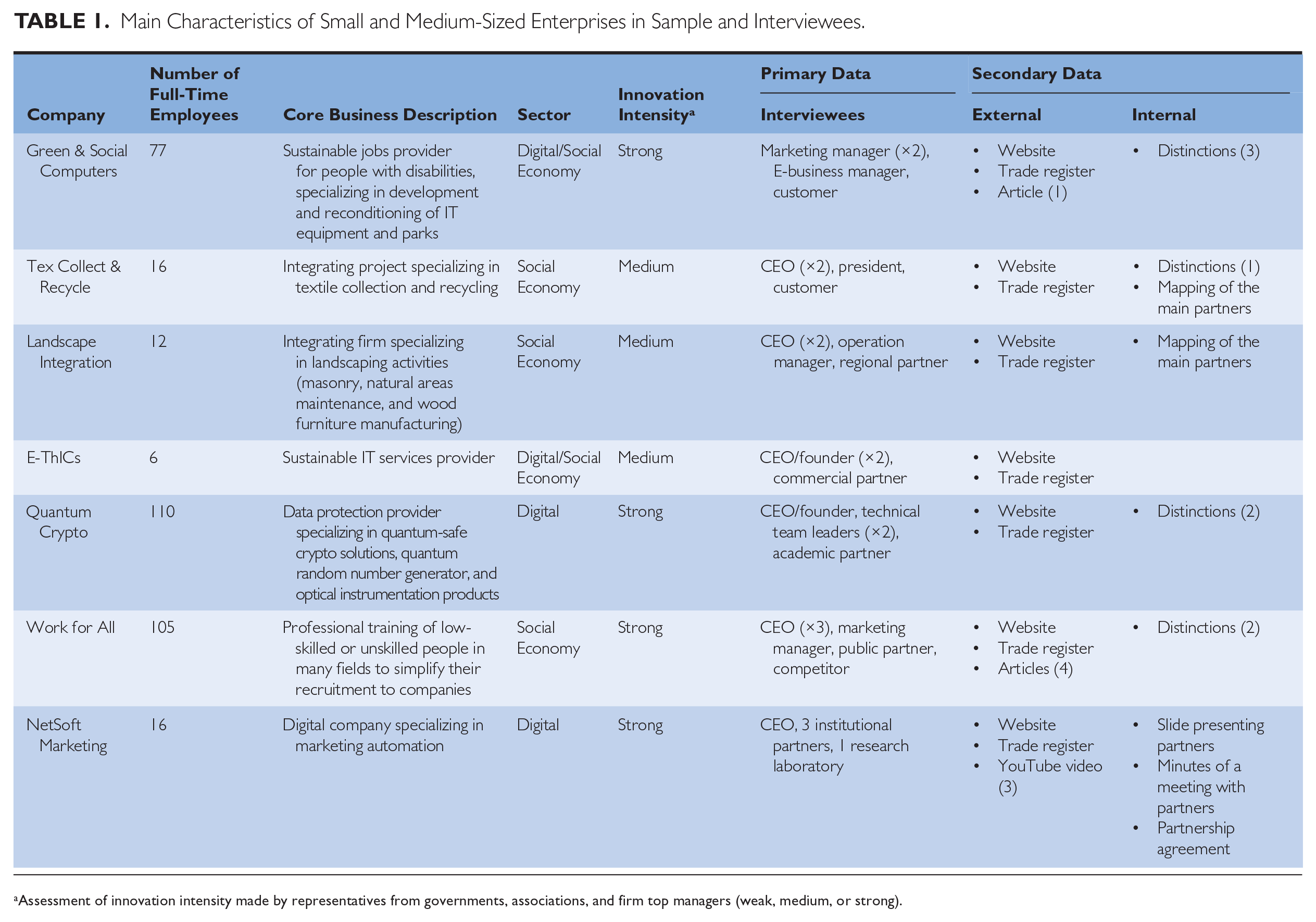
Assessment of innovation intensity made by representatives from governments, associations, and firm top managers (weak, medium, or strong).
Data Collection and Interview Protocol
Monteiro et al. 71 recommend studying OI phenomenon from diverse perspectives instead of a single one. Accordingly, in our research design, we triangulate data from multiple informants (e.g., top management, middle management of focal SMEs, and external partners) to avoid possible biases imposed by a single data type. Prior to conducting the interviews, we gathered external, secondary data from different sources (e.g., trade register, newspaper articles, web articles, and websites), which we used to craft a summary sheet for each SME, indicating its mission, history, and products or services offered. The interview grid (see appendix) consisted of four themes: general information about the SMEs; SMEs’ OI modes (practices or collaborations), barriers, and levers; description of a successful OI project, including drivers and barriers encountered; and description of an ineffective OI project, including drivers and barriers encountered. At the end of the interview, we provided each interviewee with a diagram representing the barriers they had identified but classified according to the three modes. They validated and weighted the barriers, in terms of their intensity, by specifying their effects on the OI process 72 : deterring (degree 1), slowing down permanently (degree 2), or slowing down temporarily (degree 3). We also asked the informants for internal documents, such as reports on their partnership network, minutes of meetings with partners, or contracts, if possible. Thus, we enriched the primary data and achieved triangulation (see Table 1).
Mapping Small and Medium-Sized Enterprises’ Barriers to Open Innovation.
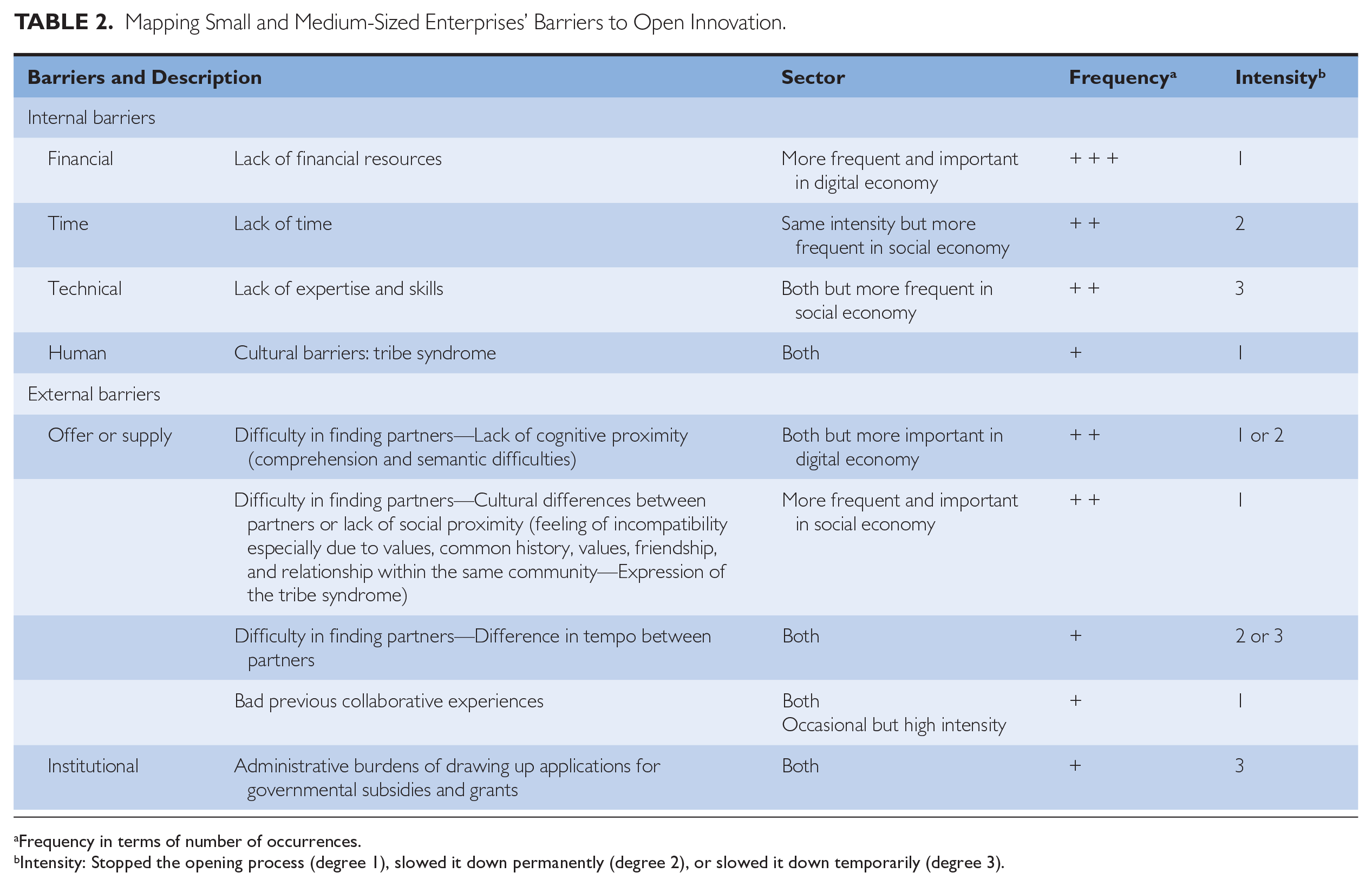
Frequency in terms of number of occurrences.
Intensity: Stopped the opening process (degree 1), slowed it down permanently (degree 2), or slowed it down temporarily (degree 3).
Coding and Analysis
To analyze and code the corpus of interview transcripts, we adopted a cyclical and iterative model, 73 applied in the software package ATLAS.ti. Three researchers from the project team, each with good knowledge of OI and SMEs, performed the content analysis. In a series of meetings, they aligned their coding practices, reviewed coding difficulties, and found consensus. The coding sheet, derived from the literature review, comprised two major themes corresponding to the three OI modes (inbound, outbound, and coupled) and the two main categories of OI obstacles (internal and external). However, if the interviewees mentioned barriers that had not been identified by prior literature, we attempted to fit the case data by exploring rival or alternative barriers. For example, a “bad previous collaborative experiences” barrier emerged from these data. We also refined our analysis of certain barriers that appeared frequently, using more inductive coding. For example, for the “difficulties in finding partners” barrier, we closely reviewed all corresponding transcription extracts and coded them, with a more inductive method, which revealed three related, emerging categories: “lack of cognitive proximity,” “lack of social proximity,” and “difference in tempo between partners,” as well as another category related to the “role of intermediaries,” which the informant highlighted as a factor to overcome the difficulty in finding partners.
We then moved from the within-case to cross-case analysis. After validating the coding, we identified the number of occurrences for each case, across the entire corpus, according to each kind of barrier. We also took care to check that the occurrences do not result from excessive reference to specific interviews. Furthermore, with the ATLAS.ti tools “Code-document Table” and “Co-occurrence Table,” we established frequency counts by calculating the co-occurrences between the barriers and the OI modes (inbound, outbound, and coupled) and also between the barriers and the firms’ sectors (social economy or digital). With this counting procedure, we gain a clearer sense of the data and the studied phenomenon, according to a cross-comprehension effort. 74 In turn, we summarized the qualitative data in explicit and structured tables, which suggested some tentative relationships across constructs. However, we did not limit our analysis to these counts; rather, we constantly revisited the cases to verify our interpretation of constructs and relationships. 75 Thus, to determine the relative importance of identified barriers, we consider both their cross-case frequency, according to the number of occurrences, and their intensity, according to the evaluations provided by the interviewees (degree 1: deterrence, degree 2: slow down permanently, and degree 3: slow down temporarily). Finally, we requested feedback on the emergent analysis from several informants (e.g., representatives from governments and associations connected to the two sectors of activity, CEOs of focal SMEs) on steering committees for our research project.
Results
Main Internal OI Barriers in SMEs
Internal barriers are the most widely perceived barriers, regardless of sector. As the interview quotes show, the lack of resources is a prevalent issue; interviewees cite the lack of time, financial resources, and expertise and skills.
Lack of time
Interviewees from both digital and social economy SMEs, and their partner firms, report the lack of time as a persistent barrier that impedes the OI process or forces collaborative innovation projects to be carried out quickly, to ensure rapid positive returns: “I also realized that NetSoft Marketing didn’t want to take on a very long-term project either. He was still looking for a relatively quick return on investment.” (Institutional Partner, marketing digital sector) “The only thing is, it’s a lot of time.” (Marketing Manager, Sustainable jobs provider) “I feel like we’re in a race against time.” (President, Textile collection and recycling)
Lack of financial resources
They link the lack of time to the lack of financial resources, which is the most frequently identified barrier, associating it with early project termination. In particular, interviewees from digital SMEs report experiencing a lack of financial resources as a barrier to OI projects, especially those conducted in collaboration with large firms: “We had the partners, but the tragedy is that we did not find the financial resources to carry out this project.” (CEO, textile collection and recycling) “Well, then there’s the question of the budget and how can you be credible as a small business, for a big business?” (CEO, Data Protection Provider)
It thus appears that SMEs self-limit their search for partners and avoid contacting larger potential partners, because they believe their small size and limited financial resources will prevent them from being considered legitimate or credible partners: “And then, the credibility. With this type of company, we didn’t have credibility. Nobody immediately trusts us. We do not have the right business card for potential partners unless they take a closer look at what we are able to do.” (CEO/Founder, IT services)
Lack of expertise and skills
For both the social economy and digital sectors, the lack of expertise and skills is another relevant barrier, which makes collaboration difficult because employees struggle to understand one another. For example, employees of NetSoft Marketing report that when developing a new digital service, they had trouble explaining their company’s needs to the employees of a research laboratory collaborator; later, they struggled to understand what the laboratory had developed: “We have never done such a project in our firm. I am the only one who has a similar experience, and I don’t have the gift of ubiquity.” (CEO, marketing automation) “We don’t have people inside who look like the people we’re talking to over there. That’s the first brake.” (CEO, Marketing automation)
Noting this lack of technical and collaborative expertise, interviewees spontaneously mentioned the role of the institutional actors as aids for overcoming this barrier. They assisted SMEs by acting as spokespersons and translators and encouraging the SMEs to overcome their initial reluctance to collaborate with external partners. For example, an institutional partner explained, with regard to removing the inhibitions of SME employees: “First, they [a cluster] relate. And after, they also give you the keys to better understand, to better collaborate. They have the experience we lack.” (Institutional Partner, marketing automation)
Paradoxically, these three internal barriers also represent SMEs’ primary motivations for opening up their innovation processes. However, the reasons to open differ with the sector. In the digital sector, SMEs open up out of obligation: “In our [digital] field, you must collaborate with outside to innovate.” (Academic Partner, data protection provider)
In contrast, SMEs in the social economy sector are open to collaboration by nature: “It is at the very heart of the social economy to collaborate.” (Operation Manager, landscaping activities)
Whereas their reasons for opening differ, they have a common view that openness is a crucial lever for obtaining additional resources. Nevertheless, their lack of resources represents a severe obstacle to achieving OI.
Cultural barriers
Beyond traditional internal barriers related to SMEs, another tension emerged from our analysis. Although SMEs are inclined to open, they associate opening their innovation with risk. This finding corresponds with the fourth internal obstacle, which relates to an internal culture that we describe as a “lack of openness to openness.” Opening organizational boundaries requires a risk-taking culture that SMEs rarely possess, due to their sense of vulnerability.
“We all have fears about competition or sharing territory or sharing the pie, whether justified or not. Most of the time, we realize that they are not, but they do exist, because in the world of integration, it is perhaps harder than elsewhere to find one’s place.” (Operation Manager, landscaping activities) “If you’re for various reasons too insecure, it’s hard to get out of your box.” “Yes, it’s always a question of saying what is the partner’s intention? If it’s to get rich from the copied ideas, you can be afraid of getting double-crossed.” (CEO, professional training)
Main External OI Barriers in SMEs
In addition, the interviewees mention supply-side and institutional barriers.
Difficulties in finding partners
Among supply-side barriers, those that relate to the difficulty in finding partners are the most prevalent. With a refined, inductive analysis, we clarify three major barriers at this level.
“People with a totally different mental model, scientific researchers, who are used to talking to data, but in a way that we don’t talk to data.” “Some people talk square, some people talk round.” (CEO, Marketing automation) “Maybe there was a little bit of misunderstanding […] there was a little mix, misunderstandings of miscommunication due to lack of common knowledge.” (Institutional partner, Marketing automation)
From the lack of social proximity to the tribe syndrome
In our results, the lack of social proximity is a major barrier in finding partners when collaboration is needed. Although this gap occurs in both sectors, it is perceived as more important and frequent in the social economy sector. These SMEs develop a strong sense of belonging to the social economy community and shared values. They explicitly refer to ethical values of solidarity (which appear even more important than financial aspects, signaling the precedence of human values over profit), reciprocity, decisional transparency, and respect for society and the environment. If potential partners share these values, they naturally would agree to engaging in OI. However, if instead they perceive that potential partners fail to embody or even reject these values, they will likely reject opportunities for OI, whether it involves inbound, outbound, or coupled flows of knowledge.
“I say to myself: wow, if tomorrow I have to work with people who seek in their form of economy more solidarity and more social, societal values, that makes sense. But suddenly, working with Leclerc or La Caisse d’Epargne, I am not sure that they have their place in the social economy. I speak very bluntly, but it wouldn’t be consistent with our values.” (CEO, textile collection and recycling) “If in some cases, we have developed good ecological gardening practices, and if our partners copied them, all the better, as long as it is not only to make money.” (CEO, professional training) “But the strongest thing is the value, though, I think. In fact, each has taken a step towards the other. But we’re still different. There are times when values, we don’t change them like that. That was a first difficulty.” (CEO, landscape activities)“We are an association and it was immediately discredited with companies, especially at the level of industry...they looked at me with big eyes, saying ‘you are from SE, you want us to collaborate’...The fact that we were normalized surprised them as well. So my job at the beginning was really to requalify Work for all, to break down the image we’d been dragging around for years as a social enterprise.” (Marketing Manager, professional training)“We will always favor suppliers who share the values of the SE. “We can’t, for example, work with companies that continue to think we’re extraterrestrials.” (CEO, professional training)
Therefore, relations among social economy actors are socially embedded, due to trust built on social values, similar experiences, and common histories within the same community. Interviewees accordingly conceded that they collaborate mainly with partners from the same community: “There was trust from the beginning because we are part of the same community. This makes it possible to move very quickly on opportunities for collaboration.” (CEO, professional training) “But the strongest is the values, anyway, I think. In fact, each has taken a step toward the other. But we remain different. There are times when values cannot change like that. That was our greatest difficulty in working with them.” (CEO, landscaping activities)
However, they also report a tension between their values and the need to finance their activities. Still, they indicate that openness is easier for SMEs when it involves social, familiar groups—a belief that we refer to as a “tribe syndrome.”
A lack of cognitive proximity
Furthermore, a lack of cognitive proximity between partners appears more frequent and important in digital SMEs. For them, OI processes can be slowed or halted if potential partners struggle to communicate with and understand one another, because they do not share the same knowledge or language. This external barrier echoes the internal barrier of a lack of skills and expertise, as the following comment implies: “Maybe there was a little bit of misunderstanding . . . there was a little mix, misunderstandings of miscommunication due to lack of common knowledge.” (Institutional Partner, marketing automation) “People with a totally different mental model, scientific researchers, who are used to talking to data, but in a way that we don’t talk to data.” “Some people talk square, some people talk round.” (CEO, marketing automation)
Difference in tempo
Finally, the difference in tempo between partners is less frequently cited; it mainly refers to public/private or university/enterprise collaborations: “It is also true that the Department of Public Education is a huge structure. So, moving things like that is possible, of course, but it often takes a long time.” (Public Partner, professional training) “He feels like they’re looking at the butterflies while we’re working. For him [CEO], we won’t be able to work together. For me, it’s just two different ways to do things. But that risks putting a stop to the project.” (Operation Manager, landscaping activities)
Past collaborative experiences
Among the less frequent supply-side barriers, interviewees cite past collaborative experiences with innovation that can “brake or break” SMEs’ propensity to open their boundaries. The existence of this barrier indicates that momentum influences openness: “Eric is completely traumatized by the fact that our competitors could steal something from us. In fact, that’s already been the case.” (Marketing Manager, sustainable jobs provider) “To be frank, I rather have the feeling that we haven’t done it very well and it’s like a blockage in my mind.” (Operation manager, landscape activities) “It was getting rich off the copied ideas...so now we can be afraid of getting double-crossed, we’ll be more suspicious.” (CEO, professional training)
Institutional barriers
Institutional barriers are relatively infrequently cited by interviewees, who note that when they occur, these barriers tend to relate to the administrative burden of drawing up applications for governmental subsidies and grants. The informants do not mention barriers related to demand or the business environment.
“There are also administrative constraints. The project leaders are not necessarily aware that the conventions of subsidies are binding and impose certain type of complementary funding.” Institutiona partner, marketing automation) “Accreditation is not easy to obtain...the administrative burden, you know!” (Marketing manager, sustainable job provider)
The Role of Intermediaries for Countering the Difficulty in Finding Partners
For the three barriers linked to the difficulty in finding partners, we note a common lever: the role of OI intermediaries. Such intermediaries may be institutional actors, such as members of clusters or labeled networks, but they also can play different roles. First, they might provide translations to overcome the lack of cognitive proximity, which can cause semantic difficulties, misunderstanding, and irritation: “It’s all this somewhat interface side, to have sufficient knowledge of public research, even if we do not know all the jargon, to translate that for the SMEs’ words.” (Institutional Partner, marketing automation)
Second, intermediaries can help partners accept the lack of cultural alignment and legitimize each partner, as well as the SMEs’ project for potential partners, which then leads to a mutual sense of trust: “There is also the aspect of inhibiting a SMEs so that she dares to go and knock on a specific partner door on his own.” (Marketing Manager, professional training) “We got the label of the scientific council to say: ‘Yes, there, the quality of the project is certified’. For some funders or partners, it is a guarantee, or in any case help to better pass the first dams. Thanks to them [institutional intermediary].” (CEO, marketing automation)
Third, intermediaries can help partners find a common tempo and develop better relational capabilities: “I think I would have been more radical to go faster, even if it means excluding people. He [Regional intermediary], for that, has moderated us a lot, we will say.” (CEO, landscaping activities)
Barriers to OI According to OI Mode
The identification of these OI barriers represents an important first step, but we also seek to determine whether these barriers depend on the OI mode. We note that inbound OI is SMEs’ most used mode, followed by the coupled and then the outbound mode (significantly less frequent). The inbound mode particularly prevails in digital SMEs, but the coupled mode is more widespread in the social economy sector. The frequency count matches this trend: SMEs are more aware of the barriers to the OI modes they experience most often, namely, the inbound and coupled modes. With regard to the inbound mode, the barriers are mainly internal, including the lack of expertise and skills, which is well perceived in both sectors: “Surprisingly, it is not so much the financial resources that are holding us back, but our lack of expertise.” (CEO, landscaping activities)
This lack of internal expertise also incites SMEs to open up to external skills: “They tried to look for a scientific collaboration that can quickly respond to their problem because they do not have time to build skills. Doing artificial intelligence, as it is now called, cannot be learned in a few months.” (Institutional Partner, marketing automation)
The lack of financial resources again emerges as a strong barrier to inbound OI, but interviewees do not perceive it to be a barrier to the other OI modes. It is much more important in the digital sector, in which SMEs develop more expensive projects in terms of materials and expertise: “Having more financial resources and quickly, earlier would have allowed us to better benefit from external sources . . . we have been able to benefit from them but too late. We have sometimes missed the boat.” (CEO/Founder, data protection provider)
Due to the lack of financial resources, the administrative burdens of drawing up applications for governmental subsidies and grants also emerge as an obstacle for digital SMEs.
Whereas the barriers are mostly internal for SMEs that adopt inbound OI, the results highlight two external, supply-side barriers with stronger influences in the coupled mode. Lack of social proximity is very important, especially for SMEs in the social economy sector, in line with the suggested tribe syndrome: “We cannot work with companies that continue to take us for aliens.” (CEO, professional training) “So, we made the effort to change partners to have ones from the social economy which share our social values.” (CEO/founder, IT services provider)
Notably, interviewees mention this syndrome, even as they acknowledge that SMEs consider themselves open by nature: “Despite all the barriers, I would say that what emerges is that SMEs in the social economy are open by nature, while those in the digital one open their process out of necessity.” (CEO, professional training)
A lack of cognitive proximity is the second strongest barrier. It results from a deficit of cognitive alignment and is more significant for digital SMEs.
Finally, with regard to the outbound mode, which SMEs in our sample adopt less than the other modes, internal cultural barriers are key. They relate to human resources’ attitudes toward risk, such as employees’ worries that they will be dispossessed of relevant knowledge: “Yes, it’s always the question of saying what the partner intends? If it’s getting rich from copied our ideas, we will be afraid of being dubbed, we will be more suspicious.” (CEO, professional training)
Discussion
We studied barriers to OI experienced by SMEs in relation to three OI modes. Differences in OI barriers also can be due to differences in sectoral patterns, so we analyzed SMEs from digital (high-tech) versus social economy (low-tech) sectors. In applying a barrier approach to OI, we showed that the nature of the barriers does not vary substantially across OI modes, but their intensity does; we also identified a novel cultural barrier, which we call the tribe syndrome. In turn, this research highlights the importance of OI intermediaries, due to their roles in helping SMEs overcome cultural barriers, including the tribe syndrome.
SME Barriers to OI, According to OI Mode and Sector
In line with previous studies, 76 our findings confirm that the most prevalent obstacles to OI for SMEs are internal, due to a lack of resources (financial, time, expertise, skills). Such obstacles are especially prevalent with regard to inbound OI activities. They tend to slow down OI, temporarily or permanently. Although previous studies identified a lack of resources as an important barrier to OI, we offer a complementary explanation that highlights the strong influence of cultural barriers. That is, SMEs display a lack of trust and openness, a tendency to seek protection and withdraw, and a propensity for secrecy. They worry because of their sense of vulnerability and their fears of being dispossessed of their relevant knowledge. Sometimes, they limit their external collaborations, because they believe their small size and limited resources prevent them from being considered as legitimate and credible partners. They tend to self-limit their openness to partners for whom they do not consider themselves legitimate. Finally, cultural barriers are influential for the outbound OI mode, which requires the transfer of relevant knowledge and is subject to major risks (e.g., loss of resources) that SMEs are not inclined to take. 77
The lack of expertise and skills are also more important internal barriers for the inbound mode than the other modes, regardless of sector. Prior research 78 has offered similar results for high-tech large firms and public-sector organizations, respectively. Not surprisingly, we confirm this finding for SMEs from the digital and social economy sectors; innovation based on external knowledge always requires dedicated and skilled personnel to benefit from this knowledge. Absorptive capacity also appears critical to allowing firms to exploit external knowledge better, 79 and our results affirm this point too. Without distinguishing OI modes, Hjalmarsson et al. 80 assert that the most salient barriers for digital firms are the lack of money and time. We find that digital SMEs consider the lack of financial resources to be a barrier overall, as well as with regard to the inbound mode specifically. They also perceive a lack of time as a barrier, but only for the inbound and coupled modes. This finding is consistent with Savitskaya et al.’s 81 suggestion that the inbound OI mode takes too much time, but this barrier does not arise for outbound OI.
Identification of a New Syndrome: The Tribe Syndrome
Among external barriers, supply-side barriers, such as difficulties in finding partners, arise for all three OI modes (inbound, outbound, and coupled) to varying degrees of intensity. They seem more important for the coupled OI mode because they tend to stop OI projects from starting or continuing. Supply-side barriers take two forms, with different degrees of importance, depending on the SME sector. In the first, a lack of social proximity stems from cultural barriers.
82
In empirical studies of SMEs’ OI barriers, cultural barriers often result from internal resistance, such as NIH and NSH syndromes.
83
Our results suggest they relate more to collaborative issues than to internal attitudes and that a lack of social proximity relates to the search for partners who share the same values. This barrier is greatest in the social economy sector, in which SMEs seem to develop a true sense of belonging to a community, with strong, shared social values. In line with a previous meta-analytic review of intra- and inter-knowledge transfer,
84
we confirm that shared vision and value systems are crucial factors for OI at the dyad or network level. Shared vision and value systems facilitate a common understanding of collective goals and provide a crucial bonding mechanism that helps different actors collaborate on innovation, by exchanging, receiving, and integrating external knowledge. Without denying its existence for the digital sector, this shared values aspect is even more crucial for firms and entrepreneurs from the social economy for which social capital represents their main asset.
85
For them, ethical values, such as solidarity, responsibility, the precedence of people over capital, and respect for society and the environment are integral to their social capital. Their members learn and use these core values to resolve problems of internal integration or external adoption for goal achievement,
86
which echoes the widely accepted definition of organizational culture.
87
Organizational culture (which we extend here to the notion of sectoral culture) is a system that involves learned, accepted, widely shared values; it also includes styles of thinking and behavioral patterns that are persistent and likely contribute to tribe syndrome. When they experience such tribe syndrome, SMEs resist opening up to other firms that fail to align with their ethical values, which in turn hinders OI behaviors and knowledge flows. In this sense, values can be understood as “social glue”
88
that binds partners; if the partners’ values are incompatible, the glue does not hold. As our results show, value systems incompatibility, which rarely has been studied in OI literature
89
or in relation to inter-group dynamics in knowledge transfer processes,
90
may be a stronger barrier than cognitive distance in concrete OI partnerships. Even beyond the local search trap identified by Meulman et al.,
91
according to which firms search for partners that possess knowledge (i.e., technology) closely related to their own knowledge bases, we find another important barrier, centered on values, that we refer to as tribe syndrome, defined as: Resistance from individuals and/or organizations toward inbound, outbound, or coupled flows of knowledge involving external actors that do not share the same values, resulting in either suboptimal utilization or rejection.
It reflects SMEs’ hesitance about collaborating with partners too distant from their values, not just their knowledge bases. Another supply-side barrier is the lack of cognitive proximity, which is more similar to the distant knowledge bases that Meulman et al. propose. This barrier seems to deter SMEs—especially those in the digital sector because they can avoid OI practices—from innovating collaboratively. It even might halt the OI process. Confronted with several types of barriers, SMEs seek to overcome such constraints, often by calling on intermediary actors.
Multiple Roles of Intermediaries
The results highlight the various ways that intermediaries, defined as “an organization or body that acts as agent or broker in any aspect of the innovation process between two or more parties,” 92 can help SMEs overcome barriers to OI. In five cases in our study, the intermediary role is performed by institutional actors or labeled networks. In turn, our study offers an initial application of Aquilani et al.’s 93 theoretical framework, which highlights intermediaries’ roles in overcoming cultural barriers (the NIH, NSH, and risk-taking culture in particular) to achieve OI. They identify four specific roles (brokers, mediators, connectors, and collectors) according to the three OI modes. With our empirical application of this theoretical framework, we confirm the crucial role of intermediaries in the OI coupled mode. In particular, intermediaries can contribute to the development of relational capabilities, build trust, and improve cultural alignment among partners (connector role). A mediator (or go-between) role also makes it possible to understand the need for and provide contacts, support a risk-taking culture, and develop mutual confidence. Such a role is essential for SMEs, and whereas Aquilani et al. suggest it pertains only to the inbound mode, we find that it applies to all OI modes. The specific features of SMEs and their negative perceptions of collaborations with firms from a “different world” (i.e., tribe syndrome) emphasize the importance of rethinking the roles of intermediaries as relationship promoters, who offer ordinal skills and can combine various special knowledge to support the OI process actively and intensively, despite a lack of networking skills. 94 These roles need to be performed by intermediaries or SME members with the appropriate network qualifications or competences (more relational and social than scientific) if they are to contribute effectively to overcoming the tribe syndrome.
More broadly, networking intermediations 95 and other boundary objects 96 should not be neglected insofar as they can support intermediaries’ actions or exert effects on their own. They can help remove barriers to OI, especially the tribe syndrome, by ensuring interactions among actors that represent heterogeneous worlds. They might maximize both the autonomy of these worlds and the communication between them, using a minimal knowledge structure. They can take different forms and give rise to various interpretations in each world, but they are sufficiently structured to be recognizable by members of each world. We did not observe such networking intermediations or boundary objects in our study. Still, innovation arenas—in which SMEs can experiment in open environments with different partners, form and maintain innovation networks and systems, undergo collective training programs (e.g., professional development, individualized open posture or attitude), establish connections across sectors or industries, leverage digital tools such as platforms, identify new partners, and overcome the limits of local social searches—likely would be useful. 97
Conclusion
This research offers both academic and practical value, as one of the few studies that applies a barrier approach to OI. In response to calls for research on diverse OI modes, 98 we define various barriers to openness in the case of SMEs, specified according to OI mode (inbound, outbound, and coupled). This study also provides validation of two roles assumed by OI intermediaries—as proposed by Aquilani et al. in their theoretical framework 99 and a refinement of the partner search tool developed by Meulman et al. 100 —that incorporates local or distant value bases (i.e., the tribe syndrome we identify) together with their proposed local or distant knowledge bases.
The managerial contributions of this study apply to two distinct audiences: SMEs and the public or semi-public structures that support them in their innovation activities (i.e., intermediaries). SMEs can use these findings to understand and predict the types of barriers they may face when implementing OI, as well as find tailored solutions to overcome them. In particular, our results suggest the need to raise awareness of OI among employees, then identify volunteers ready to assume specific roles in OI collaborations, according to the OI modes. In the absence of in-house competences, firms should mobilize training programs and/or external intermediaries (as identified in our study), selected on the basis of their competences (or network qualifications) to help overcome any identified OI barriers. For both digital and social SMEs, the intermediaries should adopt mediator or connector roles for knowledge transfer across people and organizations, and sometimes even among industries. However, the OI barriers differ in intensity between sectors, so the intermediaries also have different roles to play. To overcome the lack of cognitive proximity perceived by digital SMEs due to the distance of their knowledge base from their partners’ knowledge base, intermediaries should adopt a scientist role, more than a social one. In contrast, social economy firms whose value base is distant from their partners’ value base need the presence of intermediaries with strong social competences, which can influence members’ interpretations and beliefs and thereby help SMEs overcome prevalent cultural barriers, as manifested in the tribe syndrome. Furthermore, in a combined recommendation for both SMEs and intermediaries, we suggest greater uses of other boundary objects, such as digital platforms, to identify new partners and overcome the limits of local (relational) searches. Platforms for digital and social economy SMEs might aim to transcend both cultural and cognitive barriers with the support of intermediaries.
Footnotes
Appendix
Semi-structured Interview Guide.
Funding
The author(s) disclosed receipt of the following financial support for the research, authorship, and/or publication of this article: This research received support from the European INTERREG V program (France-Switzerland 2014-2020 INTERREG, IOP project: Innovation, Openness, and Prospective).
Author Biographies
Sandra Dubouloz is Associate Professor at the Savoie Mont Blanc University (France). She is a member of the Innovation & Development of Organizations research team at the IREGE Research Lab (email:
Rachel Bocquet is Full Professor of Strategy and Innovation at University Savoie Mont Blanc (France). She is the head of IREGE research lab (email:
Catherine Equey Balzli is an Associate Professor of Finance and Management Accounting at Haute Ecole de Gestion Geneva. (email:
Elodie Gardet is an Associate Professor of Strategic Management and Innovation at University Savoie Mont Blanc, IREGE (email:
Romain Gandia is Associate Professor of Strategic Management and Innovation at University Savoie Mont Blanc (France) and permanent member of the IREGE research lab (email: