



Abstract
During the last decade, MedTech companies started to invest in building digital healthcare platforms to maintain their competitiveness in the Digital Economy. However, launching a new digital platform business revealed several challenges that MedTech incumbents must overcome, including value impedance. This is caused by digital transformation gaps, which, when left unmanaged, can stall digital healthcare platforms’ growth and even lead to their demise. This article distills four dynamic capabilities: sensing the internal environment, value-capturing through connectedness, orchestrating silos, and transforming organizational boundaries. These mitigate value impedance and bestow competitive advantage to MedTech incumbents’ digital platform business.
Keywords
To keep pace with prevailing digital transformation, incumbent medical equipment technology manufacturers (MedTech) have launched digital healthcare platforms to strengthen their competitive advantage against entrants and maintain profitability. 1 Companies that operated in the industry before the disruptive technologies came into play are often referred to as incumbents. 2 Scholars acknowledged that incumbents often stumble to embrace disruptive technologies, and this can bring their business to demise. 3 For instance, some digital healthcare platforms established by MedTech incumbents have been unable to scale or have even failed—for example, Microsoft HealthVault, IBM Watson Health, and GE Predix. 4 During the last decade, the attention of management scholars has been devoted primarily to de novo platform-born businesses, such as Uber, Google, Facebook, Apple, and Amazon. 5 As a result, the digital healthcare platforms that have emerged as new businesses under MedTech incumbents (such as Siemens, Medtronics, and Philips) remain underexplored. 6
While developing a digital healthcare platform business, MedTech incumbents are urged to shift their focus from delivering one product to one type of customer toward providing digital healthcare services to multiple parties acting in the ecosystem. 7 However, this is not easy to accomplish because, in contrast to de novo platform-born businesses, MedTech incumbents face unique challenges: the need to create new digital platform innovation capabilities while, at the same time, supporting their existing product innovation practices; the need to shift their focus from internal to external resources to build a network of partners and complementors and seek for network effect; and the need to manage the tensions that can arise between creativity and the prevailing control practices of the core business. 8
Furthermore, MedTech incumbents operate under specific healthcare sector conditions: it is a highly regulated industry that must comply with ethics and safety standards, data privacy, and high-quality requirements 9 ; the MedTech industry is one of the most innovative measured by the number of patents filed per year, 10 resulting in a high proportion of products designed and manufactured in-house, and the customers of the MedTech incumbents are mainly public and private healthcare providers such as hospitals, clinics, and diagnostic centers. Besides, public healthcare providers are obliged to purchase through the public procurement and tender systems to enhance savings through the economies of scale. 11 These conditions do not favor and exert pressure on a platform business that engages digital technologies to facilitate the transactions between diverse players, manages data, and creates multisided value and business models that rely strongly on partnerships with existing and new players and network externalities. 12
As a result, when establishing digital healthcare platforms, MedTech incumbents face significant challenges, which we term “digital transformation gaps.” If unmanaged, these digital transformation gaps can result in “value impedance.” We define value impedance as a comprehensive expression of any form of friction or barrier to value flow within organizations. It can limit the capacity of MedTech incumbents to benefit from their digital platform innovations, despite the perceived value to the customer.
MedTech incumbents need to immerse themselves in company-wide strategic change to bridge digital transformation gaps and mitigate value impedance. Prior research suggests that dynamic capabilities—responsible for integrating, building, and reconfiguring internal and external competencies to address rapidly changing environments—are critical to achieving a purposeful strategic change in the MedTech incumbent. 13 Based on the case study of Siemens Healthineers (SHS), we aim to investigate how the dynamic capabilities of MedTech incumbents can help companies to bridge digital transformation gaps and mitigate the effect of value impedance.
Our article adds to the dynamic capabilities framework by proposing a set of dynamic capabilities critical to bridging digital transformation gaps when building MedTech incumbent-born digital healthcare platform businesses. Furthermore, our study shows that the dynamic capabilities of the incumbent’s core business are not replicated in their new digital healthcare platform business and, thus, should be built from new. Besides, the study extends the digital platform literature by proposing a new type of digital platform based on its origin and position on the value chain. It allows us to define the specific context that affects the need for unique dynamic capabilities that are critical to the digital transformation of MedTech incumbents.
For managers of MedTech incumbents, we offer a framework that explicates the digital transformation gaps and value impedance when they seek to build a new digital healthcare platform business. We propose a set of dynamic capabilities that are critical to bridging these gaps and restoring the value flow. By developing appropriate dynamic capabilities, MedTech incumbents will be better positioned to benefit from new digital healthcare platform business opportunities and build a competitive advantage against the entrants.
Incumbent Digital Healthcare Platforms, Value Impedance, and Dynamic Capabilities
Defining Incumbent Digital Healthcare Platforms
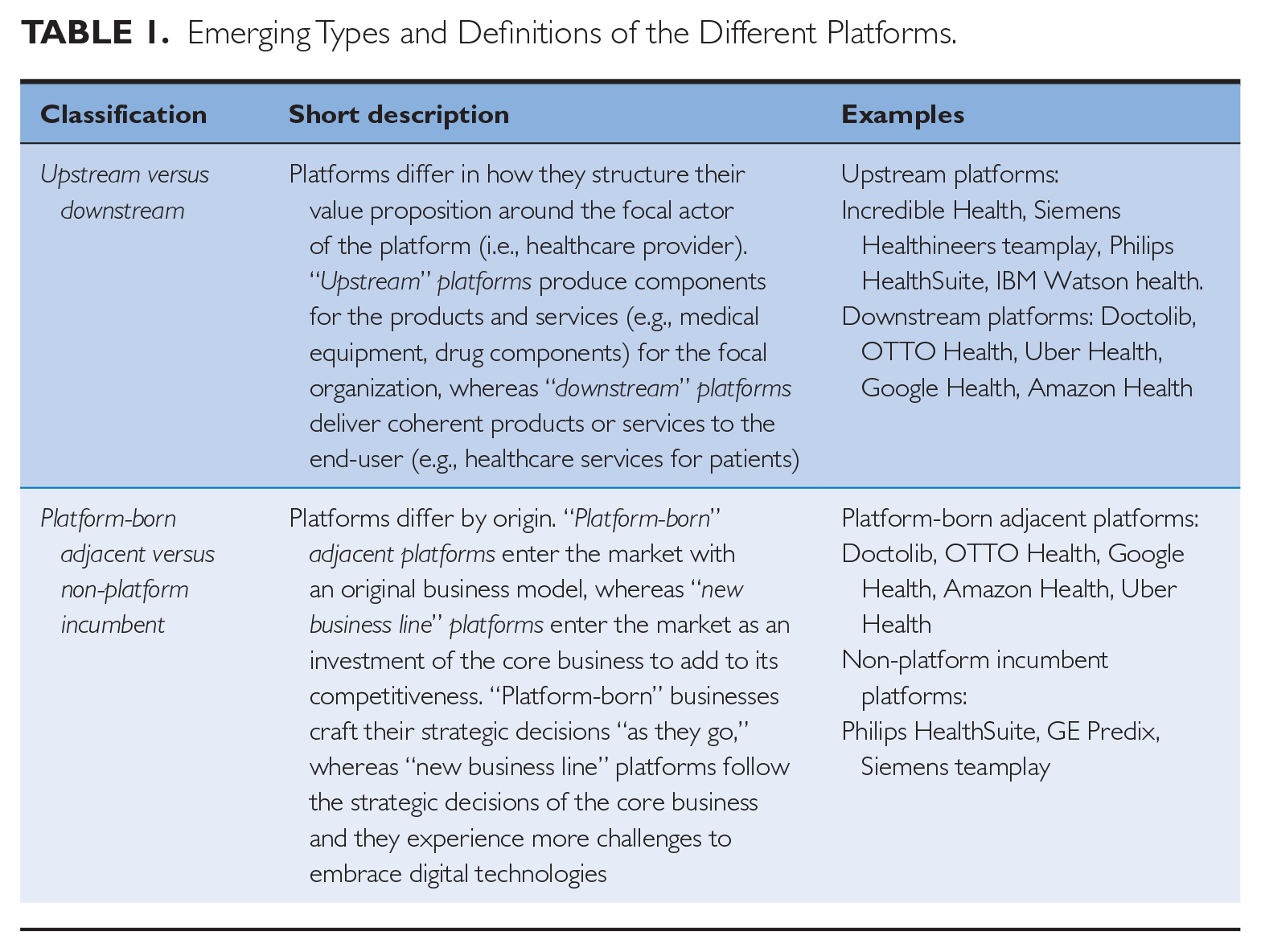
A “digital platform” can be defined as the digital infrastructure that provides a common set of design and governance rules to facilitate interactions between multiple users. 14 Digital platforms typically bring changes to the ways users access markets and consume products and services. 15 The extant literature mainly distinguishes between product and industry digital platforms, 16 with the latter being classified further into either transaction or innovation platforms. 17 To better understand the challenges MedTech incumbents face, we present two less well-known ways of distinguishing between digital innovation platforms. One is upstream versus downstream digital platforms, which indicates the platform’s position in the value chain of the industry, while the other type recognizes the origin of the business: platform-born adjacent versus incumbent-born digital platforms. Platform-born adjacent digital platforms typically grow through network effects by altering the boundaries of an existing platform, whereas non-platform incumbents add a digital platform astride their core business, which typically is not digital. 18 These two entry modularities generate different innovation cultures. 19 Adjacent digital platforms tend to invoke a transformative service innovation culture compared to incumbent digital platforms, which are more likely to have a limited understanding of the organizational settings and capabilities needed to develop successful digital platforms. 20 The definitions and examples of the emerging types of digital platforms are provided in Table 1.
Emerging Types and Definitions of the Different Platforms.
In the majority of cases, adjacent digital platforms deliver broad downstream services to the end-user. 21 In contrast, incumbent digital platforms tend to provide upstream services to the focal business or actor 22 (see Figure 1). Thus, while adjacent downstream platforms typically provide digital healthcare services to the end-user patient and get paid by the individual customer patient, incumbent upstream digital platforms typically serve healthcare providers and get paid by third parties, such as insurance companies, government, or both. 23 In addition, adjacent downstream platforms tend to access patient data directly in contrast to incumbent upstream platforms, which access data through healthcare providers. Thus, incumbent upstream platforms create value for the end-user patient through a healthcare provider. In the healthcare industry, the patient as an individual user is less affected by a heavy regulatory regime and liability in comparison with healthcare providers, and thus potentially can be more readily brought onto a platform. 24
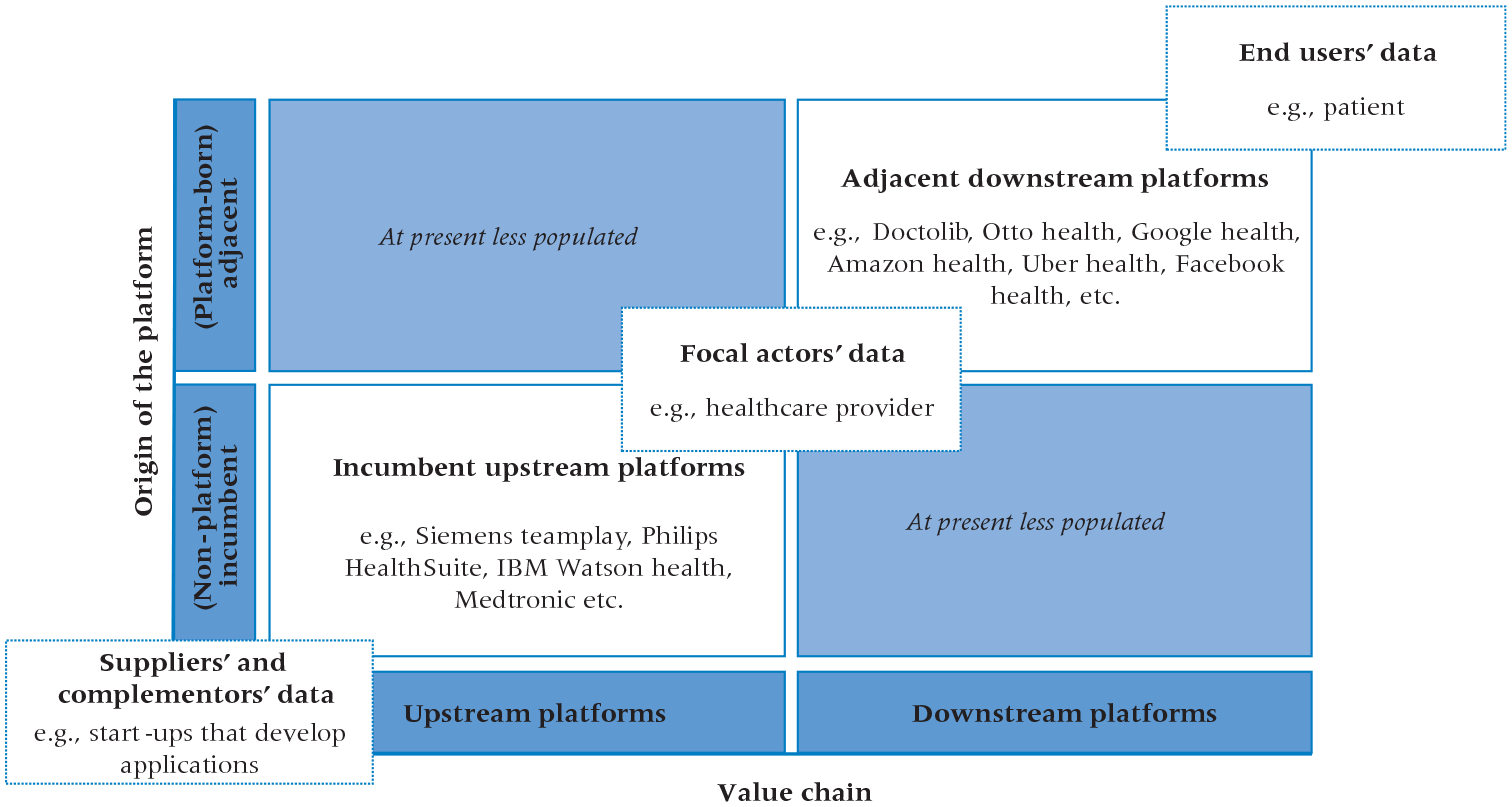
Positioning digital platforms at the intersection of the platform origin and their position in the value chain.
Defining digital platforms by their origin and their position along the value chain allows us to point out some context-specific digital transformation gaps in incumbent upstream digital platforms that cause value impedance and thus require unique dynamic capabilities to address it. The specifics of the digital transformation gaps of adjacent upstream and incumbent downstream platform types are conditioned by the differences in customers, payers, and how access to healthcare data is organized. 25 In broad strokes, adjacent downstream digital platforms tend to have strong digital-platform-building capabilities but less healthcare domain knowledge, whereas incumbent upstream digital platforms possess strong healthcare domain capabilities, gained through their long-standing relationships with healthcare providers, but less digital-platform-building knowledge. Thus, adjacent downstream and incumbent upstream digital platforms start with different challenges and capability portfolios at their disposal. 26
Defining Digital Transformation Gaps and Value Impedance
Understanding the gaps within a company’s processes can contribute to improvements in its business processes and, consequently, its performance. Business process gap analysis is consistent with the business process improvement literature. 27 An organization’s process gap analysis might be carried out among several companies or between internal units or businesses of the same company.
In our case, a digital transformation gap can be considered as one of a company’s process gaps. We define it as a difference or chasm in the processes that prevail in the incumbent MedTech company’s core business, which, however, are redundant or are impeding progress in the new digital healthcare platform business. Such gaps prevent process improvements in the incumbent’s upstream digital healthcare platform and thus cause value impedance. 28
Value impedance is a comprehensive expression of any form of friction or barrier to value flow within organizations. This translates to the limited capacity of an established and successful company to benefit from disruptive innovations, like digital platforms, despite their perceived value to the customer. The digital transformation and delivery of platform-based services typically turn out to be a challenging process for many incumbent companies, 29 who are often not fully cognizant of the scope or amplitude of the organizational change they need to undertake. It can require management to confront conventional mindsets, eliminate intraorganizational resistance, and embrace collaboration practices while also rethinking the organizational design, financial metrics, governance, and business models. 30 Put differently, value creation and value capture are impaired by roadblocks to value delivery caused by fragmented data and the lack of alignment between and among the existing and emerging parts of the business.
Defining Dynamic Capabilities
A key to profitable growth and purposeful strategic change in a complex business environment is the ability to reconfigure assets and organizational structures, especially as the enterprise grows and as markets and technologies change. 31 Dynamic capabilities are defined as “the ability to integrate, build and reconfigure internal and external competencies to address rapidly changing environments.” 32 They are therefore critical to success, especially for incumbent MedTech companies that need to pioneer an emerging digital healthcare platform market. 33
The notion of dynamic capabilities originally consisted of three clusters of processes: sensing the environment, resulting in the identification and sense-making of business opportunities; seizing opportunities through integrating and reconfiguring resources to address these opportunities and to capture value from doing so; and transforming through continuous renewal to execute and sustain the innovation at scale. 34 Later, Teece et al. extended the dynamic capabilities framework in a helpful manner when they split “seizing” into “organizing” and “value capture.” 35 Furthermore, based on Teece’s publications and multiple public speeches, “organizing” has morphed into “orchestrating” in order to better reflect the prevailing capabilities required under the “seizing” aspect. 36
Sensing capabilities assist in exploring technological opportunities, probing markets, listening to customers, and building and testing hypotheses about the market and technological evolution, including the recognition of latent demand. 37 Value-capture capabilities are responsible for the business model innovation, which allows a company to capture a share of the value it creates for customers. 38 Orchestrating capabilities are related to the identification of critical assets, making investment commitments, and the orchestration of the routines and other resources needed to seize opportunities, 39 including the coordination of co-specialized assets and their use in productive ways—that is, for value delivery. 40 Finally, transforming capabilities are responsible for keeping the internal and external elements of the organizational system aligned and fit for purpose, both with each other and with the strategy. 41 They account for creating new organizational boundaries through setting the governance mode for external linkages and for the internal environment through fostering a culture of internal openness and flexibility. 42
Method
The empirical evidence presented in this article is drawn from a larger qualitative investigation of digital platforms in the healthcare industry. We employed an instrumental case study research design, 43 analyzing a representative case of a MedTech incumbent upstream digital healthcare platform. 44 As defined by Stake, an instrumental case study can be used to explore a particular case with the aim to understand the contextual and bounded (by, for example, the settings, participants, and events) phenomenon of the key interests. 45 An instrumental case study usually rests on a conceptual framework, which helps to define the key concepts related to the phenomenon and the importance of the research problem. We immersed ourselves in a retrospective understanding of how SHS created its teamplay digital health platform and its ongoing digital transformation journey from 2013 and onward. The analysis is based on their digital health platform, which had more than 3,400 connected customers, more than 32,000 connected systems in more than 60 countries, and more than 10 million patient records accessible cross-institutionally in 2020. SHS is considered a relevant instrumental case because it faced digital transformation gaps and value impedance while building the “teamplay platform” within its already existing core business. SHS endorsed the importance of building appropriate dynamic capabilities within the teamplay platform to help to close digital transformation gaps. 46
We relied on a variety of data sources, the most prominent of which were semi-structured interviews conducted with key decision-makers and different domain experts at SHS. We opted for purposive sampling and selected informants based on specific roles, functions, and attributes that would contribute to our study. In total, we conducted, recorded, transcribed, and coded 25 hours of 18 semi-structured interviews with 14 informants (see Table 2).
List of Respondents.

To deepen our understanding, we collected extensive archival data in the form of publicly available presentations, press releases, company reports, and newspaper articles. To enhance the research reliability and validity, a research guidebook was developed prior to starting to conduct the semi-structured interviews. We designed the research instrument in accordance with the literature review, but the non-binding flow of our interviews allowed us to touch on additional research domains and to reveal further rich insights from the interviewees. The semi-structured research instrument was based on the framework of dynamic capabilities and the sub-elements of each capability that the researchers agreed upon as strongly reflecting the essence of the capabilities model. It was further improved based on the additional insights provided during the interviews. The research interviews were recorded, anonymized, transcribed, and uploaded to MAXQDA software for further analysis. Each interview was coded using an agreed matrix of dynamic capabilities and digital transformation gaps, and the findings were further analyzed by the research team. In addition, to verify our results, in August 2020 we presented the preliminary findings of our study to approximately 200 employees during a Transformation Club (T-Club) talk—an internal grassroots movement of digital business transformers dedicated to promoting interdisciplinary exchange at SHS.
Research Findings
SHS recognized that the digital transformation they desired would be unprecedented in its impact and pace and that it would not be sufficient to just sprinkle a little bit of digital glitter over the products and services of their existing core business. 47 Consequently, the company set out to fundamentally rethink how to do business with digital platforms, recognizing that gaining insights from the vast amount of data would be critical to their long-term competitive advantage. Medical imaging modalities, for instance, produce not just a wealth of clinical data that can be leveraged for diagnostic and treatment purposes, but also operational insights that can be translated into actionable improvement measures. The latter, however, is typically not readily available or accessible due to fragmented data silos along the whole patient journey. To counteract this phenomenon, the Internet of Medical Things (IoMT) has been proposed, which envisions a network of medical devices and people that are connected and exchange healthcare data. 48 Drawing from that vision, SHS built the teamplay digital health platform, which aims to enable increased digital connectedness by supplying healthcare providers with access to clinical, operational, and shared decision-making solutions.
Teamplay Digital Health Platform
With its teamplay digital health platform, SHS aimed to pave the way for the digital transformation of healthcare providers by facilitating access to solutions that support clinical, operational, and shared decision-making solutions. The teamplay digital health platform connects data, people, institutions, systems, and applications, promoting collaboration between institutions and across departments by offering seamless interoperability through its vendor-, system- and device-neutral architecture. It provides services (e.g., connectivity, data integration, secure data exchange, and real-time analysis) and a wide-ranging portfolio of digital applications and software solutions from SHS and third parties integrated in a digital marketplace. Figure 2 provides an overview of the platform.
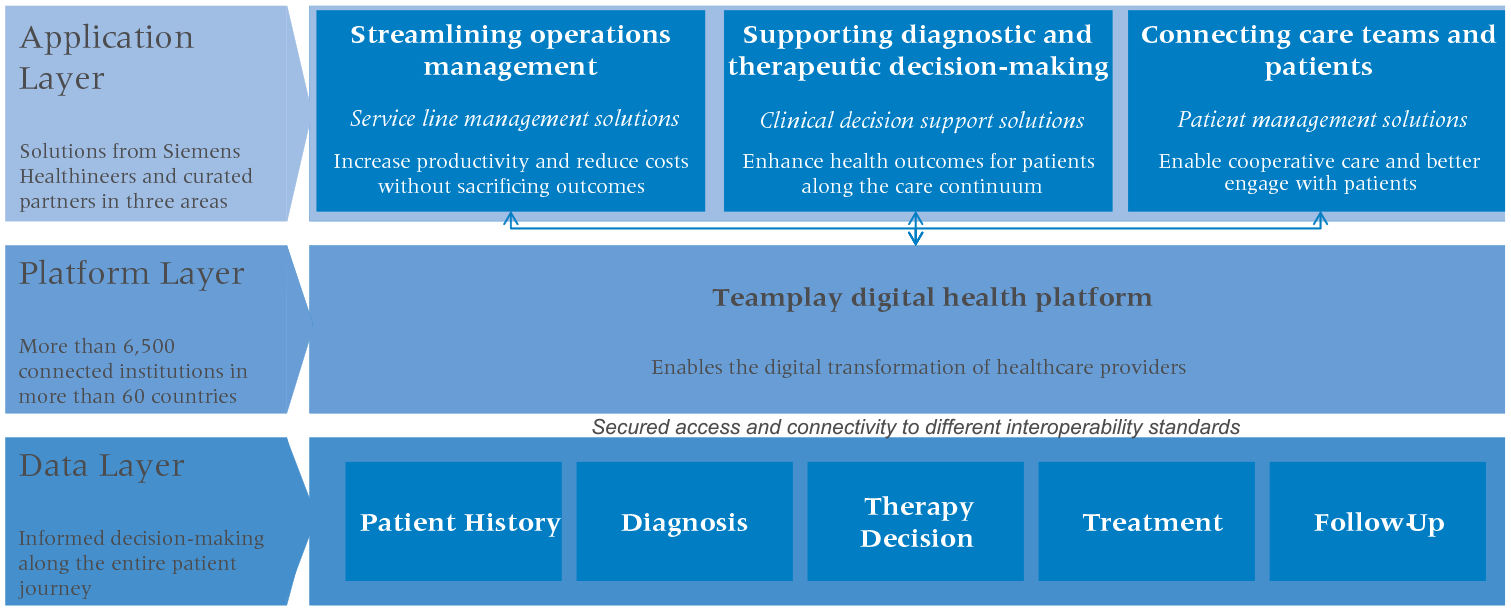
Teamplay digital health platform.
History and Development of the Teamplay Digital Health Platform
The history of the teamplay digital health platform can be traced back to February 2013 and the company’s attendance at the 4th Healthcare International Key Expert Conference (HIKEC) in Boston, USA. The conference was overshadowed by Blizzard Nemo, which caused heavy snowfall and wind, forcing many attendees to extend their trip. However, this natural disaster provided an opportunity for the current head of teamplay, the former head of digital services, and the former head of digital imaging (now CEO of SHS) to strategize over “Connectedness and Big Data” in the healthcare industry. This discussion initiated the start of the teamplay project later that year in November (see Figure 3 for an overview of the key moments in the development of the teamplay platform).
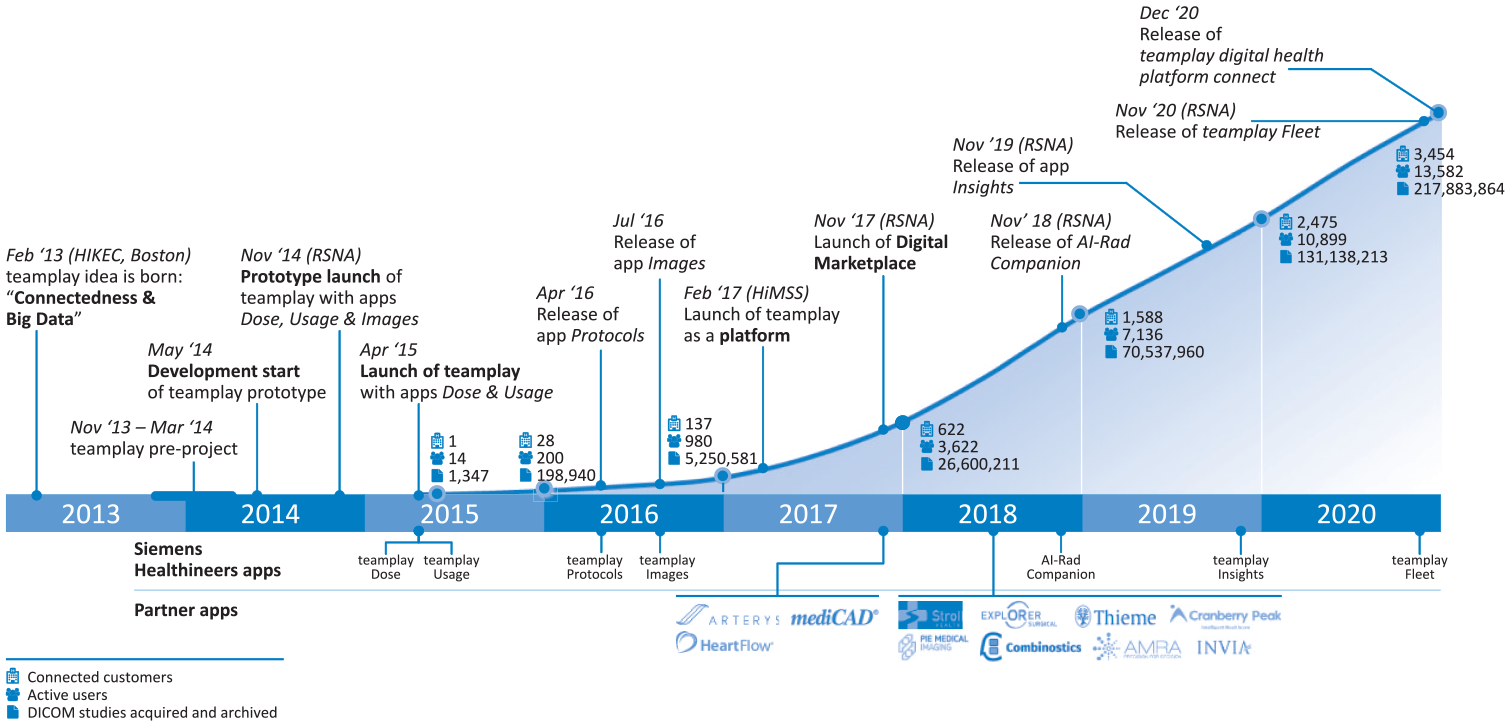
Successful digital platforms are measured in traffic.
In May 2014, prototype development started with the goal of collecting feedback at the Annual Radiology Conference (RSNA) in November 2014, where teamplay was officially launched with click-dummy apps for Dose, Usage, and Images. The first formal product release for teamplay with Dose and Usage happened in 2015. Since then, the teamplay team has prioritized speed, worked in small teams, conducted pilots with early customers and partners, and established trust with different management layers within the company. After the formal release of Protocols (April 2016) and Images (July 2016), teamplay was officially launched as an SaaS/PaaS (software-as-a-service/platform-as-a-service) platform at the February 2017 HIMSS (Healthcare Information and Management Systems Society) Annual Conference and Exhibition.As of October 2020, the teamplay digital health platform had connected more than 6,500 institutions, 32,000 systems, and 60 countries, with more than 10 million patient records accessible cross-institutionally.
Distilling Dynamic Capabilities Critical to Mitigate Value Impedance in Digital Transformation
Identifying Digital Transformation Gaps and Value Impedance
The development of the SHS teamplay digital health platform represents the digital transformation journey of MedTech incumbents. The SHS case illustrates that incumbents tend to proceed with doing what they know best and what has brought them success so far. As one innovation expert at SHS put it,
Any organization that is trying to do something new is usually set up for the existing and not for the new. So, you have all the conflicts that arise if you work in optimizing cycles, but you need cross-functional collaboration and thinking. (Innovation expert IA)
Thus, each phase in SHS building the teamplay digital healthcare platform business required new processes, assets, and competencies associated with overcoming digital transformation gaps. When analyzing the digital transformation of SHS, we identified four distinct digital transformation gaps: mindset, business model, organizational reconfiguration, and continuous renewal, as summarized in Figure 5 and discussed in the following sections. Any lingering unresolved digital transformation gap hinders new value delivery and capture, which we call the “value impedance” of digital transformation. Value impedance slows down the flow of value within a MedTech incumbent as well as in the incumbent upstream digital healthcare platform.
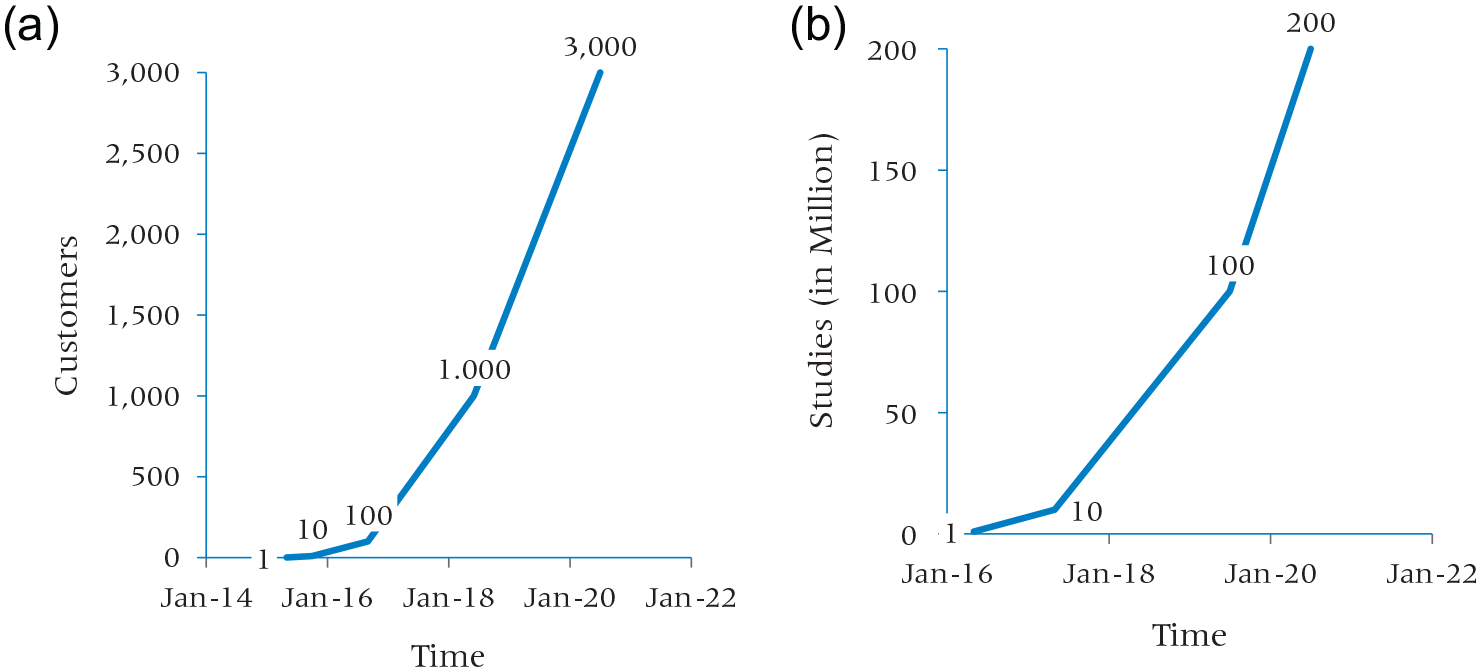
(a) Growth of the customer base of the teamplay digital health platform; (b) Growth of DICOM studies saved on the platform.
Although teamplay digital health platform customer and use cases were growing exponentially (see Figure 4), as we detail below, SHS management and employees closely monitored the platform’s progress and took relevant actions to deal with any digital transformation gaps. This enabled SHS to overcome value impedance and reap the benefits of its digital healthcare platform. Also, successful management of the digital transformation gaps helped the teamplay digital health platform to build its own dynamic capabilities.
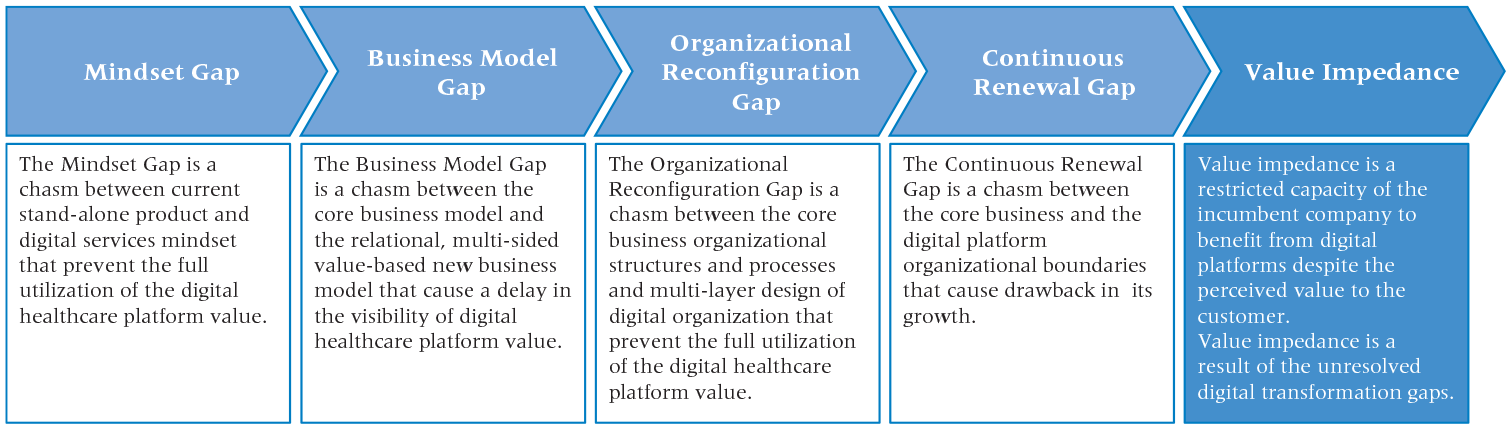
Summary of the digital transformation gaps that lead to value impedance.
Bridging the Mindset Gap and Sensing the Internal Environment Capabilities
The driver for the digital transformation of SHS was dynamic competition in the digital healthcare market and the fast-paced development of digital technologies
49
:
We are equipment manufacturers, and we have the largest market share in almost all scanners. Now with the rate at which technology is moving, you might be concerned if I don’t know that with Android’s next release or the iPhone’s next update you can scan human bones. What does that mean to our business? We are fearful but not fearful enough to act. (Platform expert IJ)
While typically adept at sensing the external business environment, in times of digital transformation, incumbent companies also need to be mindful of changes in the internal environment of their core business.
50
As stated by a platform expert at SHS, even if the company senses an external threat, it does not mean that that threat is automatically sensed inside the company. The case study revealed that the sensing of internal environment capabilities enabled SHS to detect significant differences early enough between the product and digital platform businesses:
Typically, in our world, “product” means “hardware,” which obviously has distinct differences to software, and even more when compared to digital services or to applications in various shapes and forms—in regard to how they’re developed, in regard to what is required to bring them to market, in regard to what is required to operate them, to service them, to sell them. (Partner business expert IH)
Even when the company spotlighted significant differences between the product and platform businesses, from the start it was difficult for SHS to sense and comprehend the volume of change required for the organization:
So, it’s really a different mindset and business, and this is why we also need to do different things. It starts by [asking] “How do I design a service?” What kind of people do you need? How can you engage all relevant constituencies and achieve cross-collaboration, not only because we all love each other, right? (Design thinking expert ID)
These questions managers need to answer early on in the digital transformation process. However, managers have to endorse the digital transformation themselves:
In every level, if middle management is blocking this and putting the wrong incentives, then it doesn’t help if your novel employee is doing it. (Business development expert IG)
The selective attention of managers develops throughout their careers, based on their experiences, beliefs, competencies, and other significant life events.
51
Thus, if a manager has been a strong proponent of the core business of the incumbent company for some time, they might find it challenging to shift their mindset and turn their attention toward digital transformation and supporting the new services:
The managing board was saying, yes, we want to do this, and that’s why we are investing in this. But of course, there are the power plays, which are the owners of the products. They know they are doing the business at the moment and they are the source of this money. Then the debate is going on. Not everybody who likes doing product business today is per se a fan of platforms. (Business development expert IG)
Thus, SHS needed the ability to buy in managers that preferred core business to new digital healthcare platform business. Besides, for managers, it can be difficult to overcome the “beginners’” mindset:
We hear we are the best, but here we are not, here we are beginners. So, to really get this beginner’s mindset, I mean, after all these years, is a bit hard; we are not beginners anymore, but currently we’re also not experts in the platform business. (Design thinking expert ID)
Product innovation expert at SHS noted that the “mindset shift of the managers is what we need before we can get any further.” When sensing differences between the core and new business on an organizational level and by engaging managers, incumbents can begin to address the mindset gap on an organization-wide scale:
I think this is also something which needs to be reflected in the mindset of everybody, from keeping and hiding information, to sharing information, discussing things with people early on. Without that kind of mindset, you wouldn’t be able to do this on a company scale. (Business development expert IG)
In short, sensing capabilities are helpful to MedTech incumbents to help them detect not only external opportunities but also internal threats that might hinder embracing digital healthcare platform business opportunities. The SHS case indicates four distinct sensing of internal environment capabilities: the ability to comprehend critical differences among core and new business; the ability to buy in managers that favor core business; the ability to accept the beginners’ position; and the ability to change the mindset on a company scale to bridge the digital transformation mindset gap.
Bridging the Business Model Gap and Capturing Value Through Connectedness Capabilities
Once a new incumbent digital healthcare platform opportunity is sensed, it must be seized to deliver and capture value. Thus, without value-capture capabilities, a company will fail to utilize opportunities as they arise.
52
Digital transformation and the deployment of digital services require adjusting the prevailing business model according to the needs of the digital platform. However, it is often not easy to pursue business model innovation in digital transformation, especially when the core business is thriving:
I think one of the biggest obstacles or roadblocks here is that whatever you do at Healthineers, it will always be compared to this billion [dollar] business of MR, for instance, right? This is a huge, huge business, and it’s very profitable. And it’s very easy to say, let’s do more of that because there the dollars come back; that’s what we know. (Design thinking expert ID)
Besides, incumbents tend to resist radical business model innovation due to the high uncertainty that comes along with it and the perceived risk to the existing core business income streams:
Reality is that obviously most companies need management attention to stay on the core business because that’s your revenue driver. And you want to make sure if you are establishing a new business that the core business revenue stays. (Partner business expert IH)
The business model gap for incumbent upstream digital healthcare platforms therefore often stems from incumbents being limited in their ability to diverge from a prevailing way of doing business and to establish income streams based on a new business model that cannot be compared in any meaningful way with the core business. The incumbent’s ability to overcome the resistance toward radical business model innovation and the ability to master a new value proposition that is relevant to the digital healthcare platform are critical. As one strategy and innovation expert at SHS conceded, the lack of a clear value proposition made investments into the platform business feel unfocused and lacking a discernible direction:
You need to internally actually make clear why you want to have such a platform business and why you want to continually invest money into building that and what it would really bring. It’s often not a clear value proposition in the sense of “if I take X amount of money and I bring back that plus X percent of margin.” (Strategy and innovation expert II)
SHS defined the value proposition of teamplay as onboarding and facilitating the interaction of multiple actors who otherwise could not be connected and hence could not collaborate to create mutual benefits: a “teamplay platform assists healthcare providers in making more informed decisions along the entire patient pathway—helping hospitals and clinics to streamline their operations management, supporting diagnostic and therapeutic decision-making, or connecting care teams and patients with patient management solutions. Our customers will not only be able to access our best-of-breed digital marketplace, but they will also benefit from the most advanced applications and best-in-class security.” 53 Value proposition signals that incumbent companies should not simply see the digital platform business as “doing the same, just digital.”
Furthermore, the most significant innovation of the digital platform business model is enshrined in the connectedness, the value of the data, and what such data ownership, access, and application represent:
If we would like to get into the habit of really doing digital right, the most important goods that we need to get are connectedness to equipment and especially to users. And its data use rights that we have to obtain. [. . .] We understand that we need to deliver value to our customers without getting paid in money but getting paid via connectedness and the data it generates. (Innovation expert IB)
Finally, to benefit from digital transformation and healthcare platforms, incumbents need the ability to engage their customers in digital transformation and the change in their organizations:
Besides, we need to get the healthcare environment ready for this new way of doing business because there are plenty of things which we have to still sort out with customers, how they work and how they approve new applications, what clinical questions they want to answer, so making the step into the market with a really new business model. (Strategy and innovation expert II)
In conclusion, value-capturing through connectedness capabilities bridges the digital transformation business model gap through the ability to shift incumbents’ focus from the prevailing business model to the needs of the new business model that fits in with a digital logic; the ability to redefine value proposition to embrace multiple beneficiaries that are vital to co-creating value on the digital healthcare platform; the ability to capture value through digital marketplace connectedness and leveraging data; and the ability to engage customers in simultaneous change with digital healthcare platform growth.
Bridging the Organizational Reconfiguration Gap and Orchestrating Silos Capabilities
Digital transformation and a new business model require adjusting the prevailing organizational design, competencies, and assets according to the needs of the digital platform. For SHS to succeed in an organization-wide transformation, one digital business expert explained that SHS had to bust the silos that were part of the traditional design of the incumbent organization:
And as long as we are in separate silos, it’s very difficult to do what we want to do. We are trying to overcome these things. (Digital business expert IB)
Silos prevent the flow of information and collaboration across internal units and external partners and customers, thus contributing to the creation of organizational reconfiguration gaps. As one SHS innovation expert observed, “the organization was not ready” to set aside fiefdoms and to join together in the ways that were needed to make an effective digital platform business:
They were all trying to optimize their silo, and they were not trying to optimize what the customer or the healthcare providers of the patients were getting as an experience from Siemens Healthineers. (Innovation expert IM)
The importance of leadership was cited as a crucial first step toward a more collaborative outlook:
I want the CEO or whoever to be a role model and showcase collaboration. The logic is simple: why should I collaborate with other people when I don’t see my manager and my manager’s manager, up to the CEO, doing it? (Human resource expert IC)
Organizational design should support intraorganizational collaboration. There should be clear processes in place to “walk-and-talk” the collaboration and to minimize the possible risks of not conforming to the prevailing behavioral models. One venture technology expert at SHS was at pains to point out how important communication was:
There are many levels of cooperation between the business lines. So, they’re talking to each other on a personal level, but also, they have some sort of innovation board meetings where the people from the different departments talk together on a regular basis and exchange knowledge. There are also mechanisms to share new things internally. (Venture technology expert IF)
To achieve the sought-after goal of developing a digital platform business, SHS established several practices to support organization-wide transformation. One human resources expert at SHS (IC) pointed to the T-Club (the Transformation Club) as one group that was really committed to the new business model as well as to different working groups devoted to different topics. The T-Club in particular was singled out as a safe place where employees could bring in different issues and discuss them in an informal setting with management.
Finally, incumbents need to orchestrate internal and external assets through onboarding partners that are often “smaller, more agile and faster” and by managing internal competition:
I think running a partner business versus producing your own products, the differences are to some extent in the amount of flexibility because obviously the existing and established processes do not necessarily match other [partner] companies. So, you have to be flexible to some extent to be able to alter existing processes within your company to meet that new business model. (Partner business expert IH)
In short, orchestrating silos capabilities can assist incumbents in numerous critical ways: for example, in abandoning traditional authority structures and silos; setting “walk-and-talk” collaboration and minimizing possible risks of not conforming to the prevailing behavioral models; and nurturing symbiotic relationships between SHS and third parties in order to unlearn and alter product-related routines in favor of digital services’ new pathways. These abilities help the MedTech incumbent to close the organizational reconfiguration gap.
Bridging the Renewal Gap and Transforming the Organizational Boundaries Capabilities
Digital transformation is different from adopting other new technologies, as the digitalization process must permeate the whole organization, including balancing the internal and external focus, to effect complex organizational change.
54
It can require establishing a decentralized service organization and governance structures that can ensure flexibility and control to create a culture that both maintains a symbiotic relationship between manufacturing and service-oriented values and facilitates collaboration with external actors and alignment with the ecosystem:
I think number one is culture change. You have to turn your focus from inside value creation to outside value creation. (Business development expert IG)
The digital transformation culture also requires an entrepreneurial spirit to tolerate the uncertainty that is the “new normal” during radical change periods:
Things are changing here. I want to be part of it. That’s why I’m here. I know I have to work somewhat more. This is a small stress. It’s not as relaxed. My career path is quite uncertain, but anyway, I’m doing it. This I admired very much, and this has a name as “entrepreneurial spirit.” (Business development expert IG)
Successful transformation should support the exploitation of the core business and still enable the extensive exploration of the incumbent’s upstream digital healthcare platform business. Finally, “digital transformation requires the transferability of digital objects and boundary spanning activities, which leads to new forms of partnership, both internal and external.”
55
As one design thinking expert conceded,
The real value usually comes when you use the full potential, what you can do within the new boundaries of digital opportunities. (Design thinking expert ID)
The transformation of organizational boundaries capabilities is critical in closing the continuing renewal gap through the abilities to balance internal and external focus, span the incumbent’s organizational boundaries, and build an organizational culture with a focus on outside value creation—nurturing entrepreneurial spirit and utilizing new digital opportunities. Figure 6 summarizes unique dynamic capabilities critical to bridging digital transformation gaps.
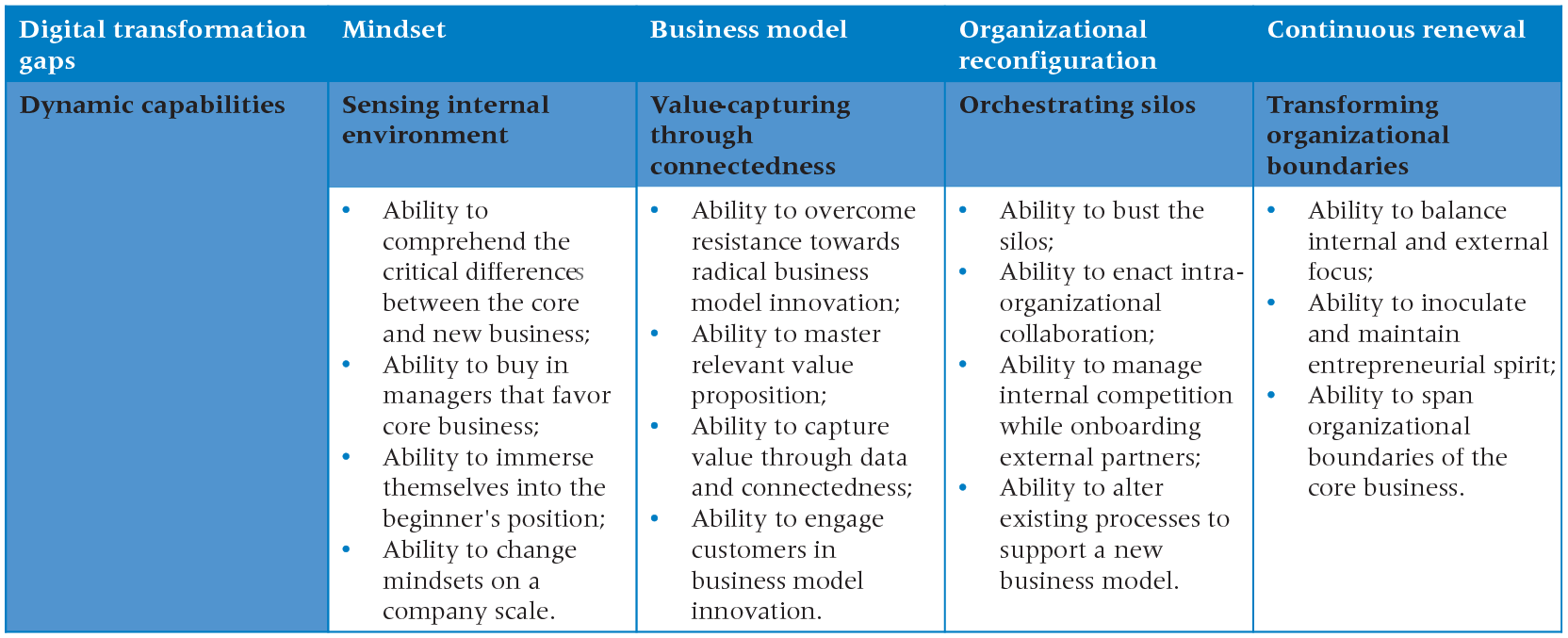
Summary of the dynamic capabilities critical to bridge digital transformation gaps and mitigates value impedance.
Discussion and Managerial Implications
Our discussion of digital transformation gaps, value impedance, and the role of dynamic capabilities in the digital transformation of MedTech incumbents provides several contributions to management theory and has a number of managerial implications. In this article, we focused on a set of dynamic capabilities that can assist the digital transformation of incumbent MedTech companies. We discussed these dynamic capabilities in a specific context of incumbent upstream digital healthcare platforms. 56
Extending the Dynamic Capabilities Framework
Management scholars acknowledge that dynamic capabilities are context-specific and embedded within the organization’s collection of its prevailing routines and processes. 57 During the last 20 years, scholars have developed different ways to dimensionalize the dynamic capabilities construct by: differentiating the types of processes dynamic capabilities are engaged in 58 ; the degree of the routinization of dynamic capabilities 59 ; the functional domain the dynamic capabilities are utilized in 60 ; the hierarchy of capabilities 61 ; and the focal unit of the analysis. 62 Most frequently, dynamic capabilities are defined in relation to an organizational process that aids in comprehending the business environment, emerging opportunities, and threads; making strategic choices on investments and business models; and transforming organizational structures, resources, and culture. 63 In this context, our study offers three critical contributions for scholars working at the intersection of dynamic capabilities and the digital transformation of MedTech incumbent companies.
First—We meet the call from scholars to enrich the dynamic capabilities framework with additional organizational processes that may have been previously overlooked. 64 Based on a case study of the incumbent companies’ digital transformation from a broad range of sectors, Warner et al. defined dynamic capabilities vital for strategic renewals of the incumbents as digital sensing, digital seizing, and digital transformation capabilities. 65 In contrast to our study, digital sensing, seizing, and transformation capabilities respond to external factors, such as digital technologies related to customer behavior change and disruptive competition, for instance, co-opetition in digital ecosystems. The SHS case study covered several less elaborated aspects of dynamic capabilities that are specific to incumbent upstream digital healthcare platforms, in particular, the sensing of the internal environment of incumbents, capturing value through connectedness, orchestrating silos, and transforming organizational boundaries. These four dynamic capabilities address digital transformation gaps and are critical to the success of the strategic change of the incumbent MedTech companies while seizing new digital healthcare platform business. The prevailing routines and processes of the core business of the incumbent company, if not considered, can cause digital transformation gaps and value impedance. The company’s appropriate dynamic capabilities can help to bridge these gaps. Consequently, it has become evident that the new digital healthcare platform business should develop its own dynamic capabilities to proceed with successful growth under the continuing core business of the incumbent MedTech company.
Second—At present, the most covered functional areas in dynamic capabilities research are new product development, mergers and acquisitions, alliances, and capital allocations. 66 Digital transformation has already pervaded most of the industries and has become imperative on incumbents’ strategic agendas. However, there is limited research on what and how incumbents build dynamic capabilities for digital transformation. 67 Furthermore, digital transformation is a broad concept embracing diverse aspects of incumbents’ business development. For instance, a Cozzolino et al. study explored frictions between incumbent producers and entrant digital platforms in the digital advertising sector. Cooperation between digital advertising incumbents and entrant digital platforms can result in frictions or barriers related to the lack of transparency and loss of control (e.g., over-pricing). To address the frictions, incumbents need to develop the ability to orchestrate competition and cooperation across market segments, technologies, and customer groups. 68 Warner et al. conceptualize digital transformation as an ongoing process of strategic renewal inoculated by advanced digital technologies to build capabilities that empower business model innovations, new collaborative strategies, and organizational culture. 69 The digital transformation of MedTech incumbents is just starting to attract some attention from dynamic capabilities scholars. Thus, little is yet known about the sequential process of incumbent MedTech companies’ digital transformation when they seek to establish a new digital healthcare platform business. Our study provides significant new insights into what digital transformation gaps might arise between the core business and new business of such incumbent MedTech companies. Furthermore, the digital transformation gaps—mindset, business model, organizational reconfiguration, and continuous renewal—can be bridged by specific dynamic capabilities, which were discussed above.
Third—The contextual factors of dynamic capabilities are also less well analyzed, especially in the context of the healthcare industry. Some contextual factors of dynamic capabilities in the digital transformation of incumbent companies were covered by Warner et al. 70 ; however, their case study was based on automotive, banking, telecoms, energy, and media industries. In our study, we propose a new classification of digital innovation platforms by specifying them in line with their origin and position along the value chain of digital healthcare services. This new classification can help to highlight the unique challenges incumbent upstream digital healthcare platforms face in contrast to adjacent downstream platforms and other innovation platforms. These two different types of platforms enter the digital healthcare platform market with different customers, innovation cultures, and, finally, different capabilities—and, thus, they need context-relevant dynamic capabilities for driving successful strategic change.
Managerial Implications
The managerial implications extend to both incumbent MedTech companies and their upstream digital healthcare platforms. In some cases, incumbent MedTech companies fail to foresee the scope and amplitude of the organizational change they will need to undergo in order to successfully embrace digital transformation.
Our instrumental case study highlighted four key digital transformation gaps: mindset, business model, organizational reconfiguration, and continuous renewal. When unmanaged, these gaps can result in value impedance and a limited ability of the incumbent MedTech company to benefit from building a digital healthcare platform. However, such digital transformation gaps can be bridged by a set of dynamic capabilities, more specifically: sensing the internal incumbent’s environment; capturing value through connectedness; orchestrating silos; and transforming organizational boundaries (see Figure 7).
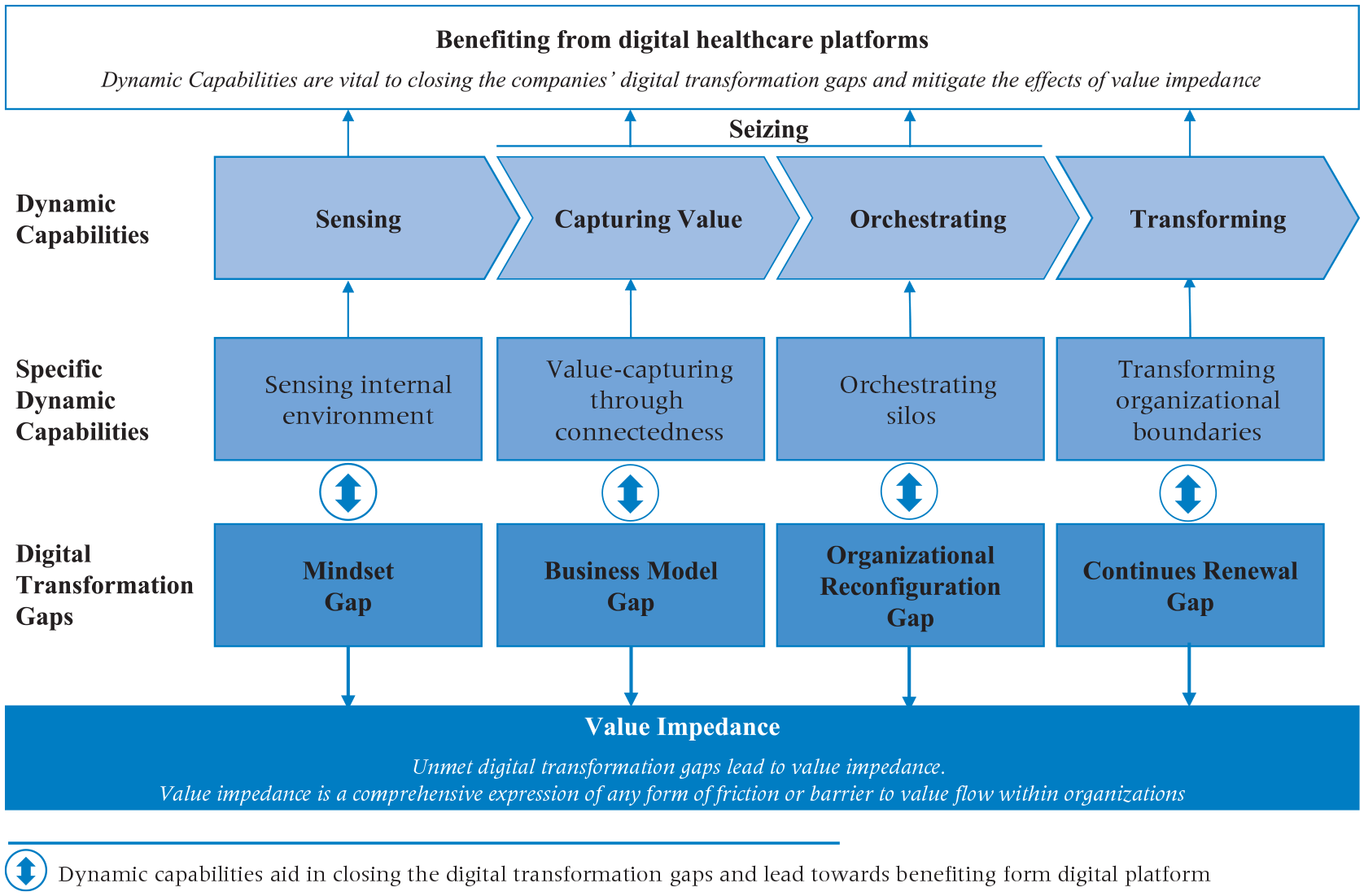
Summary of the managerial implications.
Sensing the internal environment capabilities
The sensing and sense-making of new opportunities is a scouting, scanning, probing, exploring, learning, and interpretive activity. 71 However, incumbent companies need to be mindful of several issues while identifying and interpreting digital platform opportunities. Sensing during digital transformation can be easily crippled if the incumbent company maintains a “stand-alone product” mindset. Continuous scanning of the internal environment should be performed at all levels, assuring that the front-line contributes to sharing and also interpreting internally available relevant information along with middle- and top-level managers. 72 This comes with a “digital services” mindset. Furthermore, if a manager is a strong proponent of the product-based core business of the incumbent company and has been for some time, they might find it difficult to shift their mindset and turn their attention toward digital transformation and the deployment of new digital services. Sensing of the internal environment facilitates the identification of the mindset gap at different organizational levels and enables a company to take timely measures to change the “stand-alone product” to the “digital services” mindset.
Capturing value through connectedness capabilities
Value-capture capabilities are prerequisites for rethinking and reconfiguring the business model of incumbent digital healthcare platforms. This is a critical process because, from the start, incumbent upstream digital healthcare platforms usually address the same customers as the core business of the incumbent MedTech company. Thus, incumbent upstream digital healthcare platforms should clearly define and communicate the significant added value created for the customers in comparison with the core business. Furthermore, the redefined value proposition of incumbent upstream digital healthcare platforms may drive business model change, including rethinking the R&D strategy, business network configuration, and value monetization mechanisms. 73 To stay nimble, incumbent MedTech companies need to accommodate external partners and balance co-creation among internal and external resources.
Orchestrating silos capabilities
Orchestration capabilities can assist incumbents in disbanding silos, adopting new digital routines and processes, and abandoning traditional authority structures. 74 Meanwhile, they can establish decentralized service organizations with profit-and-loss responsibilities that help to balance the company’s product and service-oriented assets, and they can nurture a culture that supports symbiotic relationships between product and service-oriented mindsets. These organizations, in turn, are able to unlearn and alter product-related routines in favor of the digital services’ new pathways. 75
Transforming organizational boundaries capabilities
Transformation in incumbent companies rarely occurs overnight due to entrenched habits reflected in a strong culture that is hard to change. Incumbents need to create explicitly named and organizationally flagged coaching roles held by transformational talents who can support people in overcoming roadblocks to develop a digital platform. Transforming capabilities can suffer, though, if “anti-cannibalization instincts and entrenched interests stand in the way for incumbent companies.” 76 Also, additional challenges can emerge during digital transformation: incumbents can face strong inertia caused by micro-politics, “bargains,” and relational contracts within the company and ecosystem that undermine the incumbent’s transforming dynamic capabilities. Transforming the organizational boundaries of incumbent MedTech companies can help bridge the “continuous renewal gap” and maintain value flow in the business.
We observed that the dynamic capabilities of the incumbent core business in our case study were not automatically conveyed to the new business of the digital platform. Therefore, at some point, incumbent upstream digital healthcare platforms need to develop their own dynamic capabilities and continue strengthening them by closing any digital transformation gaps they have in close collaboration with the core business. The process of closing such digital transformation gaps can be iterative and rather evolutional due to the earlier discussed resistance from the side of the incumbent’s core business. Developing dynamic capabilities through sensing internal drawbacks to embrace digital transformation helps to effectuate multisided co-creation with external partners and clients, orchestrate silos, and transform organizational boundaries. This can mitigate the effects of value impedance. Over time, the incumbent digital healthcare platform will help the company create a platform-specific vision and strategy for digital services with a multisided value proposition that is generated and validated with experiments about what customers are willing: to pay for; to develop platform components, processes, and capabilities; to design and use a digital platform–specific performance indicators framework that enables employees to achieve realistic objectives; and to implement “strategic” roles that will maintain an overview of the bigger picture while others can concentrate on the operational implementation and execution.
Conclusion
In this article, we explored the dynamic capabilities of MedTech incumbents that are vital to closing the companies’ digital transformation gaps and mitigating the effects of value impedance. The SHS case study we presented showed that the digital transformation of MedTech incumbents when launching an upstream digital healthcare platform can create digital transformation gaps. The four digital transformation gaps identified in this article—mindset, business model, organizational reconfiguration, and continuous renewal—can cause value impedance that prevents value creation and flow between the incumbent MedTech company and its upstream digital healthcare platform. Unresolved digital transformation value impedance can result in the failure of the incumbent upstream digital healthcare platform. To avoid this outcome, a set of unique dynamic capabilities—sensing of the internal environment, value-capturing through connectedness, orchestrating silos, and transforming organizational boundaries—are needed to bridge digital transformation gaps. By knowingly closing such gaps, incumbents can nurture the development of the dynamic capabilities of their upstream digital healthcare platform and thus successfully overcome value impedance. However, incumbents need to be mindful that the dynamic capabilities of the core business are not directly replicated in the digital platform business. Building a unique set of dynamic capabilities can help MedTech incumbents benefit from digital healthcare platform business and strengthen a competitive advantage against the entrants.
Footnotes
Acknowledgements
The authors express their deep and sincere gratitude for Siemens Healthineers Principal Key Expert for Digital Business Model Generation, Frank Konopka. His vision, insights, and motivation have deeply inspired us. We thank Rima Sermontyte-Baniule for helping with data collection and her valuable editorial assistance. The authors are extremely grateful to all Siemens Healthineers interviewees for their time devoted to the study and to the anonymous reviewers for their constructive feedback and efforts to advance our paper.
Funding
The author(s) disclosed receipt of the following financial support for the research, authorship, and/or publication of this article: This research was supported by European Social Fund (Project No. K71208006) under grant agreement with the Research Council of Lithuania (LMTLT).
Notes
Author Biographies
Asta Pundziene is a Professor of Strategic Management and Organizational Psychology at Kaunas University of Technology and Visiting Scholar at the University of California, Berkeley’s Haas School of Business (email:
Tobias Gutmann is an Assistant Professor of Product Innovation at EBS Business School and Head of the Institute for Technology, Innovation & Customer Centricity (TICC) as well as the Siemens Product Innovation Lab (email:
Marc Schlichtner is Principal Key Expert at Siemens Healthineers Digital Health, C-Level Advisor, Founder of T-Club, and Advisory Board Member (email:
David J. Teece is the Thomas W. Tusher Professor in Global Business and Director of the Tusher Initiative for the Management of Intellectual Capital at the University of California, Berkeley’s Haas School of Business (email: