




Abstract
Open innovation rests on the idea that not all the smart people work only for you, and managing human interaction across organizational boundaries is therefore central to open innovation. This article starts with outlining and reviewing research on this human dimension of open innovation. The article develops seven principles of innovation-producing encounters that can guide managers in enabling value creation through open innovation. We continue by introducing the rest of the special section, which expands beyond the human dimension to also include firms, platforms, and ecosystems, with important implications for the creation and capture of value from open innovation.
Keywords
Open innovation “refers to a distributed innovation model that involves purposively managed inflows and outflows of knowledge across organizational boundaries, for pecuniary and non-pecuniary reasons, in line with the organization’s business model.” 1 While this definition of open innovation focuses primarily on the organizational level, open innovation also relates to (higher-level) ecosystems of organizations and technologies on one hand, and (lower-level) inventions and individuals on the other hand. Moreover, open innovation spans different components of the business model, including the creation of value through new innovations and the capture of some of that value, albeit not always providing pecuniary rewards. 2
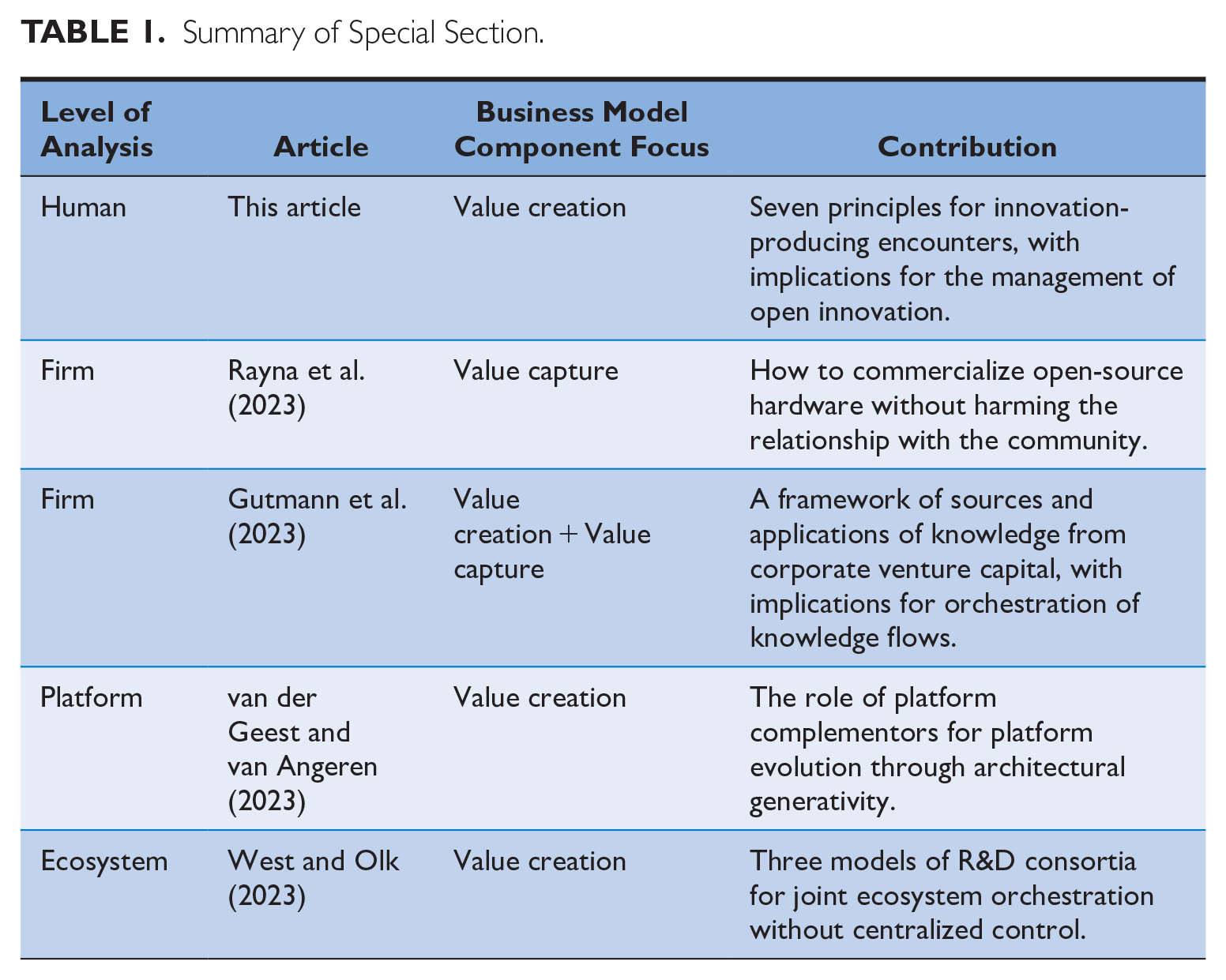
The articles in this special section cover several of the levels of analysis of relevance for open innovation, from the governance and management of ecosystems and platforms to firm-level strategies that benefit from new sources and applications of knowledge, including both value creation and value capture perspectives (see Table 1). Before we introduce these articles, we start by focusing on the human dimension of open innovation because in firms, platforms, and ecosystems, humans are still the ones actually doing the innovation. Open innovation allows humans to go beyond limitations given by group or organizational boundaries to jointly address important problems and innovate new solutions. More specifically, we will introduce the concept of innovation-producing encounters—interactions that lead to innovation—and present seven principles of such encounters, or in other terms, seven socio-cognitive principles that positively impact open innovation. In doing so, we focus primarily on value creation, while other contributions in the special section cover value capture.
Summary of Special Section.
In this article, we do not refer to innovation in the form of simple improvisation or what is commonly called “incremental innovation,” where, for example, modified and improved features are added to an existing product (e.g., adding a zoom-in button or a share button to a camera app). While important, these incremental innovations are often offered and constrained by the structure of the product (i.e., its modularity), 3 the structure of the organization’s new product development processes where long lists of user-requested features are placed in a queue, or a limited definition of the problem. 4 These types of incremental innovations are needed, of course, but they do not require breakthrough creativity. Instead, we focus on innovation processes that address problems that are ill-structured and complex, open to various definitions, multi-sided with no single or simple unidimensional user group, requiring the creativity and integration of diverse knowledge domains, and problems that come with many judging criteria that must be applied before the value of a solution can be determined. Examples of the types of problems that require breakthrough creativity include technical problems; social problems; identifying new markets, industries, and products; and developing solutions to societal challenges. 5 One example is the problem of finding a cure for Alzheimer’s disease, a case described in the article by West and Olk 6 in this special section. By “innovating” we here mean the generation of novel and implementable solutions to complex ill-structured problems. 7 These problems are sometimes referred to as “wicked problems” 8 because they are more likely to be solved when people are creative in thinking through all the different interrelated facets of the problem. Human creativity is central to this form of innovating and, since it is not confined within the boundaries of a single organization, open innovation is central when addressing such problems. 9
In the following, we explore the human dimension of open innovation. We start by summarizing some important findings from previous research. Next, we introduce the concept of innovation-producing encounters for humans in open innovation, before outlining seven principles of what makes these innovation-producing encounters productive. After that, we provide implications for managers and researchers. Finally, we introduce the remaining articles of the special section, which address additional levels of analysis.
What We Know about the Human Dimension of Open Innovation
The literature on open innovation has so far revealed many of its attributes, 10 not only in terms of benefits but also including costs and downsides. 11 Much of this research has the organization as the main unit of analysis, but the human dimension of open innovation—sometimes framed as the “microfoundations” 12 —has also been a common focus for both researchers and practitioners of open innovation. For example, the supply and mobility of highly educated professionals were featured as important drivers in Chesbrough’s 13 original book on open innovation. Since then, much research has contributed to understanding the human dimension, including the individual-level incentives and capabilities for open innovation. 14
Building on the argument that “the effectiveness of firms’ open innovation strategies strongly depends on the individuals tasked to bring those strategies to fruition,” 15 we identify several perspectives that play a role in this context. For example, realizing the potential of open innovation 16 depends on how individuals handle the challenges connected to the not-invented/sold here syndromes, 17 how they allocate their time in relation to knowledge inflows and outflows, 18 and how the entire organization can be involved in the cross-fertilization of knowledge for innovation. 19 Indeed, encouraging open innovation in a bottom-up sense may involve organizational paradoxes, such as between stability and learning, 20 between hierarchy and heterarchy, 21 and between employees’ simultaneous engagement in production and innovation. 22
Unpacking the human factor in open innovation further relates to several aspects, such as the impact of the open innovation model on R&D professionals and their work, 23 how individuals cope with open innovation, 24 how people’s abilities and efforts influence exploration-exploitation processes, 25 how resource management can create an open innovation mindset, 26 and in general, how cognition explains behavioral responses in open innovation. 27 At the same time, some studies have focused on contextual elements that can influence engagement and performance of employees in open innovation practices, such as in the domains of leadership influence 28 and in the role of gatekeepers and change agents. 29
Considering the individual incentives for open innovation, research has conclusively indicated that people are more likely to suggest innovative solutions during open innovation when there are competitors but not so many that they feel crowded out. 30 Additional conditions that stimulate solutions include intrinsic motivators, such as the promise of impacting important decision makers and intellectual stimulation, 31 and extrinsic motivators, such as job opportunities or expert feedback. 32 Other research has found that participants may personally benefit from their knowledge and relationships during a collaboration, giving them better bargaining power in relation to their employers. 33
Some research focuses on the characteristics of individuals who are more likely to be innovative when engaged in the value creation stage of open innovation. This research has indicated that the most innovative individuals are hobbyists. 34 It has also shown that individuals who have T-shaped expertise, which is deep but broad, are more innovative. 35 Individuals with broader and more adaptive social networks are also more innovative. 36 Moreover, individuals with direct experience with the problem being solved are more innovative, and those with more experience creating new products offer more innovative solutions. 37 Related studies have found that organizations must be alert to questions of individual roles and identities for contributors in open innovation, 38 and that individual-level characteristics may even lead to open innovation failure. 39
Yet another stream of literature, relating to organizational creativity, focuses on the structures and processes managers should create to facilitate creativity in groups. For example, this research has provided clues on how firms can use individual employees to unlock external communities. 40 It has also described how groups need to be provided with psychological safety 41 and should be given an intellectually challenging problem statement. 42 Also, they should be encouraged to develop new definitions of the problem, 43 to engage in creative abrasion and syntheses of differences, 44 and be given tools and techniques to support knowledge transcendence and transformation 45 for innovation to be successful. When applied specifically to open innovation, this research has expertly described how communications among group members through the social nature of their comments and networks can help increase the probability that innovative solutions will emerge. 46
Innovation-Producing Encounters in Open Innovation
The next step in understanding the human dimension of open innovation is to extend beyond a focus on the individual as a singular player or on group communications. Substantial research has indicated that trajectories of knowledge posted by individuals in open innovation formats influence the behaviors of others. 47 We suggest that open innovation researchers should build on these findings to understand humans as socio-cognitive creatures who are stimulated by and who stimulate others’ creativity through the content they individually and collectively pass on to each other. 48 Socio-cognitive processes refer to how interactions with others affect the cognitive processes of creativity, information processing, and problem-solving. 49 In some forms of open innovation, these human-to-human interactions are replaced with content-based encounters, such as reading someone else’s post in a forum and having it stimulate thinking; thus, we will call them innovation-producing encounters. A focus on the human dimension of open innovation today, therefore, must involve an understanding of what these innovation-producing encounters are, and how organizations can enable them.
What is unique about innovation-producing encounters for open innovation—compared with age-old advice on creating innovative groups—is that they do not necessarily need to be produced in groups. In fact, reliance on small groups to create innovations to solve a complex problem is increasingly recognized as problematic. 50 Groups tend to simply replicate past biases because the people within them are known to each other; knowing the other people involved changes socio-cognitive processes in many ways. They are less likely to share unique knowledge, 51 they are less likely to offer crazy wild ideas that may stimulate others, 52 and they are more concerned with norms and approval and therefore less likely to offer non-normative information. 53 Since groups historically include people similar to each other (in demographics or background or industry experience or past group experience), diversity of perspectives is often hampered. 54 Finally, because of a “shadow of the future” in which people worry about their futures with group members, they will often be afraid to disagree. 55 None of these issues are overcome even in psychologically safe groups since the boundaries of the group limit the number of diverse perspectives that are engaged. 56
With open innovation, these limitations can be cast off, and people can engage without being constrained by being in a group with others they know. A variety of open innovation formats reduce the limitations of groups. These formats include open organizations such as Hyperloop Transportation Technologies 57 or Ethereum, 58 in which there is a small staff of salaried workers relying mostly on external contributors to move the organization’s mission forward. They also include open innovation discussion forums where people describe their problems and solutions to each other (such as health care solution forums), 59 open source software communities still in the innovation-seeking stage, 60 and Stack Exchange where solutions must be novel and implementable to be highly rated by the problem initiator. 61 Finally, they include a small number (but not most) of open innovation challenges where people are encouraged and rewarded to comment and build on each other’s comments. 62
In these open innovation formats, humans are sharing knowledge with each other online in posts, where they can be read by others. Some researchers have described how, in such online formats, humans interact with the content itself, rather than being absorbed and constrained by who offered the content. 63 Consider the story of how one person involved in a large software development department used the department’s wiki to offer a metaphor that helped the department break through a conundrum. The poster was unnamed. The department was developing a security software product, with everyone pushing and pulling the product in different ways. The metaphor, born of the poster’s personal experience, suggested that the product should be framed as a hockey puck moving its way toward a goal through receive and pass actions; those features that kept the message moving toward the goal should be the ones with the highest priority. This metaphor immediately coalesced the department. It turned out that the post was made by the department’s administrative assistant who said, unequivocally, that she would not have posted it if she was identified because she did not want software engineers to focus on the source of the post, but rather the post’s content.
In sum, understanding the human dimension in open innovation must include understanding of how innovation-producing encounters occur. It must also include how to encourage more of these encounters and how to make them productive.
Seven Principles of Innovation-Producing Encounters
The first author of this article has, with Arvind Malhotra and colleagues, researched how encounters with others’ posts have engendered people to offer more innovative solutions to ill-structured problems. We can condense the results from this research into seven socio-cognitive principles as follows.
Principle 1: Humans Can Give as Little Time as They Want
A crowd, when responding to an innovation challenge question, typically offers fewer than two posts per participant yet can still be wildly innovative. 64 This means that humans involved in open innovation do not have to commit to huge time expenditures to help move a socio-cognitive process of encounters closer to an innovative solution. Consequently, open innovation events can be much more inclusive of those who are too busy, have parenting demands, are so marginalized, and alienated that they disengage from arguing with powerful white majorities; or who have only sporadic access to the internet because they cannot afford it. Every participant can do his or her part to foster innovation in just two posts.
Principle 2: Dialogue Is Not Useful
Innovative solutions emerge from what we call knowledge-baton sharing, rather than back-and-forth dialogue. 65 Dialogue forces the conversation down a particular path (or rabbit hole), closes off others from the conversation, often backs participants into their respective corners, and leads only to refinement of an initial less-innovative solution rather than creative breakthroughs of new solutions. Instead, we see participation in open innovation formats as akin to stimulating knowledge-sharing where the knowledge is encapsulated as a gift in a post, and others cognitively process that knowledge gift in a manner that uses their creative juices, inspiring them to offer the next knowledge gift. As such, what we refer to as innovation-producing encounters are not interactions as in a face-to-face dialogue, but interactions in which prior knowledge gifts have been shared.
Principle 3: Ideas Alone Do Not Beget Better Ideas; Different Types of Knowledge Need to Be Shared
More innovative solutions are generated in open innovation formats when participants share knowledge that is not simply solutions but more importantly knowledge about the problem. 66 These types of knowledge include different problem descriptions, personal experiences with the problem, examples of effective work in other contexts (called analogies), facts based on research, and wild and crazy ideas unfettered by immediate realities that pop into a human’s head when stimulated by others’ posts. This diversity of knowledge stimulates the thinking of the next people who enter the open innovation format. The most innovative solutions have been observed only after this diversity of knowledge is offered by others in the open innovation format.
Principle 4: Paradoxes Offered by Humans Are Critical Triggers for Innovation
Once the different types of knowledge are shared, a person, who helps to identify and then share a paradox associated with possible solutions or a paradox embedded in the problem, serves to stimulate solution generation. 67 The most innovative solutions come immediately after a paradox has been shared. A paradox might be that customers want to have customized solutions without their personal data being shared, or that a problem requires a lot of volunteer work yet there are no incentives for volunteering.
Principle 5: Solution Generation Is an Integration Exercise
The most innovative solutions have been offered by people who integrated the different types of knowledge shared (Principle 3) to create a solution that achieved both sides of the paradox (Principle 4). 68 We believe human integrators use their cognitively complex minds to hold so many different perspectives, pushing themselves creatively to address both sides of the paradox and thereby solve what may appear to be an overconstrained problem.
Principle 6: Human Knowledge-Sharing Role Diversity
It is too much to expect any single human to be able to offer the complete range of knowledge types, the paradoxes, and the integration needed; they cannot simultaneously play the role of wild idea generator, example giver, fact researcher, alternative problem describer, sharer of personal experiences, and creative integrator. We find that different people play each role. 69 We have also found they cannot be compelled to play any specific role. Instead, they need to be allowed to self-select the role they feel most compelled to play at the time they have entered into the open innovation process. If a necessary role is not filled, then broadcasting the need for this role to be played often works since people like to be needed.
Principle 7: Avoid Social Cues
It is easy to inadvertently fall back into thinking that humans, as social animals, need the social support of others. However, in an innovation interaction, social support recreates the constraints of the group. 70 Comments such as “good idea” leave others who do not receive such accolades thinking that their ideas are not good so they may withdraw. Voting on others’ ideas—although popular in most open innovation formats—is a death knell since it forces people to be concerned with what others think about them, and they are therefore less likely to offer unique or potentially less popular ideas and descriptions. The social animal nature of the human dimension of open innovation should be focused on encounters with others’ knowledge content, not on social support garnered from, or for, others.
Implications for Research and Practice
These principles are just the start of what we can learn about how humans can stimulate each other in creating innovative solutions in the value creation stage of open innovation. There is much more research to be done. Are there affordances 71 that encourage innovation-producing encounters? Are there other knowledge-sharing roles that, when played, can help to accelerate innovation? Is there some optimal mix of human-to-role ratio that needs to be played? Is there a maximum number of types of knowledge—especially different problem descriptions—that when exposed to participants, helps to stimulate creativity without overwhelming their cognitive capacity to process new information? Are there specific skills associated with specific roles, such as integrators who feel they need to appear more cognitively complex than others? Since dialogue and social cues are inevitable, how can the damage done by them during an open innovation event be reduced? Because these principles have been discovered as emergent from open innovation events, not forced onto human participants, what is the role of the moderator? These questions are ripe for new research.
For managers, focusing on the human dimension of open innovation means much more than simply identifying incentives for participants. It also means that simply broadcasting a new challenge question to stakeholders (who have been interacting already and agreed to spend significant time together) will be inadequate to generate innovative solutions to complex and ill-structured problems given the danger of recreating the constraints of group-based innovation (although the group may be large). A focus on the human dimension suggests what we call “unmindcuffing” those involved. 72 If possible, allow anyone to join; do not limit participation to experts or those who have the time. Open the innovation process around an exciting, broadly described problem; a problem too narrow does not engender innovation, nor does a problem described in unexciting ways. Allow anyone to redefine the problem description since a new description may generate new ideas. Allow anyone to share what they know and what they do not perfectly know—not just already-baked solutions they have considered so long they will not be open to throwing the old solution away. Allow humans to integrate the knowledge shared by others when offering new solutions, rather than “cuffing” them to rewards for competitively created ideas. Encourage interaction with participants’ knowledge content rather than their backgrounds. In short, allow humans to be human: they do not know all facets of the problem, they are curious about others’ thoughts about the problem, and they like their creative juices tickled. Focus on impact as an incentive, not money. If you offer money, humans will come to the open innovation process with their own ideas and will not be willing to share. If you offer no incentives, then most people will not come. If instead, you indicate the type of change they can make to an organization or a social cause, then there will be more interest. 73
About the Special Section: From Humans to Firms, Platforms, and Ecosystems
We have, to this point, focused on the human dimension of open innovation, based on extensive research that collectively tells us that it can be designed and managed in ways that make individuals across organizational boundaries more or less productive in creating value through innovation. Moving onward, the special section addresses a number of related and equally important levels of analysis of open innovation, from firm-level strategy to platform design and ecosystem governance. While the levels of analyses differ, each article in the special section addresses the same general question as this introduction, such as how to improve the performance of open innovation.
The article by Rayna et al., Commercialization Strategies of Large-Scale and Distributed Open innovation: The Case of Open Source Hardware, 74 departs from the value created by humans in communities—the primary focus of this introductory article—and delves deeper into the question of how private firms can capture some of that value without harming the relationship with the community of individuals who created the value. The article is based on the RepRap 3D printing case of open-source hardware and provides advice on when and how commercializing open hardware by private firms is acceptable, and when it might backfire through diminishing contributions and community calls to boycott. Simply adhering to formal license agreements is not sufficient to maintain a productive relationship with the community. Commercializing firms must contribute back to the community, either directly—for example, by sharing improvements, hosting online forums, or providing support—or indirectly—for example, when commercialization leads to decreased component costs for other community members.
The article by Gutmann et al., Extending Open Innovation: Orchestrating Knowledge Flows from Corporate Venture Capital Investments, 75 focuses on corporate venture capital (CVC) as a firm-level strategy and organizational form to enable value creation and value capture from open innovation. Based on archival data and 77 interviews with senior decision makers in CVC units, the article develops a novel yet intuitive framework of the sources and applications of knowledge in CVC innovation processes. It shows that CVC units are not only enabling outside-in and inside-out open innovation 76 but they can also act as orchestrators of external knowledge flows between other actors of an ecosystem and as internal knowledge brokers to enable innovation across corporate silos.
Another way of coordinating open innovation is by platforms that enable combinations of complements provided by external actors. 77 The article by van der Geest and van Angeren, Architectural Generativity: Leveraging Complementor Contributions to the Platform Architecture, 78 presents the case of Mozilla Firefox. Platform orchestrators open up the platform for external contributors with outward-facing interfaces that enable generativity of new combinations. However, as previous research has shown, the platform architecture also sets limits to combinatorial opportunities and innovation, and the architecture itself eventually needs to be innovated to maintain the innovativeness of the platform. 79 This article introduces the concept of architectural generativity, which refers to platform orchestrators’ active pursuit of incorporating contributions of complementors to innovate the platform architecture. The concept enables “unpredictable evolution of the platform architecture driven by the voluntary contributions of complementors,” and this article finds that external complementors account for more than 40% of architectural changes in the Firefox case. The article provides valuable advice for managers to unleash the potential of architectural generativity.
Finally, West and Olk’s article Distributed Governance of a Complex Ecosystem: How R&D Consortia Orchestrate the Alzheimer’s Knowledge Ecosystem 80 addresses ecosystem governance to tackle complex problems. The article is based on the case of the R&D ecosystem that aims to find a cure for Alzheimer’s disease. In contrast to prior research, it explores distributed governance rather than centralized ecosystem control. Based on archival data and interview data on 46 R&D consortia, the article outlines three novel approaches to distributed ecosystem governance, including regional consortia, sponsored consortia, and umbrella/nested consortia. More generally, distributed ecosystem governance creates new challenges that managers need to mitigate, for example by managing repeated collaborations with competitors in different consortia.
Conclusion
We started this article by outlining the human dimension of open innovation. While open innovation also relates to firms, platforms, and ecosystems, humans are the ones actually doing the innovating. Managing interaction between humans is thus central to open innovation. We presented seven principles of innovation-producing encounters that enable open innovation. These principles are well supported by previous research. 81 However, some of them run counter to our intuition—an intuition that typically tells us to develop close, friendly, supportive, and long-term human-to-human interactions to enable innovation. Since managers tend to follow their intuition, many open innovation processes are managed in ways that actually dampen rather than enhance innovation. 82 The seven principles of innovation-producing encounters should be used to design and manage open innovation in a way that relies more on facts and less on intuition. The remaining articles in this special section take several additional steps in developing advice on how to manage open innovation on the levels of firms, platforms, and ecosystems.
Footnotes
Acknowledgements
The authors thank their colleagues who have helped to organize the World Open Innovation Conference (WOIC) and all the academics and practitioners who attended the digital event in 2021. They would also specifically like to express their gratitude to the California Management Review editorial office as well as the reviewers who helped to assess and improve the papers that were selected for this special section.
Declaration of Conflicting Interests
The author(s) declared no potential conflicts of interest with respect to the research, authorship, and/or publication of this article.
Funding
The author(s) received no financial support for the research, authorship, and/or publication of this article.
Notes
Author Biographies
Ann Majchrzak is the Professor Emerita of Digital Innovation for Marshall School of Business at the University of Southern California. She has held concurrent appointments at Esade Business School, Ramon Llull University, and Luiss Business School (
Marcel L. A. M. Bogers is Professor of Open and Collaborative Innovation at the Innovation, Technology Entrepreneurship and Marketing (ITEM) group at Eindhoven University of Technology. He is also Affiliated Professor of Innovation and Entrepreneurship at the University of Copenhagen and Garwood Research Fellow at the Haas School of Business at the University of California, Berkeley (email:
Henry Chesbrough is Adjunct Professor and Faculty Co-Director of the Garwood Center for Corporate Innovation at the Haas School of Business at the University of California, Berkeley. He is also Maire Tecnimont Professor of Open Innovation at Luiss Guido Carli University (email:
Marcus Holgersson is Associate Professor at the Department of Technology Management and Economics at Chalmers University of Technology (email: