




Abstract
Corporate Social Responsibility (CSR) is often criticized for being overly broad and abstract, if not cynical and deceitful. This leaves many stakeholders frustrated or disengaged, including occasionally the organization’s own staff and shareholders. We see the extraordinary disruptions of the past three years amid the COVID-19 pandemic as an opportunity to reengage with CSR in a more meaningful way. Echoing early conceptualizations by academics and practitioners, we turn to the idea of neighborliness as a guide for this transformation, outlining concrete ways in which this can be operationalized for focused engagements that reflect each company’s embeddedness in distinct communities.
Keywords
“The world has become exceedingly small; no one can do anything without influencing his neighbor; no one’s neighbor can do anything without influencing him [sic] in turn.”
We are living in extraordinary times. Long-standing corporate practices, such as workplace presenteeism 1 or shareholders-first policies, 2 are being actively disrupted by employees, activists, and investors. Previously difficult organizational choices, from a remote workforce to distributed leadership, now appear increasingly feasible, if not without ongoing negotiation. 3 Such practices, long disparaged as ineffective, reemerged as a central actor in tackling the global and wicked problem of the COVID-19 pandemic. 4 In this space of possibility, alternatives to corporate social responsibility (CSR) are emerging too. Scholars have stressed the need to take systemic perspectives, incorporate metrics with longer timescales, and recognize the local effects of global events (and vice versa). 5 Some challenged the traditional corporate tendency 6 to equate CSR with philanthropic donations, 7 while others highlighted innovative companies such as the Fogo Island Inn that took a “place-based approach” as key to its business model. 8
On the ground, alternatives to customary CSR have involved shifts from multiyear programs with hundreds of measurable outputs to immediate local action. In France, the fashion giant LVMH retooled its perfumes and cosmetics production lines to manufacture urgently needed hand sanitizer. 9 The move was mostly praised, unlike its offer to fund Notre-Dame Cathedral’s rebuilding after the 2019 fire; instead, funding pledges were met with widespread accusations of opportunistic, image-led posturing. 10 In the United Kingdom, the brewery BrewDog repurposed its distillery to make hand sanitizer for its “local charities and the community.” 11 In Italy, a clothing company made masks for COVID-19 responders and health care workers in its region. 12 Such efforts joined increasingly popular neighborly peer-to-peer platforms (e.g., U.S.-based Nextdoor, 13 U.K.-based Olio, 14 and Dutch Peerby), 15 thousands of mutual aid organizations that sprang up during the pandemic, 16 and local businesses who wanted to help, facilitating higher neighborhood interactions. 17 It has become increasingly evident that doing well by society necessarily includes being a good neighbor.
One could see such actions as further evidence of our unusual global circumstances in the wake of the pandemic—that of localized corporate responsiveness that is inevitably rare and short term. This is to miss the bigger point, however. If such actions are possible in extraordinary times, they are more so in ordinary ones. All that is required is a reevaluation of the corporate norm, inspired by rich existing examples and inspirational past calls. This should include revisiting CSR itself: what it was originally meant to be, what it is, and what it could be. Our answer to such rethinking? CSR as neighborliness.
Looking Back to Look Forward: The Historical Origins of CSR
Since the 1920s, American business leaders displayed a clear awareness of their role as responsible members of society. Alongside corporate philanthropy, there was a will to contribute through employment conditions or the quality of products and services. Prominent publications (e.g., Bowen’s 1953 classic, Social Responsibilities of the Businessman, or Heald’s 1970 work, The Social Responsibility of Business) noted the religious, Protestant underpinnings motivating leaders’ concerns since the mid-nineteenth century, steeped in not only notions of trusteeship and stewardship 18 but also the effects of the Great Recession and business viewed as profiting from crisis; that drove the emergence of what would become CSR as a way of answering such critiques. 19 According to William Frederick, a leading historian of CSR, the field shifted radically in the 1970s “from the philosophical-ethical concept of corporate social responsibility (corporations’ obligation to work for social betterment) to the action-oriented managerial concept of corporate social responsiveness (the capacity of a corporation to respond to social pressure).” This shift made CSR more action-oriented, practical, and manageable. It also, as he put it, took “the ‘moral heat’ off business.” 20
Building on such foundations, CSR as a corporate practice became mainstream in the 1980s—in Western countries in this particular form—with academics making a connection to stakeholder theory “in light of its practicality.” 21 For instance, a widely cited 2008 article clarified that “organizations from [the CSR] perspective are expected to manage responsibly an extended web of stakeholder interests across increasingly permeable organization boundaries and acknowledge a duty of care toward traditional interest groups as well as silent stakeholders—such as local communities and the environment.” 22 In this approach, the social responsibility of corporations is visible in the “policies, programs, and observable outcomes as they relate to the firm’s societal relationships.” 23 CSR thus implied observable and measurable change.
Before long, this instrumental vision was normalized and operationalized by industry actors. The U.K. industry body Confederation of British Industry, for example, stressed that “CSR requires companies to acknowledge that they should be publicly accountable not only for their financial performance but also for their social and environmental record.” 24 After decades of global CSR, however, what is its record in practice?
After Decades, What Does CSR Have to Show for Itself?
Some scholars celebrate that “corporate sustainability—once viewed as utopian, irrelevant, or even subversive—has gone mainstream. Of the Fortune 500 global companies, four fifths now issue sustainability reports.” 25 Others challenge such reports as limited. One critic outlined failings from corporate contribution to ecological decline 26 to rising inequalities made worse by CEO compensation trends. 27 Add to this continued cases of corporate fraud, tax evasion, modern slavery, and other corporate irresponsibility, and it is unsurprising to hear arguments that “CSR is largely ineffective as a corrective to the shortcomings of capitalism.” 28
Indeed, a more critical view of CSR is that it serves as legitimate action within predetermined corporate boundaries, which costs organizations relatively little 29 since the actions only bolster the market-based status quo. 30 In this iteration, CSR risks reducing itself to legitimized talk, expressed in globalized, generalized pronouncements, which do not counteract the fundamental profit-maximizing baseline. This arguably reflects CSR’s intended origins in the U.S. context, “conceived as a voluntary strategic approach by business to forestall and prevent further regulation of ‘free’ markets.” 31 Importantly, similar critiques were present in the early days of CSR too. For instance, writing in 1958, Theodore Levitt, later Harvard Business Review editor in chief, identified nascent CSR (or “the social responsibility syndrome”) as self-interested posturing designed to “scuttle the political attacks” against firms. Rather than evidencing an expansion of corporate attention, Levitt stressed that “it is viewed as a way of maximizing the lifetime of capitalism.” Indeed, to the extent that CSR is permissible in his profit-maximizing view, it is precisely because it does pay, including “in hard cash.” 32
As such, the fact that CSR programs are frequently met with skepticism, if not cynicism, from civil society is far from surprising. 33 Frequent corporate scandals serve as a constant reminder that detailed CSR reports or flashy corporate donations are no guarantee against negative community impact. 34 Evidence from less powerful stakeholders, such as Indigenous communities challenging extractive industries in Brazil, Chile, and India, shows that guiding communities to accept such investments through deliberative consultation processes can also serve to subsume and reject their resistance, especially if reinforced by state violence. 35 Here, the power of the corporation ensures its decisions are received, not consulted. 36 The distrust thus echoes the essence of contemporary utilitarian CSR. After all, if a corporation “can do good only to help itself do well, there is a profound limit on just how much good it can do.” 37
Does acknowledging such limitations mean giving up on CSR altogether? Not necessarily. Similar to another prominent duo of management scholars, we would instead argue that “corporate social responsibility never really began.” 38 To offer a partial corrective to its present-day woes, we suggest a return to neighborliness, a notion that shines through in early American accounts of what CSR should be.
CSR as Neighborliness: A History
Although not always explicitly framed this way, the idea and practice of neighborliness are not new. In a 1940s survey of U.S. manufacturing executives, the primary motive for charitable donations was “a feeling of obligation to carry part of the community’s burden,” 39 while “in 1950 the Ford Motor Company established a community relations department, with a committee in each of the thirty-five cities in which the corporation operated.” 40 As the founder of the McCormick Harvesting Machine Company summarized, “The Harvester Company is a citizen of every community in which it sells a machine.” 41 In this community-based vision, the word neighbor appeared regularly: “A corporation must be more than just a neighbor in the community—it has to be a brother to the citizens of its plant and town” (Allis-Chalmers Manufacturing Company). 42 In 1953, General Electric published an internal manual, The G.E. Plant-Community Relations Program that included an objective “to be a good neighbor.” 43
Such “good neighborship” was not just the prerogative of large businesses but also a way for local ones to make sense of their social responsibilities. 44 This reflected a distinct idea of the corporation “as a citizen and neighbor in the local community (or communities) in which its establishment are located,” as Bowen wrote. 45 Twenty years later, Henry Eilbirt and Robert Parket thought that “perhaps the best way to understand social responsibility is to think of it as ‘good neighborliness.’” 46 As William C. Frederick put it, “that’s all ‘corporate social responsibility’ is—finding ways to live peacefully and respectfully with one’s neighbors.” 47
This perspective is a clear departure from a profit-maximization view of the firm, something Milton Friedman famously saw as “a fundamentally disruptive doctrine.” 48 This is not to deny that corporations need to be profitable. Drucker, for instance, recognized that “decaying businesses in a decaying economy are unlikely to be good neighbors, good employers or ‘socially responsible’ in any way.” 49 Solely focusing on one’s corporate interest, however, and disregarding the needs of one’s neighborhood, “bodes ill for the concept of social responsibility.” 50 This posits CSR not as a rejection of fiduciary duties, but rather a search for a meaningful balance with the needs of the corporation’s neighbors, wherever it operates.
Understanding and Delineating CSR as Neighborliness
What then do we mean by neighborliness? We define it as an open, collaborative mode of engaging economic, social, and environmental issues that is territory-based, community-driven, action-oriented, and respectful of local neighbors and realities. This builds on the etymology of neighbor as “near dweller.” 51 It is not just about geography though. 52 Being neighborly implies being an integral part of a place—not in abstraction but in daily relations. 53
Importantly, we approach neighborliness here as a mode of engagement with one’s community, not as a model of business. 54 In recent decades, many companies built their products and services on fundamentally responsible grounds, 55 reinforced by the rise in B Corps, social enterprises, and shared value investments, among other factors. This includes Mars Inc. centering “mutuality” as key to a “balance between making money and doing good” 56 and also other “enlightened capitalists” seeking “to address social problems primarily through their business practices,” such as Anita Roddick of The Body Shop and Michael Marks of United Kingdom’s M&S. 57 These often represent efforts toward a win-win proposition for CSR that must satisfy the corporate financial bottom line. 58 Our primary concern, however, is not with making this win-win work but in expanding meaningful engagement by all companies with their communities, regardless of their business model. As such, while we believe social enterprises may find neighborliness easier to adopt, given for example B Corp’s fundamental pillar of Community, we do not think our neighborliness solely concerns them, nor is neighborliness here a distinct business model.
The Concrete Challenges of Neighborly Engagement
Our idea of CSR as neighborliness may sound simple. The reality of corporate developments in the past decades makes it far less so. The challenge is partly one of size and distance. Indeed, the growth of global business has resulted in a multitude of large multinationals floating rootless above local territories, too often free from demands or accountabilities other than the ones they selected. Focusing on reporting, which is by its very nature removed from local operations, represents another form of the same seductive detachment. It offers corporations an appealing form of control: in what they choose to do, how they report it, and how they can be held to account for differential consequences, if at all.
In contrast, neighborhoods impose the presence of what philosophers call the Other—an unpredictable stranger one must coexist with, often messily, without choice or alternative. 59 This encounter is at the center of the philosopher Emmanuel Levinas’ influential work on ethics, where encountering the Other obliges us to them. 60 Neighborliness, therefore, demands putting corporations on the ground where they can share fates and explicitly acknowledge neighbors as people living with the local effects of their actions. This is not simple either, however. As Jean-Paul Sartre put it in his famous play No Exit, “hell is other people.” Mostly because of their very unpredictable difference from us, neighbors can be worse. 61 As the philosopher Hélène L’Heuillet stressed, being neighbors not only brings care and support but also anxiety and conflict. Neighborhoods feature mutual aid and solidarity, as well as nuisance and antipathy. 62 They involve negotiation around private versus public spaces and good and bad neighbors. 63 As one Quaker extract puts it, “it is so much easier to feel enthusiasm for humanity, than to love our immediate neighbors.” 64
It is unsurprising, therefore, that organizations would seek “to keep the neighbor at a proper distance, to [build] a kind of protective wall against the monstrosity of the neighbor,” including through detached CSR policies and practices. 65 That partly also reflects the practical challenge of neighbors not easily fitting into the customary CSR model of stakeholder salience, centered on power, legitimacy, and urgency. 66 Following this traditional understanding of salience, neighbors’ inherent disorganization reduces their power, challenges their legitimacy, and diminishes the urgency of their demands, making them unruly stakeholders. One should also not presume that copresence involves shared understanding. An imposition of a company-defined understanding of what its neighbors look like can turn them into stakesliders, who do not fit the company definition and therefore cannot be engaged. 67 Meeting the challenge of neighborliness thus requires recognizing the divergent power, legitimacy, and urgency of neighbors, and acknowledging inhabited place as “an agentic player in the game” 68 which could necessitate different attempts to understand and engage them over time in humane ways. 69
This echoes Mann’s two kinds of neighborliness: manifest, consisting of “overt forms of social relationships,” and latent, “characterized by favorable attitudes to neighbors which result in positive action when a need arises, especially in times of crisis or emergency” (see Table 1). 70 Effective neighborliness demands both high manifest and high latent neighborliness that is friendly, reliable, tangible, and with positive interactions that endure.
Different Forms of Neighborliness.
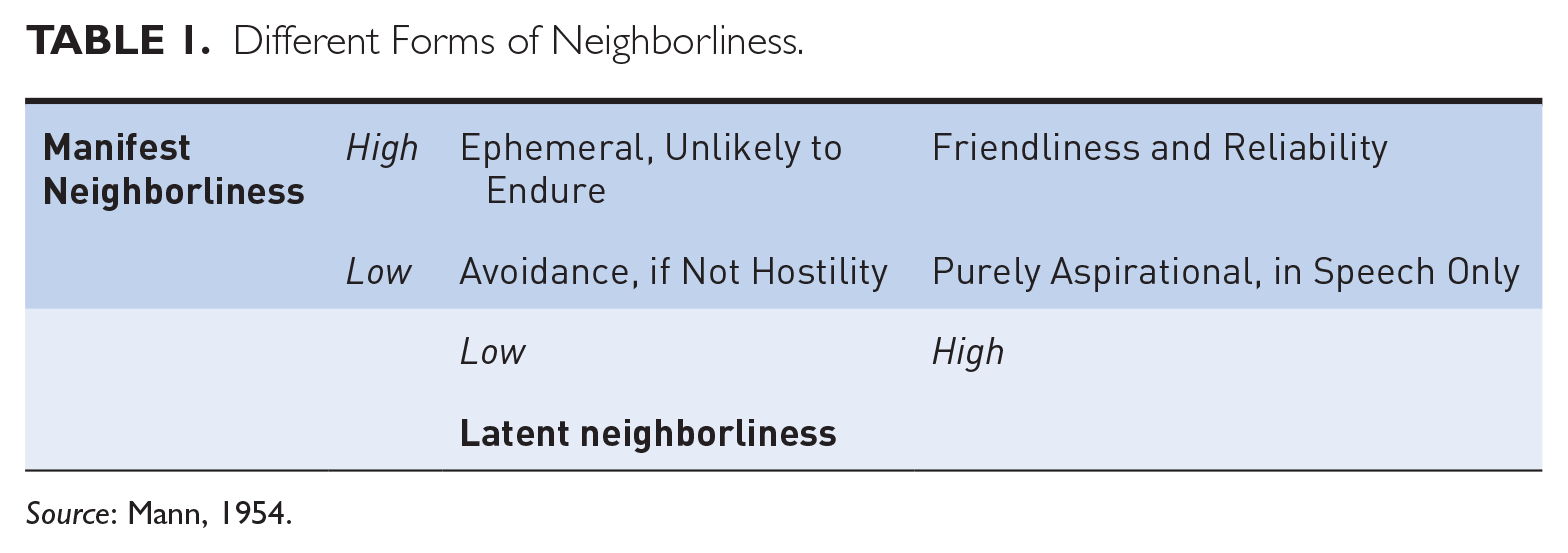
Source: Mann, 1954.
CSR as neighborliness should therefore be rooted in a commitment to connecting with varied places a company inhabits, whether through its headquarters, offices, stores, production sites, or remote worksites. Most neighborhoods also preexist companies’ presence. This calls for encountering neighbors where they are and fostering equal relationships. Done this way, neighborliness can serve as a respect-centered and future-oriented form of, if not redress, then, partial repair for past corporate exploitation and denial of rights, as seen in the way some multinationals engaged with or excluded Indigenous people and less powerful residents. 71
Putting Neighborliness to Work: Guiding Principles
At the core of CSR as neighborliness are three principles: awareness of local issues, respect for local neighbors, and readiness to act when help is required. 72 First, neighborliness implies committed relationships. It means that people have decided to live together, sharing belonging, care, and obligation. 73 One cannot be aware of a neighborhood’s needs, nor of one’s direct impact on it, however, without knowing the neighbors. 74 It takes time, effort, and being open to issues not directly related to the corporation’s core activities.
Second, neighborliness does not imply the organization knows better, or that neighbors should want the help that a company envisions. Respectful interaction means adhering to individuals’ basic rights, including the right to privacy and to saying “no.” This mutual respect goes both ways, and the needs and constraints of companies should not be denied either. 75 CSR as neighborliness is therefore not a denial that corporations need to be profitable but a demand that, while meeting their fiduciary duties, they consider their neighbors too.
Finally, neighborliness is driven by local neighborhood needs, not by corporate targets or reporting priorities. As such, it calls on companies to engage regularly and be ready to lend a hand—by meeting Mann’s high manifest and high latent neighborliness—in different ways, depending on different needs and local corporate capabilities, at different times.
How to Be a Good Neighbor in Practice? Four Key Reorientations
How can neighborliness be done in practice? Embracing it involves leaders thinking through and taking action on four key activity reorientations away from the more narrow, Anglo-Saxon CSR we challenged earlier (see Figure 1). For some companies and leaders, this will represent a considerable shift in CSR strategies and activities. For others, it means doing more of already existing efforts, and less of others—an exercise in renewed prioritization. The result is a more meaningful CSR that does consistent, concrete, and local good while making sense for actors within and around the company.
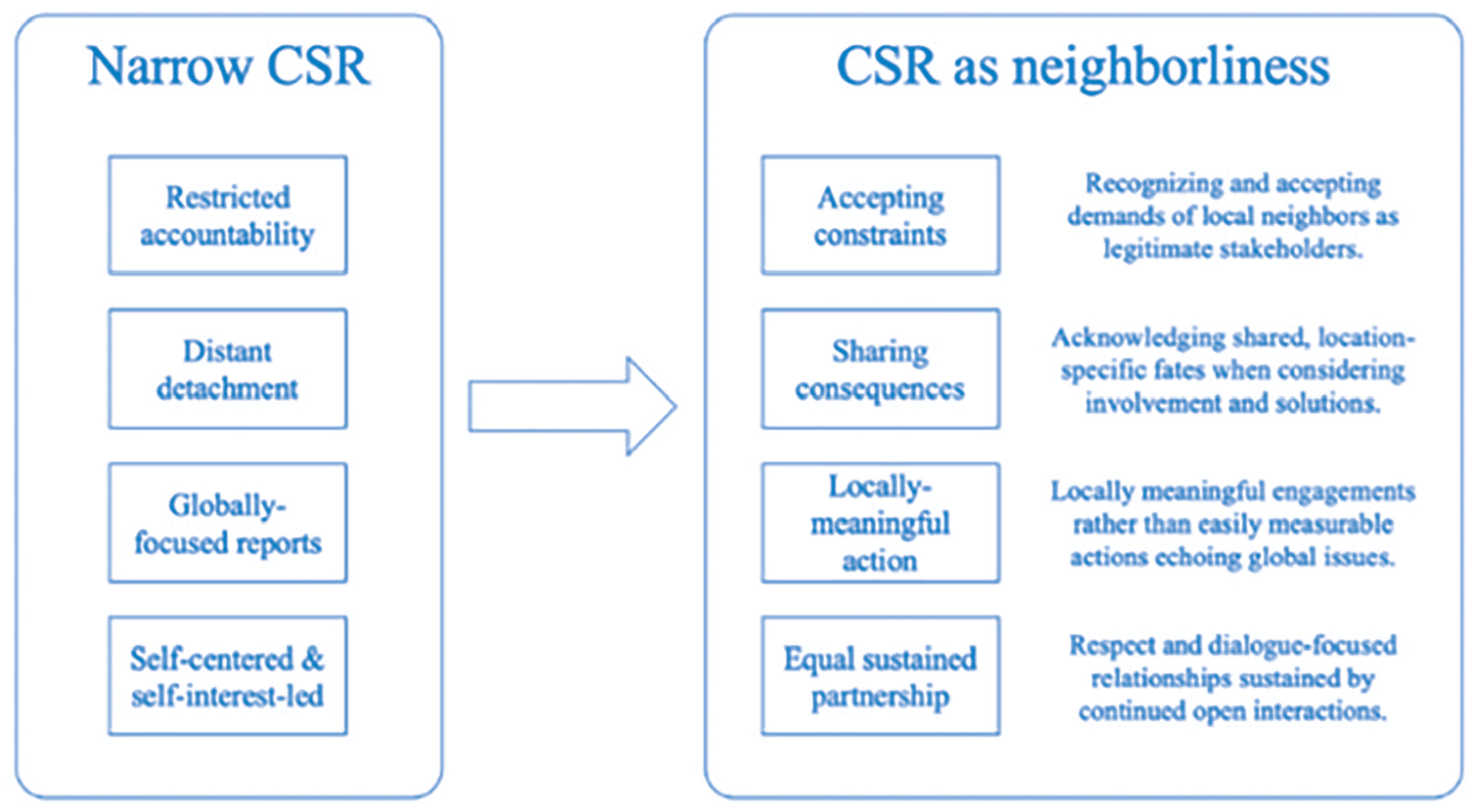
Four reorientations of CSR as neighborliness.
The four reorientations entail a wholesale rethinking of the what, the why, and the how of CSR in action. First, the what: instead of limiting accountability, including from communities a company finds itself in, a neighborly CSR approach means accepting constraints, which means recognizing neighbors in their varied local iterations as legitimate, salient stakeholders. This opens room for genuine accountability; if local neighbors have means of accessing you, they can also more easily hold you to account for corporate actions resulting in local effects. Second, the why: instead of distant independence, where companies and their outposts detach themselves from neighborhoods at their door and instead intervene through distant efforts, such as monetary donations, it means building CSR activities around recognizing shared consequences, which acknowledges that, by sharing places, companies and neighbors necessarily share fates.
Finally, the how: effective neighborly CSR implies locally meaningful action that is focusing smaller pockets of resources and attention on a more limited number of issues significant to that neighborhood. Rather than seeing CSR activities as primarily self-centered and self-interest-led, it demands equal sustained partnership. Local dialogue is key. For instance, instead of asking, “What is the amount we can donate as a one-off?” leaders should ask, “Are we regularly accessible to our various neighbors for honest conversation as a preamble for action?” This does not always need to be formalized nor grand; it can involve manifest neighborliness acts as simple as opening the doors of your air-conditioned lobby during a major heat wave or making it into an informal communications center during wildfires in collaboration with local emergency services (i.e., making your private space into a public place.) 76 This will change reporting too—from aggregate statements and numbers around global themes to rich stories of local staff and neighbors working together over time. 77
Being a Good Neighbor: Concrete Examples of Corporate Neighborliness
Many corporations already engage their neighborhoods—sometimes as part of their CSR strategy, sometimes unplanned. The following examples are meant as illustrations. The true motives and aspirations behind these actions cannot be known. However, they constitute modes of engagement that are in line with what we consider to be meaningful, neighborly CSR.
Take the software company Zendesk. It founded its Zendesk Neighbor Foundation in 2015 to “bring a hands-on and hyperlocal approach” to 11 cities where its offices are located. It used grants, financed by a fixed 0.3% of its revenues allocated annually to the Foundation, to “build long-lasting and meaningful relationships” combining each with dedicated staff with “time, attention and skills.” Zendesk also centers empathy to “get to know the people in our communities, join them in their experience and work toward solutions side by side.” This resulted in projects such as Hack Your Future in Copenhagen, where Zendesk volunteers tutored refugee and asylum seekers in web developer skills, with Zendesk donating $10,000. 78
In 2019, the food chain Pret A Manger pledged to invest more than £200,000 a year in a homeless hostel in London. 79 Its CEO stressed that the idea came from the fact that a lot of the trainees helped by their charitable Foundation, focused on poverty, hunger, and homelessness, could not complete the program because they were unable to find affordable accommodation.” 80 The solution? Pret House, set up in partnership with a charity, provided 13 formerly homeless young people with work and supported accommodation. It signaled key aspects of neighborliness in action: an awareness of wider issues, an assessment of need, and an engagement with local issues in a sustained and concrete fashion. 81
Finally, at the start of the COVID-19 pandemic, the Royal Bank of Scotland repurposed its dormant conference center as a foodbank distribution center. 82 The bank collaborated with local partners in Edinburgh, including the social enterprise café Social Bite and the foodbank Trussell Trust, to provide the necessary physical space for donations. It engaged its catering contractors to donate unused food; bank staff served as volunteers.
What such examples demonstrate is that the answer to “what counts as good neighborliness?” will inevitably differ, depending on the company; where and how it operates; its diverse individual, collective, and organizational neighbors; and their varied needs. In the case of virtual-only firms, this may involve senior leaders encouraging remote staff to reflect on what meaningful neighborliness might mean in their locales and structurally supporting their efforts, with paid days for neighborly CSR action 83 or dedicated micro-budgets for specific neighborly projects. Informal or formal encouragement could be given to supplier contractors.
To embrace it as we envision, local leaders and staff should consider four core questions on a case-by-case basis for their neighborhoods (see Figure 2).
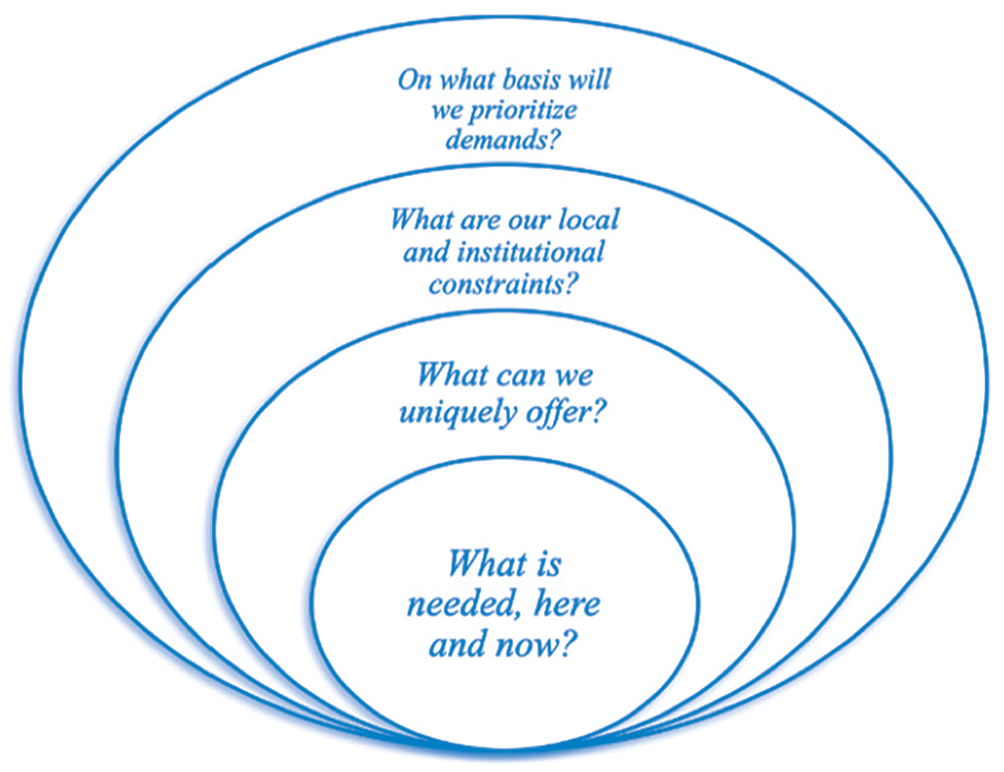
Prompts for local reflection regarding operationalizing neighborliness.
Consideration should begin with the specific need, namely, what is it and how do we know? This is where local relationships are critical. It means leaders and staff reaching out through their networks to assess the nature of need, the existing relations and aid, and the remaining areas of concern. It increases the chances that any subsequent neighborly CSR action is meaningful and welcome. Leaders and staff must reflect regularly, however, because what worked and was helpful before may not be so now. Second, leaders and staff should consider their company, including in that specific locale: what are your unique strengths and capabilities? What could you contribute that would be helpful to the collective efforts already at play but may not be as easily provided by others in this location? Building on, and contributing to, existing cross-sector, multi-neighbor initiatives is likely to amplify the overall impact. Next, what are the practical limitations, including budgets and resources such as staff time and possible legal implications? This helps safeguard against leaders overpromising and under-delivering, or against their commitment causing unforeseen problems elsewhere. Finally, how does your possible action link to other existing priorities? If this connects to existing local work, making that link may avoid duplication. There will inevitably be constraints on what is possible.
An example of such considerations is Liverpool Football Club’s Red Neighbors, a community-based program that launched five years ago. In our interview with its lead, Forbes Duff, he described the start of conversations six years ago as the club’s Foundation was doing more international work. They asked, “What are we doing for the local people?” especially as the stadium has been in the same location for more than 130 years. Duff and his small team, all well-known in the community, spent six months meeting with people, after which they identified four areas where “we would be able to positively influence and make a difference.” These areas were food poverty, elderly people, physical activity, and memorable experiences. They chose these because they were commonly cited by different groups; the team already had experience with some of the issues, including food poverty, and four “would be manageable” as a start. They also explicitly not only built on their strengths—which Duff emphasized as key for others hoping to do such work—but also matched these to unmet needs. For instance, they used their expertise in sporting activities “to target those over 50 or those that are retired” through chair yoga and walking football, given the high concentration of retirement and care homes nearby and few such activities. When their corporate partner Nivea contacted them, wanting to help the older adults during the pandemic, Duff and his team reached out to local care homes to see what would be most useful; they built on existing efforts and put themselves into a valuable role of a connector to avoid duplication and foster the “neighborly spirit” more broadly. As he put it, “you can’t help everyone, but everybody can help someone and that’s what we’ve tried to do; community and people matter.”
Limits to Neighborliness
Our argument has important caveats. Most importantly, this is not an either-or. Contributing to global issues, such as clean air, can be done through locally engaged actions too, especially since pollution and extreme climate events do not affect every place on the planet the same way. Indeed, to the extent that CSR can be deemed successful, it is so different across different contexts. 84 Equally, while traditionally salient stakeholders are easier to define and engage, including local NGOs, unpredictable, fluid, and possibly contradictory, neighbors will take different forms, 85 including nonhuman ones, 86 and so demand more responsive, unplanned, and open engagements. This implies greater inclusion of concerns, possibly with actors less familiar to leaders if not to their staff. A period of adjustment and learning is expected. 87 For this reason, starting small may be necessary; in headquarters (HQ), or HQ with further company locations where shared priorities were first agreed upon, specific actions around those identified in local collaboration and progress captured over a year-long trial period. The CSR staff leading this can hold ongoing meetings to discuss emerging issues, isolate lessons, and pin down best practices for subsequent scaling.
In addition, we are not suggesting neighborliness as yet another issue for corporations to add to an ever-expanding plate. Indeed, when it comes to wicked problems, of which pandemic-related issues such as vaccination are examples, being neighborly may most appropriately mean deferring to nation-states or supranational bodies and their existing efforts. This was demonstrated by BrewDog, for example, who in December 2020 offered to the U.K. Minister for Health and Scotland’s First Minister free use of its nationwide pubs for public vaccination, given their considerable space, ample refrigeration, and staff made dormant by the lockdown. 88 While we acknowledge such business-driven efforts still risk centering self-interest over community interest or serving as greenwashing pet projects, this risk is inherent in any corporate activity amid the confines of incentive systems such as capitalism. Focusing on CSR as the “culprit for the problems of capitalism” is also limited when one considers the many existing models of strategy that prop up the extractive mode of capitalism that prioritizes economic value above all. 89 We have worked to minimize the risk by calling for a collaborative, open-ended, non-efficiency, and nonprofit-driven approach, but we cannot wholly eliminate it, least of all because room for this within the bounds of capitalism is inevitably constrained.
Finally, we are not suggesting neighborliness implies the dismissal of other reforms to corporate CSR. These include more integrated standards for reporting, 90 opening up to a greater “plurality of voices and actors,” 91 and recognizing that, while CSR may be limited by the Anglo-Saxon model of capitalism, efforts to reform it through greater “state involvement and institutionalized social solidarity” may open better alternatives. 92 Our advocacy of neighborliness is therefore a timely reframing, which offers a way to imagine what one form of social solidarity could contribute to an organization’s efforts to engage beyond its boundaries.
Making Change Happen Now
If the COVID-19 pandemic reinforced anything, it is that geographical places shape our possibilities, as well as our constraints. The safety, vibrancy, and prosperity of our neighbors matter. It also reminded us that CSR-oriented actions do not have to be easily measurable to be good. The increasingly frequent public dismissal of media-friendly, one-off donations, or of programs that prioritize the profit imperative over other outcomes, hint at a changing tide for businesses’ social license to operate amid a global climate emergency and vast socioeconomic inequalities. Against this backdrop, purposeful consistent acts of locally meaningful action can make a positive long-term difference, in part by demonstrating that, rather than physically detached and unencumbered, businesses are in it together with their neighbors. Organizations should recognize this and practice sustained neighborliness wherever they are. The time is now.
Footnotes
Declaration of Conflicting Interests
The author(s) declared no potential conflicts of interest with respect to the research, authorship, and/or publication of this article.
Funding
The author(s) received no financial support for the research, authorship, and/or publication of this article.
Notes
Author Biographies
Yoann Bazin is a Professor of business ethics at EM Normandie Business School, whose research is broadly focused on business ethics and business in society issues (email:
Maja Korica holds the senior academic position of Reader at Warwick Business School (United Kingdom), specializing in study of organizational elites, as well as management and leadership in practice (email: Maja.