




Abstract
Artificial intelligence (AI) technologies are engaged in a harsh battle for market dominance. This article examines the emergence of a dominant design in terms of technology, service, and business model innovation. We conduct a theoretical synthesis of the literature on industrial organization, technology management, network economics, operations management, and strategic management—with the implications of each theory related to the dominant-design battle in AI. The findings indicate a dominant design for AI will be based on innovation concerning business models as much as on technology, and that the dominant business model will include AI as a service.
Artificial intelligence (AI) is disrupting business across sectors, and we are still only in the early phase of the life cycle for this technology. 1 While COVID-19’s economic impacts affected investment levels, AI deals still raised approximately $25 billion in private investment in 2020. 2 The trend has accelerated in the post-pandemic era with AI startup funding reaching a record $17.9 billion in the third quarter of 2021. 3 The intense battle to dominate the AI market is led by giants, such as Google, Amazon, Facebook, Microsoft, Apple, and IBM. In 2016 alone, they invested between $26 and $39 billion in AI, of which $6 billion-$9 billion was allocated to acquire AI startups. 4 Sundar Pichai, CEO of both Google Inc. and parent company Alphabet Inc., declared in 2016, that his company strategy centered on “AI first” two years after the company acquired the AI-powered startup DeepMind for $400 million. Amazon’s Alexa is based on AI neural networks to process and answer the human voice. Also, Joaquin Quiñonero, head of Facebook’s Applied Machine Learning Group, said, “Facebook cannot exist without AI.” 5 Digital giants are trying to control key AI technologies, and they are approaching the market by testing different business models.
AI pursues the design of rational decision systems, capable of perceiving the world and acting in it, with coherence between perceptions, actions, and objectives. 6 The AI battle is being waged on several fronts: talent attraction and retention, research and development (R&D), data acquisition, and market value creation. The pioneer IBM Watson is already operating in organizations, such as Macy’s, Staples, North Face, Campbell Soup Company, Chevrolet, Toyota, and Unilever. 7 Amazon, Google, and Microsoft are opening up their source codes to third parties and offering AI services through the cloud. Also, companies are deploying their own AI algorithms to improve their systems—such as Netflix for recommending new movies, PayPal for fraud detection, and Skype for machine translation. AI is not only useful for generating breakthrough innovations but also for augmenting the experience of existing services. 8 Within this context, firms want to secure their own sources of AI knowledge, controlling core technologies by acquiring startups. For example, Spotify acquired Mighty TV (a startup specializing in content recommendation), Uber bought Geometric Intelligence, and Salesforce invested in MetaMind. A growing number of brick-and-mortar end users, such as Unilever, Heineken, and Coca-Cola, incorporate AI algorithms into their supply chain or marketing processes to create smart brands.
In hardware, new actors have emerged, such as NVIDIA, a company specializing in chips for neural networks—the core technology of deep learning. Whereas classic machine learning is limited by human abilities and biases in identifying relevant features, the deep learning of AI obtains and uses new knowledge without human intervention. Deep learning is inspired by the functioning of the brain through so-called artificial neuronal networks, digital systems inspired by the biological architecture of the central nervous system. 9 In this case, the algorithm operates on a network of interconnected digital nodes, to which different weights are dynamically assigned. The assignation of these weights, in search of optimal solutions, is the basis of the learning process. The nodes are organized in successive layers, allowing the extraction of different characteristics from the data series in each of these layers, with increasing levels of complexity. 10 The depth of the algorithm is hence determined by the number of layers. The parallel processing capability of high-performance graphic processing units (GPUs) makes them ideal for deep learning in natural language processing, facial recognition, driverless cars, digital assistants, or virtual reality, which are precisely some of the most promising applications of AI due to their potential market size. 11
The theory of dominant designs and industry life cycles partly explains the dynamics of the battle for dominance of AI. 12 However, these dynamics appear to be more complex than scholars previously considered, with technology, service, and business model innovation interlinked and coevolving. Against this background, this article sheds light on the circumstances under which dominant designs are emerging in AI. We reviewed existing scholarly theories and compared the findings to the observed dynamics of the AI market. These insights stimulate our discussion of the strategic implications of the emergence of a dominant design.
AI’s Tremendous Growth
More than 20 years ago, the IBM system Deep Blue beat the world chess champion Gary Kasparov using brute computational force. In 2011, a new IBM system, Watson, beat two human champions in the prime-time quiz show Jeopardy. The show requires contestants to answer ambiguous questions with incomplete information asked in a human voice—a format in which Watson demonstrated advanced cognitive abilities. In 2016, the Google algorithm AlphaGo, developed by Google startup DeepMind, defeated 18-time Go world champion Lee Sedol. Go is a strategy game considered much more complex than chess, as the number of possible combinations exceeds the number of atoms in the universe. 13 During the match, the AI algorithms deployed unexpected movements, considered surprisingly elegant and beautiful. 14 In 2017, an updated version of AlphaGo beat the previous algorithm in 100 of 100 games, and the new version learned Go autonomously by playing against itself thousands of times without human intervention, using the so-called reinforcement learning technology. 15
AI is destined to create a new paradigm of human-machine interaction. The combination of virtual reality and AI’s growing realism in generating digital bots may lead to scenarios that cross ethical boundaries, such as the recent experiment in which a South Korean mother was reunited with a digital clone of her young daughter, who had died 3 years prior, in a virtual reality environment empowered by AI. 16
An analysis of more than 400 application cases across 19 industries and nine business areas shows that AI may generate $3.5-$5.8 trillion in annual value. 17 However, the industry is at a moment of immaturity, effervescence, and lack of definition. Few managers have a detailed understanding of what AI is, how to use it, or what potential benefits it has. Although the battle for a dominant design in AI has accelerated, it is still unclear how AI value chains will form, which usage models will be the definitive ones, or what the final dominant designs of the products or services will be. Most firms are not yet fully mitigating the risks of AI. 18
Method
This study aims to explain the emergence of dominant designs in AI, a complex phenomenon that has been the focus of scholarly inquiry in several fields. We sought to link findings from different fields into one coherent framework and interpret the literature to identify patterns and links between different theories and constructs. 19 We did not aim to survey thematically similar work as in a systematic literature review but rather to connect different theories that help explain the same phenomenon. 20 Therefore, the theoretical synthesis was conceptual in both its process and output. 21
The available literature explaining the chosen phenomenon contributed to our selection criteria for the fields included in this theoretical synthesis. 22 We included literature from industrial organization, technology management, network economics, operations management, and strategic management. We then selected key contributions from each of these five fields based on their relevance to the dominant-design battle. 23
Industrial Organization: The Advent of a Dominant Design
Technological change is an indisputable engine of economic growth. 24 The dynamics of disruptive innovation have been characterized by the appearance of fluid phases or periods of high instability followed by the emergence of a disruptive technology that gives birth to a new market. In these fluid phases, established actors compete with startups and other new entrants to define the market offering. This process ends with the appearance of a dominant design that is widely accepted by the market. 25 For example, the IBM personal computer was the dominant design for the PC industry for more than 25 years, and the iPhone set the standard for the smartphone industry.
However, it is difficult to investigate whether a dominant design is emerging since this can only be evaluated in retrospection, for example, by analyzing patent citations defining specific thresholds. 26 Particularly, many non-technological features have prevented superior technologies from becoming dominant designs, leading to a certain degree of black-box understanding. 27 A potential method to handle this ambiguity is to identify a window of opportunity and develop or source technologies that are likely to be part of a future dominant design before this design is set. 28
After the emergence of a dominant design, more industry actors adopt it. Then, the competition focuses on improving this design and producing it more efficiently; the battle shifts from product innovation to process innovation, a struggle dominated by standardization and resource optimization. 29 Economies of scale come into play, the number of firms is drastically reduced, and greater affordability allows the initial innovation to spread to the mass market. Still, established dominant designs can be challenged by the rise of new competitors and changing ecosystems. For instance, the automotive industry is facing competition from unexpected avenues even though the dominant design had faced no real challenge in a century with IT companies entering the field alongside new original equipment manufacturers in China. 30 This will most likely lead to a second fluid phase of design competition in the automotive industry.
According to the theoretical evolution models of technological innovation, the AI industry is now in the first fluid phase before reaching the mass market with market actors in an intensely active state. Multiple approaches, hardware architectures, and service models are being tested in successive iterations, so that, AI arrives at the corporate and customer level, and incumbents and startups are struggling to define the final dominant designs, aiming for more convenient and accessible offerings.
The AI fluid phase is currently driven by a set of technological and consumer trends, which result in different technical approaches, business models, and corporate strategies. First, we have massive data collected from the internet, through platforms, such as Google, Facebook, Twitter, LinkedIn, or Instagram, and high penetration of everyday digital devices that are dynamic data sources. The rapid progress of digital transformation and the extension of the Internet of Things to a wide array of objects, such as cars, wearables, and industrial sensors, generate vast data flows that are essential for feeding and training AI algorithms.
Second, we are witnessing a rapid increase in computational capacity through the development of GPUs, microprocessors initially designed for hyper-realistic graphic interfaces in video games, and architecture that has proven to be suitable for deep learning applications. Deep learning uses layers of digital connections inspired by the architecture of the neural networks of the human brain. Emerging companies like NVIDIA, have specialized in the development of GPUs. Incumbents in the semiconductor industry, such as Intel, follow in the GPU race. From different positions in the value chain, other firms, including Tesla, Apple, Google, and IBM have been interested in the design of deep learning chips. The ultimate step in this race has been the creation of neuromorphic chips, inspired by biological architectures that are increasingly closer to neural architectures. The most advanced of these processors incorporate a density of artificial neurons that approach its performance to the brain of a small mammal. 31
Next, the deployment of cloud computing technologies using remote large servers has allowed users to access advanced external GPUs equipped with state-of-the-art AI computing capacity. This enables the provision of AI as a service; this way, AI may become a new utility. 32
Fourth, some corporations have opened the code to develop AI applications for third parties through open-source software, generating a horizontal ecosystem of external developers. Google, Facebook, Amazon, Microsoft, and Baidu have launched programming platforms to complement their cloud business. Google’s TensorFlow and Facebook’s PyTorch are examples of these open programming platforms. Amazon Web Services also offers its Deep Scalable Sparse Tensor Network Engine (DSSTNE). Microsoft acquired the open-source platform GitHub to lead the open-source strategy. 33 The extension of these ecosystems is accelerated with other complementary services, such as online training platforms that allow non-specialized programmers to create their AI applications and run them in the cloud. 34
Finally, there is a kind of centrifugal force, which tends to concentrate AI hardware and software and run them on ubiquitous final consumer or professional devices. Apple has opted for this strategy to keep the data on consumer terminals and process it there, without sending information to the cloud; it maintains its closed system strategy, with a value proposition that bets on data privacy and security, and protects Apple devices from possible network delays or communication malfunctions. 35 This approach has been called edge computing and has a decentralized operational model, compared with the centralized approach of the cloud. 36 The different technological and business approaches, and the strategic movements of big brands and emerging startups, draw a vibrant scenario of instability and competition for the consolidation of standards and business models. This phase has been called a Cambrian explosion in applications and business models of AI. 37
In this budding ecosystem, startups may assume an orchestrating role driven by a superior understanding of the market. 38 R&D labs and strategy departments are also accumulating knowledge and experience to give birth to the final mechanism that reaches the mass market, with some technological areas, such as deep learning, already considered general-purpose technologies. 39
Technology Management: Building on Ecosystem Platforms
Platforms are innovations upon which other innovations build, thereby forming ecosystems of organizations that engage in cooperative dynamics to leverage the platform to create and capture value. 40 A platform can constitute a dominant design and be adopted by the majority of the ecosystem. The emergence of such a dominant platform requires a balance between an open architecture that allows ecosystem participants to build on the platform and a closed innovation measure that enables the platform’s sponsor to profit from the innovation. 41 Open innovation accelerates technology diffusion, and the market expands much faster than with a closed strategy. 42 A notable example of open innovation is IBM’s decision in 1981 to use an open architecture and allow other computer manufacturers to imitate its PC design by buying and integrating the same key components, such as Microsoft operating systems and Intel processors. This allowed IBM to extend its Wintel standard (Windows and Intel), make it the industry’s dominant design, and create a multi-billion-dollar market of compatible IBM machines.
Observing the open strategies chosen by several AI actors, we see parallels with the formation of the PC industry. Firms are competing to set the dominant design for AI and become the digital transformation partner of choice. 43 Microsoft, Google, Facebook, and Amazon have released much of their source software, or parts of their technologies, for free public use as an innovation platform. For example, to help spread Alexa as the standard, Amazon released its technology in June 2015, so that, any company could develop its intelligent voice applications using Amazon’s original technology. 44 TensorFlow, the Google engine for image recognition systems, opened its code in November 2015, followed that December by Facebook opening the code for its virtual assistant M, which was initially launched to compete against Apple’s Siri and Microsoft’s Cortana. 45 Facebook also published the designs of its GPUs, the specialized processors for training and executing neural networks for machine learning, in its AI engine named Big Sur. Shortly after, Microsoft opened the code of its Computational Network Toolkit, used for simultaneous translation, text processing, and image recognition, and its Distributed Machine Learning Toolkit for processing large databases. Baidu did the same with its WARP-CTC system, and Amazon and Microsoft teamed up to develop the Gluon system, a new open-source interface for AI deep learning that allows external developers to build machine learning test models. 46
According to Google’s leader Pichai, “There are only a few thousand people capable of creating machine learning models.” 47 In an industry expected to be pervasive, thousands of programmers, engineers, and end users will be required, and they must become familiar with AI technologies. Through open-source software, new programmers learn easily and can develop new applications for which there is no spontaneous market demand. They experiment with potential customers, discover new opportunities, and invent new applications.
Despite the accelerating effect of innovation, opening the source code carries a certain risk. For example, the IBM PC became the industry’s dominant design through an open strategy at the price of intensifying competition—reaching unbearable limits even for IBM, which sold its PC division to Lenovo in 2004. In the case of AI, algorithms are important but so are the quantity and quality of the data sets they process. Algorithms are a necessary condition but insufficient alone for the final recipe. If data sets are enormous, companies will need the hardware capable of processing them on a large scale; without the training data and computing power, no one can refine algorithms. For this reason, Google has only released portions of its AI software and has not given free access to part of its more advanced hardware, therefore, maintaining control of large-scale data processing infrastructures. 48
Data definitively matters in the AI game. If AI becomes a utility, how will it generate differential competitive advantages? Data will then become the key factor of strategic differentiation. 49 In this sense, China will create comparative advantages in AI, due to its gigantic market and the data flows it can generate. Chinese entrepreneurs have systematically carried out a process of copying U.S. digital business models, adapting them to the Chinese reality, and scaling them to a market four times larger. 50 This exists in the context of strong support from a government that is not especially concerned about the protection of individual citizen data but is interested in AI leadership to gain technological supremacy. Chinese citizens, culturally, are more sensitive to security and prosperity than to the privacy of their data. 51 On the other hand, the Chinese government has built a “Great Firewall” to prevent Chinese data from being used by foreign digital platforms and has banned Facebook, Twitter, Netflix, and Google in favor of national alternatives. The digitalization of Chinese consumer habits ensures the massive provision of data to train algorithms and improve predictions. Mobile payments, for example, are 50 times more frequent in China than in the United States. 52 If data are the new oil, China is the new Saudi Arabia. 53 The industry is expanding, fueled by government support for R&D, and by 2030, the Chinese AI industry could be worth $150 billion. 54 Indeed, there is explicit and massive support for AI R&D funded by the Chinese government. China has clear comparative advantages over any other national AI ecosystem due to its combination of a large market, rapid digital adoption, weakness of privacy laws, and state support for AI R&D.
The hidden war in AI is shifting to the development of AI-adapted microprocessors—the true AI electronic brain resulting in a renewed AI chip boom. 55 AI market size is expected to reach up to $57.8 billion by 2026, and large companies are moving backward in the supply chain to control this strategic technology, affirming Fine’s clockspeed model. 56 For example, Apple has made strategic movements to control its chip design, spurred by increased uncertainty in the computer-chip supply chain. 57 Google has prepared the second generation of its Tensor Processing Unit, a processor designed to train and execute machine learning algorithms based on deep neural networks, which is valid for all types of AI applications (speech and image recognition, automatic translation, or advanced robotics). 58 With this move, Google entered the hardware market and is competing against the current leader in AI processors, NVIDIA, and emerging firms that design AI-adapted chips, such as Cerebras, a startup that attracted more than $100 million in venture capital. 59 Intel also positioned itself against the competition by acquiring the startup Nervana Systems and preparing a new generation of ultra-fast specialized AI processors. 60 Microsoft revealed its Project Brainwave and relies on its reprogrammable chips to speed AI applications, Amazon teamed up with NVIDIA to solve its hardware needs, and IBM has also partnered with NVIDIA to develop a new line of chips that is 10 times faster than traditional Intel chips. 61 A definitive move toward supply chain integration in the war for AI processors came with NVIDIA’s acquisition of Britain’s ARM to create an AI computing platform aiming for a dominant design. 62
Network Economics: Digital Diffusion
According to these earlier theoretical models, centralization forces are active and one or several dominant designs may soon emerge. This argument is reinforced by the fact that like any digital industry, AI may become a winner-take-all game. In digital industries, actors with greater capabilities, such as technology, investment capacity, and market share, tend to generate higher returns and gain more market share in a snowball effect, which is mainly due to the negligible marginal cost of digital systems and their network economies. 63 Designing a driving algorithm for driverless cars requires large R&D investments, but it can immediately be applied to all vehicles within a fleet. In addition, each vehicle generates data to learn from, in turn feeding the whole fleet and making the system with the largest market share more efficient and experienced. The value for a potential user of a digital system (such as a social network) increases with the number of users already connected, making those systems of greater dimensions more attractive to customers. Especially for AI, in which the amount of data is used to condition the learning capacity of the system, market size matters. There is a data set snowball effect in AI dynamics. 64 The larger the data pools, the better the algorithm and the faster the training period for user applications.
Finally, AI is a technology with foundations that are very close to fundamental mathematics and very far from the market. Companies are increasing their demand for technicians and PhDs in the field, and the AI talent race is fierce. 65 Amazon, Microsoft, Apple, Google, Facebook, NVIDIA, and Oracle are among the most demanding companies, with Amazon investing $228 million in hiring specialized talent in AI, followed by Google ($130 million) and Microsoft ($75 million). 66 AI engineering job openings grew 344% between 2015 and 2018 in the United States. Considering all these arguments, only a small group of privileged companies will be able to achieve the critical mass in hiring, R&D investment, data sets, and hardware facilities to take advantage of AI.
Operations Management: Clockspeed Toward Integration
When disruptive technology is introduced to the market, there is a set of complex choices about product/market combinations, business models, market segmentation, pricing, and customer interface. 67 Different approaches and decisions configure a fragmented and modular supply chain targeting different niches—as is occurring now in AI’s supply chain. Generally speaking, supply chains oscillate between vertical and horizontal modular architectures at the rate of clockspeed that depends on the speed of technological change in each industry. 68 A verticalized industry tends to focus on its key competencies and does not prevent others from beginning to expand, colonize, and modularize the supply chain. If one actor breaks the market balance and gains power in a segment or part of the value chain, it will expand to other segments to increase its control and its added value, and market power in one subsystem will encourage technology integration with other subsystems to develop proprietary integral solutions. A modular industry tends to seek operational efficiency and supplier control through verticalization strategies. The dominance of some key competencies (e.g., processors, supercomputing capabilities, R&D talent, access to larger databases, or customer channels) generates incentives for vertical expansion.
The current configuration of the AI supply chain is modularized, with specialized actors and without a final dominant architecture. Within the context of this configuration, we can foresee an integration process of one or several efficient supply chains that include all agents, from R&D laboratories and computer hardware to the integration and customization of services for the end customer.
Strategic Management: Dominant Business Models
In innovation ecosystems, business model innovation requires alignment with the ecosystem as a whole. For AI in particular, alignment with the general ecosystem is crucial. 69 From the hardware perspective, the movements in the AI supply chain trend toward concentration. From the market perspective, the emerging business model seems to be software as a service (SaaS)—or, in this case, AI as a service (AIS)—through the cloud. With specific AI libraries, Amazon Web Services leads a $130 billion cloud market, capturing 32% of the total market share, followed by Microsoft Azure (20%) and Google Cloud (9%). 70 The global cloud market experienced rapid growth during the COVID-19 pandemic and is expected to achieve a compound annual growth rate of 18%, reaching around $1,026 billion by 2026. 71
Innovation in digital industries is increasingly moving from “innovation from data,” with customers as passive data providers, to “innovation as data,” with customers actively acquiring, analyzing, and acting on data. 72 For example, to increase ease of use, Amazon is offering AI services through the cloud for users to transcribe, translate, and analyze input with machine learning algorithms. 73 Cloud computing services permit small and medium-sized enterprises to include AI in their innovations without owning hardware or possessing data security expertise. 74 Google, which offers a range of AI services, is also involved in the cloud race with $8.92 billion in revenue in 2019 and annual increases higher than 50%. 75
The large digital platforms are making strategic movements to integrate and control the supply chain backward while offering cloud services forward, which seems to be the future dominant business model design in AI distribution. Google is keeping the hardware technology proprietary, although it will give access via the cloud to the supercomputing facilities as a service. Google’s computing facilities support processing services on neural networks and libraries of specific applications of video analysis, image analysis, speech and text recognition, and automatic translation. Microsoft offers more than 20 cognitive services through the cloud, including image processing, natural language allocations, pattern analysis systems, the generation of information maps, speech recognition, and intelligent search of data on the web. 76 Yet, the industry’s integrative dynamics are also evident in attempts by chip manufacturer NVIDIA to move forward in the supply chain toward the end user, although the firm has finally chosen to partner with cloud platforms and offer its machine intelligence through third parties. 77 NVIDIA offers cloud solutions through the main platforms, including Google, IBM, Microsoft, Amazon, Baidu, Oracle, Tencent, and Alibaba. Meanwhile, Facebook and Apple appear to be choosing other competitive strategies, keeping their AI algorithms closed. Apple’s strategic bet is placed on the final user device, increasing its AI capacities. Apple’s cloud system is limited to Apple users, without third-party commercial services to operate remotely. Like NVIDIA, Apple does not have the necessary server infrastructure, and much of Apple’s cloud is supported by Amazon Web Services. 78 Apple’s strategy to enhance the performance of AI systems in the user device is evidenced in the development of AI mobile phone processors like the A11 Bionic chip used in the iPhone 8s and in the facial recognition system for the iPhone X. 79 Facebook has not developed the cloud business either. Its AI engines have been centered on the processing of its data for Facebook’s nuclear business as a hyper-segmented digital marketing platform by optimizing its ads and conversational bots, as well as extending its network through automatic facial recognition systems running on an unbeatable database of two billion users. Although Facebook released its own open-source platform (PyTorch), it is oriented to enhance the company’s ecosystem of mobile apps in a decentralizing strategy more similar to Apple’s than to the cloud strategies of Amazon, Microsoft, or Google.
The leading companies in cloud AI have realized the mass market is not yet ready to take advantage of AI and, thus, not ready to integrate it into businesses. Capturing the opportunity, Amazon and Google extended their offerings with a new layer of services, developing consulting proposals to customize and parameterize their clients’ solutions. As with enterprise resource planning software, a market of integration services will be necessary to customize program-specific AI applications at the final user endpoint.
Conclusion
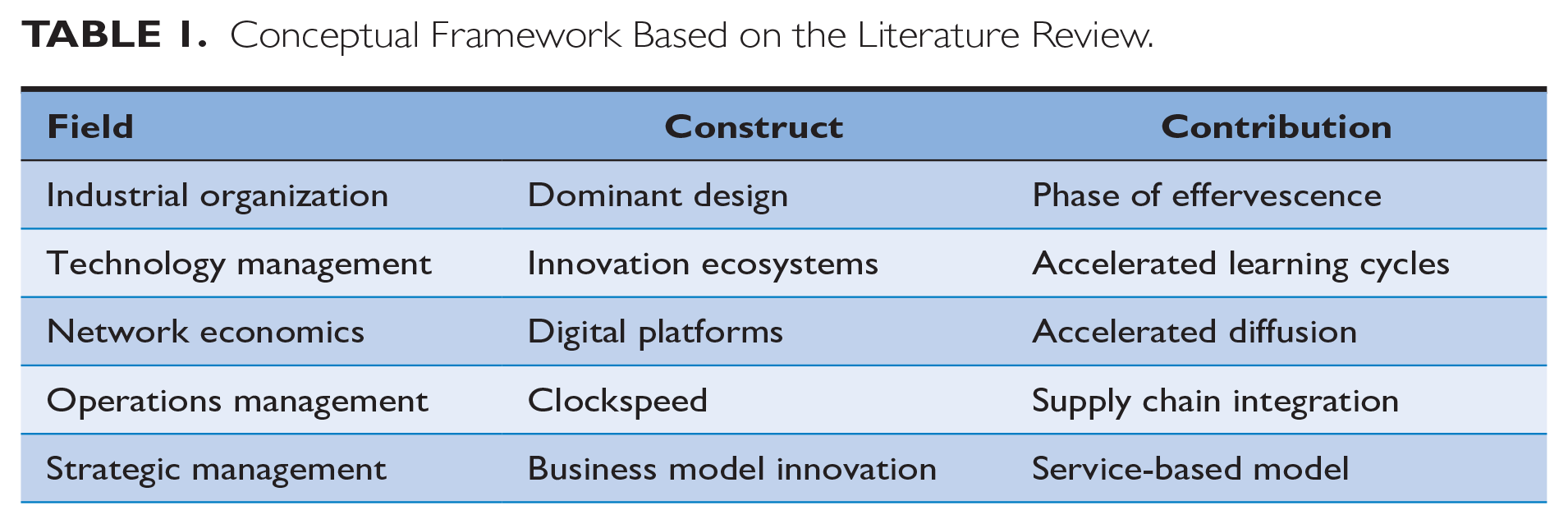
Our examination of the emergence of a dominant design in AI employed a theoretical synthesis of the literature in industrial organization, technology management, network economics, operations management, and strategic management. The results imply that a dominant design for AI will be based on business model innovation as well as on technological progress and that AIS will be included in the dominant business model. Table 1 summarizes the theoretical fields and principal constructs reviewed and the principal contributions of each.
Conceptual Framework Based on the Literature Review.
The AI industry is in a fluid, effervescent phase. Global research efforts on AI are increasing, with more and better applications appearing in practically all fields of economics. Simultaneously, large digital platforms, startups, and new agents are competing to offer AI services using different technology platforms, hardware architectures, and business models. These are typical indicators of dominant-design competition, which becomes more evident when looking into the current research fields for AI: image recognition, facial recognition, speech recognition and synthesis, writing generation, the humanization of algorithms and digital bots with growing emotional intelligence, and strategic thinking. 80 From initial interfaces (such as Apple’s Siri and Microsoft’s Cortana) to the stream of devices related to intelligent speakers (such as Amazon’s home personal assistant Alexa and Google Home), AI penetration is expected to reach the final consumer through successive waves of new and more sophisticated human-machine interface systems across all industries and markets, with increasing social capabilities and strategic thinking skills. 81 For this reason, design competition is still in its infancy and determines the right level of analysis, with dynamics of high instability, uncertainty, and confusion. 82
Our analysis of theoretical frameworks in five fields leads us to conclude that a few large digital platforms are leading a push for supply chain integration and the emergence of a dominant design for delivering services via the cloud. This is in contrast to the evidence of countless corporate movements in this direction. Thus, the AI industry is becoming an oligopoly, all while reaching the mass market. The theoretical predictions and current evidence bring us to what seems to be the winning AI business model—the provision of AI through the cloud (Figure 1).
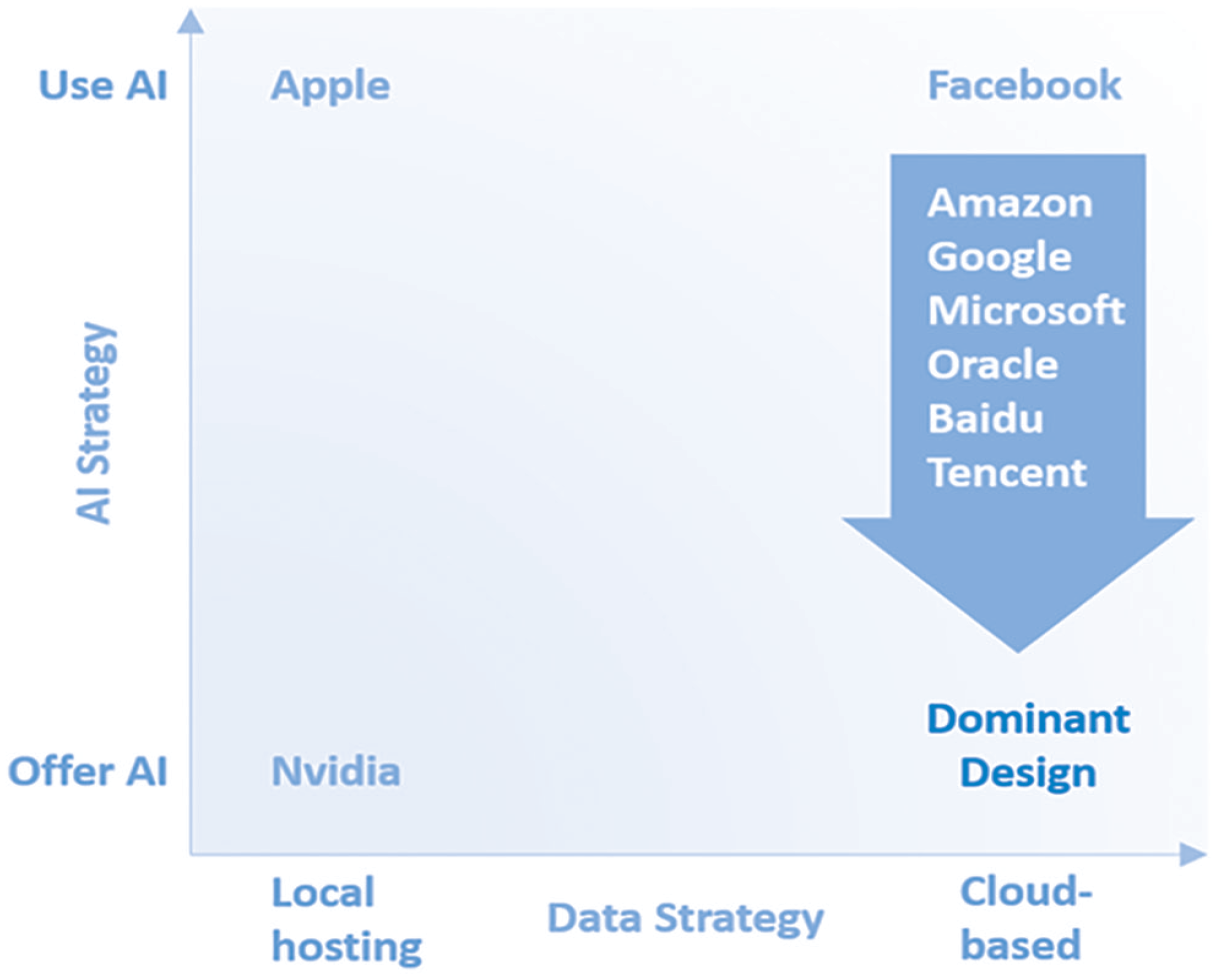
AI business model prediction resulting from theoretical framework analysis.
We believe that the AI industry will be dominated by a cumulative process of R&D, data, and computing power. We theorize that the industry will be verticalized and integrated, and only a few supply chains will have the scale and scope to bring AI to the end user. In addition, we suggest that a phenomenon like “Intel Inside” will occur for AI to reach the mass market; companies might be able to access advanced AI supercomputing facilities by connecting to an AI terminal offered by large digital actors, meaning each company could have AI Inside that would endow any end user with AI power. This resembles what the processor manufacturer Intel did in the 1980s with the IBM PC or with its clones; we may soon see cars, startups, retailers, manufactured goods, or medical devices empowered and labeled with Google Inside, Amazon Inside, IBM Inside, or Microsoft Inside to indicate their smart internal AI processes. This will imply a shift from product to process innovation in the logic of dominant designs. 83
Future AI diffusion has multiple managerial implications. First, the emergence of a dominant design of AI as software accessible as a service implies that any startup or small business will have the possibility to operate machine learning algorithms using state-of-the-art hardware (e.g., Google or Amazon). Deep learning will allow all types of companies to access the automated generation of tacit knowledge based on their own experience, and companies will need to enhance their use of information systems beyond classic task-specific programming. 84 The possibility to generate knowledge, gained from the experience without human bias, is fascinating and must be further explored from the management perspective; limitless applications may be opened in business strategy and all kinds of business applications. This article tries to shed light on the emerging dynamics of AI in business according to previous managerial frameworks, yet there is much room to research the extremely promising applications of deep learning in managerial judgment. To the extent that deep learning is capable of generating new expert knowledge from data series without human determination of what features should be used in the model, the understanding of deep learning in business contexts, the design of solid data strategies, the access to increasing computing power, and the competitive use of this expert knowledge generated autonomously will be critical in business environments across many industries. We anticipate AI will become a strategic technology in the coming years. Companies are going to need a large number of AI experts, and managers will need to understand the principles of AI, particularly deep learning, to generate these new competitive advantages.
Second, managers must be aware of the changes in knowledge creation and prepare their companies for what could be the true differentiator—data. If AI is commoditized, the quantity and quality of data with which a company trains the AI system may be decisive when customizing algorithms and gaining a competitive edge. Embracing big data requires addressing barriers that fall into technological and organizational domains. 85 Complementary actions for acquiring and storing new flows of data and critical decisions in IT systems design will be necessary. Managers have traditionally been captive by their insights and prejudices when analyzing this data. Now, they can expand their perspectives and improve their predictions and decisions with new pieces of knowledge perhaps invisible so far to the human eye. The data strategy, the use of deep learning, and the access to new computational resources to generate this expert/latent knowledge will constitute key competencies to create true sustainable competitive advantages. This suggests connected and exciting lines of research.
Third, entrepreneurs and investors should keep in mind that a concentration and verticalization process may soon take place in the industry, which could result in a winner-take-all situation. The technological convergence of AI enables firms to envelop other industries and platforms. 86 Closed standards and architectures, or systems that are too specific, may become incompatible with the winning ones and end up inoperative or obsolete. Highly specific or customized ecosystems also require more resources for coordination and may struggle in the battle for a dominant design. 87
Fourth, digital leaders must keep the R&D pace and balance their decisions on open/closed standards. A high degree of openness would accelerate the creation of communities of users while putting R&D investments at risk if competitors can reverse-engineer their developments or if no business models are prepared to capture part of the value generated. At the same time, a high degree of closedness could leave actors in a residual position in the emerging market. Strategic decisions must depend on whether the winning architecture involves open standards and backward hardware concentration in the value chain, following the strategies of Amazon or Google, or closed standards and hardware distribution in the end-user devices. Here, similarities with the PC industry’s formation emerge; at that time, IBM’s open standard won over Apple’s closed standard, but IBM did not carefully control strategic technologies (e.g., Intel’s microprocessors and Microsoft’s operating systems) even though these suppliers captured most of the industry’s value. Now, the lesson seems to have been learned, and firms are struggling to control AI microprocessor technologies. This way of thinking is also in line with research by Fernández and Valle, which highlights the role of open and closed standards in decision-making processes for dominant designs. 88
Furthermore, if the phenomena of supply chain concentration and integration occur, digital platforms will have even greater global competitive advantages. Startups are more likely than diversifying incumbents to exit battles for dominant designs when the technology is platform-based. 89 If only a few large actors have sufficient economies of scale to recoup the large investments required downstream for AI computing architectures, then these actors will gain greater market share and access to data, will be better able to train their algorithms, and will develop spillover effects. Data generated by a set of distinct clients will be used in the aggregate to improve diagnostics and recommendations to new clients. Also of note is the parallel between today’s situation and the 1980s when the emergence of the dominant design of the IBM PC facilitated the large-scale arrival of home computers through the encapsulation of microprocessors in third-party-manufactured devices. Similarly, AI will likely reach the mass market encapsulated in cloud services provided by large digital platforms. If this is the case, any company could be defined as Google Inside, Amazon Inside, Microsoft Inside, or IBM Inside, 90 making AI a commodity. The true competitive advantages will lie in the user company’s ability to design qualitative and quantitative data strategies to train the algorithms provided by the main actors.
Finally, literature on dominant designs in recent decades provides many examples in which it was not the best technical design that won but rather one that was adopted by the market. It is not the superiority of the technology that is decisive, but who provides the fastest market diffusion with the most important network patterns. 91
Footnotes
Declaration of Conflicting Interests
The author(s) declared no potential conflicts of interest with respect to the research, authorship, and/or publication of this article.
Funding
The author(s) received no financial support for the research, authorship, and/or publication of this article.
Notes
Author Biographies
Xavier Ferràs-Hernández is an Associate Professor of Innovation and Technology Management and Associate Dean at ESADE Business School, Ramon Llull University, Spain (email:
Petra Nylund is a Research Fellow of Strategy and Innovation at the Institute of Entrepreneurship and Innovation Science, University of Stuttgart, Germany (email:
Alexander Brem is an Endowed Chaired Professor and Director of the Institute of Entrepreneurship and Innovation Science, University of Stuttgart, and an Honorary Professor at the Department of Technology and Innovation, University of Southern Denmark (email: