




Abstract
Orchestrating an ecosystem requires coordination to create value, but prior research has tended to emphasize centralized ecosystem control over solutions involving distributed governance. By studying multilateral public-private collaborations to develop scientific knowledge to find a cure for Alzheimer’s disease, we identify a new model of ecosystem control—indirect and distributed governance using R&D consortia. We report archival and interview data on 46 consortia with overlapping corporate, nonprofit, and governmental membership. We find three models of consortia that allow member organizations to jointly orchestrate an ecosystem without centralized control. We discuss the broader implications of this model for orchestrating ecosystems.
Keywords
Managerial Implications
Managers can orchestrate an ecosystem through consortia.
Managers mobilizing to form consortia will work to create convergent interests as well as social and strategic relationships among potential members. This effort will vary by the type of consortium being created.
Managers creating consortia of any type will need to emphasize transparency and accessibility in the consortium’s governance, as well as decision-making by shared consensus.
Managers seeking to improve consortium members’ engagement will focus on the tasks required of members, the alignment of each member with the consortium’s goals, and the consortium’s expected impact. The specific effort will vary by the type of consortium.
Managers of an organization seeking to shape an ecosystem through indirect, distributed governance will likely engage in multiple collaborations, often with some of the same organizations.
Introduction
Firms practicing open innovation are utilizing ecosystems to coordinate with external networks of partners. 2 Aligning the interdependent efforts of these partners allows the ecosystem to innovate and create value in a way that a single firm cannot. 3 This need for interdependent value creation has raised the profile of an ecosystem as a unit of analysis, both for managers engaged in creating value and for researchers interested in understanding innovation and competition.
At the same time, such collaboration requires governance mechanisms to align interests and manage opportunism. The best-known approaches are the solitary control of a platform ecosystem (think Apple or Google) or the reliance on market mechanisms to govern a large industry (such as semiconductors or aerospace). Less often studied is the intermediate case—that of distributed control of different pockets within an ecosystem where multiple actors attempt to orchestrate the ecosystem in a particular direction; not studied has been how these actors use R&D consortia for the orchestration.
This article examines a specific example of distributed governance in a scientific knowledge ecosystem that is organized to address a pressing public health challenge: curing Alzheimer’s disease (AD). Finding a cure is one of the most intractable challenges in the world, both within human health and society as a whole. The global economic impact is estimated at more than $1 trillion annually, and it is projected to only worsen as other health improvements lengthen lifespans. Even within the scientific uncertainty that is common for human therapeutics, Alzheimer’s has proven unusually intractable for more than a century, and thus too daunting for any one firm or government agency to address. Conversely, little progress was made during this first century because of a lack of coordination in these efforts.
Government and nonprofit efforts in the late twentieth century created key institutions that helped link disparate actors into a nascent research ecosystem seeking to identify the causes and potential cures for Alzheimer’s. However, the long-time horizons, the large number of actors involved, and the unusually high scientific risk attenuated the potential role of market signals in organizing the efforts of private firms to develop and market a potential cure.
We show that over the past two decades, a specific distributed model of ecosystem governance—a network of overlapping R&D consortia—has been used to guide and accelerate the production of scientific knowledge related to Alzheimer’s. We identify three different approaches toward structuring such consortia: Regional, Sponsored, and Umbrella/Nested. We describe the rise and the overlap among these consortium types. We use this to highlight similarities and differences in how firms utilize these structures to orchestrate a larger ecosystem. From this, we suggest broader implications for how indirect, distributed governance can be used to orchestrate ecosystems found in healthcare, telecommunications, or any situation where centralized control and market signals are inadequate to provide suitable governance.
Distributed Control of Knowledge Ecosystems
A major goal of this study is to introduce the R&D consortium as a mechanism for indirect governance of an ecosystem, and how the governance of multiple consortia with overlapping membership provides a distributed approach to orchestrate a larger ecosystem. Here we contrast this with earlier and better-known approaches to ecosystem leadership.
Previously Studied Approaches to Ecosystem Governance
Ecosystems are a network of complementary organizations, arranged to jointly create value while serving the self-interests of the member organizations. Because they exist to solve a complex problem that no organization can address on its own, they must inevitably manage the tension between aligning efforts of shared value creation against the inevitable conflicts among complementary, or even directly competing, contributors. 4
Previous research has emphasized two mechanisms for governing a complex ecosystem. In market governance, firms within an ecosystem use both transactions and long-term relationships with suppliers, customers, and complementors to loosely coordinate a larger value-creating network. This is often seen in innovation ecosystems where firms across an industry cooperate to advance the innovation frontier without any obvious central sponsor. Emblematic of this is the semiconductor industry, which for more than five decades has worked to advance tools, design, and manufacturing around the shared vision of Moore’s Law. 5 However, this perspective has also been applied to the space industry—solving problems that are literally out of this world—and to healthcare, with its complex interdependence of biological, societal, and economic systems. 6
The second model is centralized control. In this model, contractual, Intellectual property (IP), and other mechanisms allow a single entity to control the ecosystem. Best known is the example of a platform ecosystem, where a single proprietary firm 7 (such as Apple, Google, or Nintendo) directly controls the evolution of the core technology while soliciting complementors to join in completing the value proposition. 8 The tremendous success of mobile phone app stores in the past decade provides the clearest example of how reducing entry barriers to complementors can improve ecosystem value creation. 9 This direct control model is often promoted as the managerial ideal, but in major industries with a large number of powerful incumbents, it is increasingly difficult to achieve.
As an alternative, centralized control of an ecosystem can be shared by multiple firms; in recent decades, such shared control has been managed by a membership nonprofit (usually an industrial consortium) that is subject to antitrust rules intended to prevent anti-competitive collaboration. 10 Such a membership nonprofit is governed by its own internal rules that manage potential conflicts but is funded and controlled by its member organizations. The consortium is the mediator that allows firms an indirect means for ecosystem control, as they join a consortium to participate in setting the direction of both the consortium and its associated ecosystem. We highlight four well-known examples of consortia providing such indirect ecosystem governance.
Standardization consortia include the Blu-ray Disc Association or the Wi-Fi Alliance. These consortia usually both develop the standard that enables distributed innovation and interoperability within the ecosystem and also promote its use by business and individual users (particularly in the case of rival technologies). One of the most influential is the 3rd Generation Partnership Project, a European consortium formed in 1998 that has extended its influence by promulgating fourth- and fifth-generation mobile standards. 11 While such consortia may provide free use of a standard, firms involved in standardization may generate some or all of their revenues from the standard by out-licensing patents required to practice the standard. 12
Open-source software consortia are a more recent offshoot of the standardization consortium that both controls the interfaces within the ecosystem and provides a shared implementation of the standardized technology. As with standards consortia, firms benefit both by influencing the direction of the technology and by obtaining tacit knowledge about the use of the technology. Examples of such consortia include the Linux Foundation and Eclipse Foundation. 13
Traditional R&D consortia came about in the late twentieth century when national governments collaborated with firms in key industries to create a new form of industrial collaboration. Frequently motivated by national competitiveness or economic development goals, these consortia benefit from the knowledge of member firms, enable collaboration that produces new knowledge, and typically provide direct benefits (such as trade secrets) or indirect benefits (tacit knowledge) that aid the innovation efforts of member firms. 14
Public-private R&D consortia have been used in this century to tackle complex medical challenges. Under conditions of strong industry regulation, or even direct participation by government agencies, these tend to have formal rules for transparency and openness. Tied to norms of open science, they enable open knowledge spillovers analogous to those of open-source consortia. 15
While direct control has been a popular topic for managerially oriented research, only recently have scholars looked closely at how organizations can manage the more difficult challenges of less directly influencing the direction of ecosystem evolution, often referred to as orchestration. 16 With such an orchestration approach, even if a solitary consortium has centralized control of the ecosystem, no one firm controls the consortium. Aligning and arbitrating the interests of the member organizations of a consortium can be particularly difficult if there are large numbers of members, or if the interests of these members are unusually diverse.
For example, in a study of a European biomedical research consortium, researchers contrasted the top-down direct control of an ecosystem to the slower and more difficult consensus-based orchestration they observed in the consortium, one that relies on bottom-up negotiation with key stakeholders. 17 They conclude that top-down control is more effective as the number of members expands. Likewise, other researchers traced the negotiation and emergence of consortium governance mechanisms used to organize the Eclipse open-source software consortium. 18 Open-source research has identified four key dimensions of shared governance within a consortium: transparency of activities, accessibility (permeability to newcomers), participation in decision rights, and a consensus-based decision process. 19 Similar issues and choices have been identified in standardization consortia. 20
Distributed Ecosystem Control
To the market and centralized (either direct or indirect) models of governance, in this article, we add a third model—that of decentralized or distributed control. In such a model, there is control over part of the ecosystem but not all of it. Thus, the two dimensions of centralized (vs. distributed) and direct (vs. indirect) provide a 2 × 2 framework for analyzing and predicting how ecosystem governance is shared and managed between multiple organizations. 21
This study examines the indirect, distributed method of control. As with indirect centralized control, a membership-controlled nonprofit directs multilateral collaboration to address a specific subset of the ecosystem’s overall value-creating goals. However, the distributed model means there are multiple consortia distributed across the ecosystem, each directing activities in a portion of that ecosystem. These multiple consortia—potentially overlapping both in membership and goals—mean that the influence of any one consortium in this decentralized model is much less than in the centralized control model. At the same time, individual organizations can increase their influence by joining multiple collaborations.
Distributed control has previously supplemented other forms of ecosystem governance. With the market governance of the broader semiconductor ecosystem, Intel has long orchestrated efforts of others to develop chipsets and other technologies that complement its core microprocessor product. 22 The Eclipse Foundation controls its overall ecosystem through centralized policies and IP control that apply throughout that ecosystem but encourages the distributed development of modular technologies to address specific needs within that ecosystem. 23
Here we are interested in distributed control in the context of a knowledge ecosystem. Such ecosystems leverage a diverse range of organizational members and expertise to create new knowledge that no single actor could achieve alone but are similar to other ecosystems in how they benefit from complementary value creation while balancing inherent tensions of competition. 24 We study an ecosystem where members produce and access knowledge in a specific scientific field, creating value by increasing the quantity and quality of the knowledge in this field. 25 Because the ecosystem creates knowledge available to those within and without the ecosystem, organizations that actively participate are those who accept that the knowledge flows cannot be controlled by any one organization. Such open collaboration tends to be more upstream and pre-competitive than participation in an innovation or platform ecosystem.
Universities and nonprofit research organizations are built to work within these knowledge flows under the norms of open science, but most firms are not. 26 However, science-based businesses (such as biotechnology and pharmaceutical firms) are more comfortable with these open science norms, because they must cope with a high degree of uncertainty and risk over the scientific understanding of complex phenomena such as human health. 27 By necessity, these firms are crucially dependent upon the development and availability of open science as inputs to their R&D efforts, and thus understand that collaboration within these norms requires that they contribute to shared ecosystem knowledge. 28
Research Context: Curing AD
With theory-building research, extreme cases are valuable because they make key relationships more visible. 29 To explore such a context, we turn to the pharmaceutical industry and the efforts to seek treatments and eventually a cure for AD. Finding a cure for Alzheimer’s constitutes an extreme problem for two reasons. First is the scope of the problem. AD and other forms of dementia 30 are estimated to affect 5.8 million Americans over the age of 65 years and, absent any medical breakthroughs to prevent, slow, or cure it, this number is expected to increase to 7.1 million in 2025, and 13.8 million in 2050. In the United States, it is the third leading cause of death—after cancer and cardiovascular disease—while the financial impact of Alzheimer’s is more expensive than both. Globally, the current number of persons with some form of dementia is approximately 50 million and is expected to grow to around 135 million by 2050. The economic impact of AD is currently estimated at more than $1 trillion annually. 31
The second reason is that while the pharmaceutical industry has among the greatest financial and technical risk of any industry, as science-based businesses “that both participate in the creation and advancement of science and attempt to capture financial returns from this participation,” 32 the risks for AD are particularly high. AD is unique in its complexity and in the limited scientific understanding of its underlying biological mechanisms. As a consequence, among the top ten causes of death in developed countries, it remains the only one “that cannot be prevented, cured, or even slowed.” Unlike most other fatal diseases, the rate of death continues to increase rather than decrease. 33 Current therapeutic goals are modest—to deliver drugs that merely slow the rate of cognitive decline.
This scientific uncertainty means that despite strong incentives to chase a huge unserved market, firms have faced repeated failures. The approval rate for prospective AD drugs remained dismal in the initial years of this century: less than 0.5% of those entering clinical trials versus 19% for cancer. 34 While the Food and Drug Administration’s (FDA) June 2021 approval of Biogen’s controversial treatment Aduhelm was the first such approval since 2003, weak clinical results and high price eventually caused the firm in May 2022 to abandon both marketing of the drug and the CEO who pushed its development.
As a prominent industry research scientist concluded a few months later, “Every single disease-modifying trial of Alzheimer’s has failed.” 35 Meanwhile, these repeated drug failures proved costly—not just for wasted R&D investment but also the loss of prospective revenues and market value in the face of disappointing clinical results—in addition to the emotional cost for families who will see loved ones die of AD before a treatment can be found.
Because improved scientific knowledge is a key upstream prerequisite to developing innovation that might prevent, arrest, or reverse AD, we trace the emergence of collaborations around attempts to develop scientific knowledge related to Alzheimer’s. We specifically focus on institutions formed to orchestrate and accelerate knowledge flows, such as public-private partnerships (PPPs) in R&D consortia.
Early Efforts to Institutionalize Alzheimer’s Research
The initial phase of AD research lasted almost 75 years from its identification in 1906 by German neuropathologist Alois Alzheimer. Due to limited scientific understanding, almost no progress was made on the diagnosis of the disease and none on prevention or cure. As two scientists concluded at the end of this period: “We are faced with no known cause and no cure. . . . [T]he understanding and ultimate treatment of this mind destroying disease will require the application of the most sophisticated scientific thoughts and techniques.” 36
One problem was that Alzheimer’s remained a niche within “aging” and “gerontology” research, lacking the legitimacy of a distinct scientific field. From the late 1970s to the early 2000s, the creation of Alzheimer’s research institutions successfully transformed AD into a distinct scientific field. This began with charitable nonprofit foundations for advocacy and research in each of the leading developed economies (1978-1992) as well as Alzheimer’s Disease International (1984), a federation of national societies. It also included four AD-specific journals (1987-2005) and two international conferences (1988, 2000).
To aid clinical research, in 1984 the U.S. National Institute on Aging (NIA) funded the first five (now 31) Alzheimer’s Disease Research Centers (ADRCs). 37 The initial goal was to improve clinical diagnosis and to develop standardized assessment protocols. 38 From 1999 to 2005, the NIA worked with these sites to create a central uniform repository for all ADRC clinical data. In 2001, the European network equivalent of the ADRC was launched with funding from the European Commission in cooperation with Alzheimer’s Europe, a coalition of 37 AD nonprofits from 33 European countries.
This institution building among university and nonprofit clinical researchers brought progress in diagnosis but not in treatments (which necessarily are commercialized by firms). While the first clinical standards were established for reliably diagnosing the disease based on cognitive (rather than biological) criteria, drugs approved by the FDA in the 1990s offered minimal clinical improvements in patient welfare. 39
Together, these institutions helped link previously separate activities and create a scientific knowledge ecosystem focused on advancing the scientific understanding of AD related to its causes, clinical progression, and potential cures. However, even at the end of the twentieth century, this ecosystem was not yet fully mature, as most of the collaborations with the ecosystem reflected bilateral collaborations such as contract research agreements.
Key Actors in the AD Research Ecosystem
To understand the transformation occurring within the ecosystem and the growing interdependence among the key organizations, we examine the roles each has in conducting AD research. The actors involved include international and national government agencies (e.g., U.S. NIA) and regional governments (e.g., Massachusetts), PPPs (e.g., Innovative Medicines Initiative (IMI) in Europe, Critical Path Institute in the United States), academic medical centers, advocacy organizations (e.g., Alzheimer’s Association, Alzheimer’s UK), and philanthropy groups (e.g., Cure Alzheimer’s Fund), as well as biotechnology and pharmaceutical companies. Table 1 provides an overview of these key actors, their primary research-related activities, and their relationship to one another. As is evident from the table, each of these actors plays a critical and interdependent role in researching possible diagnosis, treatment, or cure.
Key Actors in the Alzheimer’s Disease Research Ecosystem.
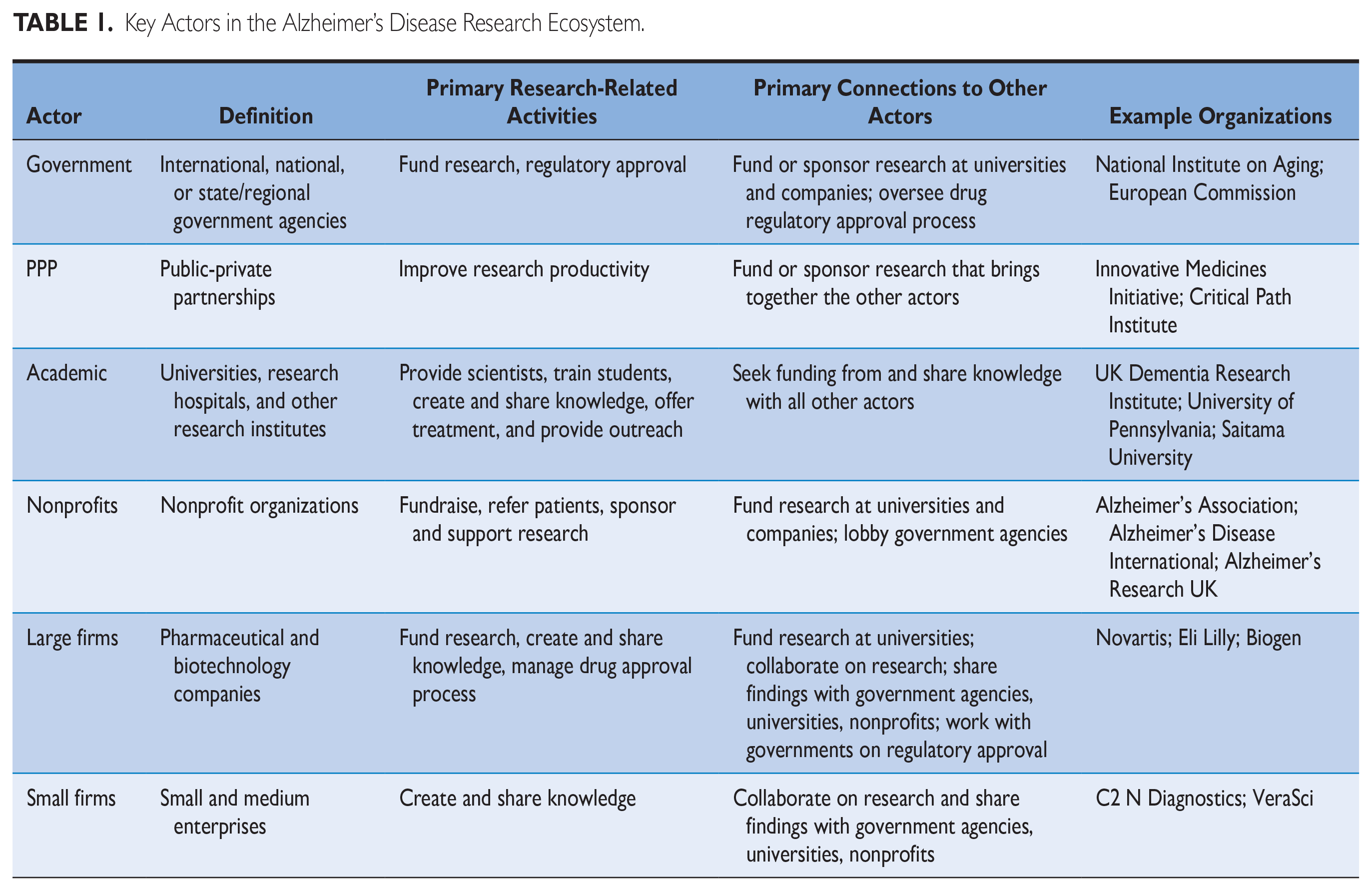
National and international government agencies typically are interested in trying to improve the health of the population and contribute by providing funding for research. For example, the NIA is the lead agency for government funding of AD research. Other U.S. federal agencies (e.g., National Science Foundation, Veterans Administration) also fund research into AD. In Europe, funding is available from both national governments and the European Commission. Besides providing financial support, an additional contribution of federal governments is the regulatory process. Their early engagement may help guide research toward a particular drug or procedure that has a greater likelihood of being approved. At more local levels several state or regional governments have also sponsored or facilitated AD research, with the goals of helping the region develop its research infrastructure (e.g., researchers, laboratories, data repositories) and attracting additional, external funds.
PPPs have been formed by governments, industries, and nonprofits to facilitate disease-related research and treatment. PPPs combine member organizations’ complementary resources, expertise, and knowledge. 40 The expectation is that the collaboration will avoid expensive duplication of effort, speed up the development process, and expand the types of knowledge created.
Universities, meanwhile, provide knowledge, personnel, and facilities to conduct the research. With a focus largely on creating new knowledge (i.e., technology push), universities primarily seek funding through grants from government agencies, nonprofit organizations, and companies. These funds are used to support researchers, train students, create and share research findings, and provide outreach about possible treatments. The creation of research centers (such as the ADRCs in the United States) helps to institutionalize individual researchers’ efforts in attracting resources, conducting research, and disseminating the findings.
Several nonprofit organizations have emerged to help advance the treatment and cure of AD. Some of the more high-profile organizations are Alzheimer’s Association, Alzheimer’s Disease International, Alzheimer’s Research UK, Alzheimer’s Society, and Alzheimer’s Drug Discovery Foundation. These nonprofits undertake a variety of AD tasks, including raising awareness about the disease, supporting families and patients, educational outreach, and advocacy for greater government support, but here our interest is in their support of research. Given the strong relationships they have developed with other stakeholders, these nonprofits often contribute in several ways to research, including sponsoring research, referring patients to clinical trials, and facilitating conversations and cooperation between different actors.
Finally, biotechnology and pharmaceutical companies’ interest in the AD research process includes funding and conducting basic research; translating basic research into potential diagnosis, treatment, or cures; and managing the drug approval process. As such, their interests are more related to the market pull and to meeting the needs of patients by providing treatments or cures. Firms large and small have similar commercial interests, but the larger firms have the resources to donate their services or even make cash payments to support other researchers (such as universities) while the small firms usually require grants or other external funding to conduct research.
We date the maturation of the previously nascent research ecosystem to the period 2003-2004, with the formation of two AD-specific consortia (Alzheimer’s Association Research Roundtable (AARR) and Alzheimer’s Disease Neuroimaging Initiative). This marked the first time that all the major actors—government, academic, nonprofit, and corporate—formed multilateral collaborations to increase the publicly available scientific knowledge related to AD.
AD Consortia Grow the Knowledge Ecosystem
Since 2003, these actors have created 46 R&D consortia focused on AD. As part of a broader study of pharmaceutical R&D consortia, we used secondary and primary data sources to identify more than 400 consortia formed since 2000. We identified those consortia that were partially or completely focused on AD: 44 AD-specific consortia, and two parent organizations that created the majority of the 44 consortia. These 46 consortia have 523 unique member organizations. Table 2 provides an overview of the 46 consortia in terms of their dates of operation, number of members, location, number of top 30 pharmaceutical companies who are members, and their structure.
Public-Private Alzheimer’s Disease R&D Consortia.
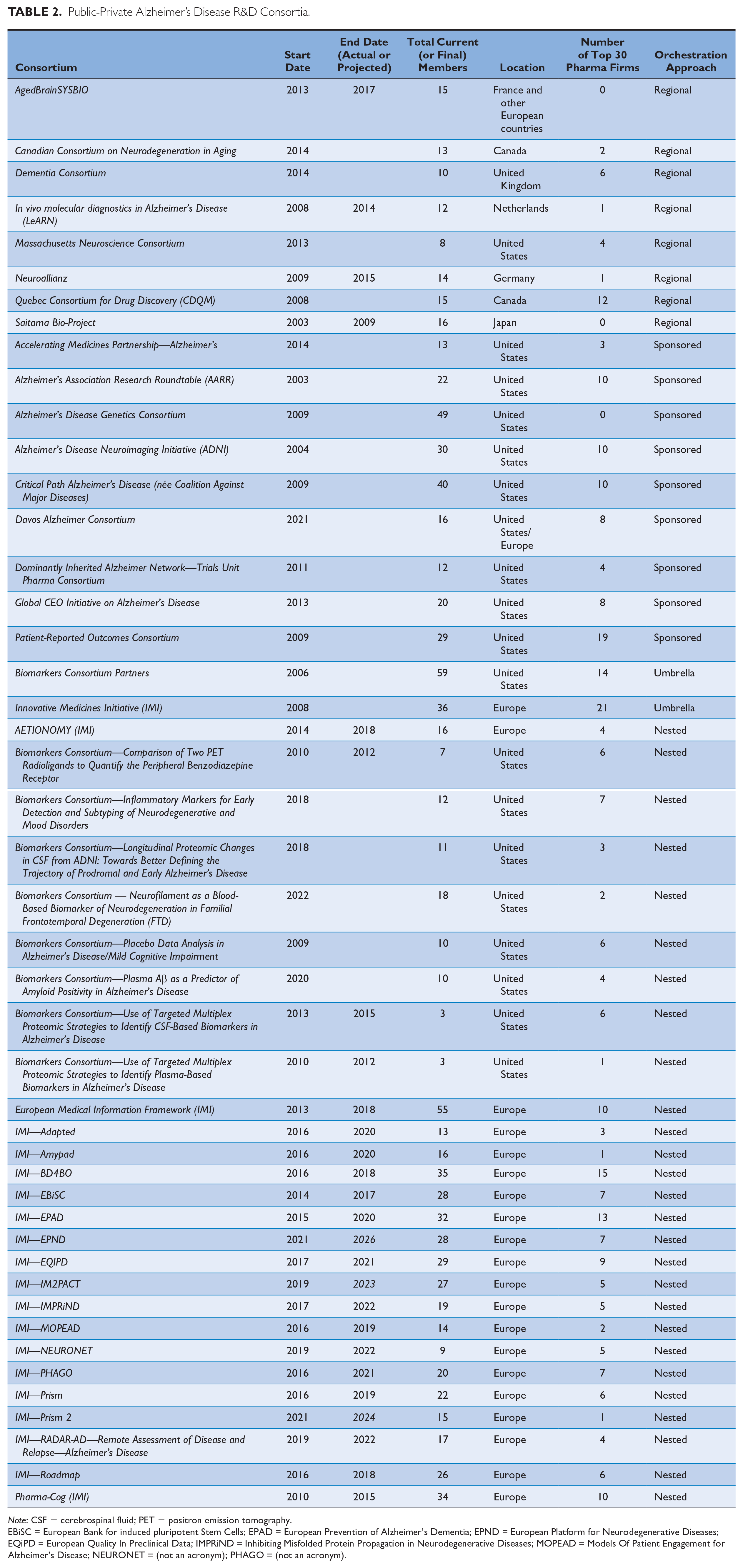
Note: CSF = cerebrospinal fluid; PET = positron emission tomography.EBiSC = European Bank for induced pluripotent Stem Cells; EPAD = European Prevention of Alzheimer’s Dementia; EPND = European Platform for Neurodegenerative Diseases; EQiPD = European Quality In Preclinical Data; IMPRiND = Inhibiting Misfolded Protein Propagation in Neurodegenerative Diseases; MOPEAD = Models Of Patient Engagement for Alzheimer’s Disease; NEURONET = (not an acronym); PHAGO = (not an acronym).
The overlapping scope and memberships suggest a potential for both synergies and duplication. As the executive director of IMI, one of these two parent organizations, wrote:
Considering the large number of consortia that are currently flourishing globally, some overlap between their activities is inevitable. Obviously, this might result in fragmentation of the knowledge created and dissipation of resources; indeed, several pharmaceutical companies have reported that they are suffering from “consortium fatigue” owing to the number of consortia they are involved in and the many solicitations they receive to join new ones. Within the IMI, an emphasis is made on establishing links and synergies, not only between IMI-Sponsored consortia but also with similar PPPs. 41
By number, most member organizations are universities, clinical research organizations, and small/medium enterprises. But as the column on the number of top 30 pharmaceutical companies suggests, many large pharmaceutical organizations have not only joined but have joined more than one AD consortium. Table 3 lists the 37 organizations that are members of five or more consortia. Two of the large pharmaceutical firms are members of a majority of these public-private consortia: Janssen/Johnson & Johnson (30) and Eli Lilly (24), while 19 more belong to at least five. Also in this table, we see that frequent joiners include: the U.S. government agencies of NIA, National Institutes of Health (NIH), and FDA; nonprofits like Alzheimer Europe, Alzheimer’s Association, Alzheimer’s Drug Discovery Foundation, and Fundació ACE; Universities or University-based centers (i.e., Erasmus Medical Center, Karolinska Institute, Oxford University, Stichting VUmc, Klinikum der Universität Zu Köln); and the German research organization Fraunhofer Institute.
Frequent Joiners of Alzheimer’s Disease R&D Consortia.
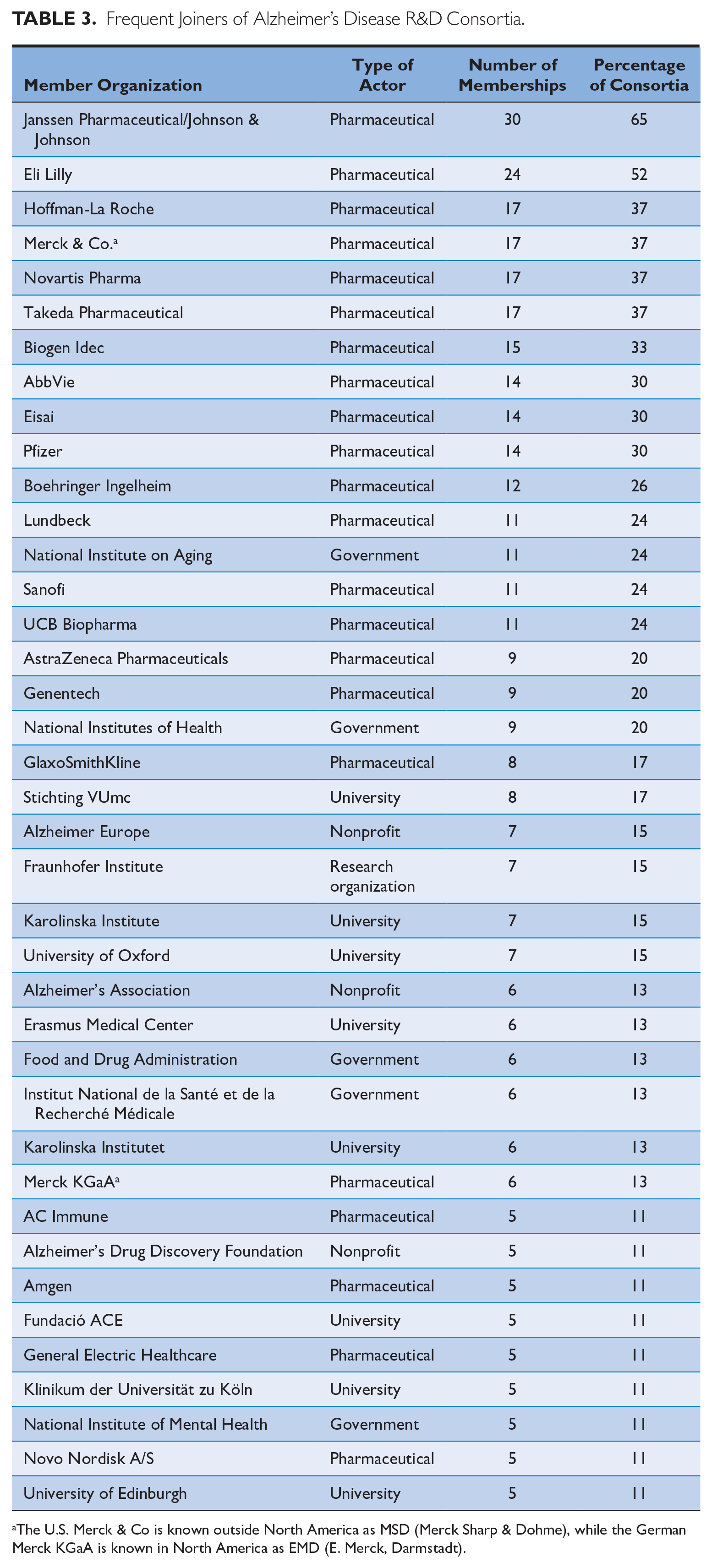
The U.S. Merck & Co is known outside North America as MSD (Merck Sharp & Dohme), while the German Merck KGaA is known in North America as EMD (E. Merck, Darmstadt).
Because of the complexity of AD, these organizations have pursued alternative approaches based on researching different types of scientific knowledge and creating distinctive managerial structures. To understand the differences in the scientific knowledge exploration led by the consortia, we used multiple raters to code each of the 46 consortia with one of eight CADRO (Common Alzheimer’s and Related Dementias Research Ontology) codes (A-H) shown in the appendix. 42 This is the system jointly developed by the NIA and the Alzheimer’s Association for classifying all research related to AD and dementia. Three categories accounted for 37 of the consortia: diagnosis, treatment, and mechanisms (Table 4); none of the remaining CADRO categories accounted for more than three consortia.
Public-Private Alzheimer’s Consortia by Research Area.
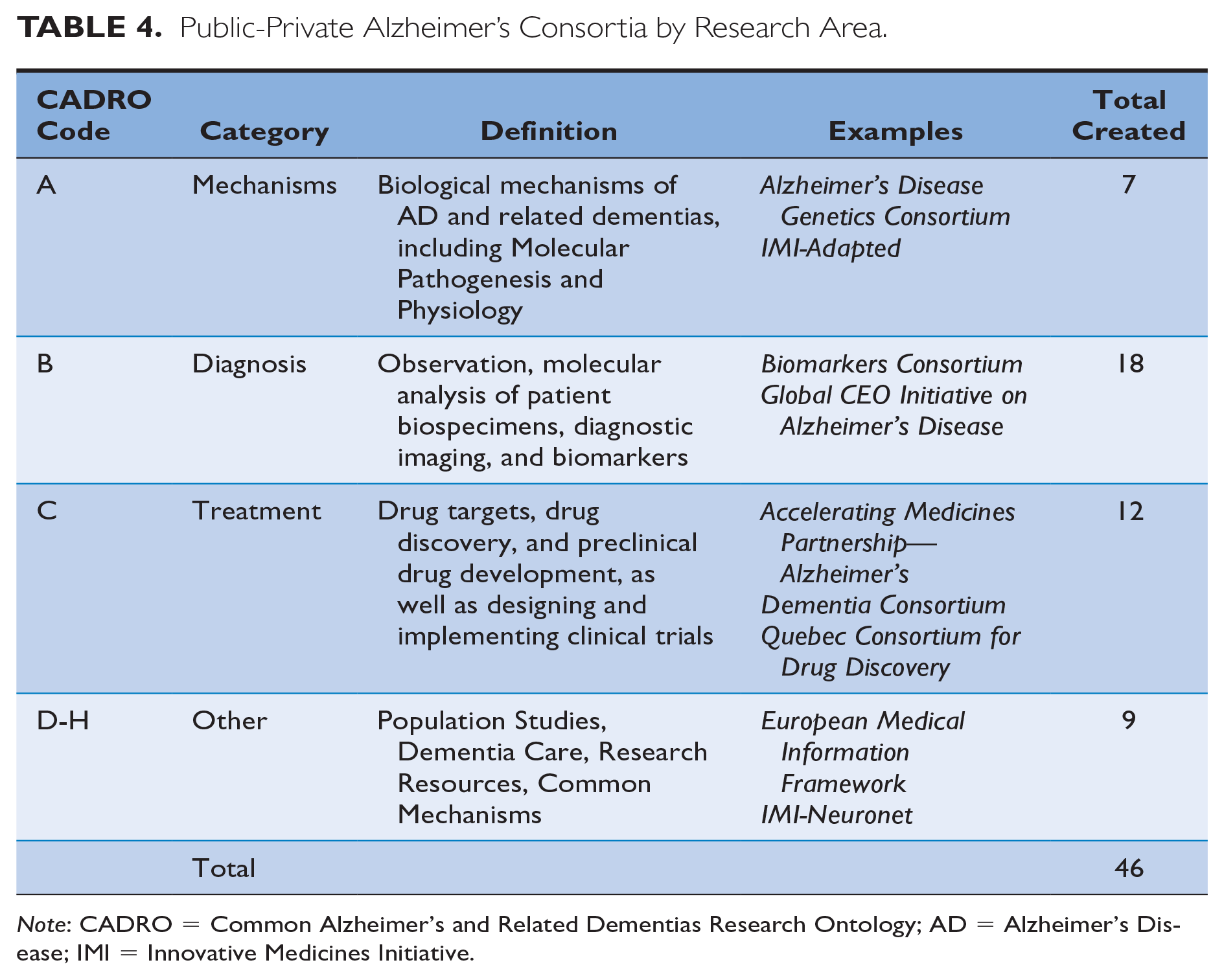
Note: CADRO = Common Alzheimer’s and Related Dementias Research Ontology; AD = Alzheimer’s Disease; IMI = Innovative Medicines Initiative.
While we found differences in the scientific knowledge pursued across these collaborations, they did not appear to have an impact on ecosystem development. More important were the differences in the managerial structures developed. We discuss these in the next section.
Alternative Approaches for Orchestrating with R&D Consortia
Orchestration is central to understanding indirect and distributed ecosystem control. Research has identified three activities of an orchestrator, which we adapt here as: forming and mobilizing, consortium governing, and ongoing engagement. 43 Unlike other contexts where a single orchestrator creates an interorganizational collaboration, there is no organization or group of organizations that exert centralized control over the entire AD research ecosystem. Rather, we found these 46 consortia and their members have indirect, distributed control.
Orchestration Approaches
To understand how these consortia influence the development of the ecosystem, we collected detailed data on each consortium. 44 We then analyzed the data to account for the variance we saw across them, which revealed three different consortium types.
We label the three structural approaches to orchestration as Regional, Sponsored, and Umbrella/Nested, and found there are commonalities in terms of value chain activities, CADRO research focus, and the number of top 30. We also found, in examining several case studies, that the ecosystem interdependence reported in Table 1 extends to these consortia. These types differ, however, in terms of frequency of use and duration. Figure 1 displays the number of each consortium type in existence each year. As it shows, for the first several years there was a balanced mix of the three types but since around 2014, the number of Umbrella/Nested consortia has grown at a faster rate than the others. The number of Sponsored consortia grew until 2014 and has stabilized since with one new one created in 2021 and none terminating. The number of Regional grew until 2014 and since then, no new ones have been formed and several have terminated.
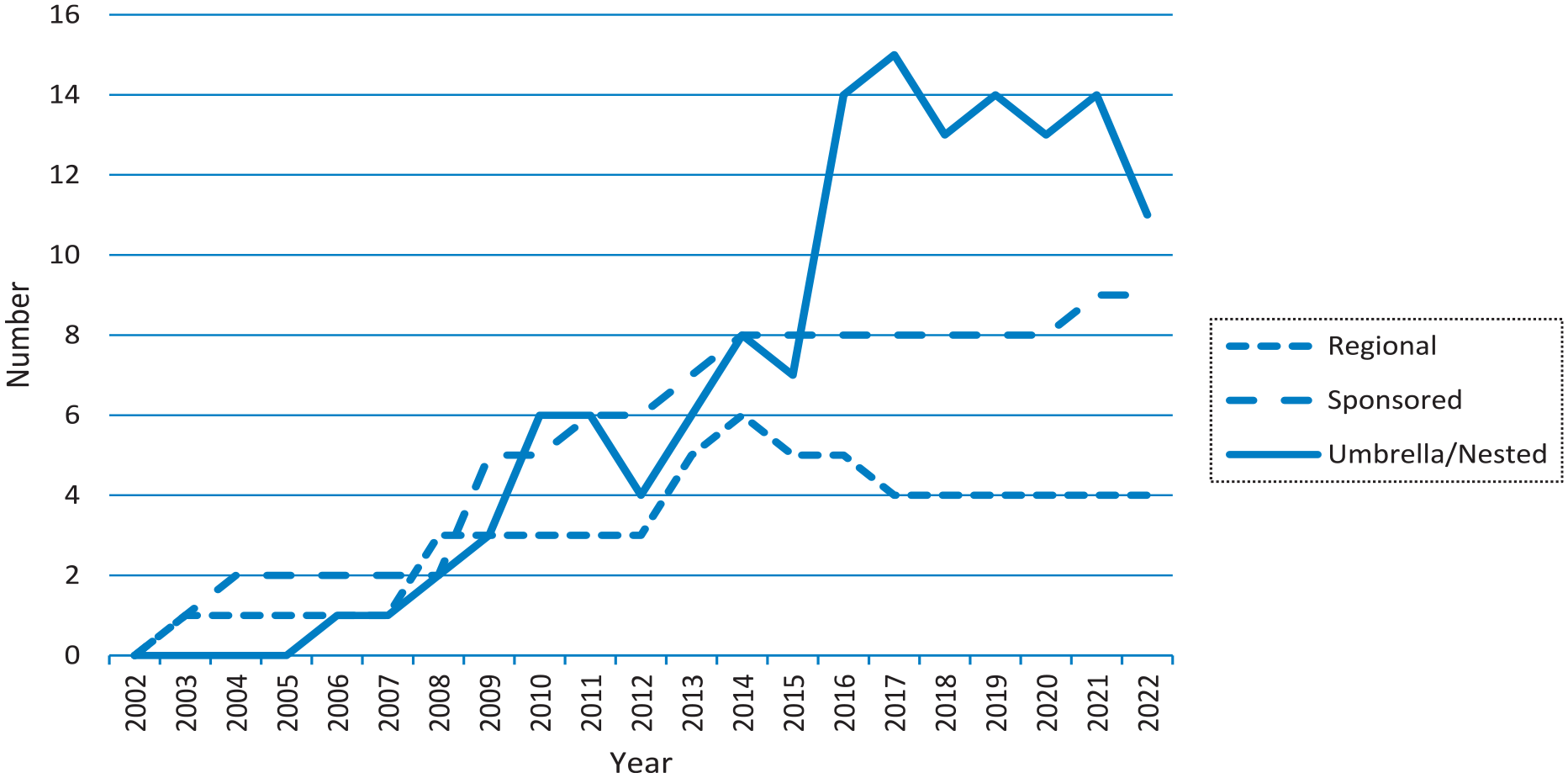
Public-private Alzheimer’s disease R&D consortia by type.
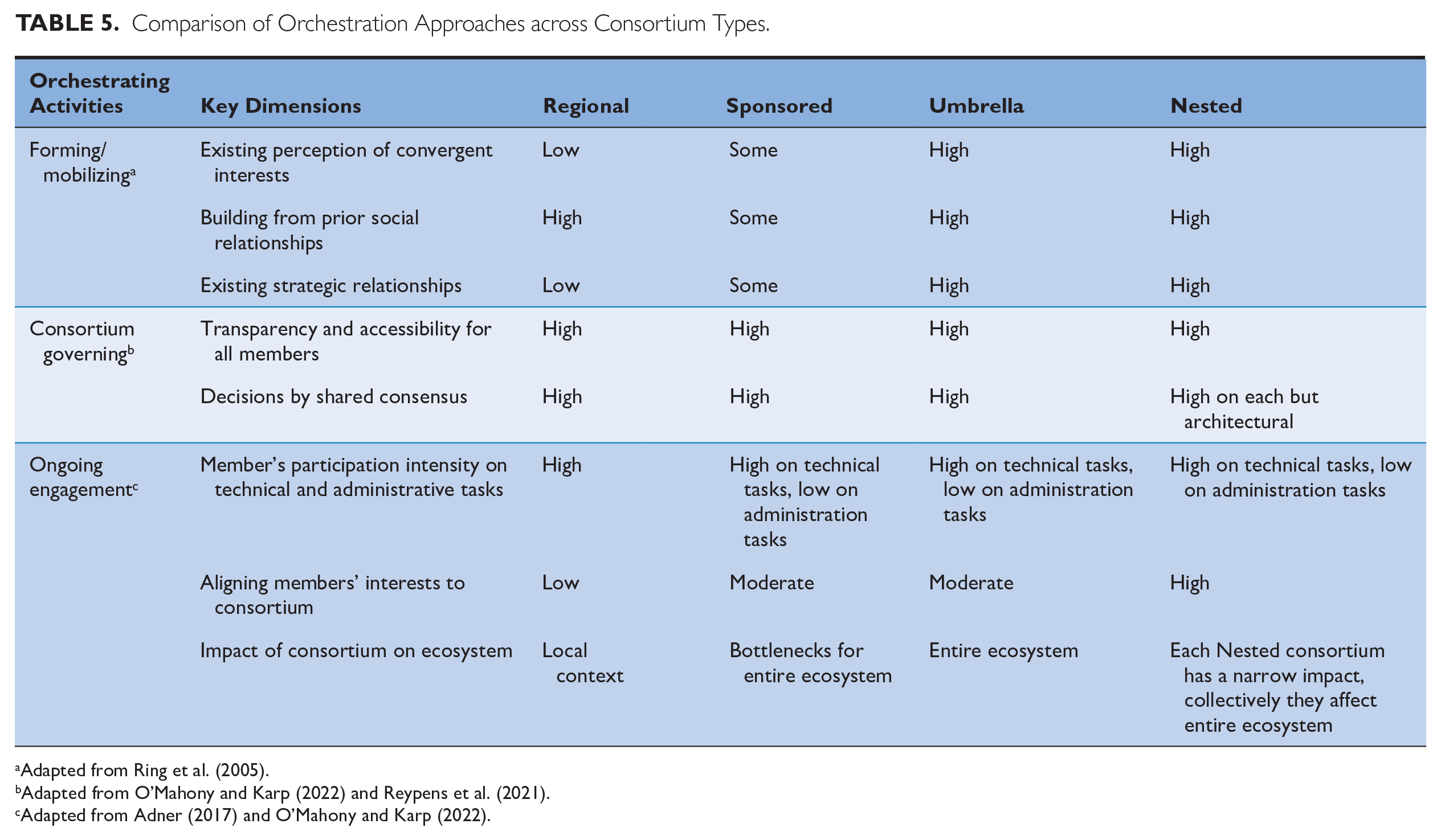
Beyond these dimensions, we found similarities and differences among the three types in their orchestration efforts of forming/mobilizing, consortium governing, and ongoing engagement. To examine these orchestration practices in greater detail, we draw from research into each orchestration activity to identify subdimensions and use these to describe each type. We draw from the above data as well as additional accounts (e.g., website, media, or published reports) for each of the 46 consortia to describe, and compare and contrast the three types. We also draw from selected case studies to illustrate each with an example. 45 Table 5 summarizes the findings from our comparison of the three types. 46
Comparison of Orchestration Approaches across Consortium Types.
Adapted from Ring et al. (2005).
Adapted from O’Mahony and Karp (2022) and Reypens et al. (2021).
Adapted from Adner (2017) and O’Mahony and Karp (2022).
Regional Consortia
Eight consortia were classified as Regional consortia. They are labeled Regional because their research activities are conducted to further the efforts by member organizations with a local presence. When created, the Regional consortia tend to have between 8 and 16 members, and typically have not grown in membership. They have been located across Europe, North America, and Japan. These consortia generally have a geographical focus, where they attempt to enhance regional development, both connecting companies that work in the area with government, nonprofit, or university researchers and building upon existing connections in a regional biomedical ecosystem.
47
For example, the Canadian Consortium on Neurodegeneration in Aging (CCNA) states that The initial vision of the CCNA was to bring together the best of Canadian research in the field of neurodegenerative diseases affecting cognition in a collaborative and synergistic space. The CCNA has grown to be a large cohesive research enterprise that has created new synergies among the Canadian research community and is catalyzing new and exciting research.
48
While there is a theoretical overlap between Regional consortia and local life science clusters, no more than half of the eight Regional consortia correspond to known life science clusters. 49
The orchestration efforts begin with the formation of the consortium. The founding organization is often a university or local PPP that attempts to fund research that will bridge the gap between basic research and practice. It seeks to match companies and other interested parties with research conducted in the local area. There is typically no existing perception of their convergent interest and while they may have known one another through local ties, they often do not have strategic relationships. The formation is focused on building the need for collaboration as well as developing strategic relationships. Once formed, the research is funded by member firms and is conducted at member firms or universities.
The consortium governance generally provides each member with access to all information of the consortium, including research findings that are typically also shared with non-members, as well as involvement in decision-making across the multiple dimensions of legal ownership, technical decisions, membership, and architecture, found in a collaborative structure. 50 To encourage consensus decision-making, the generally smaller and even part-time staff from the founding organization facilitates and oversees inputs from the members, the research progress, and the sharing of any findings. Members generally have representation on executive as well as technical committees. Because of the smaller staff, there is a need for greater participation by the member organizations. However, because of the absence of prior relationships and the transparent and shared consortium governance, members may not always be aligned with the consortium’s overall interests. Rather, they may pursue more member-specific goals. This may explain why several Regional consortia have terminated when members lost interest in continuing the collaboration. Finally, due to the regional nature of the consortium, we find that the impact will primarily be on the local context of the ecosystem and not on the overall ecosystem.
The experiences of the Massachusetts Neuroscience Consortium illustrate many of the approaches taken by Regional consortia. It was started in 2013 and receives funding from a public-private foundation, the Massachusetts Life Sciences Center, and from pharmaceutical companies. The members have an interdependent relationship as each contributes unique resources to the consortium. The purpose is to encourage the companies to sponsor research by scientists, primarily at universities, in the Massachusetts region, in support of the center’s broader efforts to encourage research and employment in the regional biomedical ecosystem, historically one of the top biotech clusters in North America. 51 The resulting consortium “funds pre-clinical neuroscience research at Massachusetts academic and research institutions.” 52
Each year the consortium staff members solicit companies to engage in sponsorship by inviting project proposals from local scientists for funding. Representatives from the companies serve on the review panels and make decisions on which research to fund. Once a project is funded, the staff oversees the allocation of the funds and monitors the progress. Any research findings are shared with all the members of the consortium, but individual companies are permitted, and encouraged, to provide direct follow-up funding to the scientists outside of the consortium’s engagement. The following year, the consortium solicits companies and scientists for the next funding round.
Sponsored Consortia
An additional nine consortia were classified as Sponsored—these consortia are part of an effort to address more than just the focal research of the consortium. These are formed when an existing organization sponsors a consortium as a complement to its other activities in hopes of overcoming bottlenecks in AD research. For most sponsoring organizations, the other activities relate to reducing the impact of AD, including support and care for patients and their families, fundraising to provide needed patient support and to fund research, and encouraging changes in public funding for the disease. Of the remaining sponsoring organizations, most are engaged in or sponsoring research related to other diseases. Sponsored consortia tend to start with around ten members but over time have seen their memberships grow to an average of around 25 members. Further, each of these consortia is based in the United States and none have shut down.
Forming and mobilizing activities begin when the sponsoring organization, typically a nonprofit or a PPP, commits initial resources (e.g., financial resources, reputational resources, relationships with research organizations) and solicits potential member organizations. The sponsor has an idea for the consortium around enhancing AD research, either by creating a collaboration with top research organizations or by extending a current methodology to AD, and seeks members to join. The perception of the need for the consortium may immediately resonate with some potential members, but others require more time and effort. Also, because of the existing activities of the sponsoring organization, there will likely be some prior social relationships as well as strategic relationships. However, the formation will involve building social and strategic ties among potential members who have not worked together.
The governance of the resulting consortium oversees research at member firms or universities and receives funding from members, who include pharmaceutical companies, nonprofits, and PPPs. Management of the consortium is overseen by staff from the sponsoring organization. There is strong transparency, with each member having access to all consortium information, and the research results are shared with all members, as well as non-members. The emphasis is on encouraging consensus decision-making across the dimensions, and members generally have representation on executive as well as technical committees. Engagement by members is high for the technical tasks of the consortium while less is needed on administrative dimensions since the sponsoring organization’s staff manages the day-to-day operations. Because there is a general agenda set by the sponsoring organization, which is then refined by the member organizations, there is some alignment of the members’ interests with the consortium’s agenda. The staff also works to grow the consortium by updating the research agenda and attracting new members. Finally, because the consortium addresses key problems of the ecosystem and the membership tends to be larger, the expected impact for a Sponsored consortium is to resolve bottlenecks for the entire ecosystem.
One of the first Sponsored consortia—the AARR—illustrates this orchestration. The Alzheimer’s Association began in 1980 to provide support to those with AD and their caregivers and to advance research into AD. The AARR began in 2003 when the Alzheimer’s Association formed a partnership with companies in the pharmaceutical industry. As part of its mission, “AARR brings industry leaders with top scientists from around the world to discuss key areas in Alzheimer’s science.” 53 By including private as well as government agencies in these discussions, the hope is to build from their different perspectives and to improve market-focused research while also increasing the awareness of any regulatory issues that could delay drug approval. The consortium started with four members and has grown to over 20 members. The Alzheimer’s Association manages the consortium with its staff members who meet with the roundtable and various subcommittees, made up of member company representatives, to define the research theme for each of the twice-a-year meeting. AARR sponsors these meetings where members share their research and critical AD research issues are discussed. The findings from each conference are shared with members and then with non-members through publication in the Alzheimer’s Association-sponsored research journal. The staff, roundtable, and subcommittee members then prepare the theme and the agenda for the subsequent meeting.
Umbrella Consortia Forming Nested Consortia
Two Umbrella consortia have formed a total of 27 additional AD consortia nested within them. Each Umbrella consortium is a longer term consortium with significant funding from PPPs and a research agenda that creates Nested consortia across multiple diseases. Two Umbrella consortia have been created (and continue to operate) to address a wide range of biomedical research topics: the U.S.-based Biomarkers Consortium and Europe’s IMI. Each was formed through a partnership between government agencies and pharmaceutical trade associations and has a steady membership of over 40 initial members. While their membership has not changed too much, Umbrella consortia evolve through the creation and termination of Nested consortia.
The Umbrella consortia emerged from prior industry and government relationships. For each, there was a high perception of convergent interests for forming the consortium, as well as a history of social and strategic relationships that could be built upon in creating the Umbrella. In both cases, the creation of the Umbrella consortium was to make progress by creating additional, focused consortia that conduct the research.
The governance of the Umbrella consortia consists of permanent staff who oversee operations while there are committees populated by representatives from member companies that make strategic decisions, including the formation and termination of Nested consortia. The funding comes from industry and government, and the consortium governance emphasizes access for all members and shared decision-making for legal, technical, membership, and architecture. The results from any Nested consortia activities are shared with members and non-members. Participation intensity is high for strategic decisions but because of the larger number of members in the consortium, it is less than other consortium types. Likewise, because of the presence of permanent staff members, there is less engagement on administrative dimensions by member organizations. This includes the skills associated with forming new consortia, which reside with the staff members. Because of the wide-ranging agenda of the Umbrella consortium, members tend to find some degree of alignment with the interests of the consortium. By creating Nested consortia, the impact of the Umbrella consortium will be quite broad and will affect not only the entire ecosystem but likely related ecosystems.
The Biomarkers Consortium was established in the United States in 2006 by the Foundation for the National Institute for Health (FNIH), NIH, the FDA, the Centers for Medicare and Medicaid Services, and two industry trade associations. 54 Its goal is to support research and guide clinical practice that will identify, develop, and qualify potential biomarkers to improve drug development and regulatory decision-making. The consortium is governed by an executive committee, is managed by the FNIH, and has a permanent staff. The Biomarkers Consortium membership, consisting of organizations in the private sector, provides funding. Four steering committees, each focused on a different disease area (cancer, neuroscience, metabolic disorders, inflammation, and immunity), oversee the formation of the additional consortia. These consortia “serve to develop promising biomarkers in order to help accelerate the delivery of successful new technologies, medicines and therapies for prevention, early detection, diagnosis and treatment of disease.” 55 To date, it has sponsored 40 consortia, including seven related to AD. It currently has approximately 60 members, including nonprofits, patient advocacy, pharmaceuticals (both large and small), diagnostic and biotechnology companies, and other government agencies.
A key responsibility of the Biomarkers Consortium was to create the processes and rules that align the interests of members of each new Nested consortium. As two Eli Lilly scientists wrote in 2010, “the collaborative environment provided by the Biomarkers Consortium, which sponsored this work, serves to align interested parties from academia, industry, and governmental agencies around the most important and logistically achievable projects.” 56 While these PPPs utilized consensus governance, such consensus was easier said than done, as other participants in the same Nested consortium wrote:
‘Before the consortium’s launch, the founding members had multiple discussions not only around the policies that should govern this novel partnership but also around which specific questions in the therapeutic areas of focus might be of interest to all stakeholders in the consortium. The importance of pre-project consensus building can never be overstated’. 57
IMI emerged from the European Technology Platform on Innovative Medicines (2005-2009), which identified an agenda to improve drug development in Europe around AD and medicines safety. This led to IMI1 (2008-2013), a PPP of the European Community and the European Federation of Pharmaceutical Industries and Associations (EFPIA). Its funding came from the European Union and from in-kind contributions from EFPIA and its member companies. During this time, the consortium funded 59 projects across a range of health issues and general challenges in drug development. The success of IMI1 led to the formation of IMI2, which started in 2014 and will run until 2024. The consortium is led by a governing board, has strategic governing groups which oversee different research topics (e.g., neurodegeneration, oncology), and has an executive director and permanent staff. The consortium governing bodies are made up of representatives from the European government, companies involved in the area, and the IMI staff.
Turning to the Nested consortia, these are typically smaller and focused on a specific problem. The two Umbrella consortia have created 27 Nested AD consortia with those created by IMI located in Europe and those by biomarkers located in the United States. The membership size of the Nested AD consortia ranges between 3 and 55 members with an average of around 20. The Nested consortia tend to be more project oriented, build from one another, and work to further the knowledge of a particular disease. When the project is finished, the Nested consortium is terminated. Of the 27 Nested AD consortia, 11 were operating in 2022.
The Nested consortium formation begins when interested parties develop a proposal for funding from the Umbrella consortium. The agenda is often narrow and often builds on related Nested consortia within the Umbrella consortium. For example, the Biomarkers Consortium launched a 2018 Nested consortium for detecting AD using cerebrospinal fluid (CSF) that “was the third stage of a multi-phased program that . . . provided early validation for proteins identified” 58 by an earlier 2013 Nested consortium studying CSF-based biomarkers. With a well-defined agenda, interested parties will likely be aware of the common interests. Also, since many—but not all—of a Nested consortium’s members will also be members of the Umbrella consortium, they will have prior social and strategic relationships that will speed up the formation process. Once the Umbrella consortium initiates the Nested Consortium, representatives from sponsoring organizations serve on executive and technical committees, while the research is conducted at members’ and non-members’ facilities, and the Umbrella consortium staff oversees the implementation. There is typically strong information access given to all members but because the Nested consortium’s agenda has been approved and funded by the Umbrella consortium, architectural decision-making is more top-down than consensus.
Similarly, Nested consortium members have high participation on the technical side, but less participation in the administrative issues which are overseen by the Umbrella consortium’s staff. Because the Nested consortium’s goals are clearly defined and agreed upon for the duration of the consortium, member organizations will likely be aligned with the consortium’s goals, or they will likely not join. Finally, although each Nested consortium has only a narrow scope and impact on the ecosystem, when combined with other Nested consortia, collectively they will affect the entire ecosystem.
An example of a Nested consortium within the Biomarkers Consortium is the Plasma Aβ as a Predictor of Amyloid Positivity in Alzheimer’s Disease project. Started in 2020 with ten organizational members, this consortium resulted from the Biomarkers Consortium neuroscience steering committee’s interest in determining whether Plasma Aβ could predict where a patient was Amyloid positive, the widely assumed but controversial 59 predictor of AD-related decline. This led to the formation of a project development team, composed of interested members within the Biomarkers Consortium, to create a proposal; solicit contributions of technology, researchers, and funds from possible partners; and create a project implementation plan. Once approved by the Biomarkers Consortium Executive Committee, a project execution team for the Nested consortium was formed, which was led by FNIH staff, key consortium members with expertise in the area, and BC partners who contribute funds to the consortium. The research is conducted with Biomarkers Consortium collaborators, and the execution team meets monthly to track the progress, with funding partners making decisions on the project until it is completed and closed out. The results and data will be shared with members and non-members alike.
Orchestration Approach Summary
The three ecosystem orchestrating approaches overlap but are not identical. They are broadly similar in how they govern consortia, but differ in the forming, mobilizing, and ongoing engagement activities.
During formation, Regional consortia focused on developing localized convergent interests among potential members as well as creating new strategic relationships. For Sponsored, some initial members will be aligned through similar bottleneck perceptions, convergent interests, and even existing social and strategic relationships; however, because others will not, the formation process requires time to attract other members and align their interests. With pre-existing Umbrella structures, the formation of new Nested consortia does not require as much effort to develop convergent interests or establish social and strategic relations.
Turning to governing consortia, we see consistency among these three structures in terms of access and decision-making. They all provide open access to members, and non-members, and generally seek consensus in decision-making on the four dimensions of legal, technical, membership, and architecture. This common approach emphasizes value creation by the consortium but, like other open R&D consortia in the pharmaceutical industry, 60 does not alter value capture activities. This consortium governance contrasts with earlier consortia in other industries where the information was not always open or shared with non-members, and the governance did not emphasize consensus decision-making.
Finally, for ongoing engagement, there are some commonalities but also more differences. We find consistency in members participating in technical tasks but due to the presence of staff, the members are less involved in administrative tasks for Sponsored and Umbrella/Nested consortia. Regional consortia also show weaker alignment of member’s interests and have a local impact, while Sponsored consortia show moderate alignment to the consortium’s interests and the impact is on ecosystem bottlenecks. For Umbrella/Nested consortia, there is stronger alignment to the interests of the consortium and the impact is on the entire ecosystem due to the breadth of the Umbrella consortium and the collective impact of its Nested consortia.
Conclusion
The emergence of increasingly complex ecosystems has brought new approaches to their governance. While prior research and practice have emphasized solitary control or market mechanisms, we extend previous research into ecosystem orchestration by focusing on the intermediate case of distributed control. Specifically, we identify two dimensions of variation within ecosystem control—centralized versus distributed and direct versus indirect—and show how consortia have been used in this century to orchestrate overlapping, distributed collaborations of indirect ecosystem control.
Using data on 46 consortia and more than 500 member organizations in the knowledge ecosystem of Alzheimer’s researchers, we document the workings of the indirect distributed model of ecosystem control. We show how these consortia on one hand provide formal processes and structure for collaborations in this ecosystem, while on the other hand, each consortium directs only one of an overlapping web of networks within the ecosystem. Also, we demonstrate the strategies of individual organizations to orchestrate the ecosystem, both by launching new consortia and by participating in multiple collaborations across the ecosystem.
Finally, we utilize prior research on consortia and ecosystems to identify three activities for consensus-based ecosystem orchestration: mobilizing, consortia governing, and engaging. We apply these dimensions to contrast three different approaches for organizing Alzheimer’s consortia—Regional, Sponsored, and Umbrella/Nested—to show which choices are consistently used to orchestrate this knowledge ecosystem, and which vary based on consortium structure.
This article highlights the messiness and inefficiencies that can exist in such an ecosystem. Not only do we find duplication in memberships, but without centralized control, there is the potential for overlap or even competition among the consortia. While overlap can create rivalry that can spur research and lead to greater progress, it may also lead to inefficiencies or cannibalization if scarce resources are spread too broadly. In fact, the proliferation of the Umbrella/Nested consortia was created to achieve greater coordination and efficiency. One of its distinguishing features, compared with Regional and Sponsored consortia, is that the purpose and outcome from earlier Nested consortia are considered by Umbrella consortium managers in creating new Nested consortia. Furthermore, the ability of the Umbrella managers to reapply existing capabilities in creating a new Nested consortium should improve the level of efficiencies in managing these consortia. This suggests that the consortium types may vary in their efficiency and effectiveness in orchestrating the ecosystem.
This study offers new insights into how firms practicing open innovation can leverage ecosystems to achieve corporate goals. While today’s managers are familiar with the dynamics of platforms and other innovation ecosystems, here we show that ecosystems are also a helpful tool in organizing cooperative value creation for the scientific knowledge upstream of a firm’s innovation strategy—particularly important for those science-based businesses heavily dependent on such knowledge. As such, firms practicing open innovation in these industries must develop strategies that leverage inbound, outbound, and coupled knowledge flows from these knowledge ecosystems. 61 As we have illustrated, this includes using different types of consortia to orchestrate the ecosystem.
Our findings also have implications for managers creating or joining consortia. In the forming/mobilizing of consortium members, the formation of Nested consortia can leverage an Umbrella consortium to build convergent interests and social and strategic relationships, while new Regional consortia will need to spend additional time and effort. For the second activity of creating the consortium governance, we found all three types to emphasize transparency and accessibility in the governance; managers consistently made decisions by shared consensus, which may reflect linkages to broader norms of scientific collaboration. For the ongoing engagement activity, managers have similar roles on technical tasks across all three types, but the types differed in how engaged the members were on administrative tasks, the overall alignment of members with the consortium’s goals, and the expected impact of the consortium.
Finally, in such an indirect distributed governance of ecosystems, managers will need to become more adept at cooperating with competitors. Moving beyond a single instance of collaborating with a direct rival, here we find several large competitors repeatedly cooperating with one another in various consortia.
Our study also offers several implications for researchers. First, we show a new form of ecosystem orchestration, the indirect distributed approach where members join multiple, overlapping consortia to influence the overall ecosystem. This approach broadens the concept of ecosystem orchestration by describing the roles and responsibilities that both members and mediating organizations have in the effort. Second, our analysis revealed overlap in membership and consortium activities that raises questions about whether within an ecosystem there is a preferred level of internal redundancy and competition versus complementarity and cooperation. Finally, our study documents not only that there are different types of consortia, but also describes similarities and dissimilarities in the managerial activities needed to form/mobilize, govern, and engage members in the orchestration.
Footnotes
Appendix
Acknowledgements
We gratefully acknowledge research assistance by Preeti Saldanha, Lauren Davey, Charlotte Dyer, Caprice van den Assem and Shahil Patel, and the comments of the editor and anonymous reviewers.
Declaration of Conflicting Interests
The author(s) declared no potential conflicts of interest with respect to the research, authorship, and/or publication of this article.
Funding
The author(s) received financial support for the research, authorship, and/or publication of this article: This research was supported by the National Science Foundation, Science of Science & Innovation Policy (SciSIP) program, under grant number 1538799.
Author Biographies
Paul Olk is a Professor of Management at the Daniels College of Business at the University of Denver (email:
Joel West is a Professor of Innovation & Entrepreneurship and Director of the Master of Business and Science program at the Keck Graduate Institute, and Faculty Fellow at Hildegard College (email: