




Abstract
Based on an in-depth analysis of a successful large-scale agile transformation, this article sheds light on the evolving role of line managers during the transformation. At the beginning of the transformation, line managers act like “missionaries” and leverage influencing mechanisms in their attempts to foster the adoption of agile values. At maturity, the role of line managers evolves into a role similar to “priests” where discipline mechanisms are enacted to maintain and sustain the newly adopted agile values. The social contracts and the organizational conditions that underpin such evolution have implications for selecting suitable line managers.
Keywords
Agile methodologies promise to make organizations more responsive by empowering individuals and teams, and by decentralizing decision-making throughout the organization. 1 Organizational responsiveness is often a sought-after strategic goal, especially when environmental uncertainty is high. Thus, it is not surprising that an increasing number of firms have adopted agile methodologies in their way of working. A small, yet growing, agile literature has documented the links between agile methodologies’ implementation and organizational outcomes. In this agile literature, an emerging empirical regularity is that, overall, the implementation of agile methodologies leads to positive organizational outcomes 2 although several contingencies have been highlighted to moderate 3 and even mediate/overturn 4 the positive relationship.
Few studies have started unpacking a hitherto overlooked effect in agile implementation: the role of middle manager actions in enabling team autonomy and in balancing team autonomy and team alignment to firm strategy. The investigation of the role of middle managers is not new in management research. 5 However, agile transformations present some idiosyncratic features that make received wisdom only partially applicable to middle managers leading agile transformations. First, in agile implementation frameworks, the role of middle managers is only generically scripted. Second, agile principles leave significant leeway for managers and team members to interpret and experiment with how to adopt agile practices. Third, more broadly, agile transformations present managers with the paradoxical challenge of managing teams that should be autonomous and self-regulating. Combined, these features of agile transformations present middle managers with even more ambiguity than in other corporate transformations.
Among the emergent studies that have focused on the role of middle managers in agile transformation, Parker et al. (2015) highlight that agile leaders should set direction, initiate collaboration, establish rules, and encourage constant feedback, while Minai et al. (2020) suggest that agile leaders should empower and support teams. By focusing on the effects of specific managerial actions and practices on agile team performance, other research studies have revealed the implications of adopting diagnostic versus interactive types of managerial controls, 6 the importance of balancing formal structure and team autonomy, 7 and the role of adopting leadership practices that teach people to lead themselves. 8 Parker et al. have brought forward the idea of middle managers as adaptive managers. The consideration that the role of managers changes over time is an established tenet in related research streams such as management 9 and leadership of self-managing teams. 10 For instance, strategic management literature links the volatility of middle managers’ role to specific strategy formulation processes and to top management intention about middle managers’ involvement in strategy implementation.
Yet, extant literature suffers from some shortcomings. First, the extant agile literature has mostly focused on the role of middle managers in some specific phases of the agile methodology implementation (hereafter, the agile transformation), but it has not developed a temporal view of the evolution of the role from one phase of the agile transformation to another and of the forces driving such evolution. Second, while past studies have described middle management adaptive roles, there is poor empirical research about how middle managers are able to accomplish their roles vis-à-vis individuals, teams, and organizational contexts that co-evolve with them, 11 and these studies do not emphasize the contingencies justifying discrete breaks in middle management behaviors. In this article, we address the shortcomings highlighted above, providing a longitudinal view of the changing role of middle managers in their attempts to enable the diffusion and adoption of agile values and agile practices, and of the organizational forces underlying such changes. Our analysis draws on a detailed longitudinal analysis (2012-2016) of a successful agile transformation of a leading international Telco Company (hereafter, TelCom). We focus on a specific category of middle managers: the line managers responsible for people development and resource allocation. In terms of organizational hierarchy, line managers are middle managers operating below the top management team as first-level managers of the agile teams.
We make several contributions to the growing middle manager literature and to managerial practices. We document line managers’ specific interventions at the beginning of the agile transformation and when the transformation was considered “mature” by TelCom senior executives (2016). The tensions that these actions address—that is, team members’ resistance to adopting agile practices and their skepticism about line managers’ credibility as agile change agents—and the effectiveness of such actions are based on five characteristics:
Adoption of influencing mechanisms to enact agile values and practices;
Leveraging information asymmetries with team members;
Use of agile rites and rituals to exemplify the meaning of agile values (“act agile”);
Systematic controls of team members’ predisposition to change; and
Constant interactions with team members through immersion in their daily operations.
Overall, at the beginning of the transformation, line managers’ actions resemble the ones of “missionaries,” practicing an active spirituality, fully embodying the principles of agile, and emphasizing the importance of individual continuous adaptation to agile values and practices.
At maturity, the sources of tensions between line managers and team members transform into radically different ones and revolve around team members’ resistance to accept controls by line managers and line managers’ doubts about their own role. In this phase, the effectiveness of line managers’ intervention is based on five radically new characteristics:
Adoption of discipline mechanisms to maintain and sustain the newly adopted agile values and practices;
Leveraging organizational hierarchical advantages and resources to counterbalance teams’ informational advantages;
Use of institutions and rituals to maintain the status quo;
Systematic assessment of team members’ agile behaviors (“be agile”); and
Spatial contiguity to teams to observe and gain information.
Jointly these actions resemble the ones of “priests.”
This article provides a systematic study of the evolution of line managers’ roles vis-à-vis the evolution of the organizational contexts in which they operate. These findings and theoretical framework contribute to the strategic agility literature 12 by corroborating Girod and Kralik’s (2020) insight that self-steering teams would not deliver on their objectives if middle managers were not involved (“empowerment within a frame”). The role of line managers is pivotal in orchestrating the sought-after, and contradictory, goals of enacting both team autonomy and team alignment to firm strategy.
Research Setting and Research Methodology
To analyze the evolving role of line managers along the agile transformation, we performed a detailed longitudinal analysis of the transformation from waterfall product development approaches to agile at TelCom. TelCom was established in 2003 as a fully owned subsidiary of a global company. TelCom had originally been tasked with developing software applications for the parent company and had been operating in a traditional hierarchical approach. Initially, TelCom was organized around highly technical functional teams specialized in specific software components—for example, Graphical User Interfaces—led by individuals with technical expertise.
In 2012, as a consequence of the decision by the parent company to embrace agile ways of working in its headquarters and all its global subsidiaries, TelCom started its own agile transformation and redeployed all its 100 employees into autonomous, cross-functional, and cross-product agile teams. In 2016, TelCom’s annual report states that the agile transformation was considered as “mature,” 13 and senior executives started focusing on harvesting the benefits of agile at scale.
The initial organizational conditions of TelCom—that is, a company operating under a hierarchical organizational structure—and the type of agile methodology implementation pursued by TelCom (devolution of technical decision-making to teams, team autonomy, new “agile” workflows, and restructuring of the managerial lines) are common in many agile transformations and therefore offer scope for generalizability.
To conduct this research, the Head of TelCom granted us unrestricted access to team members, managers, and organizational archives. Interviews were conducted under the promise of anonymity and of not reporting commercially sensitive information. All comments and examples that might have identified specific people were removed. Overall, we interviewed 33 people in 2012 and 28 people in 2016. Thanks to low staff turnover in these four years, we were able to interview most of the same people at these different temporal points, thus allowing us to trace changes over time. The interviews took place both with team members and with line managers, thus providing a comprehensive view of the topics being investigated. Line managers were responsible for up to five teams (each team having five to nine team members). Team members’ replies relate to all the line managers of the organization.
Overall, the interviews 14 revolved around discussing the challenges and the effectiveness of the practices performed by the line managers. Each semi-structured interview was transcribed within a 24-hour window. Notes were taken during the interviews to facilitate interpretation. Following the interviews, we often contacted the interviewees for clarification and validation.
Data Analysis
Data have been examined using an iterative grounded theory coding process between the literature, data, and emergent grounded categories. 15 We started by identifying first-order concepts after an open coding process, where in vivo codes resulted from interviewees’ terminology. As a second step, we searched for relationships between identified first-order concepts. We clustered convergent categories using a higher level of abstraction, therefore identifying theoretical categories or second-order themes. As a third step, several meetings between the authors were held to look for aggregate analytical dimensions by reasoning about the common denominator(s) in the second-order codes, trying to build a shared understanding. This coding process was repeated for 2012 and 2016.
Phase 1: The Beginning of the Agile Transformation—The Missionary Phase
In 2012, TelCom started its agile transformation with the implementation of agile methods, including the creation of scrum teams 16 and the application of scrum practices in software development. This agile transformation was a pivotal part of a broader strategic transformation endorsed by the parent company’s Board of Directors and aimed at striking a more sustainable balance between market share, product innovation, and profitability. The documentation we retrieved describes two high-level goals for line managers: “based on higher level, strategic, requirements, line managers should formally allocate teams (not individuals as in the past) to high-level activities—e.g., maintenance; features development; product customization,” and “line managers should remove any formal and behavioral impediment to the smooth operating of the teams to enable the continuity of the workflow.” Line managers do not have any formal responsibility in the analyses of product requirements and in the product development cycle (product development responsibilities were attributed to “product owners”).
The strategic and organizational setting described thus far constitutes the context within which line managers (and team members) interpreted their roles at the beginning of the agile transformation. In Figure 1, we describe the data structure (first-order codes, second-order codes, and aggregate analytical dimensions) emerging from our analyses.
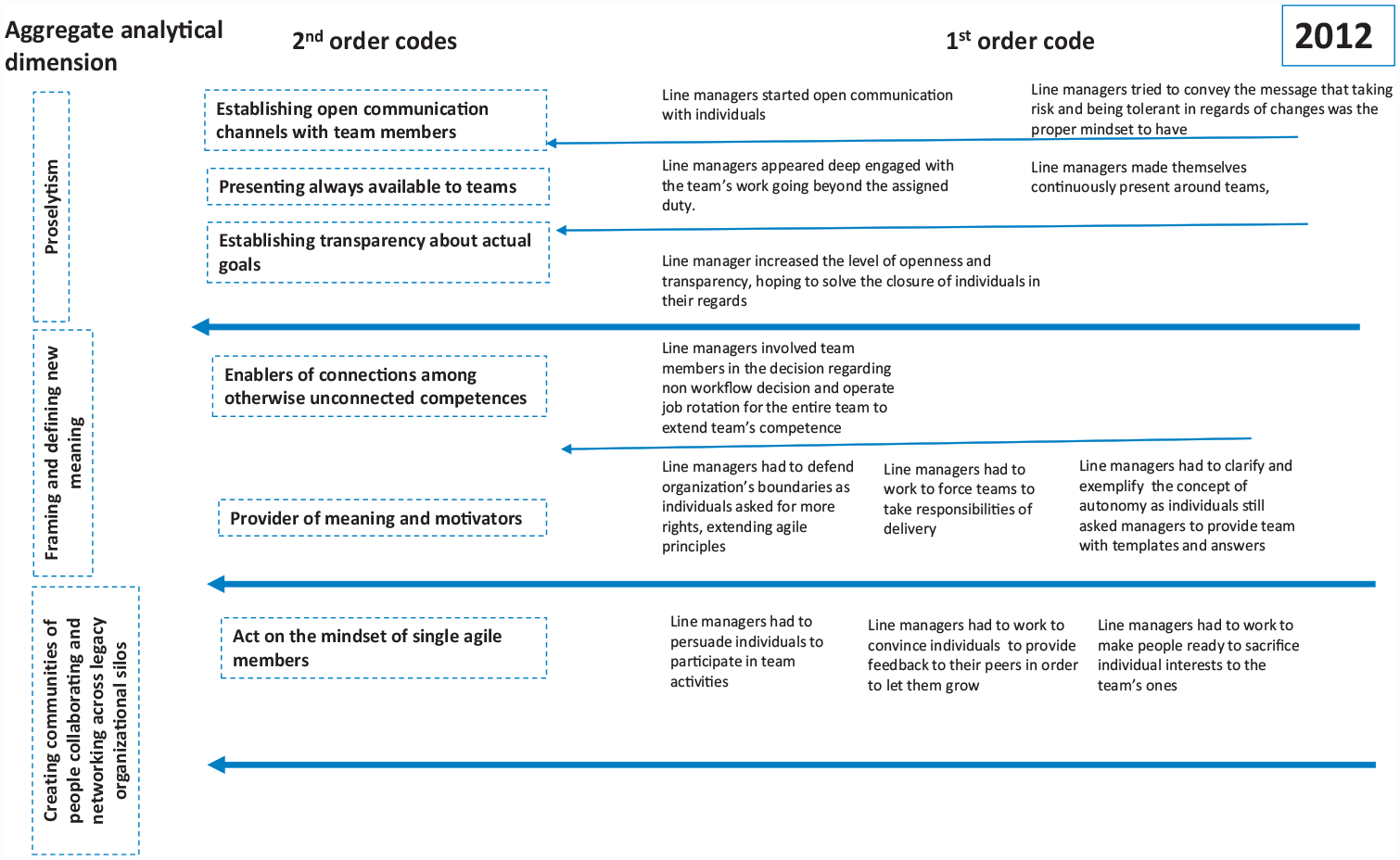
Data structure—line managers’ areas of intervention at the beginning of agile transformation.
In the first phase of agile transformation (the missionary phase)—confirming the contention that agile managers are adaptive and constantly changing as new facts arrive and questions are asked—our findings highlight three distinct macro actions performed by line managers: proselytism; framing and defining meaning; and creating communities of people networking and collaborating across legacy organizational silos.
Proselytism
The first phase of the agile transformation started in 2012 with a definitive announcement that an agile way of working will be implemented and alerting individuals about the incoming change and the allocation of team members to agile teams. Once team members were selected to join the agile workforce, they were explicitly called by their line managers to perform an interior change. This interior “turning” or “conversion” was relevant to create conditions for enacting a process of education and training. More precisely, the values of risk tolerance and flexibility toward change were presented as part of an expected individual disposition to work in the agile setting. Along this transition and “conversion” process, line managers offered security (being the good parent), more so than the not yet stable organization structure. Acting as a good parent and giving individuals a soothing presence, line managers offered team members support and protected them from external and internal distress:
“In general, as a manager, I must encourage and give freedom without controlling or filtering to avoid being perceived as an obstacle.” (Line manager)
Not surprisingly, at the beginning of the agile transition, team members—and often line managers themselves—had a limited understanding of how to implement agile practices. Agile practices do not clarify how teams should self-organize, and for some time, team members kept asking line managers for templates, examples, and guidelines for interpreting what self-organizing really meant:
“People wanted a template to organize their teamwork, even though we had given them the freedom to develop their own. It is a cultural thing, also due to the fact that until now we had fixed references within which to move and often people were punished when they proposed new things.” (Line manager)
In this phase, some team members ended up relying on line managers perhaps even more than in the past (a situation that completely changed in the mature phase):
“Then there is the fear of facing a problem alone, perhaps due to a lack of time. When you find a problem, the best you can do is to notify your supervisor without trying to solve it.” (Team member)
As a result, team members gathered around the line managers who secured the relative “routinization” of agile practices to ensure continuity. Indeed, line managers were involved in the application of the agile principles to the small events of teams’ daily working life leveraging their knowledge about agile. This process of routinization saw line managers becoming deeply involved and engaged in the working life of team members, thus enabling a faster and deeper process of “conversion.”
Yet, the proselytism actions faced strong and severe headwinds. Agile practices had been presented by the senior leadership team as a positive change for the organization. Yet, this narrative did not provide immediate incentives for team members to embrace the new practices. Furthermore, team members did not believe that line managers had genuinely become “servants of the teams,” departing from their legacy “command and control” approach. In this context, line managers quickly developed the insight that they had to build and maintain trust with team members as a precondition to enacting the desired processes of “conversion”:
“The lack of trust is vertical, not horizontal, because over the years there has been a total lack of communication. [Choices] were taken and then communicated.” (Line manager)
To start tackling the trust-building challenge, line managers adopted three tactics. First, they established open communication channels with team members. Second, they presented themselves as always available to talk and to provide feedback:
“Encouraging feedback might help. I put the focus group on the agenda by asking for it in department meetings. Forcing the sharing is an enabler with respect to team empowerment.” (Line manager) “During the individual performance meetings, it was said that making decisions in uncertain contexts and providing feedback was a positive behavior.” (Line manager)
Third, line managers sought to change the team members’ perception about the trustworthiness of the communication. For legacy reasons, team members did not believe that communication was genuine. Line managers tried to establish transparency about actual goals as the core principle of their communication activities:
“The [line] management tries to limit the communication problems by seeking to stimulate transparency and feedback.” (Team member)
Framing and Defining New Meanings
The initial experience of team members with the agile movement was that they perceived it as something unique and fascinating. However, team members began to become concerned about how agile practices would impact their working life and how the performance and the execution of work responsibilities could be secured in an agile setting. After some time of agile being processed, team members started reflecting on what advantages it could bring to them and what agile meant for them overall. Indeed, agile implementation, which had been initially presented by top managers as centered on the achievement of team autonomy and individual personal growth, did not satisfy the complex needs of team members. To answer the emerging interpretation of agile by team members, line managers evolved their viewpoints on how they could drive the process of change, behaving as perpetual agents of missionary control over their teams. As the principal agents of agile implementation, line managers imposed on teams some of the key ideas of agile practices. In this phase, line managers presented themselves as providers of meaning. Agile ideals were made more concrete with the enactment of the complete set of agile scrum practices and line managers presenting agile as a genuine and communal team activity, despite it at the beginning being a reality imposed on teams rather than a derivation of individual needs. The provision of new meanings about agile practices supplemented the effect that agile work practices had on team members. As team members started experiencing them, they started to perceive the new emerging social order with the new expected attitudes and individual responses. In addition, to further boost the exemplification of agile ideals, line managers launched additional new practices. Exemplification of agile ideals occurred, for instance, with the establishment of job rotations of teams across different areas of activities to illustrate the concept of agile as carrier of increased individual and team competence. In fact, team members also started complaining about the obsolescence of their competences and the lack of visibility on what was going on around them in the organization.
To tackle these two challenges, line managers became enablers of connections among otherwise unconnected competences, and they adopted two specific strategies. First, they started involving team members in non-workflow-related decisions, such as career advancement and training:
“The criteria for career advancement for team members are not known and therefore the organization does not seem meritocratic. We would welcome more involvement in such decisions.” (Team member)
Second, line managers adopted a “task” rotation approach to expose teams to different tasks—for example, teams were rotated across maintenance and market design tasks—and different product features:
“The orientation is to make sure that people rotate between subsystems and tasks where and when possible.” (Line manager)
Creating Communities of People Networking and Collaborating across Legacy Organizational Silos
Line managers quickly realized that making individuals collaborate better for greater team effectiveness was a bigger problem than anticipated. Team members simply did not engage with the idea that (short-term) team goals were more important than any of their (long-term) individual goals:
“There is a work model in which the individual tries to impose himself on the team. It is not easy to find people who are committed to the common good.” (Line manager) “[Teamwork] does not happen because there is too much closure. Networking is absent. Lacking the provision of feedback, there is nothing to think about and people turn on themselves to find answers.” (Line manager)
The realization that team members were not engaged with one another and were doubtful about the effectiveness of line managers’ actions prompted line managers to reassess the balance of their actions between teams and individuals. It soon became evident that to achieve the expected individual behaviors, line managers had to act on the mindset of single team members, one by one, rather than on the team as a whole:
“[Line managers] are trying to stop individualistic behaviors or, at least, are trying not to encourage them.” (Team member).
Line managers had the ability to mobilize the self-interested and disinterested motivation of team members, approached one by one, behind their attendance to the novel institutionalized patterns of agile implementation. Although the mobilization of diverse individual motives was the great strength of line managers, it also became their great weakness. In general, it became the Achilles’ heel of the agile implementation. The criteria for selection and promotion of team members within the agile teams did not reflect the functional needs of individuals to emerge and did not emphasize individual performances and therefore did not distinguish very finely between team members. This resulted in a slow transition and the attempt of many team members to deviate. When confronted with an individual crisis or threat, the line managers found themselves impotent, and they leveraged just on careerism to induce individuals to sacrifice their individual interests to the defense of team goals. Such developments also led to managers being seen as incompetent in driving the change. In response to these challenges, TelCom experimented with several governance and organizational adjustments.
Phase 2: The Maturity of the Agile Transformation—The Priest Phase
In 2016, the transformation to agile was considered mature. In this phase, TelCom did not modify the workflow but changed significantly the governance for strategic resourcing, budgeting, and controls. To enact stronger coordination and alignment between stakeholders and workflows, governance became more formal and inclusive. To reflect this new reality, several amendments, improvements, and changes were implemented in the line managers’ and teams’ job descriptions (see Table 1). Overall, in this phase, there was an increase in the level of demand on line managers who were asked to directly manage the performance of their teams. At the strategic level, TelCom’s parent company geared more assertively toward reinforcing its global technological leadership and developing zero-defect, cutting-edge, technological products. TelCom’s parent company also pushed for more centralization, automation, and standardization, while it also consolidated several production sites and increased outsourcing. By implication, TelCom’s leadership team was asked to prioritize profitability over growth and to relentlessly continue to work on efficiency and effectiveness across all operations (see Figure 2).
Job Descriptions (2016).

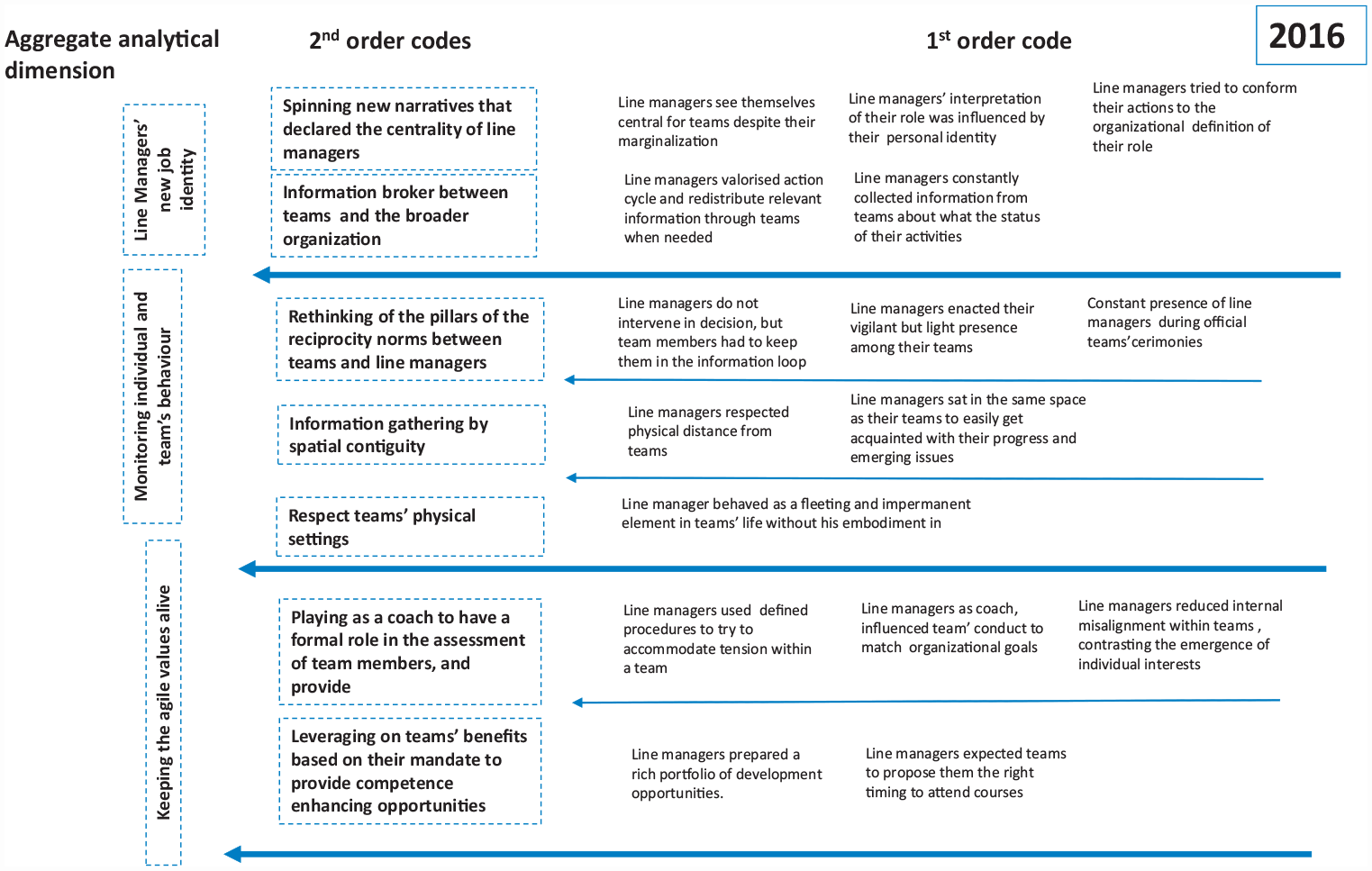
Data structure—line managers’ areas of intervention at maturity of agile transformation.
Line Managers’ New Job Identity
In the second stage of the agile transformation, a new structural change occurred with line managers being assigned a more refined role. They formally passed from being active agents responsible for restoring the software development flow to becoming responsible for coaching and developing teams and championing activities to enhance their performance. The total organization was perceived as the bearer of agile values with the agile teams being “all believers.” This external event and the different cognitive status of agile teams triggered a cognitive redefinition of managers’ interpretation of their role.
For line managers, the maturity phase of the agile transformation opened up a period of deep reflection about their job identity. The beginning of the transformation was busy, even messy. Nevertheless, line managers were reference points for managing the transformation. At maturity, there was a decreased dependency by teams on line managers (teams were now autonomous, knowledgeable of agile practices, and aware of their meanings). In addition, the emotional and political struggles between line managers and team members (which characterized the first phase of the agile transformation) faded away and were replaced by some implicit agreements about expected reciprocal behaviors:
“As far as we are concerned, as long as our line manager does not interfere too much in our choices; she has a positive role.” (Team member).
Yet, rather than embracing a truly collaborative way of working with line managers, teams limited the provision of information to line managers, thus severely limiting the scope for line managers’ interventions. In 2016, the organization had already structured the environment, translating into symbols and rituals the promises of keeping teams autonomous. Top management had reserved for teams their operative and physical space to operate where their managers should not enter. Line managers had to keep a distance from processes of software development and limit their intervention to situations of emerging tension/problems in their teams.
For this reason, line managers had to informally interact with their team to be able to extract the information they needed while avoiding making team members feel overruled by managerial intervention in the software development process. The tension for managers was how to establish relevant communication with their teams to be reactive on the problems and stimulate them in order for them to reach high performance and to keep aligned with the core business and competences of the firm.
Line managers had to invent different strategies and leverage their personal characteristics to stimulate bottom-up dialogue on new ideas or solutions that teams were working on. An example of a strategy to keep the relationship with the team open was one manager who avoided discussing performance with the team but instead directed attention to their activities, informally asking them about status updates.
However, in the absence of clear prescriptive managerial guidelines on how to perform their assigned roles, line managers’ personal identities gained more centrality in shaping the interpretation of their jobs and they started “tailoring” their role identities so that they could better fit their sense of self.
One common action in this phase was spinning new narratives that declared the centrality of line managers despite their apparent marginalization. For instance, a line manager described his role as a “sentinel.” Along a similar vein, another line manager added the following view of her role: “[I] blend the traditional role of line manager as impediment solver with an interpretation of informational broker, creating ties among individuals when needed.” The Head of TelCom summarized this plurality of interpretations along the following lines:
“This can be different manager by manager, because some of the managers have some kind of routines where they have a regular chat with the individuals. It’s not the same principle for all the managers but some of them are applying this principle; other managers are using other kinds of techniques.” (Head of TelCom)
Monitoring Individual and Team Behavior through Spatial Proximity
In this phase, top management decided that line managers had to be seated very close to their teams. The idea was that such spatial proximity would enable line managers to promptly manage any deviation from the agile values. A non-negotiable red line in the relationship between line managers and teams emerged: all line managers had to respect teams’ spaces and settings. The team’s workspace was their own space, a protected environment where team members could work away from the pressure of the line manager’s validation. Indeed, line managers stayed far from the holding environment of teams so that they could remain open to what would unfold within them:
“Normally I stay quite far from the meetings, from inside their dynamics, because I prefer to let them have self-responsibility to work by themselves, and just put the embodiments on my table if they have some.” (Line manager)
The cohabitation of common open spaces by line managers and teams enabled information gathering by spatial contiguity:
“Interaction with the line manager is daily because the line manager is also sitting next to us: we are in the same open space.” (Team member) “I prefer normally to go around, to see how they behave, and in case there are some aspects that I think need some discussions, I immediately give people feedback.” (Line manager)
Line managers became aware that achieving proximity was a good step toward obtaining information from the teams, but that this was not enough to systematically deliver on their mandate to manage the performance of the teams. This consideration triggered a deep rethinking of the pillars of the reciprocity norms between teams and line managers. A new social exchange contract emerged based on a do ut des (i.e., something for something) norm. To answer the demand coming from the teams for more information on what was going on in the organization, line managers started positioning themselves as facilitators of social connections, for instance, by creating the conditions for joint problem-solving of emerging challenges:
“Then we promote in the organization some challenges and teams can join, participate, or they can form virtual teams to address these challenges.” (Line manager)
At the same time, being exposed to top management and other colleagues in the middle management layers of TelCom, line managers positioned themselves as information brokers between teams and the broader organization:
“If they have any problem, sometimes I’m also called by them because they have some impediments. In this discussion I try also to get the chance to say: Have you talked with this other team? . . . I try to suggest connections, to encourage them to team up with each other in order to solve problems or to improve.” (Line manager)
Overall, team members found these actions useful and became more open to discussing issues with their line managers, beyond the narrow scope of their workflows and the formal interactions in the stand-up meetings.
Keeping Agile Values Alive
In this phase, the organization showed a significantly increased acceptance of agile values and practices. Nevertheless, line managers were aware that the agile values established in the first phase of the agile transformation could lose their resonance with some team members. This awareness was based on the observation that the different interpretations brought forward in Phase 1 about how to enact agile values were still creating disorientation, and disengagement, in some team members. Furthermore, the professional aspiration of achieving technical specialization—which was not always compatible with the agile values and practices of sharing, collaboration, and flexibility—periodically resurfaced in some team members. Thus, line managers directed their action toward maintaining the agile values alive by evaluating team members’ adherence to such values and desired behaviors. More specific social and political activities were required by line managers to detect unacceptable behaviors, and top management supported this broader set of actions. Specifically, the organization (see Table 1) required line managers to take on the role of coaches to have a formal role in the assessment of team members and to provide directions:
“All the line managers are trying to perform coaching to their people. Line managers have a lot of influence in terms of coaching.” (Head of TelCom)
As a consequence of the process of (team) coaching, line managers deployed their political skills to delegitimize certain behaviors and legitimize and affect the change as needed. They used their own developed management procedures to try to accommodate the agile values within teams’ work. Line managers also took care of possible internal misalignment between the new social arrangement imposed and the interest of diverse actors in their teams. By having regular and frequent formal coaching meetings with teams, line managers could become conscious of when teams’ needs were unmet and could act to change them.
Furthermore, line managers leveraged their benefits based on their mandate to provide competence-enhancing opportunities for team members:
“We have a lot of initiatives to address and to grow competences. We have a certification program, we have a lot of courses, we have the software master initiatives, and a lot of other activities . . . Lots of initiatives that aim to speed up and support the competences’ growth of the people. . .We have regular surveys to measure the level of competences based on self-evaluation.” (Line manager)
While the choice of attending such courses was exclusively within the scope of the individual team members, the competence-enhancing programs created opportunities for line managers to collect even more information about team members:
“With the Line Manager, team members make individual interviews, so it is agreed together what type of course is needed or for a path of personal growth or, rather in addition to this, it may happen that perhaps it is necessary to do build-up of competence on a domain or on a technology . . . So the same person or team that needs to do build-up of competence, asks the Line Manager how to get organized, take advantage of the training labs, or try to work side by side with the support of other teams who perhaps have that competence.” (Team member)
Overall, in the mature phase, line managers’ formal and informal control mechanisms shaped robust channels to obtain relevant information about any deviation from the team members’ expected behavior.
From Missionaries to Priests: Evolving Tensions and Structural Dimensions Supporting Line Managers’ Actions
Our model (summarized in Figure 3) shows the macro areas of intervention and the actions performed by line managers to support the diffusion and adoption of agile practices in a successful large-scale agile transformation. At the same time, our models allow us to identify the underlying tensions between line managers and team members and the underlying structural dimensions supporting line managers’ actions. Table 2 summarizes such tensions and the characteristics of line managers’ effective interventions.
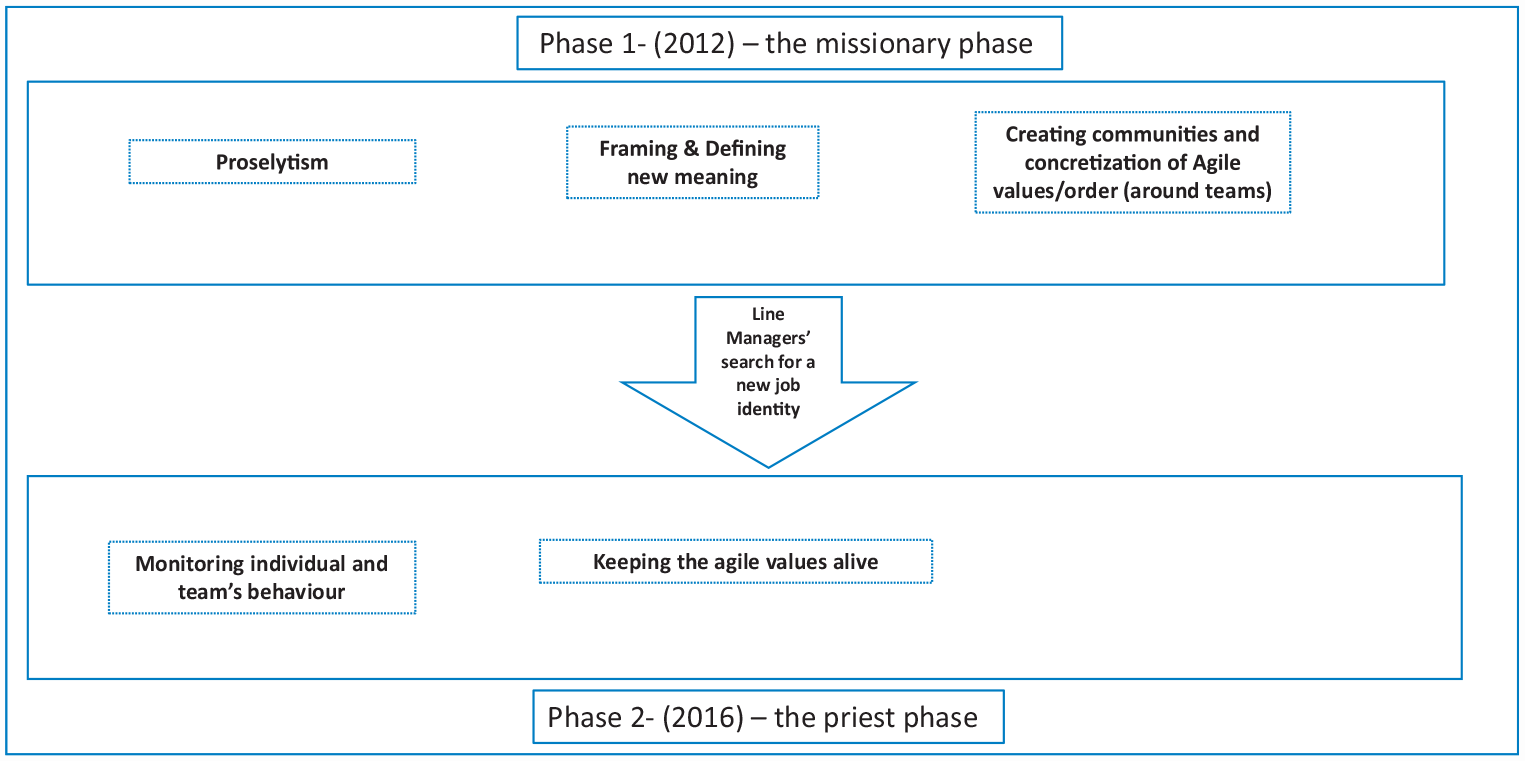
Longitudinal view of line managers’ role evolution.
An Evolutionary View of Line Managers’ Role along an Agile Transformation.
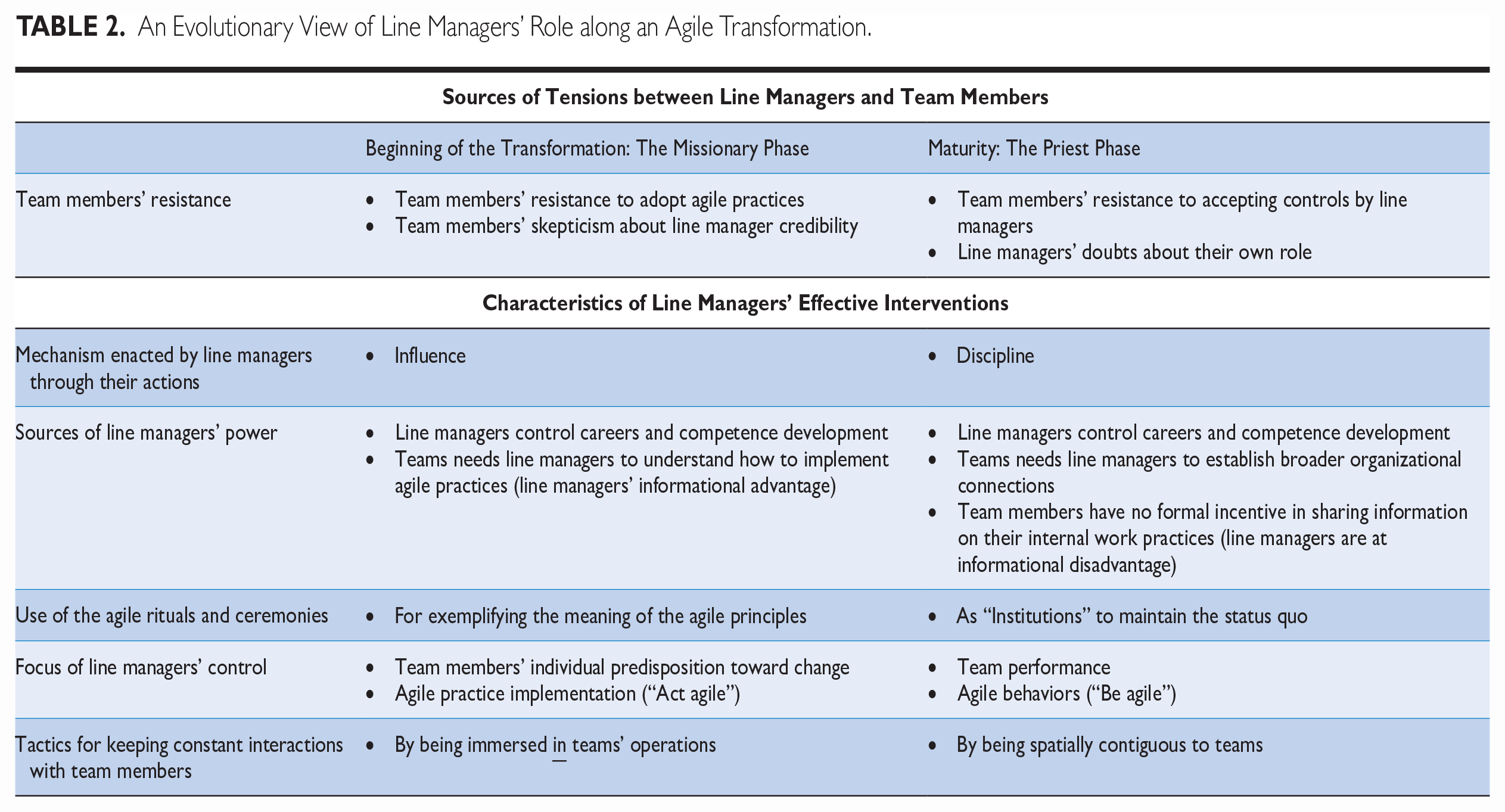
In the initial phase, the missionary phase, the key sources of tensions between line managers and team members were rooted in team members’ resistance to adopt agile practices as well as their limited trust in line managers that presented themselves as champions of agile practices after a history of “command and control” managerial approaches. Addressing these tensions, line managers’ actions were mostly aimed at influencing (and manipulating) people’s perceptions, cognitions, and preferences to enable the acceptance of agile values and agile practices. The setting of new rites, ceremonies, and other symbolic events complemented and reinforced line managers’ influencing actions. The effectiveness of such actions originated from two power asymmetries between line managers and team members. First, line managers’ power was based on their “by-design” role as responsible for team members’ career development. Second, line managers’ power was based on their informational advantage: they knew more than team members on how to act by the agile values and implement agile practices. The latter power asymmetry helped line managers to motivate, and gain acceptance for, their deep involvement in teams’ daily activities. In turn, this intimate involvement in teams’ activities allowed line managers to control on a daily basis team members’ predisposition toward agile practices and their actual change in behaviors (“act agile”).
At maturity, the priest phase, the formal role of line managers changes dramatically. In this phase, agile values and agile practices were widely adopted, and line managers’ formal job description changed as well. Line managers were asked to coach and develop teams as well as champion new initiatives to enhance team performance. In this phase, the organization was already structured to support agile values and agile practices including symbols and rituals. In this context, line managers faced brand new tensions. First, line managers had to grapple with team members’ resistance to accept being controlled by any external entity, including line managers themselves. Second, line managers’ recently acquired convictions about their role in agile settings were shattered by the new organizational realities. For instance, while teams were formally asked to inform their line managers about emerging issues potentially affecting deliveries, in practice, line managers were dependent on teams’ goodwill and mercy to collect any relevant information. Overall, line managers faced a deep internal crisis to redefine their role.
Forced to navigate these tensions, line managers used discipline mechanisms to renew team members’ adherence to agile values. Discipline mechanisms 17 were founded on baseline rules about “be agile” that “[had] to be respected as an optimum towards which one must move.” Controls were performed by line managers through the mechanisms of team members’ performance management (it is important to recall that in the mature phase of the transformation, team member performance management became central in line managers’ activities). As noted above, in the mature phase, team members had no real incentive to share with their line managers information about their internal work dynamics. To accomplish the purposive action of informal control through discipline, line managers secured their commitment to the attendance of agile ceremonies and had to develop more specific social and political activities to informally interact with their teams. Hierarchical observation in the form of intense and continuous surveillance was enacted by line managers’ spatial proximity with team members, a form of “always on” surveillance with team members. In summary, at maturity, the sources of power for line managers shift from controlling resources and product workflows to shaping and controlling behaviors of individuals within teams. The overarching problem for line managers is to come to terms with this new reality.
Our study provides a comprehensive analysis of line managers’ areas of intervention, the tensions that such interventions address, and the levers of control that enable the effectiveness of line managers’ actions at the beginning and at the maturity of the agile transformation. Our findings complement the agile leadership literature by adding a social interaction and organizational explanation for the emergence of line managers’ leadership behavior over time. 18 Furthermore, we also complement the broader leadership studies that link the changes in leadership behaviors to problem-solving, monitoring, and supporting others 19 ; to interactions between actors 20 ; and to changes in the organizational context.
Final Remarks: What Agile Implementation Can Teach about Selecting Agile Managers
Our findings shed light on a fundamental trade-off to building agility 21 —that is, how to navigate the paradox of granting autonomy to teams while seeking their alignment to strategy. In seeking to align autonomous teams to firm strategy, a key challenge for managers is acquiring information from their teams. Not surprisingly, autonomous teams are jealous of their autonomy and can see attempts to collect information as an intrusion. Our research shows that line managers overcome this informational gap by creating a new do ut des social contract with teams. Granted, teams price their autonomy, but also the most independent teams need to build a better understanding of “what’s going on” in the organization. Leveraging this need—that is, that even autonomous teams need to feel part of a bigger picture—managers can position themselves as brokers of both organizational connection and strategic information for teams in exchange for teams’ benevolence in sharing information about themselves and even accepting “always on” surveillance.
The second insight for agility refers to what managers should control when dealing with autonomous teams. Managers cannot control how teams perform their activities as this would be a violation of the principles of autonomy. Yet, the fact that team members behave in accordance with autonomy principles should not be taken for granted. This consideration opens the scope for management to focus their controls on observing behaviors and their adherence to agile principles, rather than focusing on individual performance.
Implications for Selecting the Right Managers for Agile Transformations
Extant studies have mostly focused on top managers and high-level leadership characteristics, 22 while the role of middle managers has been mostly overlooked. Our findings contribute insights to describe the needed competences and behaviors of line managers. Specifically, when selecting line managers, companies should look for the following competences in candidates. First, people selected for the position of line manager should be eclectic and exhibit adaptability. In other words, candidates for the role of line manager should exhibit an attitude to work across several leadership dimensions including sensegiving, relationship nurturing, and influencing without authority. Second, people selected for the position should show a willingness to accept the cognitive and emotional challenges of building their professional identity in a dialectic way, as a constant interaction with, and as a response to, the emerging challenges that teams posit over time. Third, line managers must show willingness and attitude to build trust with team members in an organizational context where they do not have hierarchical superiority to teams (they are considered as being at the same level as team members) and cannot command trust by technical leadership (line managers cannot interfere in technical matters). As such, they need to build credibility with teams by “making themselves liked” and leveraging their soft skills. Fourth, people selected for the role of line manager should show an excellent attitude and interest in understanding the firm’s overall strategy and exhibit political and communication skills to be among the first to learn about changes in strategy and to be adept in translating them at the team level. Our findings show the centrality of line managers as a liaison between firm strategy and teams, continuously translating firm strategy to team members, thus enabling a “real-time” alignment. Overall, line managers provide the leadership needed to avoid team autonomy morphing into team siloism. Perhaps this is the most critical component driving success for line managers. Fifth, our evidence suggests that the emergent actions of line managers, especially at the maturity phase, are influenced by a process of personalization of their job identity where a great relevance was exercised by the line managers’ experience and work-life having shaped the improvised solutions and the experienced approaches with teams. Therefore, the selection of line managers should take into consideration background and experience in the role, which can secure a successful relationship with the institutions and with teams.
Footnotes
Notes
Author Biographies
Maria Carmela Annosi is an Associate Professor of organization theory at Wageningen University & Research, School of Social Science. (
Gianvito Lanzolla is a Professor of strategy at Bayes Business School (formerly Cass) at City, University of London. (