




Abstract
Early detection of weak external signals is increasingly critical for strategic agility. While many organizations scan for weak signals, most dismiss them as anomalies, principally due to poor amplification strategies. Several challenges hinder the necessary amplification and sensemaking of weak signals for organizational awareness. This article analyzes 139 proof-of-concept projects with startups and 15 interviews with executives involved in the projects at a leading German mobility corporation, and it reveals four actions to amplify weak external signals, thereby enhancing organizational hyper-awareness. It illustrates the actions with examples and presents the implications for both weak signals and strategic agility management.
Keywords
“The best way to predict the future is to create it.”—Peter F. Drucker
Early detection of weak external signals is increasingly critical for organizational survival and growth. Weak external signals are early symptoms of possible changes in the future (strategic discontinuities) that can either threaten a firm’s existence or make it miss exploiting an opportunity. 1 Scanning the periphery for weak external signals has become sophisticated with organizations using different tools, techniques, and approaches to scan. 2 IBM’s “Crow’s Nest” and Sony’s “Antennae Shops” are popular examples of scanning the periphery for weak external signals. While most leaders acknowledge the importance of identifying weak external signals—improve peripheral vision, identify potential disruptions, and avoid surprises—knowing which ones are important remains a challenge. 3
History is filled with examples of organizations that bore the brunt of not responding to weak signals—Nokia overlooking the rise of smartphones, Xerox disregarding the rise of the graphical user interface 4 , Kodak discounting the emerging trends in digital photography and photo sharing 5 , or Mattel ignoring the changing preferences of teenage girls. 6 All the above-mentioned organizations had good weak signal detection mechanisms. Xerox saw the rise of the graphical user interface, Kodak noticed the shift toward digital photography, and Mattel watched the growth of Bratz. Most of them had the resources and the reach to respond to potential strategic discontinuities and avoid strategic surprises, yet failed to do so. One strong reason for this was their inability to make sense of the weak signals that were interesting and important.
While many organizations scan for weak external signals, most dismiss these weak external signals as anomalies, principally due to poor amplification strategies. 7 Anomalies are “weak signals that are in some way surprising but not entirely clear in scope or import.” 8 Interpreting weak signals takes time, resources, and focus. It requires an open mind that can take in external inputs, challenge existing assumptions and mental models, and embrace ambiguity. 9 All of the above characteristics make it difficult to embrace sensemaking and amplification strategies, unless there is strong management volition and courageous leadership.
Our study builds on the three-stage model of Schoemaker and Day 10 : scanning, sensemaking, and probing and acting. Scanning for weak signals involves actively seeking out weak signals, sensemaking involves amplifying interesting weak signals, and probing and acting begins post-amplification, and involves confronting reality, engaging in constructive conflict, and respecting intuition. While many organizations have become good at the scanning phase and are therefore able to detect weak signals, most remain confused with the sensemaking phase. 11 Though many approaches (gathering wisdom from crowds, scenario planning) have been proposed for the amplification of weak signals, they remain vague and largely cognitive experiments. Due to the predominantly cognitive nature of current amplification strategies, individual and organizational cognitive biases—such as the ad-hoc nature of search, CEO-frontline worker distance, individual and organizational biases, and poor integration of information—limit this amplification and sensemaking. 12 Therefore, the sensemaking phase is considered the feeblest link in the weak signal identification process. 13 To help fill this gap in our understanding of both theory and practice, we ask the question: How can organizations amplify interesting weak signals to make better sense of them?
We analyzed 139 proof-of-concept (PoC) projects at a leading German mobility corporation and supplemented it with 15 interviews with executives involved in these projects. These PoC projects, between new ventures and the parent organization, were supported by the corporation’s corporate accelerator (CA). 14 The CA scouts and selects new ventures and connects them with a suitable organizational unit from more than 100 units that exist in the corporation. The CA facilitates the creation of PoC projects that adopt agile action-based hypotheses-testing principles. Our analysis of the PoC projects and interviews revealed four ways in which organizations can amplify weak external signals enabling a hyper-aware organization.
In line with the growing importance of action over analysis to make sense of uncertainty, 15 we provide four specific actionable approaches to amplify weak signals: embody actions that bring the weak signal closer to the existing knowledge base; extend actions that increase weak signal intensity; examine actions that move the organization closer to the source of the weak signal; and elucidate actions that lead to recalibrated scanning. An action-based approach to amplification is a significant departure from past literature on the sensemaking of weak signals, which is predominantly cognitive. Our amplification framework indicates that different weak signals can benefit from different amplification strategies. While some amplification strategies will individually enable the discovery of potential discontinuities, others may do so cumulatively. Our portfolio of actions increases strategic sensitivity, thereby improving strategic agility.
Background
Strategic Agility, Weak Signals, and Hyper-Awareness
In an increasingly uncertain world, organizations are grappling with the challenges of ambiguity and complexity. Strategic agility is an organization’s ability to swiftly change the direction of the core business in the face of an uncertain environment. 16 Strategic agility can influence organizational performance through rapid changes in business models, acquisitions, internationalization, and information technology. 17 Therefore, developing strategic agility remains a CEO’s top priority. 18 While a 2020 McKinsey survey reconfirmed this finding, 19 36% of the 550 executives who took part in a 2020 IMD survey involving large organizations identified that building strategic agility remains challenging as it requires managing paradoxes at multiple levels. 20 Despite the challenges, strategic agility remains an important organizational capability. 21 It consists of three meta-capabilities that together enable an organization to quickly change strategic direction: strategic sensitivity, resource fluidity, and top management leadership unity. 22 We particularly focus on strategic sensitivity, which is defined as “the sharpness of perception of, and the intensity of awareness and attention to, strategic developments.” 23 While perception refers to scanning for weak signals; heightened awareness and attention to developments of strategic importance (hyper-awareness) requires sensemaking of weak signals early.
Weak signals can be defined as “seemingly random or disconnected pieces of information that at first appear to be background noise but which can be recognized as part of a larger pattern when viewed through a different frame or by connecting it with other pieces of information.” 24 Therefore, weak signals are early indications of strategic discontinuities that, when ignored, can lead to strategic surprises. 25 Organizations use several tools to scan for weak signals. Listening posts (such as technology scouts, extended networks, and autonomous cells) are popularly used tools to actively surface weak signals. Although a seemingly attractive option, forecasting tools do not help very much when dealing with uncertainty and weak signals. 26
While many forward-looking firms have invested in weak signal scanning tools and techniques, some of them ended up facing strategic surprises. 27 One strong reason for this is the poor sensemaking of these weak signals.
Sensemaking and the Need for Amplification
Sensemaking is the process of amplifying interesting weak signals to make them more visible to the organization. 28 A few popular approaches available to make sense of weak signals include hypotheses testing, crowdsourcing, and scenario development. 29 Although well-intentioned, hypotheses testing is largely a cognitive exercise of fitting new information vis-à-vis existing mental models and making educated guesses. It is not surprising that creating alternate hypotheses is cognitively challenging and prone to individual and group biases. In recent times, different forms of active experimentation are being embraced by organizations, which indicates a greater need for more action-orientation in sensemaking. 30 Crowdsourcing ideas have become widely popular after James Surowiecki wrote about it in his book The Wisdom of Crowds. 31 One way of doing so without succumbing to conformity and collective myopia is to keep the process anonymous. Yet, crowdsourcing as a strategy appears more effective with sourcing weak signals than amplifying them. 32 Another popular tool to overcome dominant views within organizations is scenario development. 33 The principal use of scenario development and planning is to challenge existing mental models. 34
Irrespective of the tool chosen, all the approaches depend a lot on the cognitive function at both individual and organizational levels, thereby suffering from individual and group biases. 35 Action-oriented approaches can overcome some of the inherent challenges present in cognitive-based approaches. Action-based hypothesis testing approaches have been successfully used within the lean startup movement. PoC projects within CA units can benefit from agile action-based approaches. 36
Weak Signal Amplification: A Four-Fold Typology
Ever since Schumpeter coined the phrase “creative destruction,” 37 the scanning and making sense of “strategic discontinuities”—critical moments that challenge a firms’ ability to adapt and survive 38 —have remained a top priority. 39 Strategic discontinuities primarily arise from two sources: technological and market. 40 Scanning and sensemaking of weak signals involve looking at both technological and market discontinuities. Since both discontinuities arise out of new knowledge, we explore the distance of the new knowledge vis-à-vis the firm’s current knowledge base. We therefore use the two dimensions of discontinuity type and knowledge periphery to build a typology that categorizes the various types of weak signals.
Discontinuity Type: Technology versus Market
Technological discontinuities refer to any significant technical advance that renders past technology uncompetitive. 41 Market discontinuities refer to any shift in market forces or their interrelationships. 42 While technological knowledge refers to knowledge associated with products, technologies, and/or processes, market knowledge refers to knowledge associated with targeting customer sets, entering markets, distribution channels, marketing approaches, and business models. 43
Knowledge Periphery: Proximate versus Distant
While it is widely acknowledged that new knowledge is critical for organizations to thrive and survive, the relatedness of this new knowledge is a critical factor in deciding how much of this new knowledge is absorbed and used. 44 The distance of the new knowledge vis-à-vis the existing knowledge base affects the organization’s sensemaking. Hence, we divide the new knowledge into proximate and distant. Proximate new knowledge is the new knowledge that is relatively close to the firm’s present knowledge base and distant new knowledge is the new knowledge that is relatively far from the firm’s present knowledge.
Method
The research design of our study follows the guidelines from Fisher and Aguinis 45 on theory elaboration research. Theory elaboration is used to develop, expand, or tighten theoretical ideas. This approach has been used extensively for advancing management research and practice. 46 In our study, we used construct splitting to further specify the sensemaking stage of the three-stage model for weak signals of Schoemaker and Day. 47 To do so, we leveraged the unique access to the accelerator of a German mobility corporation’s PoC projects and their management team to elaborate and extend the existing model of weak signal amplification. The access was granted through the professional network of one of the authors who works at the German mobility corporation.
Research Context
The German mobility corporation runs two acceleration programs per year, with multiple PoC projects in each program. To maintain anonymity, we use fictitious names for all the firms involved. The company we call “Covalent Corp” set up the CA in 2016 with the aim of accelerating partnerships with startups that may have a potential strategic fit. 48 We decided to focus on this single case for an in-depth examination of the phenomenon, 49 which is especially relevant when building theory about emerging topics. 50 The privileged access we received to a normally inaccessible setting allowed us to look behind the scenes with direct access to the organizational units’ managers who engaged in the PoC projects as well as rich secondary data (including internal corporate data) on each of the projects. 51
The CA team is responsible for scouting startups and supporting PoC projects between technology startups and organizational units of the corporate. We use the term “organizational units” to refer to different departments of the company (e.g., units from different departments such as R&D, mobility services, or production). The CA team has supported 139 PoC projects between the organizational units and startups. These projects have triggered several follow-up projects and about 15 innovations that ended up in products, services, and processes of the corporate.
The CA engages with the organizational units to help define search fields that are topics of organizational interest. The CA actively scouts for new ventures and jointly, with the managers of the organizational units, decides which get selected for the next stage—the PoC project phase. From hundreds of startups scouted each year by the CA unit, only a few are selected by the organizational units for conducting PoC projects. The PoC projects help organizational units gain clarity (amplification) regarding the startups’ knowledge area (weak signal), which helps Covalent Corp’s organizational units learn if they should give more attention to technologies or market changes. The PoC projects also help Covalent Corp identify “technology dead ends”—weak signals that upon amplification do not show promise. This results in the termination of the corporate-startup collaboration after the PoC. New ventures are one key way to address weak signals. 52 Sensemaking is described as a process where “action and commitment enter the picture while accounting for the very real risk of pursuing dead-end strategies” that can be executed through “small, well-designed experiments that explore new strategic initiatives.” 53 PoC projects between organizational units and new ventures have an action-based, time-limited, experimental character, making them a good empirical setting to study weak signal amplification. Therefore, PoC projects provide a suitable proxy to explore the sensemaking stage (amplification of weak signals) in the Schoemaker and Day model. 54
Data Collection and Analysis
In line with Schoemaker and Day’s model, 55 the CA unit actively scouts for startups using search fields, which helps surface weak signals for the corporation. To amplify interesting weak signals, Covalent Corp conducts PoC projects. Since the focus of our study lies in unpacking the sensemaking stage, we chose to study the 139 PoC projects at Covalent Corp and used it as a starting point for our data collection and analysis.
First, we hand-collected and created a dataset involving detailed information regarding each of the 139 PoC projects. This included internal documentation from the CA team and organizational units (overviews of PoC projects, overview of scouted startups, presentations for organizational units, meeting notes, and reports of conducted PoC projects from organizational units). We enriched these documents with public data such as press releases of Covalent Corp (about CA, PoC projects, and Expo Days), the website of Covalent Corp, and the CA. We also added hand-collected publicly available data about the startups (e.g., websites, databases with information about technology, headquarters, founding year, funding, founders, and team) and the startups’ pitch decks.
We then reached out to several managers from the organizational units and the CA. We interviewed organizational unit managers who interacted directly in a PoC project with a startup within the last two years. Semi-structured interviews allowed us to probe and explore the depth and richness of PoC projects. We started the interviews with open questions about the selection process of startups and proceeded with more specific questions about the PoC projects conducted (e.g., goals of the PoC, type of innovation, phases, and challenges). We also included interviews with the CA’s program managers (individuals who oversee the daily operations of the CA unit) to understand and validate the PoC projects.
We deep-dived into the dataset of the PoC projects to identify and classify PoC projects as per the typology presented above. We identified 47 of PoC projects in proximate technological discontinuities; 26 projects in distant technological discontinuities; 44 PoC projects in proximate market discontinuities; and 22 PoC projects sensing distant market discontinuities. The initial classification of the PoC projects was done by one of the authors. To verify these results and increase validity, an external researcher independently categorized the PoCs and cross-checked the outcome with the initial classification. For the few cases where classification discrepancies emerged, further details of the project were analyzed until both researchers reached an agreement regarding the classification.
Once the data from the interviews were transcribed, we started to actively categorize the data with consideration to our theoretical grounding. 56 We approached the data with specific questions in mind, covering topics such as reasons for the selection of specific startups and technologies or PoC project goals set by the organizational units. We continued our analysis by moving from key quotes to categories and then cross-checked the quotes in each category with the data from the PoC projects constructed earlier. We engaged in the process of contrasting the categories to establish the boundaries between them and distilling their distinct meaning. 57 As a result, we were able to triangulate our findings from the secondary data with the interview data.
Concentrating on amplification actions helped us notice subtle differences in the amplification approaches employed by the corporation across the four categories. This led us to creating the 4E framework representing different actions that organizations can take to amplify interesting weak signals. We then selected eight PoC projects that illustrate the different amplification actions. Table 1 provides a brief overview of the eight sample PoC projects.
Illustrative Examples of PoC Projects.
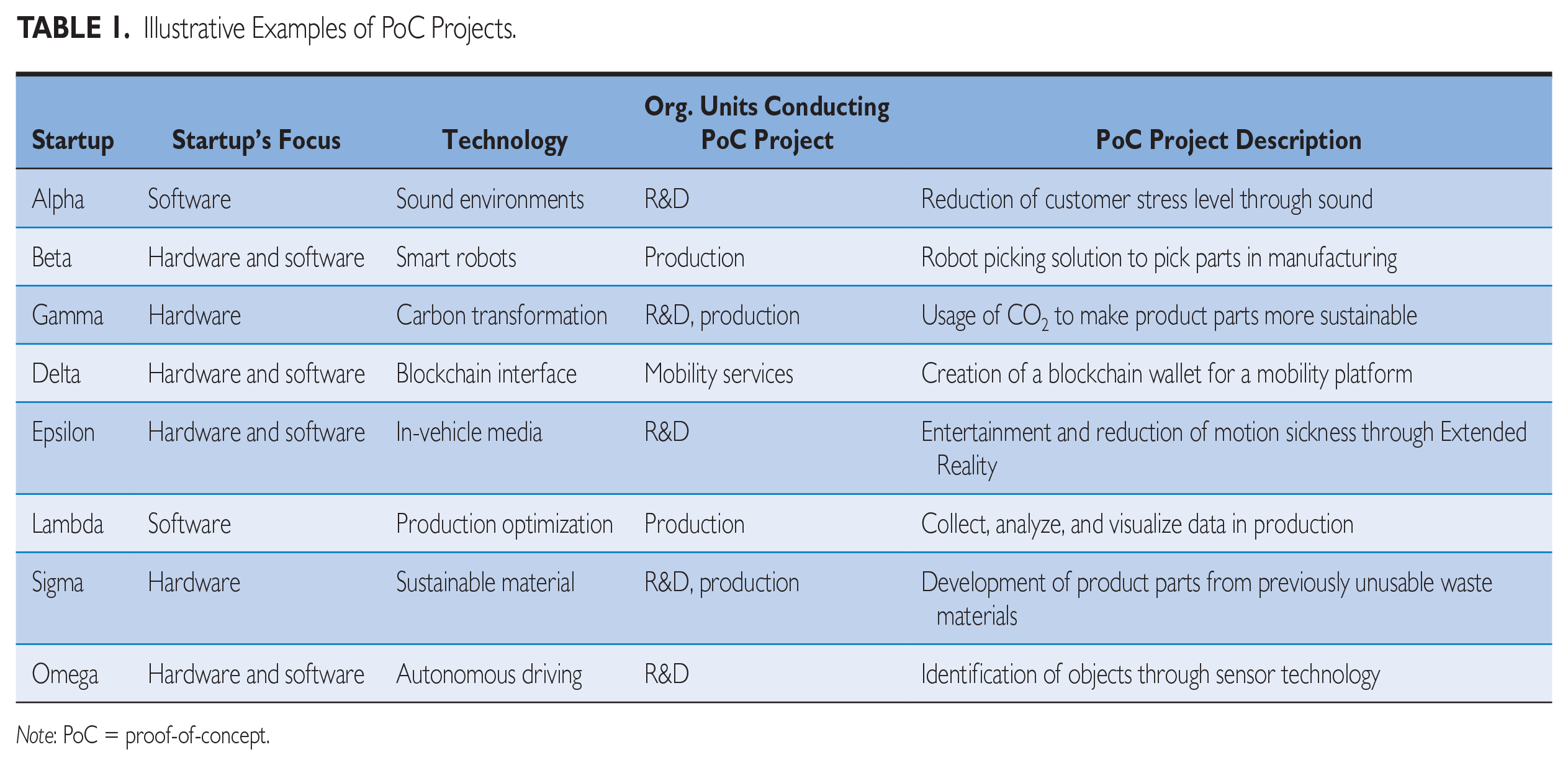
Note: PoC = proof-of-concept.
Finally, to validate our findings, we presented our 4E framework to the CA manager and discussed the different amplification approaches until we were confident with our categorizations.
Amplifying Weak External Signals: The 4E Approach
Viewing our PoC projects through the typology presented above helped us notice the subtle differences in the sensemaking actions (how corporations differently amplified interesting weak signals). As noted, we observed four types of amplification actions: embody, examine, extend, and elucidate. Each of these actions (see Figure 1) differed in subtle, yet significant ways. We detail the four actions below, define what they are, how they amplify, who triggered the PoC project, and present case vignettes to showcase their manifestation in managerial practice. We noticed that the proximate weak signal amplification was triggered by organizational units due to their interest in learning how a technology discontinuity would challenge their existing solution, and the distant weak signal amplification was triggered by the CA unit or at times the research and development teams by urging organizational units to imagine if disruptions would make them obsolete. Table 2 provides representative evidence which highlights key differences in the four amplification actions.
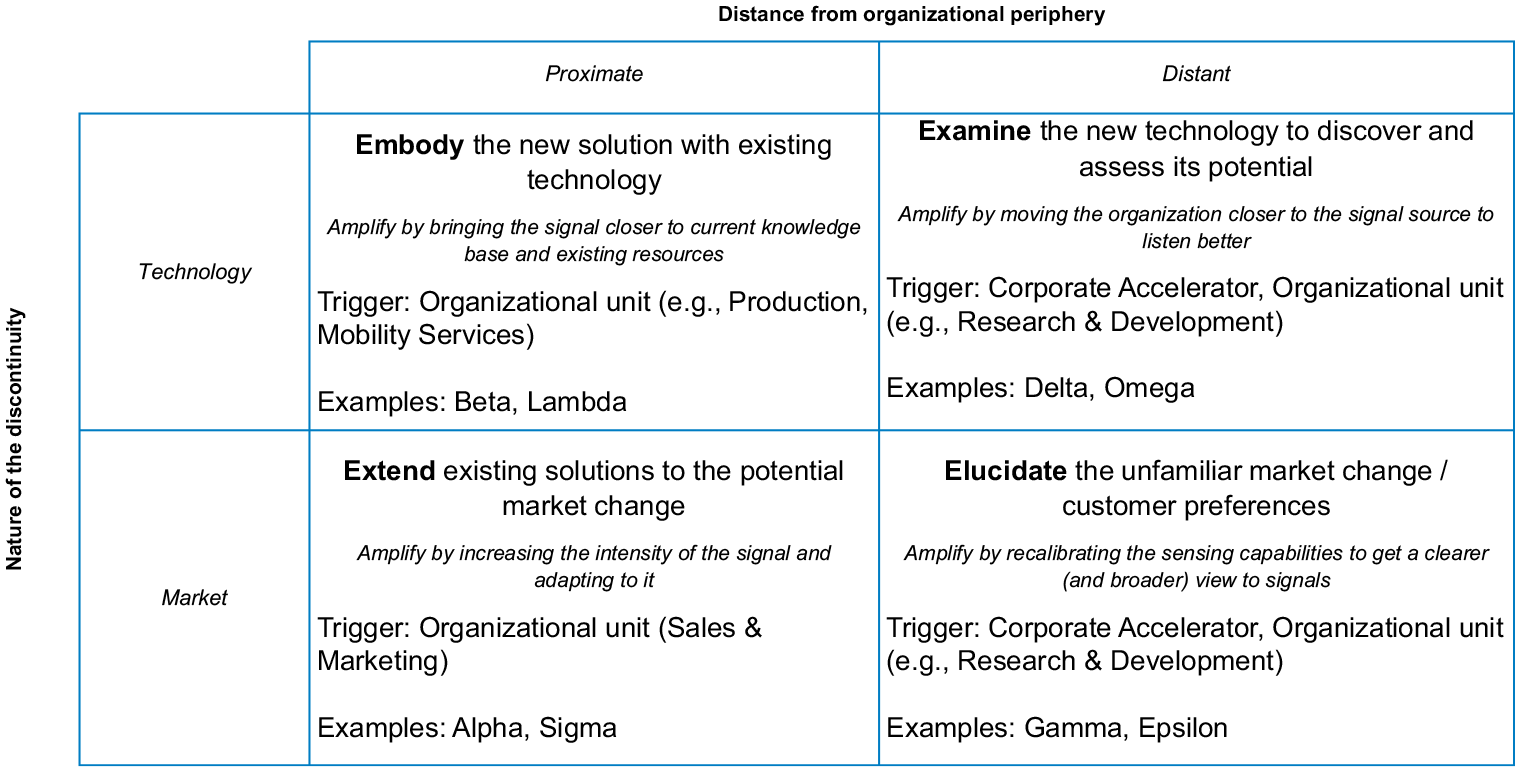
Amplifying weak signals—The 4E framework.
The Analytical Process behind the 4E Framework.
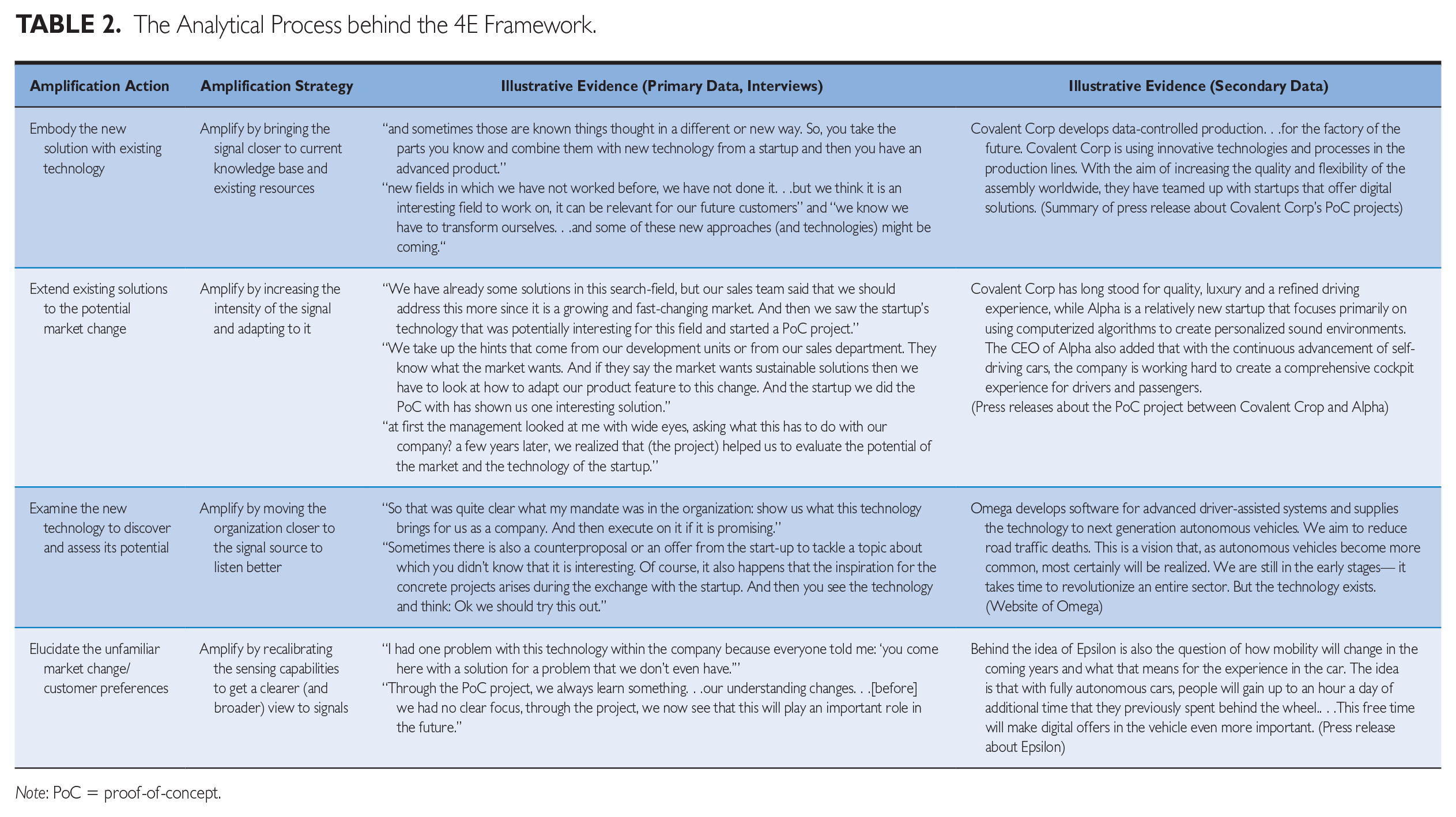
Note: PoC = proof-of-concept.
Embody
We label the weak signal amplification actions pursued by corporations toward proximate tech discontinuities as “embody.” These embody actions involved attempts by the corporation to bring a signal closer to the current knowledge base. Though such weak signals appeared close to the existing organizational knowledge boundary, there was a fair amount of uncertainty around how and why the organization should act upon them. This required a PoC project to better understand the signal. The goal of these PoC projects was to assess the potential integration of the new solution (built by the startup). During these PoC projects, leaders constantly assessed how the new solution could enhance the current value creation for the customer or for internal processes. The outcome of embody actions is to decide on whether to further integrate and extend along this direction.
Illustrative cases of embody actions
“Beta” is a good example of a PoC project that falls into the embody action category (see Table 2). The startup Beta has the vision to make industry robots smart through Artificial Intelligence (AI). Therefore, they develop intelligent systems that allow robots to overtake new roles in production or logistic processes that current robots were unable to fulfill. While large parts of Covalent Corp’s manufacturing, production, and logistic processes were partly or fully automated, an autonomous and intelligent production system was a future scenario not yet embraced. Beta, along with a production unit, co-developed an AI-enabled robot system with an advanced gripper that can pick parts from a manufacturing supermarket. The PoC project led to the development of a prototype, which can automatically identify and pick around 100 different parts from the boxes in the shopfloor.
Another example for the embody action was the PoC project with the startup “Lambda.” Lambda makes complex production processes transparent through machine learning. Their software collects data from varied sources (e.g., Enterprise Resource Planning systems) and analyses the data to create data models and visualize them. Their software represents a completely different approach to identifying problems in running processes, generating measures to uncover previously unknown correlations. It also increases production process transparency and helps reduce quality issues within production lines. While Covalent Corp has extensive experience in complex production environments, Lambda’s new technology (sensemaking large amounts of data from the production process) helped bring a proximate tech discontinuity closer to Covalent’s knowledge base. The experimental PoC project was done with the goal of assessing the potential increase in both product quality and assembly flexibility. While it used existing data, the analysis, interpretation, and visualization of gaps in the assembly line were something completely new. With Lambda’s PoC, it was then possible to explore conspicuous trends in the data and identify tiny defects. Although the PoC project was finished successfully, Covalent Corp decided to terminate the collaboration, since there were not enough use cases within the company’s production lines for rolling out Lambda’s solution.
Examine
We label the amplification actions pursued by corporations toward weak signals regarding distant tech discontinuities as “examine.” These examine actions involved moving the corporation closer to discovering the potential of the new technology. Since the identified weak signals were relatively far from the existing organizational knowledge boundary, corporate leaders recognized there were substantial unknowns and acknowledged their inability to visualize the impact on the corporation. The goal of these PoC projects was to learn if the novel technology had real potential. During these PoC projects, leaders had to creatively design potentially relevant use cases that could examine certain assumptions about the weak signal using the startup’s solution. The outcome of examine PoC projects was to decide whether the weak signal merited further organizational attention.
Illustrative cases of examine actions
The case of “Delta” (see Table 1) is a good example of an “examine” type of amplification action. Blockchain is seen as an emerging technology that is expected to fundamentally change processes and/or business models but continues to be perceived as being far from current industry needs. An organizational unit of Covalent Corp’s mobility division decided to examine different potential use cases of the technology for future processes and business models. A PoC to conceptualize a decentralized blockchain-based platform that would integrate all necessary service requirements (such as payment, user identification, and contracting) was designed with Delta, a startup that offers decentralized identity management through an Identity Wallet. Delta built a connected device that could be used in Covalent Corp products. The device would be able to fulfill transactions (e.g., for payment or sensor data) based on distributed ledger technology. After the successful examine action, Covalent Corp has continued the collaboration with Delta to materialize the platform and identify use cases. In 2021, Covalent Corp licensed the software project to another newly founded startup for further development and is working to build a whole platform.
Another case that we identified as an examine action was the collaboration with Omega. Autonomous driving is one of the emerging tech areas in the mobility sector. However, current technologies for the recognition of objects have substantial limitations, making it unrealistic to shorten the time required to evaluate the inputs from sensors like cameras, LiDAR, or radar systems. Omega has started to develop a revolutionary technology that scans objects in a radius of 40 meters and responds within five milliseconds, 60 times faster than current systems. It uses a novel high-speed sensor with an algorithm to analyze the sensor’s data. An organizational unit of Covalent Corp collaborated in a PoC project with Omega to examine the technology’s potential. Omega’s solution could eventually make current technologies obsolete. In the PoC, it was observed that the technology could allow for faster and more dynamic perception and recognition of dangerous spots. To date, no decision has yet been made by the company, but according to the organizational unit manager, the PoC has generated a much better understanding of the potential of this technology and a path for future integration.
Extend
We labeled the amplification actions toward weak signals that are proximate market discontinuities as “extend.” These extend actions involved attempts by the corporation to increase the intensity of the weak signal and adapt to it if required. Due to the nature of these weak signals, corporate leaders realized that there was uncertainty around the new market trend, and therefore needed to amplify the signal prior to deciding on a response. The goal of these PoC projects was to test the likelihood of having the new solution (built by the startup) as part of the corporation’s future (inside a particular organizational unit). During the PoC project, leaders constantly assessed how the new solution could extend the existent value creation levers. The outcome of extend PoC projects was to facilitate a future decision on whether to incorporate the startup’s solution to respond to a future change.
Illustrative cases of extend actions
Increased digitalization had increased the demand for higher-quality entertainment systems inside vehicles. While Covalent Corp has extensive experience in sound design, it needed to understand and respond to the increasing interest of consumers and the rising market potential for digital health technology. This was when Covalent Corp found “Alpha,” a startup working in the field of sound environments, which illustrates an extend amplification action. Alpha promises an individualized sound experience for its customers by using different input data like time of day, weather, heart rate, or movement. The use of music and sounds to influence the mood of a person is a new idea in this context. Alpha creates soundscapes and adapts it to the current circumstances. The system uses a mobile app, which can be active across multiple devices of the customer. The startup worked together with different R&D units to demonstrate how their technology could extend the existing product experience. The construction of a prototype helped make sense of technical feasibility and observe customer reactions. After conducting the PoC project and analyzing the customer feedback, the R&D units decided to work on conceptually refined alternative prototypes with Alpha.
Another extend action was identified as Covalent Corp was searching for novel paths towards solutions around a circular economy. The circular economy was a growing social trend with customers, policymakers, and activists calling for organizations to embrace circular solutions such as Reduce, Reuse, and Recycle. While it was enticing to quickly respond to such market discontinuities, Covalent Corp required a way to look at these weak signals more clearly. Sigma, a startup from Israel, presented a novel process that enabled converting previously unusable waste material into new usable material. Covalent Corp is experienced in testing new materials and related production processes. Yet, it had to react to the changing market demand for sustainable materials. Various organizational units (both R&D and production functions) collaborated with the startup to understand better their unique approach to producing plastic parts from waste materials. While the idea of integrating waste into premium products first seemed incompatible, the jointly developed concept was evaluated as very promising. The collaboration will continue after the initial PoC project and, if successful, in the future it could replace 25 percent of the plastics used in the corporation’s products and accelerate the sustainability strategy.
Elucidate
We label the amplification actions pursued by corporations toward weak signals that are distant market discontinuities as “elucidate.” These elucidate actions involved attempts by the corporation (usually R&D units) to recalibrate their sensing capabilities in order to gain greater clarity of the weak signal. Since the identified weak signals were far from existing organizational knowledge, corporate leaders were unable to identify the validity of the weak signals. The PoC projects helped recalibrate organizational sensing capabilities. Recalibration involved using the insights gained from the PoC projects to fine-tune the sensing/scouting (e.g., improved definition of search fields) of weak signals by the organization. During these PoC projects, corporate leaders constantly assessed how the startup’s solution could help better understand an emerging trend. The outcome of elucidate PoC projects was to take a decision on whether the weak signal was worthy of further scanning and/or scouting activities.
Illustrative cases of elucidate actions
With increasing requirements from both customers (changing preferences) and regulators (changing regulatory concerns) regarding sustainable products and production, Covalent Corp was under tremendous pressure to investigate and search for potential solutions. Yet, sustainability was a noisy space with too many voices and signals. Covalent Corp needed to improve listening to weak signals. It was then that a PoC with “Gamma,” a startup with an alternative method for carbon transformation, presented as an elucidate amplification action. Gamma proposes an alternative method for carbon transformation. Their chemical technology reduces emissions by transforming CO2 into usable materials. Covalent Corp is far removed from the chemical industry, but Gamma’s pitch captured the attention of an organizational unit. Driven by the growing need for sustainable products within mobility, Gamma deserved more attention, even if it was difficult to relate it to Covalent Corp’s current actions. Covalent Corp engaged with Gamma, although Gamma’s technology was distant from Covalent’s current core business and underlying production processes. The PoC project aimed to build the world’s first polycarbonate part from CO2 electrolysis. If successful, these parts could have the same performance as conventional parts but would be produced with a better CO2 footprint. The PoC showed that new chemical processes could be important to achieve the sustainability goals of the organization and has increased the internal awareness on potential techniques to produce parts out of CO2.
Similarly, the PoC with “Epsilon” provided another instance of an elucidate action. With increasing demand from customers for entertainment solutions, Covalent Corp had to investigate solutions that can bring different entertainment use cases into their products. The possibility to connect real-world data points with Extended Reality (XR) was not on their radar. The technology could provide customers with immersive content using a virtual reality headset and radically transform the user experience. Epsilon is the first startup to bring this technology to potential applications in the mobility sector. The content of Epsilon’s XR experience was created and adapted in real-time using data from Covalent Corp’s products like acceleration, traffic data, travel route, and physical feedback from the customers. Interestingly, while the feedback from potential users was positive, the organizational unit did not follow up on the signal as XR technologies for entertainment were not a priority. However, a few months later, when the results of the PoC project were presented to top management, the organization decided to invest further as it was perceived as relevant for the future. A further collaboration with Epsilon was initiated to examine how their technology could enhance Covalent Corp’s future product portfolio.
All the above-mentioned sensemaking initiatives through PoC projects with startups have helped Covalent Corp to be more strategically agile. The PoC projects helped the organization in fostering innovation to improve existing products (e.g., Alpha), improve the efficiency of production processes (e.g., Beta), contribute to exploring new business opportunities (e.g., Delta), and position the company to dive into transformational opportunities related to sustainability (e.g., Gamma and Sigma). While not all PoC projects were continued after the initial PoC phase, Covalent Corp was able to gain knowledge from terminated PoCs, ultimately resulting in improved strategic agility. One tangible example of weak signal amplification and increased strategic agility within Covalent Corp was the establishment of new agile working groups with employees from different organizational units around identified weak signals.
Theoretical Implications
Amplification strategies require strong management volition and courageous leadership to overcome long-held assumptions. Despite the growing popularity of strategic agility among organizations, leaders continue to struggle with ways to build and sustain strategic agility. 58 Among the three meta-capabilities of strategic agility, strategic sensitivity relates closely with weak signals and hyper-awareness. Since strategic sensitivity is key to how organizations make sense, respond, and strategize, increasing organizational hyper-awareness of weak signals remains top priority for organizations. 59 Our 4E framework suggests that a more nuanced portfolio of amplification actions framework enhances sensemaking of weak signals (see Figure 2) and thereby enabling greater hyper-awareness. Weak signals may be more heterogenous than presently visualized. While some weak signals directly point to emerging trends, others do so cumulatively.
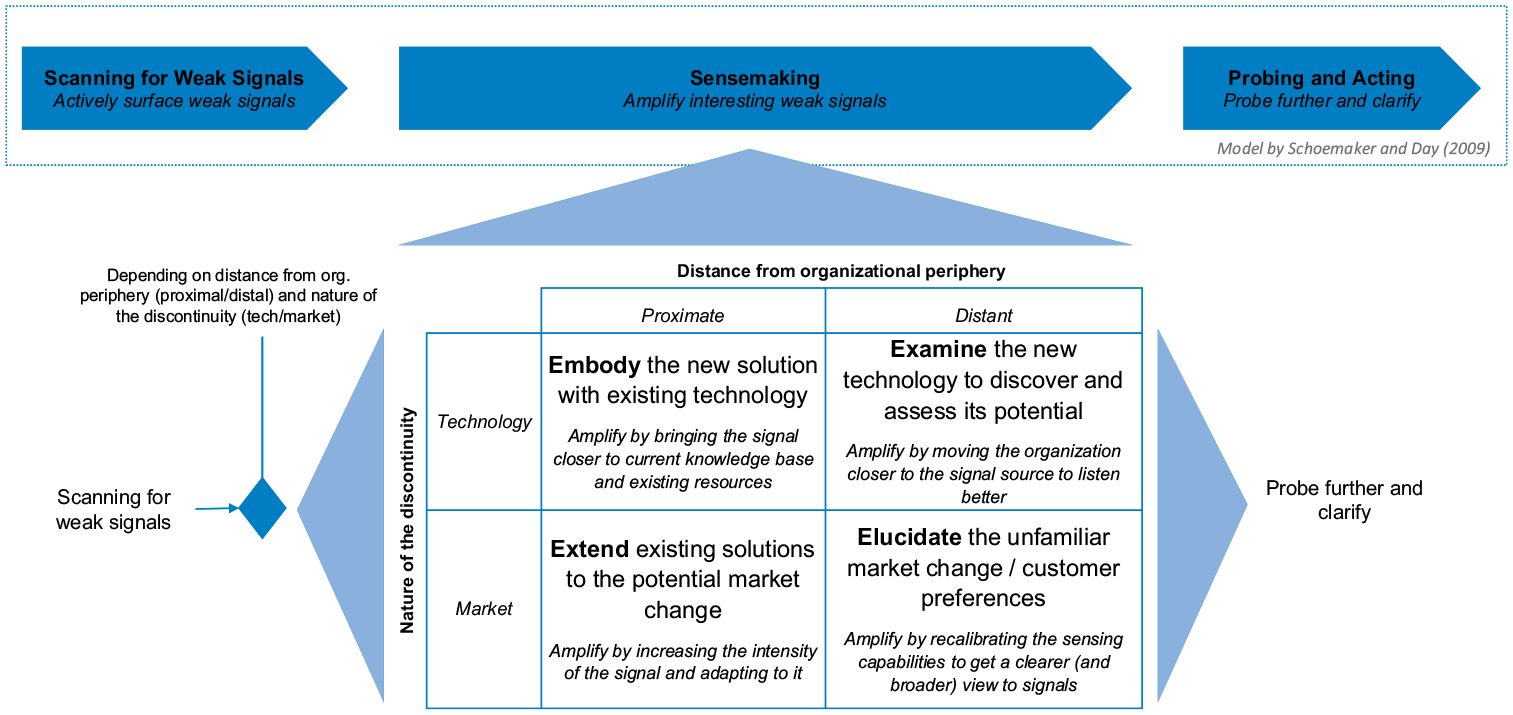
Sensemaking of weak signals.
Practical Implications
Despite good scanning techniques, many organizations fail to make sense of weak signals. This is due to the predominantly cognitive approaches to the amplification of weak signals, which are filled with biases. 60 Our findings align with the broader shift from cognitive-based techniques to action-based approaches, especially for weak signal amplification. Our four-fold action framework provides specific actions that organizations can take to amplify different types of weak signals. For example, weak signals emerging from proximate tech discontinuities can benefit from the embody actions; weak signals from distant tech discontinuities require examine actions. Weak signals emerging from proximate and distant market discontinuities need extend and elucidate types of actions respectively. These action-based approaches can heighten sensemaking of weak signals, increase awareness of changing environments, and improve the response. Heightened hyper-awareness of weak signals will enable the organization to develop better strategic agility.
Increasingly, organizations across the world are creating functions and roles to scan and make sense of weak signals. 61 Peripheral scanning, emerging business opportunities, and future planning groups have been created to supplement senior management to create agile organizations and adaptive strategies. 62 Our 4E amplification framework provides a toolkit for such weak signal management roles and functions. Strategy managers now can go beyond cognitive tools to design and test PoC projects differently for differing weak signals. Creating a portfolio of PoC projects can also enable strategists within the organization to ensure that there is more balance in the future exploratory project portfolio. 63 This will ensure that strategists have broader inputs to their strategy making process. Chief executives and heads of organizational units receive weak signals from both inside and outside their organizational boundaries. 64 It is difficult to make sense of these disparate signals. Our framework brings order to this wide-ranging group of signals and helps make sense of such disparate signals.
Our action-based portfolio of actions approach is also equally useful for CA managers. CA managers presently build their portfolios of new ventures around innovation (product/process) or the nature of technologies (hardware/software, incremental/radical). 65 Our 4E framework (see Figure 2) can now help CA managers to build their portfolios around weak signal types. This will enable CA units to better orchestrate the scouting phase (scanning for weak signals) as well as the PoC phase (amplification) depending on the needs of the larger organization. 66 Our 4E framework also gives CA managers and organizational unit managers guiding principles on how to engage with startups.
Conclusion
Organizations are increasingly scanning their environments for weak signals to avoid strategic surprises. Despite sophisticated scanning techniques, organizations struggle to make sense of these weak signals. The primary challenge in the sensemaking of weak signals is limited amplification strategies. Most existing amplification strategies are cognitive and inherently weighed down by biases. To overcome this challenge, we offer an action-oriented framework to amplify weak signals. Organizations need to employ different amplification actions depending on the nature of the weak signal. This will improve the organizational ability to make better sense of the weak signals. Putting the 4E framework to use will increase the organization’s hyper-awareness of discontinuities emerging in the environment, thereby improving the organization’s strategic agility by managing disruptive threats.
Footnotes
Notes
Author Biographies
Raj Krishnan Shankar is an Associate Professor of strategy and entrepreneurship at Great Lakes Institute of Management, Chennai, India (email:
Denis Bettenmann is a PhD Candidate at the Institute of Entrepreneurship and Innovation Science (ENI) at University of Stuttgart, Germany (email:
Ferran Giones is the Deputy Head at the Institute of Entrepreneurship and Innovation Science (ENI) at University of Stuttgart, Germany (email: